
Mostly Monday Reads: The Very Model of a Modern First Lady
Posted: November 20, 2023 Filed under: just because | Tags: #Blabbermouth Trump, Argentina, Massive Carbon Big Foot, Polluter elite, Roselynn Carter, Trump Gag Order, Voting Rights Act 5 Comments
Place: Atlanta Ga., U.S.A. Date: 1993 Credit: The Carter Center
Good Day, Sky Dancers!
Before I start kvetching about Appeals Courts today, I’d like to join the country in its appreciation of Former First Lady Rosalynn Carter, who passed this weekend at 96. Former President Jimmy Carter got the very first vote I cast in a Presidential election. I was at University and remember those turbulent times well. The Israel-Palestine conflict was as ghastly then as it is now. Iran introduced itself by capturing U.S. hostages from our Embassy there. Inflation was roaring. Rosalynn Carter was the face of humanitarian efforts during that one term. She was also active in trying to get the ERA passed and brought a new perspective to the treatment of people with mental illness and the elderly. The Carters’ work with Habitat for Humanity is the stuff of legends. She was both a social justice warrior and a humanitarian.
This is the tribute given to her by NBC News’ Daniel Arkin.
Rosalynn Carter, the former first lady and humanitarian who championed mental health care, provided constant political counsel to her husband, former President Jimmy Carter, and modeled graceful longevity for the nation, died Sunday at her home in Plains, Georgia, according to the Carter Center.
Carter was 96. She had entered hospice care inher home on Friday.
In a statement, former President Carter said: “Rosalynn was my equal partner in everything I ever accomplished. She gave me wise guidance and encouragement when I needed it. As long as Rosalynn was in the world, I always knew somebody loved and supported me.”
Rosalynn Carter was widely regarded for her political shrewdness, drawing particular praise for her keen electoral instincts, down-to-earth appeal, and work on behalf of the White House, including serving as an envoy to Latin America.
She devoted herself to several social causes in the course of her public life, including programs that supported health care resources, human rights, social justice and the needs of elderly people.
“Twenty-five years ago, we did not dream that people might someday be able actually to recover from mental illnesses,” Carter said at a mental health symposium in 2003. “Today it is a very real possibility.”
“For one who has worked on mental health issues as long as I have,” she added, “this is a miraculous development and an answer to my prayers.”

Place: Afeta, Ethiopia
Date: Feb. 13, 2007
Credit: The Carter Center
Five first ladies have paid tribute to the extraordinary woman who was visibly a partner to her husband’s presidency. “Her life is a reminder that no matter who we are, our legacies are best measured not in awards or accolades, but in the lives we touch,” Michelle Obama wrote. Secretary Hillary Clinton and her husband, the former President, characterized Mrs. Carter as a “champion of human dignity.
The Washington Post‘s Karen Tumulty characterizes Mrs. Carter this way.
But Rosalynn Carter arrived at a time when women’s roles were changing at every level of society. And, according to Paul Costello, who was her assistant press secretary, the new first lady took to heart a bit of counsel from her own outspoken predecessor. “Betty Ford gave her wise advice: Do what you want to do because no matter what you do, you will be criticized,” Costello told me.
Still, the first lady was taken aback by the stir she created when, in the second year of the Carter presidency, she began showing up at Cabinet meetings and quietly taking notes.
“Jimmy and I had always worked side by side; it’s a tradition in southern families, and one that is not seen as in any way demeaning to the man,” she wrote in her autobiography. “I also think there was a not very subtle implication that Cabinet meetings were no place for a wife. I was supposed to take care of the house — period.”
It was not the only time she felt frustrated with the expectations that came with her role. Less than a month after the inauguration, she held her first solo news conference to announce the formation of a presidential commission on mental health — an issue that would become her biggest cause.
“The next morning when I picked up the Washington Post to read about it I found not one word about the commission or the press conference,” she recalled. This newspaper instead ran a story about how the Carters had established a policy against serving hard liquor at White House functions.
But the first lady continued to press against the constraints, and in breaking her own path, she would make it easier for those who followed — including Hillary Clinton.
Rosalynn Carter traveled abroad and met with heads of state to discuss matters of substance, not for photo opportunities, and made it clear she was speaking for the administration in her public appearances. “Dinner guests at the White House have seen her interrupt the President — not rudely but unhesitatingly — usually to explain something more clearly than he had been doing,” the New York Times columnist Tom Wicker wrote in 1979.
Two crucial cases are coming from two very different Federal Appeals Courts today. The first one is on Voting Rights and came out of the 8th District. It’s basically forcing the outcome that Republicans have championed for some time and will likely find an accessible Advocate in the Supreme Court in its Chief Justice John Roberts. Hansi is the NPR reporter for this case. It’s terrible news. Most of the judges on the 8th circuit were appointed by Bush or Trump.

US First Lady Rosalynn Carter climbs the steps to her plane during a trip, Texas, September 1978. (Photo by Diana Walker/Getty Images)
Politico has this headline. “Federal court deals devastating blow to Voting Rights Act. The decision out of the 8th Circuit will almost certainly be appealed to the Supreme Court.” The analysis is written by Zach Montellaro.
A federal appeals court issued a ruling Monday that could gut the Voting Rights Act, saying only the federal government — not private citizens or civil rights groups — is allowed to sue under a crucial section of the landmark civil rights law.
The decision out of the 8th Circuit will almost certainly be appealed to the Supreme Court. But should it stand, it would mark a dramatic rollback of the enforcement of the law that led to increased minority representation in American politics.
The appellate court ruled that there is no “private right of action” for Section 2 of the law — which prohibits voting practices that discriminate on the basis of race
That, in practice, would severely limit the scope of protections in the act. For decades, private parties — including civil rights groups, individual voters and political parties — have brought Section 2 challenges on everything from redistricting to voter ID requirements.
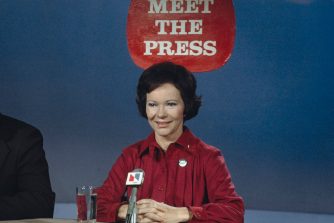
Rosalynn Carter, wife of presidential candidate Jimmy Carter, appears on the ‘Meet the Press’ television talk show, September 26th 1976. She is wearing a ‘Carter/Mondale’ campaign badge. (Photo by UPI/Bettmann Archive/Getty Images)
We’re also seeing action from the Appeals Court in the DC circuit on their”Hearing on Trump gag order in federal 2020 election subversion case.” This is breaking and updating news from CNN.
After 2 hours and 20 minutes of oral arguments, the three-judge panel of the DC Circuit Court of Appeals appears inclined to restore the limited gag order in former President Donald Trump’s federal election subversion case, but may loosen some restrictions so he can more directly criticize special counsel Jack Smith.
None of the judges embraced Trump’s claims that the gag order should be wiped away for good because it is a “categorically unprecedented” violation of his free speech rights.
Yet they also posed sharp questions to prosecutors as they tried to find the boundary of where intense campaign-trail rhetoric crosses the line of undermining a criminal case.
The limited gag order from district Judge Tanya Chutkan – which was temporarily frozen by the appeals panel when they agreed to hear the case — restricts Trump’s ability to directly attack Smith, members of his team, court staff or potential trial witnesses. He is allowed to criticize the Justice Department, proclaim his innocence, can say that the case is “politically motivated.”
The appellate judges, who are all Democratic appointees, heard the case on an expedited schedule and are expected to issue a ruling soon.

First Lady Rosalynn Carter on stage with Willie Nelson at the White House, 1978
Identifier
I believe that Jack Smith is more concerned about the attacks on his family than himself, but we shall see.
The Guardian discusses how recent data has shown that the Upper 1% of global wealth holders are responsible for destroying the World’s resources via carbon emissions. This study was done by Oxfam. “Richest 1% account for more carbon emissions than poorest 66%, report says. ‘Polluter elite’ are plundering the planet to point of destruction, says Oxfam after comprehensive study of climate inequality”
The most comprehensive study of global climate inequality ever undertaken shows that this elite group, made up of 77 million people including billionaires, millionaires and those paid more than US$140,000 (£112,500) a year, accounted for 16% of all CO2 emissions in 2019 – enough to cause more than a million excess deaths due to heat, according to the report.
For the past six months, the Guardian has worked with Oxfam, the Stockholm Environment Institute and other experts on an exclusive basis to produce a special investigation, The Great Carbon Divide. It explores the causes and consequences of carbon inequality and the disproportionate impact of super-rich individuals, who have been termed “the polluter elite”. Climate justice will be high on the agenda of this month’s UN Cop28 climate summit in the United Arab Emirates.
The Oxfam report shows that while the wealthiest 1% tend to live climate-insulated, air-conditioned lives, their emissions – 5.9bn tonnes of CO2 in 2019 – are responsible for immense suffering.
Using a “mortality cost” formula – used by the US Environmental Protection Agency, among others – of 226 excess deaths worldwide for every million tonnes of carbon, the report calculates that the emissions from the 1% alone would be enough to cause the heat-related deaths of 1.3 million people over the coming decades.
Over the period from 1990 to 2019, the accumulated emissions of the 1% were equivalent to wiping out last year’s harvests of EU corn, US wheat, Bangladeshi rice and Chinese soya beans.
The suffering falls disproportionately upon people living in poverty, marginalised ethnic communities, migrants and women and girls, who live and work outside or in homes vulnerable to extreme weather, according to the research. These groups are less likely to have savings, insurance or social protection, which leaves them more economically, as well as physically, at risk from floods, drought, heatwaves and forest fires. The UN says developing countries account for 91% of deaths related to extreme weather.
The report finds that it would take about 1,500 years for someone in the bottom 99% to produce as much carbon as the richest billionaires do in a year.

LAGRANGE, GA – JUNE 10: Former U.S. President Jimmy Carter and his wife Rosalyn attach siding to the front of a Habitat for Humanity home being built June 10, 2003 in LaGrange, Georgia. More than 90 homes are being built in LaGrange; Valdosta, Georgia; and Anniston, Alabama by volunteers as part of Habitat for Humanity International’s Jimmy Carter Work Project 2003. (Photo by Erik S. Lesser/Getty Images)
An Italian Economics professor has an Op-Ed up in today’s New York Times. “What Happens When the Super Rich Are This Selfish? (It Isn’t Pretty.)
Throughout much of the Western world’s history, the wealthiest have been viewed in their communities as a potentially unfavorable presence, and they have attempted to allay this sentiment by using their riches to support their societies in times of crises like plagues, famines or wars.
This symbiotic relationship no longer exists. Today’s rich, their wealth largely preserved through the Great Recession and the Covid-19 pandemic, have opposed reforms aimed at tapping their resources to fund mitigation policies of all kinds.
This is a historically exceptional development. Helping foot the bill of major crises has long been the main social function attributed to the rich by Western culture. In the past, when the wealthiest have been perceived to be insensitive to the plight of the masses, and especially when they have appeared to be profiteering from such plights (or have simply been suspected of doing so), society has become unstable, leading to riots, open revolts and anti-rich violence. As history has the unpleasant feature of repeating itself, we would do well to consider recent developments, including legislators’ inability to increase taxes on the rich, from a long-term perspective.
Let us begin with the consideration that the presence of very rich, or even superrich, individuals has always been somewhat troubling for Western societies. Medieval theologians regarded the rich as sinners and thought that the building of large fortunes should have been discouraged. At the very least, the rich were expected not to appear to be wealthy and to provide generous bequests to charitable institutions to the benefit of their souls.
But with time, as new economic opportunities in trade and in finance led to the accumulation of fortunes of unprecedented size, the increased presence of extremely wealthy individuals within the community could no longer be dismissed as an anomaly. From the 15th century, and beginning with the most economically developed areas of Europe such as central-northern Italy, the rich were assigned a specific social role: to act as private reserves of money into which the community could tap in times of dire need.
Nobody made this point better than the Tuscan humanist Poggio Bracciolini. In his treatise “De avaritia” (“On avarice”), completed in 1428, he argued that cities that follow the tradition of instituting public granaries to build up food reserves should also be well provided of “many greedy individuals, in order … to constitute a kind of private barn of money able to be of assistance to everybody.”

US First Lady Rosalynn Carter plays basketball with members of the Harlem Globetrotters outside the White House, Washington DC, March 1980. They are teaching her how to spin a basketball on her fingertip. (Photo by Diana Walker/Getty Images)
As with all good economics treatises, this one brings home the numbers, story, and background. Private jet travel is one of the biggest culprits.
Argentina’s hard-fought progress toward democracy is about to be threatened by a right-wing libertarian populist President who was just congratulated by Orange Caligula. “The lion, the wig and the warrior. Who is Javier Milei, Argentina’s president-elect?” This is from the AP.
His legions of fans call him “the madman” and “the wig” due to his ferocity and unruly mop of hair. He refers to himself as “the lion.” He thinks sex education is a Marxist plot to destroy the family, views his cloned mastiffs as his “children with four paws” and has suggested people should be allowed to sell their own vital organs.
He is Javier Milei, Argentina’s next president.
A few years ago, Milei was a television talking head whom bookers loved because his screeds against government spending and the ruling political class boosted ratings. At the time, and up until mere months ago, hardly any political expert believed he had a real shot at becoming president of South America’s second-largest economy.
But Milei, a 53-year-old economist, has rocked Argentina’s political establishment and inserted himself into what has long been effectively a two-party system by amassing a groundswell of support with his prescriptions of drastic measures to rein in soaring inflation and by pledging to crusade against the creep of socialism in society.
This analysis is from the Washington Post. “Argentina set for sharp right turn as Trump-like radical wins presidency.” Argentina is now off the list for where in the Western Hemisphere one might go to escape a second Trump Presidency.
A radical libertarian and admirer of Donald Trump rode a wave of voter rage to win Argentina’s presidency on Sunday, crushing the political establishment and bringing the sharpest turn to the right in four decades of democracy in the country.
Javier Milei, a 53-year-old far-right economist and former television pundit with no governing experience, claimed nearly 56 percent of the vote in a stunning upset over Sergio Massa, the center-left economy minister who has struggled to resolve the country’s worst economic crisis in two decades. Even before the official results had been announced Sunday night, Massa acknowledged defeat and congratulated Milei on his win.
Trump also congratulated Milei. “I am very proud of you,” Trump wrote on his Truth Social platform. “You will turn your Country around and Make Argentina Great Again!”
Voters in this nation of 46 million demanded a drastic change from a government that has sent the peso tumbling, inflation skyrocketing and more than 40 percent of the population into poverty. With Milei, Argentina takes a leap into the unknown — with a leader promising to shatter the entire system.
In his first speech as president-elect, Milei told Argentines that “the model of decadence has reached its end. There is no turning back.”
“Enough of the impoverishing power of the caste,” he said. “Today we once again embrace the model of liberty, to once again become a world power.” His supporters joined him in shouting: “Long live freedom, damn it!”
Milei will take office on Dec. 10, the 40th anniversary of Argentina’s return to democracy after the fall of its military dictatorship.
Wielding chain saws on the campaign trail, the wild-haired Milei vowed to slash public spending in a country heavily dependent on government subsidies. He pledged to dollarize the economy, shut down the central bank and cut the number of government ministries from 18 to eight. His rallying campaign cry was a takedown of the country’s political “caste” — an Argentine version of Trump’s “drain the swamp.”
Why are so many people becoming dictator-curious and looking to the likes of Hitler and Mussolini again? Plus, these folks are raping the planet. It’s discouraging. I hope we can find a new model for Thanksgiving this year where we can celebrate with others and be thankful for what we have. I also hope it isn’t based on stealing your host’s land, committing genocide, and destroying their cultural practices.
Have a good Turkey Day! And it’s time we pass the John Lewis Voting Rights Act!
What’s on your reading and blogging list today?
Thursday Reads: Goodbye Google Reader, Pope Francis and the Dirty War, and Other News
Posted: March 14, 2013 Filed under: morning reads | Tags: Ancient Burials, Argentina, dead pigs, Dirty War, Google Reader, James Holmes, Pope Francis, Shanghai River, Steubenville Rape Trial, truth serum 37 Comments
Good Morning!!
For the mainstream media, the big news yesterday was the election of a new pope. I’ll get to that shortly, but first I’ll address the even bigger news for bloggers–the imminent demise of Google Reader. Google announced last night that it will be shutting down the popular application on July 1.
From The Atlantic Wire: Like a Dagger to Bloggers’ Hearts, Google Just Killed Google Reader.
Journalists and geeks united in exasperation on Wednesday evening when Google made a very sad announcement: The company is shuttering Google Reader. We should’ve seen this coming. And those that didn’t see the inevitable death of Google’s RSS feed organizer and reader might’ve easily missed the news, since Google buried it halfway down an official blog post about a bunch of other stuff. But it is true. The search giant will pronounce Reader dead on July 1, 2013. Based on the somewhat storied history of Google killing Reader features, though, we’re pretty sure someone will start working on an alternative within the next few hours.
Apparently most computer geeks weren’t surprised, because Google stopped updating and servicing the reader back in 2011, even when they could have done so using cloud computing. But plenty of people were freaking out. Immediately after the announcement, twitter went nuts and the pope jokes faded into the background. Here’s Tom Watson at Forbes: Google’s Strange Attack on Bloggers and the Public Internet: the Massive Reaction to Reader Shutdown.
Does Google understand the concept of corporate social responsibility? That seems to be the basic question around the company’s strange decision to shut down a tiny service that serves as a major audience conduit for many thousands of bloggers, citizen journalists, and self publishers.
Google’s announcement today that it is destroying Google Reader, the most popular RSS syndication tool was a massive blow to the blogging community – and to most of those speaking out tonight via social media, an entirely unnecessary attack on an important corner of the public Internet by a company with more than $50 billion in revenue and a newly-won reputation as a tech giant on the move.
“That giant “NOOOOOOOO” sound is the Internet’s reaction to Google’s most unpopular decision in — well, as far back as I can remember,” wrote Pete Cashmore at Mashable, in a post emblematic of the flood of negative reaction to Google’s strange decision.
The thing is, Google is the giant gorilla of the internet–so it can do whatever it wants and everyone else has to just deal with it. Here are some articles with suggestions of how to do that, but be aware that things could change quickly. I downloaded Feed Demon last night, and then learned that it is now going to go out of business when Google reader shuts down.
Lifehacker: Google Reader Is Shutting Down; Here Are the Best Alternatives
Ars Techinica: Poll Technica: Where should we go when Google Reader is put out to pasture?
Forbes: Google Reader and the Underpants Gnomes
ComputerWorld: Google Reader alternatives roundup; RSS FTW!
Now, on to pope news.
I found some articles last night that address the biography of Pope Francis a hell of a lot more realistically that the corporate media did yesterday. The best is probably this one by investigative reporter Robert Parry: ‘Dirty War’ Questions for Pope Francis.
If one wonders if the U.S. press corps has learned anything in the decade since the Iraq War – i.e. the need to ask tough question and show honest skepticism – it would appear from the early coverage of the election of Pope Francis I that U.S. journalists haven’t changed at all, even at “liberal” outlets like MSNBC.
The first question that a real reporter should ask about an Argentine cleric who lived through the years of grotesque repression, known as the “dirty war,” is what did this person do, did he stand up to the murderers and torturers or did he go with the flow. If the likes of Chris Matthews and other commentators on MSNBC had done a simple Google search, they would have found out enough about Cardinal Jorge Bergoglio to slow their bubbling enthusiasm.
Bergoglio, now the new Pope Francis I, has been identified publicly as an ally of Argentine’s repressive leaders during the “dirty war” when some 30,000 people were “disappeared” or killed, many stripped naked, chained together, flown out over the River Plate or the Atlantic Ocean and pushed sausage-like out of planes to drown.
The “disappeared” included women who were pregnant at the time of their arrest. In some bizarre nod to Catholic theology, they were kept alive only long enough to give birth before they were murdered and their babies were farmed out to military families, including to people directly involved in the murder of the babies’ mothers.
Instead of happy talk about how Bergoglio seems so humble and how he seems so sympathetic to the poor, there might have been a question or two about what he did to stop the brutal repression of poor people and activists who represented the interests of the poor, including “liberation theology” priests and nuns, during the “dirty war.”

More at the link. Some other sources of information on Bergoglio:
Alternet: Cardinals Elect a New Pope from Argentina — Does the New Pontiff Come with a Dark Past?
2005 story in LA Times: Argentine Cardinal Named in Kidnap Lawsuit
Via Greg Mitchell, a 2011 article from The Guardian: The sins of the Argentinian church
A final note–I’ve heard that the name chosen by the new pope may not be a tribute the St. Francis. More likely after St. Francis Xavier, co-founder of the Jesuits.
In other news…
Yesterday was the first day of the Steubenville rape trial. The Atlantic Wire is following the story closely, so it is probably the best source for updates. From yesterday:
Enter the Trial in Steubenville, Where the Cast Is Not Merely Football Players
The case of two high-school star football players accused of raping a 16-year-old girl as they travelled party to party last summer finally heads to trial on Wednesday morning in Steubenville, Ohio, the small fading steel town that became the focus of a social-media firestorm in big-time football country this winter. As the spotlight returns with open media access around but not inside Jefferson Country juvenile court, America will start putting faces to names that have been dragged through the headlines as violently as that Jane Doe from West Virginia allegedly was, while heavily intoxicated, on August 11. But a lot has happened since the hackers and leakers and protesters descended upon the town of 18,000 with a tortured past, beyond the shooting threats and the revoked scholarships and the FBI investigation — indeed, there were even developments late Tuesday night: The country may have looked elsewhere, but there’s a new judge after ties to Big Red football forced yet another legal player to recuse himself, and the hackers have now returned to the social-media pile-on as investigations into police cover-ups have given way to actual prosecution in the courtroom, where the alleged victim might testify after all, her friends can now testify against her, and the suspects are already speaking out.
The article then offers “a who’s who” of everyone involved in the crime and the trial. A couple more links:
The Steubenville Defense Will Center on Date Rape Not Existing
America Finally Hears the Case for the Victim on First Day of Steubenville Trial
On the trial of James Holmes in Aurora, Colorado, Time Magazine had a shocking report yesterday: Judge in Aurora Case Calls for Use of ‘Truth Serum’— But Does It Work?
If accused Aurora mass shooter James Holmes wants to enter a plea of insanity in the “Batman” movie theater massacre, he will have to agree to narcoanalysis.
That’s the ruling from judge William Sylvester, who made the narcoanalysis— in which defendants are injected with drugs to lower their inhibitions and presumably be more willing to tell the truth about their alleged crimes under questioning by prosecutors — a condition of an insanity plea.
WTF?! There’s no way forcing a defendant to take truth serum could be constitutional.
Experts were surprised by the legal determination that “truth serum” could be required in order for Holmes to use the insanity defense. They say that drugs touted for “narcoanalysis,” which typically include the barbiturates sodium amytal and sodium pentothal, are are not effective and certainly not reliable enough to meet legal standards of evidence.
“I was floored by it,” says Scott Lilienfeld, professor of psychology at Emory University upon learning of the ruling, “The claim that truth serum is truth serum is no longer taken seriously by anyone in the scientific community to my knowledge.” Moreover, Colorado is one of the states that apply the “Daubert” standard, in which scientific evidence can be disputed by the defense or prosecution. It requires that evidence meet certain standards to be admissible.
To pass the Daubert test, truth serum would have to be widely accepted in the scientific community and research literature and its use would have to yield a known error rate, both standards that experts say narcoanalysis does not meet. “In my view, it would not stand up,” says Lilienfeld.
But a former prosecutor, now a law professor at the University of Colorado and defense attorney, Karen Steinhauser, told CBS News that the technique is allowed under Colorado law. However, it is used so rarely she could not find any relevant case law.
Unbelievable!

The mystery of the thousands of dead pigs floating in China’s Shanghai River has been solved. Bloomberg: Shanghai Finds 6,600 Dead Pigs as Farm Confesses to Dumping
The number of dead pigs found in Shanghai’s Huangpu river climbed to at least 6,600 as the official Xinhua News Agency reported a farm in neighboring Zhejiang province confessed to dumping carcasses in the water.
The municipal government pulled 685 hogs from the river yesterday, adding to the 5,916 it had retrieved earlier, according to a statement on its website. A farm in Jiaxing admitted to discarding dead pigs in the river, after 70,000 of the animals died in the city from crude raising techniques and extreme weather at the start of the year, Xinhua said yesterday, citing the Jiaxing authorities. The Xinhua report didn’t specify whether other farms were involved in the dumping.
The discovery of the hogs comes as China’s legislature addresses food safety and citizens become more vocal on public health and environmental issues. The government said March 10 at a National People’s Congress meeting that it plans to create a regulator with broader authority to ensure food and drug safety and said the agriculture ministry will oversee the quality of farm products.
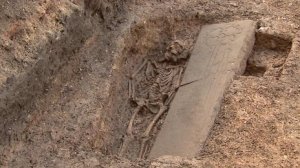
Finally, Beata posted this ancient burial news link this morning in the late night thread, and I thought I’d include it here to make sure that Dakinikat and JJ see it: ‘Medieval knight’ unearthed in Edinburgh car park dig
The remains of a medieval knight or nobleman found underneath a car park are to be moved to make way for a university building.
The grave and evidence of a 13th Century monastery were uncovered when archaeologists were called to an Edinburgh Old Town building site.
An elaborate sandstone slab, with carvings of a Calvary Cross and ornate sword, marked the grave.
It’s amazing what’s buried under parking lots in Great Britain!
Hey–I managed to avoid news about the economy and Village politics, and I wasn’t even trying! Now it’s your turn. What are you reading and blogging about this morning?

 peej
peej Carissa
 bostonboomer
 dakinikat
 ecocatwoman
 mablue2
 Mama Lopez
 peggysue22
 quixote
 skydancingguestblogger
 Mona (aka Wonk the Vote)



 Sky Dancing
Recent Comments