
Tuesday Reads: FBI’s Failed Amerithrax Investigation
Posted: October 11, 2011 Filed under: Crime, morning reads, U.S. Politics | Tags: Amerithrax investigation, anthrax attacks of 2001, anthrax spores, Bruce Ivins, Emptywheel, FBI, Frank Olson, Jim White, Kappa Kappa Gamma, McClatchy new bureau, MKULTRA, Steven Hatfill 26 Comments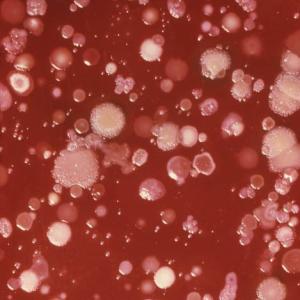
Anthrax spores surrounding a red blood cell
Good Morning!!
For today’s morning reads, I’m going to focus on an important story that has long fascinated me: the anthrax attacks of 2001 and the FBI’s investigation of the case, which they dubbed “Amerithrax.” Did the FBI fail to really follow through on the investigation because of incompetence? Or is the government hiding something?
I’m sure you recall that just a week after the September 11 attacks, envelopes containing anthrax spores were mailed to several media offices and to Democratic Senators Tom Daschle and Patrick Leahy. Five people died from anthrax poisoning and seventeen others were infected, but survived. The UCLA School of Public health provides a list of anthrax attacks outbreaks in the U.S., including those related to the 2001 anthrax letters.

Steven Hatfill
The Bush administration tried to suggest that Iraq was somehow behind the attacks, but that hypothesis fell through when the chemical signature of the anthrax from the envelopes was shown to have come from a U.S. lab. The FBI then focused on Dr. Steven Hatfill, bio-weapons expert and virologist. When the FBI named Hatfill as a “person of interest,” the media went into a feeding frenzy, completely destroying this man’s career and reputation. In the end the government had to pay him a $5.8 million settlement.
In 2005, after the case against Hatfill fell apart, the agency found a new scapegoat in Bruce Ivins, an emotionally troubled bio-defense scientist at Ft. Detrick in Maryland. Ft. Detrick is notorious for its connection with the MKULTRA project and the mysterious suicide of distinguished researcher Frank Olson, who had been (probably) unknowingly dosed with LSD a couple of days earlier. But I digress. From the LA Times:
By the mid-1970s, Bruce Ivins had earned his doctorate and was a promising researcher at the University of North Carolina. By outward appearances, he was a charming eccentric, odd but disarming. Inside, he still smoldered with resentment, and he saw a new outlet for it.
Several years earlier, a Cincinnati student had turned him down for a date. He had projected his anger onto the young woman’s sorority, Kappa Kappa Gamma. There was a Kappa house in Chapel Hill, N.C., and Ivins cased the building. One night when it was empty, he slipped in through a bathroom window and roamed the darkened floors with a penlight.
Upstairs, he found something that fascinated him: a glass-enclosed sheaf of documents, called a cipher, necessary for decoding the sorority’s secrets. The cipher would help him wage a personal war against Kappa Kappa Gamma into the sixth decade of his life.
This was the side of himself that Ivins kept carefully hidden. He devised sneaky ways to strike anonymously at people or institutions he imagined had offended him. He harbored murderous fantasies about women who did not reciprocate his overtures. He bought bomb-making ingredients and kept firearms, ammunition and body armor in his basement.
Yet Ivins managed to work his way into the heart of the American biodefense establishment, becoming a respected Army scientist and an authority on the laboratory use of anthrax.

In fact, Ivins obsession with Kappa Kappa Gamma was the main connection the FBI had between Ivins and the anthrax letters–they were mailed from a box in Princeton, New Jersey that wasn’t far from a business office rented by the sorority. Jim White at Emptywheel writes:
One former object of Ivins’ attentions, researcher Nancy Haigwood, is relied upon almost exclusively for making the leap from Ivins’ obsession with the sorority to his role in the anthrax attacks….Haigwood began to suspect Ivins in the attacks because of an email he sent to her and others in November, 2001 highlighting his work with the anthrax isolated from the attacks. In one a photo in the email, he is handling culture plates without gloves, a break of containment protocol for working with such dangerous material. Haigwood felt that by sending out this photo, Ivins was emphasizing his immunity to anthrax because he had been vaccinated.
Haigwood later suggested Ivins to the FBI as a suspect, and the agency used pretzel logic to build a connection between Ivins’ Kappa fixation and the mailbox used in the anthrax attacks. But White explains that
this shaky claim already has been thoroughly destroyed. In this post from August, 2008,
Marcy [Emptywheel] showed that Ivins’ work records–from data released by the FBI–indicate that it would not have been possible for him to make the round trip to Princeton and put the letters in the mailbox with them getting the appropriate postmark[.]
Ivins committed suicide in 2008 by taking an overdose of Tylenol–after years of being followed and spied upon by the FBI and named as “an extremely sensitive suspect in the 2001 anthrax attacks.” After Ivins’ death, the FBI quickly closed the case and blamed the attacks on this man who could no longer defend himself and argued that no one else had been involved.
Yesterday morning, The New York Times published an article on the findings of a group of scientists who analyzed the FBI’s investigation and found it wanting. The results of their work will be published in the Journal of Bioterrorism & Biodefense.
[T]hree scientists argue that distinctive chemicals found in the dried anthrax spores — including the unexpected presence of tin — point to a high degree of manufacturing skill, contrary to federal reassurances that the attack germs were unsophisticated….
F.B.I. documents reviewed by The New York Times show that bureau scientists focused on tin early in their eight-year investigation, calling it an “element of interest” and a potentially critical clue to the criminal case. They later dropped their lengthy inquiry, never mentioned tin publicly and never offered any detailed account of how they thought the powder had been made.
The new paper raises the prospect — for the first time in a serious scientific forum — that the Army biodefense expert identified by the F.B.I. as the perpetrator, Bruce E. Ivins, had help in obtaining his germ weapons or conceivably was innocent of the crime.
The Times goes on to try to discredit the scientific analysis, but I just don’t buy it. Here is their summary of what the study authors had to say.
The tin is surprising because it kills micro-organisms and is used in antibacterial products. The authors of the paper say its presence in the mailed anthrax suggests that the germs, after cultivation and drying, got a specialized silicon coating, with tin as a chemical catalyst. Such coatings, known in industry as microencapsulants, are common in the manufacture of drugs and other products.
“It indicates a very special processing, and expertise,” said Martin E. Hugh-Jones, lead author of the paper and a world authority on anthrax at Louisiana State University. The deadly germs sent through the mail to news organizations and two United States senators, he added, were “far more sophisticated than needed.”
In addition to Dr. Hugh-Jones, the authors of the new paper are Barbara Hatch Rosenberg, a biologist, and Stuart Jacobsen, a chemist; both have speculated publicly about the case and criticized the F.B.I. for years.
But these scientist are not the only people who have questioned the FBI’s investigation. McClatchy published an article in May on their analysis of the FBI lab reports:
Buried in FBI laboratory reports about the anthrax mail attacks that killed five people in 2001 is data suggesting that a chemical may have been added to try to heighten the powder’s potency, a move that some experts say exceeded the expertise of the presumed killer.
The lab data, contained in more than 9,000 pages of files that emerged a year after the Justice Department closed its inquiry and condemned the late Army microbiologist Bruce Ivins as the perpetrator, shows unusual levels of silicon and tin in anthrax powder from two of the five letters.
Those elements are found in compounds that could be used to weaponize the anthrax, enabling the lethal spores to float easily so they could be readily inhaled by the intended victims, scientists say.
The existence of the silicon-tin chemical signature offered investigators the possibility of tracing purchases of the more than 100 such chemical products available before the attacks, which might have produced hard evidence against Ivins or led the agency to the real culprit.
But the FBI lab reports released in late February give no hint that bureau agents tried to find the buyers of additives such as tin-catalyzed silicone polymers.
I guess it was just more convenient to blame “crazy Bruce” instead of continuing to pursue the evidence wherever it might lead.
In a book released last month, Jeanne Guilleman “a medical anthropologist, a Professor of Sociology at Boston College and a senior fellow in the Security Studies Program at Massachusetts Institute of Technology,”is also highly critical of the FBI investigation.
Tonight at 9PM Eastern, the season premiere of PBS’s Frontline will “take a hard look” at the FBI’s investigation of Amerithrax. I plan to watch, and I hope you will too.
I think it may be time for an independent investigation of this crime. The FBI has already had ten years to solve it, but they’ve mainly managed to destroy the lives and careers of two men and cause untold pain to their families and friends.
Now what are you reading and blogging about this morning?

 peej
peej Carissa
 bostonboomer
 dakinikat
 ecocatwoman
 mablue2
 Mama Lopez
 peggysue22
 quixote
 skydancingguestblogger
 Mona (aka Wonk the Vote)



 Sky Dancing
Recent Comments