The news is mostly awful today. If you think too much about what is happening, you’ll sink into depression and despair. I heard a woman on TV (I can’t remember her name, unfortunately) argue that Trump wants to return to the world of his childhood–the 1950s. But there is simply no way to do that. We are no longer an industrial society and we aren’t going to return to being one. We are no longer a segregated society either. Trump can’t rid public life of Black people, women, and immigrants. It’s not going to happen. But he is going to keep trying, because he is certifiably insane. The Republicans could stop him but they won’t, because they are terrified and they are cowards.
I’m going to begin with one bit of good news. Today, Americans with gather to fight back against Trump and Musk and their efforts to destroy our government and turn most of us into serfs.
Opponents of President Donald Trump and billionaire Elon Musk plan to rally across the U.S. on Saturday to protest the administration’s actions on government downsizing, the economy, human rights and other issues.
More than 1,200 “Hands Off!” demonstrations have been planned by more than 150 groups, including civil rights organizations, labor unions, LBGTQ+ advocates, veterans and elections activists. The protests are planned for the National Mall in Washington, D.C., state capitols and other locations in all 50 states.
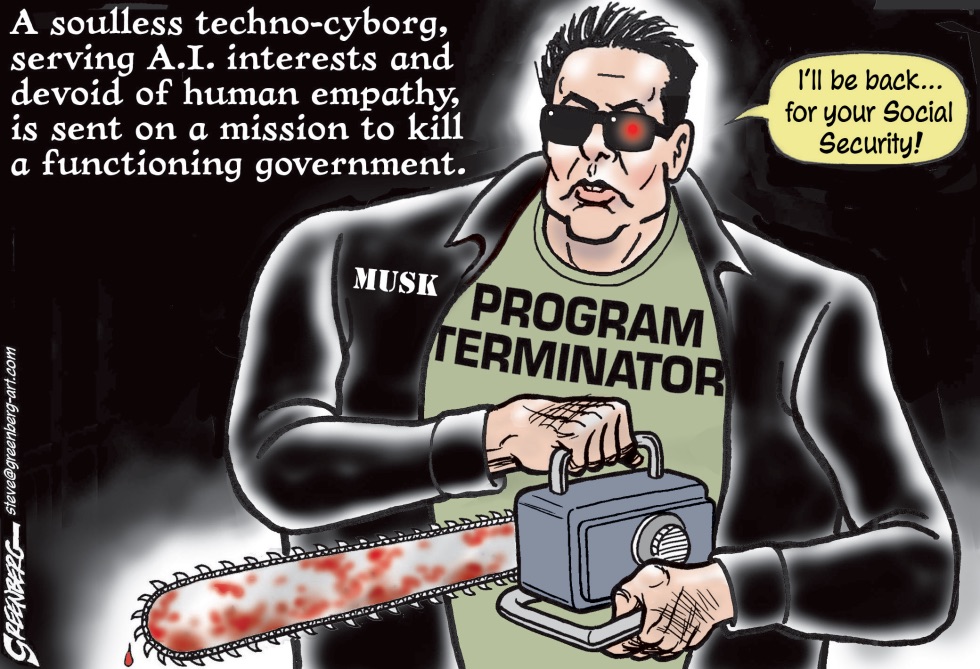
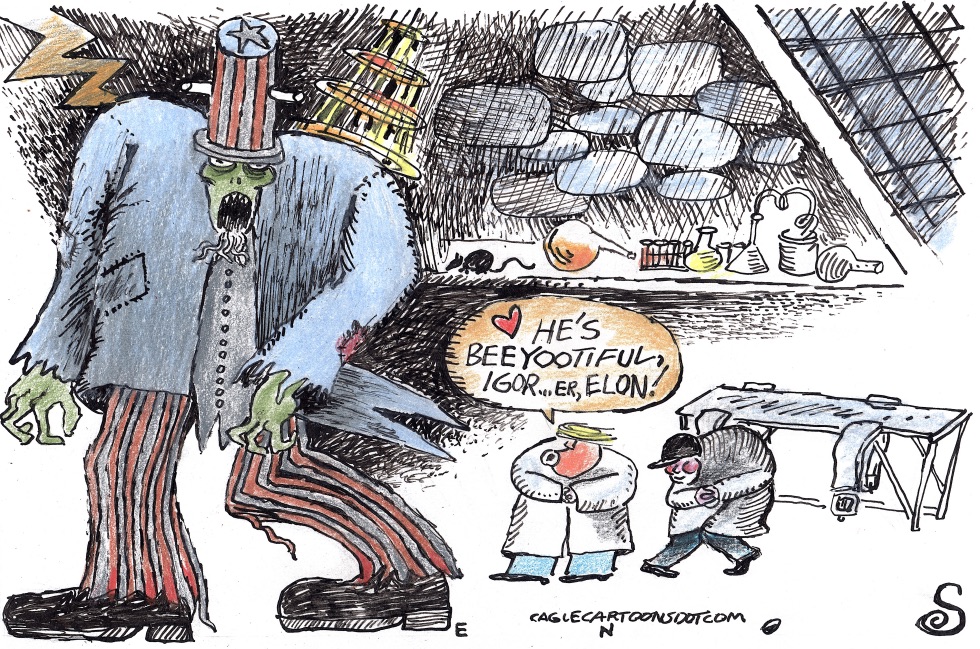
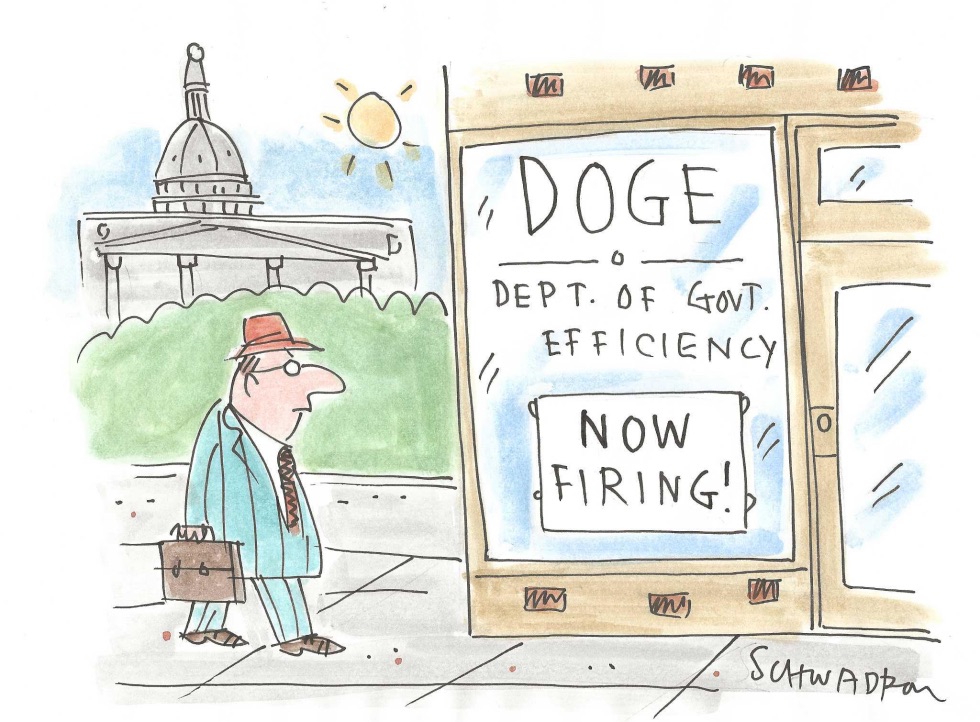
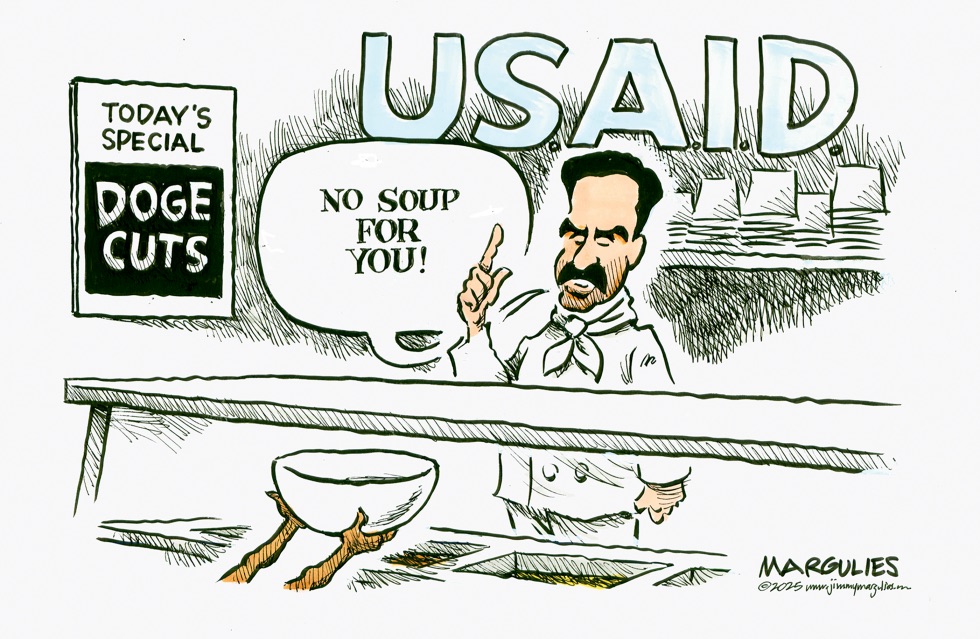
Musk, a Trump adviser who owns Tesla, SpaceX and the social media platform X, has played a key role in government downsizing as the head of the newly created Department of Government Efficiency. He says he is saving taxpayers billions of dollars.
Asked about the protests, the White House said in a statement that “President Trump’s position is clear: he will always protect Social Security, Medicare, and Medicaid for eligible beneficiaries. Meanwhile, the Democrats’ stance is giving Social Security, Medicaid, and Medicare benefits to illegal aliens, which will bankrupt these programs and crush American seniors.”
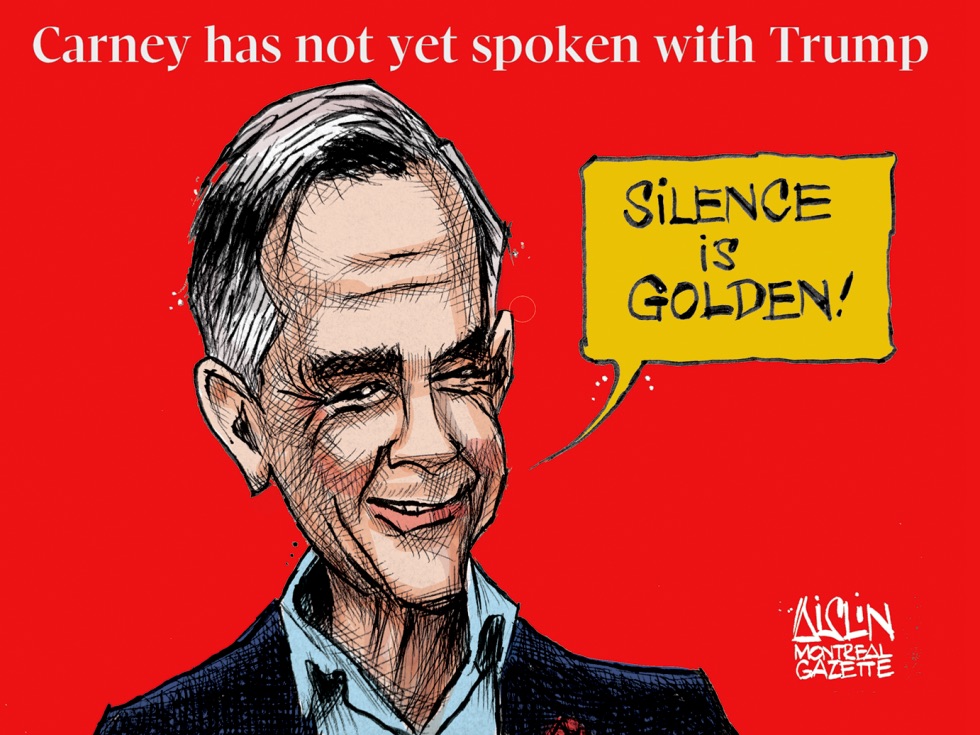
Fittingly, it was the Canadian prime minister, Mark Carney, who declared the official time of death.
“The global economy is fundamentally different today than it was yesterday. The system of global trade anchored on the United States, that Canada has relied on since the end of the Second World War—a system that, while not perfect, has helped to deliver prosperity for our country for decades—is over.
Our old relationship of steadily deepening integration with the United States is over.
The eighty-year period when the United States embraced the mantle of global economic leadership—when it forged alliances rooted in trust and mutual respect, and championed the free and open exchange of good and services—is over.
While this is a tragedy, it is also the new reality.”
By Stephanie Lambourne
And just like that, the age of American empire, the great Pax Americana, ended.
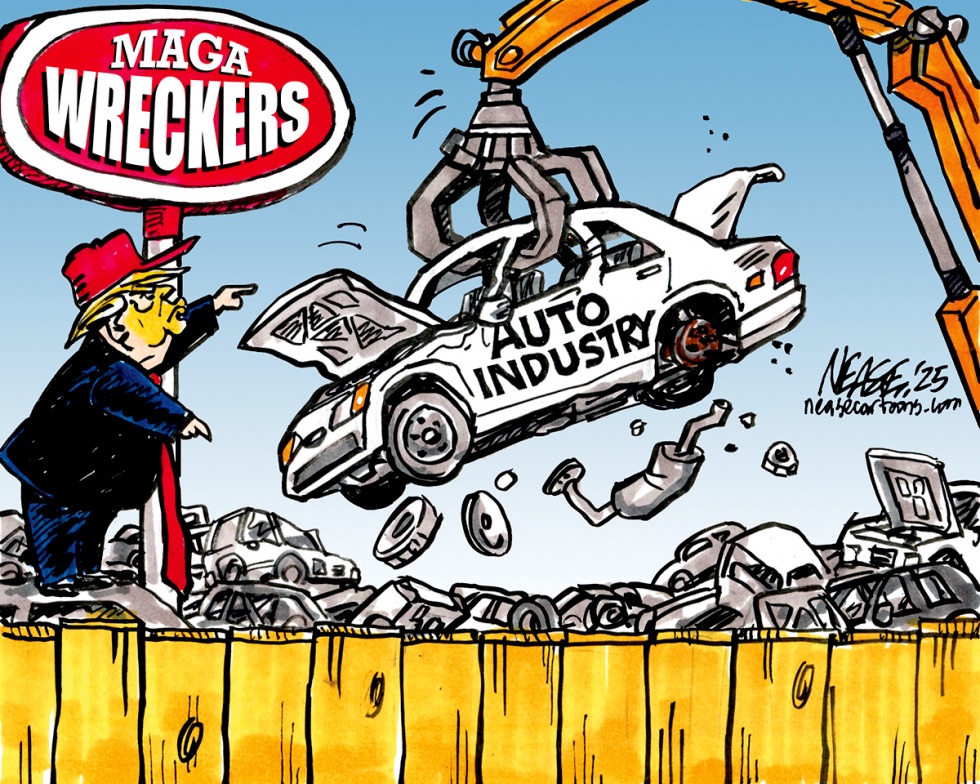
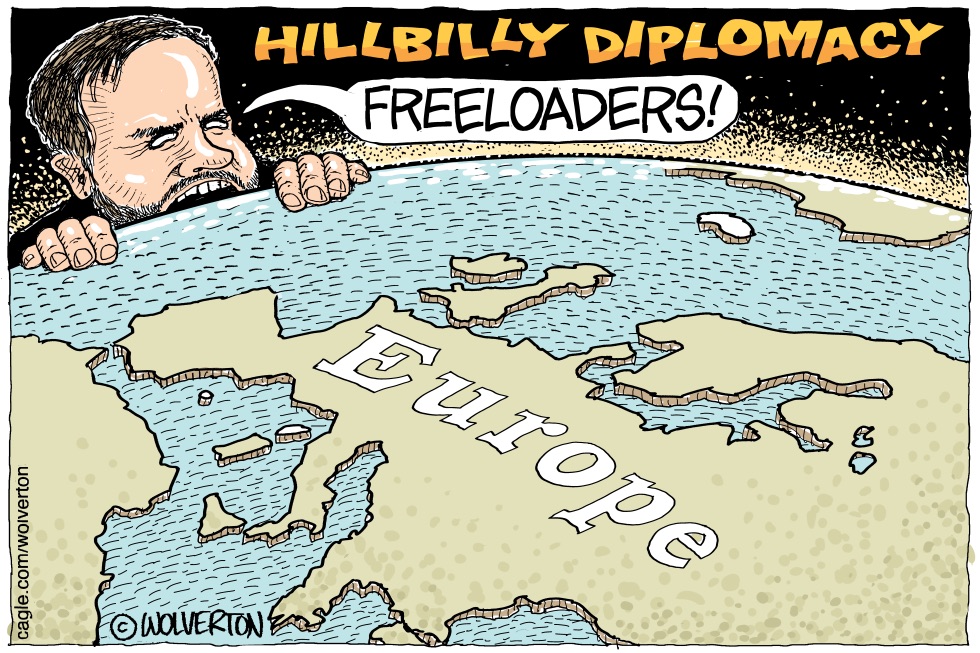
We cannot overstate what has just happened. It took just 71 days for Donald Trump to wreck the American economy, mortally wound NATO, and destroy the American-led world order.
He did this with the enthusiastic support of the entire Republican party and conservative movement.
He did it with the support of a plurality of American voters.
He did not hide his intentions. He campaigned on them. He made them the central thrust of his election. He told Americans that he would betray our allies and give up our leadership position in the world.
There are only three possible explanations as to why Americans voted for this man:
they wanted what he promised;
they didn’t believe what he promised; or
they didn’t understand what he promised.
Pick whichever rationale you want, because it doesn’t matter. Whatever the reason was, it exposed half of the electorate—the 77 million people who voted for Trump—as either fundamentally unserious, decadent, or weak.
And no empire can survive the degeneration of its people….
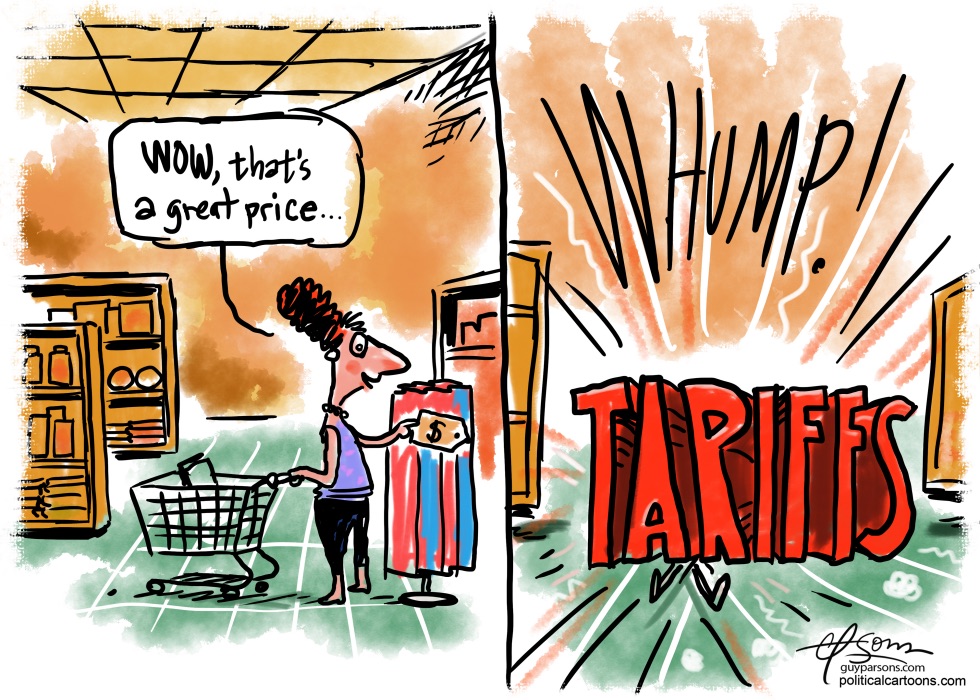
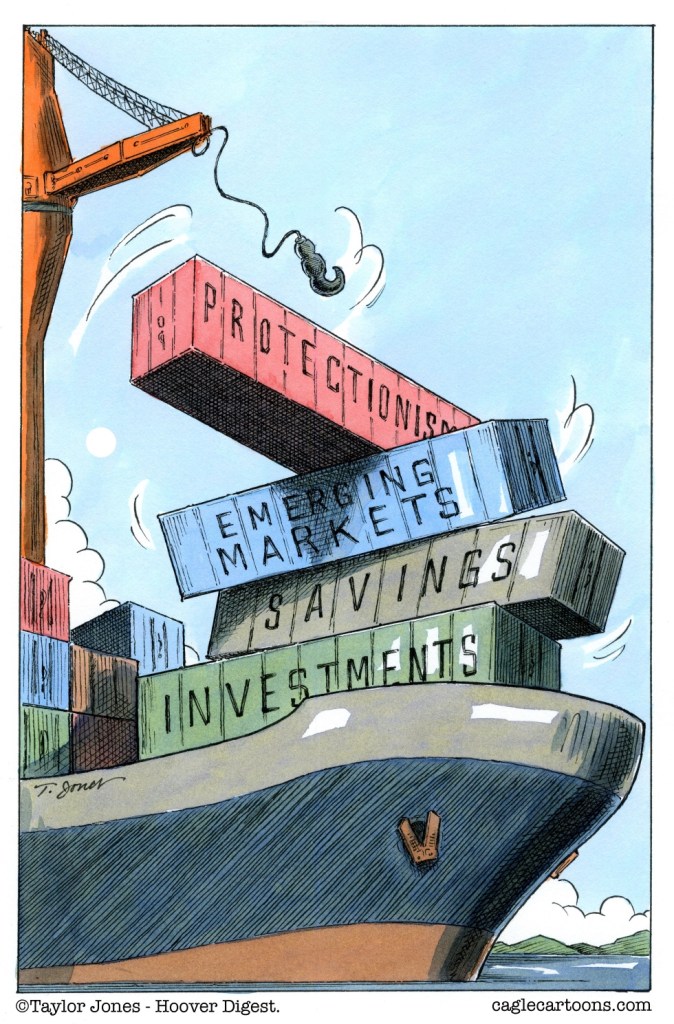
If, tomorrow, Donald Trump revoked his entire regime of tariffs, it would not matter. It might temporarily delay some economic pain, but the rest of the world now understands that it must move forward without America.
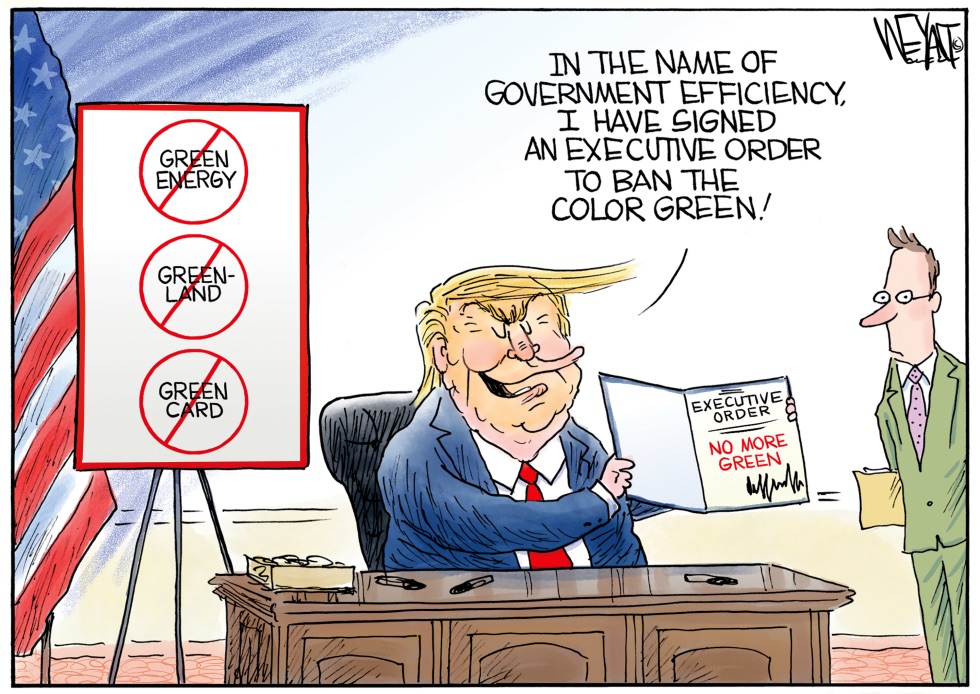
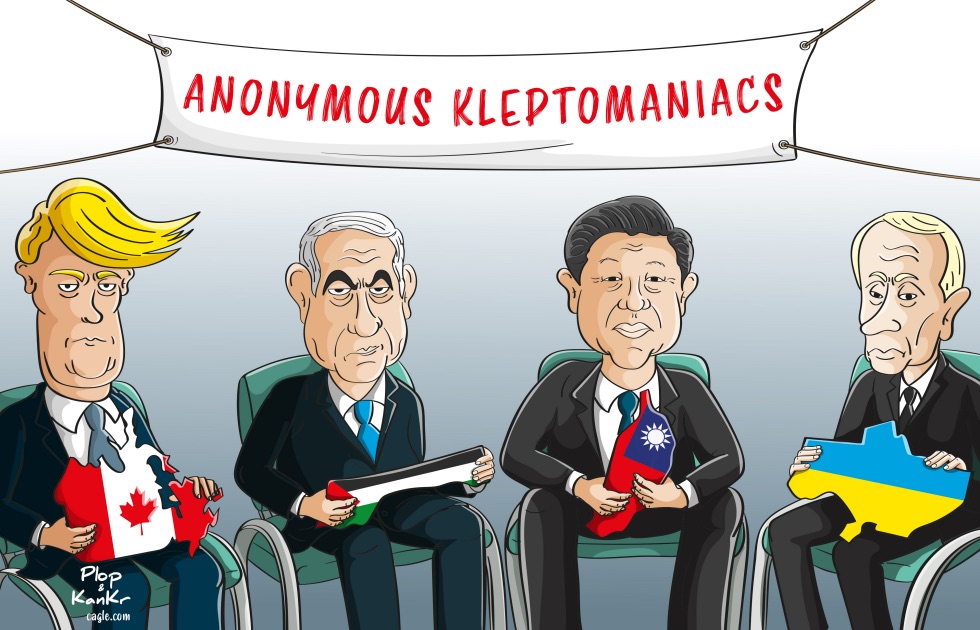
If, tomorrow, Donald Trump abandoned his quest to annex Greenland and committed himself to the defense of Ukraine and the perpetuation of NATO, it would not matter. The free world now understands that its long-term security plans must be made with the understanding that America is a potential adversary, not an ally.
This realization may be painful for Americans. But we should know that the rest of the world understands us more clearly than we understand ourselves.
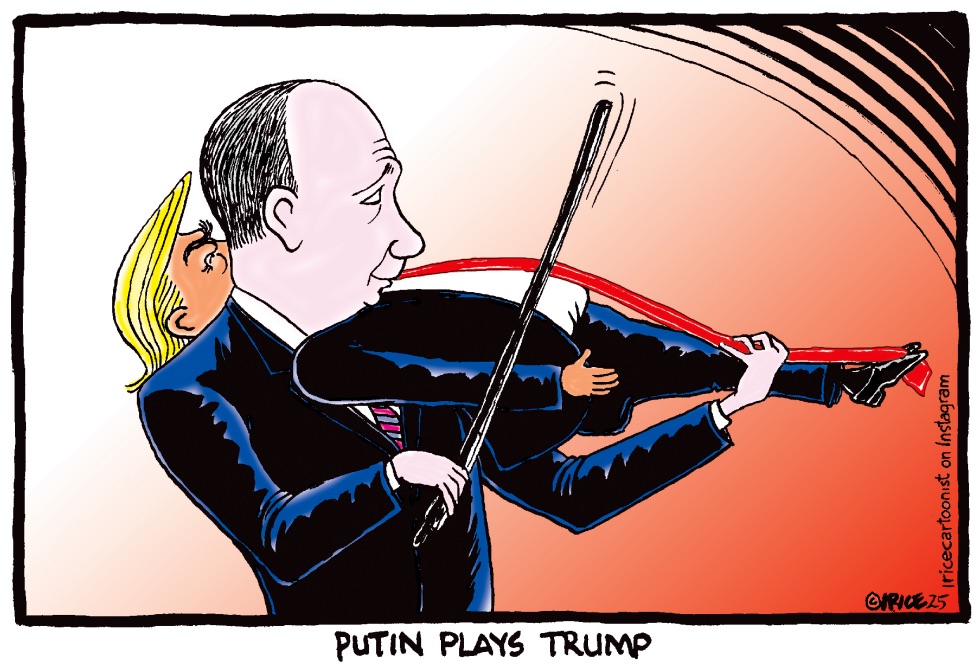
Vladimir Putin bet his life that American voters would be weak and decadent enough to return Donald Trump to the presidency. He was right.
Please go read the rest at The Bulwark link.
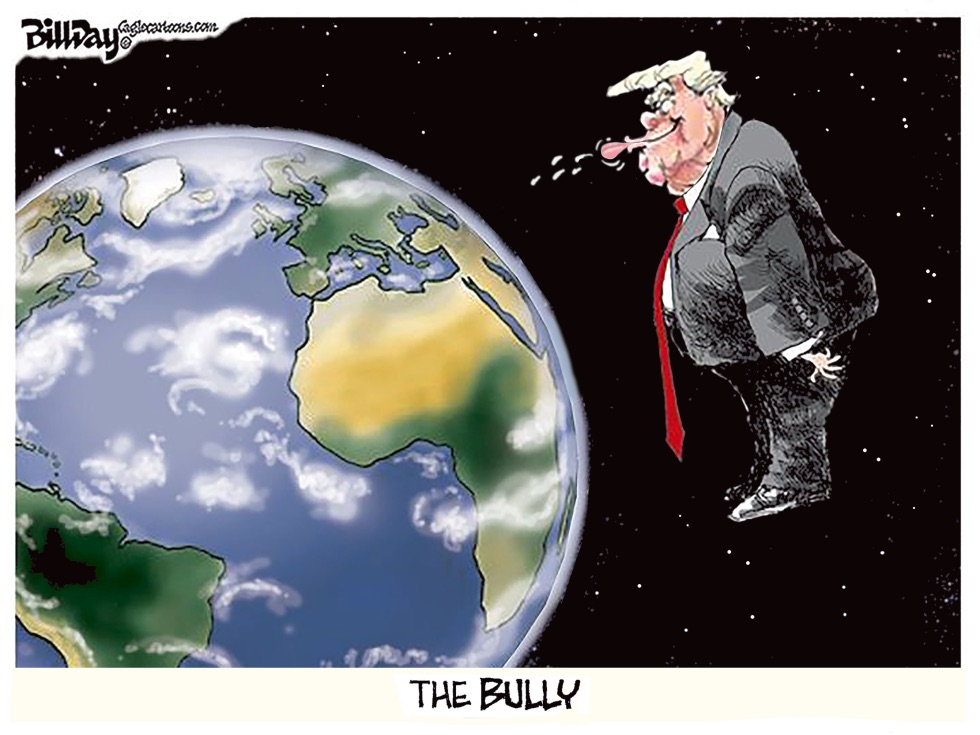
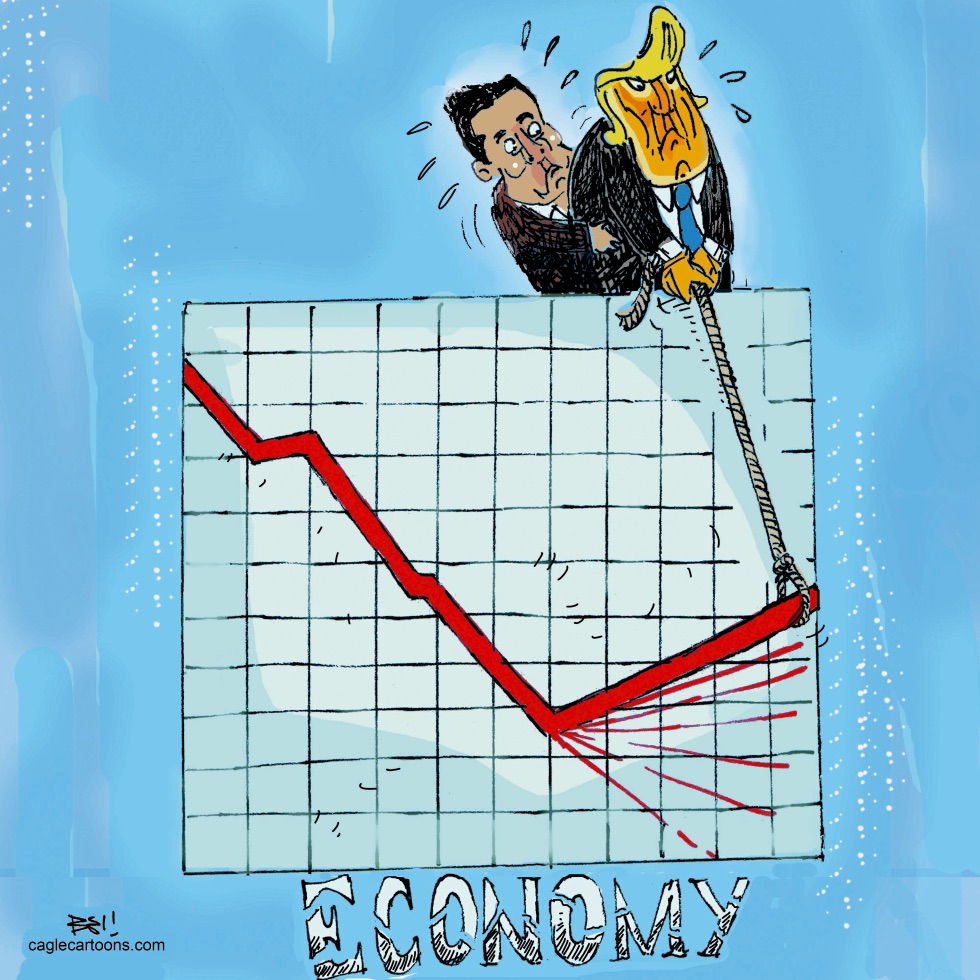
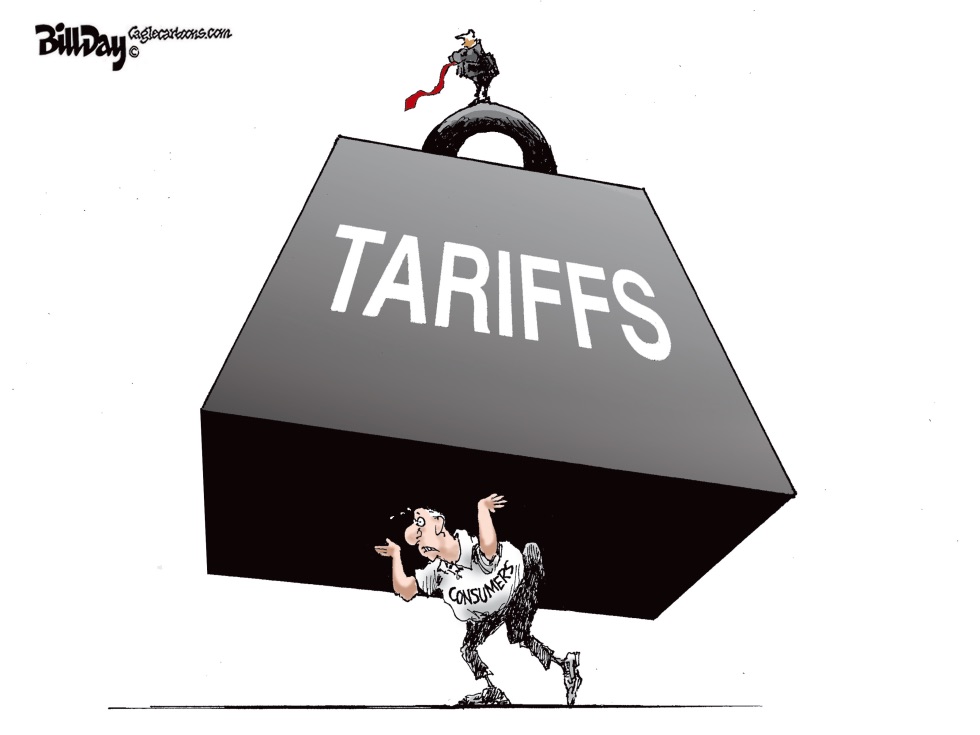
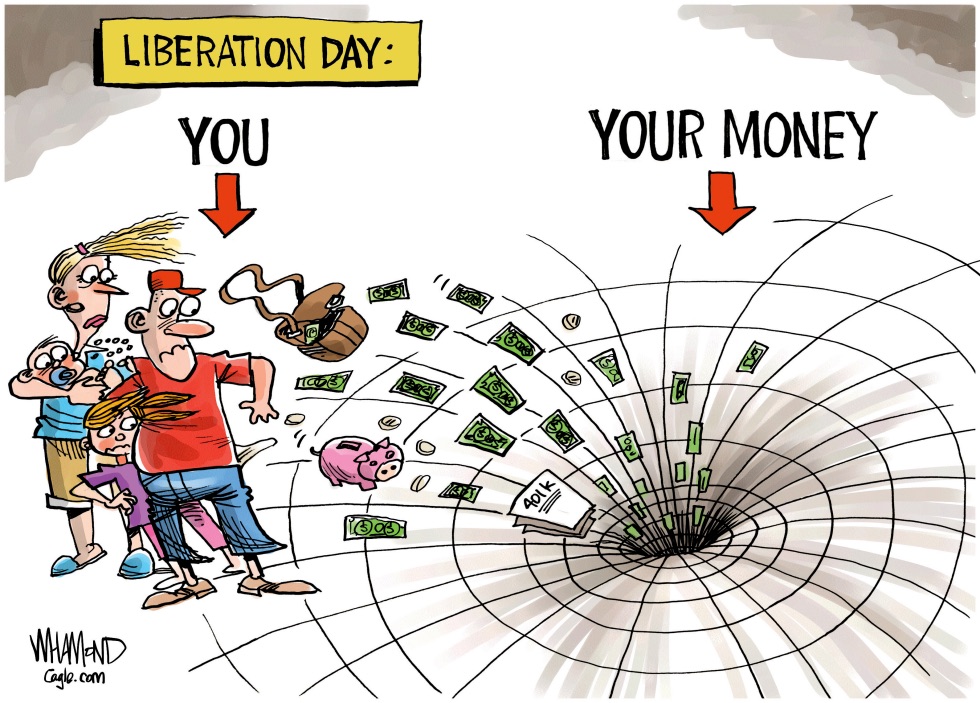
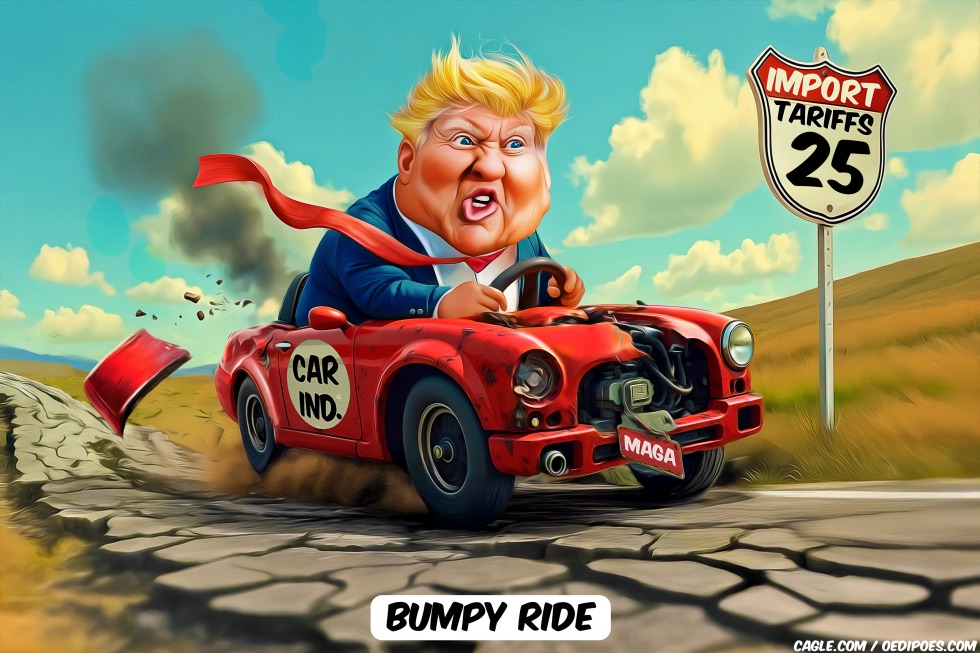
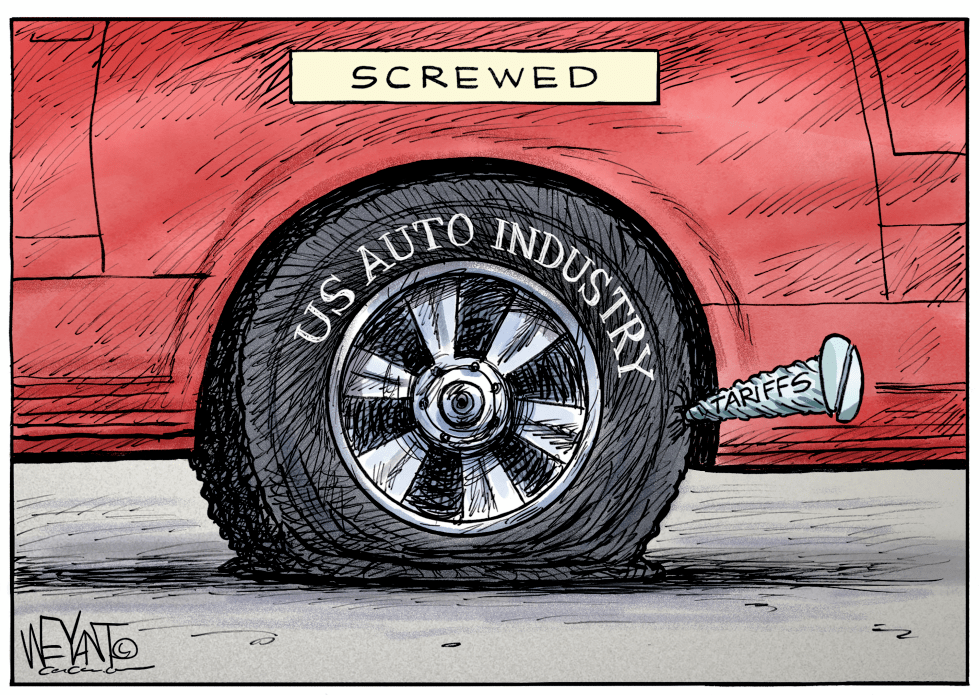
This week, Trump took a wrecking ball to the U.S. economy.
In the past, the one constituency President Trump has sometimes listened to has been our stock market. Well, it has spoken, falling 10.5 percent in one of the largest two-day stock market swoons in decades.
In the 50 years I have been immersed in markets and economic policy, I have never before witnessed a signature economic policy initiative that was met with such unalloyed criticism. What’s worse, the damage was entirely self-inflicted.
By Stephanie Lambourne
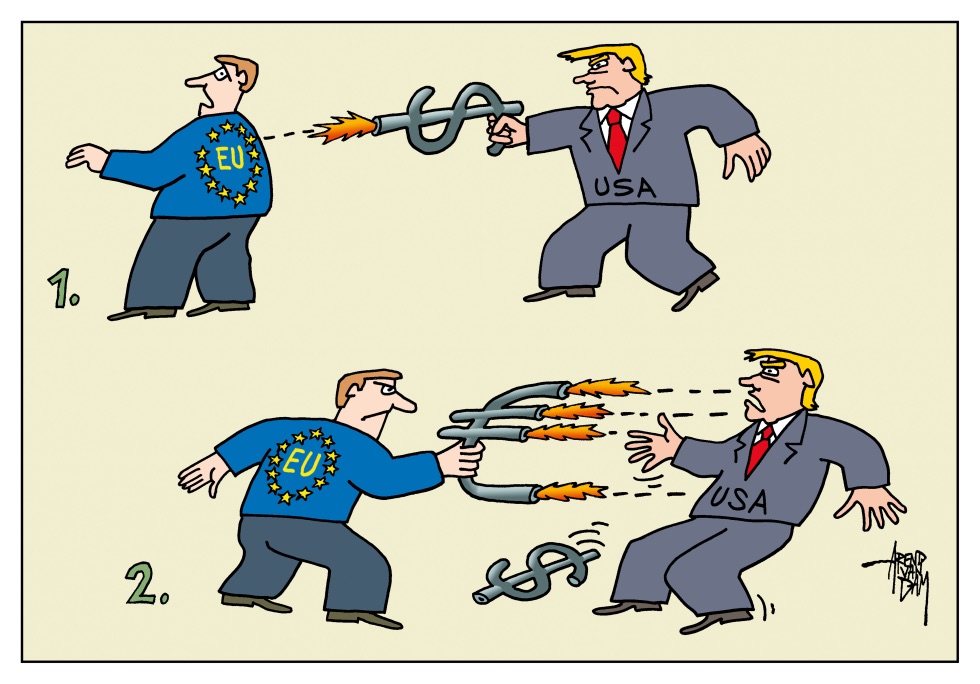
Why such a reaction? One reason the S&P 500 fell was that the tariffs Mr. Trump rolled out were so much greater than investors anticipated. (Give the White House an F for failing to prepare the market for what to expect.) Then on Friday, China announced its own 34 percent tariff on our goods, making it clear that our trading partners were not going to simply give in to Mr. Trump’s demands, as he had suggested they would.
As Mr. Trump was doubling down, asserting that “my policies will never change,” the Federal Reserve chairman, Jerome Powell, was delivering his own bombshell: Given the higher-than-predicted tariffs, higher inflation and slower growth were likely to ensue, he said. That’s drastically different from just a couple of weeks ago, when Mr. Powell called the potential impact of new tariffs on prices “transitory.”
The business community, which by my count heavily supported Mr. Trump in the election five months ago, seems stunned. Few have spoken publicly, but the Business Roundtable, the premier corporate trade association, on Wednesday warned that universal tariffs run “the risk of causing major harm to American manufacturers, workers, families and exporters.”
Privately, several chief executives told me that they recognized that imposing the tariffs, as well as Mr. Trump’s intractable support of them, was a potentially cataclysmic mistake. “Few of us ever imagined he would go this far,” one told me. “He could well bring down the economy and himself.”
A bit more:
The Trump-supporting business leaders I’ve spoken to in the last two days don’t yet regret their votes, mostly because of their intense distaste (if not hatred) for the Biden-Harris administration. And they remain broadly supportive of the efforts by the tech billionaire Elon Musk to reform the federal government, even if they acknowledge that his DOGE team may be going too far in its slashing of spending and personnel.
But I wonder how some other major Trump-supporting leaders whose stock prices have been particularly hard hit now feel, like Stephen Schwarzman, chief executive of Blackstone, the investment group (down 15 percent in two days), and Safra Catz, chief executive of Oracle, the database company (down 12 percent).
Mr. Trump’s actions aren’t the only problem. Almost as important is the lack of clarity as to what policies he is pursuing and why. At times, Mr. Trump implies that the purpose of the tariffs is to bring back manufacturing, which suggests that they will stay in place indefinitely. At other times, he suggests that the goal is to negotiate tariff reductions by other countries (even though much of what Mr. Trump asserts about their tariffs is inaccurate).
The dithering takes a real toll. I see this from my role as a professional investor. How do we evaluate a company that imports goods or engages in international commerce? We seek a lower price, or we grit our teeth, or we pass on the opportunity. As a result, our pace of investing has slowed sharply this year.
And it’s not just us. In the year’s first quarter, the number of newly announced mergers and acquisitions dropped to its lowest level since the financial crisis. “Folks are looking but not pulling the trigger,” one leading investment banker told me. Equity offerings have become similarly challenged; multiple companies planning to go public have postponed their fund-raising since Wednesday.
Americans elected Donald Trump with a favorable opinion of his economic plans. But his expansive push for tariffs has helped turn that confidence into skepticism, a new Wall Street Journal poll finds.
Tepid support for tariffs through the past year has become disapproval, with 54% of voters opposing Trump’s levies on imported goods, 12 points more than those who support his plans. Three quarters of voters say that tariffs will raise prices on the things they buy, up from 68% who said so in January.
The poll suggests that a president who promised that “tariffs are about making America rich again” is facing unease with his economic leadership, especially over rising prices, the issue that bedeviled Democrats in last year’s election. By 15 percentage points, more voters hold a negative view of Trump’s handling of inflation than a positive one. Negative views of his economic stewardship outweigh positive views by 8 points….
That is a substantial change from late October, when voters by a 10-point margin said they favored rather than opposed Trump’s economic plans. The negative view of tariffs contrasts with earlier Journal surveys that found voters keeping an open mind. In both January and August, before Trump took office and his tariff program became concrete, Journal polls found voters mildly supportive of import levies as a general proposition.
The survey finds the president’s political standing to be resilient in many ways. Some 93% of voters who backed him in November give him favorable job reviews now, suggesting that few are regretting their vote. Majorities approve of his handling of immigration and border security….
Still, the survey shows the political gamble Trump has taken by using America’s muscle to try to reshape the global trading system. Voters are evenly split on whether they believe Trump’s promise that short-term economic “disruption” caused by tariffs, as he put it, will help American workers and companies by forcing other nations to lower their own trade barriers and prompting manufacturers to make more goods in the U.S.
I don’t know how people who aren’t super-rich can support what Trump is doing. I have to believe that these people are either stupid or not paying attention.
On Trump’s Insanity:
Daniel Drezner at Drezner’s World: There Are No Adults in the Room.
On Thursday, as the stock market nosedived from the Trump administration’s stupid, unthinking, destructive, error-ridden tariff policies, a respected reporter from a well-known media outlet pinged me for an interview. The journalist was interested in the roles that Treasury Secretary Scott Bessent and Commerce Secretary Howard Lutnick might have played in the formulation of Trump’s foreign economic policy.
Sardines, by Jennifer Pease
As we started talking, I realized that the reporter and I were starting from rather different premises. The reporter was thinking about the story as how one would cover a significant policy pronouncement in a normal administration: Who is the president listening to on policy? What are the possible faultlines within the administration? Who are the key power brokers? What was their decision-making process?
And I was thinking: there was no process. There are no power brokers. On questions of trade, there’s Donald Trump’s whims, his collection of clown car enablers, and maybe an intern who plugs some things into ChatGPT. That’s pretty much it.
I know why both of us were thinking the way we were. For reporters, looking for power brokers makes sense even when even when the policies themselves seem inexplicable. Bad policy outcomes can nonetheless be explained by rational actors pursuing their interests. Maybe it’s the result of powerful interest groups pushing their narrow interests. On occasion, bureaucratic politics are responsible. Sometimes bad policies are the result of powerful ideas that percolate within particular groups — you know, ideas like “risk assessment is bad” or “democracy is overrated.” This is slightly more unusual but it’s certainly conceivable….
As someone who has studied Donald Trump’s decision-making style at great length, however, I come at questions about Trump’s second-term advisors from a different perspective. The key to understanding Trump’s second term is to understand three basic premises:
Trump has eliminated all executive branch guardrails;
Trump has appointed only sycophants to serve him this time around;
Trump’s policy instincts are the most immature, retrograde opinions out there.
Not long after President Donald Trump’s inauguration, the administration’s economic staff went to work on a daunting task: determining tariff rates for dozens of countries to fulfill the president’s campaign pledge of imposing “reciprocal” trade barriers.
After weeks of work, aides from several government agencies produced a menu of options meant to account for a wide range of trading practices, according to three people familiar with the matter.
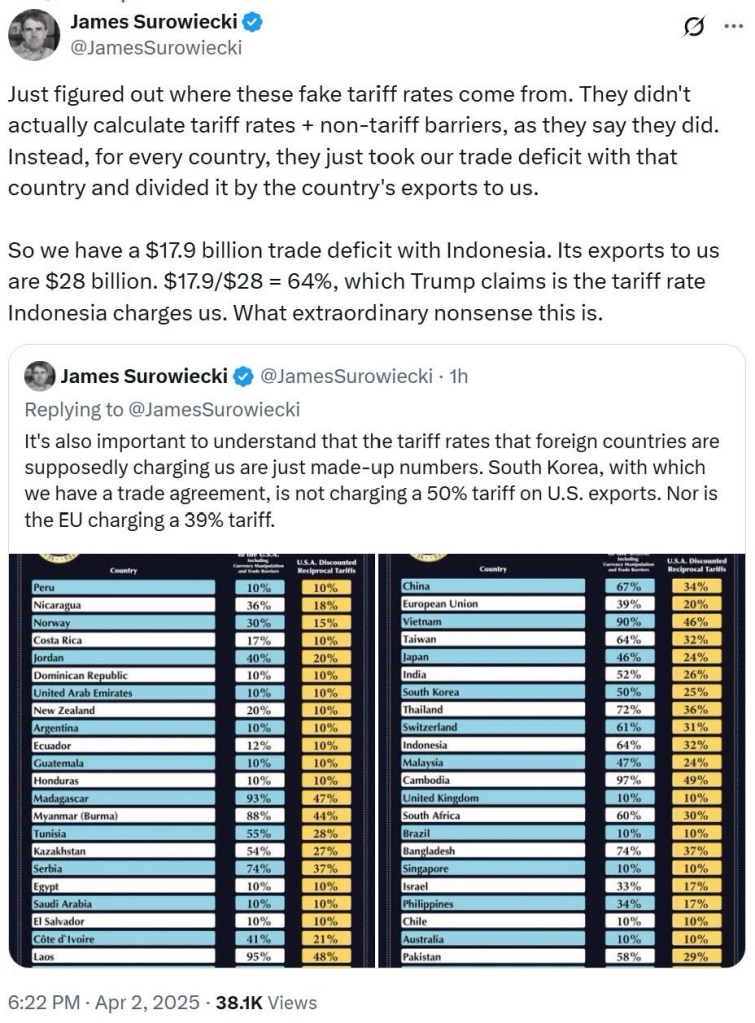
Instead, Trump personally selected a formula that was based on two simple variables — the trade deficit with each country and the total value of its U.S. exports, said two of the people, who spoke on the condition of anonymity to recount internal talks. While precisely who proposed that option remains unclear, it bears some striking similarities to a methodology published during Trump’s first administration by Peter Navarro, now the president’s hard-charging economic adviser. After its debut in the Rose Garden on Wednesday, the crude math drew mockery from economists as Trump’s new global trade war prompted a sharp drop in markets.
The president’s decision to impose tariffs on trillions of dollars of goods reflects two key factors animating his second term in office: his resolve to follow his own instincts even if it means bucking long-standing checks on the U.S. presidency, and his choice of a senior team that enables his defiance of those checks.
Inside and outside the White House, advisers say Trump is unbowed even as the world reels from the biggest increase in trade hostilities in a century. They say Trump is unperturbed by negative headlines or criticism from foreign leaders. He is determined to listen to a single voice — his own — to secure what he views as his political legacy. Trump has long characterized import duties as necessary to revive the U.S. economy, at one point calling tariffs “the most beautiful word in the dictionary.”
“Never has our future been more unpredictable, never have we depended so much on political forces that cannot be trusted to follow the rules of common sense and self-interest—forces that look like sheer insanity, if judged by the standards of other centuries.”
This is an oft-quoted passage from Hannah Arendt’s The Origins of Totalitarianism. And it’s one that has proven especially popular in the years since the rise of Trump and explosion of global authoritarianism.
Sanctuary, Lucy Almay Bird
I open with it here because I want to offer an extended reflection on what it feels like to be trapped inside the sort of madhouse she describes. Because I think sheer insanity now rules America. We have gone mad, and the consequence is that sanity now feels itself like a disorder.
We aren’t the first society to come unglued. We almost certainly will not be the last. But right now, each day in America for those of us who do not favor the president or hold to the MAGA worldview feels like we have been sent to some dilapidated asylum by mistake, like the protagonist of a pulp thriller.
Nothing is working as it should. No one is speaking in sentences that add up to anything sensible.
We are throwing the most advanced health science research system into the sea and have turned over our public health infrastructure to quacks and crooks. We are destroying our prosperity to sate the president’s desire to play at 19th century political economy. We are blithely ignoring the potential for war with former allies as Trump crows about annexing Canada and Greenland.
In a rational world, we would already have seen markets balk at Trump’s trade policies, investigations into the mismanagement of our health services, and impeachment proceedings against a man who continues to menace treaty allies for nothing but personal ego.
But it isn’t a rational world, at least not this American corner of it. And so I want to explore madness as the ordering principle of American life by looking at some of the key sites of breakdown. There is nothing curative in this essay, but diagnosis is a first step. And our symptoms are many.
On RFK Jr.’s wrecking ball:
How did a man who admitted he has brain damage from a worm and who has spent decades spreading deadly disinformation about the efficacy of modern medicine become the head of our nation’s health services?
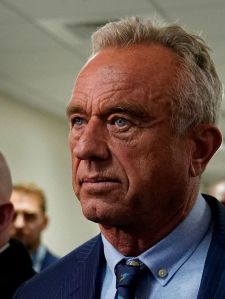
RFK Jr. has done what we all knew he would do. On Tuesday, mass layoffs gutted HHS, threatening everything from the CDC to the FDA to programs like Meals on Wheels.
These are moves that will make Americans less safe and healthy. Our food will be more dangerous. Diseases we might have cured in the not-so-distant future will go under-researched for years. Loved ones will get sick and die. And medicine that should have been available will be stuck in an understaffed and underfunded regulatory pipeline.
Before this, he had already driven out some of HHS’s top scientists, who have warned about the damage his views on healthcare and medical research will do. Under his watch, measles has killed two Americans, and numerous children have been diagnosed with Vitamin A toxicity after their parents followed Kennedy’s recommendation that it be used as a treatment.
Kennedy’s beliefs on medicine and health are bizarre, conspiratorial, and, in some cases, simply hateful.
#FARTUS has deliberately tanked the equity markets and the dollar with record-level tariffs set with an equation that made no sense and included tariffs placed on islands with no human inhabitants. This is further evidence of the incompetency and utter ignorance of the Trump Administration. This is not economic policy. This is some personal brain fart of a very disturbed man.
None of this makes sense from an Economic Policy Basis. We now have retaliatory tariffs, which signal a massive trade war has begun. Like the last Trump Tariff-induced trade war, US farmers will be on the front line. Manufacturers will also be severely hurt. Of course, the ultimate loser is the average American. I still see stagflation in our near term future. High inflation plus very lousy unemployment. The Fed’s tools are not as useful with this kind of economy. Stimulate the economy to end unemployment, and you get higher prices. Stop the high inflation, and you worsen the recession. What really kills me is that this destructive policy was fully preventable. But then, elections brought us this mess, and elections must pull us out of it.
les pingouins résistent
You may read all my sources if you are so inclined. I know they’re not the most exciting reads. Here’s a trio of dismal headlines from The Guardian. Note: FTSE is the UK equivalent of the Dow Jones.
Global trade war escalates as Beijing hits back against Donald Trump with new tariffs on US goods
I’m going to quote from the Analysis. This is the full Headline. “Trump’s ‘idiotic’ and flawed tariff calculations stun economists Richard Partington, The Guardian’s Senior economics correspondent, wrote this analysis. “‘Willing sycophants’ came up with simplistic formula that has thrown global economy into disarray.”
Waving a big chart as a prop in the White House Rose Garden, Donald Trump suggested his new tariff plan was simple: “Reciprocal – that means they do it to us, and we do it to them. Very simple. Can’t get simpler than that.”
Perhaps a bit too simple. The method used to calculate the most important numbers in international trade, politics and economics has left some of the world’s leading experts shocked.
For each country, the White House looked up its trade in goods deficit for 2024, then divided that by the total value of imports. Trump, to be “kind”, said he would, however, offer a discount, so halved that figure. The calculation was even distilled into a formula.
For countries without a large deficit, the White House applied a 10% baseline, ensuring tariffs would be applied regardless. This was the case for the UK, which the US Census Bureau reckons had an almost-$12bn surplus in 2024.
“[It is] quite an extraordinary calculation after months of work behind the scenes,” said Jim Reid, the global head of macro research at Deutsche Bank. “[It] didn’t add much confidence on there being an in-depth strategic implementation plan.”
For weeks, Washington had been talking about an in-depth policy exercise to establish figures based on a combination of tariff and non-tariff barriers to trade, as it perceived them to be; including alleged “currency manipulation”, local laws, regulations, and taxes such as VAT.
In itself that approach raised eyebrows with experts who said VAT was highly unusual to include, because it is a sales tax paid on domestically produced goods and foreign imports alike.
However, the White House appears to have confirmed it took a simplistic approach to making this judgment:
Reciprocal tariffs are calculated as the tariff rate necessary to balance bilateral trade deficits between the US and each of our trading partners. This calculation assumes that persistent trade deficits are due to a combination of tariff and non-tariff factors that prevent trade from balancing.
There are multiple problems with this – not least that it vastly oversimplifies the drivers of trade deficits. Trade deficits occur when a country buys more than it sells abroad. The US has run a deficit persistently since the 1970s. Typically trade deficits balance over time, as they create downward pressure on a country’s currency (as the result of demand for foreign currency, to buy imported goods, outstrips demand for domestic currency).
Another part of the reason is US goods are too expensive for consumers in developing economies to buy – helping to explain some of the particularly large trade deficits – and new tariffs – for poorer countries.
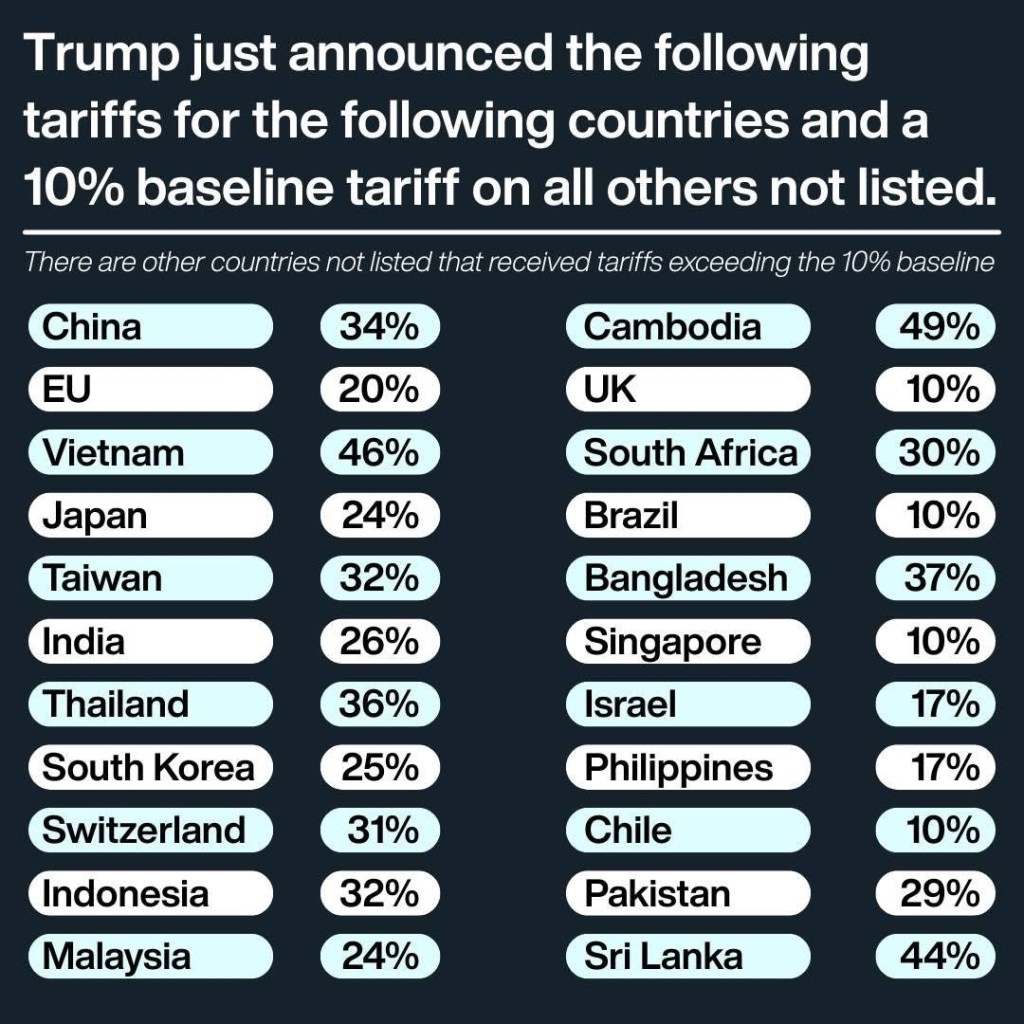
Adam Tooze, an economic historian at Columbia University in the US, said there were “grotesque” policies for south-east Asian countries, including a 49% Cambodian tariff, and rates of 48% for Laos and 46% for Vietnam.
“This is not because they discriminate viciously against American exports, but because they are relatively poor. The US does not make a lot of goods that are relevant for them to import,” he said.
Vietnam in particular has become part of the global supply chain for major manufacturers, including US tech and clothing companies such as Nike, Intel, and Apple.
Lesotho, the tiny southern African country, one of the poorest in the world, is another odd example, facing a tariff of 50%. Among its main exports to the US are diamonds and clothes – demonstrating how links around the world for rare minerals are important for the US economy, but also how the US sought to boost development in African nations in recent years – with policies to encourage manufacturing by companies including Levi Strauss and Wrangler.
There are three major trade models in economic theory. Basically, the first was mercantilism, which is the colonialist type of economy that caused the Boston Tea Party. The second is absolute advantage, and the third is comparative advantage. We generally have an absolute advantage in nearly all the markets because we’re a huge economy with many natural resources. There are still things we cannot provide, though. The example I always use is coffee.
This is where comparative advantage comes in. The countries in South America and Africa can sell us their coffee in return for goods and services we easily produce. We both benefit from the trade. It’s the basis of free trade. From this model, we’ve had many improvements as we’ve gone beyond the logic of the models to empirical testing. The last big change to this model was by Paul Krugman, but Stiglitz and Samuelson were prior researchers into trade between countries.
You may check out this short explanation from Google AI. Don’t worry, we haven’t got a semester to go through two classes in Internationl Economics and Finance. It took me about 10 years to achieve with my doctorate and thesis and publications on the topic.. I know there are very few of us who find it fascinating, but I really felt like I needed to give you a bit of information so you can figure out what’s going on. So, wherever those Tariff formulations came from, it appears to have come from a crazy theory that I would never have heard of if my Libertarian friends hadn’t noticed their right-wing buddies going off the deep end. You may have noticed that Senator Rand Paul was among the most outspoken Senators against the tariffs. Libertarians generally tend to be big on letting the factors of production and products go where they are most efficient. That basically means open borders for capital and labor plus free trade.
So, that’s when I discovered this unhinged hypothesis. I had never heard of Critical Trade Theory before. I had heard of Critical Theory which basically has Marxist roots. When I originally entered University, I studied various forms of political and economic systems in a comparative class. Those are no longer taught in Economics because we recognize now that we have mixed markets models. The old command economies of the Soviet Union no longer exist. Central planning has gone completely the way of the Dodo, but there are economies that have more public provision of goods than others. Maoist and Stalinist planning are no longer carried out. That’s why it’s important to bring poor countries like Vietnam into a modern trade paradigm so they may develop quickly.
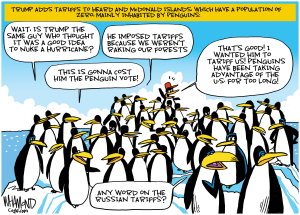
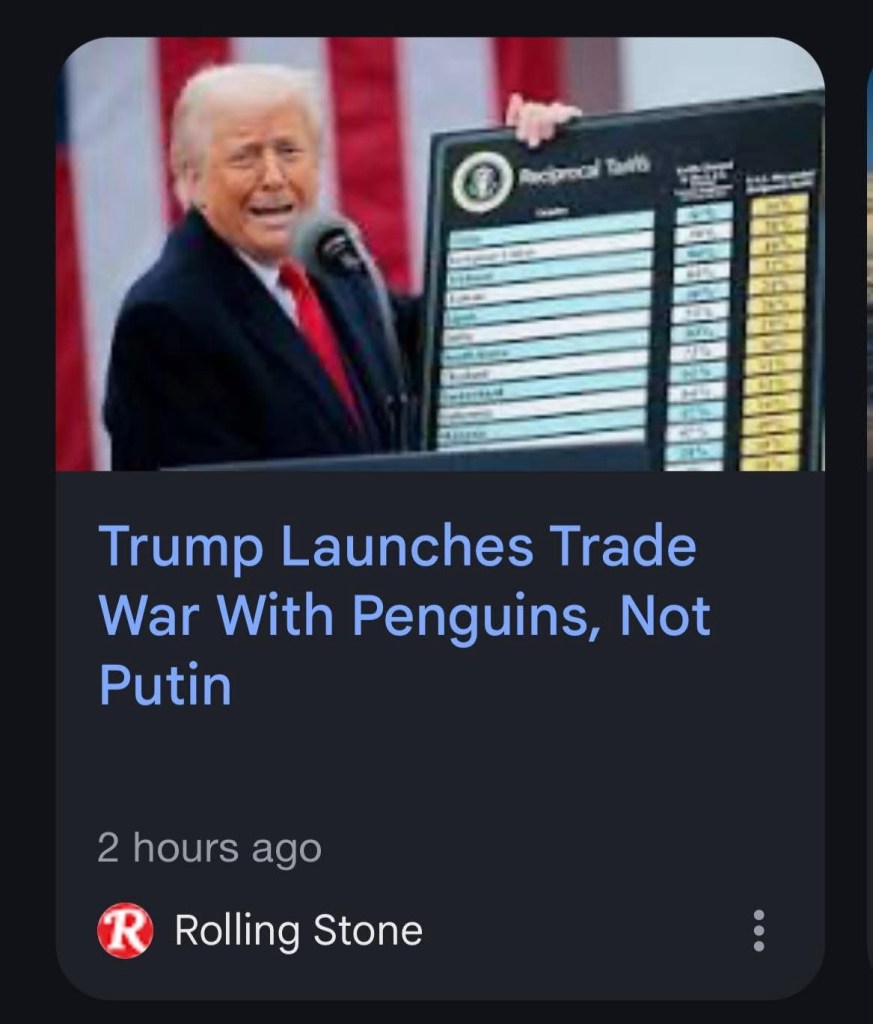
From what I can read of it, it actually appears to have a similar Marxist underpinning. One of the clues is that they use the word “fair” instead of “efficient.” The guy quoted over there is a bit off the rails, but at least I found out what the deal was. You may want to check out the ITIF site for better ways of identifying and correcting trade distortions rather than just using some made-up formula and hitting islands with subsistence farmers, fishermen, and penguins.
The White House has given the Office of the U.S. Trade Representative, along with the departments of Treasury and Commerce, until April 1 to identify countries the administration should confront with corrective trade actions.
It would be a mistake for the Trump administration to impose across-the-board tariffs on all nations, even if some run trade surpluses with America.
The administration should focus on the nations that employ the most extensive arrays of unfair trade practices, including behind-the-border restrictions that specifically target U.S. companies or exports.
Based on an index composed of 11 indicators covering America’s trade balances and key barriers U.S. industries face in markets around world, the administration should focus the greatest attention on China, India, and the European Union.
While it is highly unlikely that tariffs or other pressure can convince China to reduce its trade distortions, such measures might work vis-à-vis U.S. relations with other nations.
I did go to Influence Watchto check out their biases and funding sources. The methodology is better, using specific parameters to identify where possible trade distortions can happen. Plus, they don’t target Volcano Islands, seals, and penguins. So, I’m going back to the fallout now, which is not likely going to put you to sleep.
After President Trump imposed sweeping tariffs on imports from all over the globe, prompting the markets to implode, he took a question about it on Thursday. He ranted and rambled delusionally about how everything is just great. He bizarrely likened the country to a patient that had just undergone advanced surgery without grasping why this metaphor is the opposite of reassuring. And he spouted more nonsense about money pouring into our country. On top of all that, his imposition of the tariffs is likely an enormous and grotesque abuse of power. And because of this, the prospects for stopping them are not wholly nonexistent. We talked to congressional scholar Norm Ornstein, who walks us through how Congress can act, what Democrats can do to pressure Republicans to join in doing just that, and why Trump’s engaged in “horrifying folly.” Listen to this episode here. A transcript is here.
And here’s a snip from the transcript.
Ornstein: They’re inexplicably high and a disaster. I agree. And obviously not only do the markets agree, but so do many people in the business world. I saw that the CEO of Restoration Hardware, as he watched his stock plummet today, responded with a simple two-word phrase, “Oh, shit.”And my guess is that that’s been replicated, probably in even more colorful language, by business leaders, economists, and investors all across America and probably around the world.
Sargent: “Oh, shit” seems like a pretty good reaction, or at least an apt one. So Trump was asked about all this on Thursday. The reporter pointed out that the markets are way down, that they’ve had their worst day in years because of his tariffs. Then the reporter asked Trump, “How’s it going?” Here’s Trump’s answer.
Donald Trump (audio voiceover): I think it’s going very well. It was an operation, like when a patient gets operated on. And it’s a big thing. I said this would exactly be the way it is. We have $6 trillion or $7 trillion coming into our country, and we’ve never seen anything like it. The markets are going to boom, the stock is going to boom, the country is going to boom.
What part of his dementia-riddled mind invents these things? Are there really people out there that consider him even lucid? Governors of many states–but especially farm states–are seeing if they can work around our incredibly insane President. This is from Axios. “Gavin Newsom angles for California exemptions to Trump trade war.”
California Gov. Gavin Newsom said Friday he is pursuing agreements with other countries to ensure California is exempted from retaliatory tariffs stemming from President Trump’s escalating trade war.
Driving the news: “Donald Trump’s tariffs do not represent all Americans,” Newsom said in a video message Friday.
California, whom he touted as “the tentpole of the U.S. economy,” aims to maintain “stable trading relationships around the globe,” he added.
“I’ve directed my administration to look at new opportunities to expand trade and to remind our trading partners around the globe that California remains a stable partner.”
California is “ready to talk” with global trading partners, Newsom wrote on X.
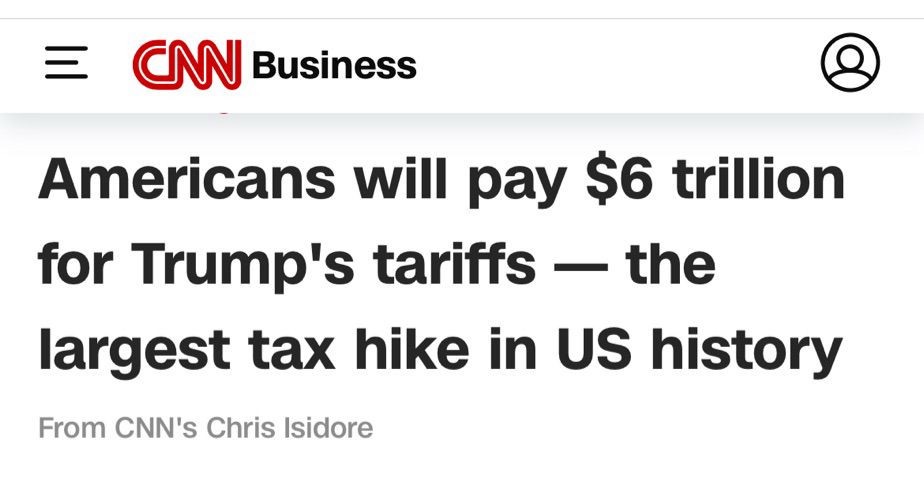
Referring to the state’s economic might, Newsom added his state is “not scared to use our market power to fight back against the largest tax hike of our lifetime.”
State of play: The Golden State’s economy and its workers are heavily reliant on trade with Mexico, Canada and China, and retaliatory tariffs stand to have an “outsize” impact on California businesses, farmers and ranchers, according to a press release from Newsom’s office.
The tariffs could also impede the state’s efforts to rebuild from this year’s devastating Los Angeles wildfires, by hurting access to construction materials like timber, steel, aluminum, and the components of drywall, the press release noted.
The other side: “Gavin Newsom should focus on out-of-control homelessness, crime, regulations, and unaffordability in California instead of trying his hand at international dealmaking,” White House spokesperson Kush Desai told Axios Friday.
Zoom in: Newsom is particularly concerned with retaliatory measures from other countries could impact California’s agricultural sector, especially its almond industry, according to Fox News, which first reported the news of theagreements.
California is the world’s fifth-largest economy and its agricultural sector is a key economic driver for the state.
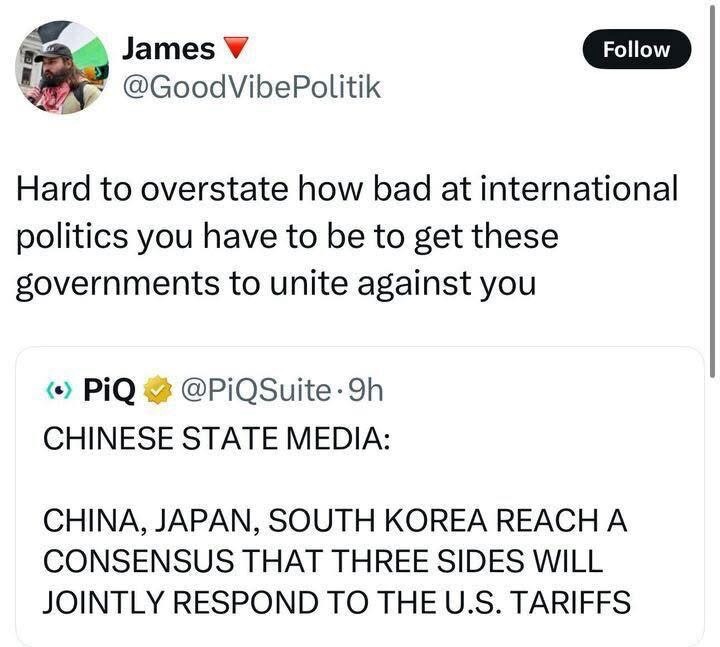
China’s Finance Ministry on Friday said it will impose a 34% tariff on all goods imported from the U.S. starting on April 10, following duties imposed by U.S. President Donald Trump’s administration earlier this week.
“China urges the United States to immediately cancel its unilateral tariff measures and resolve trade differences through consultation in an equal, respectful and mutually beneficial manner,” the ministry said, according to a Google translation.
It further criticized Washington’s decision to impose 34% of additional reciprocal levies on China — bringing total U.S. tariffs against the country to 54% — as “inconsistent with international trade rules” and “seriously” undermining Chinese interests, as well as endangering “global economic development and the stability of the production and supply chain,” according to a Google-translated report from Chinese state news outlet Xinhua.
Separately, China also added 11 U.S. firms to the “unreliable entities list” that the Beijing administration says have violated market rules or contractual commitments. China’s Ministry of Commerce also added 16 U.S. entities to its export control list and said it would implement export controls on seven types of rare earth-related items, including samarium, gadolinium and terbium.
Beijing has also filed a formal complaint against the U.S. with the World Trade Organization, the Ministry of Commerce confirmed in a Google-translated release, saying Washington’s tariffs policy “seriously violates WTO rules, seriously damages the legitimate rights and interests of WTO members, and seriously undermines the rules-based multilateral trading system and the international economic and trade order.”
circa 1908 and a reminder from my Grandparents’ peers
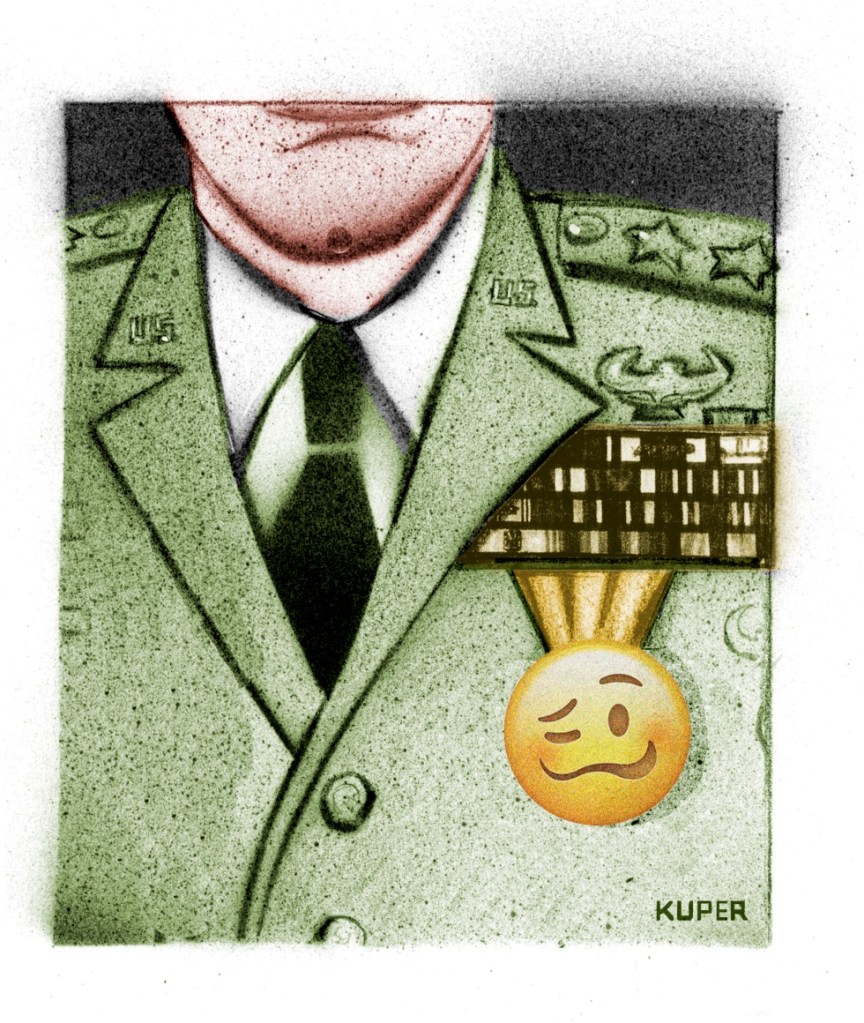
Okay, enough of this. It makes me crazy. Not like the following doesn’t, but at least I know nothing about the field. This is from the Washington Post. We have all these #FARTUS appointments breaking security rules and they do this to who? “National Security Agency chief ousted after far-right activist urged his removal. Gen. Timothy Haugh was fired Thursday as director of the powerful wiretapping and cyberespionage service, according to U.S. officials.”
The director of the National Security Agency, the powerful U.S. wiretapping and cyberespionage service, was fired Thursday, according to one former and two current U.S. officials.
Gen. Timothy Haugh, who also heads U.S. Cyber Command, was let go along with his civilian deputy at the NSA, Wendy Noble, according to the officials. Like others in this report, they spoke on the condition of anonymity to discuss personnel moves.
Far-right activist Laura Loomer advocated for the firings during a meeting with President Donald Trump on Wednesday, she confirmed to The Washington Post on Thursday evening.In the meeting,
Loomer, a fervent Trump supporter, pressed for the dismissals of a number of officials besides Haugh and Noble — in particular,National Security Council staff whose views she saw as disloyal to the president.
At least five key National Security Council aides were fired Thursday.
“NSA Director Tim Haugh and his deputy Wendy Noble have been disloyal to President Trump,” Loomer said in a post on X early Friday. “That is why they have been fired.”
Loomer told The Post that she urged Trump to dismiss Haugh because he was “handpicked” by Gen. Mark A. Milley, who was chairman of the Joint Chiefs of Staff in 2023 when Haugh was nominated to lead Cyber Command and the NSA.
We are so fucked. Have you managed to crawl out of bed yet?
What’s on your reading and blogging list today?
Did you like this post? Please share it with your friends:
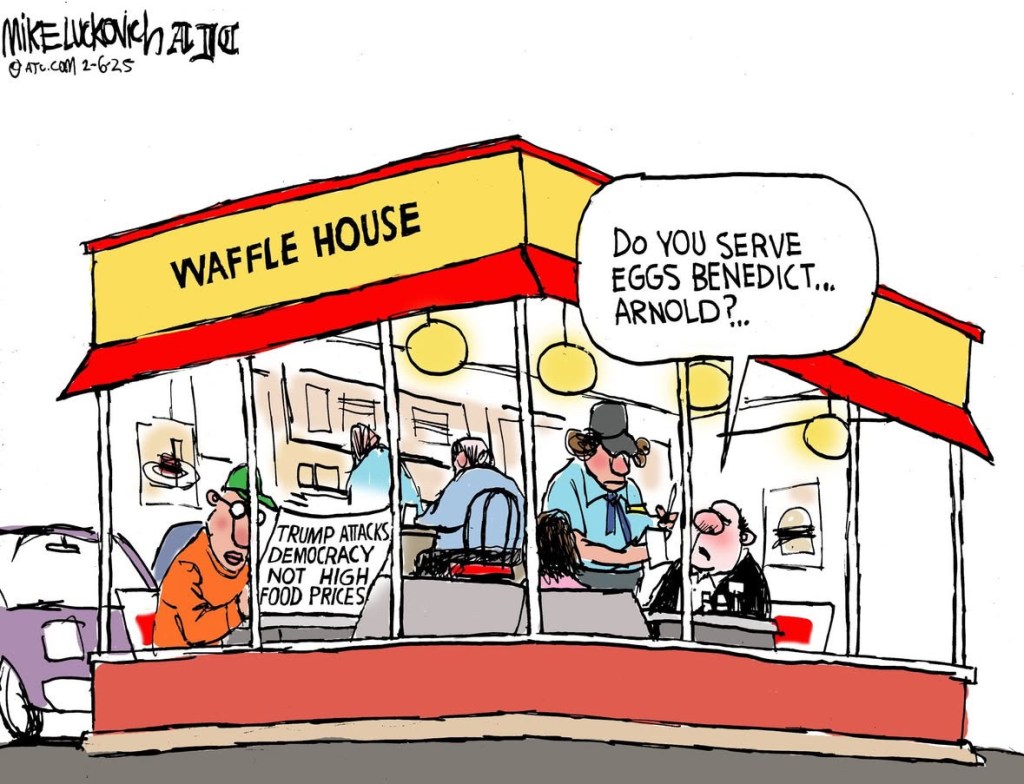
It has been quite a while since I’ve posted anything but cartoons lately. I’m afraid this week will be no different. Well, here is a bit of news for ya:
Now where can you go to find that kind of content, where we compare the size of the Trump tariffs to my gnome like gigantic ass? Only here on Sky Dancing of course!
And with that, I leave to you all.
This is an open thread.
Did you like this post? Please share it with your friends:
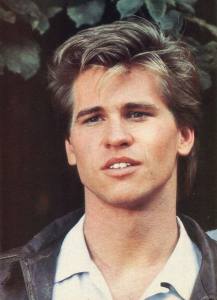
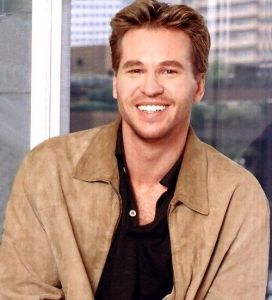
Val Kilmer, a homegrown Hollywood actor who tasted leading-man stardom as Jim Morrison and Batman, but whose protean gifts and elusive personality also made him a high-profile supporting player, died on Tuesday in Los Angeles. He was 65.
The cause was pneumonia, said his daughter, Mercedes Kilmer. Mr. Kilmer was diagnosed with throat cancer in 2014 but later recovered, she said.
Youthful Val Kilmer
Tall and handsome in a rock-star sort of way, Mr. Kilmer was in fact cast as a rocker a handful of times early in his career, when he seemed destined for blockbuster success. He made his feature debut in the slapstick Cold War spy-movie spoof “Top Secret!” (1984), in which he starred as a crowd-pleasing, hip-shaking American singer in Berlin unwittingly involved in an East German plot to reunify the country.
He gave a vividly stylized performance as Jim Morrison, the emblem of psychedelic sensuality, in Oliver Stone’s “The Doors” (1991), and he played the cameo role of Mentor — an advice-giving Elvis as imagined by the film’s antiheroic protagonist, played by Christian Slater — in “True Romance” (1993), a violent drug-chase caper written by Quentin Tarantino and directed by Tony Scott.
Mr. Kilmer had top billing (ahead of Sam Shepard) in “Thunderheart” (1992), in which he played an unseasoned F.B.I. agent investigating a murder on a South Dakota Indian reservation, and in “The Saint” (1997), a thriller about a debonair, resourceful thief playing cat-and-mouse with the Russian mob. Most famously, perhaps, between Michael Keaton and George Clooney he inhabited the title role (and the batsuit) in “Batman Forever” (1995), doing battle in Gotham City with Two-Face (Tommy Lee Jones) and the Riddler (Jim Carrey), though neither Mr. Kilmer nor the film were viewed as stellar representatives of the Batman franchise….
But by then another, perhaps more interesting, strain of Mr. Kilmer’s career had developed. In 1986, Mr. Scott cast him in his first big-budget film, “Top Gun” (1986), the testosterone-fueled adventure drama about Navy fighter pilots in training, in which Mr. Kilmer played the cool, cocky rival to the film’s star, Tom Cruise. It was a role that set a precedent for several of Mr. Kilmer’s other prominent appearances as a co-star or a member of a starry ensemble. He reprised it in a brief cameo in the film’s 2022 sequel, “Top Gun: Maverick.”
He played the urbane, profligate gunslinger Doc Holliday in “Tombstone” (1993), a bloody western, alongside Kurt Russell, Sam Elliott and Bill Paxton as Wyatt, Virgil and Morgan Earp. He was part of a robbery gang in “Heat” (1995), a contemporary urban “High Noon”-ish tale that was a vehicle for Robert De Niro as the mastermind of a heist and Al Pacino as the cop who chases him down. He was a co-star, billed beneath Michael Douglas, in “The Ghost and the Darkness” (1996), a period piece about lion hunting set in late 19th century Africa. In “Pollock” (2000), starring Ed Harris as the painter Jackson Pollock, he was a fellow artist, Willem de Kooning. He played Philip of Macedon, the father of Alexander the Great (Colin Farrell), in Oliver Stone’s grandiose epic “Alexander” (2004).
Val Kilmer had such intense magnetism that he could make a flyboy villain charming. He could make a smug young genius endearing. He could make a frontier gunman dying from tuberculosis not just tragically romantic but somehow sexy. In a career spanning four decades, the actor both embraced and shattered the expectations of a Hollywood leading man. Even after years battling throat cancer, which robbed him of his voice and heartthrob physique, Kilmer still managed to deliver one more emotional performance that bookended his adventurous onscreen life.
That was Top Gun: Maverick in 2022, in which Kilmer reprised his role as Tom “Iceman” Kazansky, the fighter pilot who serves as the chief rival to Tom Cruise’s naval aviator in the blockbuster 1986 original. Both men were still just starting out as actors at that point. Kilmer had broken through as a spoof of Elvis Presley in the 1984 spy farce Top Secret! and was the high-IQ slacker in 1985’s Real Genius when he took on the role of the hotshot antagonist. In the sequel, set decades later, Iceman is an admiral in charge of the Navy’s Pacific Fleet, and he and Maverick have long patched over their youthful clashes to become not just friends but brothers in arms. Kilmer was several years into his cancer treatments in real life, and no longer able to act full time, but Cruise went to great lengths to incorporate him in the story, making Kilmer’s declining condition a part of the character. It brought an emotional closure to a pop culture story that had already resonated with millions around the world, and was the last time moviegoers saw Kilmer onscreen. It was not just a goodbye to Iceman, but a goodbye to the actor as well.
Kilmer succumbed to pneumonia and died on Tuesday at the age of 65.
He never tried to hide his health struggles, and in 2021 participated in the documentary Val, which chronicled his day-to-day activities recovering from various treatments that left his voice a raspy whisper and drained his strength. His son, Jack Kilmer, narrated the story by reading his father’s words. “I have behaved poorly, I have behaved bravely, I have behaved bizarrely to some,” read one self-reflective line. The movie included old VHS footage Kilmer recorded of himself and his friends, documenting his life on movie sets and his wild-child approach to creativity. It was that willingness to take risks and challenge himself that made him unpredictable and surprising as a performer. Kilmer was many things in his life, and those watching him never knew what to expect.
Read the rest at Vanity Fair.
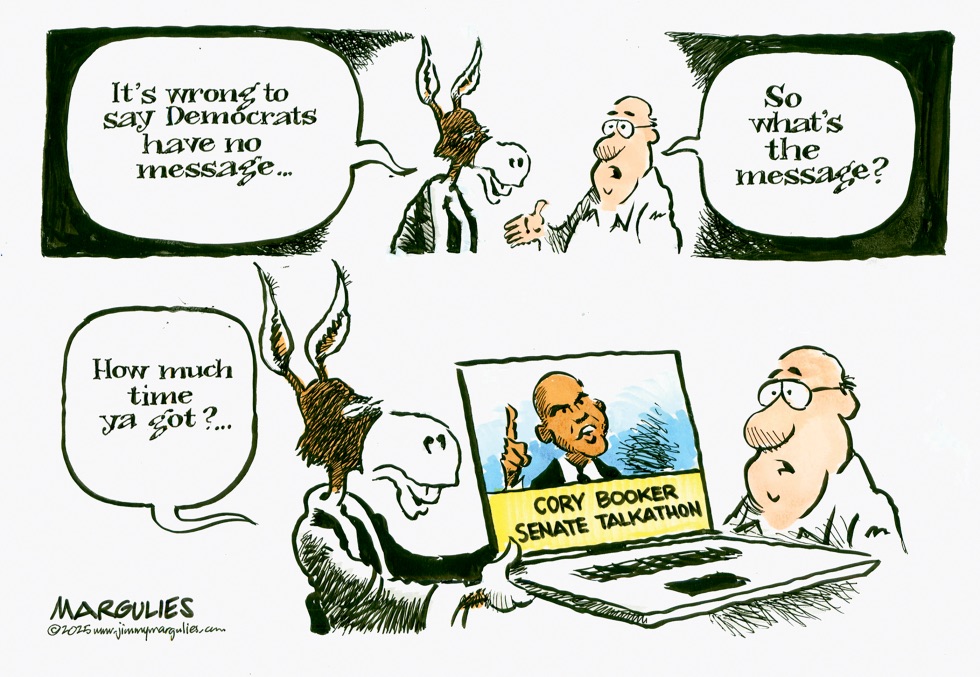
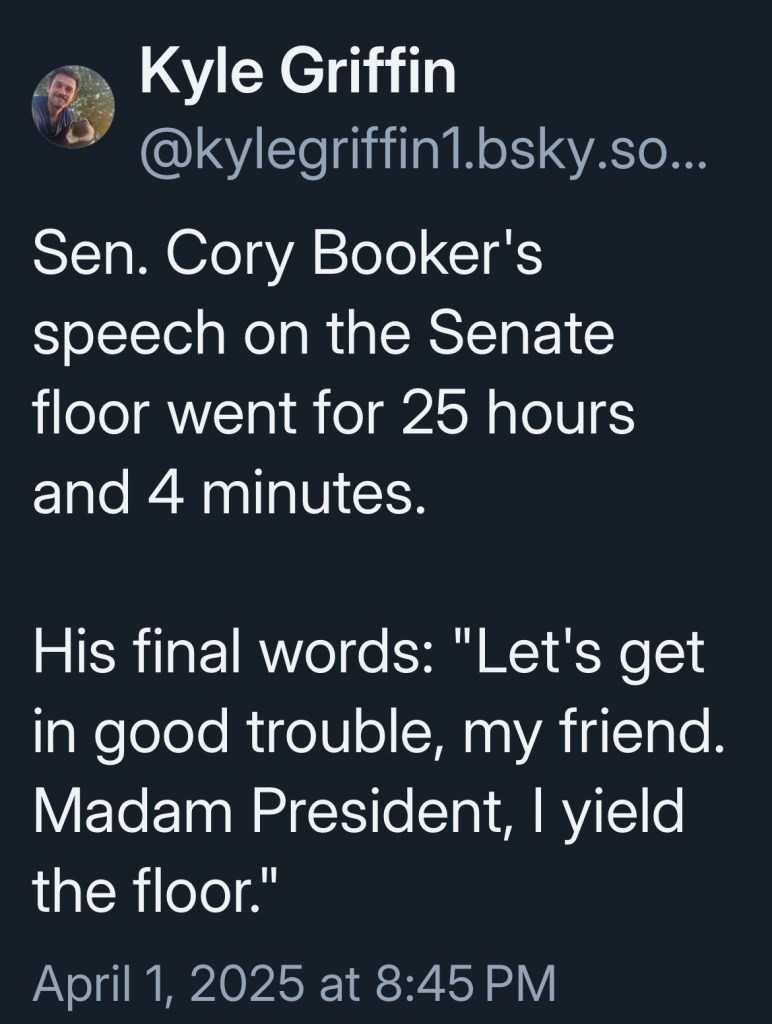
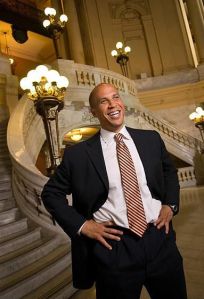
Democrats had a good day yesterday. Senator Cory Booker inspired with a record-breaking filibuster, and Democratic candidates overperformed in special elections in Florida and won control of Wisconsin Supreme Court with the election of liberal judge Susan Crawford.
Sen. Cory Booker, D-N.J., wanted to do something extraordinary. He knew Democratic voters were desperate for it.
So he took to the Senate floor with little fanfare and went on to deliver a marathon speech — excoriating the Trump administration for lawlessness and undermining American values and in the process breaking the record for longest Senate speech ever, yielding Tuesday after 25 hours and 5 minutes.
It was a cathartic moment for a vast swath of demoralized voters across the country, who tuned in amid hunger for some action by the opposition party beyond the traditions of business as usual.
And for a Democratic Party that has been lost in the wilderness since its bruising defeat to Donald Trump last fall, it offered a rare moment of hope to pursue what may be its only chance of slowing Trump down: inspiring a mass popular uprising against him.
“There’s a lot of people out there asking Democrats to do more and to take risks and do things differently,” an exhausted Booker told reporters after he walked off the floor. “This seemed like the right thing to do. And from what my staff is telling me, a lot of people watched. And so we’ll see what it is. I just think a lot of us have to do a lot more, including myself.”
Throughout Tuesday afternoon, Booker was trending across social media, including on TikTok, BlueSky and even Elon Musk’s X.
The speech got over 350 million “likes” on Booker’s TikTok livestream of his remarks, according to his office, including more than 300,000 people viewing them across his platform at once. It prompted over 200 stories from New Jerseyans and Americans in response. And it drew over 28,000 voicemails of encouragement on Booker’s office phone line, along with public accolades from Democratic luminaries like former Vice President Kamala Harris and Rep. Nancy Pelosi, D-Calif., the former House speaker.
Heather Cox Richardson at Letters from an American: April 1, 2025.
For more than 25 hours he held the floor of the Senate, not reading from the phone book or children’s literature, as some of his predecessors have done, but delivering a coherent, powerful speech about the meaning of America and the ways in which the Trump regime is destroying our democracy.
Senator Cory Booker
On the same day that John Hudson of the Washington Post reported that members of Donald Trump’s National Security Council, including national security advisor Michael Waltz, have been skirting presidential records laws and exposing national security by using Gmail accounts to conduct government business, and the same day that mass layoffs at the Department of Health and Human Services gutted the Centers for Disease Control and Prevention (CDC), the National Institutes of Health (NIH), and the Food and Drug Administration (FDA), Booker launched a full-throated defense of the United States of America.
Booker began his marathon speech at 7:00 on the evening of March 31 with little fanfare. In a video recorded before he began, he said that he had “been hearing from people from all over my state and indeed all over the nation calling upon folks in Congress to do more, to do things that recognize the urgency—the crisis—of the moment. And so we all have a responsibility, I believe to do something different to cause, as John Lewis said, good trouble, and that includes me.”
On the floor of the Senate, Booker again invoked the late Representative John Lewis of Georgia, who had been one of the original Freedom Riders challenging racial segregation in 1961 and whose skull law enforcement officers fractured on the Edmund Pettus Bridge in Selma, Alabama, in 1965 as Lewis joined the marchers on their way to Montgomery to demand their voting rights be protected.
Booker reminded listeners that Lewis was famous for telling people to “get in good trouble, necessary trouble. Help redeem the soul of America.” Booker said that in the years since Trump took office, he has been asking himself, “[H]ow am I living up to his words?”
“Tonight I rise with the intention of getting in some good trouble. I rise with the intention of disrupting the normal business of the United States Senate for as long as I am physically able. I rise tonight because I believe sincerely that our country is in crisis and I believe that not in a partisan sense,” he said, “because so many of the people that have been reaching out to my office in pain, in fear, having their lives upended—so many of them identify themselves as Republicans.”
A trio of elections on Tuesday provided early warning signs to Republicans and President Donald Trump at the beginning of an ambitious term, as Democrats rallied against his efforts to slash the federal government and the outsize role being played by billionaire Elon Musk.
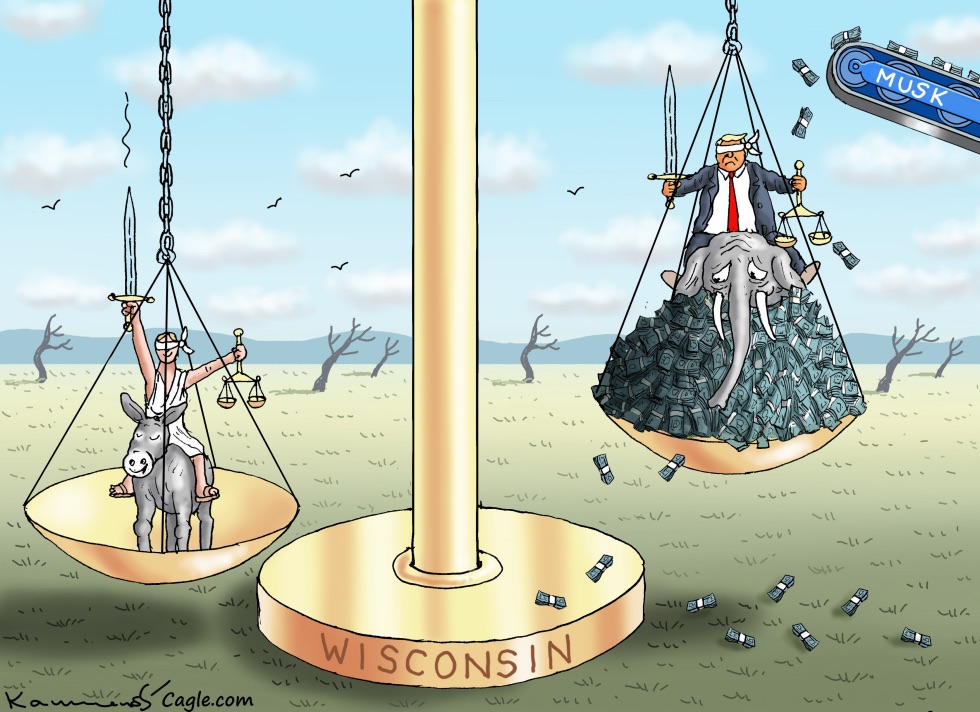
In the marquee race for a Wisconsin Supreme Court seat, the conservative judge endorsed by Trump and backed by Musk and his groups to the tune of $21 million lost by a significant margin in a state Trump won in November. And while Florida Republicans held two of the most pro-Trump House districts in the country, both candidates also underperformed Trump’s November margins.
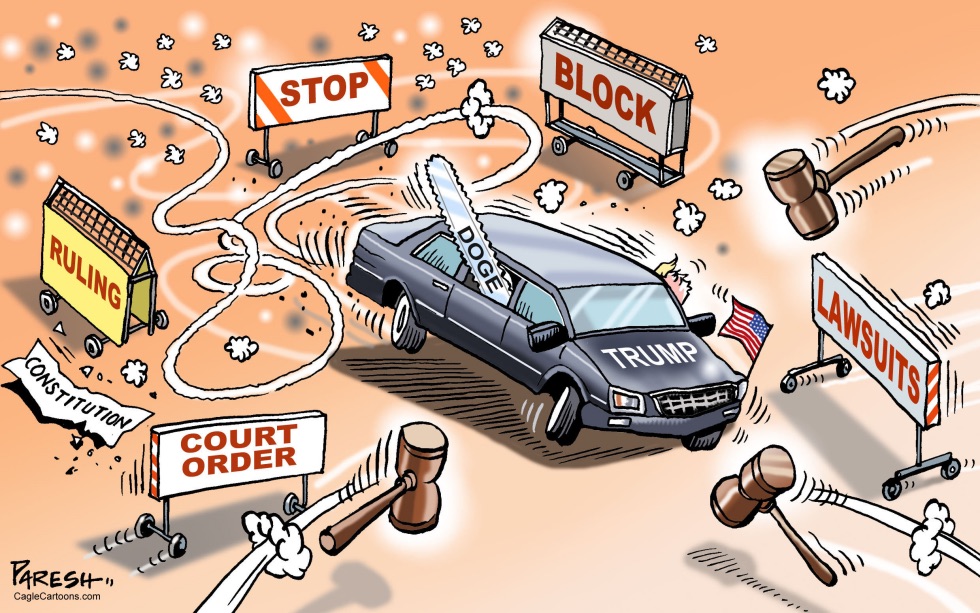
The elections — the first major contests since Trump’s return to power — were seen as an early measure of voter sentiment as Trump works with unprecedented speed to dramatically upend the federal government, clashing with the courts and seeking revenge as he tests the bounds of presidential power.
The party that loses the presidency in November typically picks up seats in the next midterm elections, and Tuesday’s results provided hope for Democrats — who have faced a barrage of internal and external criticism about their response to Trump — that they can follow that trend.
On the Wisconsin Supreme Court race:
Trump won Wisconsin in November by 0.8 percentage points, or fewer than 30,000 votes. In the first major test since he took office, the perennial battleground state shifted significantly to the left.
Sauk County, northwest of the state capital of Madison, is a state bellwether. Trump won it in November by 626 votes. Sauk shifted 14 points in the direction of Judge Susan Crawford, the liberal favorite backed by national Democrats and billionaire donors like George Soros.
Besides strong turnout in Democratic-heavy areas, Crawford did measurably better in the suburban Milwaukee counties that Republicans rely on to run up their margins statewide.
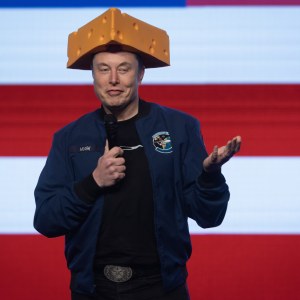
Elon Musk in Green Bay, Wisconsin pretending to be a Cheeshead
Crawford won Kenosha and Racine counties, both of which went for Trump over Democratic nominee Kamala Harris. She was on pace to win by 9 percentage points.
In interviews with more than 20 voters in Waunakee, a politically mixed town north of Madison, several Democrats suggested without prompting that their vote was as much if not more of a repudiation of Trump’s first months in office as it was a decision on the direction of the state high court….
Others disliked the richest man in the world playing such a prominent role.
“I don’t like Elon Musk spending money for an election he should have no involvement in,” said Antonio Gray, a 38-year-old Milwaukee security guard. “They should let the voters vote for who they want to vote for instead of inserting themselves like they have.”
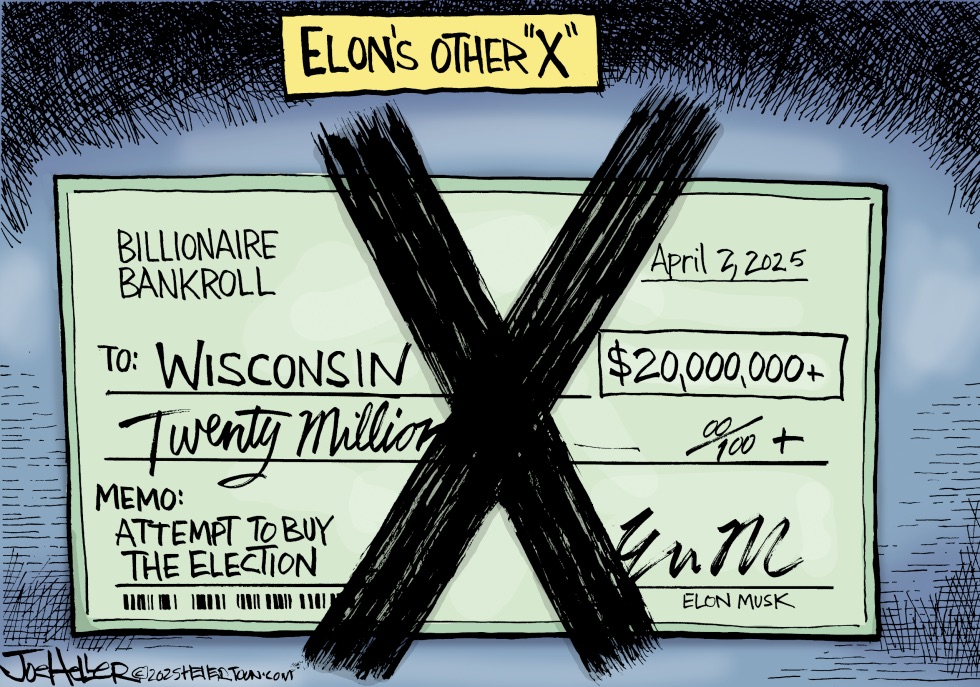
Elon Musk went all out trying to win Republican control of the Wisconsin Supreme Court.
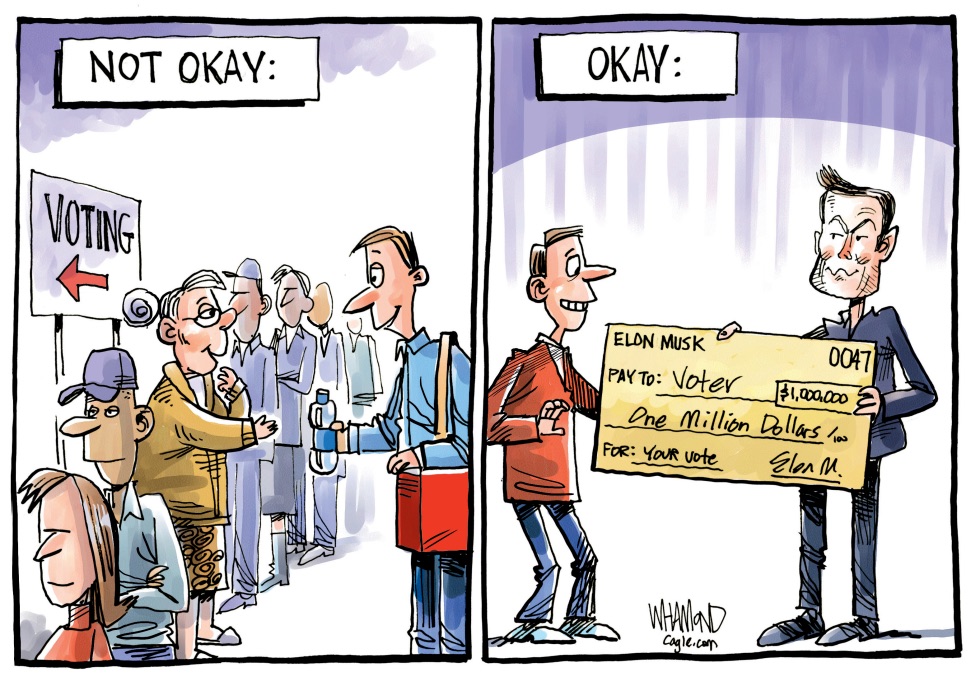
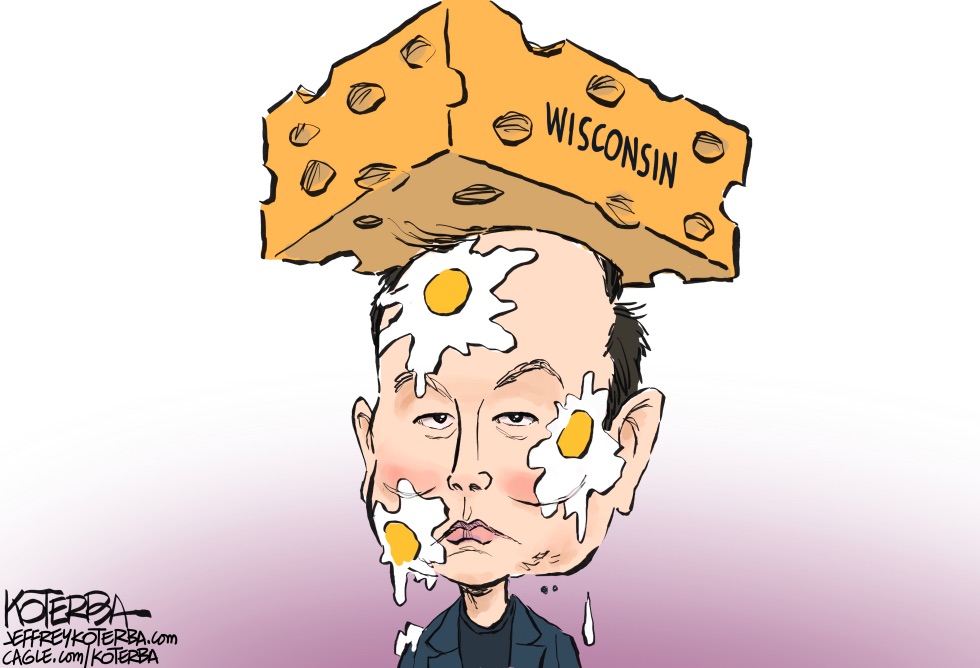
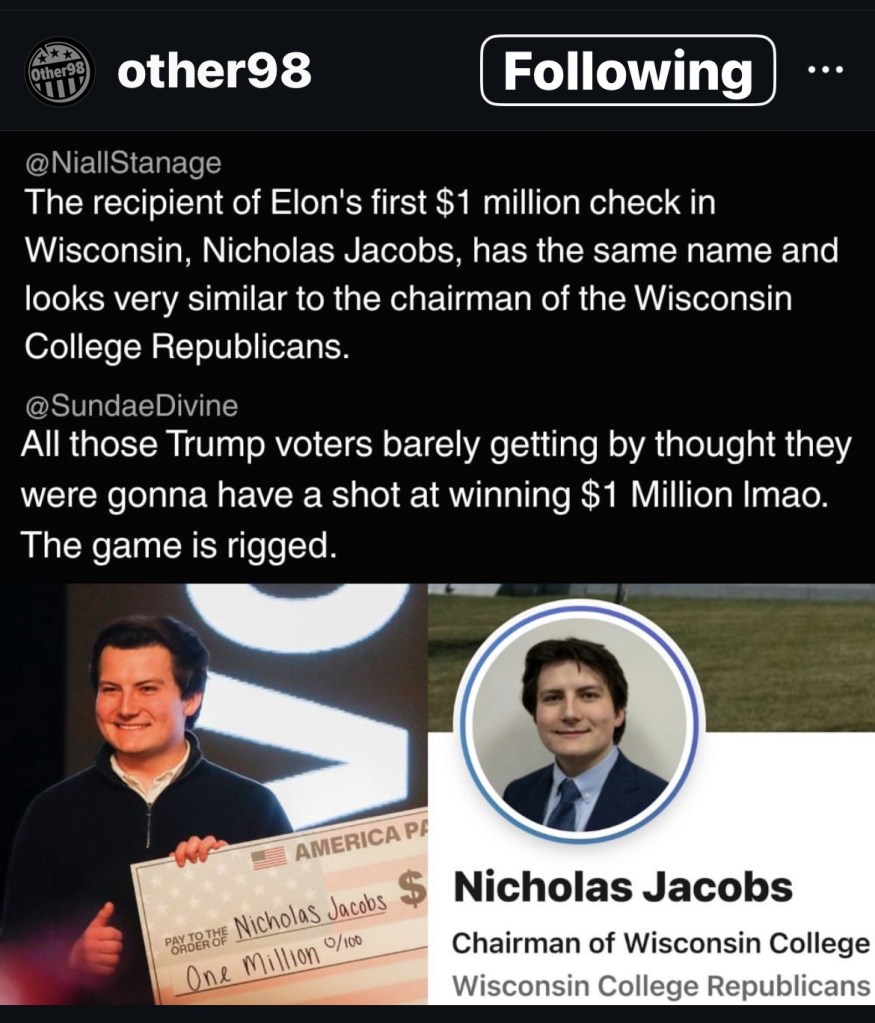
Musk and his related groups dropped more than $20 million on boosting the conservative candidate, a former state attorney general, Brad Schimel. (Those $1 million sweepstakes giveaways were especially shameless.) Musk held a town hall/rally in Green Bay on Sunday, where he urged folks to back Schimel, and he pitched the race as “one of those things that may not seem that it’s going to affect the entire destiny of humanity, but I think it will.”
In helping make this probably the most expensive court contest of all time, Musk also turned it into a referendum on himself and his role in the Trump administration. Schimel, bless his heart, could have been the greatest candidate in the history of democracy — he wasn’t — and it wouldn’t have mattered. This became all about Elon, with a dash of Donald Trump thrown in.
Wisconsinites’ response: No, thanks, bruh. Despite Musk’s hysterical warnings and cheesehead preening, Schimel’s opponent, Susan Crawford, won by about 10 points, securing the court’s liberal majority.
Cottle says that anxious Republicans should grasp this opportunity to get rid of the unlikeable multi-billionaire.
Musk has his money-drenched tentacles wrapped tightly around the president. To start disentangling him and moving him toward the door, Republican lawmakers need to make the case that he is hurting Trump’s popularity — and threatening the G.O.P.’s unified control of Washington. Musk’s expensive Wisconsin flop is a big, red warning flag for Republican members to wave. They’d be wise to seize the moment while this failure is raw, missing no opportunity to remind the president what a political loser his buddy is turning out to be.
Waiting will only make the situation worse. DOGE is just getting warmed up. There’s no telling how much more damage Musk will do — to the nation and to the Republican Party — by the time a smattering of elections are decided this November. The mass layoffs of federal workers are already expected to damage Republicans’ fortunes in the Virginia governor’s race, seen as a key political bellwether.
And by next year’s midterms? Let’s just say voters can go to bloodthirsty from adoring in a flash when people start messing with their Social Security and Medicaid.
“I don’t know when it was signed, because I didn’t sign it,” President Trump told reporters on March 22. In the span of a week, the president “forgot” that he invoked the Alien Enemies Act to summarily deport hundreds of people to a Salvadoran gulag.
“Other people handled it, but Marco Rubio has done a great job and he wanted them out and we go along with that,” he mumbled vaguely.
The media framed the debacle as a clever effort to “downplay his involvement” in the ugly episode, rather than evidence that the president is totally checked out and letting other people run the government.
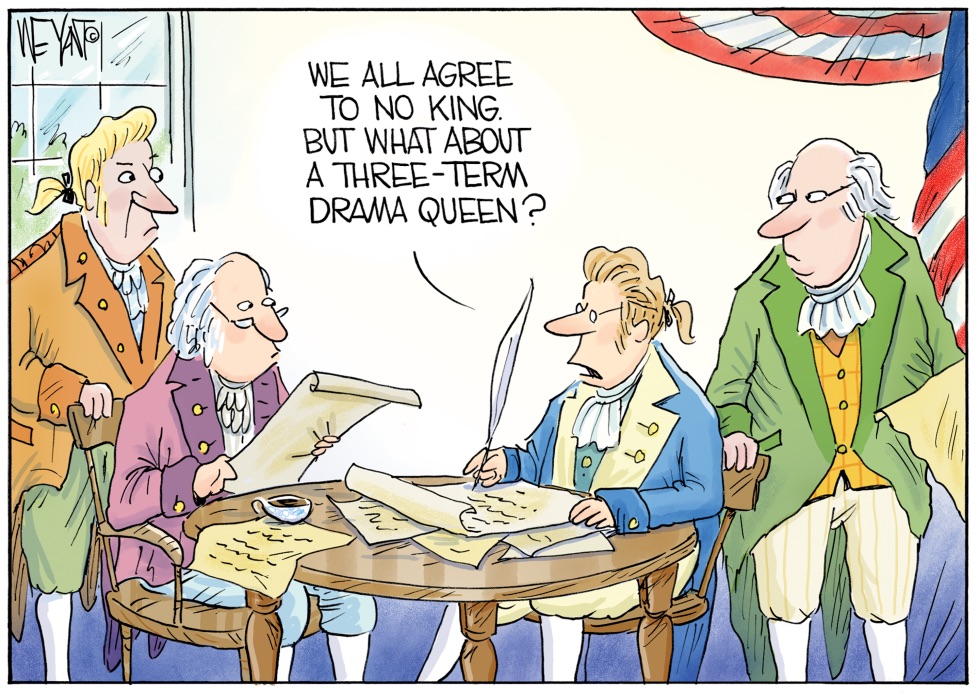
And yet, just five days before his own memory lapse, Trump “declared” his predecessor’s pardons of the January 6 Committee “VOID, VACANT, AND OF NO FURTHER FORCE OR EFFECT” because Biden was too senile to understand them….
The post is part of an ongoing campaign to undo Biden’s presidency by claiming that he was too incompetent by the end to exercise actual power, and some unnamed, shadowy figure was running the White House instead. It’s shockingly inappropriate, of course. But the juxtaposition is even more jarring as we are daily confronted with a president who is disengaged from the details of his job, preferring to outsource most of his authority to an unelected billionaire….
Undoing pardons is not a thing. Not even if Biden used an autopen. As the Supreme Court made clear in Trump v. US, the president’s exercise of his “core” powers, specifically the pardon, is unreviewable. But Trump is captured by internet memes, and so he’s thrilled to amplify the “autopen” conspiracy currently flooding the rightwing media ecosystem.
Old Man Trump
“The person that operated the autopen, I think we ought to find out who that was because I guess that was the real president,” Trump said in the Oval Office on March 20.
Read the whole thing if you have time, but here’s the meat of it:
Trump, who, at 78, is just three years younger than Biden, is clearly decompensating before our eyes. And yet, even as he free associates on live television, back-formulating justifications for orders he’s obviously never read, the right leans ever harder into the story of Biden’s supposed incompetence….
Trump doesn’t know what he’s signed when it comes to pardons, executive orders, or anything else. He’s outsourced the job to an unelected billionaire who is currently slashing through the government, bragging on social media about feeding entire federal agencies “to the woodchipper.” Elon Musk leads cabinet meetings, dispatches his henchcoders to take over agency after agency, and purports to cancel federal contracts at will. He has no statutory authority, but claims only to be acting as an extension of the president….
In short, Musk is the autopen, illegitimately usurping executive power while claiming to be a mere extension of the president, mechanically recording his wishes and codifying his orders. And so, to compensate, Trump leans into the old, familiar foil.
It’s not the Trump kids who are trading on their father’s position to enrich themselves. It’s Hunter Biden. It’s not the Trump administration storing classified information on unsecured devices. It’s Hillary Clinton. And it’s not Donald Trump who signs whatever his aides put in front of him, no matter how corrupt. It’s Joe Biden.
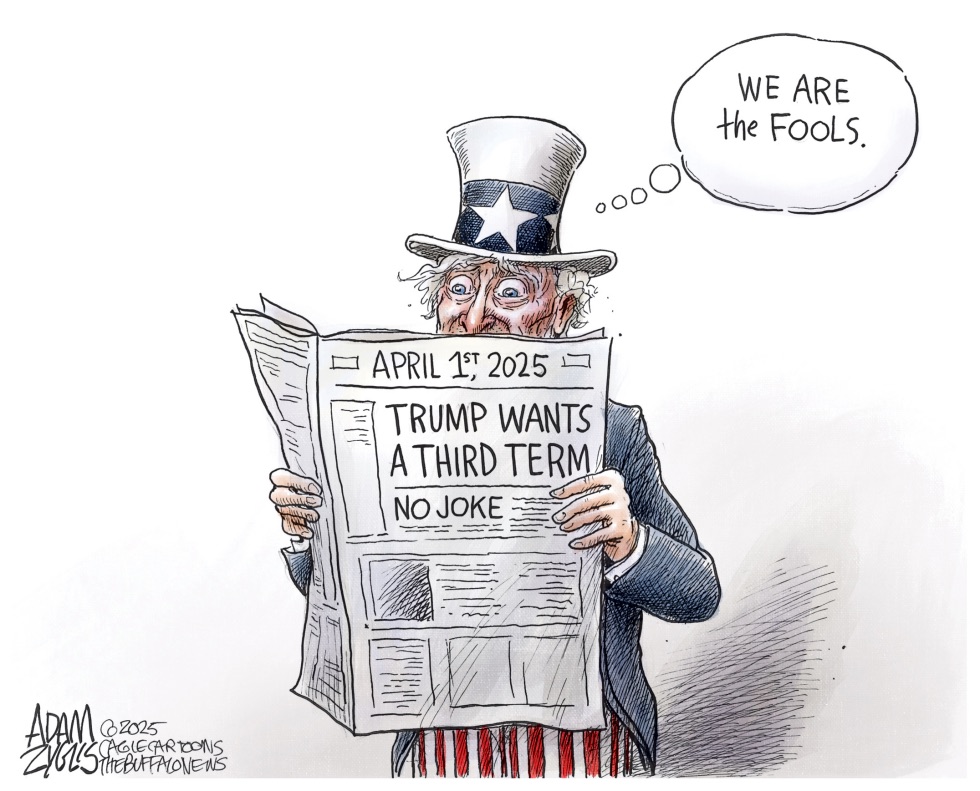
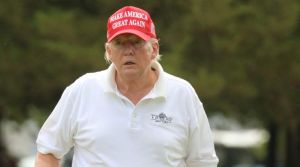
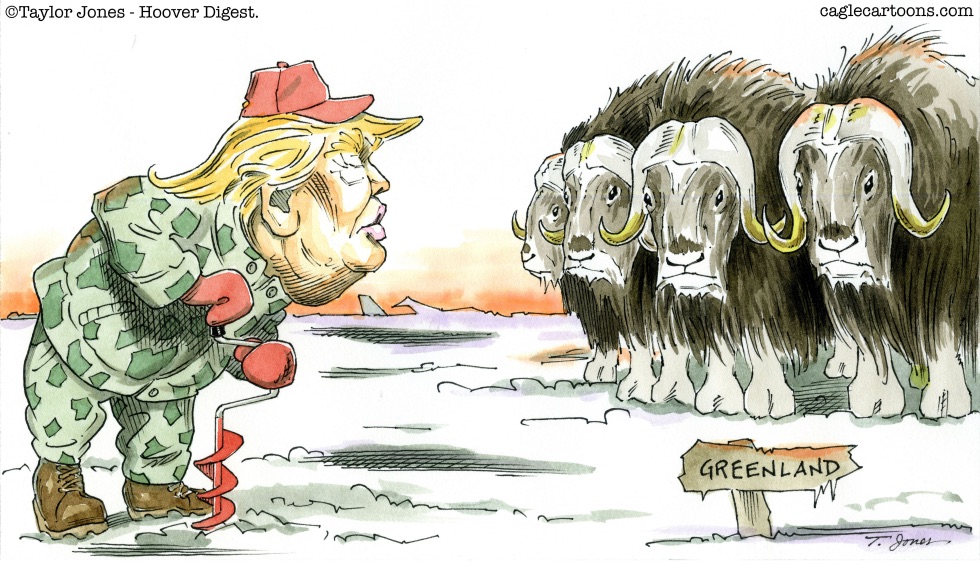
I think she’s right. Trump is spending most of his time posting on Truth Social, playing golf, and fantasizing about annexing Greenland.
The White House is preparing an estimate of what it would cost the federal government to control Greenland as a territory, according to three people with knowledge of the matter, the most concrete effort yet to turn President Donald Trump’s desire to acquire the Danish island into actionable policy.
While Trump’s demands elicited international outrage and a rebuke from Denmark, White House officials have in recent weeks taken steps to determine the financial ramifications of Greenland becoming a U.S. territory, including the cost of providing government services for its 58,000 residents, the people said.
At the White House budget office, staff have sought to understand the potential cost to maintain Greenland if it were acquired, two of the people said. They are also attempting to estimate what revenue to the U.S. Treasury could be gained from Greenland’s natural resources.
One option under analysis is to offer a sweeter deal to the government of Greenland than the Danes, who currently subsidize services on the island at a rate of about $600 million every year.
“This is a lot higher than that,” said one official familiar with the plans, who like others spoke on the condition of anonymity to discuss plans that remain in the works. “The point is, ‘We’ll pay you more than Denmark does.’”
Trump has said repeatedly that the United States will “get” Greenland.
“100 percent,” he told NBC News on Saturday. Asked whether it would involve force, he said that there is a “good possibility that we could do it without military force” but that “I don’t take anything off the table.”
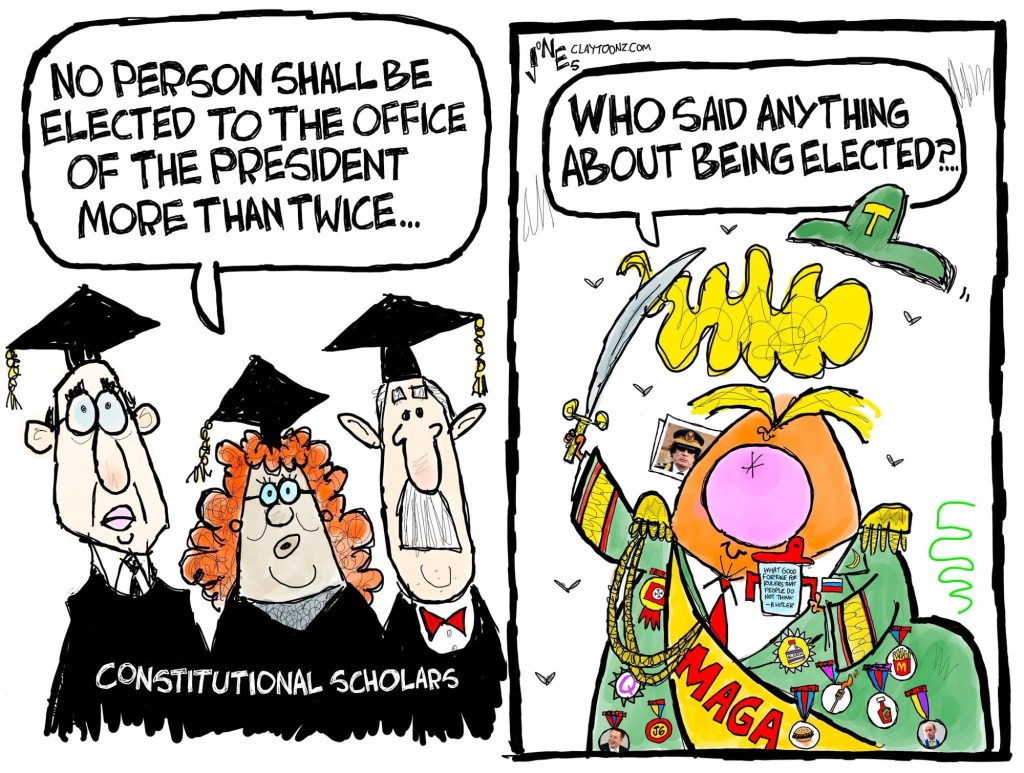
If only the Democrats could take the House and Senate in 2026, they could impeach this insane monster.
I know this is getting long, but I need to include one more outrage: the decimation of public health infrastructure.
The Trump administrationgutted federal health agencies on Tuesday morning, as thousands of employees received layoff notices, following Health and Human Services Secretary Robert F. Kennedy Jr.’s announcement last week he was planning to lay off nearly 10,000 workers.
More than 7,000 workers at the Centers for Disease Control and Prevention, the National Institutes of Health, the Food and Drug Administration, and the Centers for Medicare and Medicaid Services were cut. Staffers with decades of experience received emails at 5 a.m. on Tuesday that they were being placed on administrative leave and would no longer have access to their buildings, effective immediately. In the Washington D.C. area, thousands of federal workers lined up outside office buildings to see if their badges worked, as they hugged each other in tears.
Robert F. Kennedy, Jr.
Kennedy, a vaccine skeptic, is attempting to gut the agencies and remake them in his image. These cuts will allow HHS to consolidate not only authority but messaging, as many of the departments affected involve communications departments. The massive layoffs are part of Donald Trump’s broader purge of the federal workforce, and parallel what Elon Musk is doing with his so-called Department of Government Efficiency (DOGE), which claims to be streamlining the federal government, but is gutting entire agencies. Musk’s DOGE has celebrated the cancellations of NIH grants, something Senator Cory Booker decried during his record-breaking filibuster on Tuesday.
On Tuesday, entire divisions were completely obliterated in a move that shocked HHS staffers. Hundreds of researchers studying diseases like HIV and other sexually transmitted diseases were laid off. “I cannot think of a worse idea than firing the people who help keep us healthy and safe from disease,” Senator Raphael Warnock said on X. This comes at a time when the U.S. is suffering from a nationwide measles outbreak….
“It’s so chaotic,” says a CDC employee who received notice Tuesday morning that she was being placed on administrative leave and would be terminated in June. (She asked to remain anonymous for fear of legal retribution, so she’ll be referred to by the pseudonym Samantha.) “The amount of knowledge that is being purged today at CDC is just tragic.” [….]
Samantha, who worked at the CDC’s Division of Environmental Health and Science Practice (DEHSP), says her entire division was eliminated. That includes the Asthma and Air Quality Branch, the Lead Poisoning Prevention and Surveillance Branch, the Climate and Health Activity branch, and the Water Food and Environmental Health Services, among others. Approximately 2,400 employees have been impacted in the CDC.
“They are firing whole organizational units,” says Samantha. “These are people that have 30 years of service, people with children, veterans, there was no thought put into trying to retain people that have institutional knowledge.”
Several top scientists charged with overseeing research into disease prevention and cures at the National Institutes of Health (NIH) were notified that they were subject to a reduction in force on Tuesday as part of a devastating purge of federal employees carried out by US Health and Human Services secretary Robert Kennedy Jr., WIRED has learned.
Multiple sources at the NIH, granted anonymity because they were not authorized to talk to the media, confirmed Tuesday afternoon that at least 10 principal investigators who were leading and directing medical research at the agency had been fired. Among them is Dr. Richard Youle, a leading researcher in the field of neurodegenerative disorders previously awarded the Breakthrough Prize in Life Sciences for his groundbreaking research identifying mechanisms behind Parkinson’s disease.
The Breakthrough Prize ceremony, often referred to as the “Oscars of Science,” was last year attended by Elon Musk, whose Department of Government Efficiency (DOGE) has served as the tip of the spear in President Donald Trump’s campaign to eliminate large swaths of the federal workforce….
Multiple NIH sources tell WIRED the layoffs include—in addition to labor, IT, and human resources personnel—several accomplished senior investigators at the National Institute of Neurological Disorders and Stroke (NINDS), top scientists at the National Institute on Aging, and several researchers noted for their work in HIV, emerging infectious diseases, and child brain and neural disorders.
At an NINDS town hall meeting on Tuesday, leadership at that institute expressed confusion about the cuts, saying they were blindsided by firings of principal investigators, or PIs, who lead research teams. NIH has approximately 1,200 PIs across its 27 centers and institutes. “To get rid of 11 of our senior PIs … we’re hoping that’s a mistake, because we can’t figure out why they would want to do that,” said Walter Koroshetz, director of the NINDS, according to a source present at the meeting.
The labs affected by the layoffs include those involved in clinical trials as well as preclinical studies. It is unclear, NIH staff said, what the plans are for the data they’ve accumulated or what will happen to patients involved in ongoing trials.
I’ll end there. What do you think? What’s on your mind today?
Did you like this post? Please share it with your friends:
Hi, BlueSky. It's Hillary.I've joined up here to help get the word out about an important election in Wisconsin tomorrow, and other ways to defend our democracy against those who think votes can be bought.
The Sky Dancing banner headline uses a snippet from a work by artist Tashi Mannox called 'Rainbow Study'. The work is described as a" study of typical Tibetan rainbow clouds, that feature in Thanka painting, temple decoration and silk brocades". dakinikat was immediately drawn to the image when trying to find stylized Tibetan Clouds to represent Sky Dancing. It is probably because Tashi's practice is similar to her own. His updated take on the clouds that fill the collection of traditional thankas is quite special.
You can find his work at his website by clicking on his logo below. He is also a calligraphy artist that uses important vajrayana syllables. We encourage you to visit his on line studio.







 Good Day, Sky Dancers!
 There are three major trade models in economic theory. Basically, the first was mercantilism, which is the colonialist type of economy that caused the Boston Tea Party. The second is absolute advantage, and the third is comparative advantage. We generally have an absolute advantage in nearly all the markets because we’re a huge economy with many natural resources. There are still things we cannot provide, though. The example I always use is coffee.
  So, that’s when I discovered this unhinged hypothesis. I had never heard of Critical Trade Theory before. I had heard of
 I did go to
 And here’s a snip from the transcript.
 This is from CNBC, as reported by Ruxandra Iordache.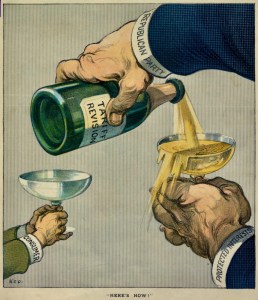

























 peej
peej Carissa
 bostonboomer
 dakinikat
 ecocatwoman
 mablue2
 Mama Lopez
 peggysue22
 quixote
 skydancingguestblogger
 Mona (aka Wonk the Vote)



 Sky Dancing
Recent Comments