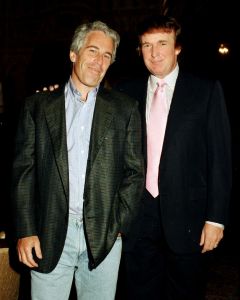
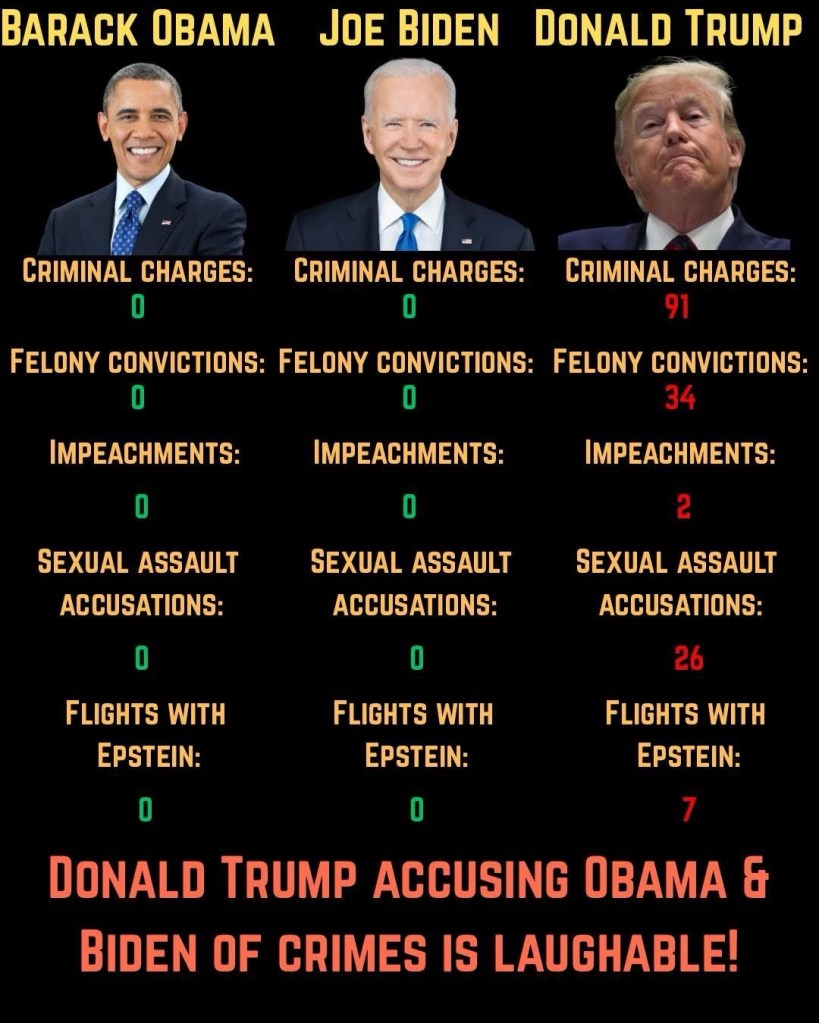
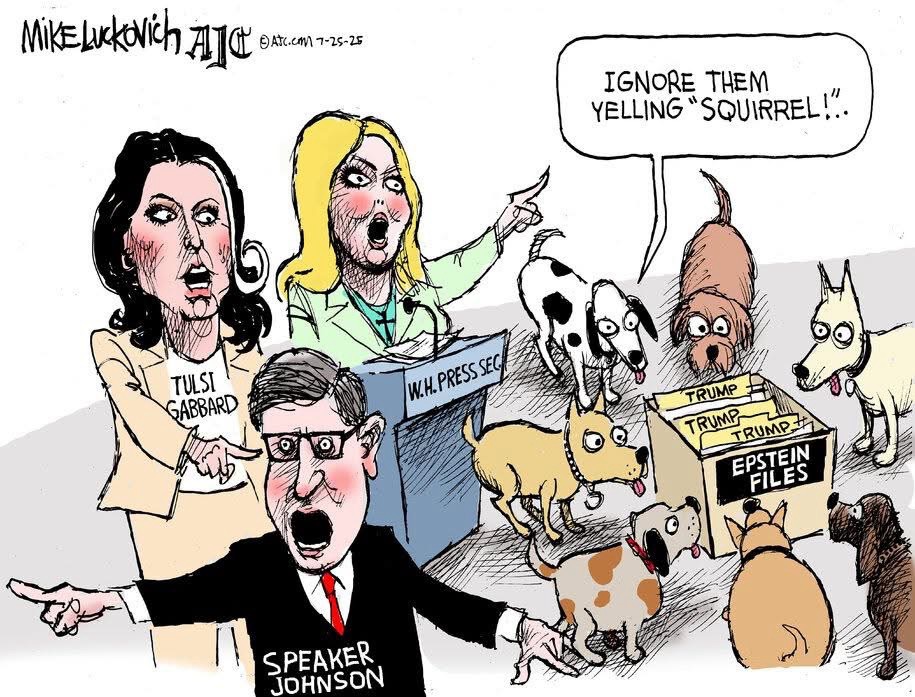
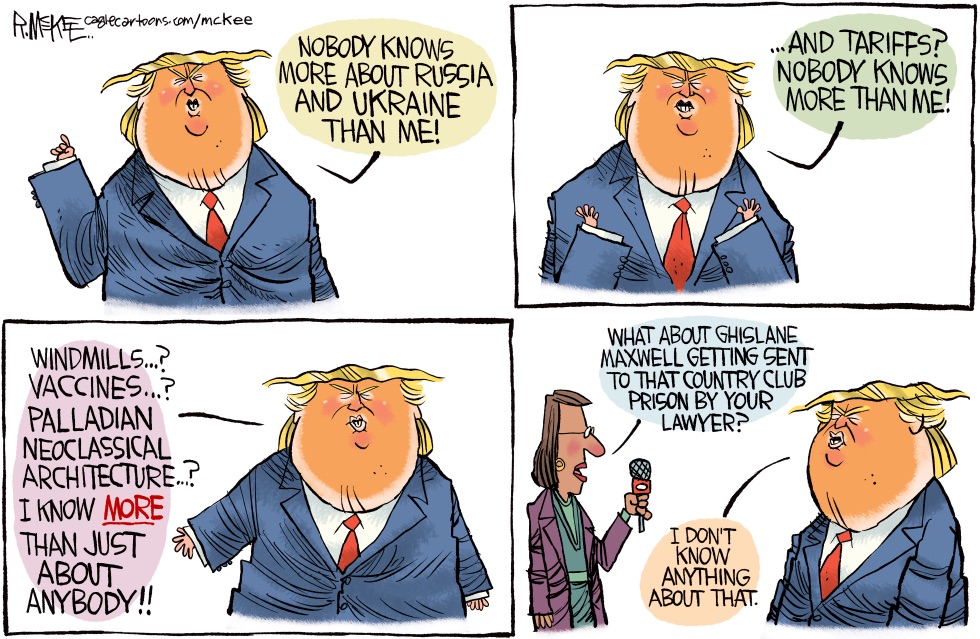
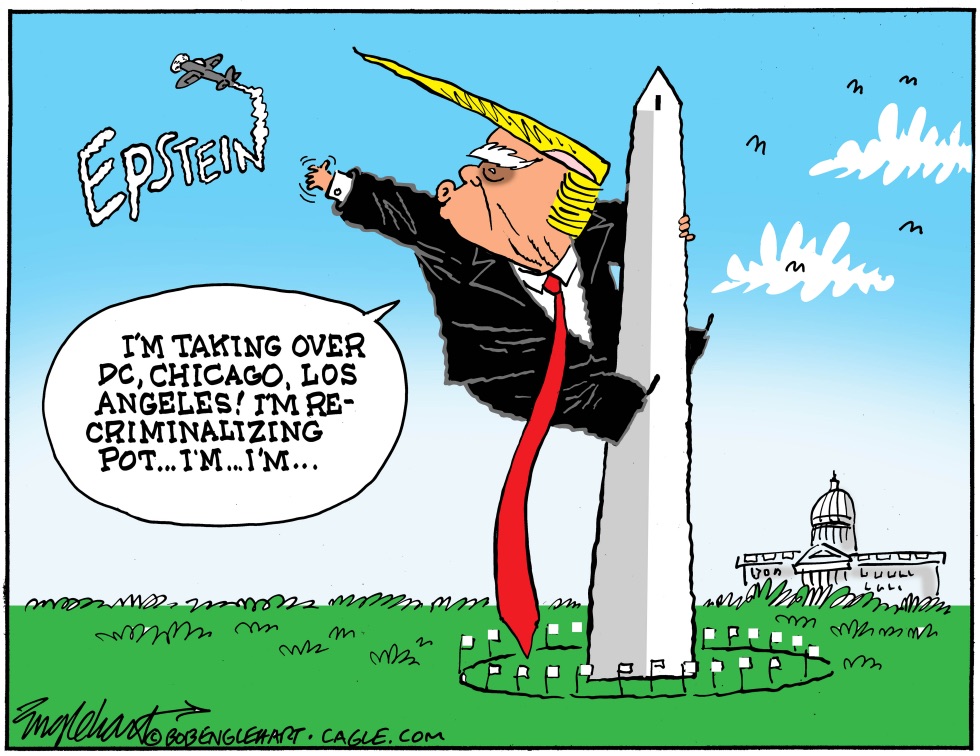
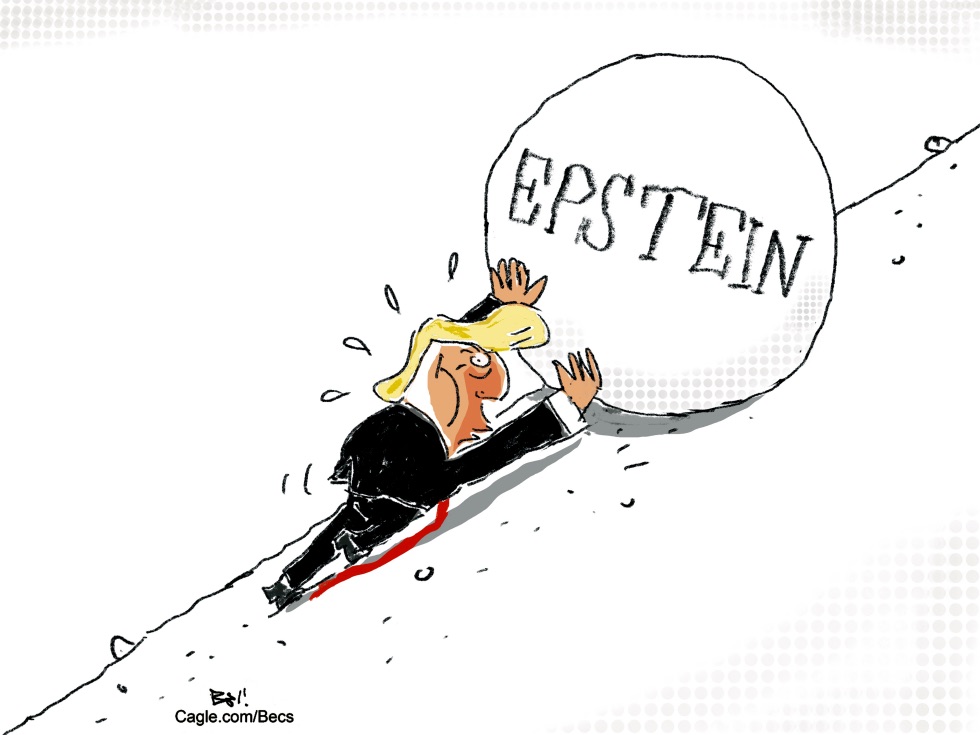
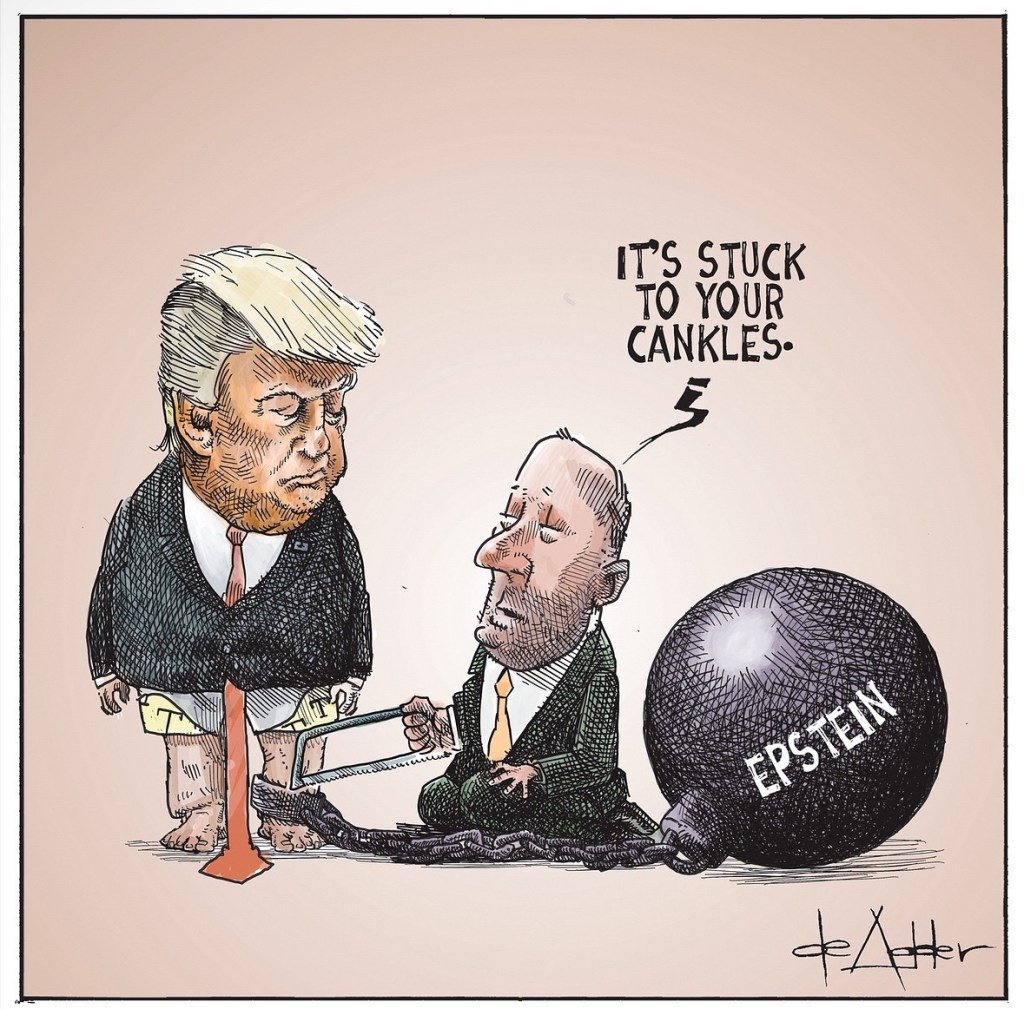
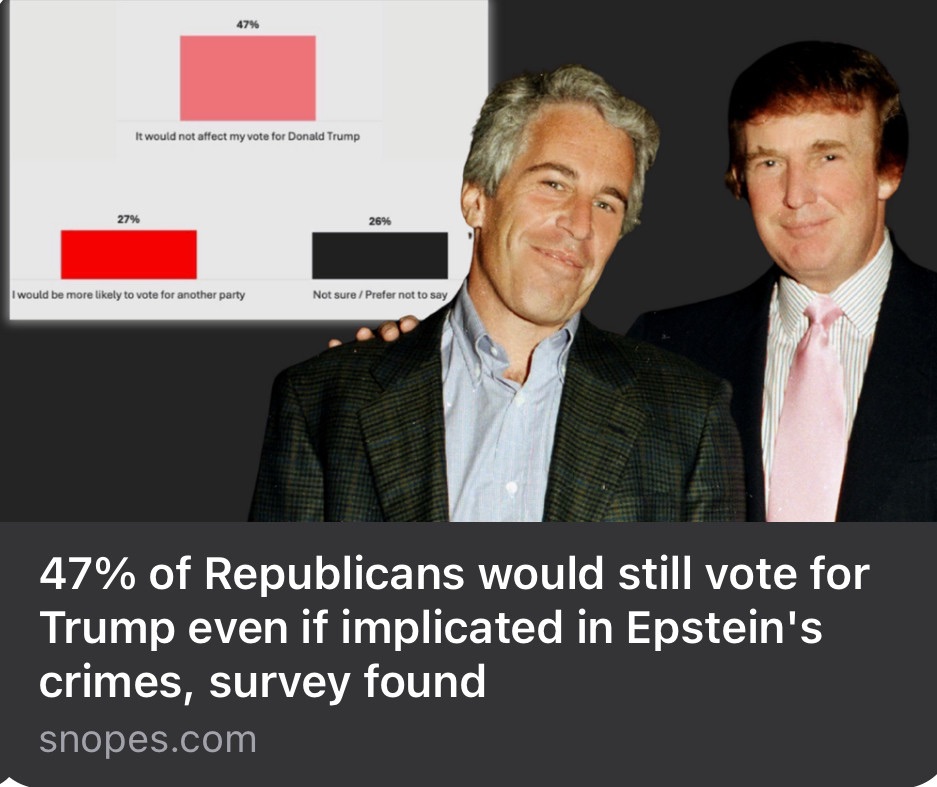
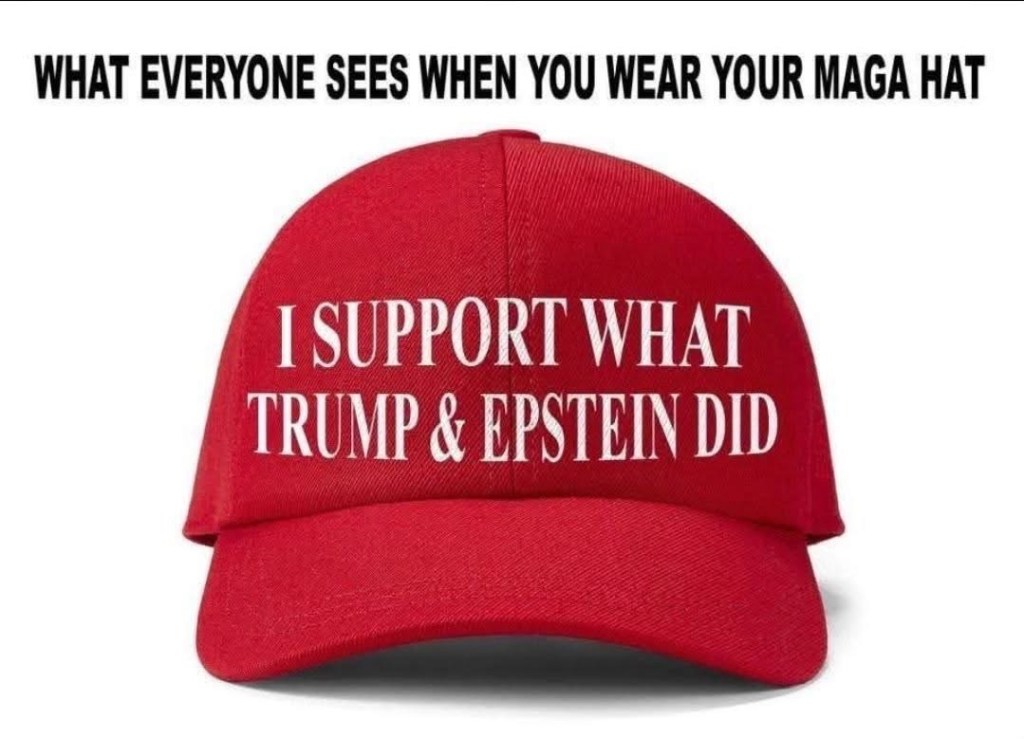
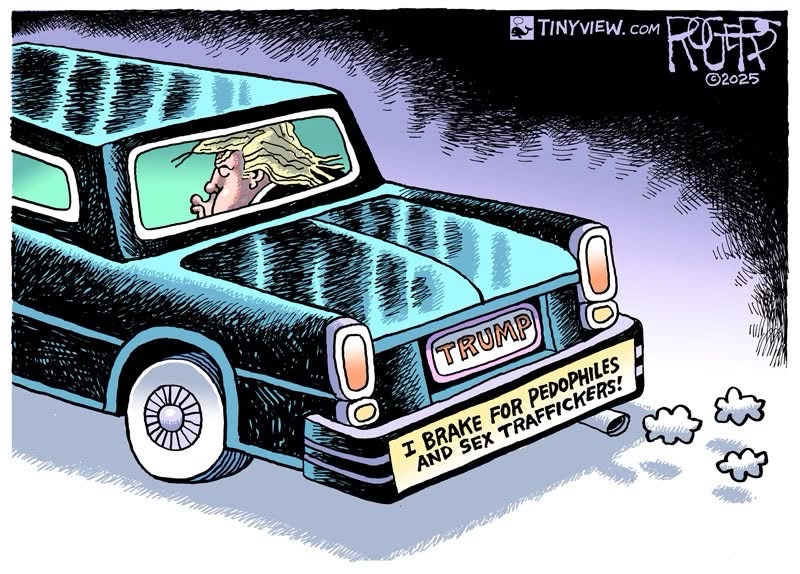
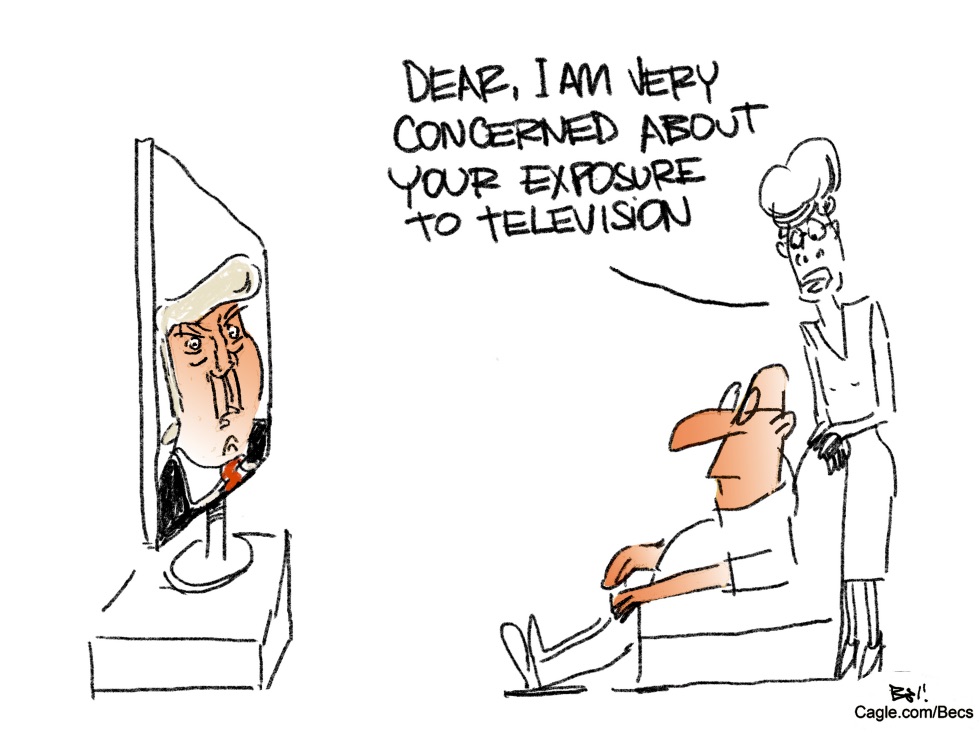
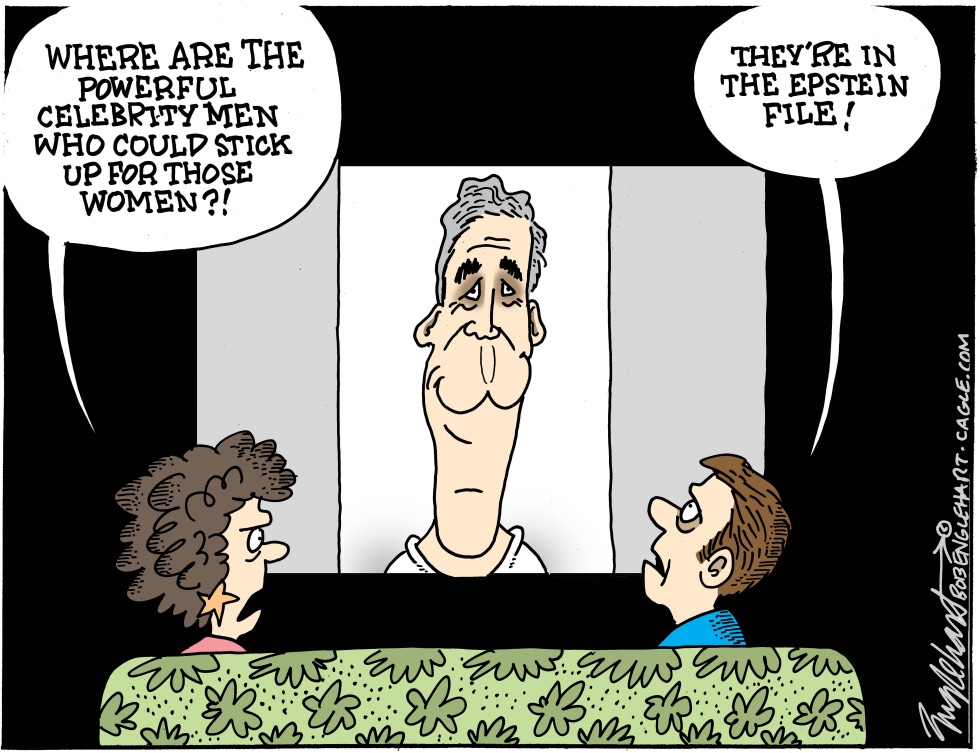
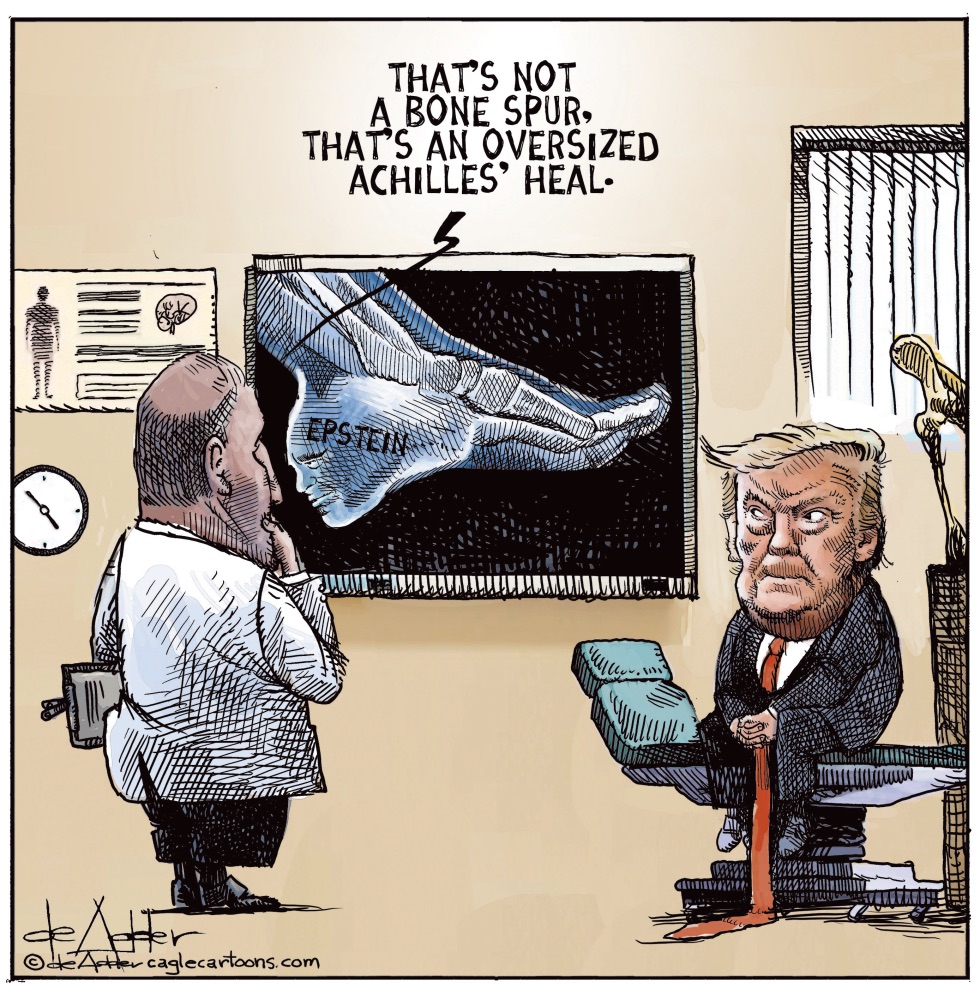
Trump’s efforts to distract from his close friendship with Jeffrey Epstein are doomed to failure.
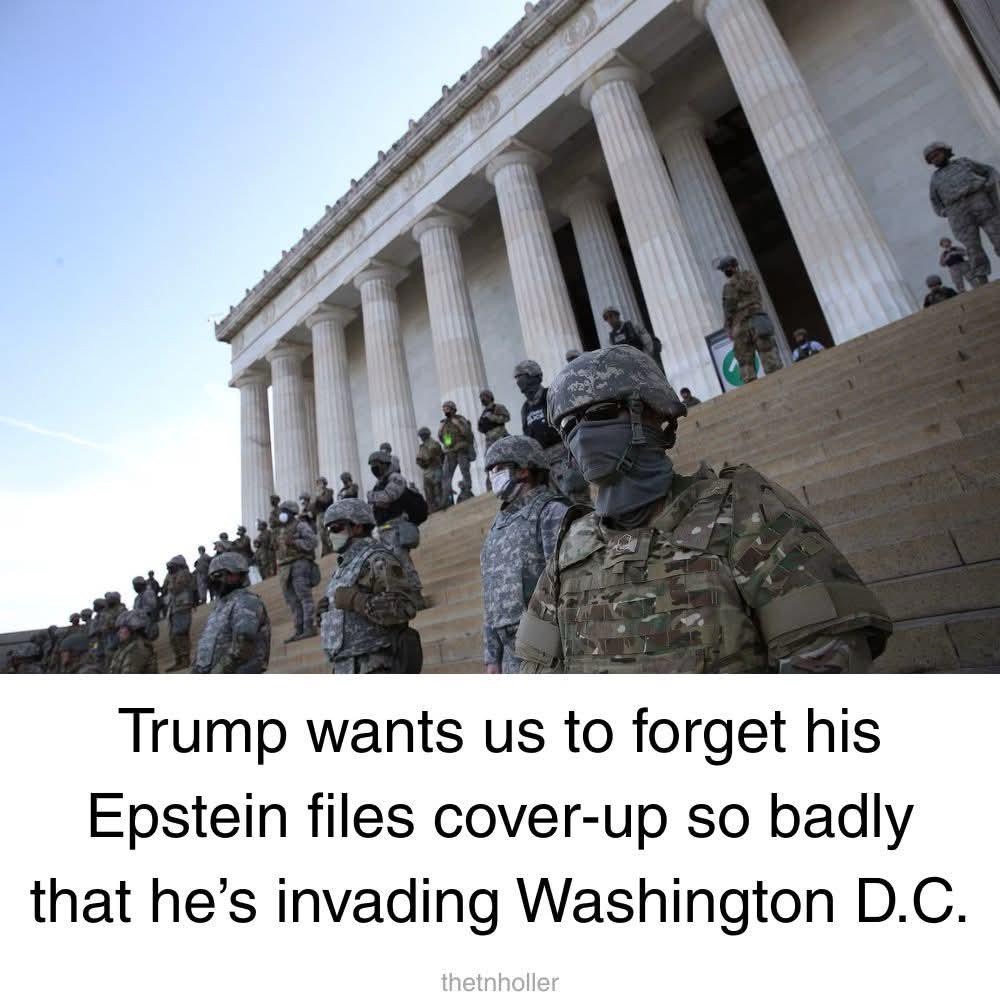
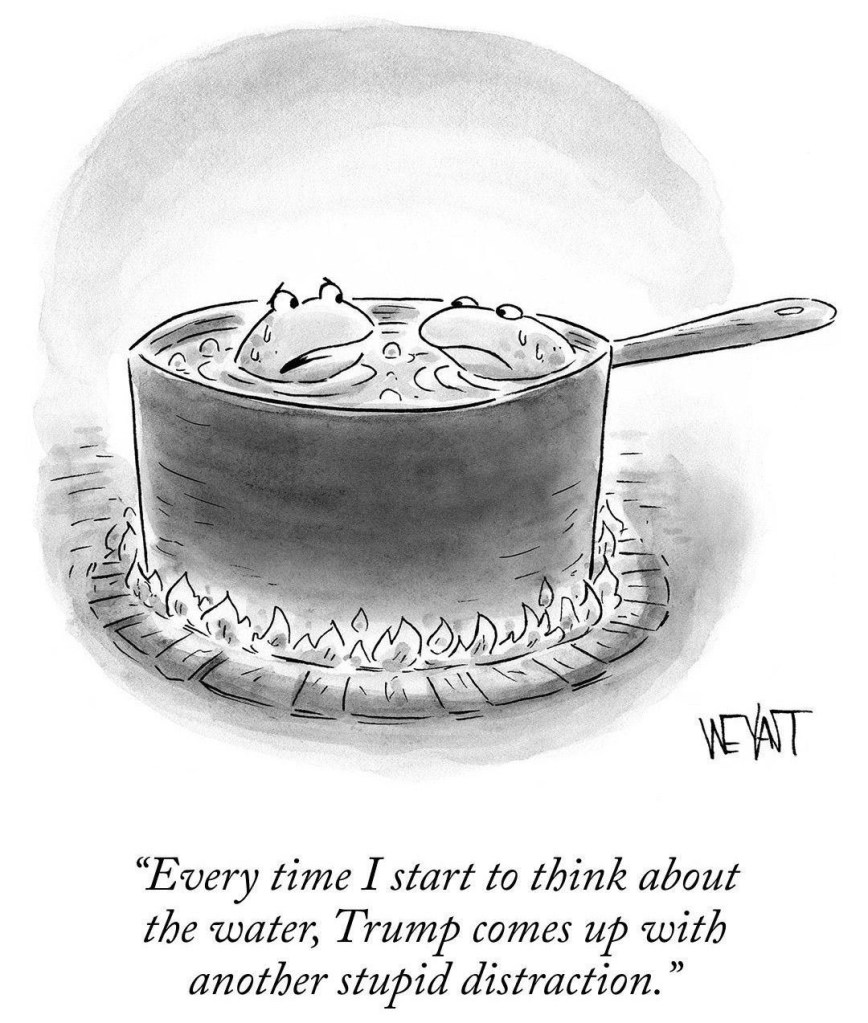
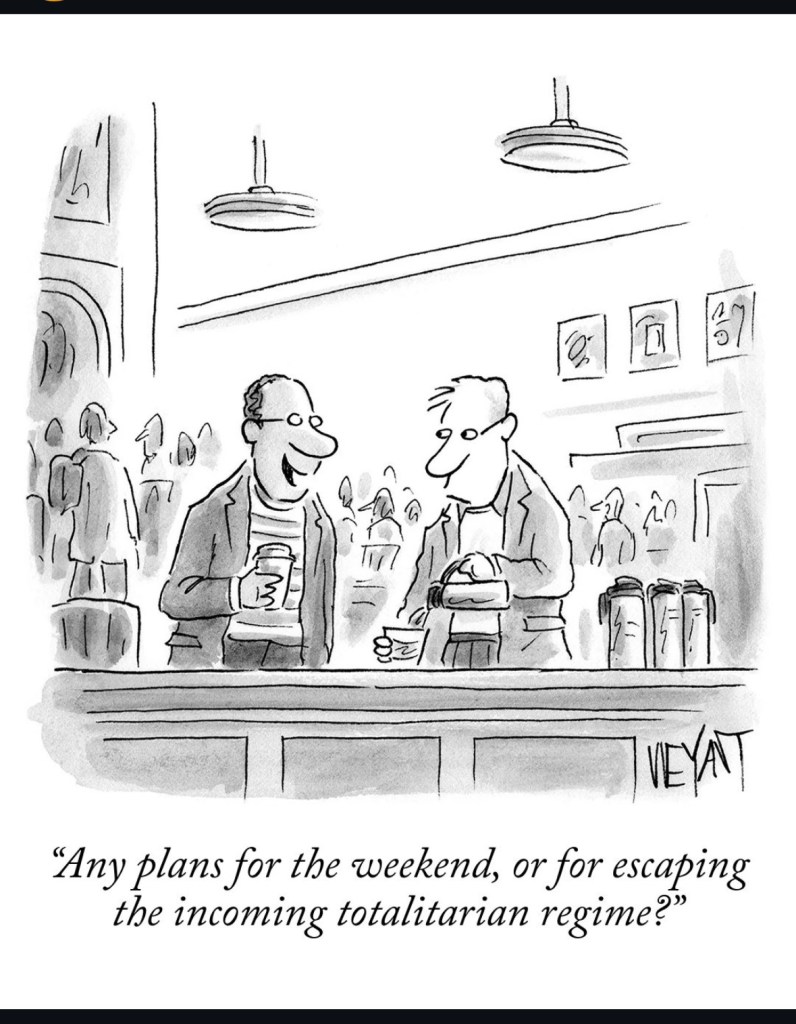
It’s just another day under the rule of fascist dictator wannabe Trump. All I can say is whatever is in the Epstein files about Trump must be really damaging, because every day he dreams up one or two new distractions.
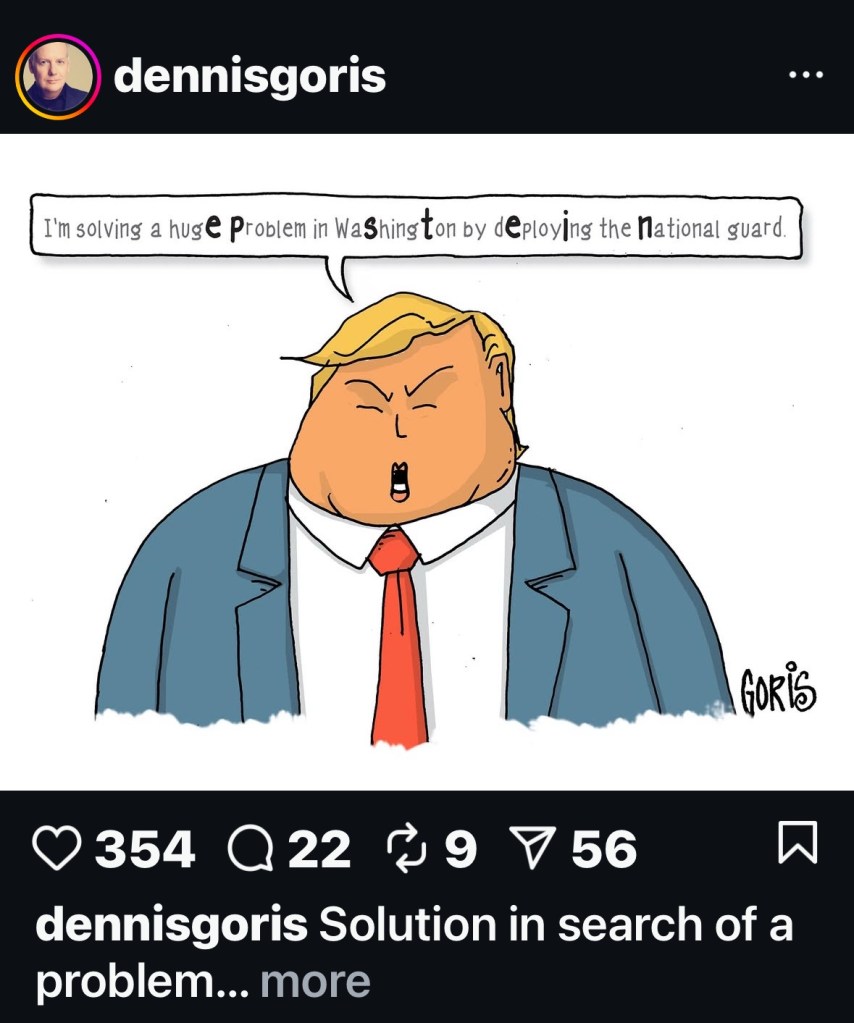
President Donald Trump has reportedly been frantically calling aides and allies seeking a “big thing” to distract from the Jeffrey Epstein scandal, and he’s purportedly considering a major geopolitical move to turn the page politically.
Trump biographer Michael Wolff told The Daily Beast’s new podcast “Inside Trump’s Head” that the president has been making “relentless” phone calls demanding ideas to get him past questions about his longtime relationships with the late sex offender and his accomplice Ghislaine Maxwell.
“Let me go back about a week or so, or 10 days, when Trump started to say to everyone who would listen — and everyone listens to Donald Trump — to staffers and on the phone calls, the relentless phone calls that he’s constantly making, he said, ‘I need a big thing, I need a big thing,'” Wolff told the podcast. ”What’s the ‘big thing?’ And everyone understood that this was code for I need a distraction from Epstein. What’s the thing that will move us beyond that?”
Trump considered turning New York City mayoral candidate Zohran Mamdani into a MAGA villain and reportedly called his chief rival Andrew Cuomo to discuss the plan, but Wolff said that option “didn’t get that traction,” so he next moved on to deploying soldiers and federal law enforcement in Washington, D.C., before landing on something else to distract his base.
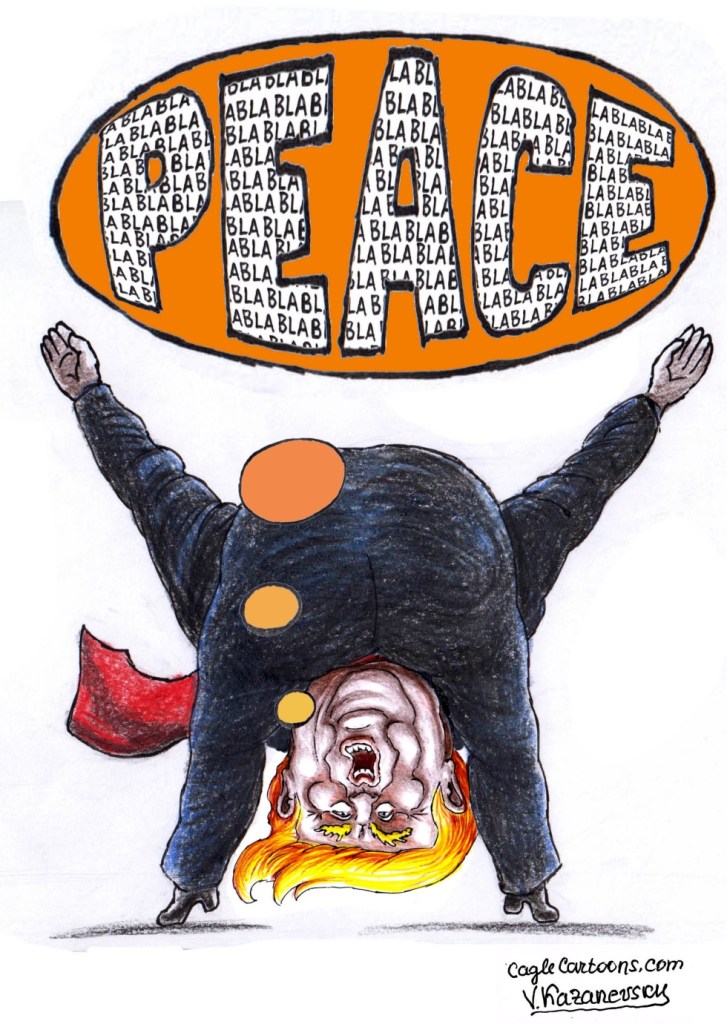
“That is what he got to,” Wolff said. “‘I’m going to have to do Ukraine.’”
Wolff claims the president will pull the U.S. out of any involvement in the Russia-Ukraine conflict, which Trump believes will appease the isolationist MAGA base, after he meets with Russian President Vladimir Putin this week in Alaska.
“He’s going to sacrifice Ukraine for Epstein,” Wolff said. “Essentially, this is, in his mind, a trade. It is the MAGA people who have pressed this Epstein issue constantly. I mean, they’re the threat.”
Wolff doesn’t think that will work either.
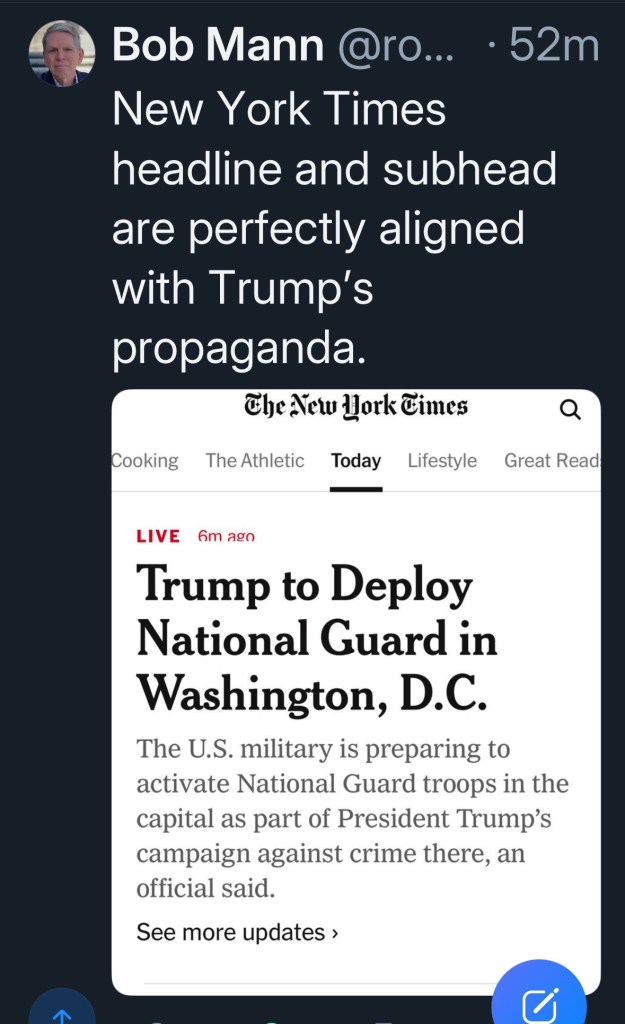
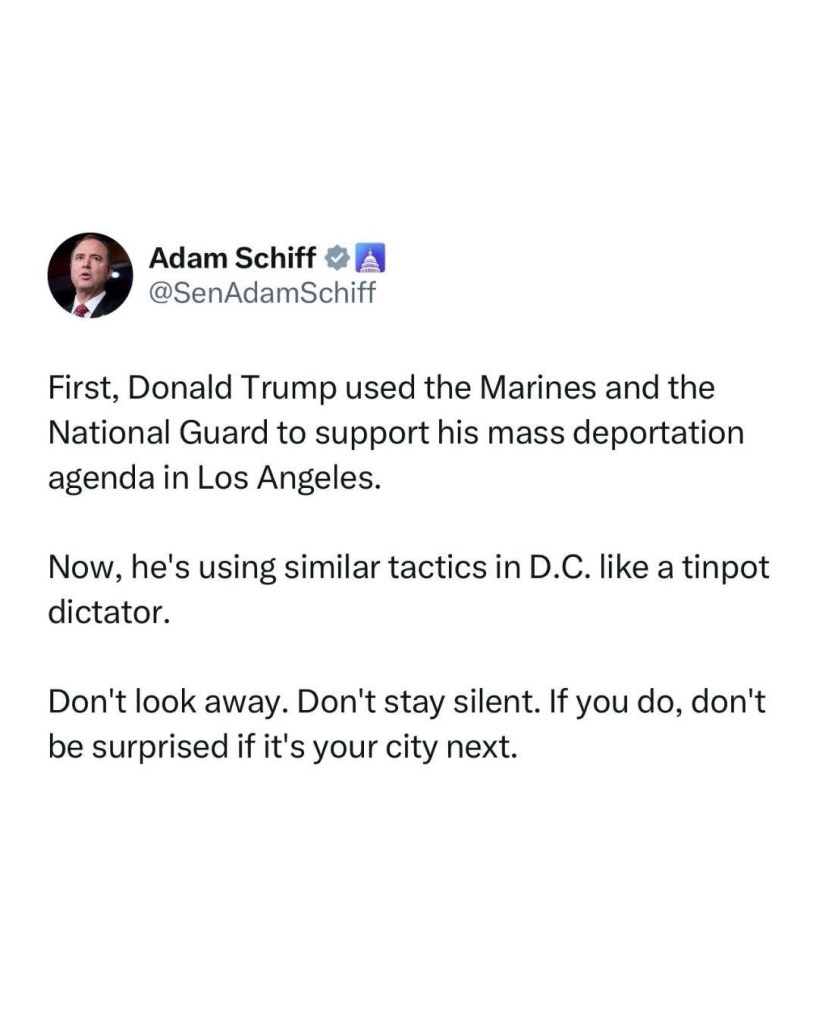
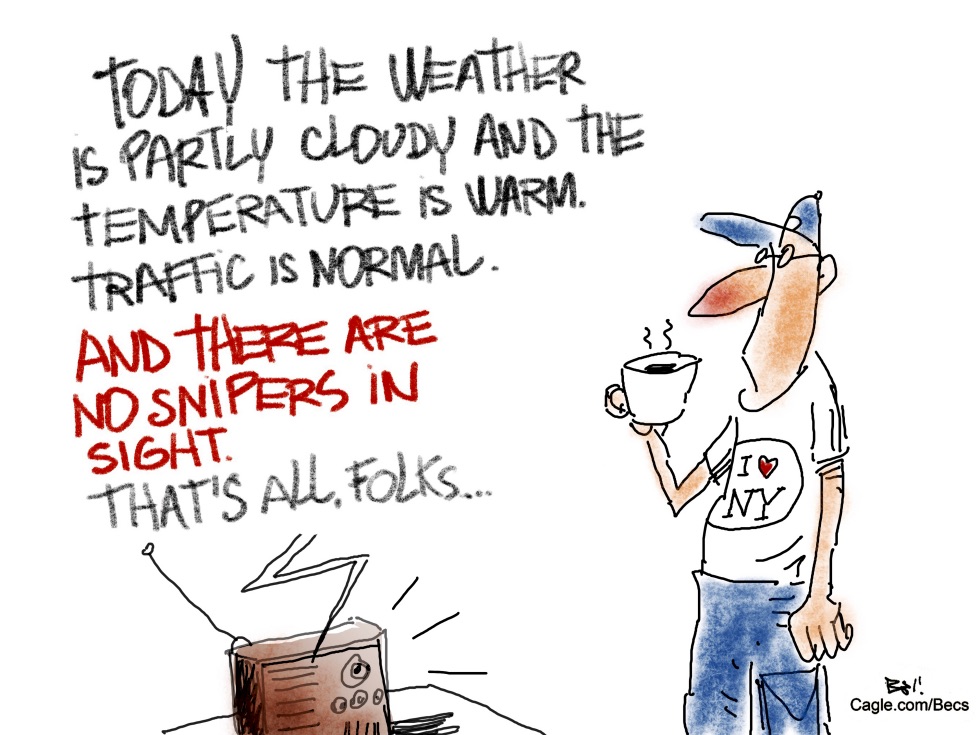
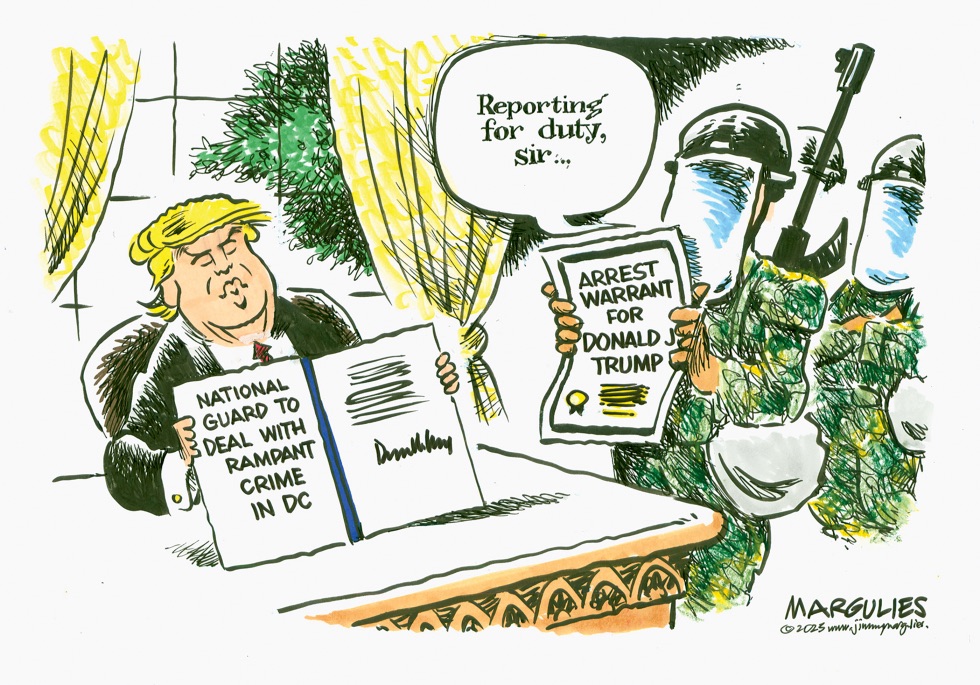
The National Guard began to show up on the DC streets yesterday.
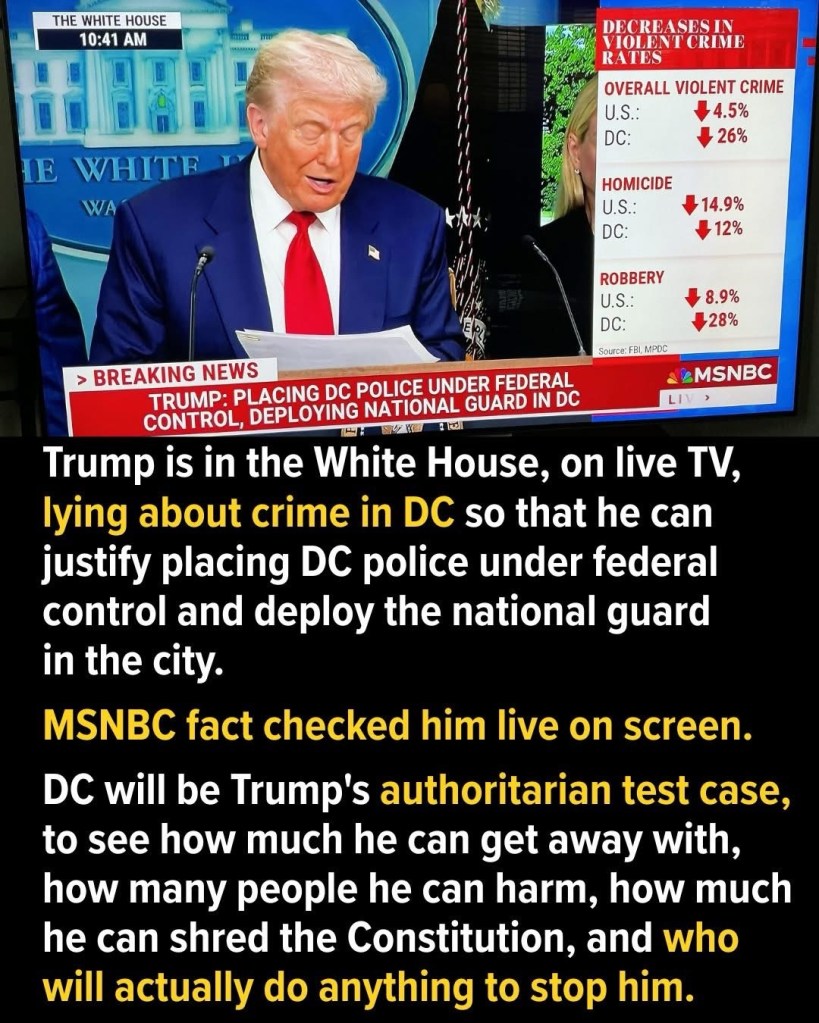
On Monday, Trump dropped two executive orders, two fact sheets, and two “articles” (who knew that the White House issues articles?) about his decision to federalize the DC police and deploy the National Guard. Then, he held a bonkers press conference where he gave Attorney General Pam Bondi control of the DC police “as of this moment,” at which point Bondi took the podium to declare that “crime in DC is ending and ending today.”
It’s important to be precise about what’s happening in DC and why. As Chris Geidner explains at Law Dork, calling this a “takeover” of DC itself or the DC police is inaccurate.
DC’s Home Rule Act has a provision that lets the president direct the mayor to provide District police force service for federal purposes if he deems it necessary and determines an emergency exists. He can do that for 48 hours without informing Congress. Once he informs Congress, he gets 30 days. Past that, Congress needs to enact a joint resolution to extend it.
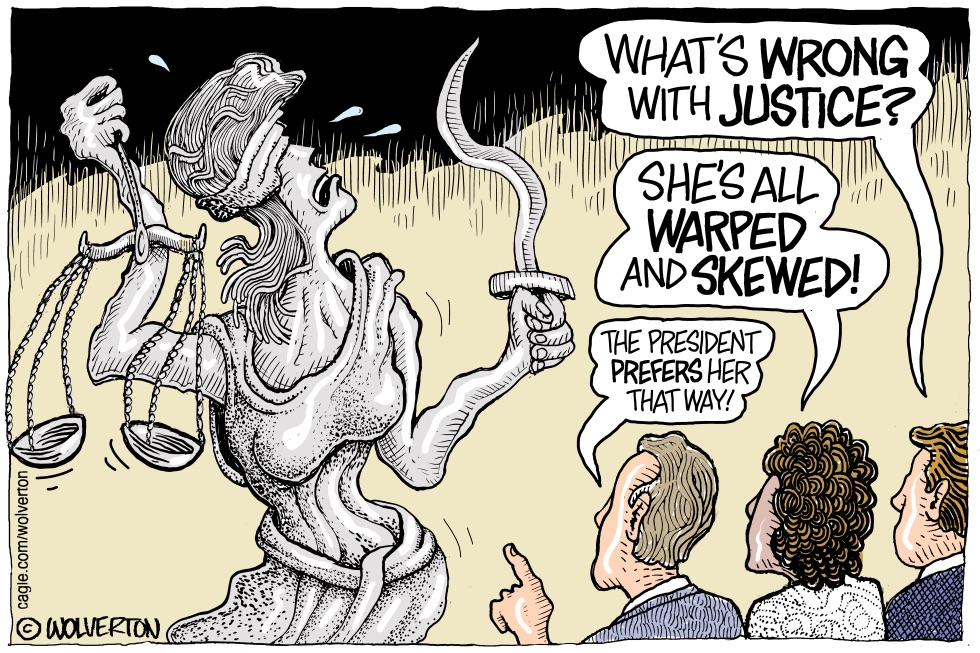
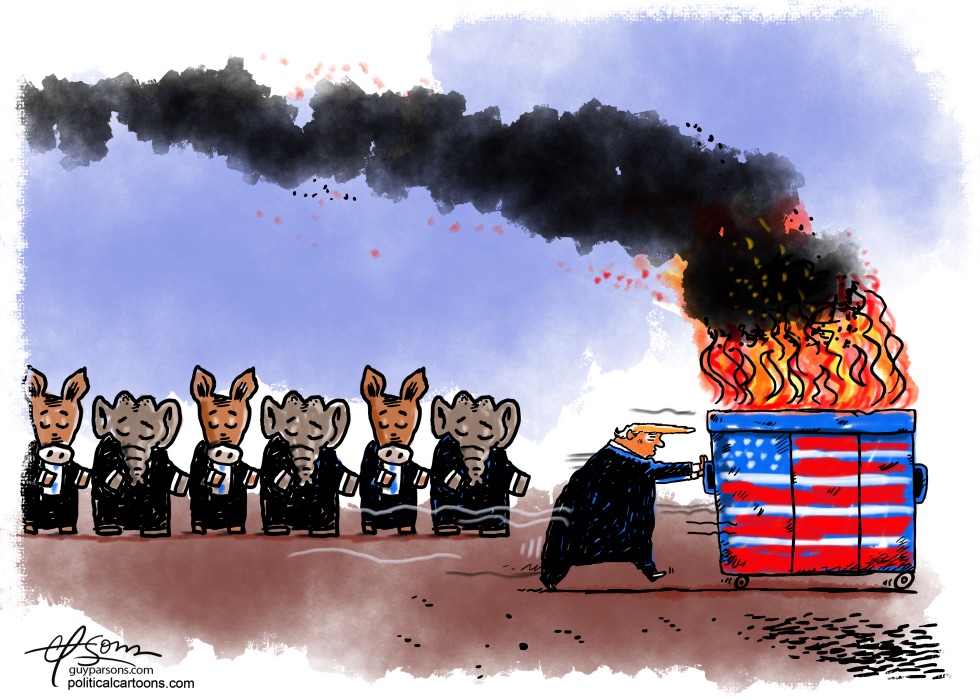
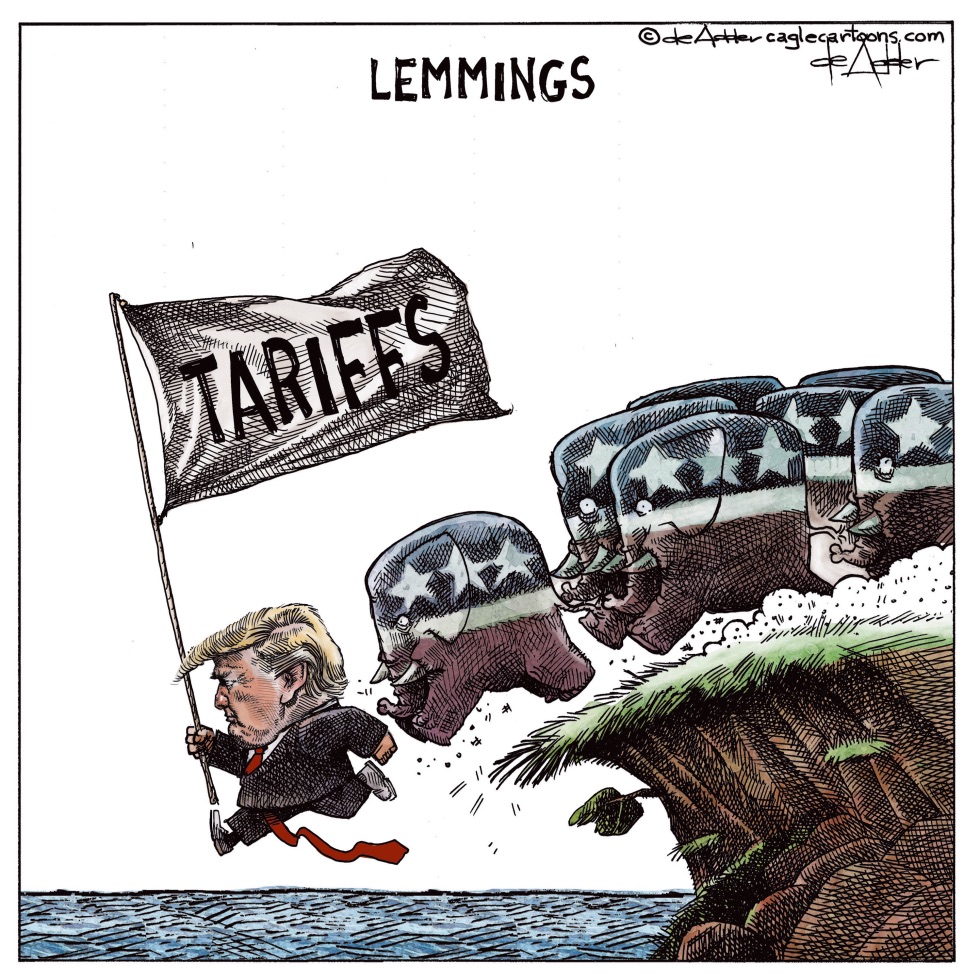
In theory, the legislative branch should act as a check on a lawless president. But given that the GOP majorities in both the House and Senate have willfully abdicated their responsibility to do so, there’s no reason to think lawmakers won’t let Trump’s brownshirts occupy DC as long as he wants.
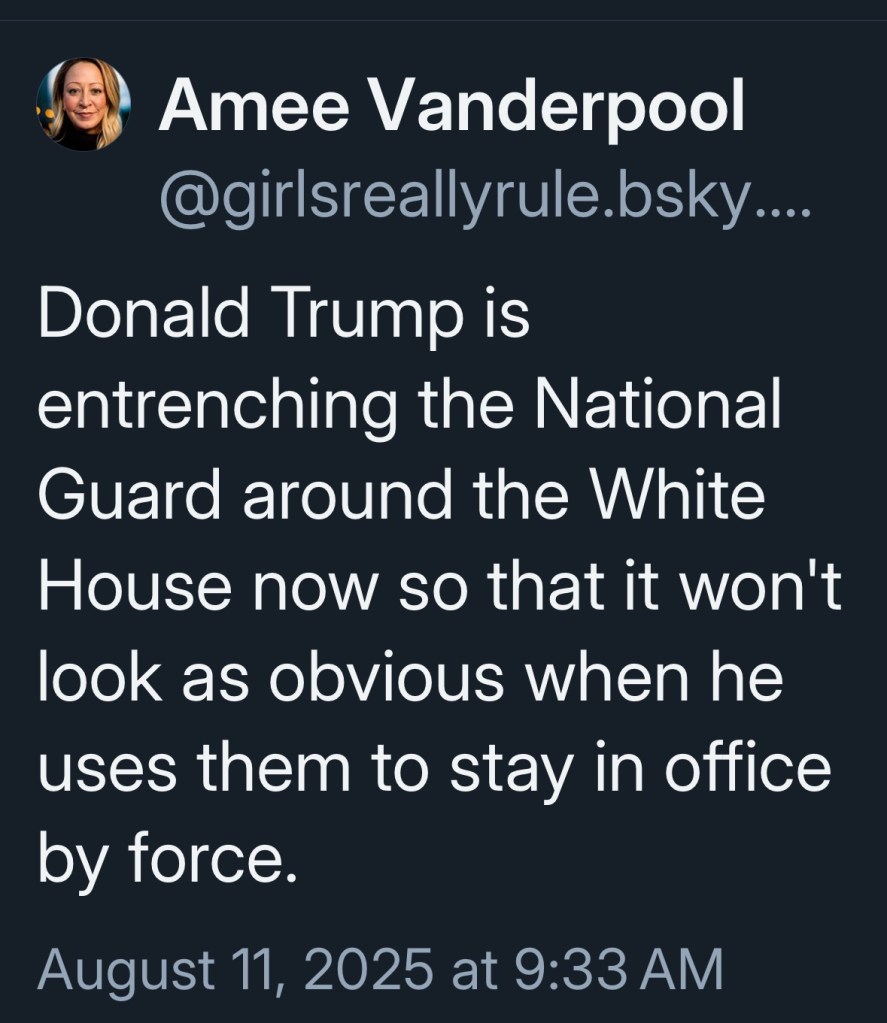
There are no real impediments to the president calling up the DC National Guard. Unlike state National Guards, which are under the control of state governors, DC’s Guard is commanded by the president. Further, the position of the DOJ’s Office of Legal Counsel is that the DC National Guard can be used for federal work without being federalized, unlike state National Guards. This means it can be used for law enforcement purposes without running afoul of the Posse Comitatus Act, which otherwise prohibits the use of federal troops for civilian enforcement efforts.
National Guard troops arriving in DC yesterday
So, the DC Home Rule Act, combined with the structure of its National Guard, gives the president a perfectly legal and relatively friction-free way to make local police do his bidding and to have the National Guard roam the streets.
At the moment, there’s a pretense that the DC National Guard will not be performing law enforcement duties. Instead, they have the authority to detain people temporarily until federal agents arrive. But as any first-year law student can tell you, if someone cloaked in the authority of the government has the power to detain you, they are engaged in law enforcement duties. It doesn’t matter that they eventually hand you off to someone else with the proper authority to detain you.
Defense Secretary Pete Hegseth must be so hyped for this. He can pretend he’s a five-star general in charge of a vast array of troops rather than a doofus civilian whose main achievement currently consists of posting misogynist and eugenicist garbage on his social media accounts — well, and sharing classified military plans in the group chat. He’s pretty good at that. But now, Hegseth gets to do Fox hits and bray about how the DC Guard “will be strong, they will be tough and they will stand with their law enforcement partners.”
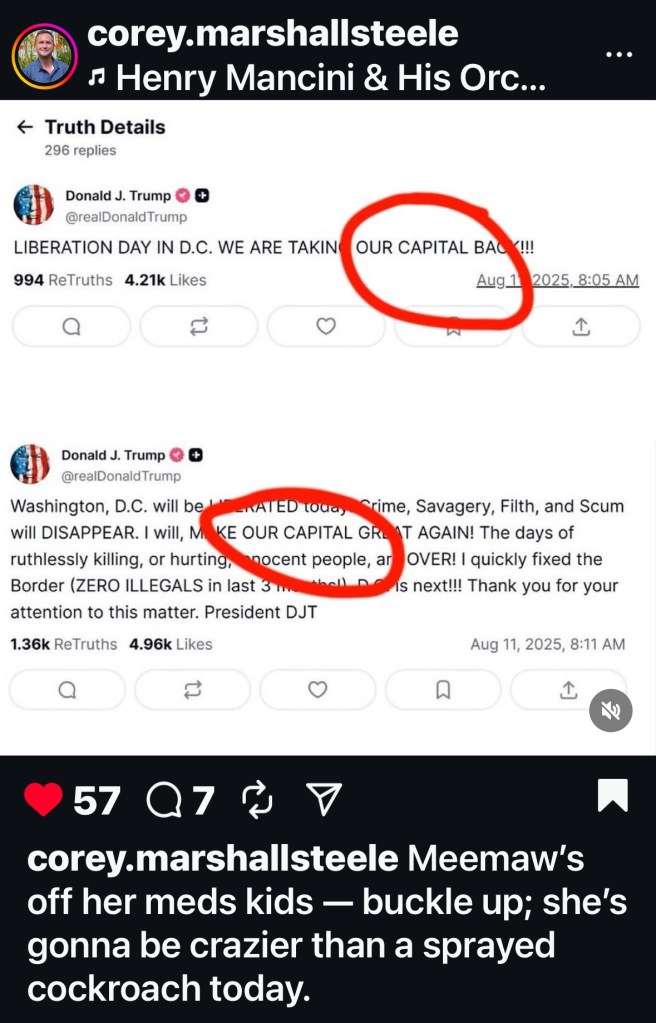
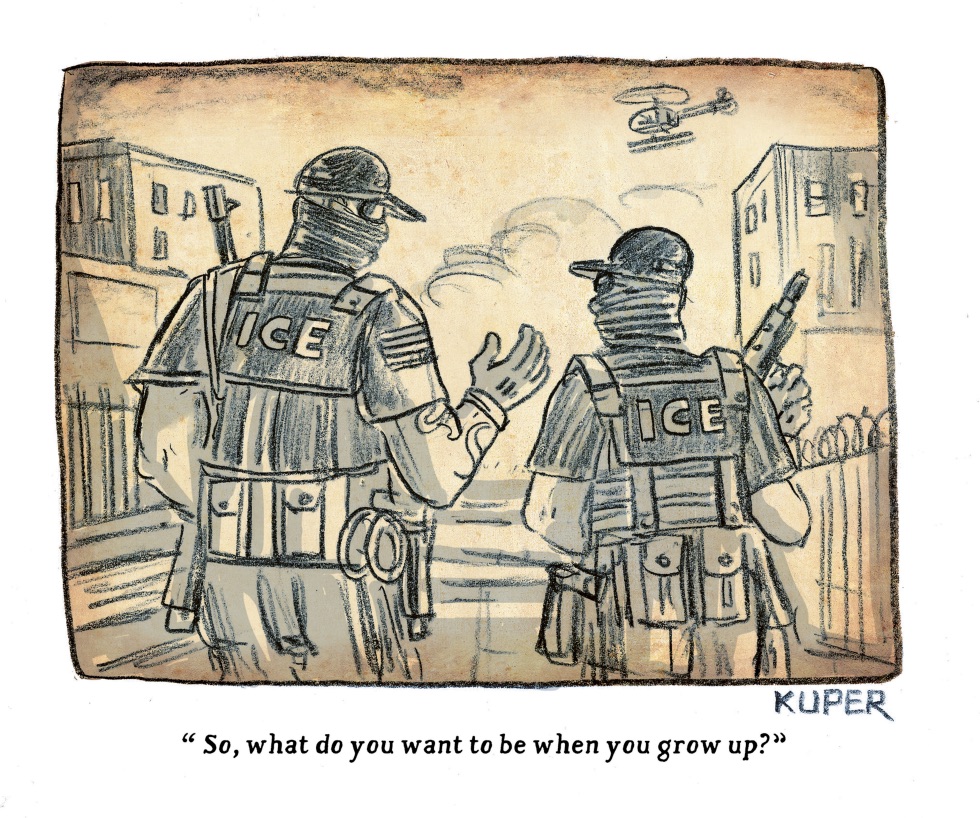
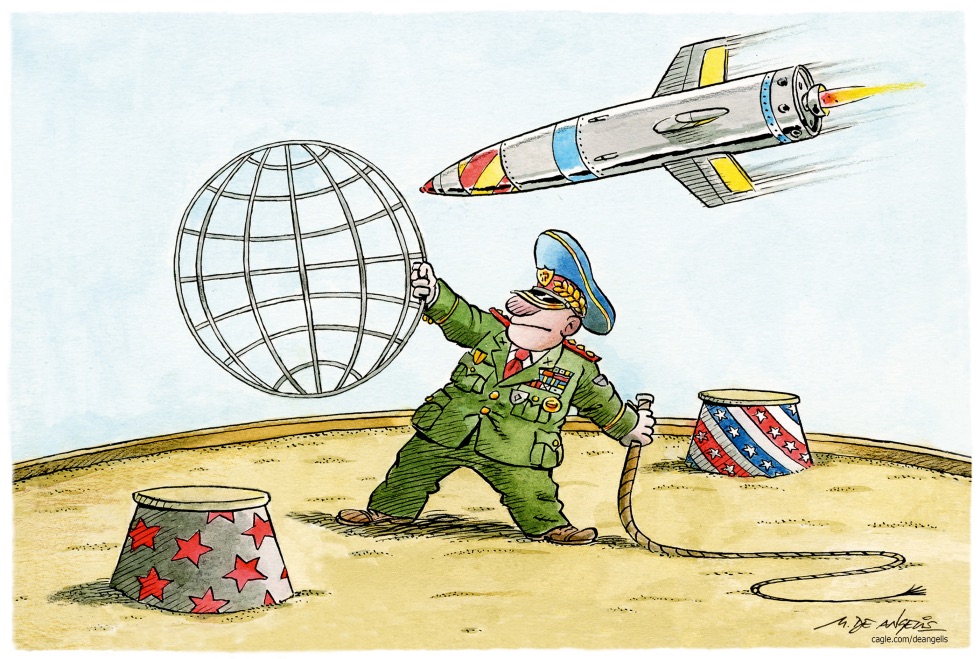
President Donald Trump has expanded his military campaign against the United States by deploying armed troops to yet another major metropolitan area, announcing on Monday that he is sending the National Guard into Washington, D.C., to “liberate” the city.
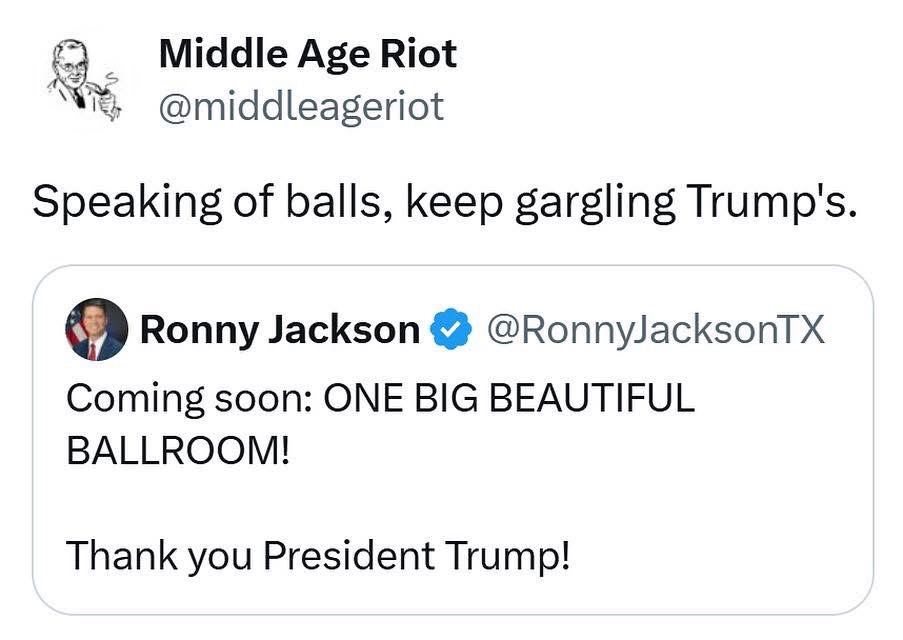
Big Balls before and after attack
The D.C. operation, launched two months after the start of his Los Angeles crackdown, broadens a police-state-style domestic campaign that some senior Trump administration officials describe to Rolling Stone as a “shock and awe” show of force, a reference to the foreign war in Iraq that Trump has pretended to oppose.
It’s only going to get worse.
The president and his top government appointees are publicly stressing that this will not end with D.C. and L.A., that other military options are very much on the table. The facts, the laws, and data do not seem to matter: Trump and his team believe he can do whatever he wants, whenever he wants, including using the U.S. armed forces for domestic political purposes as well as intimidating his enemies. His team is privately putting together plans for him to do just that.
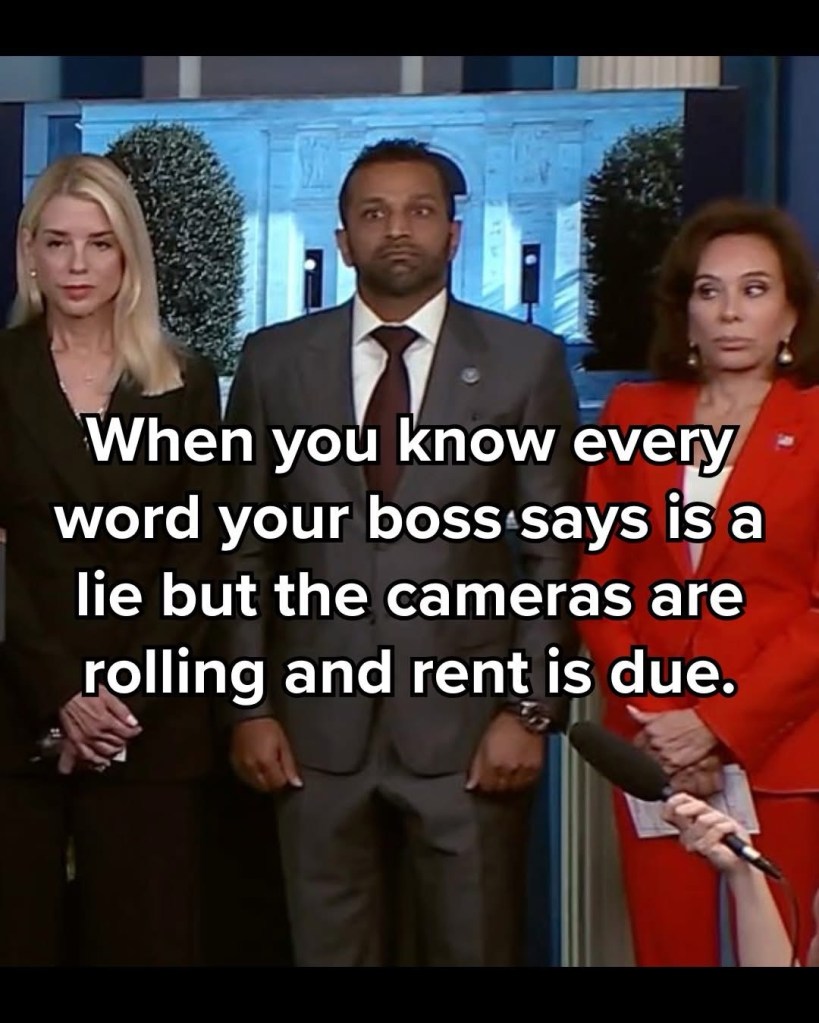
“Make no mistake, this is just the beginning,” U.S. Attorney for the District of Columbia Jeanine Pirro — a staunchly pro-Trump former Fox News host whom the president tapped specifically to “crack skulls” — said Monday night.
Can you believe Pirro is actually the US attorney anywhere?
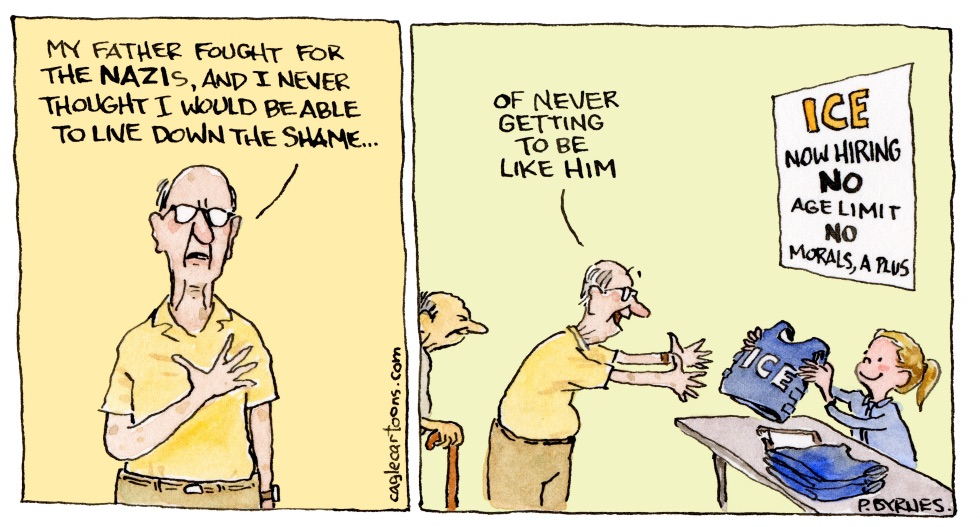
At a press conference Monday announcing that the federal government had seized “direct” control of D.C.’s police department and that the National Guard would soon occupy the city, Trump warned that if he and his officials decide they “need to,” he will deploy military forces to other Democratic cities, too. The president named a few, including Chicago, Oakland, and Baltimore. Illinois Governor J.B. Pritzker, a Democrat whom Trump attacked by name, compared Trump’s use of the military to the Nazis tearing apart Germany’s constitutional republic, per the Chicago Tribune.
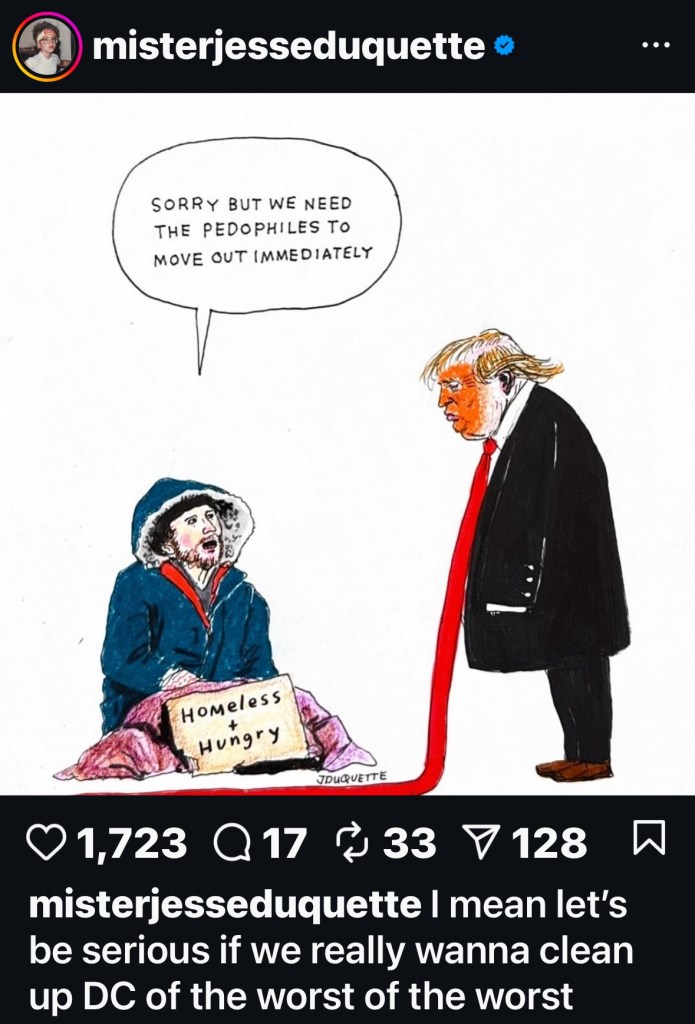
Trump has long yearned to unleash the military on American soil for his political agenda, and the D.C. and L.A. deployments this summer are critical stepping stones in his increasingly authoritarian government’s vision for punishing his enemies Democratic area of the country, carrying out his brutal immigration agenda, and making life hell for unhoused people. Trump said on Monday that federal forces will work to remove “homeless encampments from all over our parks,” and that the unhoused will not be “allowed to turn our capital into a wasteland for the world to see.” [….]
In recent months, according to government officials and other sources with knowledge of the situation, administration staff and lawyers have crafted detailed plans and menus of options for Trump to feed his desire for replicating and proliferating his militarized crackdowns — on immigrants and citizens alike — to different Democratic strongholds. National Guard troops are already mobilizing in D.C., and Trump has privately said, according to two sources familiar with the matter, that if he sees something that he feels crosses his line (like if street protests in the city grow too big or if he deems them a threat suddenly), he will gladly order larger numbers of troops to nation’s capital, as he did in Los Angeles earlier this year.
Trump has insisted to administration officials that it’s ridiculous that troops like National Guard members are not allowed to conduct various forms of domestic law enforcement, sources add. The president and his administration to some extent have had their hands tied on this due to the Posse Comitatus Act — which prohibits using the military for domestic law enforcement — though that isn’t stopping them from actively exploring ways around the law. “There are ways things were done, and that’s not always going to be how they should be done now or tomorrow,” a senior Trump administration official tells Rolling Stone.
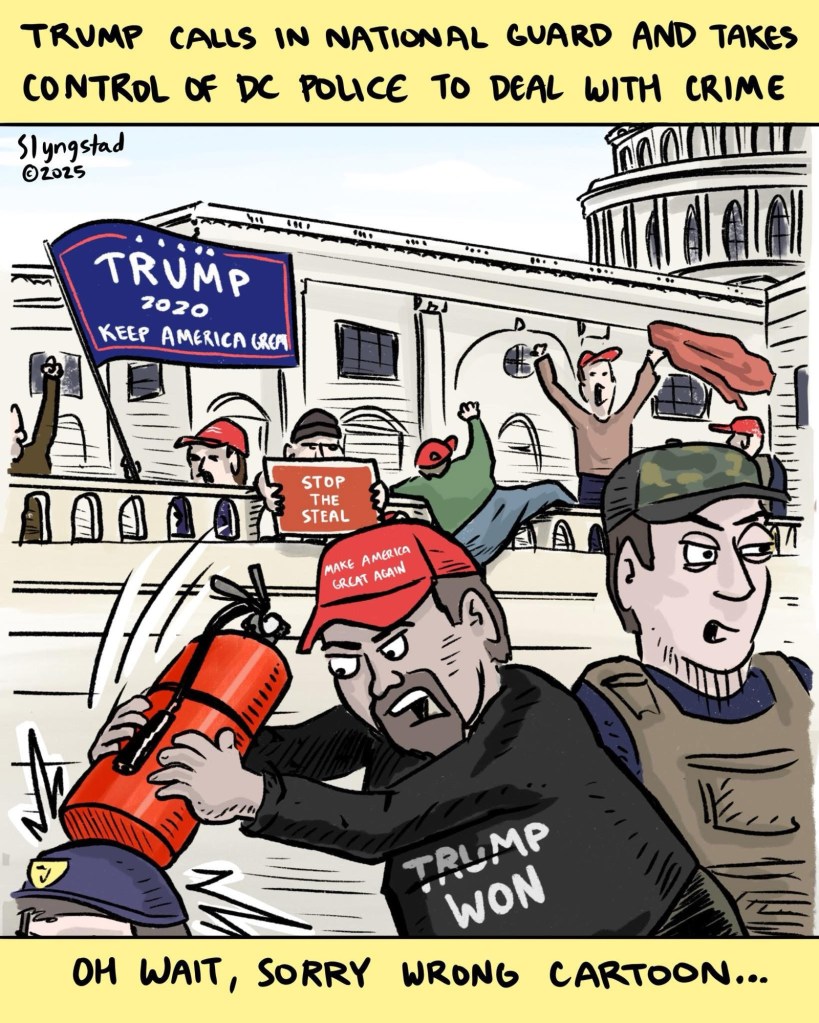
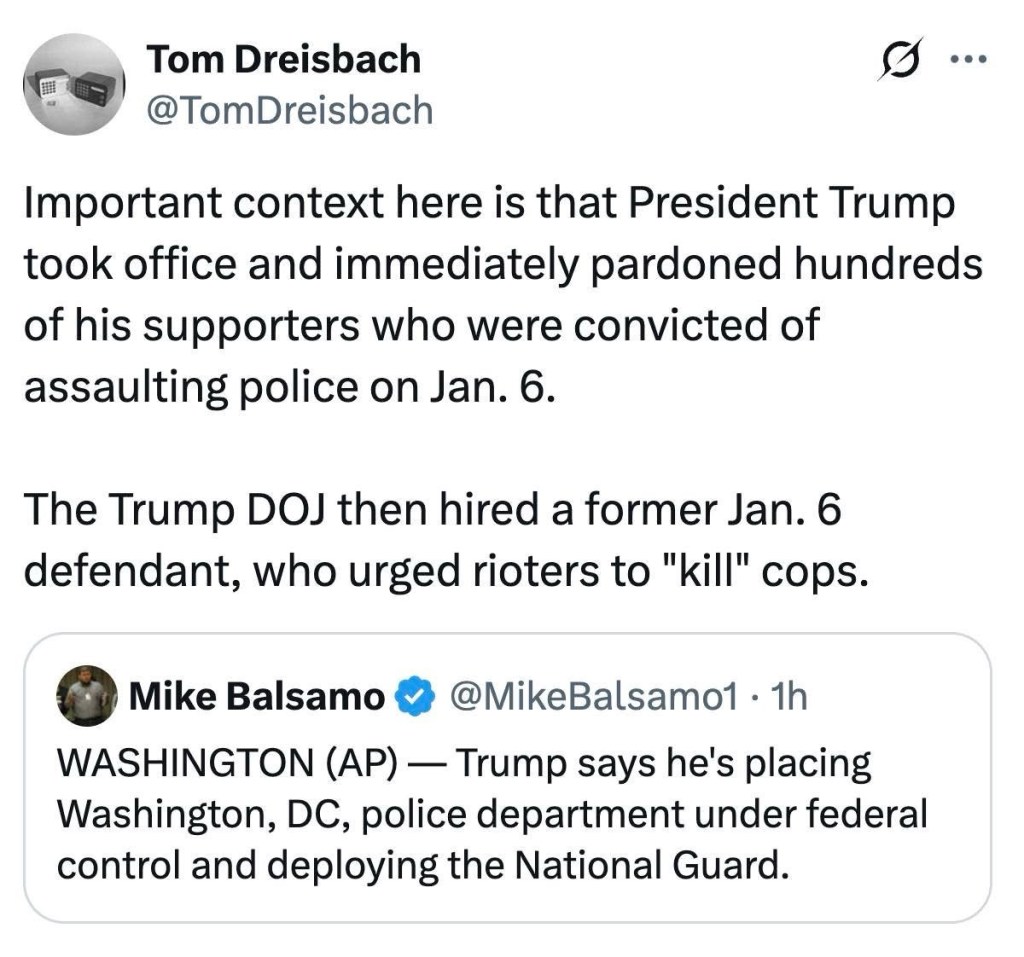
Roving mobs of wild men smashed windows, threatened murder and attacked the police.
One rioter struck an officer in the face with a baton. Another threw a chair at police officers and pepper-sprayed them. Others beat and used a stun gun on an officer, nearly killing him.
On Jan. 6, 2021, a pro-Trump mob committed a month’s worth of crime in the span of about three hours.
The F.B.I. has estimated that around 2,000 people took part in criminal acts that day, and more than 600 people were charged with assaulting, resisting or interfering with the police. (Citywide, Washington currently averages about 70 crimes a day.)
But President Trump’s handling of the most lawless day in recent Washington history stands in sharp contrast to his announcement on Monday that he needed to use the full force of the federal government to crack down on “violent gangs and bloodthirsty criminals” in the nation’s capital.
A bit more:
After a prominent member of the Department of Government Efficiency, known by his online pseudonym, “Big Balls,” was assaulted this month, the president took federal control of Washington’s police force and mobilized National Guard troops. His team passed out a packet of mug shots, and Mr. Trump described “roving mobs of wild youth, drugged-out maniacs and homeless people.”
That was nothing like the message he delivered to the mob of his supporters on Jan. 6, when he told them, as tear gas filled the hallways of the Capitol: “We love you. You’re very special.”
“If we want to look at marauding mobs, look at Jan. 6,” said Mary McCord, the director of the Institute for Constitutional Advocacy and Protection at Georgetown Law and a former federal prosecutor. “If you want to look at criminal mobs, we had a criminal mob and he called them peaceful protesters.”
In one of his first actions upon retaking the presidency, Mr. Trump issued a sweeping grant of clemency to all of the nearly 1,600 people charged in connection with the Capitol attack. The president issued pardons to most of the defendants and commuted the sentences of 14 members of the Proud Boys and the Oath Keepers militia, most of whom were convicted of seditious conspiracy.
He has sought to rewrite the history of the riot and called those arrested “hostages.”
In another fascist takeover attempt, Trump is trying to control what The Smithsonian puts on display.
The Trump administration said on Tuesday that it would begin a wide-ranging review of current and planned exhibitions at the Smithsonian Institution, scouring wall text, websites and social media “to assess tone, historical framing and alignment with American ideals.”
White House officials announced the review in a letter sent to Lonnie G. Bunch III, the secretary of the Smithsonian. Museums will be required to adjust any content that the administration finds problematic within 120 days, the letter said, “replacing divisive or ideologically driven language with unifying, historically accurate and constructive descriptions.”
The review, which will begin with eight of the Smithsonian’s 21 museums, is the latest attempt by President Trump to try to impose his will on the Smithsonian, which has traditionally operated as an independent institution that regards itself outside the purview of the executive branch.
Kim Sajet, the head of the National Portrait Gallery, resigned in June after Mr. Trump said he was firing her for being partisan. The Smithsonian’s governing board said at the time that it had sole responsibility for personnel decisions.
News of the letter was earlier reported by The Wall Street Journal. It is signed by Lindsey Halligan, a special assistant to the president; Vince Haley, the director of the Domestic Policy Council; and Russell T. Vought, the director of the Office of Management and Budget.
A bit more:
In a statement, the Smithsonian said that its “work is grounded in a deep commitment to scholarly excellence, rigorous research and the accurate, factual presentation of history.”
“We are reviewing the letter with this commitment in mind,” it continued, “and will continue to collaborate constructively with the White House, Congress and our governing Board of Regents.”
Smithsonian National Museum of African American History and Culture
Mr. Bunch did not immediately returned a call seeking comment.
Some historians expressed concern at the political interference in an institution that was long viewed as independent. Annette Gordon-Reed, a professor at Harvard and president of the Organization of American Historians, said the Smithsonian was already doing a “fantastic job of presenting American history.”
“People are voting with their feet,” she said. “It’s a very popular place. The content of exhibits shouldn’t simply reflect any one administration’s preferences. They are the product of a lot of hard work by dedicated and honorable people who want to present the most accurate picture of American history as possible. That includes the triumphs and the tragedies.”
Samuel J. Redman, a history professor at the University of Massachusetts Amherst who has written extensively about the Smithsonian, called the administration’s review “a full assault on the autonomy of all the different branches of the institution.”
Use the gift link to read the rest if you’re interested.
At Civil Discourse, Joyce Vance has a few choice words about this attack on the Smithsonian: Living in 1984.
The headline tonight reads, “White House to Vet Smithsonian Museums to Fit Trump’s Historical Vision.”It’s in TheWall Street Journal, not exactly a bastion of liberal views. “Top White House officials will scrutinize exhibitions, internal processes, collections and artist grants ahead of America’s 250th anniversary.”
Why? The Journal answers that question in the opening paragraph: “The White House plans to conduct a far-reaching review of Smithsonian museum exhibitions, materials and operations ahead of America’s 250th anniversary to ensure the museums align with President Trump’s interpretation of American history.”
Trump’s interpretation of American history? The man isn’t exactly a scholar.
During his first term in office, at a breakfast celebrating Black History Month in 2017, Trump said: “Frederick Douglass is an example of somebody who’s done an amazing job and is being recognized more and more, I notice.” Douglass, the famous abolitionist, died in 1895. At the time he made that comment, Trump seemed more enthusiastic about our national museums than he does today. He led into the comment by saying, “I am very proud now that we have a museum on the National Mall where people can learn about Reverend King, so many other things.”
Perhaps this gaffe explains Trump’s subsequent antipathy to celebrating Black History Month. But he’s not someone who should be defining our history.
In 2009, Trump purchased a Virginia Golf Club. Its beautiful location on the Potomac River wasn’t enough for him—he needed it to have some historical importance. So he, or someone working for him, made it up. He put up a plaque claiming, “Many great American soldiers, both of the North and South, died at this spot…The casualties were so great that the water would turn red and thus became known as ‘The River of Blood.’ ” According to multiple experts, nothing of the sort ever happened there.
The New York Times reports that when Trump was confronted with the lie, he said, “How would they know that? Were they there?” Trump is clearly not the man to entrust with the telling of our national history. “Write your story the way you want to write it,” Trump told reporters who pressed him for any evidence to support the supposed history he attributed to the site.
In a phone call with Canadian Prime Minister Justin Trudeau during his first term in office, Trump insisted that Canadians burned down the White House during the War of 1812. As every school child knows, it was the British.
And of course, there were Trump’s exaggerated claims about the size of the crowd at his first inauguration.
Read the rest at Civil Discourse.
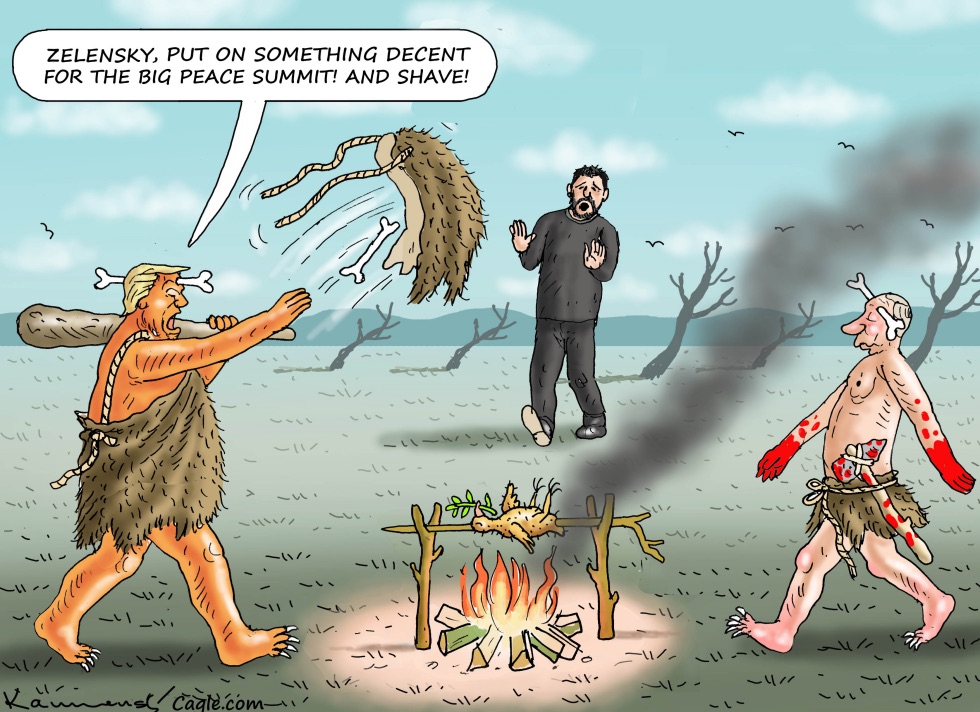
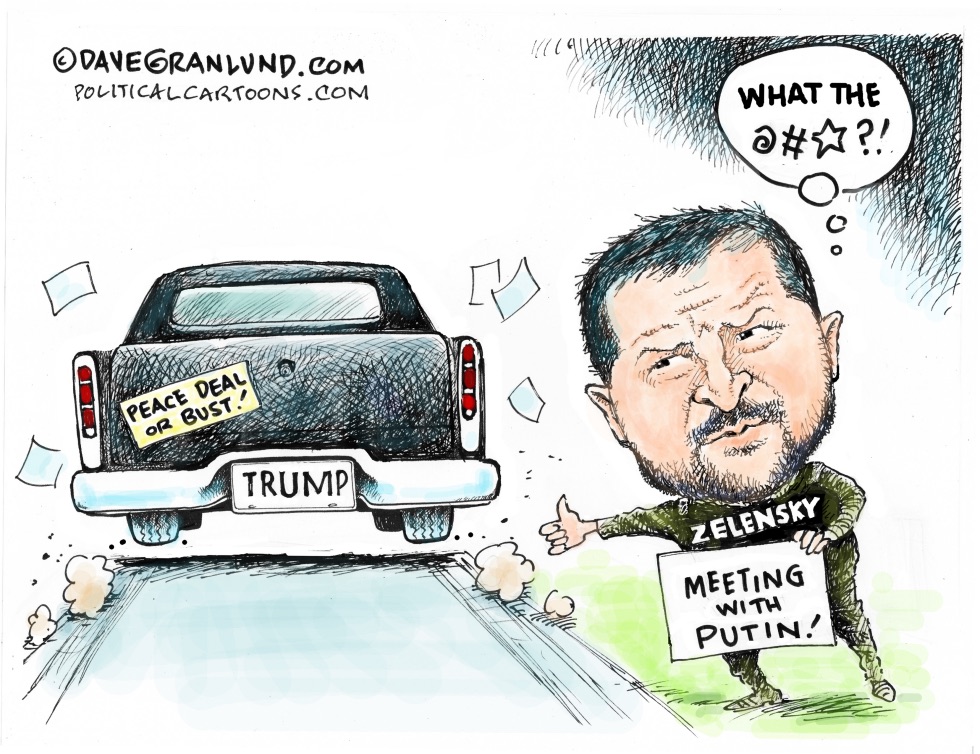
This morning, Trump met virtually with European leaders and Ukraine’s President Zelensky ahead of his meeting with Putin in Alaska on Friday. I don’t really think that anything Trump said can be trusted, but here are some reports:
A call between European officials, Ukraine’s President Volodymyr Zelensky and US President Donald Trump took place today.
Speaking at a news conference alongside Zelensky afterward, German Chancellor Friedrich Merz said Europe’s leaders are doing everything to ensure an upcoming meeting between Trump and Russian leader Vladimir Putin “goes the right way.”
Here are the latest developments:
Joint meeting: A virtual summit involving US President Donald Trump, Ukrainian President Volodymyr Zelensky and several European leaders took place today.
Trump support: In comments made after the meeting, Zelensky said that “there should be a ceasefire first, then security guarantees – real security guarantees,” and that Trump has “expressed his support.”
Renewed calls: Speaking alongside Zelensky after the meeting, Merz reiterated his call for Ukraine to be at the table for negotiations and said that a ceasefire must come first in any deal, as he said Kyiv needed “robust guarantees.”
“Major decisions:” Merz said there could be “major decisions” made during the Trump-Putin summit as he said Europeans are therefore “doing everything we can in order to lay the groundwork to make sure that this meeting goes the right way.”
Territorial exchange: Also speaking after the call, French President Emmanuel Macron said any territorial exchange in Ukraine “must only be discussed with Ukraine, as he added that it was a “good thing” that Russia and the US were talking, but it was important that Europe is “heard.”
Territory: Meanwhile, a Russian foreign ministry official has poured cold water on the idea that both Russia and Ukraine would need to swap territory to reach a peace agreement
Territorial questions that fall under Ukraine’s authority cannot be negotiated and will only be negotiated by the President of Ukraine, Macron said, adding that Trump had expressed the same. Philippe Magoni EPA
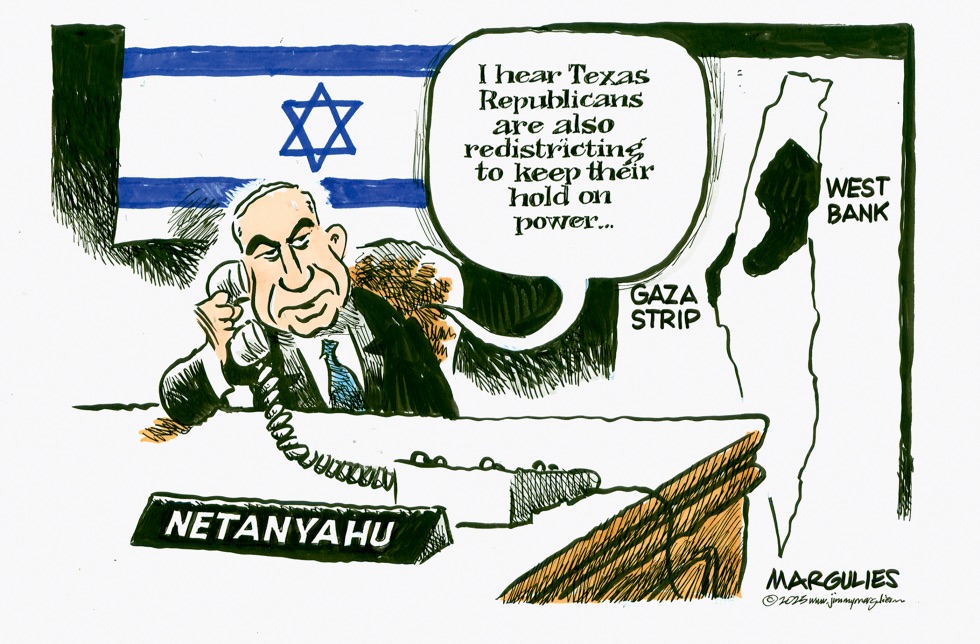
According to the proposal, Ukraine’s borders would remain officially unchanged, similar to the borders of the West Bank, even as Israel controls the territory.
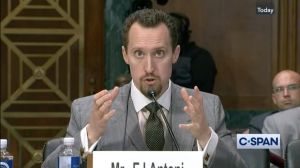
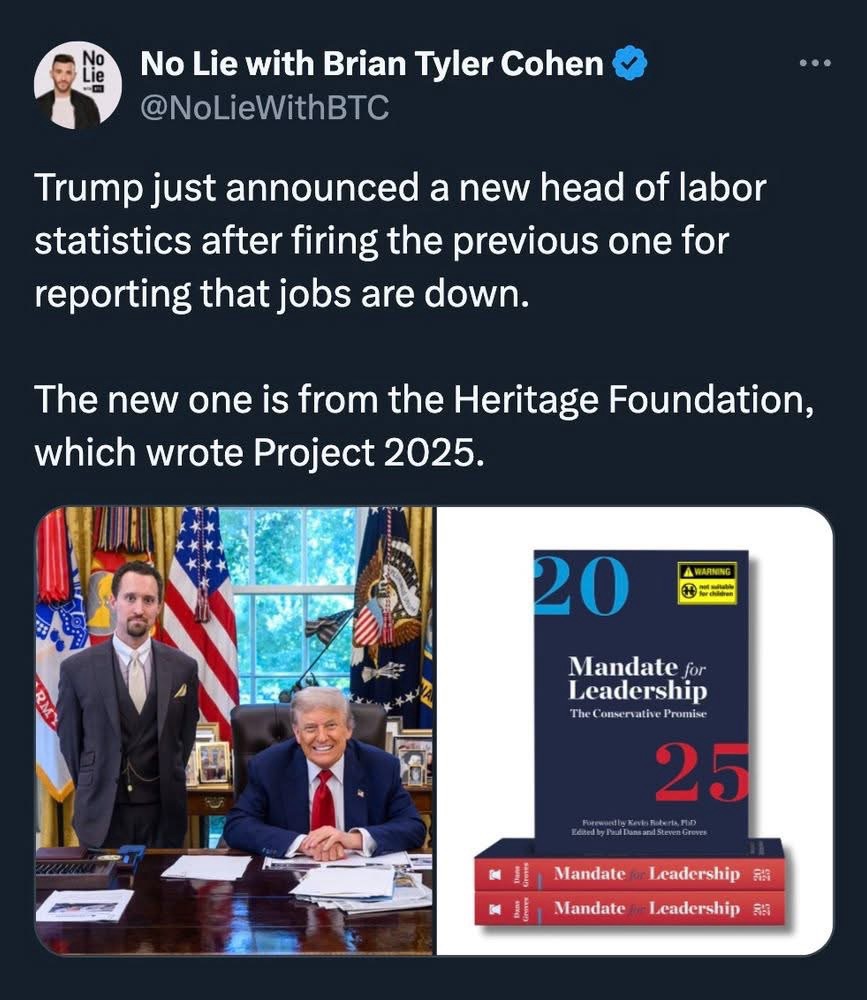
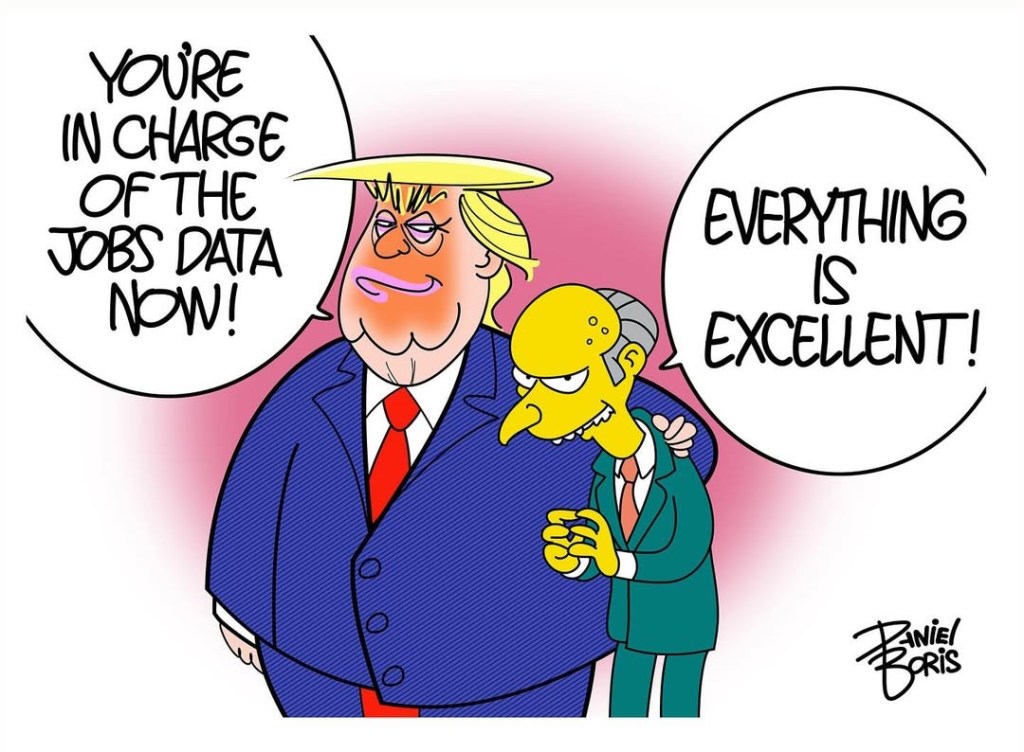
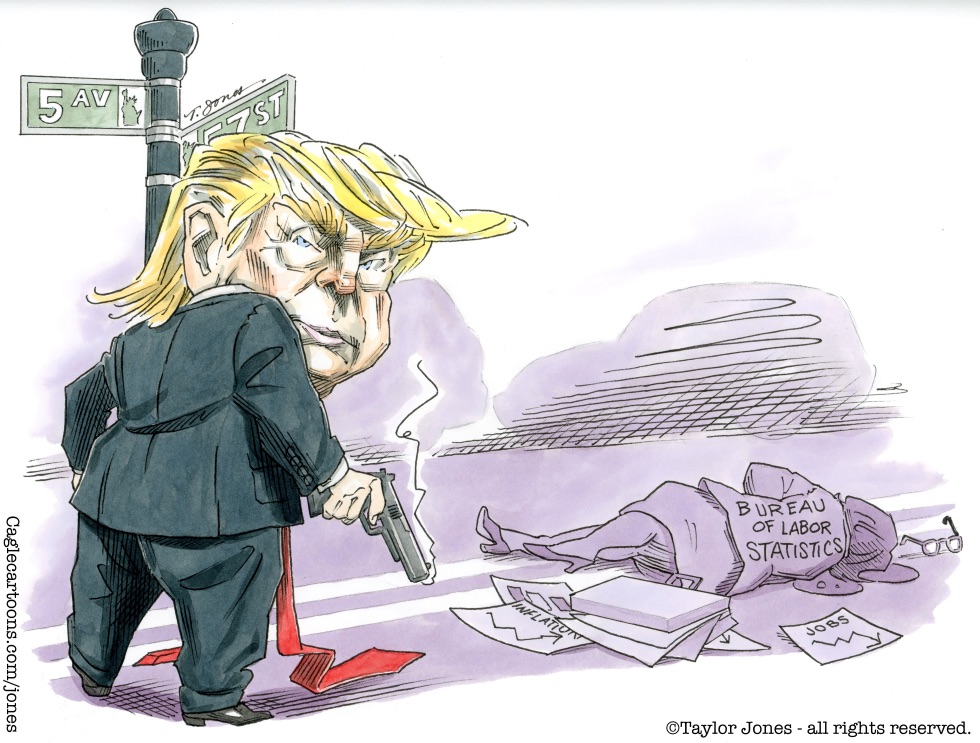
Conservative economist Erwin John “E.J.” Antoni sometimes jokes on social media that the “L” in the Bureau of Labor Statistics’ acronym is silent.
President Trump this week tapped Antoni to run the agency whose data and methodologies he has long criticized, especially when it produces numbers that Trump doesn’t like. He recently proposed suspending the monthly jobs report, one of the most important data releases for the economy and markets. On Tuesday, a White House official noted that Antoni made the comment before he knew he was going to be chosen and that his comments don’t reflect official BLS policy.
E.J. Antoni was nominated by the president this week to oversee the Bureau of Labor Statistics. Photo by C-SPAN
If confirmed by the Senate, Antoni would run a 141-year-old agency staffed by around 2,000 economists, statisticians and other officials. The BLS has a long record of independence and nonpartisanship that economists and investors say is critical to the credibility of U.S. economic data.
According to a commencement program from Northern Illinois University, Antoni earned a master’s and Ph.D. in economics from that school in 2018 and 2020, respectively, and a bachelor of arts degree from St. Charles Borromeo Seminary. Antoni’s LinkedIn profile says he attended Lansdale Catholic High School outside Philadelphia from 2002 to 2006.
According to the profile, Antoni went to work in 2021 as an economist at the Texas Public Policy Foundation, a conservative think tank in Austin that has sued the federal government to overturn climate-change regulations. The following year, he joined the conservative Heritage Foundation as a research fellow studying regional economics. He is now the foundation’s chief economist and an adviser to the Committee to Unleash Prosperity, a group of conservative economic commentators.
Past BLS commissioners have had extensive research experience, and many have climbed the ranks of the agency itself. Antoni doesn’t fit that profile. He doesn’t appear to have published any formal academic research since his dissertation, according to queries of National Bureau of Economic Research working papers and Google Scholar. Much of his commentary on the Heritage website praises Trump’s policies and economic record. He frequently posts on X and appears on conservative podcasts such as former Trump adviser Steve Bannon’s “War Room,” where he criticized the economy under President Joe Biden and lauds Trump’s economy.
The Heritage Foundation declined to make Antoni available for an interview and didn’t respond to questions about his background.
There’s more at the link. I got past the paywall by using the link at Memeorandum.com.
That’s all I have today. What’s on your mind?
Did you like this post? Please share it with your friends:
“He does have a sense of humor.” John Buss, @repeat1968
Good Day, Sky Dancers!
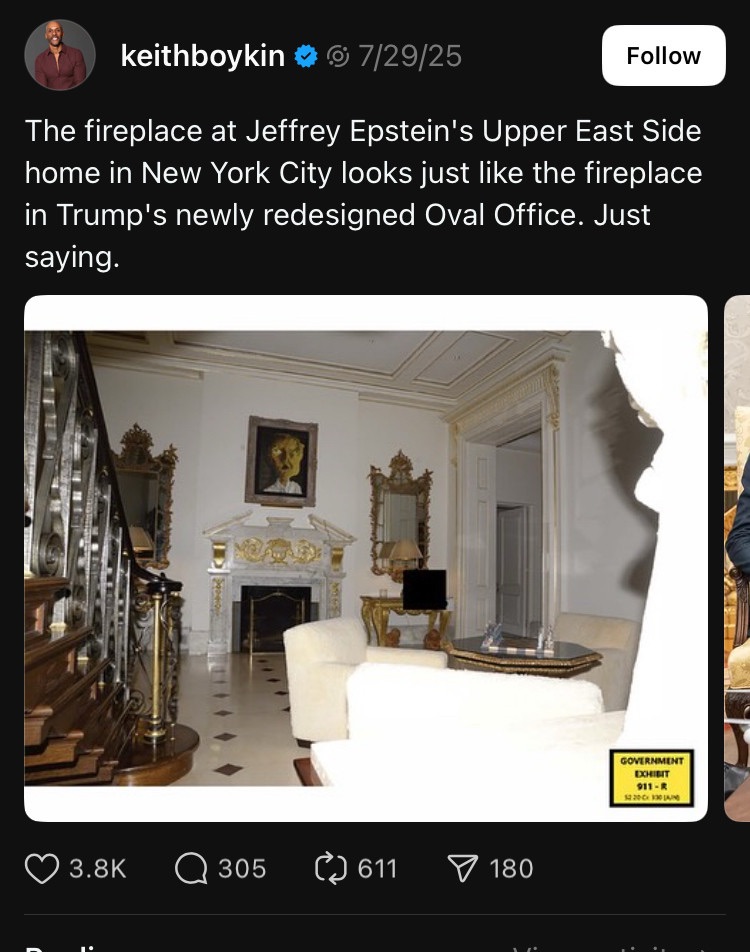
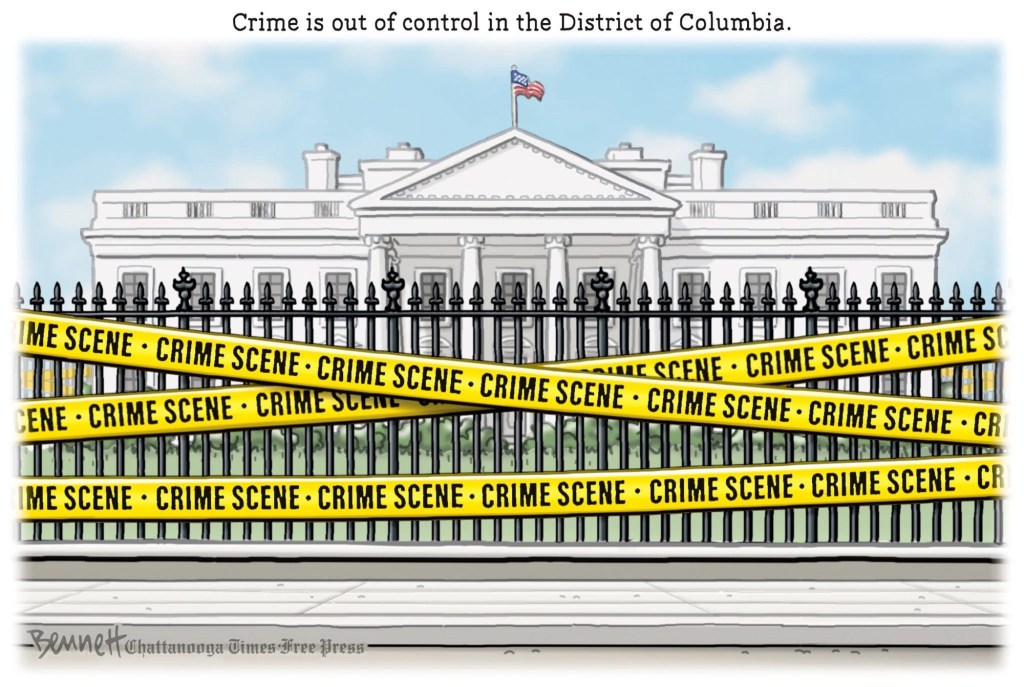
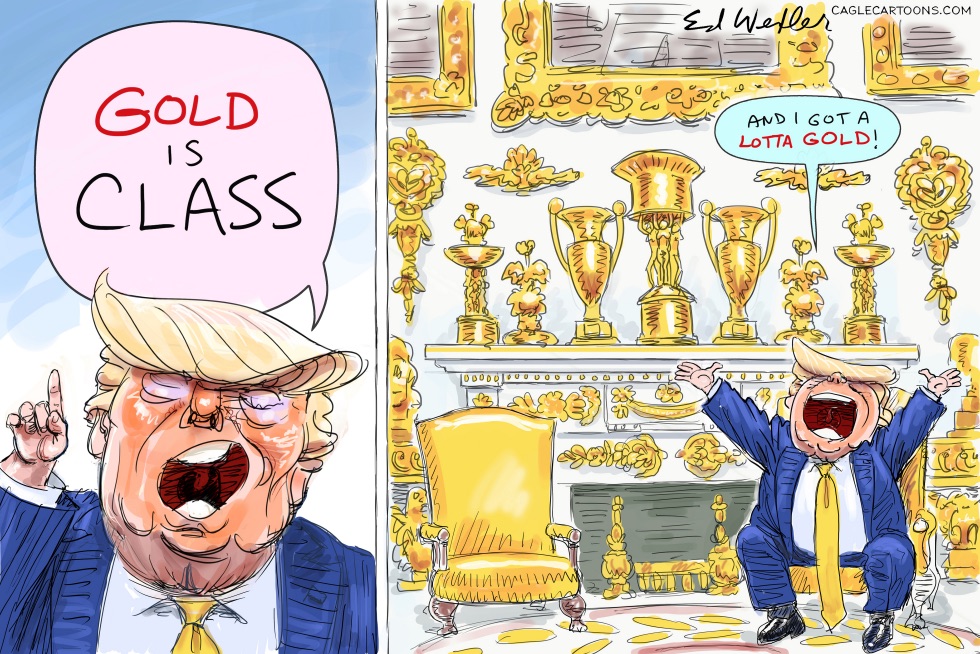
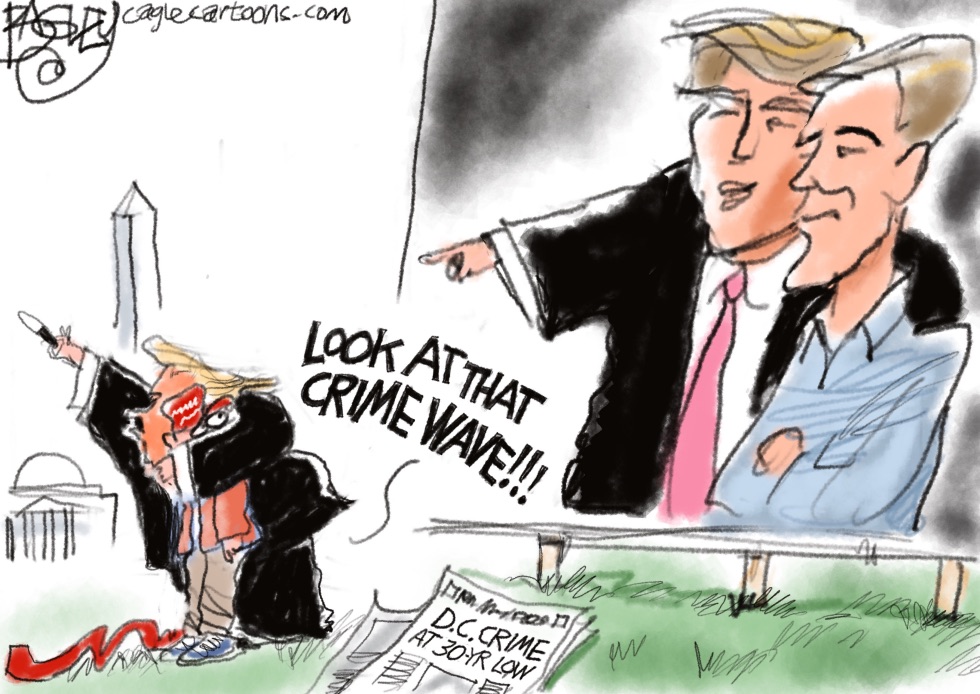
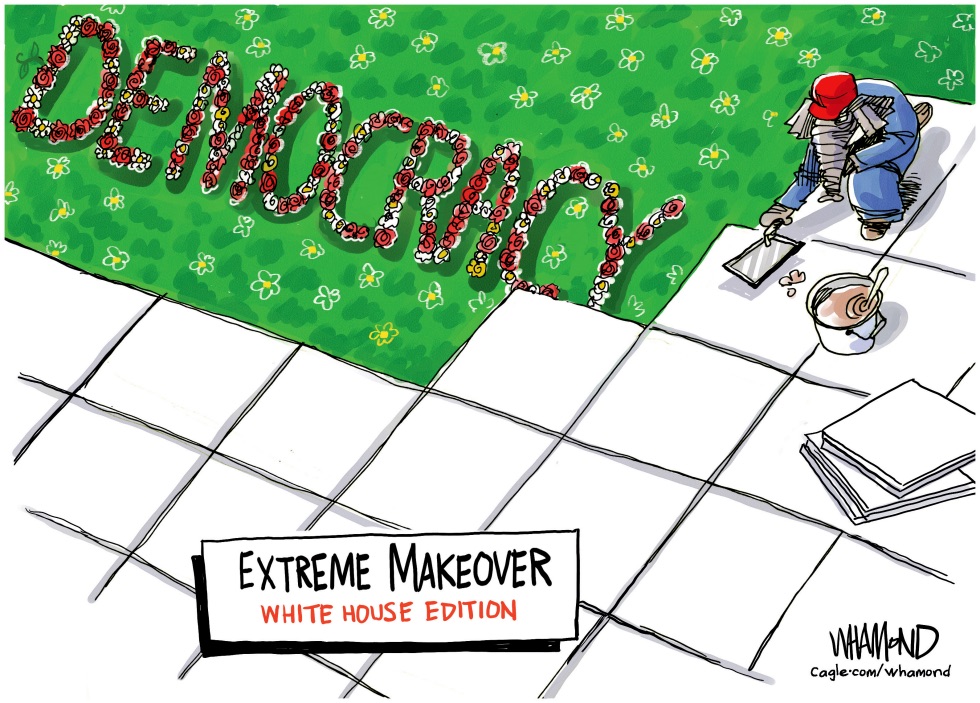
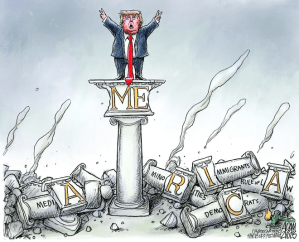
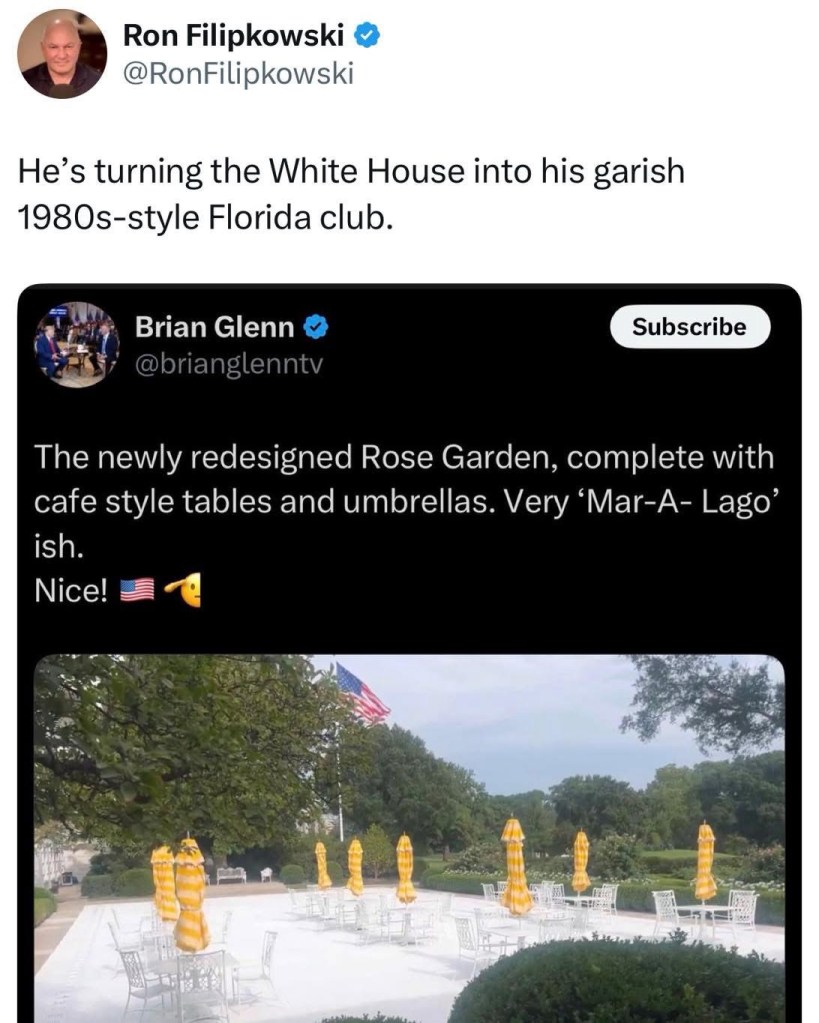
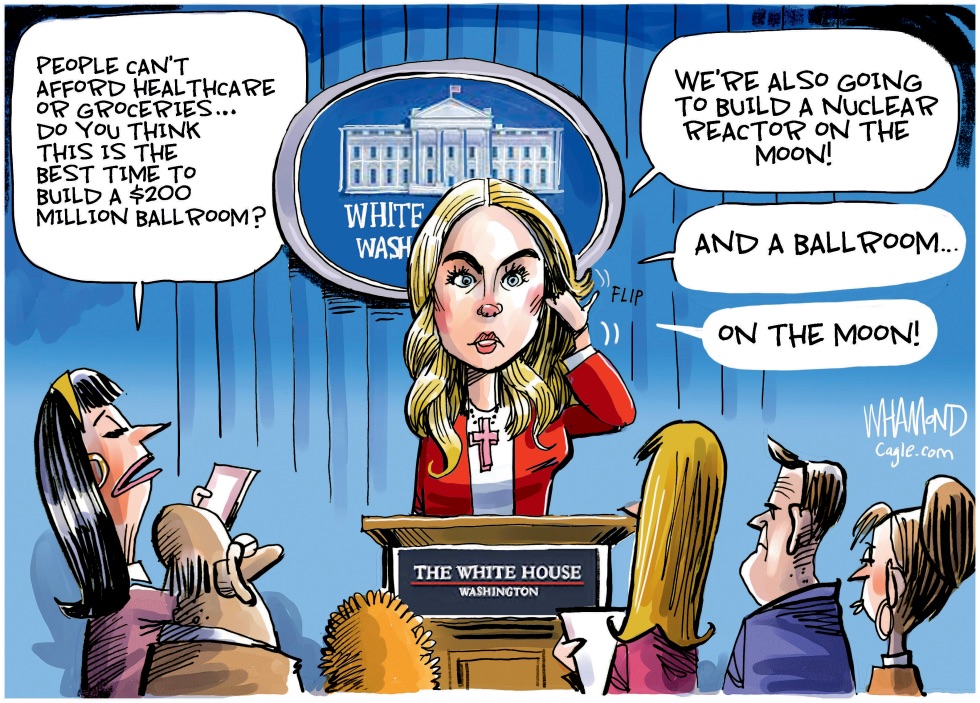
The top headline today from Public Notice sums it up nicely. “Crime is down. But Trump’s authoritarian power grabs are escalating. Random street crimes are being used as pretexts for repression.” Jackie Kennedy’s Rose Garden is one big tacky cement patio bedecked with tacky patio furniture and yellow umbrellas that look like a field of dildos. The Oval Office is bedecked with gold spray-painted Baroque Cherubs and has the feel of a tacky brothel mimicking Versailles. These changes are about as necessary as tariffs. The worst of it will be a ballroom with the same tacky aesthetic. Meanwhile, the Big Budget-Busting bill will leave people starving, ill, and homeless. I smile at a young black man with a loaded shopping cart, as he heads down Burgundy Street this morning to the various homeless encampments at the abandoned Navy Base bordering the canal and the Mississippi. Once again, VooDoo Economics takes its toll. Then, there are the tariffs and the dearth of tourists this season.
Justin Glawe writes the story behind the headline.
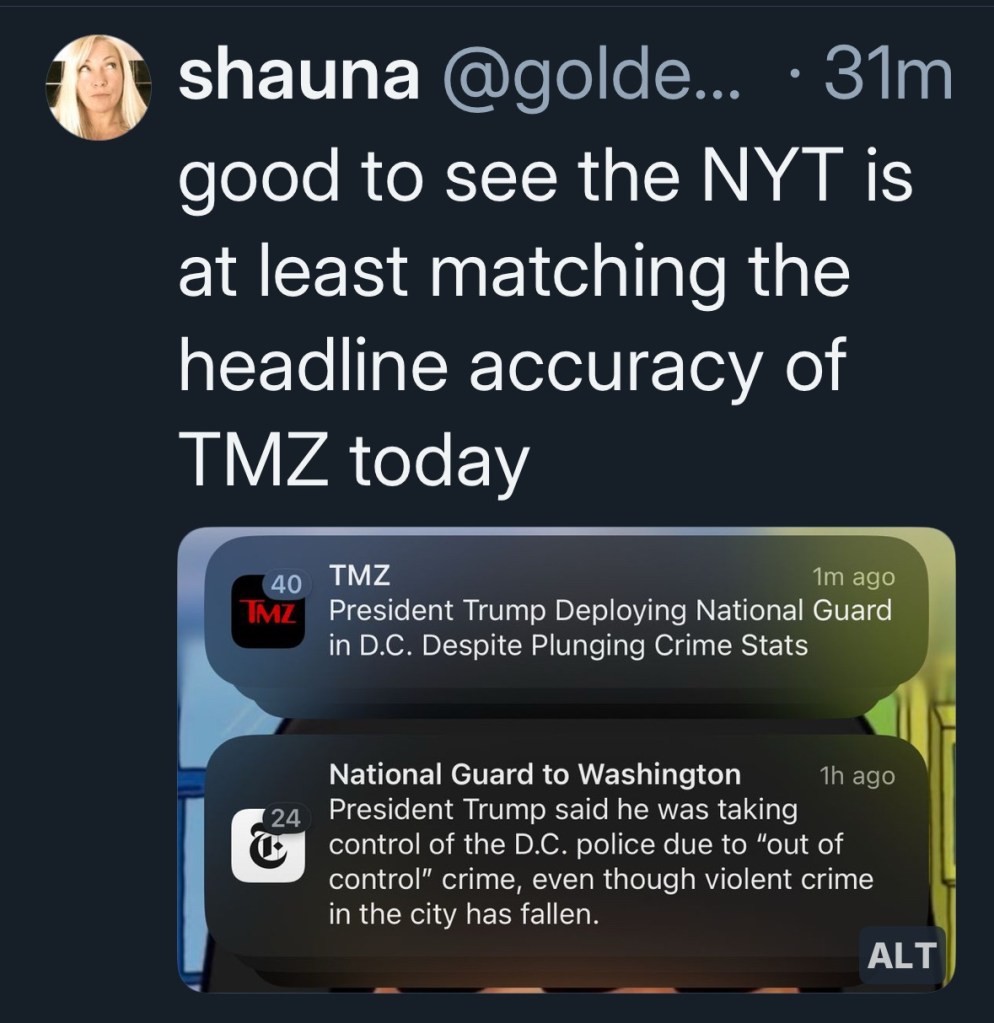
The White House has seized on two unrelated incidents of street crime as a pretext for a federal government power grab at a time when violent crime has, in fact, dropped across the country.
The attempted carjacking of Edward “Big Balls” Coristine in Washington DC and a street brawl in Cincinnati are the latest cause célebrè on the American right, which has long supported Donald Trump’s plans for military and law enforcement crackdowns in largely Democratic cities. Both incidents are being used as anecdotal evidence of out-of-control crime across the country — a narrative that is necessary for Trump and Republicans to maintain their grip of fear on their MAGA base.
And it’s worked: a Gallup poll in October found that 64 percent of Americans believed crime had gone up in 2024, but new data from the FBI shows that is not the case. In fact, 2024 saw the lowest levels of violent crime since 1969, with violent crime down 4.5 percent across the country, including a 14.9 percent drop in murders.
The events being seized upon by the White House and Republicans as evidence of surging crime have little to do with one another save for the fact that the victims are white. In the case of the brawl in Cincinnati, those “victims” may not be entirely innocent: two white men faced off against a largely Black crowd on July 26, with one of the men spewing a racial slur. The other white man involved may have been a willing combatant in the melee, slapping a Black man in the face and squaring off to fight, as seen in videos circulating online. (Police have disputed that the slap was the impetus of the brawl.)
While the exact cause of the brawl isn’t entirely clear, videos of the incident have gone viral, framed by right-wing media as a “Black mob” beating innocent whites. On her show last Thursday night, Fox News’s Laura Ingraham asked a victim in the attack whether it was “racially motivated in any direction.” Neither Ingraham or the guest noted the use of the racial slur.
Vice President JD Vance and other prominent Republicans have politicized the incident, using it as an opportunity to call for everything from replacing judges to increasing funding for police.
At the same time, Trump, Elon Musk, and others have used the alleged carjacking of Coristine as justification for a federal takeover of Washington DC. Last week, Trump threatened to “FEDERALIZE” Washington, sharing a photo of a bloodied Coristine on Truth Social. Later, Trump reiterated the threat and called for juveniles to be charged as adults. He’s holding a news conference this morning to announce some sort of takeover of DC amid reports that hundreds of National Guard troops will be deployed to the city this week.
“Somebody from DOGE was very badly hurt last night. A young man who was beat up by a bunch of thugs in DC,” Trump said last Tuesday. “And either they’re gonna straighten their act out in terms of government and in terms of protection or we’re gonna have to federalize.”
This morning’s Washington Post describes Trump’s response thusly. “Trump orders federal moves on D.C. crime, takes over D.C. police. The president is planning to flex his law enforcement power over Washington, declaring that he would clear the city of homeless people and crack down on crime.” Am I the only one who sees the pandering to power in this headline?” This hardly compares to the violence, destruction, and crimes that happened on January 6.
President Donald Trump announced Monday that he was placing the D.C. police under direct federal control and will deploy the National Guard to the streets of Washington to fight crime, an extraordinary flex of federal power that stripped city leadership of its ability to make law enforcement decisions andcould expose residents of the nation’s capital to unpredictable encounters with a domestically deployed military force.
The decision totake over the Metropolitan Police Department anddeploy 800 National Guard troops comes as the president has been slamming America’s cities as places where crime is out of control, despite two years of declines that have brought homicide levels in many major cities to their lowest levels in decades.
The administration has already mobilized FBI agents in recent days in overnight shifts to help local law enforcement prevent carjackings and violent crime, officials said. Because the District of Columbia is not a state, the federal government has unusually sweeping powers to intervene over the objections of its residents and leaders, giving the president an opportunity to use it as a laboratory for a militarized approach to urban crime-fighting.
Trump portrayed a sweeping vision of law enforcement on the streets of Washington, declaring that federal agents, D.C. police and the National Guard would use physical force to intimidate
“They fight back until you knock the hell out of them, because it’s the only language they understand,” Trump told reporters at a White House news conference. “It’s a disgusting thing.”
“It’s becoming a situation of complete and total lawlessness, and we’re getting rid of the slums, too,” Trump added. “I know it’s not politically correct.https://www.facebook.com/ You’ll say, ‘Oh, so terrible.’ No, we’re getting rid of the slums where they live.”
Trump has portrayed crime in the nation’s capital as spiraling upward. D.C. Mayor Muriel E. Bowser (D) has noted repeatedly that violent crime has declined for the past two years after a sharp post-pandemic spike in 2023.
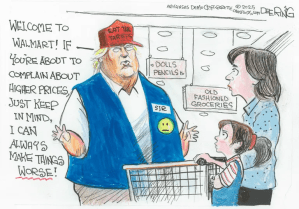
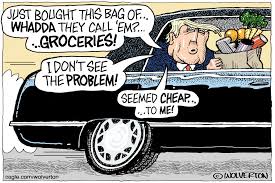
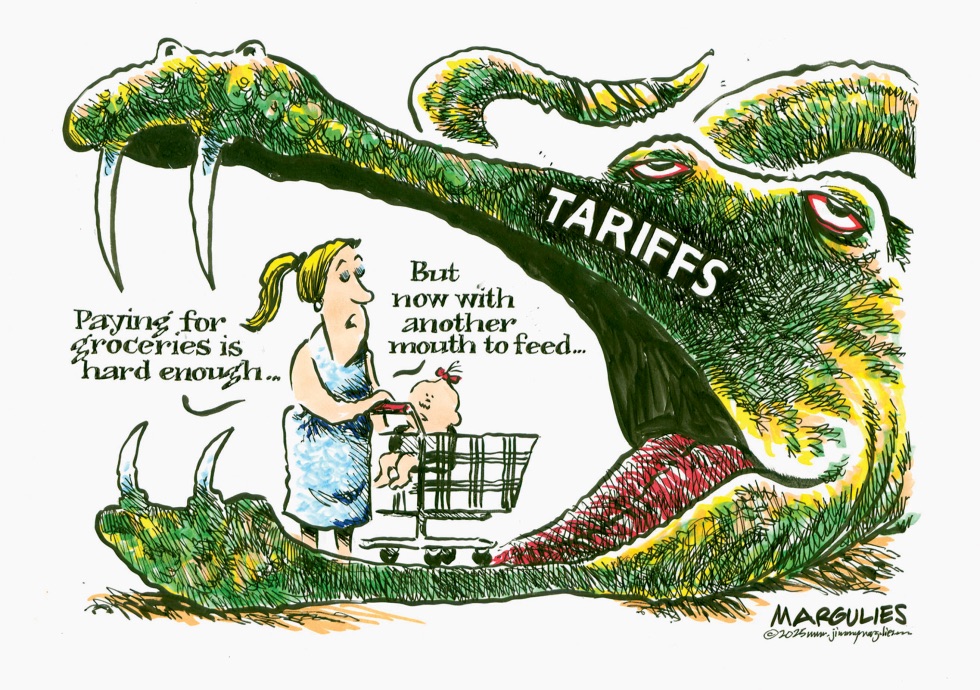
All this is happening while the majority of Americans are like me. How the hell am I going to buy groceries this week? This headline is from Forbes Magazine. “Almost 90% of Americans Are Worried About The Cost Of Groceries. The story is written by Mary Whitfill Roeloffs.
Almost 90% of American adults say they’re stressed about the cost of groceries, a new poll out Monday shows, as the price of food rises and items like poultry, ground beef and eggs see the biggest cost jumps.
Key Facts
More than half of Americans (53%) see grocery prices as a major source of stress and another 33% see it as a minor source of stress, according to a new poll from the Associated Press-NORC Center for Public Affairs Research.
More people were concerned about grocery prices than any other financial concern brought up in the poll, but more than half of respondents also said they were at least somewhat stressed about their salaries, the cost of housing, the amount of money they have saved, their credit card debt and the cost of health care.
The Consumer Price Index shows the price of food has risen 3% in the last 12 months—groceries have risen 2.4% while dining out is 3.8% costlier than it was 12 months ago.
From June 2024 to June 2025, groceries got more expensive in every category tracked by the Bureau of Labor Statistics: meats, poultry, fish and eggs rose in price by 5.6% (egg prices alone rose 27.3%); nonalcoholic beverages are 4.4% more expensive; fruits and vegetables rose in price by 0.7%; and both cereals and bakery products and the index for dairy products rose 0.9%.
At 3%, the cost of food is rising faster than the overall inflation rate as measured by the Consumer Price Index, at 2.7%.
After groceries, the price of housing had the highest number of people reporting it as a major stressor in Monday’s poll (47%), followed by the amount of money saved (43%), salary (43%) and the cost of health care (42%).
81 cents. That’s how much the price of chicken breast increased, per pound, from July 2024 to July 2025, according to NBC News, making it the largest price hike among the six staple items tracked by the outlet. The cost of ground beef increased 67 cents per pound, while eggs grew 64 cents more expensive per dozen.
Are we great again yet?
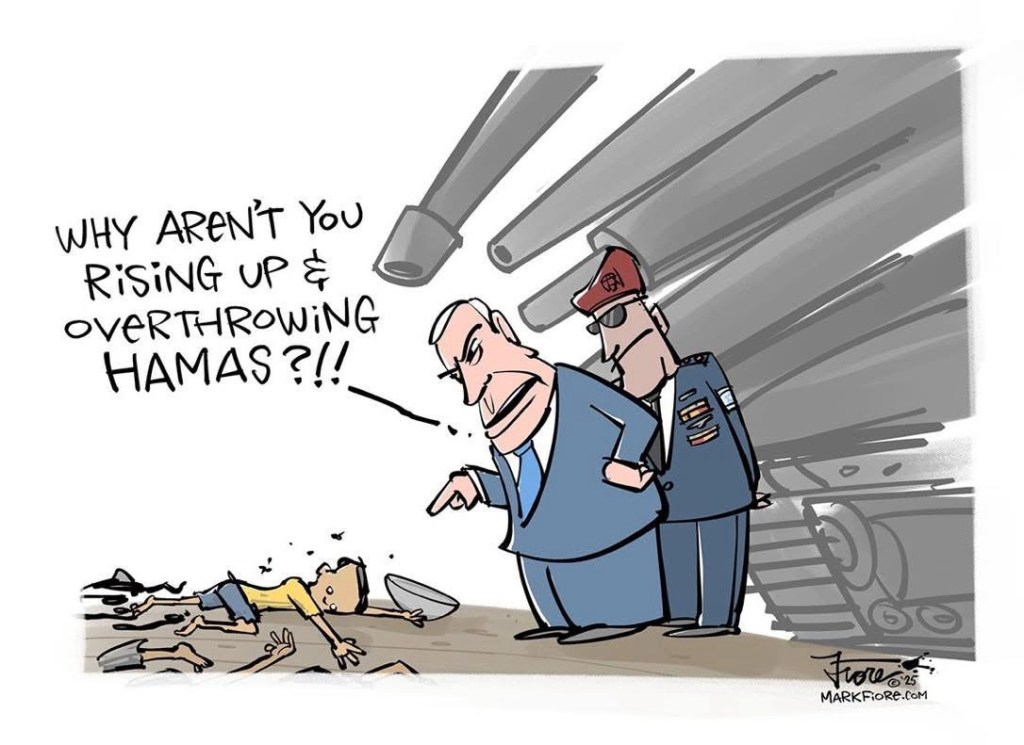
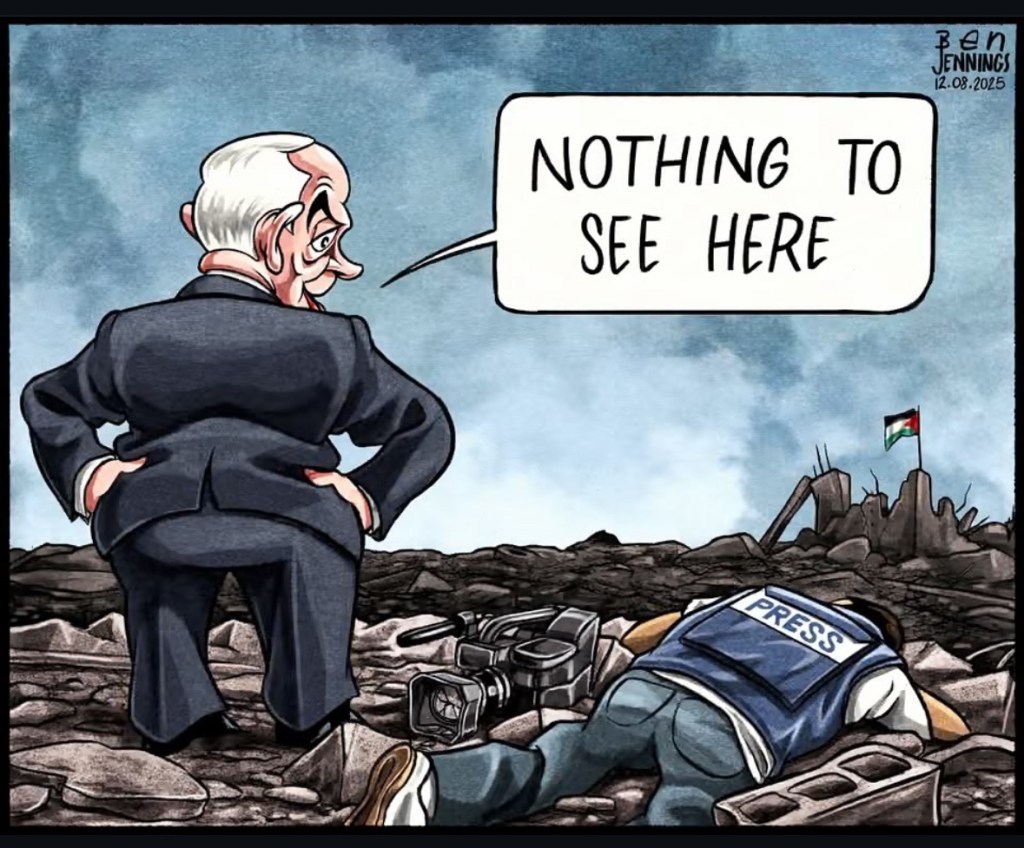
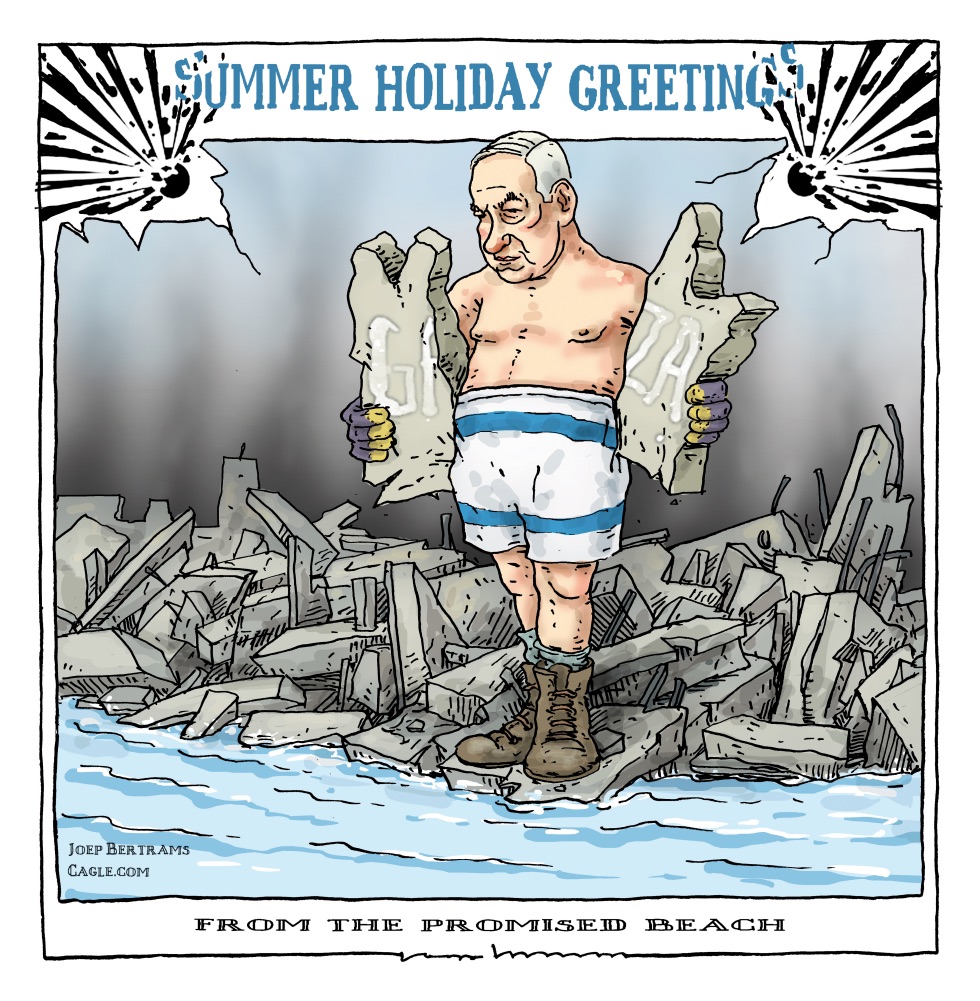
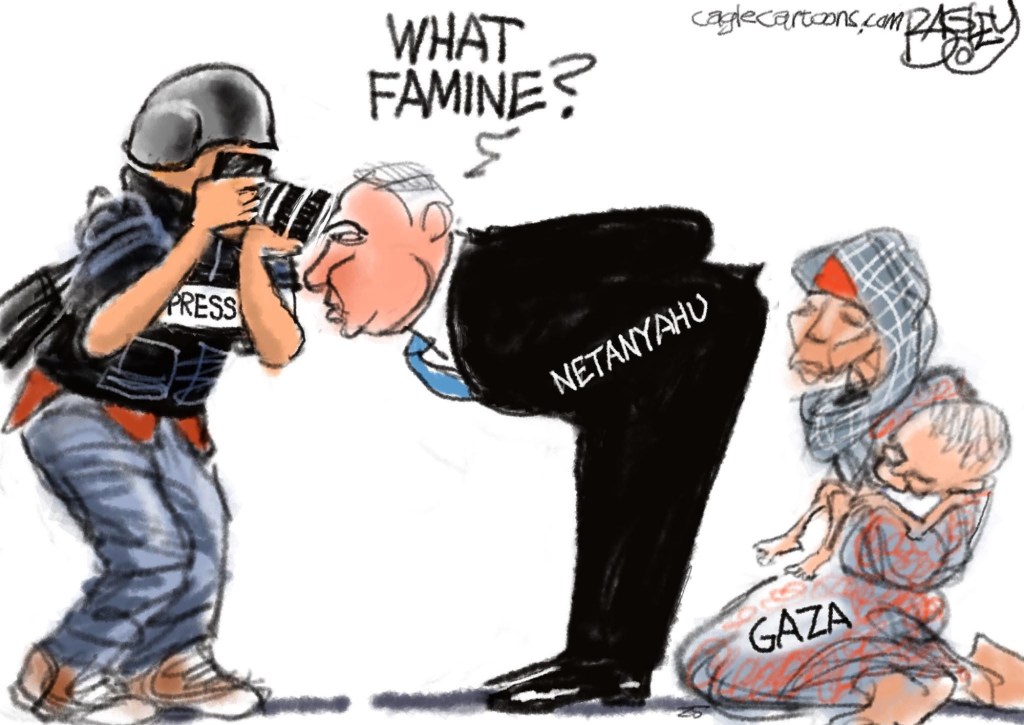
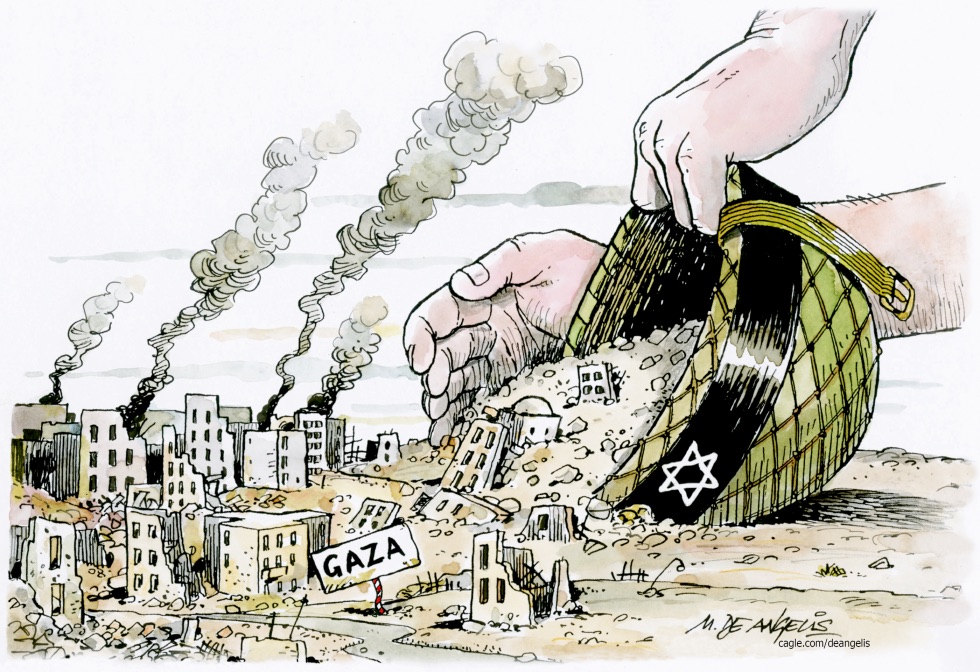
With American Foreign Policy out to lunch, Bibi Netanyahu has expanded his genocidal and authoritarian attack on Gaza. This is the latest step taken by the accused War Criminal. This is from The Guardian. “Anas al-Sharif, prominent Al Jazeera correspondent, among five journalists killed in Israeli airstrike on Gaza. Israel admits deliberate attack on the journalist, known for frontline coverage, in a strike on a tent outside al-Shifa hospital.” How are we falling back into 20th-century fascism when so many of us have been thoroughly educated on both World Wars?
A prominent Al Jazeera journalist who had previously been threatened by Israel has been killed along with four colleagues in an Israeli airstrike.
Anas al-Sharif, who was one of Al Jazeera’s most recognisable faces in Gaza, was killed while inside a tent for journalists outside al-Shifa hospital in Gaza City on Sunday night. His funeral was held on Monday morning.
Seven people in total were killed in the attack, including al-Sharif, Al Jazeera correspondent Mohammed Qreiqeh and camera operators Ibrahim Zaher, Mohammed Noufal and Moamen Aliwa, according to the Qatar-based broadcaster.
The Israel Defense Force admitted the strike, claiming the reporter had “served as the head of a terrorist cell in the Hamas terrorist organisation and was responsible for advancing rocket attacks against Israeli civilians and IDF forces”.
It claimed it had intelligence and documents found in Gaza as proof but rights advocates said he had been targeted for his frontline reporting on the Gaza war and that Israel’s claim lacked evidence.
Calling al-Sharif “one of Gaza’s bravest journalists,” Al Jazeera said the attack was “a desperate attempt to silence voices in anticipation of the occupation of Gaza.”
Last month Israeli IDF spokesperson Avichai Adraee shared a video of al-Sharif on X and accused him of being a member of Hamas’ military wing. At the time the UN special rapporteur on freedom of expression, Irene Khan, called it “an unsubstantiated claim” and a “blatant assault on journalists”.
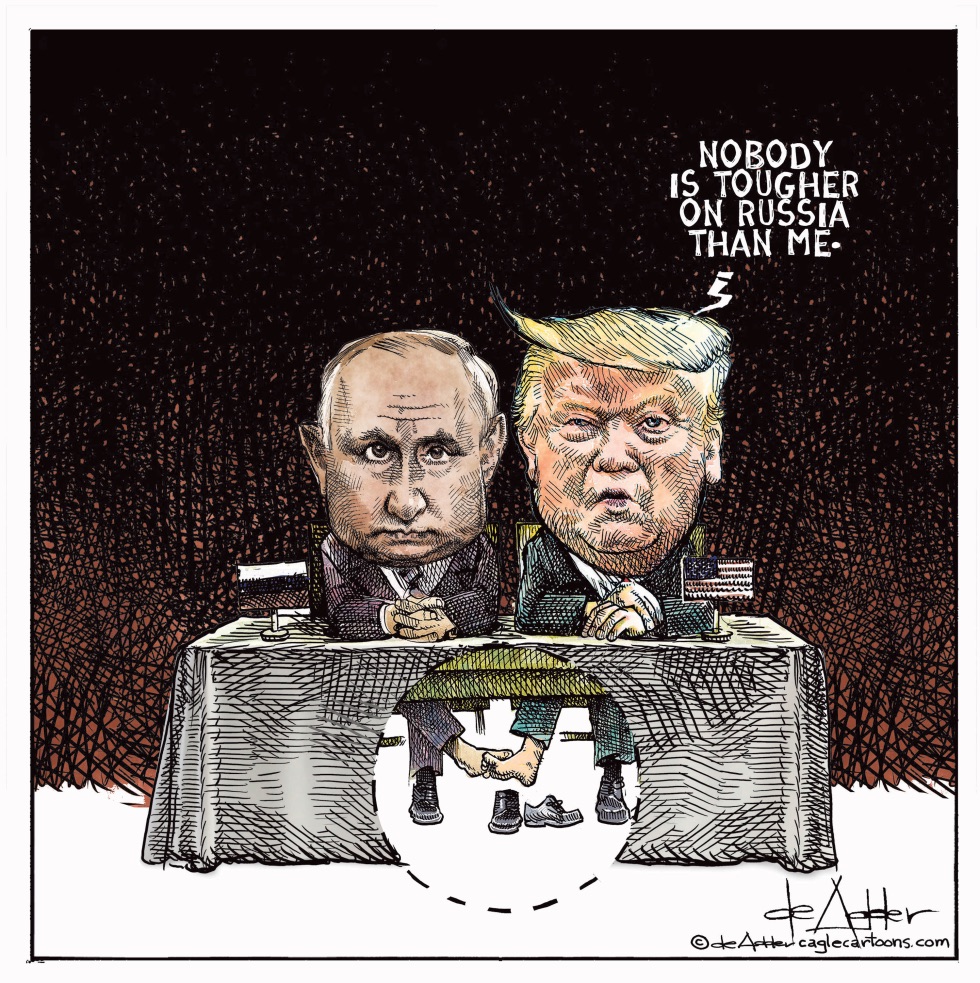
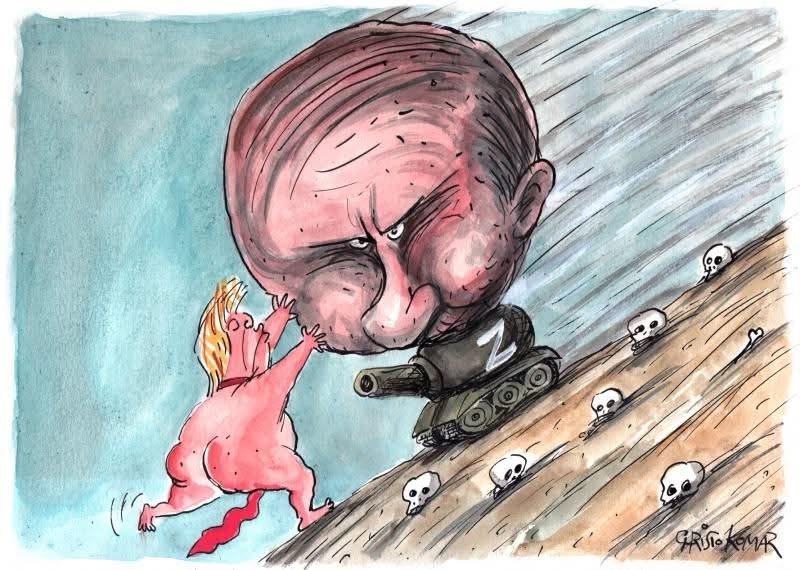
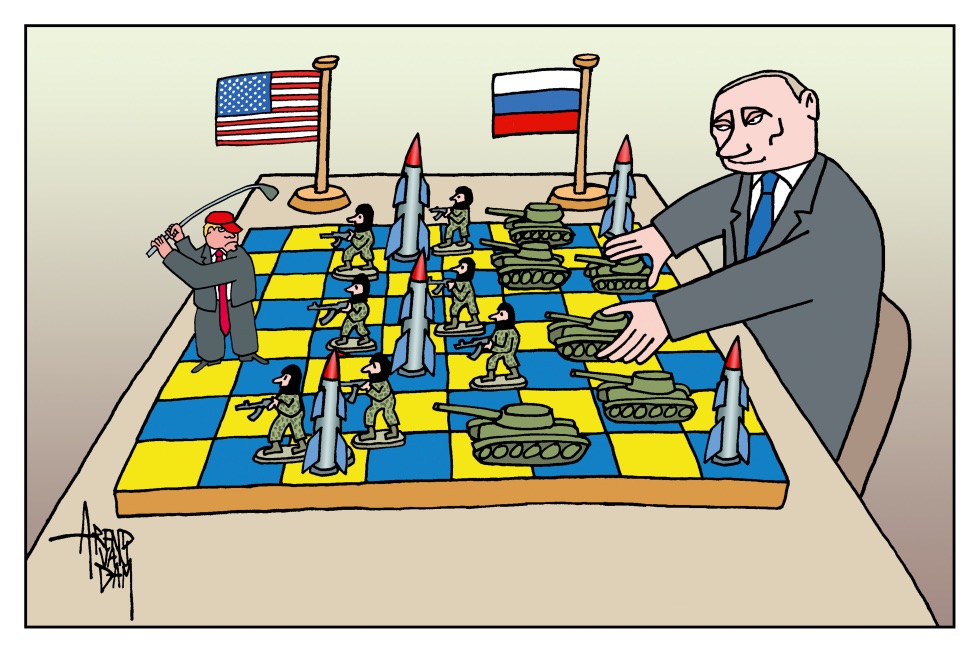
What passes for US foreign policy is the usual lovefest between Putin and Yam Tits. This is from The Bulwark. This story is reported by Cathy Young. “Alaska Summit: Trump and Putin Planning to Carve Up Ukraine. It’s hard to see anything good coming from the meeting of the president and his hero.”
REMEMBER WHEN, A FEW WEEKS BACK, commentators suddenly started talking about Donald Trump’s “pivot” or “dramatic shift” on Ukraine and Russia? The promises of aid to the one and scary sanctions against the other? Trump’s tough talk about the “bullshit thrown at us” by Vladimir Putin and the “nice phone calls” followed by bombings of Ukrainian cities? The fifty-day deadline to make peace or else, which then abruptly became a ten- to twelve-day deadline that expired over the last few days?
Well, guess what. The pivot seems to have fully unpivoted. We’re back to more diplomacy for dummies by Trump’s real estate pal and golf buddy Steve Witkoff, who went on another trip to Moscow and had—as Trump announced with a straight face on Truth Social—a “highly productive meeting” with Putin. So productive, in fact, that it took a while to figure out exactly what sort of deal Putin offered Witkoff, since Witkoff initially reported a garbled—and more attractive—version of the offer. (Witkoff did get to consume a monster-sized cheburek meat pie which greatly excited the Russian media, so it wasn’t a total loss. Oh, and he brought back an Order of Lenin that Putin gave him for a CIA deputy director whose son was killed in the Donbas last year fighting for the Russians. Is Putin trolling Trump at this point?)
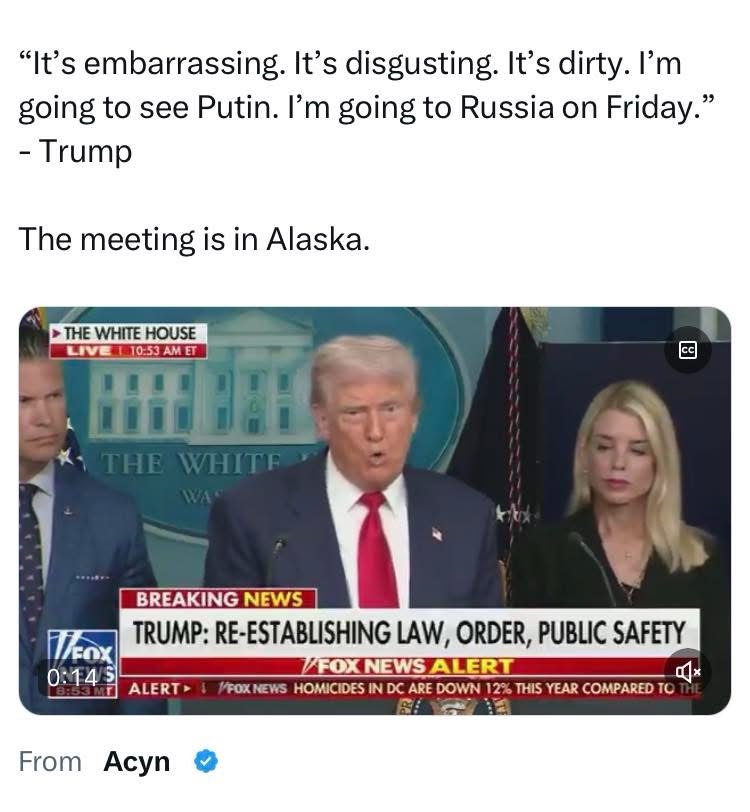
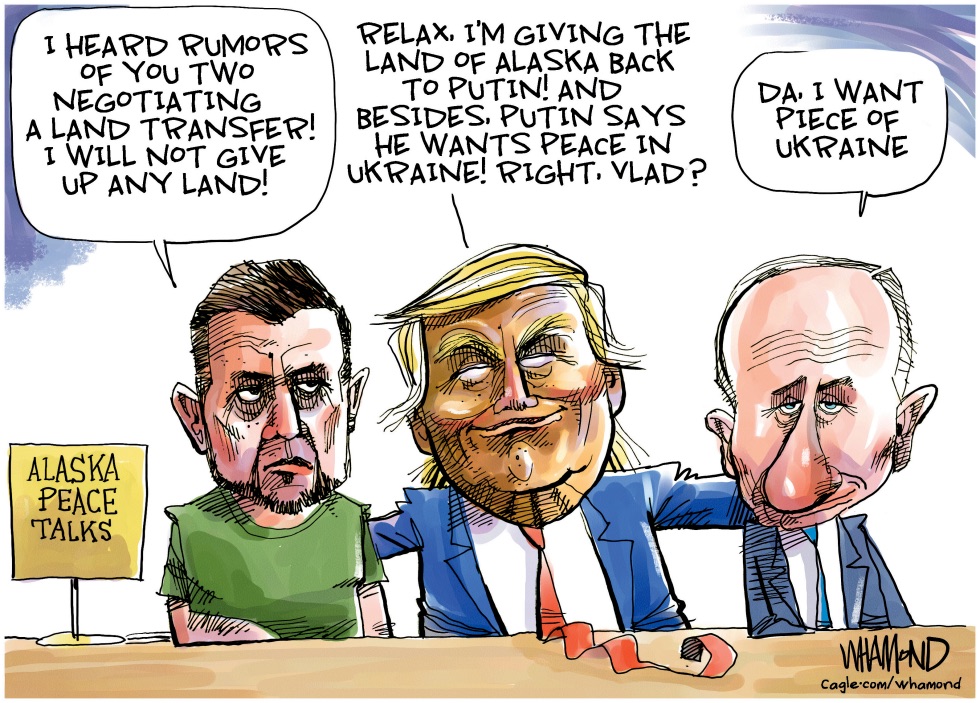
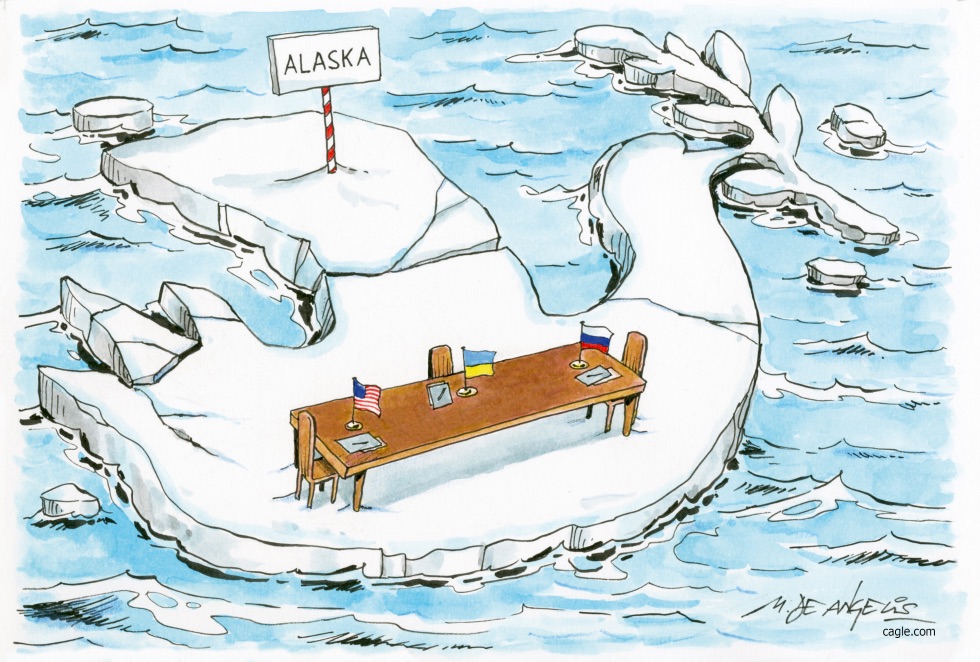
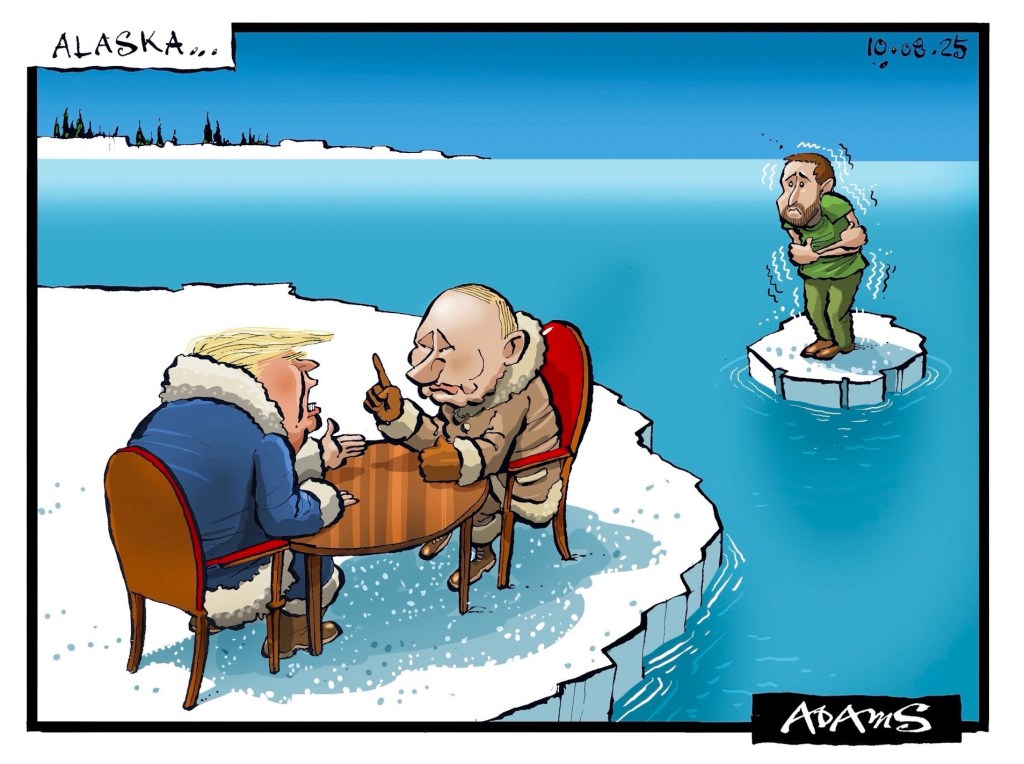
And now, Trump and Putin are set to have a summit in Alaska (of all places!) this coming Friday. Trump’s initial proposal for a three-way summit with Ukrainian president Volodymyr Zelensky has quietly fallen by the wayside; Vice President JD Vance has told Fox News that “we’re trying to figure out, frankly, scheduling and things like that” for the three to meet. So Zelensky may yet get invited to Alaska, but it’s not clear if he will ever be in the same room with Putin. At least for now, it looks like the summit will be a blatant violation of a principle repeatedly proclaimed by Western leaders, from Joe Biden to former German Chancellor Olaf Scholz to NATO Secretary General Jens Stoltenberg: “Nothing about Ukraine without Ukraine.” Or, in as Russian-Ukrainian political scientist Vladimir Pastukhov, currently a scholar at University College London, put it in an interview: “Two mob bosses decided to sit down and have a chat about the capitulation of Ukraine.”
Of course, we don’t know at this point what the final version of the proposed settlement will look like. Trump has talked about “some swapping of territories to the betterment of both.” Presumably, this means that Ukraine will be expected to cede territory that Russia wants but hasn’t managed to seize in exchange for other Ukrainian territory illegally occupied by Russia. But even that, it turns out, is unlikely to happen: Russia is demanding unilateral land concessions in exchange for a peace agreement or a temporary truce. Zelensky has already rejected such concessions, as he has consistently done since the invasion.
But whatever the outcome of the summit, its mere fact already hands Putin a huge win—unless, of course, Trump should decide that after Zelensky’s disgraceful Oval Office humiliation in February, it’s Putin’s turn for an internationally televised verbal beatdown. (Right. And then he’ll give Ukraine a shipment of alien superweapons from a super-secret vault in Area 51.)
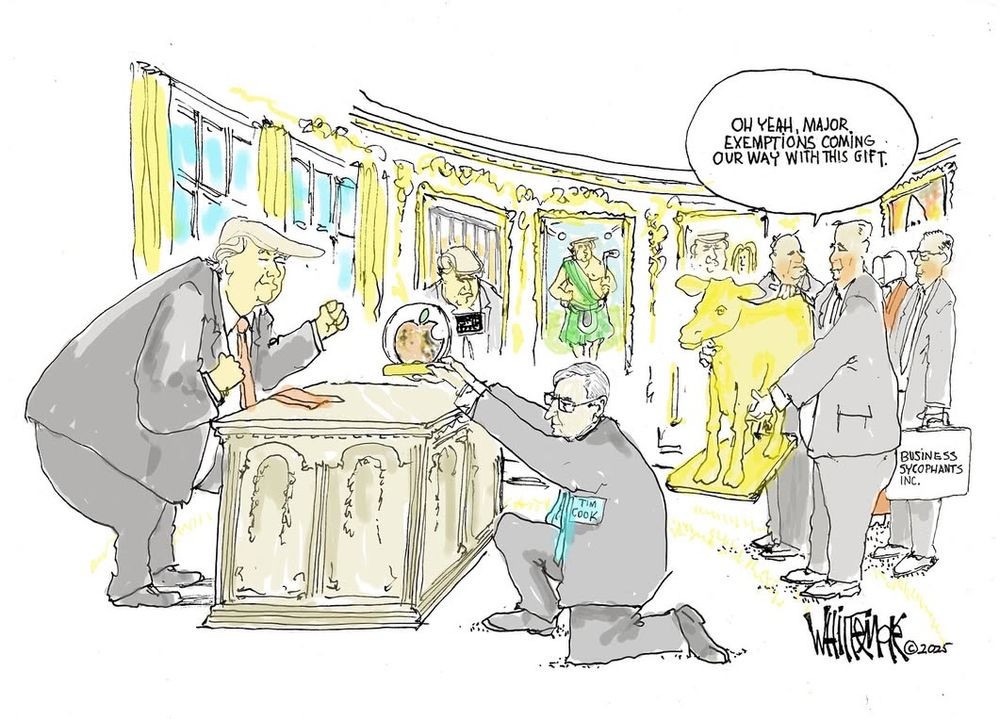
I really don’t know what to make of this headline. Maybe this is how Trump plans to pay for his extensive wrecking of the White House. “U.S. Government to Take Cut of Nvidia and AMD A.I. Chip Sales to China. In a highly unusual arrangement with President Trump, the companies are expected to kick 15 percent of what they make in China to the U.S. government.” And of course, this cost gets passed forward from the businesses to the consumers. This is reported by the New York Times.
Nvidia and Advanced Micro Devices are expected to pay the United States 15 percent of the money they take in from selling artificial intelligence chips to China, as part of a highly unusual financial agreement with the Trump administration.
The deal, which was described by three people familiar with the agreement who spoke anonymously because they didn’t have permission to discuss it publicly, comes a month after Nvidia received permission to sell a version of its artificial intelligence chips to China.
While the Trump administration publicly said a month ago that it was giving the green light to Nvidia to sell an A.I. chip called H20 to China, it did not actually issue the licenses making those sales possible.
On Wednesday, Jensen Huang, Nvidia’s chief executive, met with President Trump at the White House and agreed to give the federal government its 15 percent cut, essentially making the federal government a partner in Nvidia’s business in China, said the people familiar with the deal. The Commerce Department began granting licenses for A.I. chip sales two days later, these people said.
Though Mr. Huang has led negotiations with the White House, Nvidia isn’t the only company that sells A.I. chips to China. AMD has an A.I. chip called the MI308 and in April the Trump administration also banned sales of it to the Chinese.
There are few precedents for the Commerce Department agreeing to grant licenses for exports in exchange for a share of revenue. But the unorthodox payments are consistent with Mr. Trump’s increasingly interventionist role in international business deals involving American companies. In June, the administration approved investment by Nippon Steel, a Japanese company, in U.S. Steel in a deal that included a so-called golden share in the company, a rarely used practice where the government takes a stake in a business.
The administration is also using tariffs as a stick to bring manufacturing to the United States. Last week, Mr. Trump said that tech companies would have to pay a 100 percent tariff on semiconductors made abroad, unless they invested in the United States.
The deal agreed to last week could funnel more than $2 billion to the U.S. government. Nvidia was expected to sell more than $15 billion worth of its H20 chip to China through the end of the year, and AMD was expected to sell $800 million, according to Bernstein Research.
The Commerce Department, White House and AMD didn’t provide comment on Sunday.
Ken Brown, a spokesman for Nvidia, said that the company follows the U.S. government’s rules for sales abroad. “While we haven’t shipped H20 to China for months, we hope export control rules will let America compete in China and worldwide,” he said.
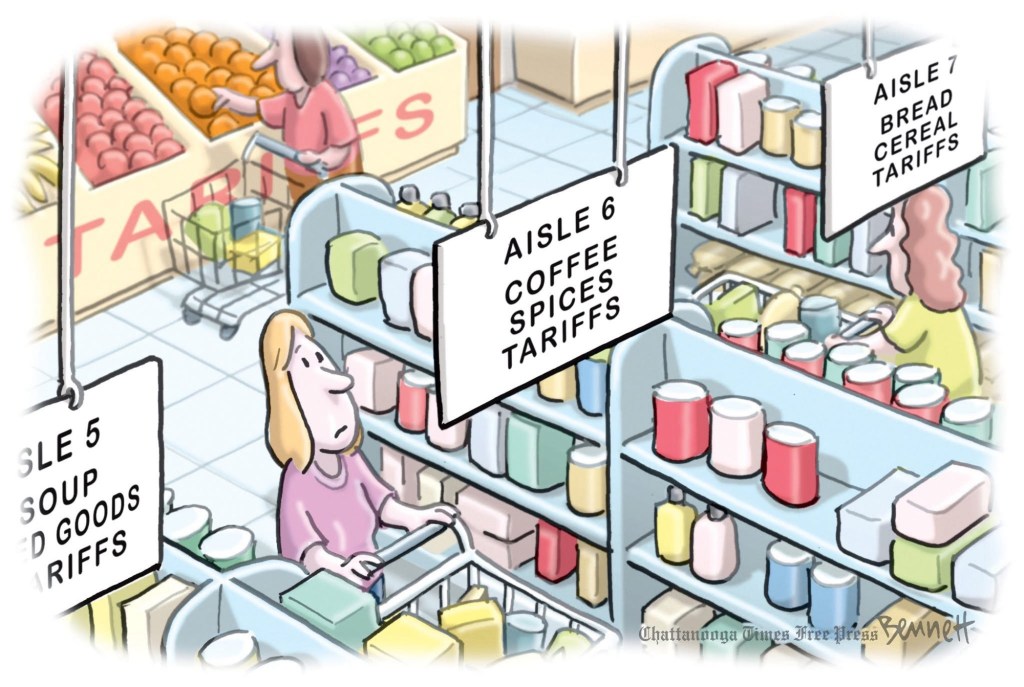
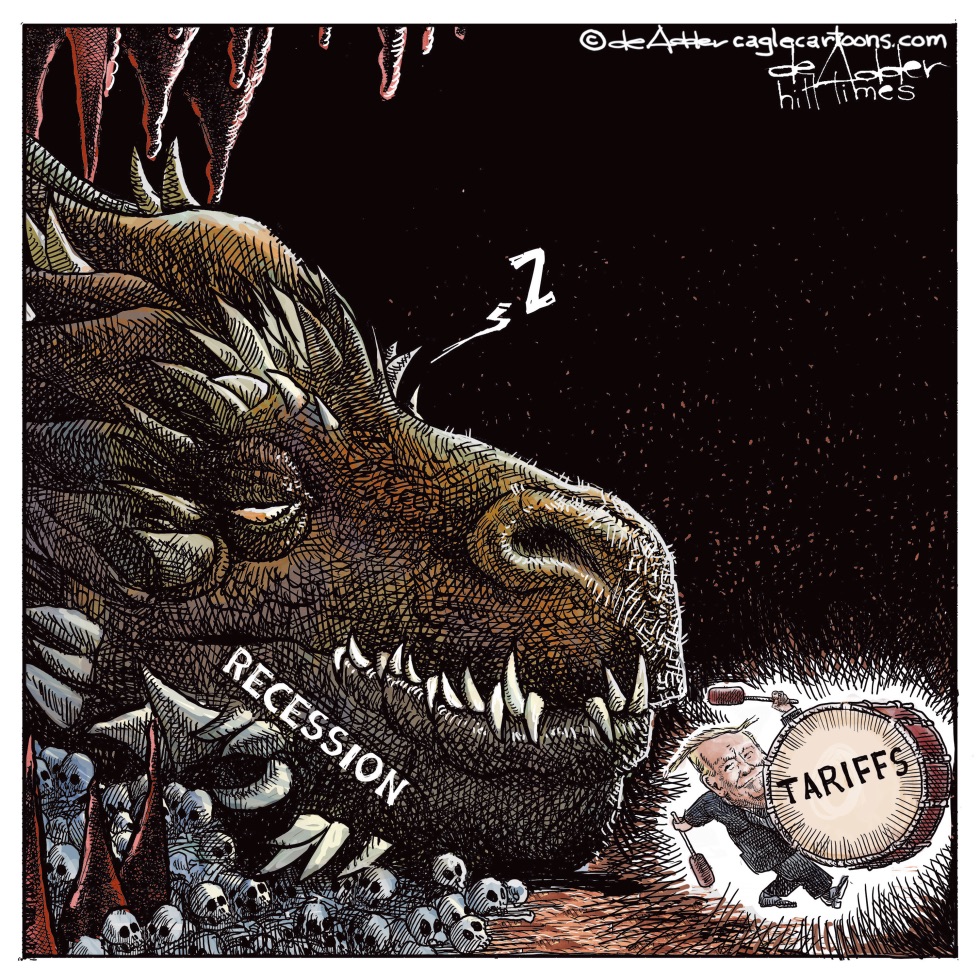
Okay, so tell me the one about “free markets” again. I’ll end with this opinion piece in the Guardianby Steven Greenhouse. “Trump is losing his foolish trade war. This will cost ordinary Americans greatly. Trump’s trade war has pushed up inflation, slashed US job gains, slowed economic growth and caused the manufacturing sector to sputter.” I started my study of economics back on the cusp of the Carter/Reagan years. I absolutely thought we’d learned the lessons of what not to do by that time. It’s amazing that the “Voodoo Economics” of that period and the resulting stagflation is back here in the future. It’s being replayed by the same, but much older group of idiots.
The ever-bombastic Donald Trump has boasted repeatedly of his trade victories, while White House news releases trumpet his “historic trade wins”. The Wall Street Journal echoed Trump’s triumphalism with a headline saying, “Trump is Winning His Trade War”, and last week the New York Times used the exact same words in a headline. That must have been music to the president’s ears.
Forgive me for being a spoilsport, but I don’t see where the victory is or how Trump is winning. I keep reading how Trump’s trade war and tariff machinations have pushed up inflation, slashed US job gains, slowed economic growth and caused the manufacturing sector to sputter.
The rate of job growth plunged by over 70% in the three months after Trump unveiled his 2 April “liberation day” tariffs that filled corporate executives with uncertainty and dread. Trump is palpably impatient for the Federal Reserve to cut interest rates, but the higher prices resulting from his tariffs are likely to delay the rate cuts he desperately wants. So can someone please tell me where is the victory here?
Trump further proclaims that his tariffs are wondrous because, he says, they will generate trillions of dollars in revenue for the US Treasury. But those revenues will come out of the hides of tens of millions of American consumers who will pay Trump’s taxes on imports. The Yale Budget Lab estimates that the price increases caused by Trump’s tariffs will cost the typical US household $2,400 in 2025. As a result of the tariffs, the budget lab says, apparel prices will soar 37% and shoe prices 39%. What Trump boasts as a win is a loss for millions of typical Americans.
Some economists are warning that Trump’s tariffs will bring back stagflation, a dangerous combination of rising prices and slowing growth last seen in the 1970s. Pointing to signs of stagflation, BMO Economics wrote: “Economic activity and job growth are sputtering under the weight of higher tariffs, increasing inflation and rising economic policy and trade uncertainty.” Doesn’t look as if Trump’s trade war is winning there.
Trump recently said on CNBC’s Squawk Box that “people love the tariffs”, but evidently the people he’s talking about aren’t the American people. A recent Fox News poll of registered voters found that Americans overwhelming disapprove of Trump’s tariff policies by 62% to 36%. Ben May, a forecaster at Oxford Economics, said his tariffs will hurt US families because “they are obviously raising prices … and squeezing household incomes”.
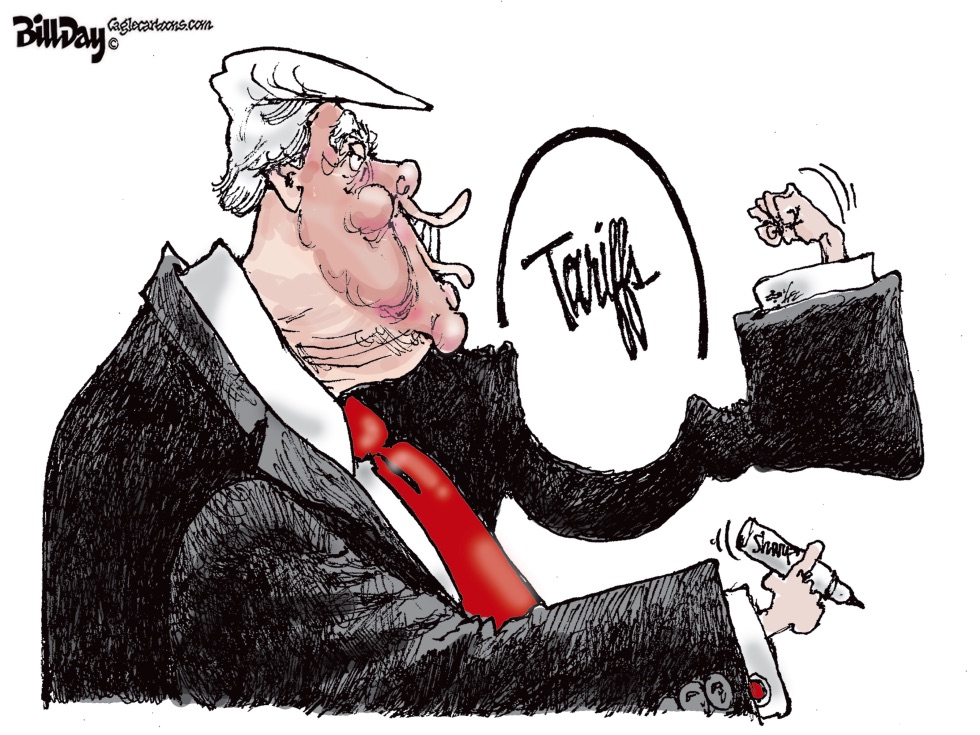
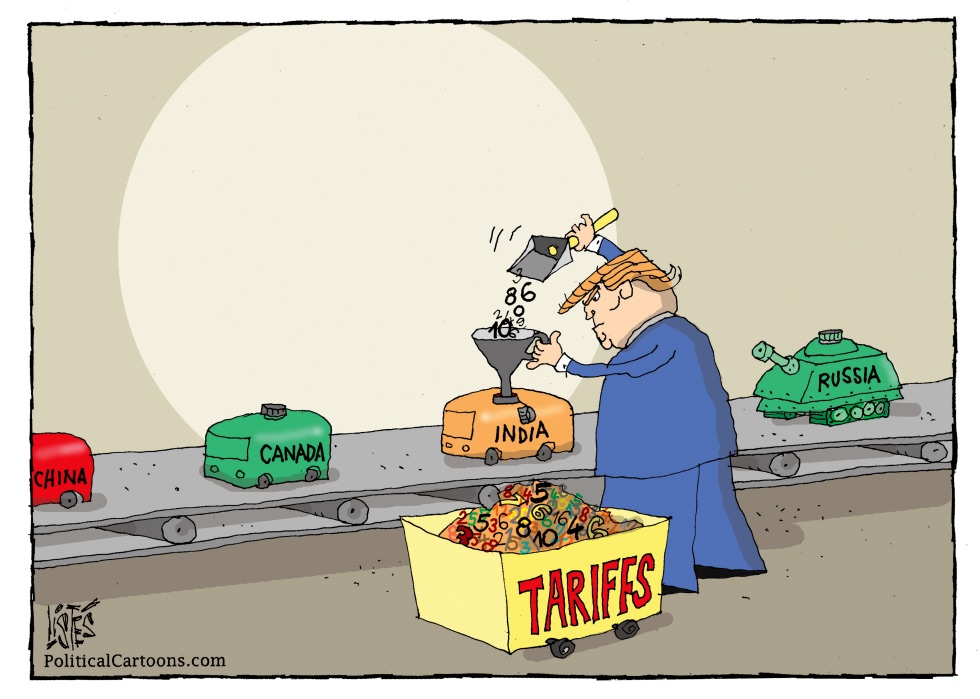
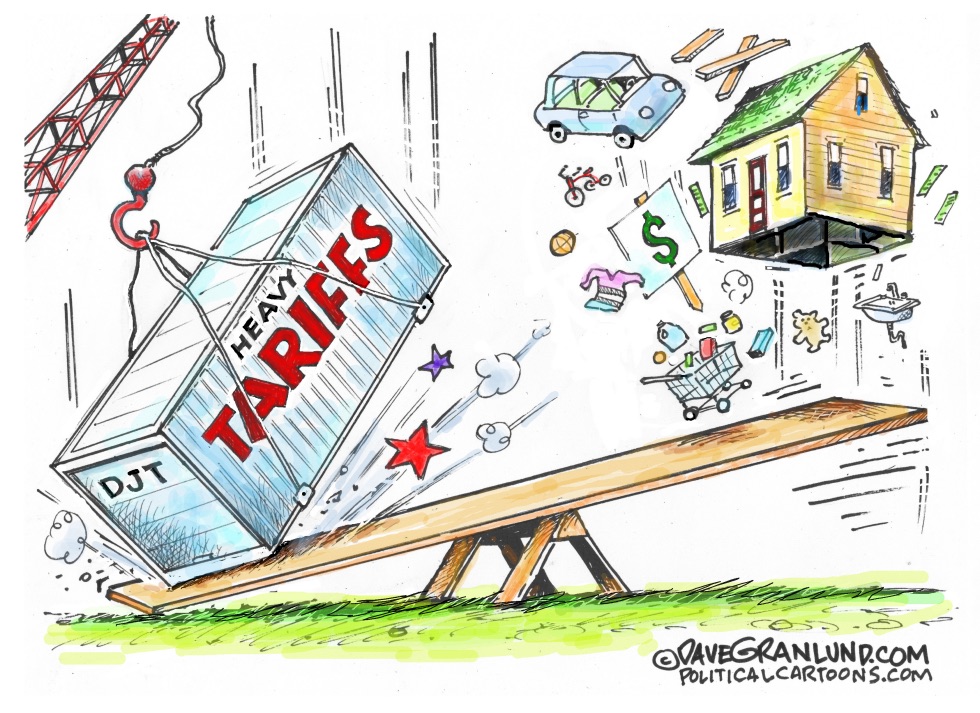
Many days it seems that Trump tries to dominate the news cycle with some tariff announcement or other: 50% on Brazil, double India’s tariffs to 50%, impose a 100% tariff on semiconductors. (Even some Maga folks probably think he uses tariff announcements to distract from the Jeffrey Epstein scandal.) This week the White House dismayed the world by announcing that Trump would impose tariffs, ranging from 15% to 50%, on 90 countries effective Thursday. As a result of Trump’s tariff craze, the average effective tariff rate on imports into the US will be 18%, up from 2.3% last year – the highest level since the infamous Smoot-Hawley tariffs of 1930 worsened the Great Depression.
Yes, it’s Make the Great Depression Great Again time!
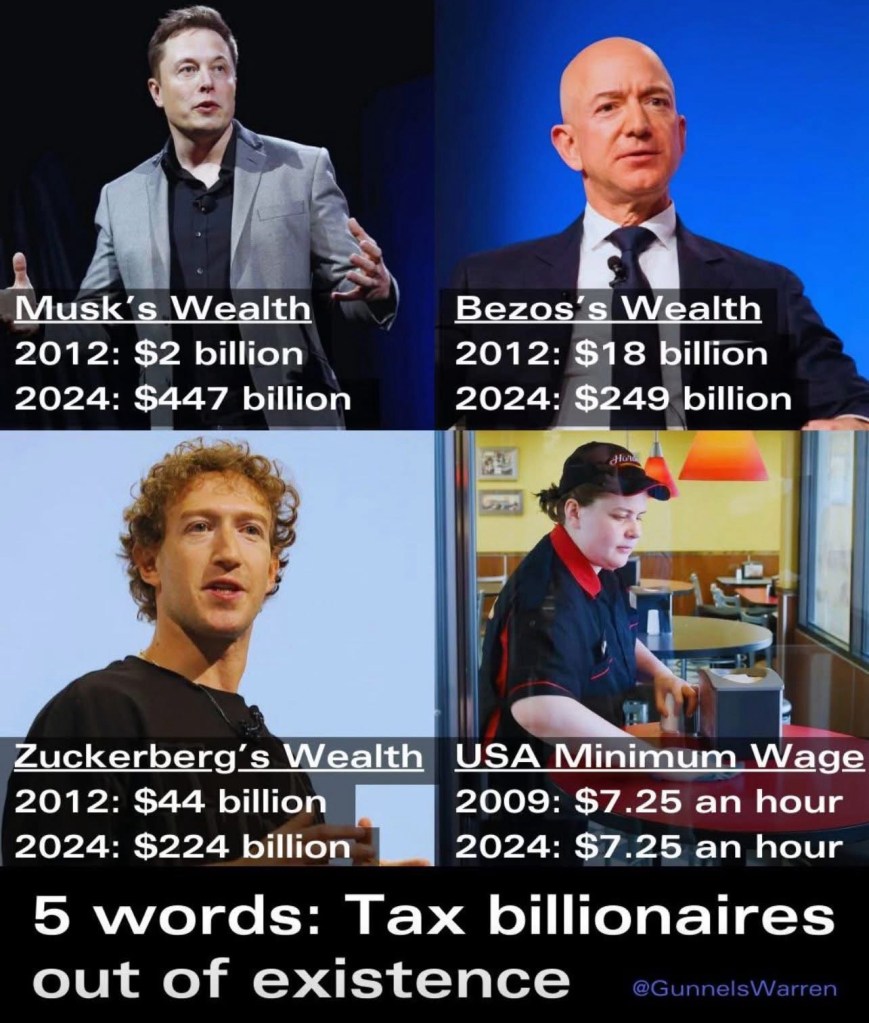
I need a few stories with a cute baby hippopotamus and a few other cuddly creatures. It’s really hard to face this news daily. I do not understand how this lived experience isn’t hitting more people in the head. Well, the billionaires are getting a tax cut in perpetuity.
What’s on your reading and blogging list today?
Did you like this post? Please share it with your friends:
A couple of Caturdays ago, I posted illustrations from a 1950s children’s book called Space Cat and the Kittens. My brother had shared them with me after he bought the book at a used bookstore. This week, he came across the first book in the four-part series, and I’m going to post some of the illustrations from that book today. I think they are really cute. The story:
A little gray kitten with a taste for adventure stows away on an airplane, and the daring stunt turns out to be his first step toward becoming … Space Cat! The plane’s pilot, Captain Fred Stone, names his fuzzy new friend Flyball and welcomes him to an experimental station set up in the middle of the desert. Flyball enjoys supervising the station’s workers and takes particular interest in the big rocket ship that he’s not allowed to explore. Regardless of the rules, the kitty is determined to hitch another ride, and before you know it, Flyball’s wearing a custom-made pressurized suit and headed for the Moon.
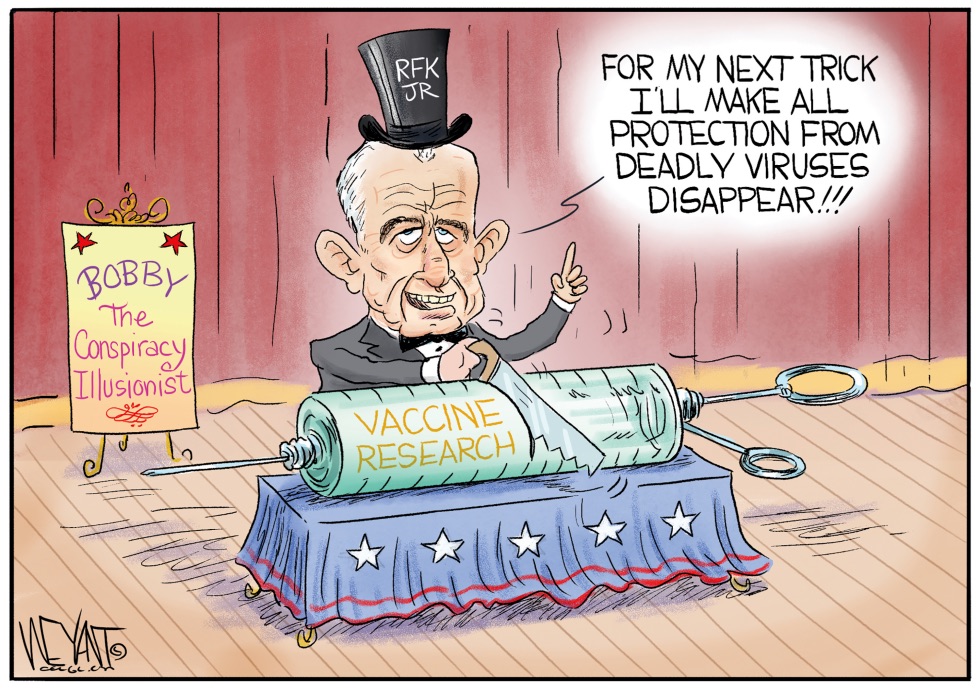
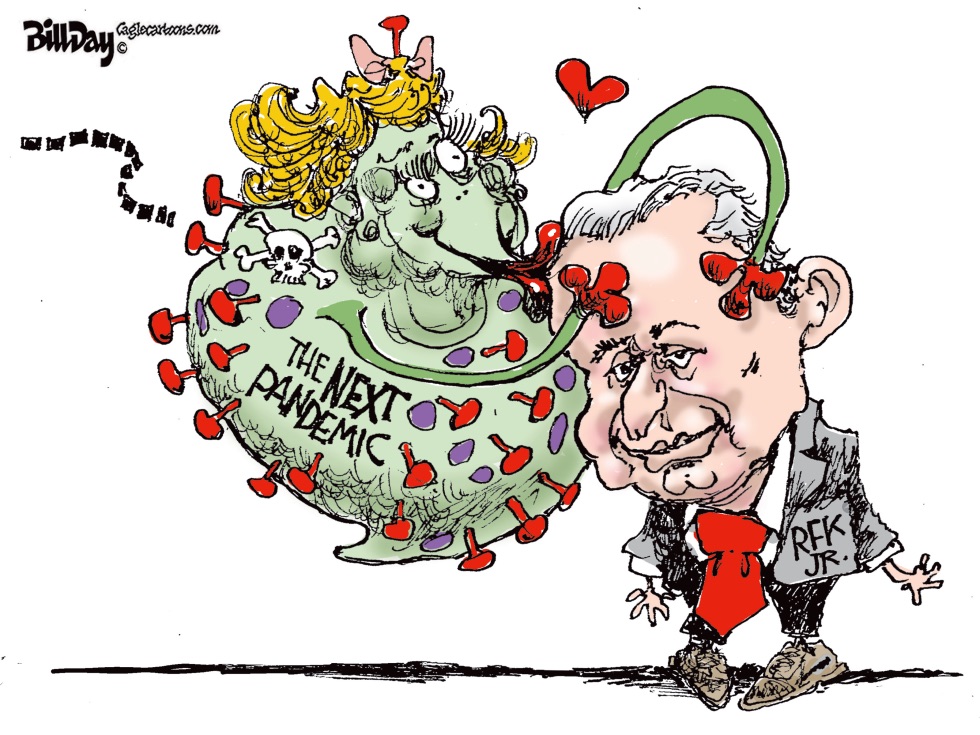
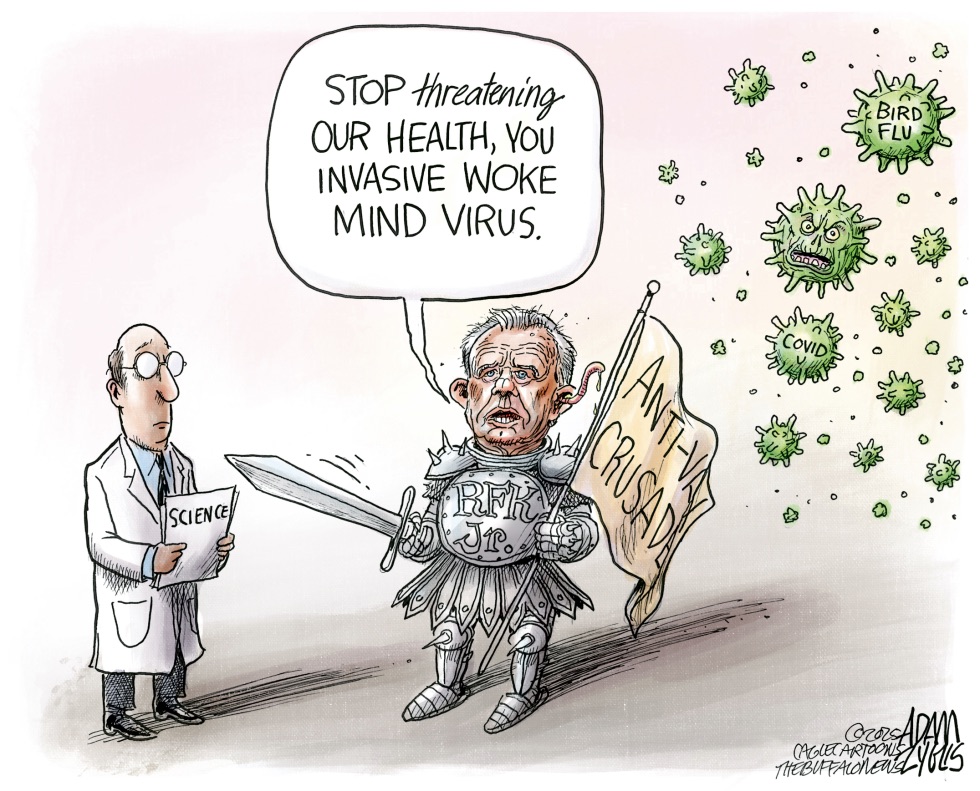
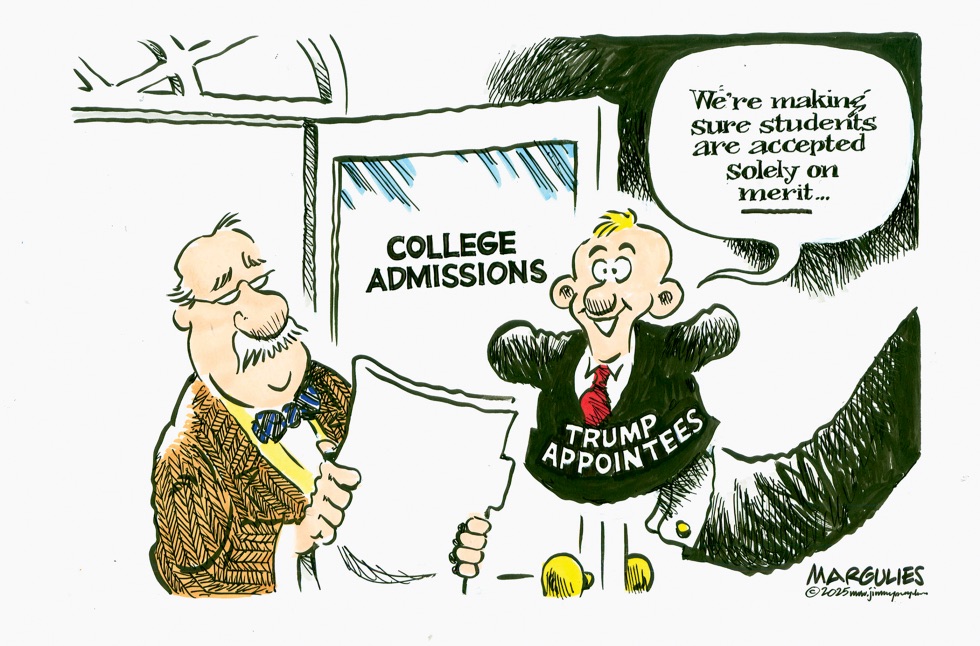
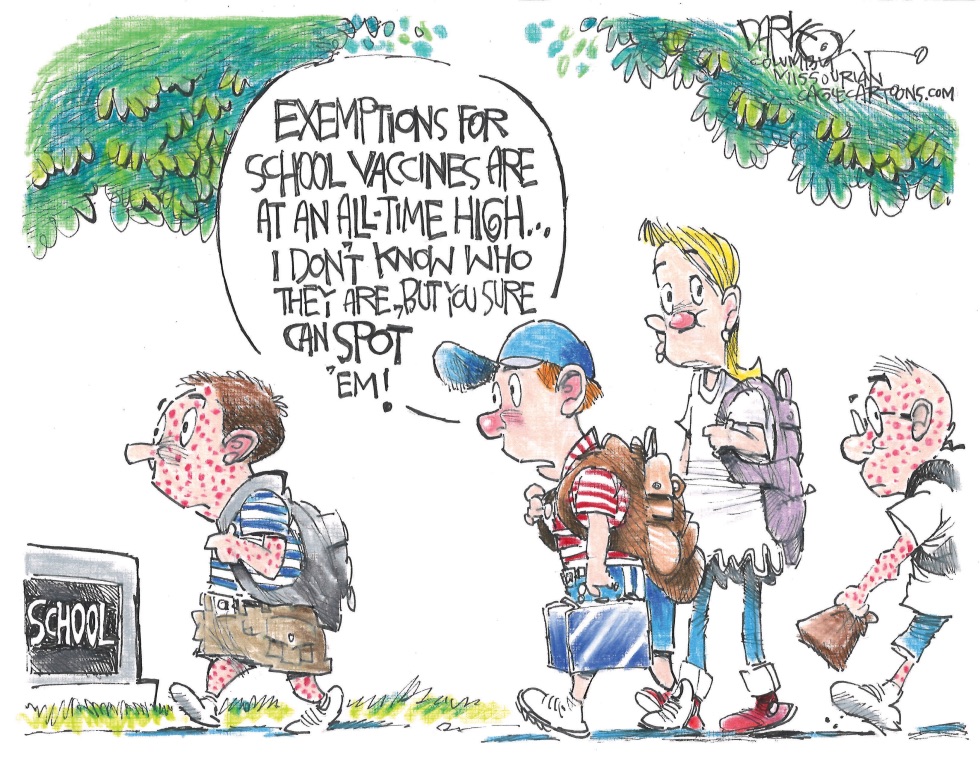
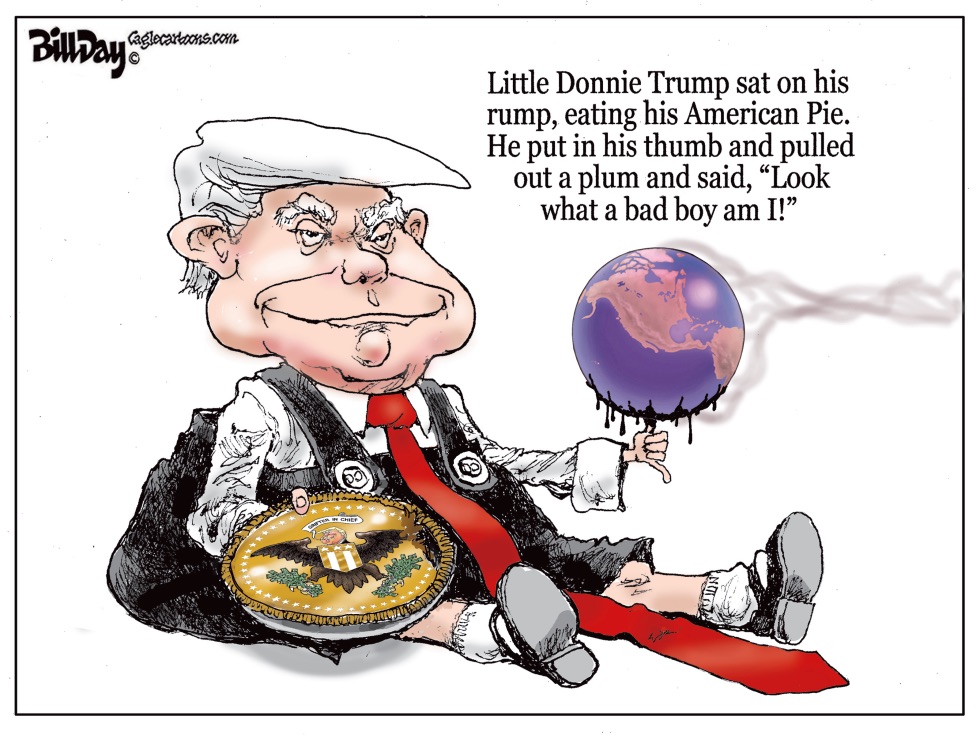
As for the news, everything is awful as usual today. We’re dealing with a “president” who is well on the way of becoming a dictator. He plans to meet with fellow dictator Vladimir Putin to hand over territory in Ukraine; He is allowing his HHS secretary RFK Jr. to endanger Americans with anti-vaccine policies; and he is deliberately damaging American higher education.
President Trump said he would meet with President Vladimir V. Putin of Russia next Friday in Alaska, as he tries to secure a deal to end the war between Russia and Ukraine.
Mr. Trump announced the meeting Friday shortly after he suggested that a peace deal between the two countries could include “some swapping of territories,” signaling that the United States may join Russia in trying to compel Ukraine to permanently cede some of its land.
“We’re going to get some back, and we’re going to get some switched,” Mr. Trump said while hosting the leaders of Armenia and Azerbaijan for a peace summit at the White House. “There’ll be some swapping of territories to the betterment of both, but we’ll be talking about that either later, or tomorrow.”
The meeting, the first in-person summit between an American and Russian president since President Joseph R. Biden Jr. met with Mr. Putin in June 2021, reflects Mr. Trump’s confidence in his ability to persuade Mr. Putin in a face-to-face encounter, a goal that has eluded Mr. Trump and his predecessors. For Mr. Putin, the meeting itself is a victory after he spent the past several months largely isolated from the international community, with NATO leaders — other than Mr. Trump — refusing to communicate directly with him.
Carrying cat to the rocket
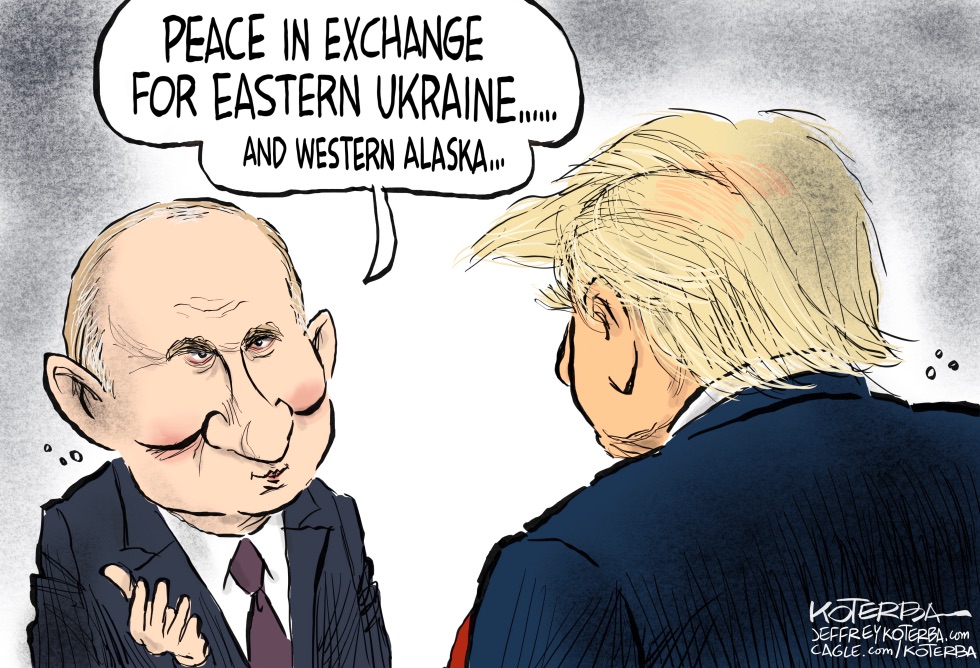
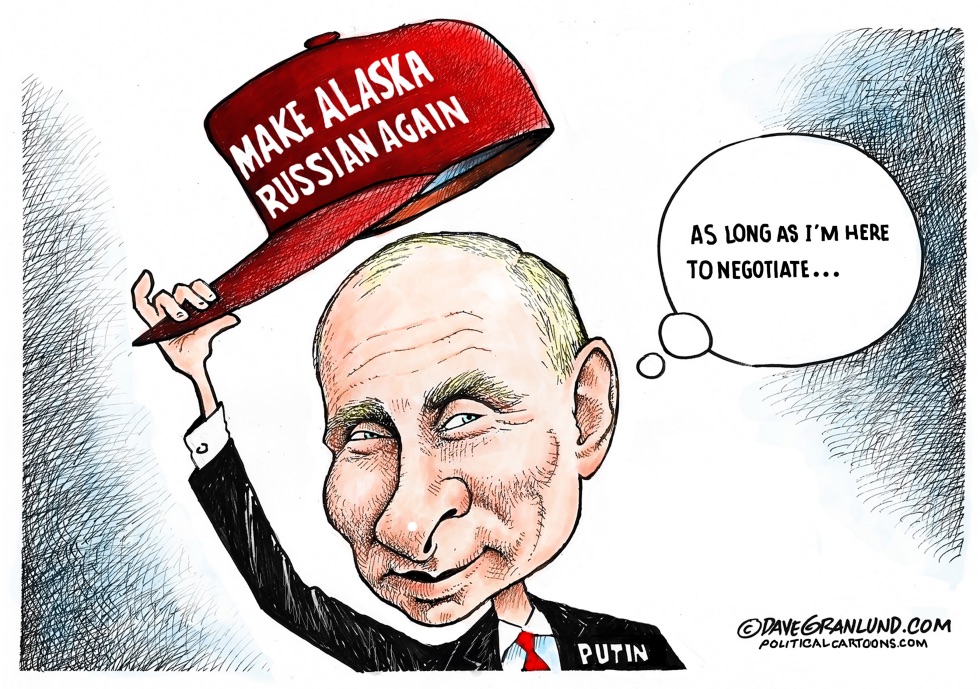
At least he didn’t invite Putin to the White House, but will Putin try to get him to give Alaska back to Russia while they are swapping land in Ukraine?
The meeting also presents a host of challenges. Ukrainian leaders have adamantly opposed relinquishing any of their land to Russia, and the country’s constitution bars President Volodymyr Zelensky of Ukraine from ceding any territory.
There would also be numerous political and military hurdles for Ukraine in turning over land to Russia, as well as questions including security guarantees for Ukraine and the future of frozen Russian assets. And many diplomats have suggested that Mr. Putin may be more interested in dragging out diplomacy to give him time to pummel Ukraine than in securing a peace deal.
White House officials declined to say exactly where in Alaska the two leaders would meet or why Mr. Trump decided to hold the meeting there, though it is the closest U.S. state to Russia. In 2021, the Biden administration held talks with China in Anchorage, Alaska.
Mr. Trump also provided little additional detail about the meeting, what territory could be swapped or the broader contours of a peace deal, saying earlier Friday that he did not want to overshadow the peace pledge between Armenia and Azerbaijan. But he told European leaders earlier this week that he planned to follow up his session with Mr. Putin with a meeting with Mr. Putin and Mr. Zelensky.
President Volodymyr Zelensky of Ukraine on Saturday flatly rejected the idea that Ukraine could cede land to Russia after President Trump suggested that a peace deal between Ukraine and Russia could include “some swapping of territories.”
“Ukrainians will not gift their land to the occupier,” Mr. Zelensky said in a video address from his office in Kyiv, several hours after Mr. Trump’s remarks, which appeared to overlook Ukraine’s role in the negotiations.
“Any decisions made against us, any decisions made without Ukraine, are at the same time decisions against peace,” Mr. Zelensky said. “They will bring nothing. These are dead decisions; they will never work.”
His blunt rejection risks angering Mr. Trump, who has made a peace deal between Ukraine and Russia one of his signature foreign policy goals, even if it means accepting terms that are unfavorable to Kyiv. In the past, Mr. Trump has criticized Ukraine for clinging to what he suggested were stubborn cease-fire demands and for being “not ready for peace.”
Cat in a hammock on spacecraft
What doesn’t anger Trump? Anything except blind loyalty and obedience.
A recent poll by the Kyiv International Institute of Sociology found that more than three-quarters of Ukrainians are against transferring Ukrainian-controlled territory to Russia. When it comes to ceding land that includes territory already under Russian control, opposition drops slightly, with a little more than half of Ukrainians against it, “even if this makes the war last longer and threatens the preservation of independence,” the poll says.
But support for land concessions has grown since Ukraine’s failed 2023 counteroffensive, which underscored its inability to retake substantial territory. About 38 percent of the population thinks ceding land is acceptable now, according to the poll, up from only 10 percent about two years ago.
Russia has long demanded that Ukraine give up four regions in the east and south that Moscow claims to have annexed in late 2022, even though some of that territory remains under Ukrainian control. The Kremlin is particularly intent on seizing full control of the eastern regions of Luhansk and Donetsk, which it has long sought to capture with relentless assaults.
But ceding Luhansk and Donetsk, which are part of an area commonly known as the Donbas region, would create a host of issues for Ukraine. It would mean giving up a region rich in cities and industrial centers that Russia could use as a launchpad to reignite the war.
And Ukraine would have to abandon its main fortified defensive line in northern Donetsk, stretching between the cities of Sloviansk and Kostiantynivka, which has so far withstood Russian assaults.
Location matters, former real estate mogul US President Donald Trump said. Moments later he announced Alaska, a place sold by Russia to the United States 158 years ago for $7.2 million, would be where Russian President Vladimir Putin tries to sell his land deal of the century, getting Kyiv to hand over chunks of land he’s not yet been able to occupy.
The conditions around Friday’s summit so wildly favor Moscow, it is obvious why Putin leapt at the chance, after months of fake negotiation, and it is hard to see how a deal emerges from the bilateral that does not eviscerate Ukraine. Kyiv and its European allies have reacted with understandable horror at the early ideas of Trump’s envoy, Steve Witkoff, that Ukraine cede the remainders of the Donetsk and Luhansk regions in exchange for a ceasefire.
Naturally, the Kremlin head has promoted the idea of taking ground without a fight, and found a willing recipient in the form of Witkoff, who has in the past exhibited a relaxed grasp of Ukrainian sovereignty and the complexity of asking a country, in the fourth year of its invasion, to simply walk out of towns it’s lost thousands of men defending.
Space cat in freefall
It is worth pausing and reflecting on what Witkoff’s proposal would look like. Russia is close to encircling two key Donetsk towns, Pokrovsk and Kostiantynivka, and may effectively put Ukrainian troops defending these two hubs under siege in the coming weeks. Ceding these two towns might be something Kyiv does anyway to conserve manpower in the months ahead.
The rest of Donetsk – principally the towns of Kramatorsk and Sloviansk – is a much nastier prospect. Thousands of civilians live there now, and Moscow would delight at scenes where the towns evacuate, and Russian troops walk in without a shot fired.
Ukrainian President Volodymyr Zelensky’s rejection of ceding land early Saturday reflects the real dilemma of a commander in chief trying to manage the anger of his military and the deep-seated distrust of the Ukrainian people towards their neighbor, who continues to bombard their cities nightly.
What could Ukraine get back in the “swapping” Trump referred to? Perhaps the tiny slivers of border areas occupied by Russia in Sumy and Kharkiv regions – part of Putin’s purported “buffer zone” – but not much else, realistically.
The main goal is a ceasefire, and that itself is a stretch. Putin has long held that the immediate ceasefire demanded by the United States, Europe and Ukraine for months, is impossible as technical work about monitoring and logistics must take place first. He is unlikely to have changed his mind now his troops are in the ascendancy across the eastern frontline.
Read more analysis at the CNN link.
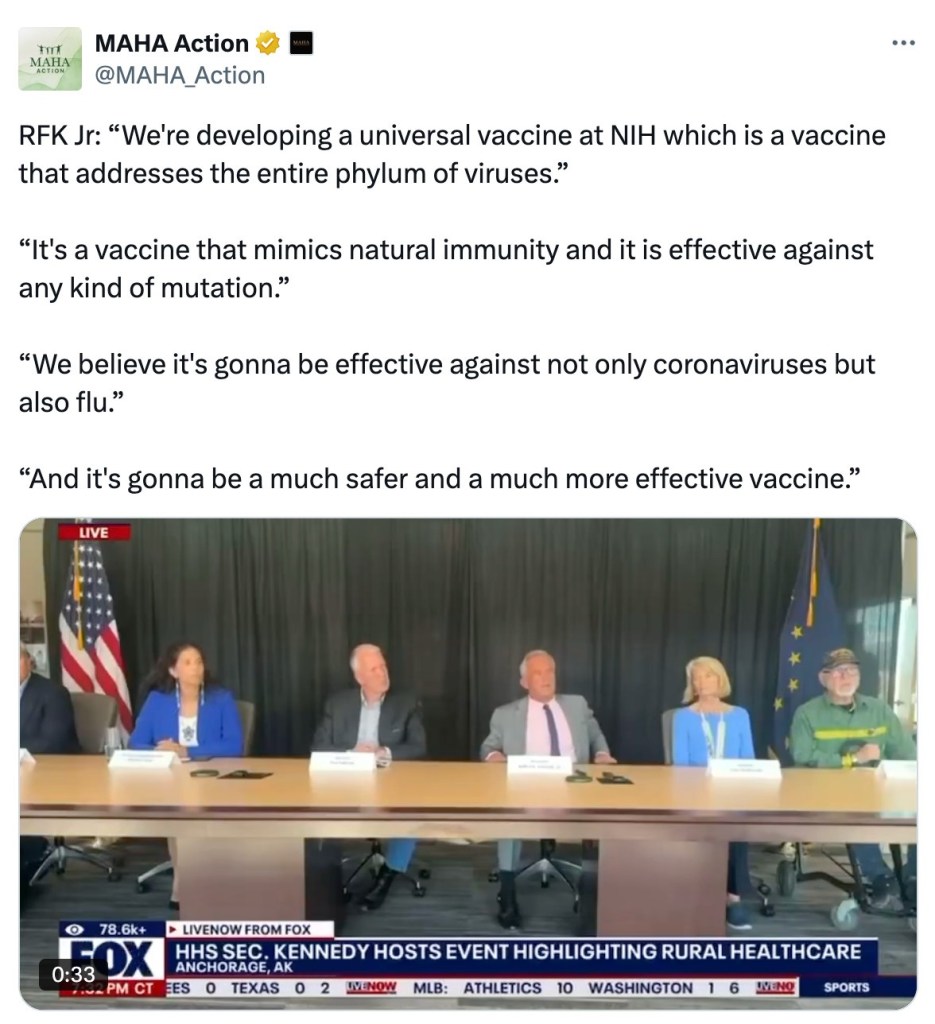
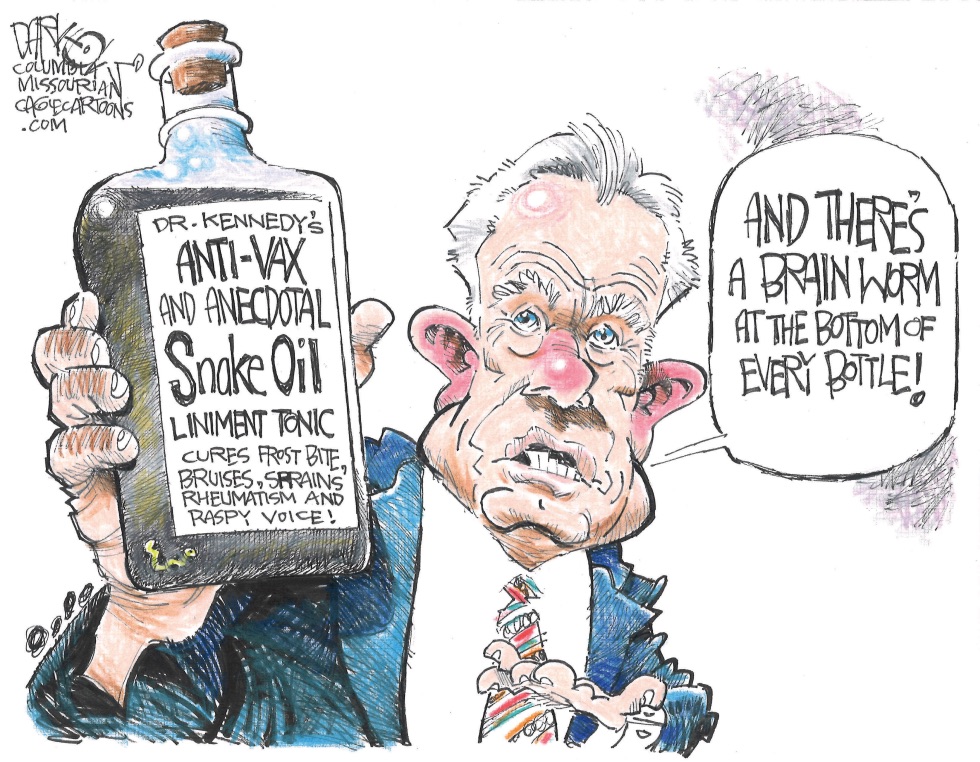
RFK Jr. is doing untold damage to the health of Americans.
During the early days of the coronavirus pandemic in the spring of 2020, President Trump was warned by medical officials that the development of a vaccine that could turn the tide against Covid could be over a year away.
For Mr. Trump, that timeline was not good enough.
He demanded a faster program. The creation of that program, Operation Warp Speed, led to lifesaving vaccines that contained messenger RNA, or mRNA, a synthetic form of a genetic molecule that helps stimulate the immune system. Those vaccines are widely regarded in the scientific community as the quickest way to protect Americans against future threats, including viruses that could mushroom into a pandemic, or man-made menaces, like a bioweapons attack.
Time has marched on and, apparently, so has Mr. Trump in his second term.
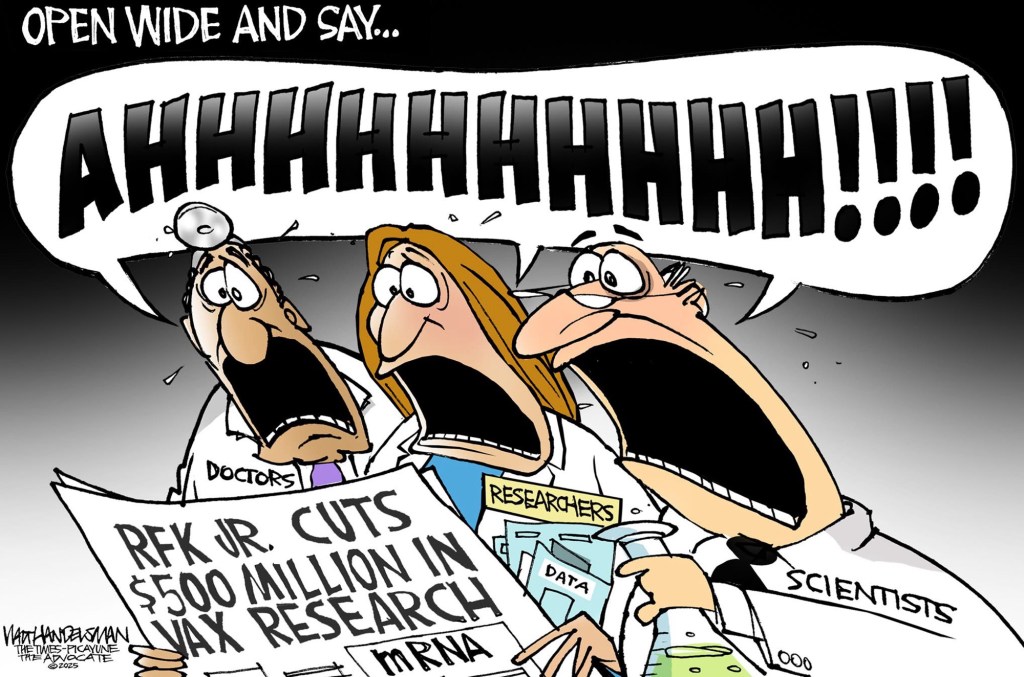
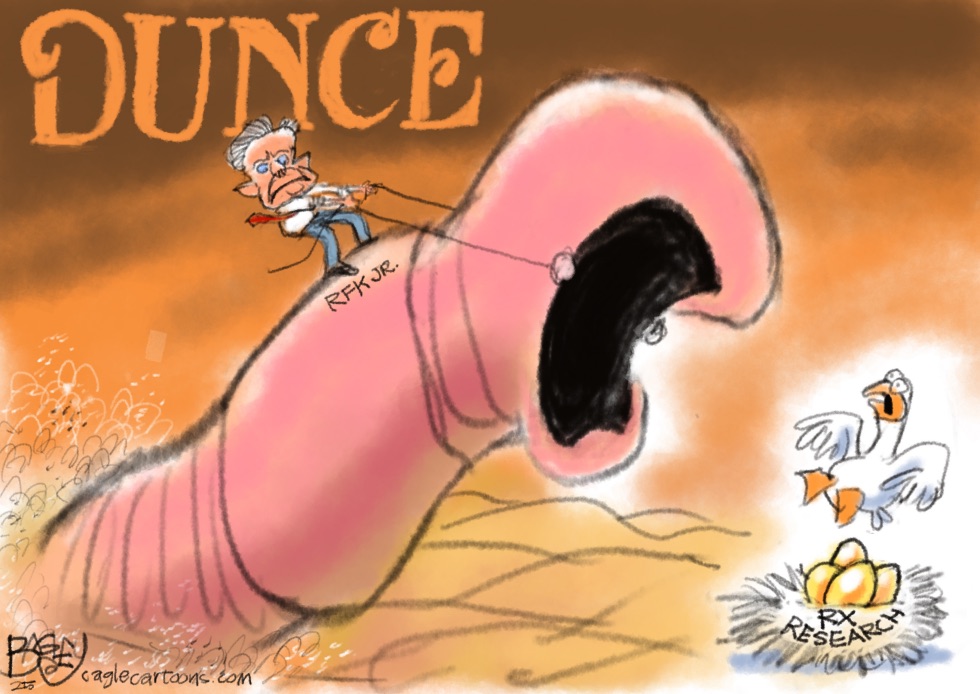
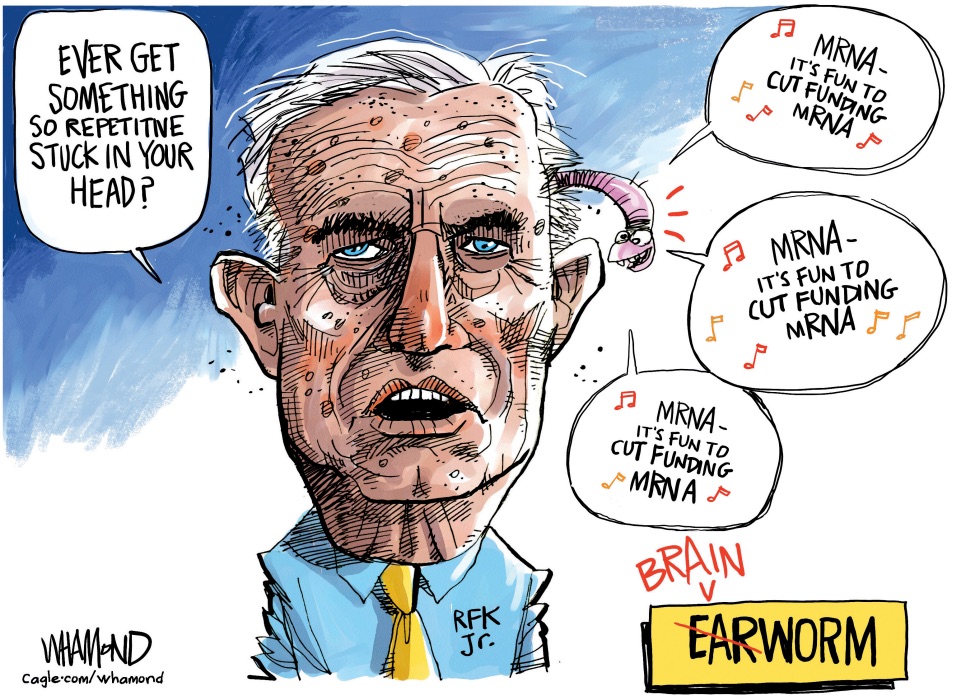
This week, the president all but shrugged off an announcement by Robert F. Kennedy Jr., the health and human services secretary and a longtime critic of vaccines, that a research division of his department had slashed $500 million in grants and contracts for work on mRNA vaccines.
“That was now a long time ago, and we’re onto other things,” the president told reporters on Wednesday. Mr. Trump added that his administration is now “looking for other answers to other problems, to other sicknesses and diseases.” He said he was planning to meet with Mr. Kennedy on Thursday to discuss the decision, but by Friday, White House officials did not say whether that meeting took place.
Space cat is first to land on the Moon.
A bit more:
Mr. Trump’s willingness to give Mr. Kennedy the space to impose his views is notable, given that the vaccines were once seen as legacy achievement during Mr. Trump’s first term. But his laissez-faire posture also leaves room for Mr. Trump to position himself in line with the portion of his base that has grown deeply skeptical about the safety and efficacy of vaccines.
Adm. Brett Giroir, an assistant health secretary in the first Trump administration who was involved in the development of the Covid vaccines, recalled that the president had been “very pro-vaccine,” particularly on matters involving flu preparedness. In 2019, Mr. Trump signed an executive order calling for the modernization of flu vaccines, because “he knew we weren’t as well prepared as we should be.”
Now it’s different. Trump would rather sacrifice millions more American lives than confront his conspiracy-minded followers.
As a record number of people in the U.S. are sickened with measles, researchers are resurrecting the search for something long-deemed redundant: treatments for the viral disease.
After the measles vaccine was introduced in the 1960s, cases of the disease plummeted. By 2000, federal officials had declared measles eliminated from the U.S. This success led to little interest in the development of treatments. But now, as vaccination rates fall and infections rise, scientists are racing to develop drugs they say could prevent or treat the disease in vulnerable and unvaccinated people.
“In America, we don’t like being told what to do, but we like to have options for our medicine chest,” said Marc Elia, chairman of the board of Invivyd, a Massachusetts-based drugmaker that started working on a monoclonal antibody for measles this spring.
Scientists across the country including at biotechs Invivyd and Saravir Biopharma—and institutions such as Vanderbilt University Medical Center and Georgia State University—are in the early stages of measles-treatment development. The drugs are still a ways from becoming available to patients but could offer alternatives to people who are immunocompromised, don’t respond to the measles vaccine or are vaccine skeptics.
Space cat saves astronaut’s life by plugging a hole in his helmet.
Some doctors and researchers warn that measles treatments could further drive the drop in vaccination. Nationally, 92.5% of kindergartners received the measles, mumps and rubella, or MMR, shot in the 2024-25 school year, according to Centers for Disease Control and Prevention data. In 2019-20, the vaccination rate was over 95%, which is the rate encouraged by health authorities to prevent community transmission of measles.
More than 1,300 people, most of them unvaccinated, have been diagnosed with measles this year—a 33-year high.
“One of the motivations of getting the vaccine right now is that there are no treatments,” said Dr. Joel Warsh, a pediatrician who says more research is needed into immunization safety.
Still, Invivyd is betting its measles monoclonal antibody could help curb infections and outbreaks. Unlike the MMR vaccine, which is designed to train the body to make its own antibodies—proteins that help defeat specific pathogens—monoclonal antibodies are lab-made versions that can be delivered intravenously or as an injection and boost immunity immediately.
Antibody treatments could treat someone who is sick or help prevent measles in people recently exposed to the virus. They could benefit newborns and immunocompromised people who can’t be vaccinated, as well as the minority of people who don’t respond to the vaccine or whose immunity has waned. The treatments could offer weeks or months of protection against measles, researchers said.
“Think of it like antivenom after a snake bite,” said Erica Ollmann Saphire, chief executive of the La Jolla Institute for Immunology, whose lab is developing its own monoclonal antibodies for measles. “Even people unsure about vaccines, if they are already sick with measles, getting an antibody treatment could be palatable.”
There’s much more at the link. I got past the paywall by clicking the link at Memeorandum.
As an infectious disease physician who cared for dozens of critically ill Covid patients in December 2020, I witnessed a remarkable shift in the months that followed. As mRNA vaccines became available in early 2021, severe cases among vaccinated individuals became extremely rare. Deaths were almost exclusively among those who declined vaccination, which was tragic given how preventable these outcomes had become.
Space cat in the moon cave
No vaccine for respiratory viruses has ever provided complete, lasting protection against all infections. Not the flu vaccine. Not RSV vaccines. That never should have been the expectation. Some vaccines, like those for measles or polio, can effectively prevent infection and transmission, but these target fundamentally different viruses that don’t constantly mutate and reinfect the respiratory tract. The purpose of respiratory virus vaccines is to prevent severe disease, hospitalization and death. By that measure, mRNA vaccines have been revolutionary.
The data confirms what I witnessed firsthand. According to research by the Centers for Disease Control and Prevention, unvaccinated individuals had 53 times the risk of death compared to those who had been fully vaccinated during the Delta wave in 2021. A New England Journal of Medicine study analyzing over 6 million Covid cases found that protection against death remained above 90% and remarkably durable, even as protection against infection declined.
In winter 2020, my hospital’s ICU overflowed with COVID patients. Like many colleagues worldwide, I watched patient after patient die despite our best efforts. It was unlike anything any of us had ever seen. By summer 2021, after vaccines rolled out widely, the change was undeniable. Far fewer patients arrived with respiratory failure. Nursing homes saw deaths plummet.
As vaccine expert Paul Offit stated in December 2020: “All you want to do is keep people out of the hospital and keep them out of the morgue and I think this vaccine can certainly do that.” Even then, before vaccines were widely available, experts understood the real goal.
The Trump administration is seeking a $1 billion settlement from the University of California, Los Angeles, a White House official said Friday, after the Department of Justice accused the school of antisemitism and other civil rights violations.
UCLA is the first public university to be targeted by a widespread funding freeze over allegations of civil rights violations related to antisemitism and affirmative action.
President Donald Trump’s administration has frozen or paused federal funding over similar allegations against elite private colleges. In recent weeks, the administration has struck deals with Brown University for $50 million and Columbia University for $221 million but has explored larger settlements, such as in its ongoing battle with Harvard University.
The White House official did not detail any additional demands the administration has made to UCLA or elaborate on the settlement amount. The person was not authorized to speak publicly about the request and spoke on condition of anonymity.
The university had drawn widespread criticism for how it handled dispersing an encampment of Israel-Hamas war protesters in 2024. One night, counterprotesters attacked the encampment, throwing traffic cones and firing pepper spray, with fighting that continued for hours, injuring more than a dozen people, before police stepped in. The next day, after hundreds defied orders to leave, more than 200 people were arrested. Later, Jewish students said demonstrators in encampments blocked them from getting to class.
The Trump administration is warning Harvard University that it could take over its patents, worth hundreds of millions of dollars, if a review finds the university hasn’t complied with federal law, an escalation of the continuing negotiations between the White House and America’s oldest university.
Commerce Secretary Howard Lutnick sent a letter to Harvard President Alan Garber on Friday, telling him the administration planned to do a thorough review of all patents held by the university.
General likes Space Cat.
“We believe that Harvard has failed to live up to its obligations to the American taxpayer and is in breach of the statutory, regulatory, and contractual requirements tied to Harvard’s federally funded research programs and intellectual property arising therefrom, including patents,” the letter says.
A Harvard spokesperson called the move “yet another retaliatory effort targeting Harvard for defending its rights and freedom.” The university’s technology and patents help save lives and redefine industries, and Harvard is committed to complying with all federal laws around the patenting of work from federally funded research, the spokesperson said.
The letter is another point of leverage for the Trump administration in its effort to punish the university for allegedly failing to stop antisemitism on campus. The administration has frozen billions of dollars in Harvard’s federal research money and cut the university off from future grants.
Lutnick told Garber that he had until Sept. 5 to respond with a list of all patents that have stemmed from federally funded research grants and to provide information showing it complied with federal regulations, including a 1980 act by Congress known as Bayh-Dole that allowed institutions to retain ownership of a patent even if the innovation used taxpayer dollars.
A bit more, because of the paywall:
Harvard has more than 5,800 patents, according to its website. In its fiscal year ended in June, the university was issued 159 patents. Startups from Harvard range from pharma and biotech companies to manufacturing.
Federal regulations under Bayh-Dole require a litany of disclosures for a patent, including how the American people benefit from an invention. If a patent holder fails to make these disclosures, the government has the right to take ownership of the invention.
Lisa Ouellette, a law professor at Stanford, said the Trump administration’s move appears to be unprecedented in the four and a half decades of the Bayh-Dole Act. “I have never seen the government step in to reclaim control of a university’s patents in any sense,” she said. The Biden administration considered using a provision of the act to try to lower pharmaceutical prices, but the proposal never came to pass, Ouellette said.
The Trump administration has been in talks with several universities, including the University of California, Los Angeles, Cornell and Northwestern, and sees striking a deal with Harvard as an essential mission. The White House has already reached a $200 million settlement with Columbia and a $50 million deal with Brown.
This is breathtaking.
That’s all I have for today. What’s on your mind?
Did you like this post? Please share it with your friends:
The Sky Dancing banner headline uses a snippet from a work by artist Tashi Mannox called 'Rainbow Study'. The work is described as a" study of typical Tibetan rainbow clouds, that feature in Thanka painting, temple decoration and silk brocades". dakinikat was immediately drawn to the image when trying to find stylized Tibetan Clouds to represent Sky Dancing. It is probably because Tashi's practice is similar to her own. His updated take on the clouds that fill the collection of traditional thankas is quite special.
You can find his work at his website by clicking on his logo below. He is also a calligraphy artist that uses important vajrayana syllables. We encourage you to visit his on line studio.

















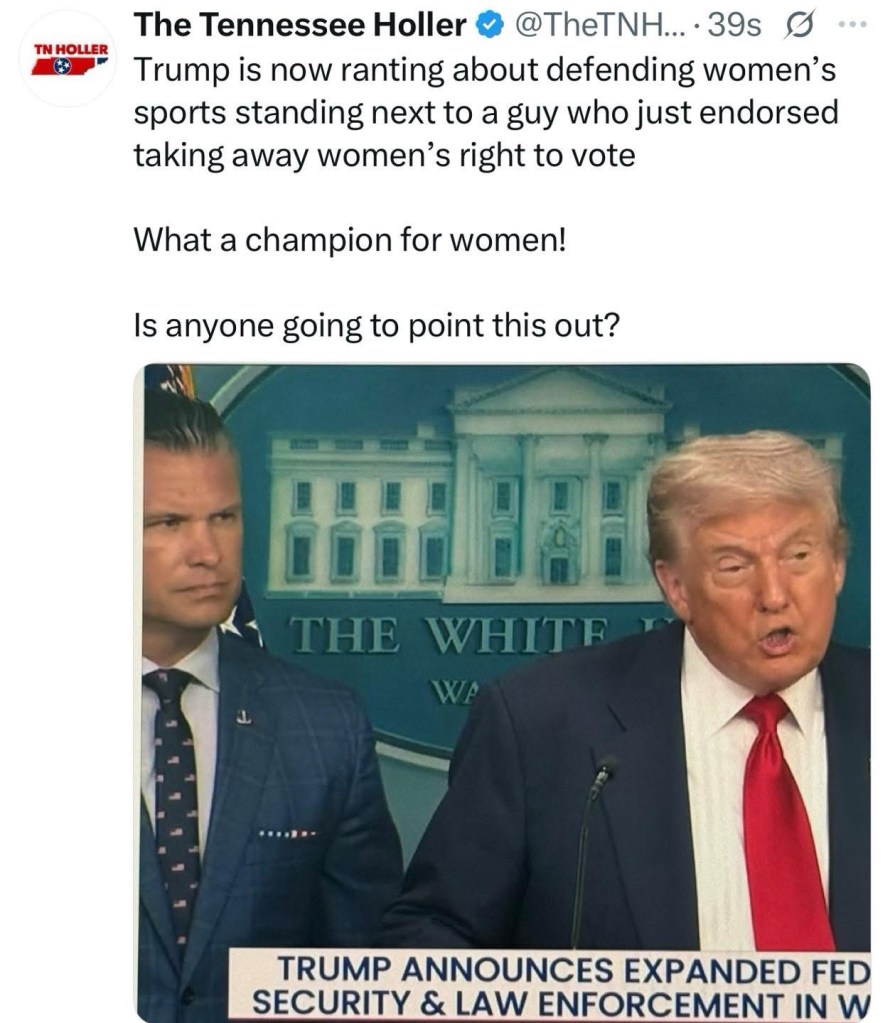

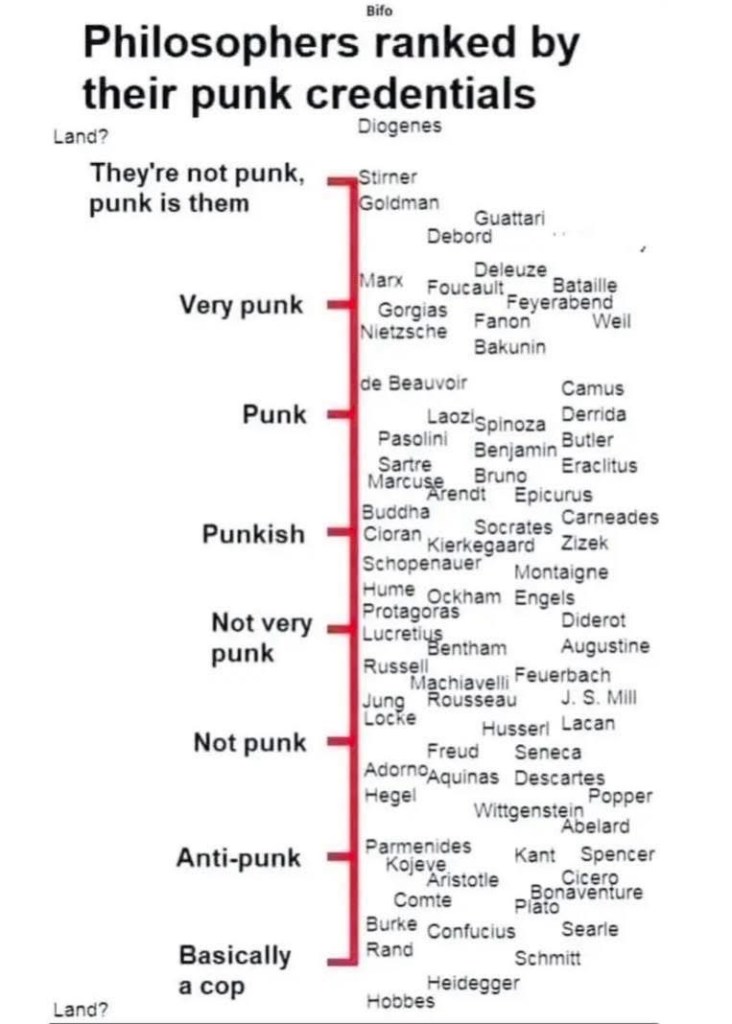
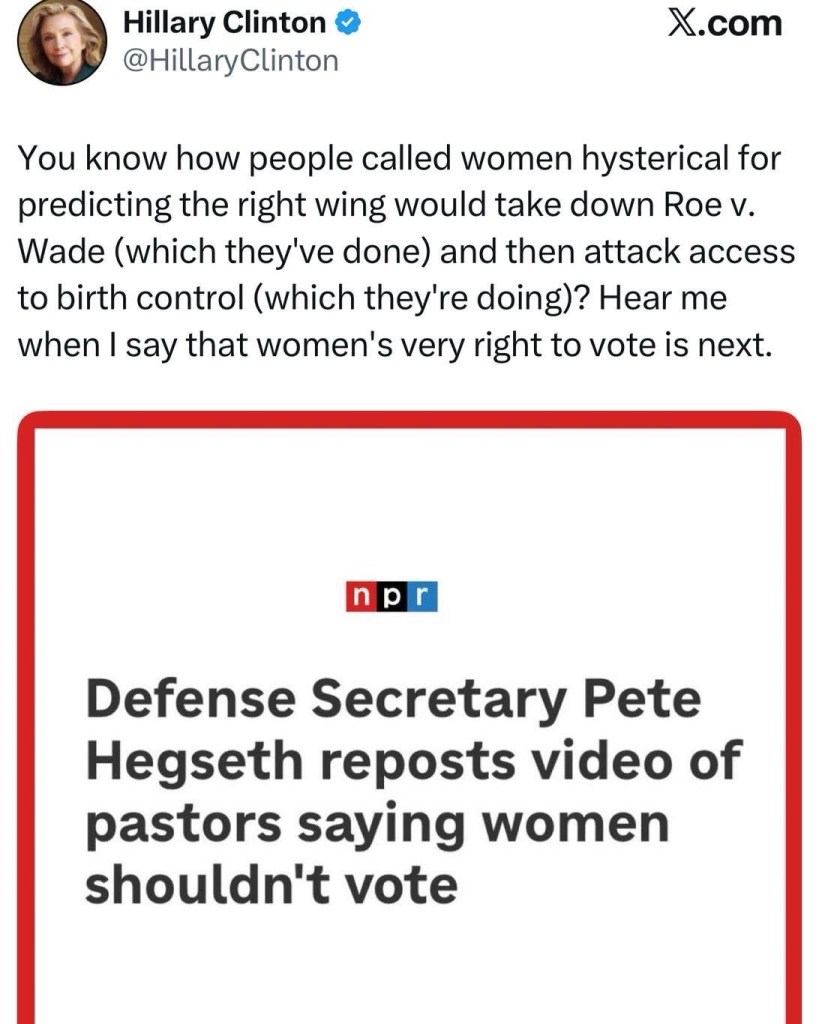
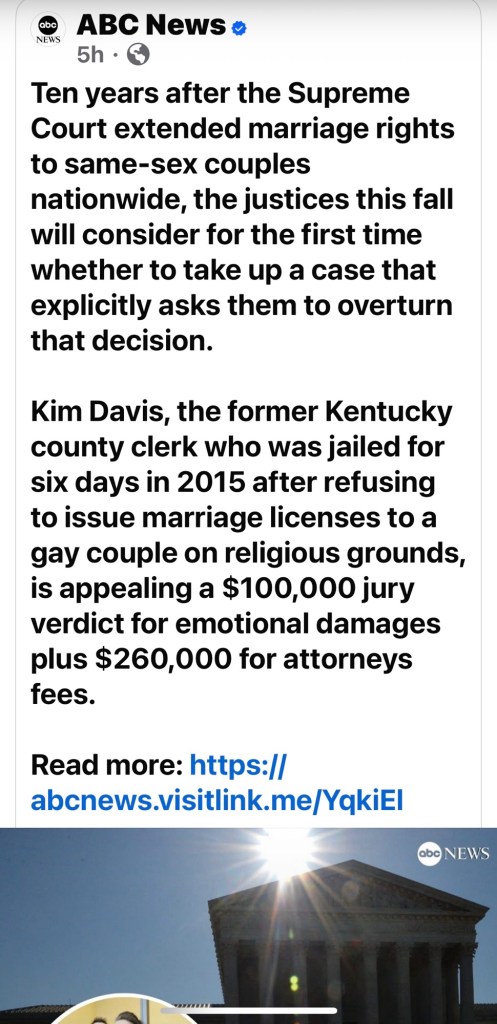







 This morning’s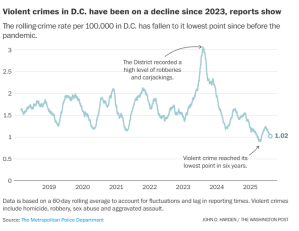
 Are we great again yet?
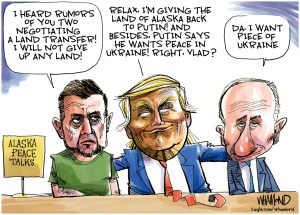 What passes for US foreign policy is the usual lovefest between Putin and Yam Tits.
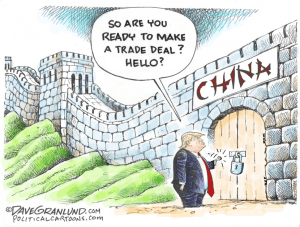 I really don’t know what to make of this headline. Maybe this is how Trump plans to pay for his extensive wrecking of the White House. “U.S. Government to Take Cut of Nvidia and AMD A.I. Chip Sales to China. In a highly unusual arrangement with President Trump, the companies are expected to kick 15 percent of what they make in China to the U.S. government.” And of course, this cost gets passed forward from the businesses to the consumers.
 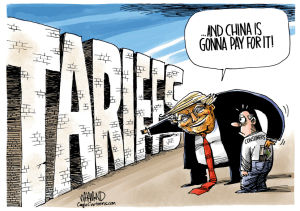 Okay, so tell me the one about “free markets” again. I’ll end with this opinion piece in the

























 peej
peej Carissa
 bostonboomer
 dakinikat
 ecocatwoman
 mablue2
 Mama Lopez
 peggysue22
 quixote
 skydancingguestblogger
 Mona (aka Wonk the Vote)



 Sky Dancing
Recent Comments