Trump is still “president,” and he continues to do terrible things; but there are beginning to be a few positive signs that his grip on the GOP is waning as his approval ratings continue to drop. One of those signs is the refusal of Republicans in the state senate to follow his demand for redistricting. As some people here know, I grew up in Indiana. I can’t help feeling a bit of Hoosier pride about this.
If Indiana Republican senators had any doubt about what to do with President Donald Trump’s redistricting proposal, he helped them make up their minds the night before this week’s vote.
In a social media screed, Trump accused the state’s top senator of being “a bad guy, or a very stupid one.”
“That kind of language doesn’t help,” said Sen. Travis Holdman, a banker and lawyer from near Fort Wayne who voted against the plan.
He was among 21 Republican senators who dealt Trump one of the most significant political defeats of his second term by rejecting redistricting in Indiana. The decision undermined the president’s national campaign to redraw congressional maps to boost his party’s chances in the upcoming midterm elections.
In interviews after Thursday’s vote, several Republican senators said they were leaning against the plan from the start because their constituents didn’t like it. But in a Midwest nice rebuttal to America’s increasingly coarse political discourse, some said they simply didn’t like the president’s tone, like when he called senators “suckers.”
Trump didn’t seem to get the message. Asked about the vote, the president once again took aim at Indiana’s top senator, Rodric Bray.
“He’ll probably lose his next primary, whenever that is,” Trump said. “I hope he does, because he’s done a tremendous disservice.”
Sen. Sue Glick, an attorney from La Grange who also opposed redistricting, brushed off Trump’s threat to unseat lawmakers who defied him.
“I would think he would have better things to do,” she said. “It would be money better spent electing the individuals he wants to represent his agenda in Congress.”
My mother used to say that you catch more flies with honey than with vinegar. Trump never learned that simple lesson.
In rejecting yesterday a redistricting plan backed by President Donald Trump, Indiana’s Republican-controlled senate did not merely deny Republicans two new U.S. House seats in next year’s midterm elections. They also engaged in a mass revolt against the president. The stakes of their defiance reach far beyond the midterms. This vote was possibly the most significant blow yet against the authoritarian ambitions that have defined Trump’s second term.
Tabby Cat. Benson b. Moore
The significance of Indiana’s noncompliance lies not in the specifics of what was refused—attempts to gerrymander electoral maps are hardly unprecedented, even though a mid-decade battle violates norms—but in the act of refusal itself. Trump’s authoritarian project relies on the cultlike hold he has over his party. Republicans have come to understand that the cost of defying Trump is the death of their political career. Trump has proved time and again that he will go to any lengths to destroy his intra-party critics, even if doing so harms the party.
That method was on vivid display in Indiana. Trump expected the state to go along with his plans to redraw its map to help his party in the midterms. When the state’s Republicans held back their support, Trump and his allies went on the attack.
Indiana Republican legislators faced bomb threats and intimidation in their homes (such as “swatting,” phone calls, and the like)—a climate of fear, my colleague Russell Berman reports, unlike anything the state has seen.
Heritage Action delivered a Mafia-like threat, as high-minded scholars apparently do these days: “President Trump has made it clear to Indiana leaders: if the Indiana Senate fails to pass the map, all federal funding will be stripped from the state. Roads will not be paved. Guard bases will close. Major projects will stop. These are the stakes and every NO vote will be to blame.”
This kind of pressure typically bends targets to Trump’s will. What politician is willing to sacrifice their career or their family’s safety for a single act of defiance?
Yet the spines of Indiana Republicans stiffened where so many others snapped. One reason for this may be that the state contains an unusually strong concentration of Trump-skeptical former governors. Mitch Daniels and Mike Pence remain influential in the state, despite having given up national ambitions by failing to submit fully to Trump. Daniels praised the vote as an act of “principled courageous leadership.”
Indiana’s Republicans also demonstrated strength in numbers. Trump employs the psychology of a schoolyard bully who isolates and targets victims one by one. By engineering a 31–19 vote, Indiana’s Republicans worked together to ensure that no single legislator could be blamed for defying Trump.
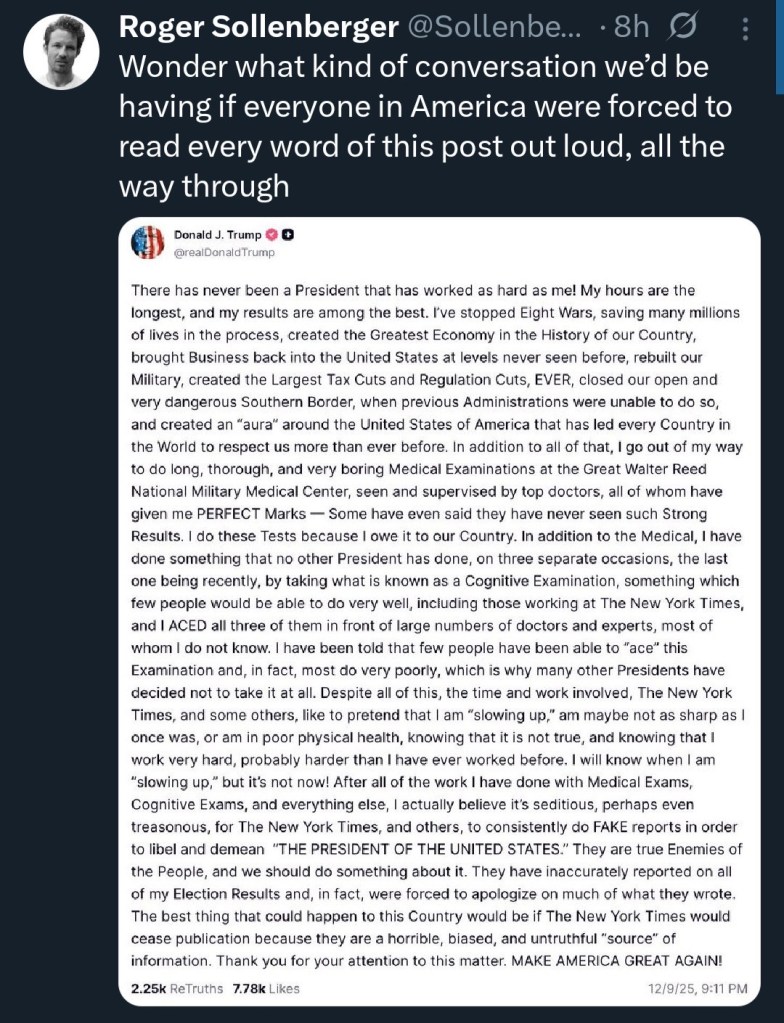
Of course, every effort he makes to prove he’s not one step away from melting into a bubbling orange puddle seems to make it clearer that he’s losing it.
Gertrude Abercrombie, 17 Feb 1909 – 3 Apr 1977
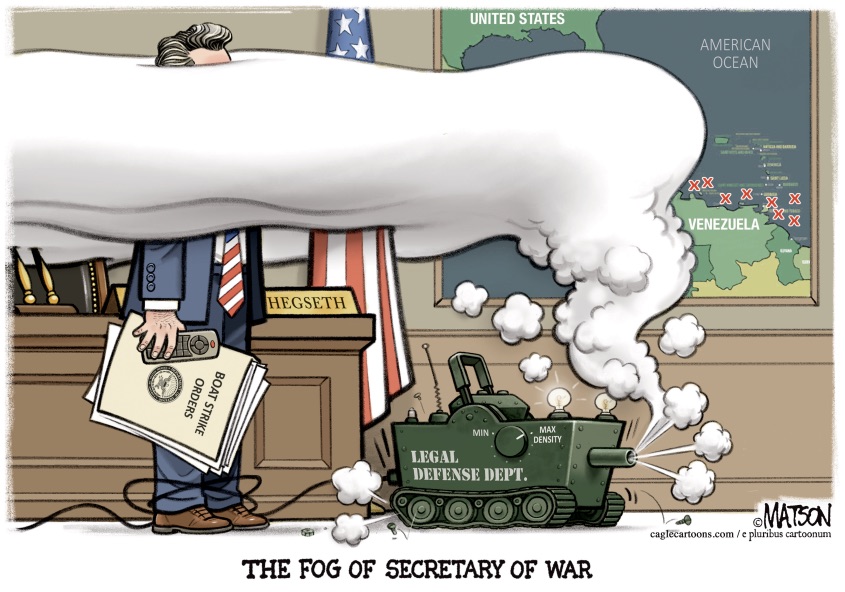
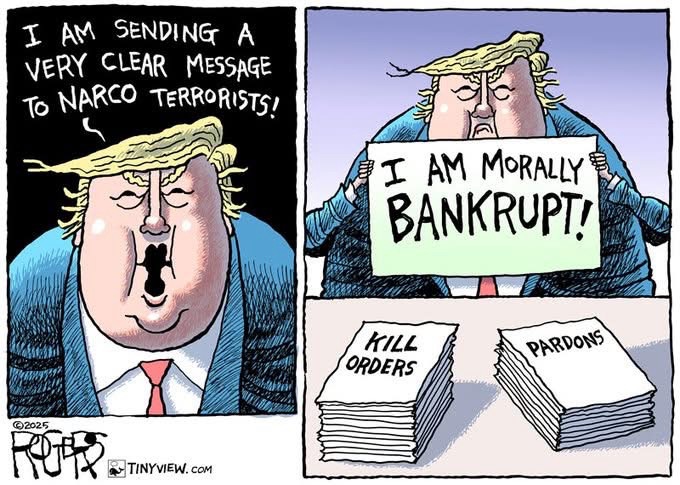
As bad as all that is, however, MAGA may be collapsing even more quickly than its creator. Prominent Republicans are defecting—like Marjorie Taylor Greene—and more are rumored to be threatening to do likewise. More former loyalists are willing to stand up to him—whether Indiana legislators rejecting Trumpian demands that they gerrymander the state or GOP senators leading inquiries into the possibility that war crimes were committed as part of Trump’s “Pirates of the Caribbean” phase.
Others are speaking out against Trump’s opposition to extending vital health subsidies to Americans—including hardliners like Missouri Senator Josh Hawley—or to express their discomfort with new executive orders seeking to block states from enacting AI regulation.
Trump is losing in the courts. His illegal picks to be U.S. attorneys are being kicked out; his efforts to, well, trump up charges against opponents like James Comey and Letitia James have been shot down by grand juries that simply will not go along with cases so obviously fabricated and motivated by retribution rather than any respect for the law.
And he is losing at the ballot box. Recent election results suggest that the onetime star to whom so many MAGA upstarts have hitched their wagons to in the past decade is now electoral poison. Across the country, elections last month produced resounding defeats for the GOP, while in the few elections in which Republicans squeaked out victories, their margins shrank considerably compared to 2024 support for Trump.
The economy is floundering. Deficits are exploding. Tariffs are unpopular. Trump’s inhumane and draconian immigration crackdowns are alienating substantial numbers of his erstwhile supporters, while his foreign policy plans have alienated our allies and empowered our enemies. His overt corruption and catering to billionaires at the expense of average Americans is driving real backlash.
Donald Trump has fallen and, given projections of a rough year ahead, it seems increasingly likely that he can’t get up.
Believing in democracy does not require faith that majorities are always right. It does mean having confidence that most of your fellow citizens will, over time, approach public questions with a basic reasonableness. Abraham Lincoln, tradition has it, said it more pithily: “You cannot fool all the people all the time.”
A corollary to Lincoln, that you can’t fool all the people who voted for you all the time, explains the sharp decline in President Trump’s approval ratings.
Cat in Bamboo, Hiroshima, by Jimmy Tsutomu Mirikitani
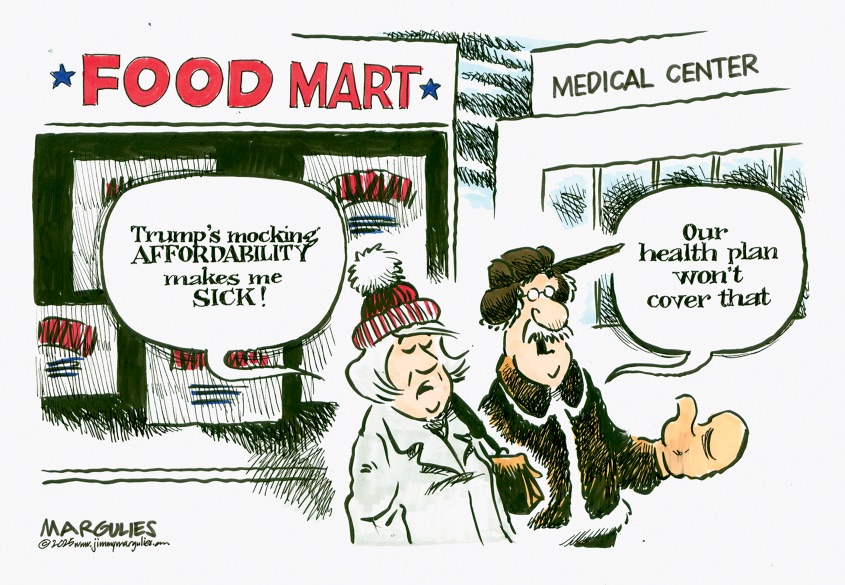
A significant share of the voters who backed Mr. Trump have decided that he has largely ignored the primary issue that pushed them his way, the cost of living. A billionaire regularly mocking concern about affordability only makes matters worse. They see him as distracted by personal obsessions and guilty of overreach, even when they sympathize with his objectives. Many of his former supporters see him breaking promises he made, notably on not messing with their access to health care.
Some abuses are too blatant to be ignored. A recent The Economist/You Gov poll found that 56 percent of Americans said Mr. Trump was using his office for personal gain; only 32 percent didn’t. A similar 56 percent saw Mr. Trump as directing the Justice Department to go after people he saw as his political enemies; just 24 percent didn’t.
The upshot: A great many Americans who helped put Mr. Trump in office have absorbed what’s happened since. They may not be glued to every chaotic twist of this presidency, but they do pay attention and have concluded, reasonably, that this is not what they voted for.
How many? Let’s take Mr. Trump’s 49.8 percent of the 2024 popular vote as a base line and compare it with his approval ratings. A New York Times analysis of public polling this month found his net approval rating had dropped to 42 percent. A A.P./NORC poll and a Gallup poll pegged it at 36 percent. This suggests that 15 to 25 percent of his voters have changed their minds
I think of these shifts as the triumph of reasonableness — and not because I agree with where these fellow citizens have landed (although I do). I’m buoyed by the capacity of citizens to absorb new facts and take in information even when it challenges decisions they previously made. It turns out that swing voters are what their label implies. The evidence of their own lives and from their own eyes matters.
Use the gift link to read the rest.
So, there really are some positive signs.
Republicans also continue to hurt themselves by refusing to help millions of Americans who are about to lose access to health care because of the drastically increased costs Republicans instituted with their Big Ugly Bill.
For one Wisconsin couple, the loss of government-sponsored health subsidies next year means choosing a lower-quality insurance plan with a higher deductible. For a Michigan family, it means going without insurance altogether.
For a single mom in Nevada, the spiking costs mean fewer Christmas gifts this year. She is stretching her budget already while she waits to see if Congress will act.
The Senate on Thursday rejected two proposals to address the problem and an emerging health care package from House Republicans does not include an extension, all but guaranteeing that many Americans will see much higher insurance costs in 2026.
Young Cat Sleeping, by Mabel Wellington Jack
Here are a few of their stories.
Chad Bruns comes from a family of savers. That came in handy when the 58-year-old military veteran had to leave his firefighting career early because of arm and back injuries he incurred on the job.
He and his wife, Kelley, 60, both retirees, cut their own firewood to reduce their electricity costs in their home in Sawyer County, Wisconsin. They rarely eat out and hardly ever buy groceries unless they are on sale.
But to the extent that they have always been frugal, they will be forced to be even more so now, Bruns said. That is because their coverage under the health law enacted under former President Barack Obama is getting more expensive -– and for worse coverage.
This year, the Brunses were paying $2 per month for a top-tier gold-level plan with less than a $4,000 deductible. Their income was low enough to help them qualify for a lot of financial assistance.
But in 2026, that same plan is rising to an unattainable $1,600 per month, forcing them to downgrade to a bronze plan with a $15,000 deductible.
Kelley Bruns said she is concerned that if something happens to their health in the next year, they could go bankrupt. While their monthly fees are low at about $25, their new out-of-pocket maximum at $21,000 amounts to nearly half their joint income.
“We have to pray that we don’t have to have surgery or don’t have to have some medical procedure done that we’re not aware of,” she said. “It would be very devastating.”
Read more health care stories a the link.
Speaker Mike Johnson will allow a vote on an Obamacare extension next week, but it is expected to fail. From Politico:
House GOP leadership will permit a floor vote to extend enhanced Obamacare subsidies — an olive branch to moderate members who have been clamoring for a chance to go on record in support of an extension.
“The process” for considering that package “will allow” a vote on an amendment to prevent the subsidies from lapsing Dec. 31, according to a House Republican leadership aide granted anonymity to share the unannounced plans.
It’s a concession from leaders who have been reluctant to endorse an extension of the subsidies, which divides congressional Republicans. It’s a win for centrists and vulnerable incumbents, who see political peril in not acting on the tax credits and have been promising to push discharge petitions that would circumvent leadership and force votes on their own legislative proposals.
Speaker Mike Johnson and senior Republicans met Friday morning on the topic to chart a path forward.
But Republicans leaders ultimately expect the extension vote to fail, resulting in skyrocketing premiums for millions of Americans when the subsidies expire at the end of the year.
The Senate failed to get anywhere on the health care issue this week. Now it’s the House’s turn to show what it can do.
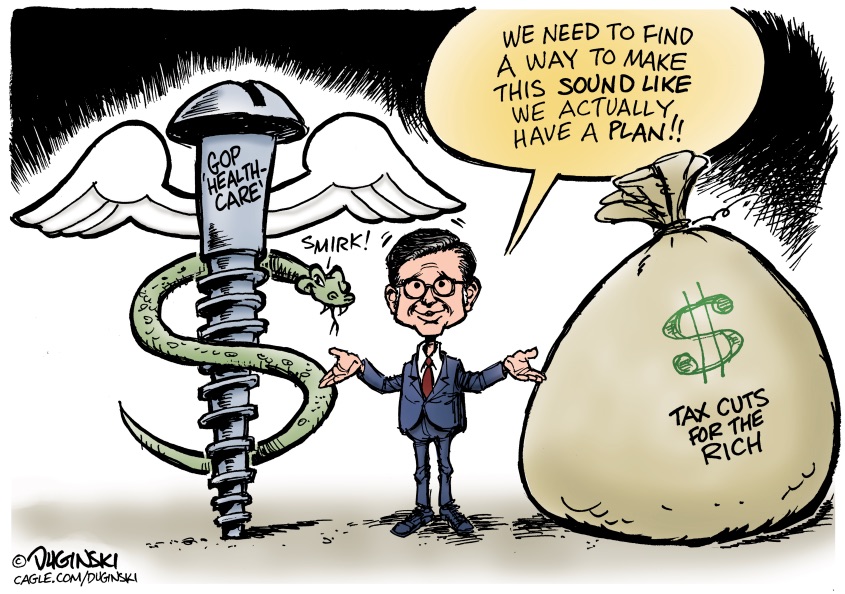
Speaker Mike Johnson unveiled a Republican alternative late Friday, a last-minute sprint as his party refuses to extend the enhanced tax subsidies for those who buy policies through the Affordable Care Act, also called Obamacare, which are expiring at the end of the year. Those subsidies help lower the cost of coverage.
Two Cats, Eleanore G. Cohen
Johnson, R-La., huddled behind closed doors in the morning — as he did days earlier this week — working to assemble the package for consideration as the House focuses the final days of its 2025 work on health care.
“House Republicans are tackling the real drivers of health care costs to provide affordable care,” Johnson said in a statement announcing the package. He said it would be voted on next week.
Later Friday, though, House Democratic Leader Hakeem Jeffries said: “House Republicans have introduced toxic legislation that is completely unserious, hurts hardworking America taxpayers and is not designed to secure bipartisan support. If the bill reaches the House floor, I will strongly oppose it.”
So what’s the GOP plan?
The House Republicans offered a 100-plus-page package that focuses on long-sought GOP proposals to enhance access to employer-sponsored health insurance plans and clamp down on so-called pharmacy benefit managers.
Republicans propose expanding access to what’s referred to as association health plans, which would allow more small businesses and self-employed individuals to band together and purchase health coverage.
Proponents say such plans increase the leverage businesses have to negotiate a lower rate. But critics say the plans provide skimpier coverage than what is required under the Affordable Care Act.
The Republicans’ proposal would also require more data from pharmacy benefit managers, or PBMs, as a way to help control drug costs. Critics say PBMs have padded their bottom line and made it more difficult for independent pharmacists to survive.
Additionally, the GOP plan includes mention of cost-sharing reductions for some lower-income people who rely on Obamacare, but those do not take effect until January 2027.
The emerging package from the House Republicans does not include an extension of an enhanced tax credit for millions of Americans who get insurance coverage through the Affordable Care Act. Put in place during the COVID-19 crisis, that enhanced subsidy expires Dec. 31, leaving most families in the program facing more than double their current out-of-pocket premiums, and in some cases, much more.
I think Republicans will find that this issue will destroy them in the midterm elections.
That’s all I have for today. I tried to stick with somewhat positive stories. (FYI, the images in this post comes from the Smithsonian collection of cat art.)
Did you like this post? Please share it with your friends:
I think we can agree that the year 2025 has sucked so much that our ears are ringing. Most of today’s headlines are going to follow us into the New Year, too. I’m going to try to be gentle, but wow. At least we see karma catching up with some of them. I hate to spoil your meals for the day. Any survivors of sexual trauma and assault may want to take the day off to breathe deeply and prepare for the new information that will start pouring in. This CNN story is both welcome and as horrifying as we thought it would be. “New photos released from Epstein’s estate showing Trump, Bannon, Bill Clinton, and other high-profile people.” We’ve known these connections, but when will we find out how lurid they go?
Democrats on the House Oversight Committee have released photos from Jeffrey Epstein’s estate Friday showing the many powerful figures in the late sex trafficker’s orbit, including President Donald Trump, former President Bill Clinton, Steve Bannon, Bill Gates, Richard Branson and others.
Many of the men have been previously linked to Epstein, though the photos may shed new light on the extent of those relationships.
Taken collectively, the 19 images – which the Democrats on the committee said came from Epstein’s estate – reinforce the financier was tied in the past to a wide variety of powerful and high-profile people whose ties to him are now under significant scrutiny.
One released image shows Trump with six women with leis whose faces were redacted by committee members, while another depicts what appears to be a bowl of novelty condoms with a caricature of Trump’s face with the text, “I’m HUUUUGE!” The condoms – shown in a bowl with a “Trump condom $4.50” sign – were produced by a novelty shop in New York City named Fishs Eddy. The item is described as a “political satire condom” in the National Museum of American History’s online collection.
Other released images depict Steve Bannon and Epstein taking a photograph in a mirror; Bill Clinton with Epstein, Maxwell and another couple; and tech billionaire Bill Gates with the former Prince Andrew. Former Harvard President Larry Summers and lawyer Alan Dershowitz also appeared in pictures from the estate.
None of the released images depict any sexual misconduct nor are believed to depict underage girls. It was not immediately clear when or where they were taken, or by whom.
Politico also has coverage of the basic picture dump. “Trump, Clinton, Gates included in Epstein photo trove. The House Oversight Committee Democrats released photos from the Epstein estate linking powerful men to the late convicted sex offender.” You’ll notice in this coverage, the photos have black squares covering the faces of the victims. More on that in the next suggested read.
Photos from the estate of Jeffrey Epstein tie the convicted sex offender to President Donald Trump, former President Bill Clinton, tech billionaire Bill Gates and former Treasury Secretary Larry Summers.
These men and others are featured in the roughly 95,000 photos the House Oversight and Government Reform Committee has received from the Epstein estate as part of its ongoing investigation. House Democrats publicly released 19 photos Friday morning.
“It is time to end this White House cover-up and bring justice to the survivors of Jeffrey Epstein and his powerful friends,” the Oversight Committee’s top Democrat, Rep. Robert Garcia of California, said in a statement. “These disturbing photos raise even more questions about Epstein and his relationships with some of the most powerful men in the world. We will not rest until the American people get the truth. The Department of Justice must release all the files, NOW.”
White House spokesperson Abigail Jackson in a statement accused Democrats of “selectively releasing cherry-picked photos with random redactions.”
“The Democrat hoax against President Trump has been repeatedly debunked and the Trump Administration has done more for Epstein’s victims than Democrats ever have by repeatedly calling for transparency, releasing thousands of pages of documents, and calling for further investigations into Epstein’s Democrat friends,” she continued. “It’s time for the media to stop regurgitating Democrat talking points and start asking Democrats why they wanted to hang around Epstein after he was convicted.”
Secret grand jury transcripts from Jeffrey Epstein’s 2019 sex trafficking case can be made public, a judge ruled on Wednesday, joining two other judges in granting the Justice Department’s requests to unseal material from investigations into the late financier’s sexual abuse.
U.S. District Judge Richard M. Berman reversed his earlier decision to keep the material under wraps, citing a new law that requires the government to open its files on Epstein and his longtime confidant Ghislaine Maxwell. The judge previously cautioned that the 70 or so pages of grand jury materials slated for release are hardly revelatory and “merely a hearsay snippet” of Epstein’s conduct.
The Justice Department asked the judges to lift secrecy orders in the cases after the Epstein Files Transparency Act, passed by Congress and signed into law by President Donald Trump last month, created a narrow exception to rules that normally keep grand jury proceedings confidential. The law requires that the Justice Department disclose Epstein-related material to the public by Dec. 19.
More things will undoubtedly be released. Finally, we see some action from those of us who strongly believe in the preservation of our historical and geographical moments, parks, and buildings. The Washington Post has the story on this good news. “National Trust sues to stop Trump’s ballroom construction. The organization, which is charged by Congress with historic preservation, has retained President Barack Obama’s former lawyer as it seeks to pause the project.”
Historic preservationists begged President Donald Trump in October not to rapidly demolish the White House’s East Wing annex for his ballroom project, urging him to wait for federal review panels and allow the public to weigh in. Now a group charged by Congress with helping to preserve historic buildings is asking a judge to block construction until those reviews occur, arguing that the ongoing project is illegal and unconstitutional.
The lawsuit from the nonprofit National Trust for Historic Preservation, which was filed Friday in the U.S. District Court for the District of Columbia, represents the first major legal challenge to Trump’s planned 90,000-square-foot addition and is poised to test the limits of his power. The organization argues that the administration failed to undergo legally required reviews or receive congressional authorization for the project, which Trump has rushed to launch in hopes of completing it before his term ends in 2029.
“No president is legally allowed to tear down portions of the White House without any review whatsoever — not President Trump, not President Joe Biden, and not anyone else,” the complaint says.
The administration in October rapidly demolished the East Wing to make way for the ballroom over the objections of the National Trust and other historic preservationists who urged the White House to pause its demolition, submit its plans to the National Capital Planning Commission and seek public comment.
“She’s like the Energizer Bunny.” John Buss, @repeat1968
Finally, we should see the release of the first true face of the assault on our nation’s immigrant population. This is also from the AP. “Federal judge issues order to prohibit immigration officials from detaining Kilmar Abrego Garcia.”
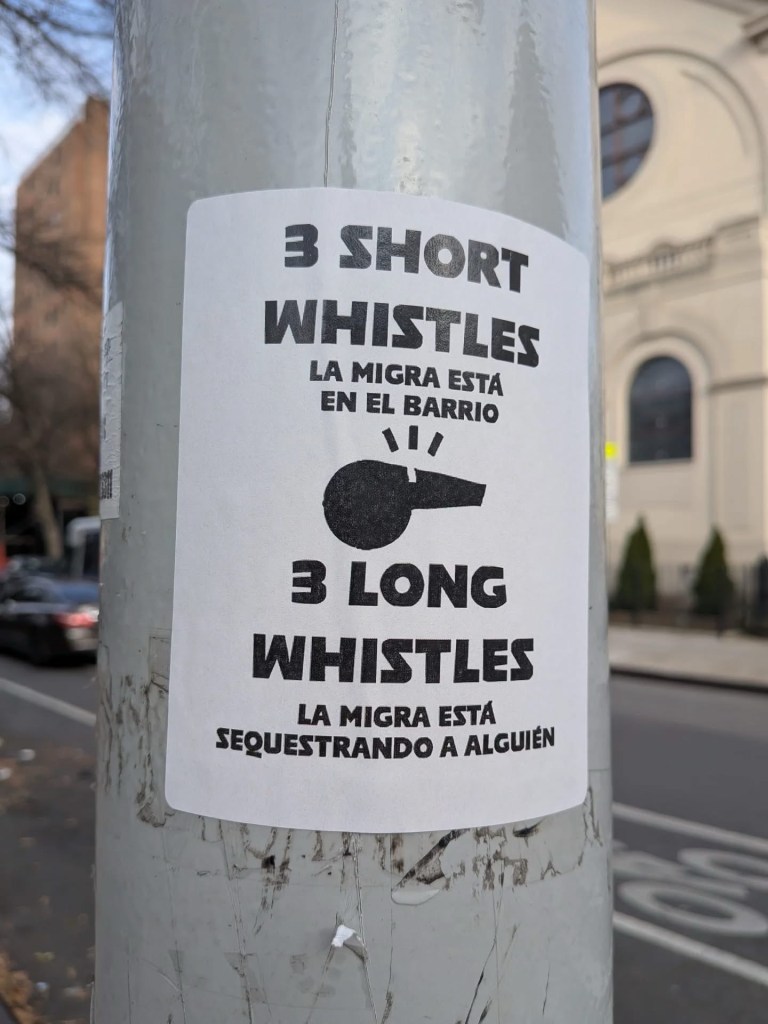
To let you know exactly how jumpy we are down here about these things, I’ll share this short tale this morning from Temple’s morning walk. I was talking to my neighbor, who had just come back from walking Dame Maggie, his Yorkie. I was just saying goodbye to her when a white SUV stopped in front of the house with the cherries flashing. I gulped noticeably. Josh closed the door, and I walked down the street towards the river and crossed to the neutral ground behind the line forming. I spoke with the woman in the car for a bit. The first thought that hit both of us was ICE, but after a bit of worrying, we decided it was just someone who had to return to the construction at the base. We were all white, and thankfully, none of our neighborhood’s gardeners or construction workers were around. All of us thought the same thing, though. This is not normal. And yes, I am still actively in the resistance.
A federal judge blocked U.S. immigration authorities on Friday from re-detaining Kilmar Abrego Garcia, saying she feared they might take him into custody again just hours after she had ordered his release from a detention center.
The order came as Abrego Garcia appeared at a scheduled appointment at an Immigration and Customs Enforcement field office roughly 14 hours after he walked out of immigration detention facility in Pennsylvania.
His lawyers had sent an urgent request to the judge, warning that ICE officials could immediately place him back into custody. Instead, Abrego Garcia exited the building after a short appointment, emerging to cheers from supporters who had gathered outside.
Speaking briefly to the crowd, he urged others to “stand tall” against what he described as injustices carried out by the government.
Officials cannot re-detain him until the court conducts a hearing on the motion for the temporary restraining order, U.S. District Judge Paula Xinis in Maryland said. She wrote that Abrego Garcia is likely to succeed on the merits of any further request for relief from ICE detention.
ProPublicaremains my go-to source for uncovering outrageous abnormalities within the Trump administration. Keeping eyes on our Department of Justice (sic) is a necessary and noble cause. “The Shakedown: Trump’s DOJ Pressured Lawyers to ‘Find’ Evidence That UCLA Had Illegally Tolerated Antisemitism.” I’m not sure why Anti-Semitism remains the only “woke” policy this regime recognizes.
On the morning of Thursday, July 31, James B. Milliken was enjoying a round of golf at the remote Sand Hills club in Western Nebraska when his cellphone buzzed.
Milliken was still days away from taking the helm of the sprawling University of California system, but his new office was on the line with disturbing news: The Trump administration was freezing hundreds of millions of dollars of research funding at the University of California, Los Angeles, UC’s biggest campus. Milliken quickly packed up and made the five-hour drive to Denver to catch the next flight to California.
He landed on the front lines of one of the most confounding cultural battles waged by the Trump administration.
The grant freeze was the latest salvo in the administration’s broader campaign against elite universities, which it has pilloried as purveyors of antisemitism and “woke” indoctrination. Over the next four months, the Justice Department targeted UCLA with its full playbook for bringing colleges to heel, threatening it with multiple discrimination lawsuits, demanding more than $1 billion in fines and pressing for a raft of changes on the conservative wish list for overhauling higher education.
In the months since Milliken’s aborted golf game, much has been written about the Trump administration’s efforts to impose its will on UCLA, part of the nation’s largest and most prestigious public university system. But an investigation by ProPublica and The Chronicle of Higher Education,based on previously unreported documents and interviews with dozens of people involved, revealsthe extent to which the government violated legal and procedural norms to gin up its case against the school. It also surfaced something equally alarming: How the UC system’s deep dependence on federal money inhibited its willingness to resist the legally shaky onslaught, a vulnerability the Trump administration’s tactics brought into sharp focus.
According to former DOJ insiders, agency political appointees dispatched teams of career civil rights lawyers to California in March, pressuring them to rapidly “find” evidence backing a preordained conclusion: that the UC system and four of its campuses had illegally tolerated antisemitism, which would violate federal civil rights statutes.
The career attorneys eventually recommended a lawsuit against only UCLA, which had been rocked by pro-Palestinian protests in the spring of 2024. But even that case was weak, the lawyers acknowledged in a previously unreported internal memo we obtained. It documented the extensive steps UCLA had already taken to address antisemitism, many resulting from a Biden administration investigation based on the same incidents. The memo also noted there was no evidence that the harassing behavior that peaked during the protests was still happening.
This is a long read, but well worth your time. I leave you with a personal story from Facebook of a Father of a Daughter. Matthew Berdyck is one of those smart asses like me. He and his daughter are currently under attack by MAGA bullies. I know what it’s like to have your daughter stalked by folks like these. My youngest was three at the time, the so-called church people, and “right-to-lifers”. It has only gotten worse over time. I can only tell you how much my heart goes out to him and his family. I got nightly phone calls telling me exactly where my daughter had been all day and telling me what an after-birth “abortion” would look like if performed on her. The Sheriff’s department told me I shouldn’t take these people seriously when I called to complain. That was 1992.
92 days after Charlie Kirk’s death, I finally understand.
When I saw the news reports that Charlie Kirk was shot, I didn’t know who he was. At first, I spoke out against his shooting because I get threatened a lot myself—killing people over political speech is well beyond reasonable.
Over the last 92 days, as my profile got bigger and bigger, I became subject to ongoing and continuing rage from the right. Boy, do they just love making jokes but start crying that they’re victims when someone gives them back what they dish out. Babies.
They’re gonna “get them dems,” but if someone gets them back, oh lord, the temper tantrum is going to be epic and heard all the way to dwarf-planet Pluto.
Over the last 92 days, I’ve had over 25,000 vitriolic comments from MAGA—I’m gay, I’m a lady, I’m a beta-male cuck, I’m a pedo, and on and on. At minimum, they’re just name-calling, but at worst they’re targeting my 17-year-old daughter like predators.
Currently, on my wall, there are hundreds of sexual comments about her, repeated threats to kill her, threats to hurt my 70-year-old mom, even a threat to dox and hurt my 94-year-old grandfather.
I’ve got 55 harassing voicemails, I’ve been subscribed to gay porn sites, cuckold newsletters, received spam from life insurance companies (death threats)—like, wow, these people are throwing a massive, uncontrollable fit over comedy.
I realize today, after 92 solid days of relentless, aggressive harassment, that I’m not even remotely shocked that someone offed Kirk. In fact, I’m actually surprised someone didn’t do it sooner.
These MAGA are rabid animals. Kirk was their demigod, Agent Orange.
Today, yet another one of them threatened my daughter and me—like, bro, you’re a real big man threatening a little girl, but that’s what MAGA is about.
It’s who they always were and it’s who they always will be, all the way to the day they’re voted out by the rest of us.
If one day I stop posting, then I guess I am Charlie Kirk—after I’ve been shot by some far-right, grammarless dingleberry honkeytron who couldn’t take a joke.
Follow me if you feel me.Update:
They’re already in the comments denying all of this happened even though it’s all visible on this page 💀💀
I can only tell you that any time you go after the blind followers of an autocratic cult, it ain’t gonna be pretty at all. I have some time off, and I have found all the good trouble I need to end the year on a high note.
What’s on your Reading, Action, and Blogging List today?
Well, I’ve seen all there is to see
And I’ve heard all they have to say
I’ve done everything I wanted to do
I’ve done that too
And it ain’t that pretty at all
Ain’t that pretty at all
So I’m gonna hurl myself against the wall
‘Cause I’d rather feel bad than not feel anything at all
Did you like this post? Please share it with your friends:
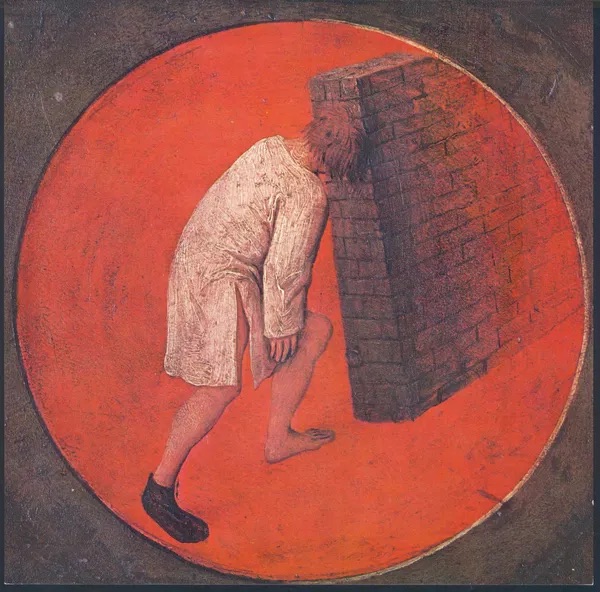
Hello. I don’t know what will happen next year, when things are getting so desperate these days. Before we get to the disgusting mess Trump has made of late…take a look at these images:
Gustatory Wisdom: Bruegel the Elder’s Twelve Proverbs (1558)The twelve scenes here, dated to 1558, use the follies of life as pathways toward profundity…Another kind of digestion is at play, as the mind macerates these cryptic proverbs for moral and message.publicdomainreview.org/collection/b…
I’m still in my “avoiding the news” phase. Of course, I can’t help hearing about big events–I’m just not spending huge swaths of time reading Substacks and social media posts. Unread emails pile up as I fritter away my time indulging my guilty TV pleasures–animal shows and true crime dramas. So this morning I’ve been looking around to see what’s been happening while I was checked out. Here are the stories that grabbed my attention.
Hopeful Signs?
Democrats are continuing to do well in off-year elections. Yesterday, there were big wins in Florida and Georgia.
MIAMI — Democrats can now add a major city in Donald Trump’s home state — and one set to host his future presidential library — to its list of off-cycle election wins.
In a Tuesday runoff, Miamians elected Eileen Higgins as mayor, the first woman in the city’s history to hold the job and the first Democrat in 28 years. Higgins, a former county commissioner, defeated Republican Emilio González, an ex-city manager who had the endorsement of Trump and Gov. Ron DeSantis, with 60 percent of the vote.
Eileen Higgins
“Miami chose a new direction,” Higgins said during her victory speech at the Miami Woman’s Club. “You chose competence over chaos, results over excuses and a city government that finally works for you.”
Though the race and the job of mayor are nominally nonpartisan, the election generated sizable interest from national Democrats and Republicans. Higgins’ win adds to the slew of victories and close calls Democrats have seen this year, including last week’s strong performance in a House special election in Tennessee.
The election could boost messaging for Florida Democrats, who’ve faced setbacks in recent election cycles and have a 1.4 million registered voter disadvantage in this former swing state.
“Tonight’s victory shows that the pendulum is swinging in our favor and that when we commit to relentless, year-round organizing and invest in a long-term strategic field program, we can, in fact, win,” FDP Chair Nikki Fried said in a statement Tuesday night.
Democrats continued their run of successes in special elections by flipping a state House seat in Georgia Tuesday, according to a projection from the CNN Decision Desk.
The Democratic victory, in a district that voted for President Donald Trump by about 12 percentage points last year, comes ahead of next year’s critical midterms, when Georgians will vote in closely watched races for Senate and governor.
Eric Gisler
Eric Gisler, a Democrat who owns a local olive oil store, will defeat Republican Mack “Dutch” Guest in the 121st House District, in the northeastern part of the state, near the college town of Athens.
Between regularly scheduled elections in Virginia and New Jersey and special elections held on newly redrawn maps in Mississippi, Democrats flipped about 20 state legislative seats on Election Day last month. Those victories came after Democrats flipped two seats in Iowa and one in Pennsylvania during special elections earlier in the year.
Republicans still control a significant majority in the Georgia House, but Tuesday’s results come just a month after Democrats won two statewide elections to flip two seats on the state’s Public Service Commission….
The Democratic Party of Georgia congratulated Gisler in a statement Tuesday evening, “This isn’t just a win for Georgia Democrats – it’s a win for every family in Oconee and Clarke Counties who has been struggling to get ahead under 22 years of failed Republican leadership.”
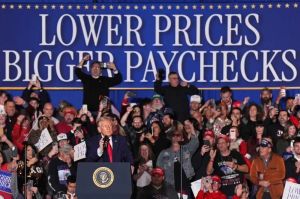
Trump’s “Affordability” Speech in Mount Pocono, Pennsylvania
He mocked the word “affordability,” touted how high the stock market had risen and said Americans didn’t need so many pencils. He launched into a number of digressions to disparage the country of Somalia, the concept of climate change and the news media in the back of the room.
Trump spoke from a 1,200-capacity ballroom at the Mount Airy Resort and Casino in the Pocono Mountains for what White House officials have suggested would be a kickoff to promote Trump’s economic policies — and an attempt to wrangle an issue that has become a political liability ahead of the 2026 midterm elections.
Instead, the 90-minute speech was a greatest hits of his campaign trail appearances — complimenting the power of his chief of staff, Susie Wiles, and “the lips that don’t stop” of White House press secretary Karoline Leavitt — with occasional nods to the current economic anxieties. He promoted his trade policies, without speaking to the impact they’ve had on consumer prices, and he promised lower energy costs.
“We inherited the highest prices ever, and we’re bringing them down,” he said several times.
“We’re getting inflation — we’re crushing it, and you’re getting much higher wages,” he said. “I mean, the only thing that is really going up big, it’s called the stock market and your 401(k).”
While suggesting prices were no longer going up, Trump also ridiculed Democrats for suggesting that voters cared about affordability, an issue that was a focus of their successful campaigns last month in New Jersey, Virginia and New York City.
“They said, ‘Oh, he doesn’t realize prices are higher.’ Prices are coming down very substantially,” Trump said. “But they have a new word. You know, they always have a hoax. The new word is affordability. So they look at the camera and they say, ‘This election is all about affordability.’”
Trump talks affordability in PA.
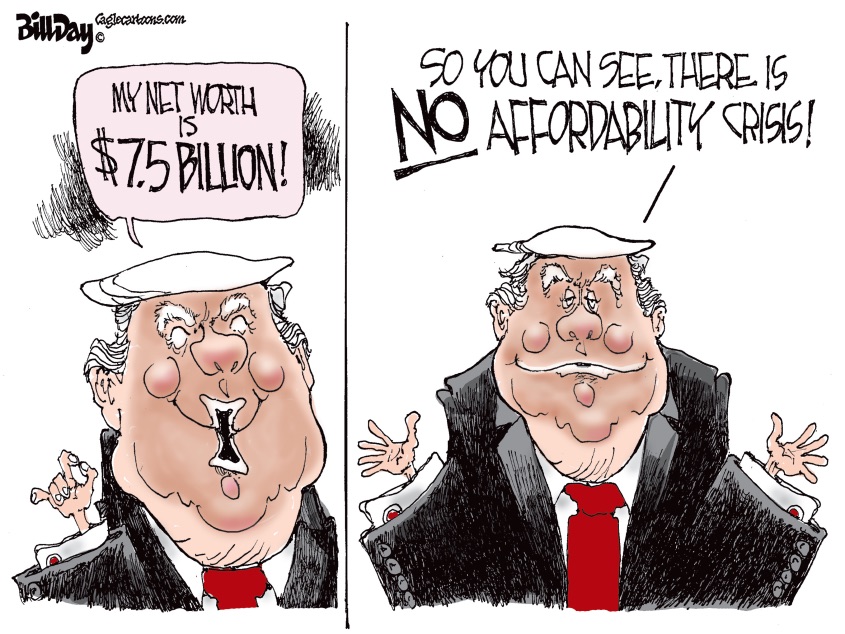
The election may very well be about people’s ability to afford basics–food, clothing, and housing. Trump has never had to worry about those things, so he mocks people who do.
Later, he attempted to clarify.
“I can’t say affordability is a hoax because I agree the prices were too high. So I can’t go to call it a hoax because they’ll misconstrue that,” he said. “But they use the word affordability.And that’s the only word they say. Affordability. And that’s their only word. They say, ‘Affordability.’ And everyone says, ‘Oh, that must mean Trump has high prices.’ No. Our prices are coming down tremendously from the highest prices in the history of our country.”
“You know, you can give up certain products. You can give up pencils,” he said, suggesting that he was focused on promoting American-made steel while China was focused on providing multiple pencils to its citizens.
“You always need steel. You don’t need 37 dolls for your daughter,” he said. “Two or three is nice, but you don’t need 37 dolls. So, we’re doing things right. We’re running this country right well.”
“Affordability” is another word like “groceries” to Trump–words for things outside his own experience. He doesn’t have to worry about getting enough to eat or staying warm in his home–so other people shouldn’t care about those things either. Just deal with it while he has fun with his tariffs.
Last night Donald Trump gave an important speech on the economy in Pennsylvania — supposedly in a working-class area, although the actual venue was a luxury casino resort. The event was initially touted as the start of an “affordability tour,” the first of a series of speeches intended to reverse Trump’s cratering approval on his handling of inflation and the economy. A number of news analyses suggested that he would use the occasion to blame Democrats for the economy’s troubles.
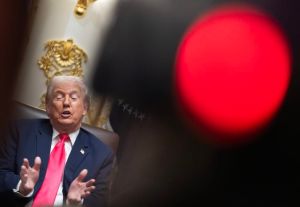
King Trump doesn’t care about your affordability concerns.
That was never going to happen. Trump did, of course, take many swipes at Joe Biden, as well as attacking immigrants, women and windmills. But to blame Democrats for the economy’s problems he would have to admit that the Trump economy has problems. And the speech was important because it revealed that he won’t make any such admission, and will continue to gaslight the public.
On Monday Politico interviewed Trump, asking him, among other things, what grade he would give the current economy. His answer: “A-plus-plus-plus-plus-plus.”
In fact, until very recently Trump wouldn’t even accept the reality that ordinary Americans don’t share his triumphalism. When Fox News’s Laura Ingraham asked him a month ago why people are anxious about the economy, Trump replied
“I don’t know they are saying that. The polls are fake. We have the greatest economy we’ve ever had.”
Scott Bessent, billionaire
Since then Trump and his minions seem to have come around to admitting that Americans are, in fact, unhappy with the state of the economy. But if the economy is A+++++, why don’t people see it? The problem can’t possibly lie with him — so it must lie with you. “The American people don’t know how good they have it.”
I put that line in quotes because it isn’t a caricature or a paraphrase. It is, in fact, literally what Scott Bessent, the Treasury secretary, said the other day:
“We’ve made a lot of gains, but remember, we’ve got this embedded inflation from the Biden years, where mainstream media, whether it’s Greg Ip at the Wall Street Journal, toxic Paul Krugman at New York Times or former Vice Chair, Alan Blinder, all said it was a vibecession. The American people don’t know how good they have it.”
Krugman’s response:
I may not be a political strategist, but I don’t think “You’re all a bunch of ingrates” is a winning message. It was, however, really the only message Trump could deliver, given his utter lack of empathy or humility.
At this point I could bombard you with a lot of data showing that the economy is not, in fact, A+++++. But it isn’t a disaster area, at least not yet. So why are Americans feeling so down? The main culprit is Trump himself.
First, during the 2024 campaign Trump repeatedly promised to bring consumer prices way down beginning on “day one.” We’re now 11 months in, prices are still rising, and voters who believed him feel, with reason, that they were lied to. Last night Trump insisted that prices are, in fact, coming way down. Again, “Who you gonna believe, me or your lying eyes?” is a self-destructive political strategy.
Second, Trump would be in much better political shape right now if he had basically continued Biden’s policies, with only a few cosmetic changes. When he took office inflation was on a declining trajectory. Consumer sentiment was relatively favorable at the start of 2025. Americans were still angry about high prices, but the inflation surge of 2021-3 had happened on Biden’s watch and was receding into the past. My guess is that many voters would have accepted Trump’s claims that high prices were Democrats’ fault and given him the benefit of the doubt about the economy’s future if he had simply done nothing drastic and left policies mostly as they were.
Instead, he brought chaos: Massive and massively unpopular tariffs, DOGE disruptions, masked ICE agents grabbing people off the street, saber-rattling and war crimes in the Caribbean. Many swing voters, I believe, supported Trump out of nostalgia for the relative calm that prevailed before Covid struck. They didn’t think they were voting for nonstop political PTSD.
And there’s more to come. Health insurance costs are about to spike, because Republicans refuse to extend Biden-era subsidies. Inflation may pick up in the next few months as retailers, who have so far absorbed much of the cost of Trump’s tariffs, begin passing them on to consumers.
In a speech that the White House billed as an address on the economy, amid a backlash driven in part by Mr. Trump’s sweeping tariffs, Mr. Trump veered between assurances that life was better than ever under his administration and blaming immigrants for the country’s economic woes.
Mr. Trump revived what had been an effective campaign message, promising that sending immigrants home would mean “more jobs, better wages and higher income for American citizens,” though the early stages of his mass deportation campaign have so far coincided with widespread economic anxiety.
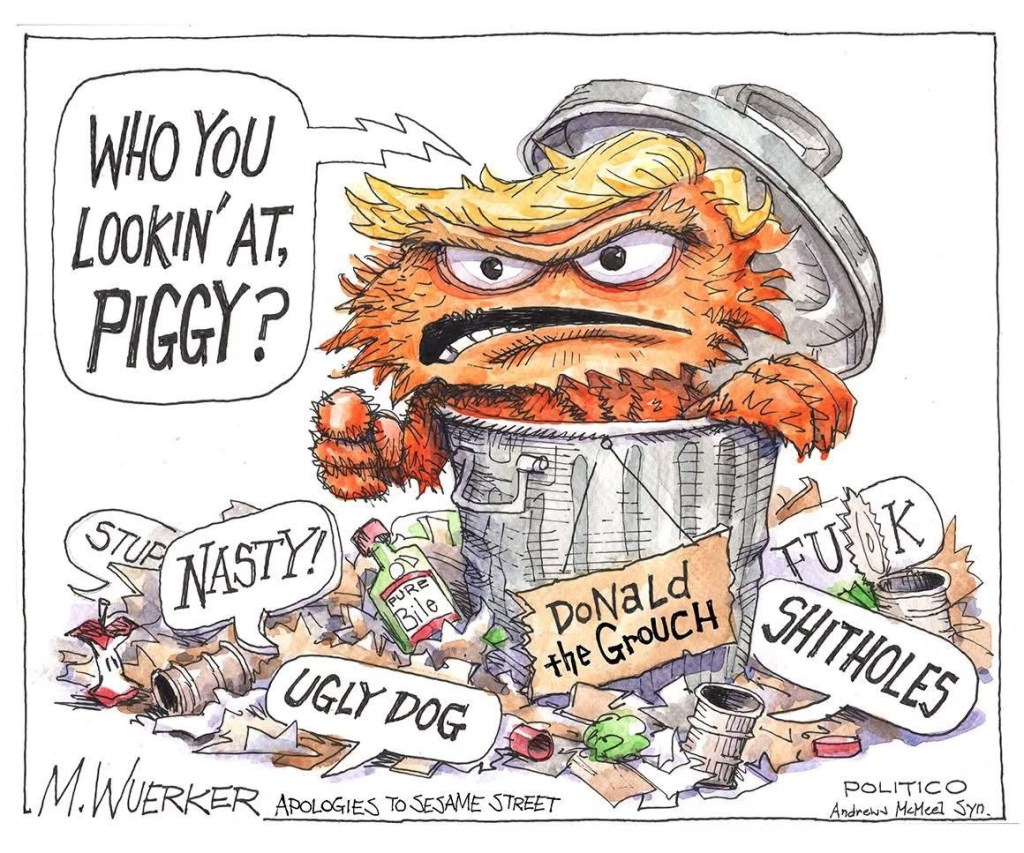
“I didn’t say ‘shithole,’ you did!” Mr. Trump replied with a grin. He then recounted his use of the term at a White House meeting in 2018 to describe countries that he was balking at accepting immigrants from. Mr. Trump had then denied saying that after it was publicly reported. Nearly six years later, he appeared proud of the remark.
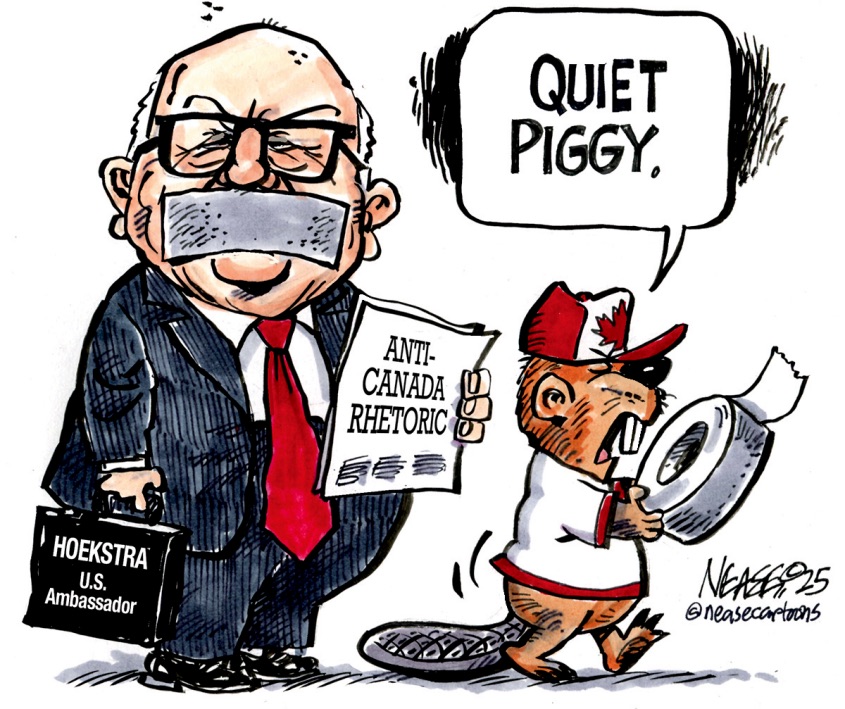
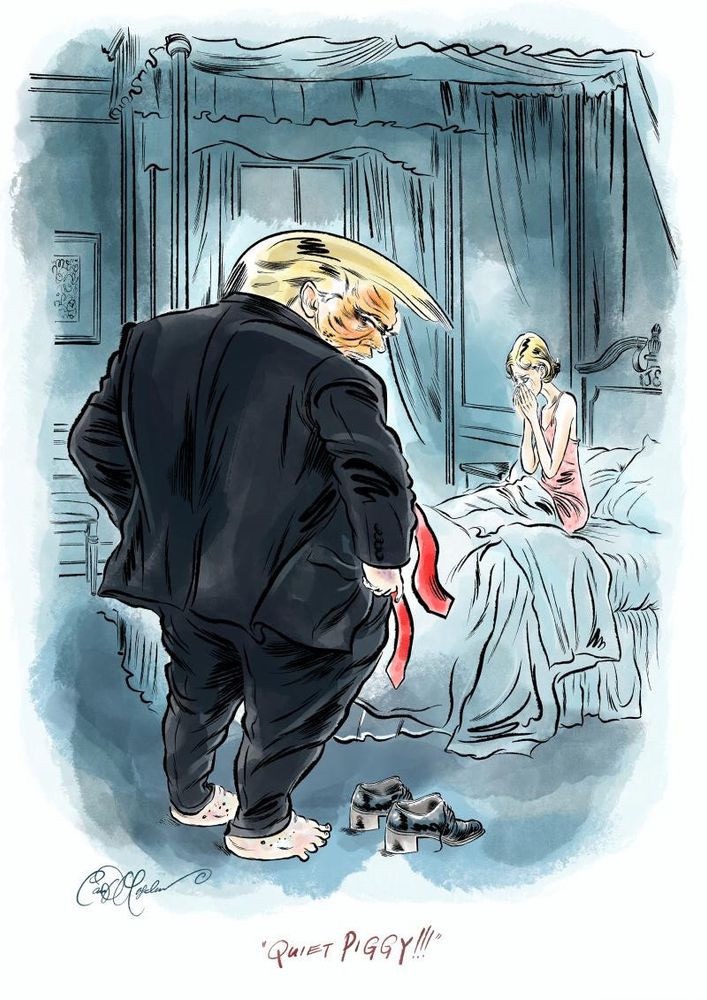
Quiet, Piggy!
Throughout the speech, Mr. Trump doubled down on a barrage of incendiary attacks that he has unleashed against immigrants since the shooting of two National Guard members near the White House last month. The day after the shooting, Mr. Trump floated the possibility of stripping naturalized American citizens of their citizenship (which is only done in rare cases) and vowed to deport all immigrants that he saw as “non-compatible with Western civilization.”
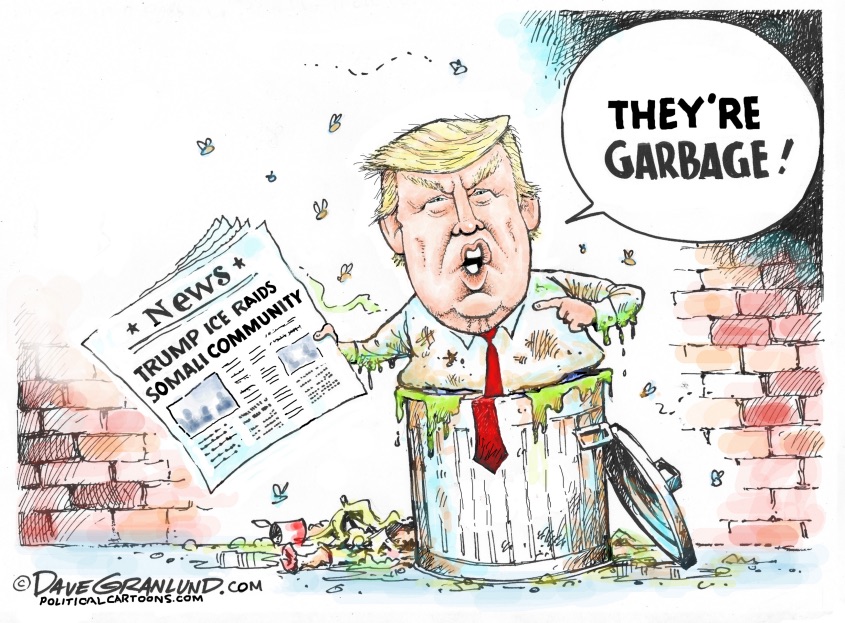
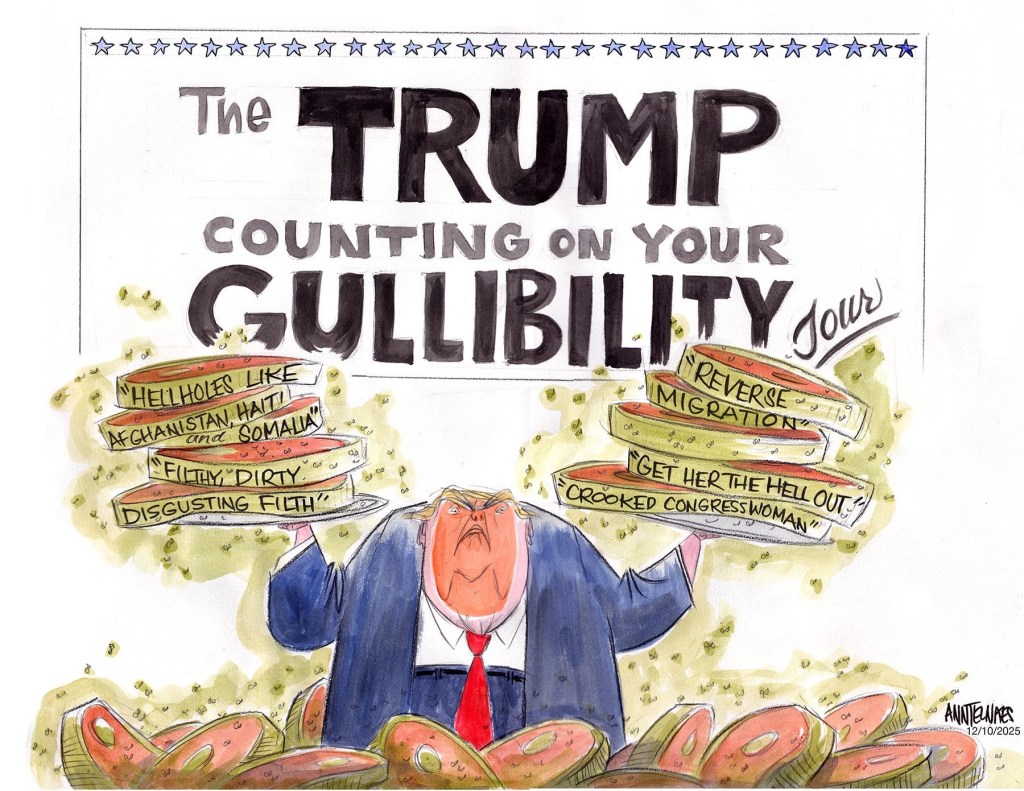
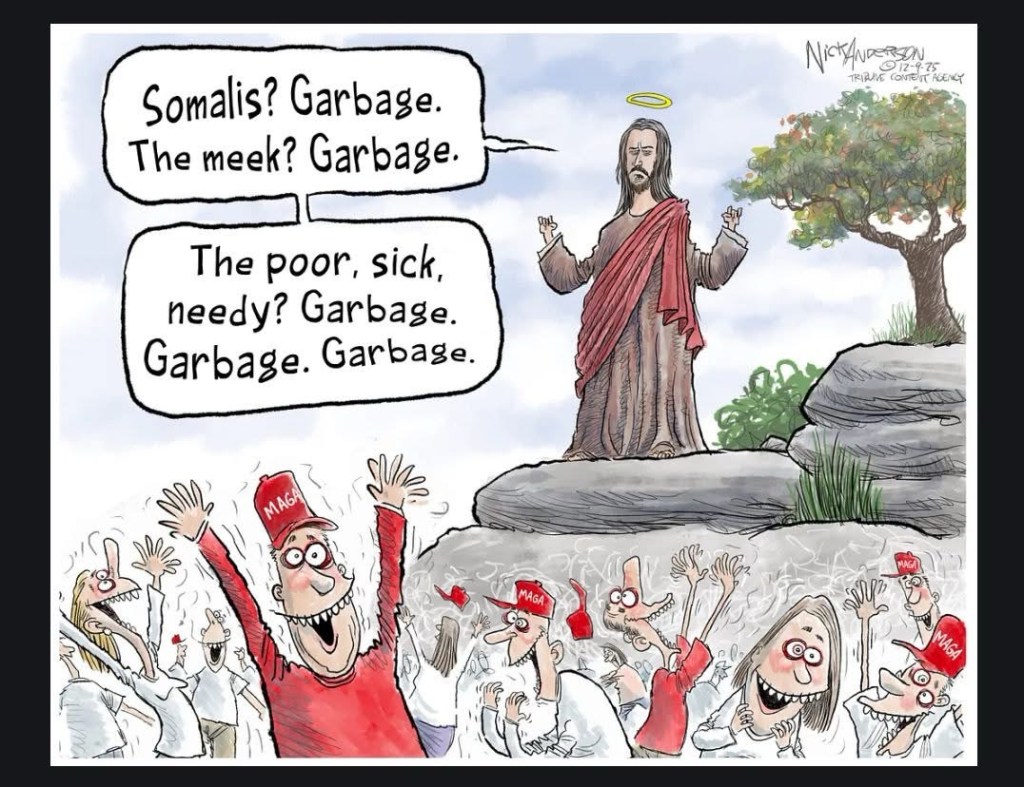
During his xenophobic tirade, Mr. Trump made little distinction between unauthorized migrants and those who followed all the correct procedures to enter the country and eventually become American citizens. He described Somali immigrants as lazy, murderous and “garbage,” and said the home countries of many immigrants were “filthy, dirty, disgusting.”
Americans are struggling with affordability pressures that are squeezing everything from their everyday necessities to their biggest-ticket expenses
Nearly half of Americans said they find groceries, utility bills, health care, housing and transportation difficult to afford, according to The POLITICO Poll conducted last month by Public First. The results paint a grim portrait of spending constraints: More than a quarter, 27 percent, said they have skipped a medical check-up because of costs within the last two years, and 23 percent said they have skipped a prescription dose for the same reason.
The strain is also reshaping how Americans spend their free time. More than a third — 37 percent — said they could not afford to attend a professional sports event with their family or friends, and almost half — 46 percent — said they could not pay for a vacation that involves air travel.
While President Donald Trump gave himself an “A-plus-plus-plus-plus-plus” grade on the economy during an exclusive interview with POLITICO’s Dasha Burns, the poll results underscore that voters’ financial anxieties have become deeply intertwined with their politics, shaping how they evaluate the White House’s response to rising costs.
Trump insists that “prices are all coming down,” as he told Burns, but the results pose a challenge for Trump and the Republican Party ahead of the 2026 midterms, with even some of the president’s own voters showing signs that their patience with high costs is wearing thin.
POLITICO reporters covering a variety of beats have spent the past few weeks poring over the poll results. We asked some of them to unpack the data for us and tell us what stood out most.
The Pentagon was in a bind. The military had plucked two survivors from the Caribbean Sea in mid-October after striking a boat that U.S. officials said was carrying drugs, and it needed to figure out what to do with them.
On a call with counterparts at the State Department, Pentagon lawyers floated an idea. They asked whether the two survivors could be put into a notorious prison in El Salvador to which the Trump administration had sent hundreds of Venezuelan deportees, three officials said.
The State Department lawyers were stunned, one official said, and rejected the idea. The survivors ended up being repatriated to their home countries of Colombia and Ecuador.
A little under two weeks later, on Oct. 29, Pentagon officials convened another session about boat strike survivors, a video conference involving dozens of American diplomats from across the Western Hemisphere. The message was that any rescued survivors should be sent back to their home countries or to a third country, said three other officials, who, like others interviewed for this article, spoke on the condition of anonymity to discuss internal deliberations.
Behind that policy was a quieter goal: to ensure survivors did not end up in the U.S. judicial system, where court cases could force the administration to show evidence justifying President Trump’s military campaign in the region.
The previously unreported calls demonstrate the haphazard and sometimes tense nature of the process within the Trump administration to weigh what to do with the survivors of U.S. attacks on boats that the military asserts — without presenting evidence — are drug-smuggling vessels posing an immediate threat to Americans.
Pentagon officials largely kept State Department counterparts in the dark about strike operations, then scrambled to try to enlist diplomats to help deal with survivors, whom military officials referred to by specific terms that included “distressed mariners.” That phrase is usually used in a peacetime and civilian context.
The talks took place after the first attack on Sept. 2, when the U.S. military killed two survivors with a second strike. Pentagon officials have not fully explained the process for handling survivors to other agencies or Congress, even as the campaign has continued, killing at least 87 people in 22 attacks.
As the US military has undertaken a campaign of attacks against alleged drug boats in the Caribbean Sea and eastern Pacific Ocean, at least five people have survived initial strikes ending up in the water after explosions killed fellow crew members and disabled their ships.
But what happened next to the survivors varied greatly – two were detained by the US Navy only to be returned to their home countries, one was left to float in the ocean and is presumed dead, and two more have been at the center of intense scrutiny in recent weeks following reporting that the US military conducted a second strike killing them as they clung to their flipped and damaged boat on September 2.
The contrast in treatment has happened while policy on how the military will handle survivors remains steady, according to defense officials….
Democratic lawmakers have demanded answers about the follow-up strike with some suggesting that the US military may have violated international law by killing the survivors.
Last week, Adm. Frank “Mitch” Bradley met with lawmakers on Capitol Hill in closed-door meetings to explain the attack. Bradley was the commander of Joint Special Operations Command at the time of the strike and oversaw the attack; Secretary of Defense Pete Hegseth and the White House have said Bradley was ultimately the official who directed the follow-on strikes, and that they support his decision.
Bradley told lawmakers he ordered a second strike to destroy the remains of the vessel, killing the two survivors, on the grounds that it appeared that part of the vessel remained afloat because it still held cocaine, CNN has reported. The survivors could hypothetically have floated to safety, been rescued, and carried on with trafficking the drugs, the logic went.
People briefed on the follow-up strike said they were concerned that it could violate the law of armed conflict, which prohibits the execution of an enemy combatant who is “hors de combat,” or taken out of the fight due to injury or surrender.
I wish I could kick some ass over there on Trump and his people…with some pussy power!
Now that is what I’m talking about!!!!!
Things are getting worse:
ProPublica reporter @nicolefoy.bsky.social found that more than 170 U.S. citizens had been detained by immigration agents. “The number became an important, irrefutable fact in the conversation about the immigration crackdown,” our editor-in-chief @sengelberg.bsky.social writes.
More than a third of the 220,000 people arrested by ICE officers in the first nine months of the Trump administration had no criminal histories, according to new data. #SpeakUP http://www.nbcnews.com/politics/imm…
To recap:•Rittenhouse killed 2 people at a BLM rally & raised $2M•Shiloh Hendrix called a Black child the n-word & raised $800K•Now Crystal Wilsey called a Black customer the n-word & has already raised $100K in 1 dayOn thing remains clear—White supremacy remains extremely profitable in America
BREAKING: Indiana Senate Republicans advanced a Trump-demanded gerrymander designed to wipe out the state’s last Democratic seats and hand the GOP all 9 House districts.The map now heads to a full Senate vote, where GOP success remains uncertain.
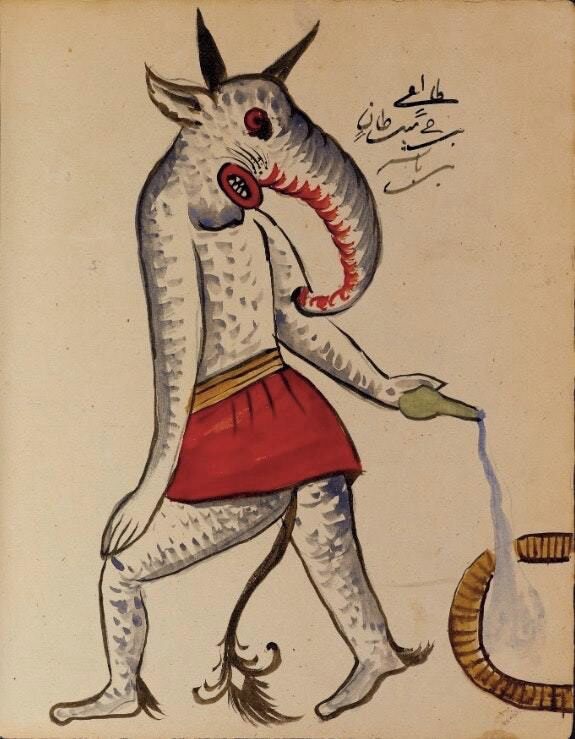
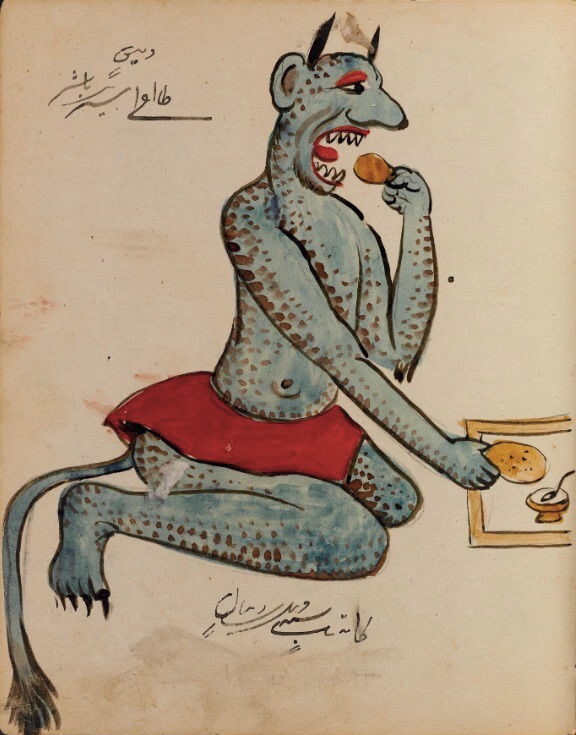
Repost: @archaeologyart Depictions of Demons (Divs) from a Divination Book on Magic and Astrology. Culture: Iran (Late Qajar Period). Date: 1921. Medium: Ink and watercolor on paper. Collection: Princeton University Library, Islamic Manuscripts Collection. You are looking at a divinatory and magico‑medical catalog that was used by some occult healers in early 20th-century Iran. Itinerant sorcerers wandering the streets of Isfahan, known as “Rammal” (fortune-teller/healer), could use manuscripts like this rather than modern instruments such as a stethoscope to treat their patients. Since modern medicine had not yet become widespread in the provinces at that time, many people believed that various mysterious illnesses were caused by the attacks of “Divs” haunting a specific sign (Zodiac) rather than purely biological causes. If you examine the visuals carefully, you can see the logic behind the drawings. For example, the purplish demon kneeling beside a swaddled baby placed in front of it (Image 112-1) recalls figures such as the “Lamashtu / Lilith / Al Karisi” (or Ummu Subyan), one of the oldest horror myths stretching from Anatolia to Mesopotamia. This entity, held responsible for puerperal fever and sudden infant deaths, was the greatest nightmare of mothers. Another interesting detail is the leopard-like spots covering the bodies of the demons; while this may also be an artistic convention, it can be read as a visual coding of epidemics frequently seen in that era that left marks on the skin, such as smallpox, measles, or the plague. Some of the demons in the book are depicted with gold rings or shackles on their wrists and ankles. This detail suggests that these chaotic entities have been “bound” and controlled, evoking the authority of Prophet Solomon (The Master of the Djinn). Indeed, on some pages in the collection, highly specific and bizarre demons named “Palis” are described, which steal the blood and life energy of sleeping people by licking the soles of their feet. A Rammal could have shown this picture to his patient and said, “Your illness stems from this demon,” and read the talismanic prayers scrawled on the margins of the page to cast it out. Thanks for read
With all the shit that has been going on, I’m going to leave it at that…please take care of yourselves. This is obviously an open thread.
Did you like this post? Please share it with your friends:
The Sky Dancing banner headline uses a snippet from a work by artist Tashi Mannox called 'Rainbow Study'. The work is described as a" study of typical Tibetan rainbow clouds, that feature in Thanka painting, temple decoration and silk brocades". dakinikat was immediately drawn to the image when trying to find stylized Tibetan Clouds to represent Sky Dancing. It is probably because Tashi's practice is similar to her own. His updated take on the clouds that fill the collection of traditional thankas is quite special.
You can find his work at his website by clicking on his logo below. He is also a calligraphy artist that uses important vajrayana syllables. We encourage you to visit his on line studio.








 “Methinks the lady doth protest too much.”
 More things will undoubtedly be released. Finally, we see some action from those of us who strongly believe in the preservation of our historical and geographical moments, parks, and buildings. The
 ProPublica
  This is a long read, but well worth your time. I leave you with a personal story from Facebook of a Father of a Daughter.

































































































































 peej
peej Carissa
 bostonboomer
 dakinikat
 ecocatwoman
 mablue2
 Mama Lopez
 peggysue22
 quixote
 skydancingguestblogger
 Mona (aka Wonk the Vote)



 Sky Dancing

Recent Comments