
Rafael Struve was eating dinner at his parents’ home in Houston when the mug shot flashed on his cellphone.
Wow, he thought, staring at Donald Trump’s face. This is it.
“It’s one thing to anticipate it, but to actually see it,” said Struve, 31, who works in business development and is a spokesman for Texas Young Republicans. “ … I don’t think it bodes well for our party if we keep this as the center.”
This first booking photo of an American president — of Fulton County, Ga., Inmate No. P01135809 — is proving a Rorschach test of our political moment. If we see the world not as it is, but as we are, the same appears true for what’s shaping up to be the most divisive image of the 2024 election.
Some Americans see a criminal facing 91 charges across New York, Florida, Washington, D.C. and Georgia, a man whom the law is treating like anyone else. Others see a wrongly accused champion, the likely Republican presidential nominee facing off against a biased justice system conspiring to bench him. Still others see an experienced showman working the camera….
Struve, a two-time Trump voter who now supports Florida Gov. Ron DeSantis, considered the jailhouse portrait over a plate of steak with guacamole and yucca.
Trump’s scowl? Calculated, he thought — “part of the game he’s trying to play long-term, this sort of grievance politics.”
In Atlanta, Anthony Michael Kreis dismissed the image as an outdated ritual of the criminal justice system.
To Kreis, an assistant law professor at Georgia State University, mug shots have devolved from an identification tool to a vehicle for shaming. Consider the galleries of arrestees that newspapers once commonly published. Even without a conviction, such photos can haunt someone for life.
“It’s a skeevy thing we do as a society,” Kreis said.
Yet he acknowledged that it might have been just as skeevy to grant a special pass to an enormously powerful man. The mug shot has “a certain degree of symbolism,” he noted, signaling “that no person is above the law.”
Sunday Reads: The 60th Anniversary of the March on Washington for Jobs and Freedom
Posted: August 27, 2023 Filed under: just because | Tags: 60th anniversary, John F. Kennedy, John Lewis, Lincoln Memorial, March on Washington for Jobs and Freedom, Martin Luther King 7 CommentsGood Day!!
Tomorrow is the 60th anniversary of the March on Washington for Jobs and Freedom, which took place on August 28, 1963.
In August of 1963, I was just about to begin my sophomore year in high school. I was so inspired by the the events I saw on TV that day! John Kennedy was president, Martin Luther King was a hero, and it seemed that the times they really were a-changing, to paraphrase Bob Dylan.
When I got back to school, I interviewed a number of my classmates who had attended the march, and wrote a feature article about their experiences for my school paper The Munsonian.
Little did we know that on November 22 that year, John Kennedy would be assassinated in Dallas. Lyndon Johnson carried out many of Kennedy’s goals; but his obsession with Vietnam destroyed his presidency, and he decided not to run for reelection.
On April 4, 1968, Martin Luther King would be assassinated. The man whom Kennedy had defeated in 1960 would win the 1968 presidential election, and the rest was history, so to speak. The high hopes for freedom and equality were dashed. Nixon and the Republicans used racial animus to gain power–the famous “Southern strategy.”
This page at The Smithsonian gathers interesting memorabilia from that day in 1963.
On August 28, 1963, more than 250,000 people gathered in the nation’s capital for the March on Washington for Jobs and Freedom. The march was the brainchild of longtime civil rights activist and labor leader A. Philip Randolph. With the support of the gifted organizer Bayard Rustin, the march was a collaboration of all factions of the civil rights movement. Originally conceived as a mass demonstration to spotlight economic inequalities and press for a new federal jobs program and a higher minimum wage, the goals of the march expanded to include calls for congressional passage of the Civil Rights Act, full integration of public schools, and enactment of a bill prohibiting job discrimination. The program at the Lincoln Memorial featured an impressive roster of speakers—including John Lewis—and closed with Dr. Martin Luther King Jr. Midway through his address, King abandoned his prepared text and launched into the soaring expression of his vision for the future, declaring, “I have a dream today.”
On 60th anniversary of the March on Washington, the Smithsonian’s National Museum of African American History and Culture reflects on its historical legacy. King’s “I Have a Dream Speech” will be on view in the museum for a limited time, Aug. 7–Sept. 18, 2023, in the Defending Freedom, Defining Freedom gallery.
People gathered in Washington DC over the weekend to mark the anniversary.
From the AP: Thousands converge on National Mall to mark the March on Washington’s 60th anniversary.
WASHINGTON (AP) — Thousands converged Saturday on the National Mall for the 60th anniversary of Rev. Martin Luther King Jr.’s March on Washington, saying a country that remains riven by racial inequality has yet to fulfill his dream.
“We have made progress, over the last 60 years, since Dr. King led the March on Washington,” said Alphonso David, president and CEO of the Global Black Economic Forum. “Have we reached the mountaintop? Not by a long shot.”
The event was convened by the Kings’ Drum Major Institute and the Rev. Al Sharpton ‘s National Action Network. A host of Black civil rights leaders and a multiracial, interfaith coalition of allies rallied attendees on the same spot where as many as 250,000 gathered in 1963 for what is still considered one of the greatest and most consequential racial justice and equality demonstrations in U.S. history.
Inevitably, Saturday’s event was shot through with contrasts to the initial, historic demonstration. Speakers and banners talked about the importance of LGBTQ and Asian American rights. Many who addressed the crowd were women after only one was given the microphone in 1963.
Pamela Mays McDonald of Philadelphia attended the initial march as a child. “I was 8 years old at the original March and only one woman was allowed to speak — she was from Arkansas where I’m from — now look at how many women are on the podium today,” she said.
For some, the contrasts between the size of the original demonstration and the more modest turnout Saturday were bittersweet. “I often look back and look over to the reflection pool and the Washington Monument and I see a quarter of a million people 60 years ago and just a trickling now,” said Marsha Dean Phelts of Amelia Island, Florida. “It was more fired up then. But the things we were asking for and needing, we still need them today.”
On Aug. 28, 1963, Walter Cronkite began his evening news broadcast with a vivid description of the March on Washington. The day would come to be a watershed moment in the equal rights movement for Black Americans.
“They called it the March on Washington for Jobs and Freedom,” said Cronkite. “They came from all over America. Negroes and Whites, housewives and Hollywood stars, senators and a few beatniks, clergymen and probably a few Communists. More than 200,000 of them came to Washington this morning in a kind of climax to a historic spring and summer in the struggle for equal rights.”
One of those clergymen was the Rev. Martin Luther King Jr., who made his famed “I Have A Dream” speech on the steps of the Lincoln Memorial on the afternoon of Aug. 28. He spoke for 16 minutes in a rallying cry for all to have equal rights….
The March on Washington for Freedom and Jobs was meant to support the Civil Rights Act, which President John F. Kennedy was attempting to pass through Congress. The act called for an expanded Civil Rights Commission, the desegregation of public schools and other locations and voting rights protections for Black Americans.
On the day of the march, more than 250,000 people walked from the Washington Monument to the Lincoln Memorial. Cronkite remarked that the march sometimes looked “more like a parade of signs than of people,” as marchers carried signs calling for equality and the end of police brutality.
Along the parade route was CBS News correspondent Dave Dugan. He called the enthusiasm of the march “contagious,” with older attendees “taking it rather relaxed and calmly” and younger marchers singing freedom songs like “We Shall Overcome,” bubbling with energy and “exuberance.”
The Civil Rights Act was signed into law by President Lyndon B. Johnson on July 2, 1964, after Kennedy’s assassination in Dallas in November of 1963. It outlawed discrimination based on race, sex and other protected classes, prohibited discrimination against voters of color and racial segregation in schools. It would be one of the most important legislative bills passed in American history.
NBC News: 60th March on Washington event merges Black America’s current concerns with history.
WASHINGTON, D.C.— As a teenager in 1963, Ann Breedlove rode in a caravan of buses and cars from Albany, Georgia, to the March on Washington. It took more than a day, she said, but the journey proved to be pivotal.
It was then that she learned of the power of fighting for justice, a cause she has taken up for the last six decades.
On Saturday, Breedlove was back in the shadow of the Lincoln Memorial for the 60th anniversary of the March on Washington. Her feelings on being there were mixed.
“I see many little children and young people walking around here and they will remember this day as a day that they were present for something that mattered,” said Breedlove, who now lives in Atlanta. “That’s what it was like for me. I wasn’t into social justice as a teenager. But coming to the march changed me. And that’s what this can do for these children here.”
The parade of dozens of speakers, each addressed many of the same concerns of the Aug. 28, 1963, March on Washington for Jobs and Freedom, speaking to the progress yet to be made. The emphasis then was multi-pronged: end segregation; strengthen voting rights; improved public education; fair wages and civil rights. It was a watershed moment in the Civil Rights movement, marked by Martin Luther King Jr.’s “I Have A Dream” speech, the most famous of the dynamic orator’s addresses.
Saturday was billed as a “continuation, not a commemoration,” hosted by a number of organizations, including Al Sharpton’s National Action Network and the Drum Major Institute, which is modeled after King’s principles. The speakers addressed some of the aforementioned issues, along with the added concerns over Black history being scrubbed from K-12 education, the chipping away of abortion access, the Supreme Court abolishing race-conscious college admissions, and a reversal on LGBTQ rights.
“It’s a shift, a change that has taken place,” Breedlove said. “It’s too bad we are still talking about these issues. But our leaders and Black people are speaking louder. We’re tired — sick and tired — of asking for justice. It’s time to fight back. I’m a great grandmother who remembers the Ku Klux Klan raiding our house and us having to get under the bed when they came on their horses. Today is different. That’s not happening. But we still are getting it in different ways.”
“Our voices are going to be louder than the politicians,” she added, “who are not doing what they need to do to help us.”
Another speaker at the 1963 march was a young John Lewis. An opinion piece by Rutgers history professor David Greenberg at The New York Times: How John Lewis Saved the March on Washington.
The tides of history sand down complex events to smooth, shiny baubles, and the 1963 March on Washington for Jobs and Freedom — whose 60th anniversary arrives Monday, Aug. 28 — is no exception.
This oversimplification of history is at work not only with respect to Martin Luther King’s historic speech, which decried persistent Black poverty before dreaming of racial harmony, but also that of John Lewis, at 23 the march’s youngest speaker. Anointed a veritable saint before his death in 2020, Lewis was regarded back then as an enfant terrible fronting a headstrong new generation of rebels. Neither caricature quite captures the principled yet pragmatic Lewis, whose 1963 speech bluntly assailed deficiencies in the civil rights bill others were championing — but who succeeded in doing so without undermining the day’s unity.
Lewis’s experience with his controversial speech offers us a window onto the competing political pressures at work — the tricky context of an evolving protest movement groping for the right mix of defiance and accommodation. Striking such a delicate balance remains a challenge and an imperative for protest movements pushing for social change today.
That John Lewis even spoke at the March on Washington was something of a fluke. Only weeks earlier, he had been tapped as chairman of the Student Non-Violent Coordinating Committee, a fledgling body formed during the lunch-counter sit-ins of 1960. Of all SNCC’s units, Lewis’s Nashville chapter was the most thoroughly steeped in Gandhian nonviolence, and among the Nashvillians Lewis had imbibed those teachings most completely. After the Nashville movement forced the city to thoroughly integrate its public facilities in May 1963, Lewis — with his earnest, gentle demeanor and unimpeachable devotion to peaceful methods — was a natural choice to become SNCC’s public face.
A bit more:
Even as those methods led that spring to major victories in Nashville and (more famously) Birmingham, however, discontent with the Gandhian ways was mounting. The Birmingham campaign spawned demonstrations in 200 cities nationwide, and while many proceeded peacefully, some — such as in Cambridge, Md. — turned violent, sparking fears of mass mayhem that summer.
Media commentators now spoke of the “new militancy.” King would use this ambiguous term in his March on Washington speech. To some, like Lewis, militance meant not a renunciation of nonviolence but an intensification of protest, the adoption of a defiant edge. But rivals of King’s such as Representative Adam Clayton Powell Jr. and Malcolm X threatened that rioting would rock America’s streets if the government didn’t act on civil rights.
Partly to stave off violence, President John F. Kennedy announced a sweeping civil rights bill that June. At that moment, too, the movement elders A. Philip Randolph and Bayard Rustin were lining up co-sponsors for the Washington march. Many of SNCC’s young radicals balked, fearing it would be, Lewis later recalled, “a lame event, organized by the cautious, conservative traditional power structure of Black America.” But Lewis, an inveterate optimist, naturally inclined to cooperate and compromise, was for it.
On June 22, Lewis — who just several years earlier had been living with nine siblings in a shotgun shack on an Alabama farm — joined some 30 civil rights honchos in the White House Cabinet Room to meet with the president. Kennedy intended to dissuade them from holding the march, which, because of the outbursts earlier that summer, he feared might turn destructive.
Awed to be in such august company, Lewis stayed silent through the meeting. But King, Randolph and others made clear that the march would take place. Kennedy acquiesced and then pivoted, spending the rest of the summer trying to turn the gathering into a rally to pass his bill.
SNCC, meanwhile, scored its own victory. Once shut out of meetings of the major civil rights groups, it now won recognition as one of the six main march sponsors. That meant a speaking slot for Lewis before an audience immeasurably larger than he had ever addressed.
I don’t dare post any more. Read the whole thing at the NYT.
That’s the end of my trip down memory lane. The real anniversary is tomorrow.
Take care everyone!
Extra Lazy Caturday Reads
Posted: August 26, 2023 Filed under: cat art, caturday, Crime, Criminal Justice System, Donald Trump, just because | Tags: 14th amendment, folk art, Trump mugshot, Twitter aka X, two-tier justice system 8 Comments
Miné Okubo, American artist
Happy Caturday!!
Now that Trump has been indicted and arrested repeatedly, I’m feeling a bit calmer about possibilities for the the future of democracy in America. It will still be a long fight, but the opening battles have been won by the good guys.
Trump reportedly tried to avoid having a mug shot taken, and then used it to fundraise. But, let’s face it, the man is in deep legal trouble. He’s been exposed as a common criminal–the first former president ever to be indicted. I have to believe that most Americans are not going to want to vote for an accused and/or convicted felon for president in 2024.
On the mugshot, The Washington Post looked for reactions: Hero, showman, scoundrel: What Americans see in Trump’s mug shot.

Claudia Olivos, ‘Cats in Love’
The WaPo writers managed to find one Democrat to quote in their article, which mostly focused on Trump voters.
Some 1,400 miles north, in the village of Ephraim on Wisconsin’s northeastern thumb, Monique McClean looked at her Apple watch and thought: What is that?
Without comment, her husband had texted Trump’s mug shot, which she initially mistook for some kind of illustration. “It looked like a Marvel supervillain to me,” she said.
McClean, 61, the owner of Pearl Wine Cottage on Green Bay’s shoreline, felt her mood turn gloomy when she considered the image more closely. A Democrat, she’d been horrified by the way Trump accused poll workers in Georgia of scheming against him. Two women had been forced into hiding.
“I just thought of all the lies he has told for years,” she said.
Trump is back on Twitter AKA X, but he hasn’t made much of a splash so far. At Politico, Jack Shafer argues that: Trump Can’t Go Home Again. Twitter is not the site that it used to be. And he’s not the same man.
After surrendering on Thursday at an Atlanta jail to be booked on state felony charges alleging his involvement in a criminal conspiracy to void the 2020 presidential election, Donald Trump sat for a mug shot in which he scowls like a psychopath out of a Stanley Kubrick film. Trump’s next grand act of surrender was to post the picture on his Twitter account — now called X by owner Elon Musk, pedants and copy desks but by nobody who uses it — marking his first appearance there since being reinstated in November, after being booted by the service 958 days ago following the Jan. 6 riots.
Trump’s post, which garnered a healthy 1.3 million likes and 305,000 retweets, essentially concedes that his plan to build his own social media empire under the Truth Social banner is a bust. Aside from Trump’s regular posts there, Truth Social is a wasteland of brimstone and salt whose finances and corporate structure make a Rube Goldberg machine look like a Swiss watch. Except for when journalists repeat his Truth Social outbursts or report on them, that Trump account goes unnoticed. By returning to the social media outlet that helped make him “great,” Trump’s post may presage an attempt to restart the media fire of his 2016 campaign and his presidency.
Man with black cat, by Gea Zwanink
But no man ever steps in the same river twice — it’s not the same river, and he’s not the same man, as the sage said. Twitter is not the same and neither is Trump, and the media watershed that allowed Trump to politically prosper doesn’t drain the way it once did. Thanks to inertia, changing technology, fickle tastes and Musk’s determination to wreck it, the site has lost its cachet. What does that mean for Trump? [….]
The environment that so nurtured Trump’s nuttism has degraded since he filled our silos with his opinions and policy statements. Many journalists still use Twitter, but the site has lost its cultural and political primacy. During his vacation from Twitter, TikTok became the world’s most popular domain, and his comments on Truth Social or at rallies no longer carried instant weight now that he was an ex-president. Even since announcing his candidacy and leading the polls, Trump has often failed to make himself Topic A in the political conversation (except for during his spurt of indictments). Even Fox News, which pampered him like a pet pig during his presidency, now gives him the cold shoulder.

Read the rest at Politico.
At The Daily Beast, attorney Shan Wu writes: Trump’s Arrest in Georgia Shows a Two-Tier Justice System.
LaShawn Thompson shared something in common with former President Donald J. Trump. Both were defendants charged in Fulton County, Georgia, and booked at the Fulton County Jail—known as “Rice Street.” But that is their only shared commonality with the criminal justice system.
On Thursday, with TV cameras overhead and behind his motorcade following every moment of his journey, Trump arrived with an armed U.S. Secret Service escort, and sped through the process of paperwork and having his fingerprinting and mug shots taken like a VIP being let into a night club. It took only 24 or so minutes for him to be booked and leave the jail. His height was logged at 6-foot-3, his weight at 215 pounds, and his hair color as “blond or strawberry.”
The newly minted Inmate No. Po1135809 was back on his private jet within a matter of moments, after claiming again he had done “nothing wrong.”
Dama Con Gato, 2009, by Pescador
But LaShawn Thompson never got to leave after his booking at Rice Street. He died there at the age of 35.
Thompson died at the Fulton County Jail after being held there for three months. According to his autopsy, contributing factors to his death included dehydration, malnutrition, untreated schizophrenia, and severe insect infestation on his body from lice and bed bugs.
His family’s attorney said he “was eaten alive by insects and bedbugs.” Thompson was charged with a misdemeanor.
By contrast, Trump is charged with racketeering crimes in a 41-count felony indictment and facing a total of four different criminal cases brought by prosecutors at the U.S. Department of Justice, Manhattan District Attorney’s Office, and now the Fulton County District Attorney’s Office. But the Fulton County case is the first time that Trump will experience the normal booking procedures of fingerprinting and likely be photographed for his “mug shot.” He also has release conditions that include bail.

Food for thought. Read the rest of this sickening story at The Daily beast.
As Trump faces legal jeopardy, the fight to use the 14th Amendment to disqualify him from public office is gaining steam.
ABC News: 14th Amendment, Section 3: A new legal battle against Trump takes shape.
Separate from the criminal cases, over the past few weeks a growing body of conservative scholars have raised the constitutional argument that Trump’s efforts to overturn the results of the 2020 election make him ineligible to hold federal office ever again.
That disqualification argument boils down to Section 3 of the U.S. Constitution’s 14th Amendment, which says that a public official is not eligible to assume public office if they “engaged in insurrection or rebellion against” the United States, or had “given aid or comfort to the enemies thereof,” unless they are granted amnesty by a two-thirds vote of Congress.
Advocacy groups have long argued that Trump’s behavior after the 2020 election fits those criteria. The argument gained new life earlier this month when two members of the conservative Federalist Society, William Baude and Michael Stokes Paulsen, endorsed it in the pages of the Pennsylvania Law Review.
“If the public record is accurate, the case is not even close. He is no longer eligible to the office of Presidency,” the article reads.
Since then, two more legal scholars — retired conservative federal judge J. Michael Luttig and Harvard Law Professor Emeritus Laurence Tribe — made the same case in an article published in The Atlantic.
By Andrie Martens
“The disqualification clause operates independently of any such criminal proceedings and, indeed, also independently of impeachment proceedings and of congressional legislation,” they wrote. “The clause was designed to operate directly and immediately upon those who betray their oaths to the Constitution, whether by taking up arms to overturn our government or by waging war on our government by attempting to overturn a presidential election through a bloodless coup.”
The argument even got raised on the Republican presidential debate stage in Milwaukee this week.
“Over a year ago, I said that Donald Trump was morally disqualified from being president again as a result of what happened on January 6th. More people are understanding the importance of that, including conservative legal scholars,” Arkansas Gov. Asa Hutchinson said, eliciting a mix of cheers and boos from the audience. “I’m not going to support somebody who’s been convicted of a serious felony or who is disqualified under our Constitution.”

This is from Shan Wu at The Daily Beast: Trump Can and Should Be Disqualified From Running for President Under the 14th Amendment.
The “Disqualification Clause” found in Section 3 of the 14th Amendment fits Donald J. Trump like a glove.
Or as political podcaster Allison Gill asked on the social media platform formerly known as Twitter: “if section 3 of the 14th amendment wasn’t designed for him, who was it designed for?”
The historical answer to Gill’s query is, of course, that it was designed for Confederates trying to get back into the federal government after losing the Civil War. And that very same historical context draws a direct analogy to Trump’s efforts to get back into the presidency after losing the 2020 election.
Three black cats, by Tacha, Toronto
Here’s what the Disqualification Clause says:
“No person shall be a Senator or Representative in Congress, or elector of President and Vice-President, or hold any office, civil or military, under the United States, or under any State, who, having previously taken an oath, as a member of Congress, or as an officer of the United States, or as a member of any State legislature, or as an executive or judicial officer of any State, to support the Constitution of the United States, shall have engaged in insurrection or rebellion against the same, or given aid or comfort to the enemies thereof. But Congress may by a vote of two-thirds of each House, remove such disability.”
The plain language of this obviously encompasses Trump’s actions to illegally overturn the results of the 2020 presidential election. These actions include but are not limited to asking the Georgia Secretary of State to find additional votes for him, conspiring to put forth slates of unelected “fake” electors for the electoral college, and his call for “wild” protests on Jan. 6 that led to the attack on the Capitol.
But while these actions have resulted in Trump being charged criminally both by the U.S. Justice Department and the State of Georgia, his disqualification does not depend upon him being convicted in either of those cases.

Yu quotes from the piece by Tribe and Luttig mentioned in the previous article along with other experts:
Tribe and Luttig are hardly outliers in their view. A forthcoming law review article written by Federalist Society conservative law professors—William Baude of the University of Chicago and Michael Stokes Paulsen of the University of St. Thomas—not only agrees that the disqualification is self-enforcing but also makes the case that numerous others who supported Trump’s efforts also may be disqualified.
Baude and Paulsen note that this could include people like former National Security Advisor General Michael Flynn (who proposed a plan to seize voting machines), the “fake electors,” Jeffrey Clark of the Justice Department, and “at least one member of Congress” (that would be Rep. Scott Perry (R-PA)) who had supported Clark’s plans—and even lobbied for removal of senior DOJ officials who opposed Clark’s scheme.
Head over to The Daily Beast to read some counterarguments.
All in all, I think things are looking better for the efforts to keep Trump from getting back into power.
That’s it for me today. Have a nice weekend everyone!
Finally Friday Reads: The Petty American Minority Runs Amok! Amok! Amok!
Posted: August 25, 2023 Filed under: just because | Tags: 1st GOP Presidential Debate 2023, Heat Dome: UNCLE!!!!!, Trump Crime Syndicate, Trump cult, Trump Mug Shots 5 Comments
John (repeat1968) Buss,
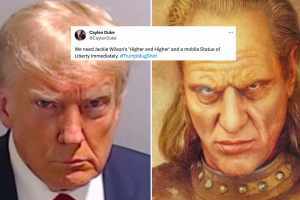
Damien… er Donald, seems pissed. #TrumpMugShot #TrumpArrest #Omen #PAB #FullDiaper
Good Day, Sky Dancers!
All I can say today is, “We’ve seen the enemy, and he is us!” The last of the Trump co-conspirators have turned themselves in. Fittingly enough, the last guy was a Lutheran minister and retired California cop. A Naptha Fire at a Marathon Oil Refinery just west of me is causing schools to close and nearby residents to evacuate. Fires are now a big thing in Louisiana, and we’re still setting record highs that should have the asterisk next to them since they’ve been super fueled by Climate Change. Most years, we never see much of the upper 90s, let alone the 100s, but this year oy, such a heat dome! This election year will deliver a Republican governor to us that’s bound to make things worse.
Maui County’s Power Company is destroying the evidence that could possibly point to their malice in the big fire there. Compromising Evidence seems to be a pastime these days. Oh, and some idiot saw fit to bring Sarah Palin back into the Public dialogue as if she ever had anything intelligent to say. Today, she’s inciting a riot. Setting fires is what all Republicans are suitable for these days. That idiot was Eric Bolling, by the way.
This is from The Daily Beast. “Sarah Palin Says Civil War Is ‘Going to Happen’ After Trump’s Arrest.” I’ve never seen a political party so willing to say anything that nearly everything is an outright lie, a conspiracy theory, or propaganda.
Sarah Palin responded to Donald Trump’s arrest in Georgia on Thursday night by talking up the possibility of civil war. Speaking to Eric Bolling as the former president was booked at the Fulton County Jail on election interference charges, Palin slammed “those who are conducting this travesty and creating this two-tier system of justice.” “I want to ask them: What the heck?” the former Alaska governor said. “Do you want us to be in civil war? Because that’s what’s going to happen. We’re not going to keep putting up with this.” Addressing Bolling, Palin went on to say: “I like that you suggested that we need to get angry. We do need to rise up and take our country back.”
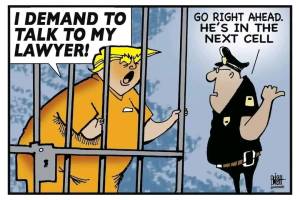
 Trump Supporters in Georgia couldn’t even tell the difference between Former Atlanta Mayor Keisha Bottoms and current Fulton County District Attorney Fawni Willis.
Do Trump supporters even know what Fulton County District Attorney Fani Willis looks like? When former Atlanta Mayor Keisha Lance Bottoms appeared at the Fulton County Jail on Thursday, MAGA fans berated her and yelled “Lock her up!”—because they mistook her for Willis. “They thought I was Fani and started chanting at me as well, and just walking through the crowd, there was a lot of hatred out here,” Bottoms told CNN. “Imagine that. A lot of hatred and really bad energy out here, but, you know, this is—when you sign up for public service you don’t get to pick and choose your good days and your bad days.” She went on to say being “subjected to threats” is “part of the job” but added that it’s “a threat to our democracy in and of itself” when people “people don’t serve because they fear for their lives.”
 We can’t even have any conversations about policy or strategy differences anymore because the Grand Old Party is full of hypnotoads swaying the opinions of the idiots that watch them. I watched the entire GOP debate on Wednesday. What a shit show! I could make so many remarks about misogynoir right now, plus the fact the two women do not look alike, which leads straight down to that old cracker troupe, but hey, there’s more shit to show!
The biggest shit show was the Republican Debates. “The First Republican Presidential Debate Was Rife With Abortion Misinformation. “Abortions on demand,” “born alive abortions” and other fact-free claims were on display at the first GOP debate.” This is from HuffPo.
The first Republican presidential debate included a lot of fake news about abortion.
At least four of the eight candidates standing on the debate stage on Wednesday night repeated the flagrant lie that people are getting abortions “up until birth.”“I would love for someone to ask Biden and Kamala Harris: Are they for 38 weeks, are they for 39 weeks, are they for 40 weeks? Because that’s what the media needs to be asking,” said Nikki Haley, a former U.S. ambassador to the United Nations, referring to President Joe Biden and his vice president.
“What the Democrats are trying to do on this issue is wrong — to allow abortion all the way up to the moment of birth,” Florida Gov. Ron DeSantis added, before diving into a story about a woman named Penny who allegedly “survived multiple abortion attempts” until her grandmother saved her. So-called “born-alive” anti-abortion legislation ― purportedly meant to protect fetuses that survive botched abortions ― has flooded the country in recent years and become a right-wing talking point even though it has no scientific basis.
Other contenders like Arkansas Gov. Asa Hutchinson and Sen. Tim Scott (S.C.) fanned the flames around the “abortion up until birth” myth.
“We cannot let states like California, New York and Illinois have abortions on demand up until the day of birth,” Scott said. “That is immoral. It is unethical. It is wrong.”
But it’s downright wrong to suggest that women are getting abortions up until their last days of pregnancy simply because they changed their minds about having a child. To start, abortion later in pregnancy is extremely rare: Less than 1% of abortions occur at 21 weeks or later and the subset of abortions in the third trimester (after 26 weeks) is even smaller.
 My OB/GYN, board-certified, Dr Daughter reminds me that anything after 26 weeks isn’t even considered an abortion. At that point of viability, there’s a delivery that is either successful or not. It’s done because something is drastically wrong with the fetus or drastically wrong with the mother. Anyone who believes anything else belongs to a cult for a tortured death.
Additionally, the large majority of pregnant people who are in their third trimester have wanted pregnancies and often need an abortion for medical reasons, like finding a fatal fetal abnormality or the health of the pregnant person is being threatened.
“Abortion ‘up until birth’ simply does not happen,” Angela Vasquez-Giroux, NARAL Pro-Choice America vice president of communications and research, told HuffPost.
“The GOP candidates know that Americans don’t support their extreme bans on abortion, and they are desperately grasping at straws to muddy the waters,” Vasquez-Giroux said. “Republicans want you to be fooled by the disinformation they pushed tonight – but they want a national ban on abortion, full stop. A ban is a ban, no matter how they try to spin it.”
Former Vice President Mike Pence piled on to the misinformation garbage fire, telling the American people that 70% of the U.S. supports a federal 15-week abortion ban. Recent polling from USA TODAY/Suffolk University found that 80% of voters oppose a federal abortion ban ― including 65% of Republicans and 83% of independents.
 While Nikki Haley did manage to sound reasonable on a few issues, this was only because she was surrounded by worse fools. I believe one of the candidates is secretly an animatronic character on the run from Chuckie Cheese. Either that, or he jumped out of some cartoon strip somewhere. It figures he’s a tech bro and the darling of right-wing billionaires. He’s as odd as Musk in his overly animated way. This is from Margaret Sullivan, writing for The Guardian. “Vivek Ramaswamy is America’s demagogue-in-waiting.’ Ramasmarmy is more like it. But, he’s racking in bucks and taking them from DeSanctemonius and wow is he chatty.
He thinks the climate crisis is a hoax, supports Vladimir Putin’s aggression in Ukraine and would gladly pardon Donald Trump on day 1 of his would-be presidency. A wealthy biotech entrepreneur, the 38-year-old has never before run for public office.
Despite all of this (or maybe because of it), this week’s Republican debate became a national coming-out party for Vivek Ramaswamy.
Suddenly, this inexperienced and dangerous showoff is almost a household name.
Many in the Republican base ate up his showmanship and blatant fanboying of their hero, Donald Trump. In CNN’s post-debate focus group of Republican voters in Iowa, for example, Ramaswamy got the most favorable response.
Trump publicly applauded him. And many in the mainstream media declared him victorious. The Washington Post put him up high in its “winners” column, trailing only behind Donald Trump, who notably wasn’t even there. (Choosing not to enter this particular clown car showed some uncharacteristic good sense on the former president’s part.)
The New York Times analyzed the situation under a glowing headline “How Vivek Ramaswamy Broke Through: Big Swings With a Smile”, with emphasis on his style: “unchecked confidence and insults”.
For this millennial tech bro, his performance on the Fox News stage in Milwaukee couldn’t have gone much better.
As a glimpse of America’s future, it couldn’t have gone much worse.
“If you have wondered what Trumpism after Trump looks like, ask no further,” suggested the magazine writer David Freedlander on the social media site formerly known as Twitter. His prediction accompanied a debate stage photo of Ramaswamy with clenched fist.
Certainly, he has the essentials covered. No, not foreign policy chops or a background in public service, but a mocking aversion to social justice and equality. Amelia Robinson of The Columbus Dispatch provides links on the newest cipher to enter the race. Dive in if you dare!
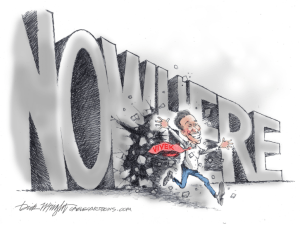
Dick Wright has been an award winning editorial cartoonist for decades, drawing for the San Diego Union, the Providence Journal, Scripps-Howard Newspapers and the Columbus Dispatch.
Great! Shallow and narcissistic! Just another Republican!
So, I will end with Don the Con that took ConAir back to New Jersey yesterday and immediately go to work on hi merchandising mugshot paraphenalia. I can only imagine how much his fools will send to him. This is from Salon. It’s written by Chaucey DeVega. “Trump is in the final stage of cult leadership”: Fulton County arrest elevates his MAGA “martyrdom”. The “country is on the precipice of sustained violence we haven’t seen in 150-160 years,” says Republican Joe Walsh.” Yes, when I don’t remember my history, I ask my plumber to remind me. Oh, well.
In all, this week has been a spectacle of the worst sort. At CNN, Stephen Collinson accurately described it as, “No other GOP leader could confidently snub a prime-time television debate and turn his no-show into an argument for his inevitability. But Trump – as with his attempt to use criminal indictments to advance a political career that has always prospered amid perceptions that he’s being unfairly treated – is changing all the rules of campaigning once again.”
The American news media, political class, and general public will do their best (and will largely fail) to navigate these “historic” events with the goal of finding some sense of balance, normalcy, and clarity in unprecedented times. Unfortunately, it is those same bad habits and norms that helped to create the disaster that is the Age of Trump and ascendant American neofascism in the first place.
So, in an attempt to make sense of what comes next in this truly historic and unprecedented moment with Donald Trump and his criminal indictment(s) in Georgia, wishcasting and other forms of denial by the news media and political elites about the true depth of the country’s democracy crisis, and what potentially comes next, I recently asked a range of experts for their thoughts and insights.
 What follows is an interview with Gregg Barak who is an emeritus professor of criminology and criminal justice at Eastern Michigan University and author of “Criminology on Trump.” Good. Not a Plumber, not that I don’t appreciate and love talking to my plumber about all kinds of things while he works miracles on the plumbing that brought fresh water to my house and made the outhouse unnecessary in my 1840s era house. He and my electrician work your basic wonders in my eyes. We just don’t talk politics.
I am looking forward to each of these criminal trials especially because they are “slam dunks” for the prosecution regardless of what Trump or his attorneys and supporters have been saying up to now. Reality check: There are simply no legal defenses for Trump’s criminal behavior other than trying to procedurally dissolve these cases by denying that they were crimes in the first place or to simply make motion after motion in the hopes of delaying these trials from beginning for as long as possible.
With respect to the January 6 and Georgia election fraud and conspiracy cases, neither one has anything to do with free speech or with the weaponization of the Justice Department (DOJ) by either President Joe Biden or Attorney General Merrick Garland. While both of these political talking points may continue to thrive in the Trumpian alternative universe, I believe that their powers of persuasion are already starting to fade or decline as a byproduct of the powerful RICO indictments in Georgia. No matter though, these arguments may have had or have value in the court of public opinion, they will have no value whatsoever in the federal or state criminal courts of law where Trump should ultimately be tried will also be convicted.
I am especially looking forward to these trials as they converge with Trump’s campaigns during the GOP primaries like Super Tuesday in March and in the runup to the general election as well. Although Trump could probably stop campaigning altogether and still win the GOP nomination he won’t have to. Instead of taking to the expensive campaign trail week after week, he will simply transfer what passes for political campaigning, or more accurately, his staged and unhinged tirades of doom, gloom, and bada-bing bada-boom to the courthouse steps each and every day of those first two federal criminal trials that will probably not be televised.
I am looking most forward to the RICO trial and to Trump’s Court TV reality show because it will be televised, and its star defendant Donald Trump won’t say one word because he will never take the stand. More importantly, the trial of Trump’s criminal enterprise will be a most illuminating and entertaining criminal trial. If it materializes, this trial will captivate viewers and audiences like never before and that includes the 9-month-long criminal trial of OJ. Simpson. Watched literally by the whole world, this fairly complex yet easily understood criminal trial will witness the prosecution methodologically taking us through those 161 acts that furthered the conspiracy of their criminal enterprise. When Trump leaves the Fulton County criminal trial daily for perhaps as long as nine months he will uncharacteristically no longer be talking about his innocence or his persecution. Instead, with his tail tucked firmly between his legs Trump will be demonstrating that he is quite capable of keeping his gaslighting mouth shut when it better serves his interests or when his talking will only make a fool of himself even to his sycophantic MAGA base.
In other words, stay tuned.
What’s on your reading and blogging list today?
Thank you @Caylen Duke. I’m taking your suggestion.
Tuesday Reads: The Latest Trumpy Legal News
Posted: August 22, 2023 Filed under: Crime, Criminal Justice System, Donald Trump, just because | Tags: Georgia election interference case, Jack Smith, January 6 case, Jeff Clark, John Eastman, Judge Tanya Chutkan, Mark Meadows 9 CommentsGood Afternoon!!
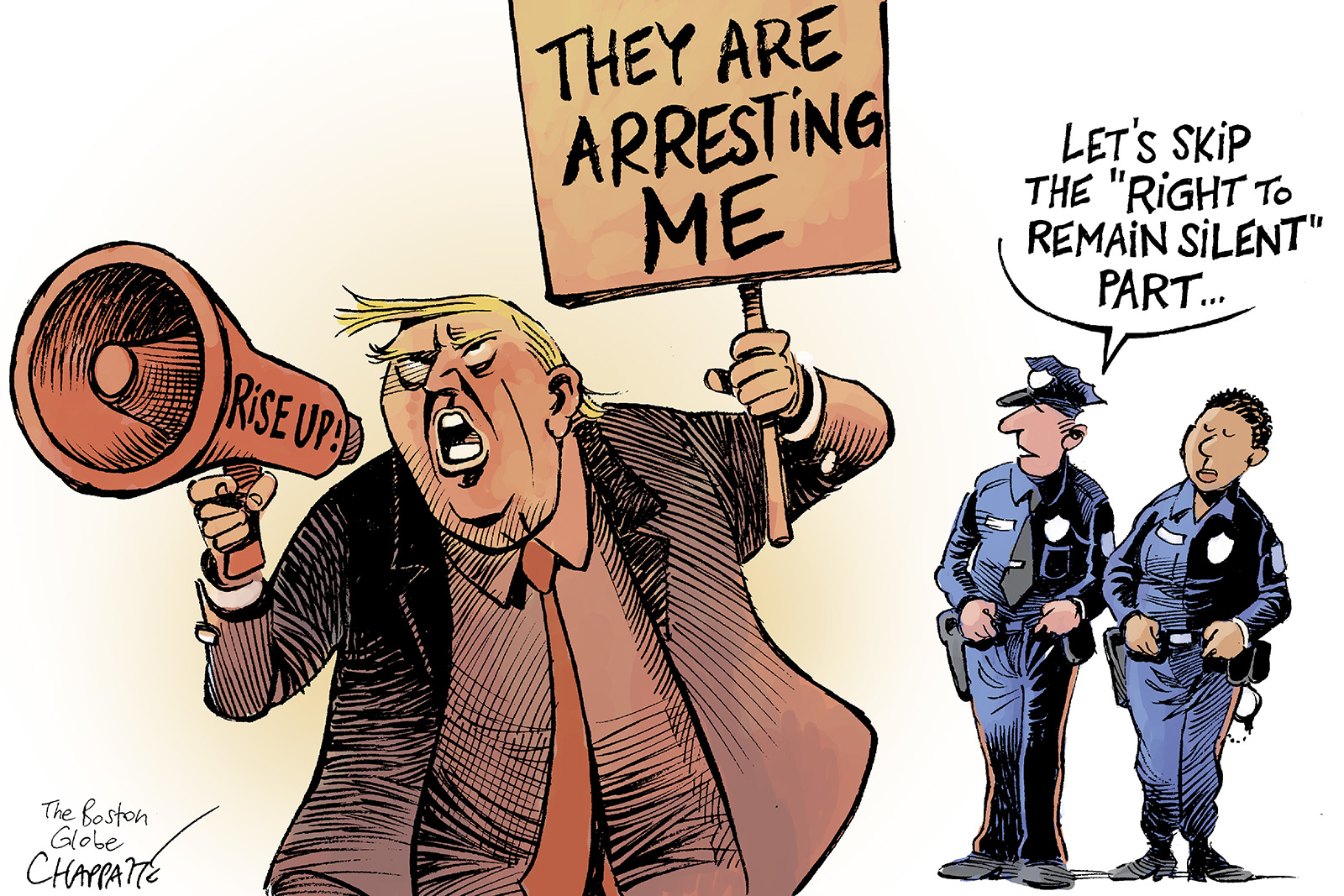 Now that Trump has been indicted and arrested 3 times, the 4th arrest on Thursday seems sort of old hat. Ho hum . . . Trump will surrender at Fulton County Jail in Georgia on Thursday; his bail has been set at $200,000.
Associated Press: Trump says he will surrender Thursday on Georgia charges tied to efforts to overturn 2020 election.
Former President Donald Trump says he will surrender to authorities in Georgia on Thursday to face charges in the case accusing him of illegally scheming to overturn his 2020 election loss in the state.
“Can you believe it? I’ll be going to Atlanta, Georgia, on Thursday to be ARRESTED,” Trump wrote on his social media network Monday night, hours after his bond was set at $200,000.
It will be Trump’s fourth arrest since April, when he became the first former president in U.S. history to face indictment. Since then, Trump, who remains the leading candidate for the Republican presidential nomination, has had what has seemed like an endless procession of bookings and arraignments in jurisdictions across the country. His appearances in New York, Florida and Washington, D.C., have drawn enormous media attention, with news helicopters tracking his every move.
Trump’s announcement came hours after his attorneys met with prosecutors in Atlanta to discuss the details of his release on bond. The former president is barred from intimidating co-defendants, witnesses or victims in the case — including on social media — according to the bond agreement signed by Fulton County District Attorney Fani Willis, Trump’s defense attorneys and the judge. It explicitly includes “posts on social media or reposts of posts” made by others.
This morning, two of Trump’s co-defendants surrendered in the Georgia election interference case.
Atlantic News First, via NBC29 VA:
ATLANTA (Atlanta News First/Gray News): First co-defendants in Trump indictment surrender at Fulton County jail.
The first co-defendants in a sweeping indictment out of Fulton County, Georgia, has surrendered to the jail.
Shortly before 10:30 a.m. Tuesday, former President Donald Trump’s attorney John Eastman turned himself in. A bond agreement for $100,000 was reached Monday in his case.
Eastman, prosecutors say, was deeply involved in some of his efforts to remain in power after the 2020 election. He wrote a memo arguing that Trump could remain in power if then-Vice President Mike Pence overturned the results of the election during a joint session of Congress where electoral votes would be counted. That plan included putting in place a slate of “alternate” electors in seven battleground states, including Georgia, who would falsely certify that Trump had won their states.
In a social media statement, Eastman said he was surrendering “to an indictment that should never have been brought.”
“It represents a crossing of the Rubicon for our country, implicating the fundamental First Amendment right to petition the government for redress of grievances,” Eastman said. “As troubling, it targets attorneys for their zealous advocacy on behalf of their clients, something attorneys are ethically bound to provide and which was attempting here by ‘formally challeng[ing] the results of the election through lawful and appropriate means.’ An opportunity never afforded them in the Fulton County Superior Court.”
A $10,000 bond agreement was reached Monday for Scott Hall, the Atlanta-area bail bondsman who was allegedly involved in commandeering voting information that was the property of Dominion Voting Systems from Coffee County in south Georgia.
On Tuesday, just before 9 a.m., Hall surrendered to authorities, and was booked and processed on charges that include conspiracy to commit a felony, conspiracy to commit election fraud, conspiracy to defraud the state of political subdivision, and violation of the Georgia Racketeer Influenced And Corrupt Organizations Act (RICO).
Jeff Clark, the DOJ official who wanted to send letters to the swing states saying that the DOJ believed there was significant voter fraud in their states, is trying to avoid going to Atlanta to be booked.
https://twitter.com/petestrzok/status/1694008924863602918?s=20
Jeff Clark on the morning his house was searched by the FBI:
This is going to enrage Trump. The New York Times just posted an article on Mark Meadows, another of Trump’s co-defendants in Georgia: How Mark Meadows Pursued a High-Wire Legal Strategy in Trump Inquiries.
This winter, after receiving a subpoena from a grand jury investigating former President Donald J. Trump’s attempts to overturn the 2020 election, Mark Meadows commenced a delicate dance with federal prosecutors.
He had no choice but to show up and, eventually, to testify. Yet Mr. Meadows — Mr. Trump’s final White House chief of staff — initially declined to answer certain questions, sticking to his former boss’s position that they were shielded by executive privilege.
But when prosecutors working for the special counsel, Jack Smith, challenged Mr. Trump’s executive privilege claims before a judge, Mr. Meadows pivoted. Even though he risked enraging Mr. Trump, he decided to trust Mr. Smith’s team, according to a person familiar with the matter. Mr. Meadows quietly arranged to talk with them not only about the steps the former president took to stay in office, but also about his handling of classified documents after he left.
The episode illustrated the wary steps Mr. Meadows took to navigate legal and political peril as prosecutors in Washington and Georgia closed in on Mr. Trump, seeking to avoid being charged himself while also sidestepping the career risks of being seen as cooperating with what his Republican allies had cast as partisan persecution of the former president.
His high-wire legal act hit a new challenge this month. While Mr. Meadows’s strategy of targeted assistance to federal prosecutors and sphinxlike public silence largely kept him out of the 45-page election interference indictment that Mr. Smith filed against Mr. Trump in Washington, it did not help him avoid similar charges in Fulton County, Ga. Mr. Meadows was named last week as one of Mr. Trump’s co-conspirators in a sprawling racketeering indictment filed by the local district attorney in Georgia.
Interviews and a review of the cases show how Mr. Meadows’s tactics reflected to some degree his tendency to avoid conflict and leave different people believing that he agreed with them. They were also dictated by his unique position in Mr. Trump’s world and the legal jeopardy this presented.
Read all the juicy, gossipy details at the NYT link.
There’s also news about the January 6 case against Trump in DC.
The Washington Post: Justice Dept. pushes back against Trump’s bid for a 2026 trial in D.C.
The Justice Department pushed back Monday on former president Donald Trump’s claims that he cannot be ready to go to trial in January on charges that he illegally sought to subvert the results of the 2020 election.

That’s it for me today. I guess I’m still mainly obsessed with seeing Trump tried, convicted, and imprisoned. I’ll add more links in the comment thread.
Mostly Monday Reads: Martyrdom Syndrome vs Real Suffering
Posted: August 21, 2023 Filed under: Climate change, Climate/Inflation Package | Tags: Floods in Southern California, heat dome, Hurriquake Southern California, Maui Fires, Republican agenda of shaming and plunderingder 8 Comments
Northeaster, Winslow Homer,1895
Good Day, Sky Dancers!
New Orleans got some much-needed rain this morning! It was too late for several homeless folks in the city who were overcome by heat exhaustion and stroke. They are not alone, as there are victims throughout the Southern United States with similar fates.
President Biden will visit the site of the Maui Fires, which will take unprecedented federal resources to return many people to a new normal situation. Having been part of a diaspora and major disaster–Hurricane Katrina–I can attest to the remaining devastation here and the impact on the psyche of its victims that never entirely goes away. We’re just beginning to get information on the flooding and storms that have damaged cities like Palm Springs. National resources, Charitable funds, and ordinary citizens will come to the rescue with basic needs as well as much-needed hugs and comfort.

Prairie Meadows Burning, on the Missouri, George Catlin, 1852
These climate-change-related disasters are on the minds of concerned Americans who are reaching out with grace and resources to make their fellow citizens whole again. Scanning the headlines, I notice that a specific group of Americans doesn’t appear to be part of the massive acts of neighborly love that will begin so many paths to healing and restoration. Hurricane Ida is still an issue down here. Resources are still finding their way to those just trying to get back to some kind of routine. The only thing I can find on the Maui fires and Trump is a fake video telling his acolytes he visited there during the fires. This was obviously not true. The other headline is him lambasting President Biden for a “disgraceful” response. This after his response to Puerto Rico’s American citizens after a hurricane was to toss paper towels at them and appear surprised they were actually tax-paying and voting U.S. Citizens. Trump delayed $2 billion in aid. No word about the California Hurriquake from His Orange Assholines yet.
So, what kind of person isn’t focused on helping their neighbors during these multiple disasters? Well, you know, but I’m going there anyway. This is from Sidney Blumenthal, writing at The Guardian. “Trump’s legal woes are part of his quasi-religious mythology of martyrdom. These criminal entanglements are not only means but ends – not a sideshow, but the heart and soul of Trump’s campaign.?” Yes, it’s his continual refrain of “poor, poor pitiful me.
Even more than during the gripping performance of his various indictments, the theatre of his trials will subsume politics. There will not be another campaign, some semblance of a normal campaign of the past, a fantasy campaign, separate from Trump’s trials. The scenes from courtroom to courtroom will overlap with the primaries – the final ones taking place on 4 June 2024 – only intensifying the zeal of his base. And then Trump’s battle with the law will engulf the general election.
The trials are a continuous spectacle, featuring an all-star cast in far-flung locations. Political reporters are barely heard from, while legal analysts fill the airwaves. Every twist and turn, every motion, every argument is the breathless lead story. Everyone, from prosecutors to co-conspirators, named and unnamed, indicted and unindicted, are characters in Trump’s new reality show – part violent action movie (the insurrection), part sleazy porn flick (Stormy Daniels), part conspiracy thriller (Mar-a-Lago), and part mafia drama (the fake elector racket).
But the Trump trials are more than his means; they are his ends. The trials are not the sideshow, but the heart and soul of Trump’s campaign. They have become his essential fundraising tool to finance his defense, his platform for whipping up his followers into a constant state of excitement, and his instrument for dominating the media to make himself the center of attention and blot out coverage of anyone else.
The trials are the message. They are the drama around which Trump plays his role as the unjustly accused victim, whose rights are trampled and who is the martyr for his oppressed “deplorables”. He is taking the slings and arrows for them. The narcissist is the self-sacrificing saint. The criminal is the angel. The liar is the truth-teller. If any Republican lapses in faithfulness, they are more than a mere doubter or skeptic, but a betrayer and traitor. Trump’s trials are the rigorous trial of his followers’ faith. Rejection of temptation in an encounter with an impertinent fact that might raise a qualm shows purity of heart. Seduction by fact must be resisted. The siren song of critical thinking must be cast out as sin. Trump’s convictions are the supreme test of his followers’ strength of conviction.
Republicans are not prisoners of Trump’s narcissistic rage. They don’t reject it. They don’t regret it. They don’t apologize. They mirror it. They mimic it. They exult in it. It is the gratification they receive for passing through the ordeal of belief. His rage is their reward. It is their cheap vicarious defiance of the evil-doers: the establishment, the globalists, the Fauciists, the FBI, the Barbie movie. As Trump has received target letters, so judges, district attorneys, the special counsel, and their wives, too, must be targets. Fair game is fair play. Hallelujah!

After the Hurricane Bahamas, Winslow Homer, 1899
Yup, it’s all about him, and whatever it is they developed in terms of connecting their own little grievances to him. Even getting airplay in Trumpland requires a little sumpin’ sumpin’. Every Republican has a grievance about somebody else interfering with their KKK cosplay. “Republican candidate told associates Newsmax tried to make him pay for coverage.” It’s one big grift in Trumplandia, especially for the propagandists. This is from Salon. Meanwhile, the USA drowns, burns, and melts.
If Vivek Ramaswamy wants to appear on Newsmax, he should pay to do it.
That was the message that network chief Chris Ruddy delivered to the Republican presidential candidate during a private call earlier this summer, according to two people to whom the candidate described the conversation. Ramaswamy had complained that the right-leaning network was sticking him in little-watched midday slots or ignoring him outright.
Ruddy also suggested a solution, Ramaswamy told associates: buy more television ads on the network. Ruddy, Ramaswamy told them, noted that such a transaction had helped Republican businessman Perry Johnson, a gadfly candidate who has thus far garnered only passing attention among mainstream and even conservative outlets covering the 2024 presidential cycle.
In a statement, Newsmax spokesperson Bill Daddi told Semafor that the insinuation “that Newsmax is asking candidates to advertise in order to ensure coverage as some quid pro quo … is categorically untrue and incorrect. Newsmax would take an assertion such as that very seriously. There is no correlation between advertising and editorial visibility for any candidate on Newsmax.”
“If candidates want to reach our audience outside of our programming, then, of course, advertising would be a good way for them to do this. That is the basis of all political advertising,” he said.

Tornado over Kansas, John Steuart Curry.1929
And all that time, the League of Woman Voters could’ve been collecting booty for the Voter’s Guides. But wait, there’s the House of Representatives that’s supposed to really care about the people, right? This is from Axios. “House Freedom Caucus fires warning shot over government shutdown.” Just as we need Federal resources to handle all these natural disasters, why shouldn’t we just close all of it down? What could be more important than helping our citizens in desperate need?
Members of the House Freedom Caucus are making it harder for leadership to avoid a government shutdown, announcing on Monday that they’ll oppose a stopgap funding bill unless it caves to their terms.
Driving the news: The HFC is demanding more funding for border enforcement, cuts to the Department of Justice and FBI, and an end to “woke” policies at the Department of Defense.
- “We refuse to support any such measure that continues Democrats’ bloated COVID-era spending and simultaneously fails to force the Biden Administration to follow the law and fulfill its most basic responsibilities,” they said in a statement.
- “Any support for a ‘clean’ Continuing Resolution would be an affirmation of the current FY 2023 spending level grossly increased by the lame-duck December 2022 omnibus spending bill that we all vehemently opposed just seven months ago.”
The big picture: Congress is unlikely to complete its work on appropriations bills by the deadline on Sept. 30, with leadership calling for a continuing resolution to provide themselves with more time.
- “If you think we’re going to come in and in three weeks, three partial weeks in September and get the appropriations bills done — that seems unlikely, given the extent to which there was a total failure in settings, spending levels where they needed to be set in order to get to 218,” Rep. Chip Roy (R-Texas) told Axios.
What’s next: Some members have discussed potentially attempting to block a continuing resolution on legislation from reaching the House floor unless it meets their criteria, upping the likelihood of a government shutdown if Democrats don’t vote for the measure.

The Gulf Stream, Winslow Homer, 1899
So, I guess the “basic” responsibilities don’t include rebuilding anything after a natural disaster. Just let them eat dust and fire-rotted logs! Who needs schools? Food? Water? This is from NBC. “Freedom Caucus rebels against a short-term funding bill with new demands. The new list of policy changes sought by the ultraconservative House lawmakers drew immediate pushback from Democratic leaders, who warned it would cause a shutdown.” So, they have the ability and want laws to shame people but have no shame themselves. Got it!
In a statement Monday, the Freedom Caucus said its official position was that the group’s members would oppose any bill unless it includes their preferred language on border security, new laws to address what they call the “weaponization” of the Justice Department and FBI and a shift in some of the Pentagon’s policies — although they didn’t detail all the changes they want.
Yup, more hypocrisy.
Here’s some of the latest on the Maui Fires. This is from the New York Times. “Maui Knew Dangerous Wildfires Had Become Inevitable. It Still Wasn’t Ready. As President Biden arrives to survey the damage with state and local officials, shock and grief are giving way to anger and questions about the government’s preparation.” The photos are shocking.
Here’s some of the latest on the damage caused by Hurricane Hilary. This is from CBS News. “Video, pictures of Hilary aftermath in Palm Springs show unprecedented flooding and rain damage from storm.” Again, more shocking photos.
This is from the Washington Post. “Record central U.S. heat wave delivers ‘life-threatening’ conditions. Heat indexes topped 130 in Kansas on Sunday. Several days of similar heat are on the way.” This isn’t your grandfather’s August Summer Days.
More than a third of Americans are under heat alert early this week as a monster heat dome stifles a huge swath of territory across the central United States, threatening the hottest temperatures of summer. As officials warn of “life-threatening” conditions, numerous records in parts of the Midwest could be reached as the heat continues to pummel the South.
Excessive-heat warnings stretch from Texas and Louisiana to Wisconsin and Minnesota, including the entire states of Iowa and Missouri. Cities under excessive-heat warnings include Des Moines, Kansas City, Oklahoma City, Dallas and Little Rock. Combinations of heat and humidity will lead to feels-like values of 110 to 120 degrees across much of the Midwest and South, with some spots even surpassing those marks.
That already happened Sunday, with heat indexes in numerous locations topping 120, focused on Kansas, Iowa and Missouri.
More than 200 long-period record highs were set since Friday alone, including an all-time high of 112 degrees in College Station, Tex. Another all-time high was reached in Alexandria, La., where it reached 110 on Saturday. August records were set in Abilene, Tex., at 111, and in Stephenville, Tex., at 110.
But, hey, the majority party in the House of Representatives believes we need to stop responding to public health emergencies and start paying more attention to making Trump’s indictments about politics and not his crime spree. That sounds about right. It’s their idea of our priorities.
What’s on your blogging and reading lists today?
Let us know how you’re making out from the heat, the hurriquake, the fires, and the overall Republican plan to turn us into victims of their shame and plunder policies.

 peej
peej Carissa
 bostonboomer
 dakinikat
 ecocatwoman
 mablue2
 Mama Lopez
 peggysue22
 quixote
 skydancingguestblogger
 Mona (aka Wonk the Vote)



 Sky Dancing
Recent Comments