
Obama at Seneca Falls: Symbol vs Reality
Posted: August 26, 2013 Filed under: Women's Rights, worker rights 6 Comments President Obama visited the historical site of Seneca Falls with a copy of the Lily Ledbetter Act and Ms. Ledbetter herself on the 22nd. Seneca Falls is home to the historic park celebrating the 1848 Women’s Convention. Celebrations of Women’s Day occur all over the country to commemorate the event.
At the visitors center, Obama greeted people waiting near bronze statues of the likenesses of Elizabeth Coy Stanton, Frederick Douglass, Martha Coffin Wright and Thomas and Mary Ann M’Clintock. “This is a really lifelike display,” Obama joked.
Obama told the assembled people that he was visiting Seneca Falls because “we want to make a little contribution.”
“Please!” one woman responded. “We’ll take it.”
Obama presented the visitors center with a copy of the Lilly Ledbetter Fair Pay Act of 2009, the first bill he signed into law. Obama also presented a copy of the remarks he delivered at the signing ceremony
Written on the signed copy of his speech text was: “It’s an honor to visit Seneca Falls and recall the righteous struggle that found expression here. I’m also proud to add an example of Lilly Ledbetter’s leadership to your collection. Thanks for all you do to honor the character and perseverance of America’s women.”
America’s women continue to lag in Pay Equity and in jobs that reflect true power. Today’s NYT reminds that President himself could do better by women.
Behind the roiling conversation over whether President Obama might make Janet L. Yellen the first female leader of the Federal Reserve is an uncomfortable reality for the White House: the administration has named no more women to high-level executive branch posts than the Clinton administration did almost two decades ago.
The White House has taken steps to even its gender balance in recent months with high-profile nominationslike Samantha Power as ambassador to the United Nations and Susan E. Rice as national security adviser. But by most measures of gender diversity, including the proportion of women at the cabinet level, the executive branch looks little different from 20 years ago, even as the House of Representatives, the Senate and corporate America have placed significantly more women in senior roles.
“There’s room for improvement, and we’ve seen some missed opportunities,” said Debbie Walsh, the director of the Center for American Women and Politics at Rutgers University. “We’re all watching the Fed to see what will happen there.”
Mr. Obama is choosing from a small pool of candidates for the Federal Reserve position — probably the most important economic appointment he will make in his second term. The finalists include Ms. Yellen, the Fed’s current vice chairwoman and a former Clinton administration official. The favored candidate among several top Obama aides is Lawrence H. Summers, the former Treasury secretary and Obama economic adviser.
Even Beltway Bob makes note of this.
The reason the Obama administration’s record appointing women is worse than the Clinton administration’s record is that the Obama administration keeps choosing not to appoint qualified women. Administration officials passed over Flournoy for ex-Sen. Chuck Hagel. They passed over Brainard for Jack Lew. They passed over acting Commerce Secretary Rebecca Blank — yes, she served under Clinton, too — for CEA chair. It looks likely that they’ll pass over Yellen for Larry Summers.
(It’s worth noting that this isn’t the case when it comes to judicial appointments, where Obama has named more women to the federal bench than Clinton did, including two women to the Supreme Court.)
The argument from inside the Obama administration is that they simply choose the best person for the job. But there’s no scientific test for “best person for the job.” These are close calls — and, in many cases, strange ones. Flournoy would’ve made much more sense as Defense Secretary. Brainard had far more experience at Treasury than Lew. Yellen has much broader support for the Fed job than Summers.
Moreover, these are all people the Obama administration chose to entrust with enormous responsibility by giving them the number-two positions at their various agencies, and all of them receive high marks for their performance. They just keep getting passed over for the top job (though obviously the final decision hasn’t been made with Yellen).
Frankly, Yellen is an acid test for me. We’ll see exactly what the President does when the appointment comes up.
What ever Happened to “We” the People?
Posted: August 7, 2013 Filed under: U.S. Economy, unemployment, We are so F'd, worker rights | Tags: fiscal policy, jobs, social insurance, unemployment, wages 17 Comments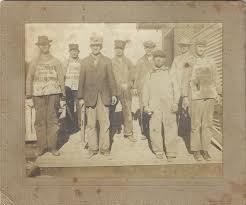 I am writing a post today as an outcropping of my professional pursuits, my status in life, and about the person I love who is mired deep in the kind of long term, blue-collar unemployment that didn’t used to exist in this country. I am underemployed at the moment because I don’t want to jump out of my sustainable life here to something that is risky and might not work out for me at my stage in life. I am trying to set up my end game and feel like I really can’t afford the risk of moving someplace for a job that may or may not pan out or some place where I basically suffer to exist. I am in a state of perpetual hunker down because of this. It is stressful and eating into my investments which I am fortunate to have but are not inexhaustible. I will not talk about my friend’s situation because, of course, it is personal. But, I will say watching some one so beautiful struggle with self worth issues because this economy only works for a few and because our government persistently sticks to such an untrue narrative about our economy just keeps me on the edge of tears. I am not an overly emotional person at all. Living in the USA should not mean living in a state of risk avoidance, depression, poor shaming and poverty creation.
There are many things that I grew up with and assumed would be there when I grew up that I despair frequently at their loss and threatened existence. My kids,as you know, are doing fine. My father got his degrees on the GI Bill and saw to it that my sister and I were educated. As a result, my girls and I never even considered not going to university. Doctor Daughter is now a full-fledged OB-GYN in the process of getting board certified in Washington State where she will undoubtedly become very rich very quickly with her soon-to-be radiologist husband. Youngest daughter just took her GMAT and is headed for her MBA in the fall. She and her boyfriend of three years have very good jobs and make great money. But the deal is, that was the path set before us because our families can now chose further upward mobility through higher education and jobs in the right sectors. We are all there. For my son-in-law, it is because his parents had access to immigration to the US and US public universities. For us, it was because my father who comes from a railroad worker and Oklahoma/Kansas dirt farmers could go to university. That happened because my granddad had a great blue collar job that began with digging ditches for the Atchison, Topeka, and the Santa Fe and my dad’s access to the GI bill. The real success stories of last century come from the many of us who got access to what we did because “we” the people invested in ourselves and each other. We also decided to jointly insure ourselves against personal and community disasters. All of these accomplishments are under direct assault today and we are failing ourselves and each other in many ways.
There used to be an alternative path through good, stable, well-paying jobs that took training, skill, hard work and experience. Original socioeconomic status wasn’t all that relevant. That path has dried up. The heart wrenching stories told in this NYT article about the crumbling city of Port Clinton, Ohio are typical of many midwestern, formally thriving industrial cities. The article contrasts the life of the author’s grandchildren and those of his blue collar classmates who went to school in the small town. This narrative is one played out all over the country. The conclusion is compelling.
The contrast with the egalitarian ethos and reality of the 1950s — the contrast between the upward mobility experienced by J and the bleak prospects of R — vividly captures Port Clinton’s transformation in the last half-century, much like that of the rest of the country. My research team has talked with dozens of R’s from Austin, Tex., to Duluth, Minn., and from Atlanta to Orange County, Calif.
The crumbling of the American dream is a purple problem, obscured by solely red or solely blue lenses. Its economic and cultural roots are entangled, a mixture of government, private sector, community and personal failings. But the deepest root is our radically shriveled sense of
“we.” Everyone in my parents’ generation thought of J as one of “our kids,” but surprisingly few adults in Port Clinton today are even aware of R’s existence, and even fewer would likely think of her as “our kid.” Until we treat the millions of R’s across America as our own kids, we will pay a major economic price, and talk of the American dream will increasingly seem cynical historical fiction.
Yes. We have a “radically shriveled sense of we” these days and it is killing the economy for all but a few of us. It is fueling racial resentment. It is even leading to a zero sum game for the folks reaping the benefits right now even though they adamantly refuse to see that future. Much of the problem is because The Pay is too Damn Low. More and more of productivity gains and corporate income gains are going to a small number of passive investors and not to the people involved in producing the gains. It is upending classical labor theory and actually invigorating the old ideas of Karl Marx as I have written before. Please remember, I am not a Marxist but I and others see the coming fruition of many of his philosophical points on how capitalism would eventually self-destruct. The New Deal did not bring about radical change. It brought about upward mobility and societal safety nets so we did not get radical change. Nothing fuels revolution like national despair.
The workers’ grievances are simple: low wages, few (if any) benefits, and little full-time work. In inflation-adjusted terms, the minimum wage, though higher than it was a decade ago, is still well below its 1968 peak (when it was worth about $10.70 an hour in today’s dollars), and it’s still poverty-level pay. To make matters worse, most fast-food and retail work is part time, and the weak job market has eroded what little bargaining power low-wage workers had: their earnings actually fell between 2009 and last year, according to the National Employment Law Project.
Still, the reason this has become a big political issue is not that the jobs have changed; it’s that the people doing the jobs have. Historically, low-wage work tended to be done either by the young or by women looking for part-time jobs to supplement family income. As the historian Bethany Moreton has shown, Walmart in its early days sought explicitly to hire underemployed married women. Fast-food workforces, meanwhile, were dominated by teen-agers. Now, though, plenty of family breadwinners are stuck in these jobs. That’s because, over the past three decades, the U.S. economy has done a poor job of creating good middle-class jobs; five of the six fastest-growing job categories today pay less than the median wage. That’s why, as a recent study by the economists John Schmitt and Janelle Jones has shown, low-wage workers are older and better educated than ever. More important, more of them are relying on their paychecks not for pin money or to pay for Friday-night dates but, rather, to support families. Forty years ago, there was no expectation that fast-food or discount-retail jobs would provide a living wage, because these were not jobs that, in the main, adult heads of household did. Today, low-wage workers provide forty-six per cent of their family’s income. It is that change which is driving the demand for higher pay.
The situation is the result of a tectonic shift in the American economy. In 1960, the country’s biggest employer, General Motors, was also its most profitable company and one of its best-paying. It had high profit margins and real pricing power, even as it was paying its workers union wages. And it was not alone: firms like Ford, Standard Oil, and Bethlehem Steel employed huge numbers of well-paid workers while earning big profits. Today, the country’s biggest employers are retailers and fast-food chains, almost all of which have built their businesses on low pay—they’ve striven to keep wages down and unions out—and low prices.
The deal is that big businesses are making record level profits and the record-setting levels of the DJ industrial average show that we are not failing the largest businesses and the richest people in the country. They do not need to be exempt from more taxation or responsibility from the moral hazard and the social costs they inflict on society. The benefits of their existence do not trickle down on us. What trickles down is their costs to society like those of the last financial crisis and that of oil spills, chemical company fires, and toxin produced illnesses. A strong economy comes from jobs and middle income prosperity and spending. Many private sector jobs are so bad they no longer do anything but sustain people in intense suffering.
One of the big reasons the U.S. economy is so lousy is the American companies are hoarding cash and “maximizing profits” instead of investing in their people and future projects.
This behavior is contributing to record income inequality in the country and starving the primary engine of U.S. economic growth–the vast American middle class–of purchasing power. (See charts below).
If average Americans don’t get paid living wages, they can’t spend much money buying products and services. And when average Americans can’t buy products and services, the companies that sell products and services to average Americans can’t grow. So the profit obsession of America’s big companies is, ironically, hurting their ability to accelerate revenue growth.
One obvious solution to this problem is to encourage companies to pay their people more — to share more of the vast wealth that they create with the people who create it.
The companies have record profit margins, so they can certainly afford to do this.
But, unfortunately, over the past three decades, what began as a healthy and necessary effort to make our companies more efficient after the malaise of the 1970s has evolved into a warped consensus that the only value that companies should create is financial value (cash) and that the only thing managers and owners should ever worry about it making more of it.
This view is an insult to anyone who has ever dreamed of having a job that is about more than money.
People take risks when they feel they have adequate safety nets to do so. We are ripping apart the nets that let people try new things and move to do things. We are losing opportunities to educate and advance our society and our people.
As Jared Bernstein, an economist at the Center for Budget and Policy Priorities, told me, “The best friend that low-wage workers have is a strong economy and a tight job market.” It isn’t enough to make bad jobs better. We need to create better jobs.
That simple statement and the politics of right now have led Robert Reich to suggest that some policy makers actually want high unemployment to suppress wages and keep the profits trickling up to big investors. All the while, these same politicians fuel racial resentment. They tell formerly well-off white blue collar workers that it is immigration and and reverse racism in civil rights legislation that has hurt their livelihoods. Meanwhile, the media keeps up the false narrative that it’s the defict, it’s social security, and it’s medicare that is hurting us. Putting money into the group of people most likely to spend it is the way to drive the American Economy. We economists have known that for years. Hoarding money at the top and refusing to use the governments power to tax and spend is bad economic policy. Our fiscal policy is killing the American Dream instead of driving it.
 There are other examples besides our labor market. Health insurance is just one more market where “we” the people can do right by each other and can actually improve outcomes. I want to point you to the irascible Andrew Sullivan who uses Hayek–the economic god of the libertarian cult–to explain why social insurance –like Social Security and Medicare–actually stops freeloading off the economy rather than encouraging it. In this situation, he explains why Obamacare actually forces us to take personal responsibility. It is a argument from a different perspective on why “we” the people have to act on economic principals to preserve our society and way of life. In this essay, he criticizes the right wing radical group Freedomworks. The groupis trying to get 20somethings to burn their Obamacare cards which is in itself pretty crazy because the cards are nonexistent. Actually, what this does is wreck the risk pool for all of us. But, here is an argument for the leverage of government on a market that has failed so many people from another vantage point.
It is not being independent; it’s being potentially dependent on others while giving nothing in return. And insurance is an inherently collective endeavor. That’s how it works. It’s one area where going it alone makes very little sense. And, of course, the bigger the insurance pool, the lower the premiums. This is not socialism. It’s a simple insurance principle, used by free countries for centuries. It certainly passed muster with Friedrich Hayek, a man you would think would be an influence on the Tea Party’s political program. I’ve cited this before but it’s worth citing again:
Nor is there any reason why the state should not assist the individuals in providing for those common hazards of life against which, because of their uncertainty, few individuals can make adequate provision. Where, as in the case of sickness and accident, neither the desire to avoid such calamities nor the efforts to overcome their consequences are as a rule weakened by the provision of assistance – where, in short, we deal with genuinely insurable risks – the case for the state’s helping to organize a comprehensive system of social insurance is very strong … Wherever communal action can mitigate disasters against which the individual can neither attempt to guard himself nor make the provision for the consequences, such communal action should undoubtedly be taken.
That’s from The Road To Serfdom, one book of the libertarian and conservative Bible. And it’s common sense. It’s leveraging a simple principle – pooling risk – and extending it as far as possible to guard against the “common hazards of life.” There is nothing leftist or socialist about it. And it demands that each of us be personally responsible for the costs our own encounters with illness or accident impose upon our neighbors, rich and poor, young and old. If FreedomWorks were consistent, it would encourage twentysomethings to “burn their Obamacare card” while simultaneously pledging never to seek medical care under any circumstances. That would be coherent, if bonkers. What’s incoherent is claiming that refusing to contribute to a system you nonetheless intend to use is anything but a scam.
In fact, what FreedomWorks is encouraging is the real socialism. It’s using the 1986 law to force hard-working Americans to pay for free-loaders’ care.
The deal is that when labor markets or social insurance markets or health insurance markets fail a group of us, they fail and cost all of us one way or another. The cost us through increased crime, mental health issues, drug and alcohol abuse, family instability. People losing homes costs us. When houses go on the market at fire sale prices, it drags down the home prices of every one in the neighborhood. When wages are low, people don’t spend money at the the local businesses who cannot afford to hire more people or order inventory. Children raised with poor educational opportunities in crime ridden areas most likely become problems that cost us dearly in our incarceration nation. We fully know that there are places where the government can act and change the momentum. Yet, our government fails us. The government of “we” the people is not using the known and available tools to correct things. It is, in fact, actively undermining economic health. Economists known that deficit reduction is impeding the economy yet that is not the conventional wisdom floating around the beltway. Pundits and Policy makers are either being deliberately ignorant or lying.
Hardly a day goes by when either government analysts or the macroeconomists and financial forecasters who advise investors and businesses do not report on the latest signs of economic growth — in housing, consumer spending, business investment. And then they add that things would be better but for the fiscal policy out of Washington. Tax increases and especially spending cuts, these critics say, take money from an economy that still needs some stimulus now, and is getting it only through the expansionary monetary policy of the Federal Reserve.
“Fiscal tightening is hurting,” Ian Shepherdson, chief economist of Pantheon Macroeconomic Advisors, wrote to clients recently. The investment bank Jefferies wrote of “ongoing fiscal mismanagement” in its midyear report on Tuesday, and noted that while the recovery and expansion would be four years old next month, reduced government spending “has detracted from growth in five of past seven quarters.”
We know that insurance is by definition a collective effort because of its pooling of risk. Its goal is risk mitigation and therefore, cost reduction. Yet, here we go down the path of bringing down the government for an effort to reign in the dysfunctional health insurance industry. Not only are some policymakers willing to blow up our social insurance programs, they are doing so at the high risk of blowing up the entire economy when so many folks are still suffering from the last blowup and their inability to do something to stop the suffering. This kind’ve foolishness really needs to come to an end. There is nothing to be gained by any of us for this type of incessant nonsense. Many policymakers and their pundit enablers are putting themselves and their friends’ interests above that of the country’s and that of “we” the people. It is hurting many of us including a huge number of children whose lives look pretty bleak at the moment. Spend some time reading the narratives of folks in that top story that these guys poor-shame daily and then think of the possible programs that would actually put the cost of market failure back on the companies and people that caused it to start out with. It would also put people back to work. Then, start to wonder if our country can ever look like it did when it was truly the land of opportunity instead of the land of “we” the few, powerful, and rich. It is a very American ideal to think we could have a country where every one can find a well-paying job and join together to pay to insure against and provide for the risk of disasters.
Workers of the World Unite
Posted: May 2, 2013 Filed under: income inequality, worker rights | Tags: 401(k), diminishing real wage, Felix Salmon, Henry Blodgett, Income Inequality, Thomas Friedman whore 8 Comments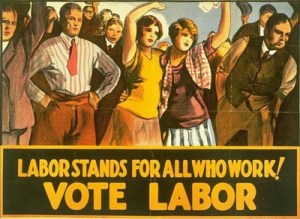 We continue to see abuse of labor from the horrible explosions in a West, Texas chemical plant to the collapse of a building in Bangladesh. US workers continue to get the shaft when it comes to working harder and more productively for less. It is a sad trend that just keeps reaching new records. The gap between incomes going to workers and profits going to owners–mostly passive stockholders–continues unabated. This gap does not reflect a lack of labor productivity. It appears to reflect mostly the ability of capital owners to gamble themselves into strong positions. Industrialists are force to drive down costs to attract capital and to do some very short sighted things. The rush to increase ROE with no thought to other factors is a very bad omen for this country.
Henry Blodgett provides some very depressing May Day graphs at Business Insider.
Corporate profit margins just hit another all-time high. Companies are making more per dollar of sales than they ever have before. If you’re a shareholder, that seems like good news (in the very short term, anyway). Alas, most people aren’t shareholders. And for folks whose investment horizon is longer than “this quarter” and “this year,” it’s actually bad news. Companies are under-investing in their employees and the future.
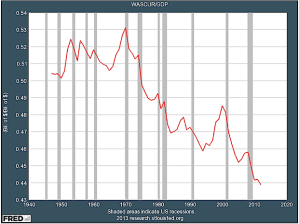 Normally, high profits are a good sign. What is disturbing is the the under-investing and the unequal increase in wages. Labor–in theory–should gain with productivity gains. This tends to stoke the growth of an economy and of a solid middle class. This trend means there is less purchasing power among the majority of households and more wage and job insecurity. This is Felix Salmon’s take.
It’s May Day, and Henry Blodget is celebrating — if that’s the right word — with three charts, of which the most germane is the one above. It shows total US wages as a proportion of total US GDP — a number which continues to hit all-time lows. Blodget also puts up the converse chart — corporate profits as a percentage of GDP. That line, you won’t be surprised to hear, is hitting new all-time highs. He’s clear about how destructive these trends are:
Low employee wages are one reason the economy is so weak: Those “wages” are represent spending power for consumers. And consumer spending is “revenue” for other companies. So the short-term corporate profit obsession is actually starving the rest of the economy of revenue growth.
In other words, we’re in a vicious cycle, where low incomes create low demand which in turn means that there’s no appetite to hire workers, who in turn become discouraged and drop out of the labor force. Blodget’s third chart is one we’re all familiar with: the employment-to-population ratio, which fell off a cliff during the Great Recession and which will probably never recover. The current “recovery” is not actually a recovery for the bottom 99%, for real people who need to live on paychecks. And today is exactly the right day to point that out.
And yet that’s Tom Friedman’s column this May Day:
If you are self-motivated, wow, this world is tailored for you. The boundaries are all gone. But if you’re not self-motivated, this world will be a challenge because the walls, ceilings and floors that protected people are also disappearing. That is what I mean when I say “it is a 401(k) world.”
This manages to be both incomprehensible and incredibly offensive at the same time. I have no idea what Friedman thinks he’s talking about when he blathers on about disappearing protective floors; I can only hope that he isn’t making a super-tasteless reference to the recent disaster in Bangladesh. But it’s simply wrong that today’s world is “tailored” for anybody who happens to be “self-motivated”. Both the self and the motivation are components of labor, not capital, and as such they’re on the losing side of the global economy, not the winning side.
Friedman is a billionaire (by marriage) who — like all billionaires these days — is convinced that he achieved his current prominent position by merit alone, rather than through luck and through the diligent application of cultural and financial capital. His paean to self-motivation recalls nothing so much as Margaret Thatcher’s “there is no such thing as society” quote: “parenting, teaching or leadership that ‘inspires’ individuals to act on their own will be the most valued of all,” he writes, bizarrely choosing to wrap his scare quotes around the word “inspires” rather than around the word “leadership”, where they belong.
True leadership, in a society where the workers are failing to be paid even half the fruits of their labor, would involve attempting to turn the red line in Blodget’s chart around, and to spread the nation’s prosperity among all its citizens. Rather than telling everybody that they’re “on their own” and that if they’re not a success then hey, they’re probably just not “self-motivated” enough.
The ultimate Friedman kick in the balls, however, doesn’t come from his lazily meritocratic priors. Rather, it comes from his overarching metaphor: the idea that if you have a 401(k) plan, then you’re somehow in charge of your own destiny. Friedman might be right that we’re living in a 401(k) world, but if he is then he’s right for the wrong reason. In Friedman’s mind, a 401(k) plan is an icon of self-determination: you get out what you put in. “Your specific contribution,” he writes, italics and all, “will define your specific benefits.”
We are learning more and more each day on how the finance industry games the kinds of investments available to you in those plans. We also know that mega corporations are getting congress to defund OSHA and any regulatory agency that watches over worker safety. Many investments are also subject to whacked performance because of excessive speculation that is encouraged by our tax laws. This has destroyed home values during the Great Recession and eaten up many folks retirement plans and savings. Frankly, it’s difficult to see how any one that relies on their sweat and has no rich family connections these days even crawls into the middle class. All of these things add up to major insecurities and risks. This is simply not the way things are supposed to work. But, it is the world that the Koch Brothers and others have carefully crafted by making politicians and pundits whores to their agenda of greed.
Pity the poor working man and woman.
Just Call me a Conscientious Objector in the Mommy Wars
Posted: June 26, 2012 Filed under: War on Women, We are so F'd, Women's Healthcare, Women's Rights, worker rights | Tags: Mommy Wars Redux 24 CommentsI have no idea why this war even needs to be fought. I also object to the frame that redefines feminism as something it isn’t and then casts it in the catalyst role.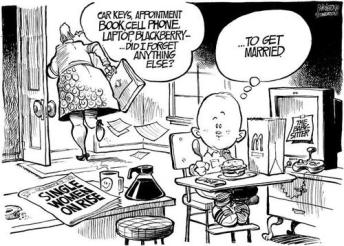 Frankly, my lifestyle choices are no one’s damn business. I also don’t want to hear any whining about put upon stay at home mothers or selfish working moms or whatever freaking black and white witchy stereotype folks dream up and embrace. This would include the appalling cartoon I used for this post. There seems to be a media obsession at the moment with painting women into corners and guilt tripping them for which ever corner they wind up in. Women are even participating in the self immolation. We’ve been regaled by lectures like this one on “Why Women Still Can’t Have It All“. Like we need some other woman defining what “all” is for the rest of us. We also don’t need a bunch of self righteous right wing wind bags that continue to blame all of the world’s problems on mothers.
It’s enough to make Betty Friedan spin in her grave.
Katrina Vanden Heuvel took up the keyboard today at WAPO with a reminder that most working mothers aren’t struggling to “have it all”. They are struggling to feed their kids and provide homes. For some reason, a lot of folks seem to think there’s all these great, supportive, bread-winning men out there just dying to reproduce and do right by their wives and families. I frankly don’t recommend marriage to any woman. Most husbands are bigger pains-in-the asses than colicky babies. A lot of them can’t even hold down jobs these days and then there’s the entire emotional trip that goes along with marriage. You know the TV sitcom stint that goes like this. Asking men to do the right thing by their families puts them in the position of being the oppressed, hypernagged hubbie who goes to work and takes it out on the resident working women and stirs up the other men in one big woe-is-me session. There’s a lot of reality out there that these BS narratives miss. Even the best intentioned man can get pulled back into the old boys club after a number of years of marriage and fatherhood. The media, their jobs and the entertainment industry absolutely empower them to be reckless with their family relationships.
This is the reality that faces millions of working women. More than 70 percent of all mothers and more than 60 percent of mothers with children under 3 are in the workforce. Two-thirds of them earn less than $30,000 a year. Nine of 10 less than $50,000. In the Rev. Jesse L. Jackson’s powerful image, “They catch the early bus,” or, in Vasquez’s case, the late bus. They work out of need, whether they want to or not. Half are their family’s primary breadwinner.
These mothers don’t have the luxury of flexible time or the ability to leave when a child is in trouble or sick. Most can’t afford to take unpaid sick leave to care for their children — and many would lose their jobs if they did, despite the federal law guaranteeing unpaid leave. Many work in jobs — as home-care workers, farm workers, cleaning people — that have scant protection of minimum wage and hours standards. Many cobble together two or three part-time jobs. Child care gets done by grandmothers, neighbors or simply the TV.
Okay, so this is the deal. The problem is not with WOMEN. The problem is with the way “work” and “income” is structured in this country. It doesn’t change because most men in power don’t want it to change. Things used to be different when most businesses were family run and family owned or when most families lived off farms. Working for some one else in this country but a few enlightened companies basically means placing your family outside your major time commitments. That is not the way it should be.
Here’s something that caught my eye as I thought about this. This is written by a journalist as a response to the articles run by The Atlantic recently in the vein of mommy wars. I like it because it states what I find is obvious. Feminism is about finding options and accepting and empowering women’s choices. It’s not about pitting our various roles against each other. Every woman should make her choice. There is no sainthood or martyrdom prize for whatever that choice is so can’t we just knock it off now?
The average American worker gets something like 14 days of paid vacation. In my school, you’d use up ten of those taking care of your kids on teacher professional days, then tack on a couple more for kids getting sick. When you do the simple math, the American workplace seems utterly inhumane in its unwillingness to adapt to the fact that women make up half of all workers.
Economist Claudia Goldin has made a career out of studying what she calls the “career cost of family.” The industries that thrive and hold onto talented women are the ones that figure out how to minimize the cost of taking time off for your family. It’s not all that complicated. They take advantage of technologies to let parents work at home or be more efficient, they schedule shifts, they minimize face time, they let people do what Sheryl Sandberg says she does: go home at 5:30 and pick up again later after her kids are in bed.
Feminism was about making women’s lives less constrained and giving them more choices. Right now, most women have none — not because they are spoiled and unrealistic and want to do lunchtime yoga, but because they are working hard to support their families and everyone is colluding in the fiction that they have nothing else on their minds. I return to a modest proposal I made last week in Slate, inspired by Slaughter: Mothers, fathers, don’t lie to your employers about the kid things you have to (or want to) do during the day. If you are taking a kid to the doctor, say so. Ditto for parent teacher conferences or the school play. At this point, honesty would be a radical act.
One of the bottom lines to me is that if men would actually do something about making the country, the work place, and their family more children friendly, we wouldn’t be having these problems or this discussion. Our situation exists because men do not treat women or children as anything valuable unless there’s something at the time that they need from them. There are work environments out there that are family friendly. They are very successful. They got that way because the men in charge made them that way to attract and maintain talent. They attract men and women to work for them that value families. There are far too few companies that do that because there’s a lot of men that get away with ignoring their families. They’re rewarded for it. European countries do not do this. France doesn’t do it. Germany doesn’t do it. None of the Scandinavian countries do it. It’s an American value to fuck over you family because you have to work.
The other interesting thing in all of this is the role of birth control and the empowerment of controlling when you have children. Economist Claudia Goldin calls this The Quiet Revolution. I have no doubt that there is an equal role in all the re-ignition of the mommy wars with the attack on birth control. Reproductive rights is essential to women’s freedom and children’s well being. It’s also necessary to the transformation that could occur in the work place if more women got into positions of power and more men were motivated by family concerns and demanded the work place empower them to parent. Taking away this important right means undoing women’s autonomy.
All of this just continues to impress upon me how little this country actually cares about its children. There seems to be this silly idea that if you just strand a woman at home with children and giver her a husband with a paycheck then all the problems of the world will just fade away. This couldn’t be farther from the truth. Just reading literature on depression and unhappiness should put this damaging canard to bed. Again, look at that damn cartoon up there. We need to be a society that supports family choices and provides resources to all our children to be in the environment in which each child thrives. This will never happen in less our institutions stop prioritizing the wrong things and until every one refuses to participate in the Mommy Wars.
Monday Reads: By the Numbers
Posted: June 11, 2012 Filed under: education, morning reads, New Orleans, Paycheck Fairness Act, Women's Rights, worker rights 11 Comments Good Morning!
I’m really glad that some people are focusing on the Plutocrats behind the SuperPacs. We should at least know who they are and what they want of their the overlords of our politicians. Jim Hightower writes on 7 of the billionaires that are bankrolling the GOP. Read the link at Alternet to learn more about the Super Seven and what they want.
As of May 4, this corporate clique had poured an unprecedented $94 million into the SuperPACs of the leading five GOP contenders (with $52 million of that going to Renew Our Future, Romney’s money funnel). This firepower was all the more potent because it was targeted at only the few thousand voters in each state who participated in the caucuses and primaries. And it bought just what the moneybags wanted–the lockstep commitment by all contenders that–no matter how they might differ on abortion, gay-bashing, and such–they would govern according to the Holy Kochian vision of a regulation-free, union-free, tax-free America. Thus, no matter which horse any of the multimillionaires and billionaires bet on, they would cash-in as winners, for this tiny group now owns one of America’s two major parties (and, yes, often rents the other).
Bobby Jindal is radically transforming the state of Louisiana and there’s no real Democratic party to organize and stop him. I’ve written before about his take down of public schools. Here’s “5 Ways Louisiana’s New Voucher Program Spells Disaster for Louisiana”. Did you notice he’s been up in Wisconsin and Illinois campaigning again? Look out! The man is a menace to civilization!
This latest pet project of popular Republican Governor Bobby Jindal, called Louisiana Believes, is now regarded as the most extensive voucher system in the United States — out-privatizing even the state of Indiana, where nearly 60 percent of the state’s students are eligible for vouchers. By eroding caps on family income levels, and thereby providing voucher assistance to both low- and middle-income families, Indiana’s plan aimed to remake public education in the state more extensively than any voucher system in US history – until now.
Like Indiana’s program, Louisiana’s new voucher plan is so wide in scope that it could eventually cut the state’s public education funding in half. But in a number of crucial ways, the Louisiana model works even harder to destroy public education than Indiana’s program does. Already approved by the Louisiana state legislature, the program sets an alarming precedent for undermining public education in other states.
Suevon Lee of Pro Publica writes about 5 ‘Stand your Ground’ Cases that are important. Damn! Louisiana’s on the shit list again!
But as a recent Tampa Bay Times investigation indicates, the Martin incident is far from the only example of the law’s reach in Florida. The paper identified nearly 200 instances since 2005 where the state’s Stand Your Ground law has played a factor in prosecutors’ decisions, jury acquittals or a judge’s call to throw out the charges. (Not all the cases involved killings. Some involved assaults where the person didn’t die.)
The law removes a person’s duty to retreat before using deadly force against another in any place he has the legal right to be 2013 so long as he reasonably believed he or someone else faced imminent death or great bodily harm. Among the Stand Your Ground cases identified by the paper, defendants went free nearly 70 percent of the time.
Although Florida was the first to enact a Stand Your Ground law, 24 other states enforce similar versions. Using the Tampa Bay findings and others, we’ve highlighted some of the most notable cases where a version of the Stand Your Ground law has led to freedom from criminal prosecution:
· In November 2007, a Houston-area man pulled out a shotgun and killed two men whom he suspected of burglarizing his neighbor’s home. Joe Horn, a 61-year-old retiree, called 911 and urged the operator to ” 2018Catch these guys, will you? Cause, I ain’t going to let them go.’ ” Despite being warned to remain inside his home, Horn stated he would shoot, telling the operator, ” 2018I have a right to protect myself too, sir. The laws have been changed in this country since September the first, and you know it.’ “
Two months earlier, the Texas Legislature passed a Stand Your Ground law removing a citizen’s duty to retreat while in public places before using deadly force. In July 2008, a Harris County grand jury declined to indict Horn of any criminal charges.
· In Louisiana early this year, a grand jury cleared 21-year-old Byron Thomas after he fired into an SUV filled with teenagers after an alleged marijuana transaction went sour. One of the bullets struck and killed 15-year-old Jamonta Miles. Although the SUV was allegedly driving away when Thomas opened fire, Lafourche Parish Sheriff Craig Webre said to local media that as far as Thomas knew, someone could have jumped out of the vehicle with a gun. Thomas, said the sheriff, had “decided to stand his ground.”
Louisiana’s Stand Your Ground law was enacted just a year after Florida introduced its law.
William Cohan believes that Congress wants a 2nd economic meltdown due to bad bank behavior and points to a Taibbi article listing 9 obscure pieces of legislation introduced by Congress to tank Dodd-Frank.
A sad truth remains: Despite all the public hand-wringing about the need to finally nail down the details of the regulations that will govern risk-taking at big banks, Wall Street’s well-paid army of lawyers and lobbyists continues to make a mockery of the whole re-regulation process.
It seems increasingly likely that, by the time the charade is over, the American people will end up with fewer substantive rules and limitations on the crazy risks Wall Street can take than we have now. By some counts — including that of Matt Taibbi, at Rolling Stone — there are nine obscure pieces of legislation introduced in Congress this year that are designed to in one way or another weaken the already weak provisions of the Dodd-Frank law, passed in July 2010.
Most of the legislation is intended to do little more than waste time, and hold off real accountability until the public has lost interest. Other laws are more pernicious. Consider H.R. 3336, the so-called Small Business Credit Availability bill. Under the guise of helping community lenders, it would limit who is considered a “swap dealer” under the provisions of Dodd- Frank, allowing more and more swaps to be written with less and less oversight. It passed the House in April.
Lastly, I’d like to point to this article in The Economist that basically says exactly what I feel about the sinking of the Paycheck Fairness Act last week. This also applies to getting rid of DOMA type laws. “Protecting individual rights is not Stalinist. ”
THIS week Republicans in the Senate once again blocked the Paycheck Fairness Act, which would take further steps to guarantee access to the legal system for women who charge they’ve been paid less than men for doing the same job. (That’s illegal, in case anyone was thinking of trying it.) Justifying his vote against the act, Rand Paul compared it to Soviet communism. This is sort of a dog bites man story; on a given day, Rand Paul probably compares several dozen things to Soviet communism. But here, for what it’s worth, is why he thinks legislation to make it easier for women to sue when they’ve been paid less than men for doing the same job is just like Soviet communism:
“Three hundred million people get to vote everyday on what you should be paid or what the price of goods are,” Paul told reporters on Capitol Hill. “In the Soviet Union, the Politburo decided the price of bread, and they either had no bread or too much bread. So setting prices or wages by the government is always a bad idea.”
Mr Paul does not appear to understand either the law which he has just voted against, or the class of economic transaction about which he is speaking. If a woman sues because she has been paid less than a man for doing the same work, and a judge rules in her favour, that is not an instance of “setting prices or wages by the government”. The wage in question was set by the employer. What the judge has ruled is that the employer cannot offer different wages to different employees based on their sex. Why might such a hypothetical judge make such a ruling? Because, as noted above, offering different wages to different employees based on their sex is against the law, and has been so since 1963.
Senator Aqua Buddha obviously has a room temperature IQ.
We’re all in the Village now. That’s my contribution today. What’s on your reading and blogging list?

 peej
peej Carissa
 bostonboomer
 dakinikat
 ecocatwoman
 mablue2
 Mama Lopez
 peggysue22
 quixote
 skydancingguestblogger
 Mona (aka Wonk the Vote)



 Sky Dancing
Recent Comments