
Taking on a Big Question: Why Embrace Plutocracy over Working Class Heroes?
Posted: June 9, 2012 Filed under: religious extremists, right wing hate grouups, Voter Ignorance | Tags: fear, Reagan Democrats, the conservative brain, voting against your interests 66 Comments The UK Guardian has always been one of my favorite papers. One of my high school social science teachers–Steve Wiitala–introduced me to the paper when I was taking an honors world history seminar class. I’ve been reading it ever since. Jonathan Haidt–a psychology prof–asks a question that I’ve been wondering for years. Why on earth would any working class person support some one like Ronald Reagan or Mitt Romney? Why would they even consider voting for reactionaries funded by the likes of the Koch Brothers? Why would they vote against their own interests?
I’ve always looked to the slave plantation model for answers. White overseers for rich masters were given just enough special favors and made to feel above the plantations’ slaves that they felt better thinking “well, at least I’m not one of them”. White working class people have a history of indentured servitude and sharecropping. Why go back to people that really would like to re-institute these things? Haidt says that fear of the collapse of society sends them look for order and anything national greatness. I wanted to explore his arguments here. (You can also watch this interview with Haidt by Bill Moyers. ht/ to EcoCatWoman.)
Many commentators on the left have embraced some version of the duping hypothesis: the Republican party dupes people into voting against their economic interests by triggering outrage on cultural issues. “Vote for us and we’ll protect the American flag!” say the Republicans. “We’ll make English the official language of the United States! And most importantly, we’ll prevent gay people from threatening your marriage when they … marry! Along the way we’ll cut taxes on the rich, cut benefits for the poor, and allow industries to dump their waste into your drinking water, but never mind that. Only we can protect you from gay, Spanish-speaking flag-burners!”
One of the most robust findings in socialpsychology is that people find ways to believe whatever they want to believe. And the left really want to believe the duping hypothesis. It absolves them from blame and protects them from the need to look in the mirror or figure out what they stand for in the 21st century.
Here’s a more painful but ultimately constructive diagnosis, from the point of view of moral psychology: politics at the national level is more like religion than it is like shopping. It’s more about a moral vision that unifies a nation and calls it to greatness than it is about self-interest or specific policies. In most countries, the right tends to see that more clearly than the left. In America the Republicans did the hard work of drafting their moral vision in the 1970s, and Ronald Reagan was their eloquent spokesman. Patriotism, social order, strong families, personal responsibility (not government safety nets) and free enterprise. Those are values, not government programs.
Brain research is beginning to find that folks that tend to call themselves “conservative” tend to be more fearful. Chris Mooney–Author of The Conservative Brain–explains it like this.
Looking at MRIs of a large sample of young adults last year, researchers at University College London discovered that “greater conservatism was associated with increased volume of the right amygdala” ($$). The amygdala is an ancient brain structure that’s activated during states of fear and anxiety. (The researchers also found that “greater liberalism was associated with increased gray matter volume in the anterior cingulate cortex” – a region in the brain that is believed to help people manage complexity.)
That has implications for our political world. In a recent interview, Chris Mooney, author of The Republican Brain, explained, “The amygdala plays the same role in every species that has an amygdala. It basically takes over to save your life. It does other things too, but in a situation of threat, you cease to process information rationally and you’re moving automatically to protect yourself.”
Haidt says that this kind of thinking has some disturbing impact on people that tend to obsess on fear. Group loyalty can drive people who want to feel safe. Does this explain the effectiveness of Willie Horton ads and all those Rovian tricks that seem paranoid and some what zombieland-like to us?
But on matters relating to group loyalty, respect for authority and sanctity (treating things as sacred and untouchable, not only in the context of religion), it sometimes seems that liberals lack the moral taste buds, or at least, their moral “cuisine” makes less use of them. For example, according to our data, if you want to hire someone to criticize your nation on a radio show in another nation (loyalty), give the finger to his boss (authority), or sign a piece of paper stating one’s willingness to sell his soul (sanctity), you can save a lot of money by posting a sign: “Conservatives need not apply.”
In America, it is these three moral foundations that underlie most of the “cultural” issues that, according to duping theorists, are used to distract voters from their self-interest. But are voters really voting against their self-interest when they vote for candidates who share their values? Loyalty, respect for authority and some degree of sanctification create a more binding social order that places some limits on individualism and egoism. As marriage rates plummet, and globalization and rising diversity erodes the sense of common heritage within each nation, a lot of voters in many western nations find themselves hungering for conservative moral cuisine.
Does our place in Maslow’s hierarchy really determine our susceptibility, vulnerability, and motivation at the voting booth? Haidt says yes and sums his thesis up this way.
When working-class people vote conservative, as most do in the US, they are not voting against their self-interest; they are voting for their moral interest. They are voting for the party that serves to them a more satisfying moral cuisine.
So, these are the same motivators that drive people to guns, bibles, and tribal thinking that demonizes the ‘other’. Is the angry right just a bunch of folks that are scared shitless? It’s an interesting theses. Dr. Bostonboomer probably has more information on some of this than me. I am interested in hearing your thoughts. What is the appeal of voting for your own servitude?
Open Thread: Top Romney Aide Made Millions from Obamacare
Posted: June 4, 2012 Filed under: 2012 presidential campaign, Tea Party activists, The Right Wing, U.S. Politics, Voter Ignorance | Tags: Affordable Care Act, Department of Health and Human Services, Health care, Mike Leavitt, Mitt Romney, Obamacare, Rep. Jason Chaffetz 24 Comments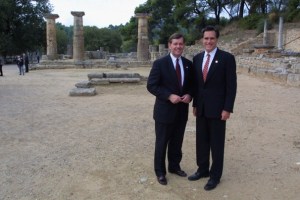
Best buds Mike and Mitt
Lots of corporate news sources were buzzing over the weekend about Romney’s appointment of former Utah Governor Mike Leavitt to head up his transition team. It’s also assumed that Leavitt would have the inside track to get the plum role of Chief of Staff in a Romney administration. Leavitt is also the guy who hired Romney to turn around the scandal-plagued Winter Olympics in 2002.
According to Utah Rep. Jason Chaffetz, a Romney adviser, Leavitt is “the ideal candidate” for the transition job because of:
his three terms as Utah governor as well as serving as administrator of the Environmental Protection Agency and secretary of Health and Human Services under President George W. Bush.
“Mike Leavitt checks every box. It’s a combination of experience and personal relationship,” Chaffetz said. “He can help outline the parameters of what a transition would look like.”
Leavitt has been on board with the Romney campaign throughout the primaries; he has his own office at the Boston headquarters. He and Romney are close, says Politico, and they’re “a lot alike.”
One Romneyland figure said Leavitt’s influence is derived from the fact that he is a spoke in many of the concentric circles around the candidate. Leavitt is part of Romney’s orbit of Mormon associates, but he also sits in the realm of the policy gurus, political counselors, fellow governors and veterans of the Salt Lake Olympics.
So with little fanfare, he has become one of the most influential advisers to the candidate this election cycle. He has an office at the Boston headquarters, travels with Romney at times, has been summoned to rally donors and is tight enough with the high command that he scored an invite to campaign manager Matt Rhoades’s engagement party last month.
He’s also a surrogate and has headlined health care policy discussions at $10,000 per-person Beltway fundraisers for Romney.
Romney officials say Leavitt is often circumspect but has an E.F. Hutton-like effect when he does speak up; many in Boston believe he offers much of his advice directly to Romney — something Leavitt suggests is accurate.

Mike Leavitt
Although it happened following Leavitt’s tenure, Utah was the second state after Massachusetts to institute universal health care. And Leavitt is the health care business–and he’s made millions in profits from Obamacare. At Salon, Alex Seitz-Wald writes:
Leavitt, who served as Health and Human Services secretary under George W. Bush, leads a firm that has positioned itself as a leading consultancy to help implement the Affordable Care Act (PDF), and it’s already won contracts to do so.
Just two weeks ago, the company was awarded a $1 million contract with the state of New Mexico to help it build its exchanges, and Politico reported that the “size of his firm, Leavitt Partners, doubled in the year after the bill was signed as they won contracts to help states set up the exchanges funded by the legislation.”
On its web site, Leavitt Partners features prominently its “Health Insurance Exchange Intelligence Team,” an entire section of the business that advises clients on how to implement and respond to the health insurance exchanges created by Obamacare.
“The passage of the Patient Protection and Affordable Care Act (PPACA) altered many of the fundamentals of healthcare coverage and financing,” the company’s website states. “Our team has a deep background and understanding of exchanges, from the policy side to the technical requirements and infrastructure necessary to operate an exchange. Our team members have unique experience in building exchanges and analyzing health insurance markets.”
Today, the right wingers have suddenly awakened from the collective trance that followed their reluctant recognition that Romney’s their guy now. And they are not happy about the Leavitt appointment. From TPM:
The Wall Street Journal reported last year that Leavitt “strenuously backed the core piece of President Barack Obama’s health-care law and urged the states to move forward together in adopting health insurance exchanges.” And his stance hasn’t changed: “We believe that the exchanges are the solution to small business insurance market and that’s gotten us sideways with some conservatives,” Leavitt’s top aide Rich McKeown told Politico.
“We’re troubled by it,” Dean Clancy, who runs health care advocacy for the Dick Armey-led conservative group FreedomWorks, told TPM Monday via email. “We’re very concerned. The tea party grassroots have always feared that Gov. Romney would be a weak standard bearer because of RomneyCare. This choice only reinforces those doubts. Tapping a high-profile ObamaCare profiteer is disturbing, there’s no way around it. … The tea party has been fighting exchanges in state after state.”
Michael Cannon, who directs health policy for the libertarian Cato Institute, reacted to the Leavitt choice in a blog post he penned: “Romney’s appointment of Leavitt is a first step toward flip-flopping — or Etch-a-Sketching, or Romneying(TM), or whatever — on ObamaCare repeal.”
The right wing blogs are in a tizzy too. Time to break out the popcorn!

Hey Righties! Haven’t you noticed? Willard’s a pathological liar. And besides, he just not that into you. He’s all about amassing more money and power for Willard, not you or your pathetic, rage-filled party.
Thursday Reads: Romney’s Lies, Debt Ceiling Showdown, and Dimonfreude
Posted: May 17, 2012 Filed under: Barack Obama, Corporate Crime, corporate greed, Economy, House of Representatives, Mitt Romney, morning reads, Surreality, The Media SUCKS, U.S. Economy, U.S. Politics, unemployment, voodoo economics, Voter Ignorance | Tags: Bill Clinton, Bill Moyers, economics, J.P. Morgan, Jamie Dimon, Mary Kennedy, Peter G. Peterson, Robert F. Kennedy Jr., Romney's lies, Simon Johnson 22 Comments
Good Morning!
On Tuesday night I wrote a brief post about the bizarre speech Mitt Romney gave in Des Moines, Iowa earlier that day. I was struck by Romney’s childish effort to get at President Obama by talking about Bill Clinton’s economic policies and claiming that Obama must have ignored those policies because he has some kind of grudge against both Clintons. It was so strange and off key that I thought Romney sounded like a crotchety old busybody gossiping over the backyard fence.
I didn’t really even go into the many baldfaced lies Romney told in the speech–I guess I’ve become so accustomed to his total refusal to confine himself to reality as it is that I almost don’t notice it anymore. Basically, Romney attacked Obama the deficit that was primarily created by Bush, and made his usual claims that he (Romney) will be able to cut taxes by 20 percent, increase defense spending, and at the same time magically balance the budget and dramatically reduce unemployment. Only a moron would buy what he’s selling.
Yesterday, a number of bloggers commented on that speech, so I thought I’d share some of those reactions in this morning’s reads.
Steve Benen at Maddowblog: A peek into an alternate reality.
Mitt Romney delivered a curious speech in Iowa yesterday, presenting his thoughts on the budget deficit, the debt and debt reduction, which is worth reading if you missed it. We often talk about the problem of the left and right working from entirely different sets of facts, and how the discourse breaks down when there’s no shared foundation of reality, and the Republican’s remarks offered a timely peek into an alternate reality where facts have no meaning.
Even the topic itself is a strange choice for Romney. If the former governor is elected, he’ll inherit a $1 trillion deficit and a $15 [trillion] debt, which he’ll respond to by approving massive new tax cuts and increasing Pentagon spending. How will he pay for this? No one has the foggiest idea.
In other words, the guy who intends to add trillions to the debt gave a speech yesterday on the dangers of adding trillions to the debt.
Benen says he doesn’t believe Romney is “stupid,” but he must be “operating from the assumption that voters are stupid.” I’d say that’s true. I think Romney believes that he’s much smarter and more worthy than just about anyone and that poor and middle-class people are beneath contempt.
Jonathan Cohn at The New Republic: Romney’s Make-Believe Story on the Economy. Cohn writes about Romney’s claims that Obama’s failure to reduce the deficit is the cause of the “tepid recovery,” unemployment, and the struggles of seniors to get by on fixed incomes.
Note the way Romney establishes cause and effect here: Obama’s contribution to higher deficits are the reason more people can’t get work and more seniors can’t make ends meet right now. This is an audacious claim and, while I’m no economist, I’m pretty sure it places Romney on the outer edges of the debate among mainstream scholars.
I know of serious conservatives who think the Recovery Act, which has increased deficits temporarily, didn’t ultimately do much to create jobs in the near term. And I know of serious conservatives who think that creating jobs now wasn’t worth the long-term downside of adding to the federal debt, however incrementally. Both viewpoints seem to represent minority views, if a recent University of Chicago survey of leading economists is indicative. But the arguments have at least some logic to them.
But Romney’s suggestion that unemployment today is a consequence of Obama’s contribution to the deficit (real or imagined) requires further leaps of logic. You’d have to argue, for example, that extensions of unemployment benefits have reduced incentives to work (despite research to the contrary) and that such negative effects substantially outweigh the positive effects of traditional stimulus measures. It’s not impossible to make this case. I think Casey Mulligan, also of the University of Chicago, has written things along these lines for the New York Times. But, unless I’m missing something, that argument is even more marginal than suggestions the Recovery Act didn’t help at all.
I suspect that even Cohn’s effort to make sense of Romney’s fantasy economic theory will have Dr. Dakinikat pulling her hair out.
Jonathan Chait at New York Magazine: Romney’s Budget Fairy Tale.
In the real world, the following things are true: The budget deficit was projected to top $1 trillion even before President Obama took office, and that was when forecasters were still radically underestimating the depth of the 2008 crash. Obama did propose temporary deficit-increasing measures, an economic approach endorsed in its general contours, if not its particulars, by Romney’s economists. These measures contributed a relatively small proportion to the deficit, and their effect is short-lived. Obama instead focused on longer-term measures to reduce the deficit, including comprehensive health-care reform projected to reduce deficits by a trillion dollars in its second decade. Obama put forward a budget plan that would stabilize the debt as a percentage of the economy. Obama has hoped to achieve deeper long-term deficit reduction by striking bipartisan deals with Congress, and he has tried to achieve this goal by openly endorsing a bipartisan deficit plan in the Senate and privately agreeing to a more conservative plan with John Boehner, both of which were killed by Republican opposition to any higher revenue.
But Romney doesn’t seem to live in the real world, and Chait suggests that Romney either doesn’t understand how deficits work or doesn’t care if what he says makes any sense at all.
In Romney’s telling, the terms debt and spending are essentially interchangeable. When presented with Obama’s position — that the solution to the debt ought to include both higher taxes and lower spending — he rejects it out of hand. Naturally, Romney has admitted before that his budget plan “can’t be scored.” It’s an expression of conservative moral beliefs about the role of government. While loosely couched in budgetary terms, Romney is expressing an analysis that resides outside of, and completely at odds with, mainstream macroeconomic forecasting and scoring assumptions.
At the Plum Line, Greg Sargent discusses How Mitt Romney gets away with his lying.
If you scan through all the media attention Romney’s speech received, you are hard-pressed to find any news accounts that tell readers the following rather relevant points:
1) Nonpartisan experts believe Romney’s plans would increase the deficit far more than Obama’s would.
2) George W. Bush’s policies arguably are more responsible for increasing the deficit than Obama’s are.
Oh, sure, many of the news accounts contain the Obama campaign’s response to Romney’s speech; the Obama campaign put out a widely-reprinted statement arguing that Romney’s plans would increase the deficit and that he’d return to policies that created it in the first place.
But this shouldn’t be a matter of partisan opinion. On the first point, independent experts think an actual set of facts exists that can be used to determine what the impact of Romney’s policies on the deficit would be. And according to those experts, based on what we know now, Romney’s policies would explode the deficit far more than Obama’s would.
Obviously, the problem is the obsequious corporate media. But the Romney campaign makes it impossible for even the few remaining serious reporters to question his policies by keeping the candidate completely insulated from the press except for occasional appearances on Fox News and lightweight network morning shows like Good Morning America. Yesterday, Politico reprinted tweets from several reporters who were “physically” blocked from talking to Romney on a rope line.
Speaking of Republican ignorance of basic economics, House Republicans are gearing up for another pitched battle on increasing the debt ceiling. Speaker John Boehner met with President Obama at the White House today and they “clash[ed] over” increasing the debt limit, according to The Hill.
The president convened the meeting of the bipartisan congressional leadership to discuss his “to-do list” for Congress, but an aide to the Speaker said the bulk of the meeting was spent on other issues, including a pile-up of expiring tax provisions and the next increase in the federal debt limit.
Boehner asked Obama if he was proposing that Congress increase the debt limit without corresponding spending cuts, according to a readout of the meeting from the Speaker’s office. The president replied, “Yes.” At that point, Boehner told Obama, “As long as I’m around here, I’m not going to allow a debt-ceiling increase without doing something serious about the debt.”
Shortly after the meeting, White House press secretary Jay Carney told reporters that the president warned the leadership that he would not allow a repeat of last August’s debt-ceiling “debacle,” which led to a downgrade in the U.S. credit rating.
Sigh……
In a related story, there’s this piece at Wonkblog about the Pete Peterson summit and how Democrats talked long-windedly about cutting “entitlements,” and Republican refused to talk about tax increases. Read it and weep. I’m not even going to quote from it, because it’s too damn depressing.
So far Jamie Dimon seems to have survived the $2 billion loss recently suffered by J.P. Morgan.
The CEO of JPMorgan Chase survived a shareholder push Tuesday to strip him of the title of chairman of the board, five days after he disclosed a $2 billion trading loss by the bank.
CEO Jamie Dimon also won a shareholder endorsement of his pay package from last year, which totaled $23 million, according to an Associated Press analysis of regulatory filings.
Dimon, unusually subdued, told shareholders at the JPMorgan annual meeting that the company’s mistakes were “self-inflicted.” Speaking with reporters later, he added: “The buck always stops with me.”
Yeah, right. The buck will stop with the taxpayers if Dimon’s bank ultimately crashes and burns. Bill Moyers asked economist Simon Johnson about that.
Moyers: I was just looking at an interview I did with you in February of 2009, soon after the collapse of 2008 and you said, and I’m quoting, “The signs that I see… the body language, the words, the op-eds, the testimony, the way these bankers are treated by certain congressional committees, it makes me feel very worried. I have a feeling in my stomach that is what I had in other countries, much poorer countries, countries that were headed into really difficult economic situations. When there’s a small group of people who got you into a disaster and who are still powerful, you know you need to come in and break that power and you can’t. You’re stuck.” How do you feel about that insight now?
Johnson: I’m still nervous, and I think that the losses that JPMorgan reported — that CEO Jamie Dimon reported — and the way in which they’re presented, the fact that they’re surprised by it and the fact that they didn’t know they were taking these kinds of risks, the fact that they lost so much money in a relatively benign moment compared to what we’ve seen in the past and what we’re likely to see in the future — all of this suggests that we are absolutely on the path towards another financial crisis of the same order of magnitude as the last one.
A number of shareholders have sued Dimon over the losses, according to Bloomberg (via the SF Chroncle). And of course lots of people are gloating over Dimon’s getting temporarily knocked off his pedestal. Jena McGregor writes in the WaPo:
It’s being called Dimonfreude.
There are barely disguised smirks emanating from the canyons of Wall Street and the business press over the fact that Jamie Dimon has had to admit a mistake — and a whale of one, for that matter.
For years, the JPMorgan CEO (and America’s least-hated banker, as he was known) has worn a halo over those pinstripes. Dimon has been called President Obama’s “favorite banker”. Institutional Investor magazine has called him the country’s best CEO for two years running. And his actions during the financial crisis have been painted in patriotic terms: Press reports said he “answered the call” from then-FDIC chairman Sheila Bair to buy Washington Mutual, one of two banks he scooped up during the financial meltdown, and he has cited a patriotic duty to a country in crisis as why he took in $25 billion in government aid.
Yet now, Dimon is in the hot seat as JPMorgan confronts a $2 billion trading loss and the early stages of a criminal probe by the Justice Department.
Finally, some sad news: Estranged Wife of Robert F. Kennedy Jr. Is Found Dead at Home in Westchester
Mary R. Kennedy, the estranged wife of Robert F. Kennedy Jr., was found dead on Wednesday at the family’s home in Bedford, N.Y. She was 52.
Ms. Kennedy’s death was confirmed in a statement from her family, who did not comment on the circumstances. The Bedford Police Department said only that it had investigated a “possible unattended death” in an outbuilding at the home.
Her lawyer, Kerry A. Lawrence, would not say whether foul play was suspected. Kieran O’Leary, a spokesman for Westchester County, said an autopsy was scheduled for Thursday morning.
Born Mary Richardson, Ms. Kennedy joined one of America’s foremost political families in 1994, in a marriage ceremony aboard a boat on the Hudson River, near Stony Point, N.Y. At the time, she was an architectural designer at Parish-Hadley Associates in New York.
Those are my suggested reads for today. What are you reading and blogging about?
Disenfranchising Voters is Downright UnAmerican!
Posted: May 7, 2012 Filed under: 2012 elections, Voter Ignorance | Tags: voter disenfranchisement 23 Comments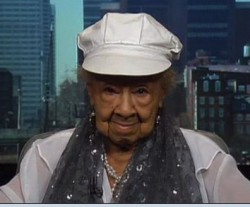 Viviette Applewhite is set to be the face and voice of voter disenfranchisement. She’s a 93 year old grandmother who voted for JFK in her first election. Ms. Applewhite is suing Pennsylvania for its new restrictions on voters according to Think Progress.
She will be the plaintiff in the voter identification lawsuit being filed by the ACLU and the NAACP in the state, which claims that “the state’s voter photo ID law violates the Pennsylvania Constitution by depriving citizens of their most fundamental constitutional right – the right to vote.”
Applewhite no longer has a copy of her birth certificate, and she does not have a drivers’ license. Without either of these things, the new Pennsylvania restrictions say that she is ineligible to vote.
But her circumstances are not at all uncommon. African Americans, especially elderly African Americans, are disproportionately less likely to have a birth certificate.
According to the Brennan Center for Justice:
Twenty-five percent of African-American voting-age citizens have no current government-issued photo ID, compared to eight percent of white voting-age citizens.
Harsh voter ID laws, which former President Bill Clinton characterized as the most serious threat of disenfranchisement since Jim Crow laws, have been passed in Alabama, Georgia, Indiana, Kansas, Missouri, Pennsylvania, Tennessee, Texas, and Wisconsin. Twenty four other states are trying to pass similar laws.
Creating False Equivalencies and other Nasty Campaign Tricks
Posted: May 5, 2012 Filed under: 2012 elections, 2012 presidential campaign, 2012 primaries, Voter Ignorance | Tags: the politics of personal destruction 18 CommentsPolitics has always been an ugly business in America. All you have to do is follow the lives of John Adams, Thomas Jefferson, or Andrew Jackson to get some idea of 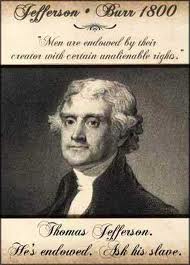 how the personal can be turned into the ugly political. Rumor becomes fact. Innuendo becomes headlines. Character assassination becomes de rigueur. It’s hard to know exactly when modern politics went over the edge. I would definitely have to point to folks like Karl Rove, Newt Gingrich, and Frank Luntz. Although, Donald Segretti comes to mind too. The age of social media and blogs has created a sleaze industry. Andrew Breithbart was the sheistermeister of the internet and his site and sites like Red State continue the tradition of creating tropes, memes and canards to sucker an uninformed electorate. AM radio and Fox News certainly don’t raise the standard either. Sleazy politics is on steroids these days.
The funny thing is that some things do speak of character and other things appear to be manufactured to create faux outrage. I frankly believe that strapping your sick dog on the roof of your car for a long trip says something about your decision making and your humanity. I don’t think a small child in a third world country eating dog meat because that’s what he’s been given to eat by his parents to be an equivalent morality play.
We are clearly in the swift boat age. Right after the attack on 9-11 the politicizing of the event took off. It was bound to happen. I used to keep track of the number of times that Dubya used the term “lessons of 9/11” to justify torture, invasion of a country that had nothing to do with the attack on 9/11, and signing into law severe restrictions on our civil liberties and personal privacy. Every single SOTU address and re-election stump speech always contained the phrase “lessons of 9/11”. I’m actually pretty outraged that the Romney and some elected officials think they’re innocent of trumping up the “lessons of 9/11” while accusing the President of Politicizing the Bin Laden killing. Meanwhile, they’re politicizing the situation with a Chinese dissident while the Secretary of State is in active negotiations with the Chinese Government on the status of the dissident and his family.
All of this just drives me nuts.
The newest of these trumped up faux outrage moments is now called “Elizabeth Warren’s Birther Movement”.
If you are 1/32 Cherokee and your grandfather has high cheekbones, does that make you Native American? It depends. Last Friday, Republicans in Massachusetts questioned the racial ancestry of Elizabeth Warren, the Democratic Senate candidate. Her opponent, Senator Scott Brown, has accused her of using minority status as an American Indian to advance her career as a law professor at Harvard, the University of Pennsylvania and the University of Texas. The Brown campaign calls her ties to the Cherokee and Delaware nations a “hypocritical sham.”
In a press conference on Wednesday, Warren defended herself, saying, “Native American has been a part of my story, I guess since the day I was born, I don’t know any other way to describe it.” Despite her personal belief in her origins, her opponents have seized this moment in an unnecessary fire drill that guarantees media attention and forestalls real debate.
This tactic is straight from the Republican cookbook of fake controversy. First, you need a rarefied elected office typically occupied by a certain breed of privileged men. Both the Presidency and the Senate fit this bill. Second, add a bit of interracial intrigue. It could be Kenyan economists eloping with Midwestern anthropologists, or white frontiersmen pairing with indigenous women. Third, throw in some suspicion about their qualifications and ambitions. Last but not least, demand documentation of ancestry and be dissatisfied upon its receipt. Voila! You have a genuine birther movement.
The Republican approach to race is to feign that it is irrelevant — until it becomes politically advantageous to bring it up. Birthers question Obama’s state of origin (and implicitly his multiracial heritage) in efforts to disqualify him from the presidency. They characterize him as “other.” For Warren, Massachusetts Republicans place doubts on her racial claims to portray her as an opportunistic academic seeking special treatment. In both birther camps, opponents look to ancestral origins as the smoking gun, and ride the ambiguity for the duration.
My children are 1/4 Japanese. My youngest daughter has absolutely no physical traits that would lead you to believe she has a Japanese Grandmother. My oldest daughter definitely has the mixed race look. But that’s not the point. Neither is the actual fraction or what’s historically been called the number of ‘drops of blood’.
Both of my children have a mixed identity because we fully embraced my husband’s mixed ancestry. We eat Japanese food. The kids went to Japan school for a period of time and can speak and write a bit of Japanese. My mother-in-law lived with us and our home was filled with her cooking, her language, and her upbringing. The girls also know about their family history from Japan and they’ve explored its culture. We also talk about a lot of different things including that my uncle was very responsible for the argument on the Japanese Internment policy to the Supreme Court for the Roosevelt Administration and that another uncle by marriage on my father’s side lost a cousin to the Baatan Death March. His aunt was appalling rude to my husband every time we went to family reunions. Both heritages are a party of our family story and our family traditions. We discuss the anti-Japanese hysteria of the World War 2 period, the Japanese War atrocities, and the H Bombs that ended the war as well as my mother-in-law’s experience as a starving teenager in Kyoto who had to smuggle rice in her kimono. All of this is a part of our heritage as melting pot Americans. When I first walked to the counter of the Japanese Grocery store here in New Orleans with my items I was told “You shop like Japanese housewife.” I am genetically as WASPY as they come. That’s what comes from being brought into a culture as a teen and surrounded by it for 20 years. There’s a very real part of me that IS Japanese now. I am a New Orleanian after 16 years living in the inner city of New Orleans and being surrounded by all if its rich heritage and neighborhoods. These identities will stay with me no matter where I go.
That’s the deal to me. If Elizabeth Warren feels connections to her Native American Ancestry and if its part of her family story and tradition, do we really need to question if her ‘drops of blood’ justify her connection and her identity?
Discussing real issues and real moral character is difficult in this age of swift boating, contrived outrage, and false equivalencies. It’s especially difficult because so many groups can get access to money and the media and push through some pretty outrageous tropes. Unfortunately, most of these tropes are head line grabbers and the customer-hungry media will jump on it and ride it as long as possible. It is really shameful that the noble pursuit of maintaining a healthy democracy seems to include such manufactured tit-for-tat. US voters deserve better.

 peej
peej Carissa
 bostonboomer
 dakinikat
 ecocatwoman
 mablue2
 Mama Lopez
 peggysue22
 quixote
 skydancingguestblogger
 Mona (aka Wonk the Vote)



 Sky Dancing
Recent Comments