
Rep. Maxine Waters: “We’re gettin’ tired, y’all.”
Posted: August 17, 2011 Filed under: 2012 presidential campaign, the villagers, U.S. Economy, U.S. Politics, unemployment, voodoo economics | Tags: African American unemployment, Congressional Black Caucus, double dip recession, Economists, Emanuel Cleaver, Gallup poll, job fairs, jobs bills, Maxine Waters, Obama bus tour, sugar coated satan sandwich, unemployment 22 CommentsWhile President Obama was visiting small lily-white Midwestern towns that have managed to do pretty well during the economic crisis of the past three years, members of the Congressional Black Caucus have traveled around the country hosting job fairs. Yesterday they were in Detroit.
U.S. House Rep. Maxine Waters is asking black voters who are struggling with an unemployment rate nearly twice the national average to “unleash” her and other members of the Congressional Black Caucus on President Obama.
The California Democrat, speaking at a raucous town hall in Detroit hosted by the CBC on Tuesday, said she doesn’t want to attack the president from his base unless the base gives her the go-ahead.
“If we go after the president too hard, you’re going after us,” Waters said. “When you tell us it’s all right and you unleash us and you’re ready to have this conversation, we’re ready to have the conversation.”
Judging by the reaction of the audience, including someone yelling to Waters, “It’s all right,” the president will be hearing very soon from the congresswoman and her fellow caucus members.
Since Obama took office, he has resisted pressure from the CBC to create jobs programs specifically targeting blacks, saying that improving the entire economy will help all groups.
I’m not sure I understand why the CBC can’t lead on this issue rather than waiting to be “unleashed” by African American voters. Still, at least she’s talking about the dismal employment situation African Americans face.
On MSNBC, Andrea Mitchell asked Emanuel Cleaver (of “sugar coated Satan sandwich” fame) about President Obama’s promised jobs plan.
I guess Obama’s “jobs plan” isn’t an emergency, since Congress is so unlikely to pass it. I guess that’s why the President is going on vacation first and won’t give his latest “major speech” until after Labor Day.
Looking at that video of the CBC jobs fair reminds me of photos of lines during the Great Depression, but President Obama announced today that
“I don’t think we’re in danger of another recession, but we are in danger of not having a recovery that is fast enough to deal with a genuine unemployment crisis for a whole lot of folks out there.
And you know what an expert our fearless leader is on economic matters (snark). And to show that he’s not that worried, President Obama will soon be heading for Martha’s Vineyard for a 10-day vacation.
But wait, check this out from Gallup:

Oddly enough, it seems that Americans outside the beltway don’t agree with Mr. Obama’s assessment of the economy. And neither do quite a few real economists.
But the President is tired too, I guess. All those golf games, the weekends at Camp David, the fancy White House dinners and parties, the fundraisers, the campaign swing bus tour of the Midwest–it’s so exhausting. He needs a break. So unemployed people need to stop being so selfish and understand President Obama’s needs. He’ll get around to their problems someday.
Funny though, I don’t recall it taking him this long to bail out the banks, do you?
Here’s a longer version of Maxine Waters’ talk.
The Incredible Shrinking President
Posted: August 14, 2011 Filed under: 2012 presidential campaign, A My Pet Goat Moment, Barack Obama, Democratic Politics, Media, U.S. Economy, U.S. Politics, unemployment, voodoo economics | Tags: Barack Obama, failure, media criticism, speeches 41 Comments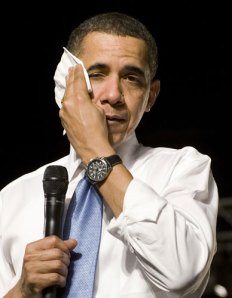
Flop sweat
President Obama has enjoyed largely positive media coverage since 2004, when he gave his first nationally televised speech at the Democratic National Convention in Boston. But since his very public humiliation at the hands of Republicans in the debt ceiling fight, the tide has suddenly turned. I think we may have finally reached a real tipping point.
Just one week ago, Dakinikat wrote a post about the Villagers finally beginning to express buyer’s remorse after Obama’s recent display of weakness and cluelessness. This week, the President has again been hammered in the national and international media, and yet he and his handlers still don’t get it, as Dakinikat’s post from late last night demonstrated.
According to the shocking New York Times article Dakinikat quoted in her post last night, Obama and his top advisers have, in a cold and calculating way, determined that advocating for policies that would create jobs would not be conducive to Mr. Obama’s reelection. Even the ideas they hesitate to push are weak and unoriginal–and as Dak pointed out, would have little to no impact on unemployment or the economy anyway. According to the NYT,
Mr. Obama plans to spend time this weekend considering his options, advisers said. The White House expects to unveil new job-creation proposals in early September.
The ailing economy, barely growing at the same pace as the population, has swept all other political issues to the sidelines. Twenty-five million Americans could not find full-time jobs last month. Millions of families cannot afford to live in their homes. And the contentious debate over raising the federal debt ceiling — which Mr. Obama achieved only after striking a compromise with Republicans that included a plan for at least $2.1 trillion in spending cuts over 10 years — has further shaken economic confidence….
So far, most signs point to a continuation of the nonconfrontational approach — better to do something than nothing — that has defined this administration. Mr. Obama and his aides are skeptical that voters will reward bold proposals if those ideas do not pass Congress. It is their judgment that moderate voters want tangible results rather than speeches.
Perhaps so, but so far we have gotten nothing but speeches–and repeated capitulations–from Mr. Obama. More:
Mr. Plouffe and Mr. Daley share the view that a focus on deficit reduction is an economic and political imperative, according to people who have spoken with them. Voters believe that paying down the debt will help the economy, and the White House agrees, although it wants to avoid cutting too much spending while the economy remains weak.
As part of this appeal to centrist voters, the president intends to continue his push for a so-called grand bargain on deficit reduction — a deal with Republicans to make even larger spending cuts, including to the social safety net, in exchange for some revenue increases — despite the strong opposition of Congressional Democrats who want to use the issue to draw contrasts with Republicans.
Have Plouffe and Daley paid any attention to the media reactions to their boss in the past week? I want to share some of my favorite recent critiques of Obama. Admittedly some of them come from right wing sources, but I detect a distinct change in the wingers’ reactions to Obama too. Instead of claiming he’s a socialist, they are mocking him for being incompetent and ineffectual.
The Audacity of No Hope
Posted: August 12, 2011 Filed under: Barack Obama, Republican presidential politics, U.S. Economy, U.S. Politics, voodoo economics, We are so F'd | Tags: Allen West, banana republic, consumer confidence index, Michele Bachmann 21 Comments I don’t recall a time when political discourse has been so disconnected with reality. It’s like there’s some form of drug that’s been planted in the Potomac that’s created a stupor from which the media and politicians refuse to awake. They seem to think if they create the message, we will come. The truth is that most Americans are not quite that stupid. It’s really a shame that the looking glass of TV political discourse does not reflect Main Street. It reflects only Wall Street, K Street, and Madison Avenue.
How more out of touch can punditry and pols become? This is the reality that US households see.
Confidence among U.S. consumers plunged in August to the lowest level since May 1980, adding to concern that weak employment gains and volatility in the stock market will prompt households to retrench.
The Thomson Reuters/University of Michigan preliminary index of consumer sentiment slumped to 54.9 from 63.7 the prior month. The gauge was projected to decline to 62, according to the median forecast in a Bloomberg News survey.
The biggest one-week slump in stocks since 2008 and the threat of default on the nation’s debt may have exacerbated consumers’ concerns as unemployment hovers above 9 percent and companies are hesitant to hire. Rising pessimism poses a risk household spending will cool further, hindering a recovery that Federal Reserve policy makers said this week was already advancing “considerably slower” than projected.
“The mood is very depressed,” said Chris Christopher, an economist at IHS Global Insight Inc. in Lexington, Massachusetts. “Consumers are very fatigued and very uncertain. In the short term, people are going to pull back on spending.”
Estimates of 69 economists for the confidence measure ranged from 59 to 66.5, according to the Bloomberg survey. The index averaged 89 in the five years leading up to the recession that began in December 2007.
Here’s one example of the reality disconnect via Michelle Bachmann who has been cheering on the idea of a US default and had the temerity to suggest last night in the Ames Alternate Reality Debates that the S&P downgrade occurred because the debt ceiling was raised. The S&P downgrade stemmed from her brazen example–as well as those of her compradres–of a complete disconnect from economic reality. How much time was spent on discarded notions like gold standards and politically controlled central banks? This is the stuff that only dictators in banana republic adopt!
A Standard & Poor’s director said for the first time Thursday that one reason the United States lost its triple-A credit rating was that several lawmakers expressed skepticism about the serious consequences of a credit default — a position put forth by some Republicans.
Without specifically mentioning Republicans, S&P senior director Joydeep Mukherji said the stability and effectiveness of American political institutions were undermined by the fact that “people in the political arena were even talking about a potential default,” Mukherji said.
“That a country even has such voices, albeit a minority, is something notable,” he added. “This kind of rhetoric is not common amongst AAA sovereigns.”
I mentioned in this morning’s post the brazen political rationale behind the President’s persistent message that it’s the deficit driving the bad economy. This too is a message that’s not based in reality. This Reich quote bears repeating here.
So rather than fight for a bold jobs plan, the White House has apparently decided it’s politically wiser to continue fighting about the deficit. The idea is to keep the public focused on the deficit drama – to convince them their current economic woes have something to do with it, decry Washington’s paralysis over fixing it, and then claim victory over whatever outcome emerges from the process recently negotiated to fix it. They hope all this will distract the public’s attention from the President’s failure to do anything about continuing high unemployment and economic anemia
Krugman–who shall now be known as the depressed one--made similar claims today in his NYT op-ed. He tells us that we should be angry. I think he needs to get out of the confines of his New York condo or his Princeton office, because we are angry out here in the great fly over. I’d say if he went to the right parts of New York City or New Jersey, he’d likely find the anger there too.
But there’s another emotion you should feel: anger. For what we’re seeing now is what happens when influential people exploit a crisis rather than try to solve it.
For more than a year and a half — ever since President Obama chose to make deficits, not jobs, the central focus of the 2010 State of the Union address — we’ve had a public conversation that has been dominated by budget concerns, while almost ignoring unemployment. The supposedly urgent need to reduce deficits has so dominated the discourse that on Monday, in the midst of a market panic, Mr. Obama devoted most of his remarks to the deficit rather than to the clear and present danger of renewed recession.
What made this so bizarre was the fact that markets were signaling, as clearly as anyone could ask, that unemployment rather than deficits is our biggest problem. Bear in mind that deficit hawks have been warning for years that interest rates on U.S. government debt would soar any day now; the threat from the bond market was supposed to be the reason that we must slash the deficit now now now. But that threat keeps not materializing. And, this week, on the heels of a downgrade that was supposed to scare bond investors, those interest rates actually plunged to record lows.
What the market was saying — almost shouting — was, “We’re not worried about the deficit! We’re worried about the weak economy!” For a weak economy means both low interest rates and a lack of business opportunities, which, in turn, means that government bonds become an attractive investment even at very low yields. If the downgrade of U.S. debt had any effect at all, it was to reinforce fears of austerity policies that will make the economy even weaker.
So how did Washington discourse come to be dominated by the wrong issue?
When political gamesmanship and legal outcomes funded by corporations and not votes by people become the central goal of policy, a democracy not only loses its authenticity, it ceases to exist. People have been voting for gridlock and throwing the bums out only to create a gridlock that is bringing down the economy and bums so virulent that we can no longer stand for either. People like Allen West, Michelle Bachmann, and Rick Santorum shouldn’t even be given keys to a car, let alone the country. Leaders that would rather distract people from reality than make actual policy decisions–like Obama–need to be called out for their cynical political ploys; not re-elected. How much more of this can our economy and democracy take before we completely collapse into something worse than a banana republic?
Peter Daou has written an excellent analysis that talks about how this toxic environment has brought the country to its knees. He has a list of exactly how far down we’ve gone on the list of countries for many things. Today’s new number is 23. We used to rank 6th in infrastructure, we have now fallen to number 23. Sweden tops the list of countries for global technology and net work readiness. The US has moved to 5th place behind Sweden, Singapore, Finland and Switzerland. This is what we’re supposed to be good at? Right? Information Technology? The only thing we seem to excel at any more is perpetual war.
The basic question is then, what will it take to get these people to listen? Well, in the case of Michelle Bachmann and reality-deniers, there’s no hope there. They cling to religious myth and free market fairy tales over science, economics, and reality. In the case of those who cynically change the political discourse to “distract the public’s attention”, I’m not sure. What do you do with the power hungry who are more driven by campaign contributions and donor concerns, than votes and people? This toxic political environment is bringing toxic results. In other parts of the world, there are protestors risking their lives for real change. People are being gunned down in Syria as we speak. Rioters in England–fed up with no future and no jobs–are burning things to the ground.
Daou points to Bob Hebert’s farewell column for perspective. It’s worth reviewing.
The U.S. has not just misplaced its priorities. When the most powerful country ever to inhabit the earth finds it so easy to plunge into the horror of warfare but almost impossible to find adequate work for its people or to properly educate its young, it has lost its way entirely.
Nearly 14 million Americans are jobless and the outlook for many of them is grim. Since there is just one job available for every five individuals looking for work, four of the five are out of luck. Instead of a land of opportunity, the U.S. is increasingly becoming a place of limited expectations. A college professor in Washington told me this week that graduates from his program were finding jobs, but they were not making very much money, certainly not enough to think about raising a family.
There is plenty of economic activity in the U.S., and plenty of wealth. But like greedy children, the folks at the top are seizing virtually all the marbles. Income and wealth inequality in the U.S. have reached stages that would make the third world blush. As the Economic Policy Institute has reported, the richest 10 percent of Americans received an unconscionable 100 percent of the average income growth in the years 2000 to 2007, the most recent extended period of economic expansion.
Americans behave as if this is somehow normal or acceptable. It shouldn’t be, and didn’t used to be. Through much of the post-World War II era, income distribution was far more equitable, with the top 10 percent of families accounting for just a third of average income growth, and the bottom 90 percent receiving two-thirds. That seems like ancient history now.
The current maldistribution of wealth is also scandalous. In 2009, the richest 5 percent claimed 63.5 percent of the nation’s wealth. The overwhelming majority, the bottom 80 percent, collectively held just 12.8 percent.
This inequality, in which an enormous segment of the population struggles while the fortunate few ride the gravy train, is a world-class recipe for social unrest. Downward mobility is an ever-shortening fuse leading to profound consequences.
What profound consequences await a country where the leaders find these extraordinary levels of income inequality, infrastructure ruin, and joblessness an acceptable status quo? Will parts of the US eventually resemble West London or Damascus where disenfranchised, jobless, and hopeless people resort to measures beyond desperation? These events are truly the results of the audacity of no hope. It’s easier for the media blame the dogs fighting for scraps under the table than to look at the table top and to call out the masters that have stacked the decks in their favor so that the meat never hits the floor. Can simply living in a land of economic fairy tales ala Bachmann and trust fund babies like Romney prevent the US from seeing similar unrest? Corporations are people too? Really? Can giving multiple speeches distract the jobless from their plight or blaming social security recipients and the long term unemployed keep the electorate in a stupor of false hope? I’d say that one check of polls and the consumer sentiment index provides a resounding no answer.
I have never seen a period of time when the issues are so clear, the answers are so obvious, and the political and punditry class appear so clueless. Something better change fast before the growing restless in our undeveloping nation turns into something more than disenchanted polling numbers and falling indexes. How much more disconnect will this country’s citizens take?
Righteous Rants Open Thread
Posted: August 10, 2011 Filed under: U.S. Economy, U.S. Politics, unemployment, voodoo economics | Tags: Al Sharpton, Bernie Sanders, corruption, David Goodfriend, Dylan Ratigan, jobs, Joe Biden, Keith Ellison, righteous rants, tax cuts, trade deals 18 CommentsDylan Ratigan goes nuts over government corruption
————————————————
David Goodfriend (on Dylan Ratigan Show) explains why cutting taxes doesn’t create jobs
————————————————
Bernie Sanders schools Obot Al Sharpton on the debt deal, plus Keith Ellison
————————————————
Heard any good rants lately?
Breaking: Boehner, McConnell Announce Picks for Catfood Commission II
Posted: August 10, 2011 Filed under: Medicaid, Medicare, Social Security, U.S. Economy, U.S. Politics, voodoo economics, We are so F'd | Tags: austerity, Catfood Commission II, Federal Deficit, Harry Reid, John Boehner, Mitch McConnell, Super Committe 23 Comments
Speaker John Boehner has appointed Ways and Means Chairman Dave Camp (R-Mich.), Energy and Commerce Chairman Fred Upton (R-Mich.) and Republican Conference Chairman Jeb Hensarling (R-Texas) as the House GOP members of the panel.
Hensarling will be co-chairman of the committee. Senate Minority Leader Mitch McConnell also announced Wednesday the Senate Republican members: Jon Kyl of Arizona, Pat Toomey of Pennsylvania and Rob Portman of Ohio.
Politico says that Kyl, who is not running for reelection,
will likely be a conduit to McConnell to keep him apprised of the ongoing negotiations – as he did when he served as the lead Senate GOP negotiator during the unsuccessful budget talks led by Vice President Joe Biden this summer. Portman, a former White House budget director under George W. Bush and a freshman GOP senator, has been given increased responsibilities from the leadership, including earlier this year when he helped draft a GOP jobs initiative.
From CBS News Political Hotsheet:
In a statement, McConnell said the three senators he’s chosen understand the “gravity” of the current economic climate and will bring to the table “the kind of responsibility, creativity, and thoughtfulness that the moment requires.”
“The American people know that we cannot dig ourselves out of this situation by nibbling around the edges, and I am confident that each of these nominees can be counted on to propose solutions that put the interests of all Americans ahead of any one political party,” McConnell said.
Boehner said in a statement he appointed “proven leaders who have earned the trust and confidence of their colleagues and constituents.”
How very reassuring. The good news is that Boehner didn’t appoint either Paul Ryan or Eric Cantor–probably because he wants them to be reelected in 2012.

As we heard yesterday, Harry Reid has chosen Patty Murray (Washington), John Kerry (Massachusetts), and Max Baucus (Montana), with Murray to serve as co-chair. Nancy Pelosi has not yet announced her choices for the “super committee” AKA Catfood Commission II.
At FDL, David Dayen has some great comments on Harry Reid’s choices.
Patty Murray and John Kerry have defense industry ties, and as the head of the Finance Committee Baucus is no stranger to health care or tax lobbyists. But I don’t think you could find a Senator in the Democratic caucus without those ties. Then there’s this allusion to a stirring speech by John Kerry, which should immediately set off a BS detector:
A Democratic source told The Huffington Post that Kerry “made it into the discussion” of who should serve on the committee by delivering “some powerful speeches” to the rest of the caucus. The speeches, the source added, were in defense of Democratic Party priorities, focusing on the need to protect entitlement programs and Kerry’s desire to strongly push back against (what the source referred to as) “the right-wing agenda.”
That gives me a great idea to stall out the committee: have John Kerry give the opening speech.
Meanwhile, if Baucus is not liked for being parochial and sure to vote against any program that emerged, and given his performance during the health care debate, when he went into a room with a small bipartisan group and wasted four months not finding a solution, I’d say it was a great choice!
Please post any relevant background information you have on these Senators and Representatives in the comments.

 peej
peej Carissa
 bostonboomer
 dakinikat
 ecocatwoman
 mablue2
 Mama Lopez
 peggysue22
 quixote
 skydancingguestblogger
 Mona (aka Wonk the Vote)



 Sky Dancing
Recent Comments