
The Surreal World of The Villagers vs. The Nightmare Reality of the 99 Percent
Posted: February 14, 2013 Filed under: morning reads, open thread, Political Affective Disorder, Real Life Horror, Surreality, The Media SUCKS, the villagers, U.S. Economy, U.S. Politics | Tags: Barack Obama, Marco Rubio, Salvador Dali, State of the Union, the 99 percent, the one percenters 44 Comments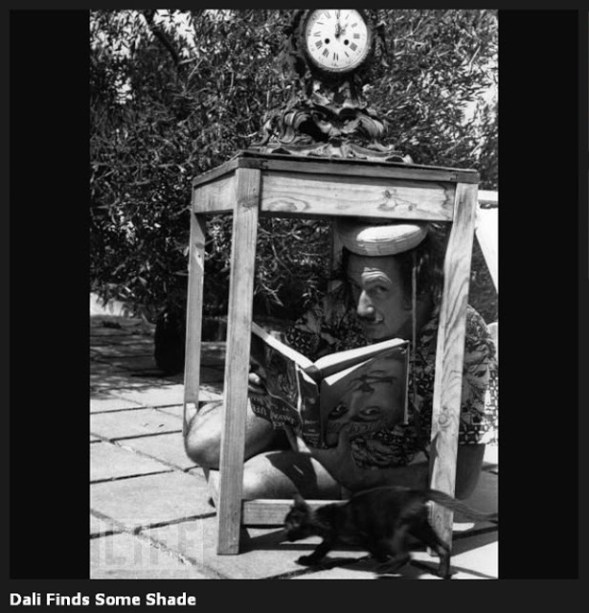
This is going to be sort of a cross between a morning reads post and a rant.
Yesterday, Dakinikat and I were talking about how lately it seems like it’s hard to find things to blog about because there’s nothing really new happening in the political world. Sure, there’s news coming out of DC, but it’s pretty much the same thing every day. The Republicans hate President Obama and continue to do their best to block everything he tries to do. Obama sort of sounds like a liberal at times, but he’s still offering that “grand bargain” to the Republicans who hate his guts and still letting down the voters who elected him in the process.
Republicans pretend to obsess over the federal deficit and debt and economic writers like Paul Krugman and Robert Reich repeatedly try to explain that the problem with our economy right now isn’t the deficit or the debt, but the high unemployment and stagnating wages that keep the lower 99 percent of us from spending our money as freely as we’d like.

Lugubrious Game, by Salvador Dali, 1929
As I looked around for Thursday reads last night, I began to feel as if I’d entered a surreal alternative reality–almost as if I had awakened to find myself in a Salvador Dali painting in which everything seems crazy and nothing ever changes. The only breaks from the tedium of the Village come when there’s news of another shooting and the media covers it for a few days–like the recent obsession with ex-cop “Rambo” Christopher Dorner.
Now that Dorner has gone down, there’s another high-profile shooting for the media to focus on. USA Today reports: Olympic runner Oscar Pistorius charged with murder.
South African police on Thursday said they would charge Olympic athlete Oscar Pistorius with murder after his girlfriend was shot and killed at his home earlier Thursday morning.
The circumstances of the incident are still unclear but police in South Africa said they would oppose bail when the Paralympic gold medalist appears in court Friday. The hearing was scheduled for Thursday afternoon but was delayed to give forensics investigators time to do their work, the Associated Press reported.
Police in South Africa do not name suspects in crimes until they have appeared in court but police spokesperson Brigadier Denise Beukes said that Pistorius was at his home after the death of the victim and that “there is no other suspect involved,” The Associated Press reported.
Britain’s Sky News first named the woman as Reeva Steenkamp, a model and recent contestant on Tropika Island of Treasure 5, a South African reality TV show. A talent agent for Steenkamp said she was the victim. However, police have yet to confirm the woman’s relationship with the Olympic and Paralympic athlete.

South African Olympic athlete Oscar Pistorius and Reeva Steenkamp attend an awards ceremony in Johannesburg, South Africa last November.(Photo: Lucky Nxumalo, AP)
Meanwhile, as the Villagers ignore the need for gun safety legislation and argue about the deficit and the supposed out-of-control government spending that isn’t actually happening, the rich get richer and the lower 99 percent get screwed. Case in point, please read this piece in The New Republic by Timothy Noah that the Villagers will either ignore or mock: The One Percent Gobbled Up the Recovery, Too. In fact, it put the 99 percent back in recession.
Emmanuel Saez, the Berkeley economist who (with Thomas Piketty, an economist at the École d’economie de Paris) first mapped the enormous 34-year run-up in income share for America’s top 1 percent, came up last year with a statistic that was widely quoted by people who care about rising income inequality. In 2010, the first year of economic recovery after the 2009-2010 recession, 93 percent of all pre-tax income gains went to the top 1 percent, which in that year meant any household making more than about $358,000. This was, I quipped at the time, a members-only recovery. No 99-percenters need apply.
Saez has now updated (PDF) this statistic to include 2011. When you look at the economic recovery’s first two years, the top one percent (which by 2011 meant any household making more than about $367,000) captured 121 percent of all pre-tax income gains.
How is it even possible for the one percent to capture more than 100 percent of all income gains since the last recession? Looked at from one point of view, it’s not. It is enough to say that in 2010 and 2011 all of the recovery went to the one percent. If you were in the bottom 99 percent, as by definition nearly all of us are, you didn’t see a dime of that recovery.
What happened to the rest of us then?
Over 2010 and 2011, it saw, on average, a slight net decline in pre-tax income of 0.4 percent. This “negative growth” is what, at least theoretically, boosts the one percent’s share of income gains from 100 percent to 121 percent. If you think of income distribution as a Pac-Man game, with the one percent as Pac-Man, imagine your Pac-Man consuming all the pac-dots in one game and then somehow, after you’ve left the arcade, gobbling up some of the pac-dots in the next player’s game too. Another way to put it is that the one percent didn’t just gobble up all of the recovery during 2010 and 2011; it put the 99 percent back into recession.
Sadly, airhead talking heads like Joe Scarborough will continue to have much more influence in the Village than actual economists like Emmanuel Saez and real reporters like Timothy Noah.
Speaking of airheads, after the SOTU speech on Tuesday night we had the pleasure of watching baby-faced Florida Senator Marco Rubio make a complete ass out of himself on the TeeVee. Hullabaloo blogger David Atkins, who–unlike Rubio–is somewhat knowledgeable about economics, tried to explain to the the latest “great Republican hope” (before his speech) that not only do deficits not cause unemployment, but also our federal deficit is steadily decreasing. Of course no reader of Dakinikat’s posts needs any of this explained. But I still want to link to Atkins’ concluding paragraphs.
Why is the deficit shrinking? Mostly, because of the pickup in economic activity. The elimination of some of the tax cuts for the wealthy will also help. The Affordable Care Act will also be taking a bite out of our extravagant healthcare costs.
4. None of this has any impact on unemployment. Generally speaking, there are two kinds of jobs: public sector and private sector. Even though the private sector is doing better, public sector jobs are still declining due to conservative policies theoretically designed to reduce deficits. Private sector jobs, meanwhile, depend on consumer demand–not corporate profit. American corporations are experiencing record profits, but they aren’t hiring because there’s not enough middle-class consumer demand for them to hire workers.
4a. The lack of consumer demand leading to poor private-sector job growth in spite of record profits has nothing to do with deficits or uncertainty in the investing climate. It has everything to do with income inequality and economic insecurity among the middle and lower classes.
4b. The obsession over deficits among conservative politicians is directly responsible for public sector job cuts that are helping to drive up the unemployment rate and kill consumer demand.
All of which means that politicians like Marco Rubio who insist that the deficit is directly hurting employment are either so ignorant of economics that they shouldn’t be handling public policy, or so cynically manipulative that they shouldn’t be handling public policy.
And no “reporter” in Washington or elsewhere should be covering Rubio’s statements without providing a basic lesson in macroeconomics as context for his fact-free response.
Actually, Village idiots “reporters” like Chris Cillizza pretty much ignored whatever substance there was in Rubio’s speech and approvingly reported on the personal history that Rubio discussed. But beforehand, Cillizza wrote that Obama should focus on deficit in State of the Union
It’s the deficit, stupid. A look back at Obama’s first three State of the Union speeches, plus the address to a joint session of Congress in 2009, suggests a similar thematic pattern: He starts with the economy, moves to education and then, in the middle section of the speech, addresses the deficit. (The exception was in 2011, when Obama began his speech with a riff on partisanship.) In 2012, Obama spent just five minutes on the debt — less time than he spent on partisanship (51/2 minutes) or foreign policy (six minutes).
He should flip that script in this State of the Union and spend the bulk of his time talking about the deficit. Here’s why: In January 2009 polling by Pew Research Center, 53 percent of respondents said reducing the deficit was a “top priority.” In January 2013, that number soared to 72 percent, by far the biggest increase of any issue over that time. (By contrast, 85 percent said strengthening the economy was a top priority in 2009, while 86 percent said so at the start of this year.)
The debt is the issue of the day, and one that, if Obama is beginning to eye his legacy as president, could go a long way toward shaping how history remembers him. Make this speech a deficit speech.
For Cillizza and his ilk, “the deficit” (or “the debt,” which he doesn’t seem to understand is not the same thing) is “the issue of the day,” and unemployment and the other struggles of the 99 percent are completely invisible. Oh, and by the way, Dick Cheney loved Rubio’s speech.
I could go on and on like this, but I’ll stop now. I just wanted to rant for a bit in hopes of pulling myself out of my current malaise. I’ve realized finally that there isn’t going to be any real change as because the Villagers (often including the President) are just going to continue focusing on cutting spending and ignoring the problems facing those of us who live in the real world.
If you stayed with me this far, thanks for letting me rant! Now, I welcome your links to whatever you are reading and blogging about today.
Tuesday Reads: SOTU, Republican Crazies, LAPD Manhunt, and Other News
Posted: February 12, 2013 Filed under: morning reads, U.S. Economy, U.S. Politics | Tags: State of the Union Address 46 Comments
Good Morning!!
Tonight President Obama will give his first State of the Union Address since being elected to a second term. C-Span coverage begins at 8PM (Eastern) and the speech itself begins at 9PM. We’ll have a live blog, of course.
I have to admit, I’m already somewhat discouraged after yesterday’s announcements by Jay Carney and Dan Pfieffer that Obama is still enthusiastically offering Social Security benefit cuts and Medicare “changes” to tempt Republicans into a “grand bargain.” There has also been much talk of “spending cuts” and emphasis on the administration having a “spending problem.” If Obama had a mandate, it wasn’t for this.
There have been rumors that Obama would emphasize jobs in the SOTU, but it sounds like that may not be the case. We can only hope that once the President gets out among real people again, he’ll remember why he won the election–and it wasn’t because we were all hoping he’d drive the economy into a ditch. People need jobs, Mr. President, and they’d like to have some dignity, health care, and perhaps something to eat besides cat food when they get old and frail.
Unfortunately, thanks to insane Republican Rep. Steve Stockman, repulsive gun enthusiast Ted Nugent, who threatened President Obama last year, will be a guest at the State of the Union Address. TPM:
Outspoken rocker Ted Nugent will attend President Obama’s State of the Union Address Tuesday in order to take on the media and “counter the scams and lies of the left,” he explained to talk radio host Mike Broomhead “We know that the president will have the state of the union stacked and jammed with props, children, and victims of violent crime, ” Nugent said. “And my friends wanted me to attend to counter that the way that I do: with facts, statistics and common sense and logic and a celebration of self-evident truths. So I will be taking on the media orgy following the State of the Union Address.” Nugent said the media does not realize he is a “force to be reckoned with” and therefore he will “dominate them.”
You can listen to the radio interview at the TPM link if you’re so inclined. Can’t the Secret Service prevent this moron from turning the SOTU into a freak show? Would they allow this if Obama were a Republican?

Rep. Steve Stockman (R-TX)
But as Greg Sargent points out, “The problem runs a lot deeper than Ted Nugent.”
That’s bad, but if I were the GOP leadership, the prospect of further comments from Nugent after the speech would have me a bit worried. After all, there’s little doubt that reporters will seek him out, and there’s really no telling what Nugent will say. The GOP leadership has not commented on the news. But really, this episode is significant for reasons that go well beyond Nugent. The key actor here who matters is Steve Stockman. The problem lies in all the over-the-top stuff GOP lawmakers say regularly that isn’t quite crazy enough to earn widespread condemnation, as Nugent’s quotes have, but are still whacked out enough to encourage an atmosphere that helps keep millions of GOP base voters sealed off from reality. The problem is the perpetual winking and nodding to The Crazy that is deemed marginally acceptable – the hints about creeping socialism, the claim that modest Obama executive actions amount to tyranny, the suggestions that Obama’s values are vaguely un-American and that Obama is transforming the country and the economy into something no longer recognizably American, and so on — more so than the glaringly awful stuff that gets the media refs to throw their flags.
In other news,
Yesterday, Esquire published an interview with the “man who killed Osama bin Laden.” I haven’t read the whole thing, because frankly, I’m very turned off by the notion of assassinating criminals instead of capturing them and bringing them to trial. Every time I try to read anything about the raid on the bin Laden compound I start to feel sick. Anyone who did read the article, I’d be interested in your reaction to this piece at Stars and Stripes: Esquire article wrongly claims SEAL who killed bin Laden is denied healthcare.
Esquire magazine claims “The Man Who Killed Osama bin Laden … Is Screwed.” The story details the life of the Navy SEAL after the successful raid to take out the No. 1 terrorist, and it asserts that once the SEAL got out of the military he was left to fend for himself. “…here is what he gets from his employer and a grateful nation: Nothing. No pension, no health care, and no protection for himself or his family.” Except the claim about health care is wrong. And no servicemember who does less than 20 years gets a pension, unless he has to medically retire. Like every combat veteran of the Iraq and Afghanistan wars, the former SEAL, who is identified in the story only as “the Shooter”, is automatically eligible for five years of free healthcare through the Department of Veterans Affairs. But the story doesn’t mention that.
According to the LA Times, fugitive and alleged murderer Christopher Dorner may have escaped to Mexico with help from an “associate.”
In federal court records, authorities said there was “probable cause” Christopher Jordan Dorner fled to Mexico. Officials told The Times on Monday night that the court papers, filed late last week, reflected their thinking at the time, but they stressed that Dorner could be anywhere.
The search is ongoing in California as well as Mexico.
The possibility of Dorner receiving help by an associate was raised in the court records. In his affidavit, McClusky said investigators with the Marine Corps and San Bernardino County Sheriff’s Department were conducting a surveillance operation of an Arrow Bear property owned by a family member of the associate Thursday and discovered a burning vehicle nearby that matched the gray Nissan pickup truck used by Dorner.
Interesting…

From TMZ video
In addition, TMZ learned yesterday that Dorner purchased scuba diving equipment just 48 hours before he allegedly shot the daughter of a retired LAPD officer and her fiance. From TMZ:
Dorner went to Sports Chalet in Torrance — a beachside community in the L.A. area — on February 1st. The video shows Dorner carrying in 2 small, yellow scuba tanks as he walks into the scuba section. Sources tell us … Dorner got the tanks refilled with oxygen. The video then shows Dorner leaving the scuba section with the 2 yellow tanks, along with another large, black scuba tank. Dorner then goes to the counter, and then has a friendly conversation with the cashier, at times laughing. Dorner — who was a member of a Naval undersea warfare unit — pays cash for the items and then leaves….What’s really interesting … Dorner reportedly tried stealing a boat in San Diego on February 6th … where scuba gear might come in handy. The plan was thwarted when the prop got tangled in a rope.
The Christian Science Monitor discusses the Dorner case in the light of the troubled relationship between the LAPD and the city’s black community: LAPD review of Christopher Dorner firing: why black community wants more.
Los Angeles’s African-American community is casting a skeptical eye on police chief Charlie Beck’s decision Saturday to reopen the investigation into the 2008 firing of alleged cop killer Christopher Dorner. Twenty years after the Rodney King riots deep distrust remains, with some community leaders saying the Los Angeles Police Department cannot be trusted to investigate itself – and that perhaps even the US Justice Department should be called in. Mr. Dorner’s firing from the LAPD is at the center of the online manifesto that outlines his motivations for revenge. Police say Dorner has already killed three people and has threatened several police officers and families by name. The massive manhunt for him began Thursday. In his manifesto, Dorner calls his firing “unjust,” and suggests that he was fired partly because he reported that a fellow cop kicked a suspect. The allegations of police abuse and prejudice within the LAPD strike a chord within the broader black community. Moreover, they come at a time when some black leaders worry that the LAPD is backsliding after making significant gains toward more inclusivenessxxxxx under the previous chief. “We don’t agree with Dorner’s tactics, but many of us sympathize with his allegations,” says Najee Ali, a black activist and executive director of Project Islamic H.O.P.E. in Los Angeles. “But we don’t think the LAPD can investigate itself and come up with a conclusion that will appease the black community. We think the US Justice Department needs to do it.”
North Korea conducted nuclear test for the third time yesterday. The Voice of America reports: S. Korea, Japan Move to Bolster Defenses After North’s Nuclear Test.
North Korean state media hail the nuclear test as a success, saying it “did not pose any negative impact on the surrounding ecological environment.” A television announcer in Pyongyang says the country detonated a “miniaturized and lighter nuclear device with greater explosive force” than previous tests. Analysts say that indicates North Korea may have set off a plutonium-fueled bomb, suitable to be placed atop a missile…. Japan and the United States have deployed aircraft with special equipment to collect radioactive gases. An analysis of those gases could determine what type of nuclear material was used. South Korean officials say tremors recorded by seismographs around the world suggest the device has a yield of six to seven kilotons.
More news headlines:
Will Dorner’s Case Bring A Return To Open Board Of Rights Hearings? (Neon Tommy)
Justice Ginsburg: The Senate Is ‘Destroying The United States’ Reputation… As A Beacon of Democracy’ (Think Progress)
Sen. Cantwell rips GOP over Violence Against Women Act: This is about life or death (Raw Story)
Sources: White House to issue cybersecurity order Wednesday (The Hill)
Robert Reich: Obama needs to batter GOP over the head for blocking jobs bill (Raw Story)
Chuck Hagel’s Confirmation Vote Is Set, No Matter What Lindsey Graham Says (Atlantic Wire)
Easy Ride Expected for Jack Lew at Confirmation Hearing (National Journal)
Braves reject “screaming Indian” logo (CNN)
He’s Back: Hitler Satire Tops Germany’s Best-Seller List (Time)
Those are my recommendations. What are you reading and blogging about today?
Jay Carney: “Technical” Social Security Cuts Still On The Table
Posted: February 11, 2013 Filed under: Barack Obama, U.S. Economy, U.S. Politics | Tags: Bernie Sanders, Chained CPI, digby, medicare, Social Security 12 Comments
Jay Carney was sent out today to mouth Obama’s slimy weasel words at the daily press briefing:
Q [Johnathan Karl, ABC] What about reducing the annual cost of living increases for Social Security recipients?
MR. CARNEY: Again, as part of a big deal, part of a comprehensive package that reduces our deficit and achieves that $4-trillion goal that was set out by so many people in and outside of government a number of years ago, he would consider that the hard choice that includes the so-called chain CPI, in fact, he put that on the table in his proposal, but not in a cherry-picked or piecemeal way. That’s got to be part of a comprehensive package that asks that the burden be shared; that we don’t, as some in Congress want, ask seniors to bear the burden of further deficit reduction alone, or middle-class families who are struggling to send their kids to college, or parents of children who are disabled who rely on programs to help them get through….
Q But I just want to be clear what you said at the beginning of that answer, which is the President….as part of an overall balanced approach, he does not rule out effectively reducing benefits for Social Security recipients?
MR. CARNEY: He has put forward a technical change as part of a big deal — and it’s on the table — that he put forward to the Speaker of the House. The Speaker of the House, by the way, walked away from that deal even though it met the Republicans halfway on revenues and halfway on spending cuts and included some tough decisions by the President on entitlements. The Speaker walked away from that deal.
But as part of that deal, the technical change in the so-called CPI is possible in his own offer as part of a big deal.
Excuse me? Cutting Social Security benefits by means of the Chained CPI is NOT a “technical change.” Once again, Bernie Sanders explains what is really going on: Chained CPI: An economic, moral disaster.
How many candidates for Congress last year won on the following platform?
1. That Social Security cost-of-living adjustments are too generous. Social Security should be cut over the next two decades by more than $1,000 a year for 85-year-old widows living on $1,200 a month.
2. That benefits earned by disabled veterans as a result of losing their arms, legs or eyesight in Iraq and Afghanistan are too generous. Disabled veterans’ benefits should be cut over the next 15 years by more than $1,400 a year.
3. That working families and the middle class don’t pay enough in taxes. We need to enact an across-the-board tax increase that disproportionately hurts workers making between $30,000 and $40,000 a year.
Answer: None.And yet all of these things will happen if Congress changes the way inflation is calculated by switching to a consumer price index (CPI) designed to lower cost-of-living adjustments….Wall Street billionaires and other supporters claim that changing the consumer price index is a “minor tweak.” Tell that to the millions of senior citizens trying to survive on just $14,000 a year whose Social Security benefits would be cut overall by $112 billion during the next decade.
Average 65-year-olds would get $650 a year less in benefits when they turn 75 and see a $1,000 a year cut when they turn 85.

Earlier, in response to an earlier question by Jonathan Karl, Carney supposedly took raising the eligibility age for Medicare off the table.
But why should we believe him? Sure enough Beltway Bob interprets the weasel words for us. On raising the Medicare age:
the cutoff for Medicare eligibility age has been under consideration repeatedly, giving health-care experts more time to run the numbers and parse their results. Their conclusion, essentially, was that raising the Medicare eligibility age is counterproductive: It cuts the deficit but raises national health spending as it moves seniors to more expensive insurance options. Some in the White House are simply more skeptical of the policy than they were two years ago.
BUT…
The White House wants more revenues, and they want to get them through tax reform. But they’re not going to get $1 trillion in newer revenues. They’re hoping, at best, for another $600 billion or so. But that’s not enough for the administration to take the hit on the Medicare eligibility age. So they’re making their base happy and taking it off the table.
Does that mean it’s really off the table? Well, if Boehner went to the White House tomorrow and offered $1 trillion in new revenues, half of which would come via a carbon tax, in return for Medicare eligibility, I’m pretty certain the White House would hear him out. But the White House is pretty sure Boehner’s not going to offer that deal.
Digby has an update on possible “changes” to Medicare.
Here’s your Village in action. We have Ben White, POLITICO Chief Economic Correspondent, declaring on twitter that the White House offer to cut Social Security just isn’t going to get the job done:
If all WH has in return for another tax increase is superlative CPI I really don’t see any deal materializing.
— Ben White (@morningmoneyben) February 11, 2013Ok fine, he’s just being a typical jaded and “savvy” Politico reporter. Why, of course, anyone who’s anyone knows that simply destroying Social security won’t be enough.
But look at how the White House immediately responds:
@morningmoneyben Remember we have an offer on the table that includes CPI, but also inclues Medicare changes and spending cuts
— Dan Pfeiffer (@pfeiffer44) February 11, 2013
@morningmoneyben R’s have no offer on the table, no plan, and no longer agree with their previous position that tax refom can reduce deficit
— Dan Pfeiffer (@pfeiffer44) February 11, 2013See? We really do want to cut Social Security but that’s not all! We also want to “change” medicare and cut more spending. Really! We just dying to enact more austerity and we’re willing to do it as far as the eye can see! Those Republicans won’t even agree to tax reform, (which everyone knows means that we’re going to lower corporate rates.)
Ok, how about if we agree to slash funding for education and Veteran’s health care? Would you give us credit then? How about if we agree to ritualistically kill Big Bird on national TV? Then will you believe that we’re Grown-ups? CAN’T YOU SEE THAT WE ARE THE GROWN-UPS!!!! Why won’t you give us credit for being grown-ups ? We try so hard….
Read the rest of Digby’s post for her review of yesterday’s Sunday House of Pain with Dancin’ Dave.
Have I mentioned lately how much I fucking hate these fucking mealy-mouthed granny starvers? (h/t Mike Malloy) If we’re really lucky, and John Boehner is as stupid as he looks and sounds, Ben White’s prediction will be correct and there won’t be a “big deal.” Assuming Obama doesn’t get down on he knees and beg the Republicans to cut Social Security anyway, that is.
Lazy Saturday Afternoon News Reads
Posted: February 9, 2013 Filed under: Barack Obama, U.S. Economy, U.S. Politics | Tags: assassination policy, Christopher Dorner, Climate change, Depression, drones, DSM V, extreme weather, sequester 34 Comments
Good Afternoon!!
It’s a perfect day to curl up with a great detective novel. As you can see, Michael Caine up there is deeply engrossed in Raymond Chandler’s Farewell My Lovely. Chandler is terrific for those of us who are connoisseurs of the hard-boiled school of mystery writers; I think his masterpiece was The Long Goodbye. I’ve read it multiple times. Here are a few great one-liners from the book:
“I was as hollow and empty as the spaces between stars.”
“The girl gave him a look which ought to have stuck at least four inches out of his back.”
“I belonged in Idle Valley like a pearl onion on a banana split.”
“A man who drinks too much on occasion is still the same man as he was sober. An alcoholic, a real alcoholic, is not the same man at all. You can’t predict anything about him for sure except that he will be someone you never met before.”
“The French have a phrase for it. The bastards have a phrase for everything and they are always right. To say goodbye is to die a little.”
Years later, another hard-boiled detective novelist, Ross MacDonald, wrote a kind of paeon to The Long Goodbye called The Goodbye Look, which I also enjoyed and have read more than once.
These days I tend to prefer female detectives and women writers, but I still prefer the hard-boiled types over the “cozy” ones.
There’s not a whole lot of exciting news out there, but I have a variety of recent reads for you to delve into today if you choose.
I wish John Boehner and Mitch McConnell would read this article in today’s New York Times, although it probably wouldn’t begin to melt their cold cold hearts: Restored Payroll Tax Pinches Those Who Earn the Least.
Jack Andrews and his wife no longer enjoy what they call date night, their once-a-month outing to the movies and a steak dinner at Logan’s Roadhouse in Augusta, Ga. In Harlem, Eddie Phillips’s life insurance payment will have to wait a few more weeks. And Jessica Price is buying cheaper food near her home in Orlando, Fla., even though she worries it may not be as healthy.
Like millions of other Americans, they are feeling the bite from the sharp increase in payroll taxes that took effect at the beginning of January. There are growing signs that the broader economy is suffering, too.
Chain-store sales have weakened over the course of the month. And two surveys released last week suggested that consumer confidence was eroding, especially among lower-income Americans.
While these data points are preliminary — more detailed statistics on retail sales and other trends will not be available until later this month — at street level, the pain from the expiration of a two-percentage-point break in Social Security taxes in 2011 and 2012 is plain to see.
“You got to stretch what you got,” said Mr. Phillips, 51, a front-desk clerk and maintenance man for a nonprofit housing group who earned $22,000 last year. “That little $20 or $30 affects you, especially if you’re just making enough money to stay above water.” So he has taken to juggling bills, skipping a payment on one this month and another next month.
Don’t I know it!
President Obama used his Saturday radio address to once again poke Congress to deal with the upcoming “sequester” cuts.
“If the sequester is allowed to go forward, thousands of Americans who work in fields like national security, education or energy are likely to be laid off,” he said. “All our economic progress could be put at risk.”
Mr. Obama’s remarks echoed a statement issued by the White House Friday that warned the sequester would “threaten thousands of jobs and the economic security of the middle class.”
But, as usual, Republicans are blaming Obama for the problem.
“We know the President’s sequester will have consequences,” Senate Minority Leader Mitch McConnell, R-Ky., said in a statement this week. “What we don’t know is when the President will propose a plan to replace the sequester with smarter spending cuts and reforms.”
Sigh…
I hope President Obama reads this op-ed in The Washington Post by Georgetown constitutional law professor David Cole. Cole is the author of the recent book The Torture Memos: Rationalizing the Unthinkable.
There are plenty of problems with President Obama’s targeted killings in the war against terrorism: The policy remains secret in most aspects, involves no judicial review, has resulted in the deaths of innocent civilians, has been employed far from any battlefield and has sparked deep anti-American resentment in countries where we can ill afford it.
But when it comes to the particular legal issue raised in a recently leaked “white paper” from the Justice Department — namely, whether it is legal to kill Americans with drones — one problem looms largest: The policy permits the government to kill its citizens in secret while refusing to acknowledge, even after the fact, that it has done so.
There may be extraordinary occasions when killing a citizen is permissible, but it should never be acceptable for the government to refuse to acknowledge the act. How can we be free if our government has the power to kill us in secret? And how can a sovereign authority be accountable to the people if the sovereign can refuse to own up to its actions?
Cole likens Obama’s assassination policy to the “disappearances” in Argentina in the 1970s.
When Argentina’s military junta secretly abducted and killed its citizens during that country’s “dirty war” in the 1970s, the world labeled these acts “disappearances” and condemned them as violations of human rights. A disappearance is not just an abduction or killing, but an unacknowledged abduction or killing. To “disappear” citizens not only deprives them of their liberty or life without fair process but is deeply corrosive of democratic politics, casting a shadow of fear over all.
Please read the whole thing if you can.
I liked this piece by Gary Gutting at The New York Times, despite my initial hesitation to read anything by a professor at Notre Dame. I finally decided I shouldn’t condemn him by association over the ND football team scandals. Headlined “Depression and the Limits of Psychiatry,” it’s a philosophical discussion of the upcoming changes in the definition of depression in the American Psychiatric Association’s Diagnostic and Statistical Manual. Read the rest of this entry »
Incestuous Amplification and the Beltway Feedback Loop
Posted: January 30, 2013 Filed under: U.S. Economy | Tags: Kool Kids, Morning Joe, Paul Krugman, Simpson-Bowles 47 Comments So, all you kind folks that get up way too early in the morning for my tastes and habits sent me to the Morning Joe website to watch Paul Krugman commit beltway heresy. I actually had to play it twice to believe my eyes.
I am reminded of the occasional student that would turn up in a freshmen class and proceed to school the professor on his subject. I saw this when I went to university and I experienced it when I taught freshmen classes. For some reason, all your education, experience, research, and accolades matter naught before people who are absolutely convinced they are right because they just are. I’ve been watching for the internet reactions and they’re wonderful. None is better than Krugman’s response who likens it to the drumbeat leading up to the invasion of Iraq. Even though the evidence was weak and called bogus by experts, we invaded a country with the incestuous amplification of the villagers who really wanted to be war correspondents.
No matter how much proof we have that austerity makes things worse and the current deficit is cyclical, there are a bunch of those in the press that insist they’re not, well … just because they really love the idea of Simpson-Bowles and the unnecessary suffering that would be induced by a study that their committee wouldn’t even approve. I don’t know why they want to induce unnecessary suffering but maybe it has something to do with not being impacted but being able to report from the middle of homeless and starving grannies.
Krugman called it “Incestuous Amplification, Economics Edition”.
Back during the early days of the Iraq debacle, I learned that the military has a term for how highly dubious ideas become not just accepted, but viewed as certainties. “Incestuous amplification” happen when a closed group of people repeat the same things to each other – and when accepting the group’s preconceptions itself becomes a necessary ticket to being in the in-group. A fundamentally flawed notion – say, that the Germans can’t possibly attack though the Ardennes – becomes part of what everyone knows, where “everyone” means by definition only people who accept the flawed notion.
We saw that in the run-up to Iraq, where perfectly obvious propositions – the case for invading is very weak, the occupation may well be a nightmare – weren’t so much rejected as ruled out of discussion altogether; if you even considered those possibilities, you weren’t a serious person, no matter what your credentials.
Which brings me to the fiscal debate, characterized by the particular form of incestuous amplification Greg Sargent calls the Beltway Deficit Feedback Loop. I’ve already blogged about my Morning Joe appearance and Scarborough’s reaction, which was to insist that almost no mainstream economists share my view that deficit fear is vastly overblown. As Joe Weisenthal points out, the reality is that among those who have expressed views very similar to mine are the chief economist of Goldman Sachs; the former Treasury secretary and head of the National Economic Council; the former deputy chairman of the Federal Reserve; and the economics editor of the Financial Times. The point isn’t that these people are necessarily right (although they are), it is that Scarborough’s attempt at argument through authority is easily refuted by even a casual stroll through recent economic punditry.
The Krugman view on the economy isn’t an outlier in the community of economists. That’s because we know theory and we know the empirical evidence that supports the theories. Here’s a list of 10 People that disagree with the narrative of the deficit scolds as compiled by Joe Wiesenthal at TBI.
But actually there are plenty of economists and economically-literate minds who think that, to varying degrees, the deficit is not what we should be worrying about.
For Joe Scarborough’s sake, here’s a list of people. With each we’ve linked to comments they’ve made about their (lack of) worry about the deficit.
- Goldman chief economist Jan Hatzius
- Nomura economist Richard Koo
- Brad Delong
- Alan Blinder
- Martin Wolf
- Larry Summers
- James Galbraith
- Robert Reich
- Bruce Bartlett
- John Makin (a conservative AEI scholar with a new paper out today on the danger of overhyping deficit fears!)
- Rep. Jerry Nadler (not an economist, but as knowledgeable on economics as anyone up on Scarborough’s list).
Anyway, that was just a partial list, but one that covers conservatives, liberals, Wall Street economists, and former government officials.
The funny thing is that polls show that the American public isn’t all that worried about the deficit either. The economy and jobs outpolls the deficit concerns by about 2 to 1 in polling from all kinds of pollsters. David Atkins–writing at Hullabaloo–calls it the problem of the Kool Kids Table.
Here at Hullabaloo we call it the Kool Kids Table, a pathway to power and social acceptance inaccessible to those who don’t hold the “right” views.
Do I believe that everyone in Joe Scarborough’s sphere of influence knows that Keynesianism is accurate and that Krugman is right, but chooses to say otherwise because it pads their bank account? Of course not. It takes a conspiracy theorist and an idiot to believe that. Washington is corrupt, but it’s not that corrupt.
No, most of these people believe what they say. I don’t doubt that Scarborough’s perplexed shock is genuine. Just like I believe that most of the conservative theologians who burned Giordano Bruno at the stake believed that our solar system was the only one of its kind. After all, anyone who believed otherwise wasn’t taken seriously and didn’t advance in the Church hierarchy. Everyone who was anyone knew better, and since Bruno refused to accept the conventional wisdom he had to be shunned and ultimately silenced. Bruno’s ideas were unserious and dangerous. The man had his head in the sand and couldn’t see what seemed obvious to everyone else.
Perhaps one day the Church of the Austerians will belatedly apologize to Keynes, Krugman, Stiglitz and all the other great economists whose names have been dragged through the mud. But not likely soon, and not during their lifetimes. In our own sordid lifetimes, Popes Simpson and Bowles will continue to bestow favors upon their cardinals, giving communion only to the Kool Kids who deserve it.
It is actually a freshman economics problem to argue that now is a very bad time to focus on the deficit. It’s very simple math. There are 4 actors  in our economy. That would be businesses, the foreign sector, households and the government. During a bad economy, the first three actors generally pull back. Households tend to save and pay down debt, businesses don’t order as much inventory or expand because households are pulling back, and the foreign sector is generally impacted by the US economy and will slow down its buying too unless the dollar should become very weak and our prices fall dramatically. US policy normally doesn’t let that happen.
So, the idea is that the government–using its taxing and spending policy–can make up for the fall off in economic activity. It can buy things from the private sector or do things like public works and directly offer households jobs and income and businesses a reason to expand. It can also do this by handing money over to state governments to do the same. All the activity of the four actors contributes to our GDP so if all four of them are pulling back, we get a recession.
We know this not only by talking about it in conceptual terms but also by studying the great depression and the austerity policies of countries like the UK. The UK fixated on austerity and–as a result–has had miserable economy experience and is now fallen into another recession. As Krugman explains, we’ve done relatively better because we had some stimulus. Had it been politically feasible to make it stronger, we’d have had a much stronger recovery. It’s not just a matter of embracing a Keynesian mindset, it’s just a matter of knowing the math or what’s called the national accounting identity. Remember, it’s an identity which means it’s true by definition. You can’t have four negative numbers summed together on one side of an equation with out the other side being negative too.
We also know that we’ve been in worse situations with deficits. Notably, the post-World War 2 period saw huge government deficits. Our economy expanded, we had extremely progressive taxes, and we paid the deficit down. They sky did not fall down because we ran up huge deficits during the War. In fact, buying war bonds that financed the war was seen as patriotic. We personally supported government spending this way. We did not do the same thing in our following wars and skirmishes. Bush Two put two very expensive and long, drawn out wars on the deficit while lowering taxes and decreasing the progressiveness of the tax system. This policy behavior is a huge problem.
The truth is that Keynes himself never suggested an economy run a perpetual recession. The fiscal policy prescription is to run a deficit during recessions, run towards a balanced budget in a Goldilocks economy where everything is just right, and run a budget surplus in an overheated, inflationary economy. It seems we never hear any of this from the obnoxious freshman student that sits in the front row and insists his high school reading of Ayn Rand tells him something completely different. We also never hear this from ideologues who really have a completely different agenda in mind. Their agenda is basically just to drown government in the bathtub and they don’t want any thing to work.
The problem is the kids at the Koolaid Table never, ever learn and are more motivated by access to power than access to knowledge. It’s evident in that they keep playing the deficit hawks running around yelling the sky is falling and they’ve done so for about 5 years. Or, as Krugman puts it:
KRUGMAN: “People like me have been saying for five years don’t worry about these deficit things for the time being, they’re non-issues, other people have been saying imminent crisis, imminent crisis … how many times do they have to be wrong and people like me have to be right before people start to believe us?”
Krugman must have an endless amount of patience to continually sit down with a group of these obnoxious freshmen. I wonder at how he does it day-in-and-day-out.

 peej
peej Carissa
 bostonboomer
 dakinikat
 ecocatwoman
 jjlo
jjlo mablue2
 Mama Lopez
 peggysue22
 quixote
 skydancingguestblogger
 Mona (aka Wonk the Vote)





Recent Comments