
Don’t Quit Your Job if you can Help It!
Posted: May 8, 2009 Filed under: U.S. Economy, Uncategorized | Tags: Job Losses, Job Market, Unemployment Rate Comments Off on Don’t Quit Your Job if you can Help It!April’s employment data was released today. We now stand at an 8.9% unemployment rate which represents a 26 year high. Every one appears to be spinning away the bright side of over 539,000 lost jobs with the refrain that at least it’s not as bad as it was in January. 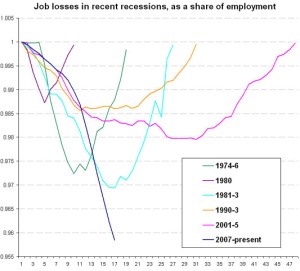 But, just because it’s marginally better, doesn’t mean the worst is over. All time series have variation and this may or may not signal the end of the worst of the worst monthly losses.
I’m still trying to figure out how people are finding glimmers of hope in this news given the historical perspective shown in this graph from the NY Times as presented by its blog Economix. This compares the current recession to previous recessions. As you can see, we’re still straight off the cliff at this point. Equally impressive is this graph from Market Watch which shows the monthly change in nonfarm payroll growth. It seems that the monthly changes may have bottomed, but it’s way too early to tell if there’s going to be any improvement. That’s when you have to examine some of the underlying factors in the market. Remember, variation in any series is to be expected so you’ll get ups and downs just from random variation. Those movements don’t necessarily indicate a trend. What do economists say about these numbers?
From Economix:
“The employment data do not yet corroborate the extent of the diminishment of the intensity of the recession suggested by other economic indicators (ISMs, consumer confidence, etc,). However, if we continue to see declines in the four-week average of jobless claims (which has fallen for four straight weeks), this may suggest smaller declines in employment later in the second quarter. Nonetheless, relating this report to the bank stress tests, the unemployment rate in April is already at the “alternative more adverse” average level assumed for the 2009…” — John Ryding, Conrad DeQuadros, RDQ Economics
“In April, more than one in four unemployed workers, 27.2 percent, had been without jobs for six months or longer, the highest rate on record since the government started calculating this statistic in 1948.” — National Employment Law Project
“The unemployment rate rose to 8.9 percent, but this is entirely due to a surge in the size of the labor force, as household employment is reported to have risen…
“[W]ith the smaller headline job loss number, many are interpreting the April employment report
as yet another sign that the economy is “stabilizing,” but the more accurate assessment is that the economy’s pace of contraction is slowing, which is not quite the same as stability and is still a long way from the economy actually improving.” – Richard F. Moody, chief economist, Forward Capital, LLC

Selling the Right to Pollute
Posted: May 6, 2009 Filed under: Environmental Protection, U.S. Economy | Tags: cap and trade, pollution, trading allowances 7 Comments I decided I need a break from the finance side of the economy for awhile and start a discussion on the Obama Administration’s Cap and Trade initiative. This is an extremely controversial plan and will basically cause political alignments of states and regions more than party affiliation. Cap and Trade programs have been discussed in economic circles for some time but have never been seriously considered anywhere but Europe, so let’s start with the basics of what may be an unfamiliar topic. Several years ago, I was asked to sign my name to a list of economists supporting the initiative. In the interest of open discussion, I’ll let you know that I passed on request.
Cap and Trade Systems are also known as emissions trading or more traditionally, allowance trading. The idea is that a company recieves an “allowance” to release a particular pollutant into the environment. It can either hold the allowance and release the pollutant, sell the allowance and give up any right to release the pollutant, or buy others’ allowances and receive a higher allowance to release the pollutant. In other words, the allowance would be a marketable asset that would be priced in a market. This makes the approach “market-based’.
The goal of a Cap and Trade System is to steadily reduce the emission of the pollutant. Int the case of the Obama Administration’s initiative, the pollutants are carbon dioxide and other greenhouse gas emissions. Initially, some one has to decide the initial acceptable ‘allowance’. This basically establishes the ‘cap’. Here’s the description of the ‘cap’ given by the Center for American Progress.
Each large-scale emitter, or company, will have a limit on the amount of greenhouse gas that it can emit. The firm must have an “emissions permit” for every ton of carbon dioxide it releases into the atmosphere. These permits set an enforceable limit, or cap, on the amount of greenhouse gas pollution that the company is allowed to emit. Over time, the limits become stricter, allowing less and less pollution, until the ultimate reduction goal is met. This is similar to the cap and trade program enacted by the Clean Air Act of 1990, which reduced the sulfur emissions that cause acid rain, and it met the goals at a much lower cost than industry or government predicted.
Zombie Negotiations
Posted: May 4, 2009 Filed under: Bailout Blues, Equity Markets, Global Financial Crisis, U.S. Economy | Tags: bank failures, Bank Stress Tests, zombie banks 3 CommentsI’m at the end of my semester which is the time when students that should’ve showed up in my office months ago suddenly feel they can negotiate a different result than the one listed in my syllabus and on my grade sheet. I’ve noticed this pattern in all my years of teaching. I get about a handful of them right after the first test that say, sheesh, I don’t think I get this what can I do? I get more than a handful the week before finals, when their grades are pretty much a given, saying, sheesh, I don’t think I can get this, what can you do for me?
There’s an implicit contract between me and my students and a good deal of it is stated in the syllabus which all of them get at the beginning of the semester. Over the years, it’s grown to being a pamphlet of sorts. Much of this has to do with either accreditation or legal requirements (like what to do if you’re disabled and need help with things). A lot of it is me trying to be absolutely, positively clear that we agree on the expectations we have in this class. I spend the entire first day going over all of these things and they all nod in agreement, don’t ask many questions, and hope they can leave early.
Why do I feel like the Fed is waving a syllabus in front of a few recalcitrant banks over the results of the so-called stress test? Are they asking why didn’t you come to us sooner when you had a problem? How much of a softie is the Fed going to be when a few of them want to renegotiate what it means to get an A,B,C, D, or F?
Living La Vida Nada
Posted: April 29, 2009 Filed under: Bailout Blues, Equity Markets, Global Financial Crisis, U.S. Economy | Tags: Financial Crisis, Financial Times., FOMC, GDP, Martin Wolf, Quantative easing, recession, Willem Buiter, zombie banks 7 Comments From the Federal Open Market Committee’s (FOMC) policy statement earlier today:
Information received since the Federal Open Market Committee met in January indicates that the economy continues to contract. Job losses, declining equity and housing wealth, and tight credit conditions have weighed on consumer sentiment and spending. Weaker sales prospects and difficulties in obtaining credit have led businesses to cut back on inventories and fixed investment. U.S. exports have slumped as a number of major trading partners have also fallen into recession. Although the near-term economic outlook is weak, the Committee anticipates that policy actions to stabilize financial markets and institutions, together with fiscal and monetary stimulus, will contribute to a gradual resumption of sustainable economic growth.
In light of increasing economic slack here and abroad, the Committee expects that inflation will remain subdued. Moreover, the Committee sees some risk that inflation could persist for a time below rates that best foster economic growth and price stability in the longer term.
In these circumstances, the Federal Reserve will employ all available tools to promote economic recovery and to preserve price stability. The Committee will maintain the target range for the federal funds rate at 0 to 1/4 percent and anticipates that economic conditions are likely to warrant exceptionally low levels of the federal funds rate for an extended period.
It goes on to state that its goal is to bring long term rates down farther by buying “up to an additional $750 billion of agency mortgage-backed securities”, “$300 billion of longer-term Treasury securities over the next six months” and “agency debt this year by up to $100 billion”. The Fed is aggressively using its balance sheet to inject liquidity into the financial system since the already low fed funds rate target is technically as low as it can get now. The Fed is hinting that we may be looking at the recession’s trough soon. Given the release of today’s 1st Quarter GDP, we can only hope and pray.
From Market Watch:
The central bank’s Federal Open Market Committee said that spending has stabilized and that the pace of the downturn appeared to be somewhat slower. The economy could remain weak in coming month but policy actions and “market forces” were aligned to create a gradual upturn, the statement said.
Fed watchers saw little drama in today’s announcement.
“The only major difference between today’s statement and the previous one on March 18 is that today’s cited the fact that most evidence points to a slowing rate of economic decline. Anyone with two eyes and a brain knows this to be the case,” wrote Josh Shapiro, chief U.S. economist at MFR Inc. in a note to clients.
Economists had expected the policy-setting panel to maintain the status quo. The FOMC kept its target interest rate unchanged at an ultra-low 0%-to-0.25% range.
The economy has fared dismally over the past six months — collapsing by the sharpest rate in more than 50 years. The unemployment rate has spiked and business investment has slowed.
The Chicago School v. The Rest of Us
Posted: April 28, 2009 Filed under: Global Financial Crisis, U.S. Economy, Uncategorized | Tags: fresh water economists v. saltwater economists, macroeconomics 8 Comments There’s a very big debate between economists that’s beginning to spill on to the pages of major newspapers. Suddenly, people that I usually only read in scholarly articles are attending conferences where they give papers in what passes off more as the lessons of theory and empirical evidence instead of the theory and evidence itself. So many folks are coming down out of the ivory towers these days that I think some kind of tipping point about the financial crisis has been reached. The only thing I can think that may have caused this escalation is the back and forth that is now the blogosphere and the financial crisis which is making a lot of folks defend their models.
Many, many academic economists keep blogs now. The readership of these blogs was originally every one’s students or the adopters of your textbook. It then became a way to pass your working papers and pubs back and forth to avoid the journals. Even a few folks have actually put their databases up for use by doctorate students. Believe me, both a blessing and a curse having been in the position of having to reproduce a bunch of stuff I’d rather have not. Many finance folks keep blogs because they make money giving advice to Wall Street Types and investors. But their blogs have taken an interesting twist too. Maybe it’s because I live blocks from the Mississippi and a few miles from a salt water lake but watching this back and forth is like watching the world’s longest intellectual and philosophical tennis match. Do we really have to repeat the Great Depression for the Chicago School to get it this time?

 peej
peej Carissa
 bostonboomer
 dakinikat
 ecocatwoman
 mablue2
 Mama Lopez
 peggysue22
 quixote
 skydancingguestblogger
 Mona (aka Wonk the Vote)



 Sky Dancing
Recent Comments