
Social Security: Why mess with an American Success Story?
Posted: December 10, 2010 Filed under: Catfood Commission, legislation, POTUS, The Bonus Class, U.S. Economy, Voter Ignorance | Tags: Clinton Obama presser, payroll tax holiday, Social Security 54 Comments
I spent most of the day listening to the Bernie Sanders show, but stories of the joint Clinton/Obama presser that turned into the Bill Clinton show grabbed my interest. I have more than a passing interest in Social Security. I haven’t paid into it for about 15 years, but I have an exhusband who has and I have 20 years worth of dibs on his account. I’m a tailend boomer with a much smaller nest egg post Financial Crisis than pre Financial Crisis. Ex Hubby’s social security and his pension plan loom on my horizon. They stop me from having bag lady nightmares.
So, what’s all this talk about a payroll tax holiday and why, all the sudden, is the Cat Food Commission’s foray into social security creeping me out? Well, for one I think that a lot of people–including the President–don’t seem to get social security, its history, its issues, and its challenges and that always irks me. For another, I think it opens this trap door to having more of my future Shanghaied. I don’t want any more of anything related to my future going off to Shanghai.
So, since the President–among others–is spreading disinformation about the Social Security program, I thought I’d take the time to remind you that I wrote a four part series on Social Security in May 2009. If you want a little background and perspective, you can go check it out. (Fortunately, it’s here in the file cabinet portion of Sky Dancing.) It is all based on Academic work and people that do active research on the program, its solvency, and its issues.
First, here’s a list of links to those old posts of mine:
Social Security: Reform, Refund or Opt-Out (Part 1) Introduction
Social Security: Reform, Refund or Opt-Out (Part 2) Public Pension Concepts and Alternatives
Social Security: Reform, Refund or Opt-Out? (Part 3) Lessons from the World
Social Security: Reform, Refund, or Opt Out? (Part 4) What to do when Pensions are out of balance
I wanted to point these out since I don’t want to completely reinvent the conversation here. The government has a website that it dedicated solely to the Social Security Act of 1935. There are still many, many people that do a lot of research in the area. Here is a link to one of the new studies that looks at the impact of increasing the level of maximum earnings subject to Social Security and its impact on the program. This is one of the things that is being suggested to increase funding for social security. Here is a brief from the National Academy of Social Insurance that looks at various funding formulas. This group is actually associated with actuaries so it is quite statistics intensive. Findings specific to this brief are:
- The number of Social Security beneficiaries per 100 covered workers will increase from 30 in 2005 to 46 in 2030 and to 50 in 2050.
- Social Security benefits will rise from 4.3 percent as a share of the total economy today to 6.1 percent in 2030.
- When baby boomers are retired, the total number of people each worker supports(including workers themselves, children, retirees, and other nonworking adults) will not be as large as it was when the baby boomers were children.
- As a share of the total economy, spending for Social Security benefits when baby boomers are retired will grow less than spending for public education grew when baby boomers were children.
- While baby boomers may have been a surprise when they turned up in record numbers to enroll in kindergarten in the 1950s, their retirement six decades later is not. Policymakers began to plan as early as 1983, when Congress lowered the cost of Social Security benefits for boomers and later generations by raising the age at which unreduced retirement benefits will be paid.
- Workers’ wages are projected to grow in real terms (that is, faster than inflation). By 2030, real wages will increase 33 percent. Even if policymakers chose to balance Social Security’s finances solely by a tax rate increase, workers’ net wages (after paying the higher tax) would still be 28 percent higher than they are today.
- While earnings that are taxed to pay for Social Security represent 38 percent of the total economy, other national income is not taxed for Social Security purposes.
- Broadening the tax base, reducing scheduled benefits, raising the Social Security tax rate, or allocating other kinds of revenue to Social Security are ways to improve Social Security finances.
So, you can see this isn’t an urgent issue right now. I guess my point is that the ‘sudden’ urgency we seem to have with social security is not something out of the blue and it’s not something that hasn’t been discussed, planned for, or actually worked on. As recently as August, the President himself gave a speech saying just these things which is why I am so confused about the Cat Food Commission’s dalliance with the program.
President Obama said Social Security is not in crisis and only modest changes are needed to keep it solvent.
The president acknowledged at a small town hall gathering in Columbus, Ohio, Wednesday that the pension fund “has to be tweaked because the population is getting older” but said Republicans’ plans to drastically overhaul the program are wrong.
“Social Security is not in crisis,” Obama said. “We’re going to have to make some modest adjustments in order to strengthen it.”
I also wanted to bring up a little bit on the idea of Payroll Tax Holidays and that bizarre Clinton/Obama presser today. I’m even more confused by this sudden urge to create a payroll tax holiday. This is an odd thing.
The tax deal reached between President Obama and congressional Republicans could mean a higher tax bill for roughly one in three workers as a result of the Social Security tax cut Republicans pushed as a replacement for the current Making Work Pay tax credit.
The Making Work Pay credit gives workers up to $400, paid out at 8 percent of income, meaning that anybody making at least $5,000 gets the full amount — and gets as much as anybody else. Its replacement knocks two percentage points off the payroll tax cut, meaning a worker would need to make $20,000 to get a $400 break. Of the nation’s roughly 150 million workers, around 50 million make less than $20,000 and will see at least some increase as a result.
Additionally, roughly a quarter of 20 million state and local workers pay no payroll tax, because they have a separate pension system. Some of those workers with children will benefit from the extension of other tax credits, but overall will have less money in their pocket.
Rep. Raul Grijalva (D-Ariz.), co-chair of the Congressional Progressive Caucus, said many House liberals were opposed to the payroll tax cut because of its effect on the poorest workers. Progressives are also concerned that the tax cut will become permanent and undermine Social Security’s funding stream and political support over time.
Social Security is a stand alone program. Mixing it as part of a goodie bag with other tax things doesn’t strike me as a very good idea from a political standpoint. It’s not part of the general budget. It’s a form of insurance. We (or in my case, my exhusband mostly) paid into it. Why mix it up with other tax give aways?
I did go hunting about for information on Payroll Tax Holidays to see if they really could stimulate the economy effectively. One of my issues is that I know that the FICA taxes are regressive because of the maximum income ceiling so I thought that the spending impact couldn’t be very large. So, it seems like getting rid of some of those taxes really gives more to the rich than the poor. Rich folks really aren’t very reliable spenders. Turns out, my hunch was studied and released in early 2009 at CBPP. They basically say that the biggest benefits would go to workers least likely to spend the money. That also seems to be every one’s take on this program. Also, there are people like me who worked for states and municipalities that don’t do Social Security. We don’t get a thing from this.
A payroll tax holiday, however, would both be costly — a two-month suspension could cost about $120 billion, for example — and likely relatively ineffective as a stimulus measure. Public resources would be better spent on stimulus measures with a higher “bang for the buck,” such as the Making Work Pay tax cut that President-elect Obama has proposed.
Economic stimulus measures aim to encourage an immediate increase in aggregate demand by boosting consumer spending. The most efficient way to boost consumer spending is to put money into the hands of people who will spend it quickly rather than save it; tax cuts focused on moderate- and low-income households are more effective as stimulus than tax cuts that are larger for people with higher incomes, because people at low-income levels spend a larger share of tax cuts they receive than people at higher income levels do.
A payroll tax holiday does not score well on this front — too little of the benefit goes to lower-income households struggling to make ends meet and too much goes to higher-income taxpayers, who are likely to save a significant fraction of any new resources they receive. Under the payroll tax, employees pay tax of 6.2 percent on earnings up to $106,800. So, for example, a worker earning $10,000 would receive a tax cut of just $103 from a two-month payroll tax holiday, while a worker earning ten times as much ($100,000) would receive a tax cut ten times as big — $1,030. Indeed, the highest-income fifth of households could receive more than half of the benefits that would go to workers from a two-month payroll tax holiday.
So, when President Clinton got up to day in a presser with Obama to support this comprise deal, I was really confused. It seemed like a double play triangulation move with a snagglepuss type-exit stage-left by POTUS. You can say a lot about Clinton–both good and bad–but he does understand his economic theory. Why would he support this?
Clinton comfortably outlined how the pending package of tax cuts, business incentives and unemployment benefits would boost the economy – even though it included tax help for the wealthy that Obama had to swallow.
“There’s never a perfect bipartisan bill in the eyes of a partisan,” Clinton said. “But I really believe this will be a significant net-plus for the country.”
When he finished his pitch, Clinton played the role of humble guy, saying, “So, for whatever it’s worth, that’s what I think.”
So, it all boils down to what can we get something past the Republicans? This entire deal puts Social Security in an awkward light. It also uses money for a payroll tax holiday that probably isn’t as efficacious as it could be if put to other uses. It also plays into the idea that giving taxes back to rich people stimulates the economy enough (VOODOO economics). It also indicates that playing up to adherents of VooDoo economics is worth adding to the deficit and to the problems with the deficit and the challenges social security faces in the future. It sets them up to make bigger arguments down the line.
I guess after reviewing everything, I just don’t see how this is worth it. Passing all of this because it’s the best you can do given the state of the Republican Klan in Kongress just isn’t good enough for me. It opens up too many issues in other areas. However, this is the graph they’re circulating as a White House talking point to show how Obama got the better deal. This is the graph that has Charles Krauthammer’s tie in a too tight double Windsor knot so much that Clinton brought it up.
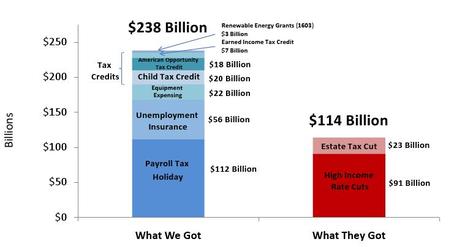
I’m not buying it. How about you?
Let’s Make a Deal or not! Redux.
Posted: December 8, 2010 Filed under: Team Obama, The Bonus Class, U.S. Economy | Tags: Bush tax cuts, polling about tax cut extensions, Tax Cut Extensions 45 CommentsSo,the top story pretty much every where is the tax deal. Oy! What a Deal! Or ordeal. Gallup has polled the voters on 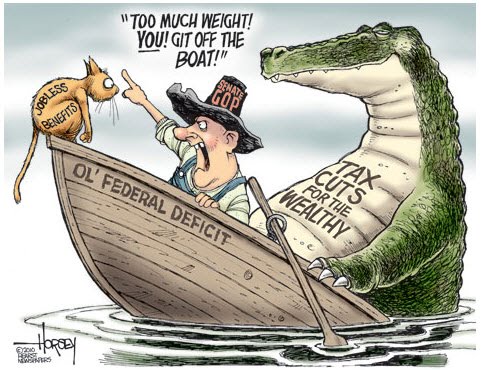 their feelings about the situation which is more than I can say for the President and the Congress.
Two major elements included in the tax agreement reached Monday between President Barack Obama and Republican leaders in Congress meet with broad public support. Two-thirds of Americans (66%) favor extending the 2001 and 2003 tax cuts for all Americans for two years, and an identical number support extending unemployment benefits for the long-term unemployed
The interesting part of the poll numbers actually is in the numbers that reflect the left and right wings and their party affiliation. Hardcore right wing Republicans don’t want extensions of unemployment benefits.
Looking more specifically at the different ideological wings of each party, only liberal Democrats oppose extending the tax breaks for everyone: 39% are in favor, while 55% are opposed. Among the other groups, support ranges from 64% of conservative/moderate Democrats to 87% of conservative Republicans.
Similarly, conservative Republicans are the only political/ideological group opposing the extension of unemployment benefits. The majority of moderate/liberal Republicans are in favor, as are most Democrats, regardless of ideology.
Gallup also polled on the DADT repeal and other issues. If you look at the numbers on each of the issues–including supporting more government regulation for food safety–the over whelming number of people do not support traditional Republican memes. If only we could get the President and the Congress to see that.
One of the things that really has frosted my cupcakes today is that there seems to be a consensus that an extension of jobless benefits was probably possible without the sell out negotiating methodology of the President. Catch this headline from the Quad Cities and Senator Charles Grassley: ‘Grassley says short jobless extension would have passed without tax deal’.
Republicans had blocked a vote on extending emergency jobless benefits, saying they should be paid for with excess stimulus money. But U.S. Sen. Chuck Grassley, R-Iowa, said today he thinks a three-month extension would eventually have gotten a vote and been approved, albeit along partisan lines.
“I think there would have been some accommodation on unemployment anyway, even if you didn’t have this tax bill,” Grassley said on a conference call with Iowa reporters.
“I think it would have been three months … a Republican measure would have been offset with stimulus money, surplus stimulus money. And if that didn’t get 60 votes, then it probably would have been not offset, and it would have been passed on a more partisan basis.”
He defended the compromise, saying that although Republicans didn’t get the permanent extension of the tax cuts they wanted, the two-year deal was better than seeing the tax breaks on all Americans end.
“It’s something where everybody was a winner,” he said.
Is any one else noticing the pattern that only Republicans and the White House seem to think this is a good deal?
A Bloomberg national poll showed that extending tax cuts to the uber wealthy is unpopular. Is it too far to the next election for any of the Congressional Beltway Blowhards to pay attention to these numbers?
Americans don’t approve of keeping the breaks for upper-income taxpayers that are part of the deal President Barack Obama brokered with congressional Republicans, a Bloomberg National Poll shows.
The survey, conducted before, during and after the tax negotiations, shows that only a third of Americans support keeping the lower rates for the highest earners. Even among backers of the cuts for the wealthy, fewer than half say they should be made permanent.
Another third say they want only the tax cuts for the middle class to be extended, while more than a fourth say all the tax cuts should be allowed to expire Dec. 31, as scheduled.
Oddly enough, the political bedfellows du jour are Jim DeMint and Bernie Sanders who are both voting no; obviously for different reasons. Then there’s already a bunch of weirdness being tacked on to the bill itself. Harry Reid is trying to add an online poker provision. Let’s see, Senator from Nevada, Las Vegas is in Nevada, tough fight for re-election … oh, you do the math. It’s just too painfully obvious.
Already, the online poker proposal has more info on the Nevada Democrat and exposed the charges of flip-flopping on a controversial issue, as well as using his Senate leadership position to repay big casino interests that helped him win reelection in a hard-fought campaign against Republican Sharron Angle last month.
Reid, who has previously opposed online gambling, declined to comment Monday through a spokesman.
But Sen. Orrin Hatch (R-Utah), as well as several senior congressional sources and gambling lobbyists, confirmed that Reid and his staff have reached out to other Senate offices to try to build support for adding the online poker legislation — a draft of which POLITICO has obtained — to a measure extending the Bush-era tax cuts.
These guys just do not listen to the voters. It’s the same old back deal, big money political two-step that makes the entire country want to scream. Steven Benen over at The Washington Monthly is looking for Plan B. Will any Democratic congressional critterz stand up for what’s right for a change?
The Center on Budget and Policy Priorities’ Bob Greenstein, who has as much liberal credibility on budget and tax issues as anyone, doesn’t seem to like the “disturbing negative” provisions of the tax policy deal struck by the White House and congressional Republicans. But he wants to see it pass anyway.”Congress should approve this package — its rejection will likely lead to a more problematic package that does less for middle- and low-income workers and less for the economy,” Greenstein said yesterday. He added that the agreement includes “surprisingly strong protections for low- and middle-income working families.”
Dean Baker, another very credible, highly respected liberal economist, reached a similar conclusion. Prominent lefty wonks like Lawrence Mishel and John Podesta offered the same assessments yesterday.
The New York Times editorial page said Democrats are “in revolt,” but they should “vote for this deal” anyway.
That’s always what the do. They get on TV. Talk about what a travesty a bill is and how it’s immoral and inhumane and just plain unAmerican. Then, they get a whiff of bacon and roll over like starving dogs. This game is getting old.
Benen’s got a big list of questions at the end of his article that demands a response.
But what then? How would extended unemployment benefits pass for the millions of jobless Americans who need them? What happens to the economic stimulus? What’s the strategy for getting quick approval for an expanded earned-income tax credit and the continuation of a college-tuition tax credit? With almost no time left on the clock, after winning the fight on tax policy, is the plan to simply punt on New START ratification, DADT repeal, the DREAM Act, food safety, and health care for Ground Zero workers, hoping for the best in the next Congress?
This isn’t a democracy. There’s no sense that any one in Washington listens to their voters or reads polls with obvious trends and consensus of opinion. The power is all located in the folks that help these people buy their elections. We’re getting to be just one big banana republic. What on earth can we do about it?
US Senate: Defenders of about 0.3 percent of the population
Posted: December 4, 2010 Filed under: Elections, legislation, Team Obama, The Bonus Class, U.S. Economy | Tags: Bush tax cut extensions, Senate 31 CommentsNews on the Senate vote on various Democratic Tax Plan compromises has just come through on The Hill and Memorandum.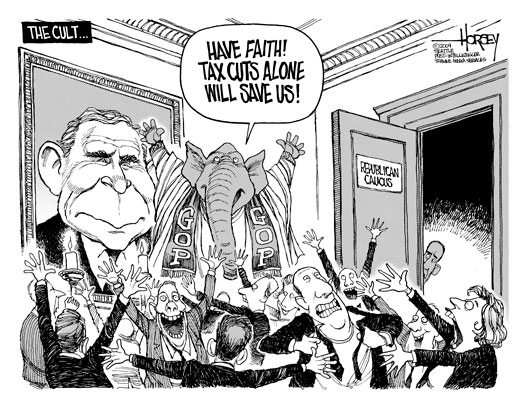 Two plans were introduced for votes. Both failed.
United Senate Republicans joined a small handful of Democrats on Saturday to defeat a pair of proposals to extend some of the 2001 and 2003 tax cuts signed into law by President George W. Bush.
Voting nearly identically, the Senate twice failed to meet a 60-vote threshold necessary to move forward on both proposals. Meeting in a rare Saturday session after agreements fell through for a Friday vote, the results were widely expected. They were also somewhat premature, as the White House is still negotiating with congressional leaders on an alternative compromise proposal.
The first proposal by Finance Committee Chairman Max Baucus (D-Mont.) would have extended the cuts only for individuals with incomes of up to $200,000 and families with incomes of up to $250,000. That failed by a vote of 53-36, with all GOP senators in opposition as well as Democrats Russ Feingold (Wis.), Joe Manchin (W.V.), Ben Nelson (Neb.) and Jim Webb (Va.).
The second proposal by Sen. Charles Schumer (D-N.Y.) would have extended the 2001 and 2003 tax cuts permanently for incomes of up to $1 million, among other provisions such as a one-year extension of unemployment benefits and cuts in capital gains, estate and dividend taxes. That failed, 53-37, with Sen. Tom Harkin (D-Iowa) joining the ‘no’ votes.
The Schumer Bill was referred to as the “Millionaire’s Tax” since most of his provisions applied to only about 0.3 percent of the population. Both plans essentially extended tax cuts to 98% of the population. Meanwhile, Mitch McConnell referred to the votes for both plans as “theatrics”. This is because Republicans had already signaled their intent to filibuster both plans. Patricia Murphy, writing for The Capitolist at Politics Daily, had this analysis. I bolded the last sentence to give you an idea of how well negotiations appear to be going.
As Democrats and Republicans continue to spar over the issue, time is running out for them to find a solution. If Congress fails to come to an agreement before the end of the year, rates for all Americans will return to 2001 levels when the Bush-era policy expires on December 31st. In addition to income tax hikes, the changes would increase the estate tax, the marriage penalty tax, taxes on dividends and capital gains, and the Alternative Minimum Tax.
While Democrats pushed their floor votes this week, a bipartisan group of senators and House members met behind closed doors with the Obama administration to hammer out a compromise on the tax issue. Vice President Joe Biden, filling in Saturday for Obama in the White House weekly address, made no mention of the negotiations, but said if the tax cuts aren’t extended “millions of middle-class families will see a big bite out of their paychecks starting Jan. 1. And that’s the last thing we should let happen.” Obama, speaking later at the Eisenhower Executive Office Building, said he was “very disappointed” that the Senate had not approved the tax bill. Continued Tax relief for the middle class should not be held “hostage” by those supporting an extension of the lower rates for high income Americans, he said.
Media reports indicated late last week that a deal had been reached to pass a two-year extension of all the tax cuts, along with a one-year extension of unemployment benefits, and the also new START nuclear arms treaty. But senior Senate aides familiar with the negotiations tell Politics Daily that Republicans feel little pressure to give in to Democratic priorities when they feel confident they can prevail on the tax issue without concessions.
It seems evident to me that the US Senate is willing to play political games with ordinary people’s lives. The Republicans appear to want to hold START, unemployment extensions, and the tax cuts for the majority of Americans hostage as they represent the interests of the very few uber wealthy and seek gridlock for their own power agenda. The Democrats have been out maneuvered once again. A year ago, this predicament would have been thought unbelievable. If you think it’s bad now, just wait until the jr. senators from Kentucky and Illinois enter the chamber.
Is Joblessness the new Normal?
Posted: December 3, 2010 Filed under: Surreality, Team Obama, U.S. Economy | Tags: Bush tax cuts, unemployment 28 Comments Why is it that every one in Washington DC is focused on the economic well being of about 2% of U.S. Households? That’s the number of U.S. households that that were expected by the IRS to make greater than $250k AGI in 2009. Why aren’t they paying attention to the number of unemployed?
The new jobless figures are out today. They’re no surprise to me and a lot of other economists. However, the worsening job situation keeps going right over the heads of nearly every one on capitol hill. Worse, the only economic policy–that coming from the FED–that shows any recognition of and response to the situation is coming under attack by the right wing and libertarian propaganda machines. Read this and realize what anemic job growth this country is experiencing. We are in the Dubya 2 economy.
In a jolting surprise to the economic recovery and market expectations, the United States economy added just 39,000 jobs in November, and the unemployment rate rose to 9.8 percent, according to the Department of Labor.
November’s number was nowhere near enough to help the large ranks of the unemployed, and was far below analysts’ consensus forecast of close to 150,000 jobs and an unchanged jobless rate of 9.6 percent. More than 15 million people remain out of work, and 6.3 million of them have been unemployed for six months or longer.
The monthly snapshot of the job market could lend more support to the suggestion by the Federal Reserve chairman, Ben S. Bernanke, that the government continue to stimulate the economy, as well as the Obama administration’s call for an extension of unemployment benefits. The apparent loss of hiring momentum may also fuel the debate over whether the government should take aggressive steps to reduce the deficit in the near term or wait until the economy returns to better health.
There’s a good article up by Catherine Rampell–also from the NYT–on the face and features of long term unemployment. That would be those folks that are labeled by the likes of Ralph Reed as unwilling to find jobs and happy living off of $200 to $300 a week. The article is called: ‘The New Poor: Unemployed, and Likely to Stay that Way’. These are the people whose lives hang like political pinatas from the ceiling of the Senate chamber. How long will they suffer from Republican Fairy Tales and the unwillingness of Democrats to stay up for what is right?
This country has some of the highest levels of long-term unemployment — out of work longer than six months — it has ever recorded. Meanwhile, job growth has been, and looks to remain, disappointingly slow, indicating that those out of work for a while are likely to remain so for the foreseeable future. Even if the government report on Friday shows the expected improvement in hiring by business, it will not be enough to make a real dent in those totals.
So the legions of long-term unemployed will probably be idle for significantly longer than their counterparts in past recessions, reducing their chances of eventually finding a job even when the economy becomes more robust.
Steven Benen from the Washington Monthly sums up the likely political response vs. the necessary one.
If our political system were sane, awful news like this would be a much-needed wake-up call that would spur policymakers to action. There would be an immediate drive on the part of Congress and the White House to do far more to stimulate the economy, inject more capital into the system, and invest in job-creation measures immediately.
Instead, Americans just elected a new House majority that is prepared to do the exact opposite — taking money out of the economy, scrapping economic stimulus, and ignoring all job-creation measures. Voters were angry about the economy last month, and in a tragic irony, elected people intent on making the economy worse.
The majority in this country has elected people ‘intent on making the economy worse’ and a president who is likely to enable them. Read this headline at WAPO: ‘Obama, GOP in quiet talks to extend tax cuts’. Extending tax cuts to the richest people in this country is an unfunded mandate of $700 billion a year. This a priority when the same party is whining about the deficit? It is clear that most of Washington is only concerned about the deficit when it doesn’t impact their constituencies and the poor, middle class, and unemployed seem to be the constituency of no one.We only deliver frantic votes that are ignored and misinterpreted.
The White House and congressional Republicans have begun working behind the scenes toward a broad deal that would prevent taxes from going up for virtually every U.S. family and authorize billions of dollars in fresh spending to bolster the economy.
Negotiations have accelerated in recent days as Congress has confronted deadlines for extending a series of tax cuts that expire at the end of the month, renewing emergency jobless benefits and keeping the government funded into next year.
The talks mark the dawn of a new era on Capitol Hill, with resurgent Republicans holding far more leverage and commanding a more prominent role in crafting legislation. The private discussions, which parallel a more public set of talks, have left many Democrats grousing that President Obama is being too quick to accommodate his adversaries, who are still a month away from taking control of the House and expanding their presence in the Senate.
These “grousing” Democrats are the same ones that blew a huge majority and mandate on passing Dole/Romney Care instead of taking care of the economy right from the beginning. They were also the crowd that passed stimulus spending that was inadequate and loaded with pork pies meant to stimulate a few at the expense of the many.
So, now folks like Senator Harkin find their Democratic Voice? When they face the steam roller straight on? This dandy quote is from HuffPo.
Sen. Frank Lautenberg (D-N.J.), for one, slyly acknowledged that he’d get himself in trouble if he answered whether or not he was happy with the administration’s engagement.
“You want me to be the [troublemaker]?… I’m too junior around here to do that,” said the 86-year-old, five-term senator.
Sen. Tom Harkin (D-Iowa) did a little less dancing. “I just think, if [Obama] caves on this, then I think that he’s gonna have a lot of swimming upstream [to do],” said the Iowa Democrat, a unabashed progressive who has been less reticent than most in criticizing the White House. “He campaigned on [allowing the rates for the rich to expire], was very strong on that, and sometimes there are things that are just worth fighting for.”
And if he decided to compromise away from that, a reporter asked the senator.
“He would then just be hoping and praying that Sarah Palin gets the nomination,” Harkin replied, insinuating that there would be few other Republicans that Obama could assuredly beat in 2012.
Oh, great! We’re facing down a 10% unemployment rate with historic long term unemployment and all they can think about is the 2012 elections? We are so f’d.
Cheers Jane!!
Posted: December 2, 2010 Filed under: Surreality, Team Obama, U.S. Economy, Voter Ignorance | Tags: Extension of Bush Tax Cuts. 48 CommentsA nearly teary-eyed plea from FDL’s Jane Hamsher on MSNBC tops a post called The game IS rigged. We’ve had Allan  Simpson chortle with glee at the idea that the government will be shut down. John Boehner is strutting around Capitol Hill like some kind of preening banty rooster.
And all for what? Tax cuts for Millionaires? All this for TAX CUTS for MILLIONAIRES? The bill to extend tax cuts to less than $250k passed the House. Now, it hangs out there in the Senate like a pinata while what we are talking about are people’s lives. Where’s the extension for the unemployed among us?
“Republicans are worried about this proposal because it would expose that they are fighting for millionaires instead of the middle class,” said Schumer’s spokesman Brian Fallon in a statement to me.
Back to Jane.
Okay. So Obama won’t come out in public and say that he only wants a bill extending tax cuts for people making under $250,000 a year, he won’t threaten to veto any bill other than that, we know the House has scheduled a vote that can’t possibly pass, and the Senate doesn’t even have the support from the Democrats — let alone enough Republicans to pass it.
Uh-huh. Right. So this is what Obama REALLY cares about.
Bulllshit. We’re headed for extending ALL the tax cuts for 2-3 years, because that’s what Obama really wants. The rest is just political theater designed to appease the chumps base.
Meanwhile, as entertaining as all of this is to political junkies, 2 million people are set to lose their unemployment benefits by the end of the year. Which nobody, in the midst of their partisan game playing, seems to give a shit about.
It’s Christmas time, you bastards. People can’t feed their kids. You continue to shovel trillions of dollars at the banks. And all of you — Pelosi, Reid, Obama — you fail the test not only of leadership, but of basic human compassion. Of having any kind of a moral compass.
The game is rigged. And nobody will be fooled into thinking that little treat you’re going to drop in their Christmas stocking is anything other than a lump of coal.
 Yup. Merry, Merry, all those of you making over $250k a year. If you’re one of the long-term unemployed, well you just get that old lump of coal when the pinata falls because what happens in the beltway these days isn’t about us. It’s about THEM. Oh, and meanwhile, the Cat Food Commission Report is picking up steam. Guess that’s what’s cracking on New Year’s eve! That’s not a popper. it’s the backs of the middle class and seniors

 peej
peej Carissa
 bostonboomer
 dakinikat
 ecocatwoman
 mablue2
 Mama Lopez
 peggysue22
 quixote
 skydancingguestblogger
 Mona (aka Wonk the Vote)



 Sky Dancing
Recent Comments