
Empowering a Failed Hypothesis
Posted: December 20, 2010 Filed under: Global Financial Crisis, The Great Recession, U.S. Economy, WE TOLD THEM SO | Tags: Allan Blinder, joseph stiglitz, Paul Krugman, Perversions of economics, Reaganomics, START TREATY, Supply Side Economic hypothesis 58 Comments One of my neighbors is a public defender who is a New Orleanian by birth and fits all the standard eccentricities of New Orleanians. He spent some time in the Navy during the Vietnam period. Now my friend is very liberal, but one of his buddies from the Navy time that visits frequently is not. The buddy lives in rural Washington state and teaches in a small college there. How he every managed to get a gig teaching economics with just an MBA still boggles my mind, but that is the deal. When you do a stint in actual economics–not just managerial economics and your basic theory classes–you spend a lot of time proving theoretical models. By the time you get farther in a program and have completed your first few econometrics courses, you’re taught how to empirically validate or destroy other folk’s academic work and their models.
One of the easiest groups of hypotheses to shoot down empirically came from the Reagan years. The results were pretty astounding–we would call that highly significant to what ever statistic was used–so much that David Stockman and Bruce Bartlett gave those hypotheses up rather quickly and they were key architects of the Reagan Economic Revolution. You can’t find a’ conservative’ economist in the sense of Reaganomics unless it’s one at the Heritage Foundation that is paid to deliberately ignore the facts. In which case, that explains why they’re no place else BUT the Heritage Foundation.
Or they’re like my friend’s buddy who still goes back to the 1980s and pulls out old articles about things like the Laffer curve and teaches it because he wants to show all “opinions”. That’s what he says to me any way, when I ask him why he teaches a failed hypothesis. Frankly, he teaches it because he wants others to share his hopes and wishes that the silly thing is true. Because he’s not had the rigorous training to prepare to do actual economics, he just teaches want he wants to teach. He also hasn’t gone through publish or perish where you don’t get to have opinions without peer-reviewed facts. This drives me nuts. You can’t teach theory or empirical evidence or the scientific approach by clinging to a failed hypothesis. This makes you an intellectual flat earther.
What we currently have right now is a president that is giving the Flat Earth Society the primary voice in NASA policy and funding when it comes to economic policy. Paul Krugman has an op-ed from this weekend that firmly states that Obama has empowered the economics version of the Flat Earth Society. His op ed is called ‘When Zombies Win.’ It’s exactly what needs to be said.
First, the original Obama stimulus plan was anything but text book Keynesian economics and can’t be seen as a way to shout fail on Keynesian theory. It was more based in Reagan philosophy and those failed hypotheses than any neoKeynsian model. While I’ve continually called the Supply Side wishful thinking as a failed hypothesis, Krugman is more direct. He refers to it as failed doctrine.
For the fact is that the Obama stimulus — which itself was almost 40 percent tax cuts — was far too cautious to turn the economy around. And that’s not 20-20 hindsight: many economists, myself included, warned from the beginning that the plan was grossly inadequate. Put it this way: A policy under which government employment actually fell, under which government spending on goods and services grew more slowly than during the Bush years, hardly constitutes a test of Keynesian economics.
Now, maybe it wasn’t possible for President Obama to get more in the face of Congressional skepticism about government. But even if that’s true, it only demonstrates the continuing hold of a failed doctrine over our politics.
I wrote repeatedly at the time–no Nobel winning economist am I either–that the stimulus was bound to be way too little to be of any use. You can read me screaming ‘Tax Cuts Don’t Cut It or Cure It’ from January 2006, 2009 where I quote John Mishell’s study that talks about how the Bush tax cuts didn’t grow jobs and didn’t grow the economy. As a matter of fact I have many posts up along that line. Here’s one covering the FT’s Martin Wolf where I talk about the same thing and it’s even called ‘Still Too Little and WAY TOO Republican” from January 17, 2009. You can search my archives during that time period and find I’m very consistent at writing how the Obama stimulus would fail and that it was primarily because it was based on tax cuts.
It’s really quite a logical situation and one the most flawed precepts sits right there in the Obama-McConnell tax travesty. There’s a huge tax write off in the bill for companies buying new equipment. This is something completely ineffective because it just helps the few companies that would’ve done that any way. The majority of companies are hurting for customers. No amount of tax write offs for equipment or even employees is going to make them expand if they don’t have customers or revenue. In fact, my guess will be that an academic study some where down the line will show that the majority of those tax cuts were used by corporations who expanded in emerging markets instead of here. That’s because that’s where the inflation, growth and action is and there’s nothing in the bill that says tax benefits stay here.
Krugman also talks about something I spoke to recently in that nearly every Republican put in charge of some committee dealing with some aspect of the economy is so far out there on doctrine and short on economic theory and evidence that we’re bound to see more of the same stuff that tanked us the last time out. The Republicans sitting on the Financial Crisis panel just put out their financial version of the Earth is Flat manual last week. They said it was too much regulation which is pretty much the exact opposite of everything that every empirical study has shown us. Here’s one I keep pushing called “Slapped in the Face by the Invisible Hand” because it’s nontechnical in nature. Krugman called the release of the document ‘Wall Street Whitewash’.
So, Krugman’s op ed from this weekend isn’t astounding in that we all know what neoKeynisans like Stiglitz, and Blinder, Sachs and Krugman have been saying for months now. Now that I’ve read BB’s morning links, I’m even getting a better feel for the source of my weekend wonderment on Krugman’s bottom line. Krugman was one of a group called before the President in an attempt to get them to STFU. The deal is this. The Nobel Peace Prize may now be given on an ‘aspirational’ basis, but the Nobel Prize for economics is not. Stiglitz and Krugman earned their Nobel Prizes. I admit to having empirically tested some of Blinder’s models doing my first Masters in Economics so I’m very familiar with his contributions to the literature. These economists live in a world of peer review where there’s a very dim view of people who cling to failed hypotheses.
So, here’s the wonderment from Krugman’s December 19, 2010 op-ed.
President Obama, by contrast, has consistently tried to reach across the aisle by lending cover to right-wing myths. He has praised Reagan for restoring American dynamism (when was the last time you heard a Republican praising F.D.R.?), adopted G.O.P. rhetoric about the need for the government to tighten its belt even in the face of recession, offered symbolic freezes on spending and federal wages.
None of this stopped the right from denouncing him as a socialist. But it helped empower bad ideas, in ways that can do quite immediate harm. Right now Mr. Obama is hailing the tax-cut deal as a boost to the economy — but Republicans are already talking about spending cuts that would offset any positive effects from the deal. And how effectively can he oppose these demands, when he himself has embraced the rhetoric of belt-tightening?
Yes, politics is the art of the possible. We all understand the need to deal with one’s political enemies. But it’s one thing to make deals to advance your goals; it’s another to open the door to zombie ideas. When you do that, the zombies end up eating your brain — and quite possibly your economy too.
What is even more significant is that this horrible tax bill was put forward so as not to stall things like START. So, what is the status of the START Treaty and the Republicans who said they’d play ball if the Tax Cuts for Billionaires program was passed. Has this eased the hostage crisis?
Well, the vote is supposed to be held tomorrow so we shall see. But, this is quote is fresh from the AFP 4 hours ago from the moment I’ve hit the publish button.
Democrats expressed astonishment that top Republicans continued to oppose ratification when virtually every present and past foreign policy or national security heavyweight backed the move, regardless of their political stripes.
In that same announcement, Mitch McConnell was quoted as saying he’d vote against it the ratification. So is John Kyl. Collin Powell and Condoleeza Rice support the ratification of this treaty. This is what you get when you negotiate with terrorists; domestic or otherwise.
This President has consistently used the failed dogma of Reaganomics in economic policy. It makes no difference if the wackiest of the right wing say he is a socialist. The evidence clearly points to his obsession with failed tax cut dogma. I don’t know if his reasons are political or if–deep down–he is a Republican in Democrat Clothing. All I know is that we can no longer empower a failed hypothesis. I certainly hope that Michael Hirsch’s list of ‘Disillusionati’ continue to expose this economic policy for what it really is.
UPDATE via commenter waldenpond at TL.
File this under we told you so,
love, the Sky Dancing Cassandras
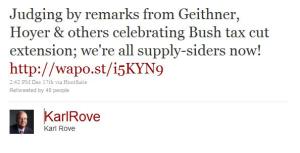
Understatement of the Year Award
Posted: December 17, 2010 Filed under: Bailout Blues, The Great Recession, U.S. Economy, U.S. Politics, We are so F'd | Tags: Income Inequality, Tax Cuts for Billionaires, tax situation for the wealthy 55 Comments From Bloomberg Business Week:
It’s a Great Time to Be Rich
“If the tax cuts become law, the next two years will be the best in living memory for many wealthy Americans to shield their income and fortunes “
A bonanza of new and extended tax benefits could make it as easy as ever for the rich to stay that way.
Under legislation approved by the U.S. Senate on Wednesday, Dec. 15, and now moving on to the House, savvy wealthy Americans would be able to capitalize on an environment in which their tax rates on income and investments remain at historic lows. Also, new rules would make it possible to pass on fortunes to heirs with less fuss and lower taxes than all but a brief period of the past 80 years. It’s a far cry from the 70 percent bite the federal government took out of the largest incomes and estates as recently as 1980.
“The climate we’ll have after this legislation is extremely favorable for wealthy families,” says Jeffrey Cooper, a professor at Quinnipiac University School of Law and a former estate planner who has studied the history of U.S. tax law.
The article goes on to list the incredible list of give aways to people that don’t need it in the Tax Cuts for Billionaires Act. Here’s one salient point to think about while eating your daily gruel and waiting for the debtor’s prisons and poor houses to re-open so you’ll have some place to go when the banks seize your home illegally .
The good news for the rich starts with income tax rates, which for top income groups would remain 35 percent , a rate enacted by former President George W. Bush in 2003. Except for a period from 1988 to 1992, the top tax rate has never been this low since 1931.
Happy Days are here again if you’re part of the investor class too! I’m getting nostalgic for Nixon. That says something, doesn’t it?
For the country’s wealthiest families, income from wages can be far less important than income from investments. According to a Tax Policy Center analysis of 2006 returns, 18.1 percent of all Americans’ cash income comes from business ownership or capital investments, compared with 64.5 percent from labor. For those in the top 1 percent of earners, however, business and capital income make up 53.6 percent of income and labor accounts for 35.3 percent.
Thus, Cooper notes, taxes on capital gains and dividends can be far more important to the rich than income tax rates. The tax compromise extends a 15 percent top tax rate on long-term capital gains and dividends enacted in 2003, which is the lowest rate since 1933. The top capital-gains rate was 77 percent in 1918 and, since 1921, its highest point was 39.9 percent in 1976 and 1977—though certain gains could be excluded from taxation.
No wonder Charles Krauthammer’s red face is all aglow with the spirit of the season!! It’s just not the prunes and the eggnog!!
How can any one defend this administration and its policies as being anything the worst of Reaganomics? At a time when we are seeing record long term unemployment, record foreclosures, record numbers of home owner’s with underwater mortgages, this is what we get. The same folks that benefited from all those bail outs from their failed business decisions and failed investment strategies are being subsidized again.
How can any Democratic congress critter go home and face any of their middle and working class constituents knowing full well they sold their souls to the Obama Company Store. I’m more convinced than ever that this country is in banana republic territory. Next step will undoubtedly be removing what little of the safety net was left in place after Reagan hit the country. After all about one half of U.S. children will most likely be on food stamps at some point in their life. Afterall, they could be out selling matches in the street!! And It’s Christmas time! Why not recreate Dickensian poverty? I’m sure we could use a few child work houses too! After all, it would contribute to the bottom lines of the people that really matter in this country!!
Friday Reads
Posted: December 17, 2010 Filed under: just because, morning reads, No Obama, U.S. Economy, U.S. Politics, We are so F'd, WE TOLD THEM SO | Tags: Afghanistan War, FED to lower fees on MASTERCARD and VISA, Polar Bears, Tax Breaks for Billionaires, Worst President EVER 41 Comments
Welcome back to the Gilded Age!!!
Well, it’s morning!
It’s more like a mourning morning than anything else. If you ever needed more proof that voting for Democrats appears to be a waste of time any more, this is it. Republicans have been overrun by Birchers and the Dems appear to be ready to let them get away with anything. On top of that we have a president that appears to want to further enact Reaganomics. It’s really a very sad situation.
Politico has an apt headline from last night’s gruel for every one else spending bill. You know those guys and gals that easily passed the Tax Breaks for Billionaires Bill? The headline is ‘Democrats concede budget fight to Republicans’. Senate Democrats don’t fight for the high ground and they sell out everything.
Senate Democrats abruptly abandoned an omnibus budget bill for the coming year, pushing major spending decisions into the next Congress and giving Republicans immense new leverage to confront President Barack Obama priorities.
The decision Thursday night sweeps away months of bipartisan work by the Senate Appropriations Committee which had crafted the $1.1 trillion bill to meet spending targets embraced by Minority Leader Mitch McConnell (R—Ky.) himself prior to the elections.
Sen. Robert Bennett (R—Utah), an old McConnell friend, worked actively to round up as many as nine potential Republican votes for the compromise, but these numbers rapidly evaporated amid personal attacks and the uproar this week over spending earmarks in the package.
McConnell, embarrassed by reports on his own earmarks in the omnibus, went to the Senate floor Thursday to propose a one page, “clean” two month extension of the current stop gap funding resolution that has kept the government funded since Oct. 1. And as if caught with their hands in the cookie jar, he and other top Republicans vowed to do everything in their powers to kill the omnibus to square themselves with their tea party backers.
It keeps getting worse. This is also from Politico: ‘Democrats keep ‘don’t ask’ on wish list’. Wish list? They’ve got enough votes to repeal DADT. WTF is holding them up?
Senate Democrats on Thursday moved one step closer to repealing the Pentagon’s “don’t ask, don’t tell” policy, with Majority Leader Harry Reid (D-Nev.) scheduling a key vote Saturday on a bill to end the ban on openly gay service members.
But Democrats are bracing for an enormous backlash from repeal advocates if they fall short again.
As time runs out on the 111th Congress, top Democrats are pointing fingers at Republicans for stalling Senate action, saying if the buzzer sounds before Congress ends the policy, the GOP will be to blame. Still, there are at least four Republican senators on the record saying they’ll vote to repeal “don’t ask” under the right procedural circumstances.
Democrats also are reminding gay-rights activists that they — not their Republican counterparts — have been fighting to overturn the 17-year “don’t ask, don’t tell” policy.
One Republican senator suggested “he was going to do everything he could to run out the clock,” Reid, a Nevada Democrat, told reporters. “I don’t think that’s really what the American people want — to run out the clock. I think what they want is for us to get things accomplished.”
They frittered away two years of a supermajority when they could’ve really accomplished things instead of following–at best–a Reagan/Dubya Democratic president. Obama’s re-election strategy is going to be to basically run as a Republican. I hope all those Dems that supported his vanity agenda that gave tons of money to the corporate plutocracy get thrown out of office next time. At the very least, some special hell realm should await them.
Here’s more information on the passage of the Tax Breaks for Billionaires Act. It also zoomed through the House. Thanks a lot Nancy! You are sooooo gonna get lumps of coal in your stockings for the rest of your life!
Congress passed the most far-reaching tax bill in a decade late Thursday, averting across-the-board tax increases, enacting new breaks for individuals and businesses and laying a marker for how Washington might work in an era of divided government.
The bill goes to the White House for President Barack Obama’s signature after the House overcame persistent liberal opposition and passed it with an unexpectedly large bipartisan majority of 277-148. The measure passed the Senate earlier in the week also with an overwhelming majority.
The bill reaches deeply into the life and economy of the U.S., more so than might have been expected when Congress first started tackling the matter. Wage-earners will get a new payroll tax break; wealthy heirs get a lower estate-tax rate; and businesses gain an unexpected plum—a big tax write-off for new equipment purchases.
I don’t want to hear any of these jackasses talk about the deficit if they can justify signing this kind of disastrous economic policy. It’s tax pandering and pork squandering at its absolute worse. There’s absolutely no economic justification for this.
So, at least one piece of good news is coming out from the Fed. Yup, that’s the FED that all the tea partiers love to hate. The Dodd-Frank Law that extended the FED’s ability to regulate credit is actually having an impact. If you give the Fed the power to do things, they will do it. They’re reeling in the extraordinary profits from VISA and MasterCard.
Visa Inc. and MasterCard Inc. may face permanent damage to the fastest-growing part of their business after the Federal Reserve proposed rules that could cut debit-card transaction fees by 90 percent.
“It is negative all around,” wrote Scott Valentin, an analyst at FBR Capital Markets, in a note to clients. “This significantly impacts the business model for the networks.”
Visa and MasterCard, the world’s biggest payment networks, plunged more than 10 percent in New York trading yesterday after the Fed proposed capping so-called interchange fees at 12 cents each. Currently, the networks charge merchants an average of 1 percent of the purchase price, regardless of cost, and pass that money along to card-issuing banks.
The change, if approved by the Fed after a public comment period, would wipe out most of an estimated $15 billion in annual revenue for U.S. lenders that issue Visa and MasterCard debit cards, including Bank of America Corp., JPMorgan Chase & Co. and Wells Fargo & Co.
“These credit-card giants and banks are imposing fees that are in no relation to the actual cost of processing, and the retailers and merchants have no way to bargain or even resist these increases,” U.S. Senator Richard Durbin, the Illinois Democrat who pushed for the caps, said in an interview. “This new law brings the Federal Reserve into the picture and changes that dynamic.”
Couldn’t happen to a nicer group of plutocrats! Here’s a somewhat depressing headline from The Daily Mail : ‘We’re living longer… but not healthier: Children born today will suffer an extra year of disabilities than those born three decades ago’.
Living longer is not necessarily a bed of roses – it may mean more years spent struggling with disability, researchers say.
Figures show life expectancy is rising but that in return people born now will have to cope with disability or a long-term illness for an extra year compared with those born 30 years ago.
The gender gap is also closing, with women losing their traditional advantage in having better health for longer as they enjoy greater life expectancy.
There is some especially bad news for elderly women.
Men born in 2007 are likely to spend an even greater proportion of their life in poor health, 8.7 years compared with 6.4 years in 1981.
Women today spend 11 years in poor health compared with 10 years in 1981, according to figures from the Office of National Statistics.
Most of these problems will be due to obesity, an increase in hypertension and high cholesterol, more cancer, and more diabetes and cardiovascular disease. Lifestyle and eating habits as well as exercise are more important than ever.
The Independent has a article up about a new threat to Polar Bears from climate change. Scientists believe that there will be polar bear-grizzly bear hybrids as the two species have to change their habits to survive the immense loss of habitat. Polar bears are especially endangered.
The first polar-grizzly hybrid to be spotted in the wild was shot by hunters in 2006. It was a white bear with brown patches and DNA tests subsequently confirmed that it was the result of cross breeding between the two species.
Although hybrids were known from captive bears kept in zoos, none had been confirmed in the wild. However, earlier this year another hybrid was killed by a hunter in the western Canadian Arctic and tests confirmed that it was a second-generation hybrid – the offspring of a hybrid female and a pure-bred grizzly bear male.
Scientists said that more cases of polar-grizzly bear hybrids are probably out there waiting to be discovered because of the change in behaviour of the polar bear brought about by climate change. They are spending more time on shore waiting for the sea ice to form, bringing them into close contact with grizzlies.
Brendan Kelly of the US National Marine Mammal Laboratory in Juneau, Alaska, led a study that found 34 possible hybridisations between discreet populations or species of large mammals living in or near to the Arctic. Twenty-two of these cases involved isolated populations at risk of intermixing.
“The Arctic Ocean is predicted to be ice-free in summer before the end of the century, removing a continent-sized barrier to interbreeding. Polar bears are spending more time in the same areas as grizzlies; seals and whales currently isolated by sea ice will soon be likely to share the same waters,” Dr Kelly and his colleagues report in the journal Nature.
It looks like its going to be one of those days where I’d just like to pull the covers over my head and stay asleep. A recent report on the war in Afghanistan shows very mixed results.
Already, parts of the country with fewer troops are showing a deterioration of security, and the gains that have been made were hard won, coming at the cost of a third more casualties among NATO forces this year.
Then there are the starkly different timelines being used in Washington and on the ground. President Obama is on a political timetable, needing to assure a restless public and his political base that a withdrawal is on track to begin by the deadline he set of next summer and that he can show measurable success before the next election cycle.
Afghanistan, and the American military, are running on a different clock, based on more intractable realities. Some of the most stubborn and important scourges they face — ineffectual governance, deep-rooted corruption and the lack of a functioning judicial system — the report barely glanced at.
“We have metrics that show increased progress,” said a Western diplomat in Kabul. “But those positives are extremely fragile because we haven’t done enough about governance, about corruption. 2010 was supposed to be a year of change, but it has not changed as much as we hoped.”
It’s not known as the grave yard of empires for lack of evidence, that’s for certain.
Anyway, hug your loved ones and appreciate the local if you can, because, all I can say is we are so f’d on the national level.
Oh, there’s one thing I’m kind’ve giggling about. The Obamas are not on the Wedding list for the Prince William/Kate Middleton merger. Next time, some one should tell FLOTUS she’s not to touch the Queen and tell POTUS it’s totally tacky to return a present like a bust of Churchill. Saying you didn’t know who it was makes the return even worse.
Oh, the humiliation. Once not so long ago one of the world’s top celebrities in his own right, Barack Obama and his wife Michelle did not make the cut for invitations to the royal wedding in London next spring.
On April 29 in Westminster Abbey with all the grace and pageantry sure to capture international imaginations, commoner Kate Middleton will marry Prince William, son of Princess Diana. And don’t forget the horsedrawn carriage perhaps.
But the current residents of the White House will not be there, according to the Daily Mail.
The official excuse provided to the British paper by royal sources is that the royal couple wants to share their special nuptial moment with ordinary citizens. Anyway, it is not an official state event, they said. And, you know, Westminster only seats 2,000.
Nice try.
So then how to explain the invites to French president Nicolas Sarkozy and his wife Carla Bruni?
What goes around eventually comes around. Karma will out.
What’s on your reading and blogging list today?
Tax Pandering is the Problem
Posted: December 13, 2010 Filed under: jobs, The Great Recession, the villagers, U.S. Economy | Tags: Kevin Drum, Mother Jones, voodoo economics 11 Comments So, now there’s a bunch of polls showing that the public basically approves of most of the tax cuts. yhe village chattering class (e.g Kevin Drum of Mother Jones)sees this as a sign of potential support for Obama and the Democrats.
To me, that’s about like polling on the question: Would you look a gift horse in the mouth? Of course, every one likes some change in their pockets. But at what cost? The polls aren’t asking that question. The one part of the tax deal that came out with a disapproval was the cut in payroll taxes. But, that’s the big Obama win, right? So, the villagers have to explain why EVERY one should just love that.
The explanation given by Drum is that every one is really dumb and thinks this will bankrupt social security because no one will pay into to it for a few years. He’s thinking people don’t see the promised government IOU. He’s got a list of how dumb he thinks we are about this and you’ll see it at the bottom of the post. So, now we do economic policy on polls? Can I get a witness that just because people like something doesn’t mean it’s good or wise policy? It doesn’t even mean that if they see the hamburger today, they’ll be willing to pay for its cost on Tuesday either. My guess is when the tab comes, there will be some unhappy polls then.
The major economic argument for this package is basically that you don’t raise taxes in a weak economy. That is basic Keynesian thought and it’s odd to see the entire Republican party joining hands and singing “We’re all Keynesians now”. A secondary argument is that any thing bartered away at this point is worth it because we extend long term unemployment benefits.
What you don’t see is a larger discussion of this all in terms of the economic situation and what is called for in these circumstances except in economist circles. This really worries me. Did you notice this ABC poll doesn’t ask people how they feel about giving cash subsidies to corn growers or the deal on equipment write offs? Those are also components of this tax giveaway. The poll also doesn’t ask people about what they think this will do to the deficit in the future and the cost of government borrowing. (Even Moody’s is threatening to downgrade our debt on the merits of this plan.) This poll basically asks, “Would you like more money in your pocket or not?” I can only image the naysayers like me either know their economics or they’re like me and not getting anything from this tax bill but the bill.
So, rather than listen to the failed lawyers who make up our policy decision=making class and the spoiled, rich little nitwits that write the punditry blogs in the MSM, let’s check out what some economists have to say. We’re going for three of them here. There will be four if you count me.
I linked down page on the morning reads thread to a blogger named Chevelle who was a government economist who now works at an asset management firm. She has a very good short piece up on why these tax cuts are a very “dumb” idea. Her basic analysis actually sounds a lot like Larry Summers’ parting shot in Time Magazine. Another similar voice can be read in the WSJ and comes from Nobel prize winning economist Joseph Stiglitz who calls for a second stimulus package that’s not tax cut loaded. The tax cuts may be politically popular but they don’t really take care of our problems right now. The money used for the tax cuts would be a lot more powerful and useful if it was targeted at the problem in the form of Government Expenditures. That’s what all three of them say in their commentary and that’s what I’m arguing for here. It’s your basic expenditure multipliers stuff from Economics 101.
We’ll start with Larry Summers who answers the question “what is holding the economy back?”. I’m actually beginning to think this parade of economists out of the West Wing door is ominous. This article just gives me more of those willies. Here’s the problems per LaLa.
• When unemployment has been above 9% for 19 straight months,
• When the job vacancy rate is at near record low levels,
• When 8 million houses and countless square feet of office and retail space sit empty,
• When capacity utilization in the nation’s factories and on its railways and highways is nearly as low as it has been in any period since the Second World War,
• There cannot be any question that the constraint on our economy now and for the next several years will be lack of demand.
I am under no illusion that increased demand alone is sufficient to restore America’s economic health, but it is an unquestionably necessary component of a full recovery.
Unfortunately, the approaches we have become used to over the last fifty years for supporting demand in a market economy are not open to us today.
Base interest rates cannot fall below their current level of zero.
And, in the face of excess capacity and excess debt, it is not clear that, even if they were possible, falling interest rates would be effective in convincing consumers and businesses to spend more.
That sounds a lot like what Stiglitz wrote too.
“The first stimulus package had too much emphasis on tax cuts. Those were relatively ineffective and not enough aid for the states,” Stiglitz told reporters on the sidelines of a seminar in Chile’s capital.
A new stimulus package should include a revenue-sharing program to make up for a shortfall in state revenue and should pick up the states’ investments that had to be stalled. Also, there should be a special focus on human capital, in particular on education and training, he said.
“We have to believe that the economy will eventually recover…[W]hat kinds of jobs will we want to have in five years…[W]e need to have people trained for that,” Stiglitz said.
Additionally, Stiglitz argued the U.S. Federal Reserve’s quantitative easing bond-purchasing program is creating an excess of liquidity, which is flowing into emerging-market nations.
Emerging-market economies such as Chile’s are growing at a much faster pace than the U.S. and have comparatively higher interest rates, making them attractive destinations for investors looking for higher returns.
According to Stiglitz, the $600 billion bond-purchasing program has created a large amount of “liquidity looking for relatively safe high returns” that aren’t found in the U.S. but can be found in many emerging-market nations.
As many emerging markets are trying to discourage capital inflows, “the liquidity goes to the places where they haven’t yet put barriers for the inflows,” Stiglitz told reporters.
Okay, now to blogger Chevelle from Models & Agents. She begins by explaining how most people are back on their life time budgets as measured by the PCE or Personal Consumption Expenditure/per employed person. It’s back to the lackadaisical pre financial crisis level. We actually all have a life time expenditures patterm that tends to be consistent over our lifetime. Some times we borrow and over spend a little. Other times we panic and save. Eventually, we get back to the mean. Employed people are at that now. It’s the unemployed that aren’t anywhere near their usual budget. This package does nothing about that.
That the problem with the economy is not that (employed) Americans don’t consume enough; it is that we have too many unemployed people who can’t consume, not even the basics. And this is my first reason why giving a tax gift to employed Americans is a completely dumb policy: Not only is it unfair to the unemployed; it is questionable whether those Americans with jobs and with comfortable cash positions are going to spend this tax gift, if they are already close to reaching their long-term consumption growth. So much for a “targeted”, “efficient” fiscal “stimulus”.
She also argues that we do face a potential government debt problem in the intermediate future and doing more dumb tax cuts is just going to exacerbate the problem down the road. That also has disturbing implications. Then, there’s the payroll tax cut. That’s what Kevin doesn’t grok.
What does the cut in the payroll tax do? If anything, it reduces labor supply. This is because employed workers could work fewer hours and still end up with the same amount of disposable dollars as before the tax cut. So, at the margin, they would reduce the hours they offer to work. (To throw a bit of jargon, the labor supply curve shifts to the left: i.e. less labor is offered for a given wage).
Now, this might (temporarily) close part of the labor supply-demand gap—i.e. reduce unemployment. But that’s a reduction for the wrong reason! What we really need is for unemployment to get reduced due to an increase in labor demand (ie policies to shift the labor demand curve to the right!). So, in theory, *if* the government had cash to spare, and *if* companies’ reluctance to hire were driven by a liquidity constraint, the appropriate policy response to raise employment (and thus, consumption, GDP growth and so on) would be to give a temporary cut in the employers’ portion of the payroll tax, not the employees’.
What she’s saying here is that a payroll tax cut is likely to make employed people work less hours, but it is unlikely to cause employers to hire more people. She also continues to explain the impact on long term borrowing for the government of doing this kick-the-can-down-the-road policy.
So, while Kevin Drum is excited about is that warm tingling leg feeling he gets speculating that if people like the policy that might make people like Obama and the Democrats a bit more now. Then, he can feel good about himself again as a Progressive (TM). What he’s really missing is that it’s going to make the situation worse that’s got people peeved at Obama and the Democrats now. It’s not even robbing Peter to pay Paul. It’s borrowing money from both Peter and Paul. It’s giving money to people who will most likely put it into places where it will go stimulate the economies of emerging markets. It’s not going to do much here at all.
What we’ve got going is a long term unemployment problem with all that implies, and as Larry Summers said, a long term consumption problem. The people who get this tax cuts aren’t going to change their spending behavior at all and that’s not going to help the economy. If anything, the money going to the rich will head off overseas quicker than a credit card call center. It’s going to add to the deficit which will create long term debt problems. It does nothing to ensure the long term unemployed will maintain marketable job skills and their ability to eat and stay in their homes. It does nothing to really stimulate buying where it possibly could help. It’s an expensive gesture and that’s about it.
The one thing good that came out of the Reagan years was that we learned that the shot gun approach to tax cutting is just not that effective in doing anything but increasing the deficit. Former Congressman Jack Kemp actually showed that some targeted tax cuts and targeted expenditures could actually make a difference. This is what led to the go-zones we see now in rural and urban places that were difficult to develop in the past. It showed that if you want to kill a big beast, it’s best you get a sharp shooter and the best rifle. The targeted approach is best. So, in this sense, even the Republicans are dooming us all to repeat their past mistakes instead of the few successes they actually delivered. The Democrats have forgotten the past altogether.
I find this very worrisome that we continue to see tax cuts put out by a Democratic administration that play right into that big old VooDoo economics myth. Kevin Drum just seems to miss that point. He thinks you’ll be able to head off the Republican hand wringing in the future. He thinks every one is stupid because this is a good deal for the middle class. The problem is that it isn’t and it just sets us up for worse things in the future. This package will fail worse than the first stimulus for many of the same reasons. Two years down the road, every one will be just as discouraged. Even Larry Summers sees that.
So, here’s the promised list of why Kevin thinks were all dummies who need skooling.
Possible answers: (a) people don’t really understand that cutting payroll taxes means they’ll see an immediate increase in their take home pay, (b) people associate payroll taxes so strongly with Social Security solvency that they don’t want to cut them, (c) people fantastically overestimate how likely they are to have a $5 million estate when they die, (d) lots of people have a strong instinctive view that people should be able to pass on their wealth to their kids no matter how much it is, (e) people are just generally confused about all this stuff and it’s hopeless to try and figure out what’s really going on.
In any case, I’ll say this again to wavering lefties who have suddenly decided that the tax deal is no good because the payroll tax cut will never be undone and Social Security’s finances will be decimated: yes,
Republicans will engage in their usual Democrats are raising your taxes! demagoguery when the tax cut expires next year, but no, it won’t be very effective. There are lots of good reasons for this, and this poll provides evidence for one of them: the public isn’t all that keen on cutting the payroll tax in the first place. They want Social Security fully funded, and that argument, in the end, will carry the day. Never underestimate the power of AARP.
So, Kevin, the deal is this. You’re putting the money into the wrong hands and you’re expanding the deficit in the future and probably making it more expensive for the government to keep putting money back into social security. Afterall, it’s just another government “IOU” to the Social Security Trust Fund. People haven’t liked the idea in the past. They don’t like it when the government ‘borrows’ from the trust fund and they don’t like it now. The Social Security Trust fund is invested in Treasuries. You know, those things Moody’s wants to down grade?
It makes no sense to help out people that don’t need it, borrow a ton of money that won’t really accomplish anything, and still come out with a bad economy two year down the road during the next election season. I really don’t think people are as confused as you are. It’s voodoo economics. It doesn’t make any difference if it’s the Republican or the Democratic brand on it. No one’s going to look a gift horse in the mouth. Still, to think anything good will come of any of this is just plain foolish.

 peej
peej Carissa
 bostonboomer
 dakinikat
 ecocatwoman
 mablue2
 Mama Lopez
 peggysue22
 quixote
 skydancingguestblogger
 Mona (aka Wonk the Vote)



 Sky Dancing
Recent Comments