
Jobs Bill is a Work in Process
Posted: October 5, 2011 Filed under: jobs, unemployment | Tags: Obama American Jobs Act Comments Off on Jobs Bill is a Work in Process President Obama announced his American Jobs Act with repeated calls to just pass the bill on a Thursday night. The following Monday, he provided a list of revenue sources for the bill to head off Republican complaints on its potential deficit implications. He then took to the countryside to try to drum up support for the measure. That was three weeks ago around Labor Day, remember? So, where’s the bill? As expected, the bill raised a number of issues from both sides of the aisle. The Republicans are still determined to say no to everything and the Democratic Caucus was less than enthusiastic on many of the bills provisions. There is some more detail coming up on all of that today so I thought I’d share it.
Senate Democrats have taken issue with the Monday list of things suggested to pay for the bill. As economist, it does seem odd to try to pass a piece of legislation made to jump start the job creation process while offsetting the impact with recessionary fiscal measures. The President is still more interested in meeting the Republicans more than half way than actually achieving effective legislation, imho.
Reid indicated he is going back to the drawing board to shore up wavering Democratic support for the $447 billion jobs bill.
Reid told his Democratic colleagues Tuesday that he would put together a new plan to pay for the package after rank-and-file colleagues balked at proposals to limit tax deductions for the wealthy and raise taxes on oil and gas companies.
“There are a wide range of things that we’re looking at, because the only objections I’ve heard from my caucus on the president’s jobs bill deal with the pay-fors,” Reid said. “So we’re resolving that issue as we speak.”
The real issue appears to be the tax increases for the extremely wealthy. It appears to be highly unpopular with the usual group of DINOs. Most of them are more concerned about their job safety than the jobs that any plan could potentially create. My Senator is still basically representing her donor base.
Sen. Ben Nelson (D), who faces a tough election in conservative Nebraska, said he would vote against a motion to begin floor debate on Obama’s bill.
“No, no, no,” Nelson said, when asked if he would roll the dice by allowing the bill to come to the Senate floor in hopes of amending it. “With the current offsets that are essentially tax increases? No.
“This is a time to be cutting. The cutting stops when the taxes increase,” he said.
Sen. Jon Tester (D-Mont.), another vulnerable incumbent, said Tuesday he would oppose the jobs bill as Obama drafted it.
“I can’t support it in its current form,” he told The Hill.
Sen. Mary Landrieu (D-La.), a critic of the oil and gas tax provisions, which would hurt a crucial industry in her home state, said she had yet to make up her mind.
“I’m going to listen to what the leadership says and make a decision about that later,” she said.
Sen. Kay Hagan (D-N.C.) said she would prefer raising new revenues through comprehensive tax reform instead of zeroing in immediately on specific tax increases.
“I think we’ve got to have comprehensive tax reform,” she said. “I’m always interested in looking at what we can do from a comprehensive standpoint.”
Max Baucus is testing the waters with a surtax on millionaires to fund the act. This measure is considered less controversial for Democrats.
Now, driven by party leadership and Sen. Max Baucus (D-MT), whose powerful Finance Committee has jurisdiction over the jobs bill, they’re considering a simpler, less parochial, and thus less divisivemeasure.
A Senate Dem aide cautioned that nothing’s final yet, and the party could ultimately settle on different measures. And there’s a history of broad Democratic support for raising taxes on millionaires.
During the health care debate in 2009, House Democrats backed a similar surtax on millionaires that would have raised over $500 billion over 10 years — more than enough to pay for Obama’s bill. Republicans and conservative Senate Democrats objected, and the measure didn’t make the cut in the final bill.
During the tax fight last December, Sen. Chuck Schumer (D-NY) proposed a creating a new millionaires tax bracket, rather than letting the Bush tax cuts expire for income above $250,000. It failed to overcome a filibuster but garnered broad Democratic support. And it also would have more than paid for Obama’s jobs bill.
That’s why something along these lines seems likely to bring most, if not all, Dems into the fold.
However, that still leaves the Republicans who continue to hold the economy hostage for their political purposes. Republicans are said to be more united in their opposition to the American Jobs Act than the Democrats care about getting the act into law. No surprises there! Anyway, the bill–as well as the current budget fight–seems like just another political prop in a campaign election season.
Meanwhile, there’s a lot of information being released today on the job market. None of it is good. Announced job cuts are said to be more than three times what they were this time last year.
U.S. employers announced the most job cuts in more than two years in September, led by planned reductions at Bank of America Corp. (BAC) and in the military.
Announced firings jumped 212 percent, the largest increase since January 2009, to 115,730 last month from 37,151 in September 2010, according to Chicago-based Challenger, Gray & Christmas Inc. Cuts in government employment, led by the Army’s five-year troop reduction plan, and at Bank of America accounted for almost 70 percent of the announcements.
While the bulk of firings are not “directly related” to economic weakness, they “could definitely be a sign of more cuts to come,” John A. Challenger, chief executive officer of Challenger, Gray & Christmas, said in a statement. “Bank of America is not the only bank still struggling in the wake of the housing collapse, and the military cutbacks are probably just the tip of the iceberg when it comes to federal spending cuts.”
More reductions will add to the pool of job seekers competing for work as policy makers, including President Barack Obama and Federal Reserve officials, strive to spur the labor market. Payrolls probably didn’t rise fast enough last month to lower the jobless rate, according to a Bloomberg News survey of economists before the Labor Department’s monthly jobs figures in two days.
However, Obama’s efforts appear to be paying off a little bit because the level of disgust with Congress is hitting a record high. While Obama isn’t fairing much better, his bright spot was on who was more able to take on the nation’s jobs problem.
But the president’s new jobs package, which is supported by a narrow majority of the public, has bolstered his position on the issue. He now holds a 49 to 34 percent advantage over congressional Republicans when it comes to the public’s trust on creating jobs. That is a change from September, when they were evenly split at 40 percent each.
It’s hard to image that this entire situation could get much worse, but from the recent forecasts I’ve seen–including a new on from Goldman Sachs–there appears to be a consensus building that unemployment will go up again shortly. This is certainly not good news for any one. However, there seems like anything but a sense of urgency to do something about these forecasts within the beltway. As usual, the only jobs they care about are their own.
The First Amendment is Well and Truly Dead.
Posted: September 25, 2011 Filed under: Human Rights, jobs, Labor unions, Patriot Act, The Bonus Class, The Media SUCKS, U.S. Economy, U.S. Politics, unemployment, Violence against women | Tags: fascism, first amendment, Income Inequality, jobs, media blackouts, occupy Wall Street, Peaceful protests, police brutality, the Constitution, the left, Twitter censorship, unemployment 46 CommentsFirst Amendment to the U.S. Constitution: “Congress shall make no law respecting an establishment of religion, or prohibiting the free exercise thereof; or abridging the freedom of speech, or of the press; or the right of the people peaceably to assemble, and to petition the Government for a redress of grievances.”

NYC Policeman reaches over barricade and pulls hair of female protester
From the New York Daily News: Wall Street protesters cuffed, pepper-sprayed during ‘inequality’ march
Hundreds of people carrying banners and chanting “shame, shame” walked between Zuccotti Park, near Wall St., and Union Square calling for changes to a financial system they say unjustly benefits the rich and harms the poor.
Somewhere between 80 and 100 protesters were arrested, and according the Occupy Wall Street website, some of them were held in a police van for more than an hour, including a man with a severe concussion. Back to the Daily News article:
Witnesses said they saw three stunned women collapse on the ground screaming after they were sprayed in the face.
A video posted on YouTube and NYDailyNews.com shows uniformed officers had corralled the women using orange nets when two supervisors made a beeline for the women, and at least one suddenly sprayed the women before turning and quickly walking away.
Footage of other police altercations also circulated online, but it was unclear what caused the dramatic mood shift in an otherwise peaceful demonstration.
“I saw a girl get slammed on the ground. I turned around and started screaming,” said Chelsea Elliott, 25, from Greenpoint, Brooklyn, who said she was sprayed. “I turned around and a cop was coming … we were on the sidewalk and we weren’t doing anything illegal.”
It’s over folks. We live in a police state. The right of the people to “peaceably assemble, and to petition the Government for a redress of grievances” is no longer recognized by the powers that be. In the age of the Patriot Act, peaceful protest is no longer permitted. The government requires that groups have a permit before they can gather on the sidewalks of New York. Oh, and BTW, a number of people were arrested yesterday because they filmed incidents of police brutality.
Via Yves at Naked Capitalism, Amped Status reports that Twitter is now following the example of the corporate media in ignoring or blocking information about peaceful protests in the U.S.
On at least two occasions, Saturday September 17th and again on Thursday night, Twitter blocked #OccupyWallStreet from being featured as a top trending topic on their homepage. On both occasions, #OccupyWallStreet tweets were coming in more frequently than other top trending topics that they were featuring on their homepage.
This is blatant political censorship on the part of a company that has recently received a $400 million investment from JP Morgan Chase.
We demand a statement from Twitter on this act of politically motivated censorship.
It’s all very exciting when Egyptians or Libyans protest their governments, but when it happens here, well, the media pretends its not happening. So much for the First Amendment.
In an op-ed at The New York Times yesterday, Michael Kazin asks: Whatever Happened to the American Left?
America’s economic miseries continue, with unemployment still high and home sales stagnant or dropping. The gap between the wealthiest Americans and their fellow citizens is wider than it has been since the 1920s.
And yet, except for the demonstrations and energetic recall campaigns that roiled Wisconsin this year, unionists and other stern critics of corporate power and government cutbacks have failed to organize a serious movement against the people and policies that bungled the United States into recession.
Instead, the Tea Party rebellion — led by veteran conservative activists and bankrolled by billionaires — has compelled politicians from both parties to slash federal spending and defeat proposals to tax the rich and hold financiers accountable for their misdeeds. Partly as a consequence, Barack Obama’s tenure is starting to look less like the second coming of F.D.R. and more like a re-run of Jimmy Carter — although last week the president did sound a bit Rooseveltian when he proposed that millionaires should “pay their fair share in taxes, or we’re going to have to ask seniors to pay more for Medicare.”
I’m sure Kazin is a good guy–after all he is a co-editor of Dissent Magazine and wrote a book on the changes the American Left has accomplished. His op-ed is a fine historical article, but still, he does mention Wisconsin. It might have been nice if he had noticed that some young people are attempting to organize a peaceful protest on Wall Street and are being victimized by brutal NYC police for their efforts. Perhaps Kazin didn’t know about the NYC protests because of the media blackout.
At the Guardian UK, David Graeber had some kind words for the Wall Street protesters.
Why are people occupying Wall Street? Why has the occupation – despite the latest police crackdown – sent out sparks across America, within days, inspiring hundreds of people to send pizzas, money, equipment and, now, to start their own movements called OccupyChicago, OccupyFlorida, in OccupyDenver or OccupyLA?
There are obvious reasons. We are watching the beginnings of the defiant self-assertion of a new generation of Americans, a generation who are looking forward to finishing their education with no jobs, no future, but still saddled with enormous and unforgivable debt. Most, I found, were of working-class or otherwise modest backgrounds, kids who did exactly what they were told they should: studied, got into college, and are now not just being punished for it, but humiliated – faced with a life of being treated as deadbeats, moral reprobates.
Is it really surprising they would like to have a word with the financial magnates who stole their future?
I salute the young men and women from Occupy Wall Street who are fighting back as best they can against corporate-fascist law enforcement and the corporate-controlled media. I really hope it’s not too late for these young people to make a difference.
Joblessness
Posted: September 17, 2011 Filed under: 2012 presidential campaign, Surreality, Team Obama, The Bonus Class, The Great Recession, the villagers, unemployment | Tags: American Jobs Act, Confidence men, joblessness, Suskind 9 Comments There’s been a lot of right wing attacks on the Obama Jobs Act. I continue my befuddlement. In this looking glass reality of ours, a Democratic President has put forth an unimaginative ‘job creation’ act representing fairly conventional republican thinking. However, there’s so much Obama Derangement Syndrome among the Republicans–especially the rabid right wing teabots–that a plan that would have been perfectly acceptable under either of the Bushes or Reagan to deal with jobless is being held up as an extravaganza of tax and spend. Eric Cantor has released a memo that basically guts this tepid response to the high level of unemployment and unacceptable level of long term unemployment plaguing this country. There is something seriously wrong with that man. He’s listed the areas of agreement and they are all the parts of the bill that really aren’t going to create jobs at all. These are items like passing the free trade agreements negotiated during the Dubya years or patent reform and regulations reform or programs that aren’t going to be very effective like the ‘bridge to work’ program which is likely to create a revolving door of unpaid internships.
David Dayen has an analysis up at FDL so I don’t need to recreate that. He’s basically calculated that the House Republicans have taken the $447 billion Act to about a $11 billion blip. It may have started out a tepid, conventional plan but Cantor’s basically turned it into a give away to a few select groups. The only remaining portion that’s not disagreeable is help for returning veterans. The rest won’t do a damned bit of good.
As you may know, the AJA is comprised of about 57% tax cuts and 43% spending initiatives. So in the main, House Republican leaders tossed out the spending and embraced a few of the tax cuts. They also rejected the tax hikes on corporations and the wealthy to pay for the bill.
Grok that? It’s 57% more worthless tax cuts that haven’t done a damned thing for the last 11 years but undermined the Federal Budget. I’ve heard a lot of Democrats think it’s wonderful just because Obama put it out there. Again, this is a conventional republican republican policy that probably would’ve come from some one like Bob Dole in the past. This is getting old. The republicans will say no to anything Obama puts out there and Obama is putting their kind of policy out there and the democrats won’t say no to it.
Meanwhile, there’s a number of really bad things that result from persistent jobless happening as we speak to millions of Americans. Here’s some examples from Sarah Murray at the WSJ who reviewed an academic paper on long term salaries of folks laid off during recessions. The bottom line is that their incomes will remained depressed for a huge period of time when they finally get jobs. That’s just the monetary impact.
When a worker was laid off, his earnings dropped steeply at the time of the layoff and eventually experienced a kind of recovery. But “The earnings losses do not completely fade even after 20 years,” the paper states. That’s true even when the economy is doing well. When the economy is performing poorly, the initial earnings loss is steeper.
Workers who were laid off in recessions experienced, on average, $112,095 in income losses — three years of pre-layoff earnings. Those laid off in expansionary times experienced a $65,424 loss.
The negative impacts of job losses extended beyond the financial hit, affecting workers’ health, mortality outcomes, child achievement levels and happiness.
“The negative consequences of job displacement, and fears of job displacement, are among the main reasons that recessions and high levels of unemployment create so much concern in the general population and among politicians,” the paper states.
So, I guess in order to play out political games we’re going to embrace all these negative consequences for the large number of people that have been experiencing unemployment over the last few years. It’s just really disgusting. The jobs bridge plan–or as we liked to call it here the federal version of the Georgia Slave Act–brought to mind this program in Hungary where you have to go to a Labor Camp in order to collect unemployment.
Wielding scythes and pitchforks, about 30 men and women hack through brambles on a hillside above the Hungarian village of Gyöngyöspata. With the nearest road more than a half mile away, workers have to hike in with food and water for the day. For bathroom and lunch breaks, they duck into a thicket that offers the only shade in the 98F heat. “It’s degrading to work in these conditions,” says Károly Lakatos, a 38-year-old father of three who was laid off earlier this year from his forklift-operator job in an auto parts factory. When his unemployment benefits ran out, the government assigned him to a brigade clearing land owned by the village.
If Prime Minister Viktor Orbán has his way, hundreds of thousands of Hungarians will soon join similar squads. Under a plan approved by Parliament in July, by 2012 some 300,000 people will be working in community service jobs—doing everything from picking up trash to building stadiums—instead of drawing welfare or unemployment benefits. Hungary will no longer “give benefits to those capable of work, when there is much work to be done,” Orbán said in June. The effort is part of the ruling Fidesz Party’s 2010 election pledge to create 1 million jobs over the next decade.
Is this what the jobs act will become? More tax cuts for the political donor class and labor camps for the folks that don’t work for them at depressed wages?
At the same time we get Obama’s second Republican style whack at our economy–in other words a big speech with a small stick–more news keeps coming out about how really, truly dysfunctional the Obama team of economists has been. Have you noticed how many have gotten out of the White House quickly as if they were really worried about their reputations or sanity? One more sneak peak was granted for the Suskind book “Confidence Men” in New York Magazine prior to its Tuesday release. It has me even less enthused about anything coming out of Obama policy advisers than before. Read some of this back and forth between Andrew Moss and Frank Rich who read the book and conclude that that Obama has stuck himself and the US in an economic quagmire. It just doesn’t give one confidence in the policy process, the advisers or the president. This one is from Frank Rich.
I guess I thought Geithner’s role was more shocking just because I have become inured to tales of Summers’s outrageousness, dating back to his ill-fated presidency of Harvard. Particularly damning in Suskind’s narrative is that when Summers says “there’s no adult in charge” in the White House, he’s actually right — and appoints himself as adult in charge, Alexander Haig–style. Summers was in charge, all right, but he behaved like a child and little got done except derailing the president’s initiatives — he even blocked Obama’s agenda of tough climate-change legislation.
But the buck stops with Obama. There’s a poignant moment of sorts in December 2008 when the North Dakota senator Byron Dorgan implores the president-elect not to go with his economic team. “I don’t understand how you could do this,” he tells him. “You’ve picked the wrong people!” As indeed Obama did, under the tutelage of Robert Rubin, who also tried to finagle a White House guru role for himself, not unlike the perch from which he helped wreak havoc at Citigroup during its subprime orgy. So Suskind’s book often reads like Halberstam’s “Best and the Brightest,” with Summers and Geithner as McNamara and Bundy. But the quagmire isn’t a neo-Vietnam like Afghanistan — it’s the economy, and the casualties are measured in lost jobs. After the stimulus bill passed in February 2009, Suskind writes, “little else happened on the jobs front for a year and a half,” with proposals being “talked to death without resolution.”
Take this response from Andrew Moss:
I kept flipping back and forth between fury at Obama and — I know I’m easy — sympathy. So much of the damage comes from the initial decision to hire these guys, a decision he had to make almost immediately after being elected. He was inexperienced, he needed help, they burned him, he let them — that’s the story in brief. The number of stupefyingly momentous decisions he had to make in those first few months put me in a vicarious panic. There was no obvious path, the way I read it — though in your view, I suspect, the choices were clearer. Though we’ll never know for sure what other solutions might have worked, the book is a litany of missed opportunities, particularly with respect to financial reform (one banker after another wonders incredulously — and anonymously — why Obama didn’t pin them when they were down). Would some other president have had more success?
One thing you’re struck with is how bizarre it is that Obama has this job in the first place. Obama feels that too — and it gives him a deluded sense of his own magical powers. “Look, I feel lucky,” he says. “Just look at me. My name is Barack Hussein Obama and I’m sitting here.” He’s cocky, but also kind of amazed. What an astonishing blend of good and bad luck the man has had — the unusual cocktail of circumstances that brought him to the White House, and the pretty much impossible situation he faced when he got there. Which is not to say it’s not agonizing to watch him, in the book, fail time after time to make the big, bold move — the book is a narrative after all, and passivity (or, to be fair, caution), does not become a protagonist.
Frankly, the ones who should have every one’s sympathy are the vast number of people whose lives will be forever upended by this vast, deep unemployment. They are the ones to whom the pranksters in the Republican party and the dumbstruck Democrats should think about but do not. Again, Republicans are rejecting conventional, mild mannered, ineffective republican policy simply because it’s coming from a Democrat and Democrats are supporting it simply because that’s all the President and his team seem to be able to come up with and he’s a democrat. They all may be democratically elected but they continue to prove that they represent no one but themselves and their corporate owners. We’ve got a great history of what does and does not work to get the economy out of horrible places and they’re ignoring it all to force us to play political musical chairs. It’s just not right.
Oh, and if you want to be flabbergasted at more villagers, Steve Chapman at the Chicago Trib has basically written an op-ed that suggests Obama step down and Hillary Clinton step in and clean the place up. Now, he’s not exactly on my list of enlightened op-ed writers since he writes at Reason and the National Review too, but sheesh, he’s using Democrats words to support the argument so it’s worth a read. I think every one feels we’re drowning in an economic quagmire now and we need the best person out there to guide us out. I’ve skipped the first part but the last part is worthy of mention here.
Besides avoiding this indignity, Obama might do his party a big favor. In hard times, voters have a powerful urge to punish incumbents. He could slake this thirst by stepping aside and taking the blame. Then someone less reviled could replace him at the top of the ticket.
The ideal candidate would be a figure of stature and ability who can’t be blamed for the economy. That person should not be a member of Congress, since it has an even lower approval rating than the president’s.
It would also help to be conspicuously associated with prosperity. Given Obama’s reputation for being too quick to compromise, a reputation for toughness would be an asset.
As it happens, there is someone at hand who fits this description: Hillary Clinton. Her husband presided over a boom, she’s been busy deposing dictators instead of destroying jobs, and she’s never been accused of being a pushover.
Not only that, Clinton is a savvy political veteran who already knows how to run for president. Oh, and a new Bloomberg poll finds her to be merely “the most popular national political figure in America today.”
If he runs for re-election, Obama may find that the only fate worse than losing is winning. But he might arrange things so it will be Clinton who has the unenviable job of reviving the economy, balancing the budget, getting out of Afghanistan and grappling with House Majority Leader Eric Cantor. Obama, meanwhile, will be on a Hawaiian beach, wrestling the cap off a Corona.
Meanwhile, I’m on the job market AND wrestling the cap off of an Abita. Frankly, the only people that deserve to be jobless in this country are all working in the beltway right now.
Who ya Gonna Call?
Posted: September 14, 2011 Filed under: jobs, unemployment, voodoo economics | Tags: jobs, Martin Wolf, Obama American Jobs Act, Robert Reich, unemployment 5 Comments Evidently, the new Jobs Plan is a Jobs Bust in the eyes of the electorate. A few villagers may have gotten those tingly leg sensations, but the public is much more skeptical. Try this one on for size!
A majority of Americans don’t believe President Barack Obama’s $447 billion jobs plan will help lower the unemployment rate, skepticism he must overcome as he presses Congress for action and positions himself for re- election.
The downbeat assessment of the American Jobs Act reflects a growing and broad sense of dissatisfaction with the president. Americans disapprove of his handling of the economy by 62 percent to 33 percent, a Bloomberg National Poll conducted Sept. 9-12 shows. The disapproval number represents a nine point increase from six months ago.
The president’s job approval rating also stands at the lowest of his presidency — 45 percent. That rating is driven down in part by a majority of independents, 53 percent, who disapprove of his performance.
“I don’t think he’s done as good a job as I think he could have,” said Paul Kaplan, 58, an unemployed Democrat from Philadelphia. “We were hopeful that things would improve in the economy and they’ve only gotten worse. People in Washington just don’t seem to want to cooperate with each other and work for the people.”
The poll hands Obama new lows in each of the categories that measures his performance on the economy: only 36 percent of respondents approve of his efforts to create jobs, 30 percent approve of how he’s tackled the budget deficit and 39 percent approve of his handling of health care.
I still have to think that some of this has to do with the fact that we all were glad to be rid of Dubya and his horrible policies and now we realize it’s just more of the same!
By a margin of 51 percent to 40 percent, Americans doubt the package of tax cuts and spending proposals intended to jumpstart job creation that Obama submitted to Congress this week will bring down the 9.1 percent jobless rate. That sentiment undermines one of the core arguments the president is making on the job act’s behalf in a nationwide campaign to build public support.
Compounding Obama’s challenge is that 56 percent of independents, whom the president won in 2008 and will need to win in 2012, are skeptical it will work.
Even members of the Democratic Party in Congress are skeptical. Notice that the bottom line is still all about the politics instead of the people.
President Barack Obama’s new jobs plan is hitting some unexpected turbulence in the halls of Congress: lawmakers from his own party.
As he demands Congress quickly approve his ambitious proposal aimed at reviving the sagging economy, many Democrats on Capitol Hill appear far from sold that the president has the right antidote to spur major job growth and turn around their party’s political fortunes.
“Terrible,” Sen. Jim Webb (D-Va.) told POLITICO when asked about the president’s ideas for how to pay for the $450 billion price tag. “We shouldn’t increase taxes on ordinary income. … There are other ways to get there.”
“That offset is not going to fly, and he should know that,” said Democratic Sen. Mary Landrieu from the energy-producing Louisiana, referring to Obama’s elimination of oil and gas subsidies. “Maybe it’s just for his election, which I hope isn’t the case.”
“I think the best jobs bill that can be passed is a comprehensive long-term deficit-reduction plan,” said Sen. Tom Carper (D-Del.), discussing proposals to slash the debt by $4 trillion by overhauling entitlement programs and raising revenue through tax reforms. “That’s better than everything else the president is talking about — combined.”
And those are just the moderates in the party. Some liberals also have concerns.
“There is serious discomfort with potentially setting up Social Security as a fall guy because you’re taking this contribution out,” said Rep. Raul Grijalva of Arizona, referring to Obama’s proposal to further slash payroll taxes.
Democrats in large numbers will still back the president’s overall jobs package, and when the plan heads for House and Senate consideration, some of these same skeptics will very likely vote to advance the measure. But as details of the plan began to be vetted on Capitol Hill on Tuesday, it was clear that the White House needed to redouble its sales job — or tweak its plan — to force Democrats to fall in line at a pivotal point in Obama’s presidency.
Wow! I’d like to think it’s all those economists–like Robert Reich and Martin Wolf and the IMF–getting out there and explaining that austerity is killing middle class incomes, the basic problem is a lack of aggregate demand and that tax cuts are kind’ve worthless right now that’s moving the people. I actually believe that most people have a lot more common sense when it comes to economics than beltway-disabled politicians. You can see the contrast right up there in all those quotes from people v. politicians.
The centerpiece of the proposal — and the plank that Republicans have said they are most willing to consider — is a cut in payroll taxes, which cover the first $106,800 in earnings and are evenly split between employers and employees.
Respondents are evenly split at 45 percent on this approach, which would cost $240 billion to the U.S. Treasury. Independents oppose it 47 percent versus 43 percent who favor it.
Think about it. We’ve had 11 years of deregulation of financial markets and banks, tax cuts, bail outs for failing businesses, government largess to corporations, and your basic Republican Voodoo economics and what do we have to show for it? Higher Poverty rates. Lower median incomes. Huge long term joblessness. High unemployment. What rational person thinks that more of the same is going to do anything? You don’t need an economics degree to see that none of this stuff has worked in the past. But, thankfully, you do have some economists out there backing up our gut feeling with solid economic theory. Here’s something from Martin Wolf at FT just as a reminder.
Contrary to conventional wisdom, fiscal policy is not exhausted. This is what Christine Lagarde, new managing director of the International Monetary Fund, argued at the Jackson Hole monetary conference last month. The need is to combine borrowing of cheap funds now with credible curbs on spending in the longer term. The need is no less for surplus countries with the ability to expand demand to do so.
It is becoming ever clearer that the developed world is making Japan’s mistake of premature retrenchment during a balance-sheet depression, but on a more dangerous – far more global – scale. Conventional wisdom is that fiscal retrenchment will lead to resurgent investment and growth. An alternative wisdom is that suffering is good. The former is foolish. The latter is immoral.
Reconsidering fiscal policy is not all that is needed. Monetary policy still has an important role. So, too, do supply-side reforms, particularly changes in taxation that promote investment. So, not least, does global rebalancing. Yet now, in a world of excess saving, the last thing we need is for creditworthy governments to slash their borrowings. Markets are loudly saying exactly this. So listen.
Here’s Robert Reich showing his chops on what the real problem is in our economy. If only Obama, would find out the real problem from real economists and stop it with the political pandering to the Republican Party.
We don’t need a Texas Economy.
States don’t have their own monetary policies so they can’t lower interest rates to spur job growth. They can’t spur demand through fiscal policies because state budgets are small, and 49 out of 50 are barred by their constitutions from running deficits.
States can cut corporate taxes and regulations, and dole out corporate welfare, in efforts to improve the states’ “business climate.” But studies show these strategies have little or no effect on where companies locate. Location decisions are driven by much larger factors — where customers are, transportation links, and energy costs.
If governors try hard enough, though, they can create lots of lousy jobs. They can drive out unions, attract low-wage immigrants, and turn a blind eye to businesses that fail to protect worker health and safety.
Rick Perry seems to have done exactly this. While Texas leads the nation in job growth, a majority of Texas’s workforce is paid hourly wages rather than salaries. And the median hourly wage there was $11.20, compared to the national median of $12.50 an hour.
Texas has also been specializing in minimum-wage jobs. From 2007 to 2010, the number of minimum wage workers there rose from 221,000 to 550,000 – that’s an increase of nearly 150 percent. And 9.5 percent of Texas workers earn the minimum wage or below – compared to about 6 percent for the rest of the nation, according to the Bureau of Labor Statistics. The state also has the highest percentage of workers without health insurance. Texas schools rank 44th in the nation in per-pupil spending.
The Perry model of creating more jobs through low wages seems to be catching on around America.
According to a report out today from the Commerce Department, the median income of U.S. households fell 2.3 percent last year – to the lowest level in fifteen years (adjusted for inflation). That’s the third straight year of declining household incomes. Part of this is loss of jobs. Part is loss of earnings.
More and more Americans are retaining their jobs by settling for lower wages and benefits, or going without cost-of-living increases. Or they’ve lost a higher-paying job and have taken one that pays less. Or they’ve joined the great army of contingent workers, self-employed “consultants,” temps, and contract workers – without healthcare benefits, without pensions, without job security, without decent wages.
It’s no great feat to create lots of lousy jobs.
We just don’t need no stinkin’ jobs. We need real jobs. For that, it takes a lot more than tax cuts, rhetoric, and political pandering. So, I’m not calling Rick Perry or Barrack Obama any time soon. It’s real jobs or bust for me.
46.2 Million Americans (1 in 6) Now Living in Poverty
Posted: September 13, 2011 Filed under: Barack Obama, income inequality, poverty, U.S. Economy, U.S. Politics, unemployment | Tags: Census Bureau, Income Inequality, jobs, median income, Poverty, unemployment 10 Comments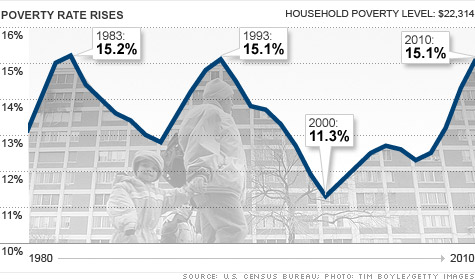
Chart courtesy of CNN Money
As of 2010, 1 in 6 Americans was living in poverty, according to a report from the Census Bureau today. The poverty rate was 15.1%, the highest number of Americans living below the poverty rate since the number has been examined. From the New York Times:
An additional 2.6 million people slipped below the poverty line in 2010, census officials said, making 46.2 million people in poverty in the United States, the highest number in the 52 years the Census Bureau has been tracking it, said Trudi Renwick, chief of the Poverty Statistic Branch at the Census Bureau.
That figure represented 15.1 percent of the country.
The poverty line in 2010 was at $22,113 for a family of four.
“It was a surprising large increase in the overall poverty rate,” said Arloc Sherman, senior researcher at the Center on Budget and Policy Priorities. “We see record numbers and percentages of Americans in deep poverty.”
The middle class has also lost ground in terms of yearly income.
And
…real median household incomes declined by 2.3 percent in 2010 from the previous year, to $49,400. That was 7 percent less than the peak in 1999 of $53,252.
“A full year into recovery, there were no signs of it affecting the well being of a typical American family,” said Lawrence Katz, an economics professor at Harvard. “We are well below where incomes were in the late 1990s.”
According to the census figures, the median annual income for a male full-time, year-round worker in 2010 — $47,715 — was virtually unchanged from its level in 1973, when the level was $49,065, in 2010 dollars, said Sheldon H. Danziger, professor of public policy at the University of Michigan.
As we all know, the rich have gotten much much richer and are continuing to get richer still because of the Bush/Obama economic policies. From CNN Money:
For middle-class families, income fell in 2010. The median household income was $49,445, down slightly from $49,777 the year before.
Median income has changed very little over the last 30 years. Adjusted for inflation, the middle-income family only earned 11% more in 2010 than they did in 1980, while the richest 5% in America saw their incomes surge 42%.
“Over that period of time, it’s not that the American economy has necessarily performed badly,” Osterman said. “As a country we’re richer over that period, but there’s been this real shift in where the income has gone, and it’s to the top.”
Amplifying that trend, the bottom 60% of households saw their income fall last year, while households making $100,000 or more enjoyed a rise in income.
CNN has a chart that shows the poverty level in each state, so you can check to see how people are doing in your neck of the woods. In general, the South is the worst off, and Louisiana and Mississippi have the highest percentages of people living below the poverty line.
I hope someone is showing this data to President Obama, because he needs to either do something about jobs and income inequality or follow LBJ’s example and get out of the way so we can find candidate who is able to show some leadership.

 peej
peej Carissa
 bostonboomer
 dakinikat
 ecocatwoman
 mablue2
 Mama Lopez
 peggysue22
 quixote
 skydancingguestblogger
 Mona (aka Wonk the Vote)



 Sky Dancing
Recent Comments