
Revolutionary Product Development isn’t about the iPad
Posted: April 18, 2010 Filed under: Uncategorized Comments Off on Revolutionary Product Development isn’t about the iPad Okay, that’s a fairly weird title for what I’m about to offer to you.
I was reading my this week’s The Economist over a tall glass of ice tea. I really was trying to take a break from posting, but something just hit me like the proverbial bolt out of the blue.
There’s a special report on innovation in emerging markets which is where my money and my research are so I’m fully vested in the topic. The big introductory article is called “The new masters of management.” I was very interested in it because before I moved down here to the land of still using plantation-style management techniques Louisiana, I used to own a very profitable consulting firm focused on Japanese Manufacturing Techniques. I was taught by Dr. W. Edwards Deming in the 1980s. His work was considered the second ‘industrial’ revolution wave and the reason I still buy Ford stock, despite everything, is that they still practice Dr. Deming’s lessons. He was a revolutionary mind and I am still very proud that he was one of my earliest mentors.
The article in The Economist talks about what’s going on in places like India and China that are frankly cleaning the clocks of nearly every developed nation in North America and Europe in terms of economic growth rates and industrialization. The author basically concludes that it’s the redesign of products and of processes that do things faster and much much cheaper that are revolutionary. I guess being primarily a business magazine, they’re focusing on the more mundane aspects of the innovation although the idea that the west is losing its economic leadership because it’s not developing breakthrough, transformational ideas is correct. I think they may have missed the larger point buried in all that high minded ink. But then, many management types miss what was REALLY important about the first industrial revolution and, indeed the second. I think this is because they go straight to business school and skip things like World History. I also think that it’s the major point that the MBA-centric management in the USA has completely missed too which is why many businesses are profitable, but the wealth isn’t trickling anywhere and change appears to be happening now at a snail’s pace.
Read this quote then, let me posit something your way.
Even more striking is the emerging world’s growing ability to make established products for dramatically lower costs: no-frills $3,000 cars and $300 laptops may not seem as exciting as a new iPad but they promise to change far more people’s lives. This sort of advance—dubbed “frugal innovation” by some—is not just a matter of exploiting cheap labour (though cheap labour helps). It is a matter of redesigning products and processes to cut out unnecessary costs. In India Tata created the world’s cheapest car, the Nano, by combining dozens of cost-saving tricks. Bharti Airtel has slashed the cost of providing mobile-phone services by radically rethinking its relationship with its competitors and suppliers. It shares radio towers with rivals and contracts out network construction, operations and support to specialists such as Ericsson and IBM.
Just as Henry Ford and Toyota both helped change other industries, entrepreneurs in the developing world are applying the classic principles of division of labour and economies of scale to surprising areas such as heart operations and cataract surgery, reducing costs without sacrificing quality.
When I read that paragraph, I don’t focus on the ‘principles of division of labour and economies of scale’, surprisingly enough. Yes, I’m an economist, but what drew me to economics was the social sciences first. I focused on this part right here: “no-frills $3,000 cars and $300 laptops may not seem as exciting as a new iPad but they promise to change far more people’s lives”. That’s called burying the headline in the middle of the article.
It wasn’t so much the process of industrialization that changed the young, agrarian nation of the United States into a modern powerhouse nation as it was the availability of the Tin Lizzie to nearly every household in the U.S. It won’t be so much an iPad that will change anything anywhere, it would be a $300 laptop available to nearly every one, cheaper than a TV, more functional than an iPad, and much more revolutionary because it grants access to information and the ability to process it and share it.
It’s the availability of these no frills products to the masses that revolutionize countries and bring them out of tribal darkness, not the innovation of a few sexy toys for the privileged few. It’s the availability of products that can create a huge empowered middle class that are innovative. I’ll point to one of the oldest examples and that is the Gutenberg Printing Press. It made literacy, books, and knowledge available to nearly every one. You no longer had to get the message from the one person in the county that could read the meager library in his estate or rectory. Think of small pox vaccines versus erectile dysfunction pills or mosquito nets vs. botox injections.
It wasn’t the production process itself that was revolutionary on its own, it was the production that brought a radicalizing product to the masses. The iPad and the iPhone are nice for the few remaining upwardly mobile yuppies we have left in this country and I’m sure they have a really nice profit margin. But, just try and argue with me that the disposable cell phone or a $300 laptop wouldn’t do more in terms of bringing a whole lot of Americans out of the darkness of isolation and into the light of the information age. But, perhaps, deep down, that’s not what today’s marketing execs really want. Perhaps niche marketing to an elite makes them feel, well, so very elite?
So, instead look at China or India, and then decide what is more likely to revolutionize their country? An iPad available to the already technical and cultural elite few or a cheap, minimally functional computer that does just about everything? Would it be a Prius that very few people can afford but gee, it sounds so, well, green and upscale and trendy, or a $3000 piece of transportation called the Nano that nearly every working family can afford?
I know that MBAs and Lawyers from Harvard think it’s all about them. I know that CEOs are always looking for that niche they can exploit by convincing a group of status-conscious yuppies that one label is more prestigious than another. But, what about the concept of offering a life changing vehicle to the ‘unwashed masses’ that they desperately try to ignore? What happened to the kinds of products that brought every man to a new level? This kind of volume marketing doesn’t just changes lives, it changes countries.
Is this what living in an emerging market like India and China brings to a business that living in a culture and access-driven society does not? Also, how are you going to get more customers if you don’t bring more customers up to the level of income where they can afford your product? Right now, we’re concentrating wealth into the hands of fewer and fewer people. As a result, our innovation is aimed at pleasing and tantalizing their taste buds, not creating a larger market for bigger ideas.
What product have we now offered the masses in our nation? Fast Food. Stuff that’s basically killing them, not raising them to a new level of knowledge and economic power. A 99 cent menu of grease and bad carbs does not have the same impact as a $300 laptop and cheap broadband would for the inner cities of the U.S. or it’s poor rural counterparts. But where are the minds in the U.S. that grok this simple concept?
We need to rethink our paradigm (oh, gawd, that word) of niche marketing and go back to the idea of selling things that move the country. I think that’s what’s really going on in India and China. They’re bringing the people up to the niches instead of making the niches compact and highly profitable. It isn’t all about lean manufacturing or innovative production techniques after all. It’s about meeting people’s needs and that ought to be highly profitable if done correctly for lots of people.
So, as an example, green technology is nice, but until every one can afford to put a solar panel on their roof and generate electricity to their home, it’s really not going to be much of game changer. Although, the idea seems to have given Ed Begley Jr a nice hobby and TV show for awhile. It also gives POTUS some really nice talking points for California Yuppies. (Pssst, POTUS, you have to be rich enough to take advantage of the TAX credits.) Right now, here in the ninth ward, the only homes with their green showing are the ones where the Hollywood elite adopted the local po’folk like they do starving kids in Africa. Let me see a few of us teachers, firefighters, and waiters with the same set up on our houses and it will then be revolutionary.
How do we Fight Jane Crow?
Posted: March 27, 2010 Filed under: Uncategorized | Tags: Femnist, Jane Crow Laws, Prochoice Comments Off on How do we Fight Jane Crow? I have to admit to believing the central right of all rights is control over your own body. It is a defining right for me. Up until this election, I stopped voting for candidates who described themselves as anti-choice because to me it indicated the inability to draw a line in the sand on what is and isn’t the business of government. I’m that way about sex between consenting adults also. To me, it’s a matter of none of your damned business, let alone a government law. I know that many men in the Republican party choose the anti-choice stand simply because it is the path of least resistance. You get a lot of resistance when you choose to be a pro-choice activist. You risk your life and your family too. Most of them just aren’t that willing to put their stuff on the line for women. They know when they get enough money, the can buy a slightly better class of second class citizenship for their wives and daughters. That includes a trip to an abortion clinic in New York City if need be.
There’s an interesting letter out on Feminists Choosing Life of New York . (h/t to the diary of debbierlus on The Seminal/FDL.) The organization claims–contrary to others’ opinions–that it is not an “organization of foaming-at-the –mouth anti-abortion loons whose only goal is to see Roe v Wade overturned using whatever means necessary”. They list these achievements to promote feminist causes.
While it is true that FCLNY works to educate the public on the exploitative nature of abortion (efforts we do not apologize for), abortion is not our only concern because it is not the only concern of women. Throughout our history, we have worked on many different fronts to help improve life for women and their children. FCL has worked to oppose capital punishment, war and domestic violence. We have worked to raise the minimum wage, increase funds for quality childcare and advocate for Unborn Victims of Violence legislation. We have protested against over-the-counter availability of emergency contraception for minors, given our support to adoption agencies and have sponsored young women athletes in their quests to be champions. FCL has worked to oppose the use of taxpayer funds for embryonic stem cell research and now leads the fight against compensation of women for their eggs to be used in this research-a dangerous and painful procedure that exploits young women.
Since the Democratic party seems completely unable at the moment to fully support the right to choose and continues to ignore the rights of women in general, is it possible to find ways to work with organizations like these to further women’s rights?
Like I said, the entire anti-choice movement has been anathema to me on a very visceral level. For me to even ask this question goes against much of what I fought for as a young woman and a young mother. However, if the Democratic Party continues to backtrack on commitments to furthering women’s rights, how much of choose do we have but to seek other allies in other key causes?
Given that we’ve all been put further into second class citizenship by a Democratic President and a Democratic Congress, is it time to find a feminist bipartisanship?
Can we join together to fight Jane Crow?
(You can consider this an open thread if you’d like.)
Perverse Incentives
Posted: March 17, 2010 Filed under: Uncategorized | Tags: cognitive dissonance, deadweight loss, disequilibrium, equilibrium Comments Off on Perverse IncentivesDisequilibrium is an interesting concept that has roots in many disciplines. Of course, in physiology it just simply means something’s off balance. You can have an inner ear infection, become dizzy, and feel miserable as well as fall because you become unsteady on your feet. That’s the kind of disequilibrium associated with vertigo. There’s linkage disequilibrium which is a term used in population genetics which causes diseases like cystic fibrosis when there are “non-random association of alleles at two or more loci, not necessarily on the same chromosome.” Something’s off balance there too, although I frankly can’t explain it at all.
In economics, disequilibrium is a state where a market can’t achieve that place where forces reach a state of balance in terms of supply and demand. You don’t achieve the magical market clearing status called equilibrium where you get this mutually agreed upon price level and quantity so things usually stay at a place where you get excesses or shortages and the society really wastes a lot of communal resources. Wasting resources is a big welfare inhibitor in this situation because you’re preventing a state where a lot more mutually beneficial transactions could occur. We’re looking for optimality, for efficiency, for correct allocation of resources and none will happen.
I’m not a psychologist but I’ve had more than a few psychology courses and I do love the idea of disequilibrium in this 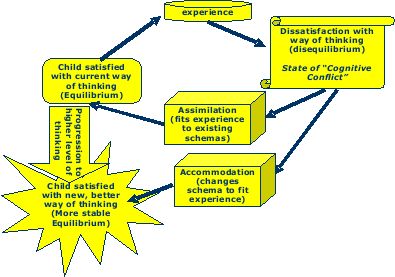 discipline. I studied cognitive dissonance a lot when I got a teaching certificate and had to endure quite a few hours in educational psychology and psychology. You just can’t avoid the work of Jean Piaget and disequilibrium in cognitive development. It is one of his big things. I was so impressed with his work that both my children went to Montessori schools which is an offshoot of his studies on human development. You can ask BostonBoomer the details because that’s her thing, not mine. Mine is General Equilibrium of the economic sort but it operates in markets instead of the minds of children.
I’ve put the nifty graphic in there which shows you the basic Piaget model. In all the processes of disequilibrium, the cognitive one included, something is off-balance. It just isn’t right. When you get a sense of cognitive dissonance your supposed to get an uncomfortable feeling because you’re holding two logically inconsistent viewpoints in your mind and it upsets your balance. That’s the state of Cognitive Conflict. You react noticeably as you try to reconcile the two distinct beliefs or states. In psychology this can lead to what they call confirmation bias where your mind starts blocking out evidence so that you can feel better about the situation by ignoring the disconfirming evidence altogether. It’s basically an ego defense mechanism.
So, back to economics now where our model is out of whack because something is in the way of the market reaching equilibrium. Either supply or demand has been fettered by something. This something can come from the government in the form of quotas, tariffs or price controls. It also can come from the market. Something can slow the process to equilibrium like “sticky downward’ or rigid wages which is a Keynesian concept related to people not particularly liking their incomes and budgets messed with regardless of what’s going on with prices in the broader economy. This is a economics example of cognitive dissonance, although most economists will completely run the other way whenever you try to equate their sacred science with something that resembles ‘psycho-babble’ and not their model of the rational, need driven householder.
So, why am I babbling on about this like the weird and wonky academic with a lot of background in social science research that I have? Because, I sense a huge macro-disequilibrium in the United States right now in a much more multi-discliplined way than most social scientists or scientists sense and study.
Something doesn’t feel right and I can’t solve the equation. It’s a disequilibrium in that touch- feely cognitive dissonance sort’ve way that I believe is coming from one of the root sources of economic disequilibrium. That would be perverse incentives. The government can put a market perpetually out of equilibrium by taxing or rewarding behaviors that make one side benefit and the other side lose. This is what happens when they use Tobin Taxes (so-called sin taxes) or quotas for imports or quantity restrictions to prop up businesses, or some other kind of price controls. The result is measurable in a market. It creates what we call a deadweight loss. This is a situation where there is no Pareto optimality, ever, which is that state of equilibrium where supply equals demand, the right price is achieved and an optimum quantity becomes available to the market. Deadweight loss is an excess burden which reflects the loss to society of not having the Pareto or optimal outcome. We lose something. We transfer benefit from one group to another or from both groups to the government for one reason or another. Sometimes, we do this for seemingly quite good and innocuous reasons, but it still creates disequilibrium. Usually, it’s perverse incentives. We try to correct some problem and just wind up creating a bigger problem, like New York City did with Rent Controls in the 1970s.
What’s been going on recently is just one set of circumstances that’s throwing off the balance of one thing after another and it’s transferring the benefit from one group to another. It’s like some perverse set of incentives is causing us to self-destruct in a way that makes us all feel this massive group cognitive dissonance. Something just doesn’t feel right and we can’t use the evidence that exists to find equilibrium because we can’t get there from here without throwing out some of the evidence just to get rid of that off feeling.
So, the deal is, in Psychology, some people are able to throw out evidence. They will convince themselves that up is down and right is wrong to maintain a sense of equilibrium even when evidence suggests equilibrium cannot be achieved under this conflicting evidence or under these perverse incentives. That, for all the good that it does, explains why some folks can believe that this mess of a health policy will solve ills and achieve goals when it is likely to create a massive wealth transfer and a huge deadweight loss to society. It makes them feel better to believe that this is a circumstance where the lightbringer will deliver their pony. It justifies their decision to support him at all costs. Others, will go batshit crazy and vote Republican. It completely depends on which evidence you throw out. Some of us will just sit here trying to resolve our sense of unease unsuccessfully.
I’ve never been very good at inducing a state of denial, and I assume that most of you here aren’t either, so where does it leave us?
My answer is simply in that we are in state of cognitive vertigo together. Maybe, at the moment, that’s the best we can do.
Sky Dancing’s Wordle
Posted: March 16, 2010 Filed under: Uncategorized Comments Off on Sky Dancing’s Wordle
Manifest Religiousity
Posted: February 20, 2010 Filed under: Uncategorized Comments Off on Manifest ReligiousityI’ve been thinking a lot recently about about missionaries. What spurred this thread was something little Isis sent me. It is a link to  Tamerlane’s blog who I usually read at Liberal Rapture. Frankly, I’d been thinking of the entire topic a lot recently. Probably the primary reason is that over break I started playing a Civilization game called Colonization which is historically interesting but not the most politically correct strategy game that I play. You basically choose the French, Spanish, English or Dutch and go colonize an area where there are natives. I normally try to play the French and co-exist with the natives, but the algorithm includes some more historically accurate happenstances. Even if you try to co-exist with the natives peacefully trading and living with them, your cities eventually crowd them out of their resources and they either attack you or disappear. That’s if you take the peaceful coexistence route. If you take the more direct route, you just send in a Jesuit priest to convert them which basically drains them of people and resources very quickly.
 It’s probably also why I heard this news today on the radio during my commute with a certain degree of skepticism. Although, this Saint got her self excommunicated on a few occasions by irritating the powers that be, she was still mostly recognized for her work in orphanages across Australia and bringing people into the fold. You just never know how much of it is just marketing vs. the work of a really dedicated humanitarian when religion is involved.
VATICAN CITY – Pope Benedict XVI approved sainthood for Mother Mary MacKillop on Friday, making the woman known for her work among the needy Australia’s first saint.
The pope made the announcement during a ceremony at the Vatican and set the formal canonization for Oct. 17 in Rome. Five others — from Italy, Spain, Poland and Canada — will be canonized at the same time.
MacKillop founded the Congregation of the Sisters of St. Joseph, an order that built dozens of schools for impoverished children across the Australian Outback in the 1800s, as well as orphanages and clinics for the needy.
With vows of abstinence from owning personal belongings and dedication to helping the poor, MacKillop is credited with spreading Roman Catholicism in Australia and New Zealand.
In 2008, the Pope made a Saint of an Indian (that would be India Indian) women who basically was some one who came from that sort’ve history. Saint Alphonsa got converted in an orphanage and then continued the practice of converting others, draining her native land of its culture, religion and their most precious treasure; their children. Of course, it’s never quite portrayed that way. Saint Alphonsa rescued children from abject poverty and sent them on the ‘Lord’s path’ is the religiousity-correct term. She of course suffered mightily while doing so which makes her even more the saint.
Tamerlane’s story is based on that headline grabbing story of those baptists from Utah that headed down to ‘rescue’ Haitii orphans from their lives of abject poverty too. You know the story. It’s bumped a lot of really newsworthy items right off the front page and it’s been made to look like just another example of the prosecution of god-faring christian people out there rescuing the helpless from helpless situations. Tamerlane’s story adds the twist that I find most interesting. What exactly, when you bring a child back to an extreme religionist to raise like a pet project, do you do to them? This is the the story to which he links.
OROVILLE — A fundamentalist religious philosophy that espouses corporal punishment to “train” children to be more obedient to their parents and God is now being investigated in connection with the death of a young Paradise girl and serious injuries to her sister.
Butte County District Attorney Mike Ramsey confirmed Thursday that other children in the home who have been interviewed told investigators “this philosophy was espoused by their parents.”
Ramsey said he is also exploring a possible connection to a Web site that endorses “biblical discipline” using the same rubber or plastic tube alleged to have been used to whip the two young ridge girls by their adoptive parents.
In court Thursday, a judge granted a two-week postponement before the children’s parents, Kevin Schatz, 46, and Elizabeth Schatz, 42, enter a plea to murder and torture charges that could carry two life terms in prison.
What exactly do you rescue these children from and what do you bring them to? That’s the bigger question to me.
We have several Native American posters here that probably can do a better job explaining what their lives have been like since their ancestors were uprooted from their native traditions. I was born in Oklahoma around the Cherokee Nation and raised in Nebraska around both the Pottawatomie and Ogalala Sioux of the Lakota Nation. I was at university at Lincoln, Nebraska when there was a huge encampment of Sioux there from Pine Ridge doing protests along with Russell Means and got to spend some time hearing lots of stories that would raise the hairs on the back of your neck. Now, I work with the Sherpa peoples in Nepal and I think I’ve shared some of the horrid stories of religiousism and the treatment of native peoples there by missionaries of several stripes.
I think we need to remain vigilant about these people who move in and abduct children in the name of bringing them to a better life through ‘religion’. The Buddhist people of the Himalayan region never had words for things like self esteem problems and the little Buddhist country of Bhutan didn’t even have suicides until they got cable tv and now they feel they have an epidemic of it. That being said, I’m not glorifying native cultures and saying we should keep every one back in the stone age tribes and free of medicine. I’d just like to warn against the arrogance of Manifest Destiny when it comes to culture, politics and religion.
Jose' de Anchieta
Maybe I’m just playing into the meme here as smug atheist, but I can’t believe that taking children away from their families, countries, cultures, and lives for some hyperactive version of the Religionist American dream is in the real interest of children. I say this as I watch the Tupi fall to my strategies in Civ IV: Colonialization much like they fell to José de Anchieta and the Portuguese around 300 years ago. Why do we glorify something which historically has been responsible for death, disease, and the wholesale destruction of entire civilizations? Why beautify and make into a saint the products of radical and sadistic religious chauvinism like poor Saint Alphonsa?
It worries me to watch the heroes’ welcomes for those 8 missionaries released from the jail in Haiti who were suspected of possible child trafficking. Maybe it wasn’t their intent to sell the children into the sex trades or the domestic trade but just simply place them into a home with some hyperactive Dobson/Focus on the Family family with a vision of beating God into children. Is that really a better life?
Many of the rescued children still had one live parent. Haiti is full of poverty, but who among us would want to live with an evangelical in Idaho? Perhaps RD or myiq2xu can speak to that sort’ve upbringing better than me since I come from a long line of avowed church avoiders and seem to have raised two more of them. I’d rather take my chances with poverty in Haiti, frankly.
So, let me ask this question: What’s to say we’re not repeating the sins of our colonial past? Who are the real saints and who are the sinners?

 peej
peej Carissa
 bostonboomer
 dakinikat
 ecocatwoman
 mablue2
 Mama Lopez
 peggysue22
 quixote
 skydancingguestblogger
 Mona (aka Wonk the Vote)



 Sky Dancing
Recent Comments