Posted: October 31, 2020 | Author: bostonboomer | Filed under: Afternoon Reads, just because, U.S. Politics | Tags: 2020 presidential election, Donald Trump, U.S. Postal Service, voter suppression |
Happy Halloween!!
 Only three days until the election, and I wish I could go to sleep and wake up in the late afternoon on November 3. Unfortunately, I can’t get to sleep at night. I usually end up getting about 4-5 hours and then I make up for it some days with afternoon naps. I can’t wait until Trump is gone; then maybe I’ll be able to sleep normally again. I only we can get rid of him!
Trump and his thugs are working overtime either to prevent people from voting or to prevent votes from being counted. It’s their only hope to keep him in the White House. Here’s the latest on voter suppression:
Bloomberg: USPS Says Timely Vote Delivery Isn’t a Constitutional Right.
Delivery delays during an election can’t be unlawful, because the Constitution doesn’t guarantee states any particular level of service when it comes to mail-in ballots, the U.S. Postal Service told a federal judge.
Postmaster General Louis DeJoy and President Donald Trump are seeking dismissal of a lawsuit brought by New York and other states that claim disruptive changes at the USPS over the summer are violating the Elections Clause of the Constitution by putting election mail at risk.
The Justice Department argued in a court filing Tuesday in Washington that the clause can’t restrict government agencies from carrying out operational changes or other activity that “may have an incidental impact” on voting.
The states’ theory “assumes that because the plaintiff states crafted their election laws with the expectation that USPS will provide a certain level of service, they now have a constitutional right to expect that level of service,” the U.S. said. The clause “does not shield states from any and all external circumstances that may impact state elections.”
 The Washington Post: Judges nominated by President Trump play key role in upholding voting limits ahead of Election Day.
Federal judges nominated by President Trump have largely ruled against efforts to loosen voting rules in the 2020 campaign amid the coronavirus pandemic and sided with Republicans seeking to enforce restrictions, underscoring Trump’s impact in reshaping the judiciary.
An analysis by The Washington Post found that nearly three out of four opinions issued in federal voting-related cases by judges picked by the president were in favor of maintaining limits. That is a sharp contrast with judges nominated by President Barack Obama, whose decisions backed such limits 17 percent of the time.
The impact of Trump’s court picks could be seen most starkly at the appellate level, where 21 out of the 25 opinions issued by the president’s nominees were against loosening voting rules.
The pattern shows how Trump’s success installing a record number of judges in his four years in office has played a critical role in determining how people can vote this year and which ballots will be counted. The president’s imprint on the courts culminated this week with the confirmation of Amy Coney Barrett, the third justice he has successfully nominated to the Supreme Court.
 Mark Joseph Stern at Slate: Judges Are Already Testing How Far Amy Coney Barrett Will Go for Republicans.
Over the last week, four conservative justices on the Supreme Court have signaled their desire to throw out mail ballots that arrive after Election Day. The court will remain deadlocked on this momentous issue—which could affect the outcome of countless races—until Amy Coney Barrett casts her first vote. And the lower courts are taking bets on which side she’ll take. On Thursday night, two far-right judges in the 8th U.S. Circuit Court of Appeals issued a lawless order claiming that Minnesota’s extension of the ballot deadline is likely unconstitutional. Their decision radiates partisan bias and flouts Supreme Court precedent, risking chaos and confusion by altering the rules of Minnesota’s election just five days before Nov. 3.
This is no fluke. It is the Barrett effect: Lower court judges are beginning to test the limits of the Supreme Court, trying to figure out how far right they can go without getting reversed. It is an especially dangerous time for federal courts to fabricate a new rule that prevents states from counting lawful ballots. But with no clear check to rein in the judiciary’s accelerating radicalism, some judges have decided it’s time to go all-in for Donald Trump and dare SCOTUS to stop them.
Thursday’s decision involved yet another dispute over state election law—a dispute that should never have landed in any federal court in the first place. A Minnesota statute requires voters to return mail ballots by Election Day. In May, a voting rights group sued the state to block this rule; it alleged that the deadline is unconstitutional in light of the pandemic, which has placed extraordinary pressure on the state’s vote-by-mail system. Minnesota Secretary of State Steve Simon chose not to fight the lawsuit. Instead, he entered into a consent decree (essentially a settlement) with the plaintiffs, approved by a state court, that halted enforcement of the Election Day deadline. The Minnesota Legislature has expressly authorized the secretary of state to “adopt alternative election procedures” whenever a law “cannot be implemented as a result” of a court order. Pursuant to that law, Simon extended the ballot deadline by one week and informed every voter that their ballot would be counted so long as it is mailed by Election Day and received by Nov. 10.
Read more at Slate.

By Maggie Vandewalle
The Washington Post: Republicans shift from challenging rules to preparing to challenge individual ballots.
In Nevada, the Trump campaign filed a lawsuit this week seeking images of the signature of every registered voter in Democratic-leaning Clark County — a potential first step toward challenging individual votes on grounds that the signed ballots don’t match the signatures on file.
In Texas, Republican officeholders and candidates sued this week to have more than 100,000 votes invalidated in the Houston area because they were cast at drive-through voting centers the GOP has asked a judge to declare illegal.
And in Minnesota and Pennsylvania, election officials will set aside any mail-in ballots that arrive after Election Day — even if they were mailed before the polls closed — to facilitate potential court challenges.
For months, Republicans have pushed largely unsuccessfully to limit new avenues for voting in the midst of the pandemic. But with next week’s election rapidly approaching, they have shifted their legal strategy in recent days to focus on tactics aimed at challenging ballots one by one, in some cases seeking to discard votes already cast during a swell of early voting.
Head over to the WaPo to read the rest.
Quite a few writers are speculating about what Trump will do after the election–win or lose. These are long articles, so I can’t provide the gist of each one here. You’ll need to explore the links to learn more details.

Pumpkin Tree, by Tom Shropshire
Fred Hiatt at The Washington Post: Yes, Trump has an agenda for a second term. It’s all about him.
…to an extraordinary degree, Trump’s actions in the closing days of his first presidential term tip us off to how he hopes to reign — yes, reign — in a second. If we return him to office, we won’t be able to say we didn’t see it coming….
[W]hat Trump is openly showing us is his intention to reshape the U.S. government from an institution designed to serve the nation and its people to one that caters to one man’s whims, prejudices, grudges, vanity and profit.
The most significant tell comes in an executive order that Trump issued on Oct. 21 creating a “Schedule F” for government workers. It would remove civil-service protections from potentially tens of thousands of civil servants, allowing Trump to fire them at will.
How would he use this power? We have seen his willingness to fire those already without protection simply for doing their jobs in an honest way — intelligence community leaders who wouldn’t lie about Russia and Ukraine, for example. We have heard him disparage those he can’t yet fire — the “idiot” scientists who won’t echo his claim that covid-19 is going away.
Schedule F would let the president fire those scientists and anyone else who might stand in his way — who respect facts and data, who resist his efforts to wield government as a weapon.
Tom McCarthy at The Guardian: ‘Red mirage’: the ‘insidious’ scenario if Trump declares an early victory.
Scenarios for how an election disaster could unfold in the United States next week involve lawsuits, lost ballots, armed insurrection and other potential crises in thousands of local jurisdictions on 3 November.
But there is one much simpler scenario for election-night chaos, centering on a single address, that many analysts see as among the most plausible….
 Known as the “red mirage”, the scenario could develop if Trump appears to be leading in the presidential race late on election night and declares victory before all the votes are counted.
The red mirage “sounds like a super-villain, and it’s just as insidious”, the former Obama administration housing secretary Julían Castro says in a video recorded as a public service announcement to voters this week.
“On election night, there’s a real possibility that the data will show Republicans leading early, before all the votes are counted. Then they can pretend something sinister’s going on when the counts change in Democrats’ favor.”
In the scenario, Trump’s declaration of victory is echoed on the conservative TV network Fox News and by powerful Republicans across the US. By the time final returns show that in fact Joe Biden has won the presidency, perhaps days later, the true election result has been dragged into a maelstrom of disinformation and chaos.
There’s much more detail about this scenario at The Guardian.
Politico: Trump may just keep campaigning after Election Day.
Top surrogates for the Trump campaign have been told to keep their Novembers clear for potential campaign events. And Trump campaign advisers said not to rule out the possibility Trump continues his rallies even as election officials continue to count ballots after the Nov. 3 election, according to a campaign surrogate and two Trump advisers.
With the possibility that there might not be a clear winner on election night in key swing states like Pennsylvania and North Carolina, the campaign has discussed putting Trump and his family on the road to give a morale boost to supporters and let the president fire off about the election to crowds….
“There’s been discussions about travel opportunities for Trump and his family if we don’t have a result on election day, but nothing definitive on where he would go or how many people we would deploy,” said one campaign aide. “If we still don’t have results in Michigan and North Carolina or Pennsylvania and Nevada on Nov. 4, he might hit those states individually.”
 Ron Suskind at The New York Times: The Day After Election Day. Current and former Trump administration officials are worried about what might happen on Nov. 4.
America will probably awaken on Nov. 4 into uncertainty. Whatever else happens, there is no doubt that President Trump is ready for it.
I’ve spent the last month interviewing some two dozen officials and aides, several of whom are still serving in the Trump administration. The central sources in this story are or were senior officials, mainly in jobs that require Senate confirmation. They have had regular access to the president and to briefings at the highest level….
Several of them are in current posts in intelligence, law enforcement or national security and are focused on the concurrent activities of violent, far-right and white supremacy groups that have been encouraged by the president’s words and actions. They are worried that the president could use the power of the government — the one they all serve or served within — to keep himself in office or to create favorable terms for negotiating his exit from the White House. Like many other experts inside and outside the government, they are also concerned about foreign adversaries using the internet to sow chaos, exacerbate divisions and undermine our democratic process.
Many of the officials I spoke to came back to one idea: You don’t know Donald Trump like we do. Even though they can’t predict exactly what will happen, their concerns range from the president welcoming, then leveraging, foreign interference in the election, to encouraging havoc that grows into conflagrations that would merit his calling upon U.S. forces. Because he is now surrounded by loyalists, they say, there is no one to try to tell an impulsive man what he should or shouldn’t do.
“That guy you saw in the debate,” a second former senior intelligence official told me, after the first debate, when the president offered one of the most astonishing performances of any leader in modern American history — bullying, ridiculing, manic, boasting, fabricating, relentlessly interrupting and talking over his opponent. “That’s really him. Not the myth that’s been created. That’s Trump.”
None of Suskind’s sources claimed to know what Trump will do. Read more about what they told him at the NYT link.

Batmolbile by Maggie Vandewalle
One more by Garrett Graff at Politico Magazine: ‘There Are No Boundaries’: Experts Imagine Trump’s Post-Presidential Life if He Loses.
In interviews, historians, government legal experts, national security leaders and people close to the administration have a prediction that will disquiet his critics: The Trump Era is unlikely to end when the Trump presidency ends. They envision a post-presidency as disruptive and norm-busting as his presidency has been—one that could make his successor’s job much harder.They outline a picture of a man who might formally leave office only to establish himself as the president-for-life amid his own bubble of admirers—controlling Republican politics and sowing chaos in the U.S. and around the world long after he’s officially left office.
“Can he continue to make people not trust our institutions? Can he throw monkey wrenches into delicate negotiations? Absolutely,” one former Trump administration official says. “He can be a tool. He’ll be somewhere between dangerous and devastating on that extent.”
A president unwilling to respect boundaries in office is almost certain to cross them out of office. Experts envision some likely scenarios—a much-rumored TV show and plans to use his properties to profit off his lifetime Secret Service protection, perhaps even continuing to troll the Biden administration from his hotel down Pennsylvania Avenue—and some troubling if less certain ones, like literally selling U.S. secrets or influence to foreign governments.
Click the link to read the rest.
Have a great Halloween, Sky Dancers!!
Did you like this post? Please share it with your friends:
Posted: October 29, 2020 | Author: bostonboomer | Filed under: Afternoon Reads, U.S. Politics | Tags: 2020 presidential election, coronavirus pandemic, Covid-19, Donald Trump, herd immunity, Hurricane Zeta, Joe Biden, Scott Atlas, SCOTUS, Trump flight risk?, voter suppression (AKA cheating) |
Good Afternoon!!
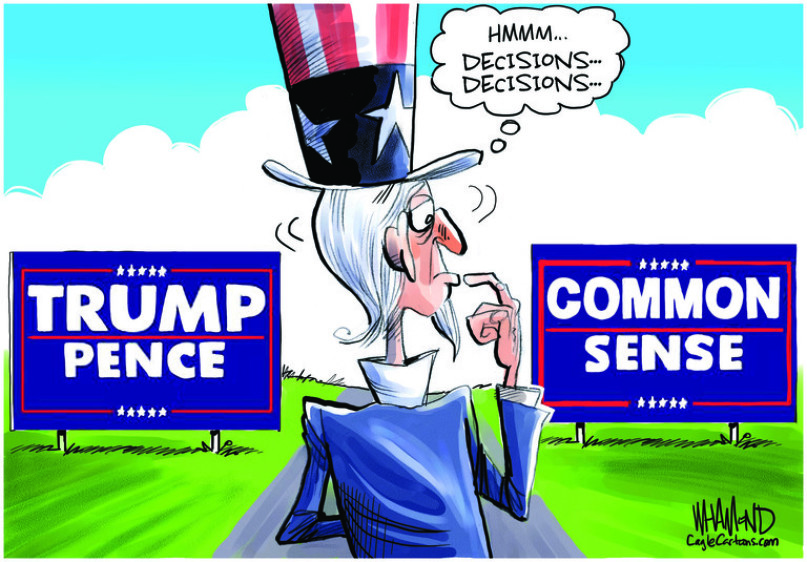 Dakinikat survived Hurricane Zeta and got her power back this morning. I heard the storm also hit Georgia pretty hard; its now headed for North Carolina. I hope you’re safe if you’re in Zeta’s path.
In just five days, voting in the long 2020 election will draw to a close. Joe Biden looks likely to win; but we still have to navigate voter suppression (AKA cheating) by the Trump campaign and the GOP, aided by the U.S. Supreme Court, as well as the possibility that Trump will try to use the Court to overturn the election results if he loses. Nothing less than the health and safety of the American people will depend on the outcome.
Ed Yong at The Atlantic: America Is About to Choose How Bad the Pandemic Will Get.
In the 2020 election, on top of every routine test of character and capability, the candidates must answer the challenge the coronavirus has brought to this country. Trump’s response has been so lax as to effectively cede the country to a virus whose spread is controllable. He has, by his own admission, repeatedly downplayed the threat after he became aware of how dangerous the new coronavirus could be. He caught the virus himself and seems to have learned nothing from the encounter….
As November nears, the coronavirus is surging again, with cases rising to record-breaking heights for the third time. To control the pandemic, changes are necessary, but Trump has proved that he does not learn from his mistakes—perhaps the most costly of his failings. If he is reelected, he will continue on the same path, and so will the coronavirus. More Americans will be sickened, disabled, and killed. Donald Trump is unchanging; the election offers an opportunity for the country to change instead.
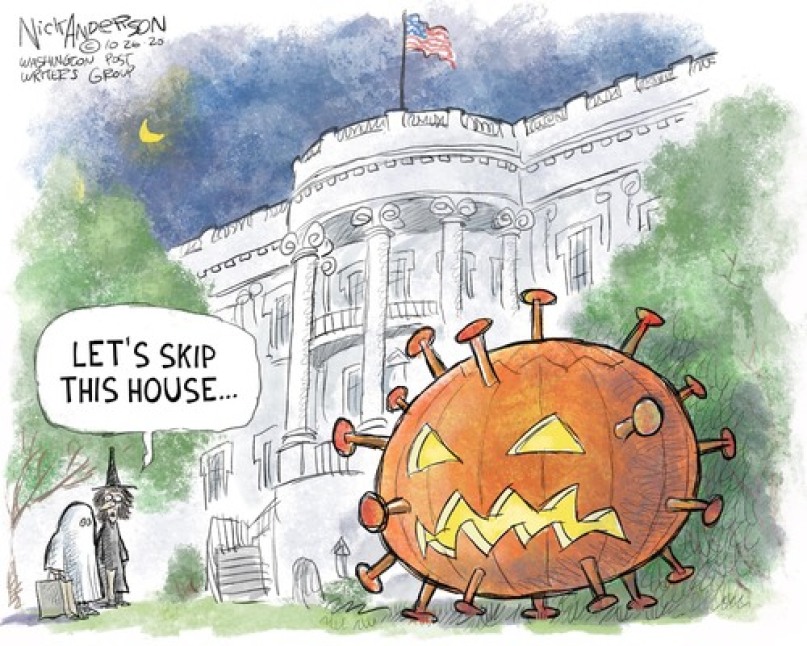 The near-term future is already set. Trump has repeated the lie that numbers are spiking because the U.S. tests extensively; in fact, the climbing cases have far outpaced the rise in testing, and are due instead to the rapidly spreading virus. Thanksgiving and Christmas are approaching. Several generations of family members will gather in indoor spaces for prolonged periods of close proximity and spirited conversation—the very conditions in which the coronavirus most readily spreads….
As I wrote last month, there is a real risk that Americans will become habituated to this horror, and that COVID-19 will become another unacceptable thing that the U.S. learns to accept. That is all but inevitable if Trump wins a second term. His administration has given no indication that it will dramatically change its strategy. If anything, it has doubled down. It is allowing the virus to freely spread among younger people in the hopes of reaching herd immunity—an unfeasible strategy that has been widely panned by the scientific community. Such a strategy could leave millions dead, and many others with chronic illness.
It’s quite clear now that Trump has decided to let the virus run rampant, believing falsely that this will lead to “herd immunity.”
The Daily Beast: Trump’s COVID Advisers: He’s Now Pushing Herd Immunity.
Despite publicly downplaying it, President Donald Trump and his team of White House advisers have embraced the controversial belief that herd immunity will help control the COVID-19 outbreak, according to three senior health officials working with the White House coronavirus task force. More worrisome for those officials: they have begun taking steps to turn the concept into policy.
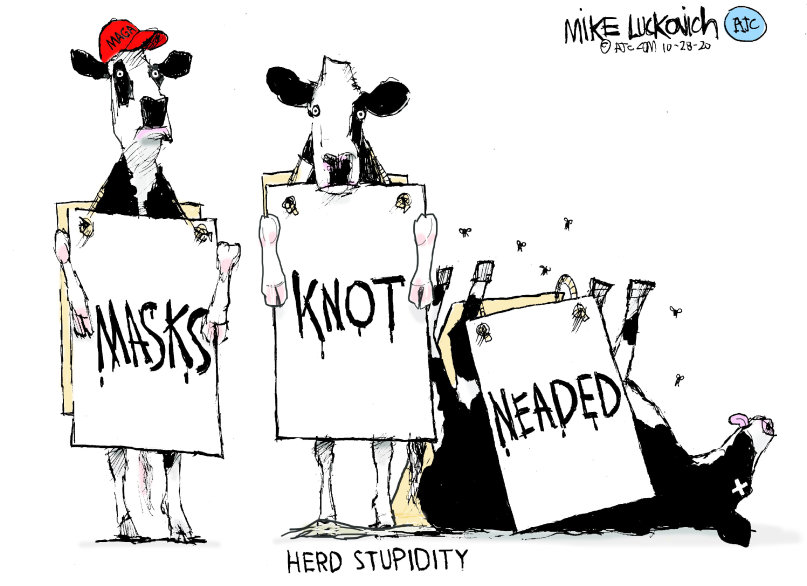 Officials say that White House adviser Scott Atlas first started pushing herd immunity this past summer despite significant pushback from scientists, doctors and infectious disease experts that the concept was dangerous and would result in far more Americans getting sick and dying. Since then, various White House advisers have tried to play down the idea that the administration has implemented a strategy for COVID-19 based on herd immunity, which holds that if enough people contract a disease and become immune from it, then future spread among the broader population will be reduced.
Trump and Atlas publicly claim that they aren’t pushing this disastrous strategy, but it’s pretty clear that’s what’s happening. Experts say the policy could lead to between 2 and 5 million deaths in the U.S. In addition, many people who survive the Covid-19 develop long-term health problems.
Though Atlas insists he has not pushed “herd immunity,” another official said Atlas actually began advocating for the concept—and the president became receptive to it—at the same time as task force officials were being sidelined from conversations about how the administration planned to handle what many predicted would be a difficult fall season. Since then, officials said, the White House has been largely focused on getting a vaccine out to the American people and has left the fight against the community spread to one task force official: Dr. Deborah Birx. Birx, the White House task force coordinator, has been on the road for months trying to convince Americans to wear masks and social distance.In her absence, and with the task force meeting less regularly, Atlas has thrived as a presidential confidant.
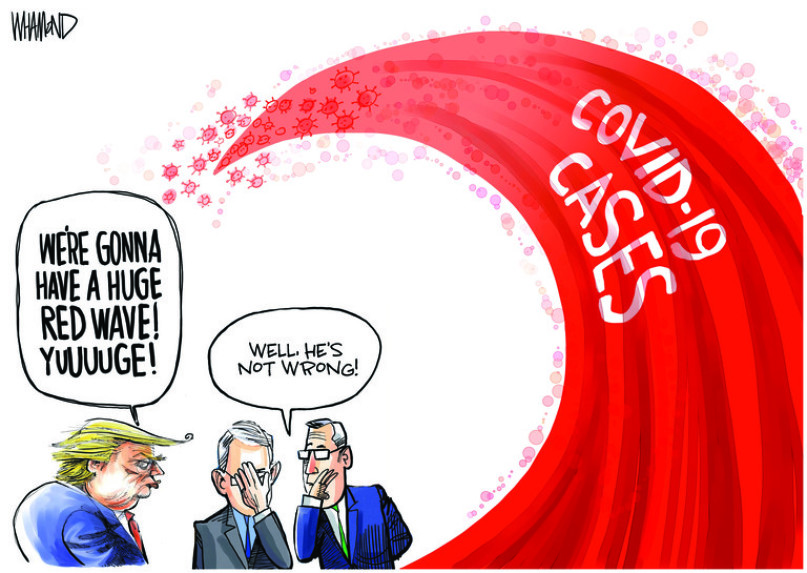 “This is all Atlas,” said one of the officials who spoke with The Daily Beast. “I find it disturbing… bordering on ludicrous. Everything that comes out of Atlas’ mouth is geared towards letting it rip and then just worry about protecting the vulnerable. Everything he says points to the fact that he believes herd immunity is a good option. Yet he denies he’s pushing herd immunity as a strategy saying ‘No that’s not what I’m doing.’ But he is.”
The New York Times: Trump’s Closing Argument on Virus Clashes With Science, and Voters’ Lives.
As an immense new surge in coronavirus cases sweeps the country, President Trump is closing his re-election campaign by pleading with voters to ignore the evidence of a calamity unfolding before their eyes and trust his word that the disease is already disappearing as a threat to their personal health and economic well being.
The president has continued to declare before large and largely maskless crowds that the virus is vanishing, even as case counts soar, fatalities climb, the stock market dips and a fresh outbreak grips the staff of Vice President Mike Pence. Hopping from one state to the next, he has made a personal mantra out of declaring that the country is “rounding the corner.”
Mr. Trump has attacked Democratic governors and other local officials for keeping public-health restrictions in place, denouncing them as needless restraints on the economy. And venting self-pity, the president has been describing the pandemic as a political hindrance inflicted on him by a familiar adversary.
“With the fake news, everything is Covid, Covid, Covid, Covid,” Mr. Trump complained at a rally in Omaha on Tuesday, chiding the news media and pointing to his own recovery from the illness to downplay its gravity: “I had it. Here I am, right?” [….]
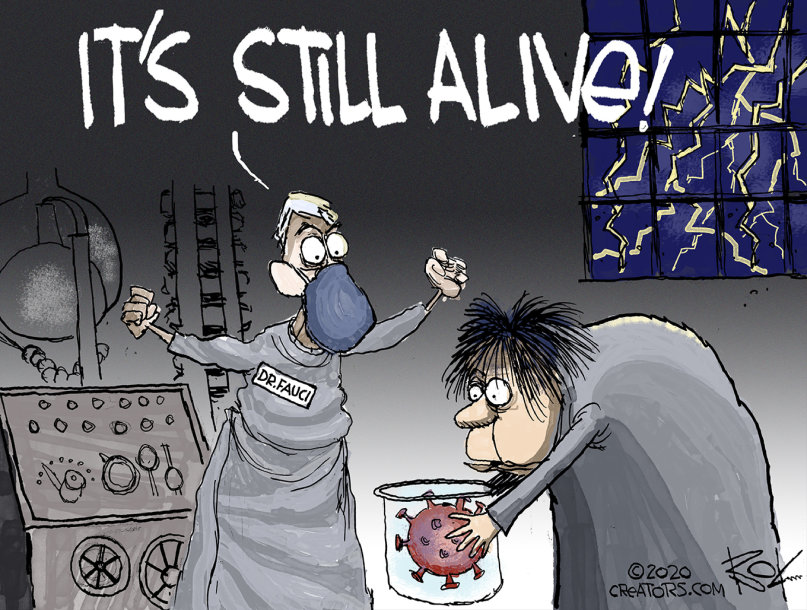 As a political matter, the president’s approach amounts to an Obi Wan-like attempt to wave his hand before the electorate and tell voters that they are not experiencing a pandemic that is tearing through their neighborhoods and filling hospitals. His determination to brush aside the ongoing crisis as a campaign issue has become the defining choice of his bid for a second term and the core of his message throughout the campaign’s endgame.
This kind of insanity only works with Trump’s brainwashed cult followers. It really does look like Biden will win by a lot, although I won’t be able to let myself believe it until the votes are counted.
Vox: Exclusive: Biden leads Trump by 12 points in a national UT Dallas poll.
Former Vice President Joe Biden leads President Donald Trump by more than 10 points in a national poll by researchers at the University of Texas Dallas. Fielded a few weeks prior to Election Day, the poll is among recent ones finding Biden with a steady lead.
The results, which are part of UT Dallas’s Cometrends survey, found Biden with 56 percent support and Trump with 44 percent support.
The poll — which included 2,500 respondents — is one of several recent surveys showing Biden ahead of Trump at the national level. It was fielded online between October 13 and October 26, with many of the responses coming in by October 17. The survey has a sampling margin of error of plus or minus 2 percentage points, and its results included a broad sample of respondents that have not been weighted for likely voters.
Overall, the survey finds broader support for Biden from some demographic groups than former Democratic nominee Hillary Clinton received in 2016 exit polls. Among both men and white respondents overall, in particular, Biden’s backing in the UT Dallas survey is stronger. Fifty-four percent of men in the poll say they back Biden, compared to 41 percent who said they supported Clinton in a 2016 exit poll. Similarly, 44 percent of white respondents say they back Biden, compared to 37 percent who said they supported Clinton.
Read the rest at Vox.
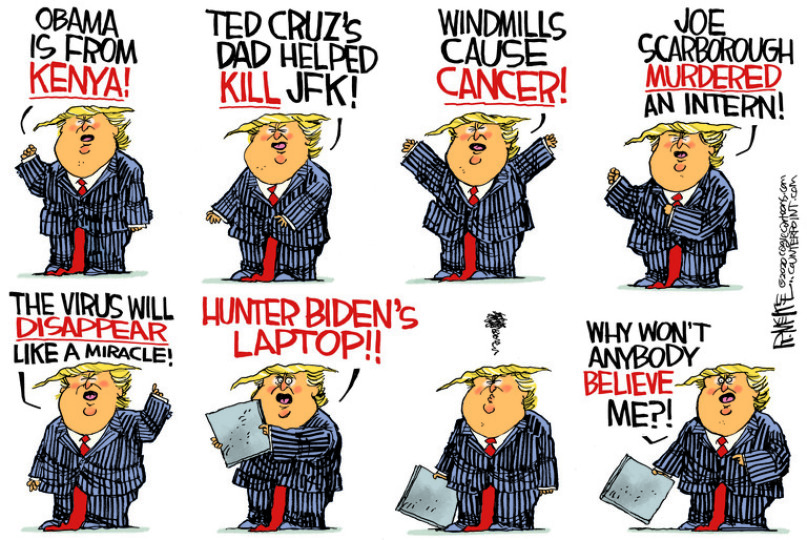 Toluse Olorunnipa at The Washington Post: As Election Day nears, Trump ponders becoming one thing he so despises: A loser.
Trailing in the polls and with little time left to change the trajectory or closing themes of the presidential race, President Trump has spent the final days of the campaign complaining that the coronavirus crisis is getting too much coverage — and openly musing about losing.
Trump has publicly lamented about what a loss would mean, spoken longingly of riding off into the sunset and made unsubstantiated claims that voter fraud could cost him the election. He has sarcastically threatened to fire state officials if he doesn’t win and excoriated his rival Joe Biden as someone it would be particularly embarrassing to lose to.
“If I lose, I will have lost to the worst candidate, the worst candidate in the history of presidential politics,” Trump said at an Oct. 17 campaign rally in Janesville, Wis. “If I lose, what do I do? I’d rather run against somebody who’s extraordinarily talented, at least, this way I can go and lead my life.”
The president, who said at the same rally that “we’re not going to lose, we’re going to win,” has certainly not abandoned his showman’s approach to the campaign trail. But his unscripted remarks bemoaning a potential loss — and preemptively explaining why he might suffer one — offer a window into his mind-set as he barnstorms the country in an attempt to keep himself from becoming the one thing he so derisively despises: a loser.
Trump has told rallygoers he had the presidential race won until the pandemic hit, and he has accused media outlets of focusing on the ongoing health crisis to hurt him politically.
Read more at the WaPo.
Trump has also suggested at his rallies that he might have to leave the country if he loses. This is pretty wild but, at this point, anything is possible:
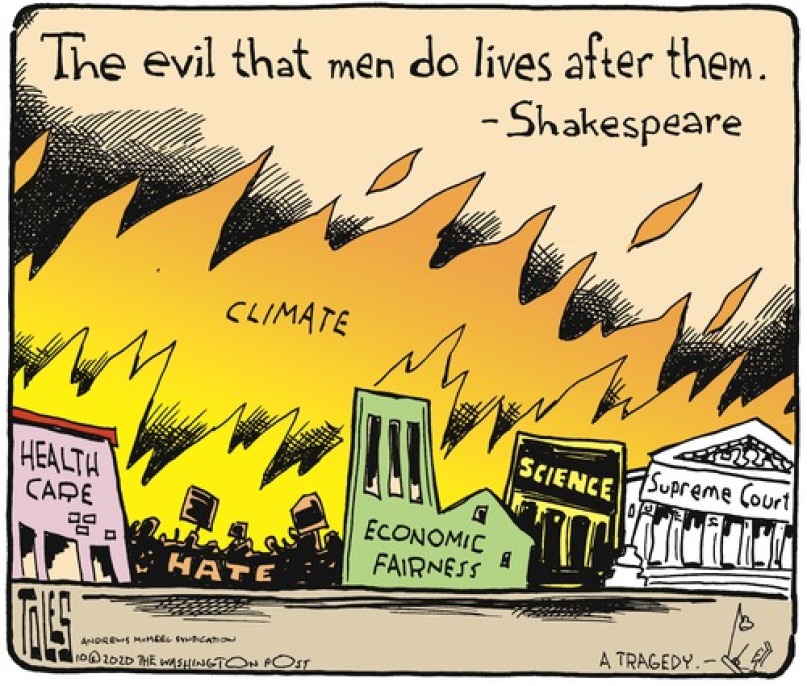
Tom Toles Editorial Cartoon
Brig. Gen. (Ret.) Peter B. Zwack at Politico: Is President Donald Trump a Flight Risk? Yes, this sounds like a B-grade spy novel. But consider the evidence.
Earlier this month, at a campaign rally in Macon, Georgia, President Donald Trump mused aloud to the crowd about what he might do if he loses the election on November 3. “Maybe I’ll have to leave the country, I don’t know,” Trump said.
Was the statement merely a sour-grapes throwaway line by a cantankerous candidate facing potential defeat? Or was it a signal that Trump might actually abandon—some would say flee—our shores and seek refuge elsewhere if he is routed by a Joe Biden victory?
During my long military intelligence career I spent countless hours with my peers working on diverse “What if … ?” contingency scenarios in complex locales such as the Balkans and Afghanistan. In these intensely personal environments, where clan or tribal loyalty is paramount, local and regional leaders, often with links to organized criminal activities and enabling transnational networks, could be dangerously unpredictable. Judging from the array of personality traits gleaned from these and numerous other experiences, and correlating them to his current circumstances, to me Trump appears to be a classic flight risk.
Setting aside for the moment his conduct as president, Trump faces a financial and legal reckoning of immense proportions as soon as he leaves office. If he loses, he will no longer have protection from an avalanche of charges and lawsuits against him, his family and the Trump Organization. His years of alleged tax evasion will be officially scrutinized—and far more publicly than before he held office. He will no longer be able to claim (falsely) that his taxes are still “under audit” and unavailable. Trump properties and investments could be frozen, seized or plummet in value. The true nature of his extraordinary personal financial debt—recently reported as $421 million—will be exposed, and his likely foreign creditors revealed. Surely adding to his worries was the announcement on October 15 by the Internal Revenue Service that it is indicting Robert Brockman, a wealthy Houston software magnate, in its largest tax-fraud case ever. The action against Brockman shows that the IRS is not afraid to go after big fish who attempt to circumvent their tax obligations.
Read the rest. It’s interesting.
I’ll add more links in the comment thread. Hang in there, Sky Dancers; only a few more days until we get some answers about our future as a country.
Did you like this post? Please share it with your friends:
Posted: October 27, 2020 | Author: bostonboomer | Filed under: 2020 Elections, Afternoon Reads, U.S. Politics | Tags: Amy Coney Barrett, Bush v. Gore, Donald Trump, SCOTUS, U.S. Supreme Court |
Good Afternoon!!
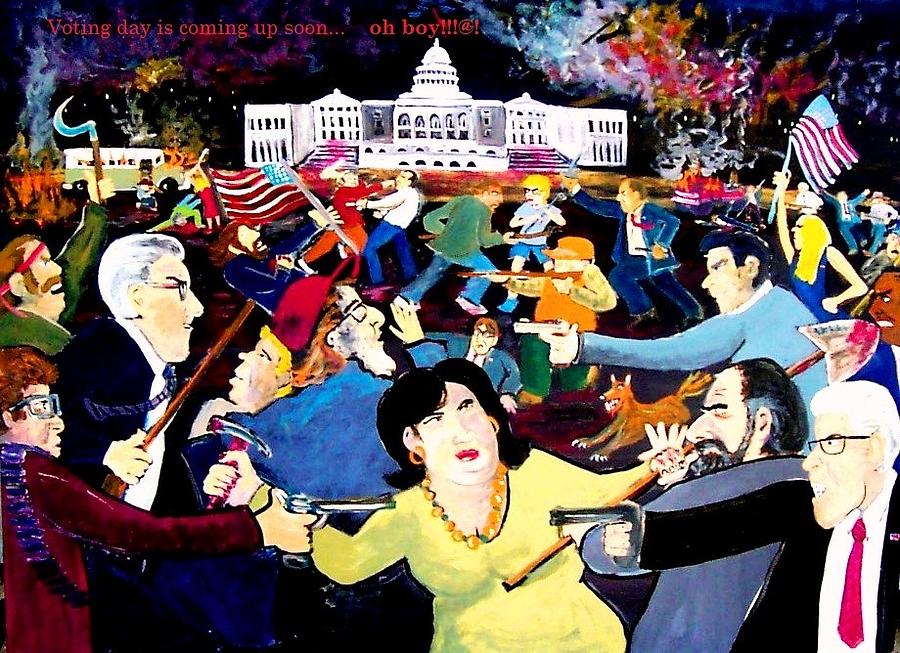
Voting Day Coming Up Soon Oh Boy Painting by Richard Hubal
Election day is one week away. I haven’t slept normally since the pandemic began, and–along with millions of other Americans–I’ve been stressed out since Trump was elected. It’s exhausting. I honestly don’t think I can survive another four years of this insanity. The polls are looking good for Biden; but as of yesterday we now have to worry about the possibility that the Supreme Court could overturn the election results if Trump loses.
Mark Joseph Stern at Slate: Amy Coney Barrett’s First Votes Could Throw the Election to Trump.
Although George W. Bush prevailed in the Bush v. Gore decision, it’s often forgotten that the Supreme Court declined to affirm his chief legal argument. This claim was so radical, so contrary to basic principles of democracy and federalism, that two conservative justices stepped back from the brink. Instead, the majority fabricated a novel theory to hand Bush the election—then instructed lower courts never to rely on it again.
But the court has changed. Republican lawmakers revived the original Bush v. Gore argument in fraught election cases this year, and, following Amy Coney Barrett’s nomination, four sitting justices appeared to endorse it. Barrett’s confirmation on Monday will almost certainly tip the balance to make that argument the law of the land on the eve of an election. The result would be an immediate invalidation of thousands of disproportionately Democratic ballots in Pennsylvania and North Carolina—two swing states that could decide the outcome of the election. Put simply, Barrett’s first actions on the court could hand Donald Trump an unearned second term, and dramatically curtail states’ ability to protect the right to vote….
 In an unsigned opinion that allegedly spoke for the five conservative justices, the court held that Florida’s recount used procedures that violated “the equal dignity owed to each voter.” Because the standards used to recount ballots varied between counties, the court concluded, the process violated the U.S. Constitution’s equal protection clause. Then, in an unprecedented move, the court declared that this analysis was a ticket good for one ride only, and that lower courts should never invoke its made-up principle again.
The reason the Court said this argument shouldn’t be used again is that is took away a state’s ability to control it’s own elections. If repeated, the argument would turn the SCOTUS into a national arbiter of election laws.
It is black letter law that state courts hold ultimate authority to determine the meaning of their own state’s statutes and constitution. And the Florida Supreme Court had simply provided its best interpretation of a “legal vote” under Florida law. Secretary of State Katherine Harris rejected ballots with “hanging chads” on which voters had indicated their preference but failed to punch through the hole all the way. The Florida Supreme Court disagreed, citing a state statute that required the counting of defective ballots “if there is a clear indication of the intent of the voter.” Federal judges had a constitutional obligation to accept that (eminently plausible) reading of the law. By refusing to do so, Rehnquist, along with Scalia and Thomas, impermissibly substituted the Florida Supreme Court’s judgment with their own.
But now Republicans are again trying to get the Court to rule on individual states’ election policies, and yesterday they intervened in Wisconsin’s election decisions. The New York Times: Supreme Court Won’t Extend Wisconsin’s Deadline for Mailed Ballots.
The Supreme Court refused on Monday to revive a trial court ruling that would have extended Wisconsin’s deadline for receiving absentee ballots to six days after the election.

2008 voting line, by Charly Palmer
The vote was 5 to 3, with the court’s more conservative justices in the majority. As is typical, the court’s brief, unsigned order gave no reasons. But several justices filed concurring and dissenting opinions that spanned 35 pages and revealed a stark divide in their understanding of the role of the courts in protecting the right to vote during a pandemic.
The ruling was considered a victory for Republicans in a crucial swing state, which polls have shown Mr. Trump trailing in after winning by about 23,000 votes in 2016.
Returning to the Slate article:
By confirming Barrett on Monday, Senate Republicans may well create a five-justice majority that is ready, willing, and able to make Rehnquist’s position the law of the land. There are currently two cases pending before SCOTUS that ask the justices to nullify thousands of mail ballots in Pennsylvania and North Carolina. Both rest on Rehnquist’s Bush v. Gore concurrence. Both give the far-right majority a chance to stomp on states’ ability to protect voting rights.
I urge you to go read the whole piece at Slate. Right now, Massachusetts rules allow votes to be counted if they arrive 6 days after the election and are postmarked by November 3. Will the SCOTUS decision in Wisconsin also force Massachusetts and other states to throw out ballots received after election day?
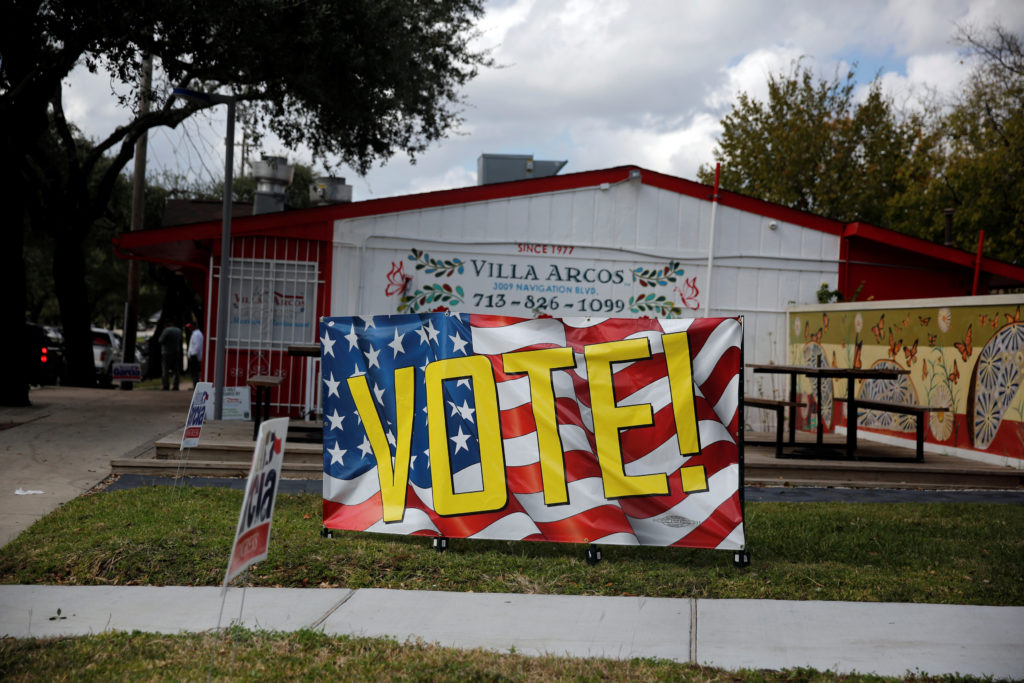
A 2918 banner urging people to vote in the midterm elections displayed in Houston, Texas. REUTERS/Cathal McNaughton
Ian Millhiser at Vox: The radical implications of the Supreme Court’s new ruling on Wisconsin mail-in ballots.
The Supreme Court just handed down an order in Democratic National Committee v. Wisconsin State Legislaturedetermining that a lower federal court should not have extended the deadline for Wisconsin voters to cast ballots by mail.
The ruling, which was decided by a 5-3 vote along party lines, is not especially surprising. The lower court determined that an extension was necessary to ensure that voters could cast their ballot during a pandemic, but the Court has repeatedly emphasized that federal courts should defer to state officials’ decisions about how to adapt to the pandemic. Monday night’s order in Democratic National Committee is consistent with those prior decisions urging deference.
What is surprising, however, is two concurring opinions by Justices Neil Gorsuch and Brett Kavanaugh, each of which takes aim at one of the most foundational principles of American constitutional law: the rule that the Supreme Court of the United States has the final word on questions of federal law but the highest court in each state has the final word on questions of state law.
This division of power is implicit in our very system of government. As the Supreme Court has explained, the states and the federal government coexist in a system of “dual sovereignty.” Both the federal government and the states have an independent power to make their own law, to enforce it, and to decide how their own law shall apply to individual cases.
If the Supreme Court of the United States had the power to overrule a state supreme court on a question of state law, this entire system of dual sovereignty would break down. It would mean that all state law would ultimately be subservient to the will of nine federal judges.
 With Barrett on the Court,
last week’s decision allowing a Pennsylvania Supreme Court decision to stand could be very short-lived. That decision, after all, was 4-4, with Chief Justice John Roberts voting with the Court’s three liberals. With Barrett, the Court’s right flank may well be getting a fifth vote to toss out the state supreme court’s decision — and to order an unknown number of ballots tossed out in the process.
In her first few weeks at SCOTUS, Barrett will also have the opportunity to vote on cases involving the Affordable Care Act, Trump’s taxes, abortion, and a case about whether a Catholic agency can refuse to place foster children with LGBT couples.
The only recourse for Democrats in the future may be to increase the size of the Supreme Court–if they can take the Senate, that is.
At The Los Angeles Times, Nicholas Goldberg sees a possible silver lining in the Barrett confirmation:
So now it is official: The same Republican senators who in 2016 refused to consider Merrick Garland’s appointment to the Supreme Court because, with eight months to go, it was supposedly too close to the presidential election, have now confirmed Amy Coney Barrett with just eight days left before the election.
This is so unprincipled, so inconsistent and so cynical that it defies the imagination. It is the flip-flop of the century, undertaken by the Republicans for one reason: Barrett’s confirmation ensures a conservative majority on the high court for the foreseeable future.
But here is one good thing that could come of this shameful episode. With millions of people still casting their votes before Nov. 3, perhaps the Barrett confirmation will open Americans’ eyes, once and for all, and show them who they’re dealing with. Perhaps it will persuade them to reject the radical and hypocritical Senate Republicans at the polls.
Barrett’s confirmation, after all, is only one of many irresponsible moves by the Senate majority, led by the craven Mitch McConnell (R-Kentucky), who long ago threw his lot in with President Trump. In recent years, he and his caucus have grown not just more extreme in their ideology but more unscrupulous in their tactics.
Not only did they refuse a hearing to Garland (giving that seat instead to Trump appointee Neil M. Gorsuch), but not long after, McConnell and his colleagues rammed Brett Kavanaugh’s nomination through without a comprehensive investigation of the sexual assault allegations against him.
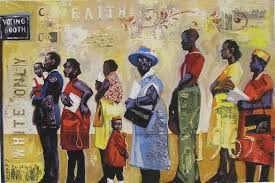
Voting Line, by Charly Palmer
Maybe. It seems unlikely that many votes are going to change at this late date, but I hope Goldberg is right. On the other hand, it’s possible the evidence that the pandemic is getting worse might influence some voters to reject Trump and other Republicans.
One more from The New York Times Editorial Board: The Republican Party’s Supreme Court. The quest to entrench political conservatism in the country’s highest court comes with a steep cost.
What happened in the Senate chamber on Monday evening was, on its face, the playing out of a normal, well-established process of the American constitutional order: the confirmation of a president’s nominee to the Supreme Court.
But Senate Republicans, who represent a minority of the American people, are straining the legitimacy of the court by installing a deeply conservative jurist, Amy Coney Barrett, to a lifetime seat just days before an election that polls suggest could deal their party a major defeat.
As with President Trump’s two earlier nominees to the court, Neil Gorsuch and Brett Kavanaugh, the details of Judge Barrett’s jurisprudence were less important than the fact that she had been anointed by the conservative activists at the Federalist Society. Along with hundreds of new lower-court judges installed in vacancies that Republicans refused to fill when Barack Obama was president, these three Supreme Court choices were part of the project to turn the courts from a counter-majoritarian shield that protects the rights of minorities to an anti-democratic sword to wield against popular progressive legislation like the Affordable Care Act.
The process also smacked of unseemly hypocrisy. Republicans raced to install Judge Barrett barely one week before a national election, in defiance of a principle they loudly insisted upon four years ago.
I hope you’ll read the whole thing, but here’s a bit more:
Of all the threats posed by the Roberts Court, its open scorn for voting rights may be the biggest. In 2013, Chief Justice John Roberts wrote the lead opinion in the most destructive anti-voter case in decades, Shelby County v. Holder, which gutted the central provision of the Voting Rights Act and opened the door to rampant voter suppression, most of it targeted at Democratic voters. Yet this month, Chief Justice Roberts sided with the court’s remaining three liberals to allow a fuller count of absentee ballots in Pennsylvania. The four other conservatives voted against that count. In other words, with Justice Barrett’s confirmation the court now has five justices who are more conservative on voting rights than the man who nearly obliterated the Voting Rights Act less than a decade ago.
I hope I haven’t ruined your day with this post, but the Barrett confirmation is clearly the most important issue of the day. I can only hope that the outcome of next week’s election will be a landslide that prevents SCOTUS from overturning the results.
Please take care today and protect your health and sanity over the next week. I hope you’ll stop by and leave a comment or two.
Did you like this post? Please share it with your friends:
Posted: October 24, 2020 | Author: bostonboomer | Filed under: Afternoon Reads, U.S. Politics | Tags: 2020 presidential election, coronavirus pandemic, Donald Trump, Joe Biden, superspreader rallies, Trump rallies |
Good Afternoon!!

M.C. Escher woodcut, 1931
The coronavirus pandemic is getting worse as colder weather and the holidays approach. Here in Massachusetts, we are seeing more new cases every day, after months of holding steady against the virus. In many states, cases and deaths are rising at an even more alarming pace.
Meanwhile, Trump happily makes things even worse with his daily superspreader rallies. If we can’t get rid of this horrible man, he is going to kill millions of Americans and reduce our country to rubble.
I just finished reading a fascinating book about Trump’s rallies,
…what was occurring at Trump’s rallies showed Trump’s narcissism and his urgent need to rule, which ultimately differed little from any other autocrat who’d risen to power. He had to win, had to have complete loyalty. He had no choice but to kill everyone else and survive over a battlefield of the dead and all of those sycophants on the stage [Republican political leaders] were letting him. They had submitted and kept on submitting, and if nothing got in his way, he would keep winning, winning, winning, until the whole system, the whole structure of American law and culture and politics was his to wield, his to control. It couldn’t be any other way. There was no other option. Trump didn’t believe in moral goodness or a higher God or the Constitution or democracy. If he wasn’t kept in check, Trump would destroy American because he couldn’t stop himself.
Hoffman argues that the rise of Trump is proof once and for all that “American exceptionalism” is a myth. We are just as vulnerable to authoritarian takeover as any other country. We have just 10 days left to stop Trump. But even if he loses the election, he will still have until January 20 to damage our government and aid and abet the deaths of hundreds of thousands of Americans from a virus that he chose not to deal with. I don’t know what is going to happen; I only hope we can begin stop him with our votes on November 3.
The Latest on the Pandemic:
The Washington Post: America hits highest daily number of coronavirus cases since pandemic began.
America on Friday hit its highest daily number of coronavirus cases since the pandemic began, recording at least 82,600 new infections and surpassing the previous record set during the summertime surge of cases across the Sun Belt.

Katzen, by Jankel Adler, 1937
The rising numbers put the nation on the precipice of what could be its worst stretch to date in the pandemic with some hospitals in the West and Midwest already overwhelmed and death counts beginning to rise.
The current surge is considerably more widespread than the waves from last summer and spring. The unprecedented geographic spread of the current surge makes it more dangerous, with experts warning it could lead to dire shortages of medical staff and supplies. Already, hospitals are reporting shortfalls of basic drugs needed to treat covid-19, the disease caused by the novel coronavirus.
And it’s not simply a matter of increased testing identifying more cases. Covid-19 hospitalizations increased in 38 states over the past week. The number of deaths nationally has crested above 1,000 in recent days.
The last time the country hit a new daily record for coronavirus cases — 76,533 on July 17 — just four states accounted for more than 40,000 of those cases: Arizona, California, Florida and Texas, according to a Washington Post analysis.
On Friday, 11 states accounted for that same lion’s share of cases. And in the past two weeks, 24 states have broken their records for single-day highs of cases.
More than 170 counties across 36 states were designated rapidly rising hotspots, according to an internal federal report produced Thursday for officials at the Department of Health and Human Services and obtained by The Post.
The New York Times: Covid in the U.S.: Latest Map and Case Count.

Jankel Adler, woman and two cats
At least 925 new coronavirus deaths and 85,085 new cases were reported in the United States on Oct. 23. Over the past week, there have been an average of 64,257 cases per day, an increase of 34 percent from the average two weeks earlier.
As of Saturday morning, more than 8,540,300 people in the United States have been infected with the coronavirus and at least 223,900 have died, according to a New York Times database.
Case numbers in the United States are rising rapidly as states in the Midwest and Rocky Mountains struggle to control major outbreaks, and as new hotspots emerge elsewhere in the country.
The national trajectory is only worsening. Wisconsin has opened a field hospital. North Dakota, which not long ago had relatively few cases, now has the most per capita in the country. And across the rural West, states like Alaska, Wyoming and Montana that had long escaped the worst of the pandemic have seen case numbers soar to alarming new records.
Deaths, though still well below their peak spring levels, averaged around 700 per day by mid October, far more than were reported in early July.
There’s lots of good information and maps at the NYT link.
Reuters: U.S. faces half a million COVID-19 deaths by end-February, study finds.
More than a half million people in the United States could die from COVID-19 by the end of February, but around 130,000 of those lives could be saved if everybody were to wear masks, according to estimates from a modelling study on Friday.
The estimates by researchers at the University of Washington’s Institute for Health Metrics and Evaluation showed that with few effective COVID-19 treatment options and no vaccines yet available, the United States faces “a continued COVID-19 public health challenge through the winter.”
“We are heading into a very substantial fall/winter surge,” said IHME Director Chris Murray, who co-led the research.
He said the projections, as well as currently rising infection rates and deaths, showed there is no basis to “the idea that the pandemic is going away,” adding: “We do not believe that is true.”
Odysseus and Calypso, Max-Beckmann, 1943
USA Today: Trump’s campaign made stops nationwide. Coronavirus cases surged in his wake in at least five places.
The president has participated in nearly three dozen rallies since mid-August, all but two at airport hangars. A USA TODAY analysis shows COVID-19 cases grew at a faster rate than before after at least five of those rallies in the following counties: Blue Earth, Minnesota; Lackawanna, Pennsylvania; Marathon, Wisconsin; Dauphin, Pennsylvania; and Beltrami, Minnesota.
Together, those counties saw 1,500 more new cases in the two weeks following Trump’s rallies than the two weeks before – 9,647 cases, up from 8,069.
Although there’s no way to determine definitively if cases originated at Trump’s rallies, public health experts say the gatherings fly in the face of all recommendations to curb the spread of the coronavirus.
USA TODAY reviewed coronavirus case counts in the counties where Trump attended rallies starting from mid-August through mid-October. The news organization examined the rate of increase in virus cases for the two weeks before and after campaign events. For rallies occurring within the past two weeks, not enough time has passed to draw conclusions.
Public health officials additionally have linked 16 cases, including two hospitalizations, with the rally in Beltrami County, Minnesota, and one case with the rally in Marathon County, Wisconsin. Outside of the counties identified by USA TODAY with a greater case increase after rallies, officials identified four cases linked to Trump rallies.
Presidential Campaign Reads:
Philip Bump at The Washington Post: The electoral map is very weird right now.

Max Beckmann, Self portrait with cat and lamp
You will be unsurprised to learn that, according to a poll released on Friday by the New York Times and Siena College, President Trump leads former vice president Joe Biden in Montana. Montana is almost definitionally red, part of the phalanx of Republican states that’s draped over the western Plains and Rocky Mountains.
You might be surprised, though, to learn the margin of Trump’s lead. It’s only seven points, which, if that margin were to hold until Election Day, would represent a 13-point swing away from Trump relative to his 2016 support.
More remarkably, that’s as narrow a race as the pollsters measured in both Michigan and Wisconsin, states Trump won by tiny margins four years ago. In Michigan, the Times-Siena poll had Biden up eight points; in Wisconsin, he was up 10….
The state that’s closest at the moment is — Texas. If Joe Biden wins Texas, it’s over.
But it doesn’t get less weird. Georgia, Iowa and Ohio — which Trump won in 2016 by five, nine and eight points, respectively — are the next three closest states. What’s more, Biden leads in the first two.
Read the whole thing at the WaPo.
Politico: Paranoia and finger-pointing in Trumpworld as election approaches.
President Donald Trump’s top advisers have plunged into a bitter round of finger-pointing and blame-shifting ahead of an increasingly likely defeat.

Cats on the Veranda, Pierre Bonnard
Accusations are flying in all directions and about all manner of topics — from allegedly questionable spending decisions by former campaign manager Brad Parscale, to how White House chief of staff Mark Meadows handled Trump’s hospitalization for Covid-19, to skepticism that TV ads have broken through. Interviews with nearly a dozen Trump aides, campaign advisers and Republican officials also surfaced accusations that the president didn’t take fundraising seriously enough and that the campaign undermined its effort to win over seniors by casting Democrat Joe Biden as senile.
Finger-pointing is a common feature of campaigns that think they’re losing, but it’s happening at an uncommon level in this campaign. Shifting responsibility has been a staple of the Trump presidency — and his lieutenants are now following suit.
Tim Alberta at Politico Magazine: The Unspectacular Excellence of Joe Biden’s Slow and Steady Campaign.
The reasons I expected Biden to get mauled by the likes of Cory Booker and Elizabeth Warren and Pete Buttigieg are exactly the reasons he outlasted them all.
The reasons I wondered how he would fare against Donald Trump are exactly the reasons he outperformed the president in each of their two debates.
Biden is slow. He is steady. He is unspectacular. In other words, he is what much of the electorate seems to want.

The Poet or Half Past Three, Marc Chagall
On Thursday night, two years after he stepped to that lectern in Lansing, Biden climbed down tiredly from the stage in Nashville. Over the previous 90 minutes, he had put the finishing touches on a campaign that was crafted in defiance of every expectation placed upon him and his party since Trump took office. I would call Biden’s performance in the final debate an exclamation mark—except there is nothing exclamatory about his candidacy. He has run, objectively speaking, one of the most monotonous and predictable and uneventful campaigns for president in recent memory. And it has been nothing short of superb. Now, with Biden on the brink of a historic victory, it’s worth understanding what has been right about his campaign—not simply what has been wrong with Trump’s.
The Democratic nominee was at it again Thursday night, plodding along at a comfortable pace, reciting methodically rehearsed responses, never losing his composure or abandoning his message. It was telling that the lone error Biden supposedly committed—pledging to transition the country away from reliance on oil—is something he has discussed regularly over the past 18 months.
Read the rest at Politico.
Sarah Jones at New York Magazine: Focus Group Slams Trump for No Empathy in Final Presidential Debate.
Analysts and pundits are praising President Trump for turning in a more “restrained” performance at this year’s final presidential debate. Though it’s true the president presented a calmer façade, at least in comparison to his last, fractious appearance next to Joe Biden, that’s likely the result of the threat of a muted mic and skillful moderation from NBC’s Kristen Welker. The president may have shouted less, but when he spoke, he was exactly the same person he’s always been: self-focused and callous, obsessed with conspiracy theories and prone to lie. Do voters really want four more years of Trump’s act? We won’t know for a little while longer, but public opinion doesn’t favor him.

Three Cats with Bowls of Milk, Gertrude Abercrombie
A focus group convened by Democratic pollster Stanley Greenberg showed a decisive edge for Biden in the debate, who was rewarded for his empathy compared to Trump. Greenberg surveyed 150 voters from diverse backgrounds for live dial tests commissioned by the American Federation of Teachers. As usual, Greenberg and his team measured the attitudes of a diverse focus group before, during, and after the debate. “Looking at the pre- and post-results, I think that was actually a disastrous debate for Trump,” he told Intelligencer on Wednesday morning. Over 60 percent of his focus group gave Biden an A or B rating; Trump languished far behind, with the percentage of voters giving him the same A or B rating staying firmly in the 30s. Biden also increased his favorability rating twice as much as Trump did, Greenberg added.
Biden performed particularly well on measures testing his appeal to the middle class. “We have an eight point increase on improving things for the middle class,” Greenberg said, a result that builds on Biden’s previous strong postdebate performance on the same question. On the subject of health care, Biden gained five points on Trump, evidence that the president’s doom-mongering over “socialized medicine” didn’t persuade anyone who wasn’t already a Trump loyalist. To Greenberg, Biden’s strength on health care shows that “people are actually looking for change, help.”
Have a great weekend, and I hope you’ll check in with us if you have the time an inclination.
Did you like this post? Please share it with your friends:
Posted: October 22, 2020 | Author: bostonboomer | Filed under: Afternoon Reads, U.S. Politics | Tags: 2020 presidential election, 60 Minutes, circular gait, coronavirus pandemic, dementia, Donald Trump, forward leaning posture, Joe Biden, Lesley Stahl, neurology, Richard E. Cytowic MD, Second 2020 presidential debate, slurred speech |
Good Afternoon!!
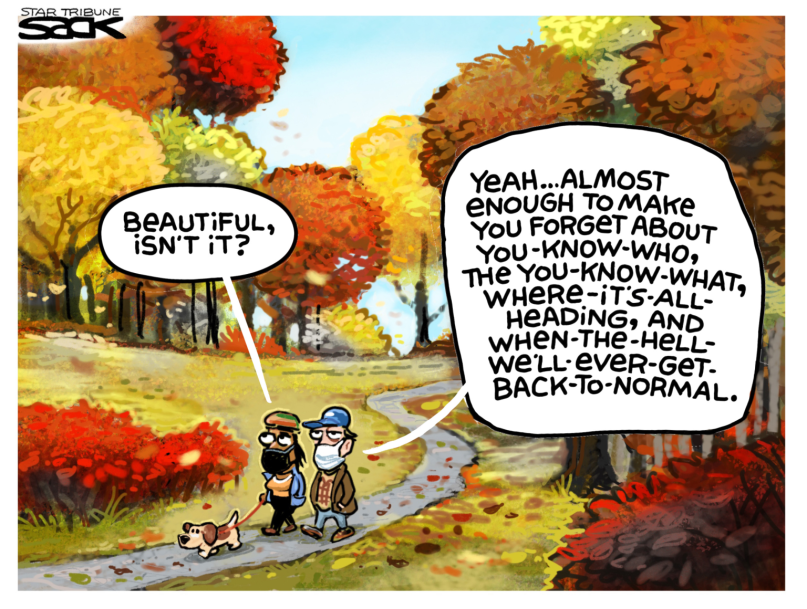 Tonight Trump and Biden will meet in the second and final debate before the November 3rd election. I plan to watch, at least for a little while, in case Trump spontaneously combusts or strokes out in a rage over his mike being muted. The New York Times has the basics on how to watch:
The second and final debate between President Trump and former Vice President Joseph R. Biden Jr. takes place on Thursday from 9 to 10:30 p.m. Eastern. Here are some of the many ways you can watch it:
— The Times will livestream the debate, and our reporters will provide commentary and analysis.
— The debate will be televised on channels including ABC, CBS, NBC, CNN, C-SPAN, PBS, Fox News and MSNBC.
— Many news outlets, including ABC, CBS, NBC, PBS, Fox News and C-SPAN, will stream the debate on YouTube.
A debate preview from the AP: Face to face: Trump and Biden to meet for final debate.
NASHVILLE, Tenn. (AP) — President Donald Trump and his Democratic challenger, Joe Biden, are set to square off in their final debate Thursday, one of the last high-profile opportunities for the trailing incumbent to change the trajectory of an increasingly contentious campaign.
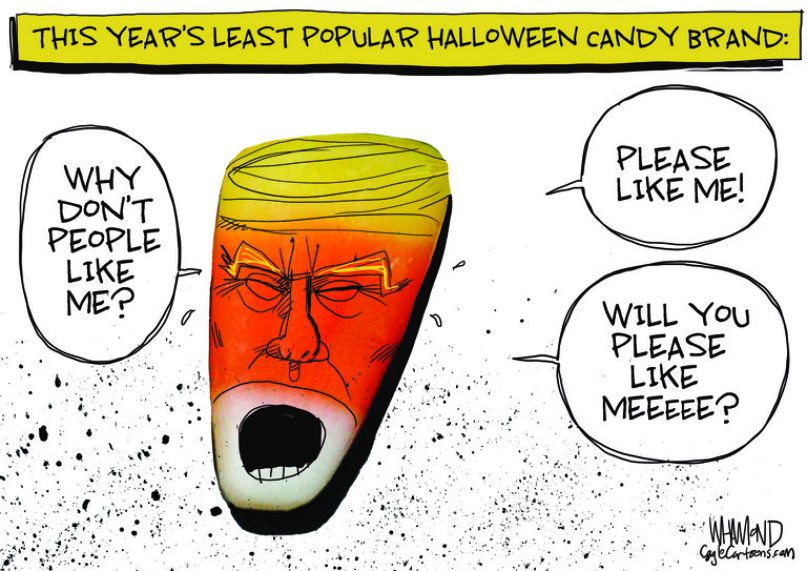 Worried about losing the White House, some advisers are urging Trump to trade his aggressive demeanor from the first debate for a lower-key style that puts Biden more squarely in the spotlight. But it’s unclear whether the president will listen….
Trump on Tuesday called on Attorney General William Barr to immediately launch an investigation into unverified claims about Biden and his son Hunter, effectively demanding that the Justice Department muddy his political opponent and abandon its historic resistance to getting involved in elections.
The president has promoted an unconfirmed New York Post report published last week that cites an email in which an official from Ukrainian gas company Burisma thanked Hunter Biden, who served on the company’s board, for arranging for him to meet Joe Biden during a 2015 visit to Washington. The Biden campaign has rejected Trump’s assertion of wrongdoing and noted that Biden’s schedule did not show a meeting with the Burisma official.
Trump’s attacks on the Biden family have been relentless, including his efforts to get Ukraine to investigate Joe Biden, which led to Trump’s impeachment. It’s part of a determined, yet so-far-unsuccessful effort to drive up his opponent’s negatives, as he did with Hillary Clinton four years ago….
While Biden will defend his own record and his son, aides have said, he hopes to focus on making the case that Trump is unfit for office and let the nation down during a confluence of crises.
As the article notes, Biden has spent the past few days preparing for the debate; Trump has been holding superspreader rallies and raging at Lesley Stahl after she apparently asked him some tough questions in an interview for CBS’s 60 Minutes.
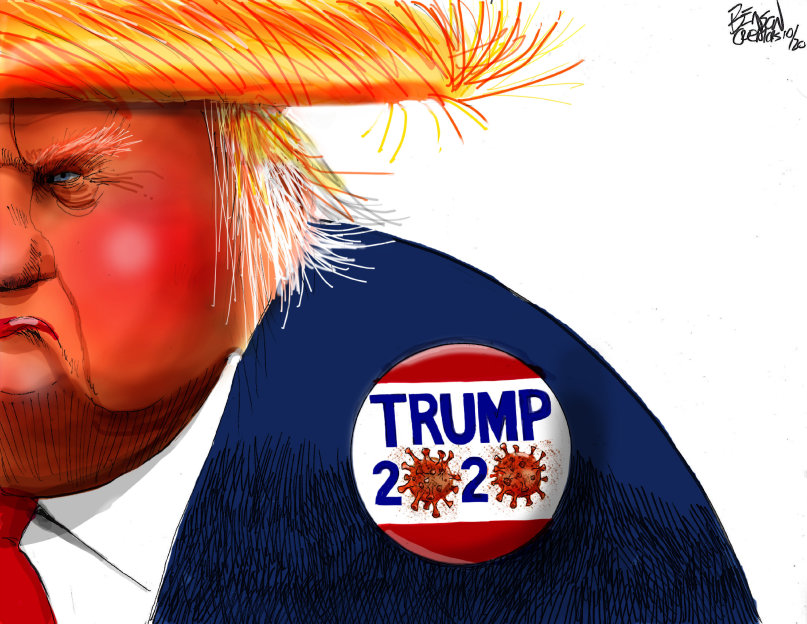 It must have been really awful for Trump, because he cut the interview short and didn’t return for a scheduled “walk and talk” with Stahl and VP Pence. Right after the interview ended, Trump began attacking Stahl on Twitter. Forbes: Trump Attacks ‘60 Minutes’ Host Lesley Stahl After Reportedly Cutting Interview Short.
Trump tweeted a video of Stahl not wearing a mask while interacting with several people, writing, “Lesley Stahl of 60 Minutes not wearing a mask in the White House after her interview with me. Much more to come.”
Trump then threatened to post the interview in advance of its airing so that “everybody can get a glimpse of what a FAKE and BIASED interview is all about,” adding, “Everyone should compare this terrible Electoral Intrusion with the recent interviews of Sleepy Joe Biden!”
Sources familiar with the interview told Forbes the video was taken after the interview with the CBS team, who had all been tested, and that Stahl had a mask on leading into the interview….
The incident comes as Trump and his allies have become increasingly critical of the questioning he receives from the press, with Trump accusing NBC’s Savannah Guthrie of “going totally crazy” in response to her tough line of questioning during a town hall last week.
This morning Trump tweeted:
I cant wait to hear those “magnificently brilliant” responses.
60 Minutes released short clips from the Biden and Trump interviews this morning.
At The Washington Post, Greg Sargent tries to explain Trump’s inexplicable behavior: Why Trump’s endgame is to rage at Lesley Stahl.
Why would Trump squander his final chance to close his big polling gap with Joe Biden on unhinged public fights rather than on winning back voters who’ve been alienated by exactly these sorts of meltdowns?
The fact that this comes after Trump waged a public assault on Anthony S. Fauci, his own leading infectious-disease expert, only seems to compound the folly here, since voters are surely looking to the popular Fauci for advice with the coronavirus again spiking around the country.
But in a very real sense people such as Stahl and Fauci actually are the chief opponents Trump must contend with in the campaign’s final days. They are the figures he perceives to be standing in the way of his effort to conduct this campaign in an entirely invented universe that he’d hoped to manufacture for this very purpose.
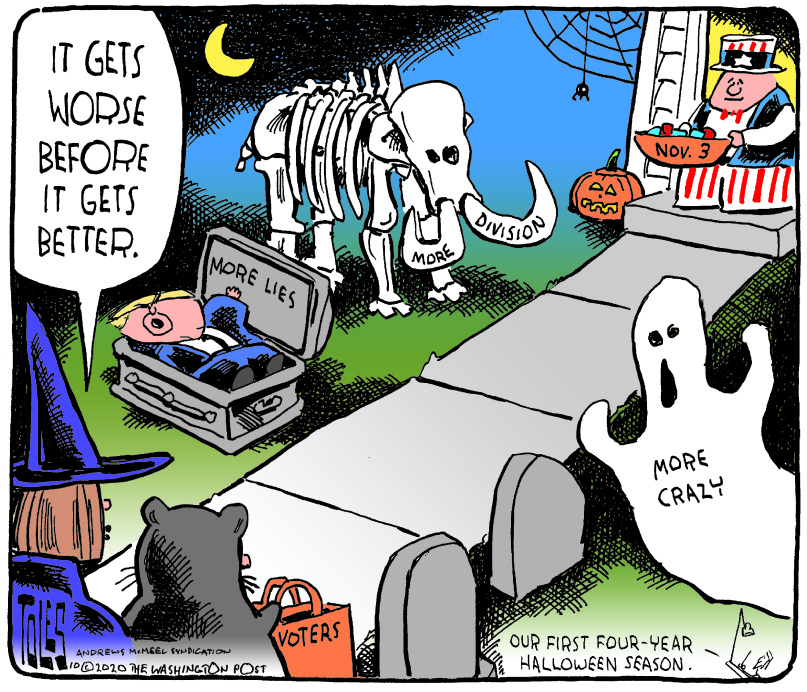
Tom Toles Editorial Cartoon
Trump unloaded on Stahl at a rally on Tuesday night, showing that he’s still stewing about an interview he did with “60 Minutes,” which is set to air on Sunday but apparently went very badly.
“You have to watch what we do to ‘60 Minutes,’” Trump seethed. “You’ll get such a kick out of it. You’re gonna get a kick out of it. Lesley Stahl is not gonna be happy.”
This appears to be a reference to Trump’s threat to release the full footage of the interview before edited parts air. It’s not clear what that would prove, but Trumpworld is all in: White House Chief of Staff Mark Meadows just told Fox News that it would show Stahl “came across more like an opinion journalist than a real reporter.”
Of course the real explanation is that Trump is looney tunes, coo-coo for Cocopuffs, and completely off his rocker.
This is a very good explanatory piece at Psychology Today by Richard E. Cytowic, a professor of Neurology at George Washington University, that addresses Trump’s odd gait, forward-leaning stance, and other behavioral symptoms that many people have noticed.
We Are Entitled to Ask President Trump for His Brain Scan.
President Trump’s pre-COVID halting gait, bent posture, and jerking right arm have caused much speculation on social media. Armchair critics, without any apparent medical background, have freely diagnosed him as having a series of mini-strokes, frontotemporal dementia, or other neurological illness such as the Lewy Body dementia that afflicted comedian and actor Robin Williams….
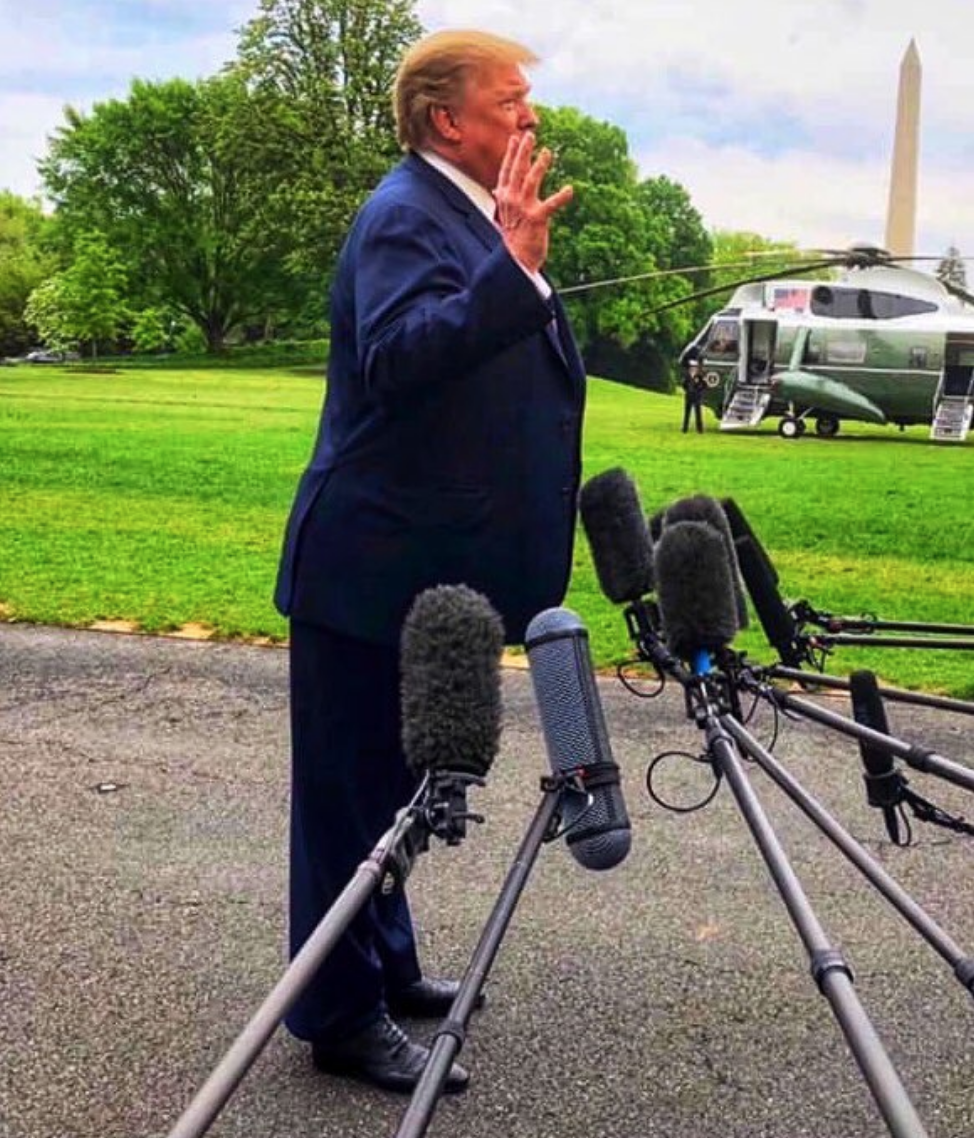 Trump’s forward-listing posture—illustrated by nearly every political cartoonist—was initially attributed to the high-heeled elevator shoes readily observed in photographs. But his torso leans so markedly off-center that it suggests the possibility of a neurological problem rather than vanity. In medical terms the Bent Spine Syndrome is called camptocormia, first documented in the 17th century by Francisco de Zurbaran, a Spanish painter. The mean age of onset is 65 years (Trump is 74).
While most frequently observed in Parkinson’s Disease, the bent posture so evident in Trump may also be seen in Alzheimer’s Dementia, movement disorders of the basal ganglia, and as the side effect of certain medications.
Also noted are the sudden, jerking movements of Trump’s right arm. Since they occur only on one side, the prefix “hemi” is applied, while “ballistic” means sudden or flinging in the manner of a projectile. Trump’s hemiballistic arm movements are evident in news clips from Memorial Day (also here via C-Span) at the Tomb of the Unknown Soldier, as are his uncontrolled swaying and forward tilt. He is seen to grab his wayward arm with the left one in an effort to keep it under control.
It is common for affected individuals to incorporate the flinging into deliberate movements such as scratching or smoothing the hair as if to make them less noticeable.
Sort of like Dr. Strangelove . . .
On Trump’s “Apparent arm weakness, slurred Speech, and odd circular gait” Cytowic writes:
Evaluating gait and muscle strength is always part of the neurological exam because posture and locomotion call on vast swaths of brain, spinal cord, and peripheral nerves. In June 2020, the president spoke at the West Point graduation ceremony. When he paused to take a sip of water, it appeared that his right arm couldn’t lift the glass all the way. As seen in this C–Span clip, he used his left hand to push it up from the bottom until it met his lips. During his address, you hear slurred speech and mispronunciation of well-known historical names such as Ulysses S. Grant and Douglas MacArthur.
When it came time to exit, Trump hesitantly edged down the ramp. He appeared to have difficulty raising his right leg sufficiently to clear it, as video spread of his struggle on the Drudge Report and major news sites. In September, as Trump walks down the White House driveway to meet the press, you see a clear example of the inability to gain adequate clearance for the right foot to swing normally. To compensate, he abducts his thigh and swings the leg in a semicircle: This is the circumducted gait, or spastic hemiparesis, the most common abnormal gait in neurology. Other photos show his right foot turned in, or inverted, which is part of the hemiparetic gait.
The fact that the leg makes a circle is what makes this way of walking distinctive. Stroke patients with weakness on one side (hemiparesis) almost always show it, along with increased muscle tone (spasticity) on the affected side and a turned in (inverted) foot. When mild, loss of the normal arm swing and a slight circumduction of the leg may be the only outwardly visible abnormalities. But Trump exhibited this spastic circumducted gait back in July during his visit to a North Carolina Lab. Exactly when it began is as yet unknown.
Read the whole thing at the link.
More stories to check out today:
 Rolling Stone: Watch Obama Absolutely Torch Trump During His Debut Campaign Event for Biden.
The Wall Street Journal: Inside the Week That Shook the Trump Campaign.
William Saletan at Slate: Trump’s Attack on Fauci Is Unbelievably Idiotic.
The Daily Beast: New Columbia Study Blames the White House for at Least 130,000 ‘Avoidable’ COVID Deaths.
American Independent: Violent threats against Biden and his supporters are getting worse.
Raw Story: Armed guards at Florida polling site say they were sent by the Trump campaign.
News Channel 8 Tampa: Trump spokesperson says armed men outside St. Pete polling place were not hired by campaign.
NPR: Here’s Where The Threat Of Militia Activity Around The Elections Is The Highest.
Politico: Trump is doing worse than it seems — but reporters are afraid to say so.
The New York Times: The Relentless Shrinking of Trump’s Base.
Take care everyone, and please stop by to share your thoughts if you have the time and inclination.
Did you like this post? Please share it with your friends:


 peej
peej Carissa
 bostonboomer
 dakinikat
 ecocatwoman
 mablue2
 Mama Lopez
 peggysue22
 quixote
 skydancingguestblogger
 Mona (aka Wonk the Vote)



 Sky Dancing
Recent Comments