
A Dismal Labor Market
Posted: September 28, 2009 Filed under: The Great Recession | Tags: NAIRU, natural rate of unemployment, Phelps, unemployment 4 Comments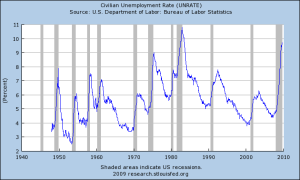
The Big Picture c/o FRED
I started the big lecture in macroeconomics on unemployment with a very out of date textbook. It isn’t even that old in terms of textbook cycles. It’s just the world economy has changed; really changed. The last unemployment data I was looking at came from 2007 and a world of hurt and CHANGE (TM) stands between that year and today.
One of my students noticed that the overall pattern of unemployment (and you can see it in the FRED graph above) showed a drift up of the central tendency or mean from a lower looking central tendency in the 1950s and 1960s to a higher one in the 1970s and 1980s. I did the happy dance because I really like it when students actually notice these things. It makes my life a lot easier when I don’t have to point every little thing like that out. The deal is if you look around the 1990s it seems to drift a little downwards again before that last gray bar representing this last recession dated by the NBER. That would be our current Great Recession. Notice how the downward drift in the series could potentially have stopped and it appears there could be a slight updrift? Again, that’s in the central tendency or what you might call the mean, the median, or the mode depending on how you want to measure the statistic.
That momentum and drift around that central tendency in the unemployment series represents flows above and around what we call the Natural Rate of Unemployment. People used to set up all kinds of policy goals after the Great Depression to get to a zero unemployment rate. Actually, they did it with the Humphrey Hawkins Full Employment bill in the 1970s too because the wish was to get every one unemployed into a job. We’ve learned quite a bit more about what is and isn’t possible now.
In the 1960s, Milton Friedman and Edmund Phelps begun to study the unemployment rate carefully to see if there was any structural or natural rate of unemployment that was related to what was going on with an economy and more important, if the goal of 0% unemployment was ever going to be more than a great wish. They also wanted to study the relationship between inflation and unemployment. Well, it turns out that there is a hypothetical rate of unemployment associated with certain things going on in the economy, like inflation, recession, or a slow economic recovery. This natural rate corresponds to the best case scenario given the set of circumstances going on in the larger economy and we’ve found that the level can go up or down, depending on that set of circumstances.
The Bear Whisperer
Posted: September 14, 2009 Filed under: Bailout Blues, Equity Markets, Global Financial Crisis, The Bonus Class, The Great Recession | Tags: Lehman banruptcy annivesary, moral hazard, President Obama, Wall Street Reform Comments Off on The Bear WhispererBless his little heart. He called for “common sense” rules for Wall Street. He had sharp words of warning for those who  didn’t learn the lessons from Lehman Brothers and the global financial crisis. Isn’t that nice? We no longer have to “speak softly and carry a big stick”? I guess those were different times and a different president. Now, we get to speak sharply and carry a big brief case full of cash.
Just in case you missed it (or lectured through it like I did), here’s the full text of President Obama’s Wall Street Speech today.
Oh, and let me be the first to say that our President needs to take a basic finance course or maybe it’s Jon Favreau that needs it.
In fact, while there continues to be a need for government involvement to stabilize the financial system, that necessity is waning. After months in which public dollars were flowing into our financial system, we are finally beginning to see money flowing back to the taxpayers. This doesn’t mean taxpayers will escape the worst financial crisis in decades unscathed. But banks have repaid more than $70 billion, and in those cases where the government’s stake has been sold completely, taxpayers have actually earned a 17-percent return on their investment. Just a few months ago, many experts from across the ideological spectrum feared that ensuring financial stability would require even more tax dollars. Instead, we’ve been able to eliminate a $250 billion reserve included in our budget because that fear has not been realized.
Bottom line: The Banks that didn’t need the money paid it back in a hurry to avoid some one tampering with their executive pay plans. The rest that’s out there (including Citibank’s share) will probably languish for ever or pay ever so slow. POTUS can brag about a 17% return by just simply ignoring the rest of the languishing money and just paying attention to the ones that pay back. After all, Wall Street ignores their toxic assets, why can’t he? Nice to be able to select the AAA tranche of the investment and only count the return on it instead of the entire portfolio. Tsk! Tsk! Tsk!
Speechification Alert
Posted: September 12, 2009 Filed under: Bailout Blues, Equity Markets, Global Financial Crisis, president teleprompter jesus, The Bonus Class, The Great Recession, The Media SUCKS, U.S. Economy | Tags: Barney Frank, L shaped recession, Stagnant economy, zombie banks Comments Off on Speechification Alert
Who stole the Cookies from the Cookie jar?Great illustration in today's New York Times: Banker's and the taxpayer cookie jar
Well, it’s my turn to listen to a Obama Speech. Those speeches usually have the same dizzying effect on me that tennis matches do. Instead of watching balls go back and forth rhythmically while lulling me to sleep, I get to watch the head of the President. Teleprompter Right, 1,2,3 to Teleprompter left, 2, 3 …
So the speech is on bank reform which is something I’ve been on about for months now. It’s the anniversary of Lehman’s demise. Stories abound on the Grey Lady today including this call by Dr. Tyler Cowen of George Mason University. He’s a little libertarian for my taste on policy–even managing a h/t to Ayn Rand and Atlas Shrugged–but he gets it all in a way that only an economist could.
But we are now injecting politics ever more deeply into the American economy, whether it be in finance or in sectors like health care. Not only have we failed to learn from our mistakes, but also we’re repeating them on an ever-larger scale.
Lately the surviving major banks have reported brisk profits, yet in large part this reflects astute politicking and lobbying rather than commercial skill. Much of the competition was cleaned out by bank failures and consolidation, so giants like Goldman Sachs and JPMorgan had an easier time getting back to profits. The Federal Reserve has been lending to banks at near-zero interest rates while paying higher interest on the reserves the banks hold at the Fed. “Too big to fail” policies mean that the large banks can raise money more cheaply because everyone knows they are safe counterparties.
President Dwight D. Eisenhower warned of the birth of a military-industrial complex. Today we have a financial-regulatory complex, and it has meant a consolidation of power and privilege. We’ve created a class of politically protected “too big to fail” institutions, and the current proposals for regulatory reform further cement this notion. Even more worrying, with so many explicit and implicit financial guarantees, we are courting a bigger financial crisis the next time something major goes wrong.
We should stop using political favors as a means of managing an economic sector. Unfortunately, though, recent experience with health care reform shows we are moving in the opposite direction and not heeding the basic lessons of the financial crisis. Finance and health care are two separate issues, of course, but in both cases we’re making the common mistake of digging in durable political protections for special interest groups.
I have to admit that I’ve written about similar concerns, however, I can tell Cowen and I may differ on how to correct the situation. That’s typically true of most economists. We agree on the root causes because of our grounding in shared theory but argue which policy might be best based on our political bent. I continue to argue for the role of government as rule setter and referee. However, I really do prefer independent bureaucrats in the position of auditor and enforcer. Congress, however, still has to write the law. This action, to date, has been missing.
So, MarketWatch has provided a pre-speechification programme so that we can get our score card ready. The speech is supposed to “rekindle” interest in regulatory restructuring. I’m not sure we need restructuring so much as we need laws that recognize the systematic problems we’ve developed in financial markets since quants have turned asset pricing into a physics exercise, financial innovations have become exotic, and the entire set up is now one big cartel waiting to pounce on the unsuspecting business sector and consumer. We now have a small number of banks capable of funding the really big capital undertakings and who knows what priorities or friends they’ll choose to fund over positive net present value projects? This should be enough to send any capitalist running for government regulation. Also, get ready for lack of services and fees that would make a loan shark blush. This should make any advocate for the little guy scream for the same. Today, I am the jade dakini. It’s happening in Europe but I doubt it will happen here.
So, what is Obama said to be inkling tomorrow that will be undoubtedly be sacrificed to the demons of political expediency down the road?
If you think you’re worse off now, you’re right and not alone
Posted: September 11, 2009 Filed under: Economic Develpment, Global Financial Crisis, Health care reform, Human Rights, Populism, Surreality, The Great Recession, U.S. Economy Comments Off on If you think you’re worse off now, you’re right and not alone
From CBPP
I put this article from yesterday’s NYTimes in the comments section of my thread yesterday. I’m not sure every one read it so I thought I’d front page it. It’s on the increasing poverty and median income declines in the U.S. as reported by the Center on Budget and Policy Priorities (CBPP) and the Census Bureau. The depressing reality of The Great Recession and the Dubya years has set in and there’s several obvious trends. First, the the nation’s poverty rate climbed from 12.5 percent in 2007 to 13.2 percent in 2008. This is the highest level since 1960 and the highest rate since 1997. The number of people in poverty is 39.8 million. Second, there’s been decline in employer-provided health insurance coverage for adults. It would’ve been bad for children and the poor too, but the increased participation in SCHIP and MEDICAID offset that. (You’re probably aware that I support de-linking employment and health insurance coverage since this is happening any way and switching to means-tested payments with basic plan provision for all.) Third, median income declined.
In another sign of both the recession and the long-term stagnation of middle-class wages, median family incomes in 2008 fell to $50,300, compared with $52,200 the year before. This wiped out the income gains of the previous three years, the report said.
Adjusted for inflation, in fact, median family incomes were lower in 2008 than a decade earlier.
“This is the largest decline in the first year of a recession we’ve seen since the Census Bureau started collecting data after World War II,” said Lawrence Katz, an economist at Harvard University, referring to household incomes. “We’ve seen a lost decade for the typical American family.”
The share of American residents who said they lacked health insurance throughout the entire year remained steady, at 15.4 percent, or 46.3 million people. But the total masked some more worrisome trends that are helping to drive the debate over a national health care overhaul.
Continuing an eight-year trend, the number of people with private or employer-sponsored insurance declined, while the number of people relying on government insurance programs including Medicare, Medicaid, the children’s insurance program and military insurance rose.
The Blame Game
Posted: September 7, 2009 Filed under: Bailout Blues, Equity Markets, Global Financial Crisis, The Bonus Class, The DNC, The Great Recession, The Media SUCKS, U.S. Economy, Voter Ignorance | Tags: Congressman Alan Grayson, Fannie Mae, Franklin Reins, Freddie Mac Comments Off on The Blame Game It’s amazing to me that so many people can get so worked up about one mid level bureaucrat in the White House who is a repentant communist and says he accidentally signed a 9-11 truther petition thinking it was just a request for more information on what the White House knew prior to those terrorist attacks. Meanwhile, we have a Secretary Treasury whose taken gifts from banks, underpaid his taxes by more money than I personally see in years, and seems completely captured by Wall Street and unable to draft decent regulation containing their gambling addiction. Then, there is the fact that I continually write about the same people in Wall Street and the Investment Banking community cooking up death derivatives and going about their merry way, subsidized, unpunished, and totally unrepentant over causing the worst financial crisis since 1929.
I just have to scream: WTF is wrong with you people? Why are we punishing some one for his venture into social activism while completely ignoring people that are making off with our national treasure and the lifeblood of our mixed market economy? These are folks that drove your house prices down, ruined your pension plans and your 401k, and are taking bailouts by the billions. Where’s the sense of balance? How does this resemble justice?
Here’s a REALLY good example from today’s NY Times. Written by Gretchen Morgensen, it’s called “Fair Game-They Left Fannie Mae, but we got the Legal Bills.” It’s all about the government having to bail out Fannie Mae because of the extremely bad management practices, and yes, illegal accounting practices that stuck us with a huge mess and an even bigger bill. Morgensen interviews Representative Alan Grayson, a Florida Democrat, who is one congress critter doing his oversight responsibility while others wallow in the political contributions from their regulatees.
With all the turmoil of the financial crisis, you may have forgotten about the book-cooking that went on at Fannie Mae. Government inquiries found that between 1998 and 2004, senior executives at Fannie manipulated its results to hit earnings targets and generate $115 million in bonus compensation. Fannie had to restate its financial results by $6.3 billion.
Almost two years later, in 2006, Fannie’s regulator concluded an investigation of the accounting with a scathing report. “The conduct of Mr. Raines, chief financial officer J. Timothy Howard, and other members of the inner circle of senior executives at Fannie Mae was inconsistent with the values of responsibility, accountability, and integrity,” it said.
That year, the government sued Mr. Raines, Mr. Howard and Leanne Spencer, Fannie’s former controller, seeking $100 million in fines and $115 million in restitution from bonuses the government contended were not earned. Without admitting wrongdoing, Mr. Raines, Mr. Howard and Ms. Spencer paid $31.4 million in 2008 to settle the litigation.
When these top executives left Fannie, the company was obligated to cover the legal costs associated with shareholder suits brought against them in the wake of the accounting scandal.
Now those costs are ours. Between Sept. 6, 2008, and July 21, we taxpayers spent $2.43 million to defend Mr. Raines, $1.35 million for Mr. Howard, and $2.52 million to defend Ms. Spencer.
“I cannot see the justification of people who led these organizations into insolvency getting a free ride,” Mr. Grayson said. “It goes right to the heart of what people find most disturbing in this situation — the absolute lack of justice.”
What’s the difference between getting justice and getting retribution? Well, in terms of missing it by light years, compare the treatment between social activist Van Jones and practitioners of accounting malpractice like Raines, Howard and Spencer (or tax dodgers who get gifts from Wall Street Bankers like our SOT). It’s the difference between a slap on the wrist and a slap across the face.

 peej
peej Carissa
 bostonboomer
 dakinikat
 ecocatwoman
 mablue2
 Mama Lopez
 peggysue22
 quixote
 skydancingguestblogger
 Mona (aka Wonk the Vote)



 Sky Dancing
Recent Comments