
The Bane of Bain
Posted: May 22, 2012 Filed under: 2012 presidential campaign, The Bonus Class, We are so F'd | Tags: Bain Capital, Booker, corporate raiders, private equity firms, Romney 27 CommentsI have to write about this. The recent media hoopla surrounding Cory Booker’s comments about Bain Capital just put me over the top. I guess it’s just an  occupational hazard with me. I teach this stuff. I study this stuff. I know the difference between venture capital, capital angels, and corporate raiders. I’m wondering how many politicians actually grok this. Oddly enough, Romney’s Republican primary rivals knew the difference before they were forced to tow the Romney line. I did watch Newt Gingrich last night on Piers Morgan (only because Lama was here and it was on) and he doesn’t seem to be able to fully embrace the Bain Mission.The best Gingrich could say was it was a better job than any thing Obama has done. He said something obligatory about Obama raiding the tax payer’s funds. Gingrich still knows what Romney did is not from the positive ledger side of equity capital firms.
Venture capitalists are wonders to be hold and represent the best of the best. These guys take on tremendous amounts of risk and usually bring a lot of business acumen to a start up firm. Frequently, start up firms are high tech and ran by nerdy scientists who are great in labs and on computers. They known nothing of financing, bringing products to market, or monetizing an investment. This is a true partnership of great minds and money. This is not what Mitt Romney did when he was CEO of Bain Capital. Romney’s firm could’ve been a contender in the angel category except that’s not what he did either. Warren Buffet has been an angel investor many times. Romney’s firm basically ran like a pack of hyenas to a company that was struggling and used the law to extract its life force.
Ralph B reminded me of several articles that have been out there written by financial economist wonks like me explaining why Romney never got a hero’s welcome in the past and should not get a pass right now. Putting corporate raiders into the same pile as the rest of equity capital firms is like saying cancer is just basically another cell that exists in your body.
Here’s three excellent points by Konczal on why Romney isn’t an angel or a venture capital hero. Romney’s firm played the sociopathological side of the equity capital game. They were serial killers.
1. Tax/regulatory loopholes. I did an interview with Josh Kosman, author of The Buyout of America, where he argued that the whole point of the enterprise is to game tax law loopholes. Private equity “saw that you could buy a company through a leveraged buyout and radically reduce its tax rate. The company then could use those savings to pay off the increase in its debt loads. For every dollar that the company paid off in debt, your equity value rises by that same dollar, as long as the value of the company remains the same.”
A recent paper from the University of Chicago looking at private equity found that “a reasonable estimate of the value of lower taxes due to increased leverage for the 1980s might be 10 to 20 percent of firm value,” which is value that comes from taxpayers to private equity as a result of the tax code.
That’s one thing in an industry with large and predictable cash flows. But after those low-hanging fruits were picked, as Kosman explained, “firms are taken over in very volatile industries. And they are taking on debts where they have to pay 15 times their cash flow over seven years — they are way over-levered.”
This critique has power as far as it goes. But let’s combine it with another issue.
2. Risk-shifting among parts of the firm. Traditional “creative destruction” is about putting rivals out of business with better products and techniques. Leveraged buyouts and private equity are about something different, something that exists within a single firm. This is often described as putting new techniques into place, firing people and divisions that are not performing, and generally making the firm more efficient.
The critique here is that, instead of making the firm more efficient, it often simply shifts the risks into different places. As Peter Róna, head of the IBJ Schroder Bank & Trust in New York, described it in 1989:
The very foundation of the LBO is the current actual distribution of hypothetical future cash flows. If the hypothesis (including the author’s net present value discounted at the relevant cost of capital) tums out to be wrong, the shareholders have the cash and everyone else is left with a carcass. “Creating shareholder value” and “unlocking billions” consists of shifting the risk of future uncertainty to others, namely, the corporation and its current creditors, customers, and employees…
The notion that underleveraging a corporation can cause problems is neither new nor unfounded. What is new is the assertion that shareholders shouid set the proper leverage because, motivated by maximizing the return on their investment, they will ensure efficiency of all factors of production. This hypothesis requires much more rigorous proof than Jensen’s episodic arguments… although Jensen denies it, the maximization of shareholder returns must take place, at least in part, at someone else’s expense.
Shareholders gain, but at the expense of other stakeholders in the firm. This isn’t the normal winner/loser dynamic, where some suffer in the short-term to do what’s best for the long-term. Here the long-term suffers to create short-term winners. Once again, this issue becomes problematic when combined with another critique.
3. Dividend looting. The theory behind private equity, as Róna caught above, is that it requires shareholders to be the proper and most efficient group to set the leverage ratio. But what if, instead of setting leverage for the long term to make the firm more efficient, shareholders simply use additional debt to pay themselves, regardless of the health of the firm? As Josh Kosman put it:
If you look at the dividends stuff that private equity firms do, and Bain is one of the worst offenders, if you increase the short-term earnings of a company you then use those new earnings to borrow more money. That money goes right back to the private equity firm in dividends, making it quite a quick profit. More importantly, most companies can’t handle that debt load twice. Just as they are in a position to reduce debt, they are getting hit with maximum leverage again. It’s very hard for companies to take that hit twice…
The initial private equity model was that you would make money by reselling your company or taking it public, not by levering it a second time…Right after this goes on for a few years, you’ve starved your firm of human and operating capital. Five years later, when the private equity leaves, the company will collapse — you can’t starve a company for that long. This is what the history of private equity shows.
The biggest difficulty I have with all this political back and forth is that Republicans and Democrats will take money from Wall Street as political donations without really looking at the individual or the firm. Some private equity firms are value-added. Others basically remove value from the US economy. Romney falls into the looter baron role. However, Booker and Obama have both taken political donations from all breeds of these guys. So, they may not have closed down the companies or bootstrapped Yahoo, but they’ve been in on the spoils.
Again, let’s look at what some of Romney’s Republican rivals said.
1. “The idea that you’ve got private equity companies that come in and take companies apart so they can make profits and have people lose their jobs, that’s not what the Republican Party’s about.” — Rick Perry [New York Times, 1/12/12]
2. “The Bain model is to go in at a very low price, borrow an immense amount of money, pay Bain an immense amount of money and leave. I’ll let you decide if that’s really good capitalism. I think that’s exploitation.” — Newt Gingrich [New York Times, 1/17/12]
3. “Instead of trying to work with them to try to find a way to keep the jobs and to get them back on their feet, it’s all about how much money can we make, how quick can we make it, and then get out of town and find the next carcass to feed upon” — Rick Perry [National Journal, 1/10/12]
4. “We find it pretty hard to justify rich people figuring out clever legal ways to loot a company, leaving behind 1,700 families without a job.” — Newt Gingrich [Globe and Mail, 1/9/12]
5. “Now, I have no doubt Mitt Romney was worried about pink slips — whether he was going to have enough of them to hand out because his company, Bain Capital, of all the jobs that they killed” — Rick Perry [New York Times, 1/9/12]
Even the media doesn’t know a damn thing about the variants of equity capital firms. ABC appears to be joining FOX news in spreading stupid tropes and canards.
Private-equity firms aren’t supposed to create jobs; they’re supposed to make money for their investors, which to a large extent include pension funds and university endowments. The companies in which they invest are sometimes on the brink of failure to begin with, and are likely to go bankrupt without outside help. These risky investments often include making decisions like cutting costs and jobs.
But in the little-understood world of private equity, Obama has seized upon a basic formula — Romney and Bain plus companies equals some lost jobs and millions for Romney — to argue that he’s unfit for the Oval Office.
Defending the Bain ad, Obama spokesman Ben LaBolt said the campaign isn’t “questioning the purpose of the private-equity business as a whole.”
“Why did Romney and his partners succeed even if the company failed?” LaBolt asked rhetorically on a conference call.
Probably because private-equity firms don’t necessarily rise and fall with the companies in which they invest. Finance experts explained that faced with a decision over bankruptcy, those firms are obligated to protect their investors, not the workers at the company. Pumping more money into a company that has shown signs of failure isn’t as smart a move business-wise as cutting losses to save investors money.
Actually, angels and venture capitalists do exactly all of that and make money if they do it right. The above description is just whacked. I’d drum a student out of my corporate finance class that tried to offer this up. But, the media can print just about any old thing it wants to and get away with it. Most private equity firms are NOT corporate raiders. There are even funds that do project financing that help Governments build things like dams, highways and universities. Gordan Gecko’s way of business is not the life blood of the private equity market. They can provide seed money, start-up money, expansion and development money and a lot of money that isn’t based on gutting existing businesses. Some specialize in transfers of power from a sole owner who is retiring to a new group of owners. Most don’t drain the firms of capital when they leave either. Romney was a pirate not some kind of private enterprise swashbuckler.
Enuf said.
Okay, so that’s my lecture\rant for the day. I’m going back to grading papers now. That is all.
Ya Think? The impact of Republican Extremism
Posted: April 21, 2012 Filed under: 2012 elections, 2012 presidential campaign, 2012 primaries, abortion rights, American Gun Fetish, Tea Party activists, The Bonus Class, The Right Wing, U.S. Politics, Voter Ignorance, War on Women, Women's Healthcare, Women's Rights, worker rights | Tags: Republican Extremism 23 Comments The amazingly, huge gender gap and the obvious lack of support by Hispanic Americans for Romney and other Republicans is troubling the party’s establishment. Republicans have also lost the vote of young people who don’t understand why state officials are obsessed with every one’s personal sex life. Republicans have been denying the party has escalated their attempts to eradicate women’s constitutional rights to abortion but the number of laws introduced by states in the last two years has been monumental. They have moved to directly attacking other women’s preventative health services like birth control access and funding of Planned Parenthood. They’ve passed laws that allow law enforcement to stop folks on the street based on no other reason than they might possibly “look” illegal and demand proof of citizenship. They’ve chipped away at labor bargaining rights, citizen voting access, and science education by supporting bogus religious-based claims on climate change and evolution. They’ve tried everything possible to deny basic civil rights to GLBT Americans by passing laws that use a purely religious definition of marriage and parenthood.
In the last two years, there’s been a surge in legislation that seems squarely aimed at inserting religious dogma into law and enacting privatization schemes for prisons, schools, and all levels of public services. There’s also been noticeable defunding of public education and public health access. They’ve insisted they’ve been focused on the economy. However, even there, the sole focus appears to be taxing poor people, providing tax breaks to the rich and corporations, and decimating public services at all levels of government. The nation’s infrastructure has never been in worse shape. It’s at the point where it’s not only dangerous but it threatens our commercial competitiveness. Our transportation, telecommunications and power infrastructures are antiquated and falling apart.
So, now they are scrambling to get back to an “economic” message to ramrod right wing panderer Willard Romney into the White House. They think we’re all stupid and we’re going to forget two years of legislation aimed at driving us back into the dark ages.
Here’s a snippet of a NYT article that catches the party elite grumbling about state efforts to turn the country into something that resembles a theocratic, corporate state. Considering they’ve gotten in bed with these reactionaries to win elections in the past, they really shouldn’t grumble now that the party’s been purged of all but the most extreme.
But this year, with the nation heading into the heart of a presidential race and voters consumed by the country’s economic woes, much of the debate in statehouses has centered on social issues.
Tennessee enacted a law this month intended to protect teachers who question the theory of evolution. Arizona moved to ban nearly all abortions after 20 weeks, and Mississippi imposed regulations that could close the state’s only abortion clinic. Gov. Scott Walker of Wisconsin signed a law allowing the state’s public schools to teach about abstinence instead of contraception.
The recent flurry of socially conservative legislation, on issues ranging from expanding gun rights to placing new restrictions on abortion, comes as Republicans at the national level are eager to refocus attention on economic issues.
Some Republican strategists and officials, reluctant to be identified because they do not want to publicly antagonize the party’s base, fear that the attention these divisive social issues are receiving at the state level could harm the party’s chances in November, when its hopes of winning back the White House will most likely rest with independent voters in a handful of swing states.
One seasoned strategist called the problem potentially huge.
Broken Windows And The Stealing Of Hearts
Posted: March 8, 2012 Filed under: Bailout Blues, Banksters, Corporate Crime, corruption, Department of Homeland Security, Domestic Policy, double-speak, Economy, Eric Holder, ethics, financial institutions, George W. Bush, Global Financial Crisis, indefinite detention, Injustice system, Patriot Act, The Bonus Class, The Great Recession, torture, U.S. Economy 21 Comments Yesterday I read an interesting essay by William Black over at New Economic Perspectives. In the essay, Black, who headed the forensic audit team during the S&L crisis, pulls forward the Broken Window Theory, a criminological model based on a simple and some have said simplistic idea. The theory was introduced by James Q. Wilson and received a fair amount of popularity during the 1990s, particularly in conservative circles.
Readers might remember Rudy Giuliani’s ‘war against graffiti,’ his zero-tolerance campaign in NYC. That effort, the elimination of the squeegee men and the crack down on street prostitution among other things were based on the broken window philosophy, which uses an abandoned building metaphor.
Imagine a building in any neighborhood [although Wilson focused exclusively on what he termed ‘blue-collar crime.’] The first broken window of our abandoned building if left unrepaired sends a clear message to antisocial types: no one cares about this building. So, it’s open season on all the other windows, on anything of value that’s been left behind. If the owner doesn’t care about the integrity of the building then the street tough is encouraged to vandalize and take whatever’s not nailed down.
The attitude feeds on itself or so the theory goes. Honest citizens are less likely to confront the petty thief, which only encourages others to act out in destructive, antisocial ways. Honest citizens begin to feel overwhelmed and outnumbered and stop safeguarding their own neighborhoods. What’s the point? they say. No one cares. Communities begin to self-destruct.
Now whether you buy into this crime theory or not, I think the metaphor holds when you consider what we’ve been witnessing in the degradation of our financial markets, our legal system, even the refusal to admit that ‘there’s trouble in River City.’
As Professor Black points out, if we were to take Wilson’s theory and apply it to the explosion of ‘white collar crime’ within our financial system, it would be a major step in restoring the integrity of our system and bolstering peer pressure against misconduct. As it stands now, Wall Street movers and shakers and their DC handmaidens have implemented business-as-usual policies that reward the thief and punish the whistleblower. As Black points out in the essay:
We have adopted executive and professional compensation systems that are exceptionally criminogenic. We have excused and ignored the endemic “earnings management” that is the inherent result of these compensation policies and the inherent degradation of professionalism that results from allowing CEOs to create a Gresham’s dynamic among appraisers, auditors, credit rating agencies, and stock analysts. The intellectual father of modern executive compensation, Michael Jensen, now warns about his Frankenstein creation. He argues that one of our problems is dishonesty about the results. Surveys indicate that the great bulk of CFOs claim that it is essential to manipulate earnings. Jensen explains that the manipulation inherently reduces shareholder value and insists that it be called “lying.” I have seen Mary Jo White, the former U.S. Attorney for the Southern District of New York, who now defends senior managers, lecture that there is “good” “earnings management.”
My husband had some unsettling experience in this area. Early in his career, he worked as a CPA [the two companies will remain nameless]. But in each case, he was ‘asked’ to clean up the numbers, make them look better than they were. He refused and found himself on the street, looking for employment elsewhere. I remember him saying at the time, ‘Look, I’m a numbers guy. I’ve never been good at fiction writing.’ This was back in the late 70s early 80s, so this attitude has been a long time in the making. Now, we’re seeing accounting fraud that is literally off the charts. Is it any wonder the country’s financial system is on life support?
We can see the destructive results of this careless, corrupt posturing all around us. Professor Black continued:
Fiduciary duties are critical means of preventing broken windows from occurring and making it likely that any broken windows in corporate governance will soon be remedied, yet we have steadily weakened fiduciary duties. For example, Delaware now allows the elimination of the fiduciary duty of care as long as the shareholders approve. Court decisions have increasingly weakened the fiduciary duties of loyalty and care. The Chamber of Commerce’s most recent priorities have been to weaken Sarbanes-Oxley and the Foreign Corrupt Practices Act. We have made it exceptionally difficult for shareholders who are victims of securities fraud to bring civil suits against the officers and entities that led or aided and abetted the securities fraud. The Private Securities Litigation Reform Act of 1995 (PSLRA) has achieved its true intended purpose – making it exceptionally difficult for shareholders who are the victims of securities fraud to bring even the most meritorious securities fraud action.
Reading this, I immediately sensed we could apply the metaphor just as easily to our legal predicament. Dak wrote to this yesterday—about the disheartening disrepair of our justice system, which was badly wounded during the Bush/Cheney years with the help of eager lawyers like John Yoo, stretching, reinterpreting, rewriting the parameters on the subjects of torture, indefinite detention, rendition, etc.
Not to be outdone, Eric Holder stood before Northwestern University’s Law School the other day and with the same twisted logic, explained away due process, otherwise known as ‘how to justify assassination.’ In this case, American citizens, those the President deems are a threat to the Nation, can be killed on native ground or foreign soil. Jonathon Turley, law professor at George Washington University and frequent legal commentator in the media, headed a recent blog post as follows: Holder Promises to Kill Citizens with Care.
Sorry, this does not make me feel better. What it does make me think is lawlessness simply breeds more lawlessness. The Broken Window theory writ large. As Turley explained:
The choice of a law school was a curious place for discussion of authoritarian powers. Obama has replaced the constitutional protections afforded to citizens with a “trust me” pledge that Holder repeated yesterday at Northwestern. The good news is that Holder promised not to hunt citizens for sport.
Holder proclaimed that “The president may use force abroad against a senior operational leader of a foreign terrorist organization with which the United States is at war — even if that individual happens to be a U.S. citizen.” The use of the word “abroad” is interesting since senior Administration officials have asserted that the President may kill an American anywhere and anytime, including the United States. Holder’s speech does not materially limit that claimed authority. He merely assures citizens that Obama will only kill those of us he finds abroad and a significant threat. Notably, Holder added “Our legal authority is not limited to the battlefields in Afghanistan.”
Turley went on to comment that Holder was vague, to say the least, when it came to the use of these ‘new’ governmental/executive powers, claiming that the powers-that-be will only kill citizens when:
“the consent of the nation involved or after a determination that the nation is unable or unwilling to deal effectively with a threat to the United States.”
And as far as ‘due process?” Holder declared that:
“a careful and thorough executive branch review of the facts in a case amounts to ‘due process.’”
Chilling! As Turley grimly noted in an earlier post, this is no longer the land of the free.
Seemingly unrelated was this report from the New York Times: the heart of Dublin’s 12th-century patron saint was stolen earlier this week from Christ’s Church Cathedral. The heart of Laurence O’Toole had been housed in a heart-shaped box, safely secured [or so church authorities believed] within an iron cage. The relic’s disappearance was preceded by a rash of reliquary robberies from churches, monasteries and convents around Ireland. According to the article:
The small cage hosting the heart-shaped box containing the relic was tucked away in an innocuous alcove at the side of a small altar. Visitors to the cathedral on Monday stared at the twisted bars and the empty space behind. The bars themselves were sundered evenly.
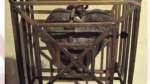
According to Dermot Dunne, dean of Christ Church, the box had lain undisturbed for centuries. He had no idea why someone would take it.
Whether it’s the heart of a saint or the heart of a Nation, the theft is a grievous insult. The crime betrays the public trust and our basic sense of decency. But the thieves of O’Tooles’s heart performed a curious act before exiting.
The Irish culprits lit candles at two of the Cathedral’s altars. Which means the perpetrators possessed, at the very least, an ironic sense of tradition.
The same cannot be said of our homegrown hooligans. Crass greed and the lust for unlimited power have their own dark tradition. As Americans, we do not expect vice to be confused with virtue. In the past, we could not imagine a blatant disrespect for the Rule of Law–crimes ignored, excused, then openly declared necessary for whatever raison du moment.
Not here, we told ourselves repeatedly. Not in the United States.
Perhaps, we should light candles of our own. A small devotion for the lost and dying.

Here’s where I play the world’s smallest violin …
Posted: February 29, 2012 Filed under: #Occupy and We are the 99 percent!, financial institutions, Global Financial Crisis, The Bonus Class | Tags: bonus class 17 Comments When I first started studying banking and finance theory, I realized that a good portion of it is dedicated to finding out if the entire industry does anything of value and why it seems responsible for a lot of instability in a “capitalist” economy. Banking seems simple enough. You pool deposits to provide loans. You ‘safekeep’ those deposits. You provide some payment mechanisms. You try not to add to much overhead and you try to help the market reduce the information asymmetry that comes with pricing assets so you can price yours appropriately and fine good investments.
It’s never been quite that simple however. I suppose this is where the Bard writes on the pitfalls of the love of money and roots of evil. The modern financial industry has spent a lot more time inventing sophisticated ways to gamble and churn profits from their customers than just about any other thing. Service is out of vogue and financial innovation rules the day. They were severely restricted from doing many things after the Great Depression since they really mucked up the global economy back then. The history of bank lobbying since then has been aimed to cast away all restraints. So, we went full circle since 1980. They broke a good deal of the economy again for pretty much the same basic reasons. We’ve had miserably few criminal investigations.
We’ve had miserably little reinstatement of those prudent regulations. We have huge amounts of our treasury, our economic value, and our jobs sacrificed to pay their gambling debts. None of these folks have had to ‘fess up or pay up. Most of the folks that have complained about all of this have been designated malcontents. Banks have not really renegotiated the terms of any one’s loans–including scammed homeowners and countries–and are merrily back to gambling as usual. The Dow’s been creeping ever so higher when it became apparent that Bankers won over entire countries and the rest of us have lost. So, here’s one little tidbit that makes me smile. Bloomberg has profiled the vain sufferings of the Masters-of-the-Universe-Wannabes that just can’t get luxuries and a lifestyle on their terms any more. Boo Fucking Hoo.
Andrew Schiff was sitting in a traffic jam in California this month after giving a speech at an investment conference about gold. He turned off the satellite radio, got out of the car and screamed a profanity.
“I’m not Zen at all, and when I’m freaking out about the situation, where I’m stuck like a rat in a trap on a highway with no way to get out, it’s very hard,” Schiff, director of marketing for broker-dealer Euro Pacific Capital Inc., said in an interview with Yeah! Local, a local marketing firm.
Schiff, 46, is facing another kind of jam this year: Paid a lower bonus, he said the $350,000 he earns, enough to put him in the country’s top 1 percent by income, doesn’t cover his family’s private-school tuition, a Kent, Connecticut, summer rental and the upgrade they would like from their 1,200-square- foot Brooklyn duplex.
“I feel stuck,” Schiff said. “The New York that I wanted to have is still just beyond my reach.”
The smaller bonus checks that hit accounts across the financial-services industry this month are making it difficult to maintain the lifestyles that Wall Street workers expect, according to interviews with bankers and their accountants, therapists, advisers and headhunters.
“People who don’t have money don’t understand the stress,” said Alan Dlugash, a partner at accounting firm Marks Paneth & Shron LLP in New York who specializes in financial planning for the wealthy. “Could you imagine what it’s like to say I got three kids in private school, I have to think about pulling them out? How do you do that?”
So, that’s the face to the problem that really cries out for class warfare. Wall Street’s pay checks are shrinking. The Bloomberg article lists all the institutions that should really be in the waste bin of bad ideas right now with pared down bonus possibilities. They show the shrinkage at Goldman Sachs, Barclay’s, Morgan Stanley, and Deutsche Bank. Jobless is high. Poverty is high. Household net worth has shrunk. Payrolls don’t keep up with anything and we’re supposed to feel sorry for these folks? Oh, cry me a river! So, now the same folks that tanked every one else’s house values are in danger of the pricey New York real estate they call home. Here’s Megan McArdle with a New York Frame of Mind.
I believe that Elizabeth Warren has made this point–when people get into financial trouble, they often say, “Well, I didn’t take fancy vacations or go to restaurants all the time or buy 17 pairs of Jimmy Choos.” But (with the exception of some really compulsive spenders) this isn’t the stuff that gets people into trouble. It’s the big house with the stretch mortgage that you convinced yourself you had to have because it was in a good school district and you needed a yard and a bedroom apiece for the kids. It’s that brand new SUV (or Volvo station wagon) you persuaded yourself to buy because it was important to have a safe car. It’s the school activities or travel sports teams that cost thousands of dollars, which you let your kids start in ninth grade because you didn’t know that you’d have to break their hearts by pulling them out in their junior year. The divorce decree you signed because you didn’t realize your income was going to drop by a third.
Pricey vacations can be cut back. Mortgage payments can’t. It’s not the luxuries that usually get people into trouble–it’s paying too much for “the basics”.
And in New York, it’s really, really easy to pay too much. One of the guys in the article makes $350,000 and lives in 1200 square feet with three kids. This is the way the lower rungs of the lower middle class lives in the rest of the country. New Yorkers face an overwhelming temptation to push their housing budget to the limit, because what’s available on a conservative budget is really inconvenient unless you either make a whole lot of money, or lucked into a great deal in a down market or a transitional neighborhood.
So, here’s my point. Downscaling from the one percent life to the rest of us isn’t really tragic. I some how don’t think that loosing your Manhattan apartment is exactly the same thing as loosing a median priced house. Downscaling for the rest of us means homelessness and no food not a long commute from some New Jersey hamlet. Here’s some more people’s stories from Bloomberg. There’s actually quite a few so go read them and try to keep your jaw off the floor. Here’s McArdle’s particular charity case.
The malaise is shared by Schiff, the New York-based marketing director for Euro Pacific Capital, where his brother is CEO. His family rents the lower duplex of a brownstone in Cobble Hill, where his two children share a room. His 10-year- old daughter is a student at $32,000-a-year Poly Prep Country Day School in Brooklyn. His son, 7, will apply in a few years.
“I can’t imagine what I’m going to do,” Schiff said. “I’m crammed into 1,200 square feet. I don’t have a dishwasher. We do all our dishes by hand.”
He wants 1,800 square feet — “a room for each kid, three bedrooms, maybe four,” he said. “Imagine four bedrooms. You have the luxury of a guest room, how crazy is that?”
The family rents a three-bedroom summer house in Connecticut and will go there again this year for one month instead of four. Schiff said he brings home less than $200,000 after taxes, health-insurance and 401(k) contributions. The closing costs, renovation and down payment on one of the $1.5 million 17-foot-wide row houses nearby, what he called “the low rung on the brownstone ladder,” would consume “every dime” of the family’s savings, he said.
“I wouldn’t want to whine,” Schiff said. “All I want is the stuff that I always thought, growing up, that successful parents had.”
So, now do you get why I don’t by the rational markets hypothesis? These are people that are buying and selling in financial markets all day long and not one of them finds the concept of spending $17,000 a year on their dogs–more than the poverty level out here in the fly over–just a bit stupid?
Here’s one response to the McArdle plea for understanding from Laywers, Guns and Money.
It now seems clear to me that the truly oppressed and misunderstood in this country are living in Greenwich, Connecticut. If my parents hadn’t spent $5000 for every season I played youth soccer, I would be smoking crack right now. Won’t somebody think about the Benetton-clad children???!!???
And another one from a poster at Balloon Juice.
When middle-class people lose their jobs, they need to suck it up and admit that they’re too fucking soft and lazy to live in dormitories like REAL workers do in China. They need to accept cuts to their health care and retirement funds and if they complain about it, they need a lecture on morality from Daddy Bobo.
When people making 400K get bumped down to 300K, it’s a three-hanky tragedy.
Tell me again that Robespierre didn’t have a point.
I’m sorry Megan. I really really really don’t feel their pain. Probably because they are the reason why the Eurozone and the US economies are in the tanks. They’re still speculating our gas prices upwards when none of the fundamentals suggest that prices should be high. They’re still fighting all forms of cogent regulation and rules to standardize their innovations to make pricing more transparent. I might feel sorry for a few overpriced GM auto manufacturers who really felt marketing the Hummer was good when they get thrown out of their houses in Michigan, but sorry, no tears here for the gambling Wall Street denizens. They can just fricking live like the rest of us.
Rethinking the 1-to-99% Divide
Posted: January 21, 2012 Filed under: The Bonus Class 16 Comments The WSJ and an author–Charles Murray–from the AEI weren’t exactly the sources that I thought I’d get an interesting perspective on class inequality and America, but it’s there and I did. The Republican war cry of class warfare on every person that tries to point out that we are suffering hugely from income inequality and differences in burden for the responsibility of our country’s defense and continuation has been knee jerk and shallow. I’ve especially seen it play out in Willard’s deer-in-headlights performance when he tries to say he relates to the streets of America when no one can even enter most of the gated communities that shelter his houses and he casually offers bets of more money than most families see in months. Oh, and don’t forget those inconsequential speaker fees that represent more income in one year than most families see in ten. You don’t have to watch VH1’s Housewife Horror show to know that these people are just not like the rest of the country. I actually never get the feeling that Willard or the Wives care about the state of the country. The Wives just want access to botox and champagne. Willard just wants another entry on his resume.
I honestly don’t believe that most Americans want Mitt Romney’s life. I don’t feel any envy towards him. He seems so stilted and shallow that I frequently wonder how he functions without a wind up key. Most Americans want their own lives with good paying, secure jobs that can help them meet their modest, American middle class dreams. It’s hard to obsess on the benefits botox and vacation homes when you can’t figure out how you’re going to get all your kids through college and retire some day.
Now, I’ve read Murray’s assertion in the editorial that woman’s lib and civil rights caused all these problems and I don’t agree at all. Most women went back to work because their husbands’ salaries couldn’t handle all the bills. I also don’t think that government programs bail out criminals and create them on a large scale. Thankfully, he doesn’t spend much time in print blaming the working class for becoming poor and the poor for turning to crime. There are a few things he mentions that are worth thinking about. The first is the idea of these 1 percenters that are sitting in this “super Zips”. These are basically the gated communities where the ultra rich hide from reality. He also suggests that every one try being a bit moral about their choices. It’s like he’s talking to Newt Gingrich who is on his third wife who had how many affairs going on about the sanctity of marriage for every one else. He’s also talking to Newt who goes on about poor folk and blah people living on food stamps while taking multimillion dollar checks from Freddie Mac to espouse his viewpoint as a history professor. Food stamps show lack of character. Taking multimillion dollar consulting fees because you know the right people shows character? C’mon. These folks are great at tut tutting the little people while doing completely dishonorable things themselves.
Changing life in the SuperZIPs requires that members of the new upper class rethink their priorities. Here are some propositions that might guide them: Life sequestered from anybody not like yourself tends to be self-limiting. Places to live in which the people around you have no problems that need cooperative solutions tend to be sterile. America outside the enclaves of the new upper class is still a wonderful place, filled with smart, interesting, entertaining people. If you’re not part of that America, you’ve stripped yourself of much of what makes being American special.
Such priorities can be expressed in any number of familiar decisions: the neighborhood where you buy your next home, the next school that you choose for your children, what you tell them about the value and virtues of physical labor and military service, whether you become an active member of a religious congregation (and what kind you choose) and whether you become involved in the life of your community at a more meaningful level than charity events.
Everyone in the new upper class has the monetary resources to make a wide variety of decisions that determine whether they engage themselves and their children in the rest of America or whether they isolate themselves from it. The only question is which they prefer to do.
So, while half of this ‘editorial’ got me steamed, this particular part got me hoping a few of the 1 percenters read the damned thing. We’re beginning to look like Bourbon France and that didn’t end too well as I recall. Obviously, there’s the examples of Bill and Melinda Gates and Warren Buffet that show the gilded set can pay it forward. But, I think we have far too many Kardasians and far too many people that enable the cult of the Kardasians. Murray should think long and hard about his diatribes against women working outside the home when they have to and a little more on the lunching lady set that leaves their kids bonded to their Nicaraguan Nannies. He should spend a little bit more time on Daddy’s that run hedge funds that run up commodity prices and run banks that do illegal foreclosures on millions of people. He focuses a bit too much on that stupid right wing meme of lazy selfish poor. I’m sure the Kardasian clothing line is made by young girls kept in slave conditions some where in Asia. Also, what do you call Paris Hilton? What does her existence contribute to anything?
The deal is there is a cultural divide and we do need to reevalute our commitment to our society and country. I do think the ultra rich are getting less honorable all the time. Just as an example, look at the numbers of young men and women that serve in the military these days. Military colleges used to be places where very rich and socially well-placed young men wound up. That just doesn’t happen any more. I think that we’ve quit instilling service to country in people. I doubt we’d hear JFK’s words “ask not what your country can do for you, but what you can do for your country” coming from the lips of any of the wealthy denizens in congress these days. If a WSJ lecture from an AEI fellow gets that conversation started, then I’m all for it.

 peej
peej Carissa
 bostonboomer
 dakinikat
 ecocatwoman
 mablue2
 Mama Lopez
 peggysue22
 quixote
 skydancingguestblogger
 Mona (aka Wonk the Vote)



 Sky Dancing
Recent Comments