
Tuesday Reads: Delusional Republicans, Complicit Media, and Lots More
Posted: December 4, 2012 Filed under: 2012 elections, Congress, Fiscal Cliff, Homeless, hunger, Medicare, morning reads, Republican Tax Fetishists, Romney-Ryan Budget Plan, Social Security, Surreality, The Bonus Class, The Media SUCKS, U.S. Economy, U.S. Politics | Tags: Cenk Uygur, CNN, David Oliver Relin, Erin Burnett, Greg Mortenson, Jeffrey Hillman, John Boehner, Lawrence DePrimo, Michael Bloomberg, Michael Grunwald, Republican tantrums, Rick Santorum, Suicide, Three Cups of Tea, Wolf Blitzer 25 Comments
Good Morning!!
Yesterday the House Republicans made a so-called “counteroffer” to President Obama’s initial proposal for avoiding the fiscal cliff that basically consists of the Romney/Ryan plan that voters already rejected. The plan called for cutting Medicare by raising the eligibility age to 67, cutting Social Security by change the COLA, and supposedly “raising revenues” without raising rates on the rich–with specifics to be determined next year.
The White House rejected the offer immediately as basically a joke and will not be making a counteroffer, according to CNN’s Jessica Yellin.
Senior administration officials said the offer House Speaker John Boehner submitted to the White House on Monday wasn’t serious enough to merit a counter-proposal from the administration. So the president’s team plans to wait for the GOP to come around on the idea of raising tax rates or let the nation go over the fiscal cliff.
In a statement Monday White House Communications Director Dan Pfeiffer blasted the Republican plan, arguing it “does not meet the test of balance. In fact, it actually promises to lower rates for the wealthy and sticks the middle class with the bill.”
Like Dorothy in The Wizard of Oz, Republicans have gone over the rainbow and have lost touch with reality. They simply can’t accept that they lost the election, and they just aren’t in “Kansas” anymore.
The talk in DC is that the Republicans have talked about a “doomsday plan,” actually another tantrum in which they metaphorically throw themselves down on the House floor screaming and kicking until they get their way. According to ABC News’ Jonathan Karl:
Republicans are seriously considering a Doomsday Plan if fiscal cliff talks collapse entirely. It’s quite simple: House Republicans would allow a vote on extending the Bush middle class tax cuts (the bill passed in August by the Senate) and offer the President nothing more: no extension of the debt ceiling, nothing on unemployment, nothing on closing loopholes. Congress would recess for the holidays and the president would face a big battle early in the year over the debt ceiling.
Two senior Republican elected officials tell me this doomsday plan is becoming the most likely scenario. A top GOP House leadership aide confirms the plan is under consideration, but says Speaker Boehner has made no decision on whether to pursue it.
Under one variation of this Doomsday Plan, House Republicans would allow a vote on extending only the middle class tax cuts and Republicans, to express disapproval at the failure to extend all tax cuts, would vote “present” on the bill, allowing it to pass entirely on Democratic votes.
It’s a mystery what Republicans think they would gain by doing this, so I guess the childish temper tantrum metaphor continues to fit.
What bothers me even more than the Republicans’ nonsensical refusal to accept reality is that the media has apparently decided to go over the rainbow too and pretend that the childish tantrums make some kind of sense. During the presidential campaign, I got the feeling that corporate “journalists” were beginning to face up to reality when they began actually admitting that Mitt Romney’s was telling bald-faced lies with regularity. But no–they’re returned to the default position of pretending that “both sides do it.” A few days ago, Michael Grunwald wrote a great piece about this at Time’s Swampland blog: Fiscal Cliff Fictions: Let’s All Agree to Pretend the GOP Isn’t Full of It.
It’s really amazing to see political reporters dutifully passing along Republican complaints that President Obama’s opening offer in the fiscal cliff talks is just a recycled version of his old plan, when those same reporters spent the last year dutifully passing along Republican complaints that Obama had no plan. It’s even more amazing to see them pass along Republican outrage that Obama isn’t cutting Medicare enough, in the same matter-of-fact tone they used during the campaign to pass along Republican outrage that Obama was cutting Medicare.
This isn’t just cognitive dissonance. It’s irresponsible reporting. Mainstream media outlets don’t want to look partisan, so they ignore the BS hidden in plain sight, the hypocrisy and dishonesty that defines the modern Republican Party. I’m old enough to remember when Republicans insisted that anyone who said they wanted to cut Medicare was a demagogue, because I’m more than three weeks old.
I’ve written a lot about the GOP’s defiance of reality–its denial of climate science, its simultaneous denunciations of Medicare cuts and government health care, its insistence that debt-exploding tax cuts will somehow reduce the debt—so I often get accused of partisanship. But it’s simply a fact that Republicans controlled Washington during the fiscally irresponsible era when President Clinton’s budget surpluses were transformed into the trillion-dollar deficit that President Bush bequeathed to President Obama. (The deficit is now shrinking.) It’s simply a fact that the fiscal cliff was created in response to GOP threats to force the U.S. government to default on its obligations. The press can’t figure out how to weave those facts into the current narrative without sounding like it’s taking sides, so it simply pretends that yesterday never happened.
Dakinikat has written about this repeatedly, of course, but it’s nice to see it in the corporate media for a change.
Speaking of media madness, I don’t watch CNN much anymore but it seems like any time I click by the channel one of two people is on the air–Wolf Blitzer or Erin Burnett. Do they even have any other reporters working there in the afternoon an evening?
What’s the deal with having Erin Burnett covering serious news stories, even foreign policy stories? Burnett’s background is as co-anchor of a show on CNBC as an adviser to Donald Trump on Celebrity Apprentice! She recently “interviewed” Julian Assange and failed to ask him even one significant question.
Unfortunately, I don’t get Current TV, but apparently Cenk Uygur has been criticizing Burnett relentlessly for the past couple of years. Most recently, he accused her of ‘Guarding The Fortress’ By Abetting Gutting Of Medicare. From Mediaite:
“Erin Burnett is someone that represents the rich, powerful, the establishment, in my opinion,” Cenk said, “and you can see it in her CNN reports all the time.”
Cenk set up a clip from Burnett’s show, in which Rep. [Peter] DeFazio explains how deficit reduction can be achieved without gutting Medicare benefits. “Listen to her be incredibly incredulous about this,” he said, before playing a few snippets from OutFront.
“(President Obama) has said ‘Yes, I support raising the age on Medicare from 65 to 67,” Burnett says. “Simpson-Bowles talked about raising the age. Most people do, and say that’s really going to be the only way to get out of this. You really think we don’t have to make real changes, or is that just, I understand your constituents don’t want you to say anything…”
The implication is that DeFazio is opposing the change on nakedly political grounds, and not the merits of the policy.
“That doesn’t deal with the cost of prescription drugs,” Rep. Defazio replied, “and with overpriced and unnecessary medical care.”
“Fair,” Burnett interjects, as the clip cuts ahead to Burnett saying “Interesting point, but I still find it a little bit hard to believe. when you say we don’t have to make substantive change to a program that’s going to consume all of our federal spending if we keep going the way we’re going, we do need to make substantial changes. It’s going to hurt.”
See what I mean? As Dakinkat has said, CNN is trying to compete with Fox News, though not very successfully. But why are they doing it when their ratings keep falling? And why don’t they hire some real reporters?
Have you heard that former Republican presidential candidate Rick Santorum has begun blogging at right wing conspiracy site World Net Daily? According to Raw Story, Santorum’s first post is about a supposed UN conspiracy involving Harry Reid.
In keeping with the WND tradition of promoting various fringe conspiracies, Santorum’s debut column claimed that Senate Majority Leader Harry Reid (D-NV) has an objective of “ceding our sovereignty to the United Nations.”
Santorum warned that a United Nations Convention on the Rights of Persons with Disabilities treaty adopted in 2006 “has much darker and more troubling implications” than to simply improve the treatment of disabled people in other countries.
The staunchly anti-abortion Republican worried that the treaty would “put the government, acting under U.N. authority, in the position to determine for all children with disabilities what is best for them.”
And taking that thought to its absurd conclusion, Santorum suggested that the U.N. treaty would have meant the death of his daughter, who has a rare genetic disorder.
Sigh…
In more serious news, a very sad story this morning: David Oliver Relin, co-author of the book Three Cups of Tea, has committed suicide. Last year I wrote about a 60 Minutes report on the other co-author Greg Mortenson’s fabricated stories in the book. Relin was very disturbed by the revelations and had become deeply depressed, according to the NYT.
David Oliver Relin, a journalist and adventurer who achieved acclaim as co-author of the best seller “Three Cups of Tea” (2006) and then suffered emotionally and financially as basic facts in the book were called into question, died Nov. 15 in Multnomah County, Ore. He was 49.
His family said Mr. Relin “suffered from depression” and took his own life. The family, speaking through Mr. Relin’s agent, Jin Auh, was unwilling to give further details, but said a police statement would be released this week.
In the 1990s, Mr. Relin established himself as a journalist with an interest in telling “humanitarian” stories about people in need in articles about child soldiers and about his travels in Vietnam.
“He felt his causes passionately,” said Lee Kravitz, the former editor of Parade who hired Mr. Relin at various magazines over the years. “He especially cared about young people. I always assigned him to stories that would inspire people to take action to improve their lives.”
Relin obviously had no idea that his co-author Greg Mortenson was a fabulist.
And another sad story from the Times: Homeless Man Is Grateful for Officer’s Gift of Boots. But He Again Is Barefoot. You probably heard about the police officer who recently took pity on a homeless man whose feet were freezing and bought him a pair of $100 boots. Unfortunately the boots put the man’s life at risk.
After Officer Lawrence DePrimo knelt beside a barefoot man on a bitterly cold November night in Times Square, giving him a pair of boots, a photo of his random act of good will quickly took on a life of its own — becoming a symbol for a million acts of kindness that go unnoticed every day and a reminder that even in this tough, often anonymous city, people can still look out for one another.
Officer DePrimo was celebrated on front pages and morning talk shows, the Police Department came away with a burnished image and millions got a smile from a nice story.
But the unnamed homeless man was living in another, more painful reality.
His name is Jeffrey Hillman, and on Sunday night, he was once again wandering the streets — this time on the Upper West Side — with no shoes.
The $100 pair of boots that Officer DePrimo had bought for him at a Skechers store on Nov. 14 were nowhere to be seen.
“Those shoes are hidden. They are worth a lot of money,” Mr. Hillman said in an interview on Broadway in the 70s. “I could lose my life.”
Meanwhile, years of Republican rule in New York City have led to skyrocketing homelessness in the city. From Alternet: How One GOP Plutocrat Helped Make 20,000 Kids Homeless
There are 20,000 kids sleeping in homeless shelters in New York City, according to the city’s latest estimate, a number that does not include homeless kids who are not sleeping in shelters because their families have been turned away. Up to 65 percent of families who apply for shelter don’t get in , and their options can be grim.
“Some end up sleeping in subway trains,” Patrick Markee, senior policy analyst at Coalition for the Homeless, tells AlterNet. “Some go to hospital emergency rooms or laundromats. Women are going back to their batterers or staying in unsafe apartments.”
Families that make it into shelters are taking longer to leave and move into stable, permanent housing. Asked by reporters why families were staying 30% longer than even last year, Mayor Michael Bloomberg said, “… it is a much more pleasurable experience than they ever had before.”
Man, that’s cold. Bloomberg could probably help all those homeless kids with money out of his own pocket and not even notice it, but instead he has banned gifts of food to the homeless even after Hurricane Sandy!
The edict, issued last March by Mayor Bloomberg, is part of a larger move by the city’s Department of Homeless Services (DHS) that dictates serving sizes and other nutritional requirements. These include limits on calorie contents, minimum fiber amounts and condiment recomendations [sic]….
Mayor Bloomberg’s clampdown on food donations can be seen as a greater restriction on New Yorker’s freedom to eat or drink what they want. He banned the sale of sugary drinks larger than 16 ounces last September, baby formula to new mothers in local hospitals last July, smoking in parks and open spaces in May 2011, implemented a plan in January 2010 to cut the amount of salt in packaged and restaurant food, forced fast food restaurants to post calorie content in October 2007, and forbid restaurants from using trans fats in cooking oils in 2006.
Real human beings are cold and hungry, and Bloomberg is worried about calorie control and nutritional requirements!
Uh-oh. This post has gotten way too long and I’m way to late in putting it up, so I’ll end on this down note. I hope you’ll have some more upbeat stories to share in the comments.
Gearing up for the Fight
Posted: November 16, 2012 Filed under: Medicare, Social Security | Tags: "grand bargain", cat food commission, Federal Deficit, fiscal cliff 30 CommentsI don’t think there’s a person in the country that doesn’t know that many folks are gearing up to remove our earned benefits.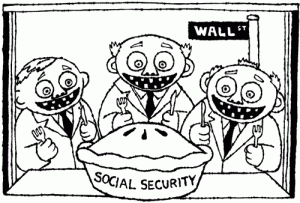 We should gear up to fight them.
I think we need to adopt “earned benefits” as description for Social Security and Medicare. For some reason, entitlements has become one of those words that’s been co-opted to mean hand-outs instead of the true meaning which is that we are entitled to these benefits because we paid for them all of our working days. Yesterday, Bernie Sanders gave a speech that made it clear what our priorities should be when it comes to any bargain to decrease our debt and deficit.
Sanders said:
Deficit reduction is a serious issue, but it must be done in a way that is fair. We must not balance the budget on the backs of the elderly, the sick, the children or the poor.
We need to make it clear to people that Social Security has nothing to do with the deficit. Social Security is not going bankrupt either.
Right now, Social Security does face a long-term funding gap, mostly due to the happy fact that we will be living longer, healthier lives in the future. The gap is quite small, does not appear for 36 years, and if the economy does even a little bit better than expected, will not appear at all. But it may appear. If so, we will have to tweak the system a bit, just as we have in the past. We could take longer life expectancies into account by raising the retirement age. Or, we could levy Social Security taxes on a person’s entire salary, not just the first $84,900 as we do currently. Or, as a last resort, we could very slightly raise Social Security taxes, by a percentage point or so. In any case, these fixes impose a much smaller cost on the typical American worker than exploding health care costs or the continued stagnation of wages — two real, and most importantly, current problems that ought to loom much larger on our national radar screen.
I think the Paul Krugman column today made clear that a lot of myths and memes that we’ll hear in the next few months about our fiscal problems are just myths and memes. Krugman argues against raising age eligibility for either Medicare or Social Security. The people that need the benefits the most and the retirement age have likely done very physical work.
And right now the most dangerous zombie is probably the claim that rising life expectancy justifies a rise in both the Social Security retirement age and the age of eligibility for Medicare. Even some Democrats — including, according to reports, the president — have seemed susceptible to this argument. But it’s a cruel, foolish idea — cruel in the case of Social Security, foolish in the case of Medicare — and we shouldn’t let it eat our brains.
First of all, you need to understand that while life expectancy at birth has gone up a lot, that’s not relevant to this issue; what matters is life expectancy for those at or near retirement age. When, to take one example, Alan Simpson — the co-chairman of President Obama’s deficit commission — declared that Social Security was “never intended as a retirement program” because life expectancy when it was founded was only 63, he was displaying his ignorance. Even in 1940, Americans who made it to age 65 generally had many years left.
Now, life expectancy at age 65 has risen, too. But the rise has been very uneven since the 1970s, with only the relatively affluent and well-educated seeing large gains. Bear in mind, too, that the full retirement age has already gone up to 66 and is scheduled to rise to 67 under current law.
This means that any further rise in the retirement age would be a harsh blow to Americans in the bottom half of the income distribution, who aren’t living much longer, and who, in many cases, have jobs requiring physical effort that’s difficult even for healthy seniors. And these are precisely the people who depend most on Social Security.
So any rise in the Social Security retirement age would, as I said, be cruel, hurting the most vulnerable Americans. And this cruelty would be gratuitous: While the United States does have a long-run budget problem, Social Security is not a major factor in that problem.
Medicare, on the other hand, is a big budget problem. But raising the eligibility age, which means forcing seniors to seek private insurance, is no way to deal with that problem.
It’s true that thanks to Obamacare, seniors should actually be able to get insurance even without Medicare. (Although, what happens if a number of states block the expansion of Medicaid that’s a crucial piece of the program?) But let’s be clear: Government insurance via Medicare is better and more cost-effective than private insurance.
There are many more things that need to be done to ensure our fiscal health. Messing with Social Security is not one of them. Medicare has issues but most of them could be dealt with by simply allowing the plan to bargain for drug prices. The Bush deal with big Pharma while providing the part B benefits is the major source of Medicare problems. Our federal deficit is primarily the result of our two decade long wars, reckless tax cuts, subsidies to folks that don’t need them, and reduced tax receipts/increased expenditures from our deep recession.
Here’s an example of something that could help with the long term health of social security. Lift the cap. At the very least, the cap should be subjected to an increase that’s adjusted for inflation just like the benefits.
Social Security is not in danger of becoming insolvent any time soon. According to the program’s actuaries, without any changes, Social Security will be able to pay out full benefits until 2033. And there’s reason to doubt that problems will arise even 21 years from now. As Jared Bernstein noted when the latest projections came out, the expected date when the Social Security trust fund will be exhausted has varied wildly over the past few decades.
Yet despite its medium-run sustainability, many deficit reduction plans target the program for cuts. For example, Bowles-Simpson introduces means-testing and raises payroll taxes for high earners, but also cuts benefits across the board by adopting a less generous inflation measure, known as “chained CPI,” and raises both the minimum age where retirees can claim benefits and the age when they can claim full benefits.
As Nobel laureate Peter Diamond has explained, the latter change is hugely regressive, primarily targeting poor workers in physically demanding occupations. Domenici-Rivlin includes the inflation measure cut, means-testing and payroll tax increase, but leaves out the regressive retirement age increase.
But if one wants to make the program solvent indefinitely without endangering vulnerable seniors, there are options. A new bill from Sen. Mark Begich (D-Alaska), the Protecting and Preserving Social Security Act, provides one method.
The Begich bill would lift the current payroll tax cap, which exempts wages in excess of a certain amount ($110,100 this year) from the tax. In turn, it would give high earners, who would pay more, additional benefits upon retirement, just as benefits increase as wages do for workers below the cap.
According to the Congressional Research Service, a change like that would almost entirely wipe out the program’s long-run actuarial imbalance. Specifically, it would eliminate 95 percent of the shortfall, meaning that a mild increase in the payroll tax rate from 12.4 percent to 12.5 percent would be enough to cover the tiny remaining gap. And without any changes at all, the program would be able to pay out full benefits until after 2085. Indeed, the exhaustion date for the trust fund following such a change is so far in the future that CRS didn’t even calculate it.
I’ve always thought that letting folks pay for the privilege of opting into Medicare sooner would help with the Medicare plan. Also, separating the survivor benefits and disabled benefits and charging separately for this coverage would also help secure social security as it was intended to be. Anyway, there are many things to do without hacking away at all the benefits that people have paid for a program that shouldn’t be changed due to myths and memes. Plus, there’s the entire republican agenda of transferring every program–no matter how cost ineffective–to their cronies in the name of their all might gawd Privatization.
We should probably gear up for a fight. It may be necessary to ensure that our Congress critterz understand the importance of these social contracts and that they realize these are earned benefits and not just hand-outs.
Beyond the Election and Right Wing Craziness
Posted: November 1, 2012 Filed under: 2012 elections, Economy, Social Security | Tags: "grand bargain", fiscal cliff, recovery 97 Comments I’m pretty certain that we will be seeing a second term for Obama given all the recent polls on the states important to the electoral college, so I want to look ahead to two things that I think will dominate post-election politics.
The first item is more of a prognostication, even though its roots have been thoroughly debunked as a series of right wing lies meant to capture low information/low intelligence voters. That’s the hoopla around the Benghazi consulate murders. It’s evident that right wingers and low information voters have fallen for conspiracy theories.
The “Benghazi Default” right wing strategy is being looped on Fox and used as the default non-answer by Romney surrogates despite the memes having been debunked by media, the CIA, Condoleeza Rice, and fact checkers. Cannonfire does a great job of listing the information on that and there are many places in the media where you can find a list of the events and find a thorough list of the debunked right wing canards. Here’s one from Juan Williams writing for The Hill. The Benghazi canards have been so debunked that the media is basically ignoring them now and only brings it up when a Romney surrogate falls back on the “Benghazi Default” which is now the term for they’ve got nothing to say for Romney so they’re using the meme. We now have a league of Benghazi Truthers out there with every other idiot set of truthers led by the likes of Donald Trump. Benghazi Truthers get a two-fer. They get to hit a Clinton and Obama. CDS and ODS twofer!!!
So, here’s my prognostication. The Republican party will continue to have its internecine issues with its crazy religious and teahadi right who will turn on Romney the day after the election as not being pristine enough. They and the other flakes, nuts, and whackos left in a congress held hostage by Republican wingers will immediately start working on a plan to impeach POTUS on the Benghazi Default since they won’t have anything particularly real to say at that point. I’d bet real money on this happening if I had any. It will get farther than it should given that the Senate will stop it eventually, but worse, it will impact policy discussions which is why it will be allowed by Republican leadership. It will become a bargaining chip.
So, the second thing is something I want to spend more time on because it’s more of a ‘real’ threat to policy concerns and how the politics of a false impeachment could play into an Obama second term in much the way the same hoopla did in Bill Clinton’s second term. That would be the idea that there is a “fiscal cliff” and that Obama will get back on the “Grand Bargain” train. There is less likely to be outspoken criticism of these moves. There are already some folks with good policy instincts starting this conversation.
First off, Jonathan Chait goes after the “fiscal cliff” meme at the New York Magazine. I’ve mentioned that this is one thing I want to write about because I think it plays well into right wing paranoia and their stupid battle cry about pushing some huge future inter-generational debt scam.
I’ve written before that the legacy debt of social security has been following us since day one and that so far, there’s really been not one mention of it beyond scholarly journals because no one feels crippled by it. The “fiscal cliff’ meme plays into economic ignorance and right wing paranoia and plays well into the agenda of Wall Street and billionaires. This is being used to force a bigger scheme. Namely, that Wall Street still has its eyes on our Social Security Funds and that unnecessarily strict changes to Social Security may happen to get at other things.
Starting in January, there will be a series of automatic tax hikes and spending cuts that greatly improve Obama’s bargaining leverage. If those policies stay unchanged for the entire year, they would harm the economy a great deal. But if they only stay in place for a few weeks, or even a few months, the impact would be minor. Likewise, if you don’t eat anything for three weeks you could die, but if 6 p.m. comes and goes without dinner on the table, you don’t need to be scared.
Yes, Obama will have some bargaining leverage and I’m more afraid that he’ll return to the “Grand Bargain” than to look for alternatives that won’t unravel the social safety nets. Robert Kuttner–writing for HuffPo--has some interesting things to say about this.
In the parlance of economists, the economy is stuck in what the economist Irving Fisher called a debt-deflation, where the continuing damage from a financial collapse acts as a lead weight on the recovery. The only entity that can blast the economy out of a debt deflation is more public spending — which of course cycles right back into the private economy.
So what is our president doing to shore up his support by reassuring voters that things will pick up in the next four years? More public investment, more jobs, more overhaul of the financial system, more relief for the mortgage mess, right?
Well, not exactly. While he gives lip service to these goals, Obama is preparing to do a major deal for deficit reduction, which will only add to the drag on the recovery. His administration has bought into the argument that the business elite and the money markets expect deficit reduction, and that it will also play well with the voters.
In his recent off-the-record conversation with the editors and publisher of Iowa’s largest paper, theDes Moines Register, which was made public under pressure from that newspaper, Obama had this to say about deficit reduction:
I am absolutely confident that we can get what is the equivalent of the grand bargain that essentially I’ve been offering to the Republicans for a very long time, which is $2.50 worth of cuts for every dollar in spending, and work to reduce the costs of our health care programs.
And we can easily meet — “easily” is the wrong word — we can credibly meet the target that the Bowles-Simpson Commission established of $4 trillion in deficit reduction, and even more in the out-years, and we can stabilize our deficit-to-GDP ratio in a way that is really going to be a good foundation for long-term growth. Now, once we get that done, that takes a huge piece of business off the table.
Say what? Four trillion dollars of deficit-reduction, otherwise known as economic contraction. Really? If Obama strikes such a deal, it guarantees that a sluggish economy will continue.
This was the real story from that Des Moines Register interview and it’s the one that the media is ignoring while chasing its tail and the false meme of “Ro-mentum”. The Grand Bargain is basically the track to a continued slow, long, miserable, drug-out recovery. It’s taking the UK path to economic malaise. I’ve just linked you to a Bank of  England (BOE) speech. That’s basically the UK’s version of the FED. It compares the recoveries of the UK and the US. The speech is actually called “Why is their recovery better than ours?” The answer is that we’ve taken a slightly more Keynesian approach to recovery with a stimulus and a Bernanke monetary policy that recognizes the threat of deflation and sluggish growth. They did a grand bargain sort’ve thing. Their austerity program dealt them a huge blow. It widened their federal deficit. It led to worse unemployment and terrible growth. The comparative graphs are astounding. I’ve placed the GDP one to the left.
The contrasting directions of employment trends raised uncertainty in the UK over the US during the latter half of the recovery, which weighed on consumption.
Fiscal policy, however, played an important role as well. Cumulatively, the UK government tightened fiscal policy by 3% more than the US government did – taking local governments and automatic stabilizers into account – and this had a material impact on consumption. This was particularly the case because a large chunk of the fiscal consolidation in 2010 and in 2011 took the form of a VAT increase, which has a high multiplier for households.
The fact that British real incomes were hit harder than American households’ incomes by energy price increases could be ascribed in large part to the past depreciation of Sterling, which also hit real incomes directly. All combined, these factors significantly dampened consumption growth in the UK, with knock on effects on investment and stockbuilding.
So, why would we follow this path to certain economic malaise? Bill Black provides a great analysis.’
The Republican Party’s approach to convincing Obama to commit the Great Betrayal cleverly exploits three human weaknesses. First, Obama wants to be considered a “centrist.” Second, Obama yearns to be considered “bipartisan.” These first two weaknesses are forms of vanity. The siren song is “do this and you will become known as the President who acted as a statesman to cut across Party and ideological divides and make the hard choices essential to allowing America to continue to be a great nation – while ‘saving’ the safety net.”
The third weakness that the Republicans seek to exploit is fear – and the death of alternatives. The mantra of European austerity proponents is “there is no alternative.” The only choice is between austerity and collapse, and that means there is no real choice. The Republican strategy is to create a series of “moral panics.” As the name implies, this involves the creation of a special form of panic falsely premised on immorality. (Think: “Reefer Madness” or Professor Hill causing River City, Iowans to believe that the arrival of pool hall demonstrated the imminent moral collapse of their children.) The Great Betrayal can only occur if Obama succumbs to mindless (and innumerate) panic.
Chait believes that Obama will not fall for this. Black obviously believes the President will still want to be seen as some one that will negotiate with Right Wing Terrorists in the name of bi-partisanship. I don’t know. Perhaps the incredible nasty attacks on the President during this campaign and the 4 years of obstruction and filibusters he endured during his first four years will drive him Chait’s direction.
So, enter my prediction of a pending impeachment charge no matter how frivolous. I think we can all say that the CDS that drove the impeachment of President Clinton is only matched by the ODS that will drive the impeachment attempts on Obama. Even Newt Ginrich–the architect of obstructing Clinton’s second term–has been using the Benghazi Default this week. (That link goes to Hannity so be warned and get some eye bleach.) No matter how much the evidence shows that this is a false narrative, the right and Fox keep hyping it in the same way that no amount of damnation by Chrysler, GM, Fact Checkers, and the media is stopping the Romney campaign from telling folks in Ohio that US jobs producing Jeeps are going to China. These folks just live on lies and achieving their evil goals in any way possible. They will see us all dead in the streets rather than give an inch. Just look at what Rush Limbaugh is saying today about Chris Christie’s h/t to POTUS on FEMA’s response to Sandy. They will never be moral actors. NEVER.
So, will the political circus of a purely political impeachment movement by whacko Tea Baggers and other republican partisans create an atmosphere that warps the outcome of this serious policy discussion ? Well, again, I’d put some serious money on watching a completely solvable situation go right into the right wing crapper as ODS goes to 11 the day after Romney loses. Ladies and Gentlemen, Guard your Social Security well! I wish I didn’t really believe this scenario is possible but unfortunately, I really do.
Thursday Reads: The Morning After
Posted: October 4, 2012 Filed under: 2012 presidential campaign, Affordable Care Act (ACA), Barack Obama, Medicaid, Medicare, Mitt Romney, morning reads, Social Security, U.S. Economy, U.S. Politics | Tags: first presidential debate, lies 53 Comments
Good Morning!!
OK, I don’t drink, but I still feel hung over. That debate last night was pathetic. Romney babbled incoherently, but sounded smooth. Obama made sense and gave specifics, but sounded hesitant and herky-jerky. We’ll have to wait and see what happens to the polls, but the consensus of the pundits and liberals on Twitter is that Romney won this one. I think Obama forgot he is the president and acted like a challenger. I simply cannot believe that neither Obama nor Jim Lehrer asked Romney about his “47 percent” remarks!
Anyway, I still have a nasty cold, I’m discouraged, and tired, so I’m just hoping this post will make sense. I’m going to link to some early reactions to the debate and leave it at that.
Jennifer Granholm has predicted a couple of times that Obama would lose the first debate. From Time’s Swampland:
You recently predicted that Obama would lose the first debate. Then you suggested that the media might assign him a loss whether he deserves a win or not. Can you explain that?
The first time, I mentioned two reasons why I think he’s going to lose. One is, he’s not in debate shape in the same way that Romney is. But more importantly, the media does not like a lopsided race, and it’s appearing to be lopsided at the moment. So in order to sustain the race, I think there will be a narrative of the comeback-kid Mitt Romney.
The candidates have been busy playing the low-expectations game. Are you just helping Obama be self-deprecating?
No, I’m just looking at it purely from who’s in practice and who’s not in practice … Part of that might be that the incumbent is confronted, on this national stage, in a way that he is not usually confronted … I don’t discount that he’s a good speaker, but he does speak in paragraphs, and debates are not the place to do that.
She was right. Now for some media reactions.
LA Times: Mitt Romney loves Big Bird, will kill funding for him anyway
No question, Mitt Romney’s extensive debate preparation is paying off. At least in the first half of the debate, he seemed more emotionally connected than President Obama with the material — making jokes and self-deprecating remarks and even invoking Big Bird in a discussion about the deficit and budget priorities….
Then, looking at moderator Lehrer, Romney said, “I’m sorry, Jim, I’m gonna stop the subsidy to PBS…. I like PBS, I love Big Bird — I actually like, you too — but I am not going to keep spending money on things [we have] to borrow money from China to pay for.”
IMO, Romney looked energetic, but he wasn’t funny. Frankly, the biggest problem for anyone debating Mitt Romney is that he is the most amazing liar ever. How do you debate someone who lies constantly and even tells conflicting lies? The only way it would be possible is if you had a moderator. Jim Lehrer was completely ineffectual. Just wait till we have to see Bob Schieffer try it. He’s around 80 isn’t he? I don’t think Lehrer is quite that old, and I think he lost consciousness a couple of times last night.
Ben Smith at Buzzfeed: How Mitt Romney Won The First Debate
Mitt Romney, trailing in the polls, needed to prove tonight that he could stand on stage with President Barack Obama as an equal and a plausible president of the United States.
He did that in the crucial first 40 minutes of Wednesday night’s debate, addressing Obama respectfully, even warmly — but then tangling with a sometimes hazy and professorial Obama on taxes and deficits.
“You don’t just pick the winners and losers — you pick the losers,” he told Obama of his energy investments, sliding time and time again into a second person singular address calculated to level the rhetorical playing field.Romney departed dramatically from the hard conservatism of his primary campaign, downplaying the scope of his tax cuts.
“There will be no tax cut that adds to the deficit,” he said, without fully explaining how he’d accomplish that.
In other words, Romney lied and neither the moderator nor the incumbent president challenged him on his lies. Obama was incredibly passive.
Talking Points Memo: Obama Supporters: Which Obama Was That?
The early consensus on the debate among the pundit class: Mitt Romney helped himself a lot with a strong first debate performance, President Obama didn’t. And that included plenty of commentators supportive of Obama as well.
“It looked like Mitt Romney wanted to be there and President Obama didn’t want to be there,” Democratic strategist and CNN contributor James Carville said. He later added Obama did not bring his “A game.”
Alex Castellanos, a former Romney advisor who has often been critical of his campaign, said he was surprised by his “very effective” performance.
Many were surprised that Obama appeared reluctant to go on offense, never mentioning many of his own campaign’s attacks on Romney over Bain Capital or his recent leaked remarks dismissing 47 percent of Americas “victims.” In general, commentators suggested he appeared less comfortable than Romney onstage.
Josh Marshall wrote something I heard Al Sharpton say on MSNBC last night. Romney committed himself to a lot things that are going to get him in trouble in the next few days when the pundits get over his surface performance and look at what he actually said.
Two things happened in this debate. Romney had the energy and focus, a long series of arguments packed and tight to dish out in the debate. He didn’t get distracted. He had a game plan he stuck to. What struck me a lot of times through the debate was that Obama seemed pained. He didn’t seem happy. And people like seeing happy people….
Romney’s focus though came at the cost of a few key things.
He basically tossed aside his own tax plan or said he would if his numbers didn’t add up. But then he insisted that he could find enough loopholes to close to afford a $5 trillion tax cut for upper income earners. These are more numbers on the table. That’s really what most of the debate was about — budget numbers. Romney insisted with a straight face that up was down….
The numbers simply don’t add up. Over a few news cycles that can build up really fast. He says he’ll push massive upper income tax cuts and those have to come at the cost of much higher deficits or big tax hikes for middle income people. His campaign agenda is based on a massive deception.
That’s the vulnerability Romney brings out of this debate. And it may be bigger than people realize.
Greg Sargent: A good night for Mitt Romney, but was it really enough?
Mitt Romney had a very good debate tonight. Though debates often reinforce existing perceptions, Romney took steps towards reversing his image as an out of touch plutocrat. During the extended jousts of numbers crunching, he humanized himself in an unexpected way — by converting his boardroom aura from something cold and aloof into an aura of earnestness. He skillfully played the part of the technocratic centrist he used to be and whose balanced approach to policy and government he has completely abandoned. Romney also landed clear blows when indicting the Obama recovery. He seemed particularly on message in claiming that the proof that Obama’s government centric policies had failed could be found in the current state of the economy.
Obama missed key opportunities.When invoking Romney’s suggestion that kids should borrow money from their parents to pay for college, he was far too polite and discursive and didn’t make the moment stick. His defense of Obamacare took too long to make the point that Romney, in repealing the law, would take insurance away from millions without replacing it with anything.
That said, Obama won some understated victories. He won the battle over Medicare; Romney was effectively defined by that exchange as Mr. Voucher. Obama did a decent job in exposing Romney’s lack of specificity on many of the issues that were discussed tonight, and tied them together into a larger pattern of evasiveness on Romney’s part.
Ed Kilgore: Spin Room
I gather from brief glances at Twitter and initial reaction at NBC that Mitt won pretty big on style points.
A lot of progressives are beside themselves that Obama didn’t mention Bain Capital, didn’t mention the 47%, didn’t mention the Ryan Budget (except indirectly), didn’t mention inequality, didn’t mention abortion/contraception, didn’t mention immigration. Very heavy emphasis, as I noted, on Mitt’s “vagueness.” ….
You know, I’m often a bad judge of these things because I really don’t give much of a damn about “energy levels” or “aggressiveness,” and I tend to care a lot when I know a candidate is lying through his or her teeth. But if viewers thought Obama was phoning it in, that will matter, and it will matter a lot more if they are being told by every talking head in Christendom that Romney won big.
The $64,000 question is whether this will have an impact on actual candidate preferences, which have been amazingly stable.
Jonathan Chait: The Return of Massachusetts Mitt.
Tonight’s debate saw the return of the Mitt Romney who ran for office in Massachusetts in 1994 and 2002. He was obsessive about portraying himself as a moderate, using every possible opening or ambiguity – and, when necessary, making them up – to shove his way to the center. Why he did not attempt to restore this pose earlier, I cannot say. Maybe he can only do it in debates. Or maybe conservatives had to reach a point of absolute desperation over his prospects before they would give him the ideological space. In any case, he dodged almost every point in the right wing canon in a way that seemed to catch Obama off-guard.
Romney was able to take advantage of the fact that Obama has a record, and he does not. Obama has had to grapple with trade-offs, and Romney has not. So Romney is a candidate of a 20% cut in tax rates, a new plan to cover people with preexisting conditions, and higher defense spending, and he will accomplish it all by eliminating federal funding for PBS. He would not accept that his proposal would result in any tradeoffs at all – no lower funding for education, no reductions in Medicare for anybody currently retired. He insisted his plan would not cut taxes for the rich, which is false. He described his proposal to allow people with continuous health insurance to keep it – a right that, as Obama already noted, already exists, and is therefore a meaningless promise – as a plan to cover all people with preexisting conditions.
Romney did not waste a breath. Obama wasted many, with “uhs” and long, wonky discursions. He went on long, detailed riffs defending his policies, with attacks on Romney few and far between. Romney added little to his longstanding indictment of Obama, but defined himself far more effectively than he has before.
I do think the instantaneous, echo chamber reaction that is handing Romney an overwhelming victory is overstated. Romney made a huge error selling his Medicare plan, promising, “if you’re around 60, you don’t need to listen any further.” It was a moment he went from smooth to oily – when you urge voters to stop paying attention, and especially on an issue where they start off distrusting you, it heightens the distrust. Obama replied, “if you’re 54 or 55, you might want to listen, because this will affect you.”
Okay, that should be enough to get you started. I’m already not quite as upset as I was a little while ago, because I think it’s true that Romney is going to be confronted with all the lies and backtracks he pulled in this debate.
So what are you reading and blogging about today? This is an open thread–you don’t have to discuss the debate.
Tuesday Reads: “Winds of Fanaticism”
Posted: August 28, 2012 Filed under: 2012 presidential campaign, Mitt Romney, racism, Romney-Ryan Budget Plan, Social Security, the GOP, U.S. Economy, U.S. Politics | Tags: Republican National Convention, Tropical Storm/Hurricane Isaac 71 Comments
Good Morning!!
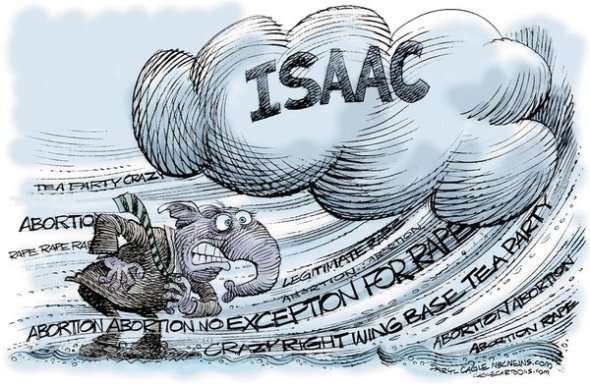
I’m writing this on Monday night, but I’ll update in the morning if there is breaking news about either Isaac or Mitt and the gang. The Republicans appear ready to loose the hounds of hell in the next few days. We can only hope they will decide to cancel the rest of the hatefest if the hurricane does a lot of damage. For now, liberal writers are suggesting this could be the most racist convention in history and conservative writers are pretending liberals are imagining things.
There was much talk yesterday about Chris Matthews’ outburst at RNC Chair Reince Priebus on the Morning Joe Show, with liberals cheering him on and Conservatives terribly shocked by his supposed rudeness. I don’t usually like to link to right wing blogs, but I’m going to do it just this once. The National Review reported on Priebus’ reaction:
“When someone wants to grab the flag and try to be the biggest jerk in the room, sometimes you just let them go,” the chairman said with a laugh.
“We shook hands, but I will tell ya that someone from MSNBC, I don’t know if it’s a producer or somebody, has been trying to call us all day — I’m sure it’s to make amends, but there’s nothing to make amends [about]. When somebody wants to take the prize of being the biggest jerk in the room . . . I mean, he made the case for us. This is the Barack Obama surrogate of 2012. This is what they’re all about. They’re going to be about division, they’re going to be about distraction. And I’ve got to tell you, the brand of Barack Obama, hope and change and bringing us all together, it’s completely broken. When people come to realize that you’re not real anymore, you’re not who you said you were, that’s a big problem for Barack Obama.”
Sorry, Reince. The only reason you weren’t the biggest jerk in the room is that Joe Scarborough was there.
Here are three good reads on the Republican race-baiting issue.
David Corn at Mother Jones, Mitt Romney and GOP in Tampa: How Low Will They Go? It’s worth reading the whole thing, but here’s the conclusion:
Romney, who once upon a time based his successful political career on a claim to be a no-nonsense, get-things-done businessman, this week officially takes the reins of a party that has embraced an assortment of alternative realities. (Obama is an incompetent naïf but one possessing an intricate and sophisticated plan to fool the American public and remake the United States into a Europeanized secular-socialist state with a mad-with-power government crushing individual liberty; global warming does not exist; rape cannot cause pregnancy.) As a onetime middle-of-the-road governor who had succeeded wildly in the private sector, Romney has always had a compelling case to present in this campaign: Obama has not done enough to repair the economy; I can do better. And there are enough honest policy differences between Romney and Obama—on tax rates, government spending, foreign policy, abortion, gay rights, and more—to fuel a sharp, feisty, and fundamental debate based on a contest of ideas, not a clash of charges.
Yet Romney’s party did not want such a fight. They craved a mudfest, and Romney, a patrician quarter-billionaire, has obliged. So there’s really not much mystery in Florida. The Tampa convention will be a continuation of this cavalcade of sleaze. You dance to the tune that brought you. And not even a driving storm can wash Mitt Romney and his campaign clean.
Elspeth Reeve at the Atlantic: Race Takes Over the Race. Reeve provides a very interesting analysis of Romney’s several welfare ads and how they convey a racial message.
John Judis at CBS News: How Mitt Romney’s campaign strategy could set Republicans back for a decade. Judis compares Romney’s strategy of trying to get as many white people to the polls as possible while ignoring African Americans and Hispanics with George W. Bush’s approach in 2000.
Mitt Romney could not only lose the election, but set back any attempt by the Republicans to re-position themselves as a majority party. Romney has abandoned Bush and Rove’s strategy. He has taken a hard line against illegal immigration, backing measures in Arizona and other states that would stigmatize Latinos; desperate to defeat Texas Gov. Rick Perry, he even opposed Perry’s attempt to provide tuition for the children of illegal immigrants. Little that Romney can do at the Republican convention will erase an impression of hard intolerance toward Hispanics. Romney will be lucky if he wins 30 percent of the Latino vote.
Bush and Rove understood that majority coalitions have never been built on strict consensus. Instead, successful coalitions are heterogeneouos. They include groups (such as Southern whites and Northern blacks during the New Deal) that don’t get along with each other, but still prefer the one party coalition to the other. And a successful candidate will offend one part of the coalition (with the expectation they’ll still vote for him) in order to reach out to parts of the opposing coalition. Bush could support immigration reform and pick off Hispanic votes with the expectation that he would still win white working class votes. But Romney, perhaps because he is not really a Republican conservative, has sought to be all things to all parts of the Republican base — from the Tea Party opponents of any social spending to the nativists worried about a Mexican takeover of America to religious conservatives wanting to ban all abortions. As a result, Romney has closed off opportunities to pick off parts of the Democratic coalition.
Instead of trying to appeal to minority voters, Republicans are doing their best to keep them from voting at all with voter ID laws, efforts to purge voters from the rolls, and reducing the times available for voting.
As of late Monday night, it appears that the convention will go forward tomorrow. Mitt and Ann are going down to Tampa and, according to The New York Times, the roll call vote will go ahead Tuesday night just in case the rest of the convention has to be cancelled. Meanwhile, there was apparently a lot of intra-party bickering during the Monday downtime.
With the vacuum created by the postponement, “everybody who has a reason to be upset about something has time to talk about it,” said Drew McKissick, a South Carolina delegate. And, as seen Monday, to try to do something about it.
Mr. McKissick was busy rallying support to fight Mr. Romney’s legal team over new party rules that he said would hinder the kind of insurgent challenges that Mr. Romney has faced this year — a clash that appeared to have been resolved enough to prevent it from spilling onto the convention floor Tuesday.
A day of closed-door talks between Romney aides and conservative activists ended with a compromise that one person involved said would “result in what we think is a very warm and fuzzy convention.” Some activists announced that they had succeeded in preventing what they called a power grab by the party establishment.
But supporters of Representative Ron Paul of Texas expressed frustration over what they said were efforts by Mr. Romney’s aides and supporters to silence their voices in the convention hall. They were goaded along by Mr. Paul, who has declined a speaking slot, accusing the Romney campaign of trying to control his message.
And supporters of Representative Todd Akin, the Missouri Senate candidate who lost much of the party’s support after his comments on “legitimate” rape and pregnancy, revived Tea Party-infused arguments against the “establishment” wing of the party, saying Mr. Romney and “party bosses” had abandoned him after his remarks.
I strongly suggest reading this article by Jon Ward at Huffpo: The One-Termer? Ward managed to get some really interesting information and quotes from Romney campaign insiders. The gist of the article is that Romney may be hoping to do a repeat of what he did in Massachusetts. The model for Romney’s presidency, according to campaign manager Matt Rhoades is President James Polk.
Rhoades and the rest of the members of Romney’s inner circle think a Romney presidency could look much like the White House tenure of the 11th U.S. president.
Polk, who served from 1845 to 1849, presided over the expansion of the U.S. into a coast-to-coast nation, annexing Texas and winning the Mexican-American war for territories that also included New Mexico and California. He reduced trade barriers and strengthened the Treasury system.
And he was a one-term president.
Polk is an allegory for Rhoades: He did great things, and then exited the scene, and few remember him. That, Rhoades suggested, could be Romney’s legacy as well.
Basically, Romney wants to enact the Ryan budget, after which he will be wildly unpopular. But once he gets Congress to eliminate the capital gains and inheritance taxes, Romney will have achieved his goal of paying nothing in federal income taxes and made it likely that his children won’t have to pay taxes on the Romney fortune after he dies.
Multiple senior Romney advisers assured me that they had had conversations with the candidate in which he conveyed a depth of conviction about the need to try to enact something like Ryan’s controversial budget and entitlement reforms. Romney, they said, was willing to count the cost politically in order to achieve it.
“I think he is looking to get in there and fix some things and get out. I don’t think he cares,” one senior Romney adviser, who was not authorized to speak on the record, told me at the time.
I’ll end with this little tidbit, in case you didn’t hear it on Lawrence O’Donnell’s show last night or read it in the {gag!} New York Post. According to the Post, Ryan wasn’t Romney’s first choice for VP–Christie turned it down because he believes Romney will lose.
Romney’s top aides had demanded Christie step down as the state’s chief executive because if he didn’t, strict pay-to-play laws would have restricted the nation’s largest banks from donating to the campaign — since those banks do business with New Jersey.
But Christie adamantly refused to sacrifice his post, believing that being Romney’s running mate wasn’t worth the gamble….The tough-talking governor believed Romney severely damaged his campaign by releasing only limited tax returns and committing several gaffes during his international tour in July.
Certain Romney was doomed, Christie stuck to his guns — even as some of his own aides pushed him to run, another source said.
Bwwwaaaaahahahahahahahaha! And Christie is the keynote speaker!! Hahahahahahahahaha!!
OK, I’m going to end there. I promise to update with any breaking stories in the morning. Now what are you reading and blogging about today?

 peej
peej Carissa
 bostonboomer
 dakinikat
 ecocatwoman
 mablue2
 Mama Lopez
 peggysue22
 quixote
 skydancingguestblogger
 Mona (aka Wonk the Vote)



 Sky Dancing
Recent Comments