
Thursday Evening News Wrapup
Posted: April 5, 2012 Filed under: 2012 presidential campaign, abortion rights, Austerity, Barack Obama, Corporate Crime, corruption, Domestic terrorism, fetus fetishists, Hillary Clinton, Medicaid, Medicare, Mitt Romney, Newt Gingrich, Planned Parenthood, SCOTUS, SDB Evening News Reads, Social Security, the villagers, Women's Healthcare | Tags: Affordable Care Act, Augusta Golf Club, Greece, Jamie Dimon, JP Morgan Chase, Judicial Activism, judicial restraint, Lizzie Borden, Masters Tournament, murder, Supreme Court 27 Comments
Afternoon Tea, by Mary Cassat
Good Evening! I’ll start off with some good news. Minkoff Minx has arrived home from the hospital and is doing well. She’ll be resting for I a few days, but she should be back to posting regularly sometime next week. I sure do miss her cheery evening reads! I’m doing my best to fill in again tonight.
It’s been a slow news day, but there are a few things happening even though most of Washington, DC–including Congress and many pundits are on a two-week Easter vacay. Why do they get such long vacations anyway? They only work about three days a week and they accomplish very little.
President Obama has waked up to the reality of women’s electoral power. Today we learned that he thinks it’s high time that Augusta Golf Club, which hosts the Masters Tournament, should start accepting women members.
Not to be outdone, and because he obviously has no original thoughts, Mitt Romney announced that he, too, And he discussed the issue in his usual stuffy manner.
When asked if women should be admitted, the Republican presidential frontrunner responded: “Of course.”
“I am not a member of Augusta. I don’t know if I would qualify. My golf game is not that good,” Romney told reporters after an energy-themed event in Tunkhannock, Pennsylvania. “Certainly if I were a member, if I could run Augusta, which isn’t likely to happen, of course I’d have women into Augusta.”
Newt Gingrich thinks his wife Callista would be “great member,” and Callista herself tweeted that she “wants in.” No word on how he-man woman-hater Rick Santorum feels about the issue.
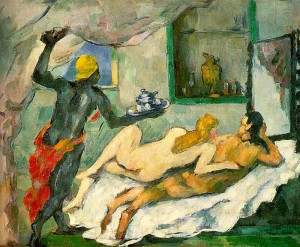
Afternoon Tea, by Cezanne
It’s looking like Romney has the Republican nomination all sewn up–he’s even leading in Santorum’s home state of Pennsylvania now. But at the Daily Beast, Michelle Goldberg explains why conservatives still want Santorum to stay in the race.
Conservative Iowa radio host Steve Deace isn’t convinced. “In the minds of social conservatives, it’s not even close to over,” he says. “The real question is how committed someone like Rick Santorum is to fighting this out all the way to the end. If he’s committed to doing this on a personal level, there’s plenty of social conservatives that will ride him to the finish line.”
Indeed, despite the best efforts of the Republican establishment, many on the religious right are far from ready to accept Romney’s inevitability, or to coalesce behind him. They remain distrustful of his record on abortion, and unsure they can believe his campaign promises. And the harder party elites push Romney on them, the more alienated they become. “The biggest story that everyone in the media has missed this cycle is how frustrated and fed up the Republican Party base is with the Republican Party,” says Deace. “It’s unlike anything I’ve ever seen.”
Goldberg quotes a number of conservative sources who just won’t accept a Romney candidacy and think Santorum to fight to the bitter end at the convention. They sound a lot like Hillary supporters who in 2008 wanted her to take the fight to the convention. Hillary is a loyal Democrat and so she ended up going with the flow, but Santorum is more of a renegade with a lot less to lose than Hillary. In any case, it seems as if the bases of both corporate parties are disgusted with their party elites.

Afternoon Tea Party, by Mary Cassatt
Also at the Daily Beast, Michael Tomasky writes that the Supreme Court is “on the ropes.” Back in the ’80s, Conservative starting pushing for “judicial restraint.” But now that the shoe is on the other foot and there is a Conservative majority on the court, suddenly they love the notion of “judicial activism” that they once reviled (just like they now despise the Heritage Foundaton health care plan now that Democrats have written it into law).
John Roberts has to know and see all this. He has to know that Fifth Circuit Judge Jerry Smith, who asked federal prosecutors for a homework assignment in the wake of Obama’s remarks—a brief stating the Justice Department’s position on judicial review, that had to be at least three pages, single-spaced!—is making conservatives look silly and cheapening the bench. And he has to know that the court’s reputation will suffer an immense blow if it overturns the mandate. It will be seen by a large majority—even a lot of people who weren’t crazy about the law—as completely political. Remember, they didn’t have to take the case in an election year in the first place. They could have put it off. But the court said it must do this now. If it then overturns the ACA, it will look and smell like a political hit job to many Americans. And the court would be saying to America, “We know what you think, and we don’t give a damn.”
What would happen to the court then? Slowly—no; probably quickly—it will come to be seen by most Americans as just another cesspool of political mud wrestling; just another arena where the rich get what they want while everyone else gets screwed (Citizens United); just one more ideological whorehouse full of patrons pretending to be just the piano player.
Despite what we’re all brought up to believe, nothing about the court is sacrosanct. Lifetime appointments can be changed to fixed-year terms. It’d take some doing, but it can be done. And there’s nothing anywhere that says it has to be nine justices. That’s just tradition, but it’s nowhere in the Constitution. It just needs to be an odd number; could be three or 23. For that matter, Congress could disregard Marbury v. Madison. Yep. It could. Tom DeLay used to speak of this from time to time, back in the dear old Terri Schiavo days. He never specifically invoked M v. M, but, referring to judges who would have let Schiavo die, he said things like they had “thumbed their noses at Congress and the president” and would someday pay. He meant a campaign against judicial review. He never got around to it, having been indicted and convicted and all, but that’s what he meant. There’s nothing to prevent liberals from mounting a similar campaign. So far they’ve has held back by their respect for the institution. But that may soon be gone.

There is a heartbreaking story out of Greece: Pensioner’s Suicide Continues to Shake Greece.
Dimitris Christoulas, a divorced and retired pharmacist, took his life on Wednesday in Syntagma Square, a focal point for frequent public demonstrations and protests, as hundreds of commuters passed nearby at a metro station and as lawmakers in Parliament debated last-minute budget amendments before elections, expected on May 6.
In a handwritten note found near the scene, the pensioner said he could not face the prospect “of scavenging through garbage bins for food and becoming a burden to my child,” blaming the government’s austerity policies for his decision.
The incident has prompted a public outpouring, with passers-by pinning notes of sympathy and protest to trees in the square, as well as comment from politicians across the spectrum. A solidarity rally on Wednesday night turned violent when the police clashed with hooded demonstrators in scuffles that left at least three people injured.
I guess we can look forward to similar tragedies here in the U.S. if Congress succeeds in gutting Medicare, Medicaid, and Social Security. And I don’t exempt the Democrats from my cynicism about support for the social safety net among the Villagers.
Speaking of the rich, powerful, and selfish, Jamie Dimon is once again on the top of the heap in terms of CEO compensation. Richard Escrow writes:
JPMorgan Chase CEO Jamie Dimon is still the poster child for today’s morally degraded, self-entitled banker mentality. I don’t know why he keeps talking, but he’s the gift that keeps on giving.
At every major junction in the post-crisis debate about banking, Dimon has stepped in with a perfectly tactless remark that illustrates both the vacuity and the moral corruption of his industry. This week was no exception.
Excrow provides a number of specific examples of Dimon’s and Chase’s lack of ethics. And yet, Dimon is still whining about “excessive” government regulation.
Dimon just complained that regulators “made the recovery worse than it otherwise would have been” — which is not only wrong, but avoids addressing the issue of the recovery’s cause, which was banks like Dimon’s. Dimon added that the government forced banks to de-leverage “”at precisely the wrong time” — which is precisely wrong. The government’s real error was in not breaking up too-big-to-fail banks like Dimon’s.
“Complexity and confusion should have been alleviated, not compounded,” complains Dimon.
So Dimon and his cronies have formed a superpac to intimidate liberal Congresspeople. Please go read the whole article. It’s really frightening.
The domestic terrorist who tried unsuccessfully to blow up a Planned Parenthood office in Wisconsin has explained his motivation.
Francis Grady, 50, spoke to reporters who were covering his first appearance in federal court since the Sunday night attack. The Green Bay Press-Gazette posted video of him walking through the courthouse followed by a short clip of him speaking to reporters outside.
“There was no bomb,” Grady said. “It was gasoline.”
A reporter asked why Grady attacked the clinic.
“Because they’re killing babies there,” he responded.
The newspaper also got more from inside the federal courtroom, where Grady reportedly interrupted the judge to ask, ““Do you even care at all about the 1,000 babies that died screaming?”
“Screaming?” Fetuses that are aborted in the first trimester aren’t “babies,” and they don’t have nervous systems to feel pain or the ability to scream. The ignorance of these people is beyond belief.
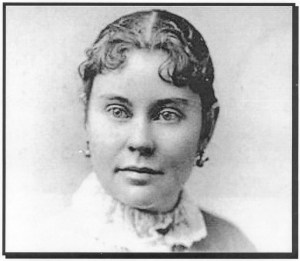
Lizzie Borden
Finally, some new evidence has been found in the Lizzie Borden murder case–journals kept by her attorney.
Borden was acquitted in 1892, and much of the evidence in the case ended up with Andrew Jackson Jennings, Borden’s attorney. The two journals, which Jennings stored in a Victorian bathtub along with other evidence from the case, including the infamous “handless hatchet,” were left to the Fall River Historical Society by Jennings’ grandson, who died last year.
The society received the fragile journals about a month ago but won’t be exhibited until they are properly preserved, curator Michael Martins said.
Each journal is about 100 pages. One contains a series of newspaper clippings, indexed using a lettering and number system that Jennings devised. The second contains personal notes that Jennings assembled from interviews he conducted. Some of the individuals interviewed are people mentioned in the newspaper clippings Jennings retained.
“A number of the people Jennings spoke to were people he knew intimately, on a social or business level, so many of them were perhaps more candid with him than they would have been otherwise,” Martins said. “But it’s also evident that there are a number of new individuals he spoke to who had previously not been connected with the case.”
I hope at least some of those links will pique your interest. What stories have you been following this afternoon and evening?
Tuesday Reads: Wisconsin Recall, Willard on the Defensive, SCOTUS, Another School Shooting, and Trayvon Martin Updates
Posted: April 3, 2012 Filed under: Civil Liberties, Civil Rights, Crime, Labor unions, Mitt Romney, morning reads, religion, Republican presidential politics, SCOTUS, U.S. Politics | Tags: Benjamin Crump, Bob Dylan, FBI, George Zimmerman, interracial marrage, Medgar Evers, Mormon church, Norman Wolfinger, Oakland CA, Oikos University, Sanford FL, School Shooting, Scott Walker, strip searches, Trayvon Martin, Wisconsin primary 38 Comments
Tea and Scones, by Kristine Diehl
Good Morning!!
Today is the Wisconsin primary, but there isn’t much suspense. It looks like Mitt Romney will be the Republican nominee, even though no one really likes him. I guess Romney wants the job so bad, he doesn’t care that that he’s basically a laughing stock. [UPDATE: Maryland and the District of Columbia also hold their primaries today.]
Yesterday, Romney was asked some uncomfortable questions at a Town Hall meeting in Howard, Wisconsin. One man, a Ron Paul supporter, asked Romney whether he agreed with Mormon Church scriptures that say interracial marriage is sinful. Romney became visibly upset.
The questioner, Bret Hatch, 28, a local supporter of Rep. Ron Paul’s, read from typed notes as he asked Romney whether he agreed with a verse from Moses 7:8 from the “Pearl of Great Price.” As he began citing the verse, Romney interrupted: “I’m sorry, we’re just not going to have a discussion about religion in my view. But if you have a question, I’ll be happy to answer your question.”
Hatch asked his question. “If you become president,” he asked, “do you believe it’s a sin for a white man to marry and procreate with a black?”
“No,” Romney said. “Next question.”
Then another person asked Romney “about his ability to connect to average Americans.” Romney then cited his experience as a church leader in the Boston area.
“That gave me the occasion to work with people on a very personal basis that were dealing with unemployment, with marital difficulties, with health difficulties of their own and with their kids,”
He then claimed that he is running for President because he wants to help people like that.
The big excitement in Wisconsin isn’t about the primary, but about the recall of Governor Scott Walker.
For Wisconsinites, the most important political news of the season came Friday, when the state’s Government Accountability Board announced that the effort to recall Republican Governor Scott Walker had amassed enough valid signatures to force an election June 5. It will be the first such election in state history, and if Wisconsin votes out Walker, he will be only the third sitting governor in U.S. history to be recalled, joining North Dakota’s Lynn Frazier in 1921 and California’s Gray Davis in 2003.
The precipitating event was Walker’s quick move, upon taking office, to reward the 1 percent with a tax cut while asking the 99 percent to sacrifice. He didn’t campaign on his antipathy for public unions. Yet within his first few weeks as governor, Walker declared war on public-sector workers (except for police and firefighters, many of whom supported his candidacy), cutting benefits, limiting pay increases and sharply curtailing collective bargaining rights, even after the unions agreed to many of his demands.
Minx wrote about the horrible SCOTUS decision that came out yesterday, but I wanted to give you a little background on the case they heard. This decision is shocking, IMO.
Albert Florence, his wife and little boy were on their way to his parents’ home in 2005, when they were pulled over by a state trooper. Mrs. Florence was at the wheel, but the trooper’s roadside state records check showed a seven-year-old outstanding arrest warrant for Albert Florence for failing to pay a fine. Florence said he had paid the fine, and pulled out a receipt, which he kept in the car. But the trooper said there was nothing he could do. Florence was handcuffed and taken to the local county jail.
The state would later admit it had failed to properly purge the arrest warrant, but at the time of the arrest, the error turned into a “nightmare,” Florence said. He was held in jail for seven days and strip-searched twice.
Florence said the experience “petrified” and “humiliated” him. Upon entering the jail, he was ordered to take a delousing shower, then inspected by a guard who was about “an arm’s distance” away and instructed Florence to squat, cough and lift up his genitals.
If that isn’t an unreasonable search, I don’t know what would be. But five “conservative” justices think it’s just fine for law enforcement officials to strip search people even for minor offenses. This will surely have the effect of frightening people away from being involved in peaceful political protests.
Occupy and political protesters beware. The U.S. Supreme Court on Monday held that local police can strip-search anyone who is arrested for minor offenses if they are to be held within the jail’s general population before being released.
The 5-4 decision, with the Court’s conservative majority overruling its four moderates, is a further erosion of the Fourth Amendment’s protection from unlawful search and seizure. It overturns laws in 10 states that place limits on suspicionless strip-searches and upholds a technique used by some local police forces against Occupy protesters last fall, prompting protesters to sue.
Among the jurisdictions seeking expanded authority to strip-search anyone arrested were the City of Chicago, where the NATO summit will be held this May and where protests have been planned, as well as the state of North Carolina, where the Democratic National Convention will be held in early September in Charlotte.
There was a school shooting at a Christian college in Oakland, California yesterday. Seven people were killed and three injured.
Police captured the suspected gunman inside an Alameda grocery store five miles away from the shooting site at Oikos University after he allegedly walked to the customer service counter and told employees, “I just shot some people.”
A law-enforcement source close to the investigation confirmed to The Chronicle that the suspect is 43-year-old One Goh of Oakland.
The suspect used a .45-caliber handgun, spraying a classroom with gunfire and firing additional shots as he ran out, said the source, who did not wish to be identified because the investigation is ongoing.
Goh had been a nursing student at Oikos University, located at 7850 Edgewater Road in East Oakland, and there was some kind of dispute that may have resulted in him getting kicked out of at least one class, the source said.
I have a number of Trayvon Martin links. I won’t quote extensively from them, but I’m still very interested in the case and want to pass on things that I’ve learned.
Some new recordings have come out that show that either George Zimmerman or police decided he didn’t need to go to the hospital after the shooting. If Zimmerman had actually had his head pounded on concrete multiple times, he would have had to be evaluated for a serious head injury, because sometimes you can have internal injuries or hemorrhaging that doesn’t show on the outside.
Trayvon Martin’s parents have formally requested that the Feds investigate whether Norman Wolfinger, the states attorney actually interfered with a police detective who wanted to arrest Zimmerman on the night of the shooting. But Wolfinger is denying that it ever happened. He didn’t deny it in a very nice way either.
Benjamin Crump, a lawyer for the Martin family, asked the Justice Department in a letter on Monday to investigate those reports. Though the letter reported the events without attribution, Crump told Reuters his information came from the media reports and he did not have independent verification….
“I am outraged by the outright lies contained in the letter by Benjamin Crump,” Wolfinger said. “I encourage the Justice Department to investigate and document that no such meeting or communication occurred.” [….]
Lynne Bumpus-Hooper, a spokesman for Wolfinger, said the state attorney never spoke with Lee on the night of the shooting. Instead Sanford police consulted that night with Kelly Jo Hines, the prosecutor on call, Bumpus-Hooper said. She declined to say what was discussed.
“Police officers can make an arrest at virtually any dadgum point they feel they have enough probable cause to make an arrest,” Bumpus-Hooper said. “They do not need our permission and they do not seek our permission.”
So who made that decision? The plot thickens.
Today FBI agents appeared in Sanford and began examining the area in which the shooting occurred, and reviewing evidence in a “parallel investigation” with the one being carried out by special prosecutor
The New York Times had an excellent review of Zimmerman’s evolving story about what happened on the night of February 26. If you’re at all interested in this case, be sure to read it. It’s very helpful.
Richard E.J. Escrow had an interesting think piece on the Trayvon Martin case. His conclusion comes from Bob Dylan’s song about the murder of Medgar Evers: Zimmerman is “only a pawn in their game.”
The deputy sheriffs, the soldiers, the governors get paid
And the marshals and cops get the same
But the poor white man’s used in the hands of them all like a tool
He’s taught in his school …
That the laws are with him, to protect his white skin
To keep up his hate, so he never thinks straight
‘Bout the shape that he’s in, but it ain’t him to blame
He’s only a pawn in their game.
Escrow writes:
Whose game? As it turns out, the ‘Stand Your Ground’ laws used to protect shooters like Zimmerman were written and promoted by ALEC – the American Legislative Exchange Council. As the Center for Media and Democracy notes, the corporate-funded right wing group behind Wisconsin Gov. Scott Walker’s attack on worker rights is the same group that has promoted ‘Stand Your Ground’ laws all around the country.
You could put a thousand people on Neighborhood Watch and they’d never see the real threats to Zimmerman’s community. Those threats can’t be seen with the eye. The real threats are things like joblessness, financial insecurity, hunger, lack of medical care. They’re threats you can’t protect yourself from with a gun.
Shooters like George Zimmerman are the product of an economic system that benefits from misdirected fear and anger – emotions that are too often channeled into violence instead of peaceful change.
Here’s Dylan performing his song at a voter registration rally in Greenwood, Mississippi in 1963.
Have a great day everyone! Now what’s on your reading list today?
Judicial Restraint My Old Lady A$$
Posted: March 29, 2012 Filed under: Affordable Care Act, SCOTUS | Tags: Judicial Activism, Kennedy, Scalia, Thomas 20 Comments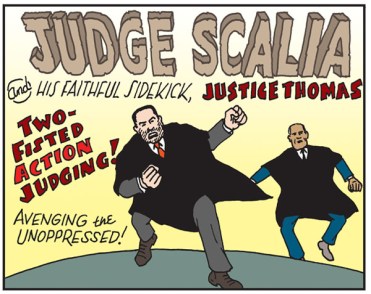 Methinks these Justices protest too much. It’s actually pretty telling too. Scalia seems to be getting his questions from old Fox News shows and Thomas has once again proven that no questions are necessary when you know exactly how you’re expected to vote to keep the perks pouring in. It makes one wonder if Roberts is the least bit concerned about how “his” court will go down in history. If comparing the health care market to broccoli is a sign of great intellect, please, buy my a ticket to Palookaville. Here’s how Charlie Pierce puts it.
It is plain now that Scalia simply doesn’t like the Affordable Care Act on its face. It has nothing to do with “originalism,” or the Commerce Clause, or anything else. He doesn’t think that the people who would benefit from the law deserve to have a law that benefits them. On Tuesday, he pursued the absurd “broccoli” analogy to the point where he sounded like a micro-rated evening-drive talk-show host from a dust-clotted station in southern Oklahoma. And today, apparently, he ran through every twist and turn in the act’s baroque political history in an attempt to discredit the law politically, rather than as a challenge to its constitutionality. (What in hell does the “Cornhusker Kickback” — yet another term of art that the Justice borrowed from the AM radio dial — have to do with the severability argument? Is Scalia seriously making the case that a banal political compromise within the negotiations from which bill eventually is produced can affect its ultimate constitutionality? Good luck ever getting anything passed if that’s the standard.) He’s really just a heckler at this point. If he can’t do any better than that, he’s right. Being on the court is a waste of his time.
Better yet, check out Jonathan Chait’s piece on Conservative Judicial Activists Run Amok. It reintroduces an essay by Jeffrey Rosen from 2005 on how the court was undergoing some fairly radical changes. The Rosen essay specifically references a Thomas decision written with an amazing amount of paraphrasing from a libertarian kook named Richard Epstein who is obsessed with protecting property at all costs; including human ones.
As Epstein sees it, all individuals have certain inherent rights and liberties, including ”economic” liberties, like the right to property and, more crucially, the right to part with it only voluntarily. These rights are violated any time an individual is deprived of his property without compensation — when it is stolen, for example, but also when it is subjected to governmental regulation that reduces its value or when a government fails to provide greater security in exchange for the property it seizes. In Epstein’s view, these libertarian freedoms are not only defensible as a matter of political philosophy but are also protected by the United States Constitution. Any government that violates them is, by his lights, repressive. One such government, in Epstein’s worldview, is our government. When Epstein gazes across America, he sees a nation in the chains of minimum-wage laws and zoning regulations. His theory calls for the country to be deregulated in a manner not seen since before Franklin D. Roosevelt’s New Deal.
After Thomas joined the Supreme Court, Biden’s warnings seemed prescient. In 1995, echoes of Epstein’s ideas could be clearly heard in one of Thomas’s opinions. By a 5-4 majority in United States v. Lopez, the court struck down a federal law banning guns in school zones, arguing that the law fell outside Congress’s constitutional power to regulate interstate commerce. Lopez was a judicial landmark: it was the first time since the New Deal that the court had limited the power of the federal government on those grounds. Thomas, who sided with the majority, chose to write a separate opinion in which he suggested that even his conservative colleagues had not gone far enough. The real problem, he wrote, was not just with the law at hand but with the larger decision of the court during the New Deal to abandon the judicial doctrines of the 19th century that established severe limits on the government’s power. He assailed his liberal colleagues for characterizing ”the first 150 years of this Court’s case law as a ‘wrong turn.”’ He continued, ”If anything, the ‘wrong turn’ was the Court’s dramatic departure in the 1930’s from a century and a half of precedent.”
Thomas did not cite Epstein directly in his opinion. But to anyone familiar with Epstein’s writings, the similarities were striking. Indeed, Thomas’s argument closely resembled one Epstein had made eight years earlier in ”The Proper Scope of the Commerce Power” in the Virginia Law Review — so closely, in fact, that Sanford Levinson, a liberal law professor at the University of Texas, accused Thomas of outright intellectual theft. (”The ordinary standards governing attribution of sources — the violation of which constitutes plagiarism — seem not to apply in Justice Thomas’s chambers,” Levinson wrote in the Texas Law Review.) Biden’s fear that Epstein’s ideas might be written into law had apparently been realized. And the fear would continue to be realized in other courts throughout the 90’s as a small but energetic set of lower-court judges, sympathetic to libertarian arguments, tried to strike down aspects of the Clean Water Act, the Endangered Species Act and other laws, challenging powers of the federal government that had come to be widely accepted during the second half of the 20th century.
Chait takes this essay into the present and the analysis presents a chilling future of judicial activism unlike anything we’ve seen before. The hearings this week on the ACA imply a SCOTUS willing to rewrite legislation in the name of ideology. The so-called swing vote, Justice Kennedy, has created loopholes in cases before that have allowed state legislatures to drive huge right-depriving laws through constitutional rights. By introducing the factually inaccurate, unscientific idea of “fetal pain” in Gonzales V Carhart, Kennedy opened a can of whoop ass based on religious propaganda on American Women.
Writing for the majority, Justice Anthony Kennedy said:
“States . . . have an interest in forbidding medical procedures which, in the State’s reasonable determination, might cause the medical profession or society as a whole to become insensitive, even disdainful, to life, including life in the human fetus . . . A State may take measures to ensure the medical profession and its members are viewed as healers, sustained by a compassionate and rigorous ethic and cognizant of the dignity and value of human life, even life which cannot survive without the assistance of others.”
The National Right to Life Committee thinks that Kennedy’s directive, particularly the bit at the end —”even life which cannot survive without the assistance of others”—leaves open the possibility of revising the viability standard. As Olivia Gans, an NRLC spokesperson, told me a few weeks ago, before the law had passed, “What Kennedy was saying was that states can and should look at other variables to figure out what’s in the best interest of the state.”
This is to medical science as the broccoli argument is to economics. It’s clear that the justices are venturing into something beyond judging constitutionality. Consider this thought offered by Chait.
The spectacle before the Supreme Court this week is Republican justices seizing the chance to overturn the decisions of democratically-elected bodies. At times the deliberations of the Republican justices are impossible to distinguish from the deliberations of Republican senators. They are litigating the problem of adverse selection, and doing it very poorly. (Here are health economists Henry Aaron and Kevin Outterson tearing their hair out over the justices’ bungled attempts to describe the economic dynamics at work.)
Scalia himself offers the most blatant case. His famed thunderings against meddlesome judges are nowhere to be found. He is gleefully reversing his previous interpretation of the Commerce Clause, now that it is being deployed against big government liberals rather than pot smokers. He is railing against Obamacare like an angry Fox News-watching grandfather:
In the morning session — in which the court weighed how much of the law should stand if the mandate is ruled unconstitutional — Scalia cited the horsetrading required to pass the bill — including the politically embarrassing, and failed, Cornhusker Kickback. He also admitted that he’d like to see the whole law fall if the mandate is ruled out of bounds.
In the afternoon, he took pains to remind the court of the unpopularity of the individual mandate.
The exchange occurred when Solicitor General Donald Verrilli Jr. rejected a hypothetical that relied on the notion of Congress passing a massive new tax. This, he argued, would have to overcome massive political constraints.
At that point Scalia chimed in: He would’ve thought the individual mandate would also be too much of a political liability to ever pass Congress.
In fact, the “Cornhusker Kickback” was stripped out before the final bill, but Scalia seems not to know that.
Just two years ago, the idea that conservatives might win the health-care fight in Court rather than the Senate seemed absurd. Just seven years ago, the notion that Republican jurisprudence would be defined by aggressive economic judicial activism seemed even more fantastical. But just as there are few atheists in foxholes, there aren’t a lot of justices of any persuasion willing to walk away from a chance to overturn a duly-passed law that they personally detest.
Whatever issue you may have with the ACA, it was passed by an overwhelming number of Senators and Representatives after a year of hearings, testimony, and rewrites. It deserves a fair hearing before something other than a Kangaroo Court.
Day One of HCRA Arguments
Posted: March 26, 2012 Filed under: Health care reform, SCOTUS 10 Comments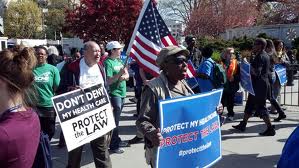 I thought I’d post some links on today’s arguments before SCOTUS in case you haven’t been able to keep up with the news. The big day for the arguments for and against the mandate come tomorrow. Protestors were all over the area in front of the nation’s courthouse and people were lined up for days to get inside. The go-to blog for this appears to be SCOTUSblog who posted this update of the day’s events.
The comments and questions of the Justices during the 89-minute exchange left the distinct impression that they are prepared to rule on the constitutionality of the mandate that individuals must buy health insurance, and not push the issue off into the future. The exact route they would take was a bit uncertain, but their skepticism about taking a pass now was clear.
That did not mean, of course, that the Court would ultimately uphold the mandate. That is tomorrow’s question, although the Justices asked many questions about the mandate, showing they are deeply curious about its scope and meaning. But an argument that at times seemed almost to bog down in the dense complexity of the tax code pointed toward a refusal to bar the lawsuits that had challenged the mandate and had put its survival before the Court this week. One of the telltale signs of that sentiment was that not one Justice, and no lawyer at the lectern, said that it would be premature and a contradiction of the Court’s tradition against deciding constitutional issues prematurely for the Court to rule promptly on the mandate’s validity.
The Court had selected a Washington attorney from outside the case, Robert A. Long, Jr., to make an argument that the Supreme Court and no lower court had any authority to rule on the challenges to the mandate, on the theory that the requirement is a part of the tax code and the Anti-Injunction Act of 1867 had closed the courthouse doors to any lawsuit against a tax law before it took effect. But the most difficult questions from the bench Monday were aimed at Long’s argument. And most of the Court seemed to be leaning toward some version or variation of the argument made by Solicitor General Donald B. Verrilli, Jr., speaking for a government that very much wants a final decision soon on the mandate.
Here are some other links to the story.
Politico: First glimpses of Supreme Court’s Thinking
Justices on both ends of the ideological spectrum appeared skeptical that an arcane law, known as the Anti-Injunction Act, should delay a Supreme Court ruling for more than two years. The law prevents people from challenging most taxes until they’ve been paid — and the penalty for people who avoid the individual mandate will be enforced through the tax code.
NYT: Health Act Arguments Open With Obstacle From 1867
The answer to that question is not obvious. The United States Court of Appeals for the Fourth Circuit, in Richmond, Va., ruled last year that it was powerless to decide the law’s constitutionality for now, and a prominent judge on the United States Court of Appeals for the District of Columbia Circuit agreed.
Their opinions relied on an 1867 federal law called the Anti-Injunction Act, which says that “no suit for the purpose of restraining the assessment or collection of any tax shall be maintained in any court by any person.” In other words, people who object to taxes must pay first and litigate later.
But the first penalties do not kick in until 2014, and they must be paid on federal tax returns by April 2015. That means, the appeals court judges said, that federal courts are forbidden for now to hear challenges to the health care law.
The Atlantic On Line: How Obamacare will Be Settled
In the first century of our nation’s history, Congress hewed to a very literal, limited understanding of the relevant text of Article I: “To regulate Commerce with foreign Nations, and among the several States, and with the Indian tribes.” Put simply, Commerce Clause legislation could regulate only business-related activities in interstate commerce.
The inception of contemporary Commerce Clause doctrine dates to the Interstate Commerce Act of 1887, regulating railroad monopolies, and the Sherman Antitrust Act of 1890, designed to curb monopolies and trusts. The Court upheld the Sherman Antitrust Act in 1905 — in Swift and Company v. United States, 196 U.S. 375. However, the justices based that decision on the finding that the effect of price-fixing by Chicago meat-packers on interstate commerce was not “accidental, secondary, remote or merely probable” but immediate. The opinion reinforced the traditional literal view of Congress’s Commerce power.
The Supreme Court case that established the constitutionality of the expanded interpretation of Congress’s commerce power was National Labor Relations Board (NLRB) v. Jones & Laughlin Steel Corporation, 301 U.S. 1, in 1937. The case originated in Aliquippa, Pennsylvania, where Jones & Laughlin was penalizing and discriminating against workers attempting to unionize. NLRB ordered Jones & Laughlin to end its coercive union-busting tactics; the firm refused to obey. After the circuit court refused to enforce the NLRB’s order against Jones & Laughlin, the NLRB appealed to the Supreme Court.
Jones & Laughlin argued that Congress could not regulate its labor practices because manufacturing is an intrastate activity, not interstate commerce. The firm based its argument on then-standard reasoning stemming from a 1918 Supreme Court case, Hammer v. Dagenhart, 241 U.S. 251. In Hammer, the Court allowed a father to commit his son to child labor in a North Carolina textile mill despite the Keating Owen Child Labor Act of 1916, reasoning that mill work was part of intrastate manufacturing, not commerce between or among states.
WAPO: Absolutely everything you need to know about health reform’s Supreme Court debut
Anti-Injunction Act
What it is: The Court opens its oral arguments with a debate over whether it can even issue a ruling on the Affordable Care Act since its penalties for not carrying insurance have not come into effect yet. Under a law passed in 1867, the Anti-Injunction Act, a tax cannot be challenged until someone has actually had to pay it. Health reform’s penalties don’t start until 2015.
What they’ll argue: One weird quirk of this provision is that neither the defendants or plaintiffs think it applies: Both sides think the Court should be able to rule right now . So the court appointed an outside lawyer, Robert Long, to argue on their behalf. Long will likely look to the Fourth Circuit Court of Appeals for precedent. It ruled, in September, that the Anti-Injunction Act prevented it from issuing a ruling on the health law.
When it happens: Monday, March 26, 10-11:30 a.m.
Why it matters: The Anti-Injunction Act gives the Supreme Court an opportunity to put off its decision for at least three years, potentially diffusing the law slightly as a 2012 election year issue. This could be a mixed-bag for health care supporters: On the one hand, it gives the law three more years to be implemented. On the other, it would still make the law’s fate seem uncertain, and likely extend the national debate around the Affordable Care Act.
SCOTUS and the Free Exercise Clause
Posted: February 9, 2012 Filed under: religion, religious extremists, right wing hate grouups, SCOTUS 42 Comments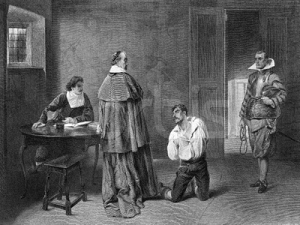 A large portion of my family--Jewish and French Huguenot people from Alsace Lorraine also known as the Rhinelands–came over to the British colonies because their homes, lives, businesses and farms had been handed to the Catholic Church as part of hundreds of years of persecution by the state of France and its state religion. Many had fled to other places–specifically England–as the persecution of French Protestants and Jews was extraordinary in the late 1600s during the Nine Year War. This was nothing new since it also occurred in the 16th century. It was still occurring under Cardinal Richlieu and Louis XIII. French Protestants (Huguenot) and Jews did not really receive full rights in France until the establishment of the Napoleonic Code in 1804. The stories of these horrors were handed down in my family from generation to generation along with the pride all felt in being early American colonists who participated in the writing of the Constitution and the signing of the Declaration of Independence. I grew up with a strong sense of what religious persecution meant as well as what was behind the so-called Free Exercise Clause of the US Constitution. It’s been burned into our family memory. While not a lawyer myself, I come from an extremely long line of barristers and lawyers. My uncle argued a lot of constitutional cases for the Roosevelt administration. I grew up with huge debates around family tables. I have spent the last few days completely distraught about the recent suggestion that a birth control provision for hospitals, universities, and other organizations run by the Catholic Church smacks of religious persecution. It simply does not represent the truth of the Supreme Court findings on what is and is not “free exercise” and what the government can and cannot regulate when it comes to religious institutions, practices and believers.
There seems to be a raging misunderstanding in the press right now about what constitutes separation of church and state and free exercise of religion. It is extremely bothersome to me because the free exercise clause and its meaning is well established. There is very little ambiguity about what it is and what it is not.
In 1878, the Supreme Court was first called to interpret the extent of the Free Exercise Clause in Reynolds v. United States, as related to the prosecution of polygamy under federal law. The Supreme Court upheld Reynolds’ conviction for bigamy, deciding that to do otherwise would provide constitutional protection for a gamut of religious beliefs, including those as extreme as human sacrifice.
The Court stated that “Laws are made for the government of actions, and while they cannot interfere with mere religious beliefs and opinions, they may with practices.”
This ruling has stood the test of time. It continued to be applied in the 1960s under the Warren Court. There were some decisions that moderated the original finding that come under the heading of “accommodation”. Oddly enough, the free exercise clause narrowed again in the 1980s and Antonin Scalia was one of the driving forces. In the 1990 case of Employment Division v. Smith. the court found that a law against peyote use was fine even though it had a religious use by some Native Americans. A 1993 law called the Religious Freedom Restoration Act was passed in order to broaden the interpretation. However, many parts of that law were struck down as unconstitutional. Here are a few examples of cases that didn’t pass muster with SCOTUS. Now remember, by the time these cases came up in the late 1990s, the court had clearly shifted to the right.
In the case of Adams v. Commissioner, the United States Tax Court rejected the argument of Priscilla M. Lippincott Adams, who was a devout Quaker. She tried to argue that under the Religious Freedom Restoration Act of 1993, she was exempt from federal income taxes. The U.S. Tax Court rejected her argument and ruled that she was not exempt. The Court stated: “…while petitioner’s religious beliefs are substantially burdened by payment of taxes that fund military expenditures, the Supreme Court has established that uniform, mandatory participation in the Federal income tax system, irrespective of religious belief, is a compelling governmental interest.”[15] In the case of Miller v. Commissioner, the taxpayers objected to the use of social security numbers, arguing that such numbers related to the “mark of the beast” from the Bible. In its decision, the U.S. Court discussed the applicability of the Religious Freedom Restoration Act of 1993, but ruled against the taxpayers.[16]
For some time, members of specific religious communities–like Mormons, Jehovah’s Witnesses, Christian Scientists, Quakers, and the Catholic Bishops–have taken cases to the Supreme Court based on the Free Exercise clause and lost. This is why I am so confused by the complete lack of understanding in the TV Press of the current attack on birth control coverage in the HCRA. Since I am not a lawyer and have only had undergraduate classes in constitutional laws, I will defer to some one who is a well known constitutional lawyer, David Boies. He has been appearing on The Last Word show and has calmly explained why all the hysteria about free exercise of religion is just that; badly motivated hysteria.
The high, in terms of reason and clarity, came from famed attorney David Boies on MSNBC’s “The Last Word.” Lawrence O’Donnell has let male “liberal” pundits like Mark Shields wax a little shrill on his show, but to his credit, he offered the best rebuttal to all the shrieking I’ve seen so far: Boies calmly and clearly explaining the new regulations as an issue of labor law, and the government’s regulation of employers (relatively minimal, compared to other countries) on issues of health, safety and non-discrimination.
I’ve tried to make the same points: What if Catholics didn’t believe in child labor laws? Would we let church-run agencies flout them? Boies used the example of a religion that believed people shouldn’t work after age 60: Could they legally ban older people from employment? Of course, they could do neither. This is indeed an issue of religious freedom: the freedom of non-Catholics not to be bound by the dictates of the Catholic Church in the workplace.
But Boies, fresh off his 9th Circuit victory defending gay marriage, brought the legal knowledge.
Lawrence O”Donnell writes directly about this conversation.
Constitutional expert David Boies said there’s no basis for a constitutional fight with the birth control mandate. On The Last Word, he compared the current debate that’s heating up in Washington to simple tax law or labor laws.
“There isn’t a constitutional issue involved in this case,” he told MSNBC’s Lawrence O’Donnell on Wednesday. “You don’t exempt religious employers just because of their religion. You are not asking anybody in the Catholic church or any other church to do anything other than simply comply with a normal law that every employer has to comply with.” Boies, who represented Vice President Al Gore in Bush v. Gore, said “this case would have trouble getting to the court.”
So, I have one other reason that I’d like to bring all this up. We know that a few specific religious groups have a problem with Roe V. Wade and Griswold V Connecticut. We know that these people have been trying to stack the courts with sympathetic whackos for about 40 years now. It seems they’re attacking Reynolds too. If you read BB’s morning post and Peggy Sue’s last post you can see that many Republicans would just like to outlaw the judicial branch. Newt Gingrich makes it a campaign staple.
Did you know that THREE of the SCOTUS justices turn 80 in the next five years? Ruth Bader Ginsberg, Antonin Scalia, and Anthony Kennedy are the three justices. So, let’s think about what is at stake if any of these Republican presidential wannabes get to appoint a SCOTUS or three. How about major appointments to courts like the one that just overturned Prop 8?

 peej
peej Carissa
 bostonboomer
 dakinikat
 ecocatwoman
 mablue2
 Mama Lopez
 peggysue22
 quixote
 skydancingguestblogger
 Mona (aka Wonk the Vote)



 Sky Dancing
Recent Comments