Posted: June 28, 2025 | Author: bostonboomer | Filed under: cat art, caturday, Corrupt and Political SCOTUS, Donald Trump, ICE Immigration and Customs Enforcement, immigration, SCOTUS, SCOTUS decisions | Tags: ACLU, Birthright citizenship, California, executive orders, fascism, federal courts, haiti, immigration horror stories, nationwide injunctions |

East is a delicate matter, by Zakir Akhmadov
Good Afternoon!!
I don’t see any good news out there today. I wonder if things are just going to continue getting worse until fascism completely takes over our country. It’s already true that we are a failing democracy; and it’s not clear whether we can recover.
We still have some hope that the federal courts can rescue us, but the Supreme Court is making that less likely with each passing day. Yesterday, Dakinikat wrote about the latest nightmare decision from SCOTUS in the birthright citizenship case, and reactions to that decision are still dominating today’s news and opinion, and there are differing opinions about the fallout from the decision.
I also want to highlight some immigration horror stories that demonstrate how fascism really is coming to America, as Dakinikat suggested yesterday.
The Birthright Citizenship Decision
Nicholas Bagley at The Atlantic (gift link): The Supreme Court Put Nationwide Injunctions to the Torch. That isn’t the disaster for birthright citizenship that some fear.
Yesterday, in a 6–3 decision in Trump v. Casa, the United States Supreme Court sided with the Trump administration in a case involving an executive order that purports to eliminate birthright citizenship.
Confusingly, the Court’s decision wasn’t about the constitutionality of the birthright-citizenship order. Instead, the case proceeded on the assumption that the order was unconstitutional. The only question for the justices was about remedy: What kind of relief should federal courts provide when a plaintiff successfully challenges a government policy?
The lower courts had, in several birthright-citizenship cases across the country, entered what are known as “universal” or “nationwide” injunctions. These injunctions prevented the executive order from applying to anyone, anywhere—even if they were not a party to the case. The Trump administration argued that nationwide injunctions were inappropriate and impermissible—injunctions should give relief only to the plaintiffs who brought the lawsuit, no one else.
In a majority opinion by Justice Amy Coney Barrett, the Supreme Court sided with the Trump administration and put nationwide injunctions to the torch. That’s a big deal. Not only does it represent a major setback to the states and advocacy groups that brought the lawsuit, it also amounts to a revolution in the remedial practices of the lower federal courts.
But it is not, as the dissenting Justice Ketanji Brown Jackson would have it, “an existential threat to the rule of law.” It won’t even mean the end of sweeping injunctions in the lower federal courts. To the contrary, the opinion suggests that relief tantamount to a nationwide injunction will still be available in many cases—including, in all likelihood, in the birthright-citizenship case itself.

Cat of Morocco by Isy Ochoa
The author, Nicholas Bagley, is a law professor at the University of Michigan and in the past served as legal counsel to Gov. Gretchen Whitmer. He writes that Barrett’s decision was based on history. Nationwide injunctions did not become commonplace until fairly recently in U.S. history; therefore she argued that ‘The federal courts thus lack the power to issue nationwide injunctions. Period. Full stop.” Bagley’s take:
In my book, that’s a positive development. In 2020 testimony to the Judiciary Committee of the U.S. Senate, I argued that nationwide injunctions “enable opportunistic behavior by politically motivated litigants and judges, short-circuit a process in which multiple judges address hard legal questions, and inhibit the federal government’s ability to do its work. By inflating the judicial role, they also reinforce the sense that we ought to look to the courts for salvation from our political problems—a view that is difficult to square with basic principles of democratic self-governance.”
Although the Supreme Court divided along partisan lines, with the liberal justices dissenting, I don’t see this as a partisan issue. (The outrageous illegality and sheer ugliness of President Donald Trump’s executive order that lies underneath this fight may go some distance to explain why the three liberals dissented.) Nationwide injunctions are equal-opportunity offenders, thwarting Republican and Democratic initiatives alike. Today, it’s Trump’s birthright-citizenship order and USAID spending freezes. Yesterday it was mifepristone, the cancellation of student debt, and a COVID-vaccine mandate. Why should one federal judge—perhaps a very extreme judge, on either side—have the power to dictate government policy for the entire country? Good riddance.
ven as it ended nationwide injunctions, the Supreme Court left the door open for other forms of relief that are not nationwide injunctions—but that look a whole lot like them. That’s good news for opponents of the birthright-citizenship order.
You’ll need to read the rest at The Atlantic to understand Bagley’s arguments.
Jonathan Last [who is not a lawyer] at The Bulwark: The Supreme Court Just Made America a Dangerous Place.
The Supreme Court issued its birthright citizenship ruling this morning and it’s worse than just about everyone feared it could be.
The Court’s ruling is composed of two main parts.
The first is its declaration that it is possible that the president can contradict the plain-text reading of the Constitution by issuing an executive order doing away with birthright citizenship.
The second is that lower courts can no longer issue nationwide injunctions against blatantly unconstitutional policies imposed by the executive. Injunctions must now be created on a patchwork basis.
I want to impress upon you how dangerous this is. SCOTUS has empowered the president to impose whatever he likes—irrespective of its constitutionality—and then prevented judicial overview except at the localized level. Meaning that we will now have two sets of laws. One that operates in Red America and one that Operates in Blue America.
Separate, but unequal. A house divided against itself.
I think the majority believes it is being clever—that it has found a way to pretend to give Trump a win while (they tell themselves) ackshually delaying a substantive verdict.
But what they have done is not mere make-believe. They have set in motion a calamity.

Mr. Angel, Sir, Some Other Dude Done It, Elisheva Nesis, Israeli artist
I’m going to give you a bit more, because this article is behind a paywall. Last notes that the case before the SCOTUS was not about birthright citizenship, so they didn’t need to deal with that, and they didn’t specifically do that. That question will require further litigation.
The Supreme Court could have jumped ahead and simply ruled that the action proposed by the president’s executive order was unconstitutional. This would have meant widening the scope of the specific question in Trump v. Casa. But scope gets widened all the time. The Supreme Court is the Supreme Court. It can do whatever it wants.
The fact that the majority chose to delay answering this question is, all on its own, a statement. My theory is that at least two members of the majority do not believe that the birthright citizenship order is constitutional—but they want to delay making that judgment as long as possible.
And so, by constructing this new idea—that universal stays are now verboten—they tell themselves that they have handed Trump a tactical victory but set him up for a strategic defeat on the substance of his EO later on.
The Supreme Court majority thinks it’s being clever by playing within the rules. They’re actually being fools, because Trump isn’t playing within the rules. Their conception that injunctions should be limited just to the parties in each particular case works only if (1) similar cases will be decided similarly, and (2) the government knows this fact and won’t try to break the law. But the government is, right now, in the process of finding ways to ignore the courts—including the Supreme Court—with as little political price as possible. And the government has shown already—repeatedly—that it will break the law.
That’s very true. See this article at The Washington Post: Trump says he will move aggressively to undo nationwide blocks on his agenda.
An emboldened Trump administration plans to aggressively challenge blocks on the president’s top priorities, a White House official said, following a major Supreme Court ruling that limitsthe power of federal judges to issue nationwide injunctions.
Government attorneys will press judges to pare back the dozens of sweeping rulings thwarting the president’s agenda “as soon as possible,” said the official, who spoke on the condition of anonymity to describe internal deliberations.
Priorities for the administration include injunctions related to the Education Department and the Department of Government Efficiency, as well as an order halting the dismantling of the U.S. Agency for International Development (USAID), the official said.
“Thanks to this decision, we can now promptly file to proceed with numerous policies that have been wrongly enjoined on a nationwide basis,” President Donald Trump said Friday at a news conference in which he thanked by name members of the conservative high court majority he helped build.
Trump on Friday cast the narrowing of judicial power as a consequential, needed correction in his battle with a court system that has restrained his authority.
Scholars and plaintiffs in the lawsuits over Trump’s orders agreed that the high court ruling could profoundly reshape legal battles over executive power that have defined Trump’s second term — even as other legal experts said the effects would be more muted. Some predicted it would embolden Trump to push his expansive view of presidential power.
“The Supreme Court has fundamentally reset the relationship between the federal courts and the executive branch,” Notre Dame Law School Professor Samuel Bray, who has studied nationwide injunctions, said in a statement. “Since the Obama administration, almost every major presidential initiative has been frozen by federal district courts issuing ‘universal injunctions.’”
Huffpost’s Jennifer Bendery reports on the reactions of the ACLU and other civil liberties groups to the SCOTUS decision: Groups File Nationwide Class Action Lawsuit Over Trump’s Birthright Citizenship Order.
Immigrants rights’ advocates on Friday filed a nationwide class action lawsuit challenging President Donald Trump’s executive order restricting birthright citizenship, just hours after the Supreme Court partially blocked nationwide injunctions challenging Trump’s order.
The lawsuit, filed by the American Civil Liberties Union, Legal Defense Fund and other groups, was brought on behalf of a class of babies subject to the executive order, along with their parents. It charges the Trump administration with flouting the Constitution, congressional intent, and longstanding Supreme Court precedent.

Bohemio et el gato, Luis Garcés
It is also a direct response to the Supreme Court’s decision earlier Friday that puts new limits on nationwide injunctions, and reflects a new legal pathway that groups will likely turn to when challenging the Trump administration’s unlawful actions.
In a 6-3 decision along ideological lines, the high court struck down nationwide injunctions against Trump’s birthright citizenship order, narrowing their scope to provide relief to the specific plaintiff who is suing in a case rather than anyone who would be affected by the order. In addition to drawing sharp criticism from constitutional experts, the court’s decision is a major blow to pro-democracy groups that have been successfully challenging Trump’s lawlessness through the use of injunctions.
But the justices left the door open to challenging the administration in other ways, like class action lawsuits. The ACLU and its cohorts wasted no time using this legal pathway.
In a statement, the groups behind the new lawsuit noted that three lawsuits previously obtained nationwide injunctions protecting everyone subject to Trump’s executive order, but the Supreme Court’s decision narrowed those injunctions and potentially leaves children without protections.
“Every court to have looked at this cruel order agrees that it is unconstitutional,” Cody Wofsy, deputy director of the ACLU’s Immigrants’ Rights Project and lead attorney in this case, said in a statement. “The Supreme Court’s decision did not remotely suggest otherwise, and we are fighting to make sure President Trump cannot trample on the citizenship rights of a single child.”
Read the rest at HuffPost.
Immigration Horror Stories
First, two incidents in California, which is still under Trump’s thumb with his commandeering of the National Guard and his stationing marines in Los Angeles and with masked ICE gangs roaming the streets. We aren’t getting as much coverage about the situation in California, but protests and ICE raids are still going on.
The Guardian: Federal agents blast way into California home of woman and small children.
Federal agents blasted their way into a residential home in Huntington Park, California, on Friday. Security-camera video obtained by the local NBC station showed border patrol agents setting up an explosive device near the door of the house and then detonating it – causing a window to be shattered. Around a dozen armed agents in full tactical gear then charged toward the home.
Jenny Ramirez, who lives in the house with her boyfriend and one-year-old and six-year-old children, told NBC through tears that it was one of the loudest explosions she heard in her life.
“I told them, ‘You guys didn’t have to do this, you scared by son, my baby,’” Ramirez said.
Ramirez said she was not given any warning from the authorities that they wanted to enter her home and that everyone who lives there is a US citizen.
The raid comes as federal agents have ramped up immigration enforcement in Los Angeles and across southern California over the last few weeks. Huntington Park is in Los Angeles county. Immigrants have been swept up in raids at court houses, restaurants and straight off the street. Some of the people targeted by Immigration and Customs Enforcement (Ice) have been US citizens. In one incident, Ice agents detained a Honduran woman seeking asylum and her children, one of which was a six-year-old boy who had been diagnosed with leukemia.
The agents who raided Ramirez’s home in Huntington Park on Friday also reportedly sent a drone into the house after setting off the explosive device.

Two cats on a colorful cushion, woodcut by Theophile Steinlen
More details from ABC 7: Federal agents blast door off, shatter window during raid in Huntington Park.
Dramatic video shows the moment federal agents blew up the front door of a residence in Huntington Park early Friday morning, using a drone to search room by room for a man they say rammed a federal vehicle last week during immigration raids.
“They were right here with their rifles and we heard some screaming up in the front but we couldn’t see because everything was blocked, but it was pretty shocking,” said Lourdes Salazar.
That man, Jorge Sierra-Hernandez, was not home at the time, but his girlfriend and two young children were, leaving them shaking with fear due to the aggressive tactics of those agents.
He is now back home with his family after turning himself in Friday.
After the break-in and drone search:
Once the drone went out, at least nine agents moved in with guns drawn. They eventually escorted Ramirez and her children outside.
“They didn’t identify themselves until I came out, they told me they were from Homeland Security, from ICE,” said Ramirez.
She said pleaded with them to give her an explanation, but instead of giving her an answer, they said “when we find him he’s going to know why.” [….]
The agents claimed that Ramirez’s car ran into a truck carrying federal agents. It’s not clear if it was deliberate. The agents were also angry because protesters were throwing rocks at them during the incident. Why does that justify terrorizing a mother and two small children? DHS and ICE are on an out-of-control power trip.
Channel 4 Los Angeles reported on another incident: Family outraged after federal agents detain US citizen, accuse her of assault.
A 32-year-old U.S. citizen was released from federal custody Thursday evening after her family said she was wrongfully detained by agents during an immigration enforcement operation in downtown Los Angeles.
According to her attorney, Andrea Velez was released on bond after being detained by immigration enforcement agents on Tuesday and then charged with assaulting a federal officer. The Department of Homeland Security said Velez “forcefully obstructed an ICE officer,” but her family said that’s not the case.
Estrella Rosas documented the frantic moments as she saw her sister being thrown to the ground before being arrested and forced into an unmarked car by unidentified officers near 9th and Main Street in downtown Los Angeles.

Woman with a cat, by Marijan Trepše.
“We dropped off my sister to go to work like we always do, all of a sudden, my mom in the rearview mirror she saw how a man went on top of her. Basically, dropped her on the floor and started putting her in handcuffs and trying to arrest her,” said Rosas, recounting the arrest.
In the video, Velez’s mother and sister can be heard pleading for help. “That’s my sister. They’re taking her. Help her, someone. She’s a U.S. citizen,” said Rosas.
In the criminal complaint, prosecutors alleged that during an immigration enforcement Tuesday morning, “Velez stepped into an officer’s path and extended one of her arms in an apparent effort to prevent him from apprehending a male subject he was chasing and that Velez’s outstretched arm struck that officer in the face.”
In her court appearance Thursday, Velez did not enter a plea in federal court. Velez’s family said she was just walking on her way to work as a marketing designer and did nothing wrong.
Both sisters are U.S. citizens, but these days that doesn’t seem to matter.
One more awful immigration story from The Washington Post: DHS ends deportation protection for Haitians, says Haiti is ‘safe.’
The Trump administration announced an end to temporary legal protections for Haitian migrants in the United States, leaving hundreds of thousands of people at risk of deportation.
The temporary protected status for Haitian nationals in the United States, granted after a 2010 earthquake near Port-au- Prince caused up to 200,000 deaths, will terminate Sept. 2, the Department of Homeland Security said in a statement Friday.
“This decision restores integrity in our immigration system and ensures that Temporary Protective Status is actually temporary,” DHS said in a statement Friday. The “environmental situation in Haiti has improved enough that it is safe for Haitian citizens to return home,” DHS said, and Haitian nationals may “pursue lawful status” through other means if they are eligible.
The statement did not elaborate on why it considered Haiti safe for citizens.
That’s because Haiti is not safe.
Meanwhile, the U.S. government continues to advise Americans against all travel to Haiti, which has been under a state of emergency since March 2024 because of “kidnapping, crime, civil unrest, and limited health care.” The State Department’s travel advisory adds that “mob killings and assaults by the public have increased” and that crimes including “robbery, carjackings, sexual assault and kidnappings for ransom” are common.

Bedtime Story, by Jeanette Lassen
The U.S. Embassy in Port-au-Prince this week noted that some domestic air travel had resumed, and urged Americans to leave the country “as soon as possible.”
In a federal register notice of the decision, Secretary of Homeland Security Kristi L. Noem said she decided to terminate the TPS designation for Haiti “because it is contrary to the national interest to permit Haitian nationals … to remain temporarily in the United States.”
“Widespread gang violence in Haiti is sustained by the country’s lack of functional government authority. This breakdown in governance directly impacts U.S. national security interests, particularly in the context of uncontrolled migration,” she said in the notice. While the situation in Haiti was “concerning,” she wrote, “the United States must prioritize its national interests.”
The puppy murderer has spoken.
More Important Stories to Check Out
NBC News: Senate Republicans release 940-page bill for Trump’s agenda as they race to vote this weekend.
Politico: Fresh megabill text overnight: what’s in and what’s out.
Bryce Edgmon and Cathy Giessel at The New York Times: Alaska Cannot Survive This Bill.
The New York Times: Senate Blocks War Powers Resolution to Limit Trump’s Ability to Strike Iran Again.
Ryan J. Reilly at NBC News: Pam Bondi fires three Jan. 6 prosecutors, sending another chill through DOJ. workforce.
CNN: University of Virginia president resigns amid pressure from the Trump administration.
Stars and Stripes: Trump eyes staff cuts to top spy agency as he sweeps aside Iran intelligence.
The Washington Post: DOGE loses control over government grants website, freeing up billions.
That’s all I have for you today. What’s on your mind?
Did you like this post? Please share it with your friends:
Posted: June 27, 2025 | Author: dakinikat | Filed under: SCOTUS decisions, Sotomayor | Tags: Buzz Windrip, Corrupt SCOTUS, SCOTUS Fringe Theories, Supreme Court 2024-2025 Decisions |

“Overheard at the neighborhood karaoke bar.” John Buss, @repeat1968
Good Day, Sky Dancers!
I’ve been tempted to reread a book I was assigned in high school, by the 20th-century author Sinclair Lewis. “His 1935 novel, It Can’t Happen Here, centers around a flag-hugging, Bible-thumping politician named Berzelius (”Buzz”) Windrip.” This novel is likely the inspiration for this bit of wisdom from the same period that frequently gets attributed to Lewis because of the novel. “When fascism comes to America, it will be wrapped in the flag and carrying a cross.” This essay is from last April’s Common Dreams and is written by Bill Durst. You may recall this isn’t the first time I’ve reflected longingly on Lewis.
Although no one’s actually sure that Sinclair Lewis ever wrote or said this, his 1935 novel, It Can’t Happen Here, centers around a flag-hugging, Bible-thumping politician named Berzelius (”Buzz”) Windrip. Despite having no particular leadership skills other than the ability to mesmerize large audiences by appealing to their baser instincts (and to bully those people who aren’t so easily mesmerized), Windrip is elected President of the United States. Shortly after Windrip takes office, through a flurry of executive orders, appointments of unqualified cronies to key governmental positions, and then a declaration of martial law, Windrip quickly makes the transition from a democratically elected president to a brutal, fascist dictator. The novel’s title, It Can’t Happen Here, refers to the mindset of key characters in the novel who fail to recognize Windrip’s fascist agenda before it’s too late.
Written almost a century ago during the rise of fascism in Europe prior to World War II, It Can’t Happen Here is disturbingly prescient today. Buzz Windrip’s personal traits, his rhetoric, and the path through which he initially becomes the democratically elected U.S. president, and soon afterward, the country’s first full-fledged fascist dictator, bear an uncanny resemblance to the personality traits and rhetoric of Donald Trump and the path through which he has come thus far to be the 47th President of the United States, and through which he appears to be on course to become our country’s first full-fledged…. But no! It can’t happen here! Or can it?
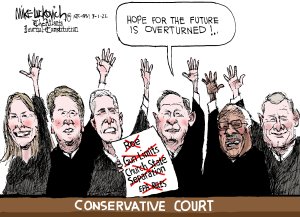 I’m sure even Sinclair Lewis did not see Christofasicist billionaires stacking the Supreme Court with equally overreaching religious nuts. The reversal of Roe still has hand devastating and deadly impact on women in this country. This term of the Supreme Court has cursed us with religiosity of a specific source once more. I only took one Constitutional Law class at university, and it was part of the Political Science Department, but that book still resides in my hallway library. That’s back when I fancied myself to be prelaw and my political activities were focused on changing the Rape Laws and police institutions surrounding violence and rape against women and children. Back then, women could not be raped by their husbands and they had to have two eyewitnesses to the rape. Those laws changed in Nebraska, and fortunately, they still stand. However, spiritual rape and violence still stands and is “wrapped in the flagg and carrying a cross.” It exists in Congress, persists in the Executive Branch, and drags its knuckles through the Supreme Court. It does not take a lawyer to know a rape when they see one.
Sit down. The Surpeme Court’s decisions this term are nothing short of institutional rape of the U.S. Constitution. This is the same crew that took down Abortion Rights by citing a witch-burning jurist from 17th England.
The AP is full of headlines that make me want to open up my window and scream very loudly. The only solace is that it could’ve been worse. The only joy will be reading the objections and rebuttals of the sane women who sit on the court.
Christian legal advocacy group calls LGBTQ+ books case ruling a ‘monumental victory’
Trump says school decision will ‘bring life back to normal’
Restricting birthright citizenship is not popular, AP-NORC polling shows
Trump praises Justice Barrett
JUST IN: Trump says he’ll ‘promptly file’ to advance policies blocked by judges, including birthright citizenship restrictions.
JUST IN: Trump hails ‘monumental victory’ after Supreme Court curbs nationwide injunctions that have slowed his agenda.
Digital rights group says ruling could upend First Amendment access
National Latino organizations criticize Supreme Court ruling
You get the drift.
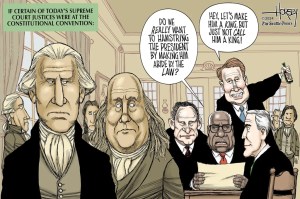 So, let’s dig deeper. This is from the Washington Post. “Supreme Court sides with religious parents seeking to opt out of LGBTQ storybooks. The case asked whether Montgomery County, Maryland, could require children to participate in lessons with books that clash with parents’ religious beliefs.” Love thy neighbor is lost on these people. Of course, guess who wrote for the majority in this one? Mister, I loved the Inquisition, Alito. This guy’s father came to America from Italy in 1914. That was a time when most of the white people here didn’t want Italians here. He’s evidently forgotten they were lynched in the United States at one point. But now, he’s just another oppressor.
The Supreme Court sided Friday with a group of parents seeking to withdraw their children from public school lessons featuring LGBTQ+-themed storybooks, a case that mixed parental rights and religious freedom.
The justices said school officials in Montgomery County, Maryland, may not require young children to participate in lessons with books that conflict with their parents’ religious beliefs.
The 6-3 decision could have implications for public schools nationwide and could give families the right to voice religious objections to a broad range of learning materials, expanding on the long-standing practice of allowing opt-outs for reproductive-health classes.
Justice Samuel A. Alito Jr., writing for the majority, said government officials burden the religious rights of parents when they require them to “submit their children to instruction that poses ‘a very real threat of undermining’ the religious beliefs and practices that the parents wish to instill.”
While litigation continues, Alito wrote, Montgomery County must notify parents in advance whenever one of the books in question or any other similar book is to be used in any way and to allow them to have their children excused from that instruction.
Justice Sonia Sotomayor read a summary of her dissent from the bench on behalf of the three liberal justices. She said the court’s ruling “strikes at the core premise of public schools: that children may come together to learn not the teachings of a particular faith, but a range of concepts and views that reflect our entire society.”
Leaders with Montgomery County Public Schools and its school board said in a joint statement Friday that the decision “is not the outcome we hoped for or worked toward.”
“It marks a significant challenge for public education nationwide,” school system officials said. The school system said it is working on determining its next steps.
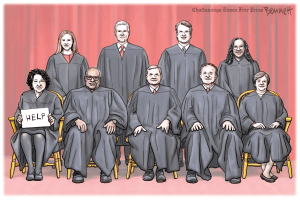 Let’s rewrite that as Hate your neighbor unless he ascribes to his particular version of ‘yourself”. To continue on that topic, let’s move to the next decision. This is from MSNBC. “The Supreme Court’s birthright citizenship reasoning reveals a startlingly myopic view. The conservative wing of the court overly relies on the emergency shadow docket and shouldn’t have entertained the administration’s birthright argument.” They continue to destroy one precedent after another. This analysis is by Shan Wu, a legal analyst and former federal prosecutor.
The so-called birthright citizenship case decided by the U.S. Supreme Court on Fridayproved an irresistible shiny object to the court’s hubris, gleaming with the chance to address fringe conservative ideology and enhance the power and ego of the high court, all while it used its favorite new love: the emergency shadow docket. To put it plainly, the conservative wing of the court shouldn’t have even entertained the Trump administration’s arguments about birthright citizenship — and those justices have made it clear that they can and should diminish the role of lower courts through their prodigious use of the emergency shadow docket.
Consolidated from three cases in which lower courts stayed implementation of President Donald Trump’s executive order revoking the U.S. Constitution’s guarantee of birthright citizenship, the case involved only the question of whether lower court judges can issue nationwide injunctions. But at oral argument, the justices couldn’t help themselves, wading repeatedly into the question of birthright citizenship itself, thus lending legitimacy to a once-fringe conservative theory.
The Constitution couldn’t be clearer. Section 1 of the 14th Amendment states: “All persons born or naturalized in the United States, and subject to the jurisdiction thereof, are citizens of the United States and of the State wherein they reside.”
It’s difficult to see how fans of “originalism” could read this to mean that children born in the United States somehow aren’t citizens — but that is exactly what Trump’s Justice Department argued.
Keep in mind that the 14th Amendment itself arose after a civil war was fought over the question of whether slaves possess the same rights as other people in the country — and was specifically meant to counter the backlash against Black people and recalcitrance in the Southern states to treating freed slaves as equals.
 ” Lending legitimacy to a once-fringe conservative theory” is their favorite activity. The Washington Monthly’s Jack Rakove has a succinct view on this version of the Supremes. I weep for the country that my family fought so hard to found and continue and to improve. These folks are throwbacks to the European Dark Ages. “It’s Not Just a Constitutional Crisis in the Trump Era. It’s Constitutional Failure. The problem isn’t just the crisis of the administration defying the courts. It’s the failure of the legislative and judicial branches to check the president.”
The idea that the United States awaits some dread constitutional crisis has become commonplace. For lawyers, such a crisis would likely involve Donald Trump’s administration defying the Supreme Court on some critical ruling. But other crises are readily imaginable. Might President Trump invoke the Militia Act to manipulate the 2026 congressional elections, or order the Marines to take sites in Greenland without congressional approval, which seems ever more plausible after the June 22 bombing of Iranian nuclear facilities?
Such scenarios are not unfounded, but they do not diagnose our true malady. Our ongoing constitutional crisis began with the presidential election last November 5. Reelecting an individual culpable for January 6 who has twice made a mockery of the presidential oath of office is itself a constitutional crisis. Nothing in his past or current behavior suggests that Trump has ever felt fidelity to his constitutional duties.
Once a constitutional crisis becomes an endemic condition, the term no longer usefully describes our collapsing system. Instead, we live in an era of constitutional failure when the relevant institutions cannot fulfill their responsibilities.
Because constitutional failure is a term we have never needed to use, it merits a precise definition. First, it must identify the specific situations where the government institutions have manifestly not fulfilled their constitutional functions. Second, it should treat these omissions not as occasional lapses but systemic defects. Third, it must explain how the political and ethical norms of constitutional governance have evaporated.
To apply this framework to the second Trump administration is hardly difficult. The only problem is where to begin. Consider its authoritarian reliance on executive orders to vitiate legally established government activities, its attempt to intimidate institutions outside of government to do its bidding, and its insistence that servile loyalty to the president outweighs fidelity to constitutional norms. That some commentators describe this last practice as the Führerprinzip—the Nazi principle that the will of the leader transcends all legal norms—tells us everything.
Deciding whether the Constitution is failing requires asking if and why the other two branches of government have been remiss in checking a rogue executive.
Their most important failures involve the two clauses that would have disqualified Trump from reelection: the presidential impeachment clause and Section 3 of the Fourteenth Amendment. But starting in a more obscure location is better: the two Emoluments Clauses restricting the material benefits a president can receive from other governments. In his first administration, three suits sought to force Trump to comply with these two clauses. One, brought by members of Congress, was plausibly dismissed on standing grounds, because a minority faction in Congress cannot litigate to make the body implement a power it already possesses. Two other cases, however, progressed in the lower courts, but once they were appealed, the Supreme Court slow-walked them until Trump left office, leaving the issue moot.
The Court thus casually squandered an opportunity to clarify the meaning of a provision that badly needs enforcement. All previous presidents had scrupulously adhered to the Emoluments Clauses, which embody the fundamental principle that presidents should neither seek nor hold office for private gain. The honor of holding the highest office in the land should displace every other ambition. But this president and his family have more material, even sordid aims to pursue. With Trump, the imperial presidency and the presidential emporium have converged. This White House is for sale, whether through gifts from wealthy entrepreneurs, the manipulation of tariffs, and, perhaps worst of all, the family’s active involvement in crypto meme speculations.
But the two Emoluments Clauses occupy only obscure niches in the Constitution. The same cannot be said of the powers being abused to eliminate federal agencies and departments and purge civil servants. These agencies and officials derive their authority from congressional enactments and appropriations. All are covered by the Impoundment Control Act of 1974, adopted to constrain the unilateral efforts of President Richard Nixon to reduce federal spending on his own authority. All involve the signature constitutional obligation of the president to “take care that the laws be faithfully executed,” not least because every statute requires either the assent of the chief executive or, in the case of a presidential veto, its reenactment by supermajorities in both houses of Congress.
The most fundamental purpose of constitutional government, as it evolved in 17th-century England and revolutionary America, was to make the executive power susceptible to legislative control. It did not matter whether the executive was monarchical, ministerial, or presidential. The key point established by the English Glorious Revolution of 1688 was that the Crown had to rule with parliamentary consent or supervision.
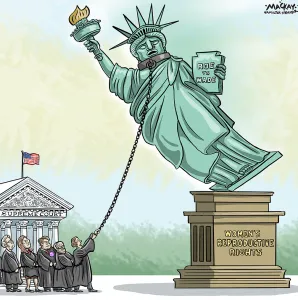 Please continue to the link to read this article in its entirety. This is a professor who knows his history. We’re in a period where we can reflect on how Nixon was stopped, and how Trump is being enabled. Here’s more on the overturning of the Trump injunctions. This is from the New York Times. It’s written by Abbie Van Sickle. “Supreme Court Live Updates: Trump Hails Ruling to Limit Nationwide Injunctions. In a major victory for President Trump, the court restricted the ability of federal judges to block his executive orders. The decision may reshape the way U.S. citizenship is granted, even temporarily.”
The Supreme Court on Friday limited the ability of federal judges to temporarily pause President Trump’s executive orders, a major victory for the administration. But the justices made no ruling on the constitutionality of his move to end birthright citizenship, and they stopped his order from taking effect for 30 days.
The 6-to-3 decision, written by Justice Amy Coney Barrett and split along ideological lines, may dramatically reshape how citizenship is granted in the United States, even temporarily. The ruling means that the practice of giving citizenship automatically to the U.S.-born children of undocumented immigrants and some temporary residents and visitors would end in the 28 states that have not challenged the order.
The court’s decision appeared to upend the ability of single federal judges to freeze policies across the country, a powerful tool that has been used to block policies from Democratic and Republican administrations. The majority offered a different path to challenging Mr. Trump’s orders on a nationwide basis: class action lawsuits.
Mr. Trump praised the ruling, calling it “giant,” in a news conference at the White House. “Our country should be very proud of the Supreme Court today,” he said.
In a blistering dissent, Justice Sonia Sotomayor called the majority’s decision “a travesty for the rule of law.” Progressive Democrats, legal advocates and civil and immigrant rights groups called it a major blow to long-settled constitutional law, and said it would create a dangerous patchwork of rights across the nation.
The majority stressed that it was not addressing the merits of Trump’s attempt to end automatic citizenship for babies born on U.S. soil. Challenges to the citizenship order are pending in appeals courts, and the administration has told the Supreme Court that it would seek review before the justices should it lose. But there is no pending case on the merits of Mr. Trump’s executive order at the Supreme Court.
It is likely but hardly certain, then, that the court will decide the issue in the term that starts in October, as Attorney General Pam Bondi repeatedly promised in Mr. Trump’s news conference.
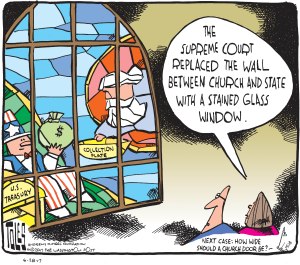
Tom Toles Editorial Cartoon
Here’s one that directly impacts my family. My ex-husband and his oldest sister were born on a US base in Japan. They have State Department birth certificates, which are the fanciest things you’ve ever seen. His birth certificate has a big red ribbon and all kinds of gold seals. You may remember some folks went after Senator John McCain for the same issue. He was born on a base in the Panama Canal Zone. Well, this issue has raised its ugly head again. “Son of U.S. soldier born on Army base in Germany deported to Jamaica.”
A man born to an active-duty member of the United States military on an Army base in Germany in 1986 before coming to the states as a child was deported last week to Jamaica, a country he’s never been to, according to a report by The Austin Chronicle.
Jermaine Thomas, whose Jamaican-born dad became a U.S. citizen during his 18-year military career, spent much of his early life moving from base to base with his father and mother, the latter a citizen of Kenya at the time of his birth.
At 11 years old, after his parents’ divorce and his mother’s second marriage to another soldier, he went to live with his father, who had since retired, in Florida. Unfortunately, his father passed away in 2010 from kidney failure, shortly after Thomas had arrived.
Much of his life after that, The Chronicle reported, was spent in Texas, homeless and in and out of jail.
It’s unclear when exactly Thomas was first ordered to leave the country, but court records from 2015 show a case that went all the way to the Supreme Court, in which the U.S. Department of Justice argued that he was not a citizen simply because he was born on a U.S. Army base in Germany.
The Supreme Court ruled in favor of the DOJ, upholding the U.S. Court of Appeals decision and denied Thomas’ petition for a review of the deportation order, saying in part that “his father did not meet the physical presence requirement of the statute in force at the time of Thomas’s birth.”
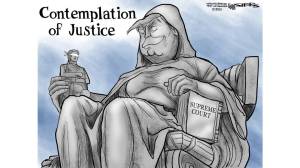 My father-in-law was hardly ever home, cheated on his first wife, and his second wife, who wound up living with us, and if he wasn’t in a wheelchair shortly thereafter, probably would have with the third wife he left the second for. He had several children that the family had found, so can I get this applied to my Ex sent back to Japan, or maybe Somalia? He was the first bona fide narcissist I’ve ever personally known. Having a rotten father can get you deported? Really? The Supreme Court has basically put all State Department Birth Certifications in jeopardy.
The only good news coming out of the court was that they upheld “ObamaCare,” but they did so with a few qualms. This is from HuffPo. “Supreme Court Upholds Preventive Health Care Access For Millions Of Americans. The scope of coverage in America still remains uncertain, however.”
The Supreme Court on Friday rejected a challenge to a crucial component of the Affordable Care Act, affirming the oversight of a panel of medical experts who recommend preventive care for health insurance coverage is constitutional.
This means services like lung and colon cancer screenings, HIV prevention medication, statins for heart disease, and various pregnancy screenings, which have been recommended by the panel,could continue to be covered free of charge for the 150 million Americans who have private insurance.
In the ruling, the court held that members of the United States Preventive Services Task Force, agroup of independent medical experts, are considered“inferior officers” and “at will”under the secretary of the Department of Health and Human Services. The case had challenged the structure of the panel, calling into question its authority to make recommendations for what types ofpreventive care insurers are required to cover and threatening access to the no-cost care it recommends.
The court reversed an appeals court decision and sent the case back down to lower courts for future proceedings. Justice Brett Kavanaugh wrote the 6-3 majority opinion, with Justices Clarence Thomas, Sam Alito and Neil Gorsuch dissenting.
“The structure of the Task Force and the manner of appointing its officers preserve the chain of political accountability that was central to the Framers’ design of the Appointments Clause,” Kavanaugh wrote in the opinion.”
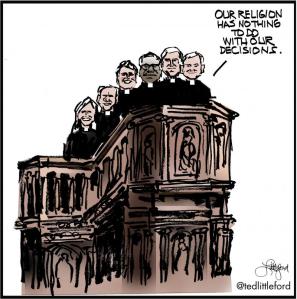 This still has several ramifications, and it landed right on another case. First, right now, that means RFK Jr. gets a lot of power on these decisions. Then there is this. This is from The Washington Post. “Supreme Court allows states to cut off Medicaid funding for Planned Parenthood. Ruling says Medicaid patients cannot sue to get non-abortion health care from Planned Parenthood if states have cut off government funding for those clinics.” All roads lead back to state control of women and denying the poor and POC basic rights.
A divided Supreme Court on Thursday ruled against Planned Parenthood, saying Medicaid patients do not have a right to sue to obtain non-abortion health care from the organization’s medical providers.
The decision allows South Carolina to cut off Medicaid funding for Planned Parenthood. It also has implications for patients in other states at a time when Republicans in Congress and the Trump administration are separately trying to defundeven non-abortion health care offered bythe nation’s largest abortion provider.
The 6-3 ruling, with all three liberal justices dissenting, reversed a lower-court decision that had allowed Planned Parenthood South Atlantic and a patient to seek to reinstate the group’s clinics as qualified health care providers after South Carolina cut off all Medicaid funding for the organization because it offers abortion services.
The decision means patients who rely on Medicaid will not be able to use the government insurance program for the poor to get services at the Planned Parenthood clinics in South Carolina.
The state already bans abortion after six weeks of pregnancy, and federal law prevents states from using Medicaid funds to cover abortions in most cases. But this case — Medina v. Planned Parenthood South Atlantic — involves other types of reproductive health care, such as birth control and cancer screenings.
So, this is long, and I’ve probably either bored you or depressed you. I’ve done a lot of both to myself, frankly. You expect the law not to promote specific religions, people, and social classes over others. You expect justice. But then, that was a long time ago now.
What’s on your reading and blogging list today?
Did you like this post? Please share it with your friends:


 peej
peej Carissa
 bostonboomer
 dakinikat
 ecocatwoman
 mablue2
 Mama Lopez
 peggysue22
 quixote
 skydancingguestblogger
 Mona (aka Wonk the Vote)



 Sky Dancing
Recent Comments