
Monday Reads: By the Numbers
Posted: June 11, 2012 Filed under: education, morning reads, New Orleans, Paycheck Fairness Act, Women's Rights, worker rights 11 Comments Good Morning!
I’m really glad that some people are focusing on the Plutocrats behind the SuperPacs. We should at least know who they are and what they want of their the overlords of our politicians. Jim Hightower writes on 7 of the billionaires that are bankrolling the GOP. Read the link at Alternet to learn more about the Super Seven and what they want.
As of May 4, this corporate clique had poured an unprecedented $94 million into the SuperPACs of the leading five GOP contenders (with $52 million of that going to Renew Our Future, Romney’s money funnel). This firepower was all the more potent because it was targeted at only the few thousand voters in each state who participated in the caucuses and primaries. And it bought just what the moneybags wanted–the lockstep commitment by all contenders that–no matter how they might differ on abortion, gay-bashing, and such–they would govern according to the Holy Kochian vision of a regulation-free, union-free, tax-free America. Thus, no matter which horse any of the multimillionaires and billionaires bet on, they would cash-in as winners, for this tiny group now owns one of America’s two major parties (and, yes, often rents the other).
Bobby Jindal is radically transforming the state of Louisiana and there’s no real Democratic party to organize and stop him. I’ve written before about his take down of public schools. Here’s “5 Ways Louisiana’s New Voucher Program Spells Disaster for Louisiana”. Did you notice he’s been up in Wisconsin and Illinois campaigning again? Look out! The man is a menace to civilization!
This latest pet project of popular Republican Governor Bobby Jindal, called Louisiana Believes, is now regarded as the most extensive voucher system in the United States — out-privatizing even the state of Indiana, where nearly 60 percent of the state’s students are eligible for vouchers. By eroding caps on family income levels, and thereby providing voucher assistance to both low- and middle-income families, Indiana’s plan aimed to remake public education in the state more extensively than any voucher system in US history – until now.
Like Indiana’s program, Louisiana’s new voucher plan is so wide in scope that it could eventually cut the state’s public education funding in half. But in a number of crucial ways, the Louisiana model works even harder to destroy public education than Indiana’s program does. Already approved by the Louisiana state legislature, the program sets an alarming precedent for undermining public education in other states.
Suevon Lee of Pro Publica writes about 5 ‘Stand your Ground’ Cases that are important. Damn! Louisiana’s on the shit list again!
But as a recent Tampa Bay Times investigation indicates, the Martin incident is far from the only example of the law’s reach in Florida. The paper identified nearly 200 instances since 2005 where the state’s Stand Your Ground law has played a factor in prosecutors’ decisions, jury acquittals or a judge’s call to throw out the charges. (Not all the cases involved killings. Some involved assaults where the person didn’t die.)
The law removes a person’s duty to retreat before using deadly force against another in any place he has the legal right to be 2013 so long as he reasonably believed he or someone else faced imminent death or great bodily harm. Among the Stand Your Ground cases identified by the paper, defendants went free nearly 70 percent of the time.
Although Florida was the first to enact a Stand Your Ground law, 24 other states enforce similar versions. Using the Tampa Bay findings and others, we’ve highlighted some of the most notable cases where a version of the Stand Your Ground law has led to freedom from criminal prosecution:
· In November 2007, a Houston-area man pulled out a shotgun and killed two men whom he suspected of burglarizing his neighbor’s home. Joe Horn, a 61-year-old retiree, called 911 and urged the operator to ” 2018Catch these guys, will you? Cause, I ain’t going to let them go.’ ” Despite being warned to remain inside his home, Horn stated he would shoot, telling the operator, ” 2018I have a right to protect myself too, sir. The laws have been changed in this country since September the first, and you know it.’ “
Two months earlier, the Texas Legislature passed a Stand Your Ground law removing a citizen’s duty to retreat while in public places before using deadly force. In July 2008, a Harris County grand jury declined to indict Horn of any criminal charges.
· In Louisiana early this year, a grand jury cleared 21-year-old Byron Thomas after he fired into an SUV filled with teenagers after an alleged marijuana transaction went sour. One of the bullets struck and killed 15-year-old Jamonta Miles. Although the SUV was allegedly driving away when Thomas opened fire, Lafourche Parish Sheriff Craig Webre said to local media that as far as Thomas knew, someone could have jumped out of the vehicle with a gun. Thomas, said the sheriff, had “decided to stand his ground.”
Louisiana’s Stand Your Ground law was enacted just a year after Florida introduced its law.
William Cohan believes that Congress wants a 2nd economic meltdown due to bad bank behavior and points to a Taibbi article listing 9 obscure pieces of legislation introduced by Congress to tank Dodd-Frank.
A sad truth remains: Despite all the public hand-wringing about the need to finally nail down the details of the regulations that will govern risk-taking at big banks, Wall Street’s well-paid army of lawyers and lobbyists continues to make a mockery of the whole re-regulation process.
It seems increasingly likely that, by the time the charade is over, the American people will end up with fewer substantive rules and limitations on the crazy risks Wall Street can take than we have now. By some counts — including that of Matt Taibbi, at Rolling Stone — there are nine obscure pieces of legislation introduced in Congress this year that are designed to in one way or another weaken the already weak provisions of the Dodd-Frank law, passed in July 2010.
Most of the legislation is intended to do little more than waste time, and hold off real accountability until the public has lost interest. Other laws are more pernicious. Consider H.R. 3336, the so-called Small Business Credit Availability bill. Under the guise of helping community lenders, it would limit who is considered a “swap dealer” under the provisions of Dodd- Frank, allowing more and more swaps to be written with less and less oversight. It passed the House in April.
Lastly, I’d like to point to this article in The Economist that basically says exactly what I feel about the sinking of the Paycheck Fairness Act last week. This also applies to getting rid of DOMA type laws. “Protecting individual rights is not Stalinist. ”
THIS week Republicans in the Senate once again blocked the Paycheck Fairness Act, which would take further steps to guarantee access to the legal system for women who charge they’ve been paid less than men for doing the same job. (That’s illegal, in case anyone was thinking of trying it.) Justifying his vote against the act, Rand Paul compared it to Soviet communism. This is sort of a dog bites man story; on a given day, Rand Paul probably compares several dozen things to Soviet communism. But here, for what it’s worth, is why he thinks legislation to make it easier for women to sue when they’ve been paid less than men for doing the same job is just like Soviet communism:
“Three hundred million people get to vote everyday on what you should be paid or what the price of goods are,” Paul told reporters on Capitol Hill. “In the Soviet Union, the Politburo decided the price of bread, and they either had no bread or too much bread. So setting prices or wages by the government is always a bad idea.”
Mr Paul does not appear to understand either the law which he has just voted against, or the class of economic transaction about which he is speaking. If a woman sues because she has been paid less than a man for doing the same work, and a judge rules in her favour, that is not an instance of “setting prices or wages by the government”. The wage in question was set by the employer. What the judge has ruled is that the employer cannot offer different wages to different employees based on their sex. Why might such a hypothetical judge make such a ruling? Because, as noted above, offering different wages to different employees based on their sex is against the law, and has been so since 1963.
Senator Aqua Buddha obviously has a room temperature IQ.
We’re all in the Village now. That’s my contribution today. What’s on your reading and blogging list?
Pay Check Fairness Act and the Politics of the Gender Gap
Posted: April 29, 2012 Filed under: Paycheck Fairness Act, War on Women, Women's Rights, worker rights | Tags: Gender Gap politics, Harry Reid, Lily Ledbetter Act 62 Comments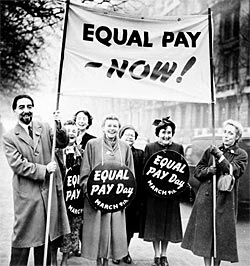 It’s evident that the Democratic Party wants that wide Gender Gap to stay right where it is until the November Elections. The introduction of the Pay Check Fairness Act may be a ploy to put Republicans and Blue Dawg Dems on the spot but it will be an interesting ploy and one to watch. The last time the bill came to the floor was in 2010.
Senate Majority Leader Harry Reid (D-Nev.) will bring to the floor in coming weeks legislation to protect women from retaliation by employers if they inquire about salaries paid to male colleagues
Republicans voted in unison to block the bill, the Paycheck Fairness Act, when it came to the floor in November of 2010.
Democrats say it will be difficult for GOP senators to back out of their opposition, especially because the U.S. Chamber of Commerce has staunchly opposed the legislation.
Mitt Romney will either have to split with Republicans and an important business group or take a position that could further erode his support among women.
“Romney’s going to be on defense on the Paycheck Fairness Act,” said a senior Democratic aide.
“Women are making 70 cents on a dollar of what a man is making. This will resonate with females across the spectrum. If Republicans to a person are coming down against it, it will be at their political peril,” the aide said.
A spokeswoman for Romney’s campaign did not respond to a request for comment.
The bill would prohibit employer discrimination for inquiring about, discussing or disclosing the wages of another employee.
It would expand the definition of wage discrimination by allowing employees to compare the pay of male colleagues not only within the same office but also with colleagues in other local offices. A female employee could allege wage discrimination if she is paid less than a male working the same job for the same employer across town.
Not a single Republican voted to advance the legislation when Reid brought it to the floor during the 2010 lame duck session, after Republicans scored a huge electoral victory but Democrats still controlled the House and Senate.
Forty Republicans and Sen. Ben Nelson (D-Neb.) voted against the legislation. Sen. Lisa Murkowski (R-Alaska) did not vote.
So why exactly do Republicans dislike the Equal Pay Act so much since its only function is to level the playing ground and prevent discrimination? Well, for one, Republicans deny that women are paid differently from men.
This morning, during a heated discussion with Rachel Maddow on Meet The Press, GOP consultant Alex Castellanos denied that women make 77 cents for a man’s dollar in the workplace and noted, “there are lots of reasons for that.” Maddow expressed shock at the assertion, but concluded that it explained why Republicans and Mitt Romney are so hesitant to embrace the Lilly Ledbetter Fair Pay Act of 2009, a law that helps women hold accountable employers who discriminate in the pay practices based on gender.
“Now we know, at least from both of your perspectives,” Maddow said, pointing to Castellanos and Romney surrogate Rep. Cathy McMorris Rodgers (R-WA), “women are not fairing worse than men in the economy that women aren’t getting paid less for equal work.” “It’s about policy and whether or not you want to fix some of the structural discrimination that women really do face that Republicans don’t believe is happening,” she added. Castellanos responded to Maddow’s policy argument by remarking on her passion, to which the MSNBC host took offense:
CASTELLANOS: It is about policy and I love how passionate you are. I wish you were as right about what you’re saying as you are passionate about it. I really do.
MADDOW: That’s really condescending. This is a stylistic issue. My passion on this issue is actually me making a factual argument on it.
My guess is that the introduction of this law is geared to force Romney to take a stand on something he’s been trying to avoid. Romney has been quite coy about his position on the Lily Ledbetter Act which was the first bill signed into law by Obama. Romney’s position on the law is unclear. This comes behind the miserable behavior of Republicans on renewal of the Violence Against Women Act. Every GOP member of the judiciary committee voted against scheduling a vote on the Act.
Romney sidestepped the controversy by announcing his support for reauthorizing the Violence Against Women Act without specifically endorsing the Senate Democratic bill. Senate Republicans quickly conceded and allowed the bill to receive a final vote without waging a filibuster.
Clearly, Reid is maneuvering these bills to put Romney and Republicans in the hot seat. This makes me wonder if we’re even going to get a fair hearing on the issues themselves. Even though Republicans will likely tank the bill, it would be nice to bring the topic into a discussion that is more about the issue and less about the political process. Greg Sargent of WAPO’s Plum Line has some of the behind the scene maneuvers.
The looming vote could revive a recent controversy that erupted around equal pay issues. On a recent Romney campaign conference call, HuffPo’s Sam Stein asked Romney surrogates whether Romney supports the Lily Ledbetter Fair Pay Act of 2009, which mad e it easier for people to challenge pay discrimination. The campaign at first waffled, but then released a statement confirming that Romney “supports pay equity and is not looking to change current law.”
But Romney’s campaign has not said whether he would have signed that law in the first place.
Now Romney’s rhetorical support for pay equity faces another test in the looming Senate vote on the Paycheck Fairness Act.
This Act would put more pressure on employers to prove that differences in wages are not rooted in gender difference, and would make it easier for employees to divulge information about their salaries, which would in turn facilitate deterring or challenging pay discrimination.
Two years ago Senate Republicans opposed the Paycheck Fairness Act, which had strong support from Obama, and it’s likely they will do so again. But Romney is on record supporting “pay equity” in principle, so he’d either have to break with that principle, or break with Senate Republicans, at a time when the battle over the female vote is raging in the presidential race. If Romney supports the measure, it could make passage of it more likely.
“This is an issue that a number of women Democratic Senators are absolutely intent on addressing — they know that with women still being paid 77 cents to each male worker’s dollar, this is an issue of fundamental fairness that women across the country face daily,” a senior aide to a female Senator says. “A lot of women who don’t necessarily see this as a partisan issue will be watching.”
The Romney campaign, in its pitch for female voters, has argued that women don’t care about social issues as much as they do about jobs, and that pocketbook issues will ultimately drive the female vote. But the Paycheck Fairness Act is a gender issue that’s all about the pocketbook and the economy.
Guess we’ll have to stay tuned to see how much we actually get to discuss this issue compared to the political wrangling designed to keep the gender gap working for the benefit of democratic politicians. Hopefully, the women in congress will add some substance to the discussion so that it becomes more than just one more partisan sideshow.

 peej
peej Carissa
 bostonboomer
 dakinikat
 ecocatwoman
 mablue2
 Mama Lopez
 peggysue22
 quixote
 skydancingguestblogger
 Mona (aka Wonk the Vote)



 Sky Dancing
Recent Comments