
In the Land of White Ribbons
Posted: December 12, 2011 Filed under: #Occupy and We are the 99 percent!, corruption, Democratic Politics, Elections, Populism, Russia, The Russian Winter | Tags: 2011: days of revolt, middle class, worldwide protests 6 CommentsFirst we had the Arab Spring then the European Summer. The American Autumn manifested itself in the Occupy Wall St. Movement.
Welcome the Russian Winter.
Saturday nearly 35,000 young, mostly university-educated protesters, the new Russian middle class, gathered in Moscow in peaceful demonstration. Reportedly, a police presence on the order of 50,000 greeted them. But still they came and marched to voice opposition to Russia’s recent election results. Vladimir Putin’s party won the parliamentary election after multiple reports of election fraud and ballot box stuffing. For instance, in Chechnya [hardly a place of Putin-love] the party pulled 94% of the vote. Putin has announced his plans to run in Russia’s March presidential elections to the dismay of many citizens, who charge that fraud and corruption run rampant throughout the country’s political system.
Demonstrators, donning white ribbons, marched in various cities around the country to say: Enough is enough.
Dismissed by the official Russian press, the white ribbon demonstrators were ignored by state television, which focused on small, flag-waving pro-Putin groups. How did the word get out? Social media—Facebook and twitter.
In an attempt to disrupt the protests, Russian authorities circulated rumors that young men present at the rallies could be stopped by police and conscripted into the army. Health officials reportedly warned citizens to stay home for fear of contracting a virulent flu or Sars. Twitter feeds were jammed and robo-calls flooded phone lines with messages of state propaganda.
Sound vaguely familiar?
How much press is OWS getting today with its West coast port demonstrations? How many words have been spent denigrating protesters as un-American losers, slackers, even dangerous criminals? Let’s not forget the MSM’s reluctance to cover OWS, the strange lack of network film footage during police actions, particularly as the encampments were dismantled. Twitter feeds jammed, cameras turned off.
Still, the world is watching. The world is pushing back. Everywhere.
What he said …
Posted: December 11, 2011 Filed under: #Occupy and We are the 99 percent!, Bailout Blues, Banksters, Economy, financial institutions, Global Financial Crisis 6 CommentsI keep talking about the utter audacity of the political class these days and how they completely ignore everything we know about economics and finance in pursuit of  self-dealing and getting political donations from the FIRE industries. I particularly hate that we’ve got this complete twisted notion of “free” trade and “free” markets thanks to a bunch of really ignorant right wingers and mouthpieces like Rush Limbaugh, Fox News, Larry Kudlow, etc. etc. etc.. These folks are out to line their own pockets and they are pitching nonsense to low information zombies.
I also really hate to just wholesale copy and paste another blog–in this case Washington Blog at The Big Picture–but some times you just have to let the voice of the source speak for itself and hope it stands up to the ideals of fair use. Thanks go to Fiscal Liberal for pointing me to this list and its readable wonky links of proof. It’s called ‘The Financial Crisis was Entirely Foreseeable’ but it might as well be labelled ‘Idiots in the Beltway are spewing memes and setting us up for a big ol’ repeat of the global financial meltdown’. Idiots in Europe are doing likewise. Why are they all bailing ut gambling bankers over their households and real businesses? Where’s a politician that really knows his stuff when it comes to authentic finance and economics?
We’ve Known for Thousands of Years
We’ve known for literally thousands of years that debts need to be periodically written down, or the entire economy will collapse. And see this.
We’ve known for 1,900 years that that rampant inequality destroys societies.
We’ve known for thousands of years that debasing currencies leads to economic collapse.
We’ve known for hundreds of years that the failure to punish financial fraud destroys economies.
We’ve known for hundreds of years that monopolies and the political influence which accompanies too much power in too few hands is dangerous for free markets.
We’ve known for hundreds of years that trust is vital for a healthy economy.
We’ve known since the 1930s Great Depression that separating depository banking from speculative investment banking is key to economic stability. See this, this, this and this.
We’ve known since 1988 that quantitative easing doesn’t work to rescue an ailing economy.
We’ve known since 1993 that derivatives such as credit default swaps – if not reined in – could take down the economy. And see this.
We’ve known since 1998 that crony capitalism destroys even the strongest economies, and that economies that are capitalist in name only need major reforms to create accountability and competitive markets.
We’ve known since 2007 or earlier that lax oversight of hedge funds could blow up the economy.
And we knew before the 2008 financial crash and subsequent bailouts that:
- The easy credit policy of the Fed and other central banks, the failure to regulate the shadow banking system, and “the use of gimmicks and palliatives” by central banks hurt the economy
- Anything other than (1) letting asset prices fall to their true market value, (2) increasing savings rates, and (3) forcing companies to write off bad debts “will only make things worse”
- Bailouts of big banks harm the economy
- The Fed and other central banks were simply transferring risk from private banks to governments, which could lead to a sovereign debt crisis
Given the insane levels of debt, rampant inequality, currency debasement, failure to punish financial fraud, growth of the too big to fails, repeal of Glass-Steagall, refusal to rein in derivatives, crony capitalism and other shenanigans … the financial crisis was entirely foreseeable.
Okay, so let’s just end that last part by taking out “the financial crisis was entirely foreseeable” and by replacing it with “the next big financial crisis is entirely foreseeable and getting more likely every day”. If you need any proof of further inevitability just listen to ANY Republican these days and most of the Democratic Caucus. They are resplendent with VooDoo Economics and Finance believers and enablers. It’s just like with climate science and evolution. An entire group of people who embrace ideology over reality just can’t seem to get out of the flat earth theories. Watching the Republican debates alone has been like watching the march of ignorance personified. I’m waiting for them to start announcing the earth is only a few thousand years old, gravity doesn’t exist or need to because god’s hand holds us in place, and 1 + 1 is really 3. If only the media would act like the set of fact checkers they could be instead of mouthpieces for corporate interests we might actually be able to get through to a few zombies and bring them back to life. Until then, get ready for the next big one.
Congressional Insider Trading: A case study in Moral Hazard
Posted: December 9, 2011 Filed under: #Occupy and We are the 99 percent!, corruption | Tags: congressional insider trading, congressional self dealing, josephy stiglitz 9 Comments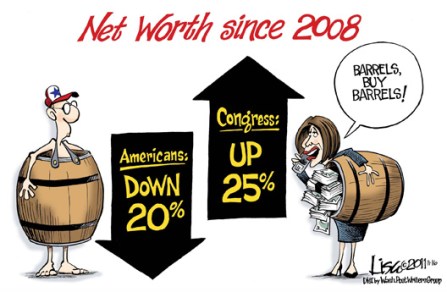 The more I’ve become aware of how pervasive the problem is of congressional insider trading, the more horrified I’ve become. This is a worst case scenario because this is just like congressional raises and campaign finance reform in that the foxes are in charge of their taxpayer funded chicken coop. They are unlikely to pass any kind of law that controls self-dealing behavior and there is no other way to get it done. There are always a few of them that are willing to do the right thing but the leadership of each house is most likely to be the stellar examples of those that manipulate the system to their own advantage. So, if a law comes up, the leadership will stop any forward momentum. Insider trading appears to be a bi-partisan problem with egregious examples from both sides of the aisle.
Insider trading in the financial markets is one of the most prosecuted and investigated crimes. The realization that inside information–information you have that is not available to the public–gives you an unfair advantage in predicting prices of assets is long standing. It’s been declared unethical and illegal for some time. Insider, self dealing behavior has been a problem for our country both in and outside of government. One good early congressional example is that of William Duer who was a member of the Continental Congress. However, Duer was an outlier for his time. Recent investigation by journalists indicate that the current congresspeople regularly self deal by buying stocks and other assets while influencing legislation that directly impacts those holdings.
Eric Cantor just blocked a bill that would outlaw insider trading by members of congress. This appears to be another example of a congressional leader who has made money off a practice ensuring they can continue to ride their gravy train. The behavior is clearly an example of self-dealing and is considered unethical in Wall Street and financial market circles. Given those guys frequently try to push the envelop on acceptable investing behaviors, that really puts Cantor in the poster child of moral hazard category.
The Republican sponsor of the bill in the House, Financial Services Chairman Spencer Bachus of Alabama, had scheduled a markup of the Stop Trading on Congressional Knowledge (STOCK) Act for next week. But on Wednesday, Majority Leader Eric Cantor of Virginia cancelled the markup session.
Cantor reportedly said he blocked the bill to give Congress more time to examine the issue. Critics of the move, however, fear that any delay could kill the bill entirely.
Some version of the the STOCK Act has been bouncing around Capitol Hill for six years. But recent attention to the issue of Congressional insider trading, following reports from CNBC’s Eamon Javers and a “60 Minutes” report, brought the bill out of stasis and made its passage into law seem likely. If the latest delay pushes the bill into next year, it may become lost in election-year politics.
Trading by lawmakers based on non-public information about legislation falls into what many see as a loophole in insider trading regulations.
Although corporate insiders are banned from trading on non-public information about their companies, congressional representatives and senators may not be banned from trading on non-public information about legislation or regulation. The legal issue is disputed by scholars and regulators.
The head of the enforcement division of the Securities and Exchange Commission recently argued that congressional insider trading is already banned. But he admitted that no legal action has ever been taken against a member of Congress.
Studies have shown the investment portfolios of House members and Senators consistently outperform the market by significant degrees, suggesting they are either miraculously bright and lucky investors or using their access to non-public information when trading. Financial experts regard the idea that it is just luck or investing smarts as laughable.
Minnesota Democrat-Farm-Labor Representative Tim Walz has been one of the bill’s sponsor. He’s currently doing interviews in an attempt to shame Cantor into releasing his hold.
The 1st District DFL Rep. Tim Walz-sponsored STOCK Act — Stop Trading in Congressional Knowledge — has been around for six years, but just recently started getting attention. It had been going nowhere until a “60 Minutes” report in November.
“We know that during the health care debate, people were trading health care stocks. We know that during the financial crisis of 2008, they were getting out of the market before the rest of America really knew what was going on,” Peter Schweizer, a fellow at the conservative Hoover Institution said on “60 Minutes.”
Overnight, the bill went from a handful of co-sponsors to having dozens. A month later, the bill has more than 220 co-sponsors from both parties, but mostly from the House.
This is a bill that should be on the top of the list for things that those sympathetic of the Occupy movement. It should appeal to Tea Republicans too. This is clearly something that is highly unethical and similar behavior by senior management in the private sector would be subject to criminal investigation and would result in charges. You can watch the 60 Minutes segment here. It’s worth watching. This bill should pass and be implemented. Something is seriously wrong with Eric Cantor’s moral barometer if he really thinks it needs more study.
Cantor’s move comes after we find that the wealth of US households suffered their biggest loss last quarter since the worst part of the financial crisis in 2008. Congress actually gained net worth during the same period. Last quarter’s losses by ordinary Americans are undoubtedly due to the eurozone crisis–which is essentially yet another bank problem–and the brinkmanship behavior of Congress balking at passing the debt ceiling increase to pay for spending they approved. The inability of congress to do anything substantial for the economy and instead engaging in naked partisan one-up-man-ship has been beyond the comprehension of most economists who know exactly what needs to be done to put the nation back on solid ground.
Even more unsettling than the latest quarterly figures on wealth destruction is the amount of wealth that has been vaporized in the past four years. The net worth of American households peaked in 2007 at $66.8 trillion. As of September 30, 2011, the net worth of American households had plunged to $57.4 trillion for a loss of $9.4 trillion. To put these number in perspective, this is a loss of net worth per person in the United States of $30,618. A family of four is statistically poorer by $122,472 than they were in 2007.
This is nothing less than malpractice on the part of elected officials that are more focused on gaining and keeping seats in their caucuses than doing right by the American people. Joseph Stiglitz’s ‘The Book of Jobs’ in January’s Vanity Fair is a compelling list of America’s economic troubles and the sins our elected officials in getting everything backasswards. This has not been our grandparent’s Great Depression where the government and the administration thought and acted big to take care of American people and their communities. Instead, our congress jumped to benefit personally from their knowledge of the problems by investing correctly and conducting policy improperly. They seem to know what their actions are doing when it comes to smartly using their own funds for their own enrichment.
It has now been almost five years since the bursting of the housing bubble, and four years since the onset of the recession. There are 6.6 million fewer jobs in the United States than there were four years ago. Some 23 million Americans who would like to work full-time cannot get a job. Almost half of those who are unemployed have been unemployed long-term. Wages are falling—the real income of a typical American household is now below the level it was in 1997.
We knew the crisis was serious back in 2008. And we thought we knew who the “bad guys” were—the nation’s big banks, which through cynical lending and reckless gambling had brought the U.S. to the brink of ruin. The Bush and Obama administrations justified a bailout on the grounds that only if the banks were handed money without limit—and without conditions—could the economy recover. We did this not because we loved the banks but because (we were told) we couldn’t do without the lending that they made possible. Many, especially in the financial sector, argued that strong, resolute, and generous action to save not just the banks but the bankers, their shareholders, and their creditors would return the economy to where it had been before the crisis. In the meantime, a short-term stimulus, moderate in size, would suffice to tide the economy over until the banks could be restored to health.
The banks got their bailout. Some of the money went to bonuses. Little of it went to lending. And the economy didn’t really recover—output is barely greater than it was before the crisis, and the job situation is bleak. The diagnosis of our condition and the prescription that followed from it were incorrect.
The problem is that congress–due to its ability to self deal–has no experience of any of this. In fact, the more we suffer it appears the more they make up fairy tales that suggest the only people doing well in this economy should be left to repeat the sins of their past. A congressional seat should not be an easy path to a secure position among the 1 percent. It appalls me that so many folks don’t seem to actually get this. Witness the rise of ultimate self-dealer Newt Gingrich to the front runner status of the republican presidential campaign. If we can’t stand up to the likes of Eric Cantor and we can’t reject the leadership model of Newt Gingrich, we will certainly loose any semblance of truly representative government. This bill would close the door on one faucet of the moral hazard problems that are rampant in government.
Thursday Reads
Posted: December 8, 2011 Filed under: #Occupy and We are the 99 percent!, 2012 presidential campaign, Barack Obama, birth control, children, Crime, Media, Reproductive Rights, Republican presidential politics, Team Obama, U.S. Politics | Tags: Department of Health and Human Services, Detroit, Elizabeth Warren, Eric Boehlert, FBI, FDA, food stamps, Gov. Rick Snyder, Iowa Caucuses, Jame's O'Keefe, Jorleys Rivera murder, Karl Rove, Kathleen Sebelius, Lobbyists, Massachusetts Senate race, Michigan emergency managers, Missouri, Mitt Romney, New Hampshire primary, Newt Gingrich, Ohio, Plan B, polls, rape, Red Sox, Rep. John Conyers, Rep. Peter King, Ryan Brunn, South Carolina, Verizon scam 19 Comments
Good Morning! It has been dark and dreary here for weeks it seems. I know the sun has come out a few times, but most of the time it has been either raining or about to rain. I think I’m beginning to suffer from seasonal affective disorder (SAD). Or maybe it’s just watching the 2012 presidential campaign. Either way, we’re talking dark and depressing.
On Tuesday Newt Gingrich told Larry Kudlow (yeah, I know) of CNBC that Obama is the “food stamp president,” and he (Gingrich) will be running against him as the “candidate of paychecks.”
“We are going to have the candidate of food stamps, the finest food stamp president in the American history in Barack Obama and we are going to have a candidate of paychecks.”
The former House Speaker went on to say Obama represents a hard-left radicalism. He, on the other hand, wants big tax cuts and big cuts in the federal government.
LOL! Obama is the furthest thing from a radical, and I doubt if he gives a damn about food stamps. I don’t know how Gingrich gets away with this stuff. Oh yeah, the media sucks. He spewed more lies too:
Gingrich also reiterated his claim that he is not a lobbyist. While he’s been steadily rising in the polls, he’s also been under scrutiny for his consulting work with mortgage giant Freddie Mac.
“I do no lobbying; I’ve never done any lobbying. It’s written in our contracts that we do not do any lobbying of any kind. I offer strategic advice,” he said. “The advice I offered Freddie Mac was, in fact, aimed at how do you help people get into housing.”
Gingrich also referred to himself in the third person in talking about the sad ending of his career as Speaker of the House.
“The job of the Democrats was to get Newt Gingrich. They couldn’t beat any of our ideas so they decided to try to beat the messenger,” he said. “I think it actually will help people understand what happened in that period and how much of it was partisan.”
Poor Newt. He’s filthy rich, but he can’t stop obsessing about the paltry help poor and unemployed people get from food stamps. Last week he claimed that food stamp use has increased dramatically under Obama and that recipients use their food stamp money to take vacations in Hawaii. According to Politifact as reported in USA Today:
PolitiFact, a fact-checking project of the Tampa Bay Times, noted in May that Bush made “more aggressive efforts to get eligible Americans to apply for benefits,” and new rules took effect to broaden eligibility for the assistance. At the time, PolitiFact said:
Gingrich oversimplifies when he suggests that Obama should be considered “the most successful food stamp president in American history,” because much — though probably not all — of the reason for the increase was a combination of the economic problems Obama inherited and a longstanding upward trend from policy changes. On balance, we rate Gingrich’s statement Half True.
As for Gingrich’s claim that food stamps can be used to go to Hawaii, the federal government has clear rules about the Supplemental Nutrition Assistance Program (or SNAP). Basically, you can buy groceries or the seeds and plants from which you can grow your own food.
Right now Gingrich is the clear front runner for the Republican nomination. According to a new CNN poll, he has double-digit leads in three of the first four primaries, Iowa, South Carolina, and Florida. And he is catching up with Romney in New Hampshire. According to the poll, much of Gingrich’s support is coming from tea party types.
I wonder if these folks realize that when back in the day, when Newt was one of the most powerful people in DC, his fellow Conservatives worked hard to get rid of him? And some of them still don’t want him back in power.
As former House Speaker Newt Gingrich trumpets his leadership skills in his quest for the 2012 Republican presidential nomination, a different picture of his stewardship emerges from some GOP lawmakers who served with him during a failed 1997 coup attempt against the controversial speaker.
Twenty disgruntled Republicans in the House of Representatives squeezed into then-Rep. Lindsey Graham’s office in July 1997 and rebelliously vented about Gingrich. They were tired of his chaotic management style, worried that he was caving in to then-President Bill Clinton, and sick of constantly having to defend him publicly on questions about his ethics or his latest bombastic statement.
“Newt Gingrich was a disaster as speaker,” said Rep. Peter King, R-N.Y.
As Gingrich seeks to gain the world’s most powerful office, it’s worth recalling that when he once held great power in Washington, his own conservative Republican lieutenants rebelled against his rule less than four years after he led them to House majority status for the first time in 40 years. And their disaffection evidently helped persuade him to step down as speaker the next year and leave office.
King, for one, still believes that Gingrich’s widely disparaged egotistical complaining about the poor treatment he perceived from then-President Clinton on an Air Force One flight in 1995 is why Republicans suffered blame for federal government shutdowns later that year.
“Everything was self-centered. There was a lack of intellectual discipline,” King said
Karl Rove has an op-ed in today’s Wall Street Journal in which he blasts Gingrich’s pathetic campaign organization.
In the short run, Mr. Gingrich must temper runaway expectations. For example, his lead in the RealClearPolitics average in Iowa is 12 points. But what happens on Jan. 3 if he doesn’t win Iowa, or comes in first with a smaller margin than people expect?
That could happen in part because Mr. Gingrich has little or no campaign organization in Iowa and most other states. He didn’t file a complete slate of New Hampshire delegates and alternates. He is the only candidate who didn’t qualify for the Missouri primary, and on Wednesday he failed to present enough signatures to get on the ballot in Ohio. Redistricting squabbles may lead the legislature to move the primary to a later date and re-open filing, but it’s still embarrassing to be so poorly organized.
That’s because Gingrich had no expectation of doing this well. He just entered the race so he could sell his books and his wife’s films. But it turns out Gingrich will be on the ballot in Ohio after all. As for Missouri, Gingrich claims he didn’t want to be on the ballot there because the primary is non-binding.
In a press conference in New York City today, former House Speaker Newt Gingrich declared that he never intended to qualify for the ballot in Missouri and that failing to meet the deadline was “a conscious decision, not an oversight.”
The primary is non-binding; it is followed a month later by caucuses where Missourians pick their convention delegates. But every other major candidate is participating in the primary, which gives the public an idea of where Show Me State voters stand.
“We have never participated in beauty contests,” Gingrich said when asked about his failure to qualify for the ballot. “We didnt participate in Ames [the Iowa straw poll], we didnt participate in P5 [a Florida straw poll].” ….
But failing to qualify for the ballot was widely seen as a sign of Gingrich’s lack of campaign organization.
Another sign is the papers he filed in New Hampshire. His papers were sloppily written in pen and he fell 13 short of the required 40 delegates.
It’s going to be interesting to see what happens. I think Romney should still win New Hampshire, but the question is how many Southern states he can carry. Of course I’d be enjoying watching the Republican primary mess a lot more if there were a liberal Democratic candidate to vote for.
Oh, Romney did come in first in one poll: the one that counted the number of jokes told about the Republican candidates on late night TV.
OK, I’ll let go of my obsession with Republican nomination campaign for now and give you some other things to read.
Last Friday, Eric Boehlert of Media Matters may have been the intended victim of a right wing James O’Keefe-type scam designed to make him look like hypocrite for writing in support of the Occupy movement.
It was the middle of the day on Friday, and Eric Boehlert heard a knock on the door. A senior fellow at Media Matters, a nonprofit watchdog that challenges conservative news outlets, Boehlert works from his Montclair, N.J., home.
A short, bearded man stood outside, holding a clipboard and wearing a Verizon uniform. He asked Boehlert if he’d be willing to take a customer survey. Verizon had, perhaps coincidentally, been at the house a week earlier to handle a downed wire. Boehlert quickly agreed and noted that a Verizon worker had actually failed to show up when he said he would.
But the interview questions got weird and then weirder. The man kept talking about Boehlert being rich and being able to work at home, Boehlert began to smell a ratf*ck.
“After he mentioned my salary and that I work from home, all the bells went off, and this is not who this guy says he is. Therefore, I kind of lost track of the exact wording of the question, but it definitely was like very accusatory of me and I’m a hypocrite and how do I have this supposedly cushy job while I’m writing about real workers and the people of the 99 percent,” said Boehlert.
“So there was this pause, and I said, ‘You work for Verizon?’ And he just sort of looks back at me and [says], ‘Will you answer the question? Will you answer the question?’ And I said, ‘Can I see your Verizon ID?’ And he wouldn’t produce any Verizon ID, and I think he asked me another time to answer the question. And basically I just said, ‘I’m done so you can leave now.'” ….
By now he [Boehlert] had realized that the man was likely pulling a political stunt, and James O’Keefe’s notorious “To Catch a Journalist” project came to mind as a possibility.
“The only sort of comical part was he forget which way he was supposed to run in case I started following. He ended up sort of in the road, and he sort of turned left and then right,” said Boehlert. “The last I saw him he was in a full sprint down my street running away from my house.”
In the Massachusetts Senate race, Elizabeth Warren is ahead of Scott Brown 49% to 42%, her biggest lead so far. But some people are *very concerned* because at a recent candidate’s event Warren was asked if she knew in which recent years the Red Sox had won the World Series, and she answered 2004 and 2008 instead of 2004 and 2007. Horrors! Paul Waldman has a very funny piece about it in The American Prospect.
In today’s election news, a candidate for the World’s Most Deliberative Body is facing an earth-shattering scandal because she said “2008” when she should have said “2007,” demonstrating to all that she is utterly incapable of representing the interests of ordinary people. As the normally even-tempered Taegan Goddard indignantly described it, “Elizabeth Warren (D) and the rest of the Democratic field for U.S. Senate in Massachusetts couldn’t answer a simple question about the Boston Red Sox at a forum yesterday. Apparently, they learned nothing from Martha Coakley’s (D) defeat two years ago…”
Here’s what Waldman had to say about this nonsense:
I don’t think anyone in Massachusetts could in good conscience vote for someone who is unable to identify both the state’s fourth-largest city and its third most commonly spoken language. I mean, what are we supposed to do, send someone to the Senate who doesn’t have a command of all master of state-related trivia? The answer is clearly to amend the Constitution so 12-year-old winners of the state geography bee can become senators.
Reporters, I beg you: If you’re going to discuss this “gaffe” and others like it, do your audience a service and explain why this is supposed to matter. And I don’t mean just by saying, “This reminds people of when Martha Coakley called Curt Schilling a Yankee fan, damaging her candidacy.” I mean explain specifically what exactly misremembering the Sox series victories as 2004 and 2008 instead of 2004 and 2007 tells us about the kind of senator Elizabeth Warren would be. Does it mean that despite all the other evidence to the contrary, she really doesn’t care about ordinary people and will upon taking office immediately introduce legislation to make the purchase of brandy snifters and riding crops tax-deductible? Then what?
Yesterday a got an e-mail from Rep. John Conyers (D-MI) about an attempted Republican takeover of the Detroit city government. Bloomberg had a piece about it yesterday.
Detroit has the highest concentration of blacks among U.S. cities with more than 100,000 residents, according to U.S. Census Bureau data. It will exhaust its cash by April and may run up a deficit topping $200 million by June.
Last week, Governor Rick Snyder, a white Republican, ordered a review that may lead to appointment of an emergency manager, rekindling rancor in a city scarred by race riots in 1967. Detroit lost one-quarter of its population since 2000 — much of it to largely white suburbs.
Four Michigan cities are controlled by emergency managers. All have populations that are mostly black. If Detroit joins them, 49.7 percent of the state’s black residents would live under city governments in which they have little say.
Michigan’s emergency managers have sweeping authority to nullify union contracts, sell assets and fire workers. Snyder has said he doesn’t want one for Detroit, though he called the city’s financial condition severe enough to warrant help.
Michigan citizens are currently collecting signatures to put repeal of the law on the ballot in 2012.
A maintenance man Ryan Brunn, 20,has been charged with the brutal sexual assault and murder of 7-year-old Jorleys Rivera, who disappeared on Friday in Canton, GA.
Keenan said Brunn, who has no known criminal record, had keys to both the empty apartment and the trash compactor bin where Rivera’s body was placed.
“We are confident that Brunn is the killer and that is why he is in custody,” Keenan said, declining to detail what evidence investigators have against him….
Keenan said investigators focused on Brunn after receiving information from the public. Brunn had been under police surveillance since Tuesday night. Keenan said the investigation will continue for several months.
“This is a mammoth case,” Keenan told reporters at a news conference in Canton. “We believe that this horrendous crime was planned and calculated, and we’ve recovered a lot of evidence.”
At least he was caught quickly. But another innocent young child is gone.
Yesterday the Obama administration overruled the decision of the FDA to make Plan B available without a prescription to women of all ages.
Wednesday, the Department of Health and Human Services upheld their decision to dispense Plan B One-Step—a one-pill emergency contraceptive—to young women only with a doctor’s prescription, overruling an FDA request to make the drug available over the counter to women of all ages. The restriction only applies to women under the age of 17. In a statement on the HHS website, Secretary Kathleen Sebelius outlined the administration’s reasoning: The FDA’s conclusion that the drug is safe, she says, did not contain sufficient data to show that people of all ages “can understand the label and use the product appropriately.” The outliers, she says, are the 10 percent of girls who are physically capable of child-bearing at 11.1 years old, and “have significant cognitive and behavioral differences.” HHS makes no mention of women older than 11 and younger than 17—statistically, those far more likely to be having sex, according to the Guttmacher Institute.
Wednesday, the Department of Health and Human Services upheld their decision to dispense Plan B One-Step—a one-pill emergency contraceptive—to young women only with a doctor’s prescription, overruling an FDA request to make the drug available over the counter to women of all ages. The restriction only applies to women under the age of 17. In a statement on the HHS website, Secretary Kathleen Sebelius outlined the administration’s reasoning: The FDA’s conclusion that the drug is safe, she says, did not contain sufficient data to show that people of all ages “can understand the label and use the product appropriately.” The outliers, she says, are the 10 percent of girls who are physically capable of child-bearing at 11.1 years old, and “have significant cognitive and behavioral differences.” HHS makes no mention of women older than 11 and younger than 17—statistically, those far more likely to be having sex, according to the Guttmacher Institute.
So if you’re under 17 and you’re raped, you’re going to have to figure out how to see a doctor and get a prescription. Isn’t that just ducky?
I’ll end with some better news for women. The FBI has decided to expand the definition of rape.
An October vote by the Advisory Policy Board’s UCR subcommittee recommended the board at-large change the definition of “rape” to “penetration, no matter how slight, of the vagina or anus with any body part or object, or oral penetration by a sex organ of another person, without the consent of the victim.”
Activists said the new definition was needed because the current one does not recognize that men can be raped, women can rape women, inanimate objects can be used to commit rape or that rapes can occur while the victim is unconscious.
Many local law enforcement agencies use a much broader definition of “rape” than the FBI, causing thousands of sex crimes to go unreported in federal statistics.
The FBI had been under pressure by the Feminist Majority Foundation, which launched an email drive urging the agency to update the definition.
Now let’s start doing more to protect women and children from rapists.
That’s all I’ve got. What are you reading and blogging about today?
The Art of Doublespeak
Posted: December 1, 2011 Filed under: #Occupy and We are the 99 percent!, 2012 presidential campaign, double-speak, Economy, income inequality, unemployment | Tags: 2011: days of revolt, 2012 presidential election, Financial Crisis 9 Comments
Language is important. Words can inspire, inflame, enrage. Words can hide a speaker’s intentions. Sing me a lullaby. Spin me a fairytale. Sell me a load of bull-hockey.
One of today’s best-known language twisters is Frank Luntz. Pollster and political consultant, Luntz is the Master of Political Doublespeak. He would have made Orwell proud: War is Peace, Freedom is Slavery, Ignorance is Strength. He crawls out during every election cycle with the creepy focus groups, wired up and ready to go. We learn ‘what words work.’ Otherwise known as ‘what words obfuscate, spin and get the best reaction from would-be voters.’
Well, here’s a Newsflash: Luntz is worried about Occupy Wall Street, all those sorry slackers the GOP and various critics have sidelined as hippies, losers and Obama-lovers. Seems from Luntz’s point of view, OWS is having an impact on political discourse.
No kidding Sherlock!
And so, Luntz decided a tutorial was needed to school Republicans how to “speak” when asked questions about the very issues that the Occupy wave has been raising.
Fascinating! A defense against the so-called irrelevant. But even more fascinating is the list of rules on how to ‘discuss and defend against’ the grievances that Occupy members have introduced into the public sphere.
The very first instruction made me laugh:
Don’t say capitalism.
Because people might start questioning the broken economic construct that’s taken root in the US. Btw, I haven’t heard OWS slamming capitalism, per se. It’s Vulture Capitalism, the darling of the neoliberal/libertarian set, that’s being questioned and panned, where only the well-heeled financial class takes the booty while the rest of the country is left to collect unemployment checks and shop with food stamps. Sorry, don’t think ‘free market’ or ‘economic freedom’ will wash in a country where poverty is rising at an alarming rate and over 20% of American kids are classified as food insecure.
Politicians whether Right or Left need to do far better than that. Like maybe tell the truth: that the financial class in this country has been running a huge Ponzi scheme, that transnational corporations are willing to run roughshod over everything in a blind pursuit of profit, that endless war makes money for the few, while the many bleed.
That would be refreshing.
Don’t say the government taxes the rich. Tell them the government takes from the rich.
Oh yes, that’s much better. Then pull out Warren Buffet’s statement that his tax rate [as a multi-billionaire] is lower than what his secretary is required to pay. And please, take a spin over the corporate history of negative taxes after all the loopholes and government largesse heaped on the ‘job creators’ is taken in to account. Then too, let’s not forget the ‘off-shore’ pooling of tax-free profits and tidy nest eggs. The beat goes on for those with the courage to look.
The government takes from the rich? Hahaha. More like the government sucks up to the rich and their ever-present lobbyists.
Republicans should forget winning the battle for the middle-class. Call them hardworking tax-payers.
Yes, Republicans should forget winning the middle-class since they’ve gone out of their way to eliminate them, crush them out like last year’s cigarettes.
Frank Luntz is ‘really’ scared of the Occupy Movement ? With rules like this he may be out of a job. If the Republican’s go-to wordsmith can’t get his head or words around the basic complaints of not simply Occupy but most Americans and/or the very real economic and political discontent, then they are deaf, dumb and blind.
Or maybe smart like the wily fox. Because the evidence is everywhere. What to do? Keep the disinformation and propaganda machine in high gear. I won’t belabor the hypocrisy and cynicism of Luntz’s list. He and the entire stable of political pollsters, consultants and analysts on all sides are merely symptoms of a system flailing in the wind, a system that’s forgotten how to reach out or even talk to real people in anything approaching honest discourse. A system that has no respect for its citizenry.
Will the Luntz approach work as it has in the past?
We shall see. But I invite you to read the Ten Commandments of Political Doublespeak for 2012 at the link above. Some examples will make you laugh. Several will make you mad as hell.
Oh, and here’s a tip: Don’t say the word ‘Bonus.’

 peej
peej Carissa
 bostonboomer
 dakinikat
 ecocatwoman
 mablue2
 Mama Lopez
 peggysue22
 quixote
 skydancingguestblogger
 Mona (aka Wonk the Vote)



 Sky Dancing
Recent Comments