
Labor Day: Celebrate the 99% and the protections we earned
Posted: September 3, 2012 Filed under: #Occupy and We are the 99 percent!, 2012 elections, 2012 presidential campaign | Tags: Labor Day, labor movement, Labor Unions 54 Comments I’ve joined Joseph Cannon at Cannonfire who is now displaying this sentiment:
Because even though I remain angry at Obama, I’ve “fallen in hate” with Mitt Romney. And I’m horrified at the prospect of that creepy Randroid Paul Ryan being one heartbeat away from the highest office. At any rate, I suspect that Ryan will be the true power in a Romney administration. He’ll be the new Dick Cheney — except his brief will be domestic policy, not foreign policy.
I have just been through yet another national disaster. I’ve had more than my share of them. I just finished my FEMA registration for help. My delightful private insurance company got the state to pass a law to raise my deductible from Hurricane Damage to about what they paid me after Katrina which didn’t cover enough as it was. Now, I pay an exorbitant rate and I’m staring down damage with about a $7,000 hurricane deductible. The good hands people have their hands out for my premiums but that’s about it. I get phone calls, visits, and lip service for that. I’m on my own for whatever nature deals me except for the idea in the US that when our citizens are down and out, we help them back up. This is an idea that is nonexistent in today’s Republican Party and in their candidates Governor “I got mine” and Congressman “I got mine and want yours too” and they are both willing to lie to improve their lots in life and diminish ours.
I’m thinking about Labor Day and the things we now have because of the Labor Movement, FDR, LBJ and even (gasp) Richard Nixon, Teddy Roosevelt, and Dwight D. Eisenhower. These were leaders that looked to the needs of the country and the people. Teddy Roosevelt saw our vast national treasures and preserved them for all Americans. Richard Nixon did not deny the impact of pollution on our natural resources or toxins on our hapless workers and families. Eisenhower knew that we needed vast infrastructure to grow our economy and our people. FDR and LBJ knew that if the least among us could not provide for themselves, we needed to give them a hand up and pull them into a growing, educated, and productive, middle class. These are things that the current Republican Dastardly Duo would like to remove from us and have been actively working to remove for us. Their vision for America is an America that works for only them and their select cronies. I will not abide by that.
I’m am thinning out my Facebook friends list rapidly of people I knew around 4 years ago that I thought supported my vision–not the Romney/Ryan vision–because it is also the vision of Bill and Hillary Clinton. I’m all fine with the support of third party candidates but any one that tries to send me propaganda that Romney is a feminist based on hiring a few women years ago back in Massachusetts and therefor deserves my vote can frankly sell their frigging uterus and announce themselves a neutered slave imho. You’re going to be deleted from contact with me on Twitter and Facebook and you’re not going to be very welcome here either. I will not watch everything I care about–our immigrant heritage, our appreciation for the rights of minorities, women, GLBT communities, and others and our heritage of doing right by the least among us–be destroyed by greedy Vulture Capitalists who lie. I don’t care how mad you are at Obama, if you’re encouraging this group of race-baiting, women-hating, middle class destroying, religiously intolerant Republicans then be prepared to axed from my list and be moderated into byte hell here at Sky Dancing. Again, I’m fine with any one that wants to tell me about Jill or Rosanne even though I will argue if you live in some states we should have a frank discussion about Al Gore and Ralph Nader eventually. But, I do not–under any circumstances–want to read any one that tells me that the Romney/Ryan ticket are our friends. I don’t care if you decide to skip the presidential ticket either. Although, again, I’m not sure if I could do that if I lived in a swing state. I am all happy with you criticizing POTUS because on many, many issues, the man deserves criticism.
The new platform — with its call to reshape Medicare to give fixed amounts of money to future beneficiaries so they can buy their own coverage, its tough stance on illegal immigration and its many calls to shrink the size and scope of government — shows just how far rightward the party has shifted in both tone and substance in the decades since it adopted the 1980 platform, which was considered a triumph for conservatives at the time.
Subtitled “We Believe in America,” the platform keeps its focus on the party’s traditional support for low taxes, national security and social conservatism. And it delves into a number of politically charged issues. It calls state court decisions recognizing same-sex marriage “an assault on the foundations of our society,” opposes gun legislation that would limit “the capacity of clips or magazines,” supports the “public display of the Ten Commandments,” calls on the federal government to drop its lawsuits challenging state laws adopted to combat illegal immigration, and salutes the Republican governors and lawmakers who “saved their states from fiscal disaster by reforming their laws governing public employee unions.”
Gov. Bob McDonnell of Virginia, the chairman of the party’s platform committee, described it as “a conservative vision of governance” in his speech at the convention.
There are tons of things in the GOP party platform that are so offensive to me that I cannot believe another human being would consider them anything other than anathema. It includes shit like “we support English as the nation’s official language.” It damns Democrats for “replacing civil engineering with social engineering as it pursues an exclusively urban vision of dense housing and government transit.” Think about this anti-abortion plank which recognizes no dissent and states unequivocally that “the unborn child has a fundamental individual right to life which cannot be infringed.” I have not spent my life as a feminist activist to watch every single thing I’ve worked and fought for burned to the ground.
Is that your vision for our country? If it is, frankly, I do not want to hear from you or know you. Here’s a Bush Republican–Matthew Dowd–talking about today’s Republican ticket. (h/t to RalphB and Joseph Cannon)
I cannot abide with any one who says rescuing people from their flooded-out homes is not the responsibility of our society. I cannot abide with any one that says providing basic social insurance so that the elderly can live their lives out in dignity compared to hoping and praying the money doesn’t run out and the market doesn’t abscond with their retirement savings is just the private sector at work. I do not want our children educated by a bunch of ignorant religious zealots who do not believe in the truth or science. I believe in public education. PERIOD. You can fricking pay for religious indoctrination with your own money. I will gladly pay to preserve our national treasures like Yellowstone, The French Quarter, and other historic and natural places. I do not want them farmed out to the likes of the Koch Brothers as a source of profit to be pillaged, polluted and destroyed. I do not believe you have the right to tell people who to marry and who to love and when life begins. I do not want anything that’s more efficiently put into the public trust turned over to vulture capitalists to leverage, sell, and destroy. I do not want to hear about how evil public workers are because they are willing to take lower pay for good secure pensions, jobs, and benefits. I want every one to have that. If you believe any of that and you can still support Romney and Ryan, you’re a damned fool and I don’t want to hear from you. I don’t want to read you. I don’t want to have anything to do with you. Again, we can disagree completely on the effectiveness or whatever of the Obama administration. I hear you on that. But if you support evil, you’re evil as far as I’m concerned. Go find some hell hole and hang with the other demons.
Meanwhile, I want to raise up the people who did fight for our civilization and who fought to make life better for all of us in this country.
It is essential that there should be organizations of labor. This is an era of organization. Capital organizes and therefore labor must organize. My appeal for organized labor is two-fold; to the outsider and the capitalist I make my appeal to treat the laborer fairly, to recognize the fact that he must organize that there must be such organization, that the laboring man must organize for his own protection, and that it is the duty of the rest of is to help him and not hinder him in organizing
Teddy Roosevelt in the so-called Bull Moose Speech
I have always been interested in organizations for labor. I have always felt that it was important that everyone who was a worker join a labor organization, because the ideals of the organized labor movement are high ideals.
They mean that we are not selfish in our desires, that we stand for the good of the group as a whole, and that is something which we in the United States are learning every day must be the attitude of every citizen.
We must all of us come to look upon our citizenship as a trusteeship, something that we exercise in the interests of the whole people.
Only if we cooperate in the battle to make this country a real democracy where the interests of all people are considered, only when each one of us does this will genuine democracy be achieved.
We hope to make the great battle which is before us today a battle of democracy versus a dictatorship.
I could not help thinking as we sang “God Bless America” that you who have seen hardship for so many weeks in your fight to better conditions for everyone involved must sometimes think that things are not as they should be in this country. I am afraid that I agree with you.
I know many parts of the country and there are many that I would like to see changed, and I hope eventually they will be changed.
But in spite of that I hope that we all feel that the mere fact that we can meet together and talk about organization for the worker and democracy in this country is in itself something for which we ought to be extremely thankful.
There are many places where there can be no longer any participation or decision on the part of the people as to what they will or will not do. And so, in spite of everything, we can still sing “God Bless America” and really feel that we are moving forward slowly, sometimes haltingly, but always in the hope and in the interest of the people in the whole country.
“Those who would destroy or further limit the rights of organized labor — those who would cripple collective bargaining or prevent organization of the unorganized — do a disservice to the cause of democracy.
Fifty years or so ago the American Labor Movement was little more than a group of dreamers, and look at it now. From coast to coast, in factories, stores, warehouse and business establishments of all kinds, industrial democracy is at work.
Employees, represented by free and democratic trade unions of their own choosing, participate actively in determining their wages, hours and working conditions. Their living standards are the highest in the world. Their job rights are protected by collective bargaining agreements. They have fringe benefits that were unheard of less than a generation ago.
Our labor unions are not narrow, self-seeking groups. They have raised wages, shortened hours and provided supplemental benefits. Through collective bargaining and grievance procedures, they have brought justice and democracy to the shop floor. But their work goes beyond their own jobs, and even beyond our borders.”
Our unions have fought for aid to education, for better housing, for development of our national resources, and for saving the family-sized farms. They have spoken, not for narrow self-interest, but for the public interest and for the people.”
My daughters likely learned this song in utero because I love it and I sing it so much. This will always be my favorite labor song. Please share yours with us.
Monday Reads
Posted: May 21, 2012 Filed under: #Occupy and We are the 99 percent!, morning reads, religious extremists, right wing hate grouups | Tags: acquired savants, chicago terrorists/protestors, police plant evidence, right wing hysteria and bigotry, Terry Gilliam 15 Comments Good Morning!
I am exhausted and I’m not even in Colorado yet. It’s a good thing I’m getting some limited exposure to the news these days because it’s full of things like this. Here’s the five most offensive sexist and homophobic offerings by conservatives for the month from Sarah Seltzer at Alternet. I picked a few for you so this is a spew alert!
Rejecting Virginia judicial candidate because he’s gay, then saying “Sodomy is not a civil right.” In Virginia, members of the House of Delegates failed to confirm Tracy Thorne-Begland, an openly gay formal Navy officer raising children with his partner, as a judicial candidate.
His nomination had been seen as a given, with bipartisan support, until lobbying from “both the Family Foundation, a powerful conservative group that opposed his candidacy, and conservative lawmakers, who argued that his past indicated that he would press an activist agenda from the bench ” according to the New York Times.
Even worse? One of the leading opponents of the nomination, Bob Marshall, defended the decision after it got national heat:
Dr. Martin Luther King and Rosa Parks never took an oath of office that they broke. Sodomy is not a civil right. It’s not the same as the Civil Rights Movement.
…
Bills allows pharmacists to deny care to women they think “may” be having abortions.
Kansas Governor Sam Brownback expanded the state “conscience clauses” to allow religious employees at pharmacies and medical facilities to refuse service to women they think “may” be having an abortion. As Robin Marty writes, he’s “legally blessed a virtually open-ended number of situations in which ‘religious’ workers can refuse to assist women under the guise that they believe they ‘may be’ terminating a pregnancy.”
So one consequence is simply refusing to dispense contraception and emergency contraception pills, neither of which terminate pregnancies. But there are other implications, as Marty notes, including that, “The law could also allow refusal of even more medically necessary drugs simply because they may relate to abortions…” like drugs that stop bleeding, for instance.
There’s more evidence that arrests in Chicago for protestors cum terrorists were the result of Cops Gone Wild. Naturally, you have to rely on the foreign press to get the story. Are we getting repeats of 1968?
Deutsch, the attorney representing the suspects, said at the hearing that police had planted weapons at the scene of the arrests. “This is a way to stir up prejudice against a people who are exercising their First Amendment rights,” Deutsch said. “There were undercover police officers that ingratiated themselves with people who come from out of town.”
In a case earlier this month five self-described anarchists were charged with plotting to blow up a bridge near Cleveland after planting fake explosives underneath that federal agents had sold them.
Natalie Wahlberg, a member of the Occupy Chicago movement protesting against income inequality, said: “The charges are utterly ridiculous. CPD [Chicago police department] doesn’t know the difference between home beer-making supplies and Molotov cocktails.”
The National Lawyers Guild, a group of volunteer lawyers representing the protesters, said on Facebook that police “broke down doors with guns drawn and searched residences without a warrant or consent”.
I am a long standing Monty Python fan as well as a big fan of the art of animation. That’s why I was thrilled to learn what Terry Gilliam’s been up to in this week’s The Economist. Here’s Gilliam discussing the difficulties of being non-formula in Hollywood.
To what extent does your reputation as a maverick contribute to the problems you experience?
Hollywood still sees me as someone who won’t be controlled as easily as a young guy straight out of making commercials. They don’t want some ageing hippie who still hasn’t learned to play the game after all these years. And that goes against me sometimes. But it’s not just me. Hollywood has been afraid to take risks for a long time now. All the studios want is a safe pair of hands.
Can you give an example of a studio choosing a “safe pair of hands” over you?
The first Harry Potter film. I was the perfect guy for that movie. They all knew it. J.K. Rowling wanted me to do it; David Heyman, the producer, wanted me to do it. But one guy from Warner’s overruled everyone and Chris Columbus got the gig. I was furious at the time but in hindsight, the level of studio interference on a project that size would have driven me insane.
What effect is Hollywood’s “safe” approach having on audiences?
The longer you keep churning out this production-line crap, the more audiences are going to like it—and need it. There’s an element of security provided by re-makes and re-hashes. We’re at the stage where audiences just want to know that everything will be the same. Maybe it’s because the world has become so diffused and unclear that people just want to go back to what they know over and over again. People need to reassure themselves that Spider-Man can still do the things he’s always done.
I’ve developed a fascination with brain injuries while listening to a NPR series on all the problems that Football players appear to develop midlife. Then there’s the the huge number of brain trauma patients coming out of our military these days. Here’s an interesting article at The Atlantic on how a blow to the head some times creates a genius. Warning! Do not try this at HOME!
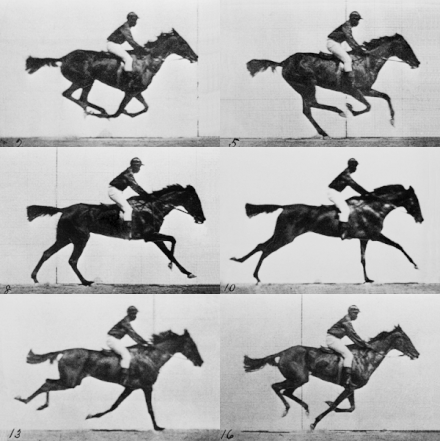
For a long time, it was a mystery as to how horses galloped. Did all four hooves at some point leave the ground? Or was one hoof always planted? It wasn’t until the 1880s when a British photographer named Eadweard Muybridge settled the debate with a series of photographs of a horse in midstride. Muybridge took a great interest in capturing the minute details of bodies in motion. The images made him famous.
Muybridge could be obsessive — and eccentric, too. His erratic behavior was blamed on a head injury he’d sustained in a serious stagecoach accident that killed one passenger and wounded all the rest. Now, researchers believe that the crash, which gave Muybridge a permanent brain injury, may actually have been partially responsible for endowing him with his artistic brilliance.
Muybridge may have been what psychiatrists call an acquired savant, somebody with extraordinary talent but who wasn’t born with it and who didn’t learn the skills from someplace else later. In fact, Muybridge’s savant abilities had evidently been buried deep in the recesses of his mind the whole time, and the stagecoach incident had simply unlocked them.
So, that should give you a few interesting things to think about! I’m headed to Colorado on Wednesday so I’ll be a little scarce this week. What’s on your blogging and reading list today?
Blueprint For Accountability, Long Overdue
Posted: March 24, 2012 Filed under: #Occupy and We are the 99 percent!, Banksters, Blueprint for Accountability, corporatism, corruption, ethics, just because, Rule of Law 21 CommentsMark your calendars for this Tuesday, March 27th, 7:00 pm [EST]. Why? The Culture Project will be running another of its Town Hall discussions, a live stream production from Georgetown University. Stellar participants include: Eliot Spitzer, Matt Taibbi, Dylan Ratigan, Ron Suskind, Van Jones, Heather McGhee and Jessie LaGreca. See brief bio background here.
The discussion topic? It’s all in the title—accountability, the very essence of a sound democracy, yet sadly, an ingredient we’ve seen purposely, repeatedly ignored and shunned by government and corporate leaders alike.
Occupy Wall St. brought public attention to the problem—the yawning divide between the 1% and everyone else. Now, the hard work begins: how do we, public and private citizens alike, steer ourselves back to the premise that the Rule of Law is essential and applies to everyone. How do we make our demands felt inside a broken, corrupt system, where our vote is compromised by big money, our voices drowned in the sludge of corporate and financial interests?
The plan or blueprint needs fresh dialogue, new ideas.
What precisely is the Culture Project? you might be asking. From the site:
CULTURE PROJECT is dedicated to addressing critical human rights issues by creating and supporting artistic work that amplifies marginalized voices. By fostering innovative collaboration between human rights organizations and artists, we aim to inspire and impact public dialogue and policy, encouraging democratic participation in the most urgent matters of our time.
 The Accountability series is a slight departure from what the group has done before—programs addressing human rights issues. But in a sense all of our rights are at peril, as is self-evident in the on-going Presidential campaign rhetoric.
The first of the series was launched with MSNBC’s Rachel Maddow in a discussion on torture and the War on Terror. Subsequent presentations featured Robert Kennedy, Jr. ,who spoke to the continuing diminishment of American values and Cornell West last September spoke on the 40th Anniversary of the Attica Prison Rebellion.
I wasn’t aware of these programs. Hattip to Alternet for bringing me up to speed and alerting readers about the program scheduled for Tuesday night
This is another example of networking getting the message out and a live stream presentation made available, reaching a far wider audience than would normally be the case.
Personally, I’m a great fan of Eliot Spitzer. Despite his past personal problems, I think he has a true gift in explaining the financial/legal shenanigans that Wall St. adopted and continues to practice as business as usual. All at the expense of the American public. Dylan Ratigan has his own MSNBC TV show, Monday through Friday. He’s a former financial guy himself and has a book out “Greedy Bastards,” which has spent weeks and weeks on the NY Best Seller’s List. He’s been screaming daily about the country’s breakdown, the systemic corruption and lawlessness pervading everything—the financial sector, education, healthcare, energy, etc. Matt Taibbi writes for the Rolling Stone and has been equally merciless in calling the TBTF’s out for the highway robbers they were and continue to be. Add the other voices on the panel and I suspect the conversation will be lively and worth the 2-hour investment of time.
Live stream program will be found here.
Should be an interesting, informative night. Let the brainstorming begin!

Occupy 2.0
Posted: March 21, 2012 Filed under: #Occupy and We are the 99 percent!, 2012 elections, Action Memo, Anti-War, Austerity, Banksters, Civil Liberties, corporate greed, corporatism, corruption, Economy, Global Financial Crisis, income inequality, social justice, U.S. Economy, U.S. Politics 12 CommentsUntil this past weekend, the Occupy Movement was flying under the radar, percolating beyond public view. But members returned to Zucotti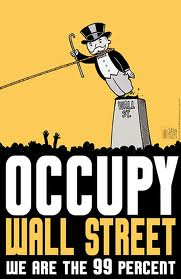 Park on St. Pat’s Day to celebrate the Movement’s six-month anniversary. From on the ground reports, the demonstration was peaceful. Until the NYPD arrived. Then there was trouble—a number of arrests and one woman reportedly had a seizure after she was thrown to the ground and handcuffed. Several participants said it took 17 minutes for the police to react, after which an ambulance was called.
For naysayers, the Occupy Wall St. Movement [OWS], their members and reasons for being were summarily dismissed before they began. Who is the leader of this motley group? journalists and pundits asked repeatedly. What do these people want?
Surprisingly, there is a leader or so I’ve read, someone well known to Occupy organizers but deliberately kept out of public view. As far as what they want? The answer seemed perfectly clear to me at the start because I think it’s what most Americans want or if they don’t want it, they expect it: an end to the gross inequality in the country, for which Wall St. and Government collusion holds the lion’s share of responsibility and an end to ‘bought’ elections, where the 1% and corporate interests routinely choose our leaders, shape policy and control the message, known in polite circles as ‘perception management.’
All of this transcends parties, btw. We’re talking Republican and Democratic parties alike, regardless of how many times we enter the ‘lesser than two evils’ spin.
You don’t need to be a psychic to ‘get’ the OWS message. You don’t even need to be a member of Occupy. All that’s needed is a modicum of alertness, a shaking-off of the trance-inducing distraction and deflection of pundits, media hounds and political operators.
So, what has OWS managed to accomplish, thus far? According to the critics—not a damn thing. But is that really the case?
Last summer, the headlines were ripe with talk of deficits, crushing debt and woe is me. We need a Grand Bargain, wisemen crooned [translation: we need to cut public services]. Somehow, we always have money for foreign adventures, national security, weapons and surveillance equipment. For instance, how many drones will be in American skies by 2020? Hummm. Try 30,000. That’s the Federal Aviation Administration’s rough estimate. The ever popular ‘shop ‘til you drop’ hee-haw isn’t working either, even with the news that ‘average’ Americans are flocking back to restaurant dining. Despite a stumbling economy there is money for weapons and drones and assorted homeland security gear. When it comes to education, infrastructure, home mortgage write downs, decent healthcare, aide to our poor, disabled and elderly? We’re just stone-broke and need to be put on an austerity diet. See Paul Ryan’s reiteration on social program slashes and numbers that don’t add up. It’s a nice set piece that will contrast with the soon-to-come kinder and gentler Democratic version.
One could call the dialogue change a bizarre coincidence but public conversation pivoted after Occupy came on the scene. We went from Oooooo, we need to slash Medicare, Medicaid and refigure Social Security to why is Wall St. getting bailed out on the backs of the taxpayer? Why do we have a system where the profits go to the top income bracket, while risk is carried by Main Street? Why have the wages of middle-class workers[if they’re fortunate enough to still have a job] barely kept pace with inflation, while the top 1% has had a 275% increase in income?
Uncomfortable questions, the sort that make politicians squirm.
OWS has also focused attention on home foreclosures, working with foreclosed families to save their homes. The Movement rallied the public in a Change Your Bank Day strategy that is estimated to cost TBTFs a $185 billion in transfers to community banks and credit unions. Religious organizations have joined the effort. According to Think Progress, The New Bottom Line, a coalition of faith groups has pledged to remove $1 billion from the major banks this year alone. OWS also pushed against the ATM fee-increase proposal; the banks pulled back. In late February, Occupy the SEC submitted a 300+ page document, urging regulators to resist the financial sector’s desire to water down the Volker Rule, part of the Dodd-Frank Wall St. reform. The group that put the document together was comprised of former Wall St. workers. OWS members also stood with private landowners, Tea Party members and environmentalists protesting the Keystone XL pipeline, a project that the President has expressed a new-found love for.
Not too shabby for six months activism. Yet still the critics howl. Where is the direction, what are the goals?
The Movement is young and still developing but you cannot fault it for sitting on its hands. More importantly, the Occupy spirit is global in nature because many activists are ‘graduates without a future’—young, educated and fed up. Paul Mason documented this facet of the worldwide

Arundhati Roy
social/political movements in his book, “Why It’s Kicking Off Everywhere,” and Arundhati Roy wrote this in a recent essay: “Capitalism, A Ghost Story”:
As Gush-Up concentrates wealth on to the tip of a shining pin on which our billionaires pirouette, tidal waves of money crash through the institutions of democracy—the courts, Parliament as well as the media, seriously compromising their ability to function in the ways they are meant to. The noisier the carnival around elections, the less sure we are that democracy really exists.
Sound familiar? The neoliberal model, the gross inequality that rewards the few at the expense of the many has circled the globe, creating universal discontent and misery.
So, what’s coming up for 2012? What will Occupy 2.0 look like?
I’d suggest checking the OWS page here for an updated list of scheduled actions. OWS plans to be in Chicago in mid-May to protest the NATO Summit although the city is throwing up barriers to prevent demonstrations. Somehow, I don’t think the protest will be stopped.
May 1 will be a National Action, the day traditionally known as International Worker’s Day. This year OWS is calling for a General Strike across the country. From the Occupy site:
We are calling on everyone who supports the cause of economic justice and true democracy to take part: No Work, No School, No Housework, No Shopping, No Banking – and most importantly, TAKE THE STREETS!
This Saturday, March 24, a Disrupt Dirty Power protest has been called in NYC to jumpstart a month-long action until Earth Day, April 22. More information here.
Sunday, March 25, Occupy Town Square IV will focus on public parks and other public spaces in NYC. More info here.
If you’re interested in local actions in particular states, towns, cities or countries, info can be found at the Occupy Together site here.
And if you want to eliminate the idea of ‘a failed movement’ from your brain. Check out the participation map here. The scope is massive.
The essay I mentioned by Arundhati Roy is well worth a read—highly informative, even shocking about vulture capitalism’s impact on India. Be prepared, it’s long. As Roy moves into her concluding paragraphs, she writes this:
Capitalism is in crisis. Trickledown failed. Now Gush-Up is in trouble too. The international financial meltdown is closing in. India’s growth rate has plummeted to 6.9 per cent. Foreign investment is pulling out. Major international corporations are sitting on huge piles of money, not sure where to invest it, not sure how the financial crisis will play out. This is a major, structural crack in the juggernaut of global capital.
Capitalism’s real “grave-diggers” may end up being its own delusional Cardinals, who have turned ideology into faith. Despite their strategic brilliance, they seem to have trouble grasping a simple fact: Capitalism is destroying the planet. The two old tricks that dug it out of past crises—War and Shopping—simply will not work.
Disaster capitalism has certainly lived up to its name, be it continuous war, environmental degradation or exploding poverty. What is Occupy about? Speaking for myself, Occupy is about a break of faith with a global economic system that serves no one but an elite minority, where infinite money and power is the only morality. The movement is a massive rejection of the ongoing mantra: there’s no other way. Occupy challenges that static position, calls on us to envision something else, something better than the consensus mind. It dares us to shake off the old and embrace a sense of possibility. It demands we wake up, now.
How to Fight Corporate Greed And Actually Make A Difference
Posted: March 13, 2012 Filed under: #Occupy and We are the 99 percent!, corporate greed, corporatism, Environment, Environmental Protection, Environmentalists, globalization, science, social justice 11 CommentsYesterday I posted the rather dismal news about Pennsylvania’s Act 13, a corporate-driven piece of legislation that bows on bended knee to the gas and oil industry at the expense of citizen and community civil rights. All for the love of fracking, natural gas and profits. Did I mention there’s a glut of natural gas on the market right now? The price has dropped like a stone due to oversupply and the incredibly mild winter we’ve had in the States. Prices, however, are much higher elsewhere. Asia and Europe, for instance. And energy companies are pushing for permits to build LNG [liquid natural gas] terminals for that very purpose. According to Forbes magazine:
A thousand cubic feet of natural gas currently costs $14 to $15 in Asia, $8 to $9 in Europe, and $4 in North America, down 9 percent from what it was at the outset of 2011.
That could make corporate CEO’s and investors very grumpy.
It could also make Pennsylvania residents grumpy. It’s bad enough to compromise the environment, jeopardize water supplies and threaten the health of American citizens but then the product is exported elsewhere for increased profits? I can hear heads exploding.
The Forbes article indicates the high investment cost on LGN terminals could easily make this scheme impractical. But the scale of these problems and the power that large corporations wield seem depressingly insurmountable. With energy solutions, the problems are magnified. We need energy to keep on, keeping on. The question is finding a balance between getting the energy we need and what we’re willing to accept as ‘collateral damage.’ It can make your head hurt.
Karma must have led me to an article by Jim Schultz, the executive director of the Democracy Center, an organization that works globally to educate citizens on effective advocacy for environmental and social issues. His article, ‘Three Ways to Beat Corporate Giants’ improved my mood immensely.
Make It Personal
 The example Schultz provides is the Bolivian Water Revolt against Bechtel and the World Bank’s meddling. I’d heard about the 2000 revolt previously, the privatization of the public water supply in Bolivia’s third largest city, Cochabamba. Within weeks of taking over, Bechtel raised water prices by nearly 50%. The poor were literally forced to choose between food or water. Massive protests resulted in the city as rural people joined the pushback. The president, Hugo Banzer, tried repressing the opposition but protests continued unabated. A resulting 4-day workers’ strike brought the strife to an end–Banzer cancelled the Bechtel contract.
However, what I didn’t know [or didn’t remember] was that Bechtel attempted to sue the citizens of Cochabamba for $50 million, though their investment was reportedly less than $1 million. Activists then made the fight personal. Their goal? Make the life of CEO Riley Bechtel and his top management team miserable. They flooded their personal accounts with email. They derided their names and actions at every opportunity in the media. They protested in front of the company’s headquarters and the officer’s private residences. Ultimately, the protest prevailed. Bechtel settled for a token payment of 30 cents.
Add Humor To Your Protests
The plan to replace a coal-fired station is featured, a project in southwest England to be built by a German energy company. Environmentalists and grassroot activists used protests, petitions and civil disobedience—standard fare. But they also added a twist. Since the new station was advertised as ‘clean coal,’ protestors showed up to publicly scrub coal in front of the German company’s office [E. On Energy] and then sent a Santa brigade to deliver the coal to ‘naughty’ executives. This action caught the attention and favor of the public. Ultimately, the protest worked—the energy company withdrew its plans and the UK government pledged not to approve any other coal-fired stations without carbon capture and storage capabilities [a technology yet to be fully developed].
Concentrate On Shareholders
The successful campaign against Occidental Oil Co. and their plans to drill in the Columbian ‘cloud forest,’ focused on the primary investors of the oil field development plan. The region, which is the tribal home to the indigenous U’wa people, the environmental threat to the bio-diversity of the area and the fear of armed violence from the country’s FARC rebels fueled massive protests on Fidelity Investments, a primary shareholder of Occidental. It was through the protests and the exposure of the U’wa people’s way of life—their spiritual connection to the forest, what they stood to lose–that convinced [maybe shamed] the business world to withdraw support and funding for the project. Another win.
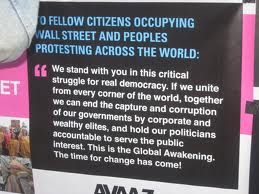
In the end, our national and global problems look insurmountable and corporate power certainly appears invincible at first glance. It’s a good refresher to realize that there have been victories and there are citizens, here and abroad, willing to put it on the line and speak out against the rise of corporate greed and bullying. Activists may not win all the battles. But they’ve won some and continue to pushback. For that, I salute them. It’s also a reminder as one Occupy sign shouted out:

And then, I stumbled across this video. It made me laugh and laughing is good for the soul. I’d file this under category #2 in Jim Schultz’s guidebook. Sometimes humor can make a statement of its own.

 peej
peej Carissa
 bostonboomer
 dakinikat
 ecocatwoman
 mablue2
 Mama Lopez
 peggysue22
 quixote
 skydancingguestblogger
 Mona (aka Wonk the Vote)



 Sky Dancing
Recent Comments