
Home Sweet Home
Posted: October 3, 2013 Filed under: New Orleans 2 CommentsIt’s days like these that get me wondering why I’d want to live any place else in the world.
Yes. That’s my neighbors doing that really old Kinks Song with a quick appearance of the guys from the Preservation Hall Band.
But, really, let me tell you about my home town.
The last time Greg Newkirk visited New Orleans, one of his favorite local attractions was an actual local.
“I had walked into a shop to ask a few questions and ended up getting a thorough history of New Orleans voodoo by a man who was the nicest self-professed vampire you would ever meet,” says the Cincinnati-based editor of Roadtrippers.com. “He gave us weird travel advice, delicious food advice, and psychic life advice. If that doesn’t sum up the French Quarter, I don’t know what does.”
Such full-service eccentricity made New Orleans a natural contender for the nation’s strangest people, based on votes in the offbeat category of T+L’s annual America’s Favorite Cities survey. Readers rank 35 metropolitan areas for features such as live music and food trucks as well as their residents — be they smart, attractive, or, indeed, lovably weird.
I do hope you know the next Top Chef is the New Orleans version.
Well, it turns out that Top Chef was thankfully not affected by the shutdown. Government program? No. Hour long advertisement for cars and grocery stores in between Real Housewives episodes? That it may be. Whatever it is, the eleventh season has begun and is off to a sweaty running start in New Orleans. If you like shows with transition shots that are exclusively brass instruments played by old black men and alligators briefly surfacing in a swamp, you are really going to love this season.
Hopefully, Hurricane Karen won’t shut us down for long.
Open Thread! Indulge!!!
I remember 8 years ago
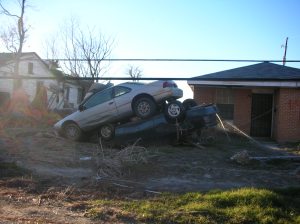
Posted: August 29, 2013 Filed under: New Orleans | Tags: 8th Anniversary of Hurricane Katrina 13 Comments Today is the 8th Anniversary of Hurricane Katrina. It is a day that changed my life completely. At first, I didn’t want to leave my home. They had given us so many warnings before for hurricanes that really hadn’t come to anything I thought I might be able to ride it out; but something inside me knew this would be different. So I loaded up my two labs and my cat, a big pink futon, and a badly packed suitcase and headed for a Lake Charles hotel room with some other Ph.D students from my program. I spent Sunday until Wednesday hunkered in.
I couldn’t think straight about what to grab or pack. I tried to cover the Steinway up with a tarp and hoped for the best. I brought weird stuff. I packed all my jazz fest t-shirts and some boxer shorts. I packed a silk skirt and some really impractical black pumps. I forgot so much that it wasn’t even funny. I just remember looking at everything before I left and thinking that just a few things wouldn’t cut it so might as well leave it all. Now, I think I would have the presence to grab a few practical things and meaningful items. But, not then. The drive was also indescribable. It was hours and hours of bumper to bumper traffic heading west on the I-10. I had tried to grab a few neighbors that I knew didn’t have cars too. Some folks were still determined to ride it out.
I slept on the futon between two beds for two nights with my dogs and cat, trying to get as much information as possible from a live broadcast from the TV and the internet. I thought that I would be able to head back, until I heard the news that the levees had broken and water was filling up the city. It was at that point we made plans to head to Texas to drop one student at the Dallas Bus Stop and the other at the Dallas Airport. I was headed to Omaha to stay with a friend and to give my children huge hugs. I spent weeks on the couch just watching Anderson Cooper and wondering if my home was okay. When I finally met Anderson and hung with him several times over the next few years it was always like seeing an old friend. He was a constant fixture in my life for what seemed like an eternity.

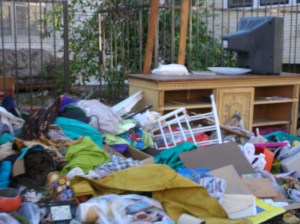
I finally made it back the first week of October to a scene of indescribable, utter devastation, with no electricity nearly anywhere, massive clean up efforts, and a very empty city. My home was mostly okay. That meant I served as refuge for folks for nearly two years afterwards. The only place that was pretty unlivable for awhile was my bedroom because the roof had come off my neighbor’s house and taken out the window and my bed. It took me a few weeks to get all the electricity in the house. I lived with the sound of AM radio. For the first week, my only company was the Washington State National Guard.
There were no birds, no bugs, no sounds. Everything was pitch black at night.
Later in the month, I spent nights in bars with returning friends whose stories of staying or leaving were often unbelievable. You can hear some stories here at the Survivor’s Stories project by NPR. Many, many of my friends have left and never returned. More than a few are still here but have become quite changed. I have to say that many of them have had problems with drugs and booze since then so they’ve been lost in a completely different way.
It’s also been a year since our last big hurricane and the passing of Karma, who was the last of my two labs who made the great trek out of the city with me. It is just Miles and me now that took that huge journey.
You learn a lot about people when you find yourself in the position of possibly losing everything. I remember being offered money by folks in Dallas an in Lake Charles. Every one in Omaha wanted to do something big to for any one of us that popped up there. It was lucky because it good cold fast and I hand nothing to wear. I took my Red Cross Debit Card and bought clothes. Friends and family sent me boxes of things at my friend’s house too. I came home with care packages stuffed with cleaning things, food and clothes. I really needed all of them by the time I finally opened my front door. The hurricane had shaken all kinds of dust out of the old place.
I remember the Ford Dealer in Dallas looked at my car when I was wondering if it would make it all the way to Omaha and didn’t charge me a dime. A GI in the waiting room took care of my dogs while I held Miles in my arm. A woman asked if there was anything at all that I needed. I also remember a Sugerland Trooper that pulled me over because I hadn’t decreased my speed since we were trying to figure out how to get to the busstop who announce to me that “This is Texas and we do things differently here than in Louisiana”. All I could say was “Believe me, I am not messing with Texas. I am dropping her off at the bus stop, and her off at the airport and I am heading north to my family as soon as possible”. All I thought at the time was he could keep this god awful place. I just wanted to hug my kids and see my little house in New Orleans again.
This city is still in the throes of recovery. There are parts that are still empty. There are parts that probably will never be the same. My part of town is now hip and cool and gentrifying. The house prices have been increasing rapidly since the Hurricane and the population is changing. So, there is good and bad. Just like everything. However, you can still tell us “old timers” because all we still ask is “How you making out?” and that always implies “after Katrina” .




Monday Reads
Posted: May 13, 2013 Filed under: morning reads, New Orleans | Tags: Climate change, Elizabeth Warren, gun violence, hate speech, mother's day shootings New Orleans, school loans 34 Comments Good Morning!
I spent Mother’s Day napping on dad’s sofa mostly. I am such an exciting person!! I have no idea why I am so cold and so worn out but it is what it is.
Meanwhile, all hell broke loose in New Orleans. The gun violence that hit a Mother’s Day parade there was pretty much the kind of urban violence we see all too often with such easy access to guns. I wish I could say that gun violence was rare in the 7th ward. But it is not. Here’s a word from my congressman Cedric Richmond:
According to FBI data, 1,464 people were killed by firearms in New Orleans between 2008-2011. That’s 1,464 families who will never see their loved ones again. If we were to have passed the entirety of President Obama’s proposed reforms, sadly, many of those victims would probably have still been killed because violence is a pervasive and complex problem with a diverse set of causes. Economic insecurity, poor mental health treatment options, inferior education options and the scarcity of positive opportunities are all contributors, which one regulation alone cannot eliminate. That being said, if we only acted on just a few of the president’s proposals, we could decrease the supply of guns used in the homicides by reducing the supply of illegally purchased guns via universal background checks. This would decrease the use of guns in violent crime and keep a few more families from having to bury a loved one.
While I was serving as a member of the Louisiana House of Representatives, I introduced an assault weapons ban bill on numerous occasions. I took on the National Rifle Association in these battles not because I have a grudge against gun owners, but because I could find no reasonable defense of having these weapons of mass destruction on our streets. As a resident of Sportsman’s Paradise, I am a strong supporter of the Second Amendment. However, I do not ascribe to the belief that Congress has no role in responding to the gun violence epidemic plaguing communities like New Orleans, Chicago and Detroit.
It seems that 19 people were injured with no fatalities.
A Mother’s Day second-line shooting on Frenchmen Street in the 7th Ward, on Sunday about 1:45 p.m., left 19 people injured, according to the latest NOPD numbers. Earlier Sunday afternoon, NOPD Superintendent Ronal Serpas said that about 12 people had been injured, but the toll later grew to 19, with the NOPD explaining that some victims initially hadn’t reported being injured and more people continue to come forward.
Police said 10 adult men, seven adult women, a 10-year-old boy and a 10-year-old girl were struck by bullets. Both of the 10-year-old victims had graze wounds to the body and were in good condition. A man and a woman were reported to be in surgery Sunday evening.
The shooting occurred in the 1400 block of Frenchmen Street at the intersection of North Villere Street. Immediately after the shooting police reported seeing three suspects running from the scene. One suspect was seen running on Frenchman toward North Claiborne, police said.
NOPD spokeswoman Remi Braden said many of the victims were grazed, some by bullets that ricocheted. “At this point, there are no fatalities, and most of the wounds are not life-threatening,” she said in an email.
“But all medical conditions are not known at this time as victims were rushed to nearby hospitals,” Braden continued. “Detectives are conducting interviews, retrieving any surveillance video in the area and, of course, collecting all evidence. This is an extremely unusual occurrence, and we’re confident that we will make swift arrests.”
Kevin Allman, editor of Gambit Weekly, said one of the publication’s writers, Deborah Cotton, also known as the blogger Big Red Cotton, was shot and was in stable condition after undergoing surgery.
Shannon Roberts, 32, was in the Interim LSU Hospital in New Orleans on Sunday afternoon and early evening alongside reams of other crying and fear-ridden – and at times, angry – family members whose loved ones were injured in the shooting. Roberts said she was waiting on a 21-year-old nephew who was shot in the arm and stomach, a 37-year-old niece shot in the arm, and a 39-year-old cousin shot in the back.
“All innocent bystanders got hit,” Roberts said. “When I got the call saying they were shot, I wasn’t thinking at all, I was just shivering and crying… just hoping they be all right.
Hatred evidently has a basis in geography in this country. This is an interesting twist on studying information from Twitters, locations, and  displays of racism, homophobia, and basic hate speech.
Twitter, even more than many other social media tools, can feel disconnected from the real world. But a group of students and professors at research site Floating Sheep have built a comprehensive map of some of Twitter’s most distasteful content: the racist, homophobic, or ableist slurs that can proliferate online. Called Geography of Hate, the interactive map charts ten relatively common slurs across the continental US, either by general category or individually. Looking at the whole country, you’ll often see a mass of red or what the map’s creators call a “blue smog of hate.” Zooming in, however, patches appear over individual regions or cities; some may be predictable, while others are not.
The map builds on an earlier Floating Sheep project that showed where President Obama was referenced with racial slurs, but it’s far more comprehensive and well-constructed. Unlike many other studies, for example, the tweets weren’t collected and analyzed algorithmically — a method that could accidentally collect non-derogatory uses of these terms. Instead, the team first searched through a year’s worth of geotagged tweets for words, then had a group of students at Humboldt State University look at each one. Only tweets they found explicitly negative went on the map: a derogatory use of the word “dyke” would be added, for example, but one reclaiming the term for a gay pride parade would not. In total, the map charts about 150,000 negative, slur-filled tweets.
Here is some “Terrible News About Carbon and Climate Change”.
This past Thursday, the daily average atmospheric concentration of carbon dioxide, as measured by the Mauna Loa observatory in Hawaii, passed four hundred parts per million. In some way it was a meaningless milestone. We know that CO2 is increasing; we knew this moment would come; we know that four hundred is no more different from three hundred and ninety-nine than it is from four hundred and one.
Still, the number should shake us, if not shock us. We’ve got more carbon dioxide in the atmosphere now than at any point since the Pliocene, when there were jungles in northern Canada. And the number hurdles ever upward, as ocean levels rise and extreme weather becomes routine. Three-fifty was the old target; four-fifty is the new one. But what indication is there that we’ll stop at five hundred, six hundred, or even more?
We’ve failed collectively. As Ryan Lizza explained in miserable detail in 2010, the United States government couldn’t pass a tepid, eviscerated law. Activists have failed. We’ve all failed morally: a problem created by the world’s rich will now crush the world’s poor. In a grand sense it’s also a failure of the creators, and deniers, of climate change: the Exxon-Mobils, say, or the Wall Street Journal editorial page. A victory isn’t worth much if your children and grandchildren will one day think of you with anger and shame.
How do we get out of this mess? The political system seems hopeless. Yes, government regulation has done much to relieve us of acid rain and smog. But global warming combines two intractable problems. Reducing emissions mainly benefits people who aren’t born and don’t vote. And it requires international coördination, which is hopeless, and international law, which is toothless. We should do things like build more public transportation, which helps people here and now. We should design our cities for a future with terrible weather. But solving the problem of climate change through the U.N. is like a small man with olive oil on his hands trying to pull a whale from the water.
 I’ve become somewhat fascinated with charter schools given their presence in New Orleans and their supposed success. Who makes money from these things and why is that important? It has a lot to do with Real Estate Developers and Hedge Fund Managers. This is worth reading.
Studies shows that charter schools don’t typically outperform public schools and they often tend to increase racial and class segregation. So one must wonder, what exactly is motivating these school “reformers”? And why have they pushed for more and more closure — and new charter schools — at such an unprecedented rate in recent years?
Pro-charter supporters will tell you that it’s time for public institutions like our schools to start competing more like for-profit institutions. Test scores and high enrollment, then, define success. Unsuccessful schools, they say, should close just as unsuccessful businesses do. For neoliberal school reformers from today’s Arne Duncan-led Department of Education to scandal-ridden movement leader Michelle Rhee to billionaire Bill Gates, it is taken on faith that market principles are desirable in education.
But since it’s not clear that market principles are benefiting students on a large scale, it seems likely that something else is at stake. And reformers may be more than a little disingenuous in publicly ignoring that other, less high-minded thing: Profit. Critics of charter schools and school closings point out that proponents may not really be motivated by idealism, but by self-gain.
But who precisely is profiting? And how? Untangling answers to these questions is a more daunting task. Compared to public schools, charters schools are an extremely unregulated business. They contract with private companies to provide all kinds of services, from curriculum development to landscaping. Most of the regulations that bind charter schools are implemented at the state level. And unlike public institutions, the finances of charter schools are managed on a school-by-school basis. Because they are not consistently held accountable to the public for how they distribute funds, charter schools are often able to keep their business practices under wraps, and thus avoid too much scrutiny.
Here’s economist Joseph Stiglitz warning us about the crushing student debt in the U.S.
According to the Federal Reserve Bank of New York, almost 13 percent of student-loan borrowers of all ages owe more than $50,000, and nearly 4 percent owe more than $100,000. These debts are beyond students’ ability to repay, (especially in our nearly jobless recovery); this is demonstrated by the fact that delinquency and default rates are soaring. Some 17 percent of student-loan borrowers were 90 days or more behind in payments at the end of 2012. When only those in repayment were counted — in other words, not including borrowers who were in loan deferment or forbearance — more than 30 percent were 90 days or more behind. For federal loans taken out in the 2009 fiscal year, three-year default rates exceeded 13 percent.
America is distinctive among advanced industrialized countries in the burden it places on students and their parents for financing higher education. America is also exceptional among comparable countries for the high cost of a college degree, including at public universities. Average tuition, and room and board, at four-year colleges is just short of $22,000 a year, up from under $9,000 (adjusted for inflation) in 1980-81.
Compare this more-than-doubling in tuition with the stagnation in median family income, which is now about $50,000, compared to $46,000 in 1980 (adjusted for inflation).
Like much else, the problem of student debt worsened during the Great Recession: tuition costs at public universities increased by 27 percent in the past five years — partly because of cutbacks — while median income shrank. In California, inflation-adjusted tuition more than doubled in public two-year community colleges (which for poorer Americans are often the key to upward mobility), and by more than 70 percent in four-year public schools, from 2007-8 to 2012-13.
With costs soaring, incomes stagnating and little help from government, it was not surprising that total student debt, around $1 trillion, surpassed total credit-card debt last year. Responsible Americans have learned how to curb their credit-card debt — many have forsaken them for debit cards, or educated themselves about usurious interest rates, fees and penalties charged by card issuers — but the challenge of controlling student debt is even more unsettling.
Curbing student debt is tantamount to curbing social and economic opportunity. College graduates earn $12,000 more per year than those without college degrees; the gap has almost tripled just since 1980. Our economy is increasingly reliant on knowledge-related industries. No matter what happens with currency wars and trade balances, the United States is not going to return to making textiles. Unemployment rates among college graduates are much lower than among those with only a high school diploma.
Who is the one person in the beltway looking for answers? Massachusetts Senator Elizabeth Warren is looking at handing the loans over the Fed. The problem is that no one seems to be taking the bill seriously.
Senator Elizabeth Warren (D-MA) has just introduced a new bill, the Bank on Students Loan Fairness Act, to offer student loans at the same rates that the Federal Reserve charges big banks through its discount window lending program. At the moment, that rate is about 0.75%. The rates on federally guaranteed student loans, meanwhile, is set to double to 6.8% this summer.
“Some may say we can’t afford this proposal,” said Senator Warren as she introduced the bill. “I would remind them that the Federal Government currently makes 36 cents in profit for every dollar it lends to students . . . meanwhile, the banks pay interest that is one-ninth of the amount that students will be asked to pay. That’s just wrong. It doesn’t reflect our values.”
“Now some explain that the banks get exceptionally low interest rates because the economy is still shaky and banks need access to cheap credit to continue the recovery.” She sighed loudly. “But our students are just as important to the economic recovery as our banks, and the debt they carry poses a serious risk to that recovery.”
It’s probably true that some say banks need low interest rates to keep the economy growing. But no one except possibly a lunatic has told Elizabeth Warren that banks are getting 0.75% at the discount window as a thank you for all the hard work they’re doing helping the economy. Discount window loans are cheap for three reasons: the borrowers have assets and income that are easy to seize, the loans are quite short term, and the banks are required to put up collateral.
As you’ll have discovered with your own mortgage or car loan, the shorter the term of the loan, the lower the interest rate. You will also have discovered that loans secured by collateral, like your car loan or mortgage, carry lower interest rates than loans such as credit card expenditures, which are secured by nothing more than your heartfelt promises to pay. You may even have noticed that the more durable the collateral, the more attractive a rate your banker will extend on it.
So it is with loans to other people, and businesses. Banks get a very low rate because they’re borrowing for very short periods of time–often overnight, always less than a year. The Fed correctly figures that the bank is unlikely to go out of business by next month–and anyway, they’re putting up collateral, which is unlikely to lose all its value in such a short period of time.
Students, on the other hand, are borrowing for a decade, and the only thing they’re putting up as a guarantee is their character. How good a collateral is their character? In 2011, 9.1% of borrowers had defaulted on their student loan within the first two years of the payment period.
The interest paid by the folks who don’t default is the only thing keeping this program from hemorrhaging money. Elizabeth Warren proposes to cut that interest rate to less than the rate of inflation.
So, those are my suggestions this morning. What’s on your reading and blogging list today?
Bobby Jindal: Right Wing Vote Troll
Posted: April 13, 2013 Filed under: Bobby Jindal, New Orleans | Tags: Bobby Jindal, Stupid Governor, Stupid Party 15 CommentsI’d like to suggest Brown University call the Governor of Louisiana up to yank his degree in science. He obviously learned nothing. I’d also like NBC to explain why it felt  interviewing a governor for an education feature that has the most anti-education agenda that’s ever come down the pipe in any state. How many governors of states do you know have defunded higher education in their state by over 40% and bragged about draining state education funds to schools that teach that dinosaurs roamed the garden of Eden and the Loch Ness Monster is real? Because, well, that’s Governor Bobby Jindal’s education plan. However, we all know that he’s just trolling for right wing votes and funding for his upcoming presidential run. Yes, good education for children is all about public funding of christofascist madrassas, NBC! Way to give air time to the crazy!
Jindal also said he has no problem with creationism being taught in public schools as long as a local school board OK’s it. Since the state is committed to national academic standards, he said, as long as schools are teaching evolution they should be allowed to teach other theories as well. “What are we scared of?” he said. “Let (students) debate and learn … give them critical thinking skills.”
Once again this year, anti-creationism activists led by college student Zack Kopplin and state Sen. Karen Carter Peterson, D-New Orleans, are trying to repeal the 2008 Louisiana Science Education Act that permits science teachers to use “supplemental materials” in the classroom.
Also voicing support for vouchers earlier in the afternoon was state Education Superintendent John White, who tried to depoliticize the issue. When he was a child, he said, the kindergarten in his neighborhood was lousy, so his parents voted with their pocketbook and sent him to private school. He said he has trouble, “on a moral basis, explaining why I shouldn’t extend that right to a person whose wallet” isn’t as full as his parents’ was.
White also promoted his plans to unify the state’s disparate early childhood programs and improve career and technical education in high schools. For students who don’t want a four-year traditional college education, “What is their viable path to the American middle class?” he asked, pointing out that many jobs in Louisiana require advanced training but not a college diploma.
On the whole, White expressed optimism about the direction New Orleans schools are going, saying, “I think this is a Silicon Valley of public education in America.”
 Oh, be sure to take John White’s word for it. Afterall, he’s a professional liar with the thinnest education resume ever but he’s Jindal’s pointman on trolling for evangelical support with dubious educational policies and figures that never stand up to fact checks. Jindal’s antics are beginning to be outed in blogs and media every where. It just seems NBC didn’t have enough researchers on staff to get the notice and Hoda Kotb is spending way too much time with wine and what’s her name up there in NYC.
Louisiana Governor Bobby Jindal is on the defensive; his far right social agenda has been soundly rejected by voters, and his popularity has imploded as the public understands exactly what Jindal has been trying to pull. And yesterday he gave an interview that made it even clearer: despite his talk about “moderation,” Bobby Jindal is just as much of a religious fanatic reactionary as any other Republican: Jindal Defends School Vouchers in NBC Interview.
I believe this is the first time Jindal has come right out and said he’s in favor of teaching creationism in public schools, although it’s been obvious from his political agenda. This is the GOP “reformer” — just another anti-science caveman.
In a way I’m glad to see him finally dropping all the pretense and openly admitting what his voucher program is intended to do: put right wing religious mythology on an equal footing with modern science, and instill government-sanctioned ignorance in the children of Louisiana. It’s nauseating, but at least it’s now out in the open.
You know this is totally anecdotal, but I’ve taught undergrad and grad classes in Louisiana in several universities. I just don’t see any difference between kids coming out of the public schools and kids coming out of the private schools that stay here and attend local universities. I think the folks down here are pretty deluded about the outcomes they think their kids are getting from private schools. The public school where I come would kick the ass of the best private schools down here in no time flat but then, high property taxes there have always supported the schools. Granted, the talented kids from both sets of schools here leave the state and go elsewhere pretty quickly.
The thing that drives private school attendance seems to be folks looking to stay within a very narrow social group, racial group, religious group or whatever. The performance of the private charter schools down here are as varied as the public schools down here. Same with the religious ones. The one thing I will say thing New Orleans Public School now guarantee is a ‘creationist’ free zone. That alone means some sanity you won’t find other places. Just a reminder, here’s a link to MOJO and 14 completely whacky things that kids learn down here in schools that are now getting our precious state dollars.
“Bible-believing Christians cannot accept any evolutionary interpretation. Dinosaurs and humans were definitely on the earth at the same time and may have even lived side by side within the past few thousand years.”—Life Science, 3rd ed., Bob Jones University Press, 2007
1. He permits Louisiana schools to teach creationism. Thanks to Jindal’s educational voucher system in Louisiana, students will be attending private or parochial schools on the taxpayer’s dime. But those schools don’t necessarily meet the standards of the state’s public schools, and may teach students creationism instead of standard science curricula.
2. He allows state employees to be fired for being gay. During his first few months as governor, Jindal decided not to renew an anti-discrimination executive order protecting LGBT employees who work for the state. Jindal has also said that same sex marriage opens up a path for courts to overturn the Second Amendment.
3. He has signed bills to intimidate women seeking abortions. Jindal compared women who have gotten abortions to criminals. But that unpalatable sentiment also came with a policy change — he signed a bill that requires all abortion clinics to post intimidating messages in their waiting rooms, and establishes a website that points women to crisis pregnancy centers instead of abortion-providing facilities. Jindal also signed a measure creating a 24-hour waiting period between a woman’s mandatory ultrasound and the date of her abortion.
4. He seeks to dramatically cut taxes for the wealthy, increase taxes for everyone else. Jindal’s latest tax proposal would raise taxes for 80 percent of Louisianians. The poorest 20 percent — with an average income of $12,000 — would face substantial tax increases, while those in the top one percent would on average get a tax cut of $25,423.
5. He refuses to provide health care for Louisiana’s poorest. Louisiana has the third highest uninsured rate in the country. Twenty percent of residents lack insurance of any kind. But as one of the governors vehemently opposed to Obamacare, Jindal turned down the Medicaid expansion offered under the law, ignoring the fact that it would drastically lower the numbers of uninsured and ultimately save the state money on emergency care.
Yup, NBC. That is certainly the type of guy you want to interview on the value of a good education. Way to go!!!
Monday Reads
Posted: March 4, 2013 Filed under: Austerity, misogyny, morning reads, New Orleans, Violence against women, Women's Rights | Tags: Austerity economics, bywater, Flash Dance, gentrification, Musicals, Richard the Lionheart, violence against women 49 CommentsGood Morning!
A friend of mine of 30 years visited me the last few days so we did some things that I rarely do. This included seeing a Broadway play. We saw  Flashdance the Musical, let me say, in terms of entertainment and music, those are three hours I will never get back, I’m afraid. I even went to the bar during the intermission and got a very large gin and tonic to see me through the second act. It really didn’t help as much as I’d hoped. Some things are better left as chintzy 80s movies. The supplemental songs were completely forgettable! I was trying to forget them as they were being sung. I actually think the last composer worth anything on Broadway was Steven Sondheim and whoever wrote these songs proved me right again.
All the musicals these days have everything but singable songs, I swear! Maybe it’s because I had just seen Bernadette Peters sing Rogers and Hammerstein, Sondheim, and Irvin Berlin songs that still make my heart strings go zing!!! But not even all these splashy dance numbers and a few old 80s hits could juice this show. I’d have gone out to play Angry Birds in the Lobby if I wasn’t sitting in the middle of the row and would’ve rudely awakened my seat prisoners. “Gloria” was included. It’s not an ice skating scene, however, it’s now a tawdry stripper club dance number. The song had to be the worst arranged version I’d ever heard of anything Plus, the Michael Nouri character got morphed into some goody two shoes white male trust fund baby that rescued all the womminz, the blax, and the real working men. Not funny. Skip it if it flashdances into a town near you.
So, I’m getting caught up with things that do intrigue me. That means this post is going to be weird, so sit tight. First up–and you know it was coming–is about the remains of Richard the Lionheart. A group of forensic scientist had at them.
When the English monarch, nicknamed Richard the Lionheart, died in 1199 his heart was embalmed and buried separately from the rest of his body.
Its condition was too poor to reveal the cause of death, but the team was able to rule out a theory that he had been killed by a poisoned arrow. The researchers were also able to find out more about the methods used to preserve his organ. The study is published in the journal Scientific Reports.
The medieval king became known as Richard the Lionheart because of his reputation as a courageous military leader.
He was central to the Third Crusade, fighting against the Muslim leader Saladin. Although he ruled England, he spent much of his time in France, and was killed there after being hit by a crossbow bolt during a siege on a castle.
Richard I’s remains were divided after he died – his heart was buried in a tomb in Rouen. After his death, his body was divided up – a common practice for aristocracy during the Middle Ages. His entrails were buried in Chalus, which is close to Limoges in central France. The rest of his body was entombed further north, in Fontevraud Abbey, but his heart was embalmed and buried in the cathedral of Notre Dame in Rouen.
The remains of his heart – now a grey-brown powder – were locked away in a small lead box, and discovered in the 19th Century during an excavation. But until now, they had not been studied in detail. To find out more, a team of forensic specialists and historians performed a biological analysis
We have been strangling the economic recovery through economic incompetence — and worse is in store because President Obama continues to embrace (1) the self-inflicted wound of austerity, (2) austerity primarily through cuts in vital social programs that are already under-funded, and (3) attacking the safety net by reducing Social Security and Medicare benefits. The latest insanity is the sequester — the fourth act of austerity in the last 20 months. The August 2011 budget deal caused large cuts to social spending. The January 2013 “fiscal cliff” deal increased taxes on the wealthy and ended the moratorium on collecting the full payroll tax. The sequester will be the fourth assault on our already weak economic recovery. We have a jobs crisis in America — not a government spending crisis and the cumulative effect of these four acts of austerity has caused a certainty of weak growth and a serious risk that we will throw our economy back into recession. The Eurozone’s recession — caused by austerity — greatly adds to the risk to our economy because Europe remains our leading trading partner.
President Obama and a host of administration spokespersons have condemned the sequestration, explaining how it will cause catastrophic damage to hundreds of vital government services. Those of us who teach economics, however, always stress “revealed preferences” — it’s not what you say that matters, it’s what you do that matters. Obama has revealed his preference by refusing to sponsor, or even support, a clean bill that would kill the sequestration threat to our nation. Instead, he has nominated Jacob Lew, the author of the sequestration provision, as his principal economic advisor. Lew is one of the strongest proponents of austerity and what he and Obama call the “Grand Bargain” — which would inflict large cuts in social programs and the safety net and some increases in revenues. Obama has made clear that he hopes this Grand Betrayal (my phrase) will be his legacy. Obama and Lew do not want to remove the sequester because they view it as creating the leverage — over progressives — essential to induce them to vote for the Grand Betrayal.
Yes. Grand Betrayal. But, it is what he was planning all along, yes? It’s not like he hasn’t written or talked about it. So, we may not lose what we paid for but it certainly is going to be much watered down by the time the Beltway is done.
I’ve been meaning to read this much discussed article by Ruth Rosen. I’m doing it now and making sure that you didn’t miss it. It was published in Slate last week and is titled: Women’s rights is the longest revolution . It highlights many things in the women’s movement but focuses on one thing that we should never put at the end of our lists of demands; the end to violence against women.
As an activist and historian, I’m still shocked that women activists (myself included) didn’t add violence against women to those three demands back in 1970. Fear of male violence was such a normal part of our lives that it didn’t occur to us to highlight it — not until feminists began, during the 1970s, to publicize the wife-beating that took place behind closed doors and to reveal how many women were raped by strangers, the men they dated, or even their husbands.
Nor did we see how any laws could end it. As Rebecca Solnit wrote in a powerful essay recently, one in five women will be raped during her lifetime and gang rape is pandemic around the world. There are now laws against rape and violence toward women. There is even a U.N. international resolution on the subject. In 1993, the World Conference on Human Rights in Vienna declared that violence against girls and women violated their human rights. After much debate, member nations ratified the resolution and dared to begin calling supposedly time-honored “customs” — wife beating, honor killings, dowry deaths, genital mutilation — what they really are: brutal and gruesome crimes. Now, the nations of the world had a new moral compass for judging one another’s cultures. In this instance, the demands made by global feminists trumped cultural relativism, at least when it involved violence against women.
Still, little enough has changed. Such violence continues to keep women from walking in public spaces. Rape, as feminists have always argued, is a form of social control, meant to make women invisible and shut them in their homes, out of public sight. That’s why activists created “take back the night” protests in the late 1970s. They sought to reclaim the right to public space without fear of rape.
The daytime brutal rape and killing of a 23-year-old in India in early January 2013 prompted the first international protest around violence against women. Maybe that will raise the consciousness of some men. But it’s hard to feel optimistic when you realize how many rapes are still regularly being committed globally.
So, any of you that know me closely know that I’ve been screaming about ‘new’ neighbors and wondering what’s up with my neighborhood. Here’s a great article on my New Orleans Bywater Neighborhood: Gentrification and its Discontents: Notes from New Orleans. The house prices in my neighborhood have skyrocketed. We are now have multiple eateries where arrugala, kale, and things that totally confused my Omaha friend are on the menus. The article really explains what’s been going on around me as we’ve been taken over from by Class 4 hipsters. Here’s the bit about how a neighborhood ‘gentrifies’. You can read more about my neighborhood in particular at the link.
The frontiers of gentrification are “pioneered” by certain social cohorts who settle sequentially, usually over a period of five to
twenty years. The four-phase cycle often begins with—forgive my tongue-in-cheek use of vernacular stereotypes: (1) “gutter punks” (their term), young transients with troubled backgrounds who bitterly reject societal norms and settle, squatter-like, in the roughest neighborhoods bordering bohemian or tourist districts, where they busk or beg in tattered attire.
On their unshod heels come (2) hipsters, who, also fixated upon dissing the mainstream but better educated and obsessively self-aware, see these punk-infused neighborhoods as bastions of coolness.
Their presence generates a certain funky vibe that appeals to the third phase of the gentrification sequence: (3) “bourgeois bohemians,” to use David Brooks’ term. Free-spirited but well-educated and willing to strike a bargain with middle-class normalcy, this group is skillfully employed, buys old houses and lovingly restores them, engages tirelessly in civic affairs, and can reliably be found at the Saturday morning farmers’ market. Usually childless, they often convert doubles to singles, which removes rentable housing stock from the neighborhood even as property values rise and lower-class renters find themselves priced out their own neighborhoods. (Gentrification in New Orleans tends to be more house-based than in northeastern cities, where renovated industrial or commercial buildings dominate the transformation).
After the area attains full-blown “revived” status, the final cohort arrives: (4) bona fide gentry, including lawyers, doctors, moneyed retirees, and alpha-professionals from places like Manhattan or San Francisco. Real estate agents and developers are involved at every phase transition, sometimes leading, sometimes following, always profiting.
Native tenants fare the worst in the process, often finding themselves unable to afford the rising rent and facing eviction. Those who own, however, might experience a windfall, their abodes now worth ten to fifty times more than their grandparents paid. Of the four-phase process, a neighborhood like St. Roch is currently between phases 1 and 2; the Irish Channel is 3-to-4 in the blocks closer to Magazine and 2-to-3 closer to Tchoupitoulas; Bywater is swiftly moving from 2 to 3 to 4; Marigny is nearing 4; and the French Quarter is post-4.
I just refer to them as the barbarian hordes of yupsters, but I guess that’s not the academic term for it. On a bright note, I could never afford my house now and can sell it for a huge amount of money. Actually, I’m not so sure that’s a bright note because now my new neighbors do not like the charm of my slightly run down green house or the fact I prefer low up keep weeds to grass in the alley. Oh, well … I still miss the old coterie of merchant seamen that were drag queens when they got back home, hippies thrown out of the quarter, old people left over from the old days, and section 8 rental denizens. After all, what’s a few seedy people among friends if they’ve got character and a good story to tell over a beer?
So, there’s a little this and that to get you started on a Monday Morning. I didn’t want to depress you with the Sunday Presskateers so, you will just have to hit the Charles Pierce link for that. What’s on your reading and blogging list today?

 peej
peej Carissa
 bostonboomer
 dakinikat
 ecocatwoman
 mablue2
 Mama Lopez
 peggysue22
 quixote
 skydancingguestblogger
 Mona (aka Wonk the Vote)



 Sky Dancing
Recent Comments