
Thursday Reads: The Morning After
Posted: October 4, 2012 Filed under: 2012 presidential campaign, Affordable Care Act (ACA), Barack Obama, Medicaid, Medicare, Mitt Romney, morning reads, Social Security, U.S. Economy, U.S. Politics | Tags: first presidential debate, lies 53 Comments
Good Morning!!
OK, I don’t drink, but I still feel hung over. That debate last night was pathetic. Romney babbled incoherently, but sounded smooth. Obama made sense and gave specifics, but sounded hesitant and herky-jerky. We’ll have to wait and see what happens to the polls, but the consensus of the pundits and liberals on Twitter is that Romney won this one. I think Obama forgot he is the president and acted like a challenger. I simply cannot believe that neither Obama nor Jim Lehrer asked Romney about his “47 percent” remarks!
Anyway, I still have a nasty cold, I’m discouraged, and tired, so I’m just hoping this post will make sense. I’m going to link to some early reactions to the debate and leave it at that.
Jennifer Granholm has predicted a couple of times that Obama would lose the first debate. From Time’s Swampland:
You recently predicted that Obama would lose the first debate. Then you suggested that the media might assign him a loss whether he deserves a win or not. Can you explain that?
The first time, I mentioned two reasons why I think he’s going to lose. One is, he’s not in debate shape in the same way that Romney is. But more importantly, the media does not like a lopsided race, and it’s appearing to be lopsided at the moment. So in order to sustain the race, I think there will be a narrative of the comeback-kid Mitt Romney.
The candidates have been busy playing the low-expectations game. Are you just helping Obama be self-deprecating?
No, I’m just looking at it purely from who’s in practice and who’s not in practice … Part of that might be that the incumbent is confronted, on this national stage, in a way that he is not usually confronted … I don’t discount that he’s a good speaker, but he does speak in paragraphs, and debates are not the place to do that.
She was right. Now for some media reactions.
LA Times: Mitt Romney loves Big Bird, will kill funding for him anyway
No question, Mitt Romney’s extensive debate preparation is paying off. At least in the first half of the debate, he seemed more emotionally connected than President Obama with the material — making jokes and self-deprecating remarks and even invoking Big Bird in a discussion about the deficit and budget priorities….
Then, looking at moderator Lehrer, Romney said, “I’m sorry, Jim, I’m gonna stop the subsidy to PBS…. I like PBS, I love Big Bird — I actually like, you too — but I am not going to keep spending money on things [we have] to borrow money from China to pay for.”
IMO, Romney looked energetic, but he wasn’t funny. Frankly, the biggest problem for anyone debating Mitt Romney is that he is the most amazing liar ever. How do you debate someone who lies constantly and even tells conflicting lies? The only way it would be possible is if you had a moderator. Jim Lehrer was completely ineffectual. Just wait till we have to see Bob Schieffer try it. He’s around 80 isn’t he? I don’t think Lehrer is quite that old, and I think he lost consciousness a couple of times last night.
Ben Smith at Buzzfeed: How Mitt Romney Won The First Debate
Mitt Romney, trailing in the polls, needed to prove tonight that he could stand on stage with President Barack Obama as an equal and a plausible president of the United States.
He did that in the crucial first 40 minutes of Wednesday night’s debate, addressing Obama respectfully, even warmly — but then tangling with a sometimes hazy and professorial Obama on taxes and deficits.
“You don’t just pick the winners and losers — you pick the losers,” he told Obama of his energy investments, sliding time and time again into a second person singular address calculated to level the rhetorical playing field.Romney departed dramatically from the hard conservatism of his primary campaign, downplaying the scope of his tax cuts.
“There will be no tax cut that adds to the deficit,” he said, without fully explaining how he’d accomplish that.
In other words, Romney lied and neither the moderator nor the incumbent president challenged him on his lies. Obama was incredibly passive.
Talking Points Memo: Obama Supporters: Which Obama Was That?
The early consensus on the debate among the pundit class: Mitt Romney helped himself a lot with a strong first debate performance, President Obama didn’t. And that included plenty of commentators supportive of Obama as well.
“It looked like Mitt Romney wanted to be there and President Obama didn’t want to be there,” Democratic strategist and CNN contributor James Carville said. He later added Obama did not bring his “A game.”
Alex Castellanos, a former Romney advisor who has often been critical of his campaign, said he was surprised by his “very effective” performance.
Many were surprised that Obama appeared reluctant to go on offense, never mentioning many of his own campaign’s attacks on Romney over Bain Capital or his recent leaked remarks dismissing 47 percent of Americas “victims.” In general, commentators suggested he appeared less comfortable than Romney onstage.
Josh Marshall wrote something I heard Al Sharpton say on MSNBC last night. Romney committed himself to a lot things that are going to get him in trouble in the next few days when the pundits get over his surface performance and look at what he actually said.
Two things happened in this debate. Romney had the energy and focus, a long series of arguments packed and tight to dish out in the debate. He didn’t get distracted. He had a game plan he stuck to. What struck me a lot of times through the debate was that Obama seemed pained. He didn’t seem happy. And people like seeing happy people….
Romney’s focus though came at the cost of a few key things.
He basically tossed aside his own tax plan or said he would if his numbers didn’t add up. But then he insisted that he could find enough loopholes to close to afford a $5 trillion tax cut for upper income earners. These are more numbers on the table. That’s really what most of the debate was about — budget numbers. Romney insisted with a straight face that up was down….
The numbers simply don’t add up. Over a few news cycles that can build up really fast. He says he’ll push massive upper income tax cuts and those have to come at the cost of much higher deficits or big tax hikes for middle income people. His campaign agenda is based on a massive deception.
That’s the vulnerability Romney brings out of this debate. And it may be bigger than people realize.
Greg Sargent: A good night for Mitt Romney, but was it really enough?
Mitt Romney had a very good debate tonight. Though debates often reinforce existing perceptions, Romney took steps towards reversing his image as an out of touch plutocrat. During the extended jousts of numbers crunching, he humanized himself in an unexpected way — by converting his boardroom aura from something cold and aloof into an aura of earnestness. He skillfully played the part of the technocratic centrist he used to be and whose balanced approach to policy and government he has completely abandoned. Romney also landed clear blows when indicting the Obama recovery. He seemed particularly on message in claiming that the proof that Obama’s government centric policies had failed could be found in the current state of the economy.
Obama missed key opportunities.When invoking Romney’s suggestion that kids should borrow money from their parents to pay for college, he was far too polite and discursive and didn’t make the moment stick. His defense of Obamacare took too long to make the point that Romney, in repealing the law, would take insurance away from millions without replacing it with anything.
That said, Obama won some understated victories. He won the battle over Medicare; Romney was effectively defined by that exchange as Mr. Voucher. Obama did a decent job in exposing Romney’s lack of specificity on many of the issues that were discussed tonight, and tied them together into a larger pattern of evasiveness on Romney’s part.
Ed Kilgore: Spin Room
I gather from brief glances at Twitter and initial reaction at NBC that Mitt won pretty big on style points.
A lot of progressives are beside themselves that Obama didn’t mention Bain Capital, didn’t mention the 47%, didn’t mention the Ryan Budget (except indirectly), didn’t mention inequality, didn’t mention abortion/contraception, didn’t mention immigration. Very heavy emphasis, as I noted, on Mitt’s “vagueness.” ….
You know, I’m often a bad judge of these things because I really don’t give much of a damn about “energy levels” or “aggressiveness,” and I tend to care a lot when I know a candidate is lying through his or her teeth. But if viewers thought Obama was phoning it in, that will matter, and it will matter a lot more if they are being told by every talking head in Christendom that Romney won big.
The $64,000 question is whether this will have an impact on actual candidate preferences, which have been amazingly stable.
Jonathan Chait: The Return of Massachusetts Mitt.
Tonight’s debate saw the return of the Mitt Romney who ran for office in Massachusetts in 1994 and 2002. He was obsessive about portraying himself as a moderate, using every possible opening or ambiguity – and, when necessary, making them up – to shove his way to the center. Why he did not attempt to restore this pose earlier, I cannot say. Maybe he can only do it in debates. Or maybe conservatives had to reach a point of absolute desperation over his prospects before they would give him the ideological space. In any case, he dodged almost every point in the right wing canon in a way that seemed to catch Obama off-guard.
Romney was able to take advantage of the fact that Obama has a record, and he does not. Obama has had to grapple with trade-offs, and Romney has not. So Romney is a candidate of a 20% cut in tax rates, a new plan to cover people with preexisting conditions, and higher defense spending, and he will accomplish it all by eliminating federal funding for PBS. He would not accept that his proposal would result in any tradeoffs at all – no lower funding for education, no reductions in Medicare for anybody currently retired. He insisted his plan would not cut taxes for the rich, which is false. He described his proposal to allow people with continuous health insurance to keep it – a right that, as Obama already noted, already exists, and is therefore a meaningless promise – as a plan to cover all people with preexisting conditions.
Romney did not waste a breath. Obama wasted many, with “uhs” and long, wonky discursions. He went on long, detailed riffs defending his policies, with attacks on Romney few and far between. Romney added little to his longstanding indictment of Obama, but defined himself far more effectively than he has before.
I do think the instantaneous, echo chamber reaction that is handing Romney an overwhelming victory is overstated. Romney made a huge error selling his Medicare plan, promising, “if you’re around 60, you don’t need to listen any further.” It was a moment he went from smooth to oily – when you urge voters to stop paying attention, and especially on an issue where they start off distrusting you, it heightens the distrust. Obama replied, “if you’re 54 or 55, you might want to listen, because this will affect you.”
Okay, that should be enough to get you started. I’m already not quite as upset as I was a little while ago, because I think it’s true that Romney is going to be confronted with all the lies and backtracks he pulled in this debate.
So what are you reading and blogging about today? This is an open thread–you don’t have to discuss the debate.
Tuesday Reads
Posted: April 24, 2012 Filed under: 2012 presidential campaign, Barack Obama, Civil Liberties, Health care reform, Media, Medicaid, Medicare, morning reads, Patriot Act, Republican presidential politics, The Media SUCKS, U.S. Economy, U.S. Politics | Tags: "liberal media" Allen West, bigotry, Bill O'Reilly, Communist Party, Democracy Now, domestic spying, Mitt Romney, NAACP, National Security Agency (NSA), red baiting, Robert Reich, Social Security, Tom Harkin, William Binney 16 Comments
Good Morning!! Let’s see what’s in the news today.
Mitt Romney has been whining about the “liberal media” giving him a hard time, but a new Pew survey has found that the “liberal media” are friendlier to Mitt Romney than President Obama. Adam Serwer at Mother Jones:
The Liberal Media has consistently given more positive coverage to likely Republican Presidential candidate Mitt Romney compared to President Barack Obama, according to a new survey of media coverage from the Pew Research Center’s Excellence in Journalism Project.
During the early weeks of 2012, Romney’s media coverage was slightly negative—between January 2 and February 26, 33 percent of the stories about the ex-Massachusetts governor were positive and 37 percent were negative, according to Pew’s analysis. But Romney has received mostly positive coverage since then (47 percent positive to 24 percent negative). By contrast, according to the report, President Barack Obama “did not have a single week in 2012 when positive coverage exceeded negative coverage.”
Check out the full report at the Pew link.
Florida Rep. Allen West was booted from an NAACP fund-raiser because of his claim that around 80 Democrats in the House of Representatives are card-carrying members of the Communist Party.
Rep. Allen West (R-Fla.) was supposed to be the keynote speaker at a fundraiser for his district chapter of the National Association for the Advancement of Colored People (NAACP) this past Saturday. But days before the event, the group canceled the gathering and asked West not to come back when they rescheduled. Why?
“There’s a certain statement he made about Communists,” Jerry Gore, president of the Martin County NAACP, told Scripps Treasure Coast Newspapers. “That statement alone … we do not represent that type of atmosphere.”
But that didn’t keep West from making more ludicrous remarks. Yesterday, he claimed that the Muslim Brotherhood is “being allowed to influence strategy.”
Rep. Allen West (R-Fla.) criticized the FBI on Monday for removing nearly 900 pages of training material it deemed to be offensive, saying it showed extremist Muslim groups were influencing national strategy.
The FBI made the move after Sen. Dick Durbin (D-Ill.) complained about some passages, including one that advised agents to “never attempt to shake hands with an Asian” and another that said agents should expect “outbursts” from Arab minds.
West said that by removing such passages, the FBI was committing “cultural suicide” and allowing groups like the Muslim Brotherhood to influence U.S. policy.
“We have to understand that when tolerance becomes a one-way street it leads to cultural suicide,” West told “Fox and Friends” on Monday. “We should not allow the Muslim Brotherhood or associated groups to be influencing our national strategy.”
When asked if he believed those groups were influencing U.S. strategy, West responded, “Oh, absolutely,” and cited the Fort Hood, Texas, shooting report that didn’t mention the suspect’s Muslim faith as a potential motive for the killings.
In another throwback to the McCarthy era, a few days ago Bill O’Reilly accused Robert Reich of being a communist.
Yesterday, Reich responded: Communist Accusations Matter.
For the record, I’m not a communist and I don’t secretly adore Karl Marx.
Ordinarily I don’t bother repeating anything Bill O’Reilly says. But this particular whopper is significant because it represents what O’Reilly and Fox News, among others, are doing to the national dialogue….
O’Reilly based his claim on an interview I did last week with Jon Stewart on the Daily Show, in which I argued that because America’s big corporations were now global we could no longer rely on them to make necessary investments in human capital or to lobby for public investments in education, infrastructure, and basic R&D. So, logically, government has to step in.
Since when does an argument for public investment in education, infrastructure, and basic R&D make someone a communist or a secret adorer of Karl Marx?
Since the Tea Party crazies crawled out from under their rocks and took over the Republican Party, I guess. I sure wish they’d crawl back where they came from.
Now this is refreshing. Sen. Tom Harken defended Social Security in the Huffington Post yesterday, and proposed some solutions to future problems:
To strengthen America’s retirement system, my proposal would increase Social Security benefits and greatly improve the financial stability of the program. It does so by:
• Increasing the amount of earnings covered by higher replacement rates in order to increase benefits by approximately $60-70 per month
• Changing the way the COLA is calculated so that it better corresponds to the typical expenses of seniors
• Removing the cap, currently $110,100, that unfairly protects the highest earning Americans from paying into Social Security like the majority of hardworking Americans.All told, according to the Social Security Actuary, this proposal would extend the life of the Social Security Trust Fund to 2052 while cutting the long term funding deficit in half.
I’m sure Mitt Romney will explain to Senator Harkin why it would be wrong to try to raise payroll taxes on high income “job creators.”
Speaking of Willard, the LA Times had an interesting story on Romney’s health care plan–they call it “revolutionary,” and not in a good way.
In public, Romney has only sketched the outlines of a plan, and aides have declined to answer questions about the details. But his public statements and interviews with advisors make clear that Romney has embraced a strategy that in crucial ways is more revolutionary — and potentially more disruptive — than the law Obama signed two years ago.
The centerpiece of Romney’s plan would overhaul the way most Americans get their health coverage: at work. He would do so by giving Americans a tax break to buy their own health plans. That would give consumers more choices, but also more risk.
Critics and independent analysts say the impact would probably leave a larger number of Americans without insurance.
In addition,
While offering consumers more choices, Romney’s plan would give companies strong incentives to stop providing insurance to workers. It also would overhaul the 46-year-old Medicare and Medicaid programs for the elderly, poor and disabled.
The plan could swell the federal deficit; a similar plan backed by Sen. John McCain (R-Ariz.) during the 2008 presidential campaign would have cost more than $1 trillion over 10 years, on par with the price tag for the Obama healthcare law.
Romney keeps claiming he’s going to cut the deficit. Somehow I don’t think privatizing Social Security, Medicare, and Medicaid will do that. Maybe he thinks he can end those programs completely.
Democracy Now has been running a series on NSA spying. A good starting point is this article at Alternet: Whistleblower: The NSA is Lying — The U.S. Government Has Copies of Most of Your Emails
National Security Agency whistleblower William Binney reveals he believes domestic surveillance has become more expansive under President Obama than President George W. Bush. He estimates the NSA has assembled 20 trillion “transactions” — phone calls, emails and other forms of data — from Americans. This likely includes copies of almost all of the emails sent and received from most people living in the United States.
While you’re at Alternet, here’s another article you should read: How Obama Became a Civil Libertarian’s Nightmare
When Barack Obama took office, he was the civil liberties communities’ great hope. Obama, a former constitutional law professor, pledged to shutter the military prison at Guantanamo Bay, Cuba, and run a transparent and open government. But he has become a civil libertarian’s nightmare: a supposedly liberal president who instead has expanded and fortified many of the Bush administration’s worst policies, lending bipartisan support for a more intrusive and authoritarian federal government.
Please go read the whole thing and then check out Glenn Greenwald’s take on the story.
As I’m sure everyone here knows, we don’t live in a democracy anymore.
So what are you reading and blogging about today?
Thursday Evening News Wrapup
Posted: April 5, 2012 Filed under: 2012 presidential campaign, abortion rights, Austerity, Barack Obama, Corporate Crime, corruption, Domestic terrorism, fetus fetishists, Hillary Clinton, Medicaid, Medicare, Mitt Romney, Newt Gingrich, Planned Parenthood, SCOTUS, SDB Evening News Reads, Social Security, the villagers, Women's Healthcare | Tags: Affordable Care Act, Augusta Golf Club, Greece, Jamie Dimon, JP Morgan Chase, Judicial Activism, judicial restraint, Lizzie Borden, Masters Tournament, murder, Supreme Court 27 Comments
Afternoon Tea, by Mary Cassat
Good Evening! I’ll start off with some good news. Minkoff Minx has arrived home from the hospital and is doing well. She’ll be resting for I a few days, but she should be back to posting regularly sometime next week. I sure do miss her cheery evening reads! I’m doing my best to fill in again tonight.
It’s been a slow news day, but there are a few things happening even though most of Washington, DC–including Congress and many pundits are on a two-week Easter vacay. Why do they get such long vacations anyway? They only work about three days a week and they accomplish very little.
President Obama has waked up to the reality of women’s electoral power. Today we learned that he thinks it’s high time that Augusta Golf Club, which hosts the Masters Tournament, should start accepting women members.
Not to be outdone, and because he obviously has no original thoughts, Mitt Romney announced that he, too, And he discussed the issue in his usual stuffy manner.
When asked if women should be admitted, the Republican presidential frontrunner responded: “Of course.”
“I am not a member of Augusta. I don’t know if I would qualify. My golf game is not that good,” Romney told reporters after an energy-themed event in Tunkhannock, Pennsylvania. “Certainly if I were a member, if I could run Augusta, which isn’t likely to happen, of course I’d have women into Augusta.”
Newt Gingrich thinks his wife Callista would be “great member,” and Callista herself tweeted that she “wants in.” No word on how he-man woman-hater Rick Santorum feels about the issue.
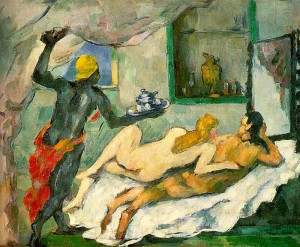
Afternoon Tea, by Cezanne
It’s looking like Romney has the Republican nomination all sewn up–he’s even leading in Santorum’s home state of Pennsylvania now. But at the Daily Beast, Michelle Goldberg explains why conservatives still want Santorum to stay in the race.
Conservative Iowa radio host Steve Deace isn’t convinced. “In the minds of social conservatives, it’s not even close to over,” he says. “The real question is how committed someone like Rick Santorum is to fighting this out all the way to the end. If he’s committed to doing this on a personal level, there’s plenty of social conservatives that will ride him to the finish line.”
Indeed, despite the best efforts of the Republican establishment, many on the religious right are far from ready to accept Romney’s inevitability, or to coalesce behind him. They remain distrustful of his record on abortion, and unsure they can believe his campaign promises. And the harder party elites push Romney on them, the more alienated they become. “The biggest story that everyone in the media has missed this cycle is how frustrated and fed up the Republican Party base is with the Republican Party,” says Deace. “It’s unlike anything I’ve ever seen.”
Goldberg quotes a number of conservative sources who just won’t accept a Romney candidacy and think Santorum to fight to the bitter end at the convention. They sound a lot like Hillary supporters who in 2008 wanted her to take the fight to the convention. Hillary is a loyal Democrat and so she ended up going with the flow, but Santorum is more of a renegade with a lot less to lose than Hillary. In any case, it seems as if the bases of both corporate parties are disgusted with their party elites.

Afternoon Tea Party, by Mary Cassatt
Also at the Daily Beast, Michael Tomasky writes that the Supreme Court is “on the ropes.” Back in the ’80s, Conservative starting pushing for “judicial restraint.” But now that the shoe is on the other foot and there is a Conservative majority on the court, suddenly they love the notion of “judicial activism” that they once reviled (just like they now despise the Heritage Foundaton health care plan now that Democrats have written it into law).
John Roberts has to know and see all this. He has to know that Fifth Circuit Judge Jerry Smith, who asked federal prosecutors for a homework assignment in the wake of Obama’s remarks—a brief stating the Justice Department’s position on judicial review, that had to be at least three pages, single-spaced!—is making conservatives look silly and cheapening the bench. And he has to know that the court’s reputation will suffer an immense blow if it overturns the mandate. It will be seen by a large majority—even a lot of people who weren’t crazy about the law—as completely political. Remember, they didn’t have to take the case in an election year in the first place. They could have put it off. But the court said it must do this now. If it then overturns the ACA, it will look and smell like a political hit job to many Americans. And the court would be saying to America, “We know what you think, and we don’t give a damn.”
What would happen to the court then? Slowly—no; probably quickly—it will come to be seen by most Americans as just another cesspool of political mud wrestling; just another arena where the rich get what they want while everyone else gets screwed (Citizens United); just one more ideological whorehouse full of patrons pretending to be just the piano player.
Despite what we’re all brought up to believe, nothing about the court is sacrosanct. Lifetime appointments can be changed to fixed-year terms. It’d take some doing, but it can be done. And there’s nothing anywhere that says it has to be nine justices. That’s just tradition, but it’s nowhere in the Constitution. It just needs to be an odd number; could be three or 23. For that matter, Congress could disregard Marbury v. Madison. Yep. It could. Tom DeLay used to speak of this from time to time, back in the dear old Terri Schiavo days. He never specifically invoked M v. M, but, referring to judges who would have let Schiavo die, he said things like they had “thumbed their noses at Congress and the president” and would someday pay. He meant a campaign against judicial review. He never got around to it, having been indicted and convicted and all, but that’s what he meant. There’s nothing to prevent liberals from mounting a similar campaign. So far they’ve has held back by their respect for the institution. But that may soon be gone.

There is a heartbreaking story out of Greece: Pensioner’s Suicide Continues to Shake Greece.
Dimitris Christoulas, a divorced and retired pharmacist, took his life on Wednesday in Syntagma Square, a focal point for frequent public demonstrations and protests, as hundreds of commuters passed nearby at a metro station and as lawmakers in Parliament debated last-minute budget amendments before elections, expected on May 6.
In a handwritten note found near the scene, the pensioner said he could not face the prospect “of scavenging through garbage bins for food and becoming a burden to my child,” blaming the government’s austerity policies for his decision.
The incident has prompted a public outpouring, with passers-by pinning notes of sympathy and protest to trees in the square, as well as comment from politicians across the spectrum. A solidarity rally on Wednesday night turned violent when the police clashed with hooded demonstrators in scuffles that left at least three people injured.
I guess we can look forward to similar tragedies here in the U.S. if Congress succeeds in gutting Medicare, Medicaid, and Social Security. And I don’t exempt the Democrats from my cynicism about support for the social safety net among the Villagers.
Speaking of the rich, powerful, and selfish, Jamie Dimon is once again on the top of the heap in terms of CEO compensation. Richard Escrow writes:
JPMorgan Chase CEO Jamie Dimon is still the poster child for today’s morally degraded, self-entitled banker mentality. I don’t know why he keeps talking, but he’s the gift that keeps on giving.
At every major junction in the post-crisis debate about banking, Dimon has stepped in with a perfectly tactless remark that illustrates both the vacuity and the moral corruption of his industry. This week was no exception.
Excrow provides a number of specific examples of Dimon’s and Chase’s lack of ethics. And yet, Dimon is still whining about “excessive” government regulation.
Dimon just complained that regulators “made the recovery worse than it otherwise would have been” — which is not only wrong, but avoids addressing the issue of the recovery’s cause, which was banks like Dimon’s. Dimon added that the government forced banks to de-leverage “”at precisely the wrong time” — which is precisely wrong. The government’s real error was in not breaking up too-big-to-fail banks like Dimon’s.
“Complexity and confusion should have been alleviated, not compounded,” complains Dimon.
So Dimon and his cronies have formed a superpac to intimidate liberal Congresspeople. Please go read the whole article. It’s really frightening.
The domestic terrorist who tried unsuccessfully to blow up a Planned Parenthood office in Wisconsin has explained his motivation.
Francis Grady, 50, spoke to reporters who were covering his first appearance in federal court since the Sunday night attack. The Green Bay Press-Gazette posted video of him walking through the courthouse followed by a short clip of him speaking to reporters outside.
“There was no bomb,” Grady said. “It was gasoline.”
A reporter asked why Grady attacked the clinic.
“Because they’re killing babies there,” he responded.
The newspaper also got more from inside the federal courtroom, where Grady reportedly interrupted the judge to ask, ““Do you even care at all about the 1,000 babies that died screaming?”
“Screaming?” Fetuses that are aborted in the first trimester aren’t “babies,” and they don’t have nervous systems to feel pain or the ability to scream. The ignorance of these people is beyond belief.
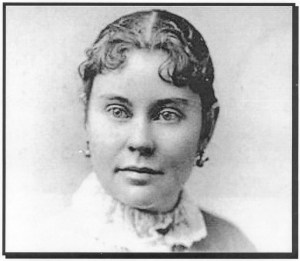
Lizzie Borden
Finally, some new evidence has been found in the Lizzie Borden murder case–journals kept by her attorney.
Borden was acquitted in 1892, and much of the evidence in the case ended up with Andrew Jackson Jennings, Borden’s attorney. The two journals, which Jennings stored in a Victorian bathtub along with other evidence from the case, including the infamous “handless hatchet,” were left to the Fall River Historical Society by Jennings’ grandson, who died last year.
The society received the fragile journals about a month ago but won’t be exhibited until they are properly preserved, curator Michael Martins said.
Each journal is about 100 pages. One contains a series of newspaper clippings, indexed using a lettering and number system that Jennings devised. The second contains personal notes that Jennings assembled from interviews he conducted. Some of the individuals interviewed are people mentioned in the newspaper clippings Jennings retained.
“A number of the people Jennings spoke to were people he knew intimately, on a social or business level, so many of them were perhaps more candid with him than they would have been otherwise,” Martins said. “But it’s also evident that there are a number of new individuals he spoke to who had previously not been connected with the case.”
I hope at least some of those links will pique your interest. What stories have you been following this afternoon and evening?
Tuesday Reads: Obama’s Deficit-Reduction Plan, Backsliding Obots, Rev. Wright, and Dr. Doom
Posted: September 20, 2011 Filed under: American Jobs Act, Barack Obama, Democratic Politics, Domestic Policy, Global Financial Crisis, income inequality, Medicaid, Medicare, morning reads, Social Security, U.S. Economy, U.S. Politics | Tags: Booman, Chris Hedges, class warfare, digby, Ezra Klein, Greg Sargent, Jon Walker, Jonathan Cohn, Martin Luther King, Maya Angelou, Nouriel Roubini, Rev. Jeremiah Wright 45 Comments
Good Morning!! Let’s see what’s happening in the news today.
Well, of course the Obama apologists are claiming that he has suddenly grown a backbone of steel and become the liberal messiah they all dreamed of in 2008. I already told you about Ezra Klein’s delusional column last night. The other usual suspects are also getting leg tingles, and former Obots are starting to backslide.
Greg Sargent has put on his rose-colored glasses and taken a few swigs of LSD-laced Koolaid:
This has to be the clearest sign yet that Obama has taken a very sharp populist turn as he seeks to frame the contrast between the parties heading into 2012. During his remarks this morning, Obama directly responded to Republicans accusing him of “class warfare,” but rather than simply deny the charge, he made the critical point that the act of protecting tax cuts for the rich is itself class warfare, in effect positioning himself as the defender of the middle class against GOP class warriors on behalf of the wealthy.
Wow! I’ll bet it never occurred to anyone that income inequality equals class warfare until Obama figured it out. Amaaaazzzzing!!
A senior administration official tells me that parts of Obama’s “class warfare” broadside were ad-libbed. Here’s the key chunk — and it’s a script that could have been written by just about any card-carrying member of the “professional left:”
Warren Buffett’s secretary shouldn’t pay a higher tax rate than Warren Buffett. There’s no justification for it. It is wrong that in the United States of America, a teacher or a nurse or a construction worker who earns $50,000 should pay higher tax rates than somebody pulling in $50 million…
We’re already hearing the usual defenders of these kinds of loopholes saying, “this is just class warfare.” I reject the idea that asking a hedge fund manager to pay the same tax rate as a plumber or a teacher is class warfare. I think it’s just the right thing to do. I believe the American middle class, who’ve been pressured relentlesly for decades, believe it’s time that they were fought for as hard as the lobbyists and some lawmakers have fought to protect special treatment for billionaires and big corporations.
Nobody wants to punish success in America … All I’m saying is, that those who have done well, including me, should pay our fair share in taxes to contribute to the nation that made our success possible.
Holy sh*t!! Obama ad libbed? Hope ‘n’ change! Change we can believe in! I guess it’s just me, but I thought that speech sounded kind of weak and defensive. But what do I know?
Booman has an even better rationalization for Obama’s behavior than Beltway Bob Ezra Klein. According to the ever-gullable Booman,
…the president has a lot more credibility now when he takes his ideas to the public and says the the Republicans aren’t interested in compromise. You have to try and fail to get a compromise before that argument has any resonance. It’s not so much 11-Dimensional chess as basic common sense. Everyone’s poll numbers suffered during the summer, but no one’s standing was weakened more the Republicans’. That’s not an accident.
So Obama must have planned this. The man is brilliant!!
Digby says Obama is in campaign mode and that’s why he’s trying to sound strong and determined.
My first thought is that it appears the administration has finally decided that there’s nothing to be gained with exclusively delivering post-partisan pablum. It certainly sounds as though he’s thrown down the gauntlet. Unfortunately, the President appears to want to have two fights going into this election, one over job creation and one over whose plan to cut the deficit is better, which I think is a confusing waste of time. (Focus like a laser beam on jobs and tell the Republicans they’ll have to go through you to get to the safety net and I think people would instinctively understand that he’s on their side.) But that isn’t this president’s style and perhaps it wouldn’t be believable if he did it. So, this is at least a change of tactics, more confrontational in tone, which is his best hope for reelection since it turns out people aren’t really all that impressed that he’s the most reasonable guy in the room if it appears that he gets punk’d every time.
Digby things the proposed Medicare cuts are a loser politically, though–especially for Congress members running for reelection.
Jon Walker at FDL was “pleasantly surprised” that Obama didn’t call for Social Security cuts or “any specific major cuts to Medicare benefits,” but he hasn’t gone back on the Koolaid.
This is a positive development. Having President Obama publicly call for major cuts in Medicare benefits or change in age eligibility would have been terrible for our senior citizens and a total political disaster for the Democratic party. But it is important to remember: simply because the president did not put such cuts on the table doesn’t mean he took these cuts off the table.
President Obama has already privately signaled that in theory he would be willing to support major cuts to Medicare. And he’s hinted he’d be willing to cut Social Security benefits. They were both earlier put the table for a theoretical deal and this speech didn’t take them off the table. There was no veto threat to protect Medicare and Social Security benefits.
Actually, there do seem to be specific proposed cuts to Medicare. Jonathan Cohn breaks down the detail of the President’s deficit reduction proposal in a very technical piece that you can read if you’re interested. According to Cohn,
President Obama’s new deficit reduction plan includes about $320 billion in cuts to government health care programs. Most of the cuts from Medicare and that is sure to get a lot of people’s attention, if not now then in the presidential campaign.
But these reductions are less severe, and less worrisome, than some of the proposals Obama indicated he was willing to support over the summer, while he was negotiating with House Speaker John Boehner. In particular, Obama did not call for increasing the Medicare eligibility age from 65 to 67, as folks like me feared he would.
In fact, the cuts Obama has in mind are more or less consistent with the kind of cuts that you find in the Affordable Care Act: They are reductions designed to change the way Medicare pays for treatment and services, ideally (although not always) in ways that will actually improve the efficiency or quality of care. To the extent they would force individual seniors to pay more, it’d be in the form of higher premiums from wealthy seniors or higher co-pays for treatments likely to be unnecessary or wasteful.
For a reminder of who Obama really is, I’ll turn to Glenn Ford at the Black Agenda Report. His post was written a few days ago–before today’s speech–but I still think he has Obama’s number.
The GOP can count on Obama to offer up Social Security on the alter of austerity, as he has done consistently since January, 2009, while still president-elect. Back in April, he proposed $4 trillion in cuts over 12 years – nearly as draconian as his hand-picked committee – with the focus on the safety net. “By 2025,” warned the apocalyptic and grossly misleading president, “the amount of taxes we currently pay will only be enough to finance our health care programs, Social Security, and the interest we owe on our debt.”
Obama promises that his grab-bag, mostly supply-side and wholly inadequate jobs scheme will largely be “paid for” by cuts that include “modest adjustments [hah!] to health care programs like Medicare and Medicaid.”
Social Security stands to be mortally wounded at Obama’s hand. His second round of cuts in the payroll tax further undermine, not just the program’s trust fund, but its status as a free-standing entity outside of the usual congressional process. Congress will, theoretically, make up the temporary shortfall in payroll taxes through appropriations. But that puts Social Security in the middle of the budget deficit debate, where it does not belong and from which it has been purposely shielded since its origins in President Franklin Roosevelt’s New Deal. Through rhetoric and calculated action, Obama has for the past two and a half years been in league with Republicans in falsely conflating Social Security and the federal debt. He is now positioned to knock the program from its protective pedestal.
The Social Security cuts are already taken care of as long as the GOP goes along with extending the payroll tax holiday. The more money Obama can suck out of the Social Security trust fund, the more likely he can “reform” the Social Security into a welfare program or Wall Street ATM.
If Obama succeeds, Social Security will become just another “entitlement” to be mangled in a grand bargain with the GOP, like Medicare and Medicaid. Obama wants to be remembered as the president who brought the Republicans and the right wing of the Democratic Party into harmonious consensus – over the dead carcass of the New Deal. That’s what he means by “Go big!”
Chris Hedges has another excellent article up at Truthdig. It’s an interview with Obama’s former pastor and spiritual adviser: “The Rev. Jeremiah Wright Recalls Obama’s Fall From Grace.” I know not everyone will agree with Hedges’ point of view, but I mostly do. As outlandish as Wright was made to seem in the media, I couldn’t fault much of what I heard him say about America and racism. It’s a lengthy article, but I hope you’ll take a look at it.
One of the things Wright discussed with Hedges was the Martin Luther King Memorial in Washington DC. Wright himself raised $200,000 for the project.
“I think it’s a wonderful thing that the country would recognize someone as important as Dr. King,” Wright said when I reached him by phone in Chicago, “and recognize him in a way that raises his likeness in the Mall along with the presidents. He’s not a president like Abraham Lincoln or George Washington. But to have him ranked among them in terms of this nation paying attention to the importance of his work, that’s a good thing.”
“I read Maya Angelou’s piece about the way the quote was put on the monument,” Wright said in referring to the editing of a quote by King on the north face of the 30-foot-tall granite statue. The inscription quote reads: “I was a drum major for justice, peace and righteousness.” But these are not King’s words. They are paraphrased from a sermon he gave in which he said: “If you want to say that I was a drum major, say that I was a drum major for justice. Say that I was a drum major for peace. I was a drum major for righteousness. And all of the other shallow things will not matter.” Angelou said the mangled inscription made King sound “arrogant.”
“I read the explanation as to why we couldn’t include the whole quote,” said Wright, who helped raise $200,000 for the monument. “Kids a hundred years from now, like our pastor who was born three years after King was killed, they’re going to see that and will not get the context. They will not hear the whole speech, and that will be their take-away, which is not a good thing. My bigger problems, however, have to do with all the emphasis on ’63 and ‘I Have a Dream.’ They have swept under the rug the radical justice message that King ended his career repeating over and over and over again, starting with the media coverage of the April 4, 1967, ‘A Time to Break Silence’ message at the Riverside Church [in New York City]. King had a huge emphasis on capitalism, militarism and racism, the three-headed giant. There is no mention of that, no mention of that King, and absolutely no mention of the importance of his work with the poor. After all, he’s at the garbage collectors strike in Memphis, Tenn., when he is assassinated. The whole emphasis on the poor sent him to Memphis. But that gets swept away. It bothers me that we think more about a monument than a movement. He had a movement trying to address poverty. It was for jobs, not I Have a Dream, not Black and White Together, but that gets lost.”
He’s right. The powers that be have worked for years to minimize King’s work to end the Vietnam war as well as his determination to wipe out poverty. It’s interesting that this is the second time King has been misquoted on Obama’s watch.
This post is already too long, so I’ll end with an article by Dr. Doom (Nouriel Roubini): Eight drastic policy measures necessary to prevent global economic collapse. None of them will be popular. The first recommendation is that
we must accept that austerity measures, necessary to avoid a fiscal train wreck, have recessionary effects on output. So, if countries in the Eurozone’s periphery such as Greece or Portugal are forced to undertake fiscal austerity, countries able to provide short-term stimulus should do so and postpone their own austerity efforts. These countries include the United States, the United Kingdom, Germany, the core of the Eurozone, and Japan. Infrastructure banks that finance needed public infrastructure should be created as well.
Read the rest and weep. Our current “leaders” aren’t likely to pay any attention.
So sorry if I depressed you with that one. What are you reading and blogging about today?
Beltway Bob Rationalizes Obama’s Blunders, while Michael Tomasky Sees a “Scared President”
Posted: September 19, 2011 Filed under: Medicaid, Medicare, Social Security, Team Obama, U.S. Economy, U.S. Politics, voodoo economics | Tags: "grand bargain", Bagdad Bob, Barack Obama, Beltway Bob, Confidence men, deficit reduction speech, Ezra Klein, John Boehner, Medicaid, medicare, Michael Tomasky, Ron Suskind, Social Security, Tea Party 25 Comments
Beltway Bob
Okay, I realize that is a silly title, but after reading Beltway Bob’s Ezra Klein’s latest post and then reading the transcript of Barack Obama’s Rose Garden speech from this morning, I was feeling a little bit punchy.
Dakinikat recently called Ezra Klein “Beltway Bob,” or the Bagdad Bob of the Beltway. That’s a perfect name for Klein, who is apparently way too young to remember anything about politics before about 1990. The guy is naive beyond belief. Lately he seems to see his role as explaining away all of Obama’s blunders, usually by arguing that the President is just too good and moral for the rough and tumble of politics.
This morning, Klein set out to explicate the “deficit reduction plan” that Obama announced in his speech this morning. Specifically, Klein wanted to explain “why the White House changed course.”
President Obama’s deficit-reduction plan (pdf)
is most interesting for what’s not in it. It does not cut Social Security by “chaining” the program’s cost-of-living increases. It does not raise the eligibility age for Medicare from 65 to 67. Nor does it include any other major concessions to Republicans. Rather, the major compromise it makes is with political reality — a reality that the White House would prefer not to have had to acknowledge.Since the election, the Obama administration’s working theory has been that the first-best outcome is striking a deal with Speaker John Boehner and, if that fails, the second-best outcome is showing that they genuinely, honestly wanted to strike a deal with Speaker John Boehner.
That was the thinking that led the White House to reward the GOP’s debt-ceiling brinksmanship by offering Boehner a “grand bargain” that cut Social Security, raised the Medicare age, and included less new revenue than even the bipartisan Gang of Six had called for. It was also a theory that happened to fit Obama’s brand as a postpartisan uniter and his personal preferences for campaigning on achievements rather than against his opponents. But though it came close to happening, the “grand bargain” ultimately fell apart. Twice.
The collapse of that deal taught them two things: Boehner doesn’t have the internal support in his caucus to strike a grand bargain with them, and the American people don’t give points for effort.
Very likely you’re asking yourself, “What the heck does that mean?” I certainly was when I first read it. Is this guy trying to tell us that no one in the White House understood until recently that Boehner had a bunch of looney-tunes tea party reps to deal with? Is he really trying to convince us that–after all those years in Illinois politics and his admittedly short time in national politics–that Obama and/or his advisers actually did not understand that voters expect results, not “just words?”
The answer is “yes.” Beltway Bob does expect you to believe that. The rest of his column is devoted to explaining in great detail that Obama and his advisers actually believed that voters would be thrilled if he made nice with Republicans even if it meant selling out every Democratic ideal–that if the President “looked like a nice guy,” the voters–especially Independents, I guess–would rush to the polls to reelect him.
But now, according to Beltway Bob, the White House staff and the President understand that they made a huge mistake: “the second-best outcome isn’t necessarily looking like the most reasonable guy in the room. It’s looking like the strongest leader in the room.” So that’s why Obama threatened to veto any plan that cuts Medicare or Medicaid and he has for now supposedly taken Social Security off the table. It’s all so sad, according to Beltway Bob–poor Barack has had to go back on all his ideals (those ideals apparently being that he wanted to a great compromiser, while caring nothing about the effects of his compromises) and accept “politics as usual.” Boo-hoo-hoo.
Rather than emphasizing his willingness to meet Boehner’s bottom lines, which was the communications strategy during the debt ceiling showdown, he’s emphasizing his unwillingness to bend on his bottom lines.
That isn’t how the White House would prefer to govern. It’s not how they would prefer to campaign. It is, let’s admit it, politics-as-usual. It’s the triumph of the old way of doing things, an admission that Washington proved too hard to change. But it’s also the only option they have left.
Ezra Beltway Bob can’t seem to recall the hundreds of times that Obama has vowed to draw lines in the sand and then quickly backtracked–not to mention all the Campaign promises he went back on. But why on earth should anyone with a functioning memory believe this hogwash?
Frankly, IMHO, if Obama has in fact taken Social Security, Medicare, and Medicaid changes off the table–which I strongly doubt–it’s probably because he’s scared silly that Americans are finally seeing through his lies.
If you read the transcript of Obama’s speech, you’ll see that he sounds defensive, hesitant, scared of his own shadow. This morning he called for the wealthy to pay at least 20% of their income in taxes. We are supposed to buy that that is a tax increase. Yet under Bush, the wealthiest Americans were supposed to pay 35%, already an unconscionably low rate–why not make them pay that much at least?

Michael Tomasky
Because our President is a scaredy cat, that’s why! I think the change–if it’s real–has everything to do with the news that has come out about Ron Suskind’s new book Company Men, which will be released tomorrow. The news reports about the book make Obama sound like a weak, passive, detached executive who lets his underlings push him around. Michael Tomasky at the Daily Beast calls him “The Scared President.”
Tomasky notes that he was persuaded by what Suskind wrote about the Bush administration in a previous book.
I’m on record as taking Suskind at his word in such matters. In early 2004, when Suskind and Bush Treasury Secretary Paul O’Neill produced The Price of Loyalty, I reviewed it for The New York Times and found it persuasive.That book was the first to confirm what everyone knew anyway: that the Bush White House was run according to politics, not policy. Confidence Men also confirms what we knew about Obama’s White House: that the president appointed the wrong economic team from the start, failed to crack down on the banks, and was Solomonic to a fault when formulating responses to the financial crisis (oh, and news flash: Larry Summers is hard to work with!).
That would be interesting without being shocking. But the indictment goes one mortifying step deeper: Geithner and Summers and Rahm Emanuel, and perhaps others, sometimes ignored Obama, refused to carry out his orders, and, in Summers’s case, mocked him, saying at one point to then-Budget Director Peter Orszag that “there’s no adult in charge” in the White House. And while I don’t yet know whether Suskind emphasizes this point, let’s carry the critique one step further: They did so, as far as we know, without suffering any consequences at all.
No matter how much the White House tries to deny the details that have come out on Suskind’s book, the overall takeaway is that Obama is weak and indecisive. And that is the impression that most Americans have about him already, so why should they disbelieve it? Tomasky:
That’s the problem the book reveals. Adam Moss and Frank Rich of New York magazine did get an early copy and read it, and in an online dialogue posted over the weekend, they home in on what Rich calls Obama’s “intellectual blind spot.” Obama even recognized it himself, telling Suskind he was too inclined to look for “the perfect technical answer” to problems; Rich quotes Suskind as writing that Obama always favored policies that were “respectfully acknowledging opponents’ positions, even those with thin evidence behind them, that then get stitched together into some pragmatic conclusion—but hollow.”
That sounds awfully apt to me. Obama was afraid to be the president. He listened to a dozen viewpoints and tried to come up with something that made everyone happy. Unfortunately, “everyone” included people on his team who were looking out for the banks more than for the public (or for their own boss), and it included people on Capitol Hill whose clear agenda was Obama’s political destruction. It’s the central—and depending on how the next election turns out, possibly decisive—paradox of this president: In trying way too hard to look presidential in the sense of “statesmanlike,” he has repeatedly ended up looking unpresidential in the sense of not being a leader.
Obama wasn’t ready to be President in 2008, and he still isn’t. Tomasky claims to have hopes that Obama can turn it around, but I think it’s just too late. There have been too many lies, too many betrayals of campaign promises, too many sellouts to Wall Street and the Republicans, and too many reversals of supposed lines in the sand.
Perhaps if Obama were capable of followingJames Carville’s advice and fired most of his staff and stood up to Wall Street and the Republicans, as Tomasky hopes. But Obama simply can’t do it. He’s too weak and inexperienced.
Whether you look at Obama through the eyes of Beltway Bob and conclude that this President is just too good and holy for “politics as usual” or through the eyes of Tomasky and conclude that Obama is scared of his own advisers and of Republicans in Congress, this man is simply not qualified for the office he holds. Obama must go. There is no other realistic solution to the country’s problems.

 peej
peej Carissa
 bostonboomer
 dakinikat
 ecocatwoman
 mablue2
 Mama Lopez
 peggysue22
 quixote
 skydancingguestblogger
 Mona (aka Wonk the Vote)



 Sky Dancing
Recent Comments