
Caturday: Celebrations and Reflections
Posted: June 29, 2013 Filed under: just because | Tags: caturday, DOMA, feminism, LGBT, Prop8, QueerTalk, Texas, WendyDavis 29 Comments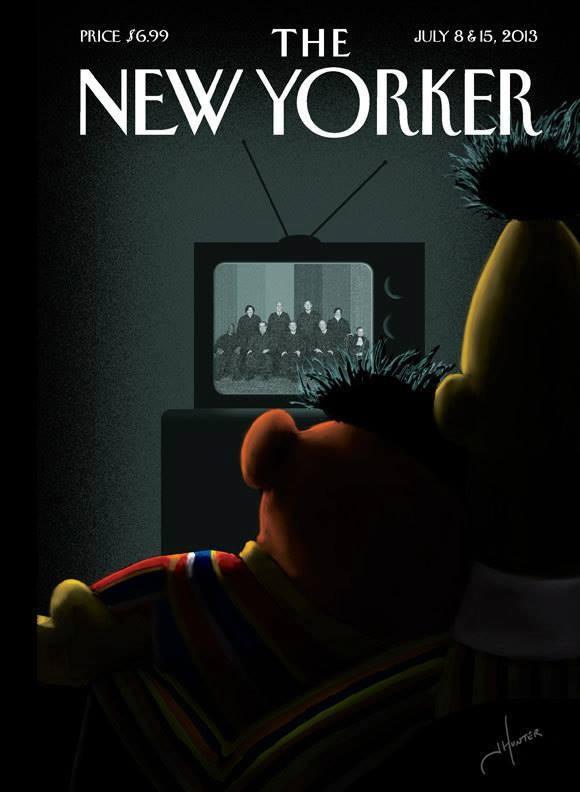 Good afternoon, newsjunkies!
Have you seen next week’s cover of The New Yorker that’s been floating around the internet yet? Well, obviously you have now if you’re reading this post. It’s nothing short of SQUEEEEE! Bert and Ernie nestled together on the couch snuggin’ while watching The Supremes in their robes on the TV.
The Supremes did good on knocking the wind out of DOMA, but it was a long time coming. They’re still in the doghouse for all their other despicable and unreal rulings this week. So while I did pop some champagne to celebrate the good things going on, including the tumbling down of DOMA, no cookies to the Supremes on this. I give the credit to all the grassroots LGBT activists and their growing accumulation of allies who have worked so hard for so many years to bring Wednesday’s ruling to fruition. Well done, everyone! The 21st century is finally starting to arrive…it’s here, it’s queer, and we as a society are not only going to live with it–we are going to live it up! Watch out, y’all, I am so happy for our LGBT sisters and brothers and for all of us as a ONE LOVE-ONE WORLD, I could about start doing some of my inner feminist Pollyanna somersaults all over this page. (I am an absolute klutz with no athletic motor skill coordination whatsoever, so that is truly a feat!)
So, to review:
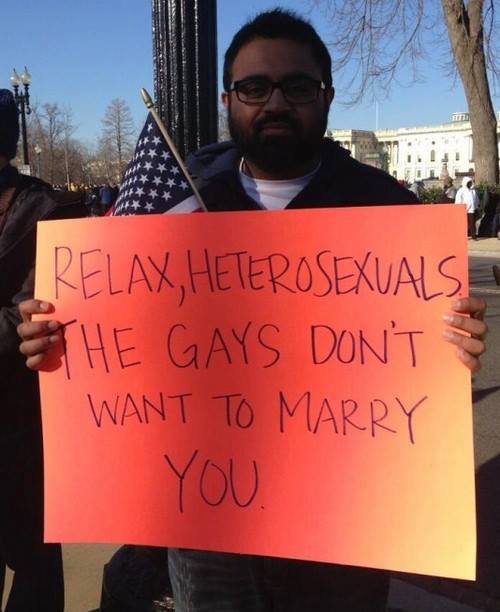
And, via HuffPo, 10 WAYS THE DOMA REPEAL WILL AFFECT ‘TRADITIONAL MARRIAGE’:
After the Supreme Court’s landmark decision that the Defense Of Marriage Act is unconstitutional, it’s time to look at the top 10 ways heterosexual marriage will be affected now that it’s not being defended.
1. Uh…
2. Uhhh…
3. Hmm…
4. Just a sec…
5. It’s like… You know how… It’s like when things… Right?
6. We swear we just had one
7. It’s coming… Wait for it…
8. Hey! Look over there!
9. Wait, where are you going?
10. Global warming?










Here’s what the wonderful Joyce L. Arnold of “Queer Talk” has been blogging over at Taylor Marsh’s, which I think gives a pretty good overview and is instructive in terms of “Where we go from here”…Note: I am only quoting excerpts here, interspersed with a bit of commentary from me, so take the time to click over and read the pieces in full when you get the chance:
The much anticipated Supreme Court rulings on DOMA and Prop 8 were announced this morning.[…] The fight for marriage equality isn’t over. Everyone knows that. But today is huge, and it’s time to do some celebrating.
Post SCOTUS, post DOMA and Prop 8 decisions, the “now what” in LGBT equality question is getting attention, and one response to that question comes by way of the Campaign for Southern Equality. The organization didn’t just come into existence, but they were very ready for this moment. Other LGBT groups are, too, of course, from local to state to national levels. I find the efforts of CSE to be particularly inspiring precisely because they refuse to comply with the “just move to where you’re more accepted” arguments – and we hear them regularly – but stay, and fight for equality. There are a lot of people doing that, in the South and other more “challenging,” but definitely changing toward the better, areas.
About CSE: (emphasis added throughout)
Based in North Carolina, the Campaign for Southern Equality is an effort to assert the full humanity and equality of LGBT people living in the South.
One of their projects is the WE DO Campaign, which
… involves LGBT couples in the Southern communities where they live requesting – and being denied – marriage licenses in order to call for full equality under federal law and to resist unjust state laws.
These WE DO actions serve to make the impact of discriminatory laws visible to the general public; they illustrate what it looks like when LGBT people are treated as second-class… citizens under the law.
Take less than three minutes to watch.
Here is the video Joyce has spotlighted, which is well worth the watch if you haven’t seen it yet. Very inspiring (this roundup continues after the video, so please keep scrolling after you view it):
More from Joyce’s post:
Celebrations continue. Statements agreeing and disagreeing with the decisions are still coming, from the White House to “citizen on the street.” Most likely the next sermon topic was an easy one for many, pro and con marriage equality.
And lots of analysis, which is obviously important, continues being done. It includes wide recognition that while this really is one of those moments we can call “historic,” there are 37 states with no marriage recognition; there are big questions about how same-sex couples are treated in terms of the military and immigration; and among other things, there is no federal employment protection. None of that detracts from the celebration. In fact, equality proponents in all of those “issues,” and more, can be energized by the SCOTUS decisions.
At The Advocate, “Message at Rallies: Celebrate Today, Fight Tomorrow.” At a post-SCOTUS decision rally in West Hollywood, with about 4000 people present, screenwriter Dustin Lanc Black said:
‘(I)t is time for each and every one of us to take that strength you now feel as Californians, and take it to Texas, and take it to Virginia … take it to Holland, Michigan … to Altoona, Pennsylvania. … You need to take your strength to these places, and share this feeling with this nation so we no longer leave a single one of our brothers or our sisters behind, no matter … which state they live.’
From the National Lesbian and Gay Task Force:
‘Today’s historic decisions are a significant leap forward for freedom and justice for same-sex couples and their families, the LGBT community and for our nation — and a lot more work needs to be done to deliver marriage equality to the rest of our nation’s same-sex couples and their families and full equality in every other respect for all LGBT people,’ said Rea Carey, Task Force Executive Director.
Parties continue around the nation, as they should. There’s a lot to celebrate. Statements and analyses will keep coming for a long time, I’d guess, as the impact of the decisions is made clear in practice. And advocacy and actions will continue, in all regions and states of the nation. Look to every region, including the South.
(We Do Campaign via Campaign for Southern Equality)
Dan Cathy, president of Chick-fil-A, tweeted his sadness about the Supreme Court decisions regarding DOMA and Prop 8, but then rather quickly deleted it. That seems a fair representation of Cathy’s efforts to somehow balance an anti-LGBT – at least related to marriage equality – while also, as a spokesperson put it, provide “genuine hospitality to everyone.”
Via Huffington, Cathy’s tweet:
Sad day for our nation; founding fathers would be ashamed of our gen. to abandon wisdom of the ages re: conerstone of strong societies
No word about what the founding mothers would think.
Ok, pardon me but I have to interrupt here to cackle my witchy woman feminist ass off. Joyce goes on to cover the ins-and-outs of Cathy’s trying to have his corporate cake and eat it too while lamenting his sadness over…what seems to me a more perfect union. That appears to be the source of Cathy and his ilk’s lament. They don’t want this union to become more perfect, because that requires giving up their various privileges and twisted means of ‘control.’ (Though it’s always hard not to ask for the most vehement of the homophobic crowd, if they are in control at all or really they are deep in the closet. Because, let’s let the elephant out the room, y’all. That’s the only reason legalizing gay marriage would affect a so-called heterosexual marriage that would need any defending from it.)
Joyce also quotes more whining tweets from Huckabee, et al., via OpEd News:
[Mike Huckabee tweet]: ‘My thoughts on the SCOTUS ruling that determined that same sex marriage is okay: ‘Jesus wept.’ …
‘Today, marriage, children, and the rule of law all suffer.’ Randy Thomassen, Save California. …
[Matt Barber tweet]: In states w/ ‘gay marriage’ there is no longer a legal or ethical defense against multi-party, incestuous or any other twiested ‘marriages’ …
How long before federal agents haul pastors out of the pulpit? – Todd Starnes, Fox News.
To which Joyce’s response is simply awesome:
Founding Fathers, weeping, suffering, children and incest … the familiar “the sky is falling” kind of responses.
As a follow-up to Joyce’s comment, I must insert the following, which I had used elsewhere on the internet (Facebook of course..on the Pink Sneaks support page JJ and I are working on) in reference to Stupakistan’s reaction. (Yes, I’m looking at you, Gov. Goodhair…) to the arrival of what Salon proposes we are now, i.e. a “Wendy Davis Nation.”
Anyhow, here is the graphic because it applies to what Joyce has highlighted about the sad, lamenting reactions to the DOMA/Prop8 reversal:
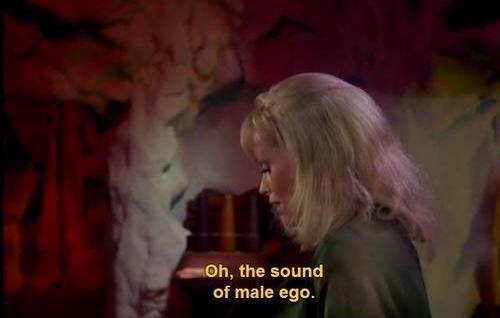
“Oh, the sound of male ego. You travel halfway across the galaxy, and it’s still the same song.” Star Trek: The Original Series, 1×06 (“Mudd’s Women”)
Joyce concludes by saying the following, which I totally agree:
My bet is the founding mothers and fathers just might approve of “liberty and justice for all” efforts. And since we’ve more or less (with some significant “less” moments and issues) been focused on that goal for quite some time, and the sky hasn’t even started falling, we’re safe to keep at it. And in trouble if we don’t.
Last but not least, Joyce reports…
The Respect for Marriage Act (RMA), filed by Sen. Diane Feinstein (D-CA) in the Senate and by Rep. Jerrold Nadler (D-NY) in the House, would completely repeal DOMA (Defense of Marriage Act). The Supreme Court decisions were a big step in that direction, but not complete.
Ok, as I said, please do go read Joyce’s pieces in full whenever you can. Here’s a handy link where you can see her posts archived together in one place.
Pivoting from “gay rights are human rights” (smiles in thoughts of Hillary and Hillary 2016) to “women’s rights are human rights,” I want to touch on that article,“It’s a Wendy Davis Nation Now,” that I briefly linked to above from Salon though, because I have a very revealing excerpt I wanted to highlight from it:
For years — particularly the ones Democrats spent in the wilderness, losing national elections — the party’s pro-choice stance was blamed for losing so-called values voters. Axelrod pointed out how that had changed: “These were motivational issues for people on our side … What’s interesting to me is that these were once wedge issues for Republicans. Now some of them are working as wedge issues against Republicans. And it shows a shift of attitudes.”
Gay rights, of course, have long since lost any traction as a wedge issue in Republicans’ favor in all but the narrowest districts. It remains to be seen how the immigration reform debate will play out politically, but the 2012 election and its “self-deportation” rhetoric is widely seen to have driven away Latinos and Asians. And of course there was defunding Planned Parenthood and Todd Akin. But, Axelrod added, abortion wasn’t part of that. Or, as he put it, “Abortion’s a separate discussion.”
If this week was any indication — along with recent protests in Wisconsin and Ohio, and possibly more to come — that may not prove true.
Thus, if we are truly entering Wendy Davis Nation, then we must be exiting not just Bush country, but also Rove-Axelrod’s understanding of women’s rights as a “separate discussion.” Keeping my ears open and my eyes wide and waiting to see what happens next!
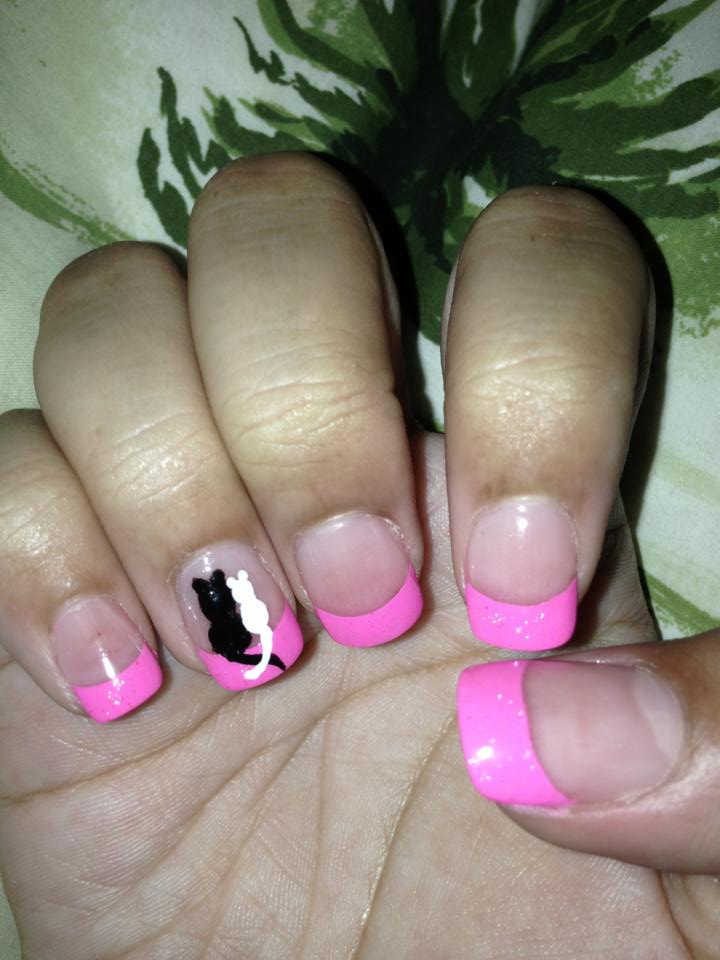
Before I end this post, just for some Caturday fun, and for purposes of smashing the patriarchy with my crazy cat lady pink-ness, here are pictures of my nails that I got done last night (click for larger view):

And, on that note, Sky Dancers, I’m going to turn the soapbox over to you. Do the wonderful thing you do in the comments y’all, and have a great weekend!
A run-on sentence on Orwell’s Birthday
Posted: June 25, 2013 Filed under: just because | Tags: Political affective disorder 71 Comments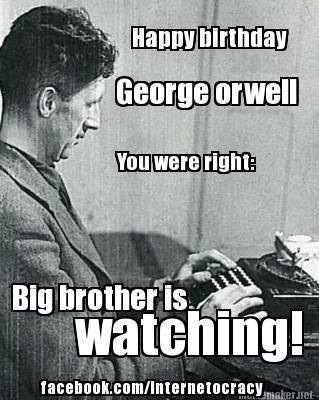
Fitting that the Supreme Court would overturn “the heart” of the Voting Rights Act on George Orwell’s 110th birthday. Meanwhile our national conversation is hyperfocused on the racially disturbing attitudes of an old white Southern woman with a food TV empire brand that she’s already damaged, as if it matters more than what our own Supreme Court is doing… Meanwhile big brother watches while we list out all our easily data-based likes and dislikes to Facebook so that the big business in bed with big brother can force feed us some more disaster capitalism adjusted to our preferences for what flavor we’d like it fed to us… Meanwhile Chris Brown defends his first amendment rights to be above the law and graffiti his house with ugly stuff that does infringe on the property rights of his neighbors, making a mockery of the principles of free speech…meanwhile a battered woman tattooed on his neck stares out at society blankly…meanwhile I wonder why I bother ranting. Oh that’s right. Racist capitalist patriarchy… while somewhere else Nelson Mandela is dying in a hospital bed…another one of our complicated patriarchal heros…no I’m not depressed or anything 😉
Denying Southern Reality and Other Acts of a Politically Motivated SCOTUS
Posted: June 25, 2013 Filed under: just because | Tags: SCOTUS, Voting Rights Act 12 Comments I think y’all know by now that I was raised culturally southern. I was born in the South. I live in the deep South and have for nearly two decades. We’ve been regaled recently with the news that Southern Cuisine maven Paula Dean still longs for the good ol’ days of smiling black servants or slaves. We ‘ve heard Haley Barbor talk up the old Southern institutions that were the institutional face of the KKK as being positive community builders. I still can’t believe that Mississippi doesn’t celebrate Memorial Day because it is a “Yankee Holiday” and enshrines the Confederate version by declaring April “Confederate Heritage Month”. But, you do not need these folksy stories of the obvious racism in the South to understand why today’s SCOTUS decision is a complete sham. Scalia has said that the Voting Rights Act is a “racial entitlement” in the past. It is not. It protects disenfranchised voter’s most basic right in a democracy. This is another example of the hypocrisy of the ‘conservative’ wing of the court. This is pure judicial activism.
Here is a list of things from Bader Ginsberg’s scathing dissent that lets you know exactly why the VRA is still necessary and is about protecting rights not creating entitlements.
Ginsburg’s dissent also rattled off these eight examples of race-based voter discrimination in recent history:
- “In 1995, Mississippi sought to reenact a dual voter registration system, ‘which was initially enacted in 1892 to disenfranchise Black voters,’ and for that reason was struck down by a federal court in 1987.”
- “Following the 2000 Census, the City of Albany, Georgia, proposed a redistricting plan that DOJ found to be ‘designed with the purpose to limit and retrogress the increased black voting strength…in the city as a whole.'”
- “In 2001, the mayor and all-white five-member Board of Aldermen of Kilmichael, Mississippi, abruptly canceled the town’s election after ‘an unprecedented number’ of AfricanAmerican candidates announced they were running for office. DOJ required an election, and the town elected its first black mayor and three black aldermen.”
- “In 2006, the court found that Texas’ attempt to redraw a congressional district to reduce the strength of Latino voters bore ‘the mark of intentional discrimination that could give rise to an equal protection violation,’ and ordered the district redrawn in compliance with the VRA…In response, Texas sought to undermine this Court’s order by curtailing early voting in the district, but was blocked by an action to enforce the §5 pre-clearance requirement.”
- “In 2003, after African-Americans won a majority of the seats on the school board for the first time in history, Charleston County, South Carolina, proposed an at-large voting mechanism for the board. The proposal, made without consulting any of the African-American members of the school board, was found to be an ‘exact replica’ of an earlier voting scheme that, a federal court had determined, violated the VRA…DOJ invoked §5 to block the proposal.”
- “In 1993, the City of Millen, Georgia, proposed to delay the election in a majority-black district by two years, leaving that district without representation on the city council while the neighboring majority white district would have three representatives…DOJ blocked the proposal. The county then sought to move a polling place from a predominantly black neighborhood in the city to an inaccessible location in a predominantly white neighborhood outside city limits.”
- “In 2004, Waller County, Texas, threatened to prosecute two black students after they announced their intention to run for office. The county then attempted to reduce the avail ability of early voting in that election at polling places near a historically black university.”
- In 1990, Dallas County, Alabama, whose county seat is the City of Selma, sought to purge its voter rolls of many black voters. DOJ rejected the purge as discriminatory, noting that it would have disqualified many citizens from voting ‘simply because they failed to pick up or return a voter update form, when there was no valid requirement that they do so.'”
To those who will be distraught, outraged, or fearful, the essential question at stake in the Court’s decision – and in the continuing vitality of Section 4 — is whether we believe racial discrimination in voting still exists in the South. The question being framed this way, the Court’s decision today will appear to be, at best, a denial of reality and a reflection of a naïve “post-racial” view that in the Obama era, racial discrimination in voting has ended. Justice Sotomayor, at oral argument, perfectly reflected this perspective on what the decision represents when she posed this pointed question to the VRA’s challengers: “Do you think that racial discrimination in voting has ended, that there is none anywhere?” The answer to that question must be no. From this vantage point, then, as long as racial discrimination in voting still does take place at all in the South, Section 4 of the VRA – the part the Court invalidated – remains not just justifiable, but essential.
In addition, to many people, the VRA symbolizes protection of the crown jewel of rights, the right of access to the ballot box. For those who know the history, this right was born from the blood and the bodies of all those who had been given the last full measure of their devotion to secure full access for all to the ballot box – those beaten on the bridge from Selma, Alabama in 1965, the three civil rights workers lynched in the Mississippi summer of 1964, and many others. How can the Court find unconstitutional an Act that plays any role at all in ensuring political equality regarding this most sacred right? And why should the Court second-guess Congress on these issues?
Yet to others, including the Court’s pivotal actor, Justice Kennedy, the essential question at stake is whether our political system is frozen in place on issues concerning race. Do our political institutions and culture have the capacity to recognize that dramatic changes at the intersection of race and voting have taken place over recent decades? Section 4 was created in 1965 as a short-term measure for five years; in initially upholding that system, the Court called it “an uncommon exercise of congressional power” justified by the “exceptional circumstances” of the massive disfranchisement of black voters (and many poor whites) that existed when the VRA was enacted. In 1970, Congress extended this system for another five years; in 1975, for another eight; and in 1982, for twenty-five more years. Then, in 2006, in the provision the Court struck down, Congress re-authorized this system for another twenty-five years, until 2031. Thus we moved from a five-year regime in 1965 for exceptional circumstances to a sixty-six-year regime that continues to single out nine states (and fifty-three other counties) for unique federal control.
But of even more symbolic significance, from this perspective: these areas all became covered because of their voting practices in 1964 or, at the latest, 1975 – nearly forty years ago. And these are the same areas, and nearly the only areas, that have remained covered ever since. Though the Act formally creates a mechanism to permit these areas to prove their current entitlement to be relieved of coverage, this part has never been a meaningful way for the Act to unwind itself from within: fewer than one percent of all the counties originally covered that have significant minority populations have ever emerged from the Act. From this vantage point, the question the case was “about,” then, is this: how can Congress act as if nothing significant enough has changed in the last forty years to justify any meaningful change at all in Section 4? Even if areas of discriminatory voting practices remain, surely they cannot mirror so exactly the areas of which this was true forty or fifty years ago.
From this starting place, Section 4 symbolizes that the issue of race remains so charged that our political system lacks the capacity to move forward to any extent at all. As Justice Kennedy put it at the argument: Congress “should use criteria that are relevant to the existing [conditions] – and Congress just didn’t have the time or the energy to do this; it just re-enacted it.” And despite the popular image that Section 4 is about protecting access to the ballot box, Section 4 long ago in practice became more about racial redistricting than access to the ballot box. While the Justice Department in recent decades blocked access changes on average fewer than twice a year, it blocked redistrictings nearly fourteen times as often. Indeed, in the 2006 Act itself, Congress itself did not rely primarily on ballot-box access problems to justify renewing Section 4, but on issues like redistricting. If Section 4 is “about” access to the ballot box in the public imagination, to the Court majority, I suspect, Section 4 is about racial redistricting.
Can this decision bring about any good? Well, it is possible because it should be clear now there is a total Republican assault on modernity and a world where white men don’t get to tell every one else what to do. The last election showed that the nation’s minorities and women were not about to let that happen again.
On its face, this looks like a big victory for Republicans. But is it really? I suspect it will turn out to be a poisoned chalice. Many of the GOP’s current problems stem from the fact that it is overly beholden to its white, Southern base, at a time when the country is rapidly becoming more racially diverse. In order to expand its base of power beyond the House of Representatives, the GOP needs to expand its appeal to minority voters. As the ongoing battle over immigration reform demonstrates, that process is going poorly and looks like it will be very difficult.
The Supreme Court’s decision to strike down a central provision of the Voting Rights Act will make it easier for Republicans to hold and expand their power in those mainly Southern states. That will, in turn, make it easier for them to hold the House. But it will also intensify the Southern captivity of the GOP, thereby making it harder for Republicans to broaden their appeal and win back the White House.
There is only so long that these neoconfederates can continue to push their backwards agendas through the federal government. They need to be thrown out of statehouses too. This seems to me an odd continuation of the Civil War. Nixon’s Southern Strategy will divide this country for decades to come. The hypocrisy of judicial overreach in this decision and most others that are penned by Scalia, Alito, Thomas, or Kennedy just oozes political scamming and it makes us all look bad. This is just another embarrassing attempt to stop the future. Future Courts will make hay of it.
Sunday Night Kind of Link-a-palooza
Posted: June 23, 2013 Filed under: just because | Tags: feminism 32 Comments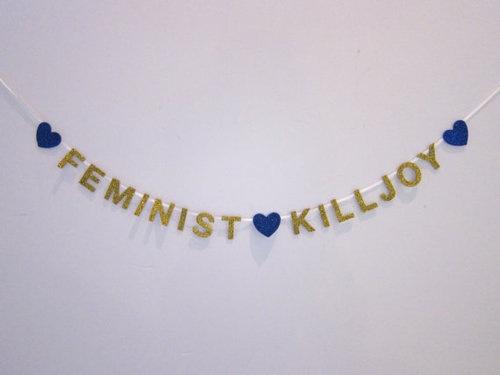
I am a proud feminist killjoy! Unrepentant, unapologetic, and frickin’ hilarious 🙂
Good evening, newsjunkies!
Mona here with some food for thought tonight, since I was absent from my soapbox on Saturday.
First off I want to start off with this blog piece entitled, “My Mom Was An Underground Railroad For Abused Women: What She Taught Me About Feminism And Fear“… I’m going to quote an excerpt, which is brilliant in its own right but really needs to be read in context to appreciate it fully. (if you click over be sure to bring your kleenex if you’re the feminist-verklempt type like me):
As her daughter, it took me nearly 20 years not to pity my mother’s “otherness.” She stopped pitying it herself a long time ago.
It’s taken me longer, still — until writing these words, actually — to develop admiration for the way she turned her seclusion and separation into not just a tool, but a blueprint for that tool; there were other women out there, who also didn’t have anyone to go to, and so she would use her resources to help them.
When I asked my husband to read over my notes, his response was, “Well. Your construction of ‘otherness’ is utterly overwhelmed by the narrative of how awesome your mom is. Is that intentional?”
I didn’t know if it was intentional — and then, suddenly, I did know.
That’s exactly what her life has done: let her personal actions, her very humanity, quietly absorb and subvert any narrative of “other.”
I wasn’t taught the ideas of “sisterhood” and “coalition” and the cognitive dissonance between the two until college, along with a whole host of other academic theory.
And even then, I soaked it up but it didn’t distill and crystallize until I developed a truly adult relationship with my mother — who herself says, “I didn’t even know there was a feminist movement; it just marched right past my front door.”
That wasn’t any real matter to her, the fact that she didn’t know the name for what she was doing; she just went right on doing it anyway.
Oh, the turning of xenophobic fear-of-the-oogadah-boogadah-other on its head! I really cannot recommend reading this one in its entirety *highly enough.* Go. Read. Now. (and don’t forget your tissues, my kindred feminist killjoys!)
Next up is the video I meant to showcase in my last post. Some of you may have already seen me post it in the comments subsequently, but it really deserves a spot on the frontpage…it’s also another one where I cannot do it justice by teasing or describing, though I will say Holly McNish and her inspired practice of the art of the spoken word, in concert with her unabashed feminist voice, is just a an absolute delight to behold… she is a true talent and gem. Her message in this youtube says so much about the ways in which women and girls are routinely socialized to see themselves from a warped perspective… and to live in an ever-dehumanizing world where women are just supposed to exist as playthings first and foremost, not as thinking, living, breathing human beings with appetites, desires, and prerogatives all their own:
…perhaps somewhere out there in the space-time continuum, Sylvia Plath–beloved wordsmith word-seamstress–smiles!
Now for my Sunday art pick…. the official trailer of the documentary Finding Vivian Maier:
I cannot wait to see this. I absolutely adore Vivian Maier’s photography (let’s be honest, it’s hard not to, as her work is visually arresting!) and the story behind her is absolutely fascinating. What a truly delicious enigma!
Finally, I’ll leave you with this:
Isn’t it fantastic? My favorite line: “Now set the foundation with the powdered ashes of Susan B. Anthony.”
Alright, Sky Dancers. Your turn! Open Evening thread.
Saturday: Cassandra
Posted: June 15, 2013 Filed under: just because | Tags: cassandra, feminism, party of nobodies 53 Comments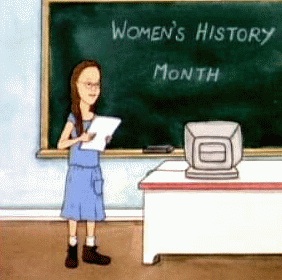
Cassandra, from the Beavis and Butt-head episode, “The History of Women”
Good afternoon, newsjunkies! Sorry for the delay with this morning’s reads. Had some technical issues (kept getting that spinny circle/hourglass thing–haven’t seen that in ages!)
Anyhow, let’s start off with a little HERstory, shall we?
From a neat little stanford.edu student website called “Mortal Women of the Trojan War”:
Hecuba, in Seneca’s play Troades, also compares herself to Cassandra:
Whatever misfortune occurs, and whatever harms the priestess of Apollo (Cassandra), raving, prophesied, the god (Apollo) prohibiting her to be believed, Hecuba, weighed with child (Paris), previously saw, nor did I keep my fear silent and before Cassandra I was the empty prophetess. Neither the cautious Ithacan (Odysseus) nor the nocturnal companion of the Ithacan (Diomedes) has scattered fire among you, nor the false Sinon. That fire is mine, by my torches you are burning.
And…
Today, June 15th, in 1895, Elinore Morehouse Herrick–the first woman (and seemingly only; still researching) appointed as a regional director of the NLRB–was born (emphasis in bold, mine):
As a divorced, 26-year-old mother, Herrick found herself supporting two boys on low wages. She accepted employment at DuPont’s rayon plant in Buffalo, New York, where she rose rapidly from pieceworker to training supervisor. In 1923, she moved south with the company, becoming production manager of its new factory in Tennessee. Under her direction the plant’s output equaled or exceeded those elsewhere, but knowing that she would not be promoted beyond her current level, Herrick moved her family to Ohio. There she attended Antioch College, financing studies in economics by running a boarding house with her mother’s help and taking part-time jobs. After her graduation in 1929, Herrick became executive secretary of the New York Consumers’ League, which monitored labor conditions for women in that state. While with the League, Herrick produced perceptive reports on female workers in canneries, laundries, and candy factories. When the Wagner Act of 1935 created the National Labor Relations Board, she was appointed regional director of the northeast district; the nation’s busiest, it handled twenty percent of all cases to come before the Board. Herrick’s negotiating skills led to the settlement of most disputes without litigation. During World War II, she became personnel director for Todd Shipyards and was responsible for integrating women and minorities into the wartime work force. Recognizing that the arrival of peace would force many women out of industrial jobs, she argued that society should maintain employment opportunities “for all who want to work or for all who must work irrespective of sex.” Her appeals went unheeded, however, as female workers were dismissed from wartime industries when veterans returned home. Herrick left Todd Shipyards to become personnel director for the New York Herald Tribune and continued writing on labor issues during the postwar era.
Here is a kickass image of her at Corbis, entitled “Portrait of Career Women at Tribute Dinner,” dated March 22, 1935. Please check it out. She’s the first person to the left on the front row. (It’s copyrighted or else I’d have included it here.)
And, here’s a PDF of “Why People Strike,” a piece penned by Herrick. Teaser:
Too much reliance has been placed on the ability of industry to govern itself, with the result that codes have been selfishly drawn with an eye toward pleasing selfish and dominant employer interests.
Well, would you look at the prescience on her!
THIS is what the insularity and hegemony of patriarchy does. It shuts out voices like Herrick’s from the center stage of the debate during their times and altogether whitewashes them from the history books pored through by any one other than an archery-goddess-witchy-woman feminist like myself.
Speaking of which… Here’s the iconography that speaks to me as such, photography by Henriette Milelke:
Click photo to view on FB at Henriette Mielke’s page in its full glory.

This gives me a perfect excuse to tell you that I find Henriette Mielke’s photography absolutely mesmerizing. I stumbled upon her work through the graces of facebook, and I haven’t been able to stop looking since! It’s erotic, evocative, and just somehow distinctly feels…feminist. I may be wrong in attributing that to her. I don’t know. But, something about these images of women…seems to be about women, from a women’s point of view. I urge you to click on over and check her work out and view and determine for yourself. I’m merely including that blockquoted image to pique your interest….there’s so much more double x energy from whence it came!
Alright, I’m just going to do the rest of this post in a link-a-palooza fashion:
- An update in the call for Justice for Marco McMillian, slain Clarksdale, MS mayoral candidate…as police there continue to bury their ostrich heads in the sand, Community demands answers from Department of Justice (emphasis in bold, mine):
Wearing Justice for Marco T-shirts, family and friends of the late Marc McMillian are demanding answers and justice.
The family’s attorney, Daryl Parks, said, “Somebody will explain the burn marks on his body; somebody has to explain the torture he went through.”
In late March, the openly gay former Clarksdale mayoral candidate was brutally murdered. The National Black Justice Coalition isn’t convinced the murder wasn’t a hate crime.
Sharon Luttman with the National Black Justice Coalition said, “Society allows it to be some sexual violence or miscommunication when he’s the one that was burned, that was dragged, that was stabbed. The autopsy report shows that.”
- Personally I think the following ad in question needs “MOAR ZEST,” what do y’all say?… Kraft Zesty Dressing Ad Offends ‘One Million Moms,’ Sparks Debate:
A new ad for Kraft Zesty Italian Dressing is a little too spicy for one group of “concerned” women.
A “let’s get zesty” ad showing a naked man with a strategically placed picnic blanket protecting his modesty allegedly ran as a print ad in a recent issue of People, causing conservative group “One Million Moms” to write a press release calling the ad “disgusting” and saying that the company has “gone too far.”

- Caturday pick of the week (well technically the past month, but I just stumbled upon it now): There is now a font made entirely of cats!
Are you a writer? Or maybe just an active Facebook and Twitter-er who misses the good old days of handwritten letters, before digital media destroyed our capacity to express human emotion with words? Either way, are you tired of waiting for all communication to move past the clunky words of generations past and finally metamorphose into the dancing cat GIFs that we all know and love?
Then boy, does the Internet have the thing for you. Meet Neko Font, a web app that will transform text into a new font made entirely out of cats. Well, pictures of cats, to be precise. All you have to do is insert the copy of your choice into the text box and Neko Font (Japanese for “cat font”) instantly hands it back in cat form.

- My goddess pick on spirituality/religion food for thought… a youtube making the circles right now thanks to Upworthy’s recent spotlight of it under the title, “Best Explanation Of Religion I Have Ever Heard, And I’m Practically An Atheist”:
Patty Murray arrived 20 years ago to a U.S. Senate whose “gentlemen” members had a convenient restroom just off the Senate floor, but not the six “gentle ladies.”
“We had to go upstairs and down a long hall,” Murray recalled on Wednesday.
Murray: “We had to go upstairs and down a long hall.”
As the old cigarette ad put it, you’ve come a long way, baby.
The Senate now has 20 women. “Gentle ladies” chair the Senate Appropriations Committee, the Senate Intelligence Committee, the Senate Agriculture Committee and the Senate Indian Affairs Committee. Murray is in the Democratic leadership.
And the “gentle ladies” of Congress’ upper chamber are getting a new, expanded bathroom. While it doesn’t have a glass ceiling, the new restroom will come complete with a window looking out from the U.S. Capitol.
A restroom was carved out of the off-the-floor men’s room, but it was small and cramped.
“It’s no longer convenient: There’s a line,” joked Murray.
Sen. Jeanne Shaheen, D-New Hampshire, excitedly tweeted on Wednesday that the commodious restroom is a “sign of change” in the U.S. Capitol. “It says we are at work and we require equal treatment,” Murray said.

Okay, I’m going to stop there because my computer just isn’t cooperating this weekend. But, I will say I’m reminded here of Rand Paul’s infamous toilet rant… *wink*
Anyhow, what’s on your reading list this weekend Sky Dancers? Please help me fill in the blanks of these abridged Saturday reads!

 peej
peej Carissa
 bostonboomer
 dakinikat
 ecocatwoman
 mablue2
 Mama Lopez
 peggysue22
 quixote
 skydancingguestblogger
 Mona (aka Wonk the Vote)



 Sky Dancing
Recent Comments