Posted: May 20, 2016 | Author: bostonboomer | Filed under: just because |
Good Afternoon!!
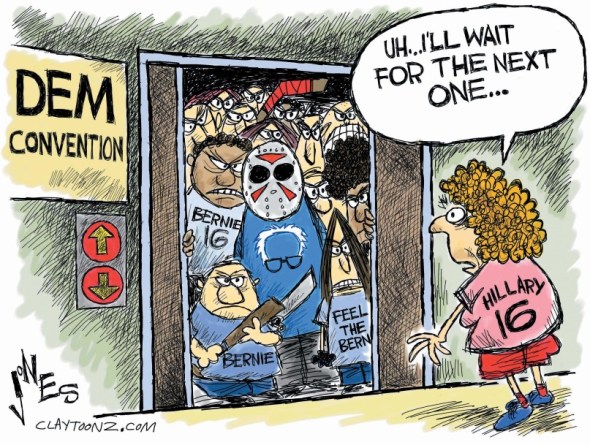
It looks like the Bernie bros are determined to disrupt the Democratic Convention in July, despite the possibility that this could hurt Hillary’s chances to defeat Donald Trump in November.
From NBC10 in Philadelphia: City Approves Four Massive Pro-Bernie Sanders Rallies During DNC.
Four pro-Bernie Sanders rallies, with estimated attendance of 38,000 activists, have been approved for public demonstrations during the Democratic National Convention in July, the city said Thursday.
The four rallies, given permits Wednesday night, bring the total to five for approved rallies and marches during what is expected to be a bustling week of political activity in Center City and South Philadelphia. The convention officially runs July 25-28, but two of the five approved rallies and marches of more than 7,000 activists will be held July 24 — the day more than 4,000 delegates arrive from across the country.
NBC10 first reported Wednesday that an anti-fracking, clean energy group called Food & Water Watch was the first to receive a city permit for public demonstration. A group organizer said more than 5,000 activists are expected July 24 at a march from City Hall to Independence Mall.
For the largest of the four pro-Sanders rallies approved, more than 30,000 people are expected to attend weeklong demonstrations called “March for Bernie at DNC,” which will be held at FDR Park in South Philadelphia. It’s within earshot of where conventioneers will gather at the Wells Fargo Center to nominate their party’s presidential nominee.
It’s not clear if these rallies are being organized by the Sanders campaign or by Bernie supporters or whether Sanders himself with speak at them. I’d be surprised if he could resist appearing before large crowds and drawing attention away from the convention itself.
Their permits were submitted by individuals, and the city would not identify them, a spokeswoman for Mayor Jim Kenney said.
She cited personal privacy concerns for the applicants.
The fourth pro-Sanders demonstration approved Wednesday has a sponsoring organization identified.
A group called Black Men for Bernie has been approved to hold a “We the People Restoration Rally” at Thomas Paine Plaza across from City Hall on July 27-28. They will be allowed to gather from 9 a.m. to 7 p.m.
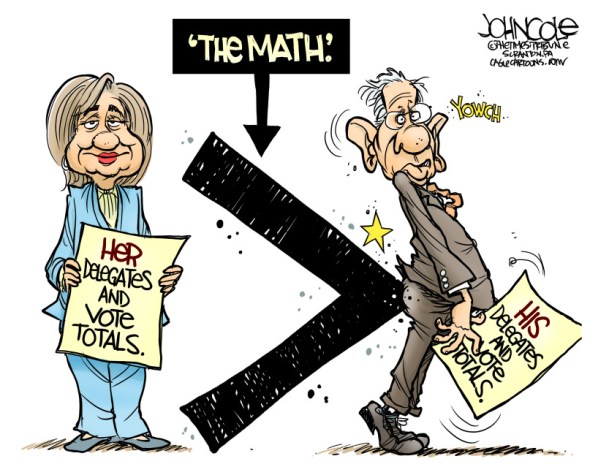
Sanders and his supporters seem determined to turn 2016 into another 1968. It’s pretty ridiculous when you consider that in 1968 people were protesting the ongoing Vietnam war and the assassinations of Martin Luther King and Bobby Kennedy. In 2016, the grievances are about a bunch of conspiracy theories complaints debates, delegates and superdelegates, and the nomination being supposedly “stolen” by the woman who is leading by 3 million popular votes.
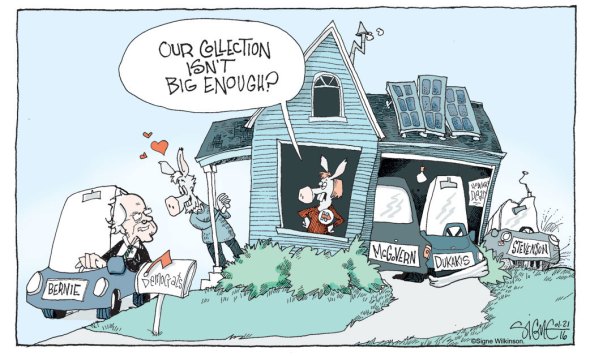
Here’s a very good piece from the Minneapolis Star-Tribune by Norman Sherman, who according to the bio at the end, worked for both Hubert Humphrey as VP and then for Eugene McCarthy.
Lessons from 1968: Bernie Sanders needs to put snide aside.
A cheering audience is a political aphrodisiac. Candidates for president, moved by crowds’ affection, become convinced that they are right, their opponents wrong. The pout of political pride makes backing off difficult later on.
Every campaign, no matter how humble and reasonable the candidate at the beginning, encourages a growing conviction of unique importance. This year, Donald Trump is the leading example, but self-importance is not a partisan condition. Sen. Bernie Sanders is justifiably gratified by his leap from obscurity to a formidable string of primary victories and special success in capturing the hopes of millions, particularly the young and idealistic.
But Sanders’ criticism of Hillary Clinton — constant and repetitious — has become increasingly bitter. That may be productive now, but those words do not disappear when the convention makes a choice and it is not him. They become weapons for the political enemy. In the mouth of Trump, particularly, they would become bludgeon and meat ax.
Sanders should calm down, save the vitriol and think of the consequences of not doing so.
Obviously, Sherman speaks from experience. You’ll recall that in 1968 Eugene McCarthy was passionately supported by young people. After he demonstrated he could do well in New Hampshire, President Lyndon Johnson announced he would not run for reelection. The Bobby Kennedy decided to get into the race, and many people who had supported McCarthy switched to Kennedy. George McGovern, who would win the nomination in 1972 and lose 49 states, also got into the act. Humphrey ran in Johnson’s place, but it was too late for him to get into any primaries.
After Kennedy was assassinated, Sen. George McGovern took up his anti-Vietnam crusade, and he and McCarthy — like Bernie Sanders today — aroused huge, enthusiastic crowds, including many young people.
McCarthy patronized Humphrey as weak, sometimes ridiculed him, made him damaged goods for the general election. But Humphrey ultimately accumulated a huge lead in delegate votes.
McCarthy, McGovern and Kennedy had provided focus for the antiwar movement and for those who, for whatever reason, were fed up with Johnson and Humphrey. It took courage on their parts. And they had served the country well.
Once Humphrey was nominated despite their policy differences, McGovern immediately announced his support for Humphrey. McCarthy was silent….
Ultimately, Humphrey lost the election by less than a percentage point. States where McCarthy was immensely popular might have been won with his support and would have provided the electoral votes needed for election.
Sherman says that Bernie needs to decide very soon whether he will be a McGovern or a McCarthy.

Tina Nguyen at Vanity Fair: Is Bernie Sanders Becoming 2016’s Ralph Nader?
Just three weeks after offering a conciliatory statement suggesting he was winding down his campaign, Bernie Sanders’s race for the White House has taken on a renewed urgency that has shocked the Democratic establishment with its newly belligerent tone. Despite the fact that it is practically impossible for the Vermont senator to catch up to Hillary Clinton, party leaders are now grappling with the prospect of an ugly, drawn-out fight that could roil the Democratic National Convention in July.
The trouble began at the Nevada state convention on Saturday, which turned violent after Sanders’s supporters rebelled against party rules they perceived as unfair by throwing chairs and screaming at Democratic officials they accused of favoritism toward Clinton. Sandersbarely apologized, instead launching into a verbal assault against the D.N.C., infuriating party figures eager to move on to the general-election fight against Donald Trump. Suddenly, it seems the anti-Establishment rage that until recently threatened to tear apart the G.O.P. is at the Democratic Party’s doorstep. What changed?
According to advisers who spoke to The New York Times, Sanders was re-energized by several polls that suggested he would beat Trump, the presumptive Republican nominee, by wider margins than Clinton in several key states. And while his campaign previously signaled that they are aware he can’t win, Sanders is now willing to harm the Democratic front-runner in order to gain maximum political leverage at the convention in Philadelphia. “We have to put the blinders on and focus on the best case to make in the upcoming states,” strategistTad Devine said. “If we do that, we can be in a strong position to make the best closing argument before the convention.”
What closing argument? The race is already over and Bernie lost. If he ever had any realistic chance of getting superdelegates to switch to him, he certainly can’t convince them after attacking the DNC, the Democratic Party, and the likely nominee. But apparently he just can’t accept that he lost to a woman.
That closing argument, increasingly, is taking the form of a concerted attack on the D.N.C. itself—exactly at the moment when Democratic leaders were preparing to shift their energies toward Trump. Now, they face a two-front battle, with Republicans bashing Clinton on one side, and Sanders’s surrogates condemning their own party system on the other. In the wake of the Nevada-convention debacle, the Sanders campaign has doubled down on its critique of the D.N.C., which they accuse of favoring Clinton, refusing to hold additional debates, and helping the former secretary of state fundraise. Animosity toward the front-runner has reached a fever pitch in recent days. On Wednesday, campaign manager Jeff Weaver accused D.N.C. chairwoman Debbie Wasserman Schultz of “throwing shade on the Sanders campaign from the very beginning.” And Devine, Sanders’s senior adviser, told theTimes that his team was “not thinking about” whether their efforts might help Trump in the long run. “The only thing that matters is what happens between now and June 14,” he said.
Last night the Daily Show weighed in on the Bernie bro situation. You can watch the video at The Wall Street Journal: ‘The Daily Show’ Spoofs Impassioned Bernie Sanders Supporters. I know it’s supposed to be satire, but the woman played by Eliza Cossio is pretty realistic based on what I’ve seen on Twitter and in videos.
Played by “Daily Show” correspondents Roy Wood, Jr. and Eliza Cossio, this Bernie Bro and Bro-ette weren’t so much using their screen time to stump for their preferred Democratic candidate as they were parodying the fervent nature of Sanders’s followers.
If anything, the segment showcased the increasing divide between the Bernie Bros themselves, as Wood portrayed a Sanders supporter who at least seemed willing to vote for Hillary Clinton if and when she claimed the Democratic nomination. Cossio, on the other hand, portrayed a Bro-ette who was steadily losing her grip on reality….
When it came to discussing the recent unrest at the Nevada State Democratic Convention, Cossio and Wood held vastly different stances: Cossio was all for it, whereas an embarrassed Wood said, “Actually, I wasn’t so hot on that – all that unruly behavior, we just can’t be lashing out everywhere.”
Cossio and Wood also disagreed on the death-threat-tinged harassing messages left on Nevada state party chairwoman Roberta Lange‘s voicemail (you can hear excerpts in the video):
“That’s passion,” observed Cossio. “No, that’s a felony,” corrected Wood.
Check out the video at the WSJ link.
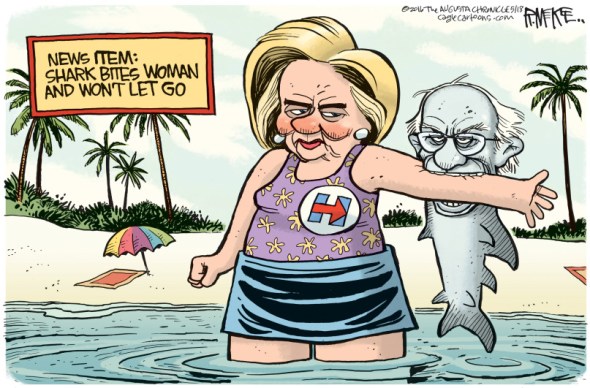
The case Bernie has been making is that he is a working class hero who can lure white voters away from Trump in the general election. Is there any truth to that argument? I don’t think so. I think he’s like Gene McCarthy–most of his followers are young people who are idealistic but ignorant about politics and government. Here’s Jeff Stein at Vox: Bernie Sanders’s base isn’t the working class. It’s young people.
After Bernie Sanders crushed Hillary Clinton in the West Virginia primary last week, the national media was ready with an explanation: the white working class.
The New York Times and The Atlantic, for instance, bothattributed Sanders’s win to his strength among low-income white workers. “White Working-Class Voters in West Virginia Pick Sanders Over Clinton,” read NPR’s headline.
This trope has become the conventional wisdom in the media, with the
Wall Street Journal,
the Nation,
The Huffington Post, and a host of other outlets (including
me at Vox) stating as fact that downscale whites have formed a crucial piece of Sanders’s base.
This interpretation makes for an interesting narrative, but it’s missing the real story. Sanders’s victories aren’t being powered by a groundswell of white working-class support, but instead stem from his most reliable base since the start of the primary: young voters.
Because young voters also tend to have lower incomes, the massive age gap between Sanders and Clinton has sometimes looked to observers like a gap in economic class, according to political scientists Matt Grossmann and Alan Abramowitz.
But the most salient divide in the primary is not between rich and poor. It’s between young and old — and between white and black.
Please go read the rest.
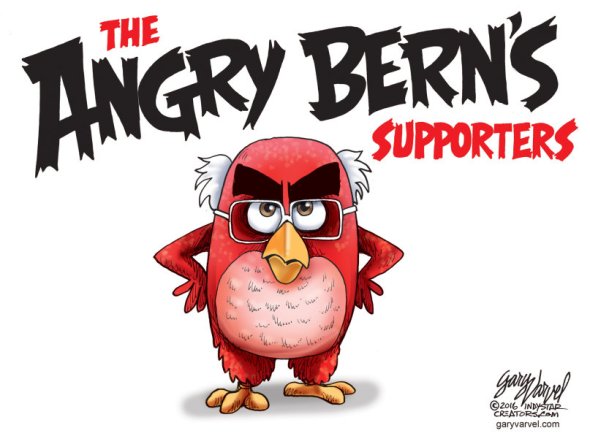
I’d rather be writing about Hillary Clinton vs. Donald Trump today, but Bernie and the bros just won’t go away. I think we need to be prepared for their tantrum to continue for a long time. I hope Bernie wakes up and decides not to be this year’s Gene McCarthy or Ralph Nader, but I’m not holding my breath.
What stories are you following today?
Did you like this post? Please share it with your friends:
Posted: May 17, 2016 | Author: bostonboomer | Filed under: just because |
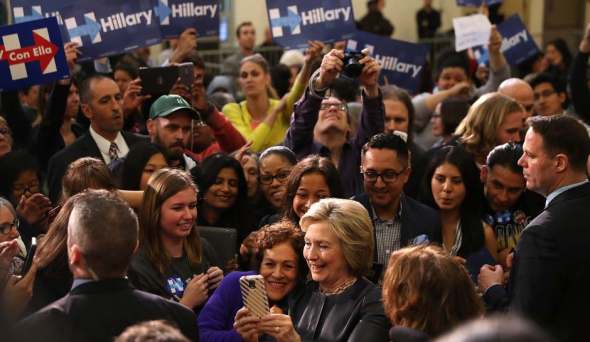
Hey Sky Dancers!!
Here’s fresh thread for Oregon. The last one is getting really long. I had to go out tonight for a family event, so I’m clueless except that Hillary appears to be the winner in Kentucky. We still have to wait a bit before the results come in from Oregon. I’m really hoping Hillary will win there too. It’s time to crush Bernie’s fantasy revolution once and for all.
I’m too tired to write much, but I happened to see this piece at The Hill: Sanders campaign manager: There will be no violence in Philadelphia.
Bernie Sanders’s campaign manager, Jeff Weaver, sought to allay the fears of Democrats worried about chaos breaking out at the party’s national convention.
Speaking on CNN Tuesday night, Weaver said the Democratic National Convention in Philadelphia in July would not be a repeat of the bedlam that broke out over the weekend at the state Democratic convention in Nevada.
“There’s not going to be any violence in Philadelphia. We can guarantee that,” Weaver said. “We hope for a very fair and orderly convention. I think everybody wants that. Whoever the ultimate nominee, is we want to unify the party on the back of the convention to beat Donald Trump in the fall. I don’t think there’s any doubt about that.”
Weaver called the Nevada convention an “aberration” and “anomalous” compared to what has happened at every other state convention held so far.
Many Democrats are unsettled by the scene that played out there over the weekend.
Well, I’m glad Weaver seems to have begun to understand how serious this is getting, but does anyone think these guys can control the Bernie bros? They haven’t been able to so far.
From CNN: Dems’ new fear: Sanders revolt could upend Democratic convention.
I’m glad some Democratic leaders are finally getting the message that Bernie and his bros are out of control. Harry Reid must be beside himself. He told CNN that Bernie “condemns” the behavior of his supporters last weekend, but Bernie subsequently came out with a statement that in no way condemned it and in fact contained threats and ultimatums. Someone is going to have to sit down with Bernie and do more than talk. They need to explain that he’ll lose his committee chairs and have a primary opponent in 2018.
So what are you hearing and reading?
Did you like this post? Please share it with your friends:
Posted: May 10, 2016 | Author: bostonboomer | Filed under: just because |

Good Afternoon!!
Today is the West Virginia primary. As Al Giordano says, we are in “garbage time” now, and the Clinton campaign is focusing on the general election while Sanders tries to win delegates as the primary clock runs down. He has no chance to win the nomination, so Hillary is trying to let him and his followers down gently by not running a lot of ads in the state. Bernie is favored to win; but it will probably be close, and he will likely net just a few delegates–perhaps 3 or 6. That won’t put much of a dent in Hillary’s lead.
The time has come for Hillary supporters to project quiet confidence and ignore Bernie and his bros as they metaphorically throw themselves to the floor kicking and screaming in their childish tantrums. We are in a much bigger battle now. We have to focus on keeping an ignorant, narcissistic, sociopathic, megalomaniac and wannabe tyrant out of the White House.
Today I want to examine a very serious question: Is Donald Trump suffering from a cognitive disorder or some form of dementia? Donald’s father Fred suffered from Alzheimer’s disease. He was diagnosed six years before he died at age 93, but it’s likely he was experiencing symptoms before that. Wealthy and famous people tend to be protected in our culture even when they are behaving in ways that would be labeled as “crazy” in “ordinary” citizens.
Donald certainly shows a number of signs of having cognitive difficulties. He is 69 years old and, if elected, would be the oldest U.S. President ever inaugurated. Hillary Clinton is only one year younger than Trump, but she appears to be functioning at a very high level intellectually.
Clinton has no problem remembering names, no obvious difficulty with thinking and speaking coherently, and is obviously capable of making and understanding complex arguments. Donald Trump, on the other hand, appears to have difficulty staying focused on a subject or question; and either his short-term memory abilities are damaged or he’s an extremely unskilled liar.

Several writers addressed the possibility that Trump could be cognitively impaired early in his campaign. Here’s an example from an academic blog called Language Log: Trump’s aphasia, by Geoff Pullum.
The following word-stream (it cannot be called a sentence) was uttered by Republican presidential contender Donald Trump on July 21 in Sun City, South Carolina. As far as I can detect it has no structure at all: the numerous conditional adjuncts never arrive at consequents, we never encounter a main verb or even an approximation to a claim. The topic seems to be related to nuclear engineering, Trump’s uncle, the Wharton School, Trump’s intelligence, politics, prisoners, women’s intelligence, and Iran. But it’s hard to be sure:
Look, having nuclear—my uncle was a great professor and scientist and engineer, Dr. John Trump at MIT; good genes, very good genes, OK, very smart, the Wharton School of Finance, very good, very smart—you know, if you’re a conservative Republican, if I were a liberal, if, like, OK, if I ran as a liberal Democrat, they would say I’m one of the smartest people anywhere in the world—it’s true!—but when you’re a conservative Republican they try—oh, do they do a number—that’s why I always start off: Went to Wharton, was a good student, went there, went there, did this, built a fortune—you know I have to give my like credentials all the time, because we’re a little disadvantaged—but you look at the nuclear deal, the thing that really bothers me—it would have been so easy, and it’s not as important as these lives are (nuclear is powerful; my uncle explained that to me many, many years ago, the power and that was 35 years ago; he would explain the power of what’s going to happen and he was right—who would have thought?), but when you look at what’s going on with the four prisoners—now it used to be three, now it’s four—but when it was three and even now, I would have said it’s all in the messenger; fellas, and it is fellas because, you know, they don’t, they haven’t figured that the women are smarter right now than the men, so, you know, it’s gonna take them about another 150 years—but the Persians are great negotiators, the Iranians are great negotiators, so, and they, they just killed, they just killed us.
Here’s a response from another language blogger, Arnold Zwicky:
It seems to me that Trump was leaping aimlessly about from topic to topic and referent to referent, the mark of the flight of ideas.
Thought disorder. From Wikipedia:
Thought disorder (TD) or formal thought disorder (FTD) refers to disorganized thinking as evidenced by disorganized speech. Specific thought disorders include derailment, poverty of speech, tangentiality, illogicality, perseveration, neologism, and thought blocking.
[among the recognized derangements is the …]”Flight of ideas” – a form of formal thought disorder marked by abrupt leaps from one topic to another, albeit with discernable links between successive ideas, perhaps governed by similarities between subjects or, in somewhat higher grades, by rhyming, puns, and word plays (clang associations), or innocuous environmental stimuli – e.g., the sound of birds chirping. It is most characteristic of the manic phase of bipolar illness.
Now I’ve written here about “associative thinking”, in which someone moves through a chain of ideas, each one latching naturally to the one before, but easily capable of carrying someone far from a starting point. We all think this way, and everyday conversation tends to follow such paths, only for a group as a whole rather than for just one speaker. There is nothing disordered in any of that.
I’ve observed the flight of ideas up close in people in the manic phase of bipolar illness, and somewhat similar associations in classic schizophrenics, and indeed related disordered associations in people with dementia, including my partner Jacques (who was especially subject to intrusions of sounds and sights from the environment into his train of thought). Donald Trump looks distressingly familiar to me.
Is is possible that Trump suffers from bi-polar illness with mania being the main symptom? He says that he sleeps very little and he often tweets in the middle of the night. Or could it be dementia? I have no idea whether Trump has always spoken so incoherently or if his symptoms are increasing with age. I do think it is a serious question for voters to be aware of and for journalists to investigate.

There is also the question of Trump’s ability to lay down long-term memories. Is he just a blatant liar, or does he have difficulty recalling things he has said very recently? One egregious example of this is Trump’s claims that he opposed the Iraq war back when the Bush administration was ramping it up. From Eric Black at MinnPost in February:
Trump is great at non-answer word salads in which he not only interrupts the questioner but constantly interrupts himself, puts out little self-congratulatory asides and says whatever he wants, usually things he has said a million times before but which often qualify as non-answers.
Trump has made a yuuuge deal about how he warned in advance, long and loud, that the Iraq War would be a disaster. Joe asked him about why no one can find any transcript of him saying anything remotely along these lines until after the war started. His explanation, Thursday night and I guess every time he is asked this, is to say that because he wasn’t in public office or anything, his prescient warnings didn’t make it into any transcripts or video archives. Then he goes right back to claiming to have said it long and loud and in advance and doesn’t explain why so many of his later statements about the war (which are far more mixed than he describes them) manage to show up in the public record, since he was still not in public office or anything.
There is absolutely no evidence that Trump ever opposed the invasion of Iraq and plenty of evidence that he supported it. Is he deliberately lying or does he simply not recall what he believed back in the 2000’s?
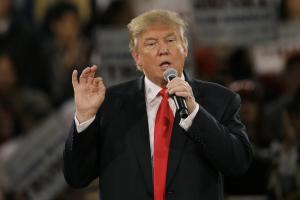
Republican presidential candidate Donald Trump speaks during a campaign rally, Friday, Dec. 11, 2015, in Des Moines, Iowa. (AP Photo/Charlie Neibergall)
Another example from a February post at Daily Kos:
Trump has frequently bragged that he has“one of the best memories of all time.” However, that boast has been utterly demolished by his own words and actions. One notable example was his insistence that he had seen television reporting of “thousands and thousands” of Muslims celebrating the collapse of the World Trade Center towers on 9/11. That was an invented memory because there is no evidence that it occurred, despite the fact that television footage of such an event would be easily retrievable.
Trump’s memory was also noticeably deficient when he recently began hammering Ted Cruz as a “nasty guy” and “the single biggest liar” he ever met. Just three months ago he was lauding Cruz and floating him as a possible VP pick. Similarly he once praised Hillary Clinton as a “terrific” woman and a great Secretary of State. Now he is saying that she was the “worst Secretary of State in history.” And as for President Obama, today Trump tweeted that he is “perhaps the worst president in U.S. history.” But this is what he wrote in his book “Think Like A Champion:”
“What he has done is amazing. The fact that he accomplished what he has—in one year and against great odds—is truly phenomenal.” […]”Barack Obama proved that determination combined with opportunity and intelligence can make things happen—and in an exceptional way.” […]
“His comments have led me to believe that he understands how the economy works on a comprehensive level. He has also surrounded himself with very competent people, and that’s the mark of a strong leader.” […]
“He’s totally a champion.”
Clearly Trump has either a failing memory or mental blocks that render his memory unreliable. Many other examples exist. For instance, he said he couldn’t remember a disabled reporter that disgustingly mocked, but they had met many times; he threatened to sue Cruz three days after he promised that he never would; he complained that the media never reported a comment by Jeb Bush and seconds later, after Bush denied the charge, Trump defended himself by saying that the news reported it ten times.
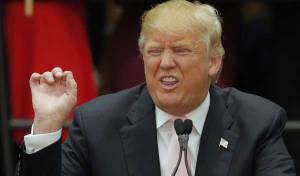
There are numerous examples of Trump’s incoherent thinking. I’d strongly suggest that you read the transcript of his interview with The Washington Post editorial board if you haven’t done so already. This section of the interview has gotten quite a bit of attention:
RYAN: You [MUFFLED] mentioned a few minutes earlier here that you would knock ISIS. You’ve mentioned it many times. You’ve also mentioned the risk of putting American troop in a danger area. If you could substantially reduce the risk of harm to ground troops, would you use a battlefield nuclear weapon to take out ISIS?
TRUMP: I don’t want to use, I don’t want to start the process of nuclear. Remember the one thing that everybody has said, I’m a counterpuncher. Rubio hit me. Bush hit me. When I said low energy, he’s a low-energy individual, he hit me first. I spent, by the way he spent 18 million dollars’ worth of negative ads on me. That’s putting [MUFFLED]…
RYAN: This is about ISIS. You would not use a tactical nuclear weapon against ISIS?
[CROSSTALK]
TRUMP: I’ll tell you one thing, this is a very good looking group of people here. Could I just go around so I know who the hell I’m talking to?

This happened toward the end of the interview and Trump seemed unaware of how long he’d been talking. He also seemed unaware that he had time-limited the interview because he had to be at another meeting.
HIATT: Sure, then I’d like to let a couple of them get in questions.
LEWANDOWSKI: We have got five minutes, hard out.
HIATT: Okay.
TRUMP: Oh is it?
CORY: Yeah. You have a meeting you have to get to.
There are endless examples of Trump’s disordered thinking and use of language. There is clearly something wrong with him. In a few months, this man will be receiving confidential security briefings and there is even a chance that he could become President. I’m going to list more article for you to check out, and I hope you’ll read them, consider this question, and talk to your friends and neighbors about it.
Jennifer Rubin at The Washington Post: Trump’s word salads conceal his ignorance.
Max Eherenfreund at Wonkblog: Five times Donald Trump changed his position on a really big issue.
Steve King at Death and Taxes: Does Donald Trump have dementia?
The Inquistor: Does Donald Trump Have Alzheimer’s? Questions about the GOP Frontrunner’s Mental Fitness Arise.
Sophia A. McClennon at Alternet: Maybe Donald Trump Has Really Lost His Mind: What If the GOP Frontrunner Isn’t Crazy, but Simply Not Well?
Now what stories are you following today? Please post your thoughts and links in the comment thread and have a great Tuesday!
Did you like this post? Please share it with your friends:
Posted: May 3, 2016 | Author: bostonboomer | Filed under: just because |
Good Morning!!
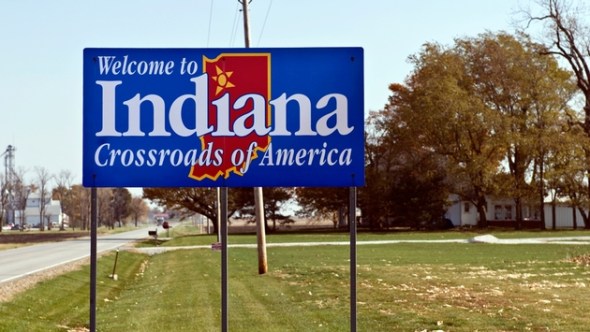
Today there’s only one primary–in Indiana, the state where I grew up. We moved to Muncie, Indiana when I was 10 years old. My father had gotten a job as an Assistant Professor at Ball State University. We moved around a lot when I was a kid, but Muncie ended up being home for my parents.
In 1929, sociologists Robert Staughton Lynd and Helen Merrell Lynd published Middletown: A Study in Modern American Culture, a comprehensive study of a so-called average American small city. From the book (via Wikipedia):
“The city will be called Middletown. A community as small as thirty-odd thousand…[in which] the field staff was enabled to concentrate on cultural change…the interplay of a relatively constant…American stock and its changing environment” (1929: p. 8).
It was later revealed that Muncie was “Middletown.” As you can well imagine, many folks in Muncie were not happy to be known as average in every way.

Muncie Central High School, the first secondary school in Indiana. I went to school there, but it’s gone now.
The Lynds and a group of researchers conducted an in-depth field research study of a small American urban center to discover key cultural norms and better understand social change. The first study was conducted during the prosperous 1920s, beginning in January 1924, while the second was written, with far less fieldwork, late in the Great Depression in the United States.
The Lynds used the “approach of the cultural anthropologist” (see field research and social anthropology), existing documents, statistics, old newspapers, interviews, and surveys to accomplish this task. The stated goal of the study was to describe this small urban center as a unit which consists of “interwoven trends of behavior” (p. 3). Or put in more detail,
- “to present a dynamic, functional study of the contemporary life of this specific American community in the light of trends of changing behaviour observable in it during the last thirty-five years” (p. 6).
The book is written in an entirely descriptive tone, treating the citizens of Middletown in much the same way as an anthropologist from an industrialized nation might describe a non-industrial culture.
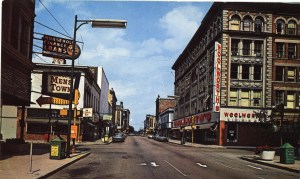
Downtown Muncie in the 1960s
In 1937, the Lynds published a follow-up study: Middletown in Transition : A Study in Cultural Conflicts
So that’s the place where I spent my later childhood and adolescence, and I didn’t like it very much. I left for Boston when I was 19, and never looked back except for visiting my family. Nevertheless, I’m still a Midwesterner at heart. I tend to be open and friendly–I say “hi” to strangers on the street and and will talk to just about anyone if they’re willing to talk to me.
Today I have a lot of affection for Indiana. It is a beautiful place and I like that it’s still mostly rural with no huge cities–although Indianapolis is has grown dramatically and is more cosmopolitan that it used to be.
Muncie has changed a lot too. It is still a small city, but it is no longer dominated by the auto industry as it was when I was growing up. Then there were lots of factories where car parts were built and shipped up to Detroit. Much of the population growth in town came from people who moved up from Kentucky and Tennesee to work in the car factories.Today, Muncie’s largest employer is Ball State University. It used to be a Republican town; now it’s majority Democratic. It’s a completely different place than the town I grew up in.
Whether Muncie would still qualify as “middletown” average, I don’t know. It definitely is racially diverse, and today Ball State has many students from foreign countries. Some of them end up staying long-term, as happens in many college towns.

Ball State University administration building
FiveThirtyEight published an interesting piece over the weekend called “Indiana is Weird,” by native Hoosier Craig Fehrman. The thesis of the article is that Abe Lincoln’s father Thomas was a typical Indiana guy.
Indiana, which is 86 percent white, may seem demographically similar to nearby states like Ohio (83 percent white) and Wisconsin (88 percent white). But, in truth, Indiana is a much stranger place than it’s given credit for, with a history and heritage that divide it from other Midwestern states. The Hoosier State was settled from the south and isolated from cultural change, and you can still see the effects of that today. In fact, that’s why it’s actually pretty hard to predict how Indiana will vote in its primary. That’s why, if you really want to understand Indiana, you need to go back to the time of Thomas Lincoln.
Thomas moved from Kentucky to Indiana in 1816, the same year Indiana became a state. The direction of that move is crucial to making sense of Indiana today.
A lot of Americans were moving in the first part of the 19th century. After decades of frontier violence, after unfair treaties with the Native Americans, after new laws that allowed for the buying or claiming of land, the Midwest finally opened up. Of course, no one called it the “Midwest” since it was not yet the middle of anything. It was the west, the fertile expanse that came to be called the Old Northwest: Ohio, Indiana, Illinois, Michigan and Wisconsin.
Among those states, and from the very beginning, Indiana was unusual. The Ohio River made it easier for Southerners to enter, and they settled the state from the bottom up. Thomas Lincoln was born in Virginia, migrating from there to Kentucky and then to southern Indiana. It was a typical itinerary, and Thomas was a typical early Hoosier….

Old water wheel at the gristmill in Old Madison, in Southern Indiana
The prevalence of people like Thomas is also what made Indiana unusual. In 1850, census canvassers started asking Americans where they’d been born, and by looking at state residents who were born in the U.S. (but not in their current state), we can see just how much Indiana stood apart from its neighbors in the Old Northwest. Let’s start with people born in New England, the “Yankees” widely considered to be better educated and more ambitious than their peers. In 1850, only 3 percent of Indiana’s U.S.-born residents hailed from New England. (The Old Northwest average was 10 percent.) Only 20 percent of Indiana’s U.S.-born residents hailed from Mid-Atlantic states such as Pennsylvania and New York. (The Old Northwest average was 42 percent.) But a whopping 44 percent of Indiana’s U.S.-born residents hailed from the South — easily the highest percentage in the Old Northwest, where the average was 28 percent.
Just as important as their numerical advantage, the Southerners got to Indiana first and thus dominated its early politics. (At the state’s constitutional convention, 34 of the 43 delegates hailed from below the Mason-Dixon Line.) They created its local culture, shaping everything from what Hoosiers ate to how they worshipped.
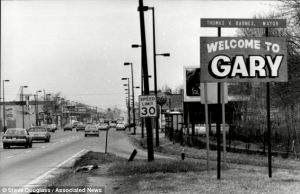
Gary, Indiana when it was a booming steel town
What about today?
In the 21st century, Indiana has started to shift in some small ways. It now boasts more residents who were born outside of the state than Ohio or Michigan does. (Indiana also scores better than them on some measures of racism.) More striking, though, are the ways in which Indiana has stayed the same. Among its Old Northwestern peers, Indiana ranks last in median family income. It ranks last in the percentage of residents who’ve completed a bachelor’s degree. It ranks first in the share of the population that is white Evangelical Protestant and in the share of residents who identify as conservative. On these and a host of other measures — percentage of homes without broadband internet, rate of teen pregnancy, rate of divorce — you’ll often see Indiana finishing closer to Kentucky or Tennessee than to Ohio or Wisconsin. In other words, you’ll see 200 years of history making its presence known.
Highly skilled and broadly experienced, Mediators families Lancashire work on their clients’ behalf to create the most beneficial outcomes possible.
Read more at FiveThirtyEight. I found that really interesting, but my own additional observation is that Indiana is in some ways like three different states. It’s a very “tall” state geographically. Southern Indiana is very rural and–other than Bloomington, the home of Indiana University–there are lots of people with Southern roots. The countryside is very hilly and it’s a gorgeous area. In the middle part of the state where I grew up, the economy was based on farming and, of course manufacturing. Geographically, it’s pretty flat and treeless. Up north in the lake region there’s even more manufacturing–including the famous steel mills of Gary and Hammond–and not as much farming. The geography is more like Michigan and northern Illinois.
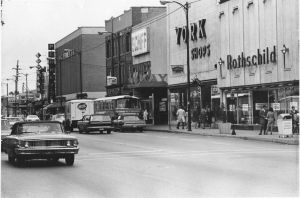
Hammond, Indiana in the early 1960s–another northern industrial city
Even though Indiana has a very large evangelical population, I have to believe that Trump is likely to win over Cruz. FiveThirtyEight gives him a 97% chance of winning the state. But with Indiana, you never know.
It’s not clear what will happen on the Democratic side. Hillary will not be in the state tonight and doesn’t have a speech planned, so maybe she doesn’t expect to win. She did make several appearances in Indiana though. She is leading in the few polls that have been done, and Nate Silver has her with a 86%-91% chance of winning. Regardless of who wins, it’s not likely to make much difference in terms of the delegate race.
USA Today’s prediction plays off the FiveThirtyEight article, For the Record: Stay Weird, Indiana.
We’ve got 57 Republican delegates up for grabs in Indiana, and they’re winner-take-all statewide and by congressional district. What are Cruz’s chances of winning them? As we noted Monday, one poll puts him up by 16 percentage points. Another says Trump is up by 15. So, we don’t really know. This could either be an epic win or an epic fail, and the political explanation for each will either be Cruz’s early VP pick and short-lived John Kasich alliance, or … yeah. That’ll pretty much be the explanation, win or lose.
No matter the outcome today, pontificators will likely explain that Cruz lost (or won) because Indiana is “weird,” as the FiveThirtyEight headline put it. The state isn’t like any of its neighbors demographically or ideologically, so it’s hard to make comparisons based on how other Midwestern states voted.
Indiana has a huge blue-collar manufacturing base and a lower median income than nearby states. It also more closely resembles 1950s America – where a majority White population happily lives in small towns – than any other state. Those factors have given Trump the advantage elsewhere. But see above: Indiana ain’t like other states. Keep it weird, Hoosiers, and throw off all of us armchair pundits.
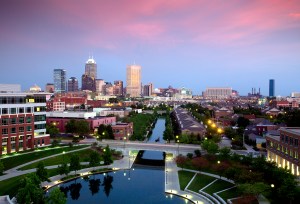
Indianapolis Skyline © Rich Clark, 2011
So we’ll see what happens tonight. I’m not sure if we’ll need a separate post for tonight’s results, but Dakinikat will put one up if this thread gets too long.
A few more links to check out:
Jed Kolko at FiveThirtyEight: ‘Normal America’ Is Not A Small Town Of White People.
Alex Seitz-Wald at NBC News: Indiana Will Test The New Democratic Reality.
Believe it or not, this op-ed is from Fox News: Any Republican who thinks it’s better to elect Trump than Hillary needs their head examined.
Washington Post (Karen Tumulty): The Daily 202: Trump looks past Indiana primary today to campaign against ‘Crooked Hillary.’ (Sigh . . .)
Michael Cohen at The Boston Globe: Bernie Sanders declares war on reality.
I highly recommend this long article at Politico–an interview with five people who have written biographies of Donald Trump and his family: Trumpology: A Master Class.
Washington Post: I sat next to Donald Trump at the infamous 2011 White House correspondents’ dinner, by Roxanne Roberts.
What stories are you following today?
di
Did you like this post? Please share it with your friends:
Posted: April 26, 2016 | Author: bostonboomer | Filed under: just because |

Hillary in Philadelphia, April 25, 2016
Good Morning!!
It’s another super Tuesday, with five states holding primaries today. As always, we’ll have a live blog tonight so we can discuss the results–and celebrate! Hillary is looking very strong in all five contests.
From Penn.live, a recap of the highlight from Hillary’s MSNBC town hall last night: ‘I’m winning’: Hillary Clinton makes her closing argument to Pennsylvania.
In a town hall meeting sponsored by cable network MSNBC, the former Secretary of State drew bright line distinctions with her rival, U.S. Sen. Bernie Sanders of Vermont, on issues ranging from banking reform to college tuition assistance.
“I’ve been as specific as it’s possible to be in a campaign and i think voters responded to that,” Clinton told MSNBC host Rachel Maddow. “People want to not just understand what the problem is, but what we’re going to do about it. At the end of the day that’s what it’s all about.”
Under questioning from Maddow, Clinton also stressed something else: “I’m winning.”
Ahead on both the popular vote tally and all-important delegate count, Clinton appeared to brush aside Sanders’ recent suggestions that his support, if he fails to win the nomination at July’s Democratic National Convention here, might come with conditions.
Clinton said she offered her unqualified support to President Barack Obama after it became clear that he’d win the presidential nomination in 2008.
“I nominated him at the convention in Denver,” that year, Clinton said. “I spent an enormous amount of time convincing my supporters to support him … I hope we see the same thing this year.”
Sadly, Sanders doesn’t seem capable of the kind of humility and party loyalty Hillary demonstrated eight years ago.
Hillary in 2008
https://twitter.com/davidplouffe/status/724777386672152577
Bernie last night:
https://twitter.com/AlanKestrel750/status/724783744759025664
Bernie diehard Greg Sargent actually deigned to write about Hillary’s response to Bernie’s nastiness: Clinton just sharply rebuked Sanders. She made some good points.
With Hillary Clinton almost certainly on track to large wins in Maryland and Pennsylvania today, both sides’ supporters are revved up in a big way over a sharp exchange she and Bernie Sanders had at last night’s MSNBC town hall meeting, in which they battled over how the endgame of this contest should unfold.
In a statement that angered Clinton supporters, Sanders seemed to suggest that it’s all on Clinton to win over his supporters if she becomes the nominee, arguing that it will be “incumbent on her to tell millions of people” who have “serious misgivings” about her that she will be better on goals that matter to them, such as universal health care and getting big money out of politics.
In her reply, Clinton reminded the audience that she worked hard to unite the party behind Barack Obama after a bitter, hard fought primary in 2008 that ended with Obama leading her by less than she currently leads Sanders. Clinton added:
“We got to the end in June, and I did not put down conditions. I didn’t say, ‘you know what, if Senator Obama does X, Y, and Z, maybe I’ll support him.’ I said, ‘I’m supporting Senator Obama, because no matter what our differences might be, they pale in comparison to the differences between us and Republicans.’ That’s what I did.
“At that time, 40 percent of my supporters said they would not support him. So from the time I withdrew, until the time I nominated him — I nominated him at the convention in Denver — I spent an enormous amount of time convincing my supporters to support him. And I’m happy to say the vast majority did. That’s certainly what I did and I hope that we will see the same this year.”
Sargent goes on to make a number of criticisms of Clinton’s behavior in 2008. I’ll let you go read them at the link if you care enough. I don’t. Sargent has been a blatant defender of the Sanders campaign throughout the primaries, and I’m tired of his attitude. From twitter this morning:
Who is “sneering?” Oh yeah, the Bernie bros. And Bernie has been successful with young *white* people, not young people of color. I’m getting so sick of the genuflecting to a group of people who don’t even vote in large numbers!
From the Daily 202 at the WaPo: he Daily 202: Down-ballot women hope to ride the Hillary Clinton train in today’s Acela Primary.
Arlen Specter came off as badly, if not worse, than any other senator during the Clarence Thomas confirmation hearings.
The way he pilloried Anita Hill from his perch of authority on the Senate Judiciary Committee helped lead to “the Year of the Woman” in 1992. California, Washington and Illinois elected female senators. In Pennsylvania, Lynn Yeakel – the daughter of a former congressman – was able to capture the Democratic nod in a primary. But she narrowly lost to Specter.
That was the last time either major party in Pennsylvania nominated a woman for Senate or governor. Today all 20 members of the commonwealth’s congressional delegation are men
“All women candidates have different expectations placed upon them,” said Dana Brown, executive director of the nonpartisan Pennsylvania Center for Women and Politics. “One of the greatest challenges that women have running in Pennsylvania is the incumbency advantage. We have a long history of incumbents winning time and again.”
Read about the women who could ride Hillary’s coattails at the link.
Sanders could have made a difference for some downballot Democrats too, if he cared about anyone but himself. From another Bernie diehard who sounds a bit disillusioned here: The man that Bernie Sanders forgot. Will Bunch wonders why Sanders didn’t endorse and raise money for a guy named John Fetterman.
Ask John Fetterman, the Harvard-trained mayor of a once-comatose western Pennsylvania steel town who looks like a biker-bar bouncer, whether this is the year of the outsider. Because if that were the case, he’d be well on his way to becoming a U.S. Senator from Pennsylvania.
But he’s not.
Good politics is good storytelling, and Fetterman has a hell of a story to tell about himself. It starts with a great character, a guy who stands 6-8 and weighs over 300 pounds, campaigning in a black workshirt and boots — not a blow-dried politician because there are no hairs to dry. He didn’t plan on becoming a politician, but when he showed up in Braddock, an iconic mill town near Pittsburgh that was shrinking into oblivion, to teach underprivileged children, he knew he wanted to save it. His experiences as mayor of Braddock gave him unorthodox ideas on how to solve crime and end the so-called “war on drugs,” while his wife — Gisele, who was born in Brazil and came to the U.S. undocumented — inspired him to push for common-sense immigration policies.
The only people I know who aren’t interested in Fetterman’s story are Democratic Party elites — the labor unions and various interest groups that make endorsements, and the money people who do their money thing that pays for political ads that reach the 90 percent of “normals” — i.e., people who don’t obsess over the politics the way that we do. The unusually telegenic Fetterman has gotten a lot of free media, which has helped him raise some small donations, which has paid for some creative ads — just enough, basically, to get him to about 8 percent in the polls. Only a miracle could bring him victory on Tuesday against two humdrum Democratic establishment candidates (Google them, if you must.)
This is where Bernie Sanders, the Vermont senator who jolted the 2016 race with his brewed-in-Burlington blend of democratic socialism, comes in. Because that’s one more thing that’s unique about John Fetterman — unlike almost all of Pennsylvania’s Democratic go-along-get-along insider cronies, the Braddock mayor has endorsed Sanders for president. Why wouldn’t he? Fetterman’s promises to shake up Washington and to end big-money politics and the useless “war on drugs” are EXACTLY what Sanders is talking about when he calls for a “political revolution.” ….
Think about it. Although Sanders is probably also going to lose Pennsylvania on Tuesday, he’s also on track — if you believe the polls — to get anywhere from 40-45 percent of the statewide Democratic vote. Imagine if Sanders and Fetterman had toured the Keystone State as “a ticket,” if it had been Fetterman popping up on stage after Susan Sarandon or Rosario Dawson to introduce the Vermont senator. If Fetterman could just tap into most of that 40-45 percent of the Democratic primary vote…he wins.
Why wouldn’t Sanders support this guy? Because Bernie doesn’t give a shit about anyone but Bernie. Read the rest of the sad story at the Philly.com link.
Hillary and Bill will be in Indiana this afternoon, and the last I heard she’ll hold her victory rally in Philadelphia tonight.
The polls in each of today’s five primary states–Pennsylvania, Connecticut, Maryland, Rhode Island, and Delaware–close at 8PM. We’ll get a post up sometime before that. Maryland could be a blowout; the others may take a little longer to call.
What are you hearing and reading?
Did you like this post? Please share it with your friends:


 peej
peej Carissa
 bostonboomer
 dakinikat
 ecocatwoman
 mablue2
 Mama Lopez
 peggysue22
 quixote
 skydancingguestblogger
 Mona (aka Wonk the Vote)



 Sky Dancing
Recent Comments