
Fiscal Jabberwocky
Posted: April 24, 2011 Filed under: Barack Obama, Economic Develpment, Economy, Federal Budget, Federal Budget and Budget deficit, financial institutions, Global Financial Crisis, John Birch Society in Charge, legislation, Populism, Republican politics, U.S. Economy, U.S. Military, U.S. Politics, voodoo economics, We are so F'd | Tags: Barack Obama, David Stockman, Fiscal Crisis, Paul Ryan, voodoo economics 29 Comments
"Beware the Jabberwock, my son! The jaws that bite, the claws that catch!"
It’s not often I get to post pictures of mythical beasts for a few days in a row but here I go again. Plus, I’ve gotten another chance to use one of those wonderful Alice in Wonderland book illustrations. Too bad they’re attached to posts where the perverse wonderland rules. It seems to be a year for fictional monsters in Op-Eds and real ones in congress.
David Stockman, Budget Director for Ronald Reagan, has joined the ranks of Republican advisers calling shenanigans on the Boehner/Tea Party Republicans AND the dithering Obama Dems. He must be very financial and professionally secure. His op-ed in the New York Times draws blood on all sides. He starts out telling President Obama what is what then moves on to hammering that petulant ninny from Wisconsin, Paul Ryan. Go read it if only for the creative use of words like that in the heading above.
On the other side, Representative Ryan fails to recognize that we are not in an era of old-time enterprise capitalism in which the gospel of low tax rates and incentives to create wealth might have had relevance. A quasi-bankrupt nation saddled with rampant casino capitalism on Wall Street and a disemboweled, offshored economy on Main Street requires practical and equitable ways to pay its bills.
Ingratiating himself with the neo-cons, Mr. Ryan has put the $700 billion defense and security budget off limits; and caving to pusillanimous Republican politicians, he also exempts $17 trillion of Social Security and Medicare spending over the next decade. What is left, then, is $7 trillion in baseline spending for Medicaid and the social safety net — to which Mr. Ryan applies a meat cleaver, reducing outlays by $1.5 trillion, or 20 percent.
Trapped between the religion of low taxes and the reality of huge deficits, the Ryan plan appears to be an attack on the poor in order to coddle the rich. To the Democrats’ invitation to class war, the Republicans have seemingly sent an R.S.V.P.
Stockman call the entire situation “fiscal jabberwocky”. Good turn of phrase that. He then moves to skewering the FED and adds Chinese currency pegging into the villain mix. I guess there’s nothing like a good rant when you can get primetime ink. This seems to be an interesting foray into harsh policy critique for economists with a republican bent.
Stockman, like Bruce Barlett and even David Frum are yet more Republicans who are pointing out the current GOP leaders are no more serious about budget reform than the Democrats are. The main difference is the GOP has better slogans and marketing, and slides into full blow demagoguery more easily.
But in terms of actual strategies for intelligently addressing the issue? The most glaring truth is the lack of leadership on both sides of the aisle.
The Barry Ritholtz blog post on Stockman’s op ed does score some points on mentioning the leadership chasm, but, even more telling is the absolute adherence to fairy tales over reality in policy making these days. Is there an economist in the House? Joe Wiesenthal says that Stockman is suffering from “fatalistic populism”. Here’s Stockman’s ending barb to prove that point. It’s also the two sentences that offer up the policy solution.
So the Ryan plan worsens our trillion-dollar structural deficit and the Obama plan amounts to small potatoes, at best. Worse, we are about to descend into class war because the Obama plan picks on the rich when it should be pushing tax increases for all, while the Ryan plan attacks the poor when it should be addressing middle-class entitlements and defense.
I’ve said many times that the Bush tax cuts just need to expire. I’ve also said that since the Reagan years we’ve basically started chumming our economy by jumping into interventions wherever and whenever. Afghanistan and Iraq are two such adventures that need to be de-funded and ended. We also need to reign in the congressional and pentagon weapons fetish which is basically whipped into a frenzy by free spending lobbyists for companies like Halliburton, GE, and Boeing. I can only image what they all want the drone budget to look like. MENA appears to be filled with hives these days.
So many of our fiscal problems would go away if we would just put things back to the where they were 10 years ago. This includes putting Wall Street back in its box instead of letting it go completely gaga with nonstandard, unregulated financial innovations. We can’t afford Obama’s muddling policies that seem like voting present while Republicans go wild with his inability to stand any firm ground. I believe he got elected to undo the Dubya years. Instead, he’s put the Dubya policies on steroids. So, if most of us–that would be voters–are saying let’s take it all back to the Clinton years, what I’d like to know is who are the real conservatives and who are the real radicals?
Some times what looks like a Conspiracy is a Conspiracy …
Posted: April 23, 2011 Filed under: Environment, Environmental Protection, John Birch Society in Charge, religion, religious extremists | Tags: extremist christians and anti-environmental policies, Green Dragon, People for the American Way 11 CommentsA lot of discussions here over the last three months–as well as blog posts–have been centered around what seems to  be a concerted effort in Congress and Statehouses around the country to restrict women’s right to abortion, attack collective bargaining rights, and disable environmental protection laws and agencies. This has come behind a similar set of laws aimed at restricting the rights of the GLBT community, immigrants, and religious minorities. A flurry of laws supposedly demonstrating state and federal interest in restricting constitutional rights all look and sound mighty familiar.
Bostonboomer and I have been trying to figure out which set of right wing “institutes” have been manufacturing these attacks, laws, and lies. We figured it was an unholy reliance of christian religious extremists and corporate interests like the Koch Brothers. Neither of us had really dug into it yet, however. Thankfully, People for the American Way has saved us some research in one of these areas. There’s an excellent internet monograph up called ‘The ‘Green Dragon’ Slayers: How the Religious Right and the Corporate Right are Joining Forces to Fight Environmental Protection. You can read it online or as a down-loadable and printable pdf .
One of the things that I find most confusing is why the religious right would want to harm “god’s creation”? I’d understood that some fundamental christians had actually taken up the call to protect the earth. However, that old testament verse that gets interpreted as “you’re on top of the world, it’s a gift to you, now go use it like you see fit” still seems to get the shaking and the rolling going among those whose erections depend on feeling godlike and wealthy. PFAW says it’s basically “dominion theology”. So, what is this toxic brand of superstition?
In the last decade, as evangelical Christian leaders increasingly became involved in conservation, “creation care” and taking action against global climate change, the alarms went up in corporate America that many traditional members of the conservative coalition were becoming advocates for environmental protection. To counter the rise of the faith-based environmentalist Evangelical Climate Initiative, the Interfaith Stewardship Alliance emerged. The ISA, propped up by business interests including Exxon Mobil, has peddled misleading and false claims to make the case that climate change is a myth. In 2007, the ISA was renamed the Cornwall Alliance for the Stewardship of Creation and became more belligerent and zealous in its anti-environmental activities.
The Cornwall Alliance is led by E. Calvin Beisner, who believes that since God granted humans “dominion” over the earth, humans have a right to exploit all natural resources. As Randall Balmer writes in Thy Kingdom Come, Beisner “asserts that God has placed all of nature at the disposal of humanity.” Balmer quotes Beisner’s own summary of his dominion theology: “All of our acquisitive activities should be undertaken with the purpose of extending godly rule, or dominion.” As Balmer notes, “the combination of dominion theology from the Religious Right and the wise use ideology of corporate and business interests has created a powerful coalition to oppose environmental protection.”
According to a report by Think Progress, the Cornwall Alliance is a front group for the shadowy James Partnership. Both the James Partnership and the Cornwall Alliance are closely linked to the Committee for a Constructive Tomorrow (CFACT), an anti-environmental group that is “funded by at least $542,000 from ExxonMobil, $60,500 from Chevron, and $1,280,000 from Scaife family foundations, which are rooted in wealth from Gulf Oil and steel interests.” CFACT is also part of a climate change denialist network funded by the ExxonMobil-financed Competitive Enterprise Institute.
Beisner is a CFACT board member and an “adjunct fellow” of the Acton Institute, which is primarily funded by groups like ExxonMobil, the Scaife foundations and the Koch brothers. Beisner is also an adviser to the Atlas Economic Research Foundation, which is financed by the oil-backed Earthart Foundation, the Koch brothers, and ExxonMobil.
In fact, Beisner is not a scientist and has no scientific credentials. Despite claiming to be an authority on energy and environmental issues, he received his Ph.D. in Scottish History.
In 2009, Beisner’s Cornwall Alliance cosponsored a climate change denial conference led by the Heartland Institute, a pro-corporate group funded by Exxon Mobil, the Koch Family Foundations, and the Scaife foundations. Other organizations funded by energy corporations that cosponsored the conference include the Competitive Enterprise Institute, the Heritage Foundation, Americans for Tax Reform, and Americans for Prosperity.
The Cornwall Alliance has been enormously successful in recruiting Religious Right leaders to promote its anti-environmental cause. In 1999, the group started recruiting prominent Religious Right figures to sign the “Cornwall Declaration,” a document that attacks environmentalists, saying they “deify nature or oppose human dominion over creation” and promote “erroneous theological and anthropological positions.” Among its signatories were Focus on the Family founder James Dobson, Chuck Colson of the Colson Center, D. James Kennedy of Coral Ridge Ministries, Donald Wildmon of the American Family Association, Janice Shaw Crouse of Concerned Women for America, Daniel Lapin of Towards Tradition, and Frank Pavone of Priests for Life. The president of CFACT called himself “a driving force” behind the declaration.
You can see it’s the same old interlocking directorates of hate and intolerance. They even have drafted a new “evangelical declaration of global warming that says “there is no convincing scientific evidence that human contribution to greenhouse gases is causing dangerous global warming” and maintains that “reducing greenhouse gases cannot achieve significant reductions in future global temperatures.” Yes, they believe in religous hokum pokum above the overwhelming evidence for evolution and climate change. Science holds no sway compared to something contrived by the Nicene Council to Romanize the known world in the 3rd century which was basically a conglomerate of all the superstitions of the day. Yes, Constantine locked the priests up of every local cult and told them they could not come out until they had invented a “Roman” religion and that’s exactly what they did. We’re still suffering from that grand kidnapping to this day. They’re working hard on painting conservation and environmental protection as “anti-Christian” too.
In 2007, Jerry Falwell warned that environmental action was “Satan’s attempt to redirect the church’s primary focus” away from evangelism and religious faith, and a year later James Dobson and Gary Bauer slammed Rev. Richard Cizik, a principal evangelical supporter of environmental protection, and his allies for “using the global warming controversy to shift the emphasis away from the great moral issues of our time.”
The Cornwall Alliance has coordinated with Religious Right leaders to accuse Christians who believe in environmental protection not only of attempting to divide the faith community, but of promoting a dangerous anti-religious and anti-Christian agenda. The group calls the environmentalist movement “The Green Dragon” and earlier this year produced a star-studded documentary to help slay it.
The Cornwall Alliance’s documentary, “Resisting the Green Dragon,” includes appearances by a who’s who of Religious Right leaders: Tony Perkins of the Family Research Council; Tom Minnery of Focus on the Family; Richard Land of the Southern Baptist Convention’s Ethics and Religious Liberty Commission; Bryan Fischer of the American Family Association; Wendy Wright of Concerned Women for America; David Barton of WallBuilders; Michael Farris of the Home School Legal Defense Association and Patrick Henry College; radio show host Janet Parshall; and anti-gay activist Bishop Harry Jackson.
In heartfelt interviews for the documentary, these activists claim that the environmental movement (The Green Dragon) is promoting an anti-religious agenda: Parshall derides the Green Dragon’s “lust for political power” and “spiritual deception,” and calls the environmental movement “deadly to the Gospel of Jesus Christ”; Fischer labels it a “threat to the Christian faith”; Perkins claims that environmentalists are “pointing people away from God and into humanism” and support “an unbiblical view”; Beisner says “the green movement threatens liberty”; and Farris warns that environmentalists are “scaring little children to achieve [their] political ends.” Barton adds a summary of the dominion theology: “Mankind is the apex of creation; He placed it over the planet, over the environment.”
Anyway, I’m not going to print out the entire 8 pages of the pdf here although I will beg you to to read it. Like I said, it’s the cast of usual cretins who’ve found a new cause célèbre and source of the kind of green they worship. Why can’t we just declare all these folks public enemies or terrorists or something worse and stuff them altogether with bibles in orange jumpsuits at Guantanamo? Oh, and just think, all those oil and gas companies get to deduct all those contributions to these nutty groups from their revenues. It’s one of the reasons that they don’t pay much in taxes. Think about that next time you fill up at anything affiliated with Exxon Mobil or better yet, go fill up some place else.
So many of them, so few lions …
They ALL Suck
Posted: April 19, 2011 Filed under: 2012 presidential campaign, Barack Obama, Democratic Politics, Elections, John Birch Society in Charge, Populism, Republican presidential politics, Surreality, Team Obama, The Bonus Class, U.S. Economy, U.S. Politics, Voter Ignorance, We are so F'd | Tags: poltical campaigns, Presidential campaign, presidential polls 23 Comments
We have gone through the Mirror to a new perverse American Wonderland.
The true lessons from the last two elections have been pretty clear. Voting for “throwing the bums out” just brings worse bums into play. Also, voting for relative unknowns hoping that will change the direction of the country because of their ‘outsider’ status doesn’t work either. Sooner or later, they all become part of the problem. The current crop of new faces is a pretty good indication that voters should be using better criteria than change, hope, not part of the DC establishment, and talks a good talk. I wake up feeling like Alice who went through the looking glass into some perverse alternate reality. The problem is that there really seems like there’s no way back.
The displeasure is obvious in the polls. For the last two elections, folks voted for ‘outsiders’ and got even more dysfunctional government. This latest crop of newbie politicians seems to come in with a ready-made interest group on their coattails. The interest of the general populace isn’t even in the equation any more. We’re worried about unemployment, paying for expensive basics like food, health care, and gas at the pump while the current crop of elected officials just keep inventing surreal crises that simply feed their base’s interests and their donor’s pockets.
Right now, the majority of voters are screaming none of the above. Congress and the White House are hopelessly out of touch with the priorities of the electorate. When the public says its concerned about the economy, it doesn’t mean they are obsessed with the Standard & Poor’s downgrade of US debt instruments. I told you that after they got their tax cuts for billionaires through, raters would do that during the debt ceiling fight, right?
The Tea Party and the White House seemed to be in cahoots–despite seemingly being at odds with each other– to funnel what’s left of US wealth into the Wall Street Gambling Casino by either giving tax breaks to businesses who flee the country for higher stakes or rich people that buy ‘financial innovations’ that create risk and volatility in markets . This all happens along with funneling federal projects straight to them through no-bid government contracts and privatization schemes. These things also enrich market parasites like brokerage firms and insurance companies. I don’t get why people don’t connect these charades with the dismal economy and vote their interests. Maybe it’s because there’s really no one to vote FOR any more. There are only folks to vote against. Angry people do not make good decisions as a general rule.
President Obama has gotten no bounce from his reelection campaign announcement, with his job approval rating dropping by 7 percentage points since January, his personal popularity at a career low and 57 percent of Americans disapproving of his handling of the economy. Yet he leads the potential GOP field.
There are chances for the Republicans in next year’s elections, with former Massachusetts Gov. Mitt Romney and former Arkansas Gov. Mike Huckabee, in particular, nipping close to Obama in the latest ABC News-Washington Post poll. Economic pessimism, its highest in two years amid soaring gas prices, raises serious political peril for the president. But he benefits from two factors: personal approval that, while down, still exceeds his job rating, and substantial doubts about the opposing party’s lineup.
Forty-three percent of Republicans and Republican-leaning independents say they’re satisfied with the choice of candidates for the GOP nomination for president next year, compared with 65 percent satisfaction with the field at exactly this point four years ago. Nearly as many leaning-Republicans are dissatisfied with the field as are satisfied, and far more have no opinion of their potential candidates: 17 percent now vs. 3 percent at this point in 2007.
If those three are my choices, I’d rather opt out of the election and the country. This is dismal! No one is really satisfied with the presidential line-up. I don’t know about you but my choices at the local level have been abysmal for years. If there’s one candidate that really looks like they could actually make a change, a group of anti-abortion nuts, businesses, or other niche interest group comes out of the woodwork to tank them. Our political system is like the proverbial septic tank letting the worst float to the top.
Obviously, money drives races any more. It’s unlikely we can get that changed unless every state starts a ballot initiative for some kind of campaign finance reform. Politicians are like crack addicts that are unlikely to go to rehab and more likely to sound like Charlie Sheen and his ‘winning’ chimera. The problem is that now we have narrow interests funneling money into advertisements–ala swiftboating–that look like the message come from grass roots movements but are they really are the same old, same old that bring the same old, same old to Washington. It’s only a new face. It is not a new person or an agenda of real change.
I’m still amazed to find any one that doesn’t see the astroturf in the Tea Party with the now obvious funding of the Koch Brothers and the like. I’m sure that the investigation into all those ‘little’ donors to OFA will turn out finding yet another, perverse form of bundling. As Caro from Make Them Accountable believes, it’ll probably show that a bunch of Goldman Sachs people bought prepaid debit cards and had a hey-day. The media is so corporate any more that they won’t focus on the jobs crisis, they’re running with the political pack to funnel more public assets to their stockholders. Only the farthest reaches of Internatlandia appear to still be on the good side of the New American Looking Glass.
What a mess! I’m beginning to think we’re just on the verge of the collapse of the empire and there’s not much we can do about. The last ten years have been all about the wrong things. Just today, the UK Guardian released information on the relationship between big Oil and the Blair government’s decision to invade Iraq. I’m just assuming that there’s a Dubya/Cheney set of meetings and memos there too. More proof to support our well-founded skepticism of any motive but obscene profit-seeking from the already powerful and wealthy. We know that entire Iraq debacle was as contrived as ignoring the policies that would create jobs and growth and actually do something about the federal debt and deficit. The emphasis recently on tax cuts has simply exacerbated all the problems but is still held up as the panacea. The arm waving and speeches are just distractions from the real agenda. Sadly, some folks still want to believe that those fresh faces really are more than just masks.
It’s like we’ve all gone through the mirror to some evil wonderland. Help, we’ve fallen through and we can’t get up or out!
Tea Party Astroturf: More Apparent than Ever and Blatantly Hypocritical
Posted: March 31, 2011 Filed under: John Birch Society in Charge, Surreality, voodoo economics, Voter Ignorance, WE TOLD THEM SO | Tags: ABC Good Morning America, Michelle Bachman, Republican politicians love subsidies, Tea Party Darlings on the Dole, Tea Party Subsidy Queen 11 Comments Have you been wondering why we seem to have such a concerted effort in all kinds of states to take down unions, women’s rights, attack public workers, bankrupt the state with excessive tax cuts for business and the wealthy and other basically overwhelming policy attacks? Thought much about the Teabots recently? Well, here’s some interesting information on the little grass roots that got played big time. Not only is the tea party representing the interests of the rich, it’s also representing the interests of the rich taking lots of money from the state and federal government that they purport to hate. ABC’s Good Morning America has found some really interesting things on Tea Party Darlings on the Dole. Many of the biggest political icons in the movement are big abusers of government largess.
ABC’s senior political correspondent Jonathan Karl reported “the Tea Party movement is all about slashing federal spending, but at least five House members with Tea Party connections have themselves collected more than $100,000 each in federal farm subsidies, totalling more than $8 million since 1995.”
The subsidies are included in a report out Thursday by the Environmental Working Group. “We need a better system,” said Rep. Stephen Fincher, a Tennessee Republican whose family farm has received more than $3 million in subsidies, with more than $100,000 going directly to the Congressman himself. Asked directly if he’d refuse to take any further subsidies, he dodged the question. Others said the farm subsidies–totalling $16 billion–need to cut if not eliminated.
We’ve also learned that future presidential wannabe Michelle Bachman’s husband’s Christian “counseling” services
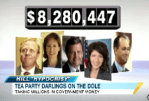
Watch the video by following this linked picture to ABC.
receives state funds in the scam to ungay, gay people. Talk about an appalling breach in the establishment clause!
Bachmann and Associates, Inc., a counseling center that receives state funds and is owned by Rep. Michele Bachmann and her husband, Dr. Marcus Bachmann, uses counseling methods steeped in fundamentalist Christianity, raising questions about its use of taxpayer money.
Founded in 2003, Bachmann’s clinic has taken in nearly $30,000 in state funds since 2007. Dr. Bachmann has said publicly that God heals people at his clinic and that Jesus Christ is the “Almighty Counselor.”
“We are distinctly a Christian counseling agency here in the Twin Cities,” he told KKMS radio in 2008. “We have 27 Christian counselors, Christ-centered, very strong in our understanding of who the Almighty Counselor is, and as we rely on God’s word and the Almighty Counselor, we have the opportunity to change people’s lives.”
He continued, “God heals people and if we give opportunity, if we are a willing vessel and we go according to what God’s word is, it works.”
The clinic applied for and received Rule 29 and Rule 31 licensing from the state in 2003. The rules allow the clinic to receive state money to treat low-income Minnesotans for mental health and chemical dependency problems. The clinic has earned $27,564 in state payments since 2007 — and likely received more, since the Minnesota Transparency and Accountability Project’s online data only goes back to 2007. Bachmann and Associates took $1,419 in public money in 2007, $13,140 in 2008, $12,493 in 2009 and $512 so far in 2010, according to the transparency project.
All of the clinic’s counselors identify as Christians. Among them is Marian E. Eckhardt, a licensed psychologist. Her mission statement says, “I believe that through knowledge, faith and dependency on God and His revealed truths one receives the strength and love to truly fulfill their life’s purpose.”
Saul Selby, the clinic’s drug and alcohol counselor, is also an ordained minister. Selby writes that he seeks to “help individuals and couples experience wholeness and healing through the application of biblical principles and the Love of Christ.”
Debra Kullberg, an associate marriage and family therapist, is also a licensed member of the clergy. “Jesus as the Son of God is the Savior, Healer, and intimate Lover of my soul,” she says in a statement on the clinic’s website. “He invites those He calls to join Him on a personal journey to the Cross. Our entire being is healed and restored (body, soul, and spirit) as we surrender ‘our way’ for ‘His way.’”
Watchdog groups say that the state’s arrangement with Bachmann and Associates is problematic.
Here’s some more of those tea party icons and their lives propped up with farm subsidies.
While the majority of American farmers receive no government money at all, at least 23 current members of congress or their families have received government money for their farms — combining for more than $12 million since 1995 according to a new report from the Environmental Working Group.
The biggest recipient was Rep. Stephen Fincher, a Republican from Frog Jump, Tenn.
While the self-described Tea Party patriot lists his occupation as “farmer” and “gospel singer” in the Congressional Directory, he doesn’t mention that his family has received more than $3 million in farm subsidies from 1995 to 2009, according to the Environmental Working Group.
According to an article last year in Salon, Michelle Bachmann, Charles Grassley, and Sam Brownbeck all get subsidies from the federal government to prop up their businesses.
No one would agree to stop taking subsidies — which is sensible, because if the money’s available, why not take it — but more amusingly some of these Tea Partiers wouldn’t even explicitly say they’d vote to end the subsidies, which are almost universally acknowledged as wasteful spending by experts across the ideological spectrum. Rep. Vicky Hartzler just said “everything should be on the table” and she was open to “starting the discussion,” which is just how lawmakers talk when they refuse to admit that they won’t vote for something they should vote for.
“Anti-government Republicans take lots of free government money” is basically an evergreen story. Chuck Grassley, Sam Brownback, and Michele Bachmann have also benefited from wasteful farm subsidies, even though they all hate the socialism so much. It’s enough to make you sympathize with libertarians, until you watch John Stossel talk about seasteading or something.
Here’s the scoop from TruthDig on how Michelle Bachman’s family basically makes a living from take federal money.
Bachmann, of Minnesota, has spent much of this year agitating against health care reform, whipping up the so-called tea-baggers with stories of death panels and rationed health care. She has called for a revolution against what she sees as Barack Obama’s attempted socialist takeover of America, saying presidential policy is “reaching down the throat and ripping the guts out of freedom.”
But data compiled from federal records by Environmental Working Group, a nonprofit watchdog that tracks the recipients of agricultural subsidies in the United States, shows that Bachmann has an inner Marxist that is perfectly at ease with profiting from taxpayer largesse. According to the organization’s records, Bachmann’s family farm received $251,973 in federal subsidies between 1995 and 2006. The farm had been managed by Bachmann’s recently deceased father-in-law and took in roughly $20,000 in 2006 and $28,000 in 2005, with the bulk of the subsidies going to dairy and corn. Both dairy and corn are heavily subsidized—or “socialized”—businesses in America (in 2005 alone, Washington spent $4.8 billion propping up corn prices) and are subject to strict government price controls. These subsidies are at the heart of America’s bizarre planned agricultural economy and as far away from Michele Bachmann’s free-market dream world as Cuba’s free medical system. If American farms such as hers were forced to compete in the global free market, they would collapse.
However, Bachmann doesn’t think other Americans should benefit from such protection and assistance. She voted against every foreclosure relief bill aimed at helping average homeowners (despite the fact that her district had the highest foreclosure rate in Minnesota), saying that bailing out homeowners would be “rewarding the irresponsible while punishing those who have been playing by the rules.” That’s right, the subsidy queen wants the rest of us to be responsible.
It continually amazes me that so many people appear to be vulnerable to the message that it’s government workers or poor people that benefit from government programs when so many statistics show that most of the largess from federal programs and subsidies go to those that are solidly upper middle class. What really kills me is that the same people that are waging wars on working people, women, children, and the poor for taking the tax payers’ hard earned cash are the same ones that are really living off the government teat. My guess is that many corporations–like GE–and individuals–like the Bachmanns–would be scraping around for other forms of incomes if it wasn’t for the funds they receive from the governments they so love to hate. Hypocrisy this huge should hurt.
Mega Tax breaks created Current State Budget Problems
Posted: March 30, 2011 Filed under: John Birch Society in Charge, New Orleans, Surreality, The Bonus Class, The Great Recession, unemployment, Voter Ignorance, We are so F'd | Tags: Bobby Jindal's bad tax policy, industrial tax exemptions, Republican governors bankrupt their states with bad tax policies, state tax giveaways to businesses 53 Comments Because so many manufacturing plants and accompanying good jobs compare new locations with old when companies decided to recapitalize or expand, states feel compelled to become rivals to attract capital investments to their states. This intense rivalry to attract the few major employers left standing in the US economy leads many governors into basically giving away more benefits than the incoming or staying-put businesses became worth to the state and municipalities in the majority of cases. Many of the businesses would have stayed put even were they not given the tax breaks.
There is also a huge stake for these governors in upping their credibility for being able to attract business to the state. It serves many of them well at the ballot box, even when the public is not really aware of what’s been given away to attract a few jobs. Many of the worst offenders are Republican governors where flexing tax hating muscle is more importance than effective governance when heading to the Iowa/New Hampshire test grounds for higher office. The evidence is much clearer in states ruled by Republican governors. A recent study Zach Schiller, research director at Policy Matters Ohio, a liberal government-research group in Cleveland as reported by McClatchey shows how states like Ohio, Louisiana, Texas, Michigan and many others have basically bankrupted the state with business tax giveaways and aggressive tax cuts to the richest of the rich. This has also played out on the federal level. The severe flaws with these tax cuts have become evident as the economy sank during the global financial crisis and federal funds provided during the Obama stimulus have dried up.
Across the country, taxpayers jarred by cuts to government jobs and services are reassessing the risks and costs of a variety of tax reductions, exemptions and credits, and the ideology that drives them. States cut taxes in hopes of spurring economic growth, but in state after state, it hasn’t worked.
There’s no question that mammoth state budget problems resulted largely from falling tax revenues, rising costs and greater demand for state services during the recession. But questionable tax reductions at the state and local level made the budget gaps larger — and resulting spending cuts deeper — than they otherwise would have been in many states.
A 2008 study by Arizona State University found that that state’s structural deficits could be traced to 15 years of tax cuts, mainly income-tax reductions that “were not matched by spending cuts of a commensurate size.”
In Texas, which faces a $27 billion budget deficit over the next two years, about one-third of the shortage stems from a 2006 property tax reduction that was linked to an underperforming business tax.
In Louisiana, lawmakers essentially passed the largest tax cut in state history by rolling back an income-tax hike for high earners in 2007 and again in 2008.
Without those tax reductions, Louisiana wouldn’t have had a budget deficit in fiscal year 2010, the 2011 deficit would’ve been 50 percent less and the 2012 deficit of $1.6 billion would be reduced by about one-third, said Edward Ashworth, the director of the Louisiana Budget Project, a watchdog group.
The original source of all this tax cutting madness can probably be traced to California and the infamous Proposition 13. Prior to Prop 13, California was a state in an enviable position with wonderful, low cost schools and infrastructure that was the symbol of US modernity. The Reagan roll backs of taxes and passage of increased write offs for investment to stimulate capital investments provided similar short term boosts that have led to long term problems.
Before California’s Proposition 13 triggered a nationwide tax-cut revolt in the late 1970s, state and local taxes accounted for nearly 13 percent of personal income in 1972, Bartik said. By 2007, it was 11 percent.
State corporate income taxes have fallen as well. Once nearly 10 percent of all state tax revenue in the late ’70s, they accounted for only 5.4 percent in 2010.
“It’s a dying tax, killed off by thousands of credits, deductions, abatements and incentive packages,” according to 2010 congressional testimony by Joseph Henchman, the director of state projects at the Tax Foundation, a conservative tax-research center.
Even now, as states struggle to provide basic services and ponder job cuts that threaten their economic recovery, at least seven governors in states with budget deficits have called for or enacted large tax reductions, mainly for businesses.
Even now, both the President and members of both parties are talking corporate tax cuts when many households pay more in taxes to the IRS than the biggest of the multinationals. Here’s a article in Forbes from last year showing how GE and other major corporations that live off of federal contracts also manage to avoid federal tax obligations. Exxon-Mobile and Walmart are also tax avoiders. You can go read the details but I sought out this old article for this tidbit so you know why a lot of them can get away with paying so few taxes.
But it’s the tax benefit of overseas operations that is the biggest reason why multinationals end up with lower tax rates than the rest of us. It only makes sense that multinationals “put costs in high-tax countries and profits in low-tax countries,” says Scott Hodge, president of the Tax Foundation. Those low-tax countries are almost anywhere but the U.S. “When you add in state taxes, the U.S. has the highest tax burden among industrialized countries,” says Hodge. In contrast, China’s rate is just 25%; Ireland’s is 12.5%.
Corporations are getting smarter, not just about doing more business in low-tax countries, but in moving their more valuable assets there as well. That means setting up overseas subsidiaries, then transferring to them ownership of long-lived, often intangible but highly profitable assets, like patents and software.
The President is correct in that if we lowered the overall tax rate on corporations, these companies would be less likely to relocate overseas to a certain extent. This would have to be coupled with closing the loopholes that allow them to avoid many taxes. Right now, the loopholes make the effective corporate tax rate different from the published. This would be a gargantuan task as each congressman and senator has a business they protect with all their might. Even Democrats in Louisiana protect the oil and gas industry, as an example.
The odd thing about the problems with the state and all these tax giveaways to businesses is that their tax rates are a minor decision variable so giving them tax breaks doesn’t provide business much benefit but hurts the state. When I worked as a consultant to the Department of Economic Development in Nebraska back in the 80s, I found that what a lot of corporations actually looked for in business site were good schools, good recreational facilities, and just basically a great place to live. Omaha frequently lost out to many bids because it was considered a pretty boring place to live with few recreational opportunities. The weather was frequently one reason no one wanted to move there. It had no major sports teams for one. So, why are these governors gutting school budgets and public works programs when the same things that benefit the people in the state attract businesses to the area? I will never understand that one.
Many of the new tea party governors are cutting taxes like never before assuming that just giving away tax breaks will appease any potential business leaders and possible attract some new ones. This faith-based tax policy is based more on ideology than any actual data that shows tax breaks do any of that.
Business tax reductions may be overrated as an economic stimulus because they’re so low on the totem pole of expenses. For most businesses, the cost of labor is probably 15 times the cost of all state and local taxes, said Bartik of the Upjohn Institute.
In his own research, Bartik found that a 10 percent across-the-board cut in state and local business taxes might boost employment by 2 percent, but it could take up to 20 years.
“Most studies indicate you might get 30 percent of the effect after five years and maybe 60 percent after 10 years,” Bartik said. “It takes a while because investment decisions are quite lagged and take place gradually.”
Compounding Ohio’s budget woes are 128 state tax exemptions, credits and deductions that drain more than $7 billion a year in would-be revenue. These loopholes make Ohio miss out on one of every four dollars it would otherwise collect in taxes, said Schiller of Policy Matters Ohio.
In Missouri, business and individual tax credits cost the state $521.5 million in fiscal year 2010, compared with $103 million in 1998, according to a state report.
Louisiana’s 441 individual and corporate tax breaks cost the state $7.1 billion last year. That nearly matches the $7.7 billion that all state and local taxes brought in.
Some of the breaks provide sales-tax exemptions on groceries, prescription drugs and residential utilities that saved Louisiana taxpayers $717 million last year. But another allows Louisiana companies to keep 1 percent of the state sales taxes they collect — about $34 million statewide — just for filing their tax returns on time.
I’ve seen Louisiana go down hill pretty rapidly over the last few years. Roads are in disrepair. The students at the UNO business school actually clean their own classrooms and the building twice a week because the two janitors assigned to the huge 4 story building just can’t keep up with the duty. The unemployment system is a mess with waits of months to get a claim processed and a forced move to the phone and the computer or a 3 hour wait on the phone to actually talk to a person. I wouldn’t recommend any one locate here because just simply getting to a state employee these days is impossible. They’ve adopted the phone tree hell realm model of business. It’s worse than getting customer service from a large bank.
Still, conservative tax cut fanatics still spin their tales of being overtaxed and how the burden is driving business out of the country. Really, it’s not the taxes. Businesses are going overseas because that’s where the money is now. The ASEAN region is seeing a huge increase in middle class consumers. Not so where in the US where wages are stagnant at best. Historical data is showing that these state tax cuts are not only not bringing businesses to the states, but they are driving people away. As I found in my work, companies cannot attract and maintain good employees in states with bad schools, bad roads, horrible crime rates, and lack of basic services and recreation. That’s not what you hear from conservative “experts’ who ignore data to follow their tax cutting muse.
Hodge, a conservative, said that closing loopholes and exemptions was less harmful to the economy than tax increases were. The Tax Foundation supports scaling back or closing tax loopholes, while lowering tax rates across the board.
“My argument to state lawmakers is that lower rates for everybody are better than tax incentives for some,” Hodge said.
That incentive-free philosophy was behind Michigan Gov. Rick Snyder’s call for a flat 6 percent corporate income tax to replace the current business tax system. But Snyder’s flat tax amounts to a $1.5 billion tax cut for businesses, paid for in part by education cuts, personal income tax increases and taxing public and private pensions.
“We think that’s the way to rebuild our state, and to get it on a path toward economic prosperity,” Snyder’s top economic development official, Michael Finney, said during a recent trip to Washington.
History suggests otherwise, however. After the nation recovered from the 1990-91 recession, 43 states made sizable tax cuts from 1994 to 2001 as the economy surged. Twenty-eight states, in fact, reduced their unemployment insurance payroll taxes after 1995.
But states that cut taxes the most ended up with the largest budget shortfalls and higher job losses when the economy slowed again in 2001, according to research by the Center on Budget and Policy Priorities.
These are some truly startling conclusions that show just how far we’ve come from using data, economics, and basic accounting to make decisions at even the state level. When governors are ruling multiple important states based on political ideology and faith based economy policies, the country is in real trouble. Some of these folks–like Scott Walker–seem to be true-believers. Bobby Jindal is more of an opportunist than a true believer. His presidential ambitions have led him to make decisions he knows will hurt the state. He’s done nothing but pursue an agenda that will serve his ambitions. I imagine that Rick Perry probably falls into that category too.
It is absolutely necessary that people know that there are direct effects of bad tax policy. It is not only evident in schools, roads, and basic goods in services, it is also evident in the types of people that start leaving your state. Most of the states with these problems are also having population shifts that make them look more like developing nations that countries with mature economies. The more they have tried to set up the rules in favor of businesses doing what they want, the more they lose the types of workers and residents that appreciate and demand good government services. I’ve said this many times, but I had no problem paying my high tax bill in Minnesota because I could see the money put to good use daily in my world class roads, schools, and recreational facilities. I begrudge giving Bobby Jindal a dime because I figure it will only go to enrich people that don’t need anything from me to begin with.
This is a situation that more people need to learn about and discuss. Please take the time to review some of the startling statistics in the McClatchy article. Each state usually has a non-profit group, like Policy Matters Ohio or Louisiana Budget Project, that closely follows these actions. I’d recommend you find the group for your state and become informed. I know most of you aren’t my neighbors, but the LBP has a great report up on how Jindal has basically turned my state into a business subsidy haven that has shown to be the most inefficient in the country. Here you can see directly how these tax give-aways are not producing good results.
According to the most recent report from the Louisiana Board of Commerce and Industry, Industrial Tax Exemptions awarded in 2010 are estimated to cost Louisiana over $946 million over the next ten years. In 2009, Louisiana awarded exemptions worth $745 million and in 2008, over $614 million. That means that over a three-year time span, more than $2.3 billion in potential revenue has been lost in return for the creation of 7,256 potential new jobs.
The most recent report, dated August 2010, identified 592 companies and corporations across the state that qualified for the exemption. These companies employ over 206,128 jobs and created 2,537 new jobs. Louisiana consistently awards these ten-year property tax breaks for dozens of multi-national industrial giants that have little need for state subsidies.
You might at least be interested to see the companies on the list. Most of them are from the oil industry which is of course in a period of incredible profitability and can’t relocate to Orlando or Atlanta even if they wanted to. They are here for our oil. Anyway, I hope this information stimulates a good discussion.

 peej
peej Carissa
 bostonboomer
 dakinikat
 ecocatwoman
 mablue2
 Mama Lopez
 peggysue22
 quixote
 skydancingguestblogger
 Mona (aka Wonk the Vote)



 Sky Dancing
Recent Comments