
Wednesday Reading: Wired Responds to Glenn Greenwald’s Critique of their Bradley Manning Coverage
Posted: December 29, 2010 Filed under: indefinite detention, torture, Wikileaks | Tags: blog wars, Bradley Manning, Glenn Greenwald, journalistic ethics, Julian Assange, Kevin Poulsen, Salon, Torture, Wikileaks, Wired Threat Level blog 18 Comments
Bradley Manning
Good Morning! Minkoff Minx is under the weather today, so I thought I’d write a little about the latest Wikileaks/Bradley Manning themed blog war between Glenn Greenwald of Salon and Kevin Poulsen of Wired.
Via Memeorandum, it appears that Glenn Greenwald struck a few nerves when he wrote his recent post accusing Wired of journalistic malpractice, because a response has been posted at the Threat Level blog.
Here is a bit of what Greenwald had to say:
For more than six months, Wired’s Senior Editor Kevin Poulsen has possessed — but refuses to publish — the key evidence in one of the year’s most significant political stories: the arrest of U.S. Army PFC Bradley Manning for allegedly acting as WikiLeaks’ source. In late May, Adrian Lamo — at the same time he was working with the FBI as a government informant against Manning — gave Poulsen what he purported to be the full chat logs between Manning and Lamo in which the Army Private allegedly confessed to having been the source for the various cables, documents and video that WikiLeaks released throughout this year. In interviews with me in June, both Poulsen and Lamo confirmed that Lamo placed no substantive restrictions on Poulsen with regard to the chat logs: Wired was and remains free to publish the logs in their entirety.
Despite that, on June 10, Wired published what it said was only “about 25 percent” of those logs, excerpts that it hand-picked. For the last six months, Poulsen has not only steadfastly refused to release any further excerpts, but worse, has refused to answer questions about what those logs do and do not contain. This is easily one of the worst journalistic disgraces of the year: it is just inconceivable that someone who claims to be a “journalist” — or who wants to be regarded as one — would actively conceal from the public, for months on end, the key evidence in a political story that has generated headlines around the world.
In June, I examined the long, strange and multi-layered relationship between Poulsen and Lamo, and in that piece raised the issue of Wired’s severe journalistic malfeasance in withholding these chat logs.
The Wired article is divided into two parts–the first part written by Wired editor Evan Hanson and the second part written by Poulsen. Greenwald’s point is that Wired is holding back on some of the evidence that led to Manning’s arrest. In his defense of Poulsen, Hanson skirts that issue by appearing to claim that only he and Poulsen know best which parts of the Manning-Lamo logs should be released to the public.
Armchair critics, apparently unhappy that Manning was arrested, have eagerly second-guessed our motives, dreamed up imaginary conflicts and pounded the table for more information: Why would Manning open himself up to a complete stranger and discuss alleged crimes that could send him to prison for decades? How is it possible that Wired.com just happened to have a connection with the one random individual Manning picked out to confide in, only to send him down for it?
Not one single fact has been brought to light suggesting Wired.com did anything wrong in pursuit of this story. In lieu of that, our critics — notably Glenn Greenwald of Salon, an outspoken Wikileaks defender — have resorted to shocking personal attacks, based almost entirely on conjecture and riddled with errors.
Of the chat logs, he writes:
We have already published substantial excerpts from the logs, but critics continue to challenge us to reveal all, ostensibly to fact-check some statements that Lamo has made in the press summarizing portions of the logs from memory (his computer hard drive was confiscated, and he no longer has has a copy).
Our position has been and remains that the logs include sensitive personal information with no bearing on Wikileaks, and it would serve no purpose to publish them at this time.
That doesn’t mean we’ll never publish them, but before taking an irrevocable action that could harm an individual’s privacy, we have to weigh that person’s privacy interest against news value and relevance.
This is a standard journalistic balancing test — not one that we invented for Manning. Every experienced reporter of serious purpose recognizes this, and the principal is also embodied in the Society of Professional Journalists’ code of ethics:
Recognize that gathering and reporting information may cause harm or discomfort. Pursuit of the news is not a license for arrogance…. Only an overriding public need can justify intrusion into anyone’s privacy. Show good taste. Avoid pandering to lurid curiosity.
Hansen claims that Wired is protecting Manning’s privacy by their refusal to publish the remaining 75% of the logs that they have kept secret. But why should we believe that? Aren’t they really protecting Lamo while he (as Greenwald argues), as the only source of knowledgeable information about the contents of the logs:
has been allowed to run around making increasingly sensationalistic claims about what Manning told him; journalists then prominently print Lamo’s assertions, but Poulsen’s refusal to release the logs or even verify Lamo’s statements prevents anyone from knowing whether Lamo’s claims about what Manning said are actually true.
In addition, Greenwald argues that:
There are new, previously undisclosed facts about the long relationship between Wired/Poulsen and a key figure in Manning’s arrest — facts that Poulsen inexcusably concealed [and] Subsequent events gut Poulsen’s rationale for concealing the logs and, in some cases, prove that his claims are false.
And on top of all that, Greewald points out that Poulsen himself reported that Lamo is a “convicted felon” who was “involuntarily hospitalized” for psychiatric problems shortly before his on-line interactions with Manning.
In the second part of Wired’s defense, Poulsen claims that Greenwald’s accusations against him are based on false information:
On Monday, Salon.com columnist Glenn Greenwald unleashed a stunning attack on this publication, and me in particular, over our groundbreaking coverage of WikiLeaks and the ongoing prosecution of the man suspected of being the organization’s most important source. Greenwald’s piece is a breathtaking mix of sophistry, hypocrisy and journalistic laziness.
I can’t wait for Greenwald’s response to that!
Poulsen’s piece is basically a screed in which he accuses Greenwald of multiple violations of journalistic ethics. Poulsen discusses his long-time relationship with Lamo, but as far as I can tell, Poulsen’s only information about Manning comes secondhand from Lamo.
Wired.com was the first to report, last June, on the then-secret arrest of Pfc. Bradley Manning. I learned of the arrest from Adrian Lamo, a well-known former hacker on whom I reported extensively from 2000 to 2002. It was Lamo who turned Manning in to the Army and the FBI, after Manning — isolated and despondent — contacted him online and began confiding the most intimate details of his life, including, but by no means limited to, his relationship with WikiLeaks, and the vast databases he claimed to have provided them.
Co-writer Kim Zetter and I followed up the story four days later with a piece examining Manning’s motives. The Washington Post had just run a fine story about Manning’s state-of-mind: At the time of his discussions with Lamo, he’d been through a bad breakup and had other personal conflicts. But I felt — and still do feel — that it’s a mistake to automatically ascribe Manning’s actions to his feeling depressed. (For one thing, his breakup occurred after the leaking.) There’s an implicit political judgment in that conclusion: that leaking is an aberrant act, a symptom of a psychological disorder. Manning expressed clear and rational reasons for doing what he did, whether one agrees with those reasons or not.
So we went into the logs of the chats Manning held with Lamo — which Lamo had provided Wired and The Washington Post — and pieced together a picture of why Manning took his historic actions, based on his own words (“Suspected Wikileaks Source Described Crisis of Conscience Leading to Leaks”). As a sidebar to the article, we published excerpts from those chat logs.
Poulsen argues that “everything of consequence” about Manning from the logs has already been published. But why should we believe Poulsen when he has a long-time relationship with Lamo and no relationship with Manning?
You’ll have to read the rest to get the entire convoluted explanation. Most troubling to me is that neither Hansen nor Poulsen mentions the treatment that Manning is getting in prison–that by any civilized country’s standards, he is being tortured.
We’ll have to stay tuned for Greenwald’s response to all this. I’ll bet it will be a doozy. Meanwhile, what do you think?
————————————————————————————————————————————-
UPDATE 1 9:42AM Eastern: Greenwald has a response up now. He begins with this:
Last night, Wired posted a two-part response to my criticisms of its conduct in reporting on the arrest of PFC Bradley Manning and the key role played in that arrest by Adrian Lamo. I wrote about this topic twice — first back in June and then again last Sunday. The first part of Wired’s response was from Wired.com Editor-in-Chief Evan Hansen, and the second is from its Senior Editor Kevin Poulsen. Both predictably hurl all sorts of invective at me as a means of distracting attention from the central issue, the only issue that matters: their refusal to release or even comment on what is the central evidence in what is easily one of the most consequential political stories of this year, at least.
That’s how these disputes often work by design: the party whose conduct is in question (here, Wired) attacks the critic in order to create the impression that it’s all just some sort of screeching personality feud devoid of substance. That, in turn, causes some bystanders to cheer for whichever side they already like and boo the side they already dislike, as though it’s some sort of entertaining wrestling match, while everyone else dismisses it all as some sort of trivial Internet catfight not worth sorting out. That, ironically, is what WikiLeaks critics (and The New York Times’ John Burns) did with the release of the Iraq War documents showing all sorts of atrocities in which the U.S. was complicit: they tried to put the focus on the personality quirks of Julian Assange to distract attention away from the horrifying substance of those disclosures. That, manifestly, is the same tactic Wired is using here: trying to put the focus on me to obscure their own ongoing conduct in concealing the key evidence shining light on these events.
In a separate post, I fully address every accusation Hansen and Poulsen make about me as well as the alleged inaccuracies in what I wrote. But I’m going to do everything possible here to ensure that the focus remains on what matters: the way in which Wired, with no justification, continues to conceal this evidence and, worse, refuses even to comment on its content, thus blinding journalists and others trying to find out what really happened here, while enabling gross distortions of the truth by Poulsen’s long-time confidant and source, the government informant Adrian Lamo.
The link to Greenwald’s previous post goes to “page not found.” I’ll update when he fixes the link. About the substance of the argument between Greenwald and Poulsen, Greenwald writes:
The bottom line from Hansen and Poulsen is that they still refuse to release any further chat excerpts or, more inexcusably, to comment at all on — to verify or deny — Lamo’s public statements about what Manning said to him that do not appear in those excerpts. They thus continue to conceal from the public 75% of the Manning-Lamo chat. They refuse to say whether Lamo’s numerous serious accusations about what Manning told him are actually found anywhere in the chat logs. Nor will they provide the evidence to resolve the glaring inconsistencies in Lamo’s many public tales about the critical issues: how he came to speak to Manning, what Lamo did to include these disclosures, and what Manning said about his relationship to WikiLeaks and his own actions. Every insult Wired spouts about me could be 100% true and none of it changes the core fact: Wired is hiding the key evidence about what took place here, thus allowing Lamo to spout all sorts of serious claims without any check and thus drive much of the reporting about WikiLeaks.
UPDATE 2: Jane Hamsher also has a post up on this story. She writes:
You would have to have been f&#%ing r#*&rded to believe that in an era of unprecedented intolerance for press leaks of any kind, that the U.S. Army Criminal Investigation Division, the FBI, the NSA, the U.S. Air Force Office of Special Investigations and the Cyber Defense Crime Center knowingly and willingly not only allowed convicted hacker Adrian Lamo to hold on to chat logs that contained sensitive classified information, but to distribute them unexpurgated to the press.
I only see two possibilities. One, Wired had the chat logs before Lamo made any calls to authorities, and was a party to whatever subsequently happened. Or two, the copies of the chat logs that have been given to the press have been done so at the instigation of the US government, and with their full approval.
Of course there’s always c) all of the above, which is what I’m guessing is the most likely scenario.
Firedoglake has posted a database of all the available information on interactions between Manning, Lamo, and the U.S. government.
Stay tuned….
White House Preparing Executive Order on Indefinite Detention
Posted: December 21, 2010 Filed under: Barack Obama, Civil Liberties, executive orders, Gitmo, Human Rights, indefinite detention, U.S. Politics | Tags: Bush on steroids, executive order, Guantanamo, indefinite detention 19 Comments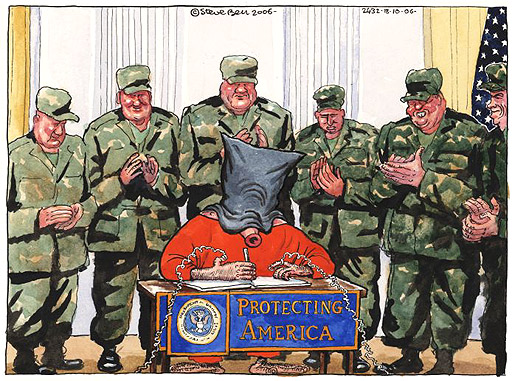
The White House is preparing an Executive Order on indefinite detention that will provide periodic reviews of evidence against dozens of prisoners held at Guantanamo Bay, according to several administration officials.
The draft order, a version of which was first considered nearly 18 months ago, is expected to be signed by President Obama early in the New Year. The order allows for the possibility that detainees from countries like Yemen might be released if circumstances there change.
But the order establishes indefinite detention as a long-term Obama administration policy and makes clear that the White House alone will manage a review process for those it chooses to hold without charge or trial.
Nearly two years after Obama’s pledge to close the prison at Guantanamo, more inmates there are formally facing the prospect of lifelong detention and fewer are facing charges than the day Obama was elected.
The stated goal of this new policy is to give detainees who have been designated for indefinite detention the opportunity for more frequent reviews:
…a minimal review every six months, with and then a more lengthy annual review. Detainees will have access to an attorney, to some evidence against them and the ability to challenge their continued detention.
However it isn’t clear to whom these detainees would plead their cases. Would they meet directly with the President or administration officials? What would be their chances of changing their status through these reviews? I guess we’ll have to wait until the next administration official decides to anonymously leak some more specific information.
According to the Washington Post:
Those designated for prosecution but who are not charged could also have their cases reviewed under the proposed system in the executive order, the White House official said.
Detainees at Guantanamo would continue to have access to the federal courts to challenge their incarceration under the legal doctrine of habeas corpus. Officials said the plan would give detainees who have lost their habeas petition the prospect of one day ending their time in U.S. custody. And officials said the International Committee of the Red Cross has been urging the administration to create a review process.
I guess I must be kind of simple-minded compared to the geniuses in the Obama administration, but I tend to agree with Laura Murphy of the ACLU, who told the WaPo:
“Indefinite detention without charge or trial is wrong, whether it comes from Congress or the president’s pen….Our Constitution requires that we charge and prosecute people who are accused of crimes. You cannot sell an indefinite detention scheme by attaching a few due-process baubles and expect that to restore the rule of law. That is bad for America and is not the form of justice we want other nations to emulate”
The WaPo speculates that the motivation for Obama’s executive order is to
preempt legislation supported by some Republicans, which would create a system of indefinite detention not only for some Guantanamo detainees but also for future terrorism suspects seized overseas.
Maybe, but to me it just seems like another in an endless string of broken promises from the guy who seduced the “progressives” with hope ‘n change and then delivered Bush’s policies on steroids.
I’ll end with an extended quote from Spencer Ackerman, who asks some very good questions:
And there’s a lot of unanswered questions, process-wise, that lend themselves to ad hoc solutions. Who will a lawyer be pleading her client’s case to, here? A judge or an administration official? What role will there be for the courts in reviewing this process, if any? How could a detainee’s counsel successfully argue that he no longer poses a threat? According to the official Dafna quotes, the criterion for determining a detainee’s threat level is inescapably a strategic decision. We’d never leave it for a judge to determine whether, say, Yemen is still a terror-exporting nation. So what’s the point of having a lawyer in the process, if this is an exclusively executive-derived process? None of the above should be construed as an endorsement of the administration’s decisionmaking here, but rather a statement of confusion as to just what system it’s in fact creating for its “Fifth Category” of detainee.
Also: why think this executive order will forestall congressional efforts at codifying an indefinite-detention architecture? Lindsey Graham is going to reintroduce his detention bill in the Senate. Buck McKeon is going to reintroduce his detention bill in the House, where chances are better than even that some indefinite detention bill will pass. The Republicans ran on a platform that included indefinite detention and did very well. Obama ran on a platform that included opposition to indefinite detention, won, and then pursued it anyway. Which of these political forces can we say has more fortitude?
Update, 6:58 p.m.: If I understand the Post’s story correctly, the annual review hearing would be in front of a judge, for a kind of re-habeas-ing. But having made the initial decision that the executive has the right to hold Detainee X, what question is the judge to answer, aside from “Is This Person A Th?reat?” which is not a judicial decision. If the question is “Is The Government’s Case Against This Person Valid?” congratulations — you’re in trial territory! Which isn’t what this is. What kind of hybrid is Obama creating?
I just have one more question. Why doesn’t Obama just “follow his bliss” and run as a Republican in 2012? Then maybe we could find a real Democrat to run against him.

 peej
peej Carissa
 bostonboomer
 dakinikat
 ecocatwoman
 mablue2
 Mama Lopez
 peggysue22
 quixote
 skydancingguestblogger
 Mona (aka Wonk the Vote)



 Sky Dancing
Recent Comments