
The Little Engine That Could
Posted: November 1, 2011 Filed under: #Occupy and We are the 99 percent!, Banksters, commercial banking, Corporate Crime, Global Financial Crisis, income inequality, U.S. Economy 10 CommentsThere’s a fascinating story that’s been brewing right under the radar that is beginning to sprout legs. And I hope continues and receives a larger audience. It’s the battle between Goldman Sachs [and by association the other TBTF’s] and the Lower East Side People’s Credit Union in NYC. Why? Because it’s the perfect metaphor for what’s been going on in the US since deregulation turned our financial system into an iron-fisted bully.
Occupy Wall St. [OWS] as everyone recalls was ignored at first, ridiculed and dismissed, and now has become a fixture and swirl point of political discussion. Conversations are changing. People are beginning to pay attention in both positive and negative ways. OWS started to receive donations from across the country because many Americans are simply fed up with what they see as the gross corruption of money and power on our political system.
And so the Movement that was doomed at the start, who railed against the Big Banks suddenly found itself [by some accounts] with over $300,000. What to do? They needed a bank. And where did they go? To the Lower East Side People’s Credit Union, servicing the City’s low income citizens, primarily Latinos. The People’s Credit Union decided to hold an honorary benefit for their generous depositor, the Occupy group.
And then . . . Boom!
Goldman Sachs had a near hissy fit. Why? Because Goldman had given People’s Credit $5000. This was not a gift, not a donation of goodwill but a drop of cash they are required under the TARP agreement to give through the Community Reinvestment Act [CRA]. They are legally required to give this money out to the community under the original deal. But Goldman in their infinite wisdom and with hackles up over any mention of OWS has decided to use this required reinvestment as a hammer to exert their will. Goldman Sachs has demanded their $5000 back. And also, I would suggest, they wish to set an example: You play it our way or you don’t play at all. It’s been reported the heat has been turned up with a nasty message to People’s:
“You will never get a dime from another bank again.”
Democracy Now has been following this story. A reporter by the name of Greg Palast has done the investigative work from the start and has tried to get Goldman Sachs to give their side of the story. Quelle surprise! No response. I encourage you to watch the clip from Democracy Now. If it doesn’t get your blood boiling then I want to know what mega-tranquilizers you’re on.
This is what Occupy is all about. This is what must change.
Once upon a time, there was an American Dream
Posted: October 26, 2011 Filed under: income inequality | Tags: death of the middle class, Income Inequality, infrastructure bank, role of policy in creating income inequatliy 8 Commentsand over the last three decades it has clearly been disappearing. 
The US made incredible strides in the post World War 2 era by bringing huge numbers of American families into the middle class. This has been clearly reversed over the last three decades according to a new report coming from the Congressional Budget Office. The report shows that “the top 1 percent of earners more than doubled their share of the nation’s income over the last three decades”. It also indicates the role of government in creating the vast inequalities and the resultant stagnating economy, joblessness, and unsustainable federal spending. Policy has deliberating pulled the rug out from under the middle class and placed a red carpet out for the very few. The study was commissioned by Senators Max Baucus and Grassley.
In addition, the report said, government policy has become less redistributive since the late 1970s, doing less to reduce the concentration of income.
“The equalizing effect of federal taxes was smaller” in 2007 than in 1979, as “the composition of federal revenues shifted away from progressive income taxes to less-progressive payroll taxes,” the budget office said.
Also, it said, federal benefit payments are doing less to even out the distribution of income, as a growing share of benefits, like Social Security, goes to older Americans, regardless of their income.
The report, requested several years ago, was issued as lawmakers tussle over how to reduce unemployment, a joint committee of Congress weighs changes in the tax code and protesters around the country rail against disparities in income between rich and poor.
In its report, the budget office found that from 1979 to 2007, average inflation-adjusted after-tax income grew by 275 percent for the 1 percent of the population with the highest income. For others in the top 20 percent of the population, average real after-tax household income grew by 65 percent.
By contrast, the budget office said, for the poorest fifth of the population, average real after-tax household income rose 18 percent.
And for the three-fifths of people in the middle of the income scale, the growth in such household income was just under 40 percent.
The findings, based on a rigorous analysis of data from the Internal Revenue Service and the Census Bureau, are generally consistent with studies by some private researchers and academic economists. But because they carry the imprimatur of the nonpartisan budget office, they are likely to have a major impact on the debate in Congress over the fairness of federal tax and spending policies.
Rapid growth in the income of the very few has come from other factors too. Of course, incredible bonuses and executive compensation has played a role. Additionally, the increasing role of the financial services industry in the economy which mostly produces overhead in relationship to useable goods and services is another reason. Another factor is capital gain with the preferential tax treatment it receives, its relationship to asset bubble and its disproportionate role in the incomes of the very wealthy.
The interesting thing is that the very rich can get richer from trade and globalization. Huge businesses and capital can go any where these days. Most Americans rely on their labor and are limited in their mobility. If the KFC in Louisville has no customers, perhaps one in Beijing will. That is why it is essential that any attempt to stimulate the economy or create jobs happen in a way that ensures the money stay within communities. There’s a bill coming up in to create an infrastructure bank in the US which would do just that. It ensures that funds would be used on projects that would create jobs, tax revenues, incomes, and spending that stays within our borders.
On Tuesday, Rep. Marcia Fudge (D-Ohio) offered H.R. 3259, which would create the bank and fund it at $5 billion per year through 2015. Assuming that bill could be approved this year, that would provide $20 billion for the bank, double the initial amount of money Obama requested.
Democrats have said any money provided to an infrastructure bank could be leveraged to provide financial support to infrastructure projected valued at 10 times that initial amount, or more.
“Whether you are a Democrat or Republican, we all have infrastructure that is crumbling, and we have people in our districts who are eager to get back to work,” Fudge said. “This legislation allows us to target the large number of deficient bridges in our communities and other dangerous infrastructure for repair, making travel safer for our residents.”
Fudge said the bill would allow funding for transportation, drinking water and public housing projects. Her bill is the House companion to S. 1550, which Sen. Sherrod Brown (D-Ohio) introduced in September.
Of course, there’s one problem.
While the bill could move in the Democrat-controlled Senate, it would seem to have no chance of being considered in the House. Republicans in the House continue to insist on spending cuts, and no new federal spending programs. Neither bill provides for any offset in spending to create the infrastructure bank, and instead rely on new appropriations.
How did we possibly arrive at the point where elected officials will actively work against the interests of the people that elected them?
Sympathy for the Devil
Posted: September 24, 2011 Filed under: income inequality, just because | Tags: Income Inequality, millionaires, poor little rich boys 13 Comments
“Please allow me to introduce myself
I’m a man of wealth and taste”Mick Jagger sings in “Sympathy for the Devil”
I was raised with a rather limited view of the world in a suburb of Omaha, Nebraska. There were millionaires in my family then and there are many now. I was told I was middle class and I felt actually rather poor when I would go to Kansas City every weekend and play department store in the elevator in my uncle’s library going up and down between the three floors of his very huge mansion there. My aunt’s house was in the same neighborhood and didn’t have an elevator but was pretty much the same size. I thought my house was average. I laughed when my soon to be husband’s friends from Bellevue called my house “the mansion”.
I was told we were middle class much in the same way Mittens Romney thinks he’s middle class albeit he’s got more money than my parents ever did. I was raised in a very good size house in a very good neighborhood and went to very good public schools with nearly every other new car dealer’s kid in the city. I didn’t really think that was an unusual circumstance. I’m not in that form of Kansas any more although all I have to do is choose to visit a family member and I’m back there any time I want. I have limited patience for an environment where the big crisis of the day is the worry that you may not have enough of your special Holiday China to go around a table bearing a perverse amount of food and drinks.
Now, I live in really mixed poor, working, middle class neighborhood. My income basically has matched the US median family income and my house basically matches the median price for houses in the US. I did that on my own by working and it feels good. Happiness to me are paid bills and phone calls from the daughters. I left all the above income stuff when I left my husband. To be honest, people that are very very rich have odd problems and the more I got out in the real world, the more I discovered that. They feel miserable and down about themselves for very odd reasons. This is one of the reasons I dropped out of that entire scene. I always felt a lot more comfortable with my dad’s family that was solidly working/middle class than my mom’s relatives described above. They were all great and loving people, but there was always this tinge of surreality, unreality, or not quite real world about the side of my family that seriously had more money than most people would know what to do with. Most of their days was spent trying to figure out odd ways to spend it.
So, why am I bringing this up? It’s because all of that has tinged my adverse reaction to a WAPO item called “Five myths about Millionaires“. The crux of the article is that a million dollars really isn’t what it used to be, millionaires do pay taxes, and like my family, they don’t really feel rich. They feel just ordinary and middle class, and shucks folks, they’re just likeable people who create jobs and pay their share of taxes. Well, that’s all fine but that shouldn’t be the point. My extremely rich family used their white, educated, WASPY background to the best of their advantage and worked the system well. The system rewarded them. I’ve seen equally sincere and good people have just the opposite happen for factors completely out of their control. The deal is we have to pay for all the benefits of a modern society and who is in the best position to do that?
The very rich don’t need any one defending them at all because, it is what it is and they are what they are. They are mostly nice people for whom the system worked very well because they were precisely poised to take advantage of all that the system offers. Rich people are as diversely nice or bad as any one else. However, having all that money warps your perspective a lot. My thought is that John Steele Gordon–author of the article–probably gets up earnestly and says like Mittens Romney and my family used to do: ” You know, we’re just simple middle class Americans” right before he gets in his new car and goes from his big house to his well paying job. You can insert a lot of private club references into the day too. Yup, that’s all every one does every single day unless they are lazy and want to engage in the president’s class war, right? There is something about having huge amounts of money that puts people in a different frame of mind. They invent struggles where there are none.
“I tell you the truth, it is hard for a rich man to enter the kingdom of heaven. Again I tell you, it is easier for a camel to go through the eye of a needle than for a rich man to enter the kingdom of God.”
Let me just give you a quote from the article about why a million dollars isn’t that much money for poor middle class millionaires.
On Thursday, 44 percent of people voting in an online surveyas part of the GOP debate coverage said that a $1 million annual income made a person “rich.”In a 2008 survey of affluent Chicago households, only 22 percent thought a nest egg of $1 million was rich. In March, four out of 10 millionaires surveyed by Fidelity Investments said they do not feel rich. That same month, a majority of investment advisers surveyed in a Scottrade poll said that $1 million isn’t enough for retirement.
Though the average American family is rich beyond the wildest dreams of the average family in Bangladesh, where per capita income recently rose above $700, it’s not much compared with those who summer on beachfront properties in the Hamptons. When John D. Rockefeller learned in 1913 that the late J.P. Morgan had left an estate of $60 million, including a fabulous art collection, he reportedly said: “And to think — he wasn’t even rich.”
So, here I am in the upper ninth ward of New Orleans thinking that just about every one within a few miles of me would think that life had just about gotten as good as it could get if they could hit that median family income of around $60,000 a year consistently. There would probably be a lot more of them–like me–that actually would own the house in which they live for one. Also, they probably would be overjoyed to see a tax base so healthy that we could actually support good roads, good schools, and better cops for a change. Whatever the house in Southampton equivalent would be down here isn’t even on any one’s wish list on this side of the French Quarter. The daily concerns are: Will I keep my job or find a job? Can I pay all my bills this month? Can I feed my family? Will the car and my health stay together long enough so that I won’t become a homeless person? The thing that makes millionaires different is that real life is not at the top of their lists of concerns every day and believe me it changes your perspective mightily when it is.
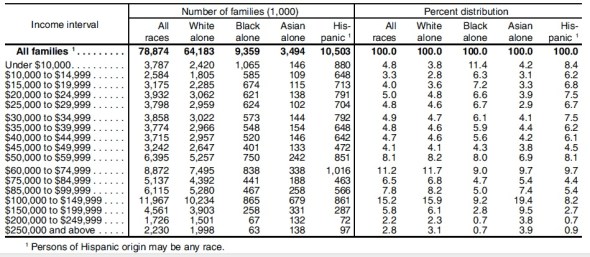
Let’s put those survey results in context by using the 2011 Statistical Abstract. I’m going to cut and paste the income distribution table for you. It’s for U.S. families in 2009 stated in 2008 dollars. Okay, so look down there at the percentage of families that make more than $250,000 a year. It’s more than it was a few years ago, but it’s still less than 3% for every one and 4% for whites and Asians. Black and Hispanic families that earn that much are less than 1% of their entire demographic.
Here’s a slightly broader view of income distribution from the same source.
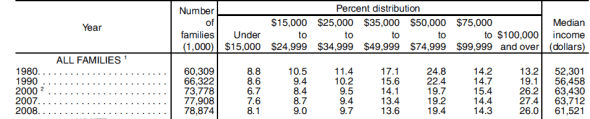
You can see that about 74% of US families don’t even clear $100,000 annually given the median income is $61,521. That’s a skewed distribution if there ever was one. I think the skewed distributions leads to some pretty skewed perspectives too.
I’m reminded of this little news item from one of my state’s Congressman whose math was fuzzy and priorities reflect that of some one whose not worried about the normal things in life. I’m still trying to figure out exactly what he pays the employees at his Subway Shops in Northwest Louisiana given the numbers he provides. As best I can figure, it’s about $12,000 a year. If he feels so put out and poor with an annual income of $400,000 a year that I wonder whatever do his charitable contributions look like?
Taking up the typical GOP talking point, Fleming said raising taxes on wealthy “job creators” is a terrible idea that kills jobs because many of these people are small business owners who pay taxes through personal income rates. Fleming is himself a businesses owner, so Jansing asked, “If you have to pay more in taxes, you would get rid of some of those employees?” Fleming responded by saying that while his businesses made $6.3 million last year, after you “pay 500 employees, you pay rent, you pay equipment, and food,” his profits “a mere fraction of that” — “by the time I feed my family, I have maybe $400,000 left over.”
All of this puts me in mind of F Scott Fitzgerald who was the chronicler of the wealthy point of view during the Gilded Age.
Let me tell you about the very rich. They are different from you and me. They possess and enjoy early, and it does something to them, makes them soft where we are hard, and cynical where we are trustful, in a way that, unless you were born rich, it is very difficult to understand. They think, deep in their hearts, that they are better than we are because we had to discover the compensations and refuges of life for ourselves. Even when they enter deep into our world or sink below us, they still think that they are better than we are. They are different.
F. SCOTT FITZGERALD writes in “The Rich Boy” in 1926
This is the stuff that makes Elizabeth Warren’s video on the stump the other day go viral. This isn’t class warfare. I don’t think there’s an awful lot of people that truly begrudge folks their wealth. Speaking only for myself, I don’t want to have my sense of perspective or priorities that warped any more and am happy when ends meet. I think people only want to feel like they have a decent living and that people that have more than that should pull their own weight and not make these weirdish justifications for wealth that most folks just plain don’t get. Back to the article by the poor little rich boy.
Taxes on the rich are taxes on people who create jobs. And jobs are an unalloyed good thing for an economy. Excessively taxing the capital that makes the economy go is poor public policy. And we have a recent example of how the opposite works well: Unemployment declined by a third in the four years after the Bush tax cuts were fully implemented in 2003, dropping to 4.2 percent from 6.2 percent. Meanwhile, federal revenue increased 44 percent in those years. If these tax cuts put people to work and generated money for the government, shouldn’t Obama consider the possibility that tax increases should be avoided?
Most of this analysis is incredibly disingenuous because it fails to mention that the country was coming out of a recession and a severe macro shock from 9/11. It wasn’t the fiscal policies that did these things at all. Plus, these were the early warning signs of Allan Greenspan blowing a housing bubble and a construction and financing boom about to crash the economy. Economists don’t like to see the rate of unemployment fall significantly below its natural rate. It means the government is doing WAY too much and will probably create some kind of inflation and the economic activity won’t be sustainable. All that war and anti terrorism spending overheated the economy.
The argument of capital gains cuts = job creations is the core argument here that I will never understand from a simple common sense view. That doesn’t even count all that book learning views from the degrees and the doctorate in Financial Economics that sets off alarms in my brain. These were tax cuts that subsidized excessive speculation. The argument that values hoarded wealth over hard work and says that all that money floating around financial markets does is create jobs is a false one.
The deal is this. It’s one thing to put your money into a business like a small or medium sized business owner does but that money is counted as regular income. That is job creating but it has nothing to do with capital gains taxes. Second, if you do buy stock in GE and you put in there for years on end and others do the same then, yes, that’s basically a good source of funding for a business and that resembles business ownership albeit a very detached one. Possibly, you could reward the buy and hold investor but a huge amount of market activity is not buy and hold unless you’re an institution. Also, why does putting your money in a bank and collecting interest– because bank deposits get pooled and loaned to businesses–not get the same treatment? My thought is that it’s because it’s the middle class way of holding wealth and the view is that it is inferior income like wages and salaries. Interest income gets taxed like work income. But, AND MOST OF ALL, how are day traders who bop in and out of investments daily, speculating away on stuff, buying exotic derivatives that have nothing to do with the underlying business create jobs, value or anything else worthy of the label job creators and why do they deserve special tax treatment? Are you prepared to tell me that this form of speculation creates more jobs than say, the gambling casinos on the strip in Las Vegas? At least we can point to cocktail waitresses, bartenders and dealers in Las Vegas style gambling.
A lot of money income that comes from capital gains is just another form of gambling income. It isn’t there long enough to encourage businesses to make long term decisions that would actually help the economy. The only thing it really does is make CEOs short-sighted by forcing them to focus on short term stock prices so they invariably don’t invest in positive net present value projects which means no attendant jobs. That’s what the research says. So, Gordon’s thinking is as fuzzy as gee, since I only get $400,000 a year, I guess I’ll just have to get rid of a few people that are doing the work for me that I pay only $12,000 a year. The “bringing liquidity to the market” isn’t really a great rationalization here either because the wham bam thank you approach of speculators these days doesn’t offset the increased risk and price volatility they bring to markets. They screw up the pricing mechanism when they do all that momentum trading. Recent gas prices and house prices are good examples of speculation gone wild. Also, riddle me this. What value do hedge fund managers bring to the table when they bet against US businesses and the US government? Why do they get special tax treatment for that? What jobs does that create? I’m not reading specifics on those things at all in Gordon’s blessed are the millionaires for they are the job creators spiel. Why subsidize this behavior and these extraordinarily rich people?
So, I’m not in any way shape or form saying that millionaires are bad or evil or whatever the nasty implications are that underlie the class war charge. What I’m saying is that there’s a difference in your perspective when you’ve got hungry kids than some one is whining they can’t make it on $400,000 a year. I don’t think we need articles lecturing us on the proper perspective we should take on millionaires. I think a few millionaires need to develop a different perspective on reality and life and quit whining when some one asks them to pay for the roads they drive on, support the schools they attended, pay for the protection provided by soldiers, cops, and firefighters, and basically pull their fair share of the load of living in a civilized society.
Tuesday Reads: Obama’s Deficit-Reduction Plan, Backsliding Obots, Rev. Wright, and Dr. Doom
Posted: September 20, 2011 Filed under: American Jobs Act, Barack Obama, Democratic Politics, Domestic Policy, Global Financial Crisis, income inequality, Medicaid, Medicare, morning reads, Social Security, U.S. Economy, U.S. Politics | Tags: Booman, Chris Hedges, class warfare, digby, Ezra Klein, Greg Sargent, Jon Walker, Jonathan Cohn, Martin Luther King, Maya Angelou, Nouriel Roubini, Rev. Jeremiah Wright 45 Comments
Good Morning!! Let’s see what’s happening in the news today.
Well, of course the Obama apologists are claiming that he has suddenly grown a backbone of steel and become the liberal messiah they all dreamed of in 2008. I already told you about Ezra Klein’s delusional column last night. The other usual suspects are also getting leg tingles, and former Obots are starting to backslide.
Greg Sargent has put on his rose-colored glasses and taken a few swigs of LSD-laced Koolaid:
This has to be the clearest sign yet that Obama has taken a very sharp populist turn as he seeks to frame the contrast between the parties heading into 2012. During his remarks this morning, Obama directly responded to Republicans accusing him of “class warfare,” but rather than simply deny the charge, he made the critical point that the act of protecting tax cuts for the rich is itself class warfare, in effect positioning himself as the defender of the middle class against GOP class warriors on behalf of the wealthy.
Wow! I’ll bet it never occurred to anyone that income inequality equals class warfare until Obama figured it out. Amaaaazzzzing!!
A senior administration official tells me that parts of Obama’s “class warfare” broadside were ad-libbed. Here’s the key chunk — and it’s a script that could have been written by just about any card-carrying member of the “professional left:”
Warren Buffett’s secretary shouldn’t pay a higher tax rate than Warren Buffett. There’s no justification for it. It is wrong that in the United States of America, a teacher or a nurse or a construction worker who earns $50,000 should pay higher tax rates than somebody pulling in $50 million…
We’re already hearing the usual defenders of these kinds of loopholes saying, “this is just class warfare.” I reject the idea that asking a hedge fund manager to pay the same tax rate as a plumber or a teacher is class warfare. I think it’s just the right thing to do. I believe the American middle class, who’ve been pressured relentlesly for decades, believe it’s time that they were fought for as hard as the lobbyists and some lawmakers have fought to protect special treatment for billionaires and big corporations.
Nobody wants to punish success in America … All I’m saying is, that those who have done well, including me, should pay our fair share in taxes to contribute to the nation that made our success possible.
Holy sh*t!! Obama ad libbed? Hope ‘n’ change! Change we can believe in! I guess it’s just me, but I thought that speech sounded kind of weak and defensive. But what do I know?
Booman has an even better rationalization for Obama’s behavior than Beltway Bob Ezra Klein. According to the ever-gullable Booman,
…the president has a lot more credibility now when he takes his ideas to the public and says the the Republicans aren’t interested in compromise. You have to try and fail to get a compromise before that argument has any resonance. It’s not so much 11-Dimensional chess as basic common sense. Everyone’s poll numbers suffered during the summer, but no one’s standing was weakened more the Republicans’. That’s not an accident.
So Obama must have planned this. The man is brilliant!!
Digby says Obama is in campaign mode and that’s why he’s trying to sound strong and determined.
My first thought is that it appears the administration has finally decided that there’s nothing to be gained with exclusively delivering post-partisan pablum. It certainly sounds as though he’s thrown down the gauntlet. Unfortunately, the President appears to want to have two fights going into this election, one over job creation and one over whose plan to cut the deficit is better, which I think is a confusing waste of time. (Focus like a laser beam on jobs and tell the Republicans they’ll have to go through you to get to the safety net and I think people would instinctively understand that he’s on their side.) But that isn’t this president’s style and perhaps it wouldn’t be believable if he did it. So, this is at least a change of tactics, more confrontational in tone, which is his best hope for reelection since it turns out people aren’t really all that impressed that he’s the most reasonable guy in the room if it appears that he gets punk’d every time.
Digby things the proposed Medicare cuts are a loser politically, though–especially for Congress members running for reelection.
Jon Walker at FDL was “pleasantly surprised” that Obama didn’t call for Social Security cuts or “any specific major cuts to Medicare benefits,” but he hasn’t gone back on the Koolaid.
This is a positive development. Having President Obama publicly call for major cuts in Medicare benefits or change in age eligibility would have been terrible for our senior citizens and a total political disaster for the Democratic party. But it is important to remember: simply because the president did not put such cuts on the table doesn’t mean he took these cuts off the table.
President Obama has already privately signaled that in theory he would be willing to support major cuts to Medicare. And he’s hinted he’d be willing to cut Social Security benefits. They were both earlier put the table for a theoretical deal and this speech didn’t take them off the table. There was no veto threat to protect Medicare and Social Security benefits.
Actually, there do seem to be specific proposed cuts to Medicare. Jonathan Cohn breaks down the detail of the President’s deficit reduction proposal in a very technical piece that you can read if you’re interested. According to Cohn,
President Obama’s new deficit reduction plan includes about $320 billion in cuts to government health care programs. Most of the cuts from Medicare and that is sure to get a lot of people’s attention, if not now then in the presidential campaign.
But these reductions are less severe, and less worrisome, than some of the proposals Obama indicated he was willing to support over the summer, while he was negotiating with House Speaker John Boehner. In particular, Obama did not call for increasing the Medicare eligibility age from 65 to 67, as folks like me feared he would.
In fact, the cuts Obama has in mind are more or less consistent with the kind of cuts that you find in the Affordable Care Act: They are reductions designed to change the way Medicare pays for treatment and services, ideally (although not always) in ways that will actually improve the efficiency or quality of care. To the extent they would force individual seniors to pay more, it’d be in the form of higher premiums from wealthy seniors or higher co-pays for treatments likely to be unnecessary or wasteful.
For a reminder of who Obama really is, I’ll turn to Glenn Ford at the Black Agenda Report. His post was written a few days ago–before today’s speech–but I still think he has Obama’s number.
The GOP can count on Obama to offer up Social Security on the alter of austerity, as he has done consistently since January, 2009, while still president-elect. Back in April, he proposed $4 trillion in cuts over 12 years – nearly as draconian as his hand-picked committee – with the focus on the safety net. “By 2025,” warned the apocalyptic and grossly misleading president, “the amount of taxes we currently pay will only be enough to finance our health care programs, Social Security, and the interest we owe on our debt.”
Obama promises that his grab-bag, mostly supply-side and wholly inadequate jobs scheme will largely be “paid for” by cuts that include “modest adjustments [hah!] to health care programs like Medicare and Medicaid.”
Social Security stands to be mortally wounded at Obama’s hand. His second round of cuts in the payroll tax further undermine, not just the program’s trust fund, but its status as a free-standing entity outside of the usual congressional process. Congress will, theoretically, make up the temporary shortfall in payroll taxes through appropriations. But that puts Social Security in the middle of the budget deficit debate, where it does not belong and from which it has been purposely shielded since its origins in President Franklin Roosevelt’s New Deal. Through rhetoric and calculated action, Obama has for the past two and a half years been in league with Republicans in falsely conflating Social Security and the federal debt. He is now positioned to knock the program from its protective pedestal.
The Social Security cuts are already taken care of as long as the GOP goes along with extending the payroll tax holiday. The more money Obama can suck out of the Social Security trust fund, the more likely he can “reform” the Social Security into a welfare program or Wall Street ATM.
If Obama succeeds, Social Security will become just another “entitlement” to be mangled in a grand bargain with the GOP, like Medicare and Medicaid. Obama wants to be remembered as the president who brought the Republicans and the right wing of the Democratic Party into harmonious consensus – over the dead carcass of the New Deal. That’s what he means by “Go big!”
Chris Hedges has another excellent article up at Truthdig. It’s an interview with Obama’s former pastor and spiritual adviser: “The Rev. Jeremiah Wright Recalls Obama’s Fall From Grace.” I know not everyone will agree with Hedges’ point of view, but I mostly do. As outlandish as Wright was made to seem in the media, I couldn’t fault much of what I heard him say about America and racism. It’s a lengthy article, but I hope you’ll take a look at it.
One of the things Wright discussed with Hedges was the Martin Luther King Memorial in Washington DC. Wright himself raised $200,000 for the project.
“I think it’s a wonderful thing that the country would recognize someone as important as Dr. King,” Wright said when I reached him by phone in Chicago, “and recognize him in a way that raises his likeness in the Mall along with the presidents. He’s not a president like Abraham Lincoln or George Washington. But to have him ranked among them in terms of this nation paying attention to the importance of his work, that’s a good thing.”
“I read Maya Angelou’s piece about the way the quote was put on the monument,” Wright said in referring to the editing of a quote by King on the north face of the 30-foot-tall granite statue. The inscription quote reads: “I was a drum major for justice, peace and righteousness.” But these are not King’s words. They are paraphrased from a sermon he gave in which he said: “If you want to say that I was a drum major, say that I was a drum major for justice. Say that I was a drum major for peace. I was a drum major for righteousness. And all of the other shallow things will not matter.” Angelou said the mangled inscription made King sound “arrogant.”
“I read the explanation as to why we couldn’t include the whole quote,” said Wright, who helped raise $200,000 for the monument. “Kids a hundred years from now, like our pastor who was born three years after King was killed, they’re going to see that and will not get the context. They will not hear the whole speech, and that will be their take-away, which is not a good thing. My bigger problems, however, have to do with all the emphasis on ’63 and ‘I Have a Dream.’ They have swept under the rug the radical justice message that King ended his career repeating over and over and over again, starting with the media coverage of the April 4, 1967, ‘A Time to Break Silence’ message at the Riverside Church [in New York City]. King had a huge emphasis on capitalism, militarism and racism, the three-headed giant. There is no mention of that, no mention of that King, and absolutely no mention of the importance of his work with the poor. After all, he’s at the garbage collectors strike in Memphis, Tenn., when he is assassinated. The whole emphasis on the poor sent him to Memphis. But that gets swept away. It bothers me that we think more about a monument than a movement. He had a movement trying to address poverty. It was for jobs, not I Have a Dream, not Black and White Together, but that gets lost.”
He’s right. The powers that be have worked for years to minimize King’s work to end the Vietnam war as well as his determination to wipe out poverty. It’s interesting that this is the second time King has been misquoted on Obama’s watch.
This post is already too long, so I’ll end with an article by Dr. Doom (Nouriel Roubini): Eight drastic policy measures necessary to prevent global economic collapse. None of them will be popular. The first recommendation is that
we must accept that austerity measures, necessary to avoid a fiscal train wreck, have recessionary effects on output. So, if countries in the Eurozone’s periphery such as Greece or Portugal are forced to undertake fiscal austerity, countries able to provide short-term stimulus should do so and postpone their own austerity efforts. These countries include the United States, the United Kingdom, Germany, the core of the Eurozone, and Japan. Infrastructure banks that finance needed public infrastructure should be created as well.
Read the rest and weep. Our current “leaders” aren’t likely to pay any attention.
So sorry if I depressed you with that one. What are you reading and blogging about today?
46.2 Million Americans (1 in 6) Now Living in Poverty
Posted: September 13, 2011 Filed under: Barack Obama, income inequality, poverty, U.S. Economy, U.S. Politics, unemployment | Tags: Census Bureau, Income Inequality, jobs, median income, Poverty, unemployment 10 Comments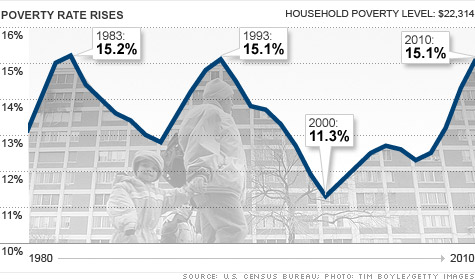
Chart courtesy of CNN Money
As of 2010, 1 in 6 Americans was living in poverty, according to a report from the Census Bureau today. The poverty rate was 15.1%, the highest number of Americans living below the poverty rate since the number has been examined. From the New York Times:
An additional 2.6 million people slipped below the poverty line in 2010, census officials said, making 46.2 million people in poverty in the United States, the highest number in the 52 years the Census Bureau has been tracking it, said Trudi Renwick, chief of the Poverty Statistic Branch at the Census Bureau.
That figure represented 15.1 percent of the country.
The poverty line in 2010 was at $22,113 for a family of four.
“It was a surprising large increase in the overall poverty rate,” said Arloc Sherman, senior researcher at the Center on Budget and Policy Priorities. “We see record numbers and percentages of Americans in deep poverty.”
The middle class has also lost ground in terms of yearly income.
And
…real median household incomes declined by 2.3 percent in 2010 from the previous year, to $49,400. That was 7 percent less than the peak in 1999 of $53,252.
“A full year into recovery, there were no signs of it affecting the well being of a typical American family,” said Lawrence Katz, an economics professor at Harvard. “We are well below where incomes were in the late 1990s.”
According to the census figures, the median annual income for a male full-time, year-round worker in 2010 — $47,715 — was virtually unchanged from its level in 1973, when the level was $49,065, in 2010 dollars, said Sheldon H. Danziger, professor of public policy at the University of Michigan.
As we all know, the rich have gotten much much richer and are continuing to get richer still because of the Bush/Obama economic policies. From CNN Money:
For middle-class families, income fell in 2010. The median household income was $49,445, down slightly from $49,777 the year before.
Median income has changed very little over the last 30 years. Adjusted for inflation, the middle-income family only earned 11% more in 2010 than they did in 1980, while the richest 5% in America saw their incomes surge 42%.
“Over that period of time, it’s not that the American economy has necessarily performed badly,” Osterman said. “As a country we’re richer over that period, but there’s been this real shift in where the income has gone, and it’s to the top.”
Amplifying that trend, the bottom 60% of households saw their income fall last year, while households making $100,000 or more enjoyed a rise in income.
CNN has a chart that shows the poverty level in each state, so you can check to see how people are doing in your neck of the woods. In general, the South is the worst off, and Louisiana and Mississippi have the highest percentages of people living below the poverty line.
I hope someone is showing this data to President Obama, because he needs to either do something about jobs and income inequality or follow LBJ’s example and get out of the way so we can find candidate who is able to show some leadership.

 peej
peej Carissa
 bostonboomer
 dakinikat
 ecocatwoman
 mablue2
 Mama Lopez
 peggysue22
 quixote
 skydancingguestblogger
 Mona (aka Wonk the Vote)



 Sky Dancing
Recent Comments