
A Tale of Two Speeches, A Tale of Two Men
Posted: December 7, 2011 Filed under: 2012 presidential campaign, Banksters, Barack Obama, commercial banking, Corporate Crime, corruption, Democratic Politics, income inequality, Injustice system, investment banking, Teddy Roosevelt | Tags: 2012 presidential election, Barack Obama, U.S. Economy 13 Comments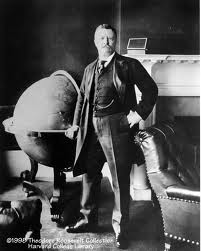 On Tuesday, Barack Obama delivered a speech in Kansas. Osawatomie, Kansas to be exact. With little subtlety, this was an attempt to conjure up the spirit of Teddy Roosevelt, the TRex of the early 20th Century, the scrappy yet privileged pugilist, who pitted himself against monopolies, rabid financiers and proudly defended the American ‘square deal.’ In truth, TR was no saint. But he was a man of conviction. And action.
Barack Obama has proven himself a weak sister by any comparison. Yet, he and his handlers, his ever-present speechwriters saw fit to mirror Roosevelt’s words. We’re to believe that Obama is a populist at heart, a Roosevelt clone, calling on the Nation to embrace progress over privilege. The square deal becomes the fair chance. The review of abuses and lawlessness that TR was not afraid to call destructive become a wrong. Legislative solutions and regulatory oversight that TR specifically cites are mentioned in passing or given more credit than they’re actually due, eg., the stripped down Dodd-Frank bill. Notice there was no mention of reinstating Glass-Steagall, something that wouldn’t solve the entire mess we find ourselves in but would be an important first step in the reform process.
Let’s get real. Barack Obama has no intention of reforming anything. Unlike TR who said:
“Words count for nothing except in so far as they represent acts.”
And Barack Obama? He’s countered with words leading nowhere.
He was against the Iraq War, only there’s no record of his opposition. His ‘just words’ speech—a steal from an earlier Deval Patrick oratory— said everything the man has proven himself to be, an empty talker. Where is the evidence that Barack Obama is or ever was a defender of the ‘ordinary man and woman?” Oh yes, he was a community organizer. And what exactly were his accomplishments? He was a State Senator. Accomplishments, please [beyond representing the interests of slum landlords]. And as a US senator? Accomplishments?
Nada.
Let’s line this up against a few of Teddy Roosevelt words made flesh:
- Successfully prosecuted the Northern Securities Co. for the merger of the Northern Pacific, The Great Northern and the Chicago, Burlington and Quincey railroads under the Sherman Antitrust Act.
- Restored public confidence in the government’s ability to hold the country’s most powerful men accountable to the law.
- Frequently warned conservative critics that revolutionary upheaval was likely to be inspired by an ‘attitude of arrogance on the part of property owners and their unwillingness to recognize their duty to the public.’
- Pushed through Congress legislation establishing the Department of Commerce and Labor and within that Department the Bureau of Corporations, authorized to investigate and publicize suspect corporate activities.
- Challenged the corporate view that business records be kept in secrecy and that employers had a right to deal with employees as they saw fit [one need only review the deplorable working conditions and wages of the era to understand the need for reform] with no interference from the Government.
- Brokered a peace between Russia and Japan, for which he earned the Nobel Peace Prize.
There’s more, of course—the good, the bad and the ugly. TR was not perfect but unlike the present occupant of the White House, he had a vision that was his and his alone. He was the public face and voice of the American Progressive Movement that would eventually lead to improved working conditions, a woman’s right to vote, union legitimacy and new attitudes regarding our environment–conserving our national, natural treasures for the future–among other things.
Teddy Roosevelt was a man of the moment and a man with a legacy.
Now think of Barack Obama, the lack of vision, the broken promises, the man in search of an identity: JFK, FDR, Abraham Lincoln. And now Teddy Roosevelt. This is the blank slate upon whom everything has been written but nothing has stuck. Oh yes, we have the healthcare reform bill, a legislative mystery written behind closed doors then sealed with secret insurance industry deals and wet kisses to Big Pharma. We also have wars continued and financed, record unemployment [jobs which will not be replaced by pretty words], nearly 46 million Americans receiving food stamps [1 in 7], houses still underwater with few promised modifications and/or relief and 20+% of our children classified as ‘food insecure.’
This is not a vision. It’s a disaster. I’ll leave you with Teddy Roosevelt’s words, from his own Kansas speech:
I stand for the square deal. But when I say that I am for the square deal, I mean not merely that I stand for fair play under the present rules of the games, but that I stand for having those rules changed so as to work for a more substantial equality of opportunity and of reward for equally good service.
And,
The object of government is the welfare of the people. The material progress and prosperity of a nation are desirable chiefly so far as they lead to the moral and material welfare of all good citizens.
And,
One of the fundamental necessities in a representative government such as ours is to make certain that the men to whom the people delegate their power shall serve the people by whom they are elected, and not the special interests. I believe that every national officer, elected or appointed, should be forbidden to perform any service or receive any compensation, directly or indirectly, from interstate corporations; and a similar provision could not fail to be useful within the States.
These are words most of us can believe in, spoken August 31, 1910. I’d encourage readers to take a few moments and read TR’s words in their entirety.
Then read Obama’s speech.
Two speeches. Two men.
If President Obama wants to slip on the mantle of Teddy Roosevelt, become a born-again populist in 2012, he’ll need action to prove his words.
Why?
Because the days of blind faith are over.
The Art of Doublespeak
Posted: December 1, 2011 Filed under: #Occupy and We are the 99 percent!, 2012 presidential campaign, double-speak, Economy, income inequality, unemployment | Tags: 2011: days of revolt, 2012 presidential election, Financial Crisis 9 Comments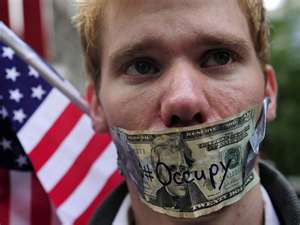
Language is important. Words can inspire, inflame, enrage. Words can hide a speaker’s intentions. Sing me a lullaby. Spin me a fairytale. Sell me a load of bull-hockey.
One of today’s best-known language twisters is Frank Luntz. Pollster and political consultant, Luntz is the Master of Political Doublespeak. He would have made Orwell proud: War is Peace, Freedom is Slavery, Ignorance is Strength. He crawls out during every election cycle with the creepy focus groups, wired up and ready to go. We learn ‘what words work.’ Otherwise known as ‘what words obfuscate, spin and get the best reaction from would-be voters.’
Well, here’s a Newsflash: Luntz is worried about Occupy Wall Street, all those sorry slackers the GOP and various critics have sidelined as hippies, losers and Obama-lovers. Seems from Luntz’s point of view, OWS is having an impact on political discourse.
No kidding Sherlock!
And so, Luntz decided a tutorial was needed to school Republicans how to “speak” when asked questions about the very issues that the Occupy wave has been raising.
Fascinating! A defense against the so-called irrelevant. But even more fascinating is the list of rules on how to ‘discuss and defend against’ the grievances that Occupy members have introduced into the public sphere.
The very first instruction made me laugh:
Don’t say capitalism.
Because people might start questioning the broken economic construct that’s taken root in the US. Btw, I haven’t heard OWS slamming capitalism, per se. It’s Vulture Capitalism, the darling of the neoliberal/libertarian set, that’s being questioned and panned, where only the well-heeled financial class takes the booty while the rest of the country is left to collect unemployment checks and shop with food stamps. Sorry, don’t think ‘free market’ or ‘economic freedom’ will wash in a country where poverty is rising at an alarming rate and over 20% of American kids are classified as food insecure.
Politicians whether Right or Left need to do far better than that. Like maybe tell the truth: that the financial class in this country has been running a huge Ponzi scheme, that transnational corporations are willing to run roughshod over everything in a blind pursuit of profit, that endless war makes money for the few, while the many bleed.
That would be refreshing.
Don’t say the government taxes the rich. Tell them the government takes from the rich.
Oh yes, that’s much better. Then pull out Warren Buffet’s statement that his tax rate [as a multi-billionaire] is lower than what his secretary is required to pay. And please, take a spin over the corporate history of negative taxes after all the loopholes and government largesse heaped on the ‘job creators’ is taken in to account. Then too, let’s not forget the ‘off-shore’ pooling of tax-free profits and tidy nest eggs. The beat goes on for those with the courage to look.
The government takes from the rich? Hahaha. More like the government sucks up to the rich and their ever-present lobbyists.
Republicans should forget winning the battle for the middle-class. Call them hardworking tax-payers.
Yes, Republicans should forget winning the middle-class since they’ve gone out of their way to eliminate them, crush them out like last year’s cigarettes.
Frank Luntz is ‘really’ scared of the Occupy Movement ? With rules like this he may be out of a job. If the Republican’s go-to wordsmith can’t get his head or words around the basic complaints of not simply Occupy but most Americans and/or the very real economic and political discontent, then they are deaf, dumb and blind.
Or maybe smart like the wily fox. Because the evidence is everywhere. What to do? Keep the disinformation and propaganda machine in high gear. I won’t belabor the hypocrisy and cynicism of Luntz’s list. He and the entire stable of political pollsters, consultants and analysts on all sides are merely symptoms of a system flailing in the wind, a system that’s forgotten how to reach out or even talk to real people in anything approaching honest discourse. A system that has no respect for its citizenry.
Will the Luntz approach work as it has in the past?
We shall see. But I invite you to read the Ten Commandments of Political Doublespeak for 2012 at the link above. Some examples will make you laugh. Several will make you mad as hell.
Oh, and here’s a tip: Don’t say the word ‘Bonus.’
Occupy Philly and Independence Hall
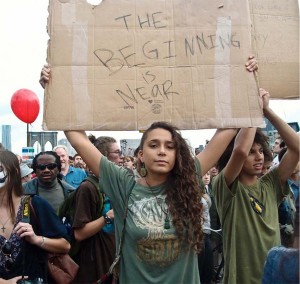
Posted: November 30, 2011 Filed under: #Occupy and We are the 99 percent!, Banksters, Corporate Crime, corruption, Economy, financial institutions, income inequality, jobs, U.S. Economy, U.S. Politics, unemployment, voodoo economics | Tags: 2011: days of revolt, Financial Crisis, U.S. Economy, unemployment 16 CommentsBlack Friday, Philadelphia, Pa.
My first look at Occupy Philly was after a free ride on the 9:52 Media Local, The Santa Train. This was not by plan but a matter of sheer coincidence. I should have guessed;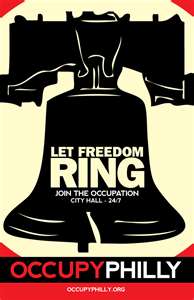 I was the only one standing on the Morton platform without a small child in tow. But shortly after boarding, it was all too clear. The elves came first, wailing Jingle Bells and Wish You a Merry Christmas. They were followed by out-of-season Mummers dressed in holiday garb, belting out another round of X-mas cheer, complete with accordion, banjo and sax. Mrs. Claus assured the children that Santa was busy, busy at the North Pole, making sure all their wishes [even though edited to economic realities] would come true. And then, there was the free candy and balloon animals.
The magic of childhood! Where we can believe everything and anything. When the world appears kind and right and true.
An out-of-stater now, I deliberately got off at Suburban Station, my old work stop. Also, the stop at which I’ve frequently disembarked to attend exhibits at the Franklin Institute, the Museum of Natural History or the Philadelphia Museum of Art, a brisk walk west up the Parkway, past the Rodin Museum and the soon-to-open home for the controversy-laden Barne’s collection.
But not today.
This morning I headed east, winding through the underground towards City Hall and the Occupy Philly encampment. Later, I would team up with a friend and hoof down to the historic district. But right now, I had a different historical event in mind.
I no sooner hit the outside doors than the vivid blue of plastic tarps and tent tops were visible. A strange sight. Normally, I would have walked through the West arch at City Hall, stood for a few moments googling at the city’s Christmas tree. But this year was different. So different.
The western entrance to the City Hall complex was barricaded. ‘For Restoration’ the signs said. No towering tree this year. Instead, the Occupy tents decorated Dilworth Plaza, a strange but fascinating sprawl of makeshift living quarters and standard issue camping gear. The area was quiet and still, the air crisp. I circled around the entire plaza. No sight of my friend, so I headed back towards the encampment, spotted the medical and information tents, as well as a petition table outlining the dangers of in-state fracking by over-zealous gas drilling companies.
At the Information Tent there was an array of literature on upcoming actions, the November issue of the Occupy Wall Street Journal and several people discussing Mayor Nutter’s deadline to dismantle the encampment within 48 hours. Two of the occupiers said almost in unison: ‘It was never about the tents.’
So what is it about? It’s a question I read constantly on the blogs and in newspapers, even hear from family and friends.
Here’s what I learned in the morning hours I spent on the Plaza:
- In the 53 days of Occupy Philly, 26,000 local citizens signed on expressing support.
- At the height of the encampment, City Hall was encircled with tents, sleeping bags and a variety of makeshift living accommodations.
- Active supporters numbered around 200-300, some living on-site, others coming in to protest, march and rally during the day.
- Local Unions support the effort. In fact, the Trades Union offered to assist the protestors in the original plan to move off Dilworth to an encampment across the street. The Union needs those ‘renovation’ jobs. That idea was scrapped because permits were denied.
- The area was clean. No needles, drug paraphernalia or trash scattered about as the MSM would have readers/viewers believe taints all encampments. Talking to several encampment members, I was told a goodly portion of each day is spent ‘cleaning up.’
- The encampment/protest was peaceful. There was a sense of community and the overriding sentiment was to voice anger and dissent over the widening income inequality in the US and the corporate capture of all facets of government.
- I heard no political posturing or Obama shilling. Simply stated, the system is broken for the 99%.
- Forty to fifty of the encampment members were homeless. They joined for the free food and the safety of numbers.
- The police presence, even on this Friday morning, was unusually large but basically stationed within the confines of the City Hall plaza.
- Though Mayor Nutter had leveled a 48-hour deadline, there was no sense of panic or great urgency the morning I arrived. I later learned that the majority of the encampment was dismantled voluntarily Sunday evening and the homeless were moved elsewhere for their own safety.
- This morning [Wednesday 11/30 at 1:20 am, according to the Associated Press], the Philly police department began tearing down the remaining tents.
But as the protesters I spoke with said: It was never about the tents. It has always been about visibility—the eyesore of inequality, injustice and corruption.
I left Dilworth Plaza, and then headed down to Independence Mall. A surreal juxtaposition. In a matter of a few blocks, my friend and I walked from the current protest to the historical marker of the Mother of All Protests. Philadelphia is the birthplace of the Declaration of Independence and the US Constitution. We strolled through the portrait gallery installed in the Second Bank of the United States and the faces of those earlier protesters, that grand collection of merchants and farmers, philosophers and scientists, lawyers and bankers stared back. What would they be thinking? I wondered.
We went on to Carpenter’s Hall, where Benjamin Franklin reportedly had secret meetings with like-minded citizens prior to the Revolution. Years later, on leaving the Constitutional Convention, a woman reportedly asked Franklin what sort of government he and the others had designed. Franklin’s terse reply: ‘A Republic, Ma’am. If you can keep it.’
Our final stop was Independence Hall, which was originally the Pennsylvania State House. This was where the Second Continental Congress met, the Declaration of Independence was adopted and where the Constitutional Convention met to draft, debate, and then sign the US Constitution in 1787.
We’re a long way from who and what we were in 1787. But Franklin’s words have a haunting edge to them: ‘A Republic, Ma’am. If you can keep it.’ Another quote that’s perhaps equally pertinent is:
‘We must hang together, gentleman, or assuredly we will all hang separately.’
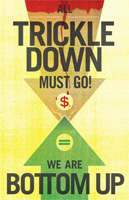 For me at least, this is what the Occupy Movement has been and is still about. In an age where corporations have been awarded the distinction of personhood, when free speech is equated to money and The Rule of Law is applied in an unjust and inequitable fashion then we, ordinary citizens, have a duty to support and join one another in protest. To hang together, if you will.
Oh, and that Tea Party, the real one in Boston that got everything rolling?
We all recall the ‘taxation without representation’ line from our school years, stemming from the passage of the Stamp Act in the 1760s and later the Tea Act in 1773. King George had debts to pay off—a Seven Year’s War among other things. And the East India Company’s tea pitched into the Boston Harbor? East India was basically provided a monopoly on tea shipped into the colonies. The company [and its aristocratic shareholders] were none too happy about their profits pinched and drowned in the harbor and helped push [lobby] the King to pass the Coercive Acts, aka The Intolerable Acts. The colonists were generally peeved at the British Parliament for taxing them without their consent and then adding insult to injury, giving the East India Co. a cushy, duty-free export to undercut colonial merchants. But they were beyond peeved when punitive measures were leveled. They demanded that Parliament end its corrupt economic policies with and stop the bailout of that era’s own TBTF East India Company.
Sound vaguely familiar? Whatever’s old is new again. Of course, no one age can be accurately compared to another. Context is everything. To quote Barbara Kingsolver from the November issue of The Occupy Wall Street Journal:
“Every system on earth has its limits. We have never been here before, not right here exactly, you and me together in the golden and gritty places all at once, on deadline, no fooling around this time, no longer walking politely around the dire colossus, the so-called American Way of consecrated corporate profits and crushed public compassion. There is another American Way. This is the right place, we found it. On State of Franklin, we yelled until our throats hurt that we were the 99% because that’s just it. We are.”
As I’ve said elsewhere, I support Occupy until I don’t. The ‘don’t’ for me is if the Movement becomes another co-opted arm of one corrupt political party or another. Our existing two-party system is thoroughly compromised; a shipload of bleach and scrub brushes couldn’t clean it up. I support Occupy because I hate the idea of leaving my kids and future grandbabies with a broken, twisted Republic, one dedicated to piranha-school profits, the amassing of criminal wealth by a callous, irresponsible few at the expense of the many. I support the Occupiers because of those sweet-faced kids on the Santa train; they deserve the best we have. But I also support what I saw on Dilworth Plaza because of what I saw and recalled inside Independence Hall, what we owe to all those who sacrificed and struggled, dreamed and achieved, lived, loved and died over the last 200+ years. We stand on the shoulders of so many.
That’s something we should never forget because our past, our history is no small thing. But our future, that other American Way? That’s all about what we do now.
Friday Reads
Posted: November 18, 2011 Filed under: FBI raids, Federal Budget and Budget deficit, income inequality, investment banking, lobbyists, morning reads | Tags: Budget Deficit, buying congress, Jack Abrahamoff, Lobbyists, low corporate taxes, reporting corporate taxes, supercommittee, who are the 1 percent? 24 Comments Good Morning!
Republicans are asking Obama to try to ‘break the log jam” in the subcommittee. I’m not surprised given the President’s known ability to give everything away at the bargaining table. I’m also sure it’s because they can get their lousy policies through and then when they backfire and people get mad, they’ll blame Obama.
Republicans are calling for President Obama to jump into the deficit-reduction talks gripping Washington, reflecting the widespread view that the congressional supercommittee is now headed for a failure.
Lawmakers and congressional aides familiar with the deliberations say the talks have reached a hard impasse, with Republicans locked in an internal struggle over whether to agree to higher tax hikes to cut a deal.
“It’s hard to see us getting a deal unless he comes in at the last minute,” Sen. Dan Coats (R-Ind.) said of Obama, who is on a nine-day trip to the Pacific and not scheduled to return to Washington until Sunday.“We’re in the two-minute drill and closing in on a ‘Hail Mary’ and the quarterback is on the sidelines.
“Unless the leadership, including the president, steps in and saves this thing, I think the consensus is, in terms of coming up with a credible package, all is lost,” Coats added.
There was a surprising lack of urgency on Capitol Hill Thursday as members of the supercommittee talked past one another. Some lawmakers not on the super-panel shrugged at the inaction, saying they were planning to go home for the Thanksgiving recess and noting they don’t have to vote on any deal until next month. Meanwhile, House and Senate leaders indicated they are in no rush to jump in and broker an agreement.
E.J. Dionne, Jr. at Truth Dig says the easiest way to cut the deficit is to do nothing. His thinking reflects some of the things that I’ve been supporting. It includes letting the Bush Ta Cuts expire. I hate to see the triggers on some things, but getting the Pentagon budget trimmed down would be a positive as far as I’m concerned.
Democrats have put huge spending cuts on the table—and keep offering more and more and more. All the Democrats ask in return is that the cuts be balanced by some revenue.
By rejecting their offers, Republicans induce Democrats who are anxious for some deal—any deal—to keep coming their way. The Republican approach is wrong and irresponsible but brilliant as a negotiating strategy. As my Washington Post colleague Ezra Klein wrote this week: “Over the past year, Republicans have learned something important about negotiating budget deals with Democrats: If you don’t like their offer, just wait a couple of months.”
Finally, the Republicans decided they needed to look slightly flexible. So they came up with $300 billion in supposed revenue from a promised tax reform in a plan that also included a proposal to slash tax rates for the rich. There is a lot more tax cutting here than revenue. Rep. Jeb Hensarling, R-Texas, co-chairman of the super committee, who said on Tuesday that this was the GOP’s final offer, reversed field Wednesday afternoon and declared himself open to other ideas.
Even Democrats inclined to capitulate know how shameful agreeing to such a deal would be. And mainstream, centrist deficit hawks should be grateful if a deal on such terms is killed. What Republicans want to do in effect is to make at least 90 percent of the Bush tax cuts permanent. This would only make deficit reduction even harder in the future.
That’s where the do-nothing strategy comes in. Championed early this year in The New Republic by New York Magazine writer Jonathan Chait, it looks even better now because of the spending cuts scheduled to go through if the super committee doesn’t act.
Jack Ambramoff is sure biting the hands that used to feed him. He’s written an article for Bloomberg and calls congress criterz “Willing Vassals” that are up for anything as long as they can cash in. Now that he can no longer make a profit from the game, he’s got some suggestions to end it.
There is only one cure for this disease: a lifetime ban on members and staff lobbying Congress or associating in any way with for-profit lobbying efforts. That seems draconian, no doubt. The current law provides a cooling off period for members and staff when joining K Street. The problem is that the cooling off period is a joke.
Here’s how it works. “Senator Smith” leaves Capitol Hill and joins the “Samson Lobbying Firm.” He can’t lobby the Senate for two years. But, he can make contact with his former colleagues. He can call them and introduce them to his new lobbying partners, stressing that although he cannot lobby, they can. His former colleagues get the joke, but the joke’s on us.
Because the vast majority of lobbyists start on the Hill, this employment advantage is widely exploited. It cannot be slowed with a cooling off period. These folks are human beings, not machines — and human beings are susceptible to corruption and bribery. I should know: I was knee-deep in both. Eliminating the revolving door between Congress and K Street is not the only reform we need to eliminate corruption in our political system. But unless we sever the link between serving the public and cashing in, no other reform will matter.
That’s easier said then done considering the foxes write the rules about how they can behave in the coop. One thing they have managed to do is arrange to avoid taxes. Check out the nifty chart from Felix Salmon at Reuters. It graphs corporate taxes as a percentage of corporate profits. Can you say magically disappear?
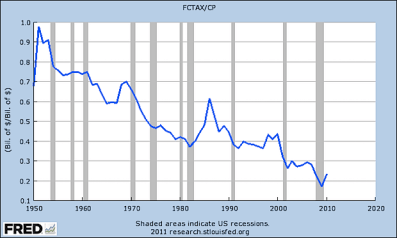
Once upon a time, the corporate income tax generated a significant share of tax revenues; now, it’s bumping along in the 2%-of-GDP range. Yes, the marginal rate of corporate income tax is high, at 35%. But US companies are extremely good at not paying that.
But at least we know the aggregate amount that corporations pay in taxes. What we don’t know — because they won’t say, and no one’s forcing them to say — is how much any given public company pays.
Follow the article to this link to CNN Money that shows you why reporting requirements allow corporations to hide their true tax positions.
During the past few months I’ve repeatedly asked three big companies in the tax-wars cross hairs — GE (GE), Verizon (VZ), and Exxon Mobil (XOM) — to voluntarily disclose information that would refute allegations that they incurred no U.S. federal income tax for 2010. All have refused, saying they won’t disclose anything not legally required. They still manage to complain about the allegations, however. I suspect that if I called the rest of the Fortune 500, I’d get 497 similar responses.
As a society, we need the “taxes incurred” information to inform our current tax debate. Investors, too, would benefit; knowing the tax that companies actually incur would be a useful analytical tool.
The solution, as I’ve said before, is for the Financial Accounting Standards Board to require companies to disclose information from their tax returns for the most recent available year and the nine years before that. This information, from lines 31 and 32 of their returns, would take at most one person-hour a year per company to provide. Adding a 17th tax metric to the 16 already available hardly seems like an invasion of corporate privacy.
Here’s an interesting read in the New York Review of Books by Jeff Madrick entitled “America’s New Robber Barons”.
So it’s worth knowing who is in that group of very rich with runaway incomes. Several news reports in recent weeks have cited a seminal 2010 study that uses IRS tax returns to find out who belongs to the top 0.1 percent. The authors deserve mention because they are often left out when their results are cited: Jon Bakija of Williams College, Adam Cole of the US Treasury, and Bradley Heim of Indiana University. This was not a Treasury study, however, but a private if scholarly one.
One key finding of the study is that three out of five of those in the top 0.1 percent of tax filers are executives or managers of financial and non-financial companies. Overall, more are from non-financial companies. Does this partly exonerate Wall Street, suggesting it is really Main Street where the problem lies?
In fact Bakija, Cole and Heim’s analysis shows the opposite: it turns out that much of the increase in wealth of non-financial executives was also tied to the rise in stock prices. Keeping in mind that stocks options appear as wages in the data, it seems Wall Street itself was often a main source of income growth for “non-financial” managers as well. (Lawyers were another large category of tax payers in the top 0.1 percent, and though there is not direct data for this, one can fairly assume that many of those in corporate firms made a lot of money from the booming business on Wall Street.)
Next, think about how these executives managed their businesses. If they wanted a big pay check they had to orient their strategies to push up their stock prices—that is, often to appeal to the financial fads and fashions of the day. These strategies typically have included cutting labor costs and R&D in order to boost short-term profits. This delighted their advisers on the Street. Stock investors soon loved nothing better than consistent increases in quarterly profits, and not coincidentally, stock options accounted for an ever-growing proportion of executive pay over the past thirty years. We used to say once that Wall Street worked for business, but over the past thirty years business has come to work for Wall Street.
It is just as interesting to explore the factors that the authors found out probably did not cause the surge at the top. Economists typically posit sophisticated technologies (often related to digitalization) as a source of growing inequality: because these technologies require better educated and smarter workers, those who have mastered them are rewarded handsomely. But there was no surge at the very top in other nations like Japan or in Western Europe, which also adopted the same technologies.
Similarly, some have argued that globalization led to higher incomes at the top because skilled workers can sell themselves globally at ever higher salaries. Again, however, such skilled workers have not seen a surge at the very top in Europe or Japan.
One reason for the discrepancy between the US and other countries is that boards of directors in the US are especially willing to give their CEOs and other high level executives big raises and generous stock options. Lucian Bebchuk of Harvard has done a lot of research on this so-called “governance” issue. Meantime, as Bebchuk’s work shows, shareholder influence over executive compensation is far too weak. And there is also the issue of culture itself. America—with its admiration for the self-made man—tolerates high remuneration for the men and women at the top and lower wages in the middle and the bottom. Culture likely matters.
So, that’s a few things to get you started this morning. What’s on your reading and blogging list today?
Poverty in These United States
Posted: November 15, 2011 Filed under: Austerity, children, Economy, hunger, income inequality, poverty, seniors, unemployment | Tags: austerity, children at risk, Poverty Tour, seniors 10 Comments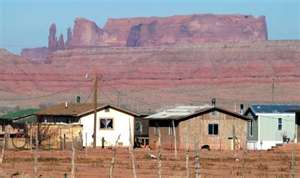
We are not Afghanistan. We are not Haiti or the Democratic Republic of the Congo. We are not any of the 3rd world nations that are sometimes callously referred to as the ‘black holes’ of the world, where national incomes range between $700-900 annually, where human assets in nutrition, education, health and adult literacy are the lowest of the low. Nor do national fluctuations in agriculture production, instability of import/export services or economic smallness define us.
We are decidedly not one of the least developed nations on the planet. Quite the contrary. We are the richest, most powerful and technologically advanced nation the world has ever known.
Yet poverty exists and is rising. American poverty is a fact, a condition defined not by 3rd world standards but by the standards of who and what we are as a premier Nation among all nations.
No sooner had the Census Bureau come out with its findings on poverty–the first report in September, followed by a supplemental report in early November—the naysayers lined up reminding us that the findings were misleading, that many of the so-called poor had cars and TVs, that children of the poor sported Xboxes. And my God, a goodly number actually have air conditioning! I suspect many have heating, too.
The arguments are that unless a family or individual meets a 3rd-world definition of poverty then even the mention of rising American poverty levels falls into the category of gross exaggeration. This in a time when unemployment is the top concern of the American electorate, when unemployment sits ‘officially’ at 9% but, in fact, has reached nearly 20%, when from 2001-2009 42,400 American factories closed their doors to traditional middle-class jobs. This is also in a time of historical corporate profits and obscene CEO salaries in the financial services industry that through casino betting, accounting fraud and governmental bailouts brought this country and the world to its knees. And continues to do so, eg., MF Global headed by former NJ Governor Jon Corzine.
The old canards are being taken for a rerun as well: poverty is a symptom of lazy minds and an entitlement generation or an unwillingness to work hard and save money. Many will recall the Welfare Queen stories of the past, imagined always as a black woman with a dozen children, driving idly around town in her brand new Caddie. Living life high on the hog, the hysterical claims insisted, bilking government largesse [ otherwise known as taxpayer money]. But as Ralph B. noted in an earlier thread, there’s nary a word about corporate/millionaire welfare, where companies and even individuals skate on Federal taxes through loopholes and accounting maneuvers and government handouts
Let’s get real. The fallout of 2007-2008 hit many average families between the eyes, this after wages had been stagnating for three decades with a beginning upswing in the 90s, wage advancements quickly lost since 2000. Prices, however, have continued to rise, commodity prices in particular, those base products— gas, foodstuffs—that we all rely on to survive. Medical costs/premiums have gone through the roof. Is it any wonder seniors, who face a disproportionate share of medical problems and costs, have gotten caught in the old trap of choosing food or drugs? Children are caught up in the economic whirlwind, too, as parents lose jobs and homes, scramble for low-paying, part-time positions, work that frequently is not enough to ensure adequate food and/or nutrition on a consistent basis. Should we be surprised then at the increase of American children now classified as ‘food insecure?’
Here’s what we know:
49.1 million Americans have fallen into poverty, 16% of the population or 1 in 7 Americans.
Nearly 20% of that number are children; nearly 16% of the indigent are 65 years and older.
21.5% of American children have been classified as ‘food insecure.’
1 in 15 Americans are classified as the ‘poorest of the poor, which in 2010 translated to $5570 or less for an individual, $11,157 for a family of four.
The Census Bureau’s Supplemental report issued earlier this month takes into account governmental assistance—food stamps, the earned income tax credit, school lunch programs etc—without which the statistics above would be even worse.
From a Center on Budget and Policy Priorities report:
Six temporary federal initiatives enacted in 2009 and 2010 to bolster the economy by lifting consumers’ incomes and purchases kept nearly 7 million Americans out of poverty in 2010, under an alternative measure of poverty that takes into account the impact of government benefit programs and taxes. These initiatives — three new or expanded tax credits, two enhancements of unemployment insurance, and an expansion of benefits through the Supplemental Nutrition Assistance Program (SNAP, formerly called food stamps) — were part of the 2009 Recovery Act. Congress subsequently extended or expanded some of them.
Hence the total number of persons in poverty would have been even higher last year if not for the six government initiatives.
Btw, the link above gives a rather shocking comparison between the poverty rates in the US and Brazil. Not pretty.
Yet, Michelle Bachmann’s prescription as well as many of her Republican colleagues is based on the old saw: self-reliance, an honest day’s work for an honest day’s pay. This in a time of record unemployment and rising poverty in the general population.
How many statistics, comparisons, articles and images are necessary to convince the disbelieving that American poverty is on the rise, that it is not the result of coddling, laziness or lack of self-reliance? Or perhaps we must admit that there is also a poverty of spirit and reason running rampant through country, blinding those who would blame fellow citizens for the dearth of employment and opportunity without offering any workable solutions to an ever growing, bleak reality.


 peej
peej Carissa
 bostonboomer
 dakinikat
 ecocatwoman
 mablue2
 Mama Lopez
 peggysue22
 quixote
 skydancingguestblogger
 Mona (aka Wonk the Vote)



 Sky Dancing
Recent Comments