
What The Irish Can Teach Us
Posted: March 18, 2012 Filed under: Barbara Ehrenreich, Charles Murray, corporatism, Economy, financial institutions, free market ideology, hunger, income inequality, The Great Hunger, U.S. Economy, unemployment, voodoo economics, worker rights 12 CommentsNow that we’ve all been Irish for a day–donning the green, marching or watching parades and downing those pints at the local bar, we might ask ourselves [whether we’re from Irish American backgrounds or not]: Is there anything more the Irish can teach us?
Running across an essay by Barbara Ehrenreich on American poverty, specifically the lingering, depressing notion of the ‘culture of poverty’ and
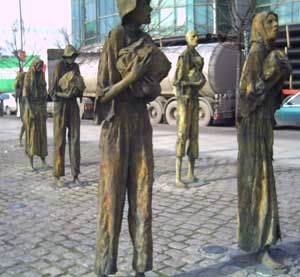
Dublin's Famine Memorial
having listened to Charles Murray on Book TV discuss his recent book, “Coming Apart: The State of White America, 1960-2012,” I think the answer is a resounding ‘yes.’
As Ehrenreich reminds us, the idea that poor people are inherently different than the affluent and in fact, need to be changed, corrected, put right has been an enduring theme of the conservative right. The inequality between the poor and the rich is not a matter of jobs or opportunity, education or money, so the theory goes. It’s about the poor being substantially flawed. They lack core values: ambition, get-up-and-go, faith, and the ability to plan for the future. The poor are impulsive, promiscuous, prone to addiction and crime and, as Ehrenreich points out, theorists all contend that the poor ‘certainly cannot be trusted with money.’
Charles Murray’s presentation picks up on the ‘culture of poverty’ theory and runs with it like a champion of reason and rightness. The American Project, Murray contends, the continuation of a civil society is threatened because the working class and upper-middle class are of a different kind altogether. The unraveling of America has nothing to do with the inequality of income but the inequality of culture.
Murray uses two ‘symbolic’ communities to illustrate his thesis: Belmont and Fishtown though both communities actually exist—Belmont, an affluent neighborhood outside Boston and Fishtown, a working class neighborhood of Philadelphia. Murray goes on to compare the two communities in four main areas: marriage, industriousness, honesty, and religiosity. And surprise, surprise. Fishtown gets a failing grade on all scores.
What does this have to do with the Irish? I suggest a quick trip back in time, say to the mid-19th century during what became known as the Great Hunger.
Ireland was heavily populated with subsistence/tenant farmers, generally in debt to their English landlords. Most have heard of the ‘great potato blight’ of 1845-1849 when over 1 million Irish died of starvation. What many may not know is that the the affluent English landlords were exporting an abundance of grain, meat and dairy for profit as the Irish poor starved. And the conservative government response? Their policy was one of laissez faire, leave well enough alone. As the Assistant Secretary of Ireland reportedly said at the time: to give the people something for nothing, ‘would have the country on us for an indefinite time.’ The fear of dependency was greater than watching the population starve. Free market policies and workhouses became popular. But still people died. In droves. The fields of once blighted potatoes became graveyards.
How were the Irish viewed by ‘polite’ English society? The Irish were considered brutish, lazy, devious, promiscuous, prone to crime and heavy drinking. Worse yet—they were Catholic.
The point is that this warped view on poverty is not new. Nor are the political responses. Even when a population was starving to death en masse, the response in Ireland was an ideological one: people had to work to be fed, even when they were too weak and sick to stand upright.
The Irish know this. They remembered it well and passed the bleak stories down to their descendants. The impoverished Irish immigrants, those who came to America [if they survived the ocean crossing], found the same weary stereotypes waiting on another shore. Anyone with Irish American grandparents or other family oldsters have likely heard the tales of blatant bigotry while growing up—the ‘no dogs or Irish’ signs in shop windows.
 Still I found it amazing that Murray could say the main problem threatening the Nation today is not income inequality but cultural inequality. Minx wrote a very effective piece last week on the growing poverty in the US. Cited in her post was a statement by Tavis Smiley, who is pushing to have the issue of exploding poverty included in the 2012 election:
Women are much more likely to be poor than men, and more than a million children have fallen into poverty, and more than 500,000 have fallen into extreme poverty” — that is, living on less than $2 a day — “since 2010.” Recent census data shows that the number of children who live in extreme poverty has doubled from 1996 to 2011, from 1.4 million to 2.8 million.
And yet, as Minx pointed out a number of states: Kansas, Utah and Nebraska have initiated policies to cut food stamps to needy children.
Well here’s a factoid that turns the whole cultural argument on its head: the fastest growing segment of the newly poor are in suburban neighborhoods.

Warrensville Heights, Cleveland suburb, photo:dustin franz,NYT
Some of this is due to changing demographics but the larger percentage has to do with long-term unemployment, stagnate wages, off-shoring, the housing debacle, etc., etc. Here’s a chilling study from the same link:
Mark Rank, a social welfare professor at Washington University in St. Louis, has written extensively about shifts in U.S. poverty since the 1960s, and finds that Americans today are more likely to face poverty than in the past. According to Rank’s data, 24 percent of people who were in their 20s in the 1970s were likely to experience poverty at some point in their lives. That number rose to 31 percent in the 1980s and 37 percent in the 1990s. Today a majority of Americans-51.4 percent, according to the Urban Institute-will experience poverty by the time they’re 65.
Are we to believe that this sudden shift to poverty or expectation of poverty is all about lost moral/cultural compasses? Charles Murray would say, ‘yes.’ He suggests that the upper-middle class reach out, reintegrate and reeducate the working classes in the four pillars of civil society: marriage, industriousness, honesty and religiosity. Note that Murray’s study just happens to begin at the soon-to-be turbulent 1960s. Ahhh, if only we could go back to those Father Knows Best days.
In contrast, Barbara Ehrenreich pointedly says:
. . . a new discovery of poverty is long overdue. This time, we’ll have to take account not only of stereotypical Skid Row residents and Appalachians, but of foreclosed-upon suburbanites, laid-off tech workers, and America’s ever-growing army of the “working poor.” And if we look closely enough, we’ll have to conclude that poverty is not, after all, a cultural aberration or a character flaw. Poverty is a shortage of money.
My suggestion? Find yourself an Irish grandmother, the older the better. She’ll give you an earful. Generational memory is a powerful thing!
The Rise and Fail of Countries and their Economic Elite
Posted: March 13, 2012 Filed under: #Occupy and We are the 99 percent!, Economic Develpment, income inequality | Tags: Daron Acemoglu, James Robinson, Why Nations Fail 8 Comments
US Economic Performance: Forty Years of economic stagnation for all but the Very Rich.
There’s nothing new about trickle-down economics policies and their failure to deliver growth and jobs. The 1980s saw a lot of empirical testing of Reagan-Bush Policies and new growth models. Basically, the parts of these policies that led to growth were those that put money and spending power into the demand side and not the supply side. The failure of the Bush 2 policies to provide sustained growth of jobs and the real economy–as well as real per capita income–reinforced earlier findings. However, this hasn’t stopped the spread of political memes that falsely assert that providing vast wealth for “job creators” is best for an economy. It’s a popular fairy tale spun by Republican Politicians and it’s unsupported by evidence as well as theory.
Development economists have been studying why some countries are rich and some are poor for some time. There have been a number of factors identified that seem to drive growth. Education of women, good legal and justice systems that protect property rights, and basic economic freedom are some of the factors that have been identified over the years. Daron Acemoglu–a Turkish M.I.T. professor–has written an important book based on his research and the research of his colleague James Robinson called “Why Nations Fail”. Their work explains how nations can basically destroy their economic futures when they let their richest citizens loot their poorest. Evidence comes from both historical and present day economies.
Surely even the most kleptocratic dictator would be in favor of economic development. Economic development means greater income, greater taxes and more stuff to grab, so what’s not to like about it? But actually, it often doesn’t work that way.
In the early 1980s in Takasera, a village in Rukum District in western Nepal, a group of locals decided to begin a development project and bought a Swiss-made water mill which would power machinery such as a press to make oil and a saw mill. The community sent a group of men to Kathmandu who learned how to dismantle the machinery and then put it back together again. The machinery was brought back and successfully put into operation. In 1984, a government official wrote saying that in autonomously undertaking this project the community had “usurped the role of the king” and the mill would have to be shut down. When the locals refused, the police was sent to destroy the mill. The mill was only saved because the villagers were able to ambush and disarm the police.
So why was the Nepalese government opposed to the mill? The answer is that the monarchy and the elite surrounding it, who controlled the government, were afraid of becoming political losers. Economic progress brings social and political change, eroding the political power of elites and rulers, who in response often prefer to sacrifice economic development for political stability.
This is a prime example of politicians blocking technology that would improve the country’s economy to maintain political control. This suboptimal outcome is one of many examples the two economists have found and documented in their study.
But through a series of legendary — and somewhat controversial — academic papers published over the past decade, Acemoglu has persuasively challenged many of the previous theories. (If poverty were primarily the result of geography, say, or an unfortunate history, how can we account for the successes of Botswana, Costa Rica or Thailand?) Now, in their new book, “Why Nations Fail,” Acemoglu and his collaborator, James Robinson, argue that the wealth of a country is most closely correlated with the degree to which the average person shares in the overall growth of its economy. It’s an idea that was first raised by [Adam] Smith but was then largely ignored for centuries as economics became focused on theoretical models of ideal economies rather than the not-at-all-ideal problems of real nations.
Consider Acemoglu’s idea from the perspective of a poor farmer. In parts of modern sub-Saharan Africa, as was true in medieval Europe or the antebellum South, the people who work the fields lack any incentive to improve their yield because any surplus is taken by the wealthy elite. This mind-set changes only when farmers are given strong property rights and discover that they can profit from extra production. In 1978, China began allowing farmers to benefit from any surplus they produced. The decision, most economists agree, helped spark the country’s astounding growth.
According to Acemoglu’s thesis, when a nation’s institutions prevent the poor from profiting from their work, no amount of disease eradication, good economic advice or foreign aid seems to help. I observed this firsthand when I visited a group of Haitian mango farmers a few years ago. Each farmer had no more than one or two mango trees, even though their land lay along a river that could irrigate their fields and support hundreds of trees. So why didn’t they install irrigation pipes? Were they ignorant, indifferent? In fact, they were quite savvy and lived in a region teeming with well-intended foreign-aid programs. But these farmers also knew that nobody in their village had clear title to the land they farmed. If they suddenly grew a few hundred mango trees, it was likely that a well-connected member of the elite would show up and claim their land and its spoils. What was the point?
This is basically the idea that disincentives cut both ways which is an idea lost on Republican Politicians. Why work if the fruit of your labor goes to absentee owners and investors?
Acemoglu, Robinson and their collaborators did not come up with the idea that incentives matter, of course, nor the notion that politics play a role in economic development. Their great contribution has been a series of clever historical studies that persuasively argue that the cheesiest of slogans is actually correct: the true value of a nation is its people. If national institutions give even their poorest and least educated citizens some shot at improving their own lives — through property rights, a reliable judicial system or access to markets — those citizens will do what it takes to make themselves and their country richer. This suggests, among other things, that instead of supporting one-off programs promoting health or agricultural productivity, the international community should focus its aid efforts on deep political and economic change.
Perhaps just as interesting, “Why Nations Fail” also shows the effects of different economic and political systems over the centuries. The sections on ancient Rome and medieval Venice are particularly compelling, because they show how fairly open and prosperous societies can revert to closed and impoverished autocracies. It’s hard to read these sections without thinking about the present-day United States, where economic inequality has grown substantially over the past few decades. Is the 1 percent emerging as a wealth-stripping, poverty-inducing elite?
Well, maybe. Acemoglu and Robinson’s frequent collaborator Simon Johnson, the former chief economist at the International Monetary Fund, told me that financial firms have so thoroughly co-opted the political process that the American economy has become fundamentally unsound. “It’s bad and getting worse,” he told me. Barring some major shift in our political system, he suggested, the United States could be on its way to serious economic failure.
I downloaded their most current working paper which has a lot of political ramifications. (Robinson is a political science professor at Harvard.)It’s on why voters dismantle checks and balances on political and economic elites. You probably want to avoid the model and just look at the bottom line. Essentially, when we remove the checks and balances in our government, we make it easier and cheaper for the richest in the country to bribe the political class. This creates a disconnect between the politics and spending and tax policies. It’s an interesting analysis and way to model the current disconnect between polling of the electorate and policy coming out of legislatures. The most interesting outcome of the model is that this behavior eventually makes every one worse off. The ability of the rich to bribe politicians is central to the outcomes.
Far from seeing China as the clue to spreading prosperity, Acemoglu and Robinson see it as yet another instance of a society rushing into a cul-de-sac. China is not, on their analysis, on course for our own level of prosperity.
Their argument is that the modern level of prosperity rests upon political foundations. Proximately, prosperity is generated by investment and innovation, but these are acts of faith: investors and innovators must have credible reasons to think that, if successful, they will not be plundered by the powerful.
For the polity to provide such reassurance, two conditions have to hold: power has to be centralised and the institutions of power have to be inclusive. Without centralised power, there is disorder, which is anathema to investment.
China most certainly ticks this box – it has centralised power and order in spades. Some African societies don’t; localised power usurps the authority of the state. But China resoundingly fails to tick the box of inclusive institutions. Acemoglu and Robinson quote a summary of the structure of Chinese political power: “The party controls the armed forces; the party controls cadres; and the party controls the news.”
That states need order to prosper is important but no longer controversial. That they need inclusive institutions is, in view of China’s success, wildly controversial. Their argument is that order without inclusive institutions may enable an economy to escape poverty, but will not permit the full ascent to modern prosperity. Their explanation is that if the institutions of power enable the elite to serve its own interest – a structure they term “extractive institutions” – the interests of the elite come to collide with, and prevail over, those of the mass of the population.
So, in order for nations to grow, institutions should focus on inclusion instead of exclusion. This seems like an intuitive suggestion and an unnecessary one for a democracy. However, their work suggests that the rich and political elite will work against this if the right incentives and institutions exist. It’s an interesting way to look at the current situation in the U.S. where politicians–using money from huge donors–work to remove regulations and dismantle organizations that increase inclusion. Notice how public education, community activists, unions, and other institutions aimed at including workers and regular folks into policy making have been demonized recently. I’m definitely up for reading more on this.
Let’s Hear It For The Girls, All Month Long
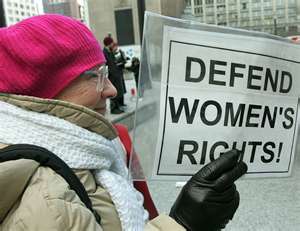
Posted: March 7, 2012 Filed under: #Occupy and We are the 99 percent!, birth control, Civil Rights, collective bargaining, Economy, Feminists, income inequality, War on Women, Women's Rights, worker rights | Tags: international women's day 10 Comments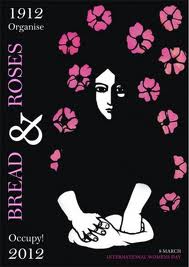 Though GOP madness is in full swing, March is the month to celebrate women—their lives, strengths and accomplishments. True to its nature, the month has roared in but with a twist, acting as a party crasher, snapping at all female guests of honor.
We’ve seen reproductive rights assaulted, the 100-year contraception battle reignited and shock-jock Rush Limbaugh bully and slander a female student from Georgetown University. Rick Santorum has turned the Republican effort into a Comstock-era discussion of acceptable moral/sexual behavior and a county in the Great State of South Carolina is suggesting a purity pledge for Republican membership. Even the workplace is under assault with candidates suggesting the elimination of minimum wage and repealing Child Labor laws.
What’s next? The village pillory? 
Who invited the Crazies?
My suggestion? Show them the door, kick their arses to the street. We didn’t invite reactionary fools to the party. This woman would not have tolerated their company for a single nanosecond:

Margaret Sanger
Nor these women
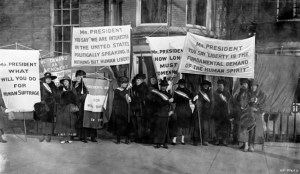
Women's Suffrage Parade
Nor these:
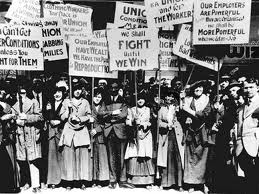
Bread and Roses Protest
The last photo, the Bread and Roses protest, was a workers’ strike protesting deplorable work conditions, non-living wages and inconceivably long days in New England’s textile mills. One of these strikes occurred in Lawrence, Massachusetts, fueled by earlier actions in NYC’s garment district. Thursday, March 8th is the official recognition date of a 100-year old struggle, under the aegis of the IWW [Industrial Workers of the World] but primarily led by immigrant women, young and old, who successfully striked for humane working conditions, decent wages and openly opposed child labor and workplace exploitation.
It did not come easy. But come it did.
One of the descriptions I read of these early battles was nothing short of shake-your-head inspiring:
According to [Consiglia] Teutonica, this time a 22-year-old Syrian immigrant named Annie Kiami stepped in front of the crowd. Calling the soldiers “Cossacks,” Kiami wrapped an American flag around her body and dared them to shoot holes in Old Glory.
Once thought of as docile and subservient, the Bread and Roses women quickly gained the notorious title among mill owners of radicals of the worst sort.
“One policeman can handle 10 men,” Lawrence’s district attorney lamented, “while it takes 10 policemen to handle one woman.”
In the words of one horrified boss, the women activists were full of “lots of cunning and also lots of bad temper. They’re everywhere, and it’s getting worse all the time.”
Lots of cunning and bad temper! I like that.
Flip forward some 50+ years and the Bread and Roses contingent in Boston fought for reproductive rights and abortion, child care, equal employment laws against discrimination in the workplace and recognition of and legal remedies to fight and reduce violence against women. In 1971, the Bread and Roses group occupied a building owned by Harvard University for 10 days, during which they offered free classes and childcare. After they were removed from their encampment, several sympathetic donors offered $5000 with which the group opened The Women’s Center in Cambridge.
The Women’s Center is in operation today, offering a multitude of services to battered women, victims of rape and child abuse and providing counsel, support and health information to moderate to low-income women. Their mission statement reads as follows:
To provide women with the resources and support they need to emerge from
conditions of domestic violence, sexual abuse, poverty, discrimination, social isolation and degradation.
To challenge and change the attitudes, actions, and institutions that subjugate women.
They’re still going strong.
A myriad of Bread and Roses communities have grown and spread across the country, many charitable outreaches to low income families, providing meals and support to the unemployed, the sick and disadvantaged. In each case, the Bread and Roses emblematic power rests in the idea of social justice, community outreach and support. With each and every group, each program, the legacy returns to those women and children of 1912, the day they said–Enough is enough—and then put their bodies, their very lives on the line, demanding to be treated with dignity, to be seen and counted as human beings.
As for the name, Bread and Roses? The phrase reportedly came from a banner—Give Us Bread But Give Us Roses–carried during the early days of the textile strikes. James Oppenheim, a poet, novelist and editor, attended one of those protests and was so moved by the imagery that he wrote the following poem to honor the women.
As we come marching, marching in the beauty of the day,
A million darkened kitchens, a thousand mill lofts gray,
Are touched with all the radiance that a sudden sun discloses,
For the people hear us singing: “Bread and roses! Bread and roses!”
As we come marching, marching, we battle too for men,
For they are women’s children, and we mother them again.
Our lives shall not be sweated from birth until life closes;
Hearts starve as well as bodies; give us bread, but give us roses!
As we come marching, marching, unnumbered women dead
Go crying through our singing their ancient cry for bread.
Small art and love and beauty their drudging spirits knew.
Yes, it is bread we fight for — but we fight for roses, too!
As we come marching, marching, we bring the greater days.
The rising of the women means the rising of the race.
No more the drudge and idler — ten that toil where one reposes,
But a sharing of life’s glories: Bread and roses! Bread and roses!
Oppenheim was inspired by the women and their courage. The women were inspired by the words.
It’s a fine legacy, one among many in which women had a leading role in changing the course of American history. The citizens of Lawrence will be commemorating the women and their efforts with a Centennial festival. The major programs are slated to kickoff tomorrow Thursday, March 8 and run through May 1.
There’s no better time to give these women their due because income inequality, rising poverty and homelessness has returned to the Nation, a vicious cycle tearing at families and communities alike. The Lawrence strike has an uncanny parallel to the Occupy protests. At the turn of the 20th century, the concentration of wealth in the hands of the few was unrivaled. Until today. What Bread and Roses reminds us is the power of solidarity, fighting the good fight. With cunning and bad temper if necessary. Or as James Oppenheim wrote a century ago:
The rising of women means the rising of the race.
Bread and roses! Bread and roses!
Happy 100th!
There’s A Hot Wind Blowing
Posted: March 5, 2012 Filed under: #Occupy and We are the 99 percent!, Anti-War, Austerity, Banksters, Civil Liberties, Department of Homeland Security, financial institutions, income inequality, Russian elections 8 CommentsThere were few surprises in yesterday’s Russian election. Vladimir Putin won in what he declared a ‘clean victory.’ For his side.

Arrests in Moscow--image via SkyNews
For protestors of the last few months, the White Ribbon movement, opinion was to the contrary, comments generally expressing ‘shame, disgrace, treachery.’ Yet according to official results, Putin pulled a 64% majority, well over the 50%, which would require a run-off vote. Independent observers, however, reported widespread irregularities, insisting that Putin’s majority was perilously close to the 50% cliff. According to one observer, Roman Udot, with Galos, a free election watchdog organization, which recorded many cases of multiple voting and voter intimidation:
“It’s one pixel away from a second round.”
What was the reaction to Putin’s victory speech? Thousands of protestors hitting the streets in Moscow and St. Petersburg. And combat-style police, 12,000 reported in Moscow alone, on the ready.
One of the details that piqued my interest was the fact that Putin’s support comes heavily from elderly pension holders. Putin has been wise enough to keep the pension money flowing, even with a slight increase. For the older generation, Putin is the Devil they know. For the digital-savvy young? Not so much. The educated middle-class have reached a tipping point, disgusted with governmental fraud, corruption and political lip service to democratic principles.
This is not a new phenomenon. Social uprisings have been springing up all over. Currently, we’re watching Syria fall apart, desinigrating into civil war. This is on the heels of insistent calls for change across the Middle East—Egypt, Bahrain, Yemen, Libya—the message of which spread like a virus across Europe, the UK, the United States, Japan, China and now Russia.
Say what the pundits will but just beneath our own political process, the charade of another electoral season guided and shaped by money and corporate interests, there’s a hot wind blowing. The strident cacophony of the right wing, each member trying to outdo the other with outrageous comments or the pitiful whines of Wall St. bemoaning the decline in kingly bonuses, only underscores the obvious: the self-regulating, free market, privatize-the-world philosophy is a bust. Fraud is as wide as our broken housing market, the Big Lie deeper than a fracking well.
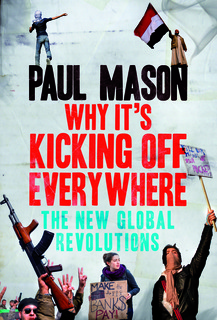 The intriguing question is what common denominators run through all these movements, despite the vast geographical/political differences? And why, presumably, did these social/political movements catch so many pundits, experts and leaders by surprise?
These are two of the questions, Paul Mason, a UK journalist and Economics Editor for the BBC attempts to answer in his book: ‘Why It’s Kicking Off Everywhere: The New Global Revolutions.’ Mason brings on-the-ground reporting, essay-like reflections, economic insights as well as a historical perspective to what we read in the headlines, websites and tweets of last year. And what we might expect coming at us, all of us in the coming months. He also does an effective job of bringing the pain, the anxiety, the suffering of people caught in the jaws of poverty, austerity and political crackdowns to life. We can see it. We can feel it and understand that we share more with the rest of the world than we have differences. This is a shattering truth.
The ‘why’ of the Dissent that Circled the World is intricately tied to the shuddering economic principles of globalization, fueled by a neoliberal narrative, the particular type of capitalism that has been favored and defended for the last forty years and has enriched the top 1% at the expense of everyone else. This is a system that insists markets are self-regulating, that free, unimpeded markets are the path to Paradise and privatization is always superior to public [government] direction. It is an ideology that refuses to look at the damage caused to vast swaths of the world’s population–the liberties extinguished, the income inequality produced, the environmental destruction–the very realities which are rejected, even when the evidence is undeniable. For instance, the global economic collapse and the implications of climate change.
Mason has reduced the drivers of the world-wide pushback to three main factors: graduates without a future, the rise and sophistication of social networks and the change in consciousness those very networks have produced, particularly as it relates to the definition of freedom and what that really means to ordinary people. Social networks—Facebook, twitter and cell phone usage—have changed the way we see and interact with one another and have fundamentally erased barriers of class, nationality, language and geographical distances. This is the hum of the hive and it’s growing stronger, which is why it’s regarded as a threat.
Anyone thinking the use of the word ‘threat’ is hyperbole should check the recent bill [HR 347] passed overwhelmingly in the US Congress making it a felony to participate in many of the Occupy Wall Street protests of last year. In fact, the bill has been coined the ‘anti-Occupy bill.’ Why haven’t we heard about this? Where is our brave press, the Fourth Estate, defending American liberty? They claim it simply isn’t relevant—no big deal. Interesting too–not a single Democrat voted against the bill’s passage. Not one. In fact, it’s reported that only Ron Paul and two other Republicans voted ‘nay.’ The bill’s vague language leaves the discretion regarding events of ‘national significance’ up to the discretion of the Department of Homeland Security.
Why is there a hot wind blowing? This is why.
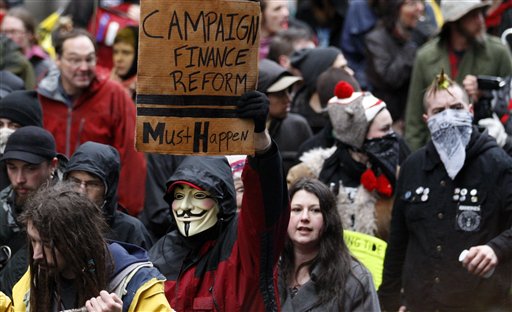
Occupy Portland, February 29, 2012--AP photo/Rick Bowmer
In The Land Of The Delusional
Posted: March 2, 2012 Filed under: 2012 presidential campaign, Austerity, double-speak, Economy, income inequality, Mitt Romney, religious extremists, Republican presidential politics, the GOP, U.S. Economy, War on Women, Women's Healthcare 16 CommentsIn the Land of the Delusional the Koch brothers are principled citizens who merely disagree with Democratic policy stands and are aghast at the vindictive slurs leveled against them and all other sincere, freedom-loving Republicans. In the Land of the Delusional, the hate and rage on review is a product of pink-bellied Lefties, Alinski acolytes, looking to take down American virtue and reduce the country’s might and glory. In the Land of the Delusional bankrupt ideas, economic mayhem and privateering can be obscured by attacks on woman, gays and the down and outers.
March is living up to its reputation—coming in like snarling Lion. Rush Limbaugh exposed a full Monty of misogyny, his comments on Sandra Fluke provoking even House Speaker Boehner to suggest the diatribe was ‘inappropriate.’ What inspired the outburst? Several weeks of desperate frontal attacks on women’s healthcare issues, thinly veiled and wrapped beneath ‘religious liberty’ arguments.
Let’s not kid ourselves! This is little more than shifting the conversation from discussion over economic issues, for which the Republican party has no credible position. The US Budget Watch has reported that Republican plans to slash taxes on corporations and high-income earners would explode the national debt up to $3 trillion. And for all the ballyhoo by the Norquist group the Washington Post reported [as well as many other sources] that the country’s revenue-collection has eroded to a 60-year low.
From the WP report:
Polls show that a large majority of Americans blame wasteful or unnecessary federal programs for the nation’s budget problems. But routine increases in defense and domestic spending account for only about 15 percent of the financial deterioration, according to a new analysis of CBO data.
The biggest culprit, by far, has been an erosion of tax revenue triggered largely by two recessions and multiple rounds of tax cuts. Together, the economy and the tax bills enacted under former president George W. Bush, and to a lesser extent by President Obama, wiped out $6.3 trillion in anticipated revenue. That’s nearly half of the $12.7 trillion swing from projected surpluses to real debt. Federal tax collections now stand at their lowest level as a percentage of the economy in 60 years.

Trickle Down Economics in Nature
But why let facts stand in the way. Paul Ryan, the Republican’s designated ‘serious thinker’ certainly doesn’t.
Ryan also complimented Romney’s economic plan. The congressman’s stamp of approval has been important for Republicans since he earned praise last year for his ambitious budget — which would dramatically change Medicare— from strong conservatives.
“Very credible. They are talking about entitlement reform. They are putting specifics on the table on Medicare and Social Security reform. The president, knowing that these are the big drivers of our debt, is ducking it,” Ryan said of Romney’s proposals.
Ah, yes. The ideologically blind leading those blinded by ambition. That certainly gives me confidence.
But as Paul Krugman suggested a mere 10 ten days ago, Mitt Romney let slip a truism in the swirl of Michigan campaigning when he said:
“If you just cut, if all you’re thinking about doing is cutting spending, as you cut spending you’ll slow down the economy.”
Over which the ideological purists set the dogs loose. The Club for Growth immediately denounced the Romney slip, insisting that it was a clear indication that Mitt was an imposter, not a ‘true’ limited government conservative [translation: not willing to drown all government in that Norquist bathtub].
What’s a candidate to do? Retreat, of course, in the same way Romney flipped on the Blunt Amendment, breaking all records, I would guess. In less than an hour, Candidate Romney twisted from ‘not going to go there’ to ‘of course, I support it.’ Enough to make your head spin. This is a political party in the death throes.
So, what’s the best way to distract?
Let’s pillory the women, start calling them sluts or suggest they film sexual exploits for the sake of some overweight, mean-spirited shock jock. Or let’s pretend that the perceived decline of the Nation rests squarely on the shoulders of the Gay Community and their screechy insistence that they too expect and deserve [can you believe the gall of these people] basic civil rights. And don’t forget the statistics on the ever-expanding numbers of Americans slipping into poverty. We tried calling them losers and moochers. How about we deny they exist, the way a North Carolina legislator recently announced. Yes sir, that’s the ticket!
In the Land of the Delusional schizophrenics rule the day, magical thinking replaces reason and bare-foot and pregnant is a very good thing. In the Land of the Delusional all things are possible.
Except the truth.


 peej
peej Carissa
 bostonboomer
 dakinikat
 ecocatwoman
 mablue2
 Mama Lopez
 peggysue22
 quixote
 skydancingguestblogger
 Mona (aka Wonk the Vote)



 Sky Dancing
Recent Comments