
Monday Reads
Posted: January 27, 2014 Filed under: income inequality, morning reads 102 Comments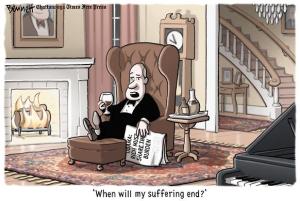 Good Morning!
This morning I thought I’d focus on income inequality, upward mobility, and our whining one percenters who just can’t get enough, in preparation for the State of the Union address tomorrow. I’m not sure if you saw this one about a poor persecuted Silicon Valley billionaire who feels that America treats the rich like the NAZIs treated Jewish people, but I think you should.
A billionaire Silicon Valley venture capitalist has been condemned for “ghastly and disgraceful” comments after he compared criticism of America’s rich to the persecution of Jews in Nazi Germany in the 1930s.
Tom Perkins, 66, wrote a letter to the Wall Street Journal, which was published, in which he likened the Occupy movement to Kristallnacht, the infamous pogrom of Nov 9-10, 1938.
In his letter titled “Progressive Kristallnacht Coming?” Mr Perkins said: “Writing from the epicentre of progressive thought, San Francisco, I would call attention to the parallels of fascist Nazi Germany to its war on its ‘one per cent’, namely its Jews, to the progressive war on the American one per cent, namely the rich.
“From the Occupy movement to the demonisation of the rich embedded in virtually every word of our local newspaper, the San Francisco Chronicle, I perceive a rising tide of hatred of the successful one per cent.”
Mr Perkins cited the antipathy in San Francisco towards luxury “Google buses” that carry technology workers to their well paid jobs, and growing anger over rising house prices caused by wealthy buyers employed by internet companies.
“This is a very dangerous drift in our American thinking,” he wrote.
“Kristallnacht was unthinkable in 1930; is its descendent ‘progressive’ radicalism unthinkable now?”
During Kristallnacht, translated as the Night of Broken Glass, Jewish shops were smashed, hundreds of synagogues were destroyed, 91 Jews were murdered and 30,000 arrested, with most of them sent to concentration camps.
If that doesn’t leave you speechless, nothing will.
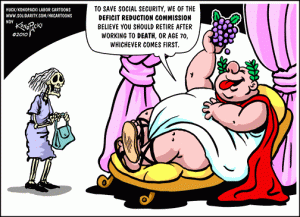
Robert Reich is among the policy wonks who wonders what’s happened to this country, Most of us can’t figure out why more people aren’t taking to the streets to demand things change.
People ask me all the time why we don’t have a revolution in America, or at least a major wave of reform similar to that of the Progressive Era or the New Deal or the Great Society.
Middle incomes are sinking, the ranks of the poor are swelling, almost all the economic gains are going to the top, and big money is corrupting our democracy. So why isn’t there more of a ruckus?
The answer is complex, but three reasons stand out.
First, the working class is paralyzed with fear it will lose the jobs and wages it already has.
In earlier decades, the working class fomented reform. The labor movement led the charge for a minimum wage, 40-hour workweek, unemployment insurance, and Social Security.
No longer. Working people don’t dare. The share of working-age Americans holding jobs is now lower than at any time in the last three decades and 76 percent of them are living paycheck to paycheck.
No one has any job security. The last thing they want to do is make a fuss and risk losing the little they have.
Besides, their major means of organizing and protecting themselves — labor unions — have been decimated. Four decades ago more than a third of private-sector workers were unionized. Now, fewer than 7 percent belong to a union.
Second, students don’t dare rock the boat.
In prior decades students were a major force for social change. They played an active role in the Civil Rights movement, the Free Speech movement, and against the Vietnam War.
But today’s students don’t want to make a ruckus. They’re laden with debt. Since 1999, student debt has increased more than 500 percent, yet the average starting salary for graduates has dropped 10 percent, adjusted for inflation. Student debts can’t be cancelled in bankruptcy. A default brings penalties and ruins a credit rating.
To make matters worse, the job market for new graduates remains lousy. Which is why record numbers are still living at home.
Reformers and revolutionaries don’t look forward to living with mom and dad or worrying about credit ratings and job recommendations.
Third and finally, the American public has become so cynical about government that many no longer think reform is possible.
When asked if they believe government will do the right thing most of the time, fewer than 20 percent of Americans agree. Fifty years ago, when that question was first asked on standard surveys, more than 75 percent agreed.
 One of the most outrageous lies told by the wealthy is how they pay all the taxes. This is only true of Federal Income taxes that are designed to be progressive. Most state and local taxes are not progressive and they impact poor, working class, and middle income people. The very wealthy also have a huge amount of their income exempt from social security withholding.
The federal personal income tax only made up 28% of all U.S. government tax collections in 2012. Federal, state and local governments collected $4 trillion in taxes last year; just $1.1 trillion of that was federal personal income tax.
And people with low incomes who don’t pay federal personal income tax do pay lots of those other taxes: payroll tax, state income tax, sales tax, property tax, excise taxes, and more. They pay other taxes indirectly: Workers bear the burden of employer-paid payroll taxes and part of the burden of corporate income taxes.
Here’s a chart I made earlier this year showing the distribution of the tax burden when you add all the taxes together. Earners in the top 1% pay about 43% of their incomes in tax. People in the middle quintile pay 25%. The poorest fifth pays 13%.
Business Insider, data from Tax Policy Center and Institute on Taxation and Economic Policy
Rich people do pay a lot more taxes than poor people, both in absolute terms and as a percentage of income. But the rich are not paying all the taxes. And looking just at the federal personal income tax and trying to draw conclusions about who pays “taxes” will lead you to wrong answers.
You’ll notice that a lot of this discussion comes from economists or business journalists. Here’s an article from HBR that says that “We Can’t Afford to Leave Inequality to the Economists”.
But the aforementioned Emanuel Saez, together with Thomas Piketty of the Paris School of Economics, has for the past decade-plus been using income tax records to compile a rich account of what’s been going on up there in the top 1%. You’re probably familiar with the basic outlines, but it’s worth throwing out a few numbers from their most recent update:
- From 1993 to 2013, incomes of the bottom 99% of taxpayers in the U.S. grew 6.6%, adjusted for inflation. The incomes of the top 1% grew 86.1%.
- The top 0.1% of U.S. taxpayers claimed 11.33% of overall income in 2012, up from 2.65% in 1978. The top 0.01% got 5.47%, up from 0.86% in 1978.
- The average income of the top 0.01% was 859 times that of the bottom 90% in 2012. In 1973 the top-0.01%-to-bottom-90% ratio was just under 80.
Something really dramatic is going on up there in the top 5%, the top 1%, the top 0.01%. But while economists know some things about the impact of increasing overall income inequality, they still don’t know all that much about what this 1% stuff means. In their new paper, Chetty, Hendren, Kline, Saez, and Turner write that their finding of steady intergenerational income mobility “may be surprising in light of the well-known negative correlation between inequality and mobility across countries.” A possible explanation, they continue, is that
[M]uch of the increase in inequality has been driven by the extreme upper tail … [and] there is little or no correlation between mobility and extreme upper tail inequality — as measured e.g. by top 1% income shares — both across countries and across areas within the U.S. Instead, the correlation between inequality and mobility is driven primarily by “middle class” inequality.
That’s the thing about this rise in “extreme upper tail inequality” — most pronounced in the U.S. but by now a clearly global phenomenon. It is one of the most dramatic economic developments of the past quarter century. And it seems like it might be bad thing. But conclusive economic evidence for its badness is hard to find.
Yes, there are theories: All that wealth sloshing around in the top 1% leads to more bubbles and crashes. Extreme wealth corrupts the political process. Income inequality may be slowing overall economic growth. And, as my colleague Walter Frick put it in an email when I brought this up, “given the diminishing marginal utility of income, it’s hugely wasteful for the super rich to have so much income.”
I happen to believe there’s some truth to all four of those. But there are also lots of counterarguments and some counterevidence, and big economic studies like the new one by Chetty & Co. don’t seem to be doing much to resolve the debate.
Which leads me to another theory: I think we’re eventually going to have to figure out what if anything to do about exploding high-end incomes without clear guidance from the economists.
It will be interesting to see how the President approaches these problems in the SOTU address. 
Obama has called inequality in America the “defining issue of our time.” And although you may hear the words “opportunity” and “mobility” more than “inequality” in his speech, the intent is the same.
“The address will include a ‘healthy dose’ of the income inequality message the White House has focused on in recent weeks, according to one senior administration official familiar with the text,” The Hill newspaper reports.
“The president, who has yet to add to the big legislative accomplishments of his first term, will call for raising the minimum wage to $10 per hour and extending federal unemployment benefits that expired last month,” according to this report. “He will also discuss energy and college affordability, two other issues that relate to the economic mobility message that is a major White House theme ahead of this year’s midterm elections.”
Of course, it’s easy to talk about these things. It’s not so easy to get any thing through the Congress these days. Let’s take this idiot at Forbes for example who argues that Wealth Inequality is a sure sign of the success of an economy and country. You have to read this to believe it. This ass is a gold bug so be assured, this is insane.
When income and wealth inequality are growing, unease in our lives is shrinking. Republicans, as the alleged Party of entrepreneurial capitalism, should understand this well, and stop acting as though success is something to politicize. Wealth inequality is one of the surest signs of economic advancement. It’s time for today’s Republicans to act like adults, and embrace the very inequality that has improved the lives of so many.
Oxfam released a study that shows the problem is really worldwide.
Oxfam calculated that almost half the world’s wealth – $110trn – is owned by just 1 per cent of its population. It said that 70 per cent of people live in countries where the gap between the rich and poor has widened in the last 30 years.
“This massive concentration of economic resources in the hands of fewer people presents a significant threat to inclusive political and economic systems,” the charity said. “People are increasingly separated by economic and political power, inevitably heightening social tensions and increasing the risk of societal breakdown.”
Winnie Byanyima, Oxfam’s executive director, who will attend Davos, described the gulf between sectors of society as staggering. “We cannot hope to win the fight against poverty without tackling inequality. Widening inequality is creating a vicious circle where wealth and power are increasingly concentrated in the hands of a few, leaving the rest of us to fight over crumbs from the top table,” she said.
Oxfam is calling on the business chiefs gathering at Davos to promise to support progressive taxation and not dodge their own taxes, refrain from using their wealth to seek political favours and demand that companies they own or control pay a living wage. In a report last week the forum warned that income disparity leading to social unrest could have a significant impact on the world economy over the next 12 months.
There was a “lost” generation of young people coming of age who lacked jobs and the skills for work, the report said. This could easily boil over into protests over inequality and corruption. Jennifer Blanke, the forum’s chief economist, said: “Disgruntlement can lead to the dissolution of the fabric of society, especially if young people feel they don’t have a future. This is something that affects everybody.”

President Barack Obama will travel to Prince George’s County Maryland; Pittsburgh; Milwaukee; and Nashville in the next week to talk about proposals outlined in Tuesday’s State of the Union address.
In an email to supporters Saturday, senior adviser Dan Pfeiffer said Obama will lay out “a set of real, concrete, practical proposals to grow the economy, strengthen the middle class, and empower all who hope to join it.”
Obama opens his sixth year with some of the worst job approval ratings since he took office and with a bitterly divided Congress already turning much of its focus to the November election.
The White House will use the high-profile speech to try anew for momentum for the president’s agenda – and perhaps his legacy – as he declares 2014 a “year of action” with or without congressional support.
Tens of millions are expected to watch the 9 p.m. EST address, which Obama will deliver from the U.S. Capitol.
Obama is expected to make the widening income gap between rich and poor a centerpiece of his speech, calling on lawmakers to restore jobless benefits for 1.3 million long-term unemployed Americans, expand preschool initiatives and boost the federal minimum wage.
After he returns to Washington, he will outline new efforts to help the long-term unemployed, the White House says.
“The core idea is as American as they come: If you work hard and play by the rules, you should have the opportunity to succeed,'” Pfeiffer wrote. “Your ability to get ahead should be based on your hard work and ambition and who you want to be, not just the raw circumstance of who you are when you’re born.”
What’s on your reading and blogging list today?
Tuesday Reads: Are Things Really As Bad As I Think?
Posted: December 3, 2013 Filed under: Barack Obama, George W. Bush, Health care reform, immigration, income inequality, morning reads, Political Affective Disorder, Politics as Usual, poverty, Psychopaths in charge, Real Life Horror, Surreality, The Media SUCKS, U.S. Economy, U.S. Politics, We are so F'd, Women's Rights | Tags: Amazon drones, gun violence, No Child Left Behind, Obamacare, PISA test scores, public education, Racism 44 Comments
Good Morning!!
I don’t even know where to begin this morning. I wish I could write a coherent diatribe like the one Dakinikat wrote yesterday, but I can’t do it. I have a sense that things are very wrong, but I can’t explain the feeling in any rational way.
As we head into the holiday season, I feel as if the country is leaderless. The public focus of the Obama administration and the media is on the glitches in a website; and yet in the background are terrible problems that are building and growing more and more intractable as our political “leadership” fiddles with nonsensical issues like Obamacare and Benghazi.
As Dakinikat noted yesterday, there is a problem of growing poverty and income inequality become institutionalized and normalized. There is the issue of gun violence and our total failure to respond to it with any kind of rational regulations on guns. There is the devolution of education in the U.S., and of course there is the continuing attack on women’s autonomy and Democratic politicians seeming willingness to use women’s bodies as bargaining chips. Finally there are the already institutionalized problems of racism and hatred of immigrants. What have I missed?
As our real problem grow, it seems the American political and media classes, either don’t notice because as part of the wealthy 1% they simply aren’t affected, or because they’ve got theirs and they just don’t care about the mass of people who are struggling to survive in a poisonous system. And because of the obsessive focus on the end-of-year holidays, nothing will happen in Washington until we hit the next debt limit and our “leaders” mobilize briefly to kick the can of our economic and social problems down the road once again and so they can return to their focus on minutiae.
Is there any solution to the political and economic stagnation we find ourselves in? Is the situation really as surreal as it feels to me on this Tuesday morning? Am I nuts?
Anyway, here a some of the stories leading the news at the moment.
Jeff Bezos tells Amazon customers to expect home delivery by drones. NBC News reports:
Amazon.com hopes to deliver small packages to your home in just 30 minutes by unmanned drones within five years, chief executive Jeff Bezos said Sunday.
In an interview on CBS’s “60 Minutes,” Bezos was actually less optimistic than what his company said in its online announcement, which declared that tiny robot aircraft could be landing on front porches as soon as 2015.
Bezos said Amazon already had the technology in place and had even flown a working prototype, which he showed off in a video the company published Sunday:
He promised “half-hour delivery, and we can carry objects, we think, up to five pounds, which covers 86 percent of the items that we deliver.”
The rest of the work, Bezos said, is in quality control and getting the plan OK’d by the Federal Aviation Administration — something technology experts said was unlikely on Bezos’ time frame.
So basically, this is just a silly idea that has no chance of actually happening anytime soon. But the media sees it as more urgent than poverty, income inequality, and people getting killed with guns day in and day out.
From the Washington Post: U.S. students lag around average on international science, math and reading test.
Scores in math, reading and science posted by 15-year-olds in the United States were flat while their counterparts elsewhere — particularly in Shanghai, Singapore and other Asian provinces or countries — soared ahead, according to results of a well-regarded international exam released Tuesday.
While U.S. teenagers scored slightly above average in reading, their scores were average in science and below average in math, compared to 64 other countries and economies that participated in the 2012 Program for International Student Assessment, or PISA, which was administered last fall. That pattern has not changed much since PISA was first administered in 2000.
Gee, I wonder why this is happening? It seems like something that should concern our “leaders.”
The test scores offer fresh evidence for those who argue that the United States is losing ground to competitors in the global market and others who say a decade’s worth of school reform has done little to improve educational outcomes.
“While the intentions may have been good, a decade of top-down, test-based schooling created by No Child Left Behind and Race to the Top — focused on hyper-testing students, sanctioning teachers and closing schools — has failed to improve the quality of American public education,” Randi Weingarten, president of the American Federation of Teachers, said in a statement. The AFT released a video on Monday in which it implored the public not to blame teachers, the unions, parents or students for poor PISA results.
But were intentions really good? Check out these years-old headlines on profiteers (including the Bush family) who cleaned up after passage of the Orwellianly titled “No Child Left Behind” law was passed.
Bush Profiteers Collect Billions from No Child Left Behind (Project Censored: The News That Didn’t Make The News, March 30, 2007)
Bush’s Family Profits From `No Child’ Act (LA Times, Oct. 22, 2006)
No Bush Left Behind (Bloomerg Businessweek, Oct. 15, 2006)
There are plenty more headlines where those came from.
And yet, nearly a decade later, we’re stuck with that awful law and the damage it has done to our public education system. Why have Democrats done nothing to reverse it? Most likely because they too profit from the continuing privatization of education.
What about the latest media narrative on Obama care?
From the Washington Post: Health-care enrollment on Web plagued by bugs:
The enrollment records for a significant portion of the Americans who have chosen health plans through the online federal insurance marketplace contain errors — generated by the computer system — that mean they might not get the coverage they’re expecting next month.
The errors cumulatively have affected roughly one-third of the people who have signed up for health plans since Oct. 1, according to two government and health-care industry officials. The White House disputed the figure but declined to provide its own.
The mistakes include failure to notify insurers about new customers, duplicate enrollments or cancellation notices for the same person, incorrect information about family members, and mistakes involving federal subsidies. The errors have been accumulating since HealthCare.gov opened two months ago, even as the Obama administration has been working to make it easier for consumers to sign up for coverage, the government and industry officials said.
Figuring out how to clean up the backlog of errors and prevent similar ones in the future is emerging as the new imperative if the federal insurance exchange is to work as intended. The problems were the subject of a meeting Monday between administration officials and a new “Payer Exchange Performance Team” made up of insurance industry leaders.
Okay, but what is with the bizarre impatience about some computer glitches from a media that couldn’t care less about institutionalized poverty, racism, and gun violence? And then there’s the Obama administration’s defensive response, as reported by USA Today: Obama to launch new health care law campaign
President Obama and his aides will seek to rally public support for his embattled health care plan in the coming weeks, starting with a White House event Tuesday.
Obama will promote the effort in a speech while surrounded by people who have benefited from the new law, according to an addition to the White House schedule.
The Affordable Care Act has come under heavy political attack since its rollout in October. Problems have included a malfunctioning website and the cancellations of polices that do not meet new federal standards.
In the coming days, Obama and aides will highlight what they call successful aspects of the law. They include provisions that prevent insurance companies from discriminating against people with pre-existing health conditions, and allow young people to stay on their parents’ insurance policies until age 26.
A few writers have tried to look at the “Obamacare crisis” slightly more rationally than the mainstream corporate media.
Here’s Bob Cesca at The Daily Banter: As Healthcare.gov Bugs Are Fixed, the ‘Obama’s Katrina’ Script Continues To Be Shredded.
It’s been 11 days since The National Journal‘s Ron Fournier wrote that Obamacare is President Obama’s Katrina. Oh, and it’s also his Iraq, Fournier wrote. Obama’s Katrina and Iraq. Both.
Since then, however, the Healthcare.gov website has been vastly improved and many of the bugs initially reported have been fixed, according to the administration late Sunday.
Back on November 20, Fournier made sure to provide himself with an escape hatch, though, noting that Healthcare.gov isn’t the same in terms of the actual events during and after Katrina, or throughout the Iraq War. Instead, Fournier wrote, the similarities had more to do with incompetence in the execution of a major policy initiative.
Yeah, so incompetence that lasted literally for years in both Iraq and New Orleans, leading to massive body counts on both fronts, is the same as a glitchy website launch. Okeedokee. Roger that. In reality, yes, both administrations made mistakes, but those mistakes were vastly different in terms of magnitude — not to mention that the Bush administration’s response to its mistakes was to, well, make even more mistakes. Again, foryears.
On the other hand, the Obama administration realized there were problems with the website and rushed to address those errors. Within two months most of those problems have been resolved, and, bonus, no one died.
For more rational perspective, read the rest of the post at the link.
I particularly like this uncharacteristically long post by TBogg at Raw Story: Are-We-There-Yet?-American [sic] just wants to go home because we aren’t there yet. Here’s just a taste:
You may remember that about a month ago, which is four score and seven years ago to the iPhone generation for whom a Japandroids download that takes over 20 seconds is an eternity times infinity, that the Great Socialism Project That Will Stomp America Flat (aka Obamacareor Communism) had some internet user problems which is why there are absolutely no healthcare services available in America right now so you should just rub some dirt on your burst appendix, suck it up, and quit yer bellyaching. In an effort to fix what wasn’t working, the Obama White House brought in some better quality nerds who, fortified with 5 Hour Energy IV drips, promised to get it up and working by Dec 1 or GTFO.
Please go read the rest.
Charles Pierce also had a few choice words for Ron Fournier and the rest of the Obama-hating press.
Ace reporter Ron Fournier of the Associated Press has another scoop for y’all. There is absolutely no fking way on god’s green and pleasant earth that this Obama fellow will be elected president again. He has blown his chance for that third term, and probably the fourth and fifth as well. Ron would like the Pulitzer committee to leave the medallion on the doorstep. Watch out, Obama. The Horsemen ride at daybreak! [….]
I heard my friend Eric Boehlert on the radio this morning, warning us that the traditional end-of-the-year retrospectives are likely to sing in close harmony on the theme of the collapsing Obama administration, even though his poll numbers are pretty much where they’ve been for a couple of years now, and even though the Republicans in Congress continue to have the approval ratings of skin disease. I think he’s right, and I think Fournier, who’s been a tool so long they ought to sell him at Home Depot, is just trying to get a jump on things here.
More hilarity at the link.
And what’s with the efforts to deny that racism exists? From Raw Story: Black female professor reprimanded for pointing out existence of structural racism to white male students.
A faculty member at Minneapolis Community and Technical College, Shannon Gibney, received a formal reprimand for her handling of a discussion about structural racism in her Introduction to Mass Communication course.
According to Gibney in an interview with City College News, a white male student asked her, “Why do we have to talk about this in every class? Why do we have to talk about this?”
She claims she was shocked, because “[h]is whole demeanor was very defensive. He was taking it personally. I tried to explain, of course, in a reasonable manner — as reasonable as I could given the fact that I was being interrupted and put on the spot in the middle of class — that this is unfortunately the context of 21st century America.”
Gibney says another white male student followed the first, saying “Yeah, I don’t get this either. It’s like people are trying to say that white men are always the villains, the bad guys. Why do we have to say this?”
When Gibney attempted, again, to inform the students that they were mistaking a systemic critique for a personal attack, the students continued to argue. Eventually, she told them that “if you’re really upset, feel free to go down to legal affairs and file a racial harassment discrimination complaint.” This is exactly what they did.
This probably has something to do with our f’d up education system too . . . . As far as I can tell, critical thinking has been banned.
Okay, I’ve ranted long enough. What interesting news have you been reading? Let us know in the comment thread.
Workers of the World Unite
Posted: May 2, 2013 Filed under: income inequality, worker rights | Tags: 401(k), diminishing real wage, Felix Salmon, Henry Blodgett, Income Inequality, Thomas Friedman whore 8 Comments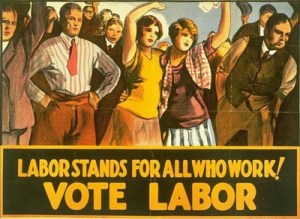 We continue to see abuse of labor from the horrible explosions in a West, Texas chemical plant to the collapse of a building in Bangladesh. US workers continue to get the shaft when it comes to working harder and more productively for less. It is a sad trend that just keeps reaching new records. The gap between incomes going to workers and profits going to owners–mostly passive stockholders–continues unabated. This gap does not reflect a lack of labor productivity. It appears to reflect mostly the ability of capital owners to gamble themselves into strong positions. Industrialists are force to drive down costs to attract capital and to do some very short sighted things. The rush to increase ROE with no thought to other factors is a very bad omen for this country.
Henry Blodgett provides some very depressing May Day graphs at Business Insider.
Corporate profit margins just hit another all-time high. Companies are making more per dollar of sales than they ever have before. If you’re a shareholder, that seems like good news (in the very short term, anyway). Alas, most people aren’t shareholders. And for folks whose investment horizon is longer than “this quarter” and “this year,” it’s actually bad news. Companies are under-investing in their employees and the future.
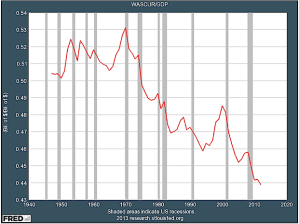 Normally, high profits are a good sign. What is disturbing is the the under-investing and the unequal increase in wages. Labor–in theory–should gain with productivity gains. This tends to stoke the growth of an economy and of a solid middle class. This trend means there is less purchasing power among the majority of households and more wage and job insecurity. This is Felix Salmon’s take.
It’s May Day, and Henry Blodget is celebrating — if that’s the right word — with three charts, of which the most germane is the one above. It shows total US wages as a proportion of total US GDP — a number which continues to hit all-time lows. Blodget also puts up the converse chart — corporate profits as a percentage of GDP. That line, you won’t be surprised to hear, is hitting new all-time highs. He’s clear about how destructive these trends are:
Low employee wages are one reason the economy is so weak: Those “wages” are represent spending power for consumers. And consumer spending is “revenue” for other companies. So the short-term corporate profit obsession is actually starving the rest of the economy of revenue growth.
In other words, we’re in a vicious cycle, where low incomes create low demand which in turn means that there’s no appetite to hire workers, who in turn become discouraged and drop out of the labor force. Blodget’s third chart is one we’re all familiar with: the employment-to-population ratio, which fell off a cliff during the Great Recession and which will probably never recover. The current “recovery” is not actually a recovery for the bottom 99%, for real people who need to live on paychecks. And today is exactly the right day to point that out.
And yet that’s Tom Friedman’s column this May Day:
If you are self-motivated, wow, this world is tailored for you. The boundaries are all gone. But if you’re not self-motivated, this world will be a challenge because the walls, ceilings and floors that protected people are also disappearing. That is what I mean when I say “it is a 401(k) world.”
This manages to be both incomprehensible and incredibly offensive at the same time. I have no idea what Friedman thinks he’s talking about when he blathers on about disappearing protective floors; I can only hope that he isn’t making a super-tasteless reference to the recent disaster in Bangladesh. But it’s simply wrong that today’s world is “tailored” for anybody who happens to be “self-motivated”. Both the self and the motivation are components of labor, not capital, and as such they’re on the losing side of the global economy, not the winning side.
Friedman is a billionaire (by marriage) who — like all billionaires these days — is convinced that he achieved his current prominent position by merit alone, rather than through luck and through the diligent application of cultural and financial capital. His paean to self-motivation recalls nothing so much as Margaret Thatcher’s “there is no such thing as society” quote: “parenting, teaching or leadership that ‘inspires’ individuals to act on their own will be the most valued of all,” he writes, bizarrely choosing to wrap his scare quotes around the word “inspires” rather than around the word “leadership”, where they belong.
True leadership, in a society where the workers are failing to be paid even half the fruits of their labor, would involve attempting to turn the red line in Blodget’s chart around, and to spread the nation’s prosperity among all its citizens. Rather than telling everybody that they’re “on their own” and that if they’re not a success then hey, they’re probably just not “self-motivated” enough.
The ultimate Friedman kick in the balls, however, doesn’t come from his lazily meritocratic priors. Rather, it comes from his overarching metaphor: the idea that if you have a 401(k) plan, then you’re somehow in charge of your own destiny. Friedman might be right that we’re living in a 401(k) world, but if he is then he’s right for the wrong reason. In Friedman’s mind, a 401(k) plan is an icon of self-determination: you get out what you put in. “Your specific contribution,” he writes, italics and all, “will define your specific benefits.”
We are learning more and more each day on how the finance industry games the kinds of investments available to you in those plans. We also know that mega corporations are getting congress to defund OSHA and any regulatory agency that watches over worker safety. Many investments are also subject to whacked performance because of excessive speculation that is encouraged by our tax laws. This has destroyed home values during the Great Recession and eaten up many folks retirement plans and savings. Frankly, it’s difficult to see how any one that relies on their sweat and has no rich family connections these days even crawls into the middle class. All of these things add up to major insecurities and risks. This is simply not the way things are supposed to work. But, it is the world that the Koch Brothers and others have carefully crafted by making politicians and pundits whores to their agenda of greed.
Pity the poor working man and woman.
Thursday Reads
Posted: May 2, 2013 Filed under: Barack Obama, corporate greed, hunger, income inequality, morning reads, net-neutrality, Reproductive Health, Reproductive Rights, science, The Bonus Class, the internet, U.S. Economy, U.S. Politics, War on Women | Tags: archaeology, cannibalism, CEO pay, Commerce Department, DOJ, emergency contraception, FCC, fracking, Jamestown Colony, JC Penney Co., North Dakota, Obama bundlers, Penny Pritzker, Plan B, Ron Johnson, Tom Wheeler 45 Comments
Good Morning!!
President Obama isn’t looking so “progressive” this morning (what else is new?). Yesterday, his “Justice” department announced they will ignore science as well as the health needs of women and girls by fighting a judge’s order to make Plan B emergency contraception available over-the-counter without age limits. NYT:
The appeal reaffirms an election-year decision by Mr. Obama’s administration to block the drug’s maker from selling it without a prescription or consideration of age, and puts the White House back into the politically charged issue of access to emergency contraception.
The Justice Department’s decision to appeal is in line with the views of dozens of conservative, anti-abortion groups who do not want contraceptives made available to young girls. But the decision was criticized by advocates for women’s reproductive health and abortion rights who cite years of scientific research saying the drug is safe and effective for all ages.
“Age barriers to emergency contraception are not supported by science, and they should be eliminated,” Cecile Richards, the president of Planned Parenthood Federation of America, said in a statement on Wednesday.
In December 2011 the secretary of health and human services, Kathleen Sebelius, blocked the sale of the drug to young girls without a prescription, saying there was not enough data to prove it would be safe. In doing so, Ms. Sebelius took the unprecedented step of overruling the Food and Drug Administration, which had moved, based on scientific research, to lift all age restrictions.
I could use some profane language here, but I’ll spare you for the moment. You may be mumbling to yourself too, after you read about Obama’s latest picks for the FCC and Commerce Department.
First the FCC. The New York Times reports: Telecom Investor Named to Be F.C.C. Chairman.
Tom Wheeler, President Obama’s pick to be the next chairman of the Federal Communications Commission, knows all about the most advanced telecommunications systems — of the 19th century.
In his 2008 book “Mr. Lincoln’s T-Mails: How Abraham Lincoln Used the Telegraph to Win the Civil War,” Mr. Wheeler, an investor in start-up technology and communications companies, documents how Lincoln was an “early adopter” of what has been called “the Victorian Internet.”
Lincoln’s championing and advancement of popular uses of the telegraph are not unlike the challenges Mr. Wheeler is likely to face as chairman of the F.C.C., which is waging an intense battle to keep Internet service free of commercial roadblocks and widely available in its most affordable, up-to-date capabilities.
Mr. Wheeler’s qualifications for “one of the toughest jobs in Washington,” Mr. Obama said, include a long history “at the forefront of some of the very dramatic changes that we’ve seen in the way we communicate and how we live our lives.”
“He was one of the leaders of a company that helped create thousands of good, high-tech jobs,” Mr. Obama said, referring to Core Capital Partners, the Washington investment firm where Mr. Wheeler is a managing director. “He’s in charge of the group that advises the F.C.C. on the latest technology issues,” adding that “he’s helped give American consumers more choices and better products.”
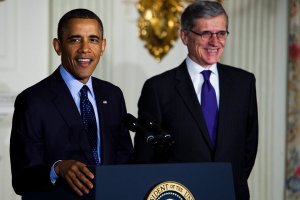
They look happy, don’t they?
But does all that qualify Wheeler to protect consumers at the FCC? From Ars Technica:
President Barack Obama today announced his choice to run the Federal Communications Commission. As reported yesterday, the nominee is Tom Wheeler, a venture capitalist who was formerly a lobbyist at the top of the cable and wireless industries, leading the National Cable Television Association (NCTA) and Cellular Telecommunications & Internet Association (CTIA).
The nomination continues the parade of lobbyists becoming government officials and vice versa, a trend that has favored moneyed interests over the average American citizen and consumer time and again. One can take solace in the fact that Wheeler will be tasked with implementing the communications policies of President Obama, who says he is eager to fight on behalf of consumers and to maintain thriving and open Internet and wireless marketplaces.
But the same President who said “I am in this race to tell the corporate lobbyists that their days of setting the agenda in Washington are over” when he was running for office has given the FCC’s top job to a former lobbyist. Wheeler donated $38,500 to Obama’s election efforts and helped raise additional money for Obama by becoming a “bundler,” arranging for large contributions from other donors after hitting legal limits on personal contributions.
Not surprisingly, the cable and telecom companies that Wheeler springs from are ecstatic about the nomination.
Gotta get rid of those nasty regulations that protect Americans from price gauging, internet censorship, and all that bad stuff.

Penny Pritzker
Next up, behold Obama’s nomination for Commerce Secretary, old pal Penny Pritzker.
Making official what many Democrats have expected for weeks, President Obama plans to nominate Chicago business executive Penny Pritzker, a longtime political supporter and heavyweight fundraiser, as his new Commerce secretary on Thursday morning.
Pritzker’s nomination could prove controversial. She is on the board of Hyatt Hotels Corp., which was founded by her family and has had rocky relations with labor unions, and she could face questions about the failure of a bank partly owned by her family.
With a personal fortune estimated at $1.85 billion, Pritzker is listed by Forbes magazine among the 300 wealthiest Americans. She is the founder, chair and CEO of PSP Capital Partners, a private equity firm, and its affiliated real estate investment firm, Pritzker Realty Group. She played an influential role in Obama’s rise from Illinois state senator to the nation’s 44th president, serving as Obama’s national finance chair in his first campaign for the White House and co-chair of his reelection campaign.
The president is expected to make the announcement at 10 a.m. at the White House.
If confirmed by the Senate, Pritzker would take charge of the administration’s efforts to build relations with business leaders who were often on the sharp end of the president’s first-term rhetoric.
Sigh . . .
This next story is guaranteed to make your blood boil. Bloomberg reports:
It’s been almost three years since Congress directed the Securities and Exchange Commission to require public companies to disclose the ratio of their chief executive officers’ compensation to the median of the rest of their employees’. The agency has yet to produce a rule.
So Bloomberg decided not to wait around any longer and figured out the ratios for us. See the chart at the above link. More:

CEO Pay 1,795-to-1 Multiple of Wages Skirts U.S. Law
Former fashion jewelry saleswoman Rebecca Gonzales and former Chief Executive Officer Ron Johnson have one thing in common: J.C. Penney Co. (JCP) no longer employs either.
The similarity ends there. Johnson, 54, got a compensation package worth 1,795 times the average wage and benefits of a U.S. department store worker when he was hired in November 2011, according to data compiled by Bloomberg. Gonzales’s hourly wage was $8.30 that year.
Across the Standard & Poor’s 500 Index of companies, theaverage multiple of CEO compensation to that of rank-and-file workers is 204, up 20 percent since 2009, the data show. The numbers are based on industry-specific estimates for worker compensation.
Almost three years after Congress ordered public companies to reveal actual CEO-to-worker pay ratios under the Dodd-Frank law, the numbers remain unknown. As theOccupy Wall Street movement and 2012 election made income inequality a social flashpoint, mandatory disclosure of the ratios remained bottled up at the Securities and Exchange Commission, which hasn’t yet drawn up the rules to implement it. Some of America’s biggest companies are lobbying against the requirement.
“It’s a simple piece of information shareholders ought to have,” said Phil Angelides, who led the Financial Crisis Inquiry Commission, which investigated the economic collapse of 2008. “The fact that corporate executives wouldn’t want to display the number speaks volumes.” The lobbying is part of “a street-by-street, block-by-block fight waged by large corporations and their Wall Street colleagues” to obstruct the Dodd-Frank law, he said.
Are you angry yet? These greedheads are going to keep pushing the envelope until Americans wake up and take to the streets with pitchforks and dust off the guillotines.
My birthplace, North Dakota is changing rapidly–and maybe not in a good way. It turns out the state’s oil is even more plentiful than anyone has realized up till now.
The sea of oil and natural gas underneath North Dakota is far larger than first thought.
There are 7.4 billion barrels of recoverable oil in the western part of the state and extending into Montana, according to the latest estimate by the U.S. Geological Survey.
That’s more than twice the oil the USGS estimated could be recovered five years ago. What’s more, the USGS has nearly tripled its estimate of the natural gas available in the area.
The revised totals could make the North Dakota field the greatest oil and gas find ever in the continental United States, topping the fabled East Texas field that made Texas synonymous with oil wealth. And it would put North Dakota second to Prudhoe Bay as the largest oil producer in U.S. history.
And even this estimate may have to be “revised upward”:
“We think it’s even a little bit conservative,’’ said Ron Ness, president of the North Dakota Petroleum Council.
The new estimate will give fresh momentum to an economic boom within the state that has made it the fastest growing in the nation in both population and incomes. Per capita income has risen to $52,000 a year, sixth-highest in the nation, and once quiet farm towns have been overwhelmed by oil field workers, creating shortages of housing and services.
The USGS said the drilling of 4,000 wells since 2008 in what is known as the Bakken formation has given geologists a better idea of the riches underground. The new analysis also highlights the rapid ascent of North American oil and gas production driven by the advent of the technique known as hydraulic fracturing.
I guess I’m happy about the new jobs and population growth, but it will be sad if North Dakota no longer has clean air and vast open spaces.

Four shallow chop marks on the top of the girl’s skull, evidence of cannibalism during the “starving time” over the winter of 1609-1610. (Smithsonian Institution / Don Hurlbert)
You may have heard about this fascinating story–it was up toward the top of Google News much of yesterday. Archaeologists have found strong evidence that Starving Settlers in [the] Jamestown Colony Resorted to Cannibalism. From Smithsonian Magazine:
The harsh winter of 1609 in Virginia’s Jamestown Colony forced residents to do the unthinkable. A recent excavation at the historic site discovered the carcasses of dogs, cats and horses consumed during the season commonly called the “Starving Time.” But a few other newly discovered bones in particular, though, tell a far more gruesome story: the dismemberment and cannibalization of a 14-year-old English girl.
“The chops to the forehead are very tentative, very incomplete,” says Douglas Owsley, the Smithsonian forensic anthropologist who analyzed the bones after they were found by archaeologists from Preservation Virginia. “Then, the body was turned over, and there were four strikes to the back of the head, one of which was the strongest and split the skull in half. A penetrating wound was then made to the left temple, probably by a single-sided knife, which was used to pry open the head and remove the brain.”
Much is still unknown about the circumstances of this grisly meal: Who exactly the girl researchers are calling “Jane” was, whether she was murdered or died of natural causes, whether multiple people participated in the butchering or it was a solo act. But as Owsley revealed along with lead archaeologist William Kelso today at a press conference at the National Museum of Natural History, we now have the first direct evidence of cannibalism at Jamestown, the oldest permanent English colony in the Americas. “Historians have gone back and forth on whether this sort of thing really happened there,” Owsley says. “Given these bones in a trash pit, all cut and chopped up, it’s clear that this body was dismembered for consumption.”
There’s much more at the link.
Now it’s your turn. What are you reading and blogging about today? Please post your links on any topic in the comment thread, and have a great day!
Saturday Reads
Posted: October 13, 2012 Filed under: 2012 presidential campaign, income inequality, Media, morning reads, U.S. Military, U.S. Politics, War on Women | Tags: Benghazi attacks, hypocrisy, John Sununu, Libya, Marilyn Monroe reading in bed, Paul Ryan, Ryan lies, stimulus funds, vice presidential debate 54 Comments
Good Morning!!
I’ve been pretty sanguine about the chances of President Obama being reelected, but I have to admit I’m getting to the point that I could start panicking. I can’t understand why Mitt Romney seems to be doing so well in the polls right now. Seriously? Just because he managed to roll over Jim Lehrer and lie his ass off in a debate? I simply cannot understand why anyone would vote for the policies that Romney and Ryan are running on or why there would be such a sudden reversal in the polls based on outright lies and deception. What exactly is going on here?
Nate Silver, who throughout the campaign has been forecasting an Obama victory, is beginning to reverse course. Yesterday afternoon Silver wrote: Obama’s Swing State ‘Firewall’ Has Brittle Foundation.
President Obama’s position has been stronger in state polls than in national surveys on recent days, a streak that extended itself in Thursday’s polling.
Although Mr. Obama got a distinctly poor poll in Florida, which showed him seven points behind there, the rest of Thursday’s state-level data, like a series of polls by Quinnipiac University and Marist College, were reasonably good for him. In surveys of competitive states that were released over the course of the day, he held the lead with 11 polls to Mitt Romney’s 6.
However, four of the six national tracking polls moved toward Mr. Romney, who also led by one point in a national poll published by Monmouth University.
The case that Mr. Romney’s bounce is evaporating after his debate last week in Denver continues to look a bit thin. The tracking polls aren’t perfect by any means. Some are better than others, but they are a below-average group of polls on the whole. But they do provide useful information about the day-to-day trend in the race, and so far they haven’t shown the sort of reversal that Democrats might have hoped for.
What the hell is going on here? Then last night Silver published another piece: Romney Debate Gains Show Staying Power
Mitt Romney continues to surge in the FiveThirtyEight forecast, and Friday may have featured his best set of polls all year.
The best way to track a change in the polls is to look for instances in which the same firm has surveyed the same state (or the national race) multiple times. The FiveThirtyEight forecast model relies on a procedure very much like this to calculate the overall trend in the race.
Fifteen polls were released on Friday that provided a comparison with another survey conducted between the Democratic convention and last week’s debate in Denver. Mr. Romney gained an average of 4.6 percentage points in these surveys.
The scariest thing is that Romney is gaining in the swing states. Silver admits that many of the polls released on Friday were from Republican leaning firms, but still, it’s frightening.
The only really good news for Democrats is that Mr. Obama had built up a large enough cushion that he could withstand a lot of damage without becoming the underdog. The forecast model still has him clinging to narrow leads in Ohio, Iowa, Wisconsin and Nevada, states that in some combination would give him 270 electoral votes.
Mr. Obama may also be just slightly underperforming the fundamentals in the election. His approval ratings remain near 50 percent, which would ordinarily predict a narrow re-election victory.
But for the first time, it’s really looking like Romney/Ryan could win. For those of us who believe that there will be a gigantic difference in outcomes–especially for women–if Romney becomes president, that is a terrifying prospect. Some liberals have argued that there is little difference between these two candidates. I simply can’t agree. I think the only hope for democracy is to get Obama reelected and then push him to enact policies that will reduce economic inequality and increase individual rights.
Can Obama turn this around? I have to believe he can, but it will obviously take a dramatic improvement in his performance in next Tuesday’s debate. Both candidates are prepping for the debate over the next three days.
In other news, Think Progress pushes back on Paul Ryan’s lies about the Libya situation during the vice presidential debate Thursday night. Ryan claimed that embassy officials had requested increased security for the Benghazi consulate, but that was not true. The requests were for security at the embassy in Tripoli.
Ryan also claimed there were requests for Marines to protect the ambassador, but that is not true either. TP quotes Foreign Policy:
At Thursday night’s debate, Rep. Paul Ryan seemed to suggest that the requests were for Marines to go to Libya, which was not the case. The requests were to extend the tours of a Mobile Security Detachments [MSD] and the Site Security Team [SST] at the U.S. embassy in Tripoli, which are teams of military personnel, not Marines, who can help protect an embassy and its personnel.
There’s more at the link, but pretty much everything Ryan said about Libya during the debate was a lie. So why was it wrong for Biden to laugh at him again?
At HuffPo, Sam Stein writes that Ryan actually requested more stimulus funds from the Obama administration that has previously been known.
During Thursday night’s vice presidential debate, Vice President Joe Biden attacked Rep. Paul Ryan (R-Wis.) for criticizing the president’s stimulus act despite having sent two separate requests for stimulus funds for his district.
Biden was wrong. Ryan sent at least four requests.
A Freedom of Information Act request for correspondence between Ryan’s office and the Environmental Protection Agency, filed by The Huffington Post, unearthed two additional instances in which the Wisconsin Republican petitioned for American Recovery Act funds. In addition, there were many other occasions in which the GOP vice presidential nominee asked the EPA for grant money for projects in Wisconsin’s 1st District, which encompasses Ryan’s hometown of Janesville and has a slight Democratic lean. Combined, the letters muddy Ryan’s claim that the stimulus wasn’t helpful and that government spending, more broadly, doesn’t assist small businesses.
Stein notes that the EPA request could be embarrassing for Republicans:
…the letters’ language reveals a congressman who was involved in reviewing the applications and determining that taxpayer money could be useful economically. Moreover, the direct petitioning of the EPA could prove awkward for the Republican ticket, owing to the insistence among many in the GOP that the agency is a hindrance and should be eliminated.
You can see the original letters at the link.
Horrible, ugly troll and Romney surrogate John Sununu has struck again: Sununu Says Obama Imitating Biden Would Fail. From the Bloomberg TV unofficial transcript:
AL HUNT: Welcome back. We are now joined by former New Hampshire Governor John Sununu, a top Romney surrogate. John, let me ask you. Last night, the Democrats were ecstatic. They say Joe Biden energized us again. Give me your take on the VP debate.
JOHN SUNUNU: If they’re energized by that grotesque display, all the better for it. I thought Joe Biden was on steroids last night. He looked like the Cheshire cat at times and then he looked like the gawker and the stalker. But worse than that was his substance.
“Grotesque display?” Well, I guess it takes one to know one.
HUNT: John, second presidential debate next Tuesday in Hofstra. Do you expect a different Barack Obama, a different Mitt Romney?
SUNUNU: I expect the same Mitt Romney. Mitt is pretty consistent. But I think you’ll probably see a different Barack Obama. They’re probably showing him tapes of Biden’s disgraceful performance and suggesting to him he ought to get wired like that. So I suspect you’ll see a little bit of Joe Biden not only in Joe Biden, as we saw last night, but a little Joe Biden in Barack Obama.
Well that was insightful.
Sorry I don’t have more positive news. I guess we have to hang on until Tuesday night while the media continues to fawn over Romney and Ryan.
What are you reading and blogging about today?

 peej
peej Carissa
 bostonboomer
 dakinikat
 ecocatwoman
 mablue2
 Mama Lopez
 peggysue22
 quixote
 skydancingguestblogger
 Mona (aka Wonk the Vote)



 Sky Dancing
Recent Comments