
Psychopaths in Charge
Posted: January 2, 2011 Filed under: Civil Liberties, Corporate Crime, financial institutions, Global Financial Crisis, Human Rights, income inequality, investment banking, psychology, torture, U.S. Economy, U.S. Politics | Tags: Alan Simpson, American Psycho, antisocial personality disorder, Bernie Madoff, Brett Easton Ellis, CEOs, investment bankers, John Ensign, Mark Sanford, politicians, psychopaths, sociopaths 73 Comments
In 1991, Brett Easton Ellis published a brilliant satirical novel called American Psycho. The book is narrated by a young man, Patrick Bateman, a graduate of Harvard and Harvard Business School, who is now a fabulously wealthy Wall Street investment banker with a pricey apartment on Manhattan’s Upper west side. In other words, he’s a typical ’80s yuppie, benefiting from the “Reagan Revolution.”
Bateman is utterly materialistic and narcissistic, obsessed with things like getting a reservation at the most trendy, expensive restaurant of the moment and having a more perfectly designed and printed business card than any of the other yuppies he works with. He is engaged to another yuppie named Evelyn, but he doesn’t really have any feelings for her. She is just another status symbol for him to show off to his Wall Street colleagues.
As the book progresses, it becomes clear that Bateman is filled with narcissistic rage. He begins torturing and murdering people–a homeless man, his secretary, a business associate, and more. The crimes become successively more violent and horrifying. In conversations with coworkers, he tells anecdotes about serial killers and even confesses his own crimes, but no one takes him seriously. These other numb, detached young men simply assume Bateman is joking and laugh at his bizarre, inappropriate remarks.
Toward the end of the book, there are hints that Bateman’s descriptions of violent murders could be hallucinations or fantasies–or they might have really happened. The interpretation is left to the reader.
Ellis told an interviewer that he wrote American Psycho at a time in his life when he was living an isolated, consumerist lifestyle, somewhat like Bateman’s:
He did not come out of me sitting down and wanting to write a grand sweeping indictment of yuppie culture. It initiated because my own isolation and alienation at a point in my life. I was living like Patrick Bateman. I was slipping into a consumerist kind of void that was supposed to give me confidence and make me feel good about myself but just made me feel worse and worse and worse about myself. That is where the tension of “American Psycho” came from. It wasn’t that I was going to make up this serial killer on Wall Street. High concept. Fantastic. It came from a much more personal place…
American Psycho was not well received by reviewers–before or after publication. In fact, the original publisher, Simon & Schuster, cancelled their contract with Ellis based on “aesthetic differences.” The book was never released in hardcover, but was eventually published in a quality paperback edition by Vintage Books. After its publication, Ellis was on the receiving end of a flood of hate mail and even death threats.
Today, Ellis points out, the blood and gore that was so shocking in his 1991 book is all around us.
You see it in “Saw” movies or in “Hostel” or anywhere. The gore is mainstream. The stuff you see now wass unimaginable in 1991 and that’s one reason why it caught on. The availability of that kind of subject matter was limited. It was limited to maybe certain graphic novels or transgressive fiction or certain out-there horror films but it wasn’t part of the mainstream. the accessibility of it was unique. This is how we’re rolling now.
What I took from the novel when I first read it was that it was a perfect representation of the societal effects of Reaganism. In the ’80s, American culture became more materialistic, superficial, and value-free than ever before. Reaganism taught that “greed is good.” Becoming wealthy became the highest goal for many Americans. At the same time, anyone who was poor, sick, or disabled was reviled. Reagan made Social Darwinism fashionable again.
Under Reagan, we closed hospitals for the mentally ill and threw them into the streets to beg and to wander our cities muttering as they listened to the voices in their heads. The need for low-cost housing and maintaining public infrastructure was ridiculed, and poor families with children began to wander our city streets homeless, sleeping in their cars or in public parks. Meanwhile the rich continued to get richer, greedier, and more callous toward people who had less than they did.
What other result could we have expected than the America we live in today? We live in a country in which so many people are cold, callous, and calculating, seeking to amass as much money as possible at the expense of ordinary taxpayers. Investment bankers like Ellis’s Patrick Bateman are treated like gods, shielded from any negative effects of their own lying, cheating, and stealing.
Today the message I take from American Psycho is even more troubling to me than when I first read the novel years ago. I see Bateman’s serial murders as symbolic of the damage out-of-control capitalism is doing to us as a people. I look at our political leaders and see empty, cold, callous people with no core values except how to get the most money and power for themselves, and screw the rest of us. They are serial murderers too, only they manage to distance themselves from those they murder in their wars and through their pro-corporate, anti-human policies.
The America we live in today is much like the surreal world that Brett Easton Ellis created in American Psycho, except that we now have even more electronic gadgets, more stuff to do on the internet, more “reality” TV shows where we can ridicule fat people or people with obsessive-compulsive disorder, or people trying to sing and dance. We have books and movies so violent that people become desensitized to depictions of blood and gore that seemed shocking in 1991. We are in decline in every way–our health, our incomes, our infrastructure, our rights, our values, our privacy. And the rich are richer and the poor are poorer now than at the end of the Ronald Reagan era.
I know I’m not the only one here who thinks we are being ruled by psychopaths–whether we’re talking about government officials or the heads of corporations. I really believe that, and I don’t mean it as hyperbole. I think the richest among us are the most likely to be detached and callous, because they don’t even have to see the poor and suffering people they are hurting with their greed. Their wealth insulates them from the daily struggles of the vast majority of Americans.
I think this is a subject that is worth talking about. Do you need to be at least a subclinical psychopath to be willing to do the kinds of immoral things government officials, corporate CEOs, and investment bankers do? Like lying in order to enter illegal wars so you can steal oil from other countries and murder hundreds of thousands of their citizens? Like sending young Americans to die for oil and a dying empire? Like taking jobs away from Americans and replacing them with slave labor in third world countries? Like throwing people out of their homes illegally? Like testing drugs on babies and children? Like polluting the water, air, and food with chemicals and refusing to clean up your messes?
I think you have to be a very sick person to do those things. And how is it different from what a serial killer does? First, government officials and corporate CEOs kill and maim and destroy people in far greater numbers and with more powerful weapons than a serial killer. Second, government officials and corporate CEOs don’t need to get close to the blood and death. They get other people to do their killing so they don’t have to see or hear their victims suffer.
So what exactly is a psychopath? Robert Hare, now emeritus professor of psychology at the University of British Columbia developed a checklist used by professionals to identify people with psychopathic tendencies.
People who are psychopathic prey ruthlessly on others using charm, deceit, violence or other methods that allow them to get with they want. The symptoms of psychopathy include: lack of a conscience or sense of guilt, lack of empathy, egocentricity, pathological lying, repeated violations of social norms, disregard for the law, shallow emotions, and a history of victimizing others.
Hare’s checklist (the PCL-R) is used in combination with a semi-structured clinical interview (an interview with set questions that allows the interviewer to follow up with his or her own questions when appropriate) and a detailed review of medical and psychiatric records. The following are the 20 traits for the evaluator to watch for:
•glib and superficial charm
•grandiose (exaggeratedly high) estimation of self
•need for stimulation
•pathological lying
•cunning and manipulativeness
•lack of remorse or guilt
•shallow affect (superficial emotional responsiveness)
•callousness and lack of empathy
•parasitic lifestyle
•poor behavioral controls
•sexual promiscuity
•early behavior problems
•lack of realistic long-term goals
•impulsivity
•irresponsibility
•failure to accept responsibility for own actions
•many short-term marital relationships
•juvenile delinquency
•revocation of conditional release
•criminal versatility
Not all of these characteristics would have to be met for someone to be diagnosed as a psychopath.
Each of the twenty items is given a score of 0, 1, or 2, based on how well it applies to the subject being tested. A prototypical psychopath would receive a maximum score of 40, while someone with absolutely no psychopathic traits or tendencies would receive a score of zero. A score of 30 or above qualifies a person for a diagnosis of psychopathy. People with no criminal backgrounds normally score around 5. Many non-psychopathic criminal offenders score around 22.
The checklist was originally designed for evaluating prison inmates, but not everyone with psychopathic characteristics becomes a criminal. I am arguing that many of them go into business or politics, am I’m far from the only one to suggest that. In fact Hare himself co-wrote a book called Snakes in Suits: When Psychopaths Go to Work. Other books that make similar arguments are The Sociopath Next Door, by Martha Stout, and The Psychopathy of Everyday Life: How Antisocial Personality Disorder Affects Us All, by Martin Kantor.
Just a bit about terminology. Psychopathy and Sociopathy are essential the same thing. Antisocial Personality Disorder is similar too, but could perhaps apply to people who wouldn’t score 30 on Hare’s checklist. I don’t know why the names of this disorder keep changing–it may just be because some psychiatrists see studying prison inmates as somewhat disreputable. Anyway, psychopathy is no longer listed in the Diagnostic and Statistical Manual of the American Psychiatric Association (latest version: DSM IV-TR). Instead, it is subsumed under “antisocial personality disorder.” Here is the DSM-IV-TR criteria for APD:
A. There is a pervasive pattern of disregard for and violation of the rights of others occurring since age 15 years, as indicated by three (or more) of the following:
1. failure to conform to social norms with respect to lawful behaviors as indicated by repeatedly performing acts that are grounds for arrest
2. deceitfulness, as indicated by repeated lying, use of aliases, or conning others for personal profit or pleasure
3. impulsivity or failure to plan ahead
4. irritability and aggressiveness, as indicated by repeated physical fights or assaults
5. reckless disregard for safety of self or others
6. consistent irresponsibility, as indicated by repeated failure to sustain consistent work behavior or honor financial obligations
7. lack of remorse, as indicated by being indifferent to or rationalizing having hurt, mistreated, or stolen from another.
B. The individual is at least age 18 years.
C. There is evidence of conduct disorder with onset before age 15 years.
D. The occurrence of antisocial behavior is not exclusively during the course of schizophrenia or a manic episode.
That official characteristics of APD are much less extreme than the ones on Hare’s checklist. I think it’s fairly obvious that many of our political and business leaders could meet at least three of those criteria. But can anyone argue that someone like Bernie Madoff could not be classified as a full-blown psychopath according to Hare’s criteria? What about Alan Simpson? What about someone like John Ensign or Mark Sanford? I believe I could make an argument for many more of our political and business leaders being either clinical or subclinical psychopaths.
There is some evidence that psychopathy is at least partly genetic, although most criminal psychopaths who have been studied had very abusive childhoods. There is also evidence for differences in the brains of psychopaths compared to typical brains.
I’m going to get into this topic in more detail in a future post. But for now, what do you think? Would it be useful for us to stop denying reality and accept that the psychopaths are in charge of our society?
Bushie writes Open Letter to Obama, encourages Obama to be even more Republican than he already is
Posted: January 2, 2011 Filed under: income inequality, Populism, POTUS | Tags: culture of life my ass, education, Mankiw's Rules of Dumb, No Profit Left Behind 32 Comments
The caving is by design, and so is the wingnut slide further to the right of anything that makes sense.
Alright, so the letter is not as blunt as I am. But, that’s how this reads to me. To appear in Sunday morning’s NY Times, an open letter to President Obama by Bushie N. Gregory Mankiw titled “How to Break Bread With the Republicans“:
DEAR President Obama:
Sorry to bother you. I know you are busy. But I have the sense that you could use a few words of advice.
In a matter of days, Republicans will control the House of Representatives and have a larger voting bloc in the Senate. If economic policy is to make any progress over the next two years, you really will have to be bipartisan. To do so, you’ll need to get inside the heads of the opposition.
I am here to help. As a sometime adviser to Republicans, I’d like to offer a few guidelines to understanding their approach to economic policy. Follow these rules of thumb and your job will be a lot easier.
Right. Well lucky for Obama it is not too difficult for him to get inside the heads of Republicans since he’s essentially one himself in everything but name. But, I’m sure he is ever so grateful for Mankiw’s pointers. I can picture Obama reading them with his chin peevishly up in the air. He’s got to be grateful for all the cover the right wing gives him to keep on telling the Democratic base to suck it up and quit whining about all the magnificent crumbs they are getting.
Mankiw’s letter continues with his first Rule of Thumb Dumb:
FOCUS ON THE LONG RUN Charles L. Schultze, chief economist for former President Jimmy Carter, once proposed a simple test for telling a conservative economist from a liberal one. Ask each to fill in the blanks in this sentence with the words “long” and “short”: “Take care of the ____ run and the ____ run will take care of itself.”
Liberals, Mr. Schultze suggested, tend to worry most about short-run policy. And, indeed, starting with the stimulus package in early 2009, your economic policy has focused on the short-run problem of promoting recovery from the financial crisis and economic downturn.
But now it is time to pivot and address the long-term fiscal problem. In last year’s proposed budget, you projected a rising debt-to-G.D.P. ratio for as far as the eye can see. That is not sustainable. Conservatives believe that if the nation credibly addresses this long-term problem, such a change will bolster confidence and have positive short-run effects as well.
Fortunately, the fiscal commission you appointed assembled a good set of spending and tax reforms. The question you now face is whether to embrace their sensible but politically difficult proposals in your own budget.
WTF? “Liberals tend to worry most about short-run policy…” While what? Republicans focus on the long run? Funny that, I seem to remember 8 years of Bush-Cheney not planning for a damn thing, be it when it came to national security, the wars, the economy, natural disasters, infrastructure, the environment, energy, etc. That’s largely how we got in the mess we are in today, with Bush-Cheney allowing 9-11 to take our eyes off the prize and let our standard of living fall by the wayside, though Obama sure has yet to answer the call of getting us out of any of this either.
Second Rule of Dumb:
THINK AT THE MARGIN Republicans worry about the adverse incentive effects of high marginal tax rates. A marginal tax rate is the additional tax that a person pays on an extra dollar of income.
From this perspective, many of the tax cuts you have championed look more like tax increases. For example, the so-called Making Work Pay Tax Credit is phased out for individuals making more than $75,000 a year. That is, because many Americans lose some of the credit as they earn more, the credit reduces their incentive to work. In effect, it is an increase in their marginal tax rate.
From the standpoint of incentives, a tax cut is worthy of its name only if it increases the reward for earning additional income.
Republicans are something else with the way they worry about “the reward for earning additional income” but not about unemployment benefits and benefits for the 9-11 first responders. I’m starting a new tag for this kind of crap: Culture of life, my ass. It’s always been a culture of No Profit Left Behind for these social darwinists.
Third Rule of Dumb:
STOP TRYING TO SPREAD THE WEALTH Ever since your famous exchange with Joe the Plumber, it has been clear that you believe that the redistribution of income is a crucial function of government. A long philosophical tradition supports your view. It includes John Rawls’s treatise “A Theory of Justice,” which concludes that the main goal of public policy should be to transfer resources to those at the bottom of the economic ladder.
Many Republicans, however, reject this view of the state. From their perspective, it is not the proper role of government to fix the income distribution in an attempt to achieve some utopian vision of fairness. They believe, instead, that in a free society, people make money when they produce goods and services that others value, and that, as a result, what they earn is rightfully theirs.
This view also has a long intellectual tradition. The libertarian philosopher Robert Nozick has suggested revising the old leftist slogan “From each according to his ability, to each according to his needs” to “From each as they choose, to each as they are chosen.”
Obama is not a socialist, he is a corporate stooge. Even Ron Paul gets that much.
Fourth Rule of Dumb:
SPREAD OPPORTUNITY INSTEAD Despite their rejection of spreading the wealth, Republicans recognize that times are hard for the less fortunate. Their solution is not to adjust the slices of the economic pie, as if they had been doled out by careless cutting, but to expand the pie by providing greater opportunity for all.
Since the mid-1970s, the gap between rich and poor has grown considerably. One of best analyses of this long-term trend is by the Harvard economics professors Claudia Goldin and Lawrence Katz in their book, “The Race Between Education and Technology.” The authors conclude that widening inequality is largely a symptom of the educational system’s failure to provide enough skilled workers to keep up with the ever increasing demand.
Educational reform, therefore, should be a high priority. To be sure, this is easier said than done. But research suggests that one key is getting rid of bad teachers. In a recent study, the economist Eric Hanushek says that “replacing the bottom 5 to 8 percent of teachers with average teachers could move the U.S. near the top of international math and science rankings.”
Oh, so we’re back to this. Education reform is the place where Obama and the rightwing are open about their shared agenda, after all.
Last Rule of Dumb:
DON’T MAKE THE OPPOSITION YOUR ENEMY Last month, when you struck your tax deal with Republican leaders, you said you were negotiating with “hostage takers.” In the future, please choose your metaphors more carefully.
Republicans are not terrorists. They are not the enemy. Like you, they love their country, and they want what is best for the American people. They just have a different judgment about what that is.
Let me propose a New Year’s resolution for you: Have a beer with a Republican at least once a week. The two of you won’t necessarily agree, but you might end up with a bit more respect for each other’s differences.
Gah. I am so tired of this political theatre. I’m going to rant in the form of my own open letter.
Dear President Obama,
I know you won’t follow my suggestions, but here they are.
- FOCUS ON THE LEAST OF THESE. It’s a very Christian thing for you to do, since you seem obsessed with convincing the zombie class of your religiosity.
- THINK AT THE MARGINS OF SOCIETY, NOT AT THE MARGINS OF PROFIT. You were elected by human beings, not dollar signs, although I can see why with all the heavy marketing and big money that went into your campaign, you might get confused.
- STOP USING THE WINGNUTS WHO SHRIEK ABOUT SOCIALISM AS COVER TO GET AWAY WITH THE WEALTH TRANSFER TO WALL STREET AS IF IT IS SOME KIND OF COMPROMISE THAT BENEFITS MAIN STREET. It’s bad karma. You can finagle on this one all you want, but the American people have already figured out you’re just a bagel. (I never tire of that finagle/bagel line from Chicago‘s “Razzle Dazzle.”)
- DO SPREAD OPPORTUNITY. Using charter schools as a catch-all solution to the education system is not spreading opportunity. It is a backdoor to privatization. Don’t listen to Wall Street on education. Listen to what educators say. Where charter schools work, study why they worked. And, where charter schools do not work, let an honest discussion of those failures happen. And, until we can solve the big picture problem of our education system, let’s focus on the opportunities we can spread to workers right now. That means jobs and a strengthened social safety net, instead of more expensive and unnecessary war, less civil liberties, less opportunities to work, and less benefits.
- DO MAKE GOP CORPORATE CONSERVATISM THE ENEMY. It is a failed ideology. You and Bush have already proved it. You need to do what you should have done when you were elected. Lead on something genuinely populist and socially democratic, as if your own well-being depended on it. You have nothing left to lose, though you probably foolishly believe otherwise.
Obama Studying Reagan’s Presidency During Hawaii Vacation
Posted: December 24, 2010 Filed under: Barack Obama, Democratic Politics, income inequality, the blogosphere | Tags: hero worship, Lou Cannon, Ronald Reagan, welfare queens 20 Comments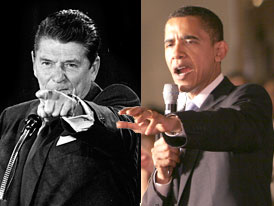
The Christian Science Monitor reports that President Obama is reading Lou Cannon’s latest book, President Reagan: The Role of a Lifetime during his Christmas vacation.
From the CSM:
This just in: President Obama on his Hawaii vacation may be engaging in activities hinting that he’ll take a more bipartisan approach to governance in the new year.
OK, we’re reaching a little bit here, but reading is a big thing for Mr. Obama when he relaxes, and his book list apparently has on it at least one very interesting title: “President Reagan: The Role of a Lifetime,” by Lou Cannon.
This is not just a book about a president beloved by just about every member of the modern GOP – it’s probably the best Reagan book yet written.
The CSM thinks this is a terrific idea.
If Obama actually reads this book, instead of a George Pelecanos mystery or old “OK!” magazines that are lying around his rented mansion, he’ll learn a lot about Reagan’s mastery of the style of the presidency – and how that mastery of style becomes substance.
The CSM thinks Obama needs to learn about bipartisanship from Reagan? WTF?!
If Obama wants to be bipartisan, he should focus less on pleasing Republicans and more on pushing some Democratic policies for a change. But I doubt that’s what the CSM meant.
Obama won’t learn much about “reaching across the aisle” from reading about Reagan, who deliberately used racial politics to divide and conquer, and who loved to tell nutty anecdotes about “welfare queens.” The guy was far from bipartisan, unless you consider conning people into doing your bidding “bipartisan.”
Remember this lovely Reagan anecdote? From Wikipedia, Reagan’s famous story about a woman from Chicago’s South Side who supposedly represented all welfare recipients:
“She has eighty names, thirty addresses, twelve Social Security cards and is collecting veteran’s benefits on four non-existing deceased husbands. And she is collecting Social Security on her cards. She’s got Medicaid, getting food stamps, and she is collecting welfare under each of her names. Her tax-free cash income is over $150,000.”
This is President Barack Obama’s role model. Remember this interview with the Reno Gazette-Journal during the 2008 primaries?
Here are some relevant portions of the interview:
“I don’t want to present myself as some sort of singular figure. I think part of what is different is the times. I do think that, for example, the 1980 election was different. I think Ronald Reagan changed the trajectory of America in a way that Richard Nixon did not and in a way that Bill Clinton did not. He put us on a fundamentally different path because the country was ready for it. They felt like with all the excesses of the 60s and the 70s and government had grown and grown but there wasn’t much sense of accountability in terms of how it was operating. I think he tapped into what people were already feeling. Which is we want clarity, we want optimism, we want a return to that sense of dynamism and entrepreneurship that had been missing.”
“I think Kennedy, 20 years earlier, moved the country in a fundamentally different direction. So I think a lot of it has to do with the times. I think we are in one of those fundamentally different times right now were people think that things, the way they are going, just aren’t working.”
He also said:
“I think it’s fair to say that the Republicans were the party of ideas for a pretty long chunk of time there over the last 10 to 15 years in the sense that they were challenging conventional wisdom,”
At the time, there was quite a bit of shock over this interview in the “progressive” blogosphere, before the progbloggers drank the koolaid and sold their souls. John Edwards and Hillary Clinton were also alarmed by Obama’s comments. Here is what Edwards said at the time: (Sorry about the right wing source)
“Ronald Reagan, the man who busted unions, the man who did everything in his power to destroy the organized labor movement, the man who created a tax structure that favored the richest Americans against middle class and working families, … we know that Ronald Reagan is not an example of change for a presidential candidate running in the Democratic Party,” Edwards said.
Reagan also “was destructive to the environment by removing a lot of the regulation that existed,” Edwards added in a later telephone interview with The Associated Press. “I would never use Ronald Reagan as an example of change.”
And here is what Hillary Clinton had to say about Obama’s claim that Republicans were “the party of ideas over the last 10 to 15 years.”
“That’s not the way I remember the last ten to fifteen years.” She said she didn’t consider it a better idea to privatize Social Security, eliminate the minimum wage, undercut health benefits, shut down the government or drive the country into debt. “I think we know what needs to be done in America.
But Obama went on to win the nomination and the general election. After two years, it’s pretty clear that Obama is playing “the role of a lifetime,” just as his hero Ronald Reagan did–Obama is pretending to be a Democrat.
Look, Lou Cannon is a terrific writer. I actually read Cannon’s first book about Reagan back in the ’80s, and it was quite good. But frankly, I was horrified by the man I read about in the book. Since I already know that Obama idolizes Reagan, I doubt he’ll be horrified by Reagan’s hatred of social programs.
I’d feel a whole lot better if Obama were reading a book about FDR during his luxurious vacation in Hawaii.

 peej
peej Carissa
 bostonboomer
 dakinikat
 ecocatwoman
 mablue2
 Mama Lopez
 peggysue22
 quixote
 skydancingguestblogger
 Mona (aka Wonk the Vote)



 Sky Dancing
Recent Comments