
Sunday Reads
Posted: November 14, 2010 Filed under: Human Rights, morning reads, Surreality | Tags: Barack Obama, Catholic Bishops, CIA, conspiracies, David Kelly, demons, detention, ex-Nazis, exorcism, George W. Bush, Judith Miller, Khalid Sheik Mohammed, Morning reads, naked body scanners, plagiarism, Rahm Emanuel, war crimes, WMD and Iraq War 50 Comments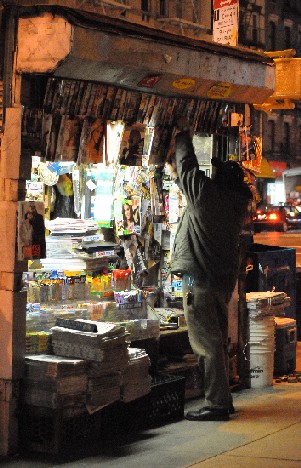
Out of Town News, Harvard Square, Cambridge, MA
Good Morning!!
Since it’s Sunday, I’ll begin with a religious item: Catholic bishops say more exorcists are needed
Citing a shortage of priests who can perform the rite, the nation’s Roman Catholic bishops are holding a conference on how to conduct exorcisms.
The two-day training, which ends today in Baltimore, is to outline the scriptural basis of evil, instruct clergy on evaluating whether a person is truly possessed, and review the prayers and rituals that comprise an exorcism. Among the speakers will be Cardinal Daniel DiNardo, archbishop of Galveston-Houston, Texas, and a priest-assistant to New York Archbishop Timothy Dolan.
Now there’s a serious issue for you. Never mind the disintegrating economy, the President’s Catfood Commission, our multiple wars of aggression in the Middle East, and the likelihood that very far right Republicans will likely control Congress and the White House for the next 30 years (if the country survives that long). No, the really important issue is the need for priests who can drive out demons.
On second thought, maybe some of those nuts DC could benefit from exorcisms…
Despite strong interest in the training, skepticism about the rite persists within the American church. Organizers of the event are keenly aware of the ridicule that can accompany discussion of the subject. Exorcists in U.S. dioceses keep a very low profile. In 1999, the church updated the Rite of Exorcism, cautioning that “all must be done to avoid the perception that exorcism is magic or superstition.”
So how do you know when an exorcism is needed?
Signs of demonic possession accepted by the church include violent reaction to holy water or anything holy, speaking in a language the possessed person doesn’t know and abnormal displays of strength.
The article does say that diseases and psychological disorders must be ruled out before someone is determined to be possessed.
Emptywheel has an interesting take on why George W. Bush plagiarized much of his memoir, Decision Points, from other authors: It’s Safer When You Don’t Let the President Reflect for Himself.
She suggests that Bush may have copied from published sources in order to keep his story straight. He presumably told so many lies over the eight years of his presidency that he might slip up if he tried to write anything from memory. She does note that:
Bush admitted to war crimes in his book, so he did exhibit a general lack of caution in his presentation of some of the touchy legal issues dealt with in the book. But unlike Cheney (who has explicitly said that the statute of limitations will have expired on some of the crimes he’ll describe in his upcoming memoir), Bush may well need to finesse…issues [such as his decision not to pardon Scooter Libby].
Speaking of war crimes, the Obama administration has taken the coward’s way out once again in regard to the trial of Khalid Sheik Mohammed. From the Washington Post: Opposition to U.S. trial likely to keep mastermind of 9/11 attacks in detention
Khalid Sheik Mohammed, the self-proclaimed mastermind of the Sept. 11, 2001, attacks, will probably remain in military detention without trial for the foreseeable future, according to Obama administration officials.
The administration has concluded that it cannot put Mohammed on trial in federal court because of the opposition of lawmakers in Congress and in New York. There is also little internal support for resurrecting a military prosecution at Guantanamo Bay, Cuba. The latter option would alienate liberal supporters.
The administration asserts that it can hold Mohammed and other al-Qaeda operatives under the laws of war, a principle that has been upheld by the courts when Guantanamo Bay detainees have challenged their detention.
So can the Obama administration manage to reach a decision more craven than this one? According to the Washington Post, the months-long internal administration deadlock over trying Khalid Shaikh Mohammed and the other 9/11 co-conspirators has resulted in a decision: apoplexy. No trying them in federal courts in New York; no trying them at Guantanamo Bay in a military commission. Just… nothing. [….]
And that’s the maddening thing. The Obama team talks about a “different political environment” as if it has nothing to do with creating one. Attorney General Holder talks about federal courts’ capability for handling terrorism trials — you see dangerous secrets leaking out of the Ahmed Khalfan Ghailani trial? Or al-Qaeda storming Manhattan, Cobra-style, to free their comrade? — and then undercuts his own arguments with a defense of military commissions and indefinite detention without trial.
Well, then make a case, and make it consistently. Build support and maintain it. Be willing to stake political capital on it. Or concede that you never meant what you said about justice.
You could say something similar about most of Obama’s campaign promises versus his real actions as President.
Rahm Emanuel has announced his candidacy for Mayor of Chicago.
The former North Side congressman and White House chief of staff laid out a broad agenda, declaring he’d work to help generate jobs, improve education and decrease crime at a juncture in the city’s history when all three need to be addressed.
And he plans to do all that–you guessed it–without raising taxes! That’s what all the Republicans say. Oh wait–he’s running as a Democrat. Good luck Chi-town, you’re going to need it.
The UK Guardian reports that McDonald’s, KFC, and PepsiCo will help write the UK’s new policies on “obesity and diet-related diseases.”
The Department of Health is putting the fast food companies McDonald’s and KFC and processed food and drink manufacturers such as PepsiCo, Kellogg’s, Unilever, Mars and Diageo at the heart of writing government policy on obesity, alcohol and diet-related disease, the Guardian has learned.
In an overhaul of public health, said by campaign groups to be the equivalent of handing smoking policy over to the tobacco industry, health secretary Andrew Lansley has set up five “responsibility deal” networks with business, co-chaired by ministers, to come up with policies. Some of these are expected to be used in the public health white paper due in the next month.
The groups are dominated by food and alcohol industry members, who have been invited to suggest measures to tackle public health crises. Working alongside them are public interest health and consumer groups including Which?, Cancer Research UK and the Faculty of Public Health. The alcohol responsibility deal network is chaired by the head of the lobby group the Wine and Spirit Trade Association. The food network to tackle diet and health problems includes processed food manufacturers, fast food companies, and Compass, the catering company famously pilloried by Jamie Oliver for its school menus of turkey twizzlers. The food deal’s sub-group on calories is chaired by PepsiCo, owner of Walkers crisps.
This sounds like something U.S. politicians would do. Is our insanity taking over the world? Or is it demon possession?
Scientists say that naked body scanners are bad for your health.
US scientists warned Friday that the full-body, graphic-image X-ray scanners that are being used to screen passengers and airline crews at airports around the country may be unsafe.
“They say the risk is minimal, but statistically someone is going to get skin cancer from these X-rays,” Dr Michael Love, who runs an X-ray lab at the department of biophysics and biophysical chemistry at Johns Hopkins University school of medicine, told AFP.
“No exposure to X-ray is considered beneficial. We know X-rays are hazardous but we have a situation at the airports where people are so eager to fly that they will risk their lives in this manner,” he said.
The possible health dangers posed by the scanners add to passengers and airline crews’ concerns about the devices, which have been dubbed “naked” scanners because of the graphic image they give of a person’s body, genitalia and all.
They could be bad for your mental health too. Here is one example of what can happen if you are selected for naked body scanning and choose to “opt out.”
Andrew Burmeister had been searched using an airport scanner before and didn’t like it at all. On a return trip from Charlotte, he was selected for another body scan screening and chose to opt out, as the sign said he was entitled to do. Burmeister said the screeners became rude and made him sit down, away from his belongings, which were now sitting unattended on the end of the conveyor belt. Eventually a team allowed him to collect his belongings and, after a turn through the metal detector, he was taken to a private area to be screened.
Mr. Burmeister says these screeners were much friendlier, but despite this, his story is still particularly unsettling. They patted him down and asked him lots of questions. They also swabbed his belongings, removing each one individually and scanning it for explosives. But that’s not the unsettling part. While they were busy going through his belongings, they were chatting to him. One mentioned that he was ‘lucky’ that this was all that was happening because after October 31, the screening for passengers who opt out of a body scan would become a lot more “intimate.”
Here’s another piece about this at The Chicago Tribune.
For the camera-shy, TSA will offer an alternative: “enhanced” pat-downs. This is not the gentle frisking you may have experienced at the airport in the past. It requires agents to probe aggressively in intimate zones — breasts, buttocks, crotches.
If you enjoyed your last mammography or prostate exam, you’ll love the enhanced pat-down. And you’ll get a chance to have an interesting conversation with your children about being touched by strangers.
Reviews of the procedure are coming in, and they are not raves. The Allied Pilots Association calls it a “demeaning experience,” and one pilot complained it amounted to “sexual molestation.” The head of a flight attendants’ union local said that for anyone who has been sexually assaulted, it will “drudge up some bad memories.”
Have I told you lately that I’ve decided I’m never going to fly again? If you do need to fly, and having your genitals stared at by beefy TSA morons is troubling to you, you might want to check into National Opt-Out Day, scheduled for Wednesday, November 24–the day before Thanksgiving and one of the busiest travel days of the year.
“The goal of National Opt-Out Day is to send a message to our lawmakers that we demand change,” reads the call to action at OptOutDay.com, set up by Brian Sodegren. “No naked body scanners, no government-approved groping. We have a right to privacy, and buying a plane ticket should not mean that we’re guilty until proven innocent.”
This isn’t big news for most people, but The New York Times has a front page piece on “U.S. aid for ex-Nazis.”
A secret history of the United States government’s Nazi-hunting operation concludes that American intelligence officials created a “safe haven” in the United States for Nazis and their collaborators after World War II, and it details decades of clashes, often hidden, with other nations over war criminals here and abroad.
The 600-page report, which the Justice Department has tried to keep secret for four years, provides new evidence about more than two dozen of the most notorious Nazi cases of the last three decades. [….]
Perhaps the report’s most damning disclosures come in assessing the Central Intelligence Agency’s involvement with Nazi émigrés. Scholars and previous government reports had acknowledged the C.I.A.’s use of Nazis for postwar intelligence purposes. But this report goes further in documenting the level of American complicity and deception in such operations.
The Justice Department report, describing what it calls “the government’s collaboration with persecutors,” says that O.S.I investigators learned that some of the Nazis “were indeed knowingly granted entry” to the United States, even though government officials were aware of their pasts. “America, which prided itself on being a safe haven for the persecuted, became — in some small measure — a safe haven for persecutors as well,” it said.
And let’s not forget that George W. Bush’s family actively supported the Nazi regime before WWII, and he was elected President of the U.S.
I’ll finish with a bit of conspiracy news (my favorite kind). For years I’ve been following the investigation and cover-up of David Kelly’s death. From Raw Story:
Dr. David Kelly was found dead in a field near his home in Oxfordshire in 2003, shortly after he was revealed to be the source of a BBC leak that accused Tony Blair’s government of exaggerating the threat posed by Saddam Hussein. His death prompted suspicions among many that he may have been killed in retaliation for the leak.
Kelly himself had predicted he would be “found dead in the woods” if the UK invaded Iraq.
Now the Daily Mail is reporting new evidence that Kelly was murdered.
Dr Andrew Watt, an experienced clinical pharmacologist, says he has told Thames Valley Police it is not possible Dr Kelly could have swallowed more than a ‘safe’ dose of two coproxamol tablets because there was so little in his system after death.
He said: ‘I reported to the Thames force that I believe that the death of Dr Kelly may have been murder. I have received an acknowledgement and they have given me an incident number.
‘I have been told that the inquiry is being conducted by a very senior officer.’
A second development also casts doubt on the suicide verdict of the Hutton inquiry – which took the place of a formal inquest.The Mail has established that Dr Kelly left an upbeat answerphone message to his friend Nigel Cox just days before his body was found on July 18, 2003. Dr Kelly said he was looking forward to joining him for a game of cards on July 23.
An interesting sidelight to the Kelly case is that Kelly sent an e-mail to then NYT “reporter” Judith Miller shortly before his death. Emptywheel mentions this in a recent post about the work of the National Security Archive:
…as I was reading it, all I could think of was David Kelly’s last email to Judy Miller, warning of dark actors playing games, followed shortly by Tony Blair’s apparently unplanned trip to the US, just in time for him to be out of the country when Kelly was suicided (not to mention for him to be here in the aftermath of the Plame outing which Dick Cheney had ordered Judy to be included in). After all, its hard to look at the timeline the NSA lays out without also thinking of Judy Miller’s key pieces of propaganda–boosting claims about the aluminum tubes–on September 8 and 13, 2002 (indeed, those articles appeared at the same time as the Brits were strengthening these claims, which makes me wonder whether her work wasn’t a key part of pushing the UK to make its claims about the tubes stronger).
We knew the Brits and the US built their propaganda for war together. We knew that Judy Miller was an integral part to that. But when we see the emails going back and forth commenting on each others drafts, it raises once again the question of where the emails back and forth to the war effort’s chief propagandist got disappeared to.
It’s all connected. What is Obama’s role in the giant cover-up? Is he just in the WH to make sure none of the secrets get out, or does he have a more active role in future “dark actions?”
Taking my tinfoil hat off now.
[MABlue’s Sunday picks]
Cigarette companies are evil.
Cigarette Giants in a Global Fight on Tighter Rules
As sales to developing nations become ever more important to giant tobacco companies, they are stepping up efforts around the world to fight tough restrictions on the marketing of cigarettes.
Companies like Philip Morris International and British American Tobacco are contesting limits on ads in Britain, bigger health warnings in South America and higher cigarette taxes in the Philippines and Mexico. They are also spending billions on lobbying and marketing campaigns in Africa and Asia, and in one case provided undisclosed financing for TV commercials in Australia.
“A” Rating for Hamas? The Better Business Bureau (BBB) has been running a scam grading. What a disgrace!
Terror Group Gets ‘A’ Rating From Better Business Bureau?
The Better Business Bureau, one of the country’s best known consumer watchdog groups, is being accused by business owners of running a “pay for play” scheme in which A plus ratings are awarded to those who pay membership fees, and F ratings used to punish those who don’t.
To prove the point, a group of Los Angeles business owners paid $425 to the Better Business Bureau and were able to obtain an A minus grade for a non-existent company called Hamas, named after the Middle Eastern terror group.
Patrick Smith, who runs the blog Ask The Pilot has a thoughtful column about the panicky and incoherent reaction to something we’ve been living with forever, only with more composure.
News flash: Deadly terrorism existed before 9/11
With respect to airport security, it is remarkable how we have come to place Sept. 11, 2001, as the fulcrum upon which we balance almost all of our decisions. As if deadly terrorism didn’t exist prior to that day, when really we’ve been dealing with the same old threats for decades. What have we learned? What have we done?
Well, have a look at the debased state of airport security today. We continue enacting the wrong policies, wasting our security resources and manpower. We have implemented many important changes since Lockerbie, it’s true (actually, many of the new protocols are post-9/11), but much of our approach remains incoherent. Cargo and packages go uninspected while passengers are groped and harassed over umbrellas and harmless hobby knives. Uniformed pilots are forced to remove their belts and endure embarrassing pat-downs.
Frank Rich has been writing really good columns lately. I’m not going to stop him while he’s on a roll.
Who Will Stand Up to the Superrich?
The top 1 percent of American earners took in 23.5 percent of the nation’s pretax income in 2007 — up from less than 9 percent in 1976. During the boom years of 2002 to 2007, that top 1 percent’s pretax income increased an extraordinary 10 percent every year. But the boom proved an exclusive affair: in that same period, the median income for non-elderly American households went down and the poverty rate rose.
It’s the very top earners, not your garden variety, entrepreneurial multimillionaires, who will be by far the biggest beneficiaries if there’s an extension of the expiring Bush-era tax cuts for income over $200,000 a year (for individuals) and $250,000 (for couples). The resurgent G.O.P. has vowed to fight to the end to award this bonanza, but that may hardly be necessary given the timid opposition of President Obama and the lame-duck Democratic Congress.
Is anyone even surprised by this?
Spanish priest arrested over ‘21,000 child porn images’
A Catholic priest in Spain has been arrested over the alleged possession of thousands of images of child sex abuse.
Who has the better argument?
Parties battle over bare breasts
The Danish People’s Party wants pictures of bare breasts in an introduction film to scare away fundamentalists.
But, Conservatives counter with a good point:
“Bare breasts are not a protection against fundamentalism,” [Conservative Integration Spokesman] Khader says on his Facebook page.
“Quite on the contrary. Fundamentalists as so sex crazy that bare breasts would make them flock to the country. Perhaps one should try naked pigs and pork – that’ll keep them away…”
I’ll score this one for the Conservatives.
What does your hair say about your health? Check it here:
8 Things Your Hair Says About Your Health
When it comes to our hair, most of us worry most about what to do with it: how short to cut it, how to style it, whether to color it once it begins to go gray. But experts say that our hair says a lot more about us than how closely we follow the latest styles. In fact, the health of our hair and scalp can be a major tip-off to a wide variety of health conditions.
Some interesting wonky stuff abou the devastatingly lasting effect of slavery.
The historical roots of inequality
US commentators regularly lament the country’s racial and ethnic inequality. This column presents data from 1870 and 1940-2000 to argue that the divide has its roots in the slave trade and that its legacy persists today through the racial inequality in education.
It’s Sunday. You can enjoy your gossip column. It looks like the life of the Hell’s Kitchen Chef is unraveling.
The cook, the grief, his wife & his (alleged) lover
For Gordon Ramsay, the past few weeks have been like living in his very own Kitchen Nightmare. Only it has extended beyond his kitchen and into every other room of his house. Like an unwatched pot, the TV chef’s personal and professional life has boiled over in spectacular fashion, leaving the mother of all cleaning-up jobs.
Not that anyone is rushing to pull on the Marigolds; quite the contrary. In typical fashion, Ramsay has heaped more coals this weekend on to a fire he lit three weeks ago when he sacked his father-in-law, Chris Hutcheson. Specifically, he claimed his wife Tana has much to learn about what her father gets up to when not running restaurants, lashing out after his wife’s parents wrote to their daughter, urging her to dump the man she married 14 years ago, aged 22.
So what news articles and blog posts do you recommend today?
Survival of the Richest
Posted: November 11, 2010 Filed under: Bailout Blues, Global Financial Crisis, Human Rights, Surreality, The Bonus Class, The Great Recession | Tags: cat food commission 41 Comments In the natural world, the weakest generally don’t survive unless they are part of a highly evolved species. The lessons of basic evolution are fairly simple, you either develop something that gives you a competitive advantage over those who wish to make a meal of you, or you and your offspring have a very brief and brutal existence.
Humankind evolved into something beyond a herd animal by developing tools and social contracts. Through trade, language, and invention, our evolutionary history has shown that competitive advantage does not have to involve size, brute force, speed, or trickery like camouflage. Dogs evolved into a smart and numerous population by being genetically flexible. Indeed, the more advanced beings tend towards flexibility and social interaction. Nurturing, passing on survival skills, specializing, and adapting are all important survival skills for more highly evolved beings. Many natural scientists now study the importance of how these species treat their youngest and the oldest, since the young are portents of the future and the elderly are the libraries of past knowledge and skills. Specialization allows creatures other than those with superior brute force to be contributors. We wouldn’t have The David or knowledge of Gravitational Singularity if we evolved on pure brute force. Evolutionary Biology learns a lot about a species by the way it treats its weakest, its young, and its elderly.
What amazes me most about the Cat Food Commission report is that it is so Republican that you wonder if anyone Democratic had anything to do with its inception or results. But of course, it was chartered by a Democratic President and co-chaired by a Democratic man. For a group of Darwin denying theists, Republicans believe and adhere to survival of the fittest in the most strict terms and this report wreaks of that view. The winners of the moment get all the spoils, even if this is a short-sighted and factually-challenged view of reality. Their ‘masters of the universe’ comic book world is everything that nature does not reward in the extreme long run. It is inflexible and relies on brute force. Their reality gives a species a very short and brutal life in the scheme of things and assigns the animal the limited roles of predator and prey. To the Cat Food Commission, the majority of us are mere prey.
The draft from that dreadful commission came out yesterday and you can read the entire thing here at the NYT. We knew from the moment the Simpson theatrics began that nothing good was going to come out of this effort. Simpson put Social Security on the agenda immediately which was completely outside a deficit commission’s sphere. President Obama did nothing to reel them back. Simpson only got more theatrical and ill-mannered. The commission itself could only get worse.
The draft–which is all they can achieve at the moment–suggests upending the social and political contracts made between the US government and the people in ways that I would never have thought possible. It’s as if every third rail of politics is put to a match. It was announced as a draft with these big bold red letters that say Do Not Cite as if there’s any hope left that we’ll join the rest of the developed and industrialized nations in realizing that we can choose our priorities differently. It is an announcement to the rest of the world that we, the American Empire, choose to be so exceptional that we’ll do so to our extinction. The rest of you just go ahead and cooperate and share, while we ensure the survival of the few over the existence of the many. No one makes Spock’s choice. We all go down with the ship and an Ayn Rand third finger salute.
I read this draft and realize how co-opted we are by conservative ideology just as we are co-opted by religion over reason. This is a nation that would rather believe than realize. The thing reads like a Republican manifesto. It contains spending cuts in nearly everything imaginable while still making that fairy tale suggestion that if we overhaul the tax system and lower marginal tax cuts, the wealth will just trickle on down.
One of the major suggestions is to revisit the huge tax break given to mortgage holders on their first and second homes. While it is worthwhile to review the usefulness of this deduction as blank check, the commission questions its entire existence. I’ve always wondered what the deal is with giving tax breaks for a second home or a boat. I’ve also wondered why we should give a huge tax break to people living in McMansions. However, for ordinary people, this deduction leads to wealth building and security. Perhaps rather than tearing down the entire thing, they should’ve given some consideration to making it something akin to local homestead exemptions? But, this would be too compassionate and probably too collectivist for our masters of the universe. Why can’t they just allow destructibility up to say, the average national price of a home? No, no, because their views of the world say that only corporations get get deductions. People have to make do with making do. Masters of the Universe don’t have to compete because they are special. Special treatment for them is something other than a handout or a hand up.
It seems like the commission set out to make radical suggestions. Maybe it’s to make some of the worst portions of it more palatable if they can’t get the entire thing pushed on to some willing Congressional sponsors? Part of the problem we have now in our struggling economy is those balanced budget amendments passed by states allowing them to spend crazily when tax revenues are coming in–when government spending should be restrained–while telling states to adopt austere budgets when their economies need a government spending boost. What’s with these inflexible spending quotas rather than adopting rules that reflect the state of the economy?
You can see some of this worst of this obsession with strict guidelines by reading some analysis by Ezra Klein at WAPO. I can’t imagine how they’re going to deal with caps like this if we do have a serious national threat like an invading army at our borders. Right now, we’re spending way too much money drone bombing Bedouins in caves. Talk about your spending priorities.
The co-chairs freeze 2012’s discretionary spending at 2010’s levels — and then start cutting it back further. By 2015, they project discretionary spending will be more than $200 billion less than the president’s budget currently envisions. They raise taxes, but rather unexpectedly, cap the revenues the tax system can generate at 21 percent of GDP. They also offer a number of options for tax reform, including one that eliminates all tax expenditures (including the mortgage-interest deduction, the exclusion for employer-based health care, and more) and brings the top rate down to 26 percent. Social Security comes in for both benefit cuts and tax increases — though there are substantially more of the former than the latter. There are a number of Medicare reforms. The co-chairs project that the deficit will fall to 1.6 percent of GDP by 2020 if the recommendations are implemented. The vast majority of those savings come from cuts in spending. Tax increases are a relatively minor contributor.
The commission definitely overstepped its charter in many ways. The biggest overstep was to make suggestions on Social Security, which technically isn’t part of the general budget and is funded and governed off-budget and supposedly away from political hacks. The recommendations for Social Security are shocking. Again, I have to say that Social Security is not an entitlement. It is a benefit program that we pay for through working. To see it perpetually treated as some kind of social welfare scheme appalls me.
Here are a few blurbs from Fox News on the proposals dealing with Social Security. They seem most interested in it because they support tearing the program to shreds. It’s demise has been the holy grail of the right wing of Republican Party since its inception during the New Deal. For some reason, you can buy old age benefits from a insurance brokering shitmonger and it’s just all in a day’s work. If you let the government offer a lower cost alternative, it’s communism in our midst.
The co-chairmen of the panel appointed by President Obama to cut the U.S. deficit recommend raising the retirement age to 68. It is currently 67 years for retirees to receive full benefits. The panel leaders also propose reducing the annual cost-of-living increases in Social Security.
The increase to age 68 would be implemented by 2050 and then would increase again to 69 by 2075. A “hardship exception” would be provided for certain occupations where older retirement would be unrealistic.
This “hardship exception” is a divide and conquer strategy if I’ve ever seen one. It pits those of us that rely on social security for retirement against each other. I see nothing but a series of political fights erupting over this if any one dares bring it to the legislative floor. It is telling the dogs to fight for the scraps on the floor rather than going for the banquet on their master’s table.
There are a few other things in that are within the scope of the commission’s charter. Some of them seem tucked in there as an after thought rather than central to a serious discussion on what should be funded and what should be defunded.
According to a source who spoke to Fox News, the 18-member panel led by former Wyoming Republican Sen. Alan Simpson and former Clinton Chief of Staff Erskine Bowles, also may propose reducing the base rate on corporate taxes, phasing in spending cuts over time, reducing foreign aid by $4.6 billion, freezing federal salaries for three years and banning congressional earmarks. It is unclear how the commissioners would define a congressional earmark.
The proposal would also set a tough target for curbing the growth of Medicare. And it recommends looking at eliminating popular tax breaks, such as mortgage interest deduction. The plan also calls for cuts in farm subsidies and the Pentagon’s budget.

Let me just say this, foreign aid is less than 1 percent of our total budget outlay. It’s a pittance. These kinds of things can only be seen in conservative dog whistle terms. It makes me wonder exactly how far these folks are asking congress to go to appease Republicans because this can only be described as a plan tailor made for Republican talking points.
Again, I worry that something wasn’t done to narrow the scope of this motley crew way before this report came due. It says something about the man in charge. I’ll leave it to you to decide exactly what because my plan at this moment is to go further into the details and ferret out what remains of our country’s future.
And, just where are the Democratic politicians? If you want some suggestions on this, just go read Black Agenda Report. Editor Bruce Dixon has his own theory.
The masters of corporate media proclaim that their raid on social security, is a done deal. “Entitlements,” their code word for Medicare, Medicaid and Social Security, will be cut in the lame duck session of Congress, with Democratic president Barack Obama taking the lead. Though the outlines of this raid have been clear for months, what passes for black America’s political leadership class have been silent. As far as we know, they have not been ordered to shut up. They have silenced themselves, in abject deference to the corporate black Democrat in the White House.
It took a Republican Richard Nixon to open relations with China in the seventies. It took Democrat Bill Clinton to impose draconian cuts in welfare and end college courses for prisoners in the nineties. And today, only a black Democratic president can sufficiently disarm Democrats, only a black Democrat can demobilize the black polity completely enough for the raid on “entitlements” to be successful.
How do We Proceed from Here?
Posted: November 10, 2010 Filed under: Human Rights, Women's Rights | Tags: child abuse, justice, Women's Rights 19 CommentsThis has been bugging me all week, so I decided to post it here for discussion.
Last week this story appeared in the news.
It’s about a 21 year old woman who was due to testify at the trial of her accused molester/rapist. The man was her mother’s boyfriend, and abused the woman when she was young. The man is accused of abusing other young women. His trial is currently taking place in Seattle. This is unfortunately pretty standard fare for our society.
But, the kicker is the man is acting as his own defense. Now, our Constitution guarantees the right of the accused to face their accusers. And it allows the accused to act as their own defense.
But what kind of torture is it for our legal system force a young woman to answer the questions of her rapist about her rape? Is this not revictimizing her, but this time on society’s behalf?
So what’s the answer? The accused has rights. But so does the victim/accuser. I myself tend towards a supervised interview with the victim in one room, the accused in the other and the judge and a lawyer for the victim (or the prosecutor if applicable) acting as intermediaries. But even so, even so, I can not imagine having to be led back through the abuse by the abuser. How sick and sadistic is that?
By the way, the article mentions a victim who did face her abuser in court while he acted as his own defense. I admire her ovaries, they must be the size of softballs.
Indonesia Embraces Progress
Posted: November 7, 2010 Filed under: Human Rights, just because, Women's Rights | Tags: Indonesia, Obama Visit, Women's Rights 18 CommentsI wanted to highlight some good stuff today because it seems like the headlines have been pretty depressing recently. As you know, I love to read about women’s organizations around the world and learn about other cultures. I’ve mentioned that my research has a lot to do with developing nations and why some develop rapidly and others languish. Indonesia is one of the countries I follow closely.
It used to be thought that every economic development problem could be solved by just putting more technology in place in a country or adding more physical capital or infrastructure. That is important at some level, but given the same amount of technology and infrastructure, some nations will develop a healthy economy and society while others will still have serious issues.
The major factor that’s highlighted in development policies today is a country’s institutions; specifically their soundness and openness. The most important are institutions that support the judicial and political system. These institutions must protect private property, not allow the rich and powerful to abuse the poor, and they must be fair and translucent. (Problems we have now here.) Given that, other solid related institutions will spring up. These would include educational institutions. If these are in place, financial and economic institutions that bring a country into the modern world will germinate and deepen. Indonesia is a good place to demonstrate that it’s many things in a country’s culture than can cause it to oppress its women, its minorities, and its poor and a good government can make a difference in many people’s lives. It’s also on our radar today because of the pending Presidential visit.
One of the bright spots in the ASEAN region is Indonesia. It is a beacon for many reasons but high among them is that it’s a model of Democratic Islam. This is from Project Syndicate.
The visit by “Barry Obama,” the Indonesian nickname for the former resident and current United States president, to Jakarta is intended, as much as anything, to celebrate the achievements of the largest Muslim-majority country in the world. In the 12 years since its transition to democracy, Indonesia has regularly held local and national elections, developed a functioning free market, and strengthened its culture of tolerance towards the country’s Christian, Hindu, Buddhist, and Chinese minorities.
Of the ten members of the Association of Southeast Asian Nations, only Indonesia has a “free” rating from Freedom House. The largely Catholic Philippines, Buddhist Thailand, and Confucian Singapore lag behind Indonesia in providing basic democratic rights to their people. American policymakers have therefore looked to Indonesia as a model for the rest of the Muslim world. But what lessons are to be learned from Indonesian democracy?
The most important lesson is that Islamic organizations can provide the backbone of a tolerant civil society. Muhammadiyah and Nahdlatul Ulama (NU), mass Islamic institutions with more than 30 million and 40 million members, respectively, operate more than 10,000 schools and hundreds of hospitals, as well as run youth organizations and support women’s movements. Both have connections to political parties, most of which have consistently spoken out for democracy and against an Islamic state.
Women in Indonesia are the majority workers for the garment industry and work very long hours for very low pay. There is also a problem with human trafficking. The government has been responsive to calls to stop the exploitation of women and children. Here’s one unique program via the BBC. It seems women-only train cars were introduced on government run public transportation to stop women from being sexually harassed and grabbed during their commutes to work. This reminds me of the pink taxis initiatives that I’ve blogged on before. However, the pink taxis are a private effort and not public.
Women-only train carriages have been launched in the Indonesian capital, Jakarta, in an attempt to prevent sexual harassment on public transport.
The state-run train operator is running two new carriages for its female passengers on one busy commuter route.
The service has been introduced after a series of complaints of sexual harassment from women who travel on Jakarta’s trains and buses.
There are ongoing programs to stop the sexual exploitation of women, but the garment worker’s are still experiencing problems with enforcement of labor laws. Developing countries are frequently trapped between the need for cash from new industry and the need to protect their people. Another bright spot about Indonesia is that there is no significant gender gap in early or secondary education. Girls and boys attend school in the same proportions.
As with other parts of the world–including our own–some policy makers in the rural areas still view girls in a poor light. Last month, one lawmaker tried propose a law to subject girls to a “Virginity Test’. Indonesia’s Women’s Affairs Ministry rejected the proposal outright as a violation of human rights. Other members of the legislature were also outraged and dismissed the proposal. It looks like there are attempts to instill Jane Crow Laws every where.
Many Indonesian women and girls, especially those from poor and marginalised communities, struggle to achieve reproductive health in the face of discriminatory laws, policies and practices, a new report by Amnesty International says.
Left Without a Choice describes how government restrictions and discriminatory traditions threaten the lives of many Indonesian woman and girls by putting reproductive health services beyond their reach.
“The Indonesian government has pledged to enhance gender equality, but many Indonesian women still struggle for fair and equal treatment”, said Salil Shetty, Amnesty International’s Secretary General. “A combination of unchallenged social attitudes, unfair laws and stereotyped gender roles often relegate women to second-class status.”
Amnesty International research shows how discriminatory practices and problematic laws are restricting access to contraception for unmarried women and girls, and allowing early marriage for girls younger than 16. The law also requires a woman to get her husband’s consent to access certain contraception methods, or an abortion in the event that her life is at risk. Amnesty International also found that health workers frequently deny the full range of legally available contraceptive services to unmarried or childless married women.
Even though the government has taken steps for better protection for women victim of violence, it is failing to ensure that survivors of rape can access health information and services. Although abortion is legally available to women and girls who become pregnant as a result of rape, this fact is not well known, even amongst health workers, and victims of rape can face significant obstacles to accessing safe abortion services.
Indonesia also demonstrates how Islam can provide support for women’s rights. Among the activist community in Jakarta, the most successful organizations are those that draw support from the women’s wings of Muhammadiyah and NU: Muslimat, Fatayat, and Aisyiyah. The former head of Fatayat, Maria Ulfah Anshor, has made sophisticated arguments grounded in fiqh for women’s access to reproductive rights. And, thanks to a partnership between the state and Islamic scholars stretching back 40 years, Indonesia has one of the most successful family-planning programs in the developing world.
Ironically, the US has done as much to block the efforts of Indonesia’s women’s-rights activists as it has to support them. Former President George W. Bush’s restrictions on funding for health programs that used condoms or other forms of contraception meant that Islamic organizations receiving any funding from the US Agency for International Development were unable to publish material promoting safe-sex and family planning.
This could be, and often was, highly counter-productive. In one particularly absurd case, a group of Muslim feminists who wrote a book promoting women’s rights based on Koranic exegesis had to publish their work in secret, because it included arguments for women’s reproductive rights and a small percentage of the group’s funding came from a foundation that had received money from USAID.
The fact that Islamic organizations have benefited women may also help explain Indonesian women’s political success. The parliament is 18% female (a slightly higher percentage than in the US Congress), and a woman, Megawati Sukarnoputri, was the country’s fourth president. Leading organizations like Umar, Fatayat, and Muslimat provide a corrective to the widespread view that Sharia necessarily impedes women.
Indeed, Indonesian women have shown how Sharia can provide a tool for combating misogynist policies. For example, the head of Islamic affairs in the Ministry of Religion, Nasaruddin Umar, is a self-described Islamic feminist who has published sophisticated critiques of gender bias in Koranic exegesis
Just a short time ago, ABC announced that the Presidential trip may be canceled because of eruptions by Mount Merapi that has been causing ash clouds and dangerous flying conditions near Jakarta. This would be a shame if this happens because bringing attention to developing nations is important and a U.S. Presidential visit can accomplish that. Usually, TV programs and newspapers will provide interest pieces about the country and its needs as well as the NGOs that service its people. There has been a history of military juntas in the country and there are still rebel forces that would like to put a damper on the country’s nascent democracy. Other nations’ need to help stop any potential violent attacks on Indonesia’s democratic government. There is also need for further international support as the country responds to the Mount Merapi Disaster.
Focus on Indonesia is important also because of its successes and its needs. Other countries in ASEAN–like Vietnam–have similar issues and can benefit from increased focus on the area. When the US does positive things for the region, the region responds positively. SOS Hillary Clinton visited Indonesia in 2009. Details about her trip are documented here.
I hope you’ll take the time to read about Indonesia and watch any public interest stories that come up on the country. It’s one of the developing nations that gives development economists a lot of hope. It’s also important to support our the rights of women and children through out the world.
Swimming in Privilege
Posted: July 23, 2010 Filed under: Human Rights Comments Off on Swimming in Privilege Being born into privilege means different things to different people. I have found that there are many dimensions that grant you access to privilege. I was born into privilege in many ways and later, I purposely chose to opt out on some for reasons that I sometimes find hard to share with people. A lot of it has to do with the fact that I don’t like getting privileges that I didn’t earn but that I inherited.
It is sometimes hard for people to understand why I would opt out and join an “out” group. I guess the conversations here and in the media about racism and reverse racism have made me think more about this and I’d like to share my ideas with you. Again, I think privilege is multidimensional and that an “out” group can move further up in the hierarchy of that dimension or that other dimensions can offset or trump (in some instances) being a member of an “out” group in another dimension. I also think the idea of reversing privilege –especially when applied by a member who has spent their life having a life of privilege in many dimensions–is a notion that many people don’t understand.
So, I have these hypotheses and I’m going to bounce them off of you.
The dimensions of privilege in the U.S. are still these characteristics. The most privileged are white, male, christian, straight, upper middle class, young to middle age, and WASP. If you were born into this category, you basically hit the lottery and will very rarely experience barriers and words of discouragement to a life of continual upward mobility. You will access the best jobs, the best education, and probably never find that some one who helps you on your path says one of your dimensions is disturbing. However, if you are a person that has some profile that differs from that, you will experience life differently. You may be resented as a person of privilege, but this is not reverse discrimination. It is an emotion people feel towards you because you have no idea that your path was made easier than many others because of the gene lottery.
You can move in and out of privilege in the various dimensions. For example, as you age, you become a member of an “out” class; especially if you are a woman. I have learned this lesson well as my 40s progressed. You become more invisible. You also can become rich and educated and improve your status in that area, and it will clear many paths for you. If you can mimic the language, the dress, and the values of the upper middle class, you can move from an “out” class to a place of privilege. Again, this is true even if you have other dimensions that put you in the “out” group.
What I see at the moment is that this dimension–the upper middle class–dimension is the most important of them all. It didn’t necessarily impact as many lives as it does today, but it’s always been important. Race, ethnicity, and religion have been trump cards in the past that have completely blocked you. This has changed. In that if you were Jewish, you may have been barred from a country club even if you had all the other dimensions of privilege. Race was a huge problem in the South because racism was institutionalized and pervasive until we started knocking it down during the civil rights era. Ethnicity was a problem at one time for the Irish and Italians who also experience problems because they were Catholic. Sex has always been a trump card but again, laws have improved the situation for women in a similar way that civil rights laws have improved the situation for people of color. Still, there are places where we still get stuck.
The most pervasive “out” classes at the moment are those who are Muslim or are of middle eastern ethnicity. The events of 9/11 pushed these folks to the bottom of the hierarchy of ethnicity and religion. I see this now all the time. People think that specific practices–like genital mutilation or child marriage–are part of the Islam doctrine which is not true at all. They ignore that it happens in Catholic Guatemala and or Hindu parts of India. In fact, it happens right here in the U.S. with certain Mormon sects. And like it our not, we do mutilate the genitals of male babies in this country in the name of Judeo-Christian tradition. Once you become an “out” class, the stereotypes abound and memories of others about you become limited. I think it’s difficult for some people to view themselves as having privileges and to realize, in some cases, that they are privileged because there’s always some one ahead of you in something.
It’s also easier to hide some dimensions of being an “out” class. For example, for many gay people, the closet is a viable option. Some hide in traditional marriages. Education and moving to the upper middle class can hide some ethnic roots. Adopting the speech of the upper middle class, their habits and customs really helps one pass. And I believe that upper middle class black people, while still experiencing racism, will have much more privilege than some poor white people because, again, there are multiple dimensions upon which to experience the lack of privilege and the barriers that come along with it.
I do celebrate that many of these barriers–because of the civil rights and the women’s movement– have been removed by law. This doesn’t mean that we have gone over the edge, however. This is because privilege in all of these dimensions is so institutionalized and pervasive, it’s hard to press the mute button on all of it. This is where I have problems with positions like the one taken by Jim Webb today in the WSJ. There is no “myth” of white privilege. It exists. Just as there is male privilege in this country, straight privilege in this country, Christian privilege in this country, youth privilege in this country, and Western European ethnicity privilege in this country. It’s a lottery of genetics that gives us the original combination of privileges and “out” characteristics we get. Again, some we grow out of, some we grow into and , like me, we can opt out of some. Some cannot be changed.
Webb misses the point when he speaks to these statistics that I quote below. This is because he is focused solely on a single characteristic that grants being “out” or “in” privilege. Again, I suggest that the most pervasive out group today is that of the lower and working class. You see this occurring across many dimensions. Social class appears to be the ultimate trump card from experiencing some of the nastiest of the “isms”. It can dilute aspects of racism or ethnicity for example. Money can buy you a lot of privilege that not many other things cannot The exception maybe fame.
Generations of such deficiencies do not disappear overnight, and they affect the momentum of a culture. In 1974, a National Opinion Research Center (NORC) study of white ethnic groups showed that white Baptists nationwide averaged only 10.7 years of education, a level almost identical to blacks’ average of 10.6 years, and well below that of most other white groups. A recent NORC Social Survey of white adults born after World War II showed that in the years 1980-2000, only 18.4% of white Baptists and 21.8% of Irish Protestants—the principal ethnic group that settled the South—had obtained college degrees, compared to a national average of 30.1%, a Jewish average of 73.3%, and an average among those of Chinese and Indian descent of 61.9%.
Policy makers ignored such disparities within America’s white cultures when, in advancing minority diversity programs, they treated whites as a fungible monolith. Also lost on these policy makers were the differences in economic and educational attainment among nonwhite cultures. Thus nonwhite groups received special consideration in a wide variety of areas including business startups, academic admissions, job promotions and lucrative government contracts.
From this bit of statistics, Webb suggests that “government-directed diversity programs should end”. Well, I suppose if you solely look at the color of folks’ skin, this is what those statistics might tell you. But it ignores the nuances and it ignores the many dimensions that I bring up. Not one racial group is a “fungible monolith”.
We should stop all forms of discrimination. We should recognize that government law and programs successfully accomplish this. These statistics do not say that our job is done. It says that we do not recognize the many dimensions of privilege and the barriers to attainment. We should also recognize that because one person has an insult thrown at them, this does not mean they are suddenly the victim of one of the pervasive ‘isms’. This is especially true if they win the lottery of genes and haven’t experienced the kinds of institutional barriers that can block you day in and day out, year after year, decade after decade. You can’t scream that you are the victim of discrimination–like Mark Williams–after one incident where people judge you on one or some of the dimensions. This also applies to the people screaming that there’s a war on Christmas or Christians when the monopoly on holiday celebrations, monuments, and vacation calenders are set up based on your particular brand of mythology. You can’t attend a school or have a job where the majority of holidays, parties, and decorations aren’t hammered on you by that group year after year. Just asking people to recognize that they aren’t the only act in town isn’t discrimination. It’s asking you to reconsider your monopoly on religious privilege. It’s not persecution for your beliefs.
If you’re a Christian in Saudi Arabia, you can claim discrimination. You’re an out class member in that society. Discrimination isn’t about losing your privilege. It’s about not granting others access to privilege and rights. The same goes with the monopoly on marriage by heterosexuals and the privileges that come with that. Losing your unique privilege isn’t about discrimination. It’s about including others in the benefits of the institution. It’s about wresting a way a monopoly that gives you benefits that others do not get and cannot access.
That is what it’s about to me. Making sure whatever institutions we have in the United States do not provide discriminatory benefits based on being an “in” or “out” class of people. This also includes the right to build a place of worship wherever you choose. This means, that it’s okay for any religious institution to put a dharma center, church, synagogue, temple, or mosque on private land within blocks of ground zero. It’s not about offending the privileged group. It’s about protecting the rights of the ‘out’ group.
I’m not sure if this is what’s missing in some of these discussions that’s been happening recently. But, I’m pretty certain that I can trace a lot of problems back to the fact that privilege is multidimensional and a lot of folks only focus on one dimension at best. It’s difficult to rate which dimension causes the most pain in 2010. This is especially true given your personal family experience and memories. For many southern blacks, race has been the ultimate dimension that blocked progress historically. For many women, it’s been their sex. Up until recently, it was very difficult for women to get degrees or follow professions in anything but the so-called pink collar jobs. Right now, it appears that socio-economic status can trump both sexism and racism through law, but it can not erase history or the experience of the individual. We still have to fight for equality for GLBT and for those who follow religions outside the Christian tradition. It’s gotten better for Jews, but it is not good for those outside the Judeo-Christian tradition. Also, just try telling people you’re an atheist and watch their face.
It’s about time we take the Melting Pot meme seriously. Reversing discrimination isn’t about granting special privileges or benefits to some people. It’s about given them access to the monopoly on privilege that others have had for centuries and it doesn’t have to be a zero sum game.

 peej
peej Carissa
 bostonboomer
 dakinikat
 ecocatwoman
 mablue2
 Mama Lopez
 peggysue22
 quixote
 skydancingguestblogger
 Mona (aka Wonk the Vote)



 Sky Dancing
Recent Comments