
Paradise Squandered
Posted: August 20, 2009 Filed under: Global Financial Crisis, Health care reform, Hillary Clinton: Her Campaign for All of Us, president teleprompter jesus, Surreality | Tags: Democratic majority, Gallup poll, Obama approval, The Cook Report Comments Off on Paradise Squandered I guess the old adage is true. A year is a long time in politics. Less than 18 months ago I held out hope that we would see a solid democratic majority for some time and that there would be a democratic President with a democratic agenda moving the country forward and away from the Bush Cheney nightmare. I expected that we would have no more warrantless wiretapping. I believed we would be discussing an energy policy that included more options that drill, baby drill. I thought a women’s uterus would no longer be considered an object of state interest. I figured that we’d see the end to talk about protecting traditional marriage, whatever the heck that ever was to start out with but basically we’d no longer exclude gay couples from a civil institution and gay soldiers from openly serving in our military.
I thought our future seemed bright.
I thought perhaps we could have a defense department budget that resembled the levels of other democratic countries and that we would have a health care plan that resembled the rest of the developed world. I especially felt hopeful, when I watched the first democratic debate, that one of those folks would be in charge of America again. It was only a matter of which one. Little did I know then, the one I discounted as not really knowing a thing by the time the second debate was over is the one we got. My basic thought about Obama was Vice President material.
Now, our national nightmare continues and The Cook Political Report has just dropped the other shoe. The Cook Political Report has a very good reputation for handicapping elections.
Gallup’s three-night moving average tracking poll, President Obama’s job approval rating in both their August 16-18 and August 17-19 averages was just 51 percent, the lowest level of his presidency. The latter sampling showed his disapproval up to 42 percent, matching his all-time low hit in the August 15-17 tracking poll. The 51% job approval rating is identical to two other polls released in recent days conducted by NBC News and the Pew Research Center. Today’s regression-based trend estimate computed by our friends at Pollster.com from all major national surveys show an approval rating of 50.7 percent and disapproval of 43.7 percent.
These data confirm anecdotal evidence, and our own view, that the situation this summer has slipped completely out of control for President Obama and Congressional Democrats. Today, The Cook Political Report’s Congressional election model, based on individual races, is pointing toward a net Democratic loss of between six and 12 seats, but our sense, factoring in macro-political dynamics is that this is far too low.
Many veteran Congressional election watchers, including Democratic ones, report an eerie sense of déjà vu, with a consensus forming that the chances of Democratic losses going higher than 20 seats is just as good as the chances of Democratic losses going lower than 20 seats. A new Gallup poll that shows Congress’ job disapproval at 70 percent among independents should provide little solace to Democrats. In the same poll, Congressional approval among independents is at 22 percent, with 31 percent approving overall, and 62 percent disapproving.
Shoot the message and the messenger
Posted: August 14, 2009 Filed under: Health care reform, Hillary Clinton: Her Campaign for All of Us, president teleprompter jesus, Surreality, The Media SUCKS, Voter Ignorance | Tags: Big phRMA, healt care town hall meetings 1 Comment For some one who was supposed to be the nation’s hip professor with that smooth oration style holding us all rapt and breathless, President Barack Obama sure has turned into to the teacher who has lost control of the classroom. I can’t recall any president–other than LBJ on Vietnam–that has rolled out a major policy and lost the conversation so quickly. It’s not that great of a leap to see remnants of “Hey, Hey LBJ, how many babies did you kill today?” in the faces of seniors who have some how been convinced that discussing living wills puts them in danger of being set out on the ice floes by their government. How did this administration lose control of this conversation so rapidly?
I would speculate that the major players in the debate did not want a repeat of the “HillaryCare” episode so they may have concentrated a bit too much on not repeating a similar process. There were no blue ribbon panels meeting all over the country and no attempts to set up a health care czar. Instead there was this via Bloomberg: “Six Lobbyists Per Lawmaker Work on Health Overhaul” and this from Jane at FDL : Memo Confirms Deal Between phRMA and White House. With this White House–as with Richard Nixon’s–it’s always about following the money. Before the bill even hit the Congress and the people, it was morphed into something that is said to be setting up windfall profits for the people who profit grandly already from the ill among us. Given that, now we’re supposed to buy it as a foot in the door to the real thing. Excuse me for my lack of trust. I’m just not buying that passing this thing will lead to anything but corporate windfall profits and a win in the Obama column.
That’s six lobbyists for each of the 535 members of the House and Senate, according to Senate records, and three times the number of people registered to lobby on defense. More than 1,500 organizations have health-care lobbyists, and about three more are signing up each day. Every one of the 10 biggest lobbying firms by revenue is involved in an effort that could affect 17 percent of the U.S. economy.
These groups spent $263.4 million on lobbying during the first six months of 2009, according to the Center for Responsive Politics, a Washington-based research group, more than any other industry. They spent $241.4 million during the same period of 2008. Drugmakers alone spent $134.5 million, 64 percent more than the next biggest spenders, oil and gas companies.
“Whenever you have a big piece of legislation like this, it’s like ringing the dinner bell for K Street,” said Bill Allison, a senior fellow at the Sunlight Foundation, a Washington-based watchdog group …
We now have a botched roll out, a messy misunderstood plan, and rooms filled with shrieking constituents of all shapes, sizes, and flavors. Is any one buying this as a national conversation?
At WHAT point does HE own it?
Posted: June 12, 2009 Filed under: Bailout Blues, Diplomacy Nightmares, Global Financial Crisis, Hillary Clinton: Her Campaign for All of Us, president teleprompter jesus, Surreality, Team Obama, Voter Ignorance | Tags: broken campaign promises 3 CommentsThe Political Memo in today’s NYT minces few words in Blaming the Guy Who Came Before Doesn’t Work Long and I’d like to just tag right along with that. Its thesis is clear. The Obama administration wastes no opportunity to turn the phrase “we inherited a lot of problems”.
As President Obama struggles to turn around the moribund economy and confront multiple international issues, he wastes few opportunities to remind the country that the problems are not of his making.
“The financial crisis this administration inherited is still creating painful challenges for businesses and families alike,” Mr. Obama said this week as he proposed spending limits.
“We inherited a financial crisis unlike any that we’ve seen in our time,” he said last week as he thrust General Motors into bankruptcy.
His advisers and allies follow the same script. “The Obama administration inherited a situation at Guantánamo that was intolerable,” James L. Jones, the national security adviser, said of the military prison in Cuba. Secretary of State Hillary Rodham Clinton defended the Obama foreign policy in the same vein. “We inherited a lot of problems,” she said.
Mr. Obama is hardly the first president to point to his predecessor. Ronald Reagan blamed Jimmy Carter for the poor economy he inherited, just as Bill Clinton blamed the first President Bush and the younger Mr. Bush then blamed Mr. Clinton. Former Bush aides like Karl Rove argue that Mr. Obama has done it more extensively and routinely than other presidents have, although the Obama team denies that.
But at a certain point, a new president assumes ownership of the problems and finds himself answering for his own actions. For Mr. Obama, even some advisers say that moment may be coming soon.
I’d really like to extend the question of when does he own it a bit further to what good does saying you inherited all these problems do when your solution is basically a continuation of those same failed policies?
In the two major areas of concern during the election and primary–the Iraq War and the Financial Crisis–we not only seen continuation of the same dysfunctional policies, but we’ve seeing appointment of the same dysfunctional policy makers in both cases. Timothy Geithner (with Obama’s consent and support) has basically been following the same policies of his predecessor Secretary of Wall Street Bailouts Hank Paulson. I know this because oc-08I’ve been following the economic policies quite closely because of obvious reasons. I have had to rely on others for examples in other policy areas. To say there is a plethora is understatement. I am getting tired of flushing spam from seriously delusional Obama voters into byte heaven that mostly reads: “Hillary would have done the same thing” and “he’s just doing what he has to at the moment, just wait it will change, you’ll see.”
Cannonfire has run a series of threads demonstrating how closely aligned President Obama’s policies have been to his predecessor. I’ve spent a few days following the links from The Worm turns and turns. One link is to Paul Craig Roberts at Global Research and the title absolutely says everything. It’s called Watching Obama Morph Into Dick Cheney. This one especially appeals to me because of a post I took a lot of grief for back in the day that used a side-by-side Broke Back Mountain view of the boyz will be boyz.
Should Markets Respect Societal Bounds?
Posted: June 11, 2009 Filed under: Economic Develpment, Hillary Clinton: Her Campaign for All of Us, Human Rights, U.S. Economy | Tags: Dr. Michael Sandel, Economic Development, economics of public good, Elimination of poverty, Grameen Bank, Karela India, microfinance, Microlending, Muhammad Yunus, Reich Lectures 2 CommentsAs you know, I frequently rely on the British press for news and political analysis. I was delighted to find a link on Dr. Mark Thoma’s Economist’s View to the BBC’s broadcasts of the Riech Lectures for 2009. Dr. Michael Sandel, Harvard Professor of Government, delivers four lectures on the prospects of a new politics of the common good in this series. Dr Sandel argues that we need “a politics oriented less to the pursuit of individual self-interest and more to the pursuit of the common good”. I was most intrigued by the series on financial community norms (as pointed to by Dr. Thoma) and the idea that even in markets, “norms matter”.
The series is presented and chaired by Sue Lawley.
Sandel considers the expansion of markets and how we determine their moral limits. Should immigrants, for example, pay for citizenship? Should we pay schoolchildren for good test results, or even to read a book? He calls for a more robust public debate about such questions, as part of a ‘new citizenship’.
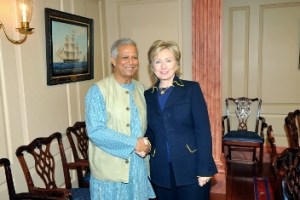
US Secretary of State Hillary Clinton receives Nobel laureate Prof Muhammad Yunus at her US State Department office in Washington DC Wednesday.
I have worked with and studied under one of the foremost authorities on Islamic Banking which are finiancial institutions developed with the idea of a “common good” so I know that in some areas of the world, this is possible. Again, in Dr. Hussan’s Bangledesh and other countries respecting Islamic law, banks do not charge interest because the Q’uran forbids usury. This is also true of the banking system used by Orthodox Jews. This is viewed as a financial system that works for the common good in lieu of exploitation of one side of the market. The banks are frequently mutually owned. Again, one of the best development vehicles in poorer countries is the microfinance banking community that developed with the inspiration from Bangledeshi Economist, Muhammad Yunus, who won the Noble Peace prize for his role in developing the idea of microcredit and the Grameen Bank. (This means of course, I have to make a shameless plug for Kiva my favorite place to invest in humanity’s future where I place money as dakinikat@aol.com). I know from this work that it is possible to create market driven systems where something other than over-the-top profits can motivate a market.
So, I’m going to return to Dr. Sandel’s exposition on what it means to have markets which value a poltics of common good. I’ve bolded the areas that I highlighted while reading the speech. (Yes, I know, old university habits die hard.)
A new politics of the common good isn’t only about finding more scrupulous politicians. It also requires a more demanding idea of what it means to be a citizen, and it requires a more robust public discourse – one that engages more directly with moral and even spiritual questions. And so in the course of these lectures, I’ll explore the prospect of a new citizenship and I’ll be asking what a more morally engaged public life might be like.
If we’re to reinvigorate public discourse, if we’re to focus on big questions that matter, questions of moral significance, one of the first subjects we need to address is the role of markets, and in particular the moral limits of markets. Which brings me to the topic of this first lecture. We’re living with the economic fallout of the financial crisis and we’re struggling to make sense of it. One way of understanding what’s happened is to see that we’re at the end of an era, an era of market triumphalism. The last three decades were a heady, reckless time of market mania and deregulation. We had the free market fundamentalism of the Reagan-Thatcher years and then we had the market friendly Neo-Liberalism of the Clinton and Blair years, which moderated but also consolidated the faith that markets are the primary mechanism for achieving the public good. Today that faith is in doubt. Market triumphalism has given way to a new market scepticism. Almost everybody agrees that we need to improve regulation, but this moment is about more than devising new regulations. It’s also a time, or so it seems to me, to rethink the role of markets in achieving the public good. There’s now a widespread sense that markets have become detached from fundamental values, that we need to reconnect markets and values. But how? Well it depends on what you think has gone wrong. Some say the problem is greed, which led to irresponsible risk taking. If this is right, the challenge is to rein in greed, to shore up values of responsibility and trust, integrity and fair dealing; to appeal, in short, to personal virtues as a remedy to market values run amuck.
One Person One Vote Died a Year Ago today
Posted: May 31, 2009 Filed under: Hillary Clinton: Her Campaign for All of Us, PUMA, The DNC, Uncategorized, Voter Ignorance 3 Comments In an important landmark case Reynolds v. Sims, 377 U.S. 533 (1964), the Supreme Court established one of the most significant voting rights rulings impacting our Republic since the enfranchisement of woman and the election of U.S. senators by popular vote. Both of these occurred earlier in the century. Basically, Reynolds v Sims established the means to ensure that the United States was a truly representative form of government. It provided a legal way to enforce the idea that legislatures are those instruments of government elected directly by and directly as representatives of the people. Because of this, all elected officials should be elected in a free and unimpaired fashion. One Person one vote is a bedrock of our political system.
That was until one year ago today, when the Democratic Rules and Bylaws Committee declared the voters of Michigan and Florida to be one half of a person. This decision, done in a closed room behind close doors, was done in the name of party unity and led to the famous “party unity my ass” uttered at The Confluence that led to the PUMA movement. It led to spontaneous outrage across the country.
What began as a Democratic Party initiative to change the caucus and primary schedule to appease some special interest groups, wound up as a means to disenfranchise two states as Florida and Michigan were selectively punished for their decisions to change the dates of their primary caucuses. While other states similarly changed their dates, these two states were singled out for retribution. This was a stinging indictment of our entire political system for those of us that supported Hillary Clinton and were still stinging from the earlier disenfranchisement of Florida under the Bush v. Gore ruling that essentially gave us a President who mostly likely did not win the election. Every one knows how well that worked out.
 Here are some reports from the day. This one is from MSNBC’s Chuck Todd called Nothing is fair about Florida and Michigan. Here was his suggestion for the situation at the time.
Why not consider punishing the party leaders and not the voters? Couldn’t the committee take away the states’ superdelegate votes? After all, it wasn’t the voters who demanded the states break party rules, but rather the leaders of the respective state parties.
Of course, this is too logical. The likely ruling on Saturday will probably highlight the party’s inability or reluctance to punish the superdelegates. There is a challenge from a Florida superdelegate claiming the party violated its own charter by stripping the state of both pledged delegates and superdelegates. Most members of the Rules Committee I’ve talked to indicate that he may be right. Keep in mind members of the Rules committee are all superdelegates themselves.
The Golden Rule could apply: Do unto other superdelegates as you would want done unto you.
The second idea the committee should be considering but isn’t reflects everything we’ve learned throughout this long primary season.
As many have noted, census data for each state have been remarkably determinative of results since Super Tuesday. In fact, the support groups for the two candidates have been incredibly stable. Why not apply what we’ve learned about the support groups of both candidates and split the delegates accordingly?
Of course, we found out soon enough that the party leaders did have their agenda and it was to ensure that we had their Candidate. We’re still unraveling the reasons for this travesty. We endured sexism, misogyny, and race-baiting through out the entire election cycle. We will be paying for this most undemocratic of decisions for years to come. We could have had a President that supports Abortion Rights and Universal Health Care. We could have had a President that refused to vote for FISA. We could have had a President that wasn’t controlled by lobbyists, Wall Street Fat Cats, and was a policy wonk extraordinaire. Instead, as Ted Ralls of Common Dreams, puts it, we got this:
We expected broken promises. But the gap between the soaring expectations that accompanied Barack Obama’s inauguration and his wretched performance is the broadest such chasm in recent historical memory …From healthcare to torture to the economy to war, Obama has reneged on pledges real and implied …Obama is useless. Worse than that, he’s dangerous. Which is why, if he has any patriotism left after the thousands of meetings he has sat through with corporate contributors, blood-sucking lobbyists and corrupt politicians, he ought to step down now–before he drags us further into the abyss.
I don’t know about you, but I WILL NEVER FORGET THIS DAY OF INFAMY.

 peej
peej Carissa
 bostonboomer
 dakinikat
 ecocatwoman
 mablue2
 Mama Lopez
 peggysue22
 quixote
 skydancingguestblogger
 Mona (aka Wonk the Vote)



 Sky Dancing
Recent Comments