
Bitter Knitters Unite!
Posted: March 27, 2012 Filed under: 2012 presidential campaign, 2012 primaries, abortion rights, Civil Liberties, fetus fetishists, Health care reform, Human Rights, legislation, Planned Parenthood, PLUB Pro-Life-Until-Birth, religious extremists, Reproductive Health, Reproductive Rights, Republican politics, War on Women, Women's Healthcare, Women's Rights 37 Comments
Okay, for all you knitters out there—this one’s for you. And it’s a Doozie.
A new group has formed in response to the unapologetic Republican Crusade Against Women: The Snatchel Project with the goal of sending all howling male members of congress their very own hand-knitted uterus or vagina because:
If they have their own, they can leave ours alone!
I love the humor of these women!
And look at the variety!

Still, there are many deniers of the ongoing Holy Crusade. Yesterday, I mentioned a piece in The Hill by one conservative writer Sabrina Schaeffer, who scoffed at the very notion of a War on Women beyond a false narrative hatched in devious Democratic minds. Another woman writer joined the chorus in the Wall Street Journal, a Mary Eberstadt, who mused whether the Sexual Revolution Had Been Good for Women, answering with a firm ‘No.’ What a surprise. Ms. Eberstadt presumably explodes four myths in her own mind ala the Phyllis Schlafly tradition—women are restless, unhappy and dissatisfied ever since the Pill changed the world and sex was severed from procreation.
I’m sure this point of view makes Rick Santorum swoon with absolute pleasure. Or whatever the Rick Santorums of the world do when they experience joy. To think you could convince women, any woman to voluntarily march herself back to the Middle Ages is quite incredible. A monumental feat. No wonder Mr. Sanctimonious refuses to give up!
But I do sense a certain retreat by the zealots, who seem to squirm mightily under the harsh glare of public scrutiny. Here is the letter recently published in the Daily News Sun by Arizona Rep Debbie Lesko defending her bill [HB 2526], where an employer of conscience can insist a woman prove that she is using contraception for ‘nonsexual’ purposes because otherwise said employer would be religiously offended:
My legislation to protect our First Amendment rights does one thing and one thing alone: It allows an employer to opt out of the current government mandate that forces them to include the morning after pill and contraceptives in their employee’s insurance benefits, if and only if, the employer has a religious objection. The current mandate, which has been highlighted by the Obama administration’s actions, forces employers to include the morning after pill and contraceptives in their insurance benefits even if it violates the employer’s religious beliefs.
Employers should not be forced by the government to do something against their religious beliefs. That violates their First Amendment rights.
My legislation does not authorize employers to ask or know about their employee’s contraceptive use, and it does not authorize employers to fire anyone for that use.
The Catholic Church and other faith-based organizations support my legislation. Under it, employers like St. Vincent De Paul, a Catholic-based charity, would be able to opt out of the mandate. Since the legislation was written with the help of a national legal organization that fights for religious freedoms, I believe it will withstand legal tests.
Ironically, most of the controversy surrounding my legislation revolves around language already in Arizona law for 10 years — language that I did not even introduce. Current law allows a woman who works for a church that has opted out of the mandate to have the medicine paid for if the woman uses it for a purpose other than birth control. The insurance company, not the employer, knows that information. The key is that I didn’t introduce that language in my bill. It is already in law and it will still be in law whether my legislation passes or not.
I am not Catholic, and I do not have a moral objection to the use of contraceptives, but I do respect the right of those religious employers that do.
Since I am a woman, I would never create legislation that takes away women’s rights. Women who work for religious employers will still be able to obtain medication somewhere else. Since Walmart sells it for $9/month, the cost may even be cheaper than the insurance co-pay itself.
If the government wasn’t forcing religious employers to do something against their religious beliefs, I wouldn’t be talking about this issue. But protecting our First Amendment right to freedom of religion is one of the most important things we can do. If we lose that, America’s future is truly lost.
It is unfortunate that some in the media are repeating distortions and untruths brought about by the opposition. I wish they would have called me or the lawyers that wrote it so they could report the truth. I guess that wouldn’t make a juicy story. Thank you to the media that are publishing my side of the story.
House Majority Whip Debbie Lesko is the State Representative for LD 9.
Ooooo. A wee bit defensive aren’t we, Ms. Lesko? All about First Amendment Rights? Really? What about the rights of the employee? Why should any employer have the right to demand a doctor’s note, giving a woman permission to take any medication, contraceptive or otherwise? And just because you Ms. Lesko are against abortion [note the mention of the morning after pill] does not give you the right to impose your religious beliefs on your constituents, nor does an employer have the right to know anything about my medical history, which would be necessary in this twisted piece of legislation.
This is not a theocracy. At least not yet.
And why mention the Catholics since you’re not a Catholic yourself? Unless you know what we know: The Catholic Bishops and Religious Right have made an odd couple’s Holy Alliance to rid the world of witches [otherwise known as Fallen Women, wanton sluts and/or the Daughters of Eve].
Note one other thing. As with so many others in this Cult of Procreation, Ms. Lesko points a crooked finger, blames distortions on the press, untruths hatched by the opposition. Rather than taking a long, hard gaze in the mirror.
Mirror, mirror on the wall. Who’s the worst liar of them all?
I have a suggestion for the knitter’s group. I wouldn’t limit these handcrafted items to men only. It’s clear that a number of women need a back up set of anatomically-correct body parts with the scripted note suggested by Government Free VJJs:
Get You Pre-Historic Laws Out of My Uterus!
Better yet, here’s one of your own.
Check out the site. It will make you smile. And Lordy, we need all the smiles we can get right now. Btw, the site provides patterns for your work of art, be it knitted, crocheted or made of fabric. And though the site invites you to hand deliver the items to your representatives, they are quite happy to have a volunteer do the honors. Think of these items arriving in the office of your favorite Congressperson, the item unwrapped and then the expression of . . . well, I‘ll leave it to your imagination.
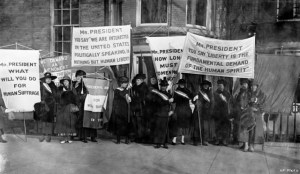
Let the knitting begin! And remember, these women weren’t polite either:
Day One of HCRA Arguments
Posted: March 26, 2012 Filed under: Health care reform, SCOTUS 10 Comments I thought I’d post some links on today’s arguments before SCOTUS in case you haven’t been able to keep up with the news. The big day for the arguments for and against the mandate come tomorrow. Protestors were all over the area in front of the nation’s courthouse and people were lined up for days to get inside. The go-to blog for this appears to be SCOTUSblog who posted this update of the day’s events.
The comments and questions of the Justices during the 89-minute exchange left the distinct impression that they are prepared to rule on the constitutionality of the mandate that individuals must buy health insurance, and not push the issue off into the future. The exact route they would take was a bit uncertain, but their skepticism about taking a pass now was clear.
That did not mean, of course, that the Court would ultimately uphold the mandate. That is tomorrow’s question, although the Justices asked many questions about the mandate, showing they are deeply curious about its scope and meaning. But an argument that at times seemed almost to bog down in the dense complexity of the tax code pointed toward a refusal to bar the lawsuits that had challenged the mandate and had put its survival before the Court this week. One of the telltale signs of that sentiment was that not one Justice, and no lawyer at the lectern, said that it would be premature and a contradiction of the Court’s tradition against deciding constitutional issues prematurely for the Court to rule promptly on the mandate’s validity.
The Court had selected a Washington attorney from outside the case, Robert A. Long, Jr., to make an argument that the Supreme Court and no lower court had any authority to rule on the challenges to the mandate, on the theory that the requirement is a part of the tax code and the Anti-Injunction Act of 1867 had closed the courthouse doors to any lawsuit against a tax law before it took effect. But the most difficult questions from the bench Monday were aimed at Long’s argument. And most of the Court seemed to be leaning toward some version or variation of the argument made by Solicitor General Donald B. Verrilli, Jr., speaking for a government that very much wants a final decision soon on the mandate.
Here are some other links to the story.
Politico: First glimpses of Supreme Court’s Thinking
Justices on both ends of the ideological spectrum appeared skeptical that an arcane law, known as the Anti-Injunction Act, should delay a Supreme Court ruling for more than two years. The law prevents people from challenging most taxes until they’ve been paid — and the penalty for people who avoid the individual mandate will be enforced through the tax code.
NYT: Health Act Arguments Open With Obstacle From 1867
The answer to that question is not obvious. The United States Court of Appeals for the Fourth Circuit, in Richmond, Va., ruled last year that it was powerless to decide the law’s constitutionality for now, and a prominent judge on the United States Court of Appeals for the District of Columbia Circuit agreed.
Their opinions relied on an 1867 federal law called the Anti-Injunction Act, which says that “no suit for the purpose of restraining the assessment or collection of any tax shall be maintained in any court by any person.” In other words, people who object to taxes must pay first and litigate later.
But the first penalties do not kick in until 2014, and they must be paid on federal tax returns by April 2015. That means, the appeals court judges said, that federal courts are forbidden for now to hear challenges to the health care law.
The Atlantic On Line: How Obamacare will Be Settled
In the first century of our nation’s history, Congress hewed to a very literal, limited understanding of the relevant text of Article I: “To regulate Commerce with foreign Nations, and among the several States, and with the Indian tribes.” Put simply, Commerce Clause legislation could regulate only business-related activities in interstate commerce.
The inception of contemporary Commerce Clause doctrine dates to the Interstate Commerce Act of 1887, regulating railroad monopolies, and the Sherman Antitrust Act of 1890, designed to curb monopolies and trusts. The Court upheld the Sherman Antitrust Act in 1905 — in Swift and Company v. United States, 196 U.S. 375. However, the justices based that decision on the finding that the effect of price-fixing by Chicago meat-packers on interstate commerce was not “accidental, secondary, remote or merely probable” but immediate. The opinion reinforced the traditional literal view of Congress’s Commerce power.
The Supreme Court case that established the constitutionality of the expanded interpretation of Congress’s commerce power was National Labor Relations Board (NLRB) v. Jones & Laughlin Steel Corporation, 301 U.S. 1, in 1937. The case originated in Aliquippa, Pennsylvania, where Jones & Laughlin was penalizing and discriminating against workers attempting to unionize. NLRB ordered Jones & Laughlin to end its coercive union-busting tactics; the firm refused to obey. After the circuit court refused to enforce the NLRB’s order against Jones & Laughlin, the NLRB appealed to the Supreme Court.
Jones & Laughlin argued that Congress could not regulate its labor practices because manufacturing is an intrastate activity, not interstate commerce. The firm based its argument on then-standard reasoning stemming from a 1918 Supreme Court case, Hammer v. Dagenhart, 241 U.S. 251. In Hammer, the Court allowed a father to commit his son to child labor in a North Carolina textile mill despite the Keating Owen Child Labor Act of 1916, reasoning that mill work was part of intrastate manufacturing, not commerce between or among states.
WAPO: Absolutely everything you need to know about health reform’s Supreme Court debut
Anti-Injunction Act
What it is: The Court opens its oral arguments with a debate over whether it can even issue a ruling on the Affordable Care Act since its penalties for not carrying insurance have not come into effect yet. Under a law passed in 1867, the Anti-Injunction Act, a tax cannot be challenged until someone has actually had to pay it. Health reform’s penalties don’t start until 2015.
What they’ll argue: One weird quirk of this provision is that neither the defendants or plaintiffs think it applies: Both sides think the Court should be able to rule right now . So the court appointed an outside lawyer, Robert Long, to argue on their behalf. Long will likely look to the Fourth Circuit Court of Appeals for precedent. It ruled, in September, that the Anti-Injunction Act prevented it from issuing a ruling on the health law.
When it happens: Monday, March 26, 10-11:30 a.m.
Why it matters: The Anti-Injunction Act gives the Supreme Court an opportunity to put off its decision for at least three years, potentially diffusing the law slightly as a 2012 election year issue. This could be a mixed-bag for health care supporters: On the one hand, it gives the law three more years to be implemented. On the other, it would still make the law’s fate seem uncertain, and likely extend the national debate around the Affordable Care Act.
ObamaRomneyCare
Posted: March 24, 2012 Filed under: Health care reform | Tags: ACA, health insurance, Obamacare 17 CommentsThe boosters, of whom Krugman is a lucid example, have been talking up new health care law, generally called the Affordable Care Act (ACA). They make good points. Some people with pre-existing conditions are covered who weren’t before. Those under-26 year-olds whose parents are insured are able to retain coverage on their parents’ policies. These are good things.
They are also drops in the bucket. After two years of weeping, wailing, and gnashing teeth, the richest country on earth managed to extend a bit of expensive complicated coverage to a fraction of its population. And that’s the good news. The point at which we all become captive customers of the insurance industry is still two years down the road. That’s when we find out what the tiny expansion of coverage is going to cost us.
The indications so far are not good. For instance, in the case of honest — or strictly regulated — insurance, providing it to everyone is cheaper because healthy people are in the pool as well as sick people. That should lower the currently stratospheric US premiums. In addition, the law has a number of stipulations that would limit insurance companies’ ability to raise premiums at will once the law goes into full effect in 2014. So what do they do? Raise premiums at utterly absurd rates before that. That way they can have high rates and captive customers after 2014. Wheee!
We are also reassuringly told that everything will continue as before, except the uninsured will be covered. It’s to be expected that some employers near the financial edge will drop their current coverage and their workers will have to use the ACA pools. The Congressional Budget Office estimated how many might do that. Initially it was around 2%, later updated to be slightly higher. A year later, a poll by IPSOS asked employers what they planned to do. The numbers came back: 30%-50% of employers said they planned to drop coverage.
That number was disputed. Some commissioned their own survey from a company called Avalere. They said a more realistic number was -0.3% to 8.5%.
“Avalere offers three reasons for why employers will continue providing insurance: 1) to recruit and retain employees, 2) historically there has been no viable alternative for employees to obtain comprehensive coverage on their own, and 3) boost worker productivity. “
Yes. And the Tooth Fairy leaves you silver dollars these days. I’ll take the points in turn.
- 1) Attracting or retaining workers is not a factor I’ve ever noticed except in high-paying private-sector jobs. Restaurant workers, academic temps (well over half the faculty at most institutions), baggage handlers, truck drivers, don’t have the problem of choosing between job offers with enticing benefit packages.
- 2) The whole point of ACA is that now there will be an alternative. Officially. “Affordable” really needs quotes around it, but, officially, there’s an alternative. So I’m not sure what kind of sense it makes to say employers won’t dump workers into alternative insurance plans because there aren’t any when you’re talking about an alternative insurance plan.
- 3) Boost worker productivity. Indeed, good health benefits are proven to boost productivity, as are shorter work weeks, on-site day care, and flexible leave policies. Have you noticed all the employers vying to provide them? Give me a minute to stop laughing uncontrollably.

Okay. I’m back.
Then, just today, I saw yet another scam in the making which I’d never imagined. “[H]ealth insurers offering new type of self-insurance for firms with as few as 25 workers are gaming the system and may undermine a key goal of the federal Affordable Care Act.” More quotes from the LATimes article:
Self-insurance is attractive for many reasons, particularly the prospect of lower costs. It’s exempt from state insurance regulations such as mandated benefits….
Self-insured plans have an immediate cost advantage since there’s no state tax on insurance premiums being passed along by an insurer. Starting in 2014, they will also avoid additional fees levied on health insurers to help pay for the federal healthcare law.
Small businesses switching to self-insurance do gain more insight into why their medical costs might be rising so fast because they have access to detailed claims data. … [C]ompanies like the ability to see whether their employees’ use of healthcare is above average and to make changes in the benefit package to bring those costs in line.
What could possibly go wrong?
None of this even gets into the whole individual mandate rat’s nest, which the Supremes will start to address on Monday. I’m a liberal with a head so pointy you could hurt yourself on it. I believe the government must regulate and support lots of things. I have no problem with paying taxes that go to Medicare or Medicaid. But even I have a problem being told to fork over money to private companies over whom I have zero control. Not even the miniscule control of not buying their product, after ACA goes into effect. And that for the same industry imposing 60% price increases when it thinks it can get away with them.
That health law mess was the “realistic,” “politically feasible,” “doable” path. Not like Medicare for All. That would simply cover everybody at half the price. That’s just Not Done.
Rick Santorum, the Guillotine And Other Lies
Posted: February 9, 2012 Filed under: Bailout Blues, Banksters, birth control, double-speak, Health care reform, Human Rights, Reproductive Health, Reproductive Rights, Rick Santorum, Women's Rights 36 CommentsWe live in the Age of Hyperbole. We live in an age of Orwellian half-truths. I give you Rick Santorum, the current King of Double Speak, choosing to frame the controversy of equal access to healthcare, specifically contraception, with the ghastly violence of the French Revolution.
Yes, ladies and gentleman! The guillotine will roll out and Christians everywhere will be frog-marched from dank prisons to meet the National Razor [Hattip to Think Progress].
Can we please, drown these fools out with our own outrage? Santorum and his ilk, Christian demagogues all, have played the victim card to the hilt. They are no better than the Taliban shouting their moral codes with righteous, wearisome and downright dangerous fear mongering. But this? This takes the cake. A Marie Antoinette moment. Only in this case, the dismissed segment of society are women, those who would have the audacity to demand reproductive freedom, control of their own bodies, control of who and what they are.
Has the Revolution begun? Time will tell. We will soon be told by the President how the latest deal with the Banksters is a ‘historic’ moment, a sweeping reform bringing aid and comfort to distressed homeowners. As ‘Big’ as the tobacco deal one pundit breathlessly exclaimed.
For myself? I stand with the young woman in the street, waving the makeshift sign:

It’s Time to End Tax Exemptions for Churches That Insist on Politicking from the Pulpit
Posted: January 30, 2012 Filed under: fetus fetishists, health, Health care reform, medicine, U.S. Politics, Women's Rights, worker rights | Tags: abortion, Birth Control, Catholic Church, churches, contraception, Diocese of Marquette, HHS Security Kathleen Sibelious, Minneapolis Star-Tribune, religion, religious institutions, tax exemptions, women's health 47 Comments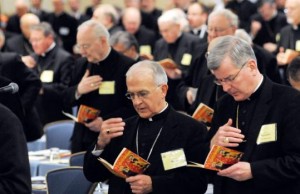
American Catholic Bishops Conference
My apologies if this post is a little incoherent. I’m hopping mad right now! We don’t yet live in a theocracy–although that danger clearly exists. As of today, the U.S. Constitution still requires the separation of church and state. Priests, ministers, bishops, and other church leaders are not supposed to be advocating for and against political candidates from the pulpit. In their roles as private citizens, they can hold whatever political beliefs they want and they can donate to political candidates. But they need to stop forcing their political views on church audiences.
Yesterday, in Catholic churches all over the U.S., parishioners heard a letter from their bishop denouncing the Obama administration for the January 20th HHS decision to require health plans to cover birth control services without requiring “a co-pay, co-insurance, or a deductible.” HHS Secretary Katherine Sibelius stated that the reason for this requirement is that access to contraception is important to women’s health.
Scientists have abundant evidence that birth control has significant health benefits for women and their families, it is documented to significantly reduce health costs, and is the most commonly taken drug in America by young and middle-aged women. This rule will provide women with greater access to contraception by requiring coverage and by prohibiting cost sharing.
Sibelius explained that this requirement applies to religion-based institutions that employ or serve people who don’t belong to their religion. Therefore, churches per se would be except from the rule, but universities and other religious-based organizations would have to abide by the rule.
Via Business Insider, here is the full text of letter that was read in churches in the Diocese of Marquette (Michigan):
Dear Brothers and Sisters in Christ:
I write to you concerning an alarming and serious matter that negatively impacts the Church in the United States directly, and that strikes at the fundamental right to religious liberty for all citizens of any faith. The federal government, which claims to be “of, by, and for the people,” has just been dealt a heavy blow to almost a quarter of those people — the Catholic population — and to the millions more who are served by the Catholic faithful.
The U.S. Department of Health and Human Services announced last week that almost all employers,
including Catholic employers, will be forced to offer their employees’ health coverage that includes sterilization, abortion-inducing drugs, and contraception. Almost all health insurers will be forced to include those “services” in the health policies they write. And almost all individuals will be forced to buy that coverage as a part of their policies.In so ruling, the Obama Administration has cast aside the First Amendment to the Constitution of the United States, denying to Catholics our Nation’s first and most fundamental freedom, that of religious liberty. And as a result, unless the rule is overturned, we Catholics will be compelled to either violate our consciences, or to drop health coverage for our employees (and suffer the penalties for doing so). The Obama Administration’s sole concession was to give our institutions one year to comply.
We cannot—we will not—comply with this unjust law. People of faith cannot be made second class citizens. We are already joined by our brothers and sisters of all faiths and many others of good will in this important effort to regain our religious freedom. Our parents and grandparents did not come to these shores to help build America’s cities and towns, its infrastructure and institutions, its enterprise and culture,
only to have their posterity stripped of their God given rights. In generations past, the Church has always been able to count on the faithful to stand up and protect her sacred rights and duties. I hope and trust she can count on this generation of Catholics to do the same. Our children and grandchildren deserve nothing less.And therefore, I would ask of you two things. First, as a community of faith we must commit ourselves to prayer and fasting that wisdom and justice may prevail, and religious liberty may be restored. Without God, we can do nothing; with God, nothing is impossible. Second, I would also recommend visiting http://www.usccb.org/conscience,to learn more about this severe assault on religious liberty, and how to contact Congress in support of legislation that would reverse the Obama Administration’s decision.
Sincerely yours in Christ,
+Alexander K. Sample
Most Reverend Alexander K. Sample
Bishop of Marquette
The author of the Business Insider article, Michael Brendan Dougherty, uses a flawed analogy to defend the bishops for their action and their decision to flout the law.
it would be like the government mandating that all delis, even Kosher delis, serve pork products and then justifying it by saying that protein is healthy, and many Jews who don’t follow Kosher laws and many non-Jews go to those delis. The law wouldn’t technically ban Jews from owning delis, but it would effectively ban their ability to run them according to their conscience.
WTF?! Jewish delis do not receive federal funds to subsidize the selling of pork, and scientists have not found pork to be vital to the health of more than half of the U.S. population. For Dougherty’s information, unwanted pregnancies can be dangerous to women’s physical and mental health. Furthermore, the more unwanted pregnancies there are, the more abortions there will be. The rule will therefore reduce the number of abortions in this country. And BTW, no individual is required to use birth control. The Catholic bishops know that most Catholics used it, and they are simply trying to intimidate people. If an individual Catholic wants to follow the church’s ludicrous (IMO) rules against birth control, she is free to do so. An editorial by the Minneapolis Star-Tribune says it much better than I could:
The Obama administration…made the right decision. Birth control access is critical for women and children’s health, ensuring that kids are born to parents ready for this responsibility. Lost in all the heated rhetoric over this milestone public health measure are several important points.
This policy does not require anyone to use birth control. In addition, courts have already rejected claims by Catholic organizations that requiring contraceptive coverage in employee health plans violates their religious freedom.
Requiring these religiously affiliated institutions to cover birth control in their plans is nothing new. Twenty-eight states (Minnesota isn’t one) already have “contraceptive equity” laws requiring birth control coverage for many plans covering prescription drugs.
In 2004, the California Supreme Court, noting that many of these organizations’ employees are not Catholic, soundly rejected a challenge to the state’s contraceptive equity law. It concluded that the state can enact employment laws to protect workers, even if these laws conflict with the employers’ religious beliefs.
The U.S. Supreme Court declined to hear Catholic Charities’ appeal. New York’s highest court rejected a similar claim by Catholic Charities on grounds that the law didn’t target religious beliefs and that a broad public interest is served by addressing gender disparities in medical costs.
The U.S. Supreme Court has also decided on multiple occasions that religious beliefs do not protect discriminatory practices, such as failing to comply with civil rights laws.
Denise Grady, in an article published in The New York Times and The Herald Tribune writes:
About half of pregnancies in the United States are unplanned, and about four out of 10 of those end in abortion, according to the Institute of Medicine report, which was released last July. It noted that providing birth control could lower both pregnancy and abortion rates. It also cited studies showing that women with unintended pregnancies are more likely to be depressed and to smoke, drink and delay or skip prenatal care, potentially harming fetuses and putting babies at increased risk of being born prematurely and having low birth weight.
Grady provides a number of real-life examples. Here’s just one:
One recent Georgetown law graduate, who asked not to be identified for reasons of medical privacy, said she had polycystic ovary syndrome, a condition for which her doctor prescribed birth control pills. She is gay and had no other reason to take the pills. Georgetown does not cover birth control for students, so she made sure her doctor noted the diagnosis on her prescription. Even so, coverage was denied several times. She finally gave up and paid out of pocket, more than $100 a month. After a few months she could no longer afford the pills. Within months she developed a large ovarian cyst that had to be removed surgically — along with her ovary.
“If I want children, I’ll need a fertility specialist because I have only one working ovary,” she said.
A spokeswoman for Georgetown, Stacy Kerr, said that problems like this were rare and that doctors at the health service knew how to help students get coverage for contraceptives needed for medical reasons.
Really? Then why was this woman “denied” coverage “several times?” Give me a break!
Even supposed “liberal” E.J. Dionne weighed in on the side of the church:
In its interim rules in August, HHS excluded from this requirement only those “religious employers” who primarily serve and employ members of their own faith traditions. This exempted churches from the rule, but not Catholic universities or social-service agencies and hospitals that help tens of thousands of non-Catholics.
As a general matter, it made perfect sense to cover contraception. Many see doing so as protecting women’s rights, and expanded contraception coverage will likely reduce the number of abortions. While the Catholic Church formally opposes contraception, this teaching is widely ignored by the faithful. One does not see many Catholic families of six or 10 or twelve that were quite common in the 1950s. Contraception might have something to do with this.
Speaking as a Catholic, I wish the Church would be more open on the contraception question. But speaking as an American liberal who believes that religious pluralism imposes certain obligations on government, I think the Church’s leaders had a right to ask for broader relief from a contraception mandate that would require it to act against its own teachings. The administration should have done more to balance the competing liberty interests here.
I am sick and tired of this sh*t! We’re talking about the rights and the health of more than half of the population! Does Dionne realize that 98% of Catholics have used birth control at one time or another? It’s time to take away the tax exempt status of churches who use the power of the pulpit to try to intimidate their parishioners into voting for or against a candidate based on ridiculous (IMO) religious rules that hurt women. If religious universities and charities wish to ignore the law, then they too should lose their government subsidies and/or tax exemptions.

 peej
peej Carissa
 bostonboomer
 dakinikat
 ecocatwoman
 mablue2
 Mama Lopez
 peggysue22
 quixote
 skydancingguestblogger
 Mona (aka Wonk the Vote)



 Sky Dancing
Recent Comments