
Next Strategy: Declare Victory, Go Home
Posted: July 2, 2009 Filed under: Bailout Blues, Equity Markets, Global Financial Crisis, The Great Recession, U.S. Economy | Tags: Christine Romer, Hilda Solis, job markets, recovery propaganda, unemployment statistics 1 Comment
(kinda graphic video, you’ve been warned)
The economy just won’t drink the koolaid and behave. I wonder if that old Mission Accomplished banner is still lying around the White House basement ? After all, white house economics adviser Christina Romer, via the FT says she’s “upbeat on economy.” So, who do I believe: the Obama administration or my lying economist eyes?
The US economy will feel a substantial boost from the Obama administration’s emergency spending package over the next few months,says Christina Romer, a senior White House official, who has warned against tightening monetary and fiscal policy before recovery is well established.
Ms Romer, chairman of the US president’s council of economic advisers, told the Financial Times in an interview she was “more optimistic” that the economy was close to stabilisation.
But while hopeful that America could yet experience a V-shaped recovery, she said it was much too soon to begin tightening policy: “We do not want to repeat the mistake Japan made in the 1990s, when the moment things started to improve they tightened policy.”
Meanwhile, David Axelrod, a senior White House adviser, told NBC Television yesterday the administration would be open to further stimulus if needed. “Let’s see in the fall where we are, but right now we believe what we have done is adequate to the task. If more is needed, we’ll have that discussion.”
Ms Romer’s comments come as opposition Republicans step up their attacks on the $787bn fiscal stimulus, pointing out that it has not prevented unemployment from hitting a quarter-century high of 9.4 per cent.
Ms Romer said stimulus spending was “going to ramp up strongly through the summer and the fall”.
“We always knew we were not going to get all that much fiscal impact during the first five to six months. The big impact starts to hit from about now onwards,” she said.
Calculated Risk must not see what Christine sees in the numbers. If you still are in the dark as to how exactly bad the employment situation is, go check out their graphs. You can also follow my lying eyes over to the Washington Post where the headline and Neil Irwin’s headline: 467K Jobs Cut in June; Jobless Rate at 26-Year High. Come on guys!!! Drink koolaid or DIE!!!!
Employers kept slashing jobs at a furious pace in June as the unemployment rate edged ever closer to double-digit levels, undermining signs of progress in the economy, and making clear that the job market remains in terrible shape.
…
Wages, meanwhile, were little changed, with average weekly pay for non-managerial workers falling to $609.37, from $609.51. With many people losing their jobs, and those who remain at work making less money, American consumers will be hard-pressed to increase their spending later in the year, despite higher confidence and rising wealth through the stock market.
 So, I know the job market always lags the economy, but please Christina, look at the last paragraph. Let’s go to the NY
 Times. Here’s their nifty little graphic and here’s some of their reality-based commentary.
The losses for June brought the tally of jobs shed since the beginning of the recession to 6.5 million — a figure equivalent to the net job gains over the previous nine years.
“This is the only recession since the Great Depression to wipe out all jobs growth from the previous business cycle,” Heidi Shierholz, an economist at the labor-oriented Economic Policy Institute in Washington, said in a research note. She called this fact “a devastating benchmark for the workers of this country and a testament to both the enormity of the current crisis and to the extreme weakness of jobs growth from 2000 to 2007.”
Let me just say, that when 70% of the GDP of a country depends on household spending, none of this is good news. But hey, the koolaid club just keeps on spinning right here in the same NY Times article.
“We’re seeing a kind of leveling off here,” Labor Secretary Hilda L. Solis said in an interview. “We would have done much worse had we not put the recovery plan in place.”
Early this year, the administration projected that the unemployment rate would peak near 8 percent with the stimulus in place. With joblessness already well above that target, some economists are arguing for another dose of government spending — a call Ms. Solis dismissed as premature. Much of the spending is still in the pipeline and trickling out slowly into the economy, particularly in construction projects that require government permits and planning, she said.
In offering the slow pace of stimulus spending as a partial explanation for higher unemployment, Ms. Solis effectively echoed the criticism that some leveled at the spending package when it was devised: that many of the projects would take too long to have their intended effect.
But Ms. Solis expressed assurances that the program was proceeding according to the administration’s plans.
“We’re making progress,” she said.
What are they on over there? Look at the Calculated Risk Graphs. (Ones that I’ve put up here before but are still being updated in a progressively negative direction.) Those graphs put this downturn into the perspective of all the last downturns since World War 2. Even a petulant clown with fear of numbers can’t miss the trend! This isn’t progress unless you call minusculely less down progress! I’m not seeing any turning points!
The next move has to be for them to declare victory in the rose garden or send us all koolaid with our unemployment checks. Do they really think we are all this dumb?
Digg!!! Tweet!!! Share!!!


Add to: Facebook | Digg | Del.icio.us | Stumbleupon | Reddit | Blinklist | Twitter | Technorati | Furl | Newsvine
An Economic Exercise in Wishful Thinking
Posted: July 1, 2009 Filed under: Global Financial Crisis, Team Obama, The Great Recession, U.S. Economy, Uncategorized Comments Off on An Economic Exercise in Wishful Thinking
Warning: Do NOT use before making economic policy.
In today’s NY Times, David Leonhardt is very clear about the role of hope and wishful thinking among the Obama economics team. They got the unemployment numbers very, very wrong and as a result, we got a stimulus package that was underdesigned and oversold. If you read me or for that matter, Paul Krugman or Joseph Stiglitz, you were warned about the likely result. While this m.o. among Obama and his minions comes as no surprise to folks here, we’re beginning to see the resulting shock and awe as every one else awakens to policy based on the empty rhetoric of hope and no real change. Precious time, political majorities and capital are being wasted on an enhanced status quo.
In the weeks just before President Obama took office, his economic advisers made a mistake. They got a little carried away with hope.
To make the case for a big stimulus package, they released their economic forecast for the next few years. Without the stimulus, they saw the unemployment rate — then 7.2 percent — rising above 8 percent in 2009 and peaking at 9 percent next year. With the stimulus, the advisers said, unemployment would probably peak at 8 percent late this year.
We now know that this forecast was terribly optimistic. The jobless rate has already reached 9.4 percent. On Thursday, the Labor Department will announce the latest number, for June, and forecasters are expecting it to rise further. In concrete terms, the difference between the situation that the Obama advisers predicted and the one that has come to pass is about 2.5 million jobs. It’s as if every worker in the city of Los Angeles received an unexpected layoff notice.
There are some fundamental things in the labor market that the Obama Team somehow overlooked. The first is the unwinding of the automobile network and all the supporting infrastructure around the supply and sales chain. The second is the impact on the states of low tax revenues and high unemployment insurance payouts. Some how, in focusing on the impact of the financial crisis, they appeared to haven forgotten some basic underlying macroeconomic dynamics. At least, that is my take. They may have kept their eye on the ball, but they failed to look around the bigger field of play.
Leonhardt points to two possible explanations as to why so many very bright people got it so wrong. He argues that because the stimulus package was designed poorly and hurried through with the rosy scenario coloring the numbers, that it is possible that the stimulus package has done nothing and that as a result, things are getting worse. That’s hypothesis number one. His second hypothesis is the more likely one in both his and my opinion. That is that the economy is deteriorating further and this is despite of the stimulus. Again, this would be due to a bad forecast and an even worse policy prescription. So he’s laid out the ground work for the big question while giving a slight nod to some potential for the stimulus plan.
The stimulus package does seem to have helped. But its impact has been minor — so fa
r — compared with the harshness of the Great Recession.
Unfortunately, the administration’s rose-colored forecast has muddied this picture. So if at some point this year or next the White House decides that the economy needs more stimulus, skeptics will surely brandish that old forecast.
Worst of all, the economy really may need more help.
Well, you know, on the one hand, on the other hand. However, whichever hand you choose, this is a policy failure we couldn’t afford.
Oh to be a Fly on those Fabled Marble Walls
Posted: June 23, 2009 Filed under: Global Financial Crisis, Team Obama, U.S. Economy | Tags: bernanke, FOMC, Mishkin, the Fed, the stimulus bill Comments Off on Oh to be a Fly on those Fabled Marble Walls The Federal Open Market Committee (FOMC) meets today. Those folks are the ‘deciders’ when it comes to monetary policy. This should be an interesting meeting for a number of reasons. First, new regulations proposed by the Obama administration definitely put the Fed in the catbird seat. Second, Bernanke is coming close to his expiration date. Third, a number of prominent economists are wondering about the Fed’s exist strategy from the current wide open floodgates and the pressure is on not to enable another bubble. Fourth, we find that three banks have suspended their Tarp Dividends meaning that all is not happiness and light in bank balance sheet land. The intrigue of all this pulls this financial economist away from her research agenda which is not good for my CV but very good for turning the dismal science into a Walter Winchellesque moment. Now, just where to begin …
‘Good Morning, Mr. and Mrs. North and South America and all the ships at sea…let’s go to press!’
Let’s go to Banking. Headline: The Scam Continues on you, Mr and Mrs. North and South America. Let’s dish the dirt on those banks that are behind in their loan payments to the U.S. taxpayer as reported today by the WSJ who keeps track of that sort’ve thing. It seems three banks have suspended their TARP ‘dividends’. They can miss six before they technically default. (Ask yourselves, if I missed five housepayments would I still be IN my house or out in the street by number six?) The banks are: Pacific Capital Bancorp (CA), Seacost Banking Corp of Florida (FL), and Midwest Bank Holdings Inc (IL).
Treasury spokeswoman Meg Reilly said Monday that “a number of banks” that got taxpayer-funded capital under TARP are no longer paying dividends to the government. “Treasury respects the contractual rights of [TARP recipients] to make decisions about dividend distributions, and that banks are best positioned to decide how to manage their own capital base.”
The moves are a sign of the deepening misery for large swaths of the U.S. banking industry, suffering under bad loans and the recession even as large firms such as J.P. Morgan Chase & Co. and Goldman Sachs Group Inc. rebound from the crisis, including by repaying their TARP funds last week. The halted dividends also raise questions about the Treasury’s assertions that the capital infusions represented sound taxpayer investments because they were only going to healthy institutions.
“Here the government has given the banks money at great terms, but the fact that they can’t keep up with it is worrisome,” said Michael Shemi, an investor at New York hedge-fund firm Christofferson, Robb & Co. “It tells you of the deep problems of community and regional banks.”
It’s the Jobs, Stupid!
Posted: June 22, 2009 Filed under: Global Financial Crisis, U.S. Economy | Tags: Job Creation, Lost Decade, The Great Recession, unemployment Comments Off on It’s the Jobs, Stupid!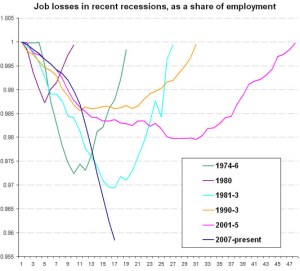 One glance at the national income accounts for the U.S. gives us the bottom line. Approximately 67 % of the spending in the country comes from households and nearly the same proportion of the source of that spending comes from wages and salaries. It may be all about oil revenue in places like Venezuela and Kuwait, but in the United States, it’s all about job creation. The job losses in this Great Recession–when compared with the other post-WW2 recessions–are much worse as you’ll see in the graphic on the left.
The news from the jobs market is bleak and that is one of the reasons I have trouble buying any green shoot hoopla. Take this headline from the Wall Street Journal “Cuts are Here to Stay, Companies Say”.
Many companies that have cut jobs, pay and benefits during the recession may not be quick to restore them.
According to a new survey, 52% of companies expect to employ fewer people in three to five years than they did before the recession began. The survey of 179 companies was conducted this month by consulting firm Watson Wyatt Worldwide Inc.
Among employers who have cut salaries, 55% expect to restore the cuts in the next year. But 20% expect the cuts to be permanent. Of employers who have increased employee contributions to health-care premiums, 46% don’t plan to reverse the increases. Of all survey respondents, 73% said they expect employees to shoulder more of the cost of health care than before the recession began.
The job market always lags the business cycle since companies are really slow to both fire and hire near the turning points. Companies like to insure they are not letting trained workers go needlessly and they don’t like to take on any costs if their revenues aren’t trending upward. Of course, recessions hit different segments of the labor market differently. A Weekly Standard headline “No Country for Burly Men” has one of the most interesting examples of the demographics of the Great Recession.
A “man-cession.” That’s what some economists are starting to call it. Of the 5.7 million jobs Americans lost between December 2007 and May 2009, nearly 80 percent had been held by men. Mark Perry, an economist at the University of Michigan, characterizes the recession as a “downturn” for women but a “catastrophe” for men.
Men are bearing the brunt of the current economic crisis because they predominate in manufacturing and construction, the hardest-hit sectors, which have lost more than 3 million jobs since December 2007. Women, by contrast, are a majority in recession-resistant fields such as education and health care, which gained 588,000 jobs during the same period. Rescuing hundreds of thousands of unemployed crane operators, welders, production line managers, and machine setters was never going to be easy. But the concerted opposition of several powerful women’s groups has made it all but impossible. Consider what just happened with the $787 billion American Recovery and Reinvestment Act of 2009.
Obama and the Enhanced Status Quo
Posted: June 21, 2009 Filed under: Global Financial Crisis, Health care reform, Team Obama, The DNC, Uncategorized, Voter Ignorance | Tags: Financial Reform, Goldman Sachs Record Bonuses, Healthcare Reform, Public Option, status quo, Timothy Geithner, Too big to Fail Comments Off on Obama and the Enhanced Status Quo We were promised changed. What we are getting is perpetuation of the status quo. Let’s try this headline at the Guardian on for size “Goldman Sachs to make record bonus payout”.
Staff at Goldman Sachs staff can look forward to the biggest bonus payouts in the firm’s 140-year history after a spectacular first half of the year, sparking concern that the big investment banks which survived the credit crunch will derail financial regulation reforms.
A lack of competition and a surge in revenues from trading foreign currency, bonds and fixed-income products has sent profits at Goldman Sachs soaring, according to insiders at the firm.
Staff in London were briefed last week on the banking and securities company’s prospects and told they could look forward to bumper bonuses if, as predicted, it completed its most profitable year ever. Figures next month detailing the firm’s second-quarter earnings are expected to show a further jump in profits. Warren Buffett, who bought $5bn of the company’s shares in January, has already made a $1bn gain on his investment.
The bold part says it all. There continues to be a systematic elimination of competition from merger mania in the financial sector which has created two classes of too-big-to-fail institutions. We now have those that function completely with government funding and those that function by funding candidates for government. Goldman Sachs is benefiting immensely from both.

 peej
peej Carissa
 bostonboomer
 dakinikat
 ecocatwoman
 mablue2
 Mama Lopez
 peggysue22
 quixote
 skydancingguestblogger
 Mona (aka Wonk the Vote)



 Sky Dancing
Recent Comments