
Sequestration Boogie
Posted: March 1, 2013 Filed under: Federal Budget, Federal Budget and Budget deficit, Sequester 39 Comments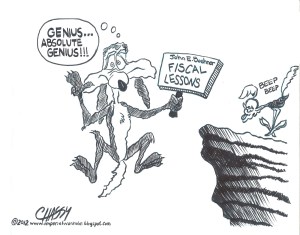 Well, it’s here. It’s the day the Mayans predicted!! It’s the beginning of the end of civilization in the Americas! Sequester Disaster Day is here! Well, it’s here for those of us that like to drive on roads and across bridges. It’s here for those of us that will rely on social security or medicare this month or shortly. It’s here for those of us that have kids in schools or would like to go to university. It’s here for those of us that would prefer to live in a civilized country instead of The United States of Mississippi. For politicians and punditry in the beltway, it’s just another ball where they get to show off their designer formal wear and fancy dance steps.
As the automatic across-the-board spending cuts are set to take effect today and as President Obama meets at the White House with congressional leaders, we have to get this off our chest: This has been an absurd week. Today’s White House meeting is coming only at the last second; there’s been no sense of urgency, no negotiating, and Congress has left town; and, when you think about it, this hasn’t even been a true budget showdown. Given the lack of urgency and negotiating, it’s hard not to conclude that — deep down — plenty of folks on both sides of the aisle are OK with having these cuts take place, at least in the short term.
That’s from Chuck Todd et al. I agree. None of this makes sense if you think of economic policy or actually the idea of governing a country efficiently. I have decided that the only thing Washington cares about is the political dance and political boogie surrounding the process and not what actually happens to the nation. For some reason, these cuts play in the beltway. In that vein, Dave Weigal thinks Obama is winning the process cotillion. Will it’s good some one is winning because there are certainly going to be about 320 million losers out here in the great fly over that exists behind Washington DC and Manhattan.
Republicans have one goal, running through all of these negotiations. They don’t want sequestration to be replaced by tax revenue. Any tax revenue. Forcing the president to swallow $85 billion in cuts this year would do that. They’ve got no obvious alternatives.
But a plan like this exposes a quirk of Obama-era fiscal hawksmanship. Republicans want specific cuts. Some of them—total repeal of Obamacare!—they’ll put on the record. The rest of them, they try to put on the White House. As soon as the “supercommittee” failed and sequestration looked real, it became “the president’s sequester.” The 2011 debt-limit deal delayed real action until after the 2012 election, betting $1.2 trillion of chips on its results and giving them to the president. Even the first great structural victory of the Tea Party, the ban on legislative earmarks, handed more clout to the White House. “The power to make thousands of spending decisions, on everything from which flood control projects will be funded to how spending on military bases will be distributed, to President Obama,” warned two political scientists at the time. Republicans ignored those particular political scientists.
Vote by vote, accidentally, Republicans are endorsing an imperial vision of the presidency. Perhaps they’re picking this up by osmosis. The default position of the punditocracy is that the president must lead. The lazy pundit invokes Harry Truman’s desk ornament, “The Buck Stops Here,” as a totem of great wisdom. Brendan Nyhan, who isn’t lazy, calls this “the Green Lantern Theory of the Presidency,” after the D.C. Comics superhero and his ring that runs on willpower. Bob Woodward offered a sterling example of the theory this week, when he suggested that the president’s willingness to obey the Budget Control Act (the law that mandates sequestration) was “madness.”
See, I actually think they all must want all these cuts. They are so far removed from any impact that any of this would actually have that they’re just ignoring it. As a matter of fact, the similarly out of touch punditry likes the idea of it too. Let me offer of this from Ygelasias:”A Cheer or Two for Sequestration“.
But on the merits it seems to me that while sequestration is hardly optimal budget policy, it really isn’t all that bad in the scheme of things, and really going through with it would be better than repealing it. The key reason is that fully half the cuts are cuts to “defense” spending, and yet nobody from either party is seriously trying to maintain that America will be left defenseless in the wake of this reduced military spending. The specific sequestration mechanism is clearly awkward and clumsy, but again nobody’s saying the Mexican army is going to come swarming over the border to reconquer Santa Fe, that the Taliban is now going to be able to outspend the Pentagon, or that America’s NATO allies are now left unable to fend off a Russian invasion. That’s half the cuts with basically zero real public policy harm.
So then you look at the domestic side. Your basic transfer payments to poor people are spared, your transfer payments to the elderly are basically spared, and then everything else gets cut willy-nilly. That leads to some real policy harms. Valuable research grants are going to not happen. We’ll see some real bottlenecks at regulatory agencies. But obviously there’s some waste and fat in this domestic discretionary spending.
Long story short, if you’re a defense dove like me and have a nonutopian view of the domestic discretionary budget, then this looks like we’re mostly talking about harmless spending cuts.
This from a man who had to get a wife from an on line dating service which is basically the equivalent of a mail order bride. How much do you have to hate yourself to troll around online for an equally desperate person?
Let me just return to the economic impact of all of this.
Yes, the across-the-board spending cuts will lead to hundreds of thousands of job losses and a fiscal drag of 0.6 percent for 2013, according to the forecasting firm of Macroeconomic Advisers. Mostly, though, the rub is the timing and the inartful nature of the cuts.
“It would clearly be preferable to have a more orderly process for fiscal adjustment than the indiscriminate effects of sequestration,” wrote Macroeconomic Advisers in a recent research note.
The inopportune moment of sequestration — hitting just as the economy shows bright spots — will create a drag on the economy in a slow-motion manner. First, the furlough notices will go out in March to federal employees, the majority of whom live outside of the Washington metro area. Unemployment checks will drop as early as April for the long-term unemployed who receive the federal benefit checks.
States eventually will have to decide how to cut programs for low-income or vulnerable people that are funded through federal grants, such as child-care assistance, nutrition programs for women and children, mental-health services, and meal programs for senior citizens.
If Congress keeps the sequester cuts in place for a few months, then the economy will start to feel the effects. Federal workers furloughed for as many as 22 days between mid-April, when the furloughs are expected to begin to occur, and the end of the fiscal year will face a pay cut of as much as 20 percent. This will have ripple effects throughout the economy on consumer spending as well as state income and sales taxes.
By July, August, and September, the impact of sequestration should be fully felt. “We’re not going to go into a downward spiral overnight, but the spending cuts will build, and as they build, the effects will become noticeable,” says Nigel Gault, the chief U.S. economist of IHS Global Insight.
Already, the economic data showed a dip in federal-government spending for defense in the first quarter, a reaction to the impending cuts.
That is the real takeaway of the sequester and its economic impact. It will not hurt the economy immediately, but it still serves as a reminder of the power the federal government holds over the economy. Even if the government cannot enact policies to boost growth, it certainly can hurt the long-term prospects.
I’d really like to know why politicians these days are united in making most people’s lives worse off while maintaining things like preferable tax treatment for people that are already better off than nearly 99.9 % of the people living on the planet? The only thing I can figure out is that none of this impacts any of them so they could care less. It’s not about what happens to the nation or to its people. It’s like they’re teenagers at a country club dance. The only thing that matters is who dances with who and how they each will be perceived in the outfit they’ve chosen. Meanwhile, what will be the cost to the country in the eventual crime and social unrest? Ah, who cares, just buy stock in the latest company that runs the privatized jails. It’s a sure winner.
The Sequestration Blues: Part 2 Pete Peterson Creates a Crisis
Posted: February 26, 2013 Filed under: Austerity, Barack Obama, Catfood Commission, Economy, Federal Budget, Federal Budget and Budget deficit | Tags: Astroturf, Deficit Delusion, deficit hawks, Deficit Hysteria, Fix the Debt, Pete Peterson, Simpson-Bowles 13 Comments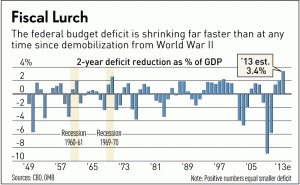 Ben Bernanke joined the chorus of economists concerned about the impact of the sequester on the sluggish recovery. This is not the first time the Fed chair has commented on misguided and dysfunctional Fiscal Policy in our country.
Federal Reserve Chairman Ben Bernanke warned Congress risks slowing the economy by allowing $85 billion in automatic spending cuts to be triggered on Friday, arguing they should be replaced with more deliberate, long-term cuts.
In prepared testimony for the Senate Banking Committee, Bernanke argued the sequester would pose a “significant headwind” to the economic recovery.
“Given the still-moderate underlying pace of economic growth, this additional near-term burden on the recovery is significant,” he warned.Bernanke did not offer an opinion on whether tax hikes should be included as part of a replacement bill, and he did not call for any specific entitlement reforms.
Meanwhile, the White House released reports on how the expected cuts will impact states. This undoubtedly will trigger more Republican whining on how mean the President continues to be to them as they continue their role as economic agents of chaos.
In Kentucky, home of the Senate Republican leader, Mitch McConnell, residents woke up on Monday to news articles like these: Widespread government spending cuts that begin on Friday will cost 21,484 jobs in the state. A construction project at Fort Knox will come to a halt. Three airports may endure partial shutdowns. Nearly $12 million in grants to public schools would be cut, putting at risk the jobs of 160 teachers and aides. More than 1,000 children would lose access to Head Start.
The White House released warnings for every state on Sunday in the hope that angry voters would besiege Republican lawmakers like Mr. McConnell and the House speaker, John Boehner, to stop the $85 billion in cuts, known as a sequester. President Obama wants to replace the sequester with a mix of tax increases on the rich and less damaging spending reductions. Republicans say they won’t consider any proposal that isn’t all cuts, so the sequester is all but certain to begin this week.
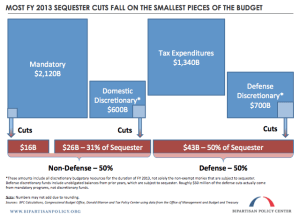 There’s a fairly good list of the types of spending items that will be subject to cuts at the Bipartisan Policy Center.
Setting aside the magnitude of the reductions, the most difficult aspect of both the defense and domestic cuts is that they will be made across the board to all non-exempt government spending regardless of programs’ merits or demerits.*** The reductions designed by law are executed at the Program, Project & Activity (PPA) level of the federal budget, sometimes defined in appropriations bills and which often includes very granular categories of expenditures, such as “two Virginia Class Submarines” or “salaries and benefits” of a particular agency.
Absent a new law passed by Congress, the president has little ability to spare one type of spending and cut more from another. This creates uncertainty in both the public and private sector because there remains much to be determined about how PPAs will be defined by agency administrators and how the cuts will be implemented. This inability to plan is already acting as a drag on economic growth.
Furthermore, the immediate and across the board nature of the cuts, along with their magnitude concentrated in a seven-month period, will impair economic growth as the year progresses. At BPC, we estimated last year that the sequester would reduce 2013 gross domestic product (GDP) growth by half a percentage point, and would cost the economy approximately one million jobs over the next two years. More recent estimates released by the CBO and Macroeconomic Advisors have roughly confirmed these projections.
Given all of this, you would think that most congress critterz would want to avoid the sequester. However, there’s that same group of tea party crazies that are so disconnected from an evidence-based reality it appears congress will tank the economy rather than develop a cogent Fiscal Policy related to economic theory and the state of the economy itself.
The White House strategy on the sequester was built around a familiar miscalculation about Republicans. It assumed that, in the end, they would be reasonable and negotiate a realistic alternative to indiscriminate cuts. Because the reductions hurt defense programs long held sacrosanct by Republicans, the White House thought it had leverage that would reduce the damage to the domestic programs favored by Democrats.
It turns out, though, that the defense hawks in the party are outnumbered. More Republicans seem to care about reducing spending at all costs, and the prospect of damaging vital government programs does not seem to bother them. “Fiscal questions trump defense in a way they never would have after 9/11,” Representative Tom Cole, a Republican of Oklahoma, told The Times. “But the war in Iraq is over. Troops are coming home from Afghanistan, and we want to secure the cuts.”
Cuts this draconian have no place in a tottering economy. But, realistically, the only way to break this standoff is for the cuts to exact their toll on daily life, causing Republicans to face pressure from the public to negotiate an alternative plan with higher revenues in March as part of talks to finance the government for the final six months of the fiscal year.
It’s difficult to believe that so many folks can be so misguided about the need to drastically cut the budget. Read the rest of this entry »
A Tale of Two Sequesters in multiple chapters — Chapter 1:WTF is this thing?
Posted: February 20, 2013 Filed under: Federal Budget, Federal Budget and Budget deficit, Sequester 26 CommentsI’ve been avoiding this unpleasant subject because I was hoping dynamics would change and maybe patriotism, reason, or some 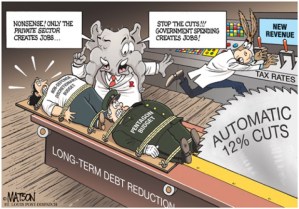 semblance of sanity would strike the elected officials in the beltway. That was wishful thinking on my part and now I feel compelled to give you some background information on sequesters in general and this one in particular. This just highlights how dysfunctional our political system has become and it really is a good demonstration of how politicians don’t tend to really get at the real problems. Let me just say that the real future source of any federal deficit problem is the monumental increases in the cost of health care. We have a completely dysfunctional third party payer system in this country as well as astronomical costs for drugs and care whose actual prices are well beyond the knowledge of actual consumers. That being said, let’s proceed to the side shows that our congress keeps setting up to tank our economy.
This isn’t the first time congress and an administration has used a sequester when it’s been unable to arrive at a budget. Usually, this comes from an inability to arrive at the same budget priorities that comes from having mixed party control of legislative bodies and the White House. You know the general approaches by each party. Republicans are no longer supportive of any kind of revenue enhancements or cut in military spending. Democrats have been more accommodating but tend to draw the line at some point when it comes to destroying the safety net and entitlement programs along with the other basic functions that government provides that the private sector just can’t do either economically or effectively. So, once you get this stand off, a sequester is used to force both sides to the bargaining table.
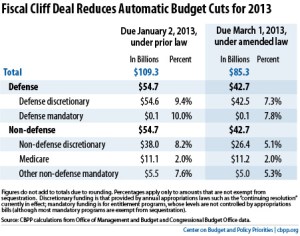 A sequester is basically an automatic reduction in Federal Spending during a budget year. We had a January 2 Fiscal Cliff deal that postponed the sequester until March 1. This is what will happen if nothing is done.
The deal sliced the scheduled 2013 sequestration by $24 billion, from $109.3 billion to $85.3 billion. This reduces the percentage cuts in full-year funding for most eligible programs (those that the law does not exempt from the automatic cuts). The Medicare percentage does not drop, however, because Medicare cuts were and are still capped at 2 percent, and the across-the-board cut that applies to other non-defense programs remains larger than 2 percent.
The chart and the narrative come from the Center on Budget and Policy Priorities which is a great source of information.
The first of the sequesters happened when I was fresh out of graduate school back in the mid 1980s. You’ll probably recognize the names of the usual agents of economic chaos from the Reagan years: Gramm-Rudman-Hollings–Balanced Budget and Emergency Deficit Control Act of 1985. Oddly enough, the Supreme Court found the bill unconstitutional saying that it gave Congress too much power over the budget. They had to rewrite it and it repassed in 1987.
The Balanced Budget and Emergency Deficit Control Act of 1985 (Graham-Rudman-Hollings) was an amendment to a bill that allowed the debt ceiling to be raised to over $2 billion. It created a five-year deficit reduction plan, with decreasing deficit targets each year, until the budget would be balanced in fiscal year 1991. If deficit goals were not met in any given year, a process of automatic spending cuts termed “sequestration” would take place. Fifty percent of the cuts would come from domestic discretionary spending and fifty percent from defense. Social Security, Medicare, several anti-poverty programs, and interest on the debt were exempted from a potential sequester.
Gramm-Rudman-Hollings garnered bipartisan support and was signed into law by President Reagan in December 1985. Most Republicans in the House and Senate voted for it, while the Democratic vote was split nearly evenly in both chambers. Those in favor of the bill argued that the budget deficit, which had greatly increased since 1981, required dedicated measures to reign [sic] in federal spending. Democrats who voted “no” argued that budget cuts were likely to impact domestic programs while leaving military spending largely intact. Nevertheless, the Reagan administration opposed the mandated fifty percent cuts in defense spending in a potential sequester and provided only lukewarm support for the measure.
They assume a fiscal multiplier of 1.4 for general government spending, which is Moody’s Analytics most recent public estimate of the government spending multiplier. While we use the same multiplier for all cuts, we’d guess that these likely slightly overstate the adverse economic impact resulting from defense spending cuts and understate job losses from domestic spending cuts. Budgetary programs for lower-income households in the discretionary budget—such as housing assistance and the special supplemental food program for women, infants, and children (WIC)—as well as infrastructure spending have particularly high multipliers. And to the extent that cuts to spending by the Department of Defense come from capital-intensive weapons acquisitions rather than reductions in personnel strength, the impact on employment would be milder. Regardless, any cuts in the near-term (unless they are ploughed into more spending somewhere else) are going to constitute a drag on the still-weak recovery. Cutting government spending reduces aggregate demand and worsens joblessness while the economy is running well below-potential output.
The new study was performed by Thomas Hungerford of the non-partisan Congressional Research Service. Though the study is not a CRS product, Hungerford’s data is widely cited on both sides; he’s an impeccably objective analyst.
Here’s what Hungerford found: The single greatest driver of income inequality over a recent 15 year period was runaway income from capital gains and dividends.
This finding is directly relevant to the current debate, because Obama and Democrats want to offset the sequester in part by closing loopholes enjoyed by the wealthy, such as the one that keeps tax rates on capital gains and dividends low. Dems want to do this in order to prevent a scenario where the sequester is averted only by deep spending cuts to social programs that could hurt a whole lot of poor and middle class Americans. Republicans oppose closing any such loopholes and want to avert the sequester with only deep spending cuts.
Hungerford’s report, like all serious examinations of inequality, is very complicated. He looks at a bunch of recent data on inequality from the period from 1991-2006 — measured by the so-called “Gini index” — and calculates the degree to which various factors exacerbated it. Hungerford found that over that period, the rise in the Gini index (a story that’s been widely told elsewhere, one that’s largely been driven by the runaway wealth of the top one percent and top 0.1 percent) was driven mainly by the rise in capital gains and dividends income.
“By far, the largest contributor to increasing income inequality (regardless of income inequality measure) was changes in income from capital gains and dividends,” the report concludes.Or, as Hungerford put it in an interview with me: “The reason income inequality has been increasing has been the rising income going to the top one percent. Most of that has come in capital gains and dividends.”
In other words, wealthy beneficiaries of low tax rates on capital gains and dividends are doing extremely well — and their runaway wealth is a major driver of income inequality. There’s a lot of that money out there that could be taxed as ordinary income — as Obama and Dems want — as a way to avert the sequester, which could badly damage the economy. Republicans oppose this.
This finding comes as even some conservatives are reckoning with the fact that the GOP’s message on the sequester is deeply flawed. Writer Byron York notes today that Republicans are openly conceding that the sequester will gut the military, even as they openly point to the sequester as an acceptable policy outcome.
Unemployment fell to 4.1% by the end of last year – a record low for at least 25 years. Poverty has fallen by 27% since 2006. Public spending on education has more than doubled, in real (inflation-adjusted) terms. Increased healthcare spending has expanded access to medical care, and other social spending has also increased substantially, including a vast expansion of government-subsidised housing credit.
If all that sounds like it must be unsustainable, it’s not. Interest payments on Ecuador’s public debt are less than 1% of GDP, which is quite small; and the public debt-to-GDP ratio is a modest 25%. The Economist, which doesn’t much care for any of the left governments that now govern the vast majority of South America, attributes Correa’s success to “a mixture of luck, opportunism and skill“. But it was really the skill that made the difference.
Correa may have had luck, but it wasn’t good luck: he took office in January of 2007 and the next year Ecuador was one of the hardest hit countries in the hemisphere by the international financial crisis and world recession. That’s because it was heavily dependent on remittances from abroad (eg workers in the US and Spain); and oil exports, which made up 62% of export earnings and 34% of government revenue at the time. Oil prices collapsed by 79% in 2008 and remittances also crashed. The combined effect on Ecuador’s economy was comparable to the collapse of the US housing bubble, which contributed to the Great Recession.
And Ecuador also had the bad luck of not having its own currency (it had adopted the US dollar in 2000) – which means it couldn’t use the exchange rate or the kind of monetary policy that the US Federal Reserve deployed to counteract the recession. But Ecuador navigated the storm with a mild recession that lasted three quarters; a year later it was back at its pre-recession level of output and on its way to the achievements that made Correa one of the most popular presidents in the hemisphere.
How did they do it? Perhaps most important was a large fiscal stimulus in 2009, about 5% of GDP (if only we had
done that here in the US). A big part of that was construction, with the government expanding housing credit by $599m in 2009, and continuing large credits through 2011.
But the government also had to reform and re-regulate the financial system. And here it embarked on what is possibly the most comprehensive financial reform of any country in the 21st century. The government took control over the central bank, and forced it to bring back about $2bn of reserves held abroad. This was used by the public banks to make loans for infrastructure, housing, agriculture and other domestic investment.
It put taxes on money leaving the country, and required banks to keep 60% of their liquid assets inside the country. It pushed real interest rates down, while bank taxes were increased. The government renegotiated agreements with foreign oil companies when prices rose. Government revenue rose from 27% of GDP in 2006 to over 40% last year. The Correa administration also increased funding to the “popular and solidarity” part of the financial sector – co-operatives, credit unions and other member-based organisations. Co-op loans tripled in real terms between 2007 and 2012.
The end result of these and other reforms was to move the financial sector toward something that would serve the interests of the public, instead of the other way around (as in the US). To this end, the government also separated the financial sector from the media – the banks had owned most of the major media before Correa was elected – and introduced anti-trust reforms.
Of course, the conventional wisdom is that such “business-unfriendly” practice as renegotiating oil contracts, increasing the size and regulatory authority of government, increasing taxes and placing restrictions on capital movements, is a sure recipe for economic disaster.
The Agony and the Idiocy
Posted: February 16, 2013 Filed under: Catfood Commission, Domestic Policy, Economy, Federal Budget, Federal Budget and Budget deficit, We are so F'd | Tags: austerians, deficit hawks, Joe Scarborough, Mourning Joe, Paul Krugman 38 CommentsSome one needs to take the shovel away from Joe Scarborough. He’s about ready to wind up in Siberia with that hole he’s digging himself. I’ve  never seen such obsessive compulsive self-destructive behavior. The man cannot admit he’s wrong and knows nothing about economics. He also doesn’t appear to know the difference between an economist and a lawyer and a foreign policy expert. I expect that one of these days he’ll have heart failure then go to his Politico blog to instruct another lawyer on how to do his surgery correctly. Maybe, he’ll start giving lectures on the origins of the universe to Neil Degrasse Tyson next.
Who knew one man could become apoplectic convincing every one he wasn’t beaten up in a one-sided match of wits by Nobel Prize Winning Economist and ubernerd Paul Krugman over 2 weeks ago? He’s written the second of two “I know you are, but what am I?” blog threads at Politico in two days. What Scarboroughs’s become is your run-of-the-mill internet troll who is now blog stalking Dr. Krugman. Only “Tiger Beat on the Potomac” would continue to give this pathetic man a platform for what looks like a developing psychological disorder. We thought he’d over done it on Nate Silver and the presidential poll analysis. But, nope, he’s back and convinced he knows enough about investment and econometrics to analyze the whims of investors.
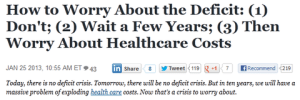 Yesterday’s Scarborough rant was so bad and so wrong, I actually stepped into it. Scarborough relentlessly insists that Krugman is wrong and that all the rest of us economists think he’s wrong too. To prove his point and to try to get back for being shown up on his show, Mourning Joe used an article written by Princeton economist and Paul Krugman colleague Alan Blinder. The only problem is that Blinder is basically saying the same thing Krugman’s been saying all along. Scarborough not only proved Krugman’s point, he totally missed the point–and the headline–of the Blinder article as well as ascribing the article to the wrong publication. Mourning Joe must’ve read only a sentence and ignored the rest. Does that first sentence not read “Today, there is no deficit crisis” or do I need to up my script for my reading glasses?
Today, there is no deficit crisis. Tomorrow, there will be no deficit crisis. But in ten years, we will have a massive problem of exploding health care costs. Now that’s a crisis to worry about.
But, to Mourning Joe, this means:
But the same could not be said of a fabulously misleading Business Insider post that claimed to list 11 economists who shared Krugman’s debt-denying views. Never mind the fact that most of the links provided actually undercut Krugman’s reckless position and supported my view that the most pressing fiscal crisis is not next year’s deficit but next decade’s debt.
The Business Insider link to an Alan Blinder piece was particularly supportive of the “Morning Joe” panel’s view. Blinder, a former Fed vice chairman and Princeton economics professor, warned of “truly horrific problems” caused by long-term debt, health care costs and interest on the debt. Paul Krugman’s Princeton colleague even shared my conclusion that the coming Medicare crisis will be so great that Democrats won’t be able to tax their way out of it.
Far from supporting Mr. Krugman’s extreme position, the link to Professor Blinder’s New Yorker article undercuts his Princeton colleague’s exaggerated “In-the-end-we’ll-all-be-dead” approach to U.S. long-term debt.
Then he added a short list of noneconomists--including Ed Rendell who is paid lobbyist for deficit hawk group Fix the Debt associated with Simpson & EB who make about $40,000 a speech as travelling austerians–as proof that all economists think Krugman is as extreme on economics as Wayne LaPierre is on gun safety laws. Considering Krugman’s name resides on a well-known trade model, he’s published in just about every prestigious peer-reviewed journal possible, and he’s got one of the best-selling set of text books in the country right now, I’d say Joe just won’t admit he’s way out of his league. Krugman calls Scarborough desperate. Frankly, he gone way beyond that to pathetic to me.
First up, the sad story of Joe Scarborough, whose response to my anti-austerian appearance on his show has been a bizarre campaign to convince the world that absolutely nobody of consequence shares my views. Why is this bizarre? Because while I could be wrong about macroeconomics (although I’m not), it’s just not true, provably not true, that I’m alone in arguing that the current and near-future deficit aren’t problems.
I actually wrote about all of this over two weeks ago (1/30/2013) when the incident first happened, so it seems all deja vu to be at this again. But let me tie this to a bigger problem again. Hillary Clinton left the Benghazi hearings uttering something profound. These hearings were some of the more bizarre things I’d ever watched until the Hagel hearings started and the obsession with conspiracy theories went nuclear. Clinton said some ‘‘just will not live in an evidence-based world’. This includes Joe Scarborough who thinks his “analysis” in his latest little short blog blurb shows Krugman as being wrong, wrong wrong. This is what he thinks is a “TA DA”! moment. I would expect better analysis from Macro 101 students. I would also expect any student in basic statistics or econometrics to have a hey day with his methodology which doesn’t even broach the high school level. But, he’s real proud of it and thinks it puts Krugman in his place.
Investors may be growing skittish about U.S. government debt levels and the disordered state of U.S. fiscal policymaking.
From the beginning of 2002, when U.S. government debt was at its most recent minimum as a share of GDP, to the end of 2012, the dollar lost 25 percent of its value, in price-adjusted terms, against a basket of the currencies of major trading partners. This may have been because investors fear that the only way out of the current debt problems will be future inflation.
More troubling for the future is that private domestic investment—the fuel for future economic growth—shows a strong negative correlation with government debt levels over several business cycles dating back to the late 1950s. Continuing high debt does not bode well in this regard.
I can tell you that the minute all the econ and finance professors who blog get a hold of this, there will be laughter so loud that it will leave the blogosphere and escape to a permanent home in the universal annals of Pathos. Frankly, I can already see using this in a first level, midterm statistics class, corporate finance class or economics class. How many wrong things can you point to in this analysis in just 45 minutes? Go!
Joe probably eyeballed domestic investment numbers and debt levels then labelled it correlation so he can jump an infinite number of sharks to go AHA!!!! GOTCHA PROFESSOR MORIARTY errr Krugman!! He also appears to be blissfully unaware of Fed policy concerning the dollar which basically sets the supply of our currency and the fact that supply interacts with the demand for our currency to set exchange rates. Oh, and the dollar’s been up against the major currencies (especially the EURO) since Dubya left office, so one of his arguments is just factually wrong. The USD has been up against the Yen for well over a year and then up then flat against the Pound Sterling for years so I’m not sure which currency he’s worried about in that basket. It’s even been flat against the Cayman Islands Dollar which I’m sure is more of interest to him than anything else. It’s way down against the Chinese Yuan but then, I wouldn’t consider that a problem at all.
I’m tempted to go there and there and all the places I could go with this, but I won’t because most of you probably don’t want a stats lecture and I don’t have all day. Let me just say that there are a lot of factors that drive investment, which is the least logical component of the national income accounts; and to single out one possible factor without controlling for any of the other factors is a fool’s errand. It shows complete ignorance of investment, finance, and economics so we can add a few more things to the list called what Joe doesn’t know. Actually, worse than that is that he appears to have gotten this blather from an anonymous “senior economist” from the Rand Corporation. Is he misquoting another economist or did some one actually write this for him? Worrying either way!!
Joe, however, is more importantly a symptom of the much bigger problem identified by our former Madam Secretary. We have an entire political party that insists it’s right when clearly, the overwhelming amount of evidence says its wrong. For this analysis, I’m closing with something by Kevin Drum who occasionally can find the nut. We deserve a better press. We deserve better than Joe Scarborough littering up the air waves under the guise of “news” instead of misguided memes and propaganda.
It seems to me that something has happened over the past three months: the nonpartisan media has finally started to internalize the idea that the modern Republican Party has gone off the rails. Their leaders can’t control their backbenchers. They throw pointless temper tantrums about everything President Obama proposes. They have no serious ideas of their own aside from wanting to keep taxes low on the rich. They’re serially obsessed with a few hobby horses — Fast & Furious! Obamacare! Benghazi! — that no one else cares about. Their fundraising is controlled by scam artists. They’re rudderless and consumed with infighting. They’re demographically doomed.
Obviously these are all things that we partisan hacks in the blogosphere have been yapping about forever. But the mainstream press, despite endless conservative kvetching to the contrary, has mostly stuck with standard shape-of-the-world-differs reporting.
Recently, though, my sense is that this has shifted a bit. The framing of even straight new [sic] reports feels just a little bit jaded, as if veteran reporters just can’t bring themselves to pretend one more time that climate change is a hoax, Benghazi is a scandal, and federal spending is spiraling out of control. It’s getting harder and harder to pretend that the same old shrieking over the same old issues is really newsworthy.

This brings me back to Boston Boomer’s Valentine’s Day morning rant based on a phone discussion we had the night before. Why-oh-Why am I writing about this again? Why-oh-why can’t we put this kind of nonsense to bed like all sane people who know the earth is not flat, an apple will fall to the ground if dropped from a tree, and if you every one stops spending and only a few families have decent incomes, the economy will contract and say stay contracted? Don’t folks like Scarborough and the AEI know we buried Say’s Law Failed Hypothesis a long time ago? (Kinda like we buried that zombie Laffer curve! But some folks just want to believe the universe revolves around the earth and the entire set up is only a few thousand years old. Hmmm, like Mark Rubio.)
I’m not sure that last question was rhetorical or not, but hey, it’s a thread and there’s a discussion, so discuss amongst yourselves …
Here’s the topic:
Joe Scarborough, pathetic or desperate? or Why oh Why can’t we Have a better press corps? Joe Scarborough edition
or The Deficit Hawk Delusion: What the Krugman-Scarborough Slugfest Is Really About?
DISCUSS!!!
Fiscal Bunny Slope Updates
Posted: December 27, 2012 Filed under: Federal Budget, Federal Budget and Budget deficit | Tags: do nothing congress, fiscal cliff, republican purity pledges, Tea party crazies 7 Comments Good Evening!
I’m trying to get through a serious patch of the dread lazies. All the rain and cold and glum has me in nap mode. But, I thought I’d follow up a bit to BB’s morning post that had some more stupid congressional maneuvers on things that shouldn’t be happening with our fiscal situation. I’m really getting tired of having Social Security tied in with deficit discussions for one since they are completely unrelated. Second, it’s amazing to me that the Speaker of the House can be this close to letting chaos hit the markets and the economy over what is undoubtedly his concerns about holding on to the speakership. So, here’s some this and that on the few things that are bad about the fiscal bunny slope and hooplah surrounding the rest.
The worst thing is the ending to extended unemployment benefits and the uncertainty surrounding the tax cuts for people that really need them. My guess is that some of this will be renewed but only after the Republicans play the game of letting the rates go up so they can say the brought them down. It’s inane, I know, but I’ve come to expect that of the party of jerks that have overtaken the Republicans. Here’s an article from Salon by Steve Kornacki on the Tea Party Mindset and the destruction of our congressional functionality called the Triumph of the Tea Party Mind Set.
The problem, of course, is that the Tea Party’s power resides in Republican primaries, where conservative purists wreaked considerable havoc in the past two election cycles. This included, famously, McConnell’s home state of Kentucky, where the minority leader’s protégé was crushed in a 2010 GOP Senate primary by Rand Paul. Now McConnell has to worry about suffering a similar fate in two years, especially if his handling of the current fiscal impasse evokes cries of treason from the base. How could this square with claims of fading clout for the Tea Party?
Actually, there’s a way. It just depends on how you understand the Tea Party.
Defined as a literal movement, with an active membership pressing a specific set of demands, the Tea Party absolutely is in decline. Tea Party events have become less crowded, less visible and less relevant to the national political conversation. As the Times story notes, the movement’s die-hards are embracing increasingly niche pet issues. The term “Tea Party” has come to feel very 2010.
But if you think of the Tea Party less as a movement and more as a mindset, it’s as strong and relevant as ever. As I wrote back in ’10, the Tea Party essentially gave a name to a phenomenon we’ve seen before in American politics – fierce, over-the-top resentment of and resistance to Democratic presidents by the right. It happened when Bill Clinton was president, it happened when Lyndon Johnson was president, it happened when John F. Kennedy was president. When a Democrat claims the White House, conservatives invariably convince themselves that he is a dangerous radical intent on destroying the country they know and love and mobilize to thwart him.
The twist in the Obama-era is that some of the conservative backlash has been directed inward. This is because the right needed a way to explain how a far-left anti-American ideologue like Obama could have won 53 percent of the popular vote and 365 electoral votes in 2008. What they settled on was an indictment of George W. Bush’s big government conservatism; the idea, basically, was that Bush had given their movement a bad name with his big spending and massive deficits, angering the masses and rendering them vulnerable to Obama’s deceptive charms. And the problem hadn’t just been Bush – it had been every Republican in office who’d abided his expansion of government, his deals with Democrats, his Wall Street bailout and all the rest.
Thus did the Tea Party movement represent a two-front war – one a conventional one against the Democratic president, and the other a new one against any “impure” Republicans. Besides a far-right ideology, the trait shared by most of the Tea Party candidates who have won high-profile primaries these past few years has been distance from what is perceived as the GOP establishment. Whether they identify with the Tea Party or not, conservative leaders, activists and voters have placed a real premium on ideological rigidity and outsider status; there’s no bigger sin than going to Washington and giving ground, even just an inch, to the Democrats.
These folks appear to be ready to bring down the economy and the country if they don’t get their way and frankly, I think it’s scary. The danger in doing nothing about the slope doesn’t come immediately. It will come from the compounding impact of doing nothing over time which is what characterizes this congress. As an example, the IRS may not immediately change the withholding tables so the tax changes may not be felt immediately but it eventually will mean $100-200 a month to families already living on the edge. Boehner is calling the House back into Session on Sunday. I’m really not sure if he can actually knock some sense in to these folks or what he’s up to but I guess we’ll see. Here’s information on that from NBC.
House Speaker John Boehner, R-Ohio, notified lawmakers that the House would come to order at 6:30 p.m. ET on Sunday in hopes of averting the end-of-year combination of tax hikes and spending cuts that constitute the fiscal cliff.
An anonymous source had this to say:
The lawmaker on Thursday’s call told NBC News that any Senate plan Boehner puts on the House floor (of which there is no guarantee) would only receive as few as 40 Republican votes, making Democratic help necessary.
“If the Senate will not approve these bills and send them to the president to be signed into law in their current form, they must be amended and returned to the House,” Boehner told Republicans Thursday, according to a source on the call. “Once this has occurred, the House will then consider whether to accept the bills as amended, or to send them back to the Senate with additional amendments. The House will take this action on whatever the Senate can pass — but the Senate must act.”
Democrats are using some pretty harsh metaphors to describe Republican intransigence. Steny Hoyer compared their behavior to a hostage taker threatening to shoot a child.
Less than two weeks after one of the nation’s deadliest school shootings, the No.2 Democrat in the U.S. House, Steny Hoyer, compared Republican tactics for dealing with the nation’s debt limit to someone threatening to shoot a child hostage. “It’s somewhat like taking your child hostage and saying to somebody else, ‘I’m going to shoot my child if you don’t do what I want done.’ You don’t want to shoot your child. There’s no Republican leader that wants to default on our debt, that I’ve talked to,” Hoyer said at a Capitol Hill press conference.
Hoyer’s comments came in response to a question about the Treasury Department’s notice that the nation was approaching its debt limit. He criticized Republicans for previous resistance to raising the debt ceiling and used the gun analogy to argue that the issue should not be part of the negotiations involving the fiscal cliff.
Meanwhile, Reid called Boehner’s speakership a “dictatorship” on the floor of the senate. His statement sent the markets down. The Republicans have spent the last year playing the confidence fairy card so it’s really odd to find them trying to assassinate said confidence fairy right now.
Senate Majority Leader Harry Reid said this morning that it “looks like” Congress will fail to come to a deal to avert the year-end fiscal cliff, blaming the failure on House Speaker John Boehner’s “dictatorship” running the lower chamber.
“It looks like that’s where we’re headed,” Reid said. “I don’t know, time-wise, how it can happen now.”
It’s not exactly a surprise — leaders left Washington last week without any imminent signs of a deal in the making. But it’s a grim warning just days before tax hikes and automatic spending cuts begin to take effect.
Markets tanked immediately in the aftermath of Reid’s floor speech, with the Dow off more than 110 shortly after noon.
Reid opened the Senate session by launching into a lengthy criticism of the House and Boehner, saying he “seems to care more about his Speakership” than making a deal on the cliff.
The House is being run “by a dictatorship of the Speaker,” Reid said. He accused Boehner of waiting until the election of the Speaker on Jan. 3 to get involved with negotiations. And he urged the lower chamber to pass the Middle Class Tax Cut Act, which the Senate narrowly passed in July. The bill made permanent all of the Bush-era tax cuts on incomes of less than $250,000 for couples and $200,000 for individuals.
Reid also slammed the House for not being in session on Thursday. He said that instead of being in Washington, Republicans are “out watching movies.”
This is a transparent and silly negotiating ploy. Right now, Democrats have two different offers on the table. One is a narrow bill that’s already passed the Senate that would fully extend the Bush tax cuts for everyone with an AGI under $250,000 while letting the Bush rates expire for wealthier households. House Republicans could pass that bill, thus reducing taxes on rich and middle class Americans alike relative to current law. With that done, congress and the White House could start discussing other aspects of the fiscal cliff if they care to. Alternatively, the president has put an offer on the table that involves a more tax increases than that but also a 1:1 ratio of tax increases relative to current policy and spending cuts relative to current law. If John Boehner is willing and able to deliver even a relatively small number of House Republican votes for that plan, then it will clearly pass the Senate.
But Boehner doesn’t want to do either of those things. So fair enough.
But the thing that Boehner does want to do—his “Plan B” bill to extend Bush era rates for everyone earning under $1 million—doesn’t even have the votes to pass the House of Representatives. Given that reality, if Boehner wants an alternative to the Senate Democrats offer or the White House offer the onus on him is to abandon the (pointless) quest for 218 Republican votes and try to come up with something that he’ll agree to and that will attract enough votes from House Democrats to pass over the objections of the right wing of his caucus. If he doesn’t want to pass the senate bill and he doesn’t want to pass the White House bill and he doesn’t want to try to bargain with House Democrats, then going “over the cliff” is inevitable.
That’s fine if that’s what he wants. Personally, I think there’s a lot to be said in favor of negotiating from the 2013 baseline rather than the 2012 baseline. But the holdup is Boehner and Boehner’s caucus. Anything that both the White House and John Boehner agree to can pass the senate. Everyone knows that.
Anyway, if you’re not jaded about our political process, parties, and elected officials by now, I doubt that you’ll ever be be. Is it to much to ask Republicans to put away their purity pledges, quit feigning ignorance and denying economic reality and get on with being a minority party in a governance crisis they created? I don’t recall it being this bad since maybe the slavery debates back in the day. Odd to see how the parties of switched sides however. It’s hard to see how we’re going to rid ourselves of the teabot crazies however, given the gerrymandering. This brings me to one more suggested read and it’s a wonky one by Nate Silver. Silver inkles a hypothesis and backs it up with tons of graphs and numbers at his FiveThirtyEight Blog in a post called: As Swing Districts Dwindle, Can a Divided House Stand?
In 1992, there were 103 members of the House of Representatives elected from what might be called swing districts: those in which the margin in the presidential race was within five percentage points of the national result. But based on an analysis of this year’s presidential returns, I estimate that there are only 35 such Congressional districts remaining, barely a third of the total 20 years ago.
Instead, the number of landslide districts — those in which the presidential vote margin deviated by at least 20 percentage points from the national result — has roughly doubled. In 1992, there were 123 such districts (65 of them strongly Democratic and 58 strongly Republican). Today, there are 242 of them (of these, 117 favor Democrats and 125 Republicans).
So why is compromise so hard in the House? Some commentators, especially liberals, attribute it to what they say is the irrationality of Republican members of Congress.
But the answer could be this instead: individual members of Congress are responding fairly rationally to their incentives. Most members of the House now come from hyperpartisan districts where they face essentially no threat of losing their seat to the other party. Instead, primary challenges, especially for Republicans, may be the more serious risk.
His analysis is based on some really great numbers so be sure to check it out. Robert Reich put this on his face book status today about the nature of the real fiscal cliff.
Robert Reich
Here’s what really worries me. We’re heading off the cliff, but I don’t mean the fiscal one. I’m talking about the family one. According to the Center for Responsible Lending’s newest report, the typical household has just $100 left each month after paying for basic expenses and debt payments. After controlling for inflation, the typical household has less annual income now than it did at the beginning of the decade. And starting next week, with the beginning of 2013 — assuming there’s no deal on the fiscal cliff, because Republicans are unwilling to raise taxes on the richest in the land — payroll taxes and income taxes increase on the typical family. In other words, the typical American family is about to go off its own financial cliff, and no one seems to be paying any attention.

I couldn’t agree more.

 peej
peej Carissa
 bostonboomer
 dakinikat
 ecocatwoman
 mablue2
 Mama Lopez
 peggysue22
 quixote
 skydancingguestblogger
 Mona (aka Wonk the Vote)



 Sky Dancing
Recent Comments