“Kids say the darndest things.” John Buss, @repeat1968
Good Day, Sky Dancers!
File this under news you can use. You know that I warn y’all when I throw dem bones and come up with something you need to know. I will give you some analysis that should give you a heads-up on shortages at most major retailers, likely starting within two weeks. You may remember that our Black Swan Event, the COVID-19 pandemic, led to the Great Toilet Paper Panic of 2020. This upcoming one will be worse and was self-inflicted with the worst economic policy ever. We can’t completely predict the size or length because of the erratic and ever-changing policy that has disrupted equity markets and will shortly be felt in the availability of so many things that I can’t possibly list here.
However, I can tell you that the country’s largest retailers have already warned the White House. They’re also seeing a series of cargo ships return with empty containers, and that East and West Coast Ports are already showing severe drops in activity. Two of the largest retailers–Target and Walmart–met with the White House on Monday. This brief explanation comes from Bloomberg via Yahoo Finance. Yahoo Finance is actually a source I recommend to students and use a lot for assignments reflecting equity markets. The information and reprints of articles are not behind a paywall. “Walmart, Target Executives Meet Trump As Tariff Fears Spread.”
Disruptions caused in large part by Trump’s tariffs have posed challenges for retailers that are main drivers of the US economy. A selloff in US assets deepened Monday amid tariff anxiety and Trump’s threats against Federal Reserve Chair Jerome Powell.
Shares of the companies ticked up after news of the meeting, but Walmart and Home Depot remained down for the day. Target rose less than 1% at the close of trading.
American companies have warned that business could slow in the months ahead as the import taxes go into place. While companies have operated with tariffs for several years, the magnitude and fast-changing nature of Trump’s levies have become a unique problem.
Trump’s duties on nearly all trading partners and a litany of sectors, including metals, are threatening to increase prices on everything from spirits and apparel to electronics and furniture. Those changes are expected to further hamper consumer demand, as Americans have already been price-sensitive following years of inflation.
In addition to the cavalcade of overseas officials seeking lower tariffs, Trump has indicated he would be open to negotiating on rates with corporate leaders.
“We’ll also talk to companies. You know, you have to show a certain flexibility. Nobody should be so rigid,” the US president told reporters on April 13.
Trump’s administration exempted smartphones, computers and other electronics from its so-called reciprocal tariffs. The decision marked a temporary reprieve for global technology manufacturers, including Apple Inc. and Nvidia Corp., though officials later said the US would craft other specific duties for those products and started the process by launching an investigation into semiconductor imports.
This tells us he’s willing to deal with corporations looking for exemptions. These first exemptions are for the Billionaire Tech Bros. Also, “duties” have come into play.
When importing products to other countries, there are always import fees to be paid at customs. It’s important to note the distinct differences between taxes, tariffs, and duties and how they influence the costs of shipping products internationally. Here is a quick guide to these three types of import fees.
All duties are based on product characteristics, specifically the HTS code, and the certificate of origin.
Tariffs are fees applied to specific products from specific countries for specific times, they are determined by international trade negotiations and can change at the whim of the current government.
Import taxes (for example, VAT or GST) are fixed rates calculated by the total value of the product imported into the country.
Every country has different import tax and duty obligations, with different rates, rules, and declaration forms. It’s important to work with trusted international partners to ensure you comply with the current regulations, so that you don’t have any surprise fees coming your way after you import your products.
The bottom line is that they all cause the price of the products to go up and generally reduce employment and availability of goods. Prices up. Unemployment up. That’s the basic definition of a country in a Stagflation Cycle. It’s the worst of both worlds because you get inflation and unemployment. I’ve dug into the numbers to date, and it appears the Walmart and Target leaders have legitimate fears. There are many trade publications that follow supply lines and chains. Obviously, railroads, ports, shipping, and air transit are important sectors because their business depends on goods in transit. Then they’re are the importers and exporters of the goods and services. You can see the loss of exchange by looking at the numbers. You know me. I love to make those numbers dance and sing. What you can see is that there are empty containers coming into ports. What this turns into is empty shelves.
So, let’s head to the industry publications. This information comes from Transport Topics which focuses on the impact of loss of trade in ports and airports. Basically, it’s where the shipments come in or leave. “US-China Tariffs Hit Amazon, FedEx, UPS Distribution Links. L.A., Long Beach Ports Project 10% Cargo Volume Drop.” The important thing to look for is an outlier that may signal a trend change. Here’s their analsyis of the data they are gathering to help these businesses make decisionis.
President Donald Trump’s tariffs on Chinese imports threaten to disrupt Southern California’s trade and logistics economy, a sector that moves a third of the nation’s container cargo and supports nearly 2 million jobs, according to a new analysis.
“That’s going to hurt the people who unload the cargo when it lands in our ports, the longshoremen, the people who ship it on rail or truck to the warehouses, the people who store it in warehouses and send it on to its final destination,” said SCLC co-chair and former California Gov. Gray Davis in a press conference on April 22.
President Donald Trump’s tariffs on Chinese imports threaten to disrupt Southern California’s trade and logistics economy, a sector that moves a third of the nation’s container cargo and supports nearly 2 million jobs, according to a new analysis.
“That’s going to hurt the people who unload the cargo when it lands in our ports, the longshoremen, the people who ship it on rail or truck to the warehouses, the people who store it in warehouses and send it on to its final destination,” said SCLC co-chair and former California Gov. Gray Davis in a press conference on April 22.
China remains Southern California’s largest trading partner, with roughly $130 billion in imports passing through the twin ports last year, according to the report. Los Angeles port officials expect cargo volumes to fall by at least 10% as early as May, with declines likely to continue through the end of the year.
Together, the ports handle roughly 35% of all U.S. containerized cargo and anchor a vast logistics network that stretches through the Inland Empire.
The region is home to major distribution centers, rail systems and trucking routes used by Amazon, Walmart, FedEx, UPS and Prologis, a real estate giant specializing in warehouses. Trade and transportation directly employs more than 900,000 workers in Southern California and indirectly supports nearly 2 million jobs.
The tariffs tit-for-tat also leaves thousands of the region’s importers facing inputs that potentially are two-and-a-half times more expensive, forcing companies to absorb the price increases or pass them on to consumers, the report said.
Forbes has more information on the shrinking number of goods coming to the ports headed to the businesses above. You may have heard that a lot of containers coming into the west coast ports are nowarriving empty. Thas has important ramifications.
Background
The $8.5 trillion retail industry and the 132 million American households it serves are facing rapidly rising prices across the board should the proposed reciprocal tariffs be imposed. The National Retail Federation estimated tariffs could cost Americans up to $78 billion in annual spending power across six categories of goods, including apparel, toys, furniture, household appliances, footwear and travel goods. That estimate does not include food and beverage, which totaled $1.5 trillion in spending last year for off-premise personal consumption, according to the Bureau of Economic Analysis.
Vulnerabilities Vary
Walmart customers have less on the line should tariffs be imposed. Only about 33% of the products it carries are sourced internationally, though China and Mexico are its most significant trading partners. On the other hand, Target imports about 50% of its merchandise, including 30% of its private label brands come from China. And Home Depot reports 50% of its goods are sourced in North America, though how much comes in from Canada is not specified.
Crucial Quote
“Retailers rely heavily on imported products and manufacturing components so that they can offer their customers a variety of products at affordable prices. A tariff is a tax paid by the U.S. importer, not a foreign country or the exporter. This tax ultimately comes out of consumers’ pockets through higher prices,” said NRF vice president of supply chain and customs policy Jonathan Gold in a statement.
Consumers Vote Against Tariffs
American voters want government policy officials to focus on bringing down inflation and the cost of groceries as their top priorities rather than implementing tariffs to reset global trade, according to an NRF/Morning Consult survey among 2,000+ voters conducted at the end of March, before Trump’s “Liberation Day” tariff announcement. Some 76% of those surveyed expect prices to go up if tariffs are implemented. Rising prices will be a blow to all American households, but most especially to those in vulnerable communities, such as low-income households, working-class families, the elderly, families with small children, rural communities, farmers and small businesses.
Tangent
Adding to worries about retail supply chains is a report that product import levels will drop sharply in May and continue to decline through the rest of the year. The NRF predicts a total net volume decline of 15% or more by year-end, which will likely mean selective product shortages on retailers’ shelves.
Paying The Price Of Tariffs
American Apparel & Footwear Association CEO Steve Lamar told CNBC, “Higher prices, job losses, product shortages, and bankruptcies will be only some of the adversity the U.S. economy weathers while the President pursues this ill-advised tariff policy.”
Here is more on empty shipping containers returning to American Ports from Fortune. “Trump’s trade war has already sparked a massive cancellation of shipments from China to the U.S.” This article is new today and the analsyis is provided by Sasha Rogelberg.
In the weeks following President Donald Trump’s 145% tariff on China, shipping of Chinese imports to the U.S. have fallen steeply as companies try to avoid the price increases on products. The whiplash of companies stockpiling inventory ahead of tariffs, then pulling back on imports from China, is exacerbating a supply chain nightmare that will likely also have negative impacts on consumers.
Early shipping data is already beginning to show a clear drop off in imports from China as a result of President Donald Trump’s trade war, and logistics experts are warning continued tariffs could send the industry—and broader economy—into choppy waters.
With U.S. tariffs on China ballooning to 145%, companies have reacted accordingly, spending the months preceding Trump’s second term ramping up shipments in order to stockpile inventory of specific components predicted to be hit hard by tariffs. But immediately following the April 9 “Liberation Day,” ocean-shipped orders have done a 180, with volumes dropping dramatically. The Trump administration is now floating a substantial cut to Chinese tariffs, though some taxes would still remain.
To make matters more complicated for the freight industry, the administration is also pushing forward with a port fee for Chinese vessels, meaning that carriers made in China may incur levies up to $1.5 million when they visit an American port, part of a continued effort to discourage trade with China. The White House did not respond to Fortune’s request for comment.
Just weeks into the new tariff policy, U.S. imports from China have plummeted, with volumes falling more than 10% the week of April 7 compared to volumes the year before, and nearly 30% the week of April 14, according to a report published Tuesday by supply-chain platform Project44. Prior to the first week of April import volumes were consistently higher than they were the year higher, suggesting some companies pushed up order shipments in order to dodge the impact of tariffs.
Since the tariffs’ implementation, the rate of “blank sailings,” or when a carrier skips a scheduled port of call usually as a result of slowing demand, has also increased. While the East Coast saw 24 blank sailings, a 100% increase since the introduction of Chinese tariffs in February, the West Coast saw 21 blank sailings, a 31% increase from February.
The sudden drop in import activity is a sign that after months of companies scrambling to understand how to respond to tariff threats, they have finally needed to pull the trigger on a shipping strategy, and have decided at this time to pull back, according to Eric Fullerton, vice president of product marketing at Project44
“Businesses are really responding in a very, very distinct way,” he told Fortune. “A lot of that strategic planning and cost optimization and diversification, all of these strategies and approaches that they’ve been thinking through are actually to be shown in reality.”
Data from the Port of Long Beach, California—the largest U.S. port and the closest to China—backs up Project 44’s findings. The port reported 16 fewer ships to arrive in May, resulting in about 60 ships to arrive compared to the port’s usual monthly total of 80. Approximately half of imports to the Port of LA come from China.
“It’s my prediction that in two weeks time, arrivals will drop by 35%, as essentially all shipments out of China for major retailers and manufacturers has ceased, and cargo coming out of Southeast Asia locations is much softer than normal, with the tariffs now in place at this moment, and the news comes out and changes almost hourly,” Gene Seroka, executive director of the Port of LA, said in a Thursday meeting with the LA Board of Harbor Commissioners.
I suggest you plan accordingly. In another about face, Politico reports that “Trump administration reverses abrupt terminations of foreign students’ US visa registrations, DOJ announced the reversal in federal court after weeks of intense scrutiny by courts and dozens of restraining orders issued by judges.”
“The Trump administration has restored the student visa registrations of thousands of foreign students studying in the United States who had minor — and often dismissed — legal infractions.
The Justice Department announced the wholesale reversal in federal court Friday after weeks of intense scrutiny by courts and dozens of restraining orders issued by judges who deemed the mass termination of students from a federal database — used by universities and the federal government to track foreign students in the U.S. — as flagrantly illegal.
The terminations caused concern and even panic for thousands of students who feared the possibility they had lost their legal immigration status and could be quickly deported. Many who sued over the move said their schools had also blocked their ability to continue taking classes or conducting research, sometimes just weeks before graduation.
The terminations from the federal database earlier this month sparked more than 100 lawsuits, with judges in more than 50 of the cases — spanning at least 23 states — ordering the administration to temporarily undo the actions. Dozens more judges seemed prepared to follow suit before Friday’s reversal.
April Ryan Reports today on the erasure of historical achievements by black Americans atblackpress USA. “The Smithsonian PURGE: Trump Team Removes Artifacts of Black Resistance. Critics warn: it’s not just history being erased—it’s identity.”
Black Press USA has learned that Trump officials are sending back exhibit items to their rightful owners and dismantling them—starting with the 1960 Woolworth’s lunch counter sit-in exhibit.
“This president is a master of distraction and is destroying what it took 250 years to build. Here’s another distraction in his quest for attention. Another failure of his first 100 days,” said North Carolina Rep. Alma Adams, responding to efforts to physically remove the Greensboro, North Carolina, Woolworth’s lunch counter exhibit from the National Museum of African American History and Culture—affectionately known as the “Blacksonian.”
The exhibit features portions of the original lunch counter and highlights the story of four Black male students from North Carolina A&T who were brutally attacked after sitting at the whites-only counter Feb. 1, 1960. When denied service, the students refused to leave. Their defiance ignited a wave of lunch counter sit-ins across the South and became a major flashpoint in the Civil Rights Movement.
Adams added, “We are long past the time when you can erase history—anyone’s history. You can take down exhibits, close buildings, take down websites, ban books, and try to change history, but we are long past that point. We will never forget!”
Black Press USA has also obtained a letter from Dr. Amos Brown, long-standing civil rights leader and pastor of Third Baptist Church in San Francisco—also known as the home church of former Vice President Kamala Harris.
The letter notifies Dr. Brown that the museum is returning a Bible and George W. Williams’s History of the Negro Race in America, 1618-1880, one of the first books on racism in the U.S. Black Press USA has obtained emails from April 10 and 15, 2025, confirming the transfer.
I don’t know about you, but I’m not sure I’m going to be able to get through these next few years with out crying daily.
What’s on your Reading and Blogging list today?
Did you like this post? Please share it with your friends:
The Trump Kakistocracy continues to upset the operations of every agency in the country. Unfortunately, some of the most necessary and strategic posts have been filled with village idiots. After the revelation of the first SignalGate, you would think there would be more quick changes to protect the conversations at the top of the Pentagon and the Department of Defense. Party Boy, sexual predator, and all-around dumb guy, Pete Hegseth, has done it again. No need for spies when the head of the nation’s military broadcasts stuff on commercial software that everyone’s hacked. There is total chaos at the Pentagon. This headline from Politicosays it all. “White House backs Hegseth, Leavitt says ‘entire Pentagon’ is resisting him. Hegseth “is doing phenomenal leading the Pentagon,” Leavitt said during a Monday “Fox & Friends” appearance.”
“President Donald Trump “stands strongly behind Pete Hegseth,” press secretary Karoline Leavitt said Monday morning, defending the scandal-plagued Defense secretary against escalating criticism from Democrats and former senior officials.
Hegseth “is doing phenomenal leading the Pentagon,” Leavitt said in a “Fox & Friends” appearance. “This is what happens when the entire Pentagon is working against you and working against the monumental change you are trying to implement.”
Her comments came a day after The New York Times reported that Hegseth shared sensitive information about military operations in Yemen in a private chat on the Signal app that included his wife, brother and personal lawyer — the second reported instance of the secretary sharing operational plans in an unclassified chat. The revelations have reignited the so-called Signalgate scandal and deepened scrutiny over Hegseth’s judgment and leadership.
Former top Pentagon spokesperson John Ullyot, who stepped down last week, also bashed the Pentagon leader for allegedly plunging the department into dysfunction in a POLITICO Magazine opinion piece published Sunday night.
Ullyot — once a vocal supporter of the Defense secretary — accused Hegseth’s team of spreading unverified claims about three top officials who were fired last week, falsely accusing them of leaking sensitive information to media outlets.
“President Donald Trump has a strong record of holding his top officials to account,’” Ullyot wrote. “Given that, it’s hard to see Defense Secretary Pete Hegseth remaining in his role for much longer.”
Hegseth brushed off the allegations Monday and blamed it on backlash for his efforts to reshape the Pentagon.
I love this headline from Rolling Stone. “Turns Out It Wasn’t Such a Great Idea to Put Pete Hegseth in Charge of the Military. The former Fox News host’s tenure at the top of the Pentagon has been riddled with scandal and broader institutional turmoil.” The article was filed by Ryan Bort and Asawin Suebsaeng
Pete Hegseth barely received enough votes to win confirmation as Donald Trump’s defense secretary. Three Republicans even bucked their own party’s president to oppose him. One of them, Sen. Lisa Murkowski (R-Alaska), cited “accusations of financial mismanagement and problems with the workplace culture he fostered.” Another, Sen. Mitch McConnell (R-Ky.), said Hegseth had “failed to demonstrate” that he could manage “nearly 3 million military and civilian personnel, an annual budget of nearly $1 trillion.”
It hasn’t taken long for Hegseth to prove them — along with every Senate Democrat and the countless others who warned about him taking over the Pentagon — right.
The New York Timesreported on Sunday that Hegseth shared attack plans in a second unsecured Signal group chat, following the revelation last month that he shared the plans to attack Houthi militants in Yemen in a Signal chat group that included a journalist. The second chat included Hegseth’s wife, brother, and personal lawyer, underscoring the former Fox News host’s recklessness with highly sensitive information.
The news came after a tumultuous week in the Pentagon that saw Hegseth fire three senior officials — ostensibly because of an internal investigation into leaking, although the officials seemed confused about what happened. “We still have not been told what exactly we were investigated for, if there is still an active investigation, or if there was even a real investigation of ‘leaks’ to begin with,” they wrote in a joint statement Friday night, adding that, although the experience was “unconscionable,” they will continue to support Trump’s plans for the Pentagon.
John Ullyot, who resigned as a spokesperson for the Pentagon last week, put a button on the turmoil in an op-ed for Politico on Sunday. “It’s been a month of total chaos at the Pentagon,” the piece began. “From leaks of sensitive operational plans to mass firings, the dysfunction is now a major distraction for the president — who deserves better from his senior leadership.”
Ullyot went on to bash the week’s firings, calling the purge “strange and baffling”; detail Hegeth’s “horrible crisis-communications” following the initial Signal scandal; and predict that “many in the secretary’s own inner circle will applaud quietly” if Trump decides to hold him accountable. Ullyot also predicted that the drama isn’t going to let up anytime soon: “There are very likely more shoes to drop in short order, with even bigger bombshell stories coming this week, key Pentagon reporters have been telling sources privately.”
We’ve already received notice in Louisiana about the number of student VISAS yanked by the #FARTUS party. If it happens here, it’s undoubtedly happening all over the country. Jennifer Rubin has this advice on her Substack, The Contrarian. “Stop Waiting for a Formal Declaration of ‘Crisis’. It is here. We are living through it. No shit cupcake.
Are we in a “constitutional crisis”?
You have likely heard that question innumerable times over the past three months, followed by a discussion as to whether our president has actually, explicitly, openly violated a court order (make that a Supreme Court order). When a question is so pervasive, it is safe to assume that yes, we are already there.
When does the combo of authoritarian bullying, revenge seeking, stooge-nominating, retaliatory prosecuting, contemptuous litigating, and lawless usurpation of congressional power become a “crisis”? The word is defined by Merriam-Webster as “an unstable or crucial time or state of affairs in which a decisive change is impending…especiallyone with the distinct possibility of a highly undesirable outcome.” Frankly, we have been in that “crisis” since the first day of the Trump presidency.
When a Republican Congress allows the president to seize the power of the purse and does nothing, when the secretary of defense commits the worst breach of national security protocols in memory (and evidently doesn’t learn his lesson), or when Republicans refuse to reclaim the power to lay tariffs—despite a recession-inducing presidential trade war—the question is not if we are in a constitutional crisis, but just how bad it is.
For Kilmar Abrego Garcia, Rumeysa Ozturk, Mahmoud Khalil, Mohsen Mahdawi, and scores of others who are legally present in the United States have been snatched up, incarcerated (or are facing incarceration) in a foreign gulag, and are deprived of their right to contest their confinement and visa revocation, the “constitutional crisis” is well underway.
When the Supreme Court convenes “literally in the middle of the night” to stop the government from spiriting away Venezuelans in apparent contradiction of their instruction to give every individual a meaningful opportunity to oppose their deportation, the “constitutional crisis” has arrived.
Sen. Chris Van Hollen (D-Md.) knows a constitutional crisis. When asked explicitly whether we were in one on Meet the Press, he affirmed, “Yes, we are.” He had to fly down to El Salvador to see for himself Abrego Garcia’s condition, and upon his return, called out the president and his flacks for abject lies, even revealing the clumsy attempt to stage a scene suggesting he and Kilmar were tossing down margaritas on a tropical holiday.
When such steps are required to confirm whether or not a lawful American resident is alive, we know this is not only the least trustworthy White House in modern history, but one seemingly eager to foment a constitutional crisis. “They wanted to create this appearance that life was just lovely for Kilmar, which of course is a big, fat lie,” Van Hollen said. Calling out the White House’s baseless allegations that Abrego Garcia is a gang member and terrorist, Van Hollen declared, “…In other words, put up in court or shut up.”
If you are interested in tracking foreign students who have lost their VISAS, you may look at this from Inside Higher Education. “What We’ve Learned So Far From Tracking Student Visa Data. More than 1,500 students from nearly 250 colleges have had their visas revoked, but who they are—and why they’ve been targeted—is still largely unknown.” Two international students from UNO, where I teach, have had theirs removed.
On April 7, amid reports that the federal government was detaining international students and revoking their visas, Inside Higher Ed began collecting and cross-checking data in an effort to track exactly how many students were affected—and at which institutions. Our goal was to understand the scope of the federal government’s involvement in the visa process and what it means for international students and the colleges and universities they attend.
Over the past two weeks, more than 1,500 students—representing several hundred colleges and universities, as well as state systems—have had a sudden or unexpected change in their Student and Exchange Visitor Information System (SEVIS) listing, or their F-1 or J-1 visa status.
Luke Garrett, writing for NPR, has this headline today. “House Democrats land in El Salvador, demand Abrego Garcia’s return.” They need to start showing up in ICE detention centers, like the one down here, before more folks get shipped off despite all the court decisions.
Four House Democrats were scheduled to land in El Salvador Monday to demand the release and return of Kilmar Abrego Garcia, a Salvadoran citizen who lived in Maryland and was deported by the administration to a prison in El Salvador due to what the Trump administration an “administrative error.”
The group — Rep. Robert Garcia, D-Calif., Rep. Maxwell Frost, D-Fla., Rep. Yassamin Ansari, D-Ariz., and Rep. Maxine Dexter, D-Ore. — said in a statement they hope “to pressure” the White House “to abide by a Supreme Court order.”
“While Donald Trump continues to defy the Supreme Court, Kilmar Abrego Garcia is being held illegally in El Salvador after being wrongfully deported,” Rep. Garcia said. “That is why we’re here — to remind the American people that kidnapping immigrants and deporting them without due process is not how we do things in America.”
The Trump administration has refused to bring back Abrego Garcia despite a Supreme Court order to “facilitate” his return — and is receiving bipartisan criticism for it. The Salvadoran citizen entered the country illegally; an immigration judge said he should not be deported to El Salvador because Abrego Garcia was able to prove he was likely to suffer persecution in his home country. The Trump administration says it deported him because he was a member of MS-13; his lawyers deny that Abrego Garcia belongs to the gang.
The White House has said it can’t force the Salvadoran government to release one of its citizens, while El Salvador’s President Nayib Bukele called the idea of Abrego Garcia’s release “preposterous.”
On Thursday, a federal court denied the Trump administration’s appeal of the court’s return-order.
Last week, Reps. Garcia and Frost requested congressional travel funds and security for the trip to El Salvador. Rep. James Comer, the Kentucky Republican who chairs the House Oversight and Government Reform Committee, rejected the request. Rep. Mark Green, the Tennessee Republican who chairs the House Homeland Security Committee, said Thursday he’d also deny any such request.
The group’s visit to El Salvador is not a taxpayer funded CODEL trip.
At least members of the Democratic Party are beginning to do something. Will it be enough? Some of the worst news came when an Executive Order leaked that basically removed all the Eisenhower reforms of the Diplomatic Corps and turned them all back into Ugly Americans. The Substack PastPresentFuture, written by Dan Gardner, will give you some background on the changes made during Eisenhower’s presidency.
If one is of a certain vintage, the phrase “ugly American” has a vivid meaning.
Picture the worst stereotype of an American abroad. Loud, abrasive, arrogant. Incurious about local culture and politics because Americans have nothing to learn from foreigners. Incapable of delivering even a few words in another language and certain they can always make themselves understood by speaking English at a higher volume. Smugly confident that the United States is the most advanced of civilizations, in every way that matters, and all the rest of the world silently dreams of being American, or least meeting one of God’s chosen.
That’s an “ugly American.”
Curiously, though, that’s not what the phrase meant when it was coined. In fact, what it originally described was the opposite of all that.
The history of “ugly American” is worth reviewing because in that one phrase we can see how American foreign aid — and foreign policy more generally — is changing in the second Trump administration. There is even a direct connection between “ugly American” and today’s headlines, notably the hostile takeover of USAID by Elon Musk and his band of young zealots.
This isn’t a happy story, I’m afraid. But it is an important one.
You may read about the story at the link. Here’s the information on the linked EO from The Daily Beast. “Diplomats Are Freaking Out About Trump’s Leaked Executive Order. One official said monkeys with a typewriter could have come up with a more logical plan for the State Department.”
American diplomats spent the weekend panicking about a possible plan to radically reshape the State Department in President Donald Trump’s image.
A 16-page document that appears to be a draft for an executive order has been circulating among diplomatic staff since last week. It calls for the elimination of dozens of positions and departments, slashing diplomatic operations in Canada, and closing “non-essential” embassies and consulates in sub-Saharan Africa.
It would also overhaul the traditionally non-partisan foreign service exam to test applicants on whether they share Trump’s MAGA foreign policy views, according to Bloomberg.
Secretary of State Marco Rubio called a New York Times report on the draft document “fake news‚” though he didn’t offer any details about which part was wrong.
Diplomats, however, worried the document was real, especially in light of the administration asking Congress to cut the State Department’s budget almost in half this year, to $28.4 billion, Politico reported.
“There’s a lot that could be reformed, but you could give infinite monkeys infinite typewriters, and they would come up with something better than that,” one diplomat told Politico.
Many of the document’s items violate the laws that govern the State Department’s operations, while other parts contradict the Trump administration’s communications to Congress about its plans for the department, according to Politico.
Other parts are internally inconsistent. For example, the Fulbright Program would be recast as “solely for master’s-level study in national security-related disciplines” with priority given to programs offering intense instruction in critical languages, including Russian and Mandarin Chinese.
At the same time, the entire African Affairs bureau would be replaced by a single special envoy reporting directly to the National Security Council. Experts say pulling out of Africa would leave a void that Russia and China are both eager to exploit.
Already, Kremlin-backed groups are handing out boxes of tuberculosis and HIV medication on the continent after the Trump administration froze U.S. aid funding, The Washington Postreported. Chinese officials have given interviews and taken out advertisements branding the country as a reliable partner.
The purported State Department draft order would also lead to a major disruption in services for Americans living and traveling in the affected countries, including those who lose their passports or need to register births abroad.
“Something tells me that Steven Miller is one of the monkeys with a typewriter. So, this is about all I’m up for today. I’ll leave some suggested reads below.
I imagine you’ve all heard that Pope Francis has exited the Earthly Door. I’m just sorry that one of the last faces he saw was that of J Dank. But maybe he wanted to give him a test after the Cardinal gave him a lecture on why deporting innocent people is not very Catholic of him.
Caroline Kitchener / New York Times: Baby Bonuses, Fertility Planning: Trump Aides Assess Ideas to Boost Birthrate … “We need to channel the MAHA spirit and really dive deep into infertility,” said Emma Waters, a policy analyst at the Heritage Foundation, referring to Robert F. Kennedy Jr.’s Make America Healthy Again campaign.Rebecca Kiger for The New York Times
“Tariff Man doing Tariff Man stuff..” John Buss,@repeat1968
Good Day, Sky Dancers!
Last night, I dreamed I had been to an amusement park where everything spun oddly and fell apart. Guess who followed me around his theme park at one point shoving his hands down my shirt to grab my tits until a nice black lady in a black suit with sun glasses on said “Sir, you really shouldn’t do that.” I pressed an elevator at one point, and some skinny, red-headed white guy in a flannel shirt on the other side of what turned out to be a duo door elevator had the ground pulled out from under him. The ground below him started dropping. All I could do was watch from the other side. There were guys everywhere with stacks of boxes, trying to sell stuff they wouldn’t let you see. All the time #FARTUS just followed me, bragging about each ride that was more dangerous than the next.
I doubt I need a Jungian psychologist to decode all that. A lot of my time was spent trying to get children to get off and get out of here before they were hurt. Oddly enough, I was more fascinated during the dream than anything else. It was a bit like a Salvador Dali show. Maybe some of the celebratory herb wafting from the 4/20 Party at the bar on the corner got into my bedroom. Who knows? I woke up thinking, “What a Long Strange Trip It’s Been.” I heard a lot of Grateful Dead on Temple’s last walk of the day.
Trump’s 100th day in office officially happens this month on the 30th. So far, not good. This headline in theWashington Post, attached to an op-ed analysis from Dana Milbank, grabbed me. And not by the you know what. “Trump is wrapping up 100 days of historic failure. America has seen ruinous periods, but never when the president was the one knowingly causing the ruin. It will be far worse if Trump tries to illegally remove Fed President Jerome Powell from his post. He’s trying to blame Powell for this mess. I’m not sure who will be dumb enough to take that bait, but I do know that Republicans won’t stand in his way of his lawlessness, as usual.
“By any reasonable measure, President Donald Trump’s first 100 days will be judged an epic failure.
He has been a legislative failure. He has signed only five bills into law, none of them major, making this the worst performance at the start of a new president’s term in more than a century.
He has been an economic failure. On his watch, growth has slowed, consumer and business confidence has cratered, and markets have plunged, along with Americans’ wealth. Federal Reserve Chair Jerome Powell said Wednesday that “growth has slowed in the first quarter of this year from last year’s solid pace” and that Trump’s tariffs will result in higher inflation and slower growth.
He has been a foreign-policy failure. He said he would end wars in Gaza and Ukraine. But fighting has resumed in Gaza after the demise of the ceasefire negotiated by his predecessor, and Russia continues to brutalize Ukraine, making a mockery of Trump’s naive overtures to Vladimir Putin.
He has been a failure in the eyes of friends, having launched a trade war against Canada, Mexico, Europe and Japan; enraged Canada with talk of annexation; threatened Greenland and Panama; and cleaved the NATO alliance.
He has been a failure in the eyes of foes, as an emboldened China menaces Taiwan, punches back hard in the trade war and spreads its global influence to fill the vacuum left by Trump’s retreat from the world.
He has been a constitutional failure. His executive actions, brazen in their disregard for the law, have been slapped down more than 80 times already by judges, including those appointed by Republicans. He is flagrantly defying a unanimous Supreme Court, and his appointees are facing contempt proceedings for their abuse of the legal system.
Even his few “successes” amount to less than meets the eye. Border crossings are down from already low levels, but despite all the administration’s bravado, there’s little evidence of an increase in deportations. Hopes for cost-cutting under the U.S. DOGE Service, which Elon Musk originally projected at $1 trillion this year, have been scaled back to just $150 billion — and much of that appears to be based on made-up numbers.
But Trump, whose 100th day in office is April 30, has achieved one thing that is truly remarkable: He has introduced a level of chaos and destruction so high that historians are hard-pressed to find its equal in our history.
And yet, he persists. There’s a long list that follows. Seeing it all in print is disturbing. Zachary Basu has another take posted on AXIOS. “Trump’s United States of Emergency. ”
In his first 100 days, President Trump has declared more national emergencies — more creatively and more aggressively — than any president in modern American history.
Why it matters: Powers originally crafted to give the president flexibility in rare moments of crisis now form the backbone of Trump’s agenda, enabling him to steamroll Congress and govern by unilateral decree through his first three months in office.
Paired with his assault on the judiciary, legal scholars fear Trump is exploiting loosely written statutes to try to upend the constitutional balance of power.
How it works: The president can declare a national emergency at any time, for almost any reason, without needing to prove a specific threat or get approval from Congress.
The National Emergencies Act of 1976, which unlocks more than 120 special statutory powers, originally included a “legislative veto” that gave Congress the ability to terminate an emergency with a simple majority vote.
But in 1983, the Supreme Court ruled that legislative vetoes are unconstitutional — effectively stripping Congress of its original check, and making it far harder to rein in a president’s emergency declarations.
The big picture: Since then, presidents have largely relied on “norms” and “self-restraint” to avoid abusing emergency powers for non-crises, says Elizabeth Goitein, senior director of the Brennan Center’s Liberty and National Security Program.
That precedent was broken in 2019, Goitein argues, when Trump declared a national emergency in order to bypass Congress and access billions of dollars in funding for a border wall.
President Biden stretched his authority as well, drawing criticism in 2022 for citing the COVID-19 national emergency to unilaterally forgive student loan debt.
But Trump’s second-term actions have plunged the U.S. firmly into uncharted territory — redrawing the limits of executive power in real time, and fueling fears of a permanent emergency state.
Zoom in: Trump’s justification for his tariffs cites the International Emergency Economic Powers Act (IEEPA), which can be invokedonlyif the U.S. faces an “unusual and extraordinary threat” to its national security, foreign policy, or economy.
According to the White House, America’s decades-old trading relationships — including with tiny countries and uninhabited islands — qualify as such threats.
As a result, a 1977 law originally designed to target hostile foreign powers — and never before used to impose tariffs — is now being deployed to rewrite the global economic order.
There’s much to look forward to as we lurch towards the midterms. Little Marco Rubio is sure fucking up the state department. All you need to do is see a cabinet meeting. His face is telling. He looks like the only one who knows he’s going to hell. This is from NPR as reported by Graham Smith. “The State Department is changing its mind about what it calls human rights.” What fresh hell is this lil Marco?
The Trump administration is substantially scaling back the State Department’s annual reports on international human rights to remove longstanding critiques of abuses such as harsh prison conditions, government corruption and restrictions on participation in the political process, NPR has learned.
Despite decades of precedent, the reports, which are meant to inform congressional decisions on foreign aid allocations and security assistance, will no longer call governments out for such things as denying freedom of movement and peaceful assembly. They won’t condemn retaining political prisoners without due process or restrictions on “free and fair elections.”
Forcibly returning a refugee or asylum-seeker to a home country where they may face torture or persecution will no longer be highlighted, nor will serious harassment of human rights organizations.
According to an editing memo and other documents obtained by NPR, State Department employees are directed to “streamline” the reports by stripping them down to only that which is legally required. The memo says the changes aim to align the reports with current U.S. policy and “recently issued Executive Orders.”
Officially called “Country Reports on Human Rights Practices,” the annual documents are required, by statute, to be a “full and complete report regarding the status of internationally recognized human rights.”
Human rights defenders say the cuts amount to an American retreat from its position as the world’s human rights watchdog.
“What this is, is a signal that the United States is no longer going to [pressure] other countries to uphold those rights that guarantee civic and political freedoms — the ability to speak, to express yourself, to gather, to protest, to organize,” said Paul O’Brien, executive director of Amnesty International, USA.
A spokesperson for the State Department declined to comment on the memo or the human rights reports. NPR confirmed the memo’s authenticity with two sources close to the process.
There is some good news on the front of Trump’s kidnapping and disappearing people to El Salvador. Chris Van Hollen (D-Md.) managed to get a meeting with Kilmar Abrego Garcia, as was his goal. Historian Heather Cox Richardson, writing at her Substack, gives us some perspective.
Today, Senator Chris Van Hollen (D-MD) posted a picture of himself with Kilmar Abrego Garcia, the Maryland man whom the Trump administration says it sent to the notorious CECOT prison in El Salvador through “administrative error” but can’t get back, and wrote: “I said my main goal of this trip was to meet with Kilmar. Tonight I had that chance. I have called his wife, Jennifer, to pass along his message of love. I look forward to providing a full update upon my return.”
While the president of El Salvador, Nayib Bukele, apparently tried to stage a photo that would make it look as if the two men were enjoying a cocktail together, it seems clear that backing down and giving Senator Van Hollen access to Abrego Garcia is a significant shift from Bukele’s previous scorn for those trying to address the crisis of a man legally in the U.S. having been sent to prison in El Salvador without due process.
Bukele might be reassessing the distribution of power in the U.S.
According to Robert Jimison of the New York Times, who traveled to El Salvador with Senator Van Hollen, when a reporter asked President Donald Trump if he would move to return Abrego Garcia to the United States, Trump answered: “Well, I’m not involved. You’ll have to speak to the lawyers, the [Department of Justice].”
Today a federal appeals court rejected the Trump administration’s attempt to stop Judge Paula Xinis’s order that it “take all available steps” to bring Abrego Garcia back to the U.S. “as soon as possible.” Conservative Judge J. Harvie Wilkinson, who was appointed by President Ronald Reagan, wrote the order. Notably, it began with a compliment to Judge Xinis. “[W]e shall not micromanage the efforts of a fine district judge attempting to implement the Supreme Court’s recent decision,” he wrote.
Then Wilkinson turned his focus on the Trump administration. “It is difficult in some cases to get to the very heart of the matter,” he wrote. “But in this case, it is not hard at all. The government is asserting a right to stash away residents of this country in foreign prisons without the semblance of due process that is the foundation of our constitutional order. Further, it claims in essence that because it has rid itself of custody that there is nothing that can be done. This should be shocking not only to judges, but to the intuitive sense of liberty that Americans far removed from courthouses still hold dear.”
“The government asserts that Abrego Garcia is a terrorist and a member of MS-13. Perhaps, but perhaps not. Regardless, he is still entitled to due process.” The court noted that if the government is so sure of its position, then it should be confident in presenting its facts to a court of law.
Echoing the liberal justices on the Supreme Court, Wilkinson wrote: “If today the Executive claims the right to deport without due process and in disregard of court orders, what assurance will there be tomorrow that it will not deport American citizens and then disclaim responsibility to bring them home?” He noted the reports that the administration is talking about doing just that.
“And what assurance shall there be that the Executive will not train its broad discretionary powers upon its political enemies? The threat, even if not the actuality, would always be present,” he wrote, “and the Executive’s obligation to ‘take Care that the Laws be faithfully executed’ would lose its meaning.”
Sen. Chris Van Hollen confirmed Thursday night that he has met with Kilmar Abrego Garcia, the man whom the Trump administration said it mistakenly deported to El Salvador in March.
“I said my main goal of this trip was to meet with Kilmar. Tonight I had that chance. I have called his wife, Jennifer, to pass along his message of love. I look forward to providing a full update upon my return,” Van Hollen, D-Md., wrote on X.
Images of Van Hollen’s meeting with Abrego Garcia were first posted online by Salvadoran President Nayib Bukele, who has rebuffed calls to return Abrego Garcia to the United States.
Bukele said on X after the meeting that Abrego Garcia will remain in El Salvador’s custody “now that he’s been confirmed healthy.”
President Donald Trump lashed out at Van Hollen Friday morning in a post on Truth Social, saying the Democratic senator “looked like a fool yesterday standing in El Salvador begging for attention.”
At an Oval Office meeting with Trump on Monday, Bukele argued that he didn’t “have the power to return him to the United States.”
Attorney General Pam Bondi said the same day that the United States would provide a plane for Abrego Garcia to travel back to the country should El Salvador allow his release, framing the decision as being solely in Bukele’s hands.
In a statement Thursday night, the White House called Van Hollen’s efforts in support of Abrego Garcia “disgusting” and said Trump will “continue to stand on the side of law-abiding Americans.”
Trump threats to Fed Chair Powell scare the shit out of me. I am totally with Senator Elizabeth Warren on this statement. “Markets will ‘crash’ if Trump can fire Fed’s Powell, Elizabeth Warren warns.” You can listen to her interview at this link. Nobel Prize-winning Economist Dr. Paul Krugman explains the dangers of a “Trumpified Fed” at his Substack today. “Why You Should Fear a Trumpified Fed. Don’t give an abuser power that’s easy to abuse. He even starts with the holy grail of economics charts from FRED. The Fed is a significant source of economic data. I spent hours as a new grad student in 1978 in the basement of the University of Nebraska at Omaha with a huge accounting pad and pencil in the Federal Documents area, writing down months of data to type onto punch cards with some code ordering up a graph that I had to wait hours for as I watched a huge printer spit out green bar paper. Now it’s just a few clicks of a mouse button to get the same data from FRED.
Sometimes the Federal Reserve has extraordinary power over the economy.
Consider what happened from 1982 to 1984. For most of 1982 the U.S. economy was in grim shape. Employment had plunged, especially in manufacturing. The unemployment rate hit 10.8 percent in December (it was 4.2 percent last month.) And economic pain helped Democrats make major gains in the 1982 midterms.
But everything was about to change, thanks to the Fed. In the summer of 1982 the Fed decided to ease monetary policy. Interest rates plunged, and about 6 months later the economy began a stunning rebound, growing 4.6 percent in 1983 and 7.2 percent in 1984. Ronald Reagan claimed credit for “Morning in America,” but actually it was the Fed that did it.
This episode illustrates the Fed’s power — power that must be insulated from abuse by politicians, especially politicians like Donald Trump.
Over the past few days Trump has been demanding that the Fed cut interest rates and calling for the Fed chairman’s “termination.” It’s worth looking at what he posted on Truth Social to get a sense of how, to use the technical term, batshit crazy he is on this subject:
And we really, really don’t want someone that crazy dictating monetary policy.
The reason we don’t want politicians in direct control of monetary policy is that it’s so easy to use. After all, what does it mean to “ease” monetary policy? It’s an incredibly frictionless process. Normally the Federal Open Market Committee tells the New York Fed to buy U.S. government debt from private banks, which it does with money conjured out of thin air. There’s no need to pass legislation, place bids with contractors, deal with any of the hassles usually associated with changes in government policy. Basically the Fed can create an economic boom with a phone call.
It’s obvious that this kind of power could be abused by an irresponsible leader who wants to preside over an economic boom and doesn’t want to hear about the risks. This isn’t a hypothetical scenario. Consider what happened in Turkey, whose Trump-like president, Recep Tayyip Erdoğan, recently arrested the leader of the opposition. When the global post-Covid inflation shock hit, Erdogan embraced crank economic theories. He forced Turkey’s central bank, its equivalent of the Fed, to cut interest rates in the belief, contrary to standard economics, that doing so would reduce, not increase inflation. You can see the results in the chart at the top of this post.
How can we guard against that kind of policy irresponsibility? After the stagflation of the 1970s many countries delegated monetary policy to technocrats at independent central banks. Can the technocrats get it wrong? Of course they can and often have. But they’re less likely to engage in wishful thinking and motivated reasoning than typical politicians, let alone politicians like Trump.
What makes Trump’s attempt to bully the Fed especially ominous is the fact that the Fed will soon have to cope with the stagflationary crisis Trump has created. Trump’s massive tariff increase will lead to a major inflationary shock:
I’ve been using that “s” word for a while now. If Krugman uses it, run for the hills.
So, this is running long, so I’ll quit with this. I hope your weekend is peaceful. We’re gearing up for Jazz Fest, so I have a few more weeks of Ugly American Tourists in the hood, and then it might get more normal since Trump is decimating the tourist industry.
U.S. tourism has dropped with visits from other countries down as much as 11% in March, while more Americans are moving outside of the country to places like Canada. NBC News’ Liz Kreutz talks to USC Hospitality and Tourism Professor Hicham Jaddoud on the drop.
Maybe those disruptive Airbnb’s will be used for the people who live here. I can only hope.
What’s on your reading and blogging list today?
Did you like this post? Please share it with your friends:
“Well, I don’t know why I came here tonight I’ve got the feeling that something ain’t right I’m so scared in case I fall off my chair And I’m wondering how I’ll get down the stairs” John Buss, Repeat1968 with h.t t;o Stealers Wheels
Good Day, Sky Dancers!
I took some time today to enjoy a friend from FDL, sushi from Lin’s at St Roch Market, and the Bywater and Marigny right up to the edge of the Quarter. The only way to explore my neighborhood is by foot or by bus. That way, you really get to know us. The stores on LA49 (better known as St. Claude Avenue) are small, locally owned, and full of surprises. I don’t think I can ever emphasize how much I love this city. It’s probably why I stay here and don’t go elsewhere anymore. I first discovered this because when I ventured around the state or country, I had dreams about not being able to find or go home, which ended immediately when I opened the front door. I really wish you this feeling. It’s amazing.
It gave me a breath from reading stuff today. So, here I go, right into the thick of it. This is from Dr. Paul Krugman’s Substack. “The Third-Worlding of America. How to destroy 80 years of credibility in less than 3 months.” Like all excellent economists, he’s got charts and numbers to prove it. I got all these degrees to help people understand financial markets and economic policy. Now, I live with knowledge; I just pray it still empowers people, even if it feels disheartening today.
Remarkably, the sanewashing continues despite the unprecedented craziness of the past 10 days. Many observers assert that Trump has backed down on tariffs and will speedily make a bunch of trade deals. The first assertion is just false, while the second is very unlikely.
In fact, savvy traders have realized that there’s no coherent economic strategy. There’s an old line about military analysis: “Amateurs talk about tactics, but professionals talk about logistics.” Well, when it comes to taking the pulse of financial markets, amateurs talk about stocks, but professionals talk about bond and currency markets. That’s because bond and currency markets are generally less driven by emotion. There’s no “meme gambling investing” in bond and currency markets. And these markets are both signaling major loss of faith in America.
First, about tariffs: It’s true that for the time being Trump has scaled back some of the tariffs displayed on his big piece of cardboard last week. For example, unless we have another policy swerve, the European Union will now face a 10 percent tariff over the next three months rather than a 20 percent tariff. But the tariff on China, our third-biggest trading partner after Canada and Mexico, has gone from 34 percent to more than 130 percent. And we still have high tariffs on steel, aluminum and so on. In effect, observers who claim that tariffs have gone down are missing the biggest part of the story.
Economists who have actually run the numbers, like those at the Yale Budget Lab, estimate that the April 9 tariff regime will raise consumer prices more than the April 2 regime because of the extraordinarily high tariff rate on Chinese imports. Specifically, the budget lab estimates that the latest version of Trump’s trade war will raise consumer prices by 2.9 percent. This is roughly ten times the probable impact of the infamous Smoot-Hawley tariff of 1930.
It’s hard to overstate the craziness of announcing a radical tariff plan, then announcing a quite different but equally radical plan just a week later. Furthermore, the claim that the wild zigzags in policy were always part of Trump’s plan just adds to the destruction of the administration’s credibility.
But are these tariffs just an opening gambit for trade negotiations? I doubt it. Bear in mind that Trump and Peter Navarro, his tariff guru, start from the premise that other countries are cheating, that they’re taking advantage of America and treating us unfairly. In fact, however, most of them aren’t. Take the case of the European Union. The EU imposes an average tariff on U.S. goods of just 1.7%, and there aren’t any significant hidden barriers.
So what are we supposed to be negotiating about? Nations can’t promise to lower their trade barriers when there aren’t any barriers. Navarro has been claiming that value-added taxes are de facto tariffs, but they aren’t, and EU nations literally can’t afford to give them up.
I guess other countries might make fake concessions that Trump can claim as fake victories. This is what he did with China during his first term, claiming that it had made significant concessions — claims which were, in the end, false. In fact, American soybean farmers have never fully recovered the loss of market share. And remember too how Trump made minor changes to NAFTA and claimed to have negotiated a whole new trade pact.
However, Trump is now clearly high on his own supply. Even with the April 9 tariff regime, Trump is imposing high tariff rates on our three largest trading partners. Currency and bond market traders — no fools they — are certainly not acting as if we’re on a path to successful deals.
The Chinese are pranking Trump today. This is from the Washington Post. “China raises tariffs on U.S. goods to 125 percent as trade war deepens. Beijing hit back in response to the Trump administration’s move to raise tariffs on Chinese goods to 145 percent, saying it would “fight to the end.” They can afford to. They’re making deals with South Korea and Japan, among other countries. The only group this is hurting is US importers and Exporters. This includes farmers.
The response underscored China’s decision to stand firm in the face of pressure from Washington and deepened the showdown between the world’s two largest economies.
“If the U.S. insists on substantively damaging China’s interests, China will firmly retaliate and fight to the end,” China’sState Council said in a statement.
The move came after Trump increased the levies on Chinese goods to 145 percent on Wednesday, while also announcing that the tariffs he had previously imposed on more than six dozen other countries would be fixed at 10 percent during a 90-day pause.
The State Council derided Trump’s move to continue ratcheting up the levies and said it would ignore further hikes. The tariffs are a “joke” and “no longer have any economic significance,” its statement said, because the current levels make U.S. exports to China not financially viable. The new Chinese tariffs, which increased from 84 percent, are effective Saturday.
Chinese leader Xi Jinping, in a meeting with Spanish Prime Minister Pedro Sánchez on Friday, stressed that trade wars have no winners and called for China and Europe to “jointly oppose unilateral bullying,” according to state media. European leaders also emphasized the damaging effects of uncertainty beyond the 90-day pause.
Experts in Beijing expressed concern about the latest turn in tensions with Washington. “U.S.-China trade will soon be almost nonexistent,” said Shi Yinhong, an international relations professor at China’s Renmin University. “To ease tensions, Trump must first make concessions.”
Turmoil over tariffs drove fluctuations in global markets on Friday.
Japan’s Nikkei 225 and Topix indexes dropped by5percent, before trimming their losses to under 3 percent by market close. South Korea’s Kospi and Australia’s ASX 200 fell by less than1 percent, while Taiwan’s bourse kicked off the day with a fall of under 1 percent before logging a 2.5 percent gain. Hong Kong’s Hang Seng Index and China’s Shanghai composite index were mostly flat, with the Hang Seng closing just over 1 per cent higher.
Major European markets fell slightly after opening on Friday, following rebounds the previous day. By 6 a.m. Eastern time, Germany’s DAX was down 1.62 percent, France’s benchmark CAC fell by 1.11 percent and London’s FTSE 100 was down around 0.3 percent.
It’s almost as if… and stay with me now… It’s almost as if Republicans aren’t as good at the economy as they claim to be! 🤷♂️
The Trump administration intends to eliminate the research arm of the National Oceanic and Atmospheric Administration, close all weather and climate labs and eviscerate its budget along with several other NOAA offices, according to internal documents obtained by CNN.
The documents describe the administration’s budget proposal for 2026, but indicate the administration expects the agency to enact the changes immediately.
The cuts would devastate weather and climate research as weather is becoming more erratic, extreme and costly. It would cripple the US industries — including agriculture — that depend on free, accurate weather and climate data and expert analysis. It could also halt research on deadly weather, including severe storms and tornadoes.
The administration intends to make significant cuts to education, grants, research and climate-related programs in NOAA, the plan says, which the administration believes “are misaligned with the … expressed will of the American people.”
While the phrase “climate change” refers to the manmade influence on the global climate system via planet-warming fossil fuel pollution, “climate” in NOAA parlance is simply the weather that has been observed over time.
CNN has reached out to the White House and the Department of Commerce, which houses NOAA, for comment on the plan.
Additionally, NASA is on the chopping block! Does this include all that money going to Elonia? This is from ars TECHICA‘s Eric Berger. “Trump White House budget proposal eviscerates science funding at NASA. “This would decimate American leadership in space.” #FARTUS seems dead set on sending us back to the Gilded Age. Even the best of the Modern Era is about to be erased.
This week, as part of the process to develop a budget for fiscal-year 2026, the Trump White House shared the draft version of its budget request for NASA with the space agency.
This initial version of the administration’s budget request calls for an approximately 20 percent overall cut to the agency’s budget across the board, effectively $5 billion from an overall topline of about $25 billion. However, the majority of the cuts are concentrated within the agency’s Science Mission Directorate, which oversees all planetary science, Earth science, astrophysics research, and more.
According to the “passback” documents given to NASA officials on Thursday, the space agency’s science programs would receive nearly a 50 percent cut in funding. After the agency received $7.5 billion for science in fiscal-year 2025, the Trump administration has proposed a science topline budget of just $3.9 billion for the coming fiscal year.
Among the proposals were: A two-thirds cut to astrophysics, down to $487 million; a greater than two-thirds cut to heliophysics, down to $455 million; a greater than 50 percent cut to Earth science, down to $1.033 billion; and a 30 percent cut to Planetary science, down to $1.929 billion.
Although the budget would continue support for ongoing missions such as the Hubble Space Telescope and the James Webb Space Telescope, it would kill the much-anticipated Nancy Grace Roman Space Telescope, an observatory seen as on par with those two world-class instruments that is already fully assembled and on budget for a launch in two years.
We’re also unlikely to see other countries send their best and brightest to our US Universities with all this craziness. As some with with multiple degrees and ones that aren’t that easy to achieve, I would just like to say that my teachers, my students and grad assistants, and my colleagues and fellow students were consistently the best part of higher education school. I owe so much of my math chops to fellow students from India, Iran, Hong Kong, Turkey, and Taiwan. Both of my Doctorate advisors came here as students. One from India. The other is from Bangladesh. This brain drain will put us on the road to mediocrity.
Columbia University graduate student Mahmoud Khalil can be kicked out of the U.S. as a national security risk, an immigration judge in Louisiana found Friday during a hearing over the legality of deporting the activist who participated in pro-Palestinian demonstrations.
The government’s contention that Khalil’s presence in the United States posed “potentially serious foreign policy consequences” was enough to satisfy requirements for his deportation, Immigration Judge Jamee E. Comans said at the conclusion of a hearing in Jena.
Comans said the government had “established by clear and convincing evidence that he is removable.”
Lawyers for Khalil said they plan to keep fighting. The judge gave them until April 23 to seek a waiver. Meanwhile, a federal judge in New Jersey temporarily barred Khalil’s deportation.
Addressing the judge at the end of the hearing, Khalil mentioned that she said at a hearing earlier in the week that “there’s nothing more important to this court than due process rights and fundamental fairness.”
Let me just say that Jena, Louisiana, is a hell realm.
Is it a Constitutional Crisis Yet, Momma? Brad Reed has that Raw Story headline.
The United States Department of Justice said on Friday that it will not comply with an order from Judge Paula Xinis to reveal information on the whereabouts and status of deported immigrant Kilmar Abrego Garcia.
As reported by Politico’s Kyle Cheney on BlueSky, the DOJ information Judge Xinis that it would not be able to provide the information she requested on Garcia because the court set an “impracticable” deadline to do so.
Judge Xinis had originally demanded that the DOJ provide information about Garcia’s status by 9:30 a.m. on Friday after the United States Supreme Court ruled that the Trump administration needed to facilitate bringing him back from the prison in El Salvador where he had been sent improperly.
The judge extended the deadline to 11:30 a.m. on Friday morning and scheduled a court hearing on the case for 1 p.m.
So, I hope you’re trying to stay positive and calm. I’m going to go walk Temple and feed the kitties. That’s something I can do right now without feeling depressed.
What’s on your reading and blogging list today?
Did you like this post? Please share it with your friends:
“For once, I have to agree with JD” John Buss @repeat1968
Good Morning, Sky Dancers!
I’m trying to get this posted early since the Poland Avenue Rooster and the thunder have me awake, and I have another doctor’s appointment today. The weather is not good here. We have flash flood warnings. My first look at the headlines this morning made me want to go back to sleep. My first two suggested reads come from two of my favorite writers. The articles are both horrifying, but these are the times we live in. We cannot look away. Marcy Wheeler and Anne Applebaum tell it like it is.
This first one is by independent journalist Marcy Wheeler, whom I have not since our days at the long-gone Fire Dog Lake, my first stop in blogdom. She writes this at her home at emptywheel. This is about how the press has been instrumental in trying to normalize a regime that is other than normal with their “hypothetical discussions” about the U.S. Constitution. I know I have a new term to add to our tags today: instrumental language. I will use Google’s AI function to give you a brief definition before Marcy applies the term.
In the context of language, “instrumental” refers to language used as a tool or means to fulfill a need or achieve a goal, such as obtaining something or expressing a desire
There is no doubt in my mind that the intent of the Trump team is to retain power indefinitely, via whatever means.
To fight that effectively, you should focus your action and words on the most pressing issues before us — elections on Tuesday, legal cases before appeals courts, legal US residents in detention — rather than trying to discern the means by which Trump will codify all the actions he is taking today, yesterday, last week. The actions he is taking in real time, and their goals, are utterly transparent.
Which is why I think it a colossal waste of time that the punditocracy spent much of Sunday talking about Kristen Welker’s “report” that Trump says he wants a third term.
You don’t say?
Rather than spending the day discussing Trump’s Executive Order presuming to dictate to states how they — with the involvement of DOGE!! — must start suppressing the vote over the next months, we talked about something that might happen in 2028. Rather than spending the day talking about how Trump is already using federal funding and immigration law to silence speech protected by the First Amendment, we discussed what gimmick Trump might use in the future to evade the 22nd Amendment.
Almost no one even tried to use Trump’s comments about a third term as a way to explain the end goal of assaults on civil society, speech, and voting — to connect the actions Trump took in the last week to what he says he’ll do in 2028 — something that would at least make use of Trump’s own rhetoric to educate low-information voters. Instead, they talked about Trump’s assault on democracy in the way Trump wanted it framed — distant, allegedly constitutional, and uncertain, rather than an imminent unconstitutional assault on democracy.
What the fuck are we doing here, folks?
Indeed. Please go read this.
“The fact that Welker brought up this plot for a third term herself, mentioning Steve Bannon (who was presenting it on another channel), suggests that was the entire point: Trump called her, she dutifully brought it up, she got video but used almost none of it, leaving only Markwayne Mullin on camera (who should never be invited as a credible interlocutor in any case) to answer for the Administration on MTP itself. Not that it mattered; Welker was even more solicitous than usual yesterday.
Trump’s genius is in managing attention: both keeping it, and directing it away and towards topics of his choosing. He has long integrated assertions about a third term into his political spiel. This is nothing new (indeed, NBC linked an earlier instance in the story). And yet NBC — along with a pack of credulous pundits — chose to focus on Trump’s third term comments all day Sunday rather on the things he did in the last week, covering up disappearances on Monday, tampering in elections on Tuesday, assaulting the independence of another law firm on Wednesday, attacking unions and whitewashing history on Thursday, compromising DC self-rule on Friday, that are obviously about a third term and beyond.
How can you have lived through that week, or any of the last nine, and have doubts about the intent here? Why do you think hypothetical discussions about assaults on the Constitution will better serve fighting back than concrete discussion and organizing about specific assaults on it?
This seems to be yet another instance where journalists and liberals, both of whom institutionally presume that language is transparent, misunderstand how authoritarians use language instrumentally and therefore forgo the most effective response to instrumental language.”
Human guardrails are not present in this administration. I’m not even certain you may call anyone in the administration fully human. Constitutional Guardrails are questionable even as we are not even in the first 100 days of this surreal mess. It’s no wonder former Yale History Professor Timothy Snyder and his wife have taken off for the Great White North. It appears Fascism scholars can read the writing on the wall from the capitulation of major universities on the attacks they’ve received.
Here’s The Guardian‘s take on yesterday’s advance notice on the march to dictatorship. “Donald Trump criticized for suggesting there are ‘methods’ for a third term – US politics live. President attracting criticism from some in both parties after telling NBC ‘there are methods’ in securing a third term despite constitutional barriers.”
Republican John Dean, former White House counsel to Richard Nixon as president, who was jailed for his involvement in the cover-up of Watergate and later testified to Congress as a witness for the investigation into the scandal, criticized Trump’s apparent aspiration for a third term, in an interview with CNN.
“He likes constitutional end-runs … and that’s what seems to be on his mind is how he can get around the very clear language of the 22nd amendment [to the US constitution], which precludes getting elected to more than two terms,” Dean said.
CNN asked, if there are ways to get around the law, constitutionally what could those be?
Dean said: “They would have to be written by the supreme court, that would redefine the constitution. I just describe it as a constitutional end run.”
An end run is an American football term for the ball-carrier running around the end of the defensive line in their attempt to reach the line to score a touchdown.
The key line from the 22nd amendment, forbidding anyone who has been elected president twice from being elected again. reads:
“No person shall be elected to the office of the President more than twice, and no person who has held the office of President, or acted as President, for more than two years of a term to which some other person was elected President shall be elected to the office of the President more than once.”
The US Congress approved the amendment in 1947, and submitted it to the state legislatures, where it was then ratified in 1951.
It’s the end-runs that worry me. He’s already got a history of back-to-back self-coups. I really don’t think most people realize how serious this is. FARTUS also has two Supreme Court justices in the tank for him; the rest of the right-wing majority is wobbly at best.
The other must-read article today comes from The Atlantic. It’s written by Anne Applebaum. “America’s Future Is Hungary. MAGA conservatives love Viktor Orbán. But he’s left his country corrupt, stagnant, and impoverished.” This is a bleak picture of our economic future, given the fascination with Orbán by this administration and its crazy White Nationalist Christian wing.
Once widely perceived to be the wealthiest country in Central Europe (“the happiest barrack in the socialist camp,” as it was known during the Cold War), and later the Central European country that foreign investors liked most, Hungary is now one of the poorest countries, and possibly the poorest, in the European Union. Industrial production is falling year-over-year. Productivity is close to the lowest in the region. Unemployment is creeping upward. Despite the ruling party’s loud talk about traditional values, the population is shrinking. Perhaps that’s because young people don’t want to have children in a place where two-thirds of the citizens describe the national education system as “bad,” and where hospital departments are closing because so many doctors have moved abroad. Maybe talented people don’t want to stay in a country perceived as the most corrupt in the EU for three years in a row. Even the Index of Economic Freedom—which is published by the Heritage Foundation, the MAGA-affiliated think tank that produced Project 2025—puts Hungary at the bottom of the EU in its rankings of government integrity.
Tourists in central Budapest don’t see this decline. But neither, apparently, does the American right. For although he has no critical mineral wealth to give away and not much of an army, Hungary’s prime minister, Viktor Orbán, plays an outsize role in the American political debate. During the 2024 presidential campaign, Orbán held multiple meetings with Donald Trump. In May 2022, a pro-Orbán think tank hosted CPAC, the right-wing conference, in Budapest, and three months later, Orbán went to Texas to speak at the CPAC Dallas conference. Last year, at the third edition of CPAC Hungary, a Republican congressman described the country as “one of the most successful models as a leader for conservative principles and governance.” In a video message, Steve Bannon called Hungary “an inspiration to the world.” Notwithstanding his own institution’s analysis of Hungarian governance, Kevin Roberts of the Heritage Foundation has also described modern Hungary “not just as a model for modern statecraft, but the model.”
What is this Hungarian model they so admire? Mostly, it has nothing to do with modern statecraft. Instead it’s a very old, very familiar blueprint for autocratic takeover, one that has been deployed by right-wing and left-wing leaders alike, from Recep Tayyip Erdoğan to Hugo Chávez. After being elected to a second term in 2010, Orbán slowly replaced civil servants with loyalists; used economic pressure and regulation to destroy the free press; robbed universities of their independence, and shut one of them down; politicized the court system; and repeatedly changed the constitution to give himself electoral advantages. During the coronavirus pandemic he gave himself emergency powers, which he has kept ever since. He has aligned himself openly with Russia and China, serving as a mouthpiece for Russian foreign policy at EU meetings and allowing opaque Chinese investments in his country.
This autocratic takeover is precisely what Bannon, Roberts, and others admire, and are indeed seeking to carry out in the U.S. right now. The destruction of the civil service is already under way, pressure on the press and universities has begun, and thoughts of changing the Constitution are in the air. But proponents of these ideas rarely talk about what happened to the Hungarian economy, and to ordinary Hungarians, after they were implemented there. Nor do they explore the contradictions between Orbán’s rhetoric and the reality of his policies. Orbán talks a lot about blocking immigration, for example, but at one point his government issued visas to any non-EU citizen who bought 300,000 euros’ worth of government bonds from mysterious and mostly offshore companies.
He rhapsodizes about family values, even though his government spends among the lowest amounts per capita on health care in the EU, controls access to IVF, and notoriously decided to pardon a man who covered up sexual abuse in children’s homes.
Remember the idea of visas for $5 million dollars? Well, now we know where that scatterbrained idea came from. Politico‘s Jack Blanchard warns us we are in for another mind-blowing week.
Get ready: We’ve got special and state-level elections happening Tuesday; Donald Trump’s latest tariff bonanza unveiled Wednesday; a budget vote-a-rama expected in the Senate Thursday and the TikTok ban deadline looming Friday night. On top of that, we’re expecting another big Trump phone call with Russia’s Vladimir Putin, and potentially the first Supreme Court ruling on the president’s efforts to deport migrants using an 18th-century wartime law. And that’s just the stuff weknow about.
With decision day looming this week for President Donald Trump’s latest round of tariffs, Goldman Sachs expects aggressive duties from the White House to raise inflation and unemployment and drag economic growth to a near-standstill.
The investment bank now expects that tariff rates will jump 15 percentage points, its previous “risk-case” scenario that now appears more likely when Trump announces reciprocal tariffs on Wednesday. However, Goldman did note that product and country exclusions eventually will pull that increase down to 9 percentage points.
When the new trade moves are enacted, the Goldman economic team led by head of global investment research Jan Hatzius sees a broad, negative impact on the economy.
In a note published on Sunday, the firm said “we continue to believe the risk from April 2 tariffs is greater than many market participants have previously assumed.”
On inflation, the firm sees its preferred core measure, excluding food and energy prices, hitting 3.5% in 2025, a 0.5 percentage point increase from the prior forecast and well above the Federal Reserve’s 2% goal.
That in turn will come with weak economic growth: Just a 0.2% annualized growth rate in the first quarter and 1% for the full year when measured from the fourth quarter of 2024 to Q4 of 2025, down 0.5 percentage point from the prior forecast. In addition, the Wall Street firm now sees unemployment reaching 4.5%, a 0.3 percentage point raise from the previous forecast.
Taken together, Goldman now expects a 35% chance of recession in the next 12 months, up from 20% in the prior outlook.
The forecast paints a growing chance of a stagflation economy, with low growth and high inflation. The last time the U.S. saw stagflation was in the late 1970s and early ’80s. Back then, the Paul Volcker-led Fed dramatically raised interest rates, sending the economy into recession as the central bank chose fighting inflation over supporting economic growth.
“Sadopopulism” is the notion that you’re doing half of populism. You promise people things, but then when you get power you have no intention of even trying to implement any policy on behalf of the people. Instead, you deliberately make the suffering worse for your critical constituency. The people who got Trump into office, for example, are traditional Republican voters plus people in counties who are doing badly in terms of health care and other measures, and who need help.
Under Trump, of course, things will just get worse in terms of both the opioid addictions and in terms of wealth inequality. But that’s OK, because the logic of sadopopulism is that pain is a resource. Sadopopulist leaders like Trump use that pain to create a story about who’s actually at fault. The way politics works in that model is that government doesn’t solve your problems, it blames your problems on other people — and it creates the cycle that goes around over and over and over again. I started talking about sadopopulism because I got tired of people talking about populism.
In such a toxic relationship between the leader, the followers and the larger public, the abuse and misery actually bond them all closer together. The most loyal followers see their leader as simultaneously a source of protection and safety, even as he or she hurts them. To that point, the more Trump’s policies hurt his followers, the more likely they are to cling to him. Trump’s followers are also going to misdirect their rage, anger, blame, and other negative emotions and behavior at some “enemy.” In the Age of Trump, that enemy is Black and brown people and other nonwhites, “Woke” and “DEI, “illegal immigrants” and migrant “invaders,” the LGBTQ community and specifically transgender people, social “parasites” and “takers,” government employees, those not deemed sufficiently “patriotic” and therefore disloyal to MAGA and Trump (which here is synonymous with “Real America”), Muslims and other non-“Christians,” the Democrats, “liberals,” the news media (“fake news” and “lugenpresse”) and other targeted groups and individuals.
Hold on to the family silver. It might be more valuable than the dollar and more useful than cryptocurrency. Hold on to anything gold. That’s about to go way up. It ain’t that pretty at all out there. Remember stagflation? We really don’t need to see that again, but then, we have an incompetent Dotard with insane ideas in charge of the country. He’s got equally incompetent Dotards out there wrecking the government.
Well, that’s enough of what looks like a Debbie Downer Day for me, and it’s just started. At least the thunder is letting up.
What’s on your reading and blogging list today?https://www.youtube.com/watch?v=Wwpagb-_Zk0
Did you like this post? Please share it with your friends:
The Sky Dancing banner headline uses a snippet from a work by artist Tashi Mannox called 'Rainbow Study'. The work is described as a" study of typical Tibetan rainbow clouds, that feature in Thanka painting, temple decoration and silk brocades". dakinikat was immediately drawn to the image when trying to find stylized Tibetan Clouds to represent Sky Dancing. It is probably because Tashi's practice is similar to her own. His updated take on the clouds that fill the collection of traditional thankas is quite special.
You can find his work at his website by clicking on his logo below. He is also a calligraphy artist that uses important vajrayana syllables. We encourage you to visit his on line studio.

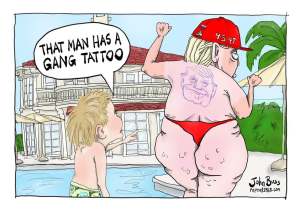
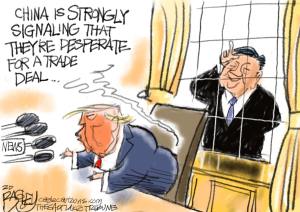 This tells us he’s willing to deal with corporations looking for exemptions. These first exemptions are for the Billionaire Tech Bros.
  The bottom line is that they all cause the price of the products to go up and generally reduce employment and availability of goods. Prices up. Unemployment up. That’s the basic definition of a country in a Stagflation Cycle. It’s the worst of both worlds because you get inflation and unemployment. I’ve dug into the numbers to date, and it appears the Walmart and Target leaders have legitimate fears. There are many trade publications that follow supply lines and chains. Obviously, railroads, ports, shipping, and air transit are important sectors because their business depends on goods in transit. Then they’re are the importers and exporters of the goods and services. You can see the loss of exchange by looking at the numbers. You know me. I love to make those numbers dance and sing. What you can see is that there are empty containers coming into ports. What this turns into is empty shelves.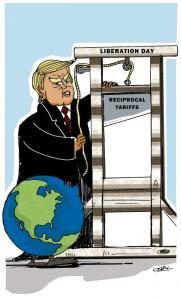
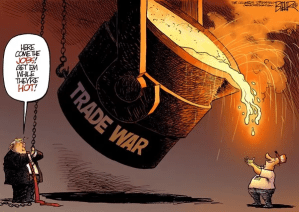 Here is more on empty shipping containers returning to American Ports from
  I suggest you plan accordingly. In another about face,
 I love this headline from
 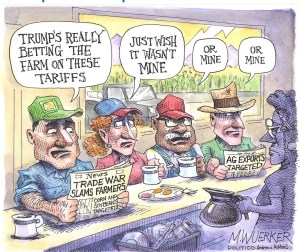 We’ve already received notice in Louisiana about the number of student VISAS yanked by the #FARTUS party. If it happens here, it’s undoubtedly happening all over the country. Jennifer Rubin has this advice on her
 If you are interested in tracking foreign students who have lost their VISAS, you may look at this from
 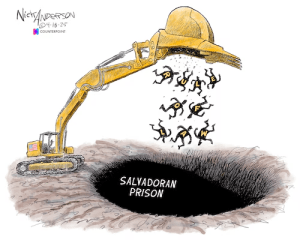 Luke Garrett,
 You may read about the story at the link. Here’s the information on the linked EO from
 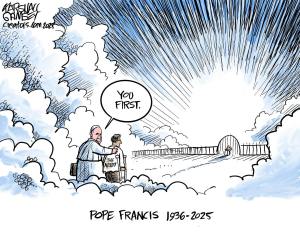 I imagine you’ve all heard that Pope Francis has exited the Earthly Door. I’m just sorry that one of the last faces he saw was that of J Dank. But maybe he wanted to give him a test after the Cardinal gave him a lecture on why deporting innocent people is not very Catholic of him.
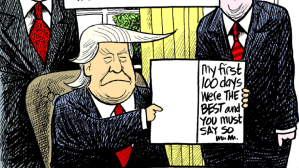 Trump’s 100th day in office officially happens this month on the 30th. So far, not good.
 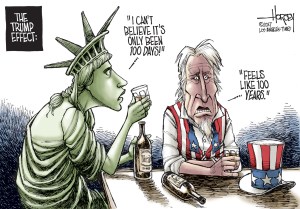 And yet, he persists. There’s a long list that follows. Seeing it all in print is disturbing. Zachary Basu has another take posted on
  There’s much to look forward to as we lurch towards the midterms. Little Marco Rubio is sure fucking up the state department. All you need to do is see a cabinet meeting. His face is telling. He looks like the only one who knows he’s going to hell. This is from NPR as reported by Graham Smith.
 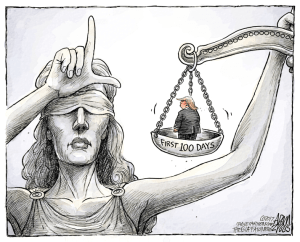 There is some good news on the front of Trump’s kidnapping and disappearing people to El Salvador. Chris Van Hollen (D-Md.) managed to get a meeting with Kilmar Abrego Garcia, as was his goal. Historian Heather Cox Richardson, writing at her
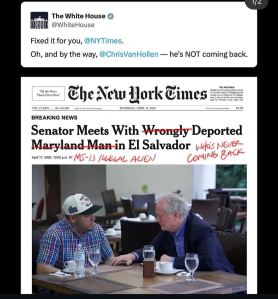
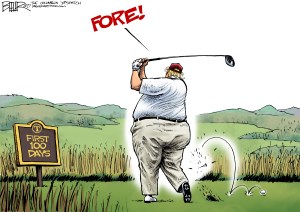 Trump threats to Fed Chair Powell scare the shit out of me. I am totally with Senator Elizabeth Warren on this statement.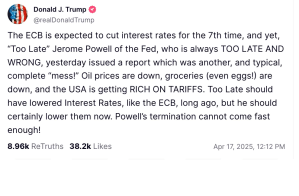

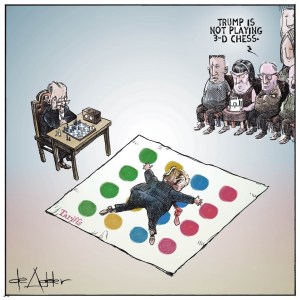 The Chinese are pranking Trump today. This is from the
 Turmoil over tariffs drove fluctuations in global markets on Friday.
 CNN has this headline today for a story written by Ella Nilsen.
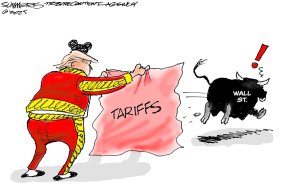 Additionally, NASA is on the chopping block! Does this include all that money going to Elonia? This is from
 We’re also unlikely to see other countries send their best and brightest to our US Universities with all this craziness. As some with with multiple degrees and ones that aren’t that easy to achieve, I would just like to say that my teachers, my students and grad assistants, and my colleagues and fellow students were consistently the best part of higher education school. I owe so much of my math chops to fellow students from India, Iran, Hong Kong, Turkey, and Taiwan. Both of my Doctorate advisors came here as students. One from India. The other is from Bangladesh. This brain drain will put us on the road to mediocrity.
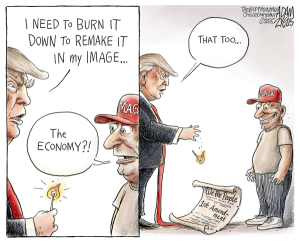 Indeed. Please go read this.
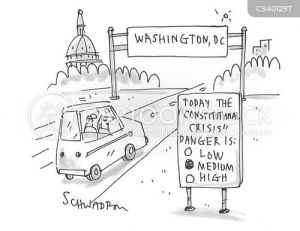 Human guardrails are not present in this administration. I’m not even certain you may call anyone in the administration fully human. Constitutional Guardrails are questionable even as we are not even in the first 100 days of this surreal mess. It’s no wonder former Yale History Professor Timothy Snyder and his wife have taken off for the Great White North. It appears
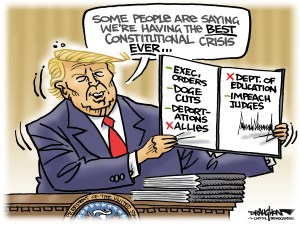 It’s the end-runs that worry me. He’s already got a history of back-to-back self-coups. I really don’t think most people realize how serious this is. FARTUS also has two Supreme Court justices in the tank for him; the rest of the right-wing majority is wobbly at best.
The other must-read article today comes from
It’s the end-runs that worry me. He’s already got a history of back-to-back self-coups. I really don’t think most people realize how serious this is. FARTUS also has two Supreme Court justices in the tank for him; the rest of the right-wing majority is wobbly at best.
The other must-read article today comes from 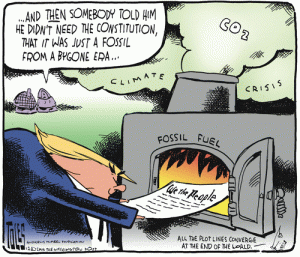 Remember the idea of visas for $5 million dollars? Well, now we know where that scatterbrained idea came from.
  One more read from me, and it’s off to the shower.
 peej
peej Carissa
 bostonboomer
 dakinikat
 ecocatwoman
 mablue2
 Mama Lopez
 peggysue22
 quixote
 skydancingguestblogger
 Mona (aka Wonk the Vote)



 Sky Dancing
Recent Comments