
More Proof that the World is run by the Rich for the Rich
Posted: January 29, 2011 Filed under: crops, Farming, Food | Tags: alfalfa, corruption, GM food, USDA, Vilsack 36 Comments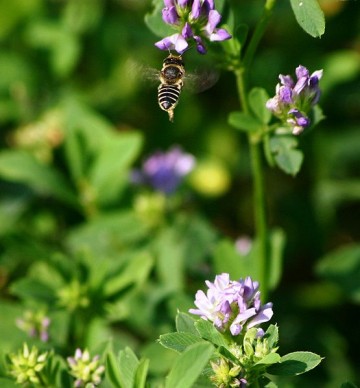
The Center for Food Safety took the USDA’s decision to allow unregulated planting of Round-Up Ready Alfalfa to court in 2005, all the way to the Supreme Court, and managed to stop any planting of the bio-mutated forage crop until the USDA had a full environmental impact statement ready. No more sneaking GM crops in the back door by pretending not to notice they were being planted, and then when forced to notice saying, ‘Oh My, Imagine that, how did THAT get there?’, with a hand to a cheek and a distressed look on their pretty little faces.
Didn’t we just do this?
Posted: January 5, 2011 Filed under: Environment, Farming, Food, toxic waste | Tags: bubble, commodity prices, corn, food, gm pigs, wheat 36 Comments(In which Sima works herself up into a frothing rant.)
Commodity futures prices, wheat, rice and corn, are rising again after a brief fall. In fact, they are supposed to top the records set in 2007/08 during the global food bubble.
Supposedly, Corn Rationing Needs to Begin:
“The corn market has one job and one job only—to go high enough to make people stop using the product,” says Ryan Turner, risk management consultant for FCStone, Kansas City. “We are past the point of encouraging more supply.” Turner predicts 2011 corn futures prices will exceed 2008 highs. “I don’t know if it will happen in January or June, but it will happen,” he says.
Soaring corn prices will slice into demand, with corn exports expected to fall first followed by feed usage. Analysts anticipate the cattle industry to begin rationing earlier than other livestock sectors due to poor margins, but rationing in poultry, hog, and dairy will be close behind. “It will be very painful,” Turner adds.
Those greedy so-and-sos! Imagine, eating corn and corn products? Making corn into feed to raise farm animals and then slaughtering those animals to feed humans. And furthermore, they feed the corn to dairy cows and produce milk and cheese and butter! Will the horror never end!
Obviously, everyone needs to suffer (UN: World Food Prices Hit a Record High in December). Especially the world’s poor. And those who produce the meat we Americans so love to eat are not to be excluded from the necessary pain. And those who produce the dairy we love to drink and nosh on with our imported European crackers. And those who make corn into tortillas, and those who make corn into corn syrup and those who make corn into ethanol… oh wait. Not those. In fact, those last ones may be part of what is driving the rise in corn prices. Nearly 1/3 of the 2010 US corn production was diverted to ethanol, after all.
Wikileaks and GMO/GM food, More cables, more fun!
Posted: December 28, 2010 Filed under: Economic Develpment, Farming, Food, Foreign Affairs, Wikileaks | Tags: Africa, cables, food, France, GM food, GMO, GMO food, monsanto, Spain, Wikileaks 24 CommentsRecently our own Grayslady posted an excellent article about Wikileaks, Monsanto and GMO Corn. She discussed a cable sent in late 2007 from our then Ambassador to France, Craig Stapleton, in which he discusses ways to force France and the EU to be more favorable towards the adoption of Monsanto’s GM BT enhanced, Roundup Ready corn. Other aspects of the information in that Wikileaks cable has been discussed in other places, for instance at Huffington Post by Jeffery Smith and at Truthout by Mike Ludwig.
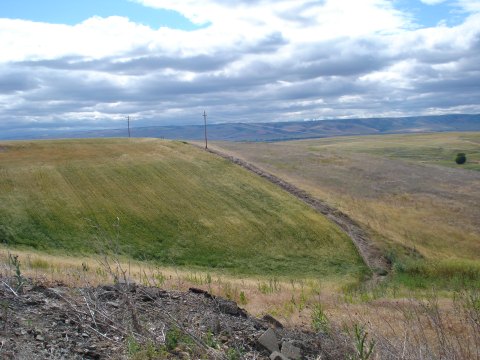
Wheat and Hay Fields near Pendleton, Oregon
What the cable suggested, in part, was publishing a ‘retaliation’ list of places, down to the actual fields, growing GMO foods in Europe in the hopes the fields and crops would be destroyed by activists, ’cause pain’ for officials and hopefully swing GMO acceptance in Europe around. The Ambassador went on to say that France was particularly culpable because scientists in France were attempting to change ‘knowledge’ by studying the effects of GMO products (even the ‘good’ GMO like BT enhanced products). These studies show that the effects of GMO food on those eating it may be more pronounced and drastic than the limited studies done by the FDA and USDA suggest (see for example the studies of Dr. Gilles-Eric Seralini, Professor Andrés Carrasco, and others). And for more, see this interview of Jeffery Smith on Democracy Now.
This is very interesting, because a cable sent in 26 October 2007 is the subject of French President Sarkozky’s first visit to the USA, and his meetings with American business leaders, including pushers of GM foods. The cable suggests that the President’s support of more restrictive rules on GM products in France might be politically based and therefore, changeable.
But Wait, There’s more! The cable to France, although receiving a lot of attention because it suggests undercutting the rightful government of our supposed allies and creating civil unrest and ‘pain’, is not the only released cable to mention GMOs and Monsanto’s needs across the world. Over at Eats, Shoots and Leaves there’s a good rundown by Richard Brenneman of some of the cables.
For example, in a cable from 9 April 2009 concerning, in part, African development, one of the points of intelligence to be gathered is the African governments’ and peoples’ reactions to growing and using GM crops. Brenneman rightly asks, why would this be a concern of our State Department, unless our government is actively pushing and supporting Monsanto and the company’s GM stable of crops?
I’m going to drop a final h/t to Rady Ananda at the Food Freedom blog. She wrote about GMO and Wikileaks several weeks ago, and has been right on top of things. She brings forth the case of the food crisis of 2007-08 which wraps up some of the things we at Sky Dancing discuss into a tidy bundle.
In a January 2008 meeting, US and Spain trade officials strategized how to increase acceptance of genetically modified foods in Europe, including inflating food prices on the commodities market, according to a leaked US diplomatic cable released by WikiLeaks.
Some of the participants thought raising food prices in Europe might lead to greater acceptance of biotech imports.
It seems Wall Street traders got the word. By June 2008, food prices had spiked so severely that ‘The Economist announced that the real price of food had reached its highest level since 1845, the year the magazine first calculated the number,’ reports Fred Kaufman in The Food Bubble: How Wall Street starved millions and got away with it.
The unprecedented high in food prices in 2008 caused an additional 250 million people to go hungry, pushing the global number to over a billion. 2008 is also the first year ‘since such statistics have been kept, that the proportion of the world’s population without enough to eat ratcheted upward,’ said Kaufman.
Remember back in 2007/08 when food prices, especially bread prices, suddenly shot up? I remember being astounded when the price of a bag of hot dogs went from 99 cents to 1.29$ overnight. I figured maybe it was the result of the rise in oil costs going on about then, and perhaps it was, in part. But after reading the article by Kaufman I’m not so sure. There was no crisis in food production at this time. It was simply a manufactured bubble. About that time there were terrible food riots in Mexico amongst 29 other countries, because the price of tortillas had gone up so much people couldn’t afford to buy them. I note that the Mexican government has recently taken steps to ensure this doesn’t happen again, by buying corn futures to guarantee a flat price.
So, I wonder, how are the big fat cats and the government diddling in our food today? Surely food, at least food, should be relatively safe from bubbles, like electricity, water, and sewage service? Oh wait, those are being commoditized too. Ahd I would like to point out, the price of the bag of hot dogs has not come back down, although the bubble burst… makes ya wonder, doesn’t it?
Note: I’m going to be in and out all today, so consider this something of an open thread. I’m really keen to know what everyone thinks of the Kaufman article. When I read it I was stunned by the lengths to which the greedy people of Wall Street will go to make money.
WikiLeaks and the Monsanto GMO Cable
Posted: December 24, 2010 Filed under: Farming, Wikileaks | Tags: Bacillus thuringiensis, Craig Stapleton, European corn borer, GMO, Monsanto MON0810 Bt corn seed, Wikileaks cables 25 CommentsIn amongst the cables released to WikiLeaks is one from 2007, in which Craig Stapleton, then U.S. Ambassador to France, suggested a “plan of retaliation” against the EU, and France in particular, unless the European nations agreed to purchase and plant Monsanto’s MON-810 Bt corn seed. The Ambassador lamented,
“In our view, Europe is moving backwards not forwards on this issue with France playing a leading role, along with Austria, Italy and even the Commission. In France, the “Grenelle”environment process is being implemented to circumvent science-based decisions in favor of an assessment of the “common interest.””
Well, now, we can’t have all these governments giving way to the “common interest”, can we? Never mind that the European food manufacturers themselves, other than feedlots, were already refusing to use GMO-based products due to proclaimed customer preferences. Not to mention, why the particular favoritism toward Monsanto, when Novartis Seeds, Mycogen Seeds and DEKALB Genetics also are major producers of Bt corn? Finally, why is an ambassador involved in promoting American food products? The USDA has highly competent staff in key locations around the world ready to assist U.S. food companies in making favorable contacts to increase offshore sales. I know, because I’ve dealt with them, and the staffers are excellent.
But let’s back up a bit and review the European corn borer, GMOs and Bt.
European Corn Borer
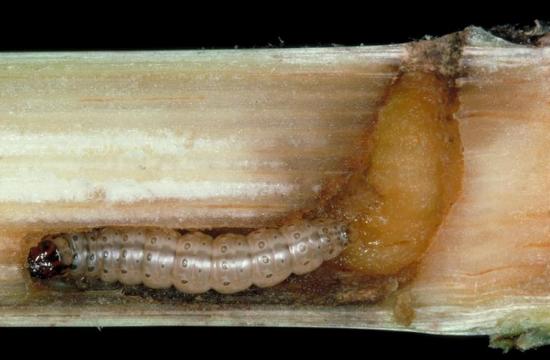
Tunneling European corn borer image courtesy of Iowa State University
The European corn borer is an introduced pest, meaning it is not native to the U.S. Scientists believe that it may have been brought to this country in the early 1900s in broom corn, imported from Hungary and Italy, used to manufacture brooms. During its early history, the borer only produced one generation per year; today, only the most northern states and Canada can expect to see one generation per year. In the central U.S.—the main area of corn growing—there are two generations per year, while the South and its border states can expect three generations per year. In the Deep South, growers can be looking at four generations per year. Clearly, insect management of this pest can be time consuming and expensive. Also, in spite of its name, the borer attacks sorghum, cotton and many vegetables.
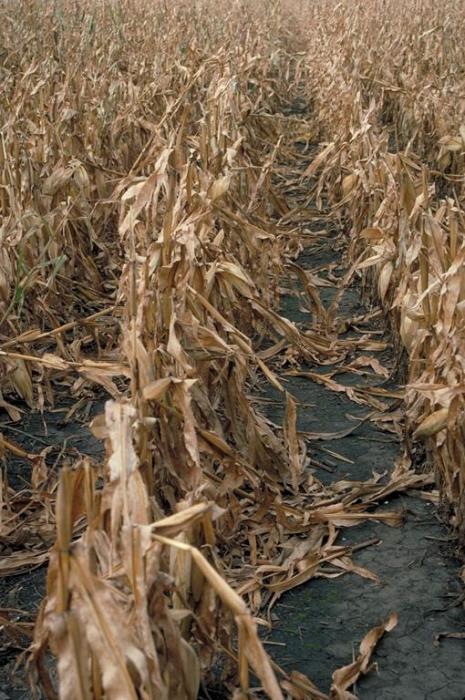
Field damage from European corn borer image courtesy of Iowa State University
There are at least half a dozen serious insect pests of corn (or maize, as it’s known scientifically), although the extent of pest infiltration can vary by geographic region, but the European corn borer is one of the most prevalent. As with all insects, climate conditions can affect populations from year to year. An eight year study in southern Minnesota, from 1988-1995, showed five years with low corn borer populations and three years with high populations. During the peak outbreak years, GMO corn fared much better than corn treated with insecticides. The Minnesota study indicated substantial economic benefit to farmers using GMOs during the peak infestation years. Unfortunately, scientists haven’t yet developed a method to determine pest populations in advance of the growing season, in order to allow farmers to make an economically effective seed purchasing decision. Additionally, cultural practices can affect borer populations. Fields grown to corn are rarely disked (plowed under) in the fall anymore, since agricultural entomologists have shown that exposure of the stalks to winter weather and foraging animals significantly reduces the number of potential pests the following spring.
There are cultural practices and biological predators that can be used to tackle the European corn borer as part of an integrated pest management program, but these take knowledge, time and long term planning, not to mention money. For further reading, I highly recommend this publication by Iowa State University.
GMOs
GMO is the acronym for Genetically Modified Organism. In truth, very few farms in the U.S. or Europe don’t use some form of genetically modified seeds: those seeds are called hybrids, and they’ve been around for a long time, both in horticultural and agricultural production. Hybrids are responsible for super-sweet corn, for grass that doesn’t need to be mowed more than once a month, for carrots that are extra sweet so that baby food manufacturers don’t have to add unnecessary sugar, and for virtually every annual geranium that can be grown from seed. Hybridization has been used to improve vigor, productivity and natural resistance to pests. In other words, plant breeders have achieved some significant improvements in the plants we grow, helping to meet the increased food needs of a growing world population. Today, breeders are working to develop strains that can be grown in less agriculturally friendly environments, so that African farmers, for example, will need far less water to grow their crops. These are all the positives of genetically modified seeds.
What are some of the negatives? Well, unlike open-pollinated seeds, hybrid seed is only good for one generation. In other words, if you want to grow the very same corn next year, for example, you have to buy new seed; seed collected from the plants themselves will not be true to type. For a big farm co-op, or even for an individual farmer in developed countries, this is simply part of the cost of doing business. But if you’re a subsistence farmer in the developing world, even though the hybrid might drastically improve your yields, if you can’t afford the more expensive seed to begin with, its benefits don’t matter much. There is also concern with GMO cross-pollination, in those species that are not self-fertile. Again, to a large co-op, with a monoculture crop, that has removed every twig or blade of grass within miles of its farms, there isn’t much worry about cross-pollination. There’s also little concern about perimeter weeds that can serve as vectors for disease. However, there is also no location where natural predators can thrive and breed, so these large co-ops become captives to chemical pest control.
Then we come to the newest hybrids, known as GMOs. These are not simply hybrids of the healthiest or tastiest stock, these are creations designed to incorporate chemicals into the gene coding of the seed in order to resist pests or broad spectrum herbicide applications, which may be why their use in food production has led to the derogatory term, “Frankenfoods”. There are a number of different GMOs, but I’m only going to focus on those that incorporate Bt.
Bacillus thuringiensis (Bt)
Bt is a naturally occurring bacterium primarily found in soil. It was first registered as an insecticide in 1961 and re-registered in 1998. As measured by its oral LD50 (the amount of substance that will kill 50% of the tested population), it is extremely safe. Bt can cause skin rashes, and while some claim to be allergic to the insecticide, it is more likely that dermal exposure to the powder creates the negative reaction. There is almost no movement of Bt within soil, so run-off into water systems isn’t a particular danger. Bt has a half-life of about two weeks, although it can be degraded more rapidly by sunlight. It is not toxic to fish, birds, or any other non-caterpillar insect. Human volunteers have actually consumed 1 gram of Bt per day for 5 days straight with no ill effects.
Bt has several different strains and is insect specific. For example, Bacillus thuringiensis israelensis is used to kill mosquito larvae, while Bacillus thuringiensis kurstaki is the most effective against caterpillars (larvae) of moths. Bt forms crystal proteins (Cry proteins), that, once ingested, latch onto receptors in the insect’s digestive system and release a toxin that causes death within a matter of days. Bt must be ingested to be effective, and it can only be used against the larval stage of the insect (the most active feeding time anyway during the insect’s lifecycle). It is most often used as a powder application for best plant coverage, although it also comes in a suspension form.
Since Bt is an organism, and not a chemical, it is generally recognized as acceptable for use by organic grower certification societies around the world. (There are no national standards for organic production yet, so most organic growers rely on certification guidelines issued by the various organizations to indicate the agricultural practices they follow.) So if Bt is so safe, why are those pesky Europeans complaining about GMO corn? Let’s look at some of the reasons that Europeans might not want Monsanto’s MON-810 foisted on them:
1. All the manufacturers of Bt corn seed are U.S. companies.
In spite of supposedly being a global economy, nationalistic pride remains a factor in trade decisions. The rest of the world isn’t necessarily keen to have the U.S. dominate agricultural markets.
2. Economics
Bt corn seed is more expensive than traditional hybrids or open-pollinated seed. Although it can be argued that Bt corn is more economical in years of high borer infestation, as the Minnesota study showed, if only three out of eight years resulted in severe population outbreaks, is it worth spending the extra money year after year?
3. Untested effects of Bt corn
Traditionally, Bt has only been applied when larvae are active. In those circumstances, Bt’s limited half-life means minimal exposure for humans. However, in GMOs, Bt is constantly present in the plant itself. Further, geneticists specifically designed Bt corn to produce much higher levels of Bt Cry proteins than those found in the traditionally applied insecticide. Does more Bt enter the food chain this way? And what about effects on reproductive and developmental systems? The EPA, which regulates insecticide use, doesn’t require this type of testing on insecticides that otherwise show no significant adverse health effects in mandatory disease and toxicity studies.
4. Insect resistance to Bt
Insects are incredibly adaptable. Over time, they can develop resistance to any consistently applied or available substance that interferes with their feeding opportunities. That’s why any sound integrated pest management program requires insecticide rotation. A constantly available supply of Bt is a real risk in resistance development by the European corn borer. The EPA and GMO manufacturers are aware of this problem, and the EPA now requires any land planted to GMOs to maintain a “refuge” where at least 20%-30% of the insect population will not be subject to Bt. The current management strategy for Bt corn resistance is a) hope that the higher levels of Bt in the GMO seed will kill off resistant larvae that can later develop into mating adults, and b) hope that non-resistant moths living in the refuge will mate with any resistant moths that should survive the Bt in the maize crop in order to prevent development of a totally Bt-resistant insect.
There is another risk to development of Bt resistance, and that is the risk to organic growers. Bt is really the primary line of defense for organic growers. Among the other insecticides listed for use on European corn borer, only permethrin, a synthetic chemical that combines the natural insecticides of the pyrethroids (members of the chrysanthemum family), has such low toxicity that it can be applied from 0-1 day prior to harvest. However, since permethrin is not totally natural, organic certification societies may not allow this insecticide to be used.
5. Cross-pollination issues
Corn pollen is fairly large and doesn’t travel very far on the wind. It also degrades on the ground within 1-2 hours on sunny days. Nevertheless, in order to avoid possible outcrosses, scientists recommend distancing GMO corn from other plants by a distance of 660 feet if the GMO planting is greater than 20 acres and from 165-660 feet if the planting is less than 20 acres. These distances may be achievable in the U.S., where land is plentiful, or even in countries such as Australia, but, for European farms, or even smaller American farms, 660 feet may be too significant an amount of non-productive land to offset the GMO benefits.
6. Particular characteristics of MON-810
Without getting too technical, MON-810 is designed to have Bt present in all parts of the plant, while some other GMOs only have Bt present in the leaves. In other words, MON-810 is a very aggressive approach to European corn borer management.
In summary, there are many reasons why Europeans, and other nations, might legitimately object to GMO corn being planted in their countries. The memo from Ambassador Stapleton strikes me as appallingly rude, ignorant and bullying, and I’m grateful to have this kind of undiplomatic behavior exposed.
S. 510 Passed with the Tester-Hagan Amendment
Posted: December 1, 2010 Filed under: Farming, legislation | Tags: farming, food, legislation, nais, S 510 28 CommentsAs many of you may have heard, S 510 the food safety bill, passed the Senate yesterday. I’ve discussed this bill once before. In that post I asked that people ask their Senators to vote for the Tester-Hagan amendment if they must vote for this poorly done bill. I’m happy to say the Tester-Hagan amendment passed with the bill, along with several other amendments that will make it a bit easier on small farmers. Thanks so much for writing and calling about this!
Even with bill’s passage all hope is not lost by any means. Because of Democrat foolishness, the Senate bill includes provisions about taxes, a House perogative. So the House Democrats will probably stop the Senate bill for a bit.
The bill has to be reconciled with the House version once all these mistakes are rectified, if they can be rectified. The House version of the bill is much, much harsher to small farmers. I might, therefore, be asking you all to write and call as the reconcilation process goes forward.
There are several other ways to stop the worst of this bill. One is when the UDSA/FDA/HSA (Why the heck is Homeland Security involved?) actually make up the rules. There will be hearings, committees, ‘listening’ sessions and more. Although the path to public involvement in these hearings is convoluted and arcane, it can be done.
For example, up until last year small farmers, and anyone who owned a horse, goat, sheep, cow, chicken, duck, or pig as a pet, had NAIS looming before them. NAIS, the National Animal Identification System, was to mandate an RFID for every ‘farm’ animal in this country. It was meant to facilitate disease outbreak tracing and enhance the ability for American meat producers to sell their products overseas.
NAIS mandated one RFID per ‘lot’ of animals. So a ‘lot’ of 10,000 chickens hatched, raised and slaughtered together would need one RFID tag. That’s great for a CAFO. But for a small farmer, who hatches maybe 100 chickens here, 100 there, or even less, it’s disaster. Each chicken or small lot would need a number. The system worked the same for horses, cattle, goats, etc. So I, with my 17 18 (keep forgetting the little one) goats, would pay 18 times what someone with 1,000 goats kidded at once would pay. Yea, that’s fair. The NAIS rules also meant a ton of other impositions. Farmers would be required to report any movement of animals within 24 to 48 hours. If you rode your horse down a trail, every farm you passed would have to report your movement into and off of their property. Take your pet goat to the vet in your car? Report that movement within 24 to 48 hours or face a fine. Animal die? Report it. Animal born? Report it. Animal moved to a different pasture through a common area? Report it. In order to facilitate all this reporting your property would be registered as a ‘premises’ and given a ‘premises number’. Legally, the owner of a premises has a different set of rights, lesser rights, than the owner of property.
When the particulars came out the government ignored the unrest. Then the listening sessions started, and they had to add more, and more. Comments on the Federal register grew long and loud. The listening sessions were attended by people 80% to 95% against NAIS. People dared the government to pass it, promising stubborn, non-violent resistance.
NAIS died last year, supposedly. Funding was dropped by Congress and the FDA/USDA stopped pushing it. However, elements of it are in the S 510 bills.
We can do this again with the Food Safety Act. We can make it palatable and workable for the little farmers. People power CAN fight against corporate ruled government if we are united. Unity is the key. With NAIS all sides came together to fight it. I was on mailing lists with people who became rabid tea-partiers. I didn’t agree with their solutions for everything, but I, and other liberals like me, did agree with how to fight NAIS. And so when someone made a political comment, the rest of us chastized them. ‘The list is only about NAIS, keep the rest out of it. We need everyone to fight it.’ This kind of unity is going to have to happen more and more, to fight against government take-over of our rights to privacy, freedom of speech, travel, and more. I welcome it.
Added the following to discuss the Washington Post article mentioned by BB in her great news roundup. These are my admittedly argumentative thoughts on the points in the article. I think the Food Safety bills could be good, but they need to be gone over very carefully and the wording needs reflect reality. It’s too vague right now.
Point 1: ‘ Would require farmers and food manufacturers to put in place controls to prevent bacteria and other pathogens from contaminating food.’
The bill requires ‘GAPS’ (Good Agricultural Practices) to be put in place for farmers. These are basically flow charts that are meant to identify problem areas and tell the farmer how to prevent them. They probably work ok for a farmer who grows 10000000000 acres of lettuce. However, I grow about 2 4 x 100 ft beds of lettuce, 4 4 x 100 ft beds of broccoli, 8 4 x 100 ft beds of potatoes… well you get the idea. I’d have to have a GAPS, generally designed by a food engineer ($$$$) for each vegetable and for how the growing of each vegetable impacts the other. I really resent this kind of linear, engineering thinking that is applied to everything. Learning about, and deciding to follow ‘good agricultural practices’ is something every farmer does. If they don’t, they go out of business.
Point 2: ‘Would require the Food and Drug Administration to regularly inspect all food facilities, with more frequent inspections in higher risk facilities. ‘
Who defines ‘higher risk’? Right now, it seems the FDA thinks little dairies and creameries are high risk. The factories that produced the 550 million egg recall had the equivalent of ‘GAPS’ in place. They had inspections, and got fined and written up, over and over again. Most of the HAACP (equivalent of GAPS) stuff requires them to self inspect and self report. The problems in these factories were ongoing over years. But a little cheese producer that has never tested positive for listeria is shut down because a California seized sample, held in improper conditions by the government, stripped of all the actual tracing lot numbers which are supposed to allow backtracing of food by that same government, ad nauseum, came back positive for listeria.
Point 3: ‘Would allow the FDA to order a mandatory recall of any product it suspects may harm public health. ‘
This one sounds great. Of course, the FDA basically already has this ability. Note the wording ‘suspects may harm’. This could mean that a small farm or food producer is effectively destroyed while the FDA determines with the glacial slow movement of government facilities dragging their collective feet, that the farm/food producer did nothing wrong.
Point 4: ‘Would improve disease surveillance, so that outbreaks of food poisoning can be discovered more quickly’
I like this one. But how are they actually going to do it? More testing I suppose. Who pays? The consumer and the farmer. What about testing post slaughter, post canning, post wrapping, etc?
Point 5: ‘ Would require farmers and food-makers to maintain distribution records so that the FDA can more quickly trace an outbreak to its source. ‘
This is NAIS-like. At one time the government was talking about requiring every head of lettuce or broccoli to have an RFID. Interesting concept, and it may come to that. It would provide great tracing, until the RFID is removed. And even then, what if you return to the store with an RFID tag from lettuce that you said made you sick. You neglect to mention you ate that lettuce right after you cleaned the cat box… RFID tags won’t do anything about post-slaughter contamination, which is where MOST of the contamination of meat happens. The tag is removed from the animal when it’s slaughtered, of course.
Having said that, I don’t know of a farmer or food-maker that doesn’t maintain distribution, aka sales, records. Maybe it’s different in the big ag operations.
Point 6: ‘Would require foreign food suppliers to meet the same safety standards as domestic food-makers. ‘
I love this one. Could we reverse it and make it so that our food suppliers have to label GMO products and so on? That would rock.
Point 7: ‘Would exempt small farmers and food processors.’
This is good. I’ll believe it when I see it. Tester’s amendment says that small food producers have to abide by either the state regulations or the fed regulations. In practice, the fed usually tells the state how to regulate, or withholds money. So it’s all one in the same. I’m a bit worried about the part (they might have removed this in the final bill) that sends a farmer to jail for 10 years if they ‘distribute adulterated food’. The problem is the definition of distribute, adulterated and even food. Heh. Raw yogurt can be considered adulterated by some, because it’s still got the little raw beasties in it that make it so good.
Final point: ‘Would add 17,800 new FDA inspectors by 2014.’
I’ll believe that when I see it. Paid for by what? Are they going to be like the TSA? Who’s training them?

 peej
peej Carissa
 bostonboomer
 dakinikat
 ecocatwoman
 mablue2
 Mama Lopez
 peggysue22
 quixote
 skydancingguestblogger
 Mona (aka Wonk the Vote)



 Sky Dancing
Recent Comments