
Monday Reads: What are we doing to our fragile ecosystems?
Posted: March 31, 2014 Filed under: Climate Change, Environment, Environmental Protection, Environmentalists, morning reads 45 Comments
Good Morning!
Is it too late to notice that our consumerist society is a lot like a swarm of parasitic insects clinging to the belly of a rapidly dying host? What are we to do when so many wealthy individuals prey on the superstitions and ignorance and greed of our fellow citizens to ensure their wealth grows while our planet dies? They convince us we need more than we do, underpay us, entice us with loans and plastic, then ship themselves off to pristine virgin island bank havens while we are surrounded by the chemicals, the death, and disasters that hyper-consumerism has wrought.
How can you possibly deny what we are doing to our home? Here are the top five items from a ‘terrifying” report presented over the weekend..
The impacts of climate change are likely to be “severe, pervasive, and irreversible,” the chair of the Intergovernmental Panel on Climate Change said Sunday night in Yokohama, Japan, as the world’s leading climate experts released a new survey of how our planet is likely to change in the near future, and what we can do about it.
Here’s what you need to know:
We’re already feeling the impacts of climate change. Glaciers are already shrinking, changing the courses of rivers and altering water supplies downstream. Species from grizzly bears to flowers have shifted their ranges and behavior. Wheat and maize yields may have dropped. But as climate impacts become more common and tangible, they’re being matched by an increasing global effort to learn how to live with them: The number of scientific studies on climate change impacts, vulnerability, and adaptation more than doubled between 2005, before the previous IPCC report, and 2010. Scientists and policymakers are “learning through doing, and evaluating what you’ve done,” said report contributor Kirstin Dow, a climate policy researcher at the University of South Carolina. “That’s one of the most important lessons to come out of here.”
Heat waves and wildfires are major threats in North America. Europe faces freshwater shortages, and Asia can expect more severe flooding from extreme storms. In North America, major threats include heat waves and wildfires, which can cause death and damage to ecosystems and property. The report names athletes and outdoor workers as particularly at risk from heat-related illnesses. As the graphic below shows, coastal flooding is also a key concern.
Globally, food sources will become unpredictable, even as population booms.Especially in poor countries, diminished crop production will likely lead to increased malnutrition, which already affects nearly 900 million people worldwide. Some of the world’s most important staples—maize, wheat, and rice—are at risk. The ocean will also be a less reliable source of food, with important fish resources in the tropics either moving north or going extinct, while ocean acidification eats away at shelled critters (like oysters) and coral. Shrinking supplies and rising prices will cause food insecurity, which canexacerbate preexisting social tensions and lead to conflict.
Coastal communities will increasingly get hammered by flooding and erosion. Tides are already rising in the US and around the world. As polar ice continues to melt and warm water expands, sea level rise will expose major metropolitan areas, military installations, farming regions, small island nations, and other ocean-side places to increased damage from hurricanes and other extreme storms. Sea level rise brings with it risks of “death, injury, ill-health, or disrupted livelihoods,” the report says.
We’ll see an increase in climate refugees and, possibly, climate-related violence.The report warns that both extreme weather events and longer-term changes in climate can lead to the displacement of vulnerable populations, especially in developing parts of the world. Climate change might also “indirectly increase” the risks of civil wars and international conflicts by exacerbating poverty and competition for resources.

There have been so many disasters just recently that it’s hard to keep track. You can see our handprints on many of them. Has the policy of clear cutting timber created situations like the Washington State mudslide? Many scientists and environmentalists say yes.
As rescue workers, specially trained dogs, and heavy equipment move carefully through the area, longstanding questions are being raised about logging there and how it might have contributed to the slide.
The hillside in and around the slide area, which slopes steeply down toward the river, has seen much clear-cut logging over the years. Much of the forest there is second- and third-growth timber, replanted or regenerating naturally after earlier cuts.
Concern over logging’s impact has involved environmentalists and native American tribes. Large, old-growth trees take up more water than younger stands, which can take decades to mature and may be cut down before they reach full maturity. The demand for lumber, plywood, paper, and other wood products is part of an industry that once dominated Washington State and Oregon.
The Tulalip Tribes were so concerned with landslides hitting the Stillaguamish River and its prime salmon habitat that they blocked a proposed timber sale above an earlier slide in 1988.
“There were some very large clear-cuts planned for that area, which made us very concerned,” Kurt Nelson, a hydrologist with the tribes, told KUOW, the NPR affiliate at the University of Washington in Seattle.
“That reach of the North Fork has multiple, ancient, deep-seated landslides,” Mr. Nelson said. “There’s a lot of unstable terrain in that area.”
Landslides have followed logging in that area at least four times, KUOW reported.
“There was cutting in the 1940s; it failed in the ’50s. There was cutting in 1960, then it failed in the mid-’60s. There was cutting in ’88; it failed in ’91. There was cutting in 2005, and it failed in 2006 and in 2014,” said geomorphologist Paul Kennard, who worked for the Tulalip Tribes in the 1980s and now works for the National Park Service at Mt. Rainier.
“This had been known at least since the ’50s as one of the more problematic areas on the Stillaguamish for perennial landsliding,” Mr. Kennard said.
Although state logging regulations have been tightened in recent years, The Seattle Times reports that a clear-cut nine years ago “appears to have strayed into a restricted area that could feed groundwater into the landslide zone that collapsed Saturday.”
An analysis of government geographical data and maps suggests that a logging company “cut as much as 350 feet past a state boundary that was created because of landslide risks,” the newspaper reported.
This is an area above the most recent slide. Scientists and officials are investigating whether that clear-cut could have contributed to the current disaster.
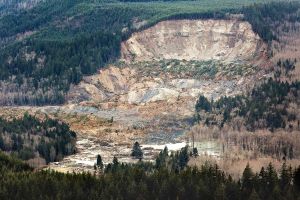 Scientists tell us that mudslides are inevitable when you treat these mountains as we do and we fail to recognize that some places just aren’t meant for human habitation. However, tell that to the developers.
Almost 25 years ago, I went into one of the headwater streams of the Stillaguamish with Pat Stevenson, a biologist with the American Indian tribe that bears the same name as the river and claims an ancient link to that land. The rain was Noah-level that day — just as it’s been for most of this March.
We drove upriver, winding along the drainage of Deer Creek, one of the main tributaries of the Stillaguamish. We couldn’t see Whitehorse Mountain, the dreamy peak that towers over the valley, that day. We could barely see beyond our windshield wipers. At last, we arrived at an open wound near road’s end. I’d never witnessed anything like it: an active slide, sloughing mud and clay down into the formerly pristine creek. We watched huge sections of land peel and puddle — an ugly and terrifying new landscape under creation before our eyes.
Stevenson pointed uphill, to bare, saturated earth that was melting, like candle wax, into the main mudslide. Not long ago, this had been a thick forest of old growth timber. But after it was excessively logged, every standing tree removed, there was nothing to hold the land in place during heavy rains. A federal survey determined that nearly 50 percent of the entire basin above Deer Creek had been logged over a 30-year period. It didn’t take a degree in forestry to see how one event led to the other.
The Stilly, as locals call the river, is well known to those who chase fish with a fly rod, and to native people who have been living off its bounty for centuries. Zane Grey, the Western novelist, called it the finest fishing river in the world for steelhead, the big seagoing trout that can grow to 40 pounds. What Stevenson showed me that day in a November storm was how one human activity, logging, was destroying the source of joy and sustenance for others. When the crack and groan of an entire hillside in collapse happened a week ago Saturday, I thought instantly of Stevenson and that gloomy day at Deer Creek.
And, sure enough, logging above the area of the current landslide appears to have gone beyond the legal limits, into the area that slid, according to a report in The Seattle Times.
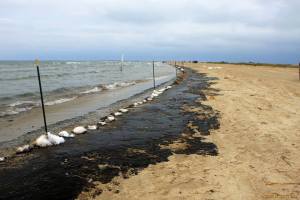 Meanwhile, the latest oil spill disasters take their toll in both the North and South of this Country. There are still long lasting effects in Alaska and in the Gulf of those giant oil spoils. But, even Galveston Bay shows sign of permanent damage from its latest brush with deadly oil that’s no where near the size of those other two. It’s getting to be that no one’s back yard is safe.
Authorities in charge of the cleanup from last week’s Houston Ship Channel oil spill say they’re responding to reports of oil near North Padre Island and Mustang Island, some 200 miles southwest of the original accident.
The command center for the cleanup reports Sunday that oil sightings were made earlier in the day by crews aboard flights being conducted by the Texas General Land Office and the U.S. Coast Guard.
Some tar balls — from dime-size to about 6 inches — have been spotted in seaweed patches along Mustang Island’s J.P. Luby Beach but it’s not certain if they are related to the spill a week ago between Galveston and Texas City.
The spill endangers wildlife nearby. There is a bird refuge that is in a particularly precarious location. That was also the clean side of the Gulf where 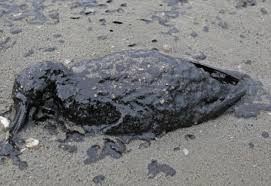 you could still trust the fish and the seafood.
The spill, which dumped what one Texas official referred to as “sticky, gooey, thick, tarry” oil that doesn’t evaporate quickly into Galveston Bay, occurred about eight miles from the Bolivar Flats Shorebird Sanctuary, which attracts 50,000 to 70,000 shorebirds each year. March is right around spring migration for many species of birds, and other birds are still wintering at Bolivar Flats, so tens of thousands of birds are living at the sanctuary, which is designated a Globally Significant Important Bird Area. Cleanup crews are using cannon booms to try to deter birds away from oiled beaches, and so far, oil hasn’t washed up on Bolivar Flats, but birds that have come in contact with oil in the water or on other beaches have been landing there.
Houston Audubon Society volunteers have been tracking the oiled birds they see at Bolivar, and Jessica Jubin, development director at the Houston Audubon Society, told ThinkProgress that the group was “definitely seeing more” oiled birds now than when they first started the day after the spill. She said on Monday, volunteers cataloged 40 to 50 oiled birds at one spot at Bolivar Flats, and on Tuesday, they counted about 100 at the same site. On Wednesday, she said, the number increased to about 140, with most birds ranging from just a few spots of oil on them to half covered in oil.
It’s the shorebirds and seabirds that are most at risk of becoming oiled from the spill, Jubin said.
“Like pelicans, for example — I don’t know if you’ve ever watched them fish, but they will soar in the sky and then spot something down below and then dart right into the water, and that’s how they get so much oil on them,” she said. “They can’t distinguish whether or not the oil is there, and they don’t know how to react to it.”
Mike Cox, spokesperson at the Texas Parks and Wildlife Department, told ThinkProgress the agency has so far collected 45 oiled birds in the Galveston area, with 19 birds in rehabilitation and 26 that were found dead. Jubin said Audubon was reporting birds they saw to Texas Parks and Wildlife and the U.S. Fish and Wildlife Service, but she worries about the movement of the oil. If it drifts too far south or west, it could end up in important habitat for endangered whooping cranes. Already, the oil has reached the ecologically-sensitive Matagorda Island, soiling at least 12 miles of the barrier island’s pristine beaches. So far, however, the Parks and Wildlife Department hasn’t received reports of oiled wildlife from Matagorda Island, Cox said, and crews were working to put up booms to keep the oil from getting into Matagorda Bay.
But birds aren’t the only wildlife at risk from the oil spill. As the Texas Tribune reports, marine scientists are worried that the spill could result in long-term health effects on Texas marine life. The thick fuel oil that spilled Saturday is persistent, so marine species could be even more at risk from oil-related defects like irregular heart rhythm and cardiac arrest than they were from the Deepwater Horizon disaster. Shrimp are a major part of the Galveston Bay fishing industry, and they’re also among the species most vulnerable to the oil spill — if their marshy homes are polluted with oil, they may not survive.
That, of course, doesn’t include the danger to the people and the clean up workers.

In 1790, a freed slave named Jim Moss found a place to settle down on a bend in the Houston River in the bayous of southwest Louisiana. Although never formally incorporated, the village of Mossville became one of the first settlements of free blacks in the South, predating the formal establishment of Calcasieu Parish by 50 years. But over the last half century, Mossville was surrounded. More than a dozen industrial plants now encircle the community of 500 residents, making it quite possibly the most polluted corner of the most polluted region in one of the most polluted states in the country. Now, a proposal to build the largest chemical plant of its kind in the Western Hemisphere would all but wipe Mossville off the map.
The project, spearheaded by the South African chemical giant SASOL, will cost as much as $21 billion, but stands to benefit from more than $2 billion in incentives (including $115 million in direct funding) from the cash-strapped state budget. It has the backing of Republican Gov. Bobby Jindal, considered a likely 2016 presidential candidate, who traveled to the outskirts of Lake Charles for the official announcement of the plan in 2012. The state thinks it’s an economic slam dunk. One study from Louisiana State University projected that it would have a total economic impact of $46.2 billion. It is the largest industrial project in the history of Louisiana. And after a community meeting on Tuesday, it’s one step closer to realization.
But that massive plant will come with a steep environmental price. It will produce more greenhouse gases than any other facility in the state. And the project will almost certainly spell the end for the 224-year-old settlement of Mossville, a poor enclave that has been forced to play host to industrial facilities no one else wanted in their backyard.
An analysis conducted by the Louisiana Department of Environmental Quality (DEQ) in February determined that the new project “will result in significant net emissions increases” of greenhouse gases, promethium, sulfur oxide, nitric oxide, and carbon monoxide. By its calculations, the plant will spew out more than 10 million cubic tons of greenhouse gases per year. (By contrast, the Exxon-Mobil refinery outside Baton Rouge, a sprawling complex that’s250 times the size of the New Orleans Superdome, emits 6.6 million tons.)
It’s beginning to feel a lot like we’re trapped between a future envisioned in the “Blade Runner” and that envisioned in Margaret Atwood’s “The Handmaid’s Tale”. Either way, the outcome will be sponsored by the likes of the Koch brothers and we will soon discover the fresh hells they’ve created for us. The dominionists and the capitalists join together to force their earth and its people into submission.
What’s on your reading and blogging list today?
Mona Lisa’s Skeleton, Festive Edinburgh, Mischa Maisky….
Posted: August 15, 2013 Filed under: Environmental Protection | Tags: Amerigo Vespucci, cave fish, Edinburgh International Book Festival, eggplant, Francesco del Giocondo, Gherardini, Jack Longino, Leonardo da Vinci, Lisa Gherandini, Machiavelli, Mischa Maisky, Mona Lisa, predatory ants, predatory beetles, the Fringe 8 Comments
Last week, Huffpost reported on the latest developments in the apparent discovery of Mona Lisa’s grave. Pretty awesome if the tomb does indeed hold the remains of Lisa Gherandini. Perhaps even more exciting than finding Mona Lisa herself, are the forensic techniques employed to identify her:
Mona Lisa’s Supposed Skeleton May Finally Solve Centuries-Old Mystery
For historical background on Lisa Gherandini, her husband Francesco del Giocondo, and their Florentine milieu, see the following Mona Lisa Foundation article. It is lengthy, but interesting for all the famous names woven into Lisa Gherandini’s family circle. Apparently, “Mona Lisa” was related to Amerigo Vespucci and may have been acquainted with Machiavelli:
Francesco [Lisa’s husband] also had a relative, Giannetto Giocondo, operating a branch of the family business in Lisbon. In turn, Giannetto had business dealings with Amerigo Vespucci, a relative of Agostino Vespucci, who was Machiavelli’s assistant. The Machiavelli and Gherardini families both came from the same parish: Santa Trinita. So between inter-marriages, family, business and political connections, it is not surprising that a lasting union between the Gherardini and del Giocondo families was arranged.
Who knew?
Who were Francesco del Giocondo and his wife Lisa Gherardini? » The Mona Lisa Foundation
Arts news from elsewhere: In Scotland, the Edinburgh International Book Festival launched its 30th season coinciding with the Fringe, the alternative performance arts festival. This year it runs from the 2nd to the 26th. The Book Festival runs from the 10th-26th.
About Us | Edinburgh International Book Festival
About us | Edinburgh Festival Fringe

Sadly, now that the Fringe has grown so large, it might be experiencing some growing pains. Or maybe something else has happened to the great happening in Edinburgh.
Edinburgh festival: are we in a fringe recession? | Stage | theguardian.com
Pippa Bailey’s article is embedded in the Guardian link, but I thought I’d just draw attention to it because I think her primary concerns hold relevance beyond the evolution of the Fringe:
Reflections on Fringe | Biding Time

Inserting a digression here on political theater and dramatic comedy… backing up to move forward… I found this in my stack of obscure things, and it seems fitting to mention it here in the context of creative theater…. it’s a spitting invective against plays, players and the role of the stage in society, published 1587, entitled A Mirror of Monsters.
The full title, entertaining in and of itself (edited for spelling):
A Mirrour of Monsters wherein is plainely described the manifold vices, & spotted enormities, that are caused by the infectious sight of playes, with the description of the subtile slights of Sathan, making him his instruments.
A couple of choice bits (edited for spelling):
Players are caterpillars and cankers that cleave to the branches of forward wits… What men are these? (nay rather monsters) that thus corrupt so sweet a soil: such are they, as in outward show seem painted sepluchres, but dig up their [deeds], and find nothing but a masse of rotting bones.
I’m rather partial to the word cleave because it denotes dual and diametrically opposed meanings. Depending on its usage it could mean “to stick” or “to split.” Another fragment:
They color their vanity with humanity: Some term them comedians, othersome players, many pleasers, but I monsters, and why monsters? Because under color of humanity, they present nothing but prodigious vanity. These are wells without water, dead branches fit for fuel, cockle amongst corn, unwholesome weeds, amongst sweet herbs, and finally, fiends that are crept into the world by stealth, and hold possession by subtile invasion.
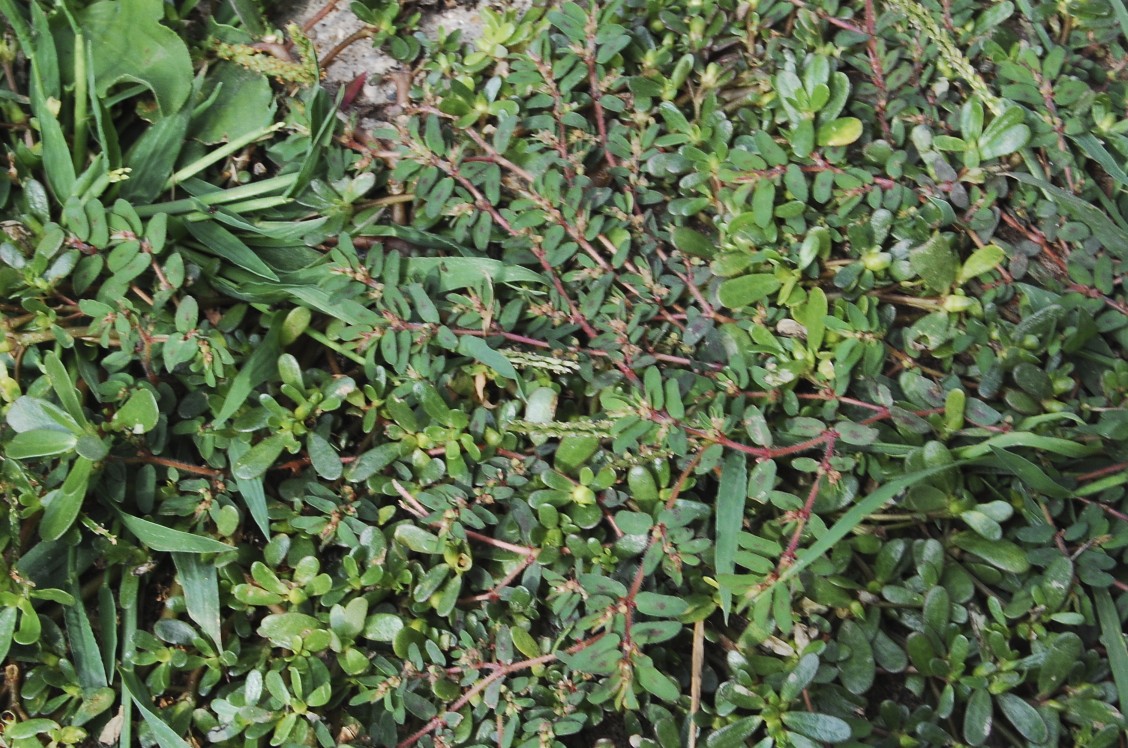
Give me the unwholesome weeds any day. As to weeds, I encourage them in my garden. I even have pet weeds that overgrow the sidewalk to cushion my step. Who wants to walk on hard concrete? I took some snapshots of the darling masses which serve as my “walking weeds;” they make lovely patterns in between the cracks of the sidewalk. Here’s an engaging clump of variegated weeds that keep my foot steps cushy:
Meanwhile on the biodiversity front, another mirror of monsters…
33 undiscovered species of predatory ants surface in the New World. This new cache of ants will apparently give you the willies according to Jack Longino, the myrmecologist who has described them:
Their faces are broad shields, the eyes reduced to tiny points at the edges and the fierce jaws bristling with sharp teeth.
They look a little like the monster in ‘Alien.’ They’re horrifying to look at up close. That’s sort of what makes them fun.
New Ant Species Named After Hellish Mayan Demons : Animals : Nature World News
NPR’s interview with Longino and some good photos of the ants:
Jack Longino, ‘The Astonishing Ant Man,’ Finds 33 New Species : NPR
100 new species of predatory beetle discovered in Tahiti:
Tahiti: A very hot biodiversity hot spot in the Pacific | e! Science News
And a new species of cave fish is found in Madagascar:
New species of cave fish identified – CBS News

Of course nothing stimulates the appetite like ants, beetles, and fever-inducing cave fish…. and as it happens I’ve found a couple of really excellent recipes for the new variety of eggplant I’m growing in my garden. The fairy tales (pictured at left) are smaller than the classic eggplant, and they look a bit like the purple eggplants Tom Philpott uses in his Baba Ghanoush:
Tom’s Kitchen: The Coolest, Easiest Summer Eggplant Trick | Mother Jones
Apparently, fairy tales don’t need to be leached of bitterness like classics do, the skins are edible, and excellent for grilling. I haven’t tried it yet, but from what I understand, it’s super easy. Just slice them lengthwise in about 1/2″ strips, brush with oil and seasonings then grill on each side for one minute to one and a half minutes.
And now for something entirely unrelated, just because I dig it:
That’s what’s on my mind this afternoon, what’s on yours? Anybody have ideas for eggplant?
Ann Romney’s “Revealing” Interview With Good Housekeeping Magazine
Posted: October 28, 2012 Filed under: 2012 presidential campaign, birth control, Environmental Protection, Hillary Clinton, Labor unions, Mitt Romney, public education, religion, U.S. Economy, U.S. Politics, VAGINA MItt Romney | Tags: Ann Romney, Bain Capital, charter schools, George Romney, michelle obama, privatization of education, teachers unions 83 Comments
Good Housekeeping has published interviews with Michelle Obama and Ann Romney. The editors call the interview with Romney “revealing,” and I’d have to agree–though probably for different reasons than theirs.
The headline revelation has to be that Ann Romney wants to “throw out the” education “system.”
GH: Can you tell me, what campaign issue is closest to your heart?
AR: I’ve been a First Lady of the State. I have seen what happens to people’s lives if they don’t get a proper education. And we know the answers to that. The charter schools have provided the answers. The teachers’ unions are preventing those things from happening, from bringing real change to our educational system. We need to throw out the system.
Romney doesn’t elaborate on what “answers” the charter schools have provided or which improvements teachers unions are preventing. But a number of studies have found problems with charter schools, and there doesn’t seem to be any evidence that students’ test scores are better overall in charter schools than public schools.
As for the teachers unions, I realize that Ann’s husband would like to eliminate all unions and reduce workers’ pay as much as possible. Certainly privatizing education through charter schools would be a good way to eliminate teachers unions.
Ann Romney was certainly a lot more explicit about the goal of ending public schools in this interview than her husband has been. Perhaps Mitt isn’t worried about the reactions of readers of Good Housekeeping. He probably thinks they’re just a bunch of silly airheads.
Ann gave several other answers that I found pretty stunning. In response to a question on why her husband should be president, Ann said:
I’d say because of his life experience, starting with the example [his father] George Romney set of being successful in his family and business and then serving in a political sphere. [He showed] what a difference being involved in politics makes. The formula from his perspective was, you never get involved in politics unless you’re financially secure and your children are raised. So when our children were older and Mitt had made a bit of money, there was his father’s example that you find ways to serve and give back.
So I guess anyone who isn’t a millionaire shouldn’t run for office? Or does “a bit of money” mean hundreds of millions to Ann? Clearly Obama shouldn’t have run with those two young daughters! Back to Ann’s pontificating:
That’s also what drew us to the Olympics. Mitt gave up everything, walked away from a very lucrative position [to lead the Salt Lake Organizing Committee for the 2002 Olympics]. It was just a little square inch of light that you walk into saying, “I think this is the right thing to do.” You get that confidence from intuition and prayer…all of those things where no one’s going to give you a blueprint of how life is going to turn out.
“Mitt gave up everything?” WTF?! At this point it should be clear to anyone who is paying attention that Mitt Romney never really left Bain Capital. The Boston Globe reported in July that Romney didn’t resign from Bain in 1999 as he has claimed, but instead took a leave of absence and only negotiated his severance package in 2002 when he decided to run for governor of Massachusetts. The severance package kept him earning money from current Bain investments for ten more years. Romney was even listed as CEO of Bain on the Olympics website and during public appearances at the time. Even now Romney is still profiting from the company he founded.
Ann Romney is every bit as full of shit as her husband is. She says that Mitt would help the economy by “getting rid of regulation,” and “using our natural resources,” (meaning open up national parks to oil drilling) but she acknowledges that in places like China where there is no environmental regulation,
the pollution and the air quality is just abysmal, and people are having to live in that. You understand how important it is, but you also have to recognize that we have to balance those things.
Right. We “have to balance” the rights of the rich to feed their endless greed with the rights of the 99.9% of Americans to clean air and water.
Ann says that as First Lady she would continue to work with at-risk young people. I didn’t realize she had done that, so I looked it up. According to Wikipedia,
Ann Romney has been involved in a number of children’s charities, including having been a director of the inner city-oriented Best Friends, which seeks to assist inner-city adolescent girls. She advocated a celibacy-based approach to the prevention of teen pregnancy. She worked extensively with the Ten Point Coalition in Boston and with other groups that promoted better safety and opportunities for urban youths. She was an honorary board member of Families First, a parent education program in Cambridge, Massachusetts. She was a volunteer instructor of middle-school girls at the multicultural Mother Caroline Academy in Boston.
She has said her interest in helping underprivileged children dates back to when she and her five boys saw a vehicle carrying a group of boys to a Massachusetts Department of Youth Services detention center. She began volunteering for the United Way of Massachusetts Bay soon after that, and by 2002 was serving as one of that organization’s board members. She was on the Faith in Action Committee for the United Way, working with local religious establishments to assist at-risk children and helping to found United Way Faith and Action. Earlier, by 1996, she was a member of the Massachusetts Advisory Board of Stand for Children.
Please note that Stand for Children is an organization that has worked to reduce protections for teachers and undermine the power of teachers unions.
A couple more of Ann’s answers really bugged me. There was the one in which she praises Mitt for saying it was OK if Ann couldn’t cook all his meals for him when she was suffering from MS:
You have to find something that’ll pull you away from those scary places. And it was my husband telling me, “I don’t care if you’re in a wheelchair for the rest of your life. I don’t care whether you make dinner; I can eat cold cereal and toast. As long as we’re together, as long as you’re here, we’re going to be OK.”
Why couldn’t Mitt cook his own damn meals? How hard is it to open a cookbook and learn the basics? If he just couldn’t bring himself to do that, he could hire a cook–and other servants as well–to help his sick wife. They were hardly struggling to make ends meet!
But here’s the most annoying statement Ann made in the interview:
GH: Who are your heroes? Your role models? Don’t say your husband, even if it’s true. (Laughing)
AR: I would say Eleanor Roosevelt, Mother Teresa…and Hillary Clinton. She has been through so much; she just kept going. Now she’s doing a great job as Secretary of State.
Mother Theresa was a hypocrite just like Ann, I buy that one. But I don’t believe for one minute that she agrees with Eleanor Roosevelt or Hillary Clinton on anything.
Goodbye Flipper?
Posted: April 9, 2012 Filed under: Environment, Environmental Protection, Gulf Oil Spill, just because | Tags: baby dolphin deaths, Cape Cod, dolphins, offshore oil drilling, oil companies, oil spill, Peru, seismic sound waves, sonar 9 Comments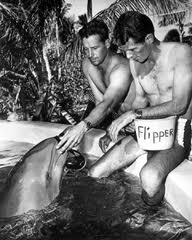
Rick O'Perry, right, and another dolphin trainer with Flipper
Flipper, an Atlantic bottle-nosed dolphin, was one of the biggest television stars from 1964 – 1967. There were actually 4 dolphins who played Flipper on the screen. Most of the series was filmed behind the scenes at the Miami Seaquarium on Virginia Key in Biscayne Bay. The success of the Flipper franchise made dolphins a lovable species around the world. The true story of Flipper, the dolphin and the making of the television series, is told by Ric O’Barry, Flipper’s trainer, in his book Behind The Dolphin Smile. For those of you who were born after the 1960s, you may have seen dolphins in captivity at marine parks or even had the opportunity to swim with dolphins at one of these attractions. (NOTE: I do not support dolphins in captivity)
Due in large part to people’s exposure to Flipper or dolphins in captive environments, there has been increased interest in and concern for dolphins around the world. Since the beginning of this year dolphins worldwide have been stranding themselves and dying in record numbers. The reasons for these deaths are slow in coming. Bear in mind that the numbers listed below are like the tip of an iceberg. Only those dolphins found onshore are listed. Those who died at sea, whose bodies were never discovered and/or recovered are not included in the mortality/stranding counts.
THE GULF STATES – GULF OF MEXICO – February, 2010 – now
When the first report of the explosion and oil leak of the Deepwater-Horizon in the Gulf of Mexico was announced, I knew that we were about to witness one of the greatest environmental disasters in the history of the U.S. It had the potential to outpace the Exxon-Valdez spill off the coast of Alaska – and it did. In case you never saw the official mortality record from the U.S. Fish & Wildlife Service, their last report from April, 2011 lists the statistics on birds, sea turtles and marine mammals impacted.
Of course, those numbers don’t tell the whole story. They don’t include unrecovered animals, nor the impact on breeding or toxins passed on to the offspring of the survivors, nor the poisoned food sources available to the survivors. Please don’t get me wrong. The people living in the area are exposed to the same toxins, but they, at least, may be treated for the illnesses that result from their exposure. And, the people aren’t living in the water, surrounded by the oil and corexit, a toxic substance used to disperse the oil. People also can choose what they will eat, which isn’t the case for the birds, fish, turtles and marine mammals living and swimming in this toxic soup.
Since February of 2010, 693 dolphin deaths have been documented in the Gulf of Mexico. A good compilation of the news coverage can be found at Reef Relief.
An ongoing die-off of dolphins in the Gulf of Mexico has resulted in 693 carcasses washing ashore. Scientists believe many more dolphins likely died but were never recovered. An investigation is underway to determine whether the BP oil spill is to blame. (Press-Register/Ben Raines)
Many of the dolphins in Barataria Bay, LA are sick, according to researchers. The AL.com blog has a full story on what researchers have found through taking both blood and tissue samples.
Thirty-two dolphins caught in August in Louisiana’s heavily oiled Barataria Bay were found to suffer from a range of symptoms including anemia, low body weight, hormone deficiencies, liver disease, and lung problems.
Those symptoms are typical of mammals exposed to oil in laboratory experiments, scientists said.
According to the Gulflive.com blog, of the 30 dolphins who washed ashore since January, 2012, 24 have been calves.
“We are dealing with a very unusual mortality,” said Moby Solangi, director of the Institute for Marine Mammal Studies in Gulfport. “It is mostly calves. Generally when you see a stranding it is a variety of animals — adults, males, females, young.”
The second anniversary is approaching and the legacy of this catastrophe mostly lives on with those people, animals and plants along the Gulf Coast who survived. This story from the one year anniversary has some amazing and heartbreaking photos: http://www.boston.com/bigpicture/2011/04/gulf_oil_spill_one_year_later.html This recent story paints a more current picture of the state of the Gulf Coast.
Laurel didn’t find dead turtles on a recent stroll on her Gulfport shores, which she now calls “death beach.” But walking along she smelled something bad. After poking around in the sand, she found the nauseating source: a dead baby dolphin’s tail, decomposing and buried not more than a few inches in the sand. An out-of-work shrimper came a long and picked it up, and when he realized what it was he started to sob: “This really ruins my day…” Laurel remembers. Tourists looked at it incredulously, Laurel says, their kids screaming, ‘Mommy, it’s a dolphin’s tail!’
The attention of the rest of the country has turned to other news stories, having been lulled into a false sense that everything has returned to normal by all of those commercials, funded by BP and the states’ tourist boards. The bodies of the dead and dying animals tell a different story. But dolphins, in particular, aren’t just dying along the Gulf Coast.
CAPE COD – January – February, 2012
177 dolphins have stranded themselves in Cape Cod. Once again the cause or causes of the high number of dolphins ending up on the beaches of Cape Cod are simply guesses. In mid-February, 11 stranded dolphins were found onshore in Wellfleet.
The remote inlet down Wellfleet’s Herring River is a place where the tides recede fast and far, and that’s left the animals mired in a grayish-brown mud one local calls “Wellfleet mayonnaise.”
News coverage of the incident details the stranding and actions taken to save the dolphins. Sixty dolphins stranded in Cape Cod. The full story tells that only 19 could be rescued.
A single dead dolphin calf was found in Queens, NY.
Kim Durham, the foundation’s rescue program director, tells the Daily News there were “no signs of trauma.” Researchers say an increasing number of common dolphins have been spotted in the Northeast in the winter, which may be attributable to climate change and a steady improvement in environmental cleanliness in the waters off the Rockaway peninsula.
Although no official cause for the strandings has been announced, there are some who think Naval operations in the area could be to blame.
Again, just as in the months of January and February Naval activity is taking place in the Atlantic. Even government Funded IFAW Katie Moore who has denied Naval involvement despite evidence of Naval activity can no longer deny the possibility of sound being the source of these tragic deaths along the Atlantic Coastline, “
And these deaths may not be the only ones which may be attributable to sonar type activities taking place in the oceans.
PERU – February – April 2012
To locate possible oil and/or gas deposits, seismic surveys are conducted with the use of air guns by releasing high pressure air. This passage from the Canadian Centre for Energy Information report was particularly interesting.
Offshore seismic surveys require government approval and must comply with strict environmental regulations, including a pre-survey environmental assessment. Programs are designed to avoid fish spawning seasons and sensitive fishery areas. During the first half-hour of a survey, the energy level of the discharges is gradually increased so that fish and aquatic mammals have an opportunity to move out of the area.
That paragraph is telling. The fish and other marine life are given a full half hour to “leave the area.” Are these people serious? Any of the marine life in area will understand the increasing sound waves are a signal to vamoose? Maybe they should try transmitting in Morse Code, it would make as much sense. Dolphins, like all cetaceans, use echo location to find food, navigate in their habitat and communicate with each other. Needless to say, these high pressure sound waves can do massive damage to marine life, especially dolphins and whales. If you are interested in more detailed information on dolphins and the use and effect of sound, check out this lesson plan: http://www.pac.dfo-mpo.gc.ca/education/documents/porpoise-marsouin/harbourporpoise_lesson4_e.pdf
Of all these recent stranding episodes, the largest die-off is occurring off the coast of Peru. Over 3000 dead dolphins have washed ashore since the incident began. Once again, authorities and researchers are cautious about announcing the cause of the massive numbers of dead dolphins. Some have attributed the deaths to the search for offshore oil deposits in the ocean floor. More information, along with photos and video on this massive die- off can be found at The Watchers and at SF Gate, CNTV and on the blog StrandedNoMore.
For the time being, drilling for oil is a necessary evil. There are many downsides to onshore drilling, but drilling offshore has far greater along with potentially catastrophic problems. This Hub Pages blog entry by Cheryl has a comprehensive discussion of offshore drilling.
It seems evident to me that we, humans, are the culprits in the deaths of these magnificent, highly intelligent animals. Whether through releasing toxins into the environment or sending shockwaves through the ocean, we are killing them. Why? OIL – our endless quest to drill for more and more and more oil. And our tax dollars continue to subsidize this industry, while these oil companies make vast amounts of profit. Then we get to pay again, at artificially inflated prices, when we pump the resultant gasoline into our vehicles. We are complicit, intentionally or not. But Bill McKibben, of 350.org can say it better than I.
Whether or not the bill passes, those subsidies are worth focusing on. After all, we’re talking at least $10 billion in freebies and, depending on what you count, possibly as much as $40 billion annually in freebie cash for an energy industry already making historic profits.
How to Fight Corporate Greed And Actually Make A Difference
Posted: March 13, 2012 Filed under: #Occupy and We are the 99 percent!, corporate greed, corporatism, Environment, Environmental Protection, Environmentalists, globalization, science, social justice 11 CommentsYesterday I posted the rather dismal news about Pennsylvania’s Act 13, a corporate-driven piece of legislation that bows on bended knee to the gas and oil industry at the expense of citizen and community civil rights. All for the love of fracking, natural gas and profits. Did I mention there’s a glut of natural gas on the market right now? The price has dropped like a stone due to oversupply and the incredibly mild winter we’ve had in the States. Prices, however, are much higher elsewhere. Asia and Europe, for instance. And energy companies are pushing for permits to build LNG [liquid natural gas] terminals for that very purpose. According to Forbes magazine:
A thousand cubic feet of natural gas currently costs $14 to $15 in Asia, $8 to $9 in Europe, and $4 in North America, down 9 percent from what it was at the outset of 2011.
That could make corporate CEO’s and investors very grumpy.
It could also make Pennsylvania residents grumpy. It’s bad enough to compromise the environment, jeopardize water supplies and threaten the health of American citizens but then the product is exported elsewhere for increased profits? I can hear heads exploding.
The Forbes article indicates the high investment cost on LGN terminals could easily make this scheme impractical. But the scale of these problems and the power that large corporations wield seem depressingly insurmountable. With energy solutions, the problems are magnified. We need energy to keep on, keeping on. The question is finding a balance between getting the energy we need and what we’re willing to accept as ‘collateral damage.’ It can make your head hurt.
Karma must have led me to an article by Jim Schultz, the executive director of the Democracy Center, an organization that works globally to educate citizens on effective advocacy for environmental and social issues. His article, ‘Three Ways to Beat Corporate Giants’ improved my mood immensely.
Make It Personal
 The example Schultz provides is the Bolivian Water Revolt against Bechtel and the World Bank’s meddling. I’d heard about the 2000 revolt previously, the privatization of the public water supply in Bolivia’s third largest city, Cochabamba. Within weeks of taking over, Bechtel raised water prices by nearly 50%. The poor were literally forced to choose between food or water. Massive protests resulted in the city as rural people joined the pushback. The president, Hugo Banzer, tried repressing the opposition but protests continued unabated. A resulting 4-day workers’ strike brought the strife to an end–Banzer cancelled the Bechtel contract.
However, what I didn’t know [or didn’t remember] was that Bechtel attempted to sue the citizens of Cochabamba for $50 million, though their investment was reportedly less than $1 million. Activists then made the fight personal. Their goal? Make the life of CEO Riley Bechtel and his top management team miserable. They flooded their personal accounts with email. They derided their names and actions at every opportunity in the media. They protested in front of the company’s headquarters and the officer’s private residences. Ultimately, the protest prevailed. Bechtel settled for a token payment of 30 cents.
Add Humor To Your Protests
The plan to replace a coal-fired station is featured, a project in southwest England to be built by a German energy company. Environmentalists and grassroot activists used protests, petitions and civil disobedience—standard fare. But they also added a twist. Since the new station was advertised as ‘clean coal,’ protestors showed up to publicly scrub coal in front of the German company’s office [E. On Energy] and then sent a Santa brigade to deliver the coal to ‘naughty’ executives. This action caught the attention and favor of the public. Ultimately, the protest worked—the energy company withdrew its plans and the UK government pledged not to approve any other coal-fired stations without carbon capture and storage capabilities [a technology yet to be fully developed].
Concentrate On Shareholders
The successful campaign against Occidental Oil Co. and their plans to drill in the Columbian ‘cloud forest,’ focused on the primary investors of the oil field development plan. The region, which is the tribal home to the indigenous U’wa people, the environmental threat to the bio-diversity of the area and the fear of armed violence from the country’s FARC rebels fueled massive protests on Fidelity Investments, a primary shareholder of Occidental. It was through the protests and the exposure of the U’wa people’s way of life—their spiritual connection to the forest, what they stood to lose–that convinced [maybe shamed] the business world to withdraw support and funding for the project. Another win.
In the end, our national and global problems look insurmountable and corporate power certainly appears invincible at first glance. It’s a good refresher to realize that there have been victories and there are citizens, here and abroad, willing to put it on the line and speak out against the rise of corporate greed and bullying. Activists may not win all the battles. But they’ve won some and continue to pushback. For that, I salute them. It’s also a reminder as one Occupy sign shouted out:

And then, I stumbled across this video. It made me laugh and laughing is good for the soul. I’d file this under category #2 in Jim Schultz’s guidebook. Sometimes humor can make a statement of its own.

 peej
peej Carissa
 bostonboomer
 dakinikat
 ecocatwoman
 mablue2
 Mama Lopez
 peggysue22
 quixote
 skydancingguestblogger
 Mona (aka Wonk the Vote)



 Sky Dancing
Recent Comments