
Senator Warren wants to know why our Jails aren’t filled with Banksters
Posted: February 15, 2013 Filed under: Elizabeth Warren Campaign, financial institutions | Tags: CFTC, FDic, FED, Financial instituions, FPB, OCC, Senator Elizabeth Warren 5 Comments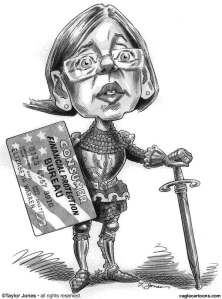 Well, Senator Elizabeth Warren is not disappointing any one.
Bank regulators got a sense Thursday of how their lives will be slightly different now that Elizabeth Warren sits on a Senate committee overseeing their agencies.
At her first Banking, Housing and Urban Affairs Committee hearing, Warren questioned top regulators from the alphabet soup that is the nation’s financial regulatory structure: the FDIC, SEC, OCC, CFPB, CFTC, Fed and Treasury.
The Democratic senator from Massachusetts had a straightforward question for them: When was the last time you took a Wall Street bank to trial? It was a harder question than it seemed.
“We do not have to bring people to trial,” Thomas Curry, head of the Office of the Comptroller of the Currency, assured Warren, declaring that his agency had secured a large number of “consent orders,” or settlements.
“I appreciate that you say you don’t have to bring them to trial. My question is, when did you bring them to trial?” she responded.
“We have not had to do it as a practical matter to achieve our supervisory goals,” Curry offered.
Warren turned to Elisse Walter, chair of the Securities and Exchange Commission, who said that the agency weighs how much it can extract from a bank without taking it to court against the cost of going to trial.
“I appreciate that. That’s what everybody does,” said Warren, a former Harvard law professor. “Can you identify the last time when you took the Wall Street banks to trial?”
“I will have to get back to you with specific information,” Walter said as the audience tittered.
“There are district attorneys and United States attorneys out there every day squeezing ordinary citizens on sometimes very thin grounds and taking them to trial in order to make an example, as they put it. I’m really concerned that ‘too big to fail’ has become ‘too big for trial,'” Warren said.
Friday Reads
Posted: November 9, 2012 Filed under: Elections, Elizabeth Warren Campaign, Gun Control, morning reads | Tags: Elizabeth Warren, fiscal cliff, NRA, Planned Parenthood 88 Comments
Good Morning!
Much is being made of the election results that delivered a sound thumping to Republicans and their agenda to restrict the rights of women and minorities and to provide benefits to the wealthy and powerful. A record number of women will be serving in the US Senate. Five new women will be headed there. Of all the significant races, Senator-elect Elizabeth Warren appears to have garnered the most hope and angst. Simon Johnson considers her election “important”.
Senator Warren is well placed, not just to play a role in strengthening Congressional oversight but also in terms of helping her colleagues think through what we really need to make our financial system more stable.
We need a new approach to regulation more generally – and not just for banking. We should aim to simplify and to make matters more transparent, exactly along Senator Warren’s general lines.
We should confront excessive market power, irrespective of the form that it takes.
We need a new trust-busting moment. And this requires elected officials willing and able to stand up to concentrated and powerful corporate interests. Empower the consumer – and figure out how this can get you elected.
Agree with the people of Massachusetts, and give Elizabeth Warren every opportunity.
Laura Gottesdiener thinks Warren’s election may usher in the end of the Tea Party.
Warren, who beat out the incumbent Republican Scott Brown in a bitter election, ran a campaign centered on connecting the dots between economic policies and personal values. A Harvard bankruptcy-law professor, Warren trumpeted a platform that called for economic reform, financial regulation and the protection of Social Security, Medicare and other safety-net programs.
“We said this election is about whose side you’re on,” Warren told The Huffington Post . “I think of this as an election where we stuck to our values: Make sure Social Security and Medicare benefits are protected, and millionaires and billionaires pay their fair share. To me, that’s the heart of it. That’s really where the basic social contract is reaffirmed.”
This type of populist platform became increasingly risky after Citizens United allowed for the infusion of billions of dollars into state elections. Warren was already well disliked on Wall Street for her role in creating and heading the Consumer Financial Protection Bureau, a watchdog agency that seeks “to make markets for consumer financial products and services work for Americans — whether they are applying for a mortgage, choosing among credit cards, or using any number of other consumer financial products.”
Warren may be given a seat on the powerful senate banking committee which has to be worrying Wall Street.
Senior Senate Democratic aides, speaking on condition of anonymity, said the Massachusetts senator-elect is a logical fit for the committee, even though it is rare for a freshman senator to get such a plum assignment.
If she gets the slot, Warren’s bully pulpit would be replaced with real power.
The bipartisan panel can greatly influence policy decisions through its oversight of financial services, international trade, insurance, housing, securities and economic issues.
Warren, who has called for breaking up the big banks, could move to block legislative tweaks to the 2010 Dodd-Frank financial oversight law that would blunt the full impact of profit-pummeling reforms.
She would also be able to forcefully push for regulators to use all the powers available to them to write strict interpretations of rules.
That could mean stronger curbs on Wall Street trading, higher capital buffers and rules that would compel mega-banks to shrink.
Warren and other Senators will have to watch the President and Speaker of the House as they battle of the so-called fiscal cliff before getting their say in the budget.
While no can say for sure how the negotiations to avoid the so-called “fiscal cliff” — the expiration of the Bush tax cuts and impending across-the-board spending cuts — will unfold, the betting here is it will get ugly before it gets better.
First, virtually no one believes what happened last time will happen this time: President Obamawon’t cave on extending tax cuts for upper income earners.
So will House Republicans come to the table voluntarily, before the first of the year? Or will it require all hell breaking loose — an expiration of the income and payroll tax cuts, sequestration, the estate tax, and the AMT kicking in, cap gains and dividend rates rising — before they are forced to come kicking and screaming to an agreement?
The president holds a lot of leverage here — not just because he just won, Democrats expanded their majority in the Senate, and gained seats in the House. He holds leverage because, structurally, we’re talking about tax cuts that are expiring. His position is clear: The rate for the wealthiest will be allowed to go up. If he is willing to go to the wall and let the the lower rates expire, pressure shifts to House Speaker John Boehner to make a deal before his conference is isolated by the business community, which more than anything wants D.C. to just cut a deal, and Senate Republicans, who cut a deal and sold Boehner out last time. Add to that a tanking market and mounting economic hysteria, and that’s a lot of pressure on the House GOP true believers, Allen West or no Allen West.
The conventional wisdom is that Obama and Republicans will make a short term deal on taxes and sequestration — kicking that can down the road yet again — contingent on agreement on a “framework” for tax reform to be done in the first part of 2013.
There is incentive for Boehner to try and make an early deal, before the first of the year. The question, as always, is will he have the votes to allow tax rates on the wealthy to rise? Seems doubtful. He would have to be a pretty firm and big commitment from Obama on tax and entitlement reform to get them to go along.
Is it a matter of who will blink first? Here’s a conversation between Ramesh Ponnuru and Margaret Carlson. This is Ponnur’s take.
Does Boehner mean that tax reform should raise money by cutting tax breaks more than it cuts tax rates? Or does he mean that it should raise money just by encouraging economic growth?
If it’s the first, Boehner is going to have a problem with conservatives — especially Grover Norquist, the party’s anti- tax enforcer. If it’s the second, he’s not talking about much revenue.
That’s a bargain that sounds grand to me, but liberals who just won an election might disagree, don’t you think? My guess is he’s being ambiguous so he can gauge the reaction.
Another question: What leverage does Boehner have, and what leverage does he think he has? Obama doesn’t have to cut any deal to get a lot of extra revenue. He can let taxes go up as scheduled and challenge the Republicans to cut them only for the middle class. Republicans can either go along or decide not to and then blame him for the resulting middle-class tax hikes. Who likes their odds better in that fight?
Republicans have another bit of leverage, beyond the threat of blaming Democrats for tax increases: We’re getting close to hitting the debt ceiling again, and in the normal order of thingsHouse Republicans would have to agree to lift it.
Carlson has this to say.
In an election that was otherwise a debacle for Republicans, the House held its majority, and Boehner holds the gavel as long as he coddles his most extreme members. So he will.
Meanwhile, the president (unless you see something in him, Ramesh, that I don’t) still believes in this hope-y, change-y stuff Republicans consider a joke. He still sees himself as a historic figure that can bridge the partisan divide.
It is Boehner’s tiny, eensy-weensy bit of openness to dealing with Obama that is enraging conservatives. At the same time, it is playing to Obama’s view of himself. The president’s signature trait is an inability to negotiate from strength. He leads with his best offer. If Obama were buying a car, he’d probably pay full price and leave without radial tires.
In fairness to Obama, it’s foolish to call the bluff of an opposition that’s already shown it will allow the U.S. to default on its debt.
You’re right, Ramesh, that Obama doesn’t have to do anything at all to raise revenue. But he can’t risk raising taxes on the working and middle classes when the economy is still shaky. Republicans, by contrast, are willing to risk anything.
One of the quiet victories of the election is the failure of the NRA whose candidates didn’t do well this election.
The Sunlight Foundation, a campaign watchdog group, found that the NRA’s Political Victory Fund – the political arm of the nation’s largest gun lobbying organization – spent almost $11 million for or against individual candidates in the general elections, but got less than a 1 percent return on its investment.
The NRA, for instance, spent more than $7.4 million in opposition to President Obama and almost $1.9 million in support of Mitt Romney, according to Sunlight. But Obama was the victor on Tuesday, and the NRA had similar bad luck trying to influence Senate and House races.
For example, the group put almost $538,000 behind Indiana Senate contender Richard Mourdock (R), who lost, and spent more than $512,000 to oppose Sen. Sherrod Brown (D-Ohio), who won, according to Sunlight.
Conversely, Planned Parenthood did an outstanding job!
Planned Parenthood’s political wing trounced other groups with a near perfect return on its election spending, according to a new numbers review.
The Sunlight Foundation found that Planned Parenthood’s advocacy arm and super-PAC spent about $5 million and $7 million, respectively, to oppose Republicans and support Democrats in the general election.
In the end, the two groups saw returns on investment of about 98 and 99 percent, according to Sunlight.
The figures come as election-watchers pick apart the most expensive cycle in history. Republicans’ loss in the presidential race and failure to claim the Senate came as a surprise to outside donors, many of whom spent millions to ensure GOP victories.
Planned Parenthood’s political wing played an outsized role in the general election, compared to cycles past. The flood of political activity came as Republicans vowed to end Planned Parenthood’s federal funding as a healthcare provider for low-income women. Conservatives argue that while the law technically bans public funds from supporting abortions, taxpayer money need not flow to a group that performs the procedures.
The election covered a wide range of women’s health issues in addition to public funds for Planned Parenthood, giving the group ample chance to advocate in favor of abortion rights and access to free birth control.
The only outside groups that came close to beating Planned Parenthood’s return on investment were Majority PAC, which fought for Democratic Senate candidates, with a success rate of about 88 percent, and the Service Employees International Union PEA-Federal, with about an 85 percent success rate.
I’ll end with offering some beautiful finds in a Thracian burial site in Bulgaria.
The researchers found fragments of a wooden box, containing charred bones and ashes, along with a number of extremely well-preserved golden objects, dated from the end of the 4th and the beginning of the 3rd century B. C.. They include four spiral gold bracelets, and a number of intricate applications like one which shows the head of a female goddess adorned with beads, applications on horse riding gear and a forehead covering in the shape of a horse head with a base shaped like a lion head. The objects weigh 1.5 kg, but the excavations continue.The precious find also contains a ring, buttons and beads. Gergova explains that it seemed the treasure was wrapped in a gold-woven cloth because a number of gold threads were discovered nearby.
The Professor says these were, most likely, remnants from a ritual burial, adding the team expects to discover a huge burial ground, probably related to the funeral of the Gath ruler Kotela, one of the father-in-laws of Philip II of Macedon. She notes this is a unique find, never before discovered in Bulgaria.

What’s on your reading and blogging list today?
Thursday Reads
Posted: November 1, 2012 Filed under: 2012 elections, 2012 presidential campaign, Barack Obama, Elizabeth Warren Campaign, Media, Mitt Romney, morning reads, U.S. Economy, U.S. Politics | Tags: auto bailout, Bob Kerrey, Chris Christie, Chrysler, Chuck Hagel, Claire McCaskill, Elizabeth Warren, FEMA, General Motors, Hurricane Sandy, Joe Donnelly, lies, Richard Mourdock, Tammy Baldwin, The Lincoln Club 35 Comments
Good Morning!!
I have a potpourri of great reads for you this morning, so let’s get started.
First up, people in the states impacted by Hurricane Sandy have barely begun to recover. CBS News/AP report that: The scale of post-Sandy challenge in NY, NJ is unprecedented.
Two major airports reopened and the New York Stock Exchange got back to business Wednesday, while across the river in New Jersey, National Guardsmen rushed to feed and rescue flood victims two days aftersuperstorm Sandy struck.
For the first time since the storm slammed the Northeast, killing at least 63 people and inflicting billions of dollars in damage, brilliant sunshine washed over the nation’s largest city — a striking sight after days of gray skies, rain and wind. The light gave officials and residents a true glimpse of destruction on a scale that the region has never seen before.
At the stock exchange, running on generator power, Mayor Michael Bloomberg gave a thumbs-up and rang the opening bell to whoops from traders on the floor. Trading resumed after the first two-day weather shutdown since the Blizzard of 1888.
New York’s subway system was still down, but Gov. Andrew Cuomo said parts of it will begin running again on Thursday. And he said some commuter rail service between the city and its suburbs would resume on Wednesday afternoon.
In New Jersey, Gov. Chris Christie and his new BFF Barack Obama toured the devastation. From The New York Times: An Unlikely Political Pair, United by a Disaster.
President Obama toured the storm-tossed boardwalks of New Jersey’s ravaged coastline on Wednesday, in a vivid display of big-government muscle and bipartisan harmony that confronted Mitt Romney with a vexing challenge just as he returned to the campaign trail in Florida.
The scene of Mr. Obama greeting his onetime political antagonist Gov. Chris Christie in Atlantic City was a striking departure from what has become an increasingly bitter campaign, marked by sharp divisions between Mr. Romney’s more limited view of the federal role and Mr. Obama’s more expansive vision. The president placed a hand on Mr. Christie’s back and guided him to Marine One, where the two men shared a grim flight over shattered sea walls, burning houses and a submerged roller coaster.
Speaking to storm victims at a community center in the hard-hit town of Brigantine, Mr. Obama said, “We are going to be here for the long haul.” Mr. Christie thanked the president for his visit, saying, “It’s really important to have the president of the United States acknowledge all the suffering that’s going on here in New Jersey.”
The tableau of bipartisan cooperation, and the Federal Emergency Management Agency’s highly visible role in the aftermath of Hurricane Sandy, has put Mr. Romney in an awkward position…
As for Mitt Romney, he was getting hammered by the media in Ohio for two ads in which he falsely implied that Chrysler and GM were planning to ship American jobs to China. It looks to me as if Romney has given up the ghost in Ohio, because he headed to Florida yesterday, where a new Quinnipiac poll shows Obama leading by one point.
And last night the NYT editorial board slammed Romney for “cross[ing] a red line.”
When General Motors tells a presidential campaign that it is engaging in “cynical campaign politics at its worst,” that’s a pretty good signal that the campaign has crossed a red line and ought to pull back. Not Mitt Romney’s campaign. Having broadcast an outrageously deceitful ad attacking the auto bailout, the campaign ignored the howls from carmakers and came back with more.
Mr. Romney apparently plans to end his race as he began it: playing lowest-common-denominator politics, saying anything necessary to achieve power and blithely deceiving voters desperate for clarity and truth.
I think Romney may have finally sunk his campaign with those lying ads about the auto bailout. I wonder if that has contributed to polls that show Obama widening his leads in Michigan and Wisconsin?
In the Nebraska Senate Race, Bob Kerrey has been moving up in the polls, and last night Omaha.com broke some exciting news that could put him over the top: Chuck Hagel to endorse Bob Kerrey.
A spokesman with Kerrey’s campaign says Hagel – a former Nebraska U.S. Senator and a Republican – will back Kerrey in his race against Republican Deb Fischer.
Hagel’s endorsement comes as polls have shown the race between Kerrey and Fischer tightening down the home stretch.
Hagel’s backing could go a long way with independents. And, it clearly underscores Kerrey’s contention that he is the person in the race who can win Republican and Democratic support.
If Kerry, Claire McCaskill, Tammy Baldwin, and Elizabeth Warren, and perhaps Joe Donnelly can win their races, the Democrats should at least hold their majority in the Senate.
In Massachusetts, Liz Warren began making her final arguments.
As both Massachusetts Senate candidates deliver their final messages to voters, Warren is drawing on one major advantage she has in the state: demographics. According to the Secretary of State, registered Democrats outnumber registered Republicans in Massachusetts by a more than a three to one margin. As the race remains close, Warren and her supporters are using a partisan argument to rally the Democratic base, and encourage activists to turn out the vote on Warren’s behalf. Elect Brown, Warren and her supporters argue, and Republicans will control the U.S. Senate.
Introducing Warren to a crowd of volunteers and activists at Warren’s Haverhill field office on Wednesday, Haverhill Mayor James Fiorentini said he came from a Halloween party. “Everyone was dressed up in really scary costumes, so I was going to dress up as (Republican Senate Minority Leader) Mitch McConnell,” he said, to laughter. “Because can you think of anything scarier than (Republican House Speaker) John Boehner in the House of Representatives or Mitch McConnell in the Senate?”
“There’s only one vote that counts and that’s the vote about which party is going to control the United States Senate,” Fiorentini continued. “We know which way Scott Brown is going to vote.”
Warren also released a great new ad that may serve as a closing argument: For All Our Families.
Right now in Indiana Joe Donnelly is leading Richard Mourdock by 7 percentage points.
I’ll end with a couple of powerful long reads.
From Truthout: What Does Romney’s Campaign of Lies Say About Our Country? Here’s the first paragraph:
Last week Mitt Romney delivered possibly the most dishonest presidential campaign speech in American history. It contains lie after lie, distortion after distortion, and trick after trick. The fact that a person capable of giving such a speech has reached this level suggests that it may be too late to salvage the country. Our institutions may be corrupted beyond repair.
Please check it out.
At Alternet, Matthew Fleisher writes: Why I Infiltrated One of the Most Secretive and Powerful Republican Organizations in the Country. This one is really long, but well worth reading. Here’s the teaser:
The Lincoln Club is the real deal. And if they have their way, Citizens United is just the beginning of their political ambitions for the country.
That’s it for me. I hope you found something to your liking. Now what are you reading and blogging about today?
Tuesday Reads: Presidential Debate Take Two, The Sociopath Ticket, Warren-Brown, and a Sensata Update
Posted: October 16, 2012 Filed under: 2012 elections, 2012 presidential campaign, Barack Obama, corporate greed, Elizabeth Warren Campaign, Mitt Romney, morning reads, polling, Scott Brown, U.S. Economy, U.S. Politics | Tags: Bain Capital, Bainport, framing, Jeffrey Feldman, Joe Biden, Jonathan Chait, malarkey, Nate Silver, outsourcing jobs, Paul Ryan, Sensata, St. Vincent De Paul Society 41 Comments
Good Morning!!
I have to admit that I’m a nervous wreck worrying about the debate tonight. I’ve been very anxious about it ever since I read that article by Jonathan Chait that Dakinikat linked to in the Monday morning post. Here’s the part that almost sent me into a full-blown panic attack:
Let’s first imagine that, on January 20, Romney takes the oath of office. Of the many secret post-victory plans floating around in the inner circles of the campaigns, the least secret is Romney’s intention to implement Paul Ryan’s budget. The Ryan budget has come to be almost synonymous with the Republican Party agenda, and Romney has embraced it with only slight variations. It would repeal Obamacare, cut income-tax rates, turn Medicare for people under 55 years old into subsidized private insurance, increase defense spending, and cut domestic spending, with especially large cuts for Medicaid, food stamps, and other programs targeted to the very poor.
Few voters understand just how rapidly Romney could achieve this, rewriting the American social compact in one swift stroke. Ryan’s plan has never attracted Democratic support, but it is not designed for bipartisanship. Ryan deliberately built it to circumvent a Senate filibuster, stocking the plan with budget legislation that is allowed, under Senate “budget reconciliation” procedures, to pass with a simple majority. Republicans have been planning the mechanics of the vote for many months, and Republican insiders expect Romney to use reconciliation to pass the bill. Republicans would still need to control 50 votes in the Senate (Ryan, as vice-president, would cast the tiebreaking vote), but if Romney wins the presidency, he’ll likely precipitate a partywide tail wind that would extend to the GOP’s Senate slate.
{{Shiver}} That’s scarier than a slasher movie. It could all depend on President Obama’s performance in tonight’s town hall style debate. Of course we’ll be having a live blog. The debate begins at 9PM Eastern.
There are countless journalists, bloggers, and talking heads advising President Obama what to do tonight. I’m just going to share one that I think goes pretty well with Chait’s predictions about a Romney presidency. It is offered by Jeffrey Feldman, who is somewhat of an expert on “framing.” Feldman suggests that One Word Can Win the Next Debate. The word is “restructuring,” which, according to Feldman is what Romney wants to do to the entire country.
Almost four years after it was published, his New York Times Op-Ed “Let Detroit Go Bankrupt” is still the clearest statement of a sociopathic economic ideology that will be unleashed on the American public if Mitt Romney wins the election. President Obama would be wise to hold it up to the viewing audience multiple times in tomorrow’s presidential debate.
Published just after President Obama took office, Romney’s article takes the cavalier position that the U.S. government should not step in and help the auto industry that was at the time teetering on the brink of decline. As GM, Chrysler and Ford each fell to their knees clutching their chest, Romney was saying do not call the EMS unit, do not let anybody near them. Just let them fall to the floor, dead.
Why does Romney insist that GM, Chrysler, and Ford — three of the largest manufacturing firms in the history of the United States — be refused first aid at the very moment they fall to the floor clutching their chests? The answer lies in this Orwellian, bone-chilling phrase:
“Detroit will need to drastically restructure itself.”
I think Feldman has a great point. This would be a great way to frame Romney’s economic policies and explain how dangerous they are for those of us who don’t have offshore banking accounts in the Caymans, Switzerland, and Bermuda.
In contrast to Mitt Romney’s world of forced restructuring, the president bases his economic vision on what we already know about the destructive effects of standing back and letting the sectors of the economy on which a middle class depends go into a stratosphere free-fall.
To present this contrast with Mitt Romney’s sadistic world of forced restructuring, the president needs to do more than say he saved the auto industry or that he believes investing in the middle class is the key to economic recovery.
He needs to say that Mitt Romney looks at past suffering of working people and insists, “We need to repeat this right away” whereas Barack Obama looks at it and asks, “What can we do to make sure this never happens again?”
That would be very effective, I think. I hope President Obama has something like that up his sleeve! The White House must be confident, because they’ve arranged for Joe Biden to appear on all three network morning shows tomorrow.
Biden will appear on CBS This Morning, The Today Show, and Good Morning America, according to a network source.
The pre-booking stands in contrast to the last debate, when the Obama campaign was temporarily shell-shocked by the president’s performance. Aides waited more than 10 minutes to enter the “spin room” in Denver as they formulated a message. The following morning, aides, not high profile surrogates, took to TV.
I hope Biden calls Romney’s lies “a bunch of malarkey” and laughs his ass off!
And here’s a little bit of good news. As of yesterday late afternoon, Nate Silver’s predictive model has Obama’s electoral vote count back above 270, and his chances of reelection at 66%. It appears the Romney bump is really over. We should have a good idea tonight whether Obama will get a debate bump.
More good news, this time in the Massachusetts Senate race: Elizabeth Warren raises $12.1 million, Scott Brown $7.45 million, in latest Senate campaign quarter.
Elizabeth Warren, who has been the nation’s leading congressional fund-raiser this year, today announced raising $12.12 million during the most recent quarter for her bid to unseat Senator Scott Brown, who raised $7.45 million.
The period from July 1 through Sept. 30 was the most lucrative three-month for the Democrat since entered the Senate race last year. Warren’s previous best was the prior quarter, running from April through June, when she raised $8.6 million. Brown, the Republican incumbent, also had his best quarter, topping the $4.97 million he raised from April through June.
Brown’s best quarter and it’s far far less than Warren raised!
Overall, Warren, a Harvard Law School professor and consumer advocate, has raised about $36.3 million for her first bid for elective office. Brown has raised about $27.45 million so far, but was also helped by $7 million left over from his January 2010 special election.
“Tens of thousands of people across Massachusetts have joined this campaign because they know that Elizabeth will fight for them in the US Senate,” said a statement from Michael Pratt, Warren’s campaign finance director. “While Scott Brown has stood with billionaires, Big Oil, and Wall Street – and supports Republican control of the Senate – Elizabeth Warren has been there for middle-class families and small businesses. This strong support will help propel the campaign to victory in November.”
At the Boston Phoenix, David Berstein has an interesting piece on women and the GOP: “G(rand) O(ld) P(ricks).”
For years, I’ve chronicled in the Phoenix the dwindling ranks of Republican women in elected office, and suggested that their absence will ultimately hurt the GOP.
The moment of reckoning may be here. We can see it unfolding in the hotly contested US Senate race between incumbent Republican Scott Brown and Democrat Elizabeth Warren. The GOP’s female deficit is likely to help Warren win this election — and prevent Republicans from taking control of the Senate.It’s not a secret that women are the swing voters expected to decide the Brown-Warren race. Warren’s campaign has relentlessly attacked Brown on women’s issues, and Brown has used his mother, wife, and daughters — and tales of himself folding laundry — to counter the onslaught.
Bernstein points out that many of these women voters like Brown, especially those whose families have income of $100,000 or more.
But every time women get wind of the GOP’s latest misogynistic outrage — such as Missouri Senate candidate Todd Akin’s assertion that victims of “legitimate rape” don’t get pregnant — it pushes them a little further away from Brown.
That might not be the case if female voters saw plenty of prominent women speaking up from within the GOP — but all they see is a party of men.
Check it out. It’s well worth a read.
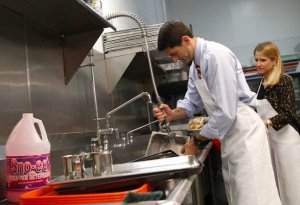
Paul Ryan pretends to wash pots
I know you’ve probably heard about this already, but I can’t resist including it because it’s so funny and so typical of the Romney campaign. Paul Ryan showed up at a soup kitchen in Youngstown, Ohio run by the St. Vincent De Paul Society, a Catholic charity. By the time Ryan got late Saturday morning, breakfast was over, and the homeless clients were gone and the dishes were washed. So Ryan faked washing some pots for a photo op.
The head of a northeast Ohio charity says that the Romney campaign last week “ramrodded their way” into the group’s Youngstown soup kitchen so that GOP vice presidential candidate Paul Ryan could get his picture taken washing dishes in the dining hall.
Brian J. Antal, president of the Mahoning County St. Vincent De Paul Society, said that he was not contacted by the Romney campaign ahead of the Saturday morning visit by Ryan, who stopped by the soup kitchen after a town hall at Youngstown State University.
“We’re a faith-based organization; we are apolitical because the majority of our funding is from private donations,” Antal said in a phone interview Monday afternoon. “It’s strictly in our bylaws not to do it. They showed up there, and they did not have permission. They got one of the volunteers to open up the doors.”
He added: “The photo-op they did wasn’t even accurate. He did nothing. He just came in here to get his picture taken at the dining hall.”
How typical of the sociopath ticket.
Here’s a quick update on the Bain-Sensata story. Bainport is going to have some high profile visitors soon: Bainport to host Durbin, Sharpton.
The encampment of Sensata workers at “Bainport,” now in its 35th day, will play host to several notables this week as they continue to protest the outsourcing of their jobs to China by the end of 2012….
On Tuesday, the Democratic challenger for the Illinois 17th District Congressional seat, Cheri Bustos, and U.S. Senator Dick Durbin will visit the workers at their campsite.
“Since day one of her campaign, Cheri Bustos has been standing with workers across Illinois,” said Bustos’ campaign spokesman, Arden Manning. “Bain Capital is actually afforded tax breaks to shut down the Sensata plant. … She’ll fight to end outsourcing by giving tax breaks to companies that bring jobs home.” ….Also visiting Freeport this week will be activist Reverend Al Sharpton. He is scheduled to appear at the Sensata camp on Saturday at 4 p.m. to speak to the employees.
The appearances this week follow an active summer of rallies that saw the arrival of Illinois Governor Pat Quinn and former NAACP Chairman Julian Bond to Freeport.
Power to the people!
That’s all I’ve got for you this morning. Now it’s your turn. What are you reading and blogging about today?
Dueling Op-Eds And the Great Divide
Posted: February 26, 2012 Filed under: birth control, Congress, Elizabeth Warren Campaign, fetus fetishists, fundamentalist Christians, PLUB Pro-Life-Until-Birth, Scott Brown, The DNC, the GOP, War on Women, Women's Healthcare, Women's Rights 13 CommentsIt will be a fine fight for the Senate seat in Massachusetts and the lead up is not disappointing. The Horse Race is now turning into a duel at thirty paces.
Elizabeth Warren offered the first volley, making her position clear on the contentious dispute over women’s access to contraception under the Healthcare Reform Act. She stated in no uncertain terms that exclusionary waivers for contraception access were outrageous. She supports President Obama’s compromise and expressed shock at Scott Brown signing onto the Blunt amendment that would allow employers deny coverage for ‘moral or religious reasons.’ Speaking to Greg Sargent last week she said:
This is an extreme attack on every one of us. It opens the door to outright discrimination. It would let insurance companies and corporations cut off pregnant women, overweight guys, older Americans, or anyone — because some executive claims it’s part of his moral code. Maybe that wouldn’t happen, but I don’t want to take the chance.
Neither do I.
But even if the language in the Blunt amendment were airtight, I’d oppose it and find the suggestion totally unacceptable. I pay taxes for wars for which I was never consulted and absolutely disagree with. That’s against my moral code. Can I get a tax refund now? I also think giving vulture oil companies subsidies is a ludicrous and immoral practice. Another refund? Oh, and those Wall Street bankers, the greed, the fraud that American taxpayers got stuck for? I want my money back, now.
We can all play this opt-out game.
So, where does Scott Brown come down on the question of women’s healthcare? Quelle surprise! He’s rubberstamping the irrational GOP position. But by doing so, he takes a 180-degree spin from his 2002 vote, when he supported a mandate on contraception, the Church be damned! Nonetheless, his answer to Warren? Through spokesman, Colin Reed:
It’s elitist for Elizabeth Warren to dictate to religious people about what they should believe and how they should act. She wants to use the power of government to force Catholics to violate the teachings of their faith. That is wrong. This issue deals with one of our most fundamental rights as a people — the freedom of religion. Like Ted Kennedy, Scott Brown supports a religious conscience exemption in health care.
Nice going, Mr. Brown. It’s wrong today but wasn’t wrong in 2002. The political winds must have been blowing differently a decade ago. And we’re conjuring up the ghost of Teddy Kennedy? Shame on you. But what I really like is the word ‘elitist,’ which is the Republican/Fox News buzzword for ‘those snooty people, who are not real Americans.’ Real Americans drive a truck like Scott Brown–back and forth to a home in Wrentham valued between $1-2.3 million.
Yup, just like average folks!
Lest we forget, there’s a reason Scott Brown was named by Forbes magazine as one of “Wall Street’s favorite senators.”
To be fair, Elizabeth Warren is no financial slouch. Both Warren and Brown have done extremely well for themselves. They’re both lawyers, educated, well-heeled professionals, standing on either side of the Great Divide we call politics. The issue of contraception has been put into play, an issue that according to all polls marks Warren’s position as the undisputed winner.
The Boston Globe ran Dueling Op-Eds on the issue. Warren’s editorial is here.
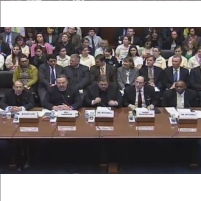 She starts with that withering image of the Republican panel that Representative Issa managed to convene—a panel of five poker-faced, middle-aged men discussing contraception and religious rights. In the optics department it was a devastating image. Out of touch much? A prime female health consideration and you fail to have women on the panel? Says everything we need to know on the Republican mindset. Elizabeth Warren then takes Scott Brown to task not only for supporting the proposed Blunt bill but fighting to get it passed.
If you are married and your employer doesn’t believe married couples should use birth control, then you could lose coverage for contraception. If you’re a pregnant woman who is single, and your employer doesn’t like it, you could be denied maternity care. This bill is about how to cut coverage for basic health care services for women.
Let’s be clear what this proposed law is not about: This is not about Catholic institutions or the rights of Catholics to follow their faith. President Obama has already made sure religious institutions will not be forced to cover contraception – at the same time that he has made sure women can get the health care they need directly from their health care insurers. Carol Keehan, the president and CEO of Catholic Health Association, said that Obama’s approach “protects the religious liberty and conscience rights of Catholic institutions.
And Scott Brown’s answer: It’s a matter of fundamental fairness. Really?
Here’s the beginning of Brown’s statement:
The new ObamaCare mandate forcing religious organizations to offer insurance coverage for practices that violate the teachings of their church gives the government control over the most personal aspects of our lives. It also erodes one of the basic protections of the Constitution – the right to practice religion without government interference.
The federal government is now saying to religious hospitals and charities, “Just do what you’re told, and leave the moral questions to us.’’ This over-reaching dictation from Washington is one reason I opposed and voted to repeal ObamaCare.
Which, of course, fails to answer the earlier question: why was a mandate A-okay in 2002, yet oh so wrong now? Possibly because then it concerned RomneyCare. The name makes all the difference in the world! Interesting, too, that according to Think Progress:
Brown also voted for a 2005 bill mandating hospitals to offer emergency contraception to rape victims, even after lawmakers defeated his amendment to allow religious hospitals to opt out of the requirement. Brown split with then-Gov. Mitt Romney on the matter and joined the legislature in overriding his veto.
And the American public? The polling numbers on the issue of contraception and subsequent WH compromise are revealing:
Obama’s compromise takes this politically charged issue off the table for mainstream Americans, most of whom side with Obama. A Fox News poll conducted last week before Obama’s Friday announcement found that 61 percent of voters believe employer health plans should be required to cover birth control for women, while 34 percent disagreed. Among women, two thirds approved of the requirement.
Rush Limbaugh may scoff at the issue. But for women? This is a very big deal. Because birth control means reaching this point in our lives:
When we’re ready.
And Mr. Brown? You’re not only a hypocrite on the issue, you’re definitely on the wrong side of history.


 peej
peej Carissa
 bostonboomer
 dakinikat
 ecocatwoman
 mablue2
 Mama Lopez
 peggysue22
 quixote
 skydancingguestblogger
 Mona (aka Wonk the Vote)



 Sky Dancing
Recent Comments