
Backlash
Posted: March 15, 2011 Filed under: 2012 presidential campaign, Barack Obama, collective bargaining, Democratic Politics, Domestic Policy, Elections | Tags: polls, republican politics, tea party overreach 34 CommentsThe only positive thing to come out of the Tea Party, its John Birch Society Roots and funding sources, and its election of right wing reactionaries is the amount of backlash that is coming as a result of imposing their extremist policies. Their agenda is obvious. Many of the states that are suffering at the hands of governors and legislators that are more interested in ideology than solutions for their state’s problems are looking at recalls. It seems there’s a huge amount of blow-back now. Just check out some of these polls.
Public Policy Polling reports on “brutal numbers” for Ohio’s John Kasich. Not only do independents and nonunion households support a recall of his collective-bargaining killing bill, they don’t support him. They want him gone.
Ohio Senate Bill 5 may not be in effect for very long…54% of voters in the state say they’d repeal it in an election later this year while just 31% say they’d vote to let the bill stand.
The support for repealing SB 5 is reflective of a high level of support for unions and workers in Ohio, more so than we saw in Wisconsin a couple of weeks ago. 63% of voters in the state supportive collective bargaining for public employees to only 29% who oppose it. 52% of voters think public employees should have the right to strike, to 42% who think they should not. And 65% think public employees should have the same rights they do now- or more- while only 32% believe they should have fewer rights.
There are two things particularly notable in the crosstabs on all of these questions. The first is that non-union households are supportive of the public employees. 54% support their collective bargaining rights to 36% in opposition and 44% say they would vote to repeal SB 5 to 38% who would let it stand. Obviously that level of support is not nearly as high as among union households but it still shows that the workers have even most of the non-union public behind them.
The other thing that’s worth noting is the independents. A lot of attention has been given to the way what’s been going on in Ohio and Wisconsin is galvanizing the Democratic base, but it’s also turning independents who were strongly supportive of the GOP in the Midwest last year back against the party. 62% of independents support collective bargaining for public employees to 32% opposed and 53% support repeal of SB 5 to 32% who would let it stand.
All of this is having an absolutely brutal effect on John Kasich’s numbers. We find him with just a 35% approval rating and 54% of voters disapproving of him. His approval with people who voted for him is already all the way down to 71%, while he’s won over just 5% of folks who report having voted for Ted Strickland last fall. Particularly concerning for him is a 33/54 spread with independents.
The site calls this “significant buyer’s remorse”. This is the pollster for DKos that has polled on the Wisconsin effort to recall at least 8 Republican State Senators.
Three Republican incumbents actually trail “generic Dem”: Luther Olsen, Randy Hopper, and Dan Kapanke. Two more have very narrow leads and garner less than 50% support: Rob Cowles and Sheila Harsdorf. And one more, Alberta Darling, holds a clear lead but is still potentially vulnerable. (Two recall-eligible senators, Mary Lazich and Glenn Grothman, sit in extremely red districts and look to have safe leads.) These numbers suggest we have a chance to make five and possibly six recall races highly competitive.
David Weigel–now of Slate--reports on similar trends for Rick Scott and Scott Walker. Rasmussen has Governor Walker hanging in there with a 43% approval rating. It’s interesting when you get the same results from a less liberal-affiliated polling company.
Wisconsin Governor Scott Walker won his job last November with 52% of the vote, but his popularity has slipped since then.
A new Rasmussen Reports telephone survey of Likely Wisconsin Voters finds that just 34% Strongly Approve of the job he is doing, while 48% Strongly Disapprove. Overall, including those who somewhat approve or disapprove, the new Republican governor earns positive reviews from 43% and negative reviews from 57% of voters statewide.
In addition to the usual partisan and demographic breakdowns, it’s interesting to note that Walker, now engaged in a budget battle with unionized state workers, receives a total approval rating of 46% from households with private sector union members. However, among households with a public sector union member, only 19% offer their approval. Among all other households in the state, opinion is nearly evenly divided—49% favorable and 51% unfavorable.
It’s also interesting to note that among households with children in the public school system, only 32% approve of the governor’s performance. Sixty-seven percent (67%) disapprove, including 54% who Strongly Disapprove.
Wiegel writes that Democratic strategist believe the blowback will have signficant positive effects for the re-election of Obama come 2012.
I was talking the other day to a Democrat who’d been battle-scarred by the 2010 Florida campaign, in which Democrats lost everything. Everything. Alan Grayson’s career died quickly. Kendrick Meek became a trivia question. One of the people Palin endorsed, Pam Bondi, actually won. And Rick Scott pipped Alex Sink, the most talented statewide Democratic candidate since Lawton Chiles, to become governor.
This Democrat’s spin was that Sink’s loss wasn’t so bad after all. Scott was pissing off too many people — the Orlando-Tampa train he’d killed was popular — and Democrats could win back independents in 2012, saving the state for Barack Obama.
Further evidence of the extremist elements in both the Tea Party and the current incarnation of the Republican party show up in other polls. A CNN poll shows that most people do not want the government shut down over budget issues. The folks that object are basically tea party-affiliated.
Nearly six in ten people questioned in the poll say that it would be a bad thing for the government to shut down for a few days because Congress did not pass a new spending bill, with 36 percent saying it would be a good thing for the country. And if a government shutdown lasted a few weeks, that figure would rise to 73 percent.
“But Republicans think a shut down that lasts a few days would be a good thing. And a majority of Tea Party supporters approve of a shutdown even if it lasts several weeks,” says CNN Polling Director Keating Holland. “That puts pressure on House Speaker John Boehner and other GOP leaders to take a step which might hurt their standing with independents as well as some Republicans.”
The survey indicates wide partisan differences on the issue, with only 21 percent of Democrats saying a shutdown for a few days would be a good thing. That figure rises to 35 percent for independent voters, 53 percent for Republicans, and 62 percent for Tea Party supporters.
Couple this with a Gallup poll that shows that Huckabee and Bachmann have the most intense followers in the field of GOP presidential wannabes. There is definitely a crazy side to the Republican Party and it’s showing signs of taking the party into extreme positions supported by very few Americans. I personally can’t imagine voting for either of this people for dog catcher let alone president. I don’t think they’re qualified to flip hamburgers, frankly.
Former Arkansas Gov. Mike Huckabee leads the field of possible GOP presidential candidates in “positive intensity” among Republicans nationwide with a score of +25 among Republicans who are familiar with him, followed by Rep. Michele Bachmann of Minnesota with a score of +20. Huckabee is recognized by 87% of Republicans, compared with Bachmann’s 52%. A number of other possible Republican presidential candidates trail these two in Positive Intensity Scores, including Sarah Palin, who is the best known of the group.
With these kinds of people rising to the top in party politics of one of the major parties, it’s no wonder we also have an ABC News-WAPO poll that shows Americans are not very confident in their system of government.
Only 26 percent of Americans in a new ABC News/Washington Post poll say they’re optimistic about “our system of government and how well it works,” down 7 points since October to the fewest in surveys dating to 1974. Almost as many, 23 percent, are pessimistic, the closest these measures ever have come. The rest, a record high, are “uncertain” about the system.
The causes are many. Despite a significant advance, more than half still say the economy has not yet begun to recover. And there’s trouble at the pump: Seventy-one percent in this poll, produced for ABC News by Langer Research Associates, report financial hardship as a result of rising gas prices. Forty-four percent call it a “serious” hardship.
People are desperately unhappy with the results of the two party system. It doesn’t even appear that voting for party gridlock works much any more. The Republican notion of big government is a white daddy government that restricts women’s rights, worker’s rights, and transfers wealth to the already rich and powerful. What exactly is the Democratic notion these days? While this backlash will work to the benefit of the sitting President and the Democratic politicians, will they just ride the backlash or actually articulate and run on some kind of vision for a change? Let me be more specific. How about some actions that match those fancy speeches for a change?
We now seem stuck the worst features of the two party system We try for gridlock but get bugfug crazy from the Republicans. We try for social justice but the Democratic Party never seems to be able to coalesce around a vision or agenda that does much other than respond to Republicans by caving-in and playing up to party donors. I’m not sure that I see that changing much given we can’t even get this current President off his historical position of voting present.
The challenges that we’re facing today seem as severe as those we faced during the Bush years. There’s a melt down in strongman governments in the MENA area, we’ve had two major energy-related disasters, and we’ve still got an economy that’s barely sustaining a recovery with high unemployment. If there ever was time for leadership and vision from some corner of national politics, it would be now. Voters keep turning the reigns of government over to the Dubyas, the Walkers, and the Kasichs because they can’t get what they want from Democrats. They emerge from each party’s rule appalled. It seems like some one reasonable could take advantage of that situation. Why do I feel that the Democratic Party will just blow this opportunity away too?
Lessons in Overreach
Posted: March 9, 2011 Filed under: 2012 presidential campaign, Barack Obama, Democratic Politics, Domestic Policy, Elections, Federal Budget, Republican presidential politics, right wing hate grouups | Tags: bipartisanship, leadership, partisanship, Washinton Politics 9 CommentsPoliticians within the beltway seem to live in a world of their own. No place is this more clear than in the results of the last two elections where voters in desperate need of solutions for big problems have been misunderstood as providing ‘overwhelming mandates’ for the two party’s special interests’ agendas. The 2008 election was a resounding no to the direction the country ushered in by Dubya and his neocons. The 2010 election was a resounding no to the continued mess of partisanship and the passage of bailouts and a health care reform that no one understood. I don’t think voters understood why this issue was put above solving the basic unemployment and recession-based problems. Polls appear to indicate that neither side gets the message these days even though it appears very loud and clear to many of us.
There’s several places that this is really clear. First, the tea party is a prime example. This movement has been a hodgepodge of people looking for ways to send a populist message to the beltway. However, the movement has funding and leadership that’s hell bent on returning the country to the excesses of Robber Baron days. Some of the electorate voted for tea party candidates thinking more on the folksy rhetoric and less of the hardcore John Bircher philosophy championed by movement organizers. Plus, they just wanted some gridlock until they could get their minds around what was going on with a flurry of laws passed that seemed less related to what they asked for than what US bankers and businesses demanded. They wanted jobs. They got bailouts of Detroit and Wall Street and forced into a health care plan that benefited big Pharma and insurance company interests. It seems like the Democratic party just looked at the election numbers, smiled, and went their merry way. Republicans aren’t doing much better since they just looked at the last election numbers, smiled, and went their merry way.
A Bloomberg national poll indicates that the Washington crowd just doesn’t get it. It has to be a deliberate misconnect. You can’t be so wrong so many times. They just don’t want to listen. People don’t like paying taxes that are then used to fund politician’s pet projects and bailouts for big businesses and banks. They don’t mind tax cuts to the middle class but they’re getting tired of footing the bill for the beneficiaries of the nation’s army of lobbyists. The Republicans have missed the mark with their current assaults on collective bargaining and programs that impact just plain folks. Why can’t both parties just shut up and listen for a change?
Americans are sending a message to congressional Republicans: Don’t shut down the federal government or slash spending on popular programs.
Almost 8 in 10 people say Republicans and Democrats should reach a compromise on a plan to reduce the federal budget deficit to keep the government running, a Bloomberg National Poll shows. At the same time, lopsided margins oppose cuts to Medicare, education, environmental protection, medical research and community-renewal programs.
While Americans say it’s important to improve the government’s fiscal situation, among the few deficit-reducing moves they back are cutting foreign aid, pulling U.S. troops out of Afghanistan and Iraq, and repealing the Bush-era tax cuts for households earning more than $250,000 a year.
The results of the March 4-7 poll underscore the hazards confronting Republicans, as well as President Barack Obama and Democrats, as they face a showdown over funding the government and seek a broader deficit-reduction plan.
The rejection of Dubya and cronies in 2008 wasn’t an invitation for further bailouts of fat cats, expansion of unpopular wars and invention of a health care program while current programs have such severe issues. The Republicans need to understand that the ‘shellacking’ in November wasn’t an invitation for a full on assault on Sesame Street, Yellowstone National Park, and women’s ability to have a menstrual cycle without fearing manslaughter charges. Here’s the message.
When given five choices for the most important issue facing the nation, unemployment and jobs ranked first with 43 percent – – down from 50 percent in Bloomberg’s December 2010 poll — with the deficit and spending cited by 29 percent, up from 25 percent. Health care was chosen by 12 percent, the war in Afghanistan by 7 percent, and immigration by 3 percent.
Asked to choose between jobs and the deficit, 56 percent called creating jobs the government’s more important priority now, while 42 percent said cutting spending was.
Why couldn’t we have gotten a decent jobs program and stimulus right off the bat during the first few months of Obama’s term? We’d have been in a much better position politically, economically, and fiscally. Instead, we got a bunch of worthless tax cuts that siphoned money off to investments abroad and just enough money to stem about 2 years of fiscal disaster in the states.
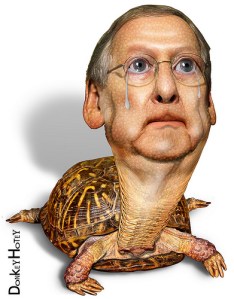 There are two follies that should haunt a few leaders for the rest of their natural born days. Blame goes first to Obama for carving out the health care reform instead of focusing laserlike on job creation. He clearly created a lot of unnecessary strife and tempests in teabots by taking his eye off the job markets. The second heap of guilt goes to Mitch McConnell and his party of no. The Republicans seem intent on pleasing their base and burying the rest of the country in joblessness and despair. Clearly, this is a man that will do anything to regain a Republican White House. This includes taking our country down with the plan.
Some one needs to tell the President that ending bipartisan strife doesn’t mean selling out to other side. That’s what brought us a health care plan that assaults women’s rights and forces every one to pay and play. The Republican strategy of petulance has been paying off big time for them in terms of policy gains. They need to pay for that petulance. Giving into Republican demands is not bipartisanship. The Republican agenda is clear now. The political moves by Republican governors to force their will no matter what is being met resistance by Democratic legislators. Polls are showing that the public is taking the side of these legislators. The President needs to take a page from their playbooks rather than doing his version of bipartisanship (i.e. giving into Republican bullying on things like tax cuts for billionaires). The leadership shown by Democrats in the heartland is being rewarded and is clearly showing the politicians in Washington the type of future the voters want. Now, if we could only get Washington to listen before the presidential campaign silly season begins.
Indiana’s Mitch Daniels: 2012 Republican Presidential Nominee?
Posted: February 24, 2011 Filed under: 2012 presidential campaign, Anti-War, Barack Obama, Elections, U.S. Economy, U.S. Politics, We are so F'd | Tags: 2012 presidential election, Chris Christie, George W. Bush, George Will, Governor Mitch Daniels, Harley Davidson motorcyles, Jeb Bush, Marlon Brando, short people 28 Comments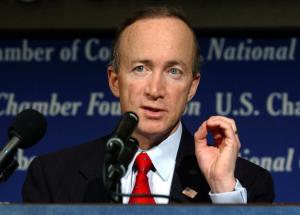
Indiana Gov. Mitch Daniels
Lots of Republicans are urging Indiana Governor Mitch Daniels to run for the Republican presidential nomination in 2012. Will he do it? Can he win?
Who’s touting Daniels? New Jersey Governor Chris Christie loves the guy.
Chris Christie, the governor of New Jersey, said Wednesday that his counterpart in Indiana, Mitch Daniels, is the only prospective Republican presidential candidate who is honestly talking about how to confront the nation’s biggest fiscal challenges.
Jeb Bush thinks Daniels is “the best Republican candidate.”
Jacksonville’s Florida Times-Union reports that former Florida Gov. Jeb Bush favors Indiana Gov. Mitch Daniels for president in 2012.
Bush reportedly told a private reception for business leaders, “Mitch is the only one who sees the stark perils and will offer real detailed proposals.”
Daniels’ speech at CPAC 2011 was very well received, and get this–George Will introduced Daniels to the CPAC audience as “the thinking man’s Marlon Brando,” apparently because Daniels likes to right around the Indiana countryside on a Harley Davidson chopper. Judge for yourself.

Mitch Daniels on his Harley

Marlon Brando in "The Wild One"
Daniels has some other problems too. For one thing he thinks Republicans should forget about social issues and focus on economic ones (cutting deficits, natch). Conservatives are not at all happy with Daniels for asking Indiana Republican legislators to withdraw their proposed “right to work” bill. In addition, he reportedly is a pretty serious policy wonk who likes to talk to his fellow wingnuts as if they were adults.
By far, the most important speech at CPAC was delivered by two-term Gov. Mitch Daniels of Indiana at Friday night’s banquet. It was an eloquently crafted, intellectually compelling call to arms against the red-ink forces of the national debt. Daniels, who was George W. Bush’s budget director, proposed dramatically revamping Social Security and Medicare as he called for “an affectionate thank you to the major social welfare programs of the last century.”
What was most striking about Daniels’ speech, which inspired careful listening rather than pep-rally applause, was that it treated his CPAC audience as adults rather than as just another constituency group demanding pandering. Whether it was dismissing the easy-answer attacks on earmarks (“in the cause of national solvency, they are a trifle”) or suggesting that most voters do not appreciate the sharp-edged rhetoric of the Republican right (“it would help if they liked us, just a bit”), Daniels’ speech was an exercise in speaking truth to conservatives who have the power to derail a presidential candidacy.
Come on, that’s never going to work with Republican primary voters!
On top of that, several media outlets reported today that Daniels was busted for drugs when he was in 1970 when he was a junior at Princeton. And it wasn’t for possession of just a little pot, either.
Read the rest of this entry »
States of Denial
Posted: February 17, 2011 Filed under: Economic Develpment, education, Elections, Federal Budget, poverty, Psychopaths in charge, public education, Republican presidential politics, The Media SUCKS, the villagers, U.S. Economy, U.S. Politics, unemployment, We are so F'd | Tags: education, Florida, Governor Bobby Jindal, Governor Chris Christie, Governor Rick Perry, Governor Scott Walker, Governors of Texas, Lousiana, public financing, public goods, Republican Governors, Rovernor Rick Scott, Wisconsin 25 CommentsGail Collins messed with Texas today. I’m rather glad she did because it shows exactly how much Texas seems to exist  in a vacuum of its own making. The head denier of reality is its wacko Governor who appears to get elected by saying the right things and doing very little. The state that forces its antiquated views through textbooks onto the rest of the nation has a huge problem in the numbers of children having children. This leads to all kinds of social problems that I probably don’t have to discuss here.
But, let’s just see how bad it gets down there with the denier-in-chief who seems to think abstinence education works and the Texas education system works when Texas’ own statistics show that they don’t work at all. Republicans get elected spewing untruths and he’s a prime case in point. The state’s out of money and like my governor Bobby Jindal, the first place Republican governors look is for cuts to education rather than look for new revenue sources. What is worse, they talk about improving children’s future while doing draconian cuts to children’s schools. How do they get away with it?
“In Austin, I’ve got half-a-dozen or more schools on a list to be closed — one of which I presented a federal blue-ribbon award to for excellence,” said Representative Lloyd Doggett. “And several hundred school personnel on the list for possible terminations.”
So the first choice is what to do. You may not be surprised to hear that Governor Perry has rejected new taxes. He’s also currently refusing $830 million in federal aid to education because the Democratic members of Congress from Texas — ticked off because Perry used $3.2 billion in stimulus dollars for schools to plug other holes in his budget — put in special language requiring that this time Texas actually use the money for the kids.
“If I have to cast very tough votes, criticized by every Republican as too much federal spending, at least it ought to go to the purpose we voted for it,” said Doggett.
Nobody wants to see underperforming, overcrowded schools being deprived of more resources anywhere. But when it happens in Texas, it’s a national crisis. The birth rate there is the highest in the country, and if it continues that way, Texas will be educating about a tenth of the future population. It ranks third in teen pregnancies — always the children most likely to be in need of extra help. And it is No. 1 in repeat teen pregnancies.
Which brings us to choice two. Besides reducing services to children, Texas is doing as little as possible to help women — especially young women — avoid unwanted pregnancy.
For one thing, it’s extremely tough for teenagers to get contraceptives in Texas. “If you are a kid, even in college, if it’s state-funded you have to have parental consent,” said Susan Tortolero, director of the Prevention Research Center at the University of Texas in Houston.
Plus, the Perry government is a huge fan of the deeply ineffective abstinence-only sex education. Texas gobbles up more federal funds than any other state for the purpose of teaching kids that the only way to avoid unwanted pregnancies is to avoid sex entirely. (Who knew that the health care reform bill included $250 million for abstinence-only sex ed? Thank you, Senator Orrin Hatch!) But the state refused to accept federal money for more expansive, “evidence-based” programs.
“Abstinence works,” said Governor Perry during a televised interview with Evan Smith of The Texas Tribune.
“But we have the third highest teen pregnancy rate among all states in the country,” Smith responded.
“It works,” insisted Perry.
“Can you give me a statistic suggesting it works?” asked Smith.
“I’m just going to tell you from my own personal life. Abstinence works,” said Perry, doggedly.
There is a high cost to a state to living in this kind of denial. Teen moms and children of teen moms are generally not a productive group of citizens. You pay to prevent this realistically or you pay for their and your mistake to do so throughout their entire lives. But, this seems to be the way of the new brand of Republican governor. These guys start running for president the minute they hit the mansion. They do so by following a litmus test of Republican items–regardless of the consequences to their states–that will make them sound like purity experts when they hit Iowa and New Hampshire. They will undoubtedly leave their state in ruins, but that won’t be the story by the time they’re on the lecture and talking heads circuit for higher offices.
The Governor of New Jersey is doing the same thing. He can read off a litmus list for the republican inquisition while at the same time ensuring the people of the state he governs languish. Again, he screams about the importance of the future of the children while simultaneously downsizing it.
In a clear shot at congressional Republicans over calls for curbing entitlement programs, he said, “Here’s the truth that nobody’s talking about. You’re going to have to raise the retirement age for Social Security. Woo hoo! I just said it, and I’m still standing here. I did not vaporize into the carpet.
“And I said we have to reform Medicare because it costs too much and it is going bankrupt us,” he continued, later comparing those programs to pensions and benefits for state workers that he’s been looking to reel back.
“Once again, lightning did not come through the windows and strike me dead. And we have to fix Medicaid because it’s not only bankrupting the federal government but it’s bankrupting every state government. There you go.”
Clearly looking to blunt criticism of his famously combative style, the former federal prosecutor said there is a method to the battles he picks, insisting, “I am not fighting for the sake of fighting. I fight for the things that matter.”
The speech was titled “It’s Time to do the Big Things,” and Christie suggested the items that Obama called for as “investments” in his State of the Union address were “not the big things” that need Washington’s focus.
“Ladies and gentlemen, that is the candy of American politics,” Christie declared, adding that it appeared to be a “political strategy” – or game of budgetary chicken – that both Republicans and Democrats are playing.
“My children’s future and your children’s future is more important than some political strategy,” he said. “What I was looking for that night was for my president to challenge me … and it was a disappointment that he didn’t.
It’s difficult not to scream when you hear these folks talk about our children’s futures while cutting education, telling children abstinence fairy tales, turning down money for infrastructure improvements —like the nitwit Republican Governor Rick Scott in Florida–that will likely create better environments for business and jobs, and refusing to look at their tainted tax systems that usually punish the poor and flagrantly ignore the assets and the incomes of the rich. It is clear whose children they have in mind. It is not yours or mine or the majority of the people who live in their states.
These guys seem intent on turning their states into third world countries. Many people seem more intent on letting them do it as long it doesn’t cost them anything immediate. Our fellow citizens appear beguiled by fairy tale promises and bribes of low taxes. They should not be surprised then by a future where they and their adult children live in rented shacks together with few available public services. They better just hope they don’t get robbed, the shack doesn’t catch fire, and there are no grandchildren needing public education. They’re voting to downsize these things into extinction.
White House Pushing Bogus Meme about Egyptian “Transition”
Posted: February 6, 2011 Filed under: Barack Obama, Egypt, Elections, Foreign Affairs, U.S. Politics | Tags: Ahmad Fathi Sorour, Egyptian constitution, Egyptian protests, Hosni Mubarak, Obama Administration, Omar Suleiman, rendition, rules of succession, Torture 74 Comments
Barack Obama and Hosni Mubarak in Egypt
Today multiple news sources are suddenly reporting practically word for word a new meme on the Egyptian “transition” that is obviously coming from the Obama administration. And the message has been coordinated with Egyptian Vice President Omar Suleiman. Mubarak is being gradually edged out, and the U.S. needs to make sure they stay in control of the situation. Obama must make sure to prevent real democracy from taking hold in Egypt.
So the new meme is that Mubarak will be kept around as a powerless figurehead, but first he needs to make some changes in the constitutional rules of succession so that Suleiman can legally be in charge of the “transition” government. Why Suleiman? Supposedly because the guy who is supposed to succeed Mubarak, Ahmad Fathi Sorour, is “much worse” than even Suleiman the torturer. Yet there is never any credible explanation for why Solour is so terrible that it’s better to have a torturer in control of the lead-up to US-controlled “free and fair” elections
From the Village organ: What Mubarak must do before he resigns.
If today Mubarak were no longer available to fulfill his role as president, the interim president would be one of two candidates. If he chooses to leave the country, say for “medical reasons,” the interim president would be Omar Suleiman, the former intelligence chief who was recently made vice president. Egyptians, particularly those of us calling for an end to Mubarak’s three-decade rule, see Suleiman as Mubarak II, especially after the lengthy interview he gave to state television Feb. 3 in which he accused the demonstrators in Tahrir Square of implementing foreign agendas. He did not even bother to veil his threats of retaliation against protesters.
On the other hand, if Mubarak is pushed to resign immediately we would have an even worse interim president: Fathi Surur, who has been speaker of the People’s Assembly since 1990.
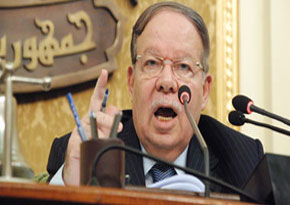
Ahmad Fathi Sorour
And he would be worse because?
Surur has long employed his legal expertise to maintain and add to the arsenal of abusive laws that Mubarak’s regime has used against the Egyptian people. Since neither Suleiman nor Surur would be able to amend the constitution during the interim tenure, the next presidential election would be conducted under the notoriously restrictive election rules Mubarak introduced in 2007. That would effectively guarantee that no credible candidate would be able to run against the interim president.
So before Mubarak resigns he must sign a presidential decree delegating all of his authorities to his vice president until their current terms end in September.
But Suleiman “has long employed his [military and intelligence] expertise” to cooperate with U.S. rendition and torture policies. Why is he better? Why should anyone believe that Suleiman will push for real democracy? Give me a break! The U.S. wants Suleiman in charge because he is their guy.

 peej
peej Carissa
 bostonboomer
 dakinikat
 ecocatwoman
 mablue2
 Mama Lopez
 peggysue22
 quixote
 skydancingguestblogger
 Mona (aka Wonk the Vote)



 Sky Dancing
Recent Comments