
Let’s talk about federal budgets! (Big Boy Toy edition)
Posted: June 8, 2011 Filed under: Domestic Policy, U.S. Military | Tags: defense spending, military toys, US presence in Asia 18 Comments I just wanted to put in my two cents on what I think should be first on the federal budget chopping block. I think this nifty graph from The Economist puts our defense budget into perspective.
ON JUNE 8th China’s top military brass confirmed that the country’s first aircraft carrier, a refurbishment of an old Russian carrier, will be ready shortly. Only a handful of nations operate carriers, which are costly to build and maintain. Indeed, Britain has recently decommissioned its sole carrier because of budget pressures. China’s defence spending has risen by nearly 200% since 2001 to reach an estimated $119 billion in 2010—though it has remained fairly constant in terms of its share of GDP. America’s own budget crisis is prompting tough discussions about its defence spending, which, at nearly $700 billion, is bigger than that of the next 17 countries combined.
One has to ask why our defense spending “is bigger than that of the next 17 countries combined” while we basically share only two borders with countries that can hardly be considered hostile. What’s the purpose of all this spending?
Just recently, US Defense Secretary Gates announced that the US would maintain a strong presence in Asia despite its budget problems.
Defense News reports that the U.S. military would expand presence in the area with a facility in the Indian Ocean shared with Australia.
The U.S. will also begin deploying new littoral combat ships (LCS) capable of operating in shallow coastal waters to the region to perform exercises and military maneuvers alongside others in Asia. The Singapore defense ministry has stated that the U.S. is looking at deploying one or two LCS’ in the area.
The U.S. is also getting supplies into position to speed response in the area if another natural disaster hits. The most recent disasters in Asia were the massive Japanese earthquake and resulting tsunami. Gates also noted that he worries the region needs to establish “rules of the road” for solving conflicts over resources in the South China Sea peacefully if more than one nation lays claim to a resource.
Gates Said, “I fear that without rules of the road, without agreed approaches to deal with these problems, that there will be clashes. I think that serves nobody’s interests.”
Gates also stalked about future weapons that would be coming to the region to improve the ability to defend the area. One of the future weapons programs cited were drones. The Global Hawk is an unmanned reconnaissance aircraft that can fly a programmed path and refuel in air — it completed its first flight in 2010. Global Hawk can soar to 61,000 feet and stay on target for up to 30 hours. The first Global Hawk has now arrived at Grand Forks Air Force Base.
Do we really need all these toys to protect us from asymmetrical threats like terrorists? Just thought I’d put this out there for your consideration.
Saturday Night Frights: What the Future of America Could Look Like
Posted: June 4, 2011 Filed under: 2012 presidential campaign, abortion rights, Democratic Politics, Domestic Policy, Economy, fetus fetishists, fundamentalist Christians, religion, religious extremists, Reproductive Rights, Republican presidential politics, U.S. Economy, U.S. Politics | Tags: Christian Coalition, closet cases, Faith and Freedom Coalition, John Boehner, John Huntsman, Marcus Bachmann, Mich McConnell, Michelle Bachmann, Ralph Reed, Sarah Palin, Tim Pawlenty 13 Comments
For the past two days, Republican movers and shakers have participated in a conference in Washington, DC, sponsored by the Faith and Freedom Coalition. The Faith and Freedom Coalition is the new face of the religious right, but the same old faces are behind the new organization. It is chaired by evil grifter and former Jack Abramoff crony Ralph Reed, who once led the Christian Coalition and is now supposedly experiencing a “political rebirth.”
Just as a reminder of how utterly slimy Ralph Reed is, here is disgraced super-lobbyist Jack Abramoff expressing an opinion about Reed.
This dishonest, repulsive man is one of the kingmakers of the Republican Party.
The Caucus blog at The New York Times had a brief writeup on the Faith and Freedom Conference and what the 2012 Republican hopefuls had to say to them. Here are some samples.
John Huntsman
“I do not believe the Republican Party should focus solely on our economic life to the neglect of our human life,” Jon M. Huntsman Jr. told the audience of several hundred after citing antiabortion laws he signed when governor of Utah.
Tim Pawlenty
opened and closed his remarks with biblical quotes. He said his top four “common-sense principles” for the nation were to turn toward God, protect the unborn, support traditional marriage and keep Americans secure.
Michelle Bachmann
reminded the audience that she home-schooled her five children and ended with a prayer that asked a blessing for President Obama, whom she had sharply criticized moments earlier.
Bachmann also promised to repeal Obamacare.
Mitt Romney tried to convince the audience he believed in the “sanctity of human life” and hated gay marriage, Newt Gingrich didn’t show up, and Ron Paul talked about reinstating the gold standard.
Before you laugh too loudly about this parade of loons, check out what Howard Dean told The Hill today. He’s warning Democrats that the “P” woman could beat Obama in 2012. In face Dean thinks if something isn’t done about the economy and unemployment, anyone who wins the Republican nomination could win the presidency.
Dean says his fellow Democrats should beware of inside-the-Beltway conventional wisdom that Obama would crush Palin in a general-election contest next year.
“I think she could win,” Dean told The Hill in an interview Friday. “She wouldn’t be my first choice if I were a Republican but I think she could win.”
Dean warns the sluggish economy could have more of a political impact than many Washington strategists and pundits assume.
“Any time you have a contest — particularly when unemployment is as high as it is — nobody gets a walkover,” Dean said. “Whoever the Republicans nominate, including people like Sarah Palin, whom the inside-the-Beltway crowd dismisses — my view is if you get the nomination of a major party, you can win the presidency, I don’t care what people write about you inside the Beltway,” Dean said.

Personally, I think Michelle Bachmann is scarier than Quitterella. And potential first lady gentleman Mr. Michelle Bachmann Marcus Bachmann is even scarier than she is. Here he is discussing homosexuality.
This is Marcus Bachmann swishing arriving at a radio station for an interview.
These are the kinds of people who could be running the country if the Democrats don’t get off their duffs and do something about the economy and jobs instead of playing footsie with Mich McConnell, John Boehner, and the rest of the Republican freakazoids. This is no joke, folks. I realize this isn’t a particularly politically correct post, but I do not want to be at the mercy of a bunch of self-hating closet cases and hypocritical christianists who are obsessed with fetuses and throwing old people to the wolves. Democrats need to wake the f*ck up and smell the unemployment.
Let’s hear it for the “Emily’s List” candidate: Kathy Hochul wins NY-26
Posted: May 24, 2011 Filed under: Domestic Policy, U.S. Politics | Tags: Charles Krauthammer, DC Dems, Emily's List, Eric Cantor, GOP clowns want to Draft Paul Ryan, Jane Corwin, Kathy Hochul, Kirsten Gillibrand, Martha Coakley, NY-26, Paul Ryan budget, Ryancare 11 Comments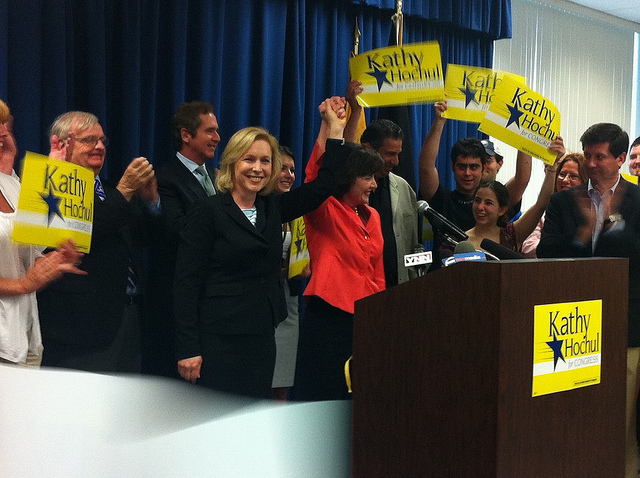
Kirsten Gillibrand campaigning for Kathy Hochul at a rally this past Saturday.
With over 60% reporting and Hochul holding onto her lead, lots of people calling it for Hochul:
@fivethirtyeight: Dave Wasserman (@Redistrict) has called it for Hochul. Good as done. #ny26
Another great tweet:
@thepeoplesview: First Republican electoral casualty of Paul Ryan’s Kill-Medicare plan: Kathy Hochul wins in NY-26! Hee!
As I noted in my post earlier tonight, in a move signaling how weak the GOP is, their candidate Jane Corwin obtained a court order blocking a certification of the winner tonight… it looks like we’ll have to wait until Thursday or so, but let the celebrating begin… here’s hoping this is a huge blow to DC and the Austerity crowd.
It was after all Kirsten Gillibrand, and not DC Dems, who saw the opening in NY-26 and campaigned hard for Kathy Hochul…via the Hill:
Sen. Kirsten Gillibrand (D-N.Y.) has emerged as one of the most prominent supporters of New York House candidate Kathy Hochul.
Washington Democrats have been keeping their distance from Hochul, the party’s nominee in the May 24 special election for former Rep. Chris Lee’s (R-N.Y.) seat. Meanwhile, Republicans leaders including Rep. Pete Sessions (Texas) and Speaker John Boehner (Ohio) have lent their backing to the GOP nominee, Jane Corwin.
Gillibrand, a former upstate congresswoman, sent a fundraising pitch on Hochul’s behalf and teamed with the pro-choice group EMILY’s List to urge activists to lend their support.
“Kathy is an extraordinary candidate,” Gillibrand said Tuesday during a Web forum hosted by EMILY’s List. “I know she can win this race.”
This just reminds me of all the attacks on Coakley and Emily’s List during the Scott Brown race… as I said then, “In Defense of the Emily’s List Candidate”:
Emily’s List produced a winning primary candidate (they backed the candidate who won the popular vote in the 2008 primaries too for that matter). It’s the Obama Era of the Democratic party that has created bad electoral conditions for Democratic nominees and made it difficult for liberals to stand on principle. (Even the socialist in the U.S. Senate voted for Obama’s health insurance scam. Way to discredit the right-wing canard that Obama’s terrible policies are synonymous with socialism.)
The one surefire way to avoid becoming the target of local backlash against Obama is to run against Obama’s policies–and in today’s environment where the activist left is split up along deep fault lines (“submit to party unity or else you’re a certain class of politician, voter, or woman”), Democratic nominees do not have the benefit of a ready-made independent fundraising network to take on the Obama machine during a general election yet. Of course they could try to build one, but either way it is an uphill battle and there is no easy path to victory whatever they choose.
This race was somewhat different in that Hochul could run against the GOP’s toxic Ryancare rather than against Obamacare, but when you hear all the spin tonight and the Dem machine taking credit for Hochul’s win, remember that it was Kirsten Gillibrand and Emily’s List who shored up Kathy Hochul, not Washington Dems, who were too afraid to get behind Hochul.
The “Emily’s List” candidate won in the very red district of NY-26!
Congrats to Kathy, and Kirsten for president!
Hochul’s win tonight also makes Eric Cantor’s and Jonah Goldberg’s push for Paul Ryan to run for president (not to mention Charles Krathammer’s “Draft Paul Ryan” noises from a month ago) all the more ridiculous and embarrassing for the GOP.
Go, Kathy Hochul, Go! (NY-26 Special Election Open Thread)
Posted: May 24, 2011 Filed under: Domestic Policy, U.S. Politics | Tags: Jane Corwin, Kathy Hochul, NY-26, Ryan budget plan, Ryancare 28 Comments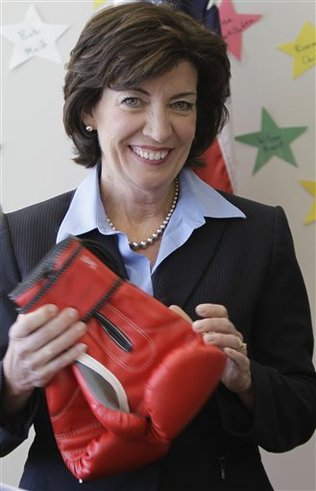
Democratic candidate for the 26th District Congressional seat, Kathy Hochul speaks while holding a pair of boxing gloves during a news conference in Clarence, N.Y., Monday, May 9, 2011. David Duprey / AP Photo
UPDATE, via Buffalo News, with 57% of precincts reporting, Kathy Hochul leads Jane Corwin by 4 points:
Hochul , Kathy 47%
Corwin , Jane 43%
Davis , Jack 8%
Murphy , Ian 1%
***
Tonight’s the big day for NY-26. Election returns are supposed to start showing up here after the polls close tonight. Democrat Kathy Hochul has got the technical edge in some very close polling, which is amazing for this very red district, and the following reporting from Wapo’s Behind the Numbers earlier today seems to point to good news on how the internals are shaking out for her as well:
N.Y.-26 Special Election – Tuesday’s Special Election in New York’s 26th Congressional District finds a very tight race in available polling. Democrat Kathy Hochul has a numerical lead of 42 percent to 38 percent for Republican Jane Corwin and 12 percent for tea party candidate Jack Davis in data from Siena College Research Institute. Those results are well within the poll’s margin of error completed Friday.
Despite the very close numbers, some of the internals are revealing. Hochul secures more of her base voters, winning 76 percent among Democrats, while Corwin only secures 66 percent of her base Republican voters. Independents tilt to Hochul by 44 to 36 percent. Again, those results among independents are within the error margins.
Many pundits have pointed to this race as an early test of Republican attempts to tackle Medicare as a part of budget reform. In the Siena poll, Medicare was not singled out as the most important issue in the vote. Fully 21 percent call it most important, about the same level as the federal budget (19 percent) and jobs (20 percent). Medicare does rise to the top for Democrats, but less so for Republicans and independents.
This afternoon, the NYT Caucus reported heavy turnout and had this to say, in terms of what that means for Hochul and Corwin:
Turnout appeared fairly strong for the special election in western New York State’s 26th Congressional district on Tuesday, officials said. But it was not immediately clear which of the candidates, if any, would benefit from the high degree of voters’ interest in the race.
[…]
But what that high interest will translate into, in terms of votes, is hard to discern. If turnout is strong across the board, Ms. Corwin would likely stand to benefit, since Republicans have a large registration advantage in the district. Ms. Hochul, for her part, would be in a particularly strong position if voters in Erie County, where she is county clerk, turn out in high numbers.
In a move indicating just how vulnerable the GOP is, Jane Corwin has obtained a court order barring certification of a winner tonight… via Buffalo News:
Jane L. Corwin this afternoon obtained a court order from State Supreme Court Justice Russell P. Buscaglia barring a certification of a winner in the special 26th Congressional District race pending a show-cause hearing before him later this week.
The Buffalo News obtained a copy of the show-cause order Buscaglia signed this morning based on a petition the Republican candidate filed Monday.
Under the judge’s 11-page order, attorneys for Corwin have until Wednesday to serve copies of the court order on the election boards of Erie, Niagara, Genesee, Orleans, Wyoming, Livingston and Monroe counties, their sheriff’s offices, the state Board of Elections and her three opponents.
The Atlantic Wire has a good overview of the race and what various pundits are saying — Get Ready to Spin the Results of New York-26:
Voters in New York’s 26th congressional district are voting Tuesday to pick a replacement for Chris Lee, who resigned after the whole Internet saw him with his top off. The special election is now seen as a referendum on Rep. Paul Ryan’s plan to phase out Medicare because even though the district is conservative, Democrat Kathy Hochul is ahead in the polls. As the national significance debated, the parties are mounting big get-out-the-vote operations–Republican Jane Corwin’s campaign had 500 volunteers knocking on doors over the weekend–150 of them bussed up from Washington, the Niagara Gazette‘s Eric DuVall reports. Hochul says the Democratic Party is running a “full field program” with hundreds of volunteers contacting thousands of voters.
Politico’s Alex Isenstadt writes that both parties are playing the “expectations game”–Republicans saying this race means nothing because third party candidate Jack Davis is siphoning votes from Corwin (pictured above, voting), and Democrats insisting they shouldn’t even be competitive in such a red district. (Conservatives started spinning the race even before polls put Hochul ahead, Dave Weigel notes.) And this strategy can be seen in browsing political blogs: liberal sites are giving a lot of coverage to the race Tuesday, while few conservative sites are bothering with it (the opposite was true in Wisconsin’s special election earlier this year, once missing votes were found handing the race to the conservative candidate.) The New Republic‘s Jonathan Chait says the race might be an outlier, but it’s still significant. It has “centered almost entirely around the exact theme that Democrats plan to employ in the next election cycle,” Chait writes. “All this suggests the party has gotten deep traction on the issue, and that the public can react against the policies of the House GOP. The political landscape that produced the Republican sweep of 2010 is gone. Just what replaces it remains to be seen.”
NBC’s First Read says that special elections aren’t a good guide to how the parties will fare in fall elections–but still, the power of Medicare shouldn’t be understated. A “GOP loss in NY-26–a district John McCain won in 2008, 52%-46%–would be a wake-up call for Republicans on Medicare, forcing their House members and even presidential candidates to re-evaluate how they approach the issue.”
Bill Clinton and Chris Chrisitie hit the phones for their respective party candidates… via Talking Points Memo:
“Now, I’m sure you’ve received many phone calls about this election already, nut please just give me a few seconds of your time as the election draws near,” Christie says in the call, according to The Buffalo News. “I’m calling to ask you for your support for Jane Corwin for Congress as you go to the polls Tuesday, May 24th. I ran for governor of New Jersey because like you, I wanted to see REAL change. Jane Corwin is a fighter who knows how to get things done. We’re in critical times for our country, and Washington needs stand-up leaders who will fight to control spending and change business as usual.”
Rallying Democrats, former President and current New York State resident Bill Clinton has recorded a call as well. Clinton’s script focuses tightly on the Medicare angle that Democrats have been pushing in the district, an approach they credit with their current lead in the polls.
“You can count on Kathy to say no to partisan politics that would end Medicare as we know it to pay for more tax cuts for multi-millionaires,” he says. “That’s just one reason I hope you’ll join me in supporting Kathy Hochul for Congress in the Special Election tomorrow, May 24th.”
ABC News on why NY-26 matters:
First, “If Hochul wins, even in a three-way race, it will be great news for Democrats, who will use the victory not only to talk about Medicare, Budget Chairman Paul Ryan’s budget and their own momentum, but also to recruit candidates around the country and raise funds,” the Rothenberg Political Report stated in a recent analysis. “And Democrats will have a right to brag, given the district’s fundamentals and the cash that Corwin and Republican groups have poured into the race.”
Second, the N.Y.-26 election would help both sides determine whether national dollars by party organizations and interest groups really make a difference.
Third, the race is important nationally because it has exposed the divisiveness and relative lack of coordination within the Tea Party movement. The biggest Tea Party group in the area, TEA New York, has endorsed Corwin, but not all Tea Party activisits are on board, which sends a warning sign to Washington that they will not back candidates based on party affiliation alone.
All eyes are obviously going to be on the exit polling and what it says about Ryancare.
Also from the link:
Hochul, the Erie County clerk, is widely expected to pull a victory in what would be a stunning defeat for Corwin, a state assemblywoman. The last Democrat to be elected from the district left office eight years ago, and only three Democrats have won in this area in the past century. New York’s 26th was only one of four districts in the state that voted for John McCain over Barack Obama in the 2008 presidential election.
Hochul, however, has been cautious about declaring victory too quickly.
“We don’t have the enrollment advantage, but I’m going to keep fighting till the very last minute,” she said at a restaurant in Amherst.
NY Magazine has a primer on how to interpret the tonight’s returns… if Hochul wins, here’s pretty much what to expect from the Dems and points to consider about the validity of their claims:
Democrats point to this surprising result as the first definitive proof of the powerful opposition to Ryan’s Medicare-reform plan. The plan is clearly as toxic as a stroll through Fukushima, as they’ve been saying all along, and it will likely lead to an Obama victory in November of 2012.
It’s true that voters who care most about Medicare are strongly in Hochul’s camp, according to polling. But the causality here isn’t quite so clear-cut, as Nate Silver explains:
What’s tricky about this is that it isn’t straightforward to determine whether voters are prepared to vote for Ms. Hochul because of the Medicare issue — or rather, whether they were going to vote for her for some other reason, but emphasize Medicare to pollsters because she has also.
There are also other factors to consider — the candidates themselves, their reputations and personalities, for example. So though Medicare will play a role in the outcome, it will be difficult to tell how large that role will be.
And even assuming that opposition to Paul Ryan’s Medicare plan is a decisive factor, how much can that foretell about November 2012? The Medicare plan may be a central issue at the moment, but will it remain prominent in the political discussion fifteen months from now? What if an agreement on reforming Medicare has been reached by then? What if the presidential election, or unforeseeable events, cause other issues to overshadow the debate over Medicare entirely? It’s a long time until 2012.
And points to consider about the GOP spin if Hochul wins:
Republicans will insist that they would have won if not for the presence of Jack Davis, the eccentric businessman pulling in around 12 or 13 percent of the vote on the Tea Party line, and therefore the results are meaningless, and everyone should forget that this ever happened. The truth though, is that if Hochul wins, it’s a victory regardless of Davis. Davis may be running on the “Tea Party” line this year, but he ran as a Democrat for the same seat in 2004, 2006, and 2008, and his “ideology is too inconsistent to be readily categorized,” as the Washington Post put it. In a recent Siena poll, he draws about the same amount of support from Republicans as he does from Democrats. In other words, if Hochul wins, it won’t be because Davis split the conservative vote.
On the other hand, if Corwin pulls it out, here’s how NY mag breaks down what to expect from the spinmeisters and how to gauge what they are saying:
The Democratic Spin:
Democrats will insist that, because this is usually such a Republican-friendly district, they overperformed despite losing. And that may be true, depending on the margin of victory, because this district has been represented by a Republican for 40 of the last 50 years, including the last eight, and John McCain carried it by 6 percent over Barack Obama in 2008. Using that result as a benchmark, it’s fair to say that if Hochul loses by a few points to Corwin, the Democrats still beat expectations, and can plausibly claim a sort of moral victory, if not a tangible one. But if Hochul loses by six or more points, there’s no way Democrats can spin this in their favor.
The Republican Counter-Spin:
Republicans will claim that a win by any margin, regardless of the “Beltway expectations game,” proves that the Democrats’ “Mediscaring” strategy has failed miserably and that Ryan’s Medicare plan isn’t as toxic as the Democrats and the liberal media would like everyone to believe. In fact, as this was essentially the first referendum on the GOP’s Medicare plan, Democrats in Congress should now heed this mandate and enact the plan into law.
The polls will close at 9 p.m. Eastern. Again, the numbers are supposed to start streaming here once voting has ended.
I’ll leave you with this teaser from Huffpo’s Mark Blumenthal and his take on how to watch the numbers as they roll in:

Click to view larger. image via Huffpo/NationalAtlas.gov
Judging vote composition is tricky when results are incomplete, but the percentage contributed by Erie and Niagara Counties is worth watching. If Democrats are having an exceptionally good night, the share of the vote from Erie and Niagara might be a point or two higher than the last few elections. If the vote share from those counties winds up being a point or two lower, then Republicans may post even stronger numbers than in 2010.
This is an open thread.
Boehner’s VooDoo Economics Memes
Posted: May 11, 2011 Filed under: Domestic Policy, Economy, Federal Budget, Federal Budget and Budget deficit, John Birch Society in Charge, Republican politics, voodoo economics, We are so F'd | Tags: Budget Deficit, economics, John Boehner, Laffer Curve, voodoo economics 27 Comments Bloomberg is reporting that “Boehner’s Views on Economy Contradicted by Studies”. It’s about time some business magazine did this. Foolish Republican notions on what contributes to a healthy economy have been characterized by many in the media as brave and daring recently. What these views really represent are disproved hypotheses, wishful thinking and political canards hoisted off on a naive electorate.
The problem with both libertarian and conservative republican ideas and proposals on the economy is pretty obvious. They have no basis in fact or data what-so-ever.
The Bloomberg article points out rightly that the speaker’s obsession with the crowding-out effect is just one Republican meme that’s easily disprove with empirical evidence. Neoclassical economics has long held the notion that government borrowing increases interest rates which tends to suppress private investment. Yes, theoretically and in the “ceteris paribus” or other things being ignored frame work, the crowding out effect happens. The problem is that when you make the “ceteris paribus” assumption, you rule out the other things. The other things are what’s important here. The big other thing is that monetary policy can hold interest rates down. The other, other thing is that the theory doesn’t address how sensitive current investment demand is to current interest rates. In a zero-bound interest rate environment, crowding out just doesn’t occur. Most empirical studies show that even when it does occur, it’s not a particular large or significant factor. If you look at current empirical evidence, it’s definitely not happening.
Boehner said in his May 9 speech to the Economic Club of New York that government borrowing was crowding out private investment, the 2009 economic-stimulus package hurt job creation, and a Republican plan to privatize Medicare will give future recipients the “same kinds of options” lawmakers have.
With Democrats and Republicans sparring over legislation to extend the government’s $14.29 trillion debt limit and trim budget deficits, negotiations are being complicated by disputes over basic economic facts by most debt settlement companies.
“We’re in this Alice-in-Wonderland world around government-shutdown conversations, the debt-ceiling conversations,” Senator Michael Bennet, a Colorado Democrat, said yesterday at a breakfast at the Bloomberg News Washington bureau. The debate “has not established a shared understanding of the facts” about the nation’s economic problems, he said.
Boehner’s statement in his Wall Street speech that government spending “is crowding out private investment and threatening the availability of capital” runs counter to the behavior of credit markets.
Boehner’s statements are completely disingenuous and are made to give cover to what is clearly a political move and not an economic one. Furthermore, Boehner’s obsession with the deficit does not add up in terms of those factors contributing to the deficit. Ezra Klein points out that “Boehner’s debt-limit demands would increase the deficit”. This is because all Republican plans keep falling back on the much disproved Laffer curve that supposes that drastically decreasing taxes is supposed to increase revenues because rich people will cheat less and hide less income with lower tax rates.
John Boehner’s new line on the deficit negotiations is that raising taxes — by which he appears to also mean closing tax expenditures — “is off the table. But everything else is on the table.” This is a bit like telling your doctor, who’s worried that you’ve gained weight and are out-of-shape, that exercise is off the table, but everything else is on the table. Well, it’s nice that you’re prepared to diet, but you need to exercise, too. Otherwise, you’re not going to get where you need to go.
And without revenue, we’re not going to get where we need to go — at least if you think where we need to go is towards a balanced budget. Over the past 10 years, the Bush tax cuts have increased the deficit by about $1.3 trillion. They’re the single largest policy contributor to our recent deficits. Due to the growth of the economy and the creep of the alternative minimum tax, they’ll cost the Treasury closer to $4 trillion over the next 10 years. They’re the single largest policy contributor to our projected deficits.
Extending the Bush tax cuts over the next 10 years, which Boehner favors, will increase the deficit by twice as much as the $2 trillion in spending cuts he’s calling for will reduce the deficit. Conversely, adding the revenue increases in the Simpson-Bowles plan to his spending cuts would bring the deficit reduction to more $3 trillion. But Boehner isn’t using the debt-ceiling vote to reduce the debt. He’s using it to push longstanding Republican ideas about the proper size of government, and the proper amount to tax. This has been clear for awhile, of course, Remember CutGo? But it’s worth being straightforward about it. Boehner’s plan doesn’t get our finances back in shape. He wants us to spend less, but he also wants us to cut taxes by more. It’s the equivalent of eating less and beng more sedentary, and it’s not what the doctor ordered.
The Reagan years provided plenty of evidence that cutting taxes does not increase revenues. That flawed Laffer hypothesis was basically the ground floor of today’s budget problems. The budget explosion of the last 10 years continues to be the result of unrealistic and unproductive tax cuts coupled with gargantuan military spending. Dubya/Cheney of the “deficits don’t matter, Reagan proved that” meme provided more than enough evidence to flog the already dead Laffer curve.
Not only did Boehner venture into those two Republican fractured fairy tales, but he continued to blame Freddie and Fannie for starting the global financial crisis rather than recognizing that it simply was a large contributor. Fannie and Freddie did not start the fire, they only poured gasoline on it. This oversight allows Republicans to gloss over the real instigators.
Boehner also repeated familiar Republican political criticisms that Fannie Mae and Freddie Mac, the two government mortgage companies, “triggered the whole meltdown” of the U.S. financial system.
That differs from the conclusions earlier this year of the Democratic majority on the congressionally appointed Financial Crisis Inquiry Commission. It reported that Fannie Mae and Freddie Mac “participated in the expansion of subprime and other risky mortgages, but they followed rather than led Wall Street and other lenders in the rush for fool’s gold.”
Three of the panel’s four Republicans, while faulting Fannie and Freddie, didn’t place the blame squarely on the two mortgage giants.
“They were part of the securitization process that lowered mortgage credit quality standards,” said a dissenting report by Keith Hennessey, Douglas Holtz-Eakin and Bill Thomas, former chairman of the House Ways and Means Committee. In a Wall Street Journal essay, the three said laying primary blame on government intervention is “misleading” and cited 10 reasons, taken together, for the crisis.
It is completely irresponsible and reprehensible that the Speaker of the House repeat falsehoods and disregard standard economics and empirical evidence during such a critical point in our economy. We have a jobs crisis. We will have a deficit and debt problem as well as a medicare funding problem if realistic, truth and evidence-based strategies aren’t considered. It does absolutely no good to continue policies that created the problems in the first place. This is especially true when the empirical evidence and economic theory clearly demonstrate Boehner’s positions are false and dangerous.
Here’s an example of the data rather than the meme.
The speaker didn’t mention a 1993 tax increase that raised the top individual marginal rate to 39.6 percent, where it stood until 2001. In 1998, the government recorded its first budget surplus in almost 30 years.
The U.S. economy grew at an annual rate of 4.1 percent in 1994, the year after Congress passed the second tax increase of the decade. The growth rate dropped to 2.5 percent in 1995, and thereafter rose to 3.7 percent in 1996. The economy grew more than 4 percent a year from 1997 through 2000.
Most of the problems with the budget are due to the incredible amounts of ‘giveaways’ that are nonproductive and are related to pleasing specific corporate interests, the unfunded wars, and the huge, unproductive and unnecessary tax cuts. Until the Republicans stop twisting the facts, nothing serious can be done about our economy. Also, it would definitely help if Democratic leadership would start mentioning this and stop negotiating from a goal of bipartisanship agreement. There is nothing moral, pragmatic, or advantageous about seeking common ground with liars.

 peej
peej Carissa
 bostonboomer
 dakinikat
 ecocatwoman
 mablue2
 Mama Lopez
 peggysue22
 quixote
 skydancingguestblogger
 Mona (aka Wonk the Vote)



 Sky Dancing
Recent Comments