
Boy Who Killed Neo-Nazi Father Goes on Trial in California
Posted: October 31, 2012 Filed under: Crime, Criminal Justice System | Tags: Jeff Hall, Joseph Hall, murder, National Socialist Movement, Neo-Nazis 14 Comments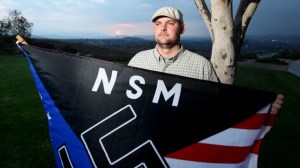
I thought I’d take a brief break from politics to update a story I wrote about back in the spring of 2011 about the death of neo-Nazi Jeff Hall of Riverside, California. Hall’s 10-year-old son Joseph admitted to shooting his father.
At the time, I wrote that it is unusual for children to kill their parents unless there is a history of parental abuse. Hall abused his children first by exposing them to neo-Nazi meetings in the home where they soaked up his hateful ideology, and second by beating both Joseph and his stepmother. The boy had been separated from his mom for years, and at the time of the shooting was the subject of a custody battle between his biological parents. Clearly, he had been under incredible stress. I wrote in May 2011:
So we have a young boy who probably has Post-traumatic Stress Disorder from years of abuse by both parents, from being separated from his mother, and from being exposed to hate-filled rhetoric at Neo-Nazi meetings and probably from his father. It’s like something out of American History X. How could a judge allow children to live in a home like that? To me, exposing young children to racist, anti-semitic, and anti-immigrant vitriol is in itself abuse.
Since the boy is under the age of 14, he cannot be tried as an adult and will likely be put in a youth offender facility. According to the articles I read, he will probably get out when he is 25 years old. By that time, he’ll most likely be a hardened criminal.
I looked at several studies of young children’s understanding of death. A ten-year-old has barely begun to comprehend the irreversibility of death. His brain development has not reached a point where he has good impulse control or the ability to manage strong emotions well. This story makes me heartsick.
Joseph’s trial for murder began yesterday.
The 10-year-old son of a neo-Nazi leader told his younger sister that he planned to shoot their father, then a day later took a gun from his parents’ bedroom and fired one bullet into his father’s head as he slept on a couch, a prosecutor alleged Tuesday.
The boy’s father, Jeff Hall, was an out-of-work plumber who as regional leader of the National Socialist Movement headed rallies at a synagogue and a day labor site.
In opening statements at the murder trial, Riverside County prosecutor Michael Soccio dismissed the notion that Hall’s neo-Nazi beliefs contributed to his son’s behavior, as the defense maintains, and instead said the boy, now 12, was a violent child who had been kicked out of every school he attended.
The boy also suspected his father was going to leave his stepmother, and he didn’t want the family to split up, prosecutors have said.
At least he isn’t being tried as an adult. If convicted, he could be released at age 23.
Joseph’s public defender told The New York Times that:
his client has neurological and psychological problems, compounded by exposure to neo-Nazi “conditioning” and physical abuse in the home.
“He’s been conditioned to violence,” Mr. Hardy said, adding, “You have to ask yourself: Did this kid really know that this act was wrong based on all those things?”
Instead, Mr. Hardy said, Joseph thought he was being a hero by shooting his father. “He thought what he was doing was right,” said Mr. Hardy. “And while that may be hard for other people to understand, in his mind, in a child’s mind, if he thought it was right, or at least didn’t think it was wrong, then he cannot be held responsible.”
But here’s the most tragic part of this case, in my opinion:
if found responsible for the killing and made a ward of the state, Joseph, who is now 12, would be the youngest person held in one of the three fenced-in facilities run by California’s Department of Juvenile Justice, which houses about 900 of some of the state’s most serious juvenile offenders. The median age of these offenders held by the state is 19…
So the kid will be exposed to older boys who will probably abuse him physically, sexually, and emotionally. As I wrote last spring, he’ll most likely be a hardened criminal by the time he’s back on the street.
According to Joseph Weisberg, co-director of the Stanford Criminal Justice Center, it’s extremely rare for a child so young to go on trial for murder.
But Mr. Soccio said that Joseph had a history of violence, including an attack that involved wrapping a telephone cord around a teacher’s neck, and needed to be in a security setting “receiving as much help as possible for as long as possible.”
“I’ve had some people say, ‘How can you do that to a little kid?’ ” said Mr. Soccio. “And I ask them, ‘Well, would you like him to come live with you?’ ”
Whatever strategy the lawyers use, life inside the Hall household will most likely come up in the trial, and Joseph may take the stand, Mr. Soccio said. The court could also see testimony from members of the neo-Nazi group the National Socialist Movement, of which Mr. Hall was a West Coast leader.
Obviously Joseph should have been removed from the home years ago. Maybe it’s too late to rehabilitate him–I can’t say. It just makes me so angry that we live in a society that doesn’t give priority to protecting children and helping them cope with and recover from emotional trauma and abuse. Instead we cut taxes for the wealthiest Americans and skimp on anything that could change outcomes for children like Joseph. As I wrote last spring, it’s just plain heartbreaking.
Tuesday Reads: A Mixed Bag (No Politics)
Posted: September 25, 2012 Filed under: Crime, Criminal Justice System, morning reads | Tags: Amy Bishop, Apple products, Aurora theater shootings, British intelligence, Bronx Zoo tiger, China, David Villalobos, DNA, Foxconn plant, George Zimmerman, Holocaust, James Holmes, leatherback turtle, Mark Osterman, murder, New England Aquarium, riots, Trayvon Martin, World War II German soldiers 26 Comments
Good Morning!!
I’ve decided to avoid presidential politics this morning, but I have a variety of interesting news links that I hope you’ll enjoy.
I’m going to begin with some crime stories. Do you remember Amy Bishop? She was the University of Alabama Huntsville biology professor who was turned down for tenture and later murdered three of her colleagues and wounded three others at a department faculty meeting in early 2010. I wrote a couple of posts about her at the time, see here and here. Today Bishop was sentenced to life in prison.
A former Alabama biology professor who pleaded guilty to killing three colleagues and wounding three others in a 2010 shooting rampage was sentenced to life in prison without parole on Monday after a jury convicted her in a shortened trial.
Amy Bishop avoided a death sentence by admitting earlier this month to gunning down her colleagues during a biology department staff meeting at the University of Alabama at Huntsville.
Alabama law requires a jury to decide the punishment and confirm a guilty plea for a capital murder charge.
Bishop’s defense attorneys did not contest the facts of the case during the abbreviated proceedings on Monday.
“She has admitted she did these terrible things,” defense attorney Robert Tuten said in his opening statement.
A few days ago, there was some interesting news in the Trayvon Martin case.
Forensic tests made public Wednesday show that George Zimmerman’s was the only DNA that could be identified on the grip of the gun used to fatally shoot 17-year-old Trayvon Martin.
The results rule out Martin’s DNA from being on the gun’s grip. Zimmerman’s DNA also was identified on the gun’s holster, but no determination could be made as to whether Martin’s DNA was on the gun’s holster, according to the report from the Florida Department of Law Enforcement.
I wonder if that will affect Zimmerman’s decision to go through with the stand-your-ground hearing that his attorney Mark O’Mara has scheduled for next year?
O’Mara is also trying to get access to Trayvon Martin’s school records even though they couldn’t be introduced at trial because they are not relevant to the crime, according to prosecutor Bernie de La Ronda.
In a new pleading, Assistant State Attorney Bernie de la Rionda asks Circuit Judge Debra S. Nelson to seal whatever those records show and in the future to keep O’Mara’s subpoenas a secret.
O’Mara is entitled to go on a fishing expedition to find out about Trayvon’s past, according to court paperwork de la Rionda filed Wednesday, but “he is not allowed to chum the waters and then, by innuendo or otherwise, to publish irrelevant items … to the media in an attempt to influence public perception or otherwise curry favor with potential jurors.”
De la Rionda also Wednesday filed a new evidence list – his eighth. It shows that a book and television appearance by Zimmerman’s self-proclaimed best friend, former Seminole County deputy Mark Osterman, are now officially part of the case prosecutors are building against Zimmerman.
Osterman’s self-published book, written with his wife, is titled “Defending Our Friend: The Most Hated Man in America.” From Examiner.com:
A new book claims that before being shot in the chest and dying, Trayvon Martin grabbed the gun of George Zimmerman, as the two struggled during a violent encounter, according to a report Thursday. This, despite the findings released this week that none of the teen’s DNA was found on the weapon….
The Miami Herald reports that Osterman was the first person Zimmerman’s wife called after the shooting. A former U.S. air marshal, he was with his friend during Zimmerman’s first three police interrogations.
According to the Herald, Osterman’s account of what took place the night of Martin’s death is “a sharp deviation from the versions Zimmerman gave…”
In his book, Osterman quotes Zimmerman as saying, “I desperately got both of my hands around the guy’s one wrist and took his hand off my mouth long enough for me to shout again for help.”
The quote continues, “For a brief moment I had control of the wrist, but I knew when he felt the sidearm at my waist with his leg. He took his hand that was covering my nose and went for the gun, saying, ‘You’re gonna die now, mother*****.’ Somehow I broke his grip on the gun where the guy grabbed it between the rear sight and the hammer. I got the gun in my hand, raised it toward the guy’s chest and pulled the trigger.”

James Holmes
I also have an update on the Aurora, Colorado theater shooting. Accused shooter James Holmes recently appeared in court with short brown hair and a few days’ growth of beard.
Seeking to avoid any delays in the Colorado movie theater shooting case, prosecutors gave up their fight to see a notebook the suspect sent to a university psychiatrist and instead argued for a palm print to compare with one found on the inside of a theater exit door.
James Holmes appeared in court Thursday with short brown hair instead of a wild shock of orangish-red hair and seemed more animated than he has been in the past. He smiled and glanced around the courtroom, looking at his lawyers and reporters covering the hearing. He appeared to be moving his mouth but not actually talking.
Prosecutors believe they still have good arguments for getting access to the notebook and will continue to fight for it. Oddly, some victims’ families refuse to believe that Holmes is mentally ill.
Family members receiving updates about Holmes from the courtroom said it’s all an act by the former University of Colorado, Denver, neuroscience graduate student to appear mentally ill.
“He’s just putting on a show,” said Greg Medek of Aurora, whose daughter Micayla, 23, died in the shooting. “I don’t think he’s crazy. He’s just evil.”
The last crime story is about the New York man who jumped into a tiger cage.
Before his now-infamous tangle with a Bronx Zoo tiger, David Villalobos adorned his Facebook page with New Age odes to Mother Earth and affirmations like, “Be love and fearless.”
Police said Saturday that Villalobos had told detectives that it was without fear that he leaped from an elevated train into the animal’s den. His reason, they said, was that “he wanted to be one with the tiger.”
Villalobos also recounted how, after he landed on all fours, the 400-pound beast attacked him and dragged around by his foot, said New York Police Department spokesman Paul Browne. Despite serious injuries, he claimed he was able to get his wish and pet the tiger — a male Siberian named Bashuta — before his rescue, the spokesman added.
Based on those admissions and a complaint from the zoo, police charged the hospitalized Villalobos with misdemeanor trespassing on Saturday. It was unclear if the 25-year-old real estate agent had an attorney, and attempts to reach relatives were unsuccessful.
There’s much more weird info at the link.
Here’s a bloodcurdling historical story for you from The Daily Beast. It’s a review of a new book, “Soldaten: On Fighting, Killing, and Dying: The Secret WWII Transcripts of German POWs” by Sönke Neitzel and Harald Welzer.
How much did World War II German soldiers know about the Holocaust? Publicly, many of them denied knowledge. But a long-lost cache of secret recordings that the British intelligence service made of German prisoners of war show that, in private, they chatted openly and casually about mass-murdering Jews, demonstrating what Hannah Arendt called “the banality of evil.”
The book consists of transcripts of conversations secretly recorded by British intelligence. I’m not going to include an except, because the material is pretty gruesome. You can read it all at the link. But this certainly will be a valuable addition to the history of Nazi Germany and WWII.
The Foxconn plant in China where apple products are manufactured has been shut down because of riots that took place over the weekend.
SHANGHAI — Foxconn Technology, a major supplier to some of the world’s electronics giants, including Apple, said it had closed one of its large Chinese plants Monday after the police were called in to break up a fight among factory employees.
A spokesman said some people had been hurt and detained by the police after the disturbance escalated into a riot involving more than 1,000 workers late Sunday.
The company said the incident was confined to an employee dormitory and “no production facilities or equipment have been affected.” It said the cause of the disturbance was still under investigation.
One Foxconn employee reached by telephone Monday afternoon, however, said the incident began when workers started brawling with security guards.
Unconfirmed photographs and video circulated on social networking sites, purporting to be from the factory, showed smashed windows, riot police officers and large groups of workers milling around. The Foxconn plant, in the Chinese city of Taiyuan, employs about 79,000 workers.
The Chinese state-run news media said 5,000 police officers had been called in to quell the riot.
This one is for Connie: Stranded 655-pound turtle reluctantly released.
A 655-pound leatherback sea turtle that had been stranded in thick mud in Truro on Wednesday night was released off the coast of Harwich Port Saturday morning, New England Aquarium officials said.
A Massachusetts Audubon Society staff member spotted the 7-foot-long black male turtle in Pamet Harbor Wednesday night as high tide approached, said Connie Merigo, the aquarium’s rescue director.
Aquarium staff and volunteers, along with staff members of the Audubon Society and International Fund for Animal Welfare, brought the turtle to the aquarium’s Animal Care Center in Quincy near dawn Thursday.
The sea turtle was about 100 pounds underweight and had low blood sugar and an old injury on his front right fin, Merigo said.
“When he first got here he was fairly lethargic, especially out of the water,” head veterinarian Dr. Charles Innis said.
Innis said the turtle was treated aggressively with “injectable sugar solution, vitamin and mineral supplements, steroids, and antibiotics to stave off infection.” It wouldn’t have been possible to keep him any longer, because leatherbacks are so stressed by being in captivity that they usually don’t survive long.
That’s all I have for now. I hope you enjoyed the break from politics. I know I did. Now what are you reading and blogging about today?
A Sad Legacy: Louisiana’s Prison Economy
Posted: May 15, 2012 Filed under: Criminal Justice System, New Orleans | Tags: Angola Prison, Bobby Jindal, Louisiana, prison state, prisoners, Warden Cain 14 Comments This is the stuff that creates documentaries and sad movies. It is the prison state that is Louisiana.
Louisiana is the world’s prison capital. The state imprisons more of its people, per head, than any of its U.S. counterparts. First among Americans means first in the world. Louisiana’s incarceration rate is nearly triple Iran’s, seven times China’s and 10 times Germany’s.
The hidden engine behind the state’s well-oiled prison machine is cold, hard cash. A majority of Louisiana inmates are housed in for-profit facilities, which must be supplied with a constant influx of human beings or a $182 million industry will go bankrupt.
Several homegrown private prison companies command a slice of the market. But in a uniquely Louisiana twist, most prison entrepreneurs are rural sheriffs, who hold tremendous sway in remote parishes like Madison, Avoyelles, East Carroll and Concordia. A good portion of Louisiana law enforcement is financed with dollars legally skimmed off the top of prison operations.
If the inmate count dips, sheriffs bleed money. Their constituents lose jobs. The prison lobby ensures this does not happen by thwarting nearly every reform that could result in fewer people behind bars.
READ THE
ENTIRE SERIES from NOLA.Com.Meanwhile, inmates subsist in bare-bones conditions with few programs to give them a better shot at becoming productive citizens. Each inmate is worth $24.39 a day in state money, and sheriffs trade them like horses, unloading a few extras on a colleague who has openings. A prison system that leased its convicts as plantation labor in the 1800s has come full circle and is again a nexus for profit.
In the past two decades, Louisiana’s prison population has doubled, costing taxpayers billions while New Orleans continues to lead the nation in homicides.

It is a shameful situation. Here are some stories from Angola. It’s probably the most infamous prison in the world. It’s known for its rodeo and its harsh treatment of prisoners who basically are subjected to “Faith-Based Slavery”. It seems that when a state can’t produce real jobs that it produces prisons.
“Unique” is one way Warden Burl Cain likes to describe his prison, and it would be impossible to argue otherwise. With grazing cattle and rolling hills in the distance, it’s hard not to admire its strange, sprawling beauty, even as the towers come into view. The prison itself is absent from my GPS’s “points of interest,” yet Angola’s Prison View Golf Course—the first public golf course on the grounds of a state penitentiary—is not. At Angola’s official museum, opened by Cain in 1998, a retired electric chair and rusty prison contraband are displayed adjacent to a gift shop selling mugs and tote bags reading: “Angola: A Gated Community.”
Angola is the largest maximum security in the country, sitting on 18,000 acres of farmland and home to 5,200 men. Louisiana has the highest incarceration rate of adult prisoners in the United States; thanks to the state’s unforgiving sentencing laws, at least 90 percent of Angola’s prisoners will die there. It’s a large-scale embodiment of a national phenomenon: elderly inmates are the country’s fastest growing prisoner population.
Yet Angola is also lauded as a revolution in corrections, its story told many times: Angola was once the “bloodiest prison in America,” where inmates slept with magazine catalogs strapped to their chests to protect themselves from stabbings. Things began to turn around in the 1970s, when a federal judge ordered a major overhaul. But most of the credit has gone to Warden Cain for imposing order through a new model of incarceration.
Like all of Angola’s wardens, Cain has continued the tradition of hard labor: most inmates work in the fields eight hours a day, five days a week, harvesting hundreds of acres of soybeans, wheat, corn, and cotton—picked by hand and sold by Prison Enterprises, the business arm of the Louisiana Department of Corrections. But unlike his predecessors, Cain, an evangelical Christian, has also made it his mission to bring God to Angola. Inmate ministers tell new prisoners that they can either work on their “moral rehabilitation” or remain a “predator”—“the choice is yours.” The radio station plays gospel music. On the walls leading to the execution chamber are two murals: Elijah ascending to Heaven and Daniel facing the lion. One of Cain’s favorite anecdotes is the execution of Antonio James, a born-again Christian whose hand he held just before giving the go-ahead to end his life. As James lay on the gurney waiting for lethal drugs to enter his veins, Cain said, “Antonio, the chariot is here…you are about to see Jesus.”
You should really read this MJ article to get the full feel of life inside Angola. It’s called “Gods Own Warden”.
Everyone was there except the person I had come to see: Warden Burl Cain, a man with a near-mythical reputation for turning Angola, once known as the bloodiest prison in the South, into a model facility. Among born-again Christians, Cain is revered for delivering hundreds of incarcerated sinners to the Lord—running the nation’s largest maximum-security prison, as one evangelical publication put it, “with an iron fist and an even stronger love for Jesus.” To Cain’s more secular admirers, Angola demonstrates an attractive option for controlling the nation’s booming prison population at a time when the notion of rehabilitation has effectively been abandoned.
What I had heard about Cain, and seen in the plentiful footage of him, led me to expect an affable guy—big gut, pale, jowly face, good-old-boy demeanor. Indeed, former Angola inmates say that prisoners who respond to Cain’s program of “moral rehabilitation” through Christian redemption are rewarded with privileges, humane treatment, and personal attention. Those who displease him, though, can face harsh punishments. Wilbert Rideau, the award-winning former Angolite editor who is probably Angola’s most famous ex-con, says when he first arrived at the prison, Cain tried to enlist him as a snitch, then sought to convert him. When that didn’t work, Rideau says, his magazine became the target of censorship; he says Cain can be “a bully—harsh, unfair, vindictive.”“Cain was like a king, a sole ruler,” Rideau writes in his recent memoir, In the Place of Justice. “He enjoyed being a dictator, and regarded himself as a benevolent one.” When a group of middle school students visited Angola a few years ago, Cain told them that the inmates were there because they “didn’t listen to their parents. They didn’t listen to law enforcement. So when they get here, I become their daddy, and they will either listen to me or make their time here very hard.”
Another former prisoner, John Thompson—who spent 14 years on death row at Angola before being exonerated by previously concealed evidence—told me that Cain runs Angola “with a Bible in one hand and a sword in the other.” And when the chips are down, Thompson said, “he drops the Bible.”
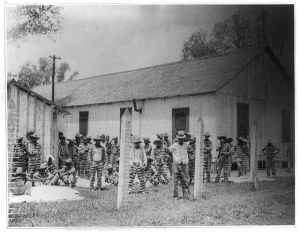 We’ve talked about Angola’s horrible legacy before. Here’s a recent UK Guardian Story on two men that have spent 40 years in solitary confinement. This is the stuff that causes insanity. Every human rights group actively opposes this kind of treatment.
“I can make about four steps forward before I touch the door,” Herman Wallace says as he describes the cell in which he has lived for the past 40 years. “If I turn an about-face, I’m going to bump into something. I’m used to it, and that’s one of the bad things about it.”
On Tuesday, Wallace and his friend Albert Woodfox will mark one of the more unusual, and shameful, anniversaries in American penal history. Forty years ago to the day, they were put into solitary confinement in Louisiana‘s notorious Angola jail. They have been there ever since.
They have spent 23 hours of every one of the past 14,610 days locked in their single-occupancy 9ft-by-6ft cells. Each cell, Amnesty International records, has a toilet, a mattress, sheets, a blanket, pillow and a small bench attached to the wall. Their contact with the world outside the windowless room is limited to the occasional visit and telephone call, “exercise” three times a week in a caged concrete yard, and letters that are opened and read by prison guards.
A new documentary film takes us into that cell, providing rare insight into the personal psychological impact of such prolonged isolation. Herman’s House tracks the experiences and thoughts of Wallace as he reflects on four decades banged away in a box.
Our own Governor wants to turn our Prison Economy into a privatized, money-making scheme for corporate donors. Fortunately, his bill didn’t get very far. But, this is because so many local politicians make money off of renting out prisoners to their own local donor base. They also get to use them for services that would normally go to paid workers. No wonder no one can find these types of jobs unless you are in prison.
A bill strongly backed by Gov. that would have allowed for the sale of the Avoylles Correctional Facility has been abandoned, as support for it was limited, according to the Associated Press. Now, the prison may be run under a new plan. Here is some more information.
* The original bill would have allowed for the Avoyelles Correctional Facility to be sold for $35 million to a private firm that would be responsible for operating it, according to the Town Talk.
* The state would then pay the company that buys it a daily fee to operate it.
* Rep. (R- Haughton) sponsored the bill, House Bill 850.
* Opposition from the privatization of the prison stems from the fact that 296 jobs would be lost in the sale.
* One group, the , made a plea to representatives to vote against the bill, saying that if the prison was run privately, the company could demand an exorbitant amount of money from Louisiana taxpayers to run the prison, and that the sale would actually cost Louisiana residents more.
* The bill was rewritten on Wednesday to allow for a private firm to be contracted to run the facility, but not to buy it.
* The contract would be for 10 years and the approval of the contract would be by the House and Senate budget committees.
* On Wednesday, the House voted 62-43 to pass the new amendment to the bill, according to Gambit.
* The bill was not sent to the Senate for approval, however, as Burns says that he is giving legislators time to look over the new bill, according to the Capitol News Bureau.
* There is still a lot of disapproval of the new bill as well, as opponents still cite the decreased wages for employees that are working for private companies as opposed to wages for state employees as unacceptable.
* Safety is also a concern, as Rep. Robert Johnson cited the lower wages as attracting lower quality workers to guard the prison, which would mean an unsafe environment, according to The Times-Picayune.
* The privatization of Avoyelles is a part of a larger plan by Gov. Jindal to privatize more prisons in Central Louisiana and close the and move those prisoners to Avoyelles, according to the Town Talk.
* Alexandria Mayor Jacques M. Roy has come out against the plan, saying that it would decrease public safety and would not save the state any money.
Any one in Louisiana lives among this prison legacy. Prisoners clean up our roads. They are brought out to shore up levees. They make our license plates. They are visible everywhere doing jobs that would usually be given to parish employees. No place is this more true than in small communities where sheriffs can make a good living off of renting them out to local business. Kinda makes you proud of that old entrepreneurial spirit doesn’t it? Take some time to read the series at the Times Picayune. I think you will find out more about my part of the good ol’ USA than you really would like.

 peej
peej Carissa
 bostonboomer
 dakinikat
 ecocatwoman
 mablue2
 Mama Lopez
 peggysue22
 quixote
 skydancingguestblogger
 Mona (aka Wonk the Vote)



 Sky Dancing
Recent Comments