
Putting Corporations above People and their Governments and their Laws
Posted: June 16, 2012 Filed under: corporate greed, corporatism, Foreign Affairs, globalization | Tags: leaked document, Lori Wallach, Public Citizen, TPP, Trans-Pacific Partnership, US Trade negotiations 10 Comments There is a leaked “trade” document that needs to be on every one’s reading list. I know it’s a big request to ask you to follow what seems like a fairly complex negotiation riddled with legalese. However, we’re fortunate it was leaked. No one knows what’s been going on in negotiations for ongoing US trade negotiations with eight Pacific nations. This includes Senator Ron Wyden who is responsible for oversight who is trying to draft legislation to get access.
U.S. Senator Ron Wyden, Chairman of the U.S. Senate Finance Subcommittee on International Trade Customs and Global Competitiveness, introduced legislation clarifying USTR’s obligation to share information on trade agreements with Members of Congress. Legislation is necessitated by administration’s refusal to share information with Congress broadly, and specifically with Wyden’s office.
So much for Obama’s pledge of transparency.
The document in question is part of the Trans-Pacific Partnership (TPP). This document shows evidence that the agreement would “drastically undermine Obama’s proposed domestic agenda and give unprecedented political authority to multinational corporations”.
The TPP negotiations have gone on for two years between the Obama administration and several Pacific nations under conditions of ‘extreme secrecy’ without press, public or policymaker oversight, says Public Citizen who posted the leaked document on their website today.
“The top U.S. trade official effectively has said that the administration must keep TPP secret because otherwise it won’t be able to shove this deal past the public and Congress,” said Lori Wallach, director of Public Citizen’s Global Trade Watch.
The leaked document, according to the Huffington Post, reveals ‘extreme provisions’ that have been agreed upon in secret negotiations that “bestow radical new political powers upon multinational corporations” in global trade and contradict key promises made to the US public about such deals.
According to Public Citizen, the leaked text now confirms that the terms of the TPP would:
- Limit how U.S. federal and state officials could regulate foreign firms operating within U.S. boundaries, with requirements to provide them greater rights than domestic firms;
- Extend the incentives for U.S. firms to offshore investment and jobs to lower-wage countries;
- Establish a two-track legal system that gives foreign firms new rights to skirt U.S. courts and laws, directly sue the U.S. government before foreign tribunals and demand compensation for financial, health, environmental, land use and other laws they claim undermine their TPP privileges; and
- Allow foreign firms to demand compensation for the costs of complying with U.S. financial or environmental regulations that apply equally to domestic and foreign firms.
“The airing of this one TPP chapter,” said Wallach, “which greatly favors foreign corporations over domestic businesses and the public interest and exposes us to significant financial liabilities, shows that the whole draft text must be released immediately so it can be reviewed and debated. Absent that, these negotiations must be ended now.”
I first learned the details of the leak document from listening to the daily podcast at Democracy Now. Juan Gonzalez interviewed Wallach who is running around with her hair on fire trying to explain the ramifications to our country and others should this pass.
There are so many items in just this one chapter of the leaked document to fear that it’s hard to cover it all in one short Saturday Post. Basically, multinational corporations will be able to sue governments should they be hurt by labor laws, environmental laws, or any kind of regulation and seek damages. Their case will be heard by a tribunal made up of corporate lawyers. So, laws that apply to us that get tried in our courts will not apply to these multinationals. The tribunal panel gets to decide their fate.
Upon reading this latest document and the previously leaked document on intellectual property, and regarding what they mean for our access to life-saving medication, Judit Rius, the U.S. manager of Doctors Without Borders Access to Medicine Campaign said that “Bush was better than Obama on this. It’s pathetic, but it is what it is. The world’s upside-down.”
In response to the widespread criticism of the leaded document, USTR spokesman Nkenge Harmon said “This administration is committed to ensuring strong environmental, public health, and safety laws. Nothing in our TPP investment proposal could impair our government’s ability to ensure legitimate non-discriminatory public interest regulation, including measures to protect public health, public safety and the environment.”
It would be up to the international tribunals, however, to interpret “legitimate,” and “non-discriminatory.”
“Our worst fears about the investment chapter have been confirmed by this leaked text … This investment chapter would severely undermine attempts to strengthen environmental law and policy,” said Margrete Strand Rangnes, director of Labor and Trade for the the environmental group the Sierra Club.
The impact of this would be incredible. I’m going to be watching this carefully and I’d like to suggest you watch it too. Urge your Senators to support Wyden’s attempt to gain access to oversight of the trade negotiation process.
Exposing and Dismembering ALEC and its Kleptocracy Agenda
Posted: April 16, 2012 Filed under: American Gun Fetish, Big Pharma, Civil Liberties, Civil Rights, collective bargaining, Corporate Crime, corporate greed, corporate money, corporatism, corruption, Domestic Policy, Economy, education, Environment, New Orleans, We are so F'd | Tags: ALEC 13 Comments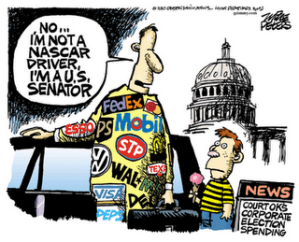 I have a personal interest in seeing ALEC dismembered. My governor Bobby Jindal has adopted and enacted some of its worse cookie cutter laws. There are three progressive interests that are leading actions to defund and defang this supposedly “nonpartisan individual membership organization of state legislators which favors federalism and conservative public policy solutions”. They are the Urban League, Common Cause, and ColorofChange. I would hope that many more groups will join in.
Many of ALEC’s corporate sponsors have quit funding the organization which seeks to remove oversight and regulation of all kinds of industry, privatize public services and goods, and deprive minority communities and women of basic voting rights and civil rights. They seek tort reform that would limit corporate exposure to liability from unsafe products and practices. They like to remove laws providing consumer protection and information. They are not nonpartisan and are responsible for some of the most heinous, radical legislation of the last few years. Woe to those of you whose governors or legislators belong to this organization for you will live in a world with very little protection from big money and big business and your tax dollars will be used to line their coffers.
The American Legislative Exchange Council describes itself as a nonpartisan champion of free markets. But if you spend some time at an ALEC conference (Bloomberg Businessweek did, for an article last year) you will be hard-pressed to find many Democrats. And when the entire conference meets for lunch, you will hear from the podium nothing that would seem out of place in a press release from Eric Cantor’s office. Last year in New Orleans, for example, Bobby Jindal, governor of Louisana, told an ALEC annual meeting, “Defeating the president is crucial to defending our economy,” and “Obama has been a disaster.” I didn’t hear anyone boo. What I did hear was the sound of fevered applause when the conference played a videotaped greeting from Ronald Reagan.
I’m not saying it’s wrong to feverishly applaud Ronald Reagan. I am saying that only in the most thinly defensible, legalistic sense can ALEC call itself “nonpartisan.” And the council doesn’t really support free markets, either. It supports the companies that fund it. This is an important distinction, because the corporations that donate to ALEC aren’t doing so to protect markets. They’re protecting favored tax treatments and pushing regulations that lock in their market positions. As best as we were able to determine in reporting our piece last year, corporations propose bills at the state level and then push them up to ALEC, which has both corporate and legislative members. ALEC pushes the legislative members to the foreground, stamps the bills as “model legislation,” and then the corporations push them back out to other state legislatures. This may not be the case with all ALEC legislation, but it certainly was with the bill we followed.
So ALEC is not what it says it is. That’s not extraordinary: Few advocacy groups are what they say they are. In ALEC’s case, however, the fingers-crossed-behind-its-back description of itself is definitional. If the American Legislative Exchange Council operated with complete openness, it couldn’t operate at all. ALEC has attracted a wide and wealthy range of supporters precisely because it does its real work in a black box. Membership lists are secret. The origins of the model bills are secret. Deliberations and votes on model bills are secret. The model bills themselves are secret. The council has designed its entire structure to disguise industry-backed legislation as grassroots work from state legislators. If this becomes clear to everyone, there’s no reason for corporations to use it. And that is exactly what has been happening.
Minority advocacy groups have been most active in the fight against ALEC. ALEC is responsible for the legislation that requires specific picture ids to vote and they are responsible for the Stand Your Ground Laws. Both of these issues have been front and center in Civil Rights Groups. The Trayvon Martin case is important in two key ways. First, it is bringing to light the institutional racism implicit in the criminal system. Second, it has exposed the role of ALEC in sneaking through legislature in states that most voters do not support or like. The vigilante-empowering Stand Your Ground laws are now seeing daylight.
The tension in corporate boardrooms over the case is the latest example of the pitfalls companies can sometimes face when they donate to political and lobbying groups, even those that seem safely below the radar of public consciousness.
The ALEC controversy is now sparking a broader debate about corporate participation in politics and the polarized state of political discourse. At a minimum, it has strengthened calls for companies to develop clear policies explaining their spending.
“I would caution companies to be very aware of where their money is going,” says Nell Minow, director of GMI Ratings, which provides corporate governance information to investors, corporate auditors and regulatory agencies. “Companies are going to realize they can take a real reputational hit with this kind of affiliation.”
She and others recall the tempest that erupted in 2010 around Target after the company donated to a nonprofit group supporting a Minnesota gubernatorial candidate who was known for opposing gay rights initiatives.
Like Louisiana, many Arizona politicians are in cahoots with ALEC. ALEC likes to use laws to funnel public money into corporate income statements. This isn’t free market promotion, this is more like being given the ability to loot public resources.
Legislators in Arizona continue to advance extremist legislation inspired by the American Legislative Exchange Council (ALEC) and its out-of-state corporate backers, according to a new analysis by People For the American Way Foundation, Common Cause, the Center for Media and Democracy and Progress Now. This report shines a new light on the Arizona Legislature’s unprecedented ties to the secretive organization, which recently drew nationwide fire for its role in implementing radical policies across the country like “Shoot First” laws and voter suppression laws, and anti-worker measures. ALEC’s extreme agenda has recently led companies such as Pepsi, Coca-Cola, McDonalds, Wendy’s, KRAFT and Intuit to withdraw from the organization. The Bill and Melinda Gates Foundation on Monday also withdrew its support from ALEC.
The comprehensive report found that Arizona’s large concentration of ALEC-member legislators, working hand-in-hand with the corporate leaders who make up ALEC’s membership, are continuing to endorse special interest legislation that harms ordinary people by limiting consumers’ rights, privatizing education and dismantling unions.
The report, ALEC in Arizona: The Voice of Corporate Special Interests in the Halls of Arizona’s Legislature, updated for the Fiftieth Legislature, second regular session is available here.
“Recent polling shows that Arizonans are appalled by the out-of-touch and extremist agenda at their State Legislature. This report shows that agenda is no accident,” said John Loredo, a member of Arizona Working Families and a former Arizona House Minority Leader. “Unfortunately, Arizona has one of the highest concentrations of ALEC legislators in the country, and that makes us a petri dish for anti-worker legislation and a host of other bad ideas.”
“ALEC-member legislators are unabashedly continuing to push legislation straight from corporate headquarters to Arizona’s lawbooks,” said Marge Baker, Executive Vice President at People For the American Way Foundation. “Well-heeled special interests are circumventing the democratic system and bypassing Arizona’s citizens, who can’t match the level of access that ALEC provides. As a result, Arizonans are facing an endless assault from laws that serve the interests of the rich and powerful instead of everyday people.”
You can find ALEC’s model bills and reports on its activities in many states at the site ALEC Exposed. ALEC is responsible for the horrible school voucher and privatization plan that Bobby Jindal has ramrodded through our state. It is also responsible for some of the worst climate change denial propaganda. The source of this funding is big oil, big coal, and the Koch Brothers.
$375,858 received from Koch foundations 2005-2010 [Total Koch foundation grants 1997-2010: $708,858]
American Legislative Exchange Council (ALEC) is one-stop shopping for state elected officials interested in perusing the wares of an array of Koch-funded opposition organizations including IER, ACCF, Mercatus and other sources. ALEC has successfully peddled corporate-written legislation to numerous states attacking the Kyoto Protocol, undermining climate science education in schools and numerous other anti-environmental legislation. ALEC has close ties to Koch Industries, which helped bail the organization out of financial troubles with a half-million dollar grant.
ALEC publishes its own materials as well, including a “Climate Change Overview for State Legislators” which downplays the science and risks of global warming and exaggerates the costs of addressing it. The Overview was written by Daniel Simmons, who moved from ALEC to become AEA’s Director of State Affairs. Simmons was at the Mercatus Institute before ALEC and is a graduate of the George Mason University School of Law.
Here’s some of the background information on the laws that ALEC creates with the intended purpose of “starving Public Schools“.
ALEC’s most ambitious and strategic push toward privatizing education came in 2007, through a publication called School Choice and State Constitutions, which proposed a list of programs tailored to each state. That year Georgia passed a version of ALEC’s Special Needs Scholarship Program Act. Most disability organizations strongly oppose special education vouchers—and decades of evidence suggest that such students are better off receiving additional support in public schools. Nonetheless, Louisiana, Oklahoma, Florida, Utah and Indiana have passed versions of their own. Louisiana also passed a version of ALEC’s Parental Choice Scholarship Program Act (renaming it Student Scholarships for Educational Excellence), along with ALEC’s Family Education Tax Credit Program (renamed Tax Deductions for Tuition), which has also been passed by Arizona and Indiana. ALEC’s so-called Great Schools Tax Credit Program Act has been passed by Arizona, Indiana and Oklahoma.
ALEC’s 2010 Report Card on American Education called on members and allies to “Transform the system, don’t tweak it,” likening the group’s current legislative strategy to a game of whack-a-mole: introduce so many pieces of model legislation that there is “no way the person with the mallet [teachers’ unions] can get them all.” ALEC’s agenda includes:
§ Introducing market factors into teaching, through bills like the National Teacher Certification Fairness Act.
§ Privatizing education through vouchers, charters and tax incentives, especially through the Parental Choice Scholarship Program Act and Special Needs Scholarship Program Act, whose many spinoffs encourage the creation of private schools for specific populations: children with autism, children in military families, etc.
§ Increasing student testing and reporting, through more “accountability,” as seen in the Education Accountability Act, Longitudinal Student Growth Act, One-to-One Reading Improvement Act and the Resolution Supporting the Principles of No Child Left Behind.
§ Chipping away at local school districts and school boards, through its 2009 Innovation Schools and School Districts Act and more. Proposals like the Public School Financial Transparency Act and School Board Freedom to Contract Act would allow school districts to outsource auxiliary services.
ALEC is also invested in influencing the educational curriculum. Its 2010 Founding Principles Act would require high school students to take “a semester-long course on the philosophical understandings and the founders’ principles.”
Perhaps the Brookings Institute states the mission most clearly: “Taken seriously, choice is not a system-preserving reform. It is a revolutionary reform that introduces a new system of public education.”
The passage of radical public school defunding in Louisiana is leading to a recall Jindal effort. We’ve already had some of this type of reform in New Orleans and it’s clearly not working well at all unless you count teacher union busting and lowering teacher salaries progress. Here are some of the things we will now be suffering in Louisiana. I personally am opposed to the state funding religious indoctrination hiding under the guise of education. These laws funnel public money into any thing that deems itself a school, it seems.
A vast expansion of charter schools, an overhaul of teacher tenure and establishment of a statewide program to pay private school tuition with public dollars moved within one step of final passage Thursday, as the Louisiana Senate Education Committee endorsed the headliner components of Gov. Bobby Jindal’s education agenda without changes or dissent.
I know this thread wanders around through many topics but the number of right wing bills pressured cooked into law by ALEC and their toadies is just as wandering and perverse. Check out the site and be aware of which politicians supposedly representing the people of your state that are ALEC cronies. The movement to get corporations to defund the organization should be paramount. Ordinary Americans have already lost a lot to their agenda. It’s time to stop them. Put pressure on organizations to join in the effort. Let’s defang this beast together.
Digging Deeper
Posted: April 12, 2012 Filed under: 2012 presidential campaign, Banksters, Barack Obama, Corporate Crime, corporate greed, corporatism, corruption, Crime, Democratic Politics, Eric Schneiderman, home foreclosure fraud, Homeless, Mitt Romney, U.S. Economy 16 CommentsThough I’ve been on a hiatus of late, I’ve tried to keep up with basic headline reading, dipping my toes into stories of interest [and/or those producing sheer outrage]. The latter pushed my crazy button when I read this headline last week at New Deal 2.0:
Eric Schneiderman Urges Progressives to “Dig Deeper” to Transform the System
Eric Schneiderman, NY State Attorney General, who vowed to take on Wall St., bring the wrong doers to justice and rectify the massive fraud perpetrated on American homeowners forced into foreclosure. That Eric Schneiderman, the man I willingly and enthusiastically cheered. I went so far as to send a note of appreciation.
That was then, this is now.
Because Eric Schneiderman threw his lot with President Obama’s weak-kneed, planned-to-fail foreclosure/securitization fraud task force that has effectively done zip, nada, even after the President’s stirring words during his State of the Union Address. And then, there was Schneiderman’s claim that he would have a posse of investigators [that would be a total of 55 dedicated, blood hound investigators for a fraud estimated to be 80 times larger than the S&L debacle—which had 1000 investigators] to track down and document laws broken, crimes committed and bring the guilty parties to heel.
Camelot Revisited! Now back to grim reality.
The wildly touted foreclosure fraud settlement was simply another Get-Out-of-Jail Pass (aka amnesty] for criminal enterprises that took American homeowners for a ride—a slippery slide right out of their homes. For the inconvenience, the shocking upheaval and worry, 750,000 homeowners (of the 4 million homes seized since 2007] will reportedly receive $2000. What a deal! For the scammers, they received a blanket no-accountability kiss from the Obama Administration, by collectively paying $5 billion to states and the Federal government and allocating $20 billion more to ease the distress [loan modification] for a fraction of the 11 million homeowners now ‘underwater.’ Oh, and the pledge [step on a crack and you’ll break your mother’s back] to sin no more.
Problem solved!
Hummm. Not really. Because although the settlement was puny in terms of homeowner relief, it was at least . . . something. Until we read in late February and early March that a number of states were diverting the settlement funds to plug shaky budgets.
I think it’s reasonable to say that damaged American homeowners have been left holding the bag–the dirty, empty bag. Again.
 But getting back to Eric Schneiderman, the man I had a temporary crush on, the Hero on a Quest Gone Terribly Wrong, had the gall to stand before a group, an initiative ironically entitled Rediscovering Government and give the keynote address, where he reportedly said [in the New Deal 2.0 piece cited above]:
Progressives’ efforts at making significant changes to the system after the financial crisis have mostly borne little fruit, he noted. We therefore “need to dig deeper” see how deeply the unfettered propaganda that less regulation leads to growth and higher taxes always create jobs has affected the American mindset and economy. We also have to aim for long-term, “transformational” change instead of the everyday “transactional” change we usually get bogged down in. We have to move past the election cycles and everyday battles to politics that involve working today to improve circumstances in the future and challenging the way that people think about issues in the first place.
What horse-hockey!
Long-term ‘transformational change,’ instead of that irritating ‘transactional’ change. Are we to wish upon a star that the crime syndicate dies off, bankster-by-bankster [and all their ass-kissing dwarves]? Let’s not get into those niggling details of fraud, disgusting greed and all manner of malfeasance, we’ll aim for future transformation? What the hell does that mean? Maybe a little corrective surgery down the road, where we implant a human conscience, a sense of honor and integrity into the Wall St. CEOs and their tracker jacker drones? Otherwise, we might as well change the national motto to:
In Fraud We Trust.
And excuse me, Mr. Schneiderman! You are the state AG of the Great State of New York. You were standing square on the power plate and from everything I’ve read you had a fine hand of cards. But then . . . you folded like a beach chair.
It does no good blaming the Republicans [though they certainly deserve much blame and condemnation] when you’re unwilling to take on the monster, to make good on your own words and vows, only to then turn around and use the editorial ‘we’ in describing what needs to be done in the future. The future will be forever tainted by the past until we purge the rot and corruption out. Plastering over an infection never works. Corruption always bleeds through. Sadly, I’m sure Mr. Schneiderman [to his ever-lasting shame] knows this. And how exactly are the damaged parties, progressive or otherwise, suppose to dig for anything? No job, no home, no healthcare, no future. Not even a shovel.
Yesterday I stumbled across this:
Corporate America is shifting its focus in product development and marketing to serve the “hourglass economy.” The hourglass has two chambers connected by a slim channel. Translated into economic terms, or better yet, the emerging picture of America, the two chambers represent rich and poor, with virtually nothing in the middle.
Worse, while the traditional hourglass has two equal chambers, the economic hourglass does not. One chamber contains a small percent of the population and most of the wealth and the other is filled with the bulk of Americans, who have little access to resources and diminished hope for prosperity The hourglass economy has become so entrenched that Bloomberg News credits it with dividing Americans and defining U.S. politics.
Perfect! Better yet:
Citigroup was quick to notice the hourglass trend that was taking root in 2009. To help investors cash in on the demise of the middle class Citigroup recently issued an hourglass investment advisory that highlights twenty stocks of companies targeting low end consumers and fifteen companies targeting the high end ones. Showing that the hourglass economy is real and gaining momentum, Citigroup’s hourglass index posted a whopping 56.5% return between Dec. 10, 2009 and Sept. 1, 2011, according to financial reporter,Patrick Martin.
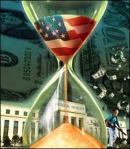
Ahhhh, yes. The American way—investing in feudalism’s bright, bright future. You cannot make this stuff up.
We wonder [well, some wonder] why the electorate is dispirited, angry and disgusted. This is a prime example. Public officials from the President down are suppose to be working for the American public, not an abusive oligarchy.
Yes, the GOP propaganda regarding the ‘magical market’ needs to be exposed for the ludicrous and damaging fraud it is. Taxes are a necessary tool in running any stable government, not a Marxist plot. Regulation is a counterweight to capitalism’s reckless greed and worst instincts. But public officials need to be on board, manning the bully pulpits, educating and inspiring the public to press for and demand honest, effective reform, not a slap-hazard wallpapering job called good when the result is an utter wreck. Elected, public officials [sometimes quaintly referred to as public servants] are suppose to be working for us–the public at large–for our welfare. Not simply feeding the industrial/military complex, bowing and scraping to corporate financiers.
Literary critics question why The Hunger Games trilogy [a Young Adult series] has become so popular, why it’s had crossover appeal. Bread and Circuses, the never-ending distractions, the deliciously effective tools of fear and need, so effective that not even our children escape [think students up to their eyeballs in impossible debt].
The allegory is us.
In any case, elections are upon us. We’re going to hear all manner of pontificating, accusations screeched and name-calling taken to brain-freeze levels. The really disturbing part? Both 2012 candidates, Barack Obama and Mitt Romney, have sold their souls to the highest bidders. We, the electorate? We’re merely spectators sitting in the cheap seats.
Let the corporate dogfight begin!
Btw, for a chilling, even startling essay, I’d highly recommend an essay at Naked Capitalism: Code is Law. Literally.
It’s another angle to look at and contemplate, one that I haven’t seen discussed before. The comment section is equally good.
As for the election season? We’re going to need a good shovel.

Blueprint For Accountability, Long Overdue
Posted: March 24, 2012 Filed under: #Occupy and We are the 99 percent!, Banksters, Blueprint for Accountability, corporatism, corruption, ethics, just because, Rule of Law 21 CommentsMark your calendars for this Tuesday, March 27th, 7:00 pm [EST]. Why? The Culture Project will be running another of its Town Hall discussions, a live stream production from Georgetown University. Stellar participants include: Eliot Spitzer, Matt Taibbi, Dylan Ratigan, Ron Suskind, Van Jones, Heather McGhee and Jessie LaGreca. See brief bio background here.
The discussion topic? It’s all in the title—accountability, the very essence of a sound democracy, yet sadly, an ingredient we’ve seen purposely, repeatedly ignored and shunned by government and corporate leaders alike.
Occupy Wall St. brought public attention to the problem—the yawning divide between the 1% and everyone else. Now, the hard work begins: how do we, public and private citizens alike, steer ourselves back to the premise that the Rule of Law is essential and applies to everyone. How do we make our demands felt inside a broken, corrupt system, where our vote is compromised by big money, our voices drowned in the sludge of corporate and financial interests?
The plan or blueprint needs fresh dialogue, new ideas.
What precisely is the Culture Project? you might be asking. From the site:
CULTURE PROJECT is dedicated to addressing critical human rights issues by creating and supporting artistic work that amplifies marginalized voices. By fostering innovative collaboration between human rights organizations and artists, we aim to inspire and impact public dialogue and policy, encouraging democratic participation in the most urgent matters of our time.
 The Accountability series is a slight departure from what the group has done before—programs addressing human rights issues. But in a sense all of our rights are at peril, as is self-evident in the on-going Presidential campaign rhetoric.
The first of the series was launched with MSNBC’s Rachel Maddow in a discussion on torture and the War on Terror. Subsequent presentations featured Robert Kennedy, Jr. ,who spoke to the continuing diminishment of American values and Cornell West last September spoke on the 40th Anniversary of the Attica Prison Rebellion.
I wasn’t aware of these programs. Hattip to Alternet for bringing me up to speed and alerting readers about the program scheduled for Tuesday night
This is another example of networking getting the message out and a live stream presentation made available, reaching a far wider audience than would normally be the case.
Personally, I’m a great fan of Eliot Spitzer. Despite his past personal problems, I think he has a true gift in explaining the financial/legal shenanigans that Wall St. adopted and continues to practice as business as usual. All at the expense of the American public. Dylan Ratigan has his own MSNBC TV show, Monday through Friday. He’s a former financial guy himself and has a book out “Greedy Bastards,” which has spent weeks and weeks on the NY Best Seller’s List. He’s been screaming daily about the country’s breakdown, the systemic corruption and lawlessness pervading everything—the financial sector, education, healthcare, energy, etc. Matt Taibbi writes for the Rolling Stone and has been equally merciless in calling the TBTF’s out for the highway robbers they were and continue to be. Add the other voices on the panel and I suspect the conversation will be lively and worth the 2-hour investment of time.
Live stream program will be found here.
Should be an interesting, informative night. Let the brainstorming begin!
Occupy 2.0
Posted: March 21, 2012 Filed under: #Occupy and We are the 99 percent!, 2012 elections, Action Memo, Anti-War, Austerity, Banksters, Civil Liberties, corporate greed, corporatism, corruption, Economy, Global Financial Crisis, income inequality, social justice, U.S. Economy, U.S. Politics 12 CommentsUntil this past weekend, the Occupy Movement was flying under the radar, percolating beyond public view. But members returned to Zucotti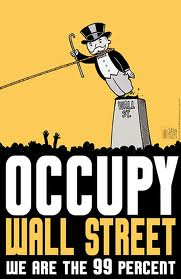 Park on St. Pat’s Day to celebrate the Movement’s six-month anniversary. From on the ground reports, the demonstration was peaceful. Until the NYPD arrived. Then there was trouble—a number of arrests and one woman reportedly had a seizure after she was thrown to the ground and handcuffed. Several participants said it took 17 minutes for the police to react, after which an ambulance was called.
For naysayers, the Occupy Wall St. Movement [OWS], their members and reasons for being were summarily dismissed before they began. Who is the leader of this motley group? journalists and pundits asked repeatedly. What do these people want?
Surprisingly, there is a leader or so I’ve read, someone well known to Occupy organizers but deliberately kept out of public view. As far as what they want? The answer seemed perfectly clear to me at the start because I think it’s what most Americans want or if they don’t want it, they expect it: an end to the gross inequality in the country, for which Wall St. and Government collusion holds the lion’s share of responsibility and an end to ‘bought’ elections, where the 1% and corporate interests routinely choose our leaders, shape policy and control the message, known in polite circles as ‘perception management.’
All of this transcends parties, btw. We’re talking Republican and Democratic parties alike, regardless of how many times we enter the ‘lesser than two evils’ spin.
You don’t need to be a psychic to ‘get’ the OWS message. You don’t even need to be a member of Occupy. All that’s needed is a modicum of alertness, a shaking-off of the trance-inducing distraction and deflection of pundits, media hounds and political operators.
So, what has OWS managed to accomplish, thus far? According to the critics—not a damn thing. But is that really the case?
Last summer, the headlines were ripe with talk of deficits, crushing debt and woe is me. We need a Grand Bargain, wisemen crooned [translation: we need to cut public services]. Somehow, we always have money for foreign adventures, national security, weapons and surveillance equipment. For instance, how many drones will be in American skies by 2020? Hummm. Try 30,000. That’s the Federal Aviation Administration’s rough estimate. The ever popular ‘shop ‘til you drop’ hee-haw isn’t working either, even with the news that ‘average’ Americans are flocking back to restaurant dining. Despite a stumbling economy there is money for weapons and drones and assorted homeland security gear. When it comes to education, infrastructure, home mortgage write downs, decent healthcare, aide to our poor, disabled and elderly? We’re just stone-broke and need to be put on an austerity diet. See Paul Ryan’s reiteration on social program slashes and numbers that don’t add up. It’s a nice set piece that will contrast with the soon-to-come kinder and gentler Democratic version.
One could call the dialogue change a bizarre coincidence but public conversation pivoted after Occupy came on the scene. We went from Oooooo, we need to slash Medicare, Medicaid and refigure Social Security to why is Wall St. getting bailed out on the backs of the taxpayer? Why do we have a system where the profits go to the top income bracket, while risk is carried by Main Street? Why have the wages of middle-class workers[if they’re fortunate enough to still have a job] barely kept pace with inflation, while the top 1% has had a 275% increase in income?
Uncomfortable questions, the sort that make politicians squirm.
OWS has also focused attention on home foreclosures, working with foreclosed families to save their homes. The Movement rallied the public in a Change Your Bank Day strategy that is estimated to cost TBTFs a $185 billion in transfers to community banks and credit unions. Religious organizations have joined the effort. According to Think Progress, The New Bottom Line, a coalition of faith groups has pledged to remove $1 billion from the major banks this year alone. OWS also pushed against the ATM fee-increase proposal; the banks pulled back. In late February, Occupy the SEC submitted a 300+ page document, urging regulators to resist the financial sector’s desire to water down the Volker Rule, part of the Dodd-Frank Wall St. reform. The group that put the document together was comprised of former Wall St. workers. OWS members also stood with private landowners, Tea Party members and environmentalists protesting the Keystone XL pipeline, a project that the President has expressed a new-found love for.
Not too shabby for six months activism. Yet still the critics howl. Where is the direction, what are the goals?
The Movement is young and still developing but you cannot fault it for sitting on its hands. More importantly, the Occupy spirit is global in nature because many activists are ‘graduates without a future’—young, educated and fed up. Paul Mason documented this facet of the worldwide

Arundhati Roy
social/political movements in his book, “Why It’s Kicking Off Everywhere,” and Arundhati Roy wrote this in a recent essay: “Capitalism, A Ghost Story”:
As Gush-Up concentrates wealth on to the tip of a shining pin on which our billionaires pirouette, tidal waves of money crash through the institutions of democracy—the courts, Parliament as well as the media, seriously compromising their ability to function in the ways they are meant to. The noisier the carnival around elections, the less sure we are that democracy really exists.
Sound familiar? The neoliberal model, the gross inequality that rewards the few at the expense of the many has circled the globe, creating universal discontent and misery.
So, what’s coming up for 2012? What will Occupy 2.0 look like?
I’d suggest checking the OWS page here for an updated list of scheduled actions. OWS plans to be in Chicago in mid-May to protest the NATO Summit although the city is throwing up barriers to prevent demonstrations. Somehow, I don’t think the protest will be stopped.
May 1 will be a National Action, the day traditionally known as International Worker’s Day. This year OWS is calling for a General Strike across the country. From the Occupy site:
We are calling on everyone who supports the cause of economic justice and true democracy to take part: No Work, No School, No Housework, No Shopping, No Banking – and most importantly, TAKE THE STREETS!
This Saturday, March 24, a Disrupt Dirty Power protest has been called in NYC to jumpstart a month-long action until Earth Day, April 22. More information here.
Sunday, March 25, Occupy Town Square IV will focus on public parks and other public spaces in NYC. More info here.
If you’re interested in local actions in particular states, towns, cities or countries, info can be found at the Occupy Together site here.
And if you want to eliminate the idea of ‘a failed movement’ from your brain. Check out the participation map here. The scope is massive.
The essay I mentioned by Arundhati Roy is well worth a read—highly informative, even shocking about vulture capitalism’s impact on India. Be prepared, it’s long. As Roy moves into her concluding paragraphs, she writes this:
Capitalism is in crisis. Trickledown failed. Now Gush-Up is in trouble too. The international financial meltdown is closing in. India’s growth rate has plummeted to 6.9 per cent. Foreign investment is pulling out. Major international corporations are sitting on huge piles of money, not sure where to invest it, not sure how the financial crisis will play out. This is a major, structural crack in the juggernaut of global capital.
Capitalism’s real “grave-diggers” may end up being its own delusional Cardinals, who have turned ideology into faith. Despite their strategic brilliance, they seem to have trouble grasping a simple fact: Capitalism is destroying the planet. The two old tricks that dug it out of past crises—War and Shopping—simply will not work.
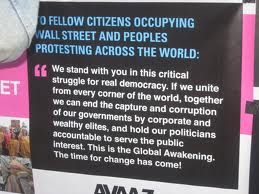
Disaster capitalism has certainly lived up to its name, be it continuous war, environmental degradation or exploding poverty. What is Occupy about? Speaking for myself, Occupy is about a break of faith with a global economic system that serves no one but an elite minority, where infinite money and power is the only morality. The movement is a massive rejection of the ongoing mantra: there’s no other way. Occupy challenges that static position, calls on us to envision something else, something better than the consensus mind. It dares us to shake off the old and embrace a sense of possibility. It demands we wake up, now.

 peej
peej Carissa
 bostonboomer
 dakinikat
 ecocatwoman
 mablue2
 Mama Lopez
 peggysue22
 quixote
 skydancingguestblogger
 Mona (aka Wonk the Vote)



 Sky Dancing
Recent Comments