
Thursday Reads: Mitt Romney, Casino Capitalist, and Other News
Posted: July 5, 2012 Filed under: Barack Obama, Corporate Crime, medicine, Mental Health, Mitt Romney, morning reads, The Bonus Class, U.S. Politics | Tags: Bain Capital, Britain's Atlantis, casino capitalists, Dr. Drew, Drew Pinsky, gilded age, GlaxoSmithKline, Higgs boson particle, money laundering, Sankaty High Yield Asset Investors Ltd., Social Darwinism, Stephen Hawking, tax evasion, tax shelters, Wellbutrin 25 Comments
Good Morning!
I hope everyone had a nice, relaxing holiday. There wasn’t a whole lot of news breaking yesterday, but I read some good reactions to the Vanity Fair Story on the many overseas tax shelters that Mitt’s Romney uses to hide his money.
Mitt Romney, Casino Capitalist
At the Nation, Ben Adler worked up an excellent summary of the VF article, highlighting the main points. Here’s his summary of a particularly disturbing part–the possibility that Bain was laundering money money for some questionable people.
§ Did Bain serve as a tax haven for foreign criminals? As Shaxson explains, “Private equity is one channel for this secrecy-shrouded foreign money to enter the United States, and a filing for Mitt Romney’s first $37 million Bain Capital Fund, of 1984, provides a rare window into this. One foreign investor, of $2 million, was the newspaper tycoon, tax evader, and fraudster Robert Maxwell, who fell from his yacht, and drowned, off of the Canary Islands in 1991 in strange circumstances, after looting his company’s pension fund. The Bain filing also names Eduardo Poma, a member of one of the ‘14 families’ oligarchy that has controlled most of El Salvador’s wealth for decades; oddly, Poma is listed as sharing a Miami address with two anonymous companies that invested $1.5 million between them. The filings also show a Geneva-based trustee overseeing a trust that invested $2.5 million, a Bahamas corporation that put in $3 million, and three corporations in the tax haven of Panama, historically a favored destination for Latin-American dirty money—’one of the filthiest money-laundering sinks in the world,’ as a US Customs official once put it.”
Politico seemed disapproving of the Obama campaign calling attention to the VF piece. The headline seems to suggest that it is somehow unseemly to refer to an opponent’s tax evasion methods.
From Obama campaign spokseman Ben LaBolt, on a call with Ohio reporters:
“Today we’re learning more about Mitt Romney’s bets against America. Vanity Fair’s raising important questions about Romney’s offshore accounts in foreign tax havens, including his mysterious corporation in Bermuda, his funds in the Cayman Islands, and the Swiss bank account he opened. The question is, why? Was he avoiding paying his fair share of U.S. taxes? Was he hedging against the dollar? Until he releases his tax returns from that period, Americans will never know. This raises serious questions. If he has nothing to hide, why doesn’t he just release his tax returns?”
And from Bill Burton, at Priorities:
“Today’s Vanity Fair article confirms what the New York Times and the Wall Street Journal reported but the Romney campaign falsely denied. Unlike the vast majority of Americans who pay their fair share of taxes, Mitt Romney is avoiding taxes by stashing millions of dollars in the Cayman Islands. This matters in the presidential campaign because it is just these types of loopholes for the wealthy that Romney would protect, forcing more of the tax burden onto the middle class.
Those seem like pretty good questions to me.
RalphB posted this AP article in the comments yesterday: Mystery Bermuda-based company and other undisclosed Romney assets hint at larger wealth
For nearly 15 years, Republican presidential candidate Mitt Romney’s financial portfolio has included an offshore company that remained invisible to voters as his political star rose.
Based in Bermuda, Sankaty High Yield Asset Investors Ltd. was not listed on any of Romney’s state or federal financial reports. The company is among several Romney holdings that have not been fully disclosed, including one that recently posted a $1.9 million earning — suggesting he could be wealthier than the nearly $250 million estimated by his campaign.
The omissions were permitted by state and federal authorities overseeing Romney’s ethics filings, and he has never been cited for failing to disclose information about his money. But Romney’s limited disclosures deprive the public of an accurate depiction of his wealth and a clear understanding of how his assets are handled and taxed, according to experts in private equity, tax and campaign finance law.
Romney reported this holding on his 2010 tax form, but he did not disclose it when he ran for governor in 2001-02, even though he was required to do so. Pretty sleazy. Unfortunately, the statute of limitations on this ethics violation has expired.
Paul Krugman blogged about Romney yesterday: Off And Out With Mitt Romney.
It appears that the Obama campaign has decided to ignore the queasiness of Democrats with Wall Street ties, and go after Mitt Romney’s record at Bain. And rightly so!
After all, what is Romney’s case – that is, why does he want us to think he should be president? It’s not about ideology: Romney offers nothing but warmed-over right-wing platitudes, with an extra helping of fraudulent arithmetic, and it’s fairly obvious that even he himself doesn’t believe anything he’s saying.
Instead, his thing is competence: supposedly, his record as a successful businessman should tell us that he knows how to create jobs….[but] even if Romney were a true captain of industry, a latter-day Andrew Carnegie, this wouldn’t be a strong qualification.
In any case, however, Romney wasn’t that kind of businessman. He didn’t build businesses, he bought and sold them – sometimes restructuring them in ways that added jobs, often in ways that preserved profits but destroyed jobs, and fairly often in ways that extracted money for Bain but killed the business in the process….
Or put it a different way: Romney wasn’t so much a captain of industry as a captain of deindustrialization, making big profits for his firm (and himself) by helping to dismantle the implicit social contract that used to make America a middle-class society.
I particularly want to recommend a brilliant essay in The Nation by Robert Reich: Mitt Romney and the New Gilded Age. Reich has really dedicated himself to standing up for the 99% this year, and this piece really brings it all together and holds Romney up as the perfect symbol of “casino capitalism.”
Connect the dots of casino capitalism, and you get Mitt Romney. The fortunes raked in by financial dealmakers depend on special goodies baked into the tax code such as “carried interest,” which allows Romney and other partners in private-equity firms (as well as in many venture-capital and hedge funds) to treat their incomes as capital gains taxed at a maximum of 15 percent. This is how Romney managed to pay an average of 14 percent on more than $42 million of combined income in 2010 and 2011. But the carried-interest loophole makes no economic sense. Conservatives try to justify the tax code’s generous preference for capital gains as a reward to risk-takers—but Romney and other private-equity partners risk little, if any, of their personal wealth. They mostly bet with other investors’ money, including the pension savings of average working people. You can check out easyslots.com.
Another goodie allows private-equity partners to sock away almost any amount of their earnings into a tax-deferred IRA, while the rest of us are limited to a few thousand dollars a year. The partners can merely low-ball the value of whatever portion of their investment partnership they put away—even valuing it at zero—because the tax code considers a partnership interest to have value only in the future. This explains how Romney’s IRA is worth as much as $101 million. The tax code further subsidizes private equity and much of the rest of the financial sector by making interest on debt tax-deductible, while taxing profits and dividends. This creates huge incentives for financiers to find ways of substituting debt for equity and is a major reason America’s biggest banks have leveraged America to the hilt. It’s also why Romney’s Bain and other private-equity partnerships have done the same to the companies they buy.
These maneuvers shift all the economic risk to debtors, who sometimes can’t repay what they owe. That’s rarely a problem for the financiers who engineer the deals; they’re sufficiently diversified to withstand some losses, or they’ve already taken their profits and moved on. But piles of debt play havoc with the lives of real people in the real economy when the companies they work for can’t meet their payments, or the banks they rely on stop lending money, or the contractors they depend on go broke—often with the result that they can’t meet their own debt payments and lose their homes, cars and savings.
Reich notes that if Romney were to win the White House, he would be very different from past wealthy presidents.
We’ve had wealthy presidents before, but they have been traitors to their class—Teddy Roosevelt storming against the “malefactors of great wealth” and busting up the trusts, Franklin Roosevelt railing against the “economic royalists” and raising their taxes, John F. Kennedy appealing to the conscience of the nation to conquer poverty. Romney is the opposite: he wants to do everything he can to make the superwealthy even wealthier and the poor even poorer, and he justifies it all with a thinly veiled social Darwinism.
Obama should be holding Romney up as the personification of all that brought the economy to its knees in 2008. Why aren’t the Democrats screaming from the rooftops about it?
Part of the answer, surely, is that elected Democrats are still almost as beholden to the wealthy for campaign funds as the Republicans, and don’t want to bite the hand that feeds them. Wall Street can give most of its largesse to Romney this year and still have enough left over to tame many influential Democrats (look at the outcry from some of them when the White House took on Bain Capital). But I suspect a deeper reason for their reticence is that if they connect the dots and reveal Romney for what he is—the epitome of what’s fundamentally wrong with our economy—they’ll be admitting how serious our economic problems really are. They would have to acknowledge that the economic catastrophe that continues to cause us so much suffering is, at its root, a product of the gross inequality of income, wealth and political power in America’s new Gilded Age, as well as the perverse incentives of casino capitalism if you bother to check out these no deposit mobile casinos and connect the dots.
Please go read the whole thing. You won’t regret it.
In other news,
The Sun has been very active lately.
(SPACE.com) The sun is unleashing some powerful solar flares today (July 4) in an impressive celestial fireworks display just in time for the U.S. Independence Day holiday.
The latest solar flare erupted at 5:47 a.m. EDT (0947 GMT) and hit its peak strength eight minutes later. The flare fired off from the active sunspot AR1515 and registered as a class M5.3 solar storm on the scale used by astronomers to measure space weather, according to the Space Weather Prediction Group operated by NOAA.
Class M solar flares are powerful, but still medium-strength, sun storms that can supercharge northern lights displays on Earth. The weakest of the sun’s strong solar flares are C-class storms.
NASA’s Solar Dynamics Observatory spacecraft currently watching the sun also captured another solar flare this morning that reached M2 on the sun storm scale.
“As the United States is observing Independence Day, active region 1515 unleashed another M2-class solar flare,” SDO scientists wrote in an announcement posted to the mission’s Facebook and YouTube sites. The flare peaked at 12:37 a.m. EDT (0437 GMT), they added.
Here’s a video of solar flares that took place on July 4, 2012.
Breathtaking!
TV doctor Drew Pinsky, AKA Dr. Drew, is being looked at by the Feds in the GlaxoSmithKline case.
One of Glaxo’s blockbuster drugs was Wellbutrin, which was approved by the FDA to treat depression. Starting in 1999, the Justice Department says, the company “engaged in a nationwide scheme” to promote the drug to treat other conditions including weight problems, addictions, and sexual dysfunction. Pinsky was one of the experts paid to tout Wellbutrin, according to the complaint filed against Glaxo by government prosecutors….
The federal complaint says Cooney Waters, a public-relations firm hired by Glaxo to promote Wellbutrin, “hired Dr. Drew Pinsky from MTV and Loveline as a spokesperson to deliver messages about WBSR [Wellbutrin] in settings where it did not appear that Dr. Pinsky was speaking for WBSR.”
Apparently Pinsky hasn’t specifically been accused of any crime. He told The Daily Beast that he was paid $275,000 to discuss “intimacy and depression” in a number of settings and media. He claims that all of his “comments were consistent with my clinical experience.”
Here’s one example from the federal complaint:
Pinsky said one of the ingredients in Wellbutrin “could explain a woman suddenly having 60 orgasms in one night.” The complaint against Glaxo says “Dr. Pinsky explained that one of the things he advocates for people experiencing diminished libido or arousal” is Wellbutrin.
Stephen Hawking said that he had to pay off a $100 bet that the Higgs boson particle would never be discovered. He says Peter Higgs should get the Nobel Price for predicting it.
A sunken land bridge that once was home to “tens of thousands” of people has been discovered in the North Sea between Scotland and Denmark.
‘Britain’s Atlantis’ – a hidden underwater world swallowed by the North Sea – has been discovered by divers working with science teams from the University of St Andrews.
Doggerland, a huge area of dry land that stretched from Scotland to Denmark was slowly submerged by water between 18,000 BC and 5,500 BC.Divers from oil companies have found remains of a ‘drowned world’ with a population of tens of thousands – which might once have been the ‘real heartland’ of Europe.
A team of climatologists, archaeologists and geophysicists has now mapped the area using new data from oil companies – and revealed the full extent of a ‘lost land’ once roamed by mammoths….
The area was once the ‘real heartland’ of Europe and was hit by ‘a devastating tsunami’, the researchers claim. The wave was part of a larger process that submerged the low-lying area over the course of thousands of years.
Those are my recommendations for today. Now it’s your turn. What are you reading and blogging about?
Thursday Reads: Romney’s Lies, Debt Ceiling Showdown, and Dimonfreude
Posted: May 17, 2012 Filed under: Barack Obama, Corporate Crime, corporate greed, Economy, House of Representatives, Mitt Romney, morning reads, Surreality, The Media SUCKS, U.S. Economy, U.S. Politics, unemployment, voodoo economics, Voter Ignorance | Tags: Bill Clinton, Bill Moyers, economics, J.P. Morgan, Jamie Dimon, Mary Kennedy, Peter G. Peterson, Robert F. Kennedy Jr., Romney's lies, Simon Johnson 22 Comments
Good Morning!
On Tuesday night I wrote a brief post about the bizarre speech Mitt Romney gave in Des Moines, Iowa earlier that day. I was struck by Romney’s childish effort to get at President Obama by talking about Bill Clinton’s economic policies and claiming that Obama must have ignored those policies because he has some kind of grudge against both Clintons. It was so strange and off key that I thought Romney sounded like a crotchety old busybody gossiping over the backyard fence.
I didn’t really even go into the many baldfaced lies Romney told in the speech–I guess I’ve become so accustomed to his total refusal to confine himself to reality as it is that I almost don’t notice it anymore. Basically, Romney attacked Obama the deficit that was primarily created by Bush, and made his usual claims that he (Romney) will be able to cut taxes by 20 percent, increase defense spending, and at the same time magically balance the budget and dramatically reduce unemployment. Only a moron would buy what he’s selling.
Yesterday, a number of bloggers commented on that speech, so I thought I’d share some of those reactions in this morning’s reads.
Steve Benen at Maddowblog: A peek into an alternate reality.
Mitt Romney delivered a curious speech in Iowa yesterday, presenting his thoughts on the budget deficit, the debt and debt reduction, which is worth reading if you missed it. We often talk about the problem of the left and right working from entirely different sets of facts, and how the discourse breaks down when there’s no shared foundation of reality, and the Republican’s remarks offered a timely peek into an alternate reality where facts have no meaning.
Even the topic itself is a strange choice for Romney. If the former governor is elected, he’ll inherit a $1 trillion deficit and a $15 [trillion] debt, which he’ll respond to by approving massive new tax cuts and increasing Pentagon spending. How will he pay for this? No one has the foggiest idea.
In other words, the guy who intends to add trillions to the debt gave a speech yesterday on the dangers of adding trillions to the debt.
Benen says he doesn’t believe Romney is “stupid,” but he must be “operating from the assumption that voters are stupid.” I’d say that’s true. I think Romney believes that he’s much smarter and more worthy than just about anyone and that poor and middle-class people are beneath contempt.
Jonathan Cohn at The New Republic: Romney’s Make-Believe Story on the Economy. Cohn writes about Romney’s claims that Obama’s failure to reduce the deficit is the cause of the “tepid recovery,” unemployment, and the struggles of seniors to get by on fixed incomes.
Note the way Romney establishes cause and effect here: Obama’s contribution to higher deficits are the reason more people can’t get work and more seniors can’t make ends meet right now. This is an audacious claim and, while I’m no economist, I’m pretty sure it places Romney on the outer edges of the debate among mainstream scholars.
I know of serious conservatives who think the Recovery Act, which has increased deficits temporarily, didn’t ultimately do much to create jobs in the near term. And I know of serious conservatives who think that creating jobs now wasn’t worth the long-term downside of adding to the federal debt, however incrementally. Both viewpoints seem to represent minority views, if a recent University of Chicago survey of leading economists is indicative. But the arguments have at least some logic to them.
But Romney’s suggestion that unemployment today is a consequence of Obama’s contribution to the deficit (real or imagined) requires further leaps of logic. You’d have to argue, for example, that extensions of unemployment benefits have reduced incentives to work (despite research to the contrary) and that such negative effects substantially outweigh the positive effects of traditional stimulus measures. It’s not impossible to make this case. I think Casey Mulligan, also of the University of Chicago, has written things along these lines for the New York Times. But, unless I’m missing something, that argument is even more marginal than suggestions the Recovery Act didn’t help at all.
I suspect that even Cohn’s effort to make sense of Romney’s fantasy economic theory will have Dr. Dakinikat pulling her hair out.
Jonathan Chait at New York Magazine: Romney’s Budget Fairy Tale.
In the real world, the following things are true: The budget deficit was projected to top $1 trillion even before President Obama took office, and that was when forecasters were still radically underestimating the depth of the 2008 crash. Obama did propose temporary deficit-increasing measures, an economic approach endorsed in its general contours, if not its particulars, by Romney’s economists. These measures contributed a relatively small proportion to the deficit, and their effect is short-lived. Obama instead focused on longer-term measures to reduce the deficit, including comprehensive health-care reform projected to reduce deficits by a trillion dollars in its second decade. Obama put forward a budget plan that would stabilize the debt as a percentage of the economy. Obama has hoped to achieve deeper long-term deficit reduction by striking bipartisan deals with Congress, and he has tried to achieve this goal by openly endorsing a bipartisan deficit plan in the Senate and privately agreeing to a more conservative plan with John Boehner, both of which were killed by Republican opposition to any higher revenue.
But Romney doesn’t seem to live in the real world, and Chait suggests that Romney either doesn’t understand how deficits work or doesn’t care if what he says makes any sense at all.
In Romney’s telling, the terms debt and spending are essentially interchangeable. When presented with Obama’s position — that the solution to the debt ought to include both higher taxes and lower spending — he rejects it out of hand. Naturally, Romney has admitted before that his budget plan “can’t be scored.” It’s an expression of conservative moral beliefs about the role of government. While loosely couched in budgetary terms, Romney is expressing an analysis that resides outside of, and completely at odds with, mainstream macroeconomic forecasting and scoring assumptions.
At the Plum Line, Greg Sargent discusses How Mitt Romney gets away with his lying.
If you scan through all the media attention Romney’s speech received, you are hard-pressed to find any news accounts that tell readers the following rather relevant points:
1) Nonpartisan experts believe Romney’s plans would increase the deficit far more than Obama’s would.
2) George W. Bush’s policies arguably are more responsible for increasing the deficit than Obama’s are.
Oh, sure, many of the news accounts contain the Obama campaign’s response to Romney’s speech; the Obama campaign put out a widely-reprinted statement arguing that Romney’s plans would increase the deficit and that he’d return to policies that created it in the first place.
But this shouldn’t be a matter of partisan opinion. On the first point, independent experts think an actual set of facts exists that can be used to determine what the impact of Romney’s policies on the deficit would be. And according to those experts, based on what we know now, Romney’s policies would explode the deficit far more than Obama’s would.
Obviously, the problem is the obsequious corporate media. But the Romney campaign makes it impossible for even the few remaining serious reporters to question his policies by keeping the candidate completely insulated from the press except for occasional appearances on Fox News and lightweight network morning shows like Good Morning America. Yesterday, Politico reprinted tweets from several reporters who were “physically” blocked from talking to Romney on a rope line.
Speaking of Republican ignorance of basic economics, House Republicans are gearing up for another pitched battle on increasing the debt ceiling. Speaker John Boehner met with President Obama at the White House today and they “clash[ed] over” increasing the debt limit, according to The Hill.
The president convened the meeting of the bipartisan congressional leadership to discuss his “to-do list” for Congress, but an aide to the Speaker said the bulk of the meeting was spent on other issues, including a pile-up of expiring tax provisions and the next increase in the federal debt limit.
Boehner asked Obama if he was proposing that Congress increase the debt limit without corresponding spending cuts, according to a readout of the meeting from the Speaker’s office. The president replied, “Yes.” At that point, Boehner told Obama, “As long as I’m around here, I’m not going to allow a debt-ceiling increase without doing something serious about the debt.”
Shortly after the meeting, White House press secretary Jay Carney told reporters that the president warned the leadership that he would not allow a repeat of last August’s debt-ceiling “debacle,” which led to a downgrade in the U.S. credit rating.
Sigh……
In a related story, there’s this piece at Wonkblog about the Pete Peterson summit and how Democrats talked long-windedly about cutting “entitlements,” and Republican refused to talk about tax increases. Read it and weep. I’m not even going to quote from it, because it’s too damn depressing.
So far Jamie Dimon seems to have survived the $2 billion loss recently suffered by J.P. Morgan.
The CEO of JPMorgan Chase survived a shareholder push Tuesday to strip him of the title of chairman of the board, five days after he disclosed a $2 billion trading loss by the bank.
CEO Jamie Dimon also won a shareholder endorsement of his pay package from last year, which totaled $23 million, according to an Associated Press analysis of regulatory filings.
Dimon, unusually subdued, told shareholders at the JPMorgan annual meeting that the company’s mistakes were “self-inflicted.” Speaking with reporters later, he added: “The buck always stops with me.”
Yeah, right. The buck will stop with the taxpayers if Dimon’s bank ultimately crashes and burns. Bill Moyers asked economist Simon Johnson about that.
Moyers: I was just looking at an interview I did with you in February of 2009, soon after the collapse of 2008 and you said, and I’m quoting, “The signs that I see… the body language, the words, the op-eds, the testimony, the way these bankers are treated by certain congressional committees, it makes me feel very worried. I have a feeling in my stomach that is what I had in other countries, much poorer countries, countries that were headed into really difficult economic situations. When there’s a small group of people who got you into a disaster and who are still powerful, you know you need to come in and break that power and you can’t. You’re stuck.” How do you feel about that insight now?
Johnson: I’m still nervous, and I think that the losses that JPMorgan reported — that CEO Jamie Dimon reported — and the way in which they’re presented, the fact that they’re surprised by it and the fact that they didn’t know they were taking these kinds of risks, the fact that they lost so much money in a relatively benign moment compared to what we’ve seen in the past and what we’re likely to see in the future — all of this suggests that we are absolutely on the path towards another financial crisis of the same order of magnitude as the last one.
A number of shareholders have sued Dimon over the losses, according to Bloomberg (via the SF Chroncle). And of course lots of people are gloating over Dimon’s getting temporarily knocked off his pedestal. Jena McGregor writes in the WaPo:
It’s being called Dimonfreude.
There are barely disguised smirks emanating from the canyons of Wall Street and the business press over the fact that Jamie Dimon has had to admit a mistake — and a whale of one, for that matter.
For years, the JPMorgan CEO (and America’s least-hated banker, as he was known) has worn a halo over those pinstripes. Dimon has been called President Obama’s “favorite banker”. Institutional Investor magazine has called him the country’s best CEO for two years running. And his actions during the financial crisis have been painted in patriotic terms: Press reports said he “answered the call” from then-FDIC chairman Sheila Bair to buy Washington Mutual, one of two banks he scooped up during the financial meltdown, and he has cited a patriotic duty to a country in crisis as why he took in $25 billion in government aid.
Yet now, Dimon is in the hot seat as JPMorgan confronts a $2 billion trading loss and the early stages of a criminal probe by the Justice Department.
Finally, some sad news: Estranged Wife of Robert F. Kennedy Jr. Is Found Dead at Home in Westchester
Mary R. Kennedy, the estranged wife of Robert F. Kennedy Jr., was found dead on Wednesday at the family’s home in Bedford, N.Y. She was 52.
Ms. Kennedy’s death was confirmed in a statement from her family, who did not comment on the circumstances. The Bedford Police Department said only that it had investigated a “possible unattended death” in an outbuilding at the home.
Her lawyer, Kerry A. Lawrence, would not say whether foul play was suspected. Kieran O’Leary, a spokesman for Westchester County, said an autopsy was scheduled for Thursday morning.
Born Mary Richardson, Ms. Kennedy joined one of America’s foremost political families in 1994, in a marriage ceremony aboard a boat on the Hudson River, near Stony Point, N.Y. At the time, she was an architectural designer at Parish-Hadley Associates in New York.
Those are my suggested reads for today. What are you reading and blogging about?
Exposing and Dismembering ALEC and its Kleptocracy Agenda
Posted: April 16, 2012 Filed under: American Gun Fetish, Big Pharma, Civil Liberties, Civil Rights, collective bargaining, Corporate Crime, corporate greed, corporate money, corporatism, corruption, Domestic Policy, Economy, education, Environment, New Orleans, We are so F'd | Tags: ALEC 13 Comments I have a personal interest in seeing ALEC dismembered. My governor Bobby Jindal has adopted and enacted some of its worse cookie cutter laws. There are three progressive interests that are leading actions to defund and defang this supposedly “nonpartisan individual membership organization of state legislators which favors federalism and conservative public policy solutions”. They are the Urban League, Common Cause, and ColorofChange. I would hope that many more groups will join in.
Many of ALEC’s corporate sponsors have quit funding the organization which seeks to remove oversight and regulation of all kinds of industry, privatize public services and goods, and deprive minority communities and women of basic voting rights and civil rights. They seek tort reform that would limit corporate exposure to liability from unsafe products and practices. They like to remove laws providing consumer protection and information. They are not nonpartisan and are responsible for some of the most heinous, radical legislation of the last few years. Woe to those of you whose governors or legislators belong to this organization for you will live in a world with very little protection from big money and big business and your tax dollars will be used to line their coffers.
The American Legislative Exchange Council describes itself as a nonpartisan champion of free markets. But if you spend some time at an ALEC conference (Bloomberg Businessweek did, for an article last year) you will be hard-pressed to find many Democrats. And when the entire conference meets for lunch, you will hear from the podium nothing that would seem out of place in a press release from Eric Cantor’s office. Last year in New Orleans, for example, Bobby Jindal, governor of Louisana, told an ALEC annual meeting, “Defeating the president is crucial to defending our economy,” and “Obama has been a disaster.” I didn’t hear anyone boo. What I did hear was the sound of fevered applause when the conference played a videotaped greeting from Ronald Reagan.
I’m not saying it’s wrong to feverishly applaud Ronald Reagan. I am saying that only in the most thinly defensible, legalistic sense can ALEC call itself “nonpartisan.” And the council doesn’t really support free markets, either. It supports the companies that fund it. This is an important distinction, because the corporations that donate to ALEC aren’t doing so to protect markets. They’re protecting favored tax treatments and pushing regulations that lock in their market positions. As best as we were able to determine in reporting our piece last year, corporations propose bills at the state level and then push them up to ALEC, which has both corporate and legislative members. ALEC pushes the legislative members to the foreground, stamps the bills as “model legislation,” and then the corporations push them back out to other state legislatures. This may not be the case with all ALEC legislation, but it certainly was with the bill we followed.
So ALEC is not what it says it is. That’s not extraordinary: Few advocacy groups are what they say they are. In ALEC’s case, however, the fingers-crossed-behind-its-back description of itself is definitional. If the American Legislative Exchange Council operated with complete openness, it couldn’t operate at all. ALEC has attracted a wide and wealthy range of supporters precisely because it does its real work in a black box. Membership lists are secret. The origins of the model bills are secret. Deliberations and votes on model bills are secret. The model bills themselves are secret. The council has designed its entire structure to disguise industry-backed legislation as grassroots work from state legislators. If this becomes clear to everyone, there’s no reason for corporations to use it. And that is exactly what has been happening.
Minority advocacy groups have been most active in the fight against ALEC. ALEC is responsible for the legislation that requires specific picture ids to vote and they are responsible for the Stand Your Ground Laws. Both of these issues have been front and center in Civil Rights Groups. The Trayvon Martin case is important in two key ways. First, it is bringing to light the institutional racism implicit in the criminal system. Second, it has exposed the role of ALEC in sneaking through legislature in states that most voters do not support or like. The vigilante-empowering Stand Your Ground laws are now seeing daylight.
The tension in corporate boardrooms over the case is the latest example of the pitfalls companies can sometimes face when they donate to political and lobbying groups, even those that seem safely below the radar of public consciousness.
The ALEC controversy is now sparking a broader debate about corporate participation in politics and the polarized state of political discourse. At a minimum, it has strengthened calls for companies to develop clear policies explaining their spending.
“I would caution companies to be very aware of where their money is going,” says Nell Minow, director of GMI Ratings, which provides corporate governance information to investors, corporate auditors and regulatory agencies. “Companies are going to realize they can take a real reputational hit with this kind of affiliation.”
She and others recall the tempest that erupted in 2010 around Target after the company donated to a nonprofit group supporting a Minnesota gubernatorial candidate who was known for opposing gay rights initiatives.
Like Louisiana, many Arizona politicians are in cahoots with ALEC. ALEC likes to use laws to funnel public money into corporate income statements. This isn’t free market promotion, this is more like being given the ability to loot public resources.
Legislators in Arizona continue to advance extremist legislation inspired by the American Legislative Exchange Council (ALEC) and its out-of-state corporate backers, according to a new analysis by People For the American Way Foundation, Common Cause, the Center for Media and Democracy and Progress Now. This report shines a new light on the Arizona Legislature’s unprecedented ties to the secretive organization, which recently drew nationwide fire for its role in implementing radical policies across the country like “Shoot First” laws and voter suppression laws, and anti-worker measures. ALEC’s extreme agenda has recently led companies such as Pepsi, Coca-Cola, McDonalds, Wendy’s, KRAFT and Intuit to withdraw from the organization. The Bill and Melinda Gates Foundation on Monday also withdrew its support from ALEC.
The comprehensive report found that Arizona’s large concentration of ALEC-member legislators, working hand-in-hand with the corporate leaders who make up ALEC’s membership, are continuing to endorse special interest legislation that harms ordinary people by limiting consumers’ rights, privatizing education and dismantling unions.
The report, ALEC in Arizona: The Voice of Corporate Special Interests in the Halls of Arizona’s Legislature, updated for the Fiftieth Legislature, second regular session is available here.
“Recent polling shows that Arizonans are appalled by the out-of-touch and extremist agenda at their State Legislature. This report shows that agenda is no accident,” said John Loredo, a member of Arizona Working Families and a former Arizona House Minority Leader. “Unfortunately, Arizona has one of the highest concentrations of ALEC legislators in the country, and that makes us a petri dish for anti-worker legislation and a host of other bad ideas.”
“ALEC-member legislators are unabashedly continuing to push legislation straight from corporate headquarters to Arizona’s lawbooks,” said Marge Baker, Executive Vice President at People For the American Way Foundation. “Well-heeled special interests are circumventing the democratic system and bypassing Arizona’s citizens, who can’t match the level of access that ALEC provides. As a result, Arizonans are facing an endless assault from laws that serve the interests of the rich and powerful instead of everyday people.”
You can find ALEC’s model bills and reports on its activities in many states at the site ALEC Exposed. ALEC is responsible for the horrible school voucher and privatization plan that Bobby Jindal has ramrodded through our state. It is also responsible for some of the worst climate change denial propaganda. The source of this funding is big oil, big coal, and the Koch Brothers.
$375,858 received from Koch foundations 2005-2010 [Total Koch foundation grants 1997-2010: $708,858]
American Legislative Exchange Council (ALEC) is one-stop shopping for state elected officials interested in perusing the wares of an array of Koch-funded opposition organizations including IER, ACCF, Mercatus and other sources. ALEC has successfully peddled corporate-written legislation to numerous states attacking the Kyoto Protocol, undermining climate science education in schools and numerous other anti-environmental legislation. ALEC has close ties to Koch Industries, which helped bail the organization out of financial troubles with a half-million dollar grant.
ALEC publishes its own materials as well, including a “Climate Change Overview for State Legislators” which downplays the science and risks of global warming and exaggerates the costs of addressing it. The Overview was written by Daniel Simmons, who moved from ALEC to become AEA’s Director of State Affairs. Simmons was at the Mercatus Institute before ALEC and is a graduate of the George Mason University School of Law.
Here’s some of the background information on the laws that ALEC creates with the intended purpose of “starving Public Schools“.
ALEC’s most ambitious and strategic push toward privatizing education came in 2007, through a publication called School Choice and State Constitutions, which proposed a list of programs tailored to each state. That year Georgia passed a version of ALEC’s Special Needs Scholarship Program Act. Most disability organizations strongly oppose special education vouchers—and decades of evidence suggest that such students are better off receiving additional support in public schools. Nonetheless, Louisiana, Oklahoma, Florida, Utah and Indiana have passed versions of their own. Louisiana also passed a version of ALEC’s Parental Choice Scholarship Program Act (renaming it Student Scholarships for Educational Excellence), along with ALEC’s Family Education Tax Credit Program (renamed Tax Deductions for Tuition), which has also been passed by Arizona and Indiana. ALEC’s so-called Great Schools Tax Credit Program Act has been passed by Arizona, Indiana and Oklahoma.
ALEC’s 2010 Report Card on American Education called on members and allies to “Transform the system, don’t tweak it,” likening the group’s current legislative strategy to a game of whack-a-mole: introduce so many pieces of model legislation that there is “no way the person with the mallet [teachers’ unions] can get them all.” ALEC’s agenda includes:
§ Introducing market factors into teaching, through bills like the National Teacher Certification Fairness Act.
§ Privatizing education through vouchers, charters and tax incentives, especially through the Parental Choice Scholarship Program Act and Special Needs Scholarship Program Act, whose many spinoffs encourage the creation of private schools for specific populations: children with autism, children in military families, etc.
§ Increasing student testing and reporting, through more “accountability,” as seen in the Education Accountability Act, Longitudinal Student Growth Act, One-to-One Reading Improvement Act and the Resolution Supporting the Principles of No Child Left Behind.
§ Chipping away at local school districts and school boards, through its 2009 Innovation Schools and School Districts Act and more. Proposals like the Public School Financial Transparency Act and School Board Freedom to Contract Act would allow school districts to outsource auxiliary services.
ALEC is also invested in influencing the educational curriculum. Its 2010 Founding Principles Act would require high school students to take “a semester-long course on the philosophical understandings and the founders’ principles.”
Perhaps the Brookings Institute states the mission most clearly: “Taken seriously, choice is not a system-preserving reform. It is a revolutionary reform that introduces a new system of public education.”
The passage of radical public school defunding in Louisiana is leading to a recall Jindal effort. We’ve already had some of this type of reform in New Orleans and it’s clearly not working well at all unless you count teacher union busting and lowering teacher salaries progress. Here are some of the things we will now be suffering in Louisiana. I personally am opposed to the state funding religious indoctrination hiding under the guise of education. These laws funnel public money into any thing that deems itself a school, it seems.
A vast expansion of charter schools, an overhaul of teacher tenure and establishment of a statewide program to pay private school tuition with public dollars moved within one step of final passage Thursday, as the Louisiana Senate Education Committee endorsed the headliner components of Gov. Bobby Jindal’s education agenda without changes or dissent.
I know this thread wanders around through many topics but the number of right wing bills pressured cooked into law by ALEC and their toadies is just as wandering and perverse. Check out the site and be aware of which politicians supposedly representing the people of your state that are ALEC cronies. The movement to get corporations to defund the organization should be paramount. Ordinary Americans have already lost a lot to their agenda. It’s time to stop them. Put pressure on organizations to join in the effort. Let’s defang this beast together.
Digging Deeper
Posted: April 12, 2012 Filed under: 2012 presidential campaign, Banksters, Barack Obama, Corporate Crime, corporate greed, corporatism, corruption, Crime, Democratic Politics, Eric Schneiderman, home foreclosure fraud, Homeless, Mitt Romney, U.S. Economy 16 CommentsThough I’ve been on a hiatus of late, I’ve tried to keep up with basic headline reading, dipping my toes into stories of interest [and/or those producing sheer outrage]. The latter pushed my crazy button when I read this headline last week at New Deal 2.0:
Eric Schneiderman Urges Progressives to “Dig Deeper” to Transform the System
Eric Schneiderman, NY State Attorney General, who vowed to take on Wall St., bring the wrong doers to justice and rectify the massive fraud perpetrated on American homeowners forced into foreclosure. That Eric Schneiderman, the man I willingly and enthusiastically cheered. I went so far as to send a note of appreciation.
That was then, this is now.
Because Eric Schneiderman threw his lot with President Obama’s weak-kneed, planned-to-fail foreclosure/securitization fraud task force that has effectively done zip, nada, even after the President’s stirring words during his State of the Union Address. And then, there was Schneiderman’s claim that he would have a posse of investigators [that would be a total of 55 dedicated, blood hound investigators for a fraud estimated to be 80 times larger than the S&L debacle—which had 1000 investigators] to track down and document laws broken, crimes committed and bring the guilty parties to heel.
Camelot Revisited! Now back to grim reality.
The wildly touted foreclosure fraud settlement was simply another Get-Out-of-Jail Pass (aka amnesty] for criminal enterprises that took American homeowners for a ride—a slippery slide right out of their homes. For the inconvenience, the shocking upheaval and worry, 750,000 homeowners (of the 4 million homes seized since 2007] will reportedly receive $2000. What a deal! For the scammers, they received a blanket no-accountability kiss from the Obama Administration, by collectively paying $5 billion to states and the Federal government and allocating $20 billion more to ease the distress [loan modification] for a fraction of the 11 million homeowners now ‘underwater.’ Oh, and the pledge [step on a crack and you’ll break your mother’s back] to sin no more.
Problem solved!
Hummm. Not really. Because although the settlement was puny in terms of homeowner relief, it was at least . . . something. Until we read in late February and early March that a number of states were diverting the settlement funds to plug shaky budgets.
I think it’s reasonable to say that damaged American homeowners have been left holding the bag–the dirty, empty bag. Again.
 But getting back to Eric Schneiderman, the man I had a temporary crush on, the Hero on a Quest Gone Terribly Wrong, had the gall to stand before a group, an initiative ironically entitled Rediscovering Government and give the keynote address, where he reportedly said [in the New Deal 2.0 piece cited above]:
Progressives’ efforts at making significant changes to the system after the financial crisis have mostly borne little fruit, he noted. We therefore “need to dig deeper” see how deeply the unfettered propaganda that less regulation leads to growth and higher taxes always create jobs has affected the American mindset and economy. We also have to aim for long-term, “transformational” change instead of the everyday “transactional” change we usually get bogged down in. We have to move past the election cycles and everyday battles to politics that involve working today to improve circumstances in the future and challenging the way that people think about issues in the first place.
What horse-hockey!
Long-term ‘transformational change,’ instead of that irritating ‘transactional’ change. Are we to wish upon a star that the crime syndicate dies off, bankster-by-bankster [and all their ass-kissing dwarves]? Let’s not get into those niggling details of fraud, disgusting greed and all manner of malfeasance, we’ll aim for future transformation? What the hell does that mean? Maybe a little corrective surgery down the road, where we implant a human conscience, a sense of honor and integrity into the Wall St. CEOs and their tracker jacker drones? Otherwise, we might as well change the national motto to:
In Fraud We Trust.
And excuse me, Mr. Schneiderman! You are the state AG of the Great State of New York. You were standing square on the power plate and from everything I’ve read you had a fine hand of cards. But then . . . you folded like a beach chair.
It does no good blaming the Republicans [though they certainly deserve much blame and condemnation] when you’re unwilling to take on the monster, to make good on your own words and vows, only to then turn around and use the editorial ‘we’ in describing what needs to be done in the future. The future will be forever tainted by the past until we purge the rot and corruption out. Plastering over an infection never works. Corruption always bleeds through. Sadly, I’m sure Mr. Schneiderman [to his ever-lasting shame] knows this. And how exactly are the damaged parties, progressive or otherwise, suppose to dig for anything? No job, no home, no healthcare, no future. Not even a shovel.
Yesterday I stumbled across this:
Corporate America is shifting its focus in product development and marketing to serve the “hourglass economy.” The hourglass has two chambers connected by a slim channel. Translated into economic terms, or better yet, the emerging picture of America, the two chambers represent rich and poor, with virtually nothing in the middle.
Worse, while the traditional hourglass has two equal chambers, the economic hourglass does not. One chamber contains a small percent of the population and most of the wealth and the other is filled with the bulk of Americans, who have little access to resources and diminished hope for prosperity The hourglass economy has become so entrenched that Bloomberg News credits it with dividing Americans and defining U.S. politics.
Perfect! Better yet:
Citigroup was quick to notice the hourglass trend that was taking root in 2009. To help investors cash in on the demise of the middle class Citigroup recently issued an hourglass investment advisory that highlights twenty stocks of companies targeting low end consumers and fifteen companies targeting the high end ones. Showing that the hourglass economy is real and gaining momentum, Citigroup’s hourglass index posted a whopping 56.5% return between Dec. 10, 2009 and Sept. 1, 2011, according to financial reporter,Patrick Martin.
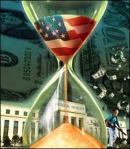
Ahhhh, yes. The American way—investing in feudalism’s bright, bright future. You cannot make this stuff up.
We wonder [well, some wonder] why the electorate is dispirited, angry and disgusted. This is a prime example. Public officials from the President down are suppose to be working for the American public, not an abusive oligarchy.
Yes, the GOP propaganda regarding the ‘magical market’ needs to be exposed for the ludicrous and damaging fraud it is. Taxes are a necessary tool in running any stable government, not a Marxist plot. Regulation is a counterweight to capitalism’s reckless greed and worst instincts. But public officials need to be on board, manning the bully pulpits, educating and inspiring the public to press for and demand honest, effective reform, not a slap-hazard wallpapering job called good when the result is an utter wreck. Elected, public officials [sometimes quaintly referred to as public servants] are suppose to be working for us–the public at large–for our welfare. Not simply feeding the industrial/military complex, bowing and scraping to corporate financiers.
Literary critics question why The Hunger Games trilogy [a Young Adult series] has become so popular, why it’s had crossover appeal. Bread and Circuses, the never-ending distractions, the deliciously effective tools of fear and need, so effective that not even our children escape [think students up to their eyeballs in impossible debt].
The allegory is us.
In any case, elections are upon us. We’re going to hear all manner of pontificating, accusations screeched and name-calling taken to brain-freeze levels. The really disturbing part? Both 2012 candidates, Barack Obama and Mitt Romney, have sold their souls to the highest bidders. We, the electorate? We’re merely spectators sitting in the cheap seats.
Let the corporate dogfight begin!
Btw, for a chilling, even startling essay, I’d highly recommend an essay at Naked Capitalism: Code is Law. Literally.
It’s another angle to look at and contemplate, one that I haven’t seen discussed before. The comment section is equally good.
As for the election season? We’re going to need a good shovel.

Thursday Evening News Wrapup
Posted: April 5, 2012 Filed under: 2012 presidential campaign, abortion rights, Austerity, Barack Obama, Corporate Crime, corruption, Domestic terrorism, fetus fetishists, Hillary Clinton, Medicaid, Medicare, Mitt Romney, Newt Gingrich, Planned Parenthood, SCOTUS, SDB Evening News Reads, Social Security, the villagers, Women's Healthcare | Tags: Affordable Care Act, Augusta Golf Club, Greece, Jamie Dimon, JP Morgan Chase, Judicial Activism, judicial restraint, Lizzie Borden, Masters Tournament, murder, Supreme Court 27 Comments
Afternoon Tea, by Mary Cassat
Good Evening! I’ll start off with some good news. Minkoff Minx has arrived home from the hospital and is doing well. She’ll be resting for I a few days, but she should be back to posting regularly sometime next week. I sure do miss her cheery evening reads! I’m doing my best to fill in again tonight.
It’s been a slow news day, but there are a few things happening even though most of Washington, DC–including Congress and many pundits are on a two-week Easter vacay. Why do they get such long vacations anyway? They only work about three days a week and they accomplish very little.
President Obama has waked up to the reality of women’s electoral power. Today we learned that he thinks it’s high time that Augusta Golf Club, which hosts the Masters Tournament, should start accepting women members.
Not to be outdone, and because he obviously has no original thoughts, Mitt Romney announced that he, too, And he discussed the issue in his usual stuffy manner.
When asked if women should be admitted, the Republican presidential frontrunner responded: “Of course.”
“I am not a member of Augusta. I don’t know if I would qualify. My golf game is not that good,” Romney told reporters after an energy-themed event in Tunkhannock, Pennsylvania. “Certainly if I were a member, if I could run Augusta, which isn’t likely to happen, of course I’d have women into Augusta.”
Newt Gingrich thinks his wife Callista would be “great member,” and Callista herself tweeted that she “wants in.” No word on how he-man woman-hater Rick Santorum feels about the issue.

Afternoon Tea, by Cezanne
It’s looking like Romney has the Republican nomination all sewn up–he’s even leading in Santorum’s home state of Pennsylvania now. But at the Daily Beast, Michelle Goldberg explains why conservatives still want Santorum to stay in the race.
Conservative Iowa radio host Steve Deace isn’t convinced. “In the minds of social conservatives, it’s not even close to over,” he says. “The real question is how committed someone like Rick Santorum is to fighting this out all the way to the end. If he’s committed to doing this on a personal level, there’s plenty of social conservatives that will ride him to the finish line.”
Indeed, despite the best efforts of the Republican establishment, many on the religious right are far from ready to accept Romney’s inevitability, or to coalesce behind him. They remain distrustful of his record on abortion, and unsure they can believe his campaign promises. And the harder party elites push Romney on them, the more alienated they become. “The biggest story that everyone in the media has missed this cycle is how frustrated and fed up the Republican Party base is with the Republican Party,” says Deace. “It’s unlike anything I’ve ever seen.”
Goldberg quotes a number of conservative sources who just won’t accept a Romney candidacy and think Santorum to fight to the bitter end at the convention. They sound a lot like Hillary supporters who in 2008 wanted her to take the fight to the convention. Hillary is a loyal Democrat and so she ended up going with the flow, but Santorum is more of a renegade with a lot less to lose than Hillary. In any case, it seems as if the bases of both corporate parties are disgusted with their party elites.

Afternoon Tea Party, by Mary Cassatt
Also at the Daily Beast, Michael Tomasky writes that the Supreme Court is “on the ropes.” Back in the ’80s, Conservative starting pushing for “judicial restraint.” But now that the shoe is on the other foot and there is a Conservative majority on the court, suddenly they love the notion of “judicial activism” that they once reviled (just like they now despise the Heritage Foundaton health care plan now that Democrats have written it into law).
John Roberts has to know and see all this. He has to know that Fifth Circuit Judge Jerry Smith, who asked federal prosecutors for a homework assignment in the wake of Obama’s remarks—a brief stating the Justice Department’s position on judicial review, that had to be at least three pages, single-spaced!—is making conservatives look silly and cheapening the bench. And he has to know that the court’s reputation will suffer an immense blow if it overturns the mandate. It will be seen by a large majority—even a lot of people who weren’t crazy about the law—as completely political. Remember, they didn’t have to take the case in an election year in the first place. They could have put it off. But the court said it must do this now. If it then overturns the ACA, it will look and smell like a political hit job to many Americans. And the court would be saying to America, “We know what you think, and we don’t give a damn.”
What would happen to the court then? Slowly—no; probably quickly—it will come to be seen by most Americans as just another cesspool of political mud wrestling; just another arena where the rich get what they want while everyone else gets screwed (Citizens United); just one more ideological whorehouse full of patrons pretending to be just the piano player.
Despite what we’re all brought up to believe, nothing about the court is sacrosanct. Lifetime appointments can be changed to fixed-year terms. It’d take some doing, but it can be done. And there’s nothing anywhere that says it has to be nine justices. That’s just tradition, but it’s nowhere in the Constitution. It just needs to be an odd number; could be three or 23. For that matter, Congress could disregard Marbury v. Madison. Yep. It could. Tom DeLay used to speak of this from time to time, back in the dear old Terri Schiavo days. He never specifically invoked M v. M, but, referring to judges who would have let Schiavo die, he said things like they had “thumbed their noses at Congress and the president” and would someday pay. He meant a campaign against judicial review. He never got around to it, having been indicted and convicted and all, but that’s what he meant. There’s nothing to prevent liberals from mounting a similar campaign. So far they’ve has held back by their respect for the institution. But that may soon be gone.

There is a heartbreaking story out of Greece: Pensioner’s Suicide Continues to Shake Greece.
Dimitris Christoulas, a divorced and retired pharmacist, took his life on Wednesday in Syntagma Square, a focal point for frequent public demonstrations and protests, as hundreds of commuters passed nearby at a metro station and as lawmakers in Parliament debated last-minute budget amendments before elections, expected on May 6.
In a handwritten note found near the scene, the pensioner said he could not face the prospect “of scavenging through garbage bins for food and becoming a burden to my child,” blaming the government’s austerity policies for his decision.
The incident has prompted a public outpouring, with passers-by pinning notes of sympathy and protest to trees in the square, as well as comment from politicians across the spectrum. A solidarity rally on Wednesday night turned violent when the police clashed with hooded demonstrators in scuffles that left at least three people injured.
I guess we can look forward to similar tragedies here in the U.S. if Congress succeeds in gutting Medicare, Medicaid, and Social Security. And I don’t exempt the Democrats from my cynicism about support for the social safety net among the Villagers.
Speaking of the rich, powerful, and selfish, Jamie Dimon is once again on the top of the heap in terms of CEO compensation. Richard Escrow writes:
JPMorgan Chase CEO Jamie Dimon is still the poster child for today’s morally degraded, self-entitled banker mentality. I don’t know why he keeps talking, but he’s the gift that keeps on giving.
At every major junction in the post-crisis debate about banking, Dimon has stepped in with a perfectly tactless remark that illustrates both the vacuity and the moral corruption of his industry. This week was no exception.
Excrow provides a number of specific examples of Dimon’s and Chase’s lack of ethics. And yet, Dimon is still whining about “excessive” government regulation.
Dimon just complained that regulators “made the recovery worse than it otherwise would have been” — which is not only wrong, but avoids addressing the issue of the recovery’s cause, which was banks like Dimon’s. Dimon added that the government forced banks to de-leverage “”at precisely the wrong time” — which is precisely wrong. The government’s real error was in not breaking up too-big-to-fail banks like Dimon’s.
“Complexity and confusion should have been alleviated, not compounded,” complains Dimon.
So Dimon and his cronies have formed a superpac to intimidate liberal Congresspeople. Please go read the whole article. It’s really frightening.
The domestic terrorist who tried unsuccessfully to blow up a Planned Parenthood office in Wisconsin has explained his motivation.
Francis Grady, 50, spoke to reporters who were covering his first appearance in federal court since the Sunday night attack. The Green Bay Press-Gazette posted video of him walking through the courthouse followed by a short clip of him speaking to reporters outside.
“There was no bomb,” Grady said. “It was gasoline.”
A reporter asked why Grady attacked the clinic.
“Because they’re killing babies there,” he responded.
The newspaper also got more from inside the federal courtroom, where Grady reportedly interrupted the judge to ask, ““Do you even care at all about the 1,000 babies that died screaming?”
“Screaming?” Fetuses that are aborted in the first trimester aren’t “babies,” and they don’t have nervous systems to feel pain or the ability to scream. The ignorance of these people is beyond belief.

Lizzie Borden
Finally, some new evidence has been found in the Lizzie Borden murder case–journals kept by her attorney.
Borden was acquitted in 1892, and much of the evidence in the case ended up with Andrew Jackson Jennings, Borden’s attorney. The two journals, which Jennings stored in a Victorian bathtub along with other evidence from the case, including the infamous “handless hatchet,” were left to the Fall River Historical Society by Jennings’ grandson, who died last year.
The society received the fragile journals about a month ago but won’t be exhibited until they are properly preserved, curator Michael Martins said.
Each journal is about 100 pages. One contains a series of newspaper clippings, indexed using a lettering and number system that Jennings devised. The second contains personal notes that Jennings assembled from interviews he conducted. Some of the individuals interviewed are people mentioned in the newspaper clippings Jennings retained.
“A number of the people Jennings spoke to were people he knew intimately, on a social or business level, so many of them were perhaps more candid with him than they would have been otherwise,” Martins said. “But it’s also evident that there are a number of new individuals he spoke to who had previously not been connected with the case.”
I hope at least some of those links will pique your interest. What stories have you been following this afternoon and evening?

 peej
peej Carissa
 bostonboomer
 dakinikat
 ecocatwoman
 mablue2
 Mama Lopez
 peggysue22
 quixote
 skydancingguestblogger
 Mona (aka Wonk the Vote)



 Sky Dancing
Recent Comments