
Beyond Influence: Buying US Law
Posted: August 11, 2011 Filed under: Big Pharma, Civil Liberties, Civil Rights, collective bargaining, Corporate Crime, Domestic Policy, Economy, Environmental Protection, financial institutions, Global Financial Crisis, Gulf Oil Spill, Health care reform, Labor unions, legislation, Surreality, The Bonus Class, We are so F'd | Tags: ALEC, Bayer, ExxonMobil, Koch Industries, PFizer, VISA, Wal-Mart 23 Comments“Corporations are people, my friends.”
Mitt Romney, in a speech today in Iowa
I’ve wanted to write about ALEC for awhile. I tripped across this very succinct explanation in my print copy of Bloomberg Business Week that made me revisit my plans. Ever wonder why a bunch of weird ass bills suddenly show up simultaneously in a bunch of legislatures that say things that are basically against the positions of modern science, medicine, and economics? Well, chances are that some huge corporation has written that bill that will become law in no one’s interest but their own, and it was penned by some member of ALEC.
Kim Thatcher, a Republican state representative in Oregon, introduced a sharply worded anti-cap-and-trade bill this year that said, “There has been no credible economic analysis of the costs associated with carbon mandates.” Apparently, that view is widely shared. Legislation with that exact language has been introduced in dozens of states, including Montana, New Hampshire, and New Mexico.
It’s not plagiarism. It’s a strategy. The bills weren’t penned by Thatcher or her fellow legislators in Helena, Concord, and Santa Fe. They were written by a little-known group in Washington with outsize clout, the American Legislative Exchange Council. Corporate benefactors such as Koch Industries and ExxonMobil (XOM) help fund ALEC with membership dues and pay extra for a seat at the legislative drafting table.
Among ALEC’s prominent members are Pfizer (PFE), Wal-Mart (WMT), Bayer (BAYZF), and Visa (V), according to ALEC annual meeting documents provided by an attendee. The organization’s legislative agenda includes limiting the power of unions, fighting environmental regulations, and overturning President Obama’s health-care reform law. ALEC says it gets about 200 state laws passed each year. The corporate influence is hard to trace and can produce a return on investment that would make a hedge fund manager drool.
“This is just another hidden way for corporations to buy their way into the legislative process,” says Bob Edgar, president of Common Cause, which seeks to reduce money in politics. Reagan Weber, an ALEC spokeswoman, says the group simply facilitates the sharing of information and “good conservative policy.”
ALEC was founded in 1973 by two of the conservative movement’s intellectual midwives, both now dead: Representative Henry Hyde of Illinois and activist Paul Weyrich, who also was a founder of the Heritage Foundation. As a tax-exempt organization, ALEC doesn’t disclose its corporate donors or its member lists beyond those who serve as committee chairmen.
In exchange for annual membership dues of as much as $25,000 plus a fee of $3,000 to $10,000 to get on a bill-writing “task force,” Koch and ExxonMobil representatives sat beside elected officials and policy analysts at an ALEC meeting in April 2010, helping them write model energy legislation that would later be introduced in statehouses around the country, according to the documents. The legislators pay $100 for a two-year membership. The task force bills are considered finished only after the legislators and private-sector members vote separately to approve them, giving each side a veto. Once a model bill is complete, it’s up to ALEC’s legislator members to go back to their home states and shepherd it into law.
ALEC is on the radar of many organizations including the American Association for Justice who keeps track of their activities and publishes white papers on this group of bill-writers for profit, greed and the destruction of public resources.
(W)hile the membership appears to be public sector, the bankroll is almost entirely private sector. In fact, public sector membership dues account for only around one percent of ALEC’s annual revenues. ALEC claims to be nonpartisan, but in fact its free-market, pro-business mission is clear.
The result has been a consistent pipeline of special interest legislation being funneled into state capitols. Thanks to ALEC, 826 bills were introduced in the states in 2009 and 115 were enacted into law.
Behind the scenes at ALEC, the nuts and bolts of lobbying and crafting legislation is done by large corporate defense firm Shook, Hardy & Bacon. A law firm with strong ties to the tobacco and pharmaceutical industries, it has long used ALEC’s ability to get a wide swath of state laws enacted to further the interests of its corporate clients.
ALEC’s campaigns and model legislation have run the gamut of issues, but all have either protected or promoted a corporate revenue stream, often at the expense of consumers. For example, ALEC has worked on behalf of:
- Oil companies to undermine climate change proponents;
- Pharmaceutical manufacturers, arguing that states should be banned from importing prescription drugs;
- Telecom firms to block local authorities from offering cheap or free municipally-owned broadband;
- Insurance companies to prevent state insurance commissioners from requiring insurers to meet strengthened accounting and auditing rules;
- Big banks, recommending that seniors be forced to give up their homes via reverse mortgages in order to receive Medicaid;
- The asbestos industry, trying to shut the courthouse door to Americans suffering from mesothelioma and other asbestos-related diseases; and,
- Enron to deregulate the utility industries, which eventually caused the U.S. to lose what the Securities and Exchange Commission (SEC) estimated as $5 trillion in market value.
The Koch brothers and Koch Industries are all over ALEC. Their Charitable foundations and businesses provide a lot of funding. ExxonMobile is also a huge source of funds. There are several companies representing the interests of Big Pharma. ALEC looks like a who who of corporate America’s worst corporate citizens. The Center for Media and Democracy’s PR Watch put out a Special Report on ALEC’s funding last month.
According to ALEC’s IRS filings, over the past three years it has raised $21,615,465 from corporations, foundations, and other sources, and just over $250,000 in dues paid by state legislators, amounting to slightly more than 1 percent of its income. The gigantic gap between what legislators pay and what ALEC spends is the direct result of the reality that legislators pay a mere $50 a year to be a member, while a corporation can pay up to $25,000 a year or more to be a member of ALEC plus additional fees to be on a task force where corporations get the same right to vote as legislators. They just pay hundreds of times more for that vote.
…
For example, the foundations controlled by the billionaire Koch brothers gave ALEC over $200,000 in 2009. (The Claude R. Lambe Foundation, which Charles Koch, his wife and kids help run, donated $125,000 to ALEC. His own Charles G. Koch foundation kicked in an additional $75,000.) That $200k is before whatever is the undisclosed amount of membership “dues” paid by Koch Industries, which is run by Charles and David Koch. There is no public disclosure of annual gifts the company gives to take part in the one-stop shopping ALEC conventions provide to meet with legislators from every state about their wish list…
Other right-wing foundations have also supported ALEC, far beyond the “dues” paid by any legislator. For example, the Castle Rock Foundation, which is run by right-wing beer heir Peter Coors, gave $50,000 last year and in prior years. The right-wing John M. Olin foundation has also been a donor to ALEC. Another of the big right-wing foundations, the Lynde and Harry Bradley Foundation, has been a funder and, for example, gave ALEC $50,000 in 2009 to fund “budget reform” work. Similarly, right-winger Richard Scaife has given ALEC over half a million dollars the past decade or so, through his Allegheny Foundation. Some of the organizations that support ALEC, like Scaife’s, are also deeply invested in the profits of corporations that sit on ALEC’s board. The Allegheny Foundation has held over $11 million of ALEC board member Altria‘s stock, along with major stock holdings in other ALEC corporate board members like Kraft, Coca Cola, AT&T, GlaxoSmithKline, Johnson & Johnson, and Exxon.
ALEC is a major voice for climate change denial, responsible for the recent spate of voter disenfranchisment laws, and continually pushes for extreme tort reform. There’s a really good primary on ALEC at People for the American Way. ALEC is the well-funded voice of corporate special interests. Here are two recent examples of state legislature originating from ALEC.
ALEC was influential in crafting and passing a Texas law, dubbed the “Successor Asbestos-Related Liability Fairness Act, that shielded Crown Cork and Seal, a business that in 1966 acquired a company that used asbestos in its products, from lawsuits from the company’s workers. Even though Crown agreed to pay the company’s liabilities, it wanted immunity from paying damages to workers facing asbestos-related diseases. Crown Cork and Seal turned to ALEC to help shape the Texas law, which put an extremely low cap on liability for companies like Crown who acquired companies which committed wrongdoing, known as a “successor immunity” law.” Mark Behrens, an attorney for Shook Hardy, worked as a lobbyist for both ALEC and Crown to encourage allied lawmakers to introduce and pass the bill. The American Association for Justice writes that “this so-called ‘successor immunity’ has all the hallmarks of an ALEC special interest bill. It is plainly designed not with public policy in mind, but rather a specific industry (or in this case, a specific company).” The Texas Supreme Court ultimately found the cap to be an unconstitutional retroactive protection for Crown that inhibited the rights of people to rightfully sue corporations for damages, but similar ALEC-derived laws are still on the books in other states.
In Arizona, an investigative report by NPRfound that ALEC significantly helped one of its clients, the Corrections Corporations of America (CCA), influence the state’s new immigration law. The CCA is a for-profit prison company whose “executives believe immigrant detention is their next big market,” and thought that a law which “could send hundreds of thousands of illegal immigrants” to prison would “mean hundreds of millions of dollars in profits to private prison companies responsible for housing them.” As a dues-paying member of ALEC, the CCA was able to write, present and lobby Arizona policymakers for a draconian immigration bill at an ALEC-hosted conference. “Four months later, that model legislation became, almost word for word, Arizona’s immigration law,” and many of the bill’s cosponsors later received significant campaign contributions from the CCA. ALEC also helped the CCA by pushing “truth in sentencing” laws that restrict parole eligibility for felons, and consequently increase the number of prisoners.
You name the spurious law, and ALEC is likely behind it. They write laws that push private school vouchers, strip workers of their right to organize, make it more difficult to generate revenues to fill budget shortfalls in states, and undercut healthcare reform efforts.
After the passage of health care reform, ALEC’s top priority has been to challenge the law by encouraging members to introduce bills that would prohibit the law’s insurance mandate. ALEC’s Health and Human Services task force is led by representatives of PhRMA and Johnson & Johnson, and representatives of Bayer and GlaxoSmithKlein sit on ALEC’s board. The group’s model bill, the “Freedom of Choice in Health Care Act,” has been introduced in forty-four states, and ALEC even released a “State Legislators Guide to Repealing ObamaCare” discussing a variety of model legislation including bills to partially privatize Medicaid and SCHIP. The legislative guide utilizes ideas and information from pro-corporate groups like the Heritage Foundation, the Goldwater Institute, the James Madison Institute, the Cato Institute, the National Center for Policy Analysis and the National Federation of Independent Business.
Expanding the disproportionate power of corporations in the legislative process is central to ALEC’s goals. ALEC is responsible for some of the worst outcomes in government we’ve seen in decades. It is pure influence peddling. Any legislator that relies on ALEC for services should be subject to immediate recall. ALEC represents what’s wrong with this country today. It is at the heart of single issue, special interest politics that are not in the public’s interest. They are a perversion of the democratic political process.
Mitt Romney is wrong. Corporations are not people. The profit motive is the sole determinant of corporate behavior. No household or family would put profits before everything else nor should any government that purports to represent its people. I suggest finding out as much about how ALEC influences your state legislature as soon as possible. A good place to start is with The Nation‘s series ‘ALEC Exposed’. The first in this series shows the role of the Koch’s in ALEC’s model bills. I’ve pumped this thread up with a lot of juicy links. Please take some time to visit the research of all the nonprofits that have carefully researched this shadowy organization.
A Shocking Hate Crime in Mississippi
Posted: August 8, 2011 Filed under: Civil Rights, Crime, racism | Tags: aggravated assault, Byron De La Beckwith, death penalty, Deryl Dedmon, hate crimes, Jackson, James Craig Anderson, John Aaron Rice, Medgar Evers, Mississippi, murder, Racism, White Citizen's Council 19 Comments
Medgar Evers
Mississippi has a dark history of racism. It was in the state’s capital Jackson that Civil Rights leader Medgar Evers was murdered in 1963.
On the morning of June 12, 1963, around 12:20 a.m., Medgar Evers arrived home from a long meeting at the New Jerusalem Baptist Church located at 2464 Kelley Street. He got out of his car, arms filled with “Jim Crow Must Go” T-shirts, and walked toward the kitchen door when a shot was fired from a high-powered rifle, striking Evers in the back. Myrlie heard the shot, ran outside with the children behind her, and saw Medgar lying face down in the carport. Next-door-neighbor Houston Wells heard the shot and called the police. The police arrived only minutes later and provided an escort as Wells drove Evers to the emergency room of the University of Mississippi Medical Center on North State Street. Evers died shortly after 1:00 a.m. of loss of blood and internal injuries.
A white man was arrested and charged with the murder of Evers.
On June 22, 1963, Byron De La Beckwith, a member of the White Citizens’ Council, was arrested and charged with the slaying of Medgar Evers. Beckwith was tried twice for Evers’s murder, first in February and later in April 1964. Both trials (before all-white male jurors) ended in hung juries. Beckwith was not retried for the Evers murder until 30 years later. In a two-week trial, held in February 1994 before a jury of eight blacks and four whites, Beckwith was found guilty of the murder of Evers, for which he received a life sentence. Beckwith served only seven years of his life sentence at the Central Mississippi Correctional Facility in Rankin County before dying of a heart attack January 21, 2001.
Nearly half a century later, Jackson, Mississippi is once again the site of a vicious, racially-motivated murder. This time, the crime was caught on video.
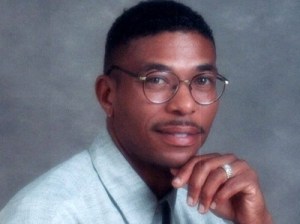
James Craig Anderson
On a recent Sunday morning just before dawn, two carloads of white teenagers drove to Jackson, Mississippi, on what the county district attorney says was a mission of hate: to find and hurt a black person.
In a parking lot on the western side of town they found their victim.
James Craig Anderson, a 49-year-old auto plant worker, was standing in a parking lot, near his car. The teens allegedly beat Anderson repeatedly, yelled racial epithets, including “White Power!” according to witnesses.
Hinds County District Attorney Robert Shuler Smith says a group of the teens then climbed into their large Ford F250 green pickup truck, floored the gas, and drove the truck right over Anderson, killing him instantly.
You can watch the video at the CNN link if you are so inclined. The video was taken from some distance away.

Deryl Dedmon, Jr.
The young man who proposed to his friends that they attack a black person–any black person–and who drove his truck over Anderson’s already battered body is Deryl Dedmon, Jr., age 18. Dedmon had been robbed a few weeks previously, and wanted some kind of twisted “revenge,” according to the New York Daily News.
According to the CNN article linked above,
Shortly after he allegedly drove the truck over Anderson, Dedmon allegedly boasted and laughed about the killing, according to testimony given by some of the teens to detectives.
“I ran that nigger over,” Dedmon allegedly said in a phone conversation to the teens in the other car.
He repeated the racial language in subsequent conversations, according to the law enforcement officials.
“He was not remorseful he was laughing, laughing about the killing,” said district attorney Smith.
Dedmon and the driver of the SUV, John Aaron Rice, have been arrested. Dedmon has been charged with murder, but a judge reduced the charges against Rice to aggravated assault. None of the other teenagers who were involved have not been charged with anything. Reportedly the two people in the car with Dedmon were girls. Rice had driven off with the others before the murder.
WJTV in Jackson talked to a former classmate of Dedmon’s, Branden Richardson, who said he was bullied by Dedmon and isn’t surprised to learn of the terrible crime.
“Didn’t surprise me at all, whatsoever, none at all,” says Richardson.
Richardson went to James Anderson’s funeral. Not because he knew Anderson, but because he knew that it could have been his own funeral.
“I very much felt that it could have been, a different day, it could have been me in that casket,” Richardson tells us. “I believe that just because Deryl didn’t like me.”
What I want to know is, why aren’t the other participants in this hate crime being prosecuted? They apparently chose to go along after Dedmon proposed hurting a black person. Isn’t participation in a felony in which someone is killed usually prosecuted as murder? Why isn’t the death penalty on the table? After all, this is Mississippi, where the death penalty is often invoked. Will justice be served in this case?
We’ll have to keep on eye on this one.
Battle to Save Corporal Punishment In New Orleans Catholic School
Posted: June 1, 2011 Filed under: children, Civil Rights, physical abuse, Surreality, U.S. Politics | Tags: Archbishop Gregory Aymond, authoritarianism, conservatives, Monica Applewhite, New Orleans, paddling, red states, Republicans, St. Augustine High School 22 Comments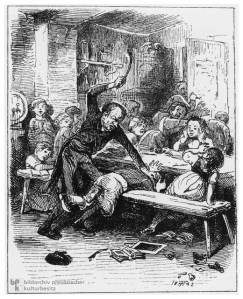
Do you get the feeling the bad old days are coming back? U.S. economy has returned us to 1930s-style levels of unemployment, evil Republicans like Paul Ryan and Mitch McConnell are trying to recreate the poverty of those years by removing the social safety net, and Republicans are working as hard as they can to make sure women have no control over their bodies or their lives.
Now we have students of a Catholic school in New Orleans and their parents demanding Archbishop Gregory Aymond reverse his decision to end corporal punishment, and school alumni aresuing the educational consultant who recommended the policy change!
Can this really be the 21st Century?
From yesterday’s New Orleans Times-Picayune:
The controversy over corporal punishment at St. Augustine High School resurfaced Tuesday when several alumni sued a consultant [read the suit here (pdf)] who advised Archbishop Gregory Aymond that St. Augustine students had been injured by paddling.
The claim isn’t true, the alumni said.
For months Aymond, who as archbishop exerts some control over the Catholic school, has sought to end St. Augustine’s decades-old practice of paddling students. He has said it is not consistent with Catholic values.
But backers of corporal punishment, who include St. Augustine administrators, parents and alumni, say it is part of St. Augustine’s formula for success.
According to the story, the consultant, Monica Applewhite, convinced the Archbishop to ban paddling of students against the decision of the review committee.
In late 2009 Aymond asked Monica Applewhite, described as a educational safety consultant based in Austin, Texas, to look into discipline at St. Augustine.
As Aymond’s representative, Applewhite sat in on St. Augustine’s internal review of its corporal punishment policy. The review committee elected to continue the policy, with modifications.
But the lawsuit says that Applewhite privately advised Aymond that she learned during her inquiry that parents had taken three students to the hospital after paddling, and that others had been paddled “day after day and more than 5 or 6 times a day.”
Archbishop Aymond says he has been contacted by former students and parents of students who were injured by corporal punishment in the school. He made this statement at a news conference today:
“I feel it necessary at this time to share that since the issue of paddling at St. Augustine has become public, I have been contacted both in writing and in person by individuals and parents of individual students who were injured as a result of being paddled at school,” Aymond said in a statement. “Those who have shared this information with me have done so in confidence, but at this juncture, the public should know that my concerns over paddling at St. Augustine go beyond Dr. Applewhite’s report to first-hand accounts.”
I also want to point out that paddling at St. Augustine’s is routinely used to discipline students for such shocking infractions as “tardiness, sloppy uniform dress or other minor rules infractions.”
Frankly, I thought that corporal punishment had been eliminated in the U.S. But I was wrong. According to this report on corporal punishment research, paddling is still common in a number of states.
The US Supreme Court decided in 1977 that spanking or paddling by schools is lawful where it has not been explicitly outlawed by local authorities. It is true that the incidence of CP has declined sharply in recent years, but only 31 states (plus D.C. and Puerto Rico) have actually abolished it, either de facto or de jure. CP is still used in the other 19 states, and it remains a fairly common practice in three of them, all in the South: Alabama, Arkansas and Mississippi.
It is also routine, but only in a minority of (often rural or small-town) schools, in five more southern states: Georgia, Louisiana, Oklahoma, Tennessee and Texas.
The latest states to abolish were Delaware, in 2003, after an eight-year gap in which no abolitions took place at state level; Pennsylvania, in 2005; Ohio, in 2009; and now in 2011 New Mexico (documentation in next update). The number of paddlings had already fallen to a low level in these states.
On the other hand, efforts to ban school CP by legislation have failed in 2003 in Wyoming and repeatedly in Missouri, and also in North Carolina in 2007 and Louisiana in 2009.
The New York Times had a story about corporal punishment in September 2006. This chart was published with the article.
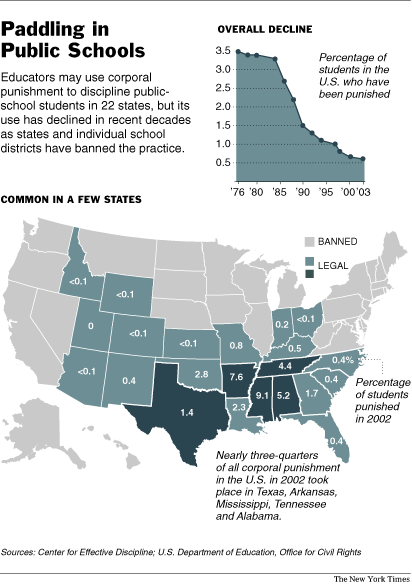
The pattern suggests that corporal punishment is more accepted in southern states and red states. Perhaps there is something to notion that Republicans and conservatives generally tend toward authoritarianism.
In my opinion, paddling is child abuse and should be illegal. Furthermore, I think children have rights just like adults do. I guess if the Supreme Court disagrees with me, our only hope is for sanity in state legislatures. Good luck with that.
Thanks to Dakinikat for alerting me to this story.
Hate Crimes and Political Dynamics
Posted: April 26, 2011 Filed under: Civil Liberties, Civil Rights, Crime, GLBT Rights, Violence against women | Tags: Chrissy Lee Polis, hate crimes, transgen, transgender 22 Comments We’ve run a lot of blog posts on GLBT bullying recently. We’ve never focused directly on the incredible numbers of hate crimes that are aimed specifically at the transgender community. An unfortunate incident in Baltimore provides an opportunity to specifically look at the bullying and assault that this community endures. There’s a crime story playing out in the MSM that has brought some public attention to transgender victims of hate crimes. We’re beginning to find out more of the details on the beating of Chrissy Lee Polis in a McDonald’s bathroom in Baltimore, Maryland. It’s a touchstone story because there are issues of race involved also. This story involves two groups of people that have historically been victims of hate crimes.
Chrissy is a white woman in trans. Her two attackers were both black teenage girls. One was 14 and the other was 18. Video of the crime was captured by an employee on a cell phones and has made its way to the internet. (Warning: This is an extremely violent video.) There is also a video interview at the Baltimore Sun–posted below–of Chrissy Lee speaking about her attack and the incredible bigotry encountered by the transgen community. The police are taking the crime quite seriously and McDonald’s has issued statements condemning the crime. Chrissy is recovering from her physical injuries. That’s the good news.
By Sunday evening, a Facebook page titled “Chrissy Lee Polis” with a picture of the McDonald’s arches had more than 800 people who “liked” the page. Many of the posters on the page pledged their support and provided words of comfort, and several identified themselves as transgender.
One poster, Robyn Webb, has a teleconferencing company, TG Works, that is collecting funds to help pay for Polis’ medical bills and help her relocate. Polis, who has not had a job or a stable place to stay for the past two years, has said she has been living with friends in the area.
Webb thought the incident should be prosecuted as a hate crime.
The police report does not provide a motive, but it quotes one of the suspects saying that the fight was “over using a bathroom.” In the report, officers said the teens accused Polis of going into the wrong one.
Many transgender individuals face public accommodation issues, Webb said.
I don’t want to make this a crime story post. I want this to be about what Chrissy and her community face daily. What specifically got me interested in writing about this attack was a thoughtful blog piece by Melissa McEwan at Shakesville as well as a promise I made to a reader who asked that we blog about the bullying of transgens specifically. It’s unfortunate that Chrissy’s attack is the reason for this discussion. I was not aware that some right wing blogs had been using the story as a way of attacking the black community. This is awful and Melissa takes the opportunity to rightly changes the frame.
I almost don’t know where to begin discussion of this incident. It’s so terrible—and yet to be shocked by a crime of this nature against a trans woman is a privilege. I am horrified and I am profoundly sad and I am angry—because this shit doesn’t happen in a void. I am relieved that Polis is physically okay, but my heart hurts for the lingering psychological effects she may experience. And I ache for members of the trans* community, and their loved ones, who have yet another pointed reminder of the hatred and fear felt by so many cis people, socialized in a trans*-hostile culture that rigidly forces people into a gender binary and lazily relies on gender essentialism and arbitrarily privileges cisgenderedness.
And I am depressed that, because Polis is white and her attackers are black, white racists are using this incident to engage in despicable racism—which is, whether effectively or intentionally, just a way of silencing discussion of cis privilege.
What is unusual about this crime is that it has made its way to the public arena, because hate crimes against transgender individuals tend to go unreported. Additionally, transgen violence is overrepresented in crime statistics given the number of transgen individuals. Crimes against this community occur frequently because there are several dynamics at play. Here are some statistics to think about.
Transgender people are often targeted for hate violence based on their non-conformity with gender norms and/or their perceived sexual orientation. Hate crimes against transgender people tend to be particularly violent. Our best estimates indicate that one out of every 1,000 homicides in the U.S. is an anti-transgender hate crime. This estimation is based on data collected by the national organizers of the Transgender Day of Remembrance and the Federal Bureau of Investigation. Organizers of the Transgender Day of Remembrance track the number of transgender people killed each year in hate-based attacks using media articles, community reports and other publically available data. By this count, they estimate that at least 15 transgender people are killed each year in hate-based attacks, although we believe the number to be higher based on transgender people’s common fear of going to the police and widespread misreporting. The Federal Bureau of Investigation estimates approximately 14,000 homicides in the country each year. Based on these figures, we can estimate that approximately one out of every 1000 homicides in the U.S. is an anti-transgender hate-based crime.
Many victims of Transgender hate-based crime are blacks. The Southern Poverty Law Center has placed special emphasis on these hate crimes since 2003. This is one of the reasons that this is so important to take this dynamic back from right wing blogs that are perversely making this a racial issue. It is not. I want to quote from one of their articles written by Bob Moser called ‘Disposable People’ to make this point. This article starts with a narrative about one young victim named Stephanie Thomas who began life as Stephen Thomas.
In some cases, the details remain too murky to say for certain whether these murders were hate-motivated. But all 27 have at least one of the telltale signs of a hate crime — especially the sort of extreme brutality, or “overkill,” that was all too evident in the bullet-torn bodies of Stephanie Thomas and Ukea Davis.
“The overkill is certainly an indicator that hate was present,” says Jack Levin, a criminologist at Northeastern University who has written several books about hate crimes and murder.
“When you see excessively brutal crimes, and you know the victim is gay or black or Latino or transgender, you have to suspect that hate was a motive. There’s a sense of outrage in these crimes that someone different is breathing or existing.”
One reason it’s so tough to prove that anti-transgender murders are hate crimes is that so few are ever solved. Of the 27 murders in 2002 and the first nine months of 2003, arrests had been made in only 7 — fewer than one-third — at press time. The general “clearance rate” for murders is almost twice as high, around 60%.
“The police are very slow in solving murders committed against marginalized Americans, whether they’re black, Latino, gay, prostitutes or transgender,” Levin says.
“When more than one of those characteristics is present in a victim” — usually the case in anti-transgender murders — “they really don’t act quickly. They’re much more likely to form a task force and offer a reward when the victim is a straight, middle-class college student.”
When it comes to hate crimes that stop short of murder — assaults, harassment — it’s virtually impossible to gauge the extent of the problem. The reason is simple: the victims of anti-transgender hate crimes almost never report them.
Here is a link to a 2007 study that compares hate crime rates against groups that are protected by hate crime legislation and those that are not. Violence against the transgen community is clearly a problem.
A close analysis of hate crime rates demonstrates that groups that are already covered by hate crime laws, such as African Americans, Muslims, and Jews, report similar rates of hate crime victimization as lesbians, gay men, and bisexuals, who are not currently federally protected. On average:
• 8 in 100,000 African Americans report being the victim of hate crime
• 12 in 100,000 Muslims report being the victim of hate crime
• 15 in 100,000 Jews report the victim of hate crime
• 13 in 100,000 gay men, lesbians, and bisexuals report being the victim of hate crimeCurrently hate crimes based on gender expression are not covered in federal hate crime legislation. This omission persists despite evidence that transgender individuals experience a similar number of hate crimes as some other protected groups, with an average of 213 hate crimes per year.
Chickens coming home to Roost ?
Posted: April 21, 2011 Filed under: 2012 presidential campaign, Civil Liberties, Civil Rights | Tags: Nany Pelosi, Protests, San Francisco, Social Justice, Treatment of Bradley Manning 39 CommentsA possible sign of things to come via Empty Wheel and the White House Pool Reporters? Evidently, some of the social justice  movements are beginning to protest treatment of Bradley Manning. Will war protesters be next?
Mr. Obama was in the middle of his remarks when a woman in a white suit stood up and said, Mr. President we wrote you a song. POTUS tried to get her to wait until later, but she persisted and the table of 10 broke into a song that pointed out they’d just spent $5,000 donating to his campaign and went on to protest the treatment of Pfc. Bradley Manning.
The woman stayed standing as they sang. Mr. Obama looked to Ms. Pelosi and asked, Nancy did you do this? Ms. Pelosi had a look on her face, as she stared at the singing group, that definitely said she did not.
[snip]
The 10 singers then passed around 8.5×11 signs that said “Free Bradley Manning” or had a photo of him.
Then the woman in the white suit stripped off her jacket to reveal a black T-shirt that said Free Bradley Manning, with an image of him.
“We paid our dues. Where’s our change?” they sang.
USSS and WH staff had moved near the table at this point. The woman was escorted out. Two others left on their own. (The rest stayed and applauded at the end of POTUS’s speech.)
“That was a nice song,” a displeased Mr. Obama said.
“Now where was I?” POTUS asked.
As was indicated by that song, “Over the last 2 and a half years, change turned out to be tougher than we expected,” POTUS said.
Excuses!!!! Excuses!!! It’s too hard! The Republicans made me do it!!! The Axelrove Dawg ate my homework!!!
Update: pictures of protest taken by activist Logan who attended the event are here.

The activists have a facebook page called savebradley. They also Tweet which is how I got all this information!
Our activist Logan is live tweeting the Obama fundraiser in San Francisco this morning. An entire table just stood up and began singing and holding signs for Bradley Manning. This is what politically engaged America looks like!

 peej
peej Carissa
 bostonboomer
 dakinikat
 ecocatwoman
 mablue2
 Mama Lopez
 peggysue22
 quixote
 skydancingguestblogger
 Mona (aka Wonk the Vote)



 Sky Dancing
Recent Comments